Home Blog Page 161

India wins 2030 Commonwealth Games bid: A look back at the 2010 corruption scandal under UPA govt that shook the nation

0

On 15th October, Union Home Minister Amit Shah announced that India will host the Commonwealth Games (CWG) in 2030. India will host the multi sport global stage 20 years after the scandal tainted 2010 Games. The Commonwealth Sport executive board has recommended Ahmedabad as the host city for the centenary edition of 2030. Abuja, the capital of Nigeria, was another proposed city to host the Games; however, Ahmedabad became the final choice.

Formal approval is expected at the Commonwealth Games Federation’s General Assembly in Glasgow on 26th November 2025. This development is expected to become a stepping stone towards India’s ambition of hosting the 2036 Olympics, and the Central Government has touted it as a “day of immense joy and pride”.

In a statement, Amit Shah hailed the decision and credited Prime Minister Narendra Modi’s focus on sports infrastructure and talent development for making India “a marvel of sports destination”. President of the Indian Olympic Association, P. T. Usha, said in a statement that the Games will showcase India’s event capabilities and inspire youth. She called it a meaningful step towards the nation’s vision of Viksit Bharat 2047.

India last hosted the CWG in 2010 in Delhi, which was overshadowed by poor planning, construction delays, and serious allegations of corruption. The memory of that scandal looms large as India prepares for 2030. The stakes have been raised high for India as the Central Government has to prove that it has learned from the past and can deliver a transparent and efficient Games on time and on budget.

The shadow of 2010 – How the Commonwealth Games scam unfolded

When India won the bid for the 2010 Commonwealth Games in New Delhi, it was seen as a moment of national pride. However, it became a synonym for mismanagement and corruption. Here is the timeline of key events from the 2010 CWG saga that still casts a shadow over India’s sporting reputation.

It all began in November 2003, when India won the bid to host the 2010 Commonwealth Games. Canada was the top contender. India’s IOA had estimated the total cost of hosting the event at just Rs 1,200 crore. It was later criticised as “stunning in its short sightedness”. Soon, it was clear that the estimated budget was grossly unrealistic, and the final costs ballooned manyfold. There was also an allegation that India effectively bought support by giving a grant of 100,000 dollars to every Commonwealth nation’s Olympic committee as part of the bid. The “gesture” was later described by former sports Minister Mani Shankar Aiyer as akin to a “bribe”.

In December 2004, then Congress MP Suresh Kalmadi was appointed as Chairman of the CWG Organising Committee on the recommendation of the Prime Minister’s Office, despite objections from the then Sports Minister, the late Sunil Dutt. Kalmadi, by becoming the Chairman of the CWG, gained control over Games preparations. Later, the auditors flagged it as an early mistake.

Between 2006 and 2009, construction of stadiums and city infrastructure proceeded at a snail’s pace. The budget for the Games spiralled upwards in multiple revisions. Between April 2007 and September 2010, the official cost estimates were revised seven times. What was touted to be just Rs 1,100 crore soared from Rs 3,566 crore to Rs 11,687 crore, ten times the initial estimate. But this was not the end. By the time the Games happened, the total spending by various agencies soared to around Rs 18,532 crore, over fifteen times the original bid estimate.

Warning signs had emerged as the schedule of the Games came closer. In late 2009, Commonwealth Games Federation President Michael Fennell publicly warned that preparations were behind schedule and “time is your enemy” for the Delhi organiser. The CGF set up a special review panel to monitor progress monthly as a sense of urgency grew.

Then Sports Minister of India, MS Gill, assured that the government would pour in more funds as needed to ensure success. His assurance reflected how cost control had effectively been lost.

In July 2010, internal criticism from former Sports Minister and Congress leader Mani Shankar Aiyar came as he lambasted the Games expenditure. He claimed that Rs 35,000 crore was being spent on a “circus” while basic sports needs for India’s poor went unmet. He provocatively said he would be “unhappy” if the Games were successful, as it would encourage more such extravagance. He even levelled allegations that India “bribed” other Commonwealth nations, as mentioned above, to win the hosting rights. Kalmadi retorted by calling his remarks “irresponsible” and “anti national”.

In September 2010, last minute chaos mounted. As athletes were about to arrive, Delhi’s preparations descended into crisis. Twelve days before the opening, on 21st September 2010, a newly constructed 95 metre foot overbridge collapsed outside the main venue, which was Jawaharlal Nehru Stadium. Around 27 workers were injured, exposing the shoddy construction practices.
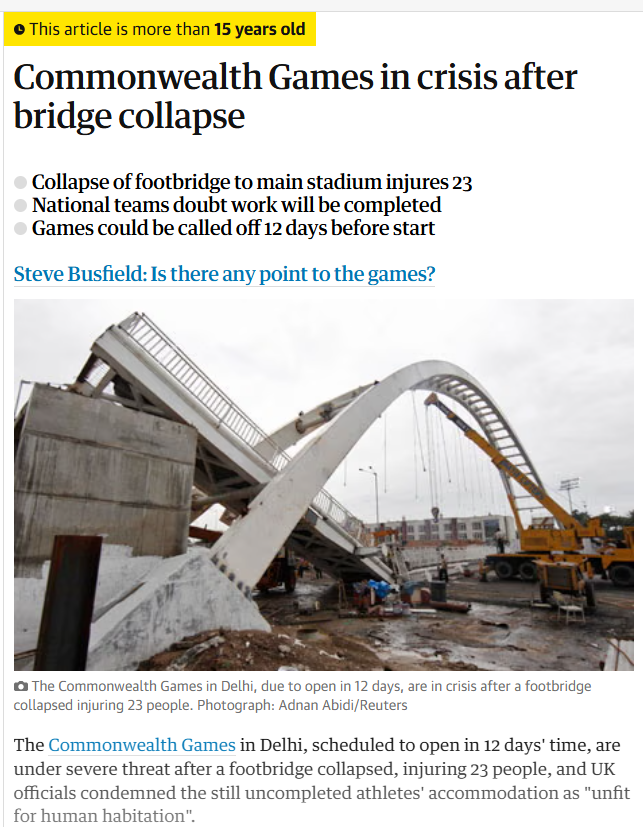
Photos of collapsed bridge highlighted by international media. Source: The Guardian.

Bad construction was not the only problem. As the international teams checked in, they complained that the Athletes’ Village was filthy, incomplete and “unfit for human habitation”. Photos of waterlogged apartments and stray dogs in rooms made global headlines. Several countries’ delegation heads openly questioned if the Games should be held at all, as essential facilities were unfinished just days out. Commonwealth Games Scotland warned the situation was “unsafe” and asked the CGF to consider calling off the event if things did not improve.
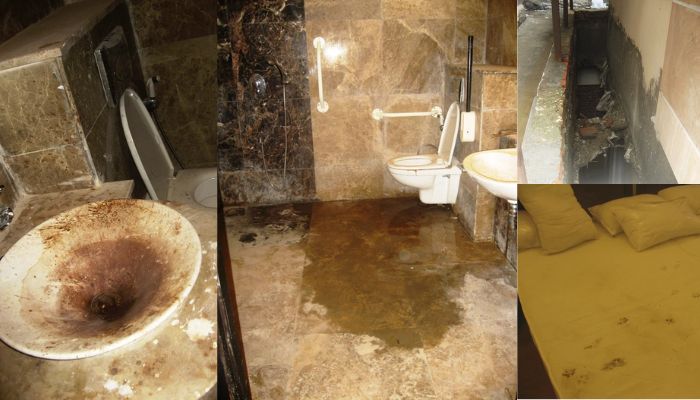
Photos of filthy washrooms and rooms were shared by international media. Source: nationalpost

In a rare move, the Indian Army was called to bail out the organisers. Army engineers built a temporary Bailey bridge in just four days to replace the collapsed footbridge, working round the clock to avert a security and logistical nightmare. Even then, Indian officials insisted everything would be fixed in time, dismissing the problems as largely “cosmetic”. Emergency clean up and repair efforts succeeded in patching up the venues just in time.
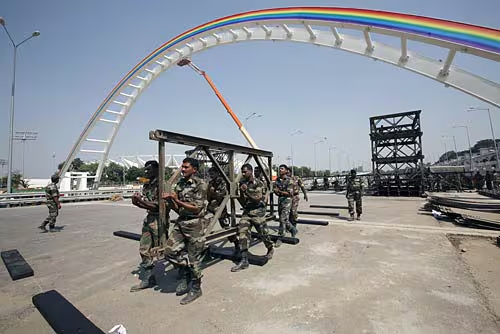
Indian Army was called to construct the collapsed foot bridge. Source: India Today

Between 3rd and 14th October 2010, the 19th Commonwealth Games took place in Delhi on schedule. Over 6,000 athletes from 71 nations participated. Once the events began, India managed to deliver a reasonably successful sporting competition. India finished second in the medals tally.

The relief was short lived. The spectacle could not wash away the stain of pre Games troubles. Allegations of large scale corruption and financial irregularities began to dominate the narrative as the closing ceremony confetti was still settling.

After the Games were over, then Prime Minister Manmohan Singh moved quickly and, on 25th October 2010, appointed a high level committee headed by former CAG VK Shunglu to investigate irregularities in the Games. This Shunglu Committee was tasked with examining the conduct of all agencies involved, from the Organising Committee to the Delhi government and central ministries, and to recommend action. At the same time, India’s anti corruption watchdog, the Central Vigilance Commission, and the Central Bureau of Investigation (CBI) also started probing specific complaints of fraud during the CWG preparations.

In 2011, the CBI filed its first chargesheet, naming Suresh Kalmadi as the “main accused” in a conspiracy to award an exorbitant contract for the Timing, Scoring, Result system to a Swiss firm. On 24th April 2011, Kalmadi was arrested on charges of cheating, conspiracy and corruption. Several of his close aides, including Secretary General Lalit Bhanot and Director General V. K. Verma of the OC, were also arrested and charged.

They were accused of colluding to award a Rs 141 crore timing equipment contract to Swiss Timing at an allegedly inflated cost of Rs 95 crore higher than market rates. In the same year, India’s Comptroller and Auditor General presented a scathing audit report in Parliament on 5th August 2011. The report detailed massive cost overruns and rules violations in Games projects.

The CAG flagged the Delhi government and multiple agencies for “ill conceived” projects, wasteful expenditures and severe irregularities. Political pressure mounted on those implicated. Kalmadi, meanwhile, remained in Delhi’s Tihar Jail for nine months as an undertrial until he was granted bail in January 2012.

Between 2012 and 2015, investigations continued and the Shunglu Committee submitted six reports, one after another. The reports uncovered irregularities in various areas. The findings indicted Delhi’s Lieutenant Governor Tejinder Khanna and Chief Minister Sheila Dikshit for overruns in city infrastructure and the Games Village project. The committee also slammed broadcasting deals overseen by national TV officials and recommended prosecuting then Prasar Bharati CEO B. S. Lalli for the broadcasting contract worth Rs 246 crore awarded to a UK firm.

By 2012, the CBI filed 19 FIRs on different aspects of the CWG scam. The FIRs ranged from venue construction to street lighting contracts. Trials slowly ground forward in special CBI courts. In 2014, a special court accepted a CBI closure report in one case related to an inflated contract for the swimming pool complex, citing lack of evidence of criminal conspiracy by officials. The cases dragged for years due to the sheer complexity of the investigations spread across dozens of tenders and projects.

In 2015, the first convictions came five years after the Games. In August 2015, a Delhi trial court convicted six people in a scam involving the upgrading of street lighting in Delhi for the Games. Four Municipal Corporation of Delhi engineers and two directors of a private company, M/s Sweka Powertech, were found guilty of manipulating tender documents to inflate prices, causing a Rs 3.3 crore loss to the government. Sentences ranged from four to six years in prison. The convicts appealed in the High Court and the sentences were suspended pending appeal. The cases are still ongoing in the Delhi High Court.

Between 2016 and 2017, the CBI quietly closed at least one high profile case against Kalmadi and others related to Rs 70 crore of contracts given to a London based consultancy, Event Knowledge Services, for Games planning and management. The investigators failed to find sufficient evidence of wrongdoing. In another case, a special CBI court in 2017 convicted two contractors for cheating in the award of contracts to renovate stadiums, Shivaji and Talkatora stadiums. They were sentenced to two and a half years in prison. That court acquitted the officials from the New Delhi Municipal Council who were accused of colluding in that contract, due to lack of proof of their involvement. Also in 2017, a separate trial over the CWG scoring equipment ended in all eleven accused, including Kalmadi and Bhanot, being acquitted by a Delhi court. The court ruled that the prosecutors had failed to prove the charges, a setback for the narrative of a “scam”.

From 2020 to 2025, cases wound up with few held accountable. The CWG related cases either ended in acquittals or remained stuck in procedural limbo. According to media reports, eleven of the nineteen CBI FIRs had been closed without any charges. Only two cases had led to convictions. Both of them were under appeal with no jail time served. The prosecution against Kalmadi and other OC officials for the Swiss Timing contract continues at snail pace through witness testimonies thirteen years later, with no verdict yet.

In April 2025, a Delhi court officially accepted the Enforcement Directorate’s closure report in the last pending case, which stated there was “no case” against Kalmadi, Bhanot or others under anti corruption laws. The judge noted that the CBI had already closed its related case due to lack of evidence and therefore no “proceeds of crime” could be proven for money laundering. With that, fifteen years after the fact, the legal saga ended with no top official held criminally liable for what was widely perceived as a massive scandal, showing the lapses in Indian investigation techniques and the judiciary.

Key players and the massive scale of corruption

At the centre of the 2010 Commonwealth Games corruption scandal was then Congress MP Suresh Kalmadi, as he had extensive control over Games related contracts and spending. Kalmadi was a veteran sports administrator and was joined by key aides, including Secretary General Lalit Bhanot and V. K. Verma, who served as the Director General. Other key officials were T. S. Darbari and M. Jayachandran, along with officials across Delhi’s civic and construction agencies.

The alleged financial misconduct was vast. According to media reports, the scam might have involved misappropriation or misuse of up to Rs 70,000 crore, which aligned with the total public expenditure on the Games, making it the costliest CWG in history. In contrast, the previous CWG in Australia in 2006 cost under Rs 7,000 crore. The CAG found that estimated costs inflated fifteen fold between 2003 and 2010, without a credible final assessment.

Cost overruns were rampant across sectors. The Connaught Place renovation ballooned from Rs 76 crore to Rs 671 crore. The street lighting project rose from Rs 13 crore to Rs 37 crore. “Beautification” works, according to the CAG, wasted Rs 101 crore.

Investigating agencies said that contracts were often awarded at inflated prices, favouring select firms. The Central Vigilance Commission flagged exaggerated rates even before the Games. Examples often cited in media reports included toilet paper rolls billed at Rs 4,000 and umbrellas at Rs 6,000 each. The CAG concluded that delays were used to manufacture urgency, which allegedly enabled the procurement agencies to bypass procedures without a check on the spending.

One major example was the Rs 141 crore Time, Scoring, Results system contract to Swiss Timing, where actual costs were later estimated at just Rs 50 crore. It means that Rs 90 crore was paid over and above the actual costs. The Games Village, which was developed by Emaar MGF, faced CAG criticism over irregularities. The DDA had to inject Rs 766 crore to rescue the project. Several units were later sold commercially.

The Queen’s Baton Relay in London also drew scrutiny after Rs 3.8 crore was paid to obscure UK firms without tendering. Reportedly, it was done on a personal recommendation of Kalmadi’s aide. The CAG labelled the payments “highly suspicious”.

Over Rs 18,000 crore was spent for a twelve day event, which made the CWG a synonym for systemic graft and inefficiency in India’s public projects.

Infrastructure delays, inflated costs, and national embarrassment

In the weeks leading up to October 2010, Delhi’s lack of readiness dominated headlines and the sporting aspect of the Games took a back seat. Virtually every CWG project was delayed. Several venues were incomplete or being hurriedly finalised just before the opening ceremony.

Jawaharlal Nehru Stadium was the site for key events and ceremonies. Even this particular venue narrowly met deadlines. Shivaji Stadium, which was intended for hockey training, was completed two years after the Games in 2012, which made it unusable for the event. As late as September 2010, organisers were still racing to finish basic infrastructure, making it extremely embarrassing for India as the host.

On 21st September, the most damaging incident took place when the newly constructed footbridge outside Nehru Stadium collapsed while workers were pouring concrete. The bridge was being constructed at a cost of Rs 10.5 crore. Around 27 workers were injured, of whom five were rushed to hospital in critical condition.

The photographs of the twisted wreckage quickly made international headlines. The Delhi PWD Minister admitted a failure in securing key structural components. The situation got completely out of hand and the Indian Army had to be roped in on an urgent basis. One thousand soldiers, along with Army engineers, were deployed, who raised the Bailey bridge in just four days. The bridge was handed over to the authorities on 29th September. The military’s intervention was seen as a rescue mission for a civilian disaster.

The Athletes’ Village, which was constructed on the Yamuna riverbank, was supposed to accommodate 6,500 athletes and officials. However, it was declared “unfit for human habitation” by the advance delegations from Scotland and New Zealand. They cited problems like waterlogging, filth, stray dogs, faulty plumbing and exposed wiring. Some teams even threatened to delay or cancel participation. A series of exposés left India on the verge of losing face as the host of the Games.

Chief Minister of Delhi, Sheila Dikshit, and the Organising Committee led by Kalmadi scrambled to recover. Cleaning crews were deployed and Dikshit herself oversaw improvements. Officials blamed the condition on labourers and claimed issues would be resolved in “a couple of days”. The chaos was calmed down with an emergency clean up drive that only came after the international criticism. Athletes from England and Canada were initially housed in hotels and only moved into the Village after last minute fixes.

According to the CAG, the poor planning and compressed timelines led to a “substantial increase in cost that could have been avoided”. Global coverage, instead of celebrating India’s sporting potential, highlighted chaos, politicians comparing it unfavourably to China’s polished Beijing 2008 Olympics.

The CAG report and revelations that shocked India

While media exposés and opposition criticism made headlines, what made eyebrows raise and heads roll was the CAG report tabled on 5th August 2011. The report offered the first detailed, official confirmation of large scale mismanagement and corruption. The performance audit of CWG 2010 was scathing, targeting both the Organising Committee and several tiers of government. It revealed widespread procedural violations, favouritism, and systemic failures in governance.

Key findings of the CAG report

The report pointed at the massive cost escalation without oversight. The CAG report mentioned that the initial estimate was only Rs 1,200 crore in 2003, which rose to Rs 18,532 crore by 2010. The government failed at every stage to reassess or contain costs, which allowed the OC to have “virtually unlimited state funding” without accountability. The CAG observed a “complete breakdown of financial discipline”.

The audit noted that there were deliberate delays in decision making which led to false or manufactured urgency. It enabled the contracts to be awarded on a nomination basis or through compromised tendering. The whole process allowed the officials to circumvent normal competitive procedures under the pretext of time constraints.

The CAG confirmed that Kalmadi was appointed as the Chairman of the CWG OC by the PMO in 2004 despite “serious objections” raised by then Sports Minister Sunil Dutt. Though the PMO later denied wrongdoing, the CAG pointed to the decision as a key misstep. This particular point brought then Prime Minister Manmohan Singh under scrutiny, though he was never formally accused of any wrongdoing.

The CAG report noted that contracts for track surfaces, hockey turf and lighting were awarded in ways favouring expensive, foreign suppliers without merit based comparisons. A notable example involved imported streetlights that cost twice as much as Indian alternatives. Documents related to the purchase linked the decision to then Chief Minister of Delhi, Sheila Dikshit.

The Games Village contract awarded to Emaar MGF and the Queen’s Baton Relay expenses involving AM Films in the UK were highlighted for gross procedural violations. The Rs 246 crore broadcasting contract to UK based SIS Live also came under fire and the Shunglu Committee recommended criminal action.

The CAG noted that multiple overlapping committees were formed which led to a diffusion of responsibility. There was no single authority that was accountable, leading to delay in response to red flags and exacerbated coordination failures.

The CAG report included evidence of overpricing and falsified tenders which included examples such as post tender item rates being increased from Rs 800 to Rs 1,800. It suggested that the documents were tampered with. In some cases, altered bids were not forensically verified and the contracts were split to bypass tender rules.

The measured language of the CAG report did not mask the severity of its findings. The report confirmed public suspicions that the Games had been marred by waste, favouritism, and poor governance. The fallout of the report was almost immediate. The opposition parties used the audit to demand accountability.

A parallel report submitted by the Shunglu Committee further accused officials including the Chief Minister and Lieutenant Governor for cost overruns and mismanagement in the Village and city infrastructure projects.

The CAG report did not use terms like “scam”. At the same time, it did not leave any doubt about systemic failure. The implications extended beyond the CWG and it became symbolic of deeper institutional weakness. Reports suggested even some Congress leaders acknowledged the damage off the record. Law Minister Salman Khurshid’s defence in Parliament fell flat, and the episode became a touchstone for reform and political change.

Political fallout – how the UPA government faced public outrage

The CWG scandal became a major liability for the Congress led UPA government. At that time, Congress was already under fire for other corruption cases including the 2G spectrum scam. Public anger intensified between 2010 and 2011 with media exposing the wrongdoings, CAG findings being tabled and the Shunglu Committee submitting reports one after another.

It was the time for the Bharatiya Janata Party, the largest opposition party in the country at that time, to lead a fierce campaign against the UPA government. Party leaders accused Congress of “destroying national honour” and demanded the resignation of the then Chief Minister of Delhi. BJP spokesperson Ravi Shankar Prasad said in a statement that Dikshit should resign and if “she does not, she should be sacked”.

The attack on the government was so fierce that the Congress leaders found no other way but to shift blame. Dikshit and Kalmadi had ugly spats shifting blame to each other to the point Congress Party had to step in and ask them to stop.

Manmohan Singh’s office faced questions about Kalmadi’s appointment, as reportedly Dutt had objected to it. Congress argued that the CAG had not used the word “corruption” and that legal processes must run their course. The stance failed to alleviate public anger.

In April 2011, Anna Hazare launched a hunger strike demanding the Lokpal Bill. His protest grew stronger amid public outrage over multiple issues including scams like CWG and 2G. Suresh Kalmadi was arrested in the same month, and Congress suspended him from primary membership. Kalmadi, though not officially charged by then, became a political outcast in his home base of Pune.

The protests and political fallout continued and then came the General Elections of 2014. In 2013, when BJP started its campaign, UPA’s alleged scams including CWG were hot topics of discussion. Narendra Modi had joined the national campaign for the General Elections. He referred to the CWG scam in his rallies. In a speech in Pune, he said the Games had destroyed national honour and contrasted them with South Korea’s Olympics, which enhanced its global standing. He said, “One country uses sport to bring laurel to itself among the global community and another brings itself dishonour.”

In the same year, Delhi had Assembly Elections and Congress suffered a massive defeat in the hands of the Aam Aadmi Party. Though AAP joined hands with Congress to form government, which ran for a few months, Dikshit losing her seat was a massive setback and CWG corruption played a vital role in the defeat.

Years later, as prosecution faltered, Congress began claiming vindication. In 2025, Pune Congress leaders cited Kalmadi’s acquittal and ED case closure to suggest that the scam was politically motivated. However, the CAG and Shunglu reports remain evidence of systemic failure, and in public memory, the “CWG scam” still symbolises misgovernance and corruption.

The aftermath – trials, arrests, and convictions

The legal fallout from the scandal was lengthy, complex, and underwhelming in securing accountability. There is no doubt that the initial investigations were swift and trials began promptly. Between 2010 and 2012, the CBI registered 19 FIRs across different aspects. Kalmadi and others were charged with conspiracy, cheating, forgery, and corruption offences. Kalmadi and Verma spent time in jail between April 2011 and January 2012 before securing bail. The ED also pursued cases for money laundering accusations. There were day to day hearings in several matters. The proceedings slowed down due to heavy documentation, witness unavailability, and procedural delays. In one case, tampered tender documents were not sent for forensic analysis, prompting judicial criticism.

Convictions were rare. In two cases, six people were convicted but the cases are now under consideration at the Delhi High Court with sentences suspended.

Most major cases were closed or ended in acquittals. In 2016, the CBI shut the Swimming Pool Complex case for lack of evidence. In 2017, the main CWG trial over the TSR contract ended with the acquittal of Kalmadi, Bhanot, and all co accused; the court ruled no criminal conspiracy was proven. The ED’s linked case on EKS consultancy was closed in 2025 after a court accepted that there were no proceeds of crime to trace.

To date, no top political figure has been convicted in any case, reflecting systemic failure in terms of poor investigations, evidentiary lapses, and dwindling political will. While Congress claims vindication, BJP and others cite the CAG and CVC findings as evidence that wrongdoing did occur, even if unpunished.

Lessons learned or forgotten? Accountability in mega events

Following the 2010 CWG debacle, several changes happened. Reforms were introduced but their implementation remained inconsistent. Lack of a central coordinating authority was the key root cause identified by the CAG for confusion and mismanagement. Later events that fell under the Modi government, including the 2017 FIFA U 17 World Cup and the 2016 South Asian Games, were handled with tighter controls.

In 2011, then Sports Minister Ajay Maken introduced the National Sports Bill, which proposed transparency in sports bodies like the Indian Olympic Association and bringing them under audit and Right to Information provisions. The bill faced resistance and lapsed.

The ignored 2009 CAG preliminary audit became a cautionary tale and the Planning Commission and PMO issued some guidelines after 2010 for timely audits and adherence to early warnings.

Kalmadi was removed and banned from the IOC. The IOA was suspended by the IOC in 2012 for separate governance failures. A new constitution was adopted in 2014, introducing oversight. Leadership under athletes like PT Usha now reflects a shift towards credibility amid Olympic ambitions.

International bodies also adjusted. The Commonwealth Games Federation instituted tighter oversight for future hosts, helping ensure smoother preparations in Glasgow 2014 and Gold Coast 2018. Yet recent editions have struggled. Durban, 2022, and Victoria, 2026, withdrew, citing costs. The CGF has since limited sporting events, ten for 2026, to improve affordability.

While 2010 offered hard lessons, institutional reforms remain patchy. Government claims of new digital procurement systems and private sector expertise must now be tested. The 2030 Games represent an opportunity to show that lessons have been internalised, or risk a repeat of past failings.

What is different this time – new transparency and monitoring frameworks

India’s bid for the 2030 Commonwealth Games came with assurances of avoiding the pitfalls of 2010. Both Indian authorities and the CGF have outlined reforms to ensure transparency and accountability.

Although India is getting less time, the preparations are already on track. Many venues that will be used in 2030 already exist or are part of larger infrastructure upgrades connected to a potential 2036 Olympic bid. This will avoid the need for large scale, last minute constructions.

The Modi government has shifted to open tenders and e procurement, which offer transparency. The CGF’s own oversight has become stricter since 2010. Proactive monitoring and vigilance by the public and media have evolved exponentially since 2010. Any inflated contract or delayed project will become national news in no time.

Political stakes are higher. The 2030 CWG is seen as a stepping stone to the 2036 Olympics. The central government, including the Home Minister, is involved in the planning, leaving virtually no loopholes.

The road to 2030 – can India redeem its image?

India’s successful bid for the 2030 Commonwealth Games offers a chance to correct the legacy of 2010. Execution over the next five years will determine whether that trust was well placed.

If the Games are delivered smoothly, without delays or corruption, India could shed the stigma of 2010 and prove itself ready for larger events, including the Olympics. India seeks a narrative that will put it at the top spot as a go to destination for sporting events.

For India, success also means legacy. Delhi’s CWG infrastructure was underutilised. In contrast, if Ahmedabad builds multi use facilities and improves urban services, the event can spur long term gains. Mega events should catalyse city development, but within strict financial and transparency boundaries.

2030 is India’s second chance. A new generation leads the effort, with lessons from the past and tools of the digital era. If they succeed, the 2030 opening ceremony could mark a full circle moment for India, and the country will come out of the shame to progress towards proving its capacity and integrity on the global stage.

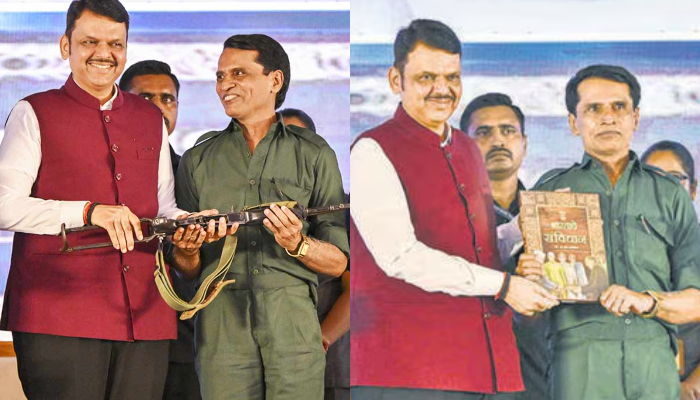
Commonwealth Games 2030 to be held in Ahmedabad: Here is how will this event will strengthen India’s bid for the 2036 Olympics

India is set to host 2030 Commonwealth Games in Gujarat’s Ahmedabad. In a meeting held on 15th October, the Commonwealth Executive Board recommended Ahmedabad’s name with a stamp of approval. India and Nigeria were competing to host the 2030 games. Now, it will be presented for formal approval at the Commonwealth Sport General Assembly to be held in Glasgow in November 2025 and will be officially given the green light.

Regarding this development, Olympic Association India President P. T. Usha said , “It will be a matter of pride for India to host the Commonwealth Games in Ahmedabad. These Games will not only showcase India’s world-class organising capabilities, but will also play a vital role in the journey towards a developed India 2047. We see the 2030 Commonwealth Games as a golden opportunity to inspire youth, strengthen international partnerships and contribute to the shared future of the Commonwealth countries.”

The discussion around the possibility of Ahmedabad being recommended for hosting the upcoming Commonwealth Games has going on for quite some time. Keeping this in mind, the central and state governments have been working together for many years to make Ahmedabad a hub of sports infrastructure.

Development of sports complex in Ahmedabad

As a part of the plan to make Ahmedabad ready for hosting international sporting events, the world’s largest cricket stadium, Narendra Modi Stadium, was built in Ahmedabad. Its capacity is more than one lakh spectators. In addition, the Sardar Vallabhbhai Patel Sports Enclave, of which this stadium is a part, is also being prepared in Ahmedabad, which is spread over 650 acres.

A total of 10 new stadiums will be built in this sports complex, which is currently under construction, where permanent and temporary facilities will be provided for sports like gymnastics, skateboarding, softball, tennis, etc. The construction work of all these stadiums is being handled by the government agency Gujarat Sports Infrastructure Development Corporation Limited.

A football stadium will also be set up in this enclave, and an athletes’ village and hotels will also be built. The village is said to have a capacity of three thousand players.

In addition, recently Home Minister Amit Shah also inaugurated the Veer Savarkar Sports Complex in Naranpura, Ahmedabad. Equipped with state-of-the-art facilities, this sports complex will also provide venues for many sports. This complex has been designed in accordance with the standards of the Commonwealth Games. In which more than 20 sports will be covered. The government has spent ₹824 crore on this complex.

Apart from this, special emphasis is also being given on transportation facilities. Bullet train service between Ahmedabad-Mumbai will also be started by 2030. Apart from this, there are plans to build a large sports infrastructure in one lakh square meters on the Sarkhej-Gandhinagar highway. Sabarmati Riverfront is also in the redevelopment phase, where infrastructure for various water sports will be set up.

How India is planning to bolster its Olympic bid

At the heart of all these preparations is the 2036 Olympics, which the government has expressed its desire to host in India. But before hosting a world-class sporting festival like the Olympics, some other events need to take place. That is why India has shown equal enthusiasm for the 2030 Commonwealth Games.

The Commonwealth Games will provide India with an opportunity to demonstrate to the sporting world that India has the world class capabilities to host such major sporting events and that there is no dearth of world-class infrastructure, political will, or sports ecosystem.

What makes India’s ongoing efforts even more significant is the dent on the country’s image caused during the UPA era during the 2010 Commonwealth Games in Delhi.  The country’s image was badly damaged due to poor planning, allegations of financial irregularities and scams by the UPA government, and no such major event has been held in India since then.

Now that the new government is working to build a sports ecosystem and project India’s image to the world as a distinct, mature, and responsible nation, the Commonwealth and other international events will help in that.

Before the Commonwealth Games, the World Police and Fire Games will also be held in Ahmedabad in 2029. Law enforcement agencies from all over the world participate and tens of thousands of players come. Before that, the Women’s Volleyball World Championship will be held in 2027. The World U20 Athletics Championship is also being held in Ahmedabad in 2028. This year, the Commonwealth Weightlifting Championship (which is a qualifying event for the Commonwealth) and the Asian Swimming Championship will also be held in Ahmedabad, which is being held at the newly built Naranpura Sports Complex. The regular hosting of such important sporting events will add to the experience required for a successful organisation of Commonwealth Games, and if all goes well, the Olympics too.

Given the track record of the Modi government in Centre and the BJP government in Gujarat, there is no possibility of any UPA-era like scandal in such big sports events from now on.

The Modi government has already proven how serious it is in all such matters with the successful and grand organization of the G20. In which leaders from all over the world came to India and a successful organization could be held. All these sports events in Ahmedabad will also be organized in the same way, with the same seriousness and with the same pre-planning, which will only raise India’s place in the world of sports.

There is also a possibility, however, that the host for the 2036 Olympics will be decided even before the Commonwealth Games are held in 2030. But even by then, these efforts of India, along with other sports events, will have been noticed worldwide. This could massively benefit India’s bid for the Olympics.

BCom graduate to attacks on security forces: Who is Mallojula Venugopal Rao and how he climbed the ranks within the Maoist hierarchy before his eventual surrender

The Modi government has repeatedly announced its intention to liberate the nation from the violent clutches of Left Wing Extremism (LWE) by 31st March 2026. Hence, an unprecedented operation has been initiated to fulfil this commitment which has achieved remarkable success. The Maoist movement has significantly weakened as numerous members, including high-ranking leaders, have either been eliminated or have surrendered.

Now, in a further advance towards a red-terror-free India, the most-wanted Maoist commander, Mallojula Venugopal Rao also referred to as Bhupathi, along with over 60 of his associates laid down arms in Gadchiroli of Maharashtra. He was a member of the Politburo and one of the last three top leaders of the banned Communist Party of India (Maoist).

Bhupathi is recognized by various other names, including Sonu, Sonu Dada, Venugopal, Abhay, Master, Vivek and Venu. He had several bounties on his head, from Rs 1 crore to 10 crore, in states such as Odisha, Maharashtra, Chhattisgarh, Telangana and Andhra Pradesh. Maoist activity in the Gadchiroli area suffered a huge jolt as a result his surrender. Meanwhile, 78 cadres capitulated in Chhattisgarh on 15th October following the occurrences in Maharashtra.

Who is Mallojula Venugopal Rao

The 69-year-old was born into a Brahmin family in Peddapalli, Karimnagar district of Telangana, on 10th May 1956. He was the youngest son of Mallojula Venkataiah and Madhuramma’s three sons. His parents were part of a family of freedom fighters and priests. The two passed away, Madhuramma in 2022 and Venkataiah in 1997.

Their oldest son Mallojula Koteshwara Rao, also known as Kishenji, became one of the most powerful figures in the Maoist organisation until being slain in a police encounter in West Bengal on 24th November 2011 while the second son Anjanna, is a temple priest.

As the military leader and member of the Politburo, Kishenji led the operations in Lalgarh of Bengal since 2008. He was a founding member of the People’s War Group (PWG) and guided its union with the Maoist Communist Centre of India to create the CPI (Maoist) in 1980. Notably, Bhupati had begun his Maoist operations with the PWG.

The Radical Students Union and People’s War Group, two organisations that fostered Leftist ideology in undivided Andhra Pradesh, attracted him when he was pursuing a degree in commerce. During the 1970s and 1980s, the groups served as breeding grounds for Naxalite ideas.

Bhupathi first attempted to pursue a normal career, even working as an apprentice in the state public relations department in Adilabad, Andhra Pradesh, after graduating. However, he soon followed his sibling’s footsteps which left his life enveloped in violence for at least 40 years.

Emergence of a proficient Maoist propagandist

Bhupathi left his home and family to join Left Wing Extremism and swiftly moved through the ranks of the former People’s War Group (PWG) while operating under the aliases Bhupathi, Sonu, Master and Abhay. He operated out of Gadchiroli and Maad (Abujhmad) in Chhattisgarh where his role transitioned from field operations to ideological command.

Bhupathi was appointed head of the Dandakaranya Special Zonal Committee of the CPI (Maoist) in the Gadchiroli area. He was thereafter tasked with extending the movement to Western Ghats, which run from Goa to Idukki in Kerala, as part of their southern expansion plan.

Afterward, Bhupathi joined the party’s Central Military Commission and Politburo. He functioned as the party’s intellectual leader, its communication expert and the link between the outfit and the outside world beyond Chhattisgarh’s woods. He became Maoist voice after its spokesperson Cherukuri Rajkumar (Azad) was killed in 2010 and presided over the publications division.

“As official spokesperson, he used the alias Abhay and issued statements regularly, although his influence ran far deeper. He shaped ideological discourse, guided propaganda, and oversaw the janatana sarkar, the Maoist parallel governance system in Dandakaranya,” a senior Telangana Special Intelligence Bureau (SIB) officer disclosed, reported The Times of India.

Bhupathi created manifestos, booklets and policy declarations that effectively peddled the party’s nefarious agenda in the form of messaging and outreach. His leadership cemented their brutal authority throughout the far-flung tribal areas of the “Red Corridor” by implementing alleged local governance programs also known as janatana sarkar or people’s government.

The CPI (Maoist) relied on Bhupathi to manage the same in isolated forest areas by combining guerilla control and political supervision. “He mentored new cadres and emerging leaders, ensuring the organisation’s continuity and ideological consistency despite internal rifts and growing security pressure,” an intelligence officer mentioned.

“He promoted political education among cadres and sought to recalibrate armed struggle with political engagement, occasionally advocating short pauses in violence to reassess strategies,” the officer added. Bhupathi even founded a base inside Indravati National Park in Chhattisgarh.

Perpetrating acts of terror against the Indian state

Bhupathi improved guerilla warfare manuals while serving as the head of the People’s Liberation Guerrilla Army’s (PLGA) central military commission. It is the highest Maoist authority in charge of organising and authorising attacks on civilians and security personnel. He advised regional commanders and enforced stringent operational secrecy which enhanced their offensive capabilities.

Bhupathi spent almost 40 years planning and carrying out a number of major strikes in the “Red Corridor.” Over the years, he has been implicated in every deadly attack and conspiracy in the Gadchiroli belt. He is connected to hits on security forces in Maharashtra and is linked with planning multiple assaults in Chhattisgarh, Telangana, Odisha and Andhra Pradesh.

Dozens of CRPF, Special task Force (STF) and District Reserve Guard (DRG) troops were killed in these onslaughts. Bhupati oversaw these operations along the border between Maharashtra and Chhattisgarh as well. His platoons unleashed unbridled violence to instill fear throughout the region.

Bhupathi has been charged with orchestrating the 2011 Chintalnar massacre in the Dantewada district which claimed the lives of 76 Central Armed Police Force (CRPF) members. It was among the most deadly assaults in the history of anti-Maoist operations.

Bhupathi reportedly assumed leadership of Maoist resistance against “Operation Green Hunt” in West Bengal after his brother, especially during the Lalgarh movement. Mostly working from deep forest areas in central India, he remained a crucial strategist in the Maoist leadership.

Bhupathi’s actions enabled the anti-India movement to spread into regions like Telangana, southern Maharashtra and the Western Ghats. He influenced the group’s morale and its perception as a spokesman as he handled press releases, talks during hostage situation as well as the public and media articulation of Maoist beliefs.

Additionally, Bhupathi managed efforts to purportedly reach a balance between appeal to their sympathisers in the intelligentsia and civil society alongside Maoist inflicted terrorism. He became one of the most significant leaders in the history of the Maoist movement in India because of his ability to combine violence with strong organisational control and ideological drive.

Red curtain falls with Bhupathi’s exist

Last month, Bhupathi expressed his wish to put down his weapons and the authorities commenced talks with him. A senior cop revaled that Gadchiroli Police launched their intelligence network and started negotiations through sources in the Bhamragad district after he released press releases and leaflets last month announcing his intention to surrender.

According to him, Bhupathi took the decision as red terror is nearing its demise and the Gadchiroli Police created a favourable atmosphere. The latter published press releases and brochures pointing out his intentions. There was also a lot of discussion among Maoist circles over his surrender.

The officer conveyed that Bhupathi discussed his ideas of discarding the path of violence in a meeting with the people of the Phodewada area around ten days ago. On 13th October, a source close to him told Gadchiroli Police that Bhupathi and other Naxalites were going to give up arms near Hodari village in Bhamragad taluka that same evening.

Gadchiroli Police Superintendent Nilotpal, Inspector General of Police-Anti-Naxal Operations Sandeep Patil and other top personnel were keeping an eye on the situation. The entire group was taken into safe custody after the place of surrender was decided through the source. On the same night, six private vehicles with the surrendered Naxalites were driven to Gadchiroli and the surrender transpired before Chief Minister Devendra Fadnavis.

Disillusionment with the ideology

A letter was released by Bhupathi prior to his surrender in which he informed his fellow fighters that, given the current situation, he could no longer carry on the armed conflict. He apologised for his failure to stop their downfall and acknowledged that their course had been “completely wrong.” He added that the Maoists had suffered significant setbacks as a result of constant leadership errors.

Bhupathi was supported by the CPI (Maoist) North and West sub-Zonal Bureaus who also indicated an interest in integrating into society. On 15th August, he proclaimed in a written and verbal communication that they were prepared for a ceasefire. He reportedly made another speech in September and asserted that the Central Committee and Politburo had deliberated and decided on laying down arms even before Nambala Keshav Rao (Basavaraju) death in May.

“In view of the changed global and national circumstances, as well as the continuous requests from the Prime Minister, Home Minister and senior police officials to give up arms and join the mainstream, we are ready to give up arms and join the mainstream,” Bhupathi stated in the letter which led to a critical division as his sentiments were termed as personal by the party.

Notably, when CPI (Maoist) general secretary Basavaraju died Bhupathi was considered a potential replacement. However, the Maoist movement was already in a severe fall and cadre morale was crumbling. Furthermore, operations in Bastar and Gadchiroli had been intensified and senior leaders had either perished or captured.

Bhupathi’s wife Tarakka already turned herself in to the Maharashtra police together with ten other Maoists including 8 women amid the presence of chief Minister Devendra Fadnavis in Gadchiroli, in December 2018. She had a reward of Rs 25 lakh on her head and was sought for 66 offences.

The proactive operations such as the vital “Operation Kagar” launched by the Modi government seek to fully eliminate the terrorism imposed by Maoists within the country and Mallojula Venugopal Rao surrender is a momentous step in the direction. It is poised to strengthen the already effective policies of the government and stands as a testament to the collaborative efforts of our security forces, administration and centre in addressing the grave but waning threat.

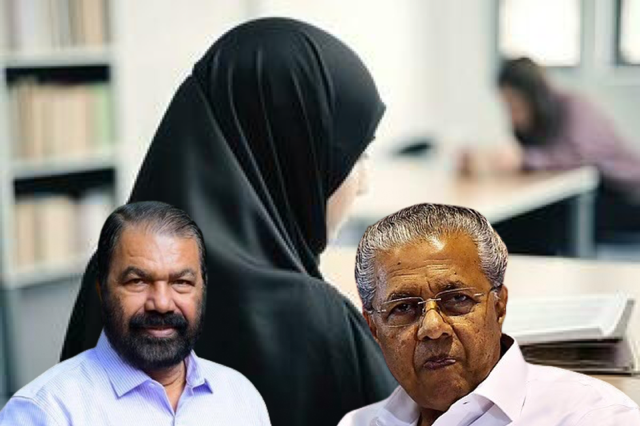
Kerala hijab row: Edu Minister’s diktat to allow hijab shows how CPM govt has turned institutional autonomy into a theatre of Muslim appeasement

In Kerala, “secularism” doesn’t mean equality. It means knowing whom to offend, whom to appease, and when to retreat. Nothing illustrates this better than the recent hijab controversy at St Rita Public School in Kochi, a dispute that began as a question of uniform rules but ended up unmasking the Communist Party of India (Marxist)’s cynical politics of religious appeasement.

When a school rule became a political theatre

St Rita Public School, a Catholic-run CBSE institution in Kochi, has a clear uniform policy. One Muslim student’s family demanded that she be allowed to wear a hijab, directly violating that code. The management refused, not out of malice, but to maintain equality among students.

What followed was a familiar Kerala drama: the father threatened the management, protests flared up outside the school, and the administration had to seek police protection and even approach the High Court for relief.

Instead of defending the institution’s right to maintain order, Education Minister V. Sivankutty swooped in with a politically charged directive ordering the school to let the student wear her hijab and continue studying. The CPIM had, once again, prioritised religious identity over institutional autonomy.

The move was a signal to Kerala’s Muslim electorate, an attempt to posture as the defender of Islamic sensibilities before the local body polls. What the government called “inclusivity” was nothing more than vote-bank arithmetic dressed up as compassion. Muslims form a sizeable chunk of Kerala’s population, a block that is fiercely united in it voting preferences as compared to Hindus, who are disunited and disconnected for the ruling class to consider them as an indispensable vote bank.

The Church pushed back, and the ‘secular’ minister folded overnight

Within 24 hours, the same minister who thundered about the girl’s “religious right” was begging for consensus. What changed? The Syro-Malabar Church struck back. Its media commission accused Sivankutty of “rekindling communal trouble” and enabling fundamentalism to enter Christian educational institutions. The Church-owned Deepika Daily published an editorial warning the government not to “remain silent under duress from fundamentalists.”

Suddenly, Sivankutty discovered moderation. He told reporters that the matter was “settled” and that the girl’s father had agreed to comply with the dress code. The episode was declared “closed.” In reality, it was a full-blown political retreat, proof that Kerala’s Communists will bend to one community only until another powerful bloc growls.

In one stroke, the CPM’s so-called secularism lay bare: pander to Muslims, placate Christians, and persecute Hindus.

A government that prays with one faith and prosecutes another

This is not an isolated case. The CPM’s pattern of appeasement is now a political doctrine in itself.

In August 2025, CPIM leader Bineesh Kodiyeri proudly posted a video of a Muslim hawker offering namaz inside a party office in Kollam. The act was celebrated online as “an expression of brotherhood.” Party leaders called it “the real spirit of Kerala.”

But when it comes to Hindu expression, the CPIM’s “spirit” vanishes faster than political morality.

In February 2024, CPIM goons stormed a school in Kozhikode to stop a Ganapati Homam being performed on Mahanavami, a ritual held annually with official permission. They attacked the organisers, called the police, and had the devotees arrested. The same party that had converted its office into a mosque decided that a school courtyard was no place for a Hindu prayer.

In “progressive” Kerala, Muslim piety is celebrated; Hindu devotion is criminalised.

Even Marxist ministers can’t pray

The hypocrisy runs deeper.

In 2017, CPIM minister Kadakampally Surendran was reprimanded for visiting the Guruvayur Temple and offering prayers with his family. The party’s internal committee said the act was “against Marxist principles.” Think about that, in Communist Kerala, a Hindu minister was punished for entering a temple.

Yet the same party publicly applauds a namaz held inside its own headquarters. This isn’t secularism. It’s a perverse hierarchy of faith, where Islam is romanticised, Christianity negotiated with, and Hinduism demonised.

The message is unmistakable: you can fold your hands before Marx or before Mecca, but never before a Hindu deity.

Documented anti-Hindu prejudice

The CPM’s 64-page political resolution from 2025 makes this bigotry official. It described the Ram Mandir inauguration as an “aggressive continuation of Hindutva,” mocked Hindu processions as “provocations,” and claimed that “minorities face police repression” as though Hindus never suffer from mob violence or targeted hate.

It went further, objecting to laws against love jihad, dismissing demands for temple restoration as “communal,” and sneering at the “mythological rewriting of history.” The same document offered a sympathetic explanation for Islamist radicalisation, blaming it conveniently on “Hindutva aggression.”

In short, Hindus are the problem; Islamists are the misunderstood. This is the ideological lens through which the CPM views Kerala, a worldview where the majority must forever atone for the sensitivities of the minority.

From classrooms to temples: The war on Hindu visibility

The CPM’s assault on Hindu space isn’t limited to party memos. It shapes governance and culture. When Hindu festivals are held in schools, police are deployed “to maintain order.” When temples hold public rituals, Left-affiliated groups demand restrictions in the name of “secularism.”

But when a Muslim group wants to block a road for Friday prayers, the government rushes to “facilitate” arrangements. When Christian managements demand staff appointments or curriculum exemptions, ministers sprint to church headquarters to negotiate. When Hindu bodies raise identical demands, they’re branded “communal.”

Kerala’s Marxism has morphed into minority-majoritarianism, an ideology that sees Hindus as expendable ballast and Islamists as indispensable voters.

The hijab row fits the pattern perfectly

Seen in that light, the St Rita controversy is not an accident. It’s the inevitable outcome of decades of selective secularism. The CPM’s instinctive reaction was to side with the Muslim parent, not because the law required it, but because politics demanded it. Only when the Church raised its voice did the government remember the virtue of neutrality.

Had the same incident occurred in a Hindu-run school, the CPM’s reaction would have been very different. The management would have been accused of “discrimination,” the SDPI would have staged protests, and the minister’s order would have stood firm. But because the Church pushed back, the party remembered the limits of its own arrogance.

This is not governance. This is religious brokerage, where the state operates like an auction house for hurt sentiments.

Kerala’s secularism: Equality before elections, not before law

What passes for “secularism” in Kerala is a grotesque parody. The CPM doesn’t believe in equality before the law, only equality before the vote shares. It bends for one community until another threatens to shift allegiance, then performs a rhetorical pirouette in the name of “harmony.”

This is why Hindus in Kerala increasingly view the state as institutionally hostile. Their temples are controlled by the government, their festivals restricted, their rituals mocked, while every demand rooted in Muslim or Christian identity is met with exaggerated deference.

From Sabarimala to St Rita, from Guruvayur to Kozhikode, the story is the same: appease, retreat, repeat.

Why this matters beyond Kerala

The hijab row may seem local, but it reveals a national problem: the moral collapse of India’s Left ecosystem. The same ideologues who accuse others of “communalism” have built their entire political survival on minority chauvinism. They celebrate Islamic assertion as “rights,” condemn Hindu expression as “bigotry,” and ridicule any call for equal treatment as “saffron politics.”

Kerala’s CPM is merely the most shameless practitioner of this art. It has replaced ideology with identity management. It no longer governs; it curates grievances.

The tragedy behind the theatre

What makes the St Rita episode truly tragic is that it could have been resolved quietly. The girl’s father himself told reporters he was ready to follow the school’s dress code. There was no crisis until the minister decided to manufacture one for political mileage.

In doing so, Sivankutty undermined both sides. He offended the Church, embarrassed the government, and deepened communal suspicion. His retreat wasn’t an act of wisdom; it was an act of political self-preservation.

And therein lies the essence of CPM’s Kerala model, rule by appeasement, retreat by fear.

Appeasement is not harmony

The hijab was never the issue. The issue is ideological hypocrisy. A party that cannot decide whether faith is sacred or regressive has no business sermonizing about secularism. The CPM’s Kerala government has turned the state into a laboratory of selective tolerance where Islam is appeased, Christianity negotiated, and Hinduism humiliated.

Every such episode chips away at public trust and deepens communal cynicism. When the law bends for some and breaks for others, equality becomes an illusion. The Left’s moral posturing collapses under its own contradictions.

Kerala deserves better than this. It deserves a government that treats citizens as citizens, not as commodities of religious arithmetic. Until that happens, the “God’s Own Country” will remain, under Communist rule, a God-forsaken playground of political hypocrisy.

India Air Force successfully tests indigenously developed Military Combat Parachute System: Read its main features and how it will enhance India’s defence capabilities

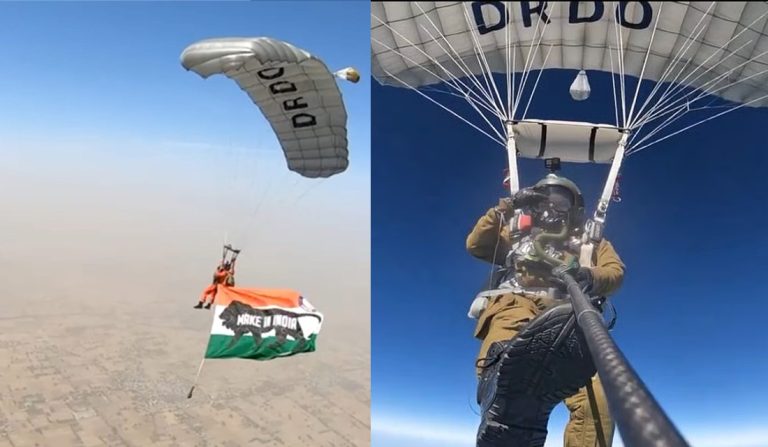
Marking a major feat in indigenous defence technologies, the Indian Air Force successfully tested an indigenous parachute system developed by the Defence Research and Development Organisation (DRDO) on Wednesday (15th October). Indian Air Force personnel, Wing Commander Vishal Lakhes, VM(G) and Master Warrant Officers R J Singh and Vivek Tiwari, tested the Military Combat Parachute System (MCPS) by conducting a free-fall jump from 32,000 feet, making it the only currently operational parachute system capable of deployment above 25,000 feet.

This is a significant improvement over its earlier test trial in March 2025, when it was successfully tested for a free-fall jump from an altitude of 27,000 feet. In both test trials, the MCPS system displayed unparalleled reliability and efficiency.

Developed by DRDO’s Aerial Delivery Research and Development Establishment (ADRDE), Agra, and Defence Bioengineering and Electromedical Laboratory (DEBEL), Bengaluru, the MCPS significantly enhances the operational abilities of the Indian Air Force for modern airborne operations. High-altitude parachute systems are crucial for conducting operations in challenging terrain like mountainous regions and contested territories. They provide a leverage to special forces and airborne units engaged in operations in areas where conventional deployment is not possible. The MCPS has specifically been designed for difficult, high-altitude airborne operations to allow paratroopers to descend by evading enemy radars and air defence systems and cover large distances.

This is a robust and reliable parachute system, developed with inputs from operational units and equipped to handle challenges like extreme heights, low oxygen levels, extremely low temperatures and strong winds. The system will prove immensely useful in covert insertions, rapid troop deployment and disaster response in high-altitude or mountaineous areas like the Himalayas. It offers a range of enhanced tactical features, which are not available in any of the existing parachute systems used by the Indian Defence Forces.

Key features of the MCPS and how it will improve IAF’s operational capabilities

Lower Rate of Descent: Compared to existing parachute systems, the MCPS has been engineered to have a lower rate of descent. Reduced speed of descent will lower the risk of injury while landing and allow paratroopers to descend safely with a heavy combat load. This will improve survivability during descent in challenging terrains.

Increased Steering capabilities: The Military Combat Parachute System embodies advanced steering mechanisms, which offer improved steering control, allowing paratroopers finer lateral control and to navigate with enhanced precision. This also enhances the paratroopers’ ability to adjust their flight path in the air, dodge obstacles and land with accuracy even amid extreme weather conditions.

High-altitude deployment: This feature of the MCPS is critical for operations requiring long-range infiltration or covert operations. The deployment ability of 32,000 feet is unique to this parachute system, as the existing traditional systems lack this. This makes the system preferable for High-Altitude Low-Opening (HALO) and High-Altitude High-Opening (HAHO) style operations. HALO and HAHO are advanced military parachuting techniques used for covert insertions into hostile territory from altitudes ranging from 15,000 feet to 35,000 feet. HALO jump involves opening the parachute at a lower altitude after a period of free-fall, while in HAHO jump, the parachute is opened at a high altitude shortly after exiting the aircraft. The MCPS reduces the exposure to hostile air defences by allowing paratroopers to jump outside the reach of many air defences and extending the time for navigation and formation before descent.

NaVIC compatibility: Compatibility with India’s indigenous satellite navigation system NavIC (Navigation with Indian Constellation) is another unique feature of the MCPS. The feature has been incorporated in the system as the DRDO and the Ministry of Defence (MoD) wanted to ensure that the MCPS is not dependent on third-party global navigation satellite systems (GNSS) to avoid the possibility of jamming or denial of access during times of conflict. GNSS resilience is a way to reduce the risk of an adversary blocking or degrading the navigation for airborne forces, which would affect their capability for precise insertion and hinder the operations in electronic warfare environments. Thus, the NavIC compatibility of the MCPS system would ensure autonomy during military operations and block the interference of foreign actors.

Combat Load compatibility: The MCPS allows paratroopers to carry a full combat load. This means paratroopers engaged in airborne operations would be able to carry all necessary equipment, including weapons, communication devices and survival gear, without compromising their safety or efficiency during the operation.

Indigenous manufacturing and maintenance: Since the MCPS is indigenously designed and maintained, it will significantly reduce the turnaround time for maintenance or repair. This will also reduce dependency on imported parachute systems procured from foreign suppliers and improve availability, especially during prolonged operations.

The development marks a tactical enhancement in India’s defence capabilities and an advancement in the country’s self-reliance in the field of defence technologies. This is also a significant step towards equipping Indian security personnel with modern defence and warfare technology using indigenous innovations, and gradually reducing India’s dependence on other nations.

As Taliban humiliates Pakistan months after India’s Operation Sindoor, Pakistani Defence Minister claims Afghanistan is fighting India’s ‘proxy war’

0

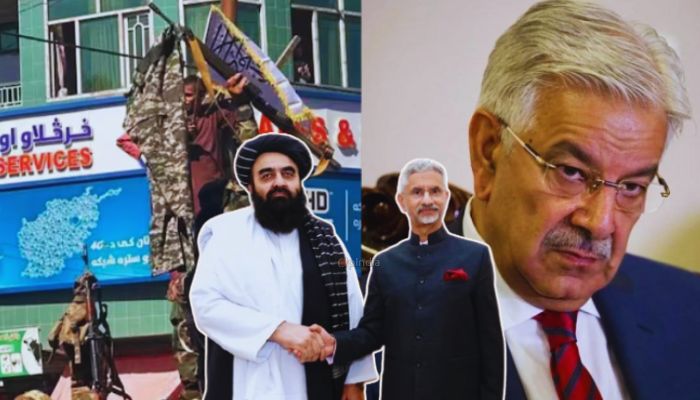
Pakistan has a penchant for blaming India for hiding its own failures. After the Taliban forces of Afghanistan humiliated Pakistan in a recent border skirmish, the ‘It’s all over the social media’ fame, Pakistani Defence Minister, Khwaja Asif has claimed that the Afghan Taliban are fighting India’s “proxy war”.

Asif also cast doubt on the ceasefire agreement reached between the two neighbours following clashes on the Afghan border. To lend credence to his lies, Khwaja Asif linked Taliban Foreign Minister Amir Khan Muttaqi’s recent six-day visit to India with the Af-Pak border conflict. He alleged that had Muttaqi had “made plans” during his India visit.

While the Afghan Foreign Minister’s first visit to India was intended as a step toward strengthening trade and bilateral relations, Khwaja Asif alleged that it had ulterior motives.

48-hour ceasefire continues in Afghanistan-Pakistan

A 48-hour ceasefire is currently underway between Afghanistan and Pakistan. The ceasefire began at 6 p.m. Islamabad time (1300 GMT), confirmed by both governments, who claimed the other side had requested a halt to the escalating violence.

Pakistan’s Foreign Ministry said both sides would “make sincere efforts to find a positive solution through constructive dialogue” during the ceasefire period. The Taliban government said it had directed its forces to respect the ceasefire ‘unless it is violated by Pakistan.’ The ceasefire comes after a week of fierce fighting along the southern border, where the Taliban targeted Pakistani positions.

Afghanistan accuses Pakistan of supporting the local Islamic State group’s Khorasan wing and aiding its attacks inside Afghan territory. Pakistan, meanwhile, accuses Afghanistan of harbouring the Tehrik-e-Taliban Pakistan (TTP).

While a ceasefire is in effect, tensions are rising between Afghanistan and Pakistan, as Pakistani airstrikes deep inside the Afghan border killed 15 civilians. Earlier, the Taliban had captured Pakistani posts and seized uniforms and weapons from abandoned positions. Trousers were publicly displayed in Afghanistan.

Moreover, Pakistani airstrikes in Kabul and Kandahar killed at least 15 Afghan civilians and injured more than 100. This came after the Taliban retaliated by capturing border posts in Spin-Boldak, a move symbolised by the trousers of Pakistani soldiers who abandoned their posts.

Regarding Afghan forces displaying piles of pants of Pakistani soldiers, Daud Junbish, an Afghan journalist for the BBC, wrote , “Trousers recovered from posts abandoned by the Pakistani army near the Durand Line are on display in Afghanistan’s eastern Nangarhar province.” He shared a photo of Taliban fighters showing off trousers and weapons seized from border posts they fled after a counter-attack. A video of Taliban fighters on a seized Pakistani T-55 tank went viral.

Interestingly, the spectacle of the pants of Pakistani soldiers who fled their posts fearing Afghan fighters reminded people of the iconic “pant-removal ceremony” Indian Army conducted of surrendered Pakistani soldiers after defeating the latter in the war of 1971.

200 people killed in Pakistan-Afghanistan conflict

Over 200 people have been killed so far in the fresh Pakistan-Afghanistan conflict. Last week, Pakistan carried out airstrikes in Afghanistan, targeting camps of the Tehrik-e-Taliban Pakistan (TTP). Afghan Foreign Minister Amir Khan Muttaqi, on his first visit to India, warned Pakistan at the time.

Over the past week, both sides have claimed significant casualties. Reuters reports that Pakistan has killed more than 200 fighters from the Afghan Taliban and its allies, while Afghanistan claims it has killed 58 Pakistani soldiers.

OpIndia reported earlier how Pakistan for decades funded, fostered and shielded TTP and other such Islamist outfits to use them as their proxies against India. However, as the tides of time have turned against the Pakistan ‘Aand’ Forces, they have started labelling TTP as Fitna-al-Khawarij and Baloch freedom fighters as Fitna-al-Hindustan.  

The TTP, which Pakistan today calls a proxy for India, is actually fostered by it. The TTP’s roots lie with al-Qaeda, the same al-Qaeda whose leader and terrorist, Osama bin Laden, was sheltered in Pakistan.

Haryana police suicide cases: All you need to know about IPS Y Puran Kumar’s death, ASI Sandeep’s final note and allegations, the SIT probe and what the FIR says

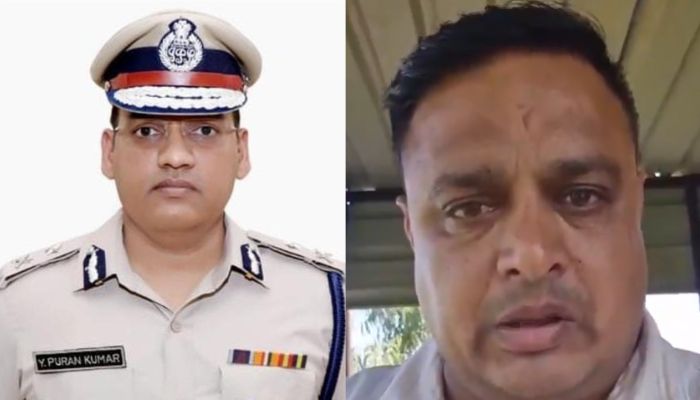
On 15th October, the post-mortem examination of senior Haryana IPS officer Y Puran Kumar was conducted at the Post Graduate Institute of Medical Education and Research (PGIMER) in Chandigarh. In a statement, the official spokesperson of PGIMER said that a duly constituted medical board conducted the post-mortem following all due procedure. According to media reports, the procedure lasted for around four hours and was fully videographed. Ballistics and forensic experts were present during the examination to ensure transparency.

The mortal remains of the deceased officer were handed over to the family members. IPS officer Puran Kumar allegedly died by suicide on 7th October, leading to serious political and administrative turmoil in the state. Notably, Kumar’s family had earlier refused consent for the autopsy until the officers named in his suicide note were arrested. On Wednesday morning, his family finally gave consent. Kumar’s wife, senior IAS officer Amneet P Kumar, said in a written statement that Chandigarh Police had assured the family of a fair and impartial investigation. She also stated that a timely autopsy was necessary to preserve evidence and ensure justice.

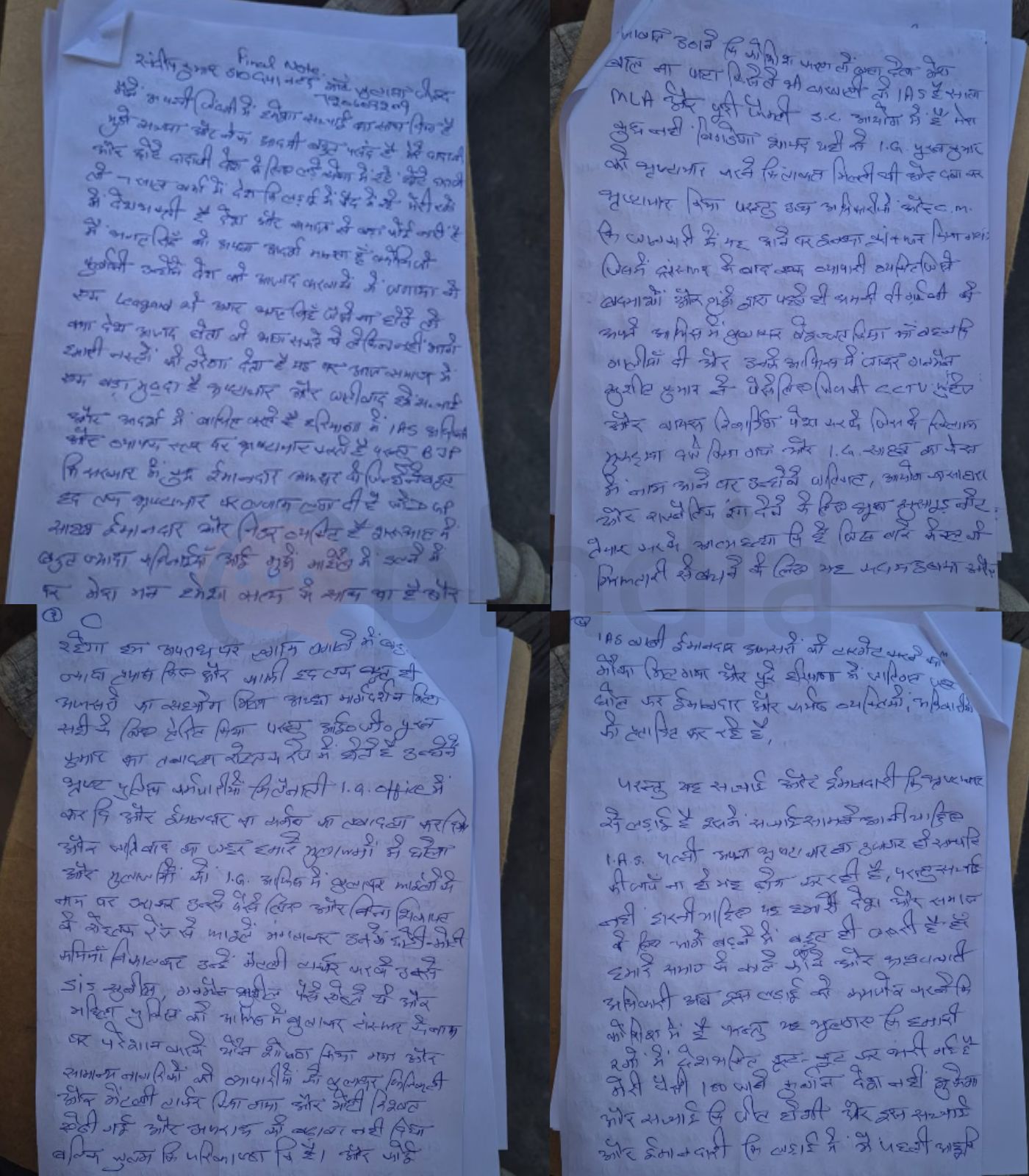
After the mortal remains were handed to the family, they were taken to his official residence in Chandigarh. The cremation took place at the Sector 25 cremation ground after 4 PM. IPS officer Puran Kumar was not the only officer who died in this case. Assistant Sub-Inspector Sandeep Kumar also committed suicide, leading to a major crisis within the Haryana Police. ASI Kumar was investigating a case involving IPS Kumar’s Personal Security Officer (PSO).

How the case began and where it stands

The deaths of IPS Puran Kumar and ASI Sandeep Kumar within a span of one week have shaken the administrative and political arena in Haryana. While the IPS officer’s family attributed his death to caste-based harassment and systemic humiliation, the ASI’s note and video accused the same officer and his family of corruption, extortion, and links with gangsters.

A Special Investigation Team (SIT) led by Chandigarh IG Pushpendra Kumar was constituted to probe both suicides. Haryana Police’s Director General of Police (DGP), Shatrujeet Kapur, was sent on leave and Rohtak’s Superintendent of Police, Narendra Bijraniya, was transferred by the state government. IPS Puran Kumar had named them in his suicide note.

The transfer and the first signs of trouble

The chain of events began on 29th September. 2001-batch IPS officer Y Puran Kumar was transferred from the post of Inspector General (Rohtak Range) to the Sunaria Police Training College. The transfer reportedly came without prior notice, which deeply upset the 52-year-old officer. The following day, he handed over the charge and went on a week-long leave.

According to media reports, family sources alleged that the officer was disturbed by the sudden transfer and saw it as a campaign to sideline him. He had been serving in the mainstream after a long period of low-profile postings.

Detention of PSO Sushil Kumar and subsequent FIR

On 1st October, when IPS Puran Kumar was travelling from Rohtak to Chandigarh with his Personal Security Officer (PSO) Sushil Kumar, a Rohtak police team that included ASI Sandeep Kumar stopped his car. The PSO was detained without a formal warrant or FIR. When Puran Kumar objected, he was allegedly threatened that he would be next.

The PSO reportedly left his service revolver in the vehicle before being taken away. According to media reports, this was the same weapon that Puran Kumar later used to allegedly shoot himself. The PSO was interrogated for several days in what was later described as “illegal custody”. It was alleged that he was tortured and pressured to give a false statement implicating his senior officer. Despite repeated calls from Puran Kumar to DGP Shatrujeet Kapur and SP Narendra Bijraniya, his appeals for help reportedly went unanswered.

On 6th October, an FIR was finally filed against the PSO under the Prevention of Corruption Act. In the FIR, he was accused of demanding Rs 2.5 lakh from a businessman. The FIR named him as the main accused. ASI Sandeep Kumar was part of the team investigating this case and had retrieved the phone details linked to it. Officials later said the FIR was strategically filed so that no government sanction would be needed to arrest the IPS officer through indirect linkage.

Suicide of IPS Y Puran Kumar and his final note

On 7th October, IPS Puran Kumar allegedly shot himself with his PSO’s revolver at his residence in Chandigarh. He left an eight-page note which was recovered from his pocket, along with a one-page will. The note mentioned that he was driven to suicide due to continuous harassment, humiliation, and the false case against his PSO. He named over ten senior IPS officers in his suicide note, including DGP Kapur and Rohtak SP Narendra Bijraniya, accusing them of maligning his reputation.

When the incident took place, his wife, IAS officer Amneet P Kumar, was in Japan on official duty as part of a delegation led by Chief Minister Nayab Saini. She returned to Chandigarh on 8th October and filed a formal complaint accusing the officers named in the note of abetment to suicide and caste-based harassment. She refused to permit a post-mortem until arrests were made.

The FIR, registered under provisions of the Bharatiya Nyaya Sanhita and the SC/ST (Prevention of Atrocities) Act, later included Section 3(2)(v) after her request to ensure that the caste angle was properly acknowledged.

OpIndia accessed a copy of the FIR in the matter. The FIR was registered under Sections 108 and 3(5) of the Bharatiya Nyaya Sanhita, 2023, along with Section 3(1)(r) of the Scheduled Castes and Scheduled Tribes (Prevention of Atrocities) Act, 1989. It was filed at Police Station Sector 11, Chandigarh, on the complaint of IAS officer Amneet P Kumar, wife of the late IPS officer Y Puran Kumar. The complaint named Haryana Director General of Police Shatrujeet Singh Kapur and Rohtak Superintendent of Police Narendra Bijraniya as accused, alleging that the two officers abetted the suicide of her husband through sustained harassment, humiliation, and caste-based persecution.

In the FIR, the complainant had also attached the final note of IPS officer Y Puran Kumar, recovered from his residence and laptop, which detailed years of alleged harassment and discrimination. According to the FIR, the late officer and his wife had repeatedly raised concerns of caste-based slurs, denial of service benefits, public humiliation, and targeted administrative action. The FIR stated that the IPS officer had informed his wife that a conspiracy was being hatched at the behest of the DGP to falsely implicate him in a corruption case through his staff member, and that his calls to both the DGP and the Rohtak SP seeking intervention went unanswered. It alleged that a false FIR against his PSO was deliberately registered to pave the way for his arrest without sanction, which drove the officer to despair.

The complaint further alleged that the DGP had made casteist remarks in the officer’s annual performance report, withdrawn his official vehicle in November 2023, leaked confidential information to the media, and entertained anonymous complaints to publicly humiliate him. It also claimed that the SP had conspired with the DGP by ignoring the officer’s repeated pleas and allowing the campaign of defamation to continue unchecked. Amneet Kumar maintained that her husband was systematically isolated, mentally tortured, and defamed within the police department, and that the harassment amounted to abetment to suicide. She urged for the immediate arrest of the accused officers, stating that their senior positions enabled them to influence witnesses and tamper with evidence.

According to the FIR, the final note attached by the complainant listed several serious allegations raised by IPS Y Puran Kumar before his death. These included:

  1. Caste-based discrimination within the Haryana Police, beginning in 2020 when he was allegedly ridiculed for visiting a temple in Ambala and continuing through his later postings.
  2. Systematic mental harassment by senior officers through malicious transfers, delays in granting earned leave, and denial of promotions and arrears due since 2015.
  3. Targeted humiliation by then DGP Shatrujeet Kapur, who had allegedly made casteist comments in his Annual Performance Appraisal Report and issued communications meant to publicly embarrass him.
  4. Withdrawal of his official vehicle in November 2023 and manipulation of administrative procedures to create personal inconvenience.
  5. Circulation of false and anonymous complaints and leaking of confidential correspondence to media houses to defame him.
  6. Vindictive filing of a false affidavit by IPS officer Kala Ramachandran regarding official accommodation in Panchkula, allegedly to discriminate against him.
  7. Neglect of formal complaints and representations submitted to senior bureaucrats including the Additional Chief Secretary (Home), despite clear recommendations for redressal.
  8. Deliberate mishandling of his confidential letters and representations, violating mandated timelines under service rules and causing reputational harm.
  9. False implication through subordinates, where his PSO was booked in a fabricated corruption case allegedly under the DGP’s directions to indirectly link and arrest him.
  10. Public humiliation through media leaks about internal disciplinary matters that were never formally initiated.

The final note concluded with the officer stating that having waited in vain for justice and fearing continued persecution, he saw no option but to end his life. It recorded his belief that the animosity directed at him should “end with me now.”

In her statement, Amneet Kumar described her husband as an officer of “unimpeachable integrity” who had been pushed to take his life after years of caste-based discrimination and administrative persecution. She asserted that the death was not a spontaneous act but the culmination of sustained institutional prejudice and official misconduct by powerful officers who had used their authority to break his spirit and destroy his reputation.

Laptop and forensic examination dispute

Following the death, the SIT requested access to the IPS officer’s official laptop for forensic examination to verify the authenticity of his suicide note. However, Amneet Kumar stated that the police had already accessed the laptop on 10th October but failed to generate a digital hash even after four hours. In her letter to the SIT, she accused the investigators of misrepresenting her cooperation and demanded that a secure copy of the laptop data be provided before any further analysis. Subsequently, the Chandigarh Police filed an application in court requesting that the family be directed to hand over the laptop for forensic imaging.

The second suicide and ASI Sandeep Kumar’s allegations

On 14th October, a week after the IPS officer’s death, Assistant Sub-Inspector Sandeep Kumar, who had been involved in investigating the PSO case, allegedly shot himself dead near a farm on the Rohtak–Panipat road. His body was found with a four-page handwritten note and a six-minute video message. In both the note and the video, Sandeep Kumar accused the late IPS officer and his family of corruption, sexual misconduct, and abuse of power. He claimed that Puran Kumar had manipulated the system through caste politics and had removed honest officers to appoint his own team. He alleged that the IPS officer took bribes, exploited women police officers by threatening them with transfers, and had ties with gangsters.

Content of ASI Sandeep Kumar’s note and video

In the video recorded before his death, Sandeep Kumar described himself as a follower of freedom fighter Bhagat Singh. He said that he was “sacrificing his life for truth.” He alleged that the IPS officer had struck a Rs 50 crore deal with gangster Rao Inderjit, owner of James Music, to help him evade a murder charge. Rao Inderjit was reportedly in the United States and linked to the Himanshu Bhau gang, which had been named in several violent incidents in Haryana, including an attack on singer Fazilpuria and firing near YouTuber Elvish Yadav’s residence.

Suicide not of ASI Sandeep. Source: Amar Ujala

Sandeep Kumar also alleged that after taking charge as IG Rohtak, Puran Kumar selected police personnel from his own caste and formed a corrupt circle that extorted money from businessmen. He further claimed that women officers were harassed and that corruption was rampant within the office. The ASI referred to DGP Shatrujeet Kapur and SP Narendra Bijraniya as honest officers, stating that they were being unfairly targeted after the IPS officer’s death. He urged for an impartial probe, asserting that he was ending his life “to awaken the system.”

Links drawn to gangster Rao Inderjit and alleged corruption

In his note, Sandeep Kumar alleged that Rao Inderjit had paid Rs 50 crore to clear his name in a murder case under investigation during Puran Kumar’s tenure. He also mentioned the involvement of a liquor trader who had accused the IPS officer’s PSO of demanding Rs 2.5 lakh. The ASI claimed that the IPS officer feared exposure in the same corruption complaint and took his life to protect his family’s political and bureaucratic interests. Sandeep Kumar also alleged that Amneet P Kumar’s position as an IAS officer and her family’s influence had shielded them from scrutiny, claiming that “IAS officers engage in widespread corruption in Haryana.”

Special Investigation Team steps and evidence focus

The SIT has been examining call detail records from the IPS officer’s phone to identify who he spoke with before his death. It has also written to the Haryana Police for full records of the FIR against PSO Sushil Kumar, who remains in custody in Rohtak. The team intends to question all personnel involved in his detention and arrest. The SIT has already questioned officers linked to the case, including the IG’s reader Shyam Sunder and ASI Sunil, both of whom were associated with the Rohtak office.

Shyam Sunder has reportedly been on leave, and ASI Sunil has been transferred to Bhiwani. Sandeep Kumar had also been questioned by the SIT shortly before his own death. Officials said the post-mortem report of IPS Kumar and the forensic analysis of his laptop would be crucial to determine whether the suicide note was authored by him and whether any digital manipulation occurred.

Political reactions and public statements

The deaths have drawn widespread political attention. Union Minister Chirag Paswan met the family and said every demand made by them would be fulfilled. He assured that those responsible, regardless of rank, would face strict action and described the IPS officer’s family as “his own.” The state government has maintained that no one will be spared if found guilty.

Chief Minister Nayab Saini described the incident as “very tragic” and reiterated that a fair investigation was underway.

Congress Party has also stepped in. Congress MP and LoP Rahul Gandhi visited the family in Chandigarh, urging the Haryana government to “stop the spectacle” and arrest the officers named in the note. He said the case reflected systematic discrimination faced by Dalit officers in the bureaucracy. He added that millions of Dalit citizens would view this incident as a sign that success and merit offer no protection from humiliation.

Contradictions and questions still unresolved

There are multiple discrepancies between the two narratives. The IPS officer’s family insisted his suicide was caused by caste-based harassment, while the ASI’s note portrayed him as corrupt and manipulative. The authenticity of both notes and videos, the legality of the PSO’s detention before his FIR, and the chain of custody for the PSO’s weapon are now central to the probe. Chandigarh Police has confirmed that analysis of the IPS officer’s call records has begun, but several officials are yet to be formally questioned.

A deeper rot in policing that India cannot ignore

Beyond the personal tragedies, the twin suicides highlight a deeper institutional problem within India’s police forces. The overlapping claims of caste bias, corruption, and political interference point to a system struggling with internal fractures. When senior officers feel persecuted, and junior ranks claim moral despair, it signals erosion of discipline and trust within the structure. While the investigation into caste-based discrimination and internal corruption is underway, both sides describe a force divided by factions, fear, and misuse of authority. The events call for an overhaul in the policing system not only in Haryana but across the country.

If you or someone you know is struggling with thoughts of self-harm, help is available.
Tele MANAS — Govt of India’s 24×7 mental health support helpline.
Visit https://telemanas.mohfw.gov.in or call 14416 to connect with a trained counsellor for free, confidential support.

Was Ashley Tellis the missing link between Soros-funded Carnegie think tank, China’s espionage, and the anti-India lobby?

0

When the U.S. Department of Justice charged Ashley J. Tellis, a senior adviser to the U.S. State Department and a contractor with the Pentagon’s Office of Net Assessment, for espionage and unlawful retention of classified documents, Washington’s foreign policy establishment was left stunned.

Tellis, long regarded as an “India expert,” allegedly removed sensitive military documents from secure facilities and met Chinese officials multiple times in Virginia between 2022 and 2023. Federal prosecutors say that he discussed “emerging technologies” and “Iran–China relations,” and was seen carrying manila envelopes and accepting gift bags from Chinese representatives.

Over 1,000 classified papers marked ‘Top Secret’ were recovered from his home. Prosecutors believe Tellis exploited his government access while serving as an unpaid senior adviser at the State Department and a contractor for the Department of Defense, using his proximity to policy circles to leak or discuss restricted information.

The Tata Chair at Carnegie, funded by Soros’s Network

Beyond his government role, Tellis held a prestigious position as the Tata Chair for Strategic Affairs at the Carnegie Endowment for International Peace (CEIP), one of the most influential think tanks in Washington. But Carnegie’s image as a beacon of diplomacy hides a deeply compromised funding structure, particularly its multi-million-dollar ties to George Soros’s Open Society Foundations (OSF).

Between 2019 and 2023, Carnegie received over $3 million from OSF, apart from funds from U.S. defense contractors and foreign governments. The same institution that housed Tellis’s academic work has long functioned as a globalist policy factory, one that subtly aligns with Soros’s ideological project of eroding national sovereignty and “correcting” governments that refuse to conform to Western liberal orthodoxy.

George Soros: The billionaire who meddles with nations

George Soros has spent decades leveraging his fortune to manipulate politics worldwide. Through the Open Society Foundations, he funds NGOs, activists, journalists, and think tanks under the banner of “democracy promotion” but in practice, his empire is notorious for regime change funding, narrative engineering, and financial pressure on sovereign nations.

From Eastern Europe’s “colour revolutions” to funding far-left activism in the United States, Soros’s blueprint is consistent: use money and media to delegitimize governments, undermine conservative leaders, and reshape national institutions.

India has been among Soros’s most visible targets. He has personally declared that PM Modi’s India represents “one of the most frightening setbacks to democracy.” Since the early 2000s, OSF has cultivated a web of Indian NGOs, academics, and journalists, from Lawyers Collective and Centre for Policy Research to Alt News and Scroll, all purporting to defend “civil liberties” while advancing ideological hostility toward the Indian state.

Tellis’s Anti-India essays: Propaganda in the garb of policy

Within this Soros–Carnegie ecosystem, Ashley Tellis penned two major essays in Foreign Affairs that systematically undermined India’s global standing, both of which now appear, in hindsight, to echo Chinese and globalist talking points.

In May 2023, his essay “America’s Bad Bet on India” warned Washington against trusting New Delhi as a strategic partner. He portrayed India as a selfish, unreliable actor and accused it of “democratic erosion” and “strategic hypocrisy.” His advice was unmistakable: America should lower expectations from India, implicitly paving the way for a softer posture toward Beijing.

Two years later, in June 2025, Tellis authored “India’s Great-Power Delusions”, mocking India’s civilizational rise and arguing that its nationalism had made it “illiberal.” He dismissed India’s push for multipolarity, which challenges both Chinese dominance and Western hegemony as “delusional” and “counterproductive.”

Taken together, these essays not only attacked India’s democratic legitimacy but also subtly reinforced China’s position as the more “rational” power in Asia.

Now, with Tellis under investigation for espionage on behalf of China, his writings look less like academic critique, and more like the ideological scaffolding of a psy-ops campaign to seed anti-India sentiment within U.S. policy circles.

NewsClick and Beijing’s propaganda in India

What Tellis was doing in the corridors of Washington, NewsClick was replicating in the newsrooms of New Delhi.

In August 2023, The New York Times published an explosive exposé revealing that Neville Roy Singham, an American millionaire “working closely with the Chinese Communist Party’s media machine,” was funneling money to NewsClick, a far-left Indian portal.

The NYT found that NewsClick’s coverage was “sprinkled with Chinese government talking points”, with one video declaring, “China’s history continues to inspire the working classes.”

Subsequent investigations by the Enforcement Directorate (ED) confirmed that NewsClick received ₹38 crore between 2018 and 2021 from Singham-linked entities. The funds were disguised as “export remittances,” part of a global network financing propaganda in India, South Africa, Brazil, and the United States.

Interestingly, one of NewsClick’s frequent contributors, Paranjoy Guha Thakurta, also played a central role in publishing defamatory content against Adani Group, both through Economic and Political Weekly and The Wire.

OCCRP, Soros, and the Adani hitjob

The attack on Adani Group was not limited to Indian activists. In August 2023, the Organized Crime and Corruption Reporting Project (OCCRP), another “investigative collective” funded by George Soros’s OSF, published a report accusing Adani Group of questionable financial practices.

As OpIndia revealed, OCCRP is backed not only by OSF but also by the Ford Foundation and Rockefeller Brothers Fund, receiving an $800,000 grant from Soros’s foundation to expand its “cross-border investigations.” The group had earlier coordinated with Transparency International under the OSF-backed Global Anti-Corruption Consortium, designed to “build partnerships with civil society”, a euphemism for global political influence.

The timing of OCCRP’s report, following closely on the Hindenburg short-seller attack, triggered turmoil in India’s financial markets. Adani Group rejected the allegations outright, and even the Supreme Court of India ruled that OCCRP’s unverified material “cannot be treated as credible evidence” in ongoing investigations.

The economic subtext was clear: destabilize India’s top industrial conglomerate, dent investor confidence, and weaken the narrative of India’s economic rise, a strategy that benefits both China’s geoeconomic positioning and Soros’s ideological agenda.

Paranjoy Guha Thakurta and the Adani defamation case

The same ecosystem reappears here too. Paranjoy Guha Thakurta, who works as a consultant with NewsClick, authored a 2017 article in Economic and Political Weekly (EPW) alleging that the Modi government tweaked SEZ rules to benefit Adani Group by ₹500 crore. The article was later withdrawn by EPW’s publisher after Adani Group issued a legal notice, prompting Thakurta to republish it on The Wire.

Years later, India’s courts have sided with Adani. In September 2025, a Delhi Court issued an interim injunction restraining Thakurta, journalist Ravi Nair, and several foreign-linked NGOs, including Bob Brown Foundation and Dreamscape Network International, from publishing or republishing defamatory content.

The court observed: “There is a prima facie case in favour of the plaintiff… continual forwarding and publishing of defamatory material could result in a media trial.”

The order directed social media platforms and websites like Google, X, and YouTube to remove defamatory content, with the next hearing scheduled for October 9, 2025.

Coincidence or coordination? The pattern is too perfect

To be clear, there is no conclusive evidence directly connecting Ashley Tellis’s alleged espionage, the NewsClick–Beijing funding trail, the OCCRP’s Soros-linked reports on Adani, or the coordinated anti-India narratives. Yet, the recurring overlaps and timing make the pattern difficult to overlook.

Notably, it is highly coincidental, and deeply concerning, that all these actors, across different fields and continents, were working toward a singular outcome: promoting Chinese talking points, Discrediting India’s leadership and democracy, and Weakening confidence in Indian economic powerhouses like Adani.

Whether through stolen intelligence, manipulated news, or selective “investigations,” the effect is identical, helping Beijing control global narratives and influence policy while undermining India’s ascent as a civilizational power.

The hidden war against India

From espionage in Washington to propaganda in Delhi and financial sabotage in Mumbai, a web of actors: Soros-funded think tanks, Chinese-funded media outlets, and compromised “journalists”, appear to be operating in sync to manipulate global opinion against India.

Ashley Tellis’s arrest simply exposed one node of this sprawling machinery. The true story is far bigger: a coordinated attempt to reshape global perception, suppress India’s nationalist resurgence, and normalize China’s expansionism.

The battlefield is no longer physical; it’s informational. The weapons are not missiles, but money, media, and manipulation.

And in this silent war, India’s greatest defense will be the one thing its adversaries fear most: an informed citizenry that refuses to be deceived by sell-out ‘experts’, ‘neutral’ journalists, and ‘selfless philanthropist’ — all of them coincidentally working towards advancing Beijing’s geopolitical ambitions.

Russia and China sign Northern Sea Route deal: Millions of tons of Chinese cargo to be carried across the Arctic Ocean with nuclear ice-breakers. Read why it is significant

On 14th October, the “Russian-Chinese Commission for the Preparation of Regular Meetings of Heads of Government” convened its second meeting of the “Sub-Commission for Cooperation on the Northern Sea Route (NSR)” in Harbin of People’s Republic of China. The action plan for the expansion of shipping between the two countries via the Northern Sea Route was accepted after the meeting.

The goal of the roadmap’s development and approval was to create a sustainable transit corridor. The collaboration entails the application of innovative technology and logistics to boost capital projects and shipment efficiency.

Alexey Likhachev, Director General of Rosatom State Corporation who participated in the crucial event stated, “Russia sees the Northern Sea Route as a key transport artery of the 21st century, capable of providing faster, more efficient and safer connections between continents.”

Rosatom, Russia’s State Atomic Energy Corporation, is the organisation that runs 8 massive nuclear-powered icebreakers, the only ones of their kind in the world, through the Arctic Ocean’s frozen territories. Russia has over 40 icebreakers working in the Arctic. 4 more nuclear-powered ones are under construction.

“I am confident that the decisions taken today will give additional impetus to the development of Russian-Chinese cooperation in developing the potential of the Northern Sea Route and will allow us to materialise opportunities for cooperation in major capital projects. Our cooperation allows us not only to diversify global trade routes, but also to introduce advanced technologies in the development of high latitude areas with specific conditions,” he further mentioned.

Interestingly, global warming has made it possible for ships to travel the new route which passes through Arctic waters and inside Russia’s exclusive economic zone.

A landmark development in shipping operations

The Northern Sea Route is the primary maritime route in the Russian part of the Arctic Ocean and is a historically significant national transportation corridor. It extends throughout the Barents, Kara, Laptev, East Siberian, Chukchi, and Bering seas as well as the northern Russian shoreline. It unifies Siberia’s navigable rivers and ports in the Far East Russia alongside Europe into a single transportation network

It is the shortest shipping course connecting the western portion of Eurasia with the Asia-Pacific area. The route is roughly 5,600 kilometres long linking Providence Bay and the Kara Strait. With about 37.9 million tonnes of cargo handled in 2024, it set another record surpassing the previous year’s benchmark by over 1.6 million tonnes. Notably, transportation of containers between China and Russia is increasing in volume.

The summer-autumn navigation season of 2024 witnessed 14 international container journeys between the ports of northwest Russia and ports of China. This is double the number from 2023. Out of the 22 container journeys scheduled for this year, 17 have already been completed since the start of 2025 and 280,000 tonnes of container cargo have been moved, setting a new milestone. This represents an almost 59% increase over the 176,000 tonnes of freight transported over the entire previous year.

Image via Sky News

The partners now want to boost Northern Sea Route freight volume to 20 million tonnes by 2030. “We haven’t just set each other the goal of bringing (freight traffic) volumes to 20 million tons by 2030, our roadmap details various areas (of cooperation),” Likhachev highlighted. “It involves implementing modern logistics and technological solutions to increase shipping efficiency and support the development of major projects,” he mentioned.

“The cooperation between Russia and China in the coming years will affect not only seafaring and navigation, but also the creation of Arctic-class cargo ships, personnel training, as well as other areas,” the chief executive officer added. Russia and China hope to surpass 400,000 tonnes of containers, achieving a new record for container transportation through the Northern Sea Route.

The two nations decided to form a panel devoted to the development of the route earlier last year and the charge was handed over to Chinese Minister of Transportation and Rosatom. The subcommittee intends to transit 50 million tonnes of cargo annually along the pathway.

A polar silk route: Why is the NSR important

The Northern Sea Route has five major ports named Sabetta, Dudinka, Khatanga, Tiksi and Pevek. It starts at the boundary between the Kara and Barents Seas and closes in the Bering Strait. It was first accessed by a ship without an icebreaker in 2017 but has been in operation since the middle of the 1930s. Now, it accommodates ice class ships.

It already demonstrated its ability to handle substantial cargo transport volumes when an estimated 35 million tonnes was shipped in 2021, nearly 4.5 times more than in 2016. The year recorded that the cargo volume surpassed the USSR’s (Union of Soviet Socialist Republics) statistics for the first time as 6.57 million tonnes were transported along the route in 1987.

The Northern Sea Route has several considerable advantages. It is about 40 per cent shorter than the Suez Canal (21,000 kilometres) and at least10 to 15 days faster than the Northern Europe to China route (12,800 kilometres). Likewise, it is also 60 per cent shorter than the route through the Cape of Good Hope.

The NSR also enables for the generation of revenue from return goods travelling from the Far East and is free from pirate hazards or delays as compared to other congested routes.

Russia occupies more than 53% of the coastline of the Arctic Ocean. The route functions for transit shipping and the delivery of essential goods to 2.5 million people in remote Russian territories through the Northern Supply initiative, a yearly program designed to supply the Far North’s population with necessities including food and fuel for the long and harsh polar winters.

The shortened transit times are even slated to save emissions by 20-30 million tonnes a year and be cost effective. Moreover, the route is uninterrupted, making it ideal for smooth international trade, in contrast to those governed by European governments which regularly stop shipments for a variety of reasons.

Chinese ship reduces EU delivery time on first voyage

The first container transit from China to Europe via the Northern Sea Route left Ningbo on 23rd September and reached a United Kingdom port on 13th October. It only took 20 days to travel through the Russian Arctic which is almost half the time of more conventional southern routes.

A storm off the coast of Norway caused the Istanbul Bridge’s first voyage which was initially scheduled to take 18 days, to be delayed by two days. However, it arrived in Europe sooner than the 40 to 50 days that freighters have to travel through the Suez Canal or around the Cape of Good Hope.

The ship which was carrying about 4,000 containers from the Chinese port of Zhoushan, moored in Britain’s largest container port named Felixstowe with stops planned in Germany, Poland and the Netherlands. Sea Legend, a container line under Chinese control operates the vessel.

China is pursuing faster maritime ties with the European Union, the third-largest economy in the world as it is embroiled in an expensive trade war with the United States. Beijing has increased the nautical cooperation with Russia in the Arctic in recent years while it looks for a different shipping route to lessen its reliance on the Southeast Asian Strait of Malacca.

Opportunities in the Arctic

Modern technology, particularly the development of stronger icebreakers has made it possible to reach previously unreachable or isolated areas and to travel shorter distances across the Arctic. It is anticipated that the technological prowess would create new avenues for commercial shipping throughout the water body, including the possibility of year-round navigation along the route.

The Arctic which contains vast natural reserves is also appealing to countries and industry in terms of development due to rising commodity prices and an expanding worldwide need for resources. The promise of faster shipping and easier access only serves to reinforce this attraction.

Image via Wikipedia

Similarly, China considers the treasure trove of untapped energy and vital mineral resources of the Arctic as essential for protecting its economy from potential energy supply interruptions and geopolitical shocks, especially in the light of its fued with the United States. The Northern Sea Route will also benefit Russia’s oil and natural gas discoveries in the ocean.

Struggle for supremacy

The Northern Sea Route is currently one of the most significant and increasingly feasible commercial initiatives of the twenty-first century, specifically amid the return of the United States President Donald Trump and the escalating geopolitical tensions over the Arctic.

The Arctic is a primary factor behind Trump’s desire to take control of Greenland. The third-largest island in the world has enormous geopolitical, strategic and economic importance because of its exceptional location and resources. Due to its location between the Atlantic and Arctic oceans, Greenland is situated along critical air and sea routes which link Europe with North America.

It is a key actor in the rapidly changing Arctic region where melting ice brought on by climate change has opened up both opportunities and challenges, as a result its proximity to the Arctic Circle. The Arctic Circle which spans around 20% of Russia’s area and runs through the country from west to east. Major cities are located in this area as it is home to millions of Russians.

Hence, the position of Greenland amplifies its military value for space surveillance, missile defence and monitoring on naval operations in the North Atlantic and Arctic.

Trump wants the country because of its unmatched dominance over the North Atlantic and Arctic which is pivotal for the US to maintain surveillance and counter North Korean, Chinese and Russian activity in the area. Greenland would also bolster US project power into the High North and contribute to its influence in the Arctic commerce lanes.

Therefore, Washington which has regularly expressed concerns about Russia’s increasing influence and control over Arctic trade is also keeping an eye on the recent situation in the Northern Sea Route.

India’s Arctic Strategy and the Northern Sea Route: Another dimension to India-Russia friendship

A senior official at Russia’s State Atomic Energy Corporation, Rosatom, informed that Russia and India are in talks to work together to construct ice-class ships that can carry goods along the Northern Sea Route. Russia wants India’s involvement in the NSR and has already approached Delhi for it.

According to Vladimir Panov, Rosatom’s special representative for Arctic Development, discussions with New Delhi also involve collaboration on crew training for cutting-edge Arctic-class ships. He conveyed Russia is in favour of signing a bilateral pact on this matter.

“Cooperation with India on the Northern Sea Route is carried out within the framework of the intergovernmental format, the Russian-Indian Working Group on Cooperation in the Northern Sea Route under the Intergovernmental Russian-Indian Commission on Trade, Economic, Scientific, Technical and Cultural Cooperation. The first meeting of the Working Group took place on 10th October 2024 in New Delhi,” Panov pointed out.

He outlined that increasing freight traffic between the two nations along the route is the primary objective of the partnership.

Notably, union minister Dr. Jitendra Singh already unveiled India’s Arctic strategy in 2022 with the title “India and the Arctic: building a partnership for sustainable development.” It included six pillars including expanding national capacity building in the Arctic region, governance and international cooperation, economic and human development, transport and connectivity, climatic and environmental protection alongside bolstering India’s scientific research and collaboration.

“The Northern Sea Route is not just a new shipping lane, it’s the last major addition to global marine logistics for the next few centuries. Given the instability in traditional maritime corridors like the Red Sea and the rising threat of piracy in Southeast Asia, it offers a safe and efficient alternative. India, as a trusted long-term partner of Russia, has a vital role to play in this transformation,” Panov asserted while talking to NDTV.

Modern Arctic-class ships, particularly high-ice-class container ships that can navigate all year round are needed for the same. Joint novel projects are reportedly going to develop these vessels. There is a direct cargo link between Chennai and Vladivostok, an important Russian port on the route. Chennai might be developed as a massive cargo aggregation centre for containerised shipments to Russia, as the volume of cargo between the two countries is already growing.

A specialised shipping service between Chennai and Vladivostok requires a minimum of 100 containers every week. Russian President Vladimir Putin is scheduled to visit India in December when he is likely to discuss the route and infrastructure development.

During PM Narendra Modi’s visit to Moscow in July 2024, India and Russia agreed to establish a joint working group under their intergovernmental commission to explore cooperation in Arctic shipping.

Who is Ashley Tellis, US State Department adviser accused of removing classified US govt documents and meeting with Chinese officials. Read the charges against him

Ashley Tellis, a senior adviser to the US State Department has been accused of illegally removing classified documents from secure government locations. Tellis, a known foreign policy expert and defence strategist of Indian origin, is also accused of holding meetings with Chinese officials dating back to 2023.

On 14th October, the US Attorney’s Office for the Eastern District of Virginia informed that Ashley Tellis has been arrested on charge of “unlawfully retaining classified national defence information”. Tellis was arrested on 11th October after the US authorities searched his residence in Vienna, Virginia.

In a statement, Lindsey Halligan, U.S. Attorney for the Eastern District of Virginia, said that Ashley Tellis of Vienna was “arrested over the weekend and charged by criminal complaint with the unlawful retention of national defense information, in violation of 18 U.S.C. § 793(e).”

“We are fully focused on protecting the American people from all threats, foreign and domestic. The charges as alleged in this case represent a grave risk to the safety and security of our citizens. The facts and the law in this case are clear, and we will continue following them to ensure that justice is served,” the statement reads.

Notably, Ashley Tellis, a naturalised US citizen of Indian origin, served as an unpaid senior adviser to the State Department. He was also a contractor with the Office of Net Assessment at the Department of Defense (DOD).

As per an affidavit filed FBI special agent Jeffrey Scott, Tellis held Top Secret security clearance with access to ‘sensitive compartmented information’.

According to the federal prosecutors, during the raid at Tellis’s Vienna residence, investigators “located over a thousand pages of paper documents with classification markings at the Top Secret and/or Secret levels”.

How Ashley Tellis removed classified documents from secure compartmented information facility

Back in 2001, Ashley Tellis signed a Classified Information Nondisclosure Agreement with the U.S. government, however, he allegedly violated this agreement by removing classified materials from the Secured Compartmented Information Facility.

Tellis’s activities came under scanner after he was observed via video surveillance inside the Mark Center, a DOD facility in Virginia, entering a SCIF utilized by Office of Net Assessment (ONA) on 12th September 2025. Computer records indicated Ashley Tellis used a computer at an identified cubicle and had a co-worker print multiple classified documents for him that day.

“Later that evening, after TELLIS departed, investigators located two Redweld file pockets, both labeled “TELLIS,” in the cubicle TELLIS had used. The documents contained in the Redweld file pockets included the documents printed by the co-worker for TELLIS earlier that day, including a document classified at the TOP SECRET level,” the affidavit filed by FBI agent Scott reads.

In another instance of alleged removal of classified material, Ashley Tellis arrived the Department of State’s HST building on 25th September. He entered the office of the Bureau of South and Central Asian Affairs suite 5247 and logged onto “Classnet,” DOS’s SECRET-level computer system. He stayed for approximately one hour and then departed DOS.

“Later in the evening, Tellis returned to the HST building carrying a leather briefcase and logged on to Classnet. Tellis opened a PDF file from the desktop with a filename that referenced adversary fighter aircraft and the year 2024. The file opened as a 1288-page document with a title that referred to U.S. Air Force tactics techniques and procedures. The document had a Department of the Air Force Seal at the top and banner markings at the top and bottom that read SECRET//r Foreign Government Information/Risk Sensitive Notice/NOFORN//Foreign Intelligence Surveillance Act,” the affidavit reads.

Tellis re-saved the PDF as “Econ Reform”, opened the print window and entered “59- 172” in the “pages” window. He made multiple attempts to print the select pages of the sensitive document, however, the document did not print. Later, he opened an unclassified document concerning a public speech by a U.S. government official and printed the document. Minutes later, he reopened the “Econ Reform” document, printed pages 943-959 and then deleted the said file.

He then allegedly opened a PDF document classified “secret” or “NOFORN” which denoted information that may not be disseminated to individuals other than U.S. persons.

The file Ashley Tellis opened was a U.S. Air Force Weapons School document concerning military aircraft capabilities. He briefly scrolled through the document and then printed all 40 pages of the document.

“At approximately 8:53 p.m., TELLIS opened a PDF document classified SECRET//NOFORN. The file opened as another U.S. Air Force Weapons School document concerning military aircraft. TELLIS printed all 40 pages of the document,” the affidavit reads.

On 10th October, the authorities observed Tellis again inside the Mark Center inside a SCIF suite utilized by ONA and sitting at the same cubicle. He was noticed on video surveillance arriving at the cubicle carrying a leather briefcase at around 10 am. He removed several pages from a Redweld file pocket on his desk and placed a PowerPoint presentation-like document (Document A) on his desk. The affiant opine that the documents Tellis removed this time too were top secret “as it appears to be a document that was previously printed and left at the same cubicle utilized by TELLIS when TELLIS last came into the ONA SCIF on September 12, 2025.”

Relevant excerpts taken from the affidavit filed by the FBI agent before a federal court in Virginia

Tellis allegedly mixed the classified document into the pages of his notepads, kept them in his briefcase and left the office. He drove back to his home in Vienna.

Ashley Tellis and the China connection

Over the past few years, Ashley Tellis met several government officials of the People’s Republic of China (PRC) on multiple occasions, the court filing says. One such meeting took place on 15th September 2022, wherein Tellis and multiple PRC officials met for dinner at a restaurant in Fairfax, Virginia. During the meeting, Tellis brought a manila envelope, and the PRC officials entered the restaurant with a gift bag. The federal prosecutors alleged that Tellis handed over the envelope to PRC officials.

On 11th April 2023, Tellis met with Chinese government officials at a restaurant in Virginia. During the dinner meeting, Tellis and the Chinese officials were “overheard” talking about Iranian-Chinese relations and emerging technologies, including artificial intelligence.

In a similar meeting in March 2024, Tellis and the Chinese government officials discussed US-Pakistan relations.

On 2nd September 2025, just days before Ashley Tellis allegedly began removing classified documents, Tellis and some Chinese officials dined again. This time, they allegedly gave Tellis a red gift bag.

Search at Tellis’s residence led to the discovery of classified documents

Acting on a federal court’s order, investigators conducted a search at Ashley Tellis’s residence in Virginia’s Vienna on 11th October. During the searches, the investigators found over a thousand pages of paper documents with classification markings at the top secret or secret levels at various locations within the house.

“The documents were generally found in four locations: (1) a four-drawer locked filing cabinet in a closet in the basement home office area; (2) a two-drawer locked filing cabinet in the basement home office area; (3) in the vicinity of a desk in the basement home office area; and (4) in three large black trash bags in an unfinished storage room in the basement,” the affidavit detailed, adding that the investigators recovered a document with “secret” portion markings in the basement home office area.

If convicted, Tellis could face up to ten years in prison.

Ashley Tellis and his troubling track record

Ashley Tellis is currently the Tata Chair for Strategic Affairs and a Senior Fellow at the Carnegie Endowment for International Peace (CEIP). Interestingly, CEIP received funding from Hungarian-American investor and regime change specialist George Soros’s Open Society Foundation. Not to forget, the animosity of Soros towards the Modi government and his ambition to establish a puppet administration of his preference in New Delhi is well-known as he has openly expressed his malicious intentions regarding India on public forums. Soros has leveraged his wealth to regularly undermine India.

The CEIP has regularly been receiving funds from Soros’s Open Society Foundation. According to the group’s grants records, OSF granted lakhs of dollars to the CEIP for various purposes in around 40 such grants. In 2024, the OSF gave $3,000,000 to CEIP for “to provide general support”.

Source: OSF website

As a Senior Adviser to the Undersecretary of State for Political Affairs during the George W. Bush administration, he is attributed with having played a key role in negotiating the US-Indian civil nuclear deal. He also served as a research director at the Strategic Institute of the US Army War College.

Tellis also had a significant affiliation with the RAND Corporation, a non-profit global policy think tank. His involvement predates his transition to the US government service. Ashley Tellis served as a senior policy analyst at RAND, which also received funding from the Open Society Foundations for specific projects.

Unsurprisingly, Ashley Tellis was hyped by Indian left liberal media circle. From Newsclick, a leftist propaganda portal accused of receiving Chinese funding and violating FCRA rules, to The Wire, Tellis has been a favourite of Indian left liberal cabal. Tellis appeared in one of the interviews with Karan Thapar, who enjoys support among Indian leftists and Pakistanis alike.

In his articles, and interviews, Tellis never left an opportunity to slander the Modi government. He often advocated for India to do away its strategic autonomy and align with the US as a ‘junior partner’ to counterbalance China.

As a contributor to the Foreign Affairs magazine, Tellis persistently wrote anti-India articles in the pretext expert geopolitical analysis. In one such piece titled, India’s Great Power Delusions, Tellis argued that India’s belief in multipolarity and strategic autonomy “may not be effective or even realistic.”

His China love also found expression in the article as he mindlessly amplified Pakistan’s unfounded claim of shooting down Indian fighter jet using Chinese defence systems, during the May conflict wherein India inflicted severe blow to the hostile neighbour in the aftermath of the Islamic terror attack in Pahalgam.

“Although India has grown in economic strength over the last two decades, it is not growing fast enough to balance China, let alone the United States, even in the long term. It will become a great power, in terms of relative GDP, by midcentury, but not a superpower. In military terms, it is the most significant conventional power in South Asia, but here, too, its advantages over its local rival are not enormous: in fighting in May, Pakistan used Chinese-supplied defense systems to shoot down Indian aircraft. With China on one side and an adversarial Pakistan on the other, India must always fear the prospect of an unpalatable two-front war,” Tellis wrote in the article published in June this year.

Excerpt from Ashley Tellis’s article in Foreign Affairs magazine

Unsurprisingly, Tellis also expressed his disappointment over India’s alleged embrace of ‘Hindu nationalism’ and shunning of a ‘liberal democracy’.

In December 2023, Tellis told Nikkei Asia “It would be a mistake for New Delhi to conclude that India’s importance to the U.S. strategy for balancing against China gives India the latitude to unilaterally target U.S. citizens.” He said this in the context of the alleged plot to assassinate Khalistani terrorist Gurpatwant Singh Pannun.

Now, the arrest of Ashley Tellis for allegedly removing classified documents and spying for China has sent shockwaves in Washington’s policy circles and also triggered a discussion in India over his harshness towards Modi government’s foreign policy.