Home Blog Page 160

European companies face chip crisis after China’s export ban on Nexperia: Read how Trump’s diktat to Dutch govt threatens to shut down EU’s own automobile production

The European Automobile Manufacturers’ Association (ACEA) on 16th October issued a statement calling for a quick resolution of critical chip supply disruptions from a major chipmaker caused by major geopolitical factors. Nexperia, a Dutch chipmaker, said that it can’t guarantee supply of European car manufacturers after China imposed an export ban in retaliatory action, potentially disrupting the automobile industry in Europe. ACEA said that it deeply concerned by potential significant disruption to European vehicle manufacturing if the interruption of Nexperia chips supplies cannot be immediately resolved.

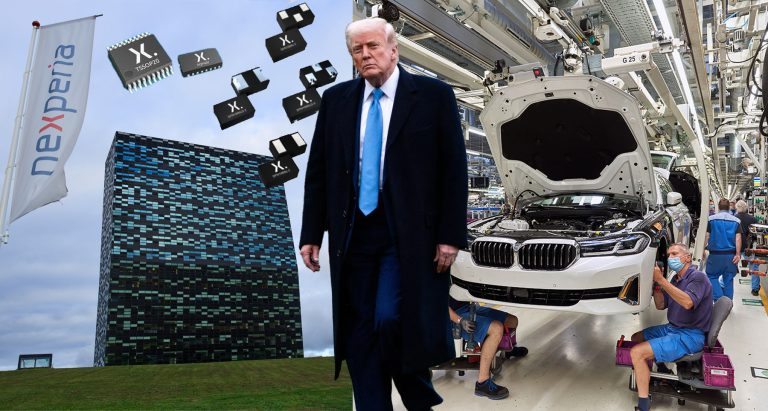
This dramatic escalation of global trade tensions was caused by the Dutch government’s seizure of Chinese-owned semiconductor firm Nexperia after U.S. threatened to sanction the company for its Chinese links. The takeover of the company, and removal of its Chinese CEO, triggered a retaliatory export ban from China, threatening to halt vehicle production across Europe.

This chain of events, rooted in geopolitical pressures from the United States, has left European automakers scrambling for alternatives as supplies of critical chips dwindle. The European Automobile Manufacturers’ Association (ACEA) has issued an urgent call for resolution, warning of imminent disruptions. Here is how American pressure on global trade, increased many fold under Donald Trump’s presidency, is causing disruptions across the oceans.

Nexperia and its strategic importance

Nexperia, headquartered in Nijmegen, Netherlands, is a leading producer of high-volume semiconductors used in automotive, consumer electronics, and industrial applications. The company manufactures older generations of semiconductors in large numbers, not the latest chips like GPUs and AI processors.

These “mature” chips power essential components like electronic control units in vehicles, making them indispensable for modern manufacturing. The company is also one of the world’s largest makers of simple computer chips such as diodes, transistors, and MOSFETs (Metal Oxide Semiconductor Field-Effect Transistors, a type of semiconductor device used for switching and amplifying electronic signals) used in large numbers in almost every electronic and electrical equipment. These relatively simple chips perform unglamorous but absolutely vital functions in vehicles and other machinery. The company makes around 50 billion components annually.

Originally spun off from Dutch giant NXP in 2017, Nexperia was acquired by China’s Wingtech Technology in 2019 for approximately $3.6 billion. This acquisition created a dual ownership structure, while Wingtech, a Shanghai-listed company with significant Chinese state ties, holds majority control, including through its CEO Zhang Xuezheng’s stake, Nexperia maintains its operational independence with a global footprint.

This setup has allowed it to leverage European innovation and Chinese manufacturing scale, but it has also exposed the company to geopolitical risks, as Western governments are increasingly worried about Chinese influence over critical technologies.

Even after the Chinese acquisition, Nexperia has operated with research, development, and manufacturing sites across the Netherlands, Germany, Britain, the United States, and Asia, including China, employing over 14,000 people and generating billions in revenue. Its vertically integrated supply chain includes front-end wafer fabrication primarily in Europe with sites in Hamburg, Germany, and Manchester, UK, and back-end assembly and testing in Asia, notably in Guangdong, China, alongside facilities in Malaysia and the Philippines.

For ease in understanding, this can be compared with Tata’s upcoming two semiconductor plants in India, while its Gujarat plant will fabricate the wafers, the final semiconductor chips will be assembled, packaged and tested at its Assam plant. While Tata’s production extends into different states in India, Nexperia’s production extends in different continents.

This hybrid model of Nexperia, design and initial production in Europe and then with cost-effective finishing and assembly in Asia, has made Nexperia a key supplier, producing over 100 billion components annually. However, the reliance on cross-border flows has made it vulnerable to trade disruptions, particularly in the automotive sector, where its chips are integral.

The company’s dual European-Chinese identity has made it a flashpoint in the U.S.-China tech war. Nexperia’s chips are vital for Europe’s automotive sector, which has already endured chip shortages during the COVID-19 pandemic and geopolitical conflicts. Losing access to these components could cripple production lines, as alternatives require months of homologation and testing.

U.S. pressure leads to Dutch government takeover

The saga began escalating earlier this year amid heightened U.S. scrutiny of Chinese influence in global technology supply chains. U.S. officials, under the Trump administration, viewed Nexperia’s Chinese ownership as a national security risk, fearing potential technology transfers or supply manipulations by Beijing in a crisis. Given that Nexperia is benefiting from major researches in Europe and USA, the Trump admin believe China can access such intellectual property through the company.  

In June 2025, Washington warned Dutch authorities that Nexperia risked being added to the U.S. Entity List, a blacklist restricting exports of American technology, unless changes were made, particularly regarding the company’s CEO, Zhang Xuezheng, who holds a controlling stake in Wingtech.

Then in September, the U.S. govt issued a new rule expanding its Entity List, to automatically include subsidiaries owned 50% or more by a company already on the list. The action was aimed at stopping export of critical technology and equipment to Chinese companies. This new rule applied to Wingtech, Nexperia’s parent company, bringing Nexperia under indirect U.S. export control. 

Along with this American pressure, concerns over governance issues at Nexperia also existed, including allegations of mismanagement such as forcing unnecessary wafer orders worth $200 million, firing executives who protested, and conflicts of interest tied to Zhang’s other business interests.

On 30 September, the Dutch government took over the control of Nexperia invoking the rarely used 1952 Goods Availability Act, a Cold War-era law allowing intervention in private companies to secure critical goods during emergencies. The govt cited worries about the possible transfer of technology to Nexperia’s Chinese parent company Wingtech.

This “highly exceptional” move placed Nexperia under temporary external management, suspending Zhang from his roles and transferring control to a court-appointed administrator. The Dutch Ministry of Economic Affairs cited “serious governance shortcomings and actions” that threatened the continuity of Nexperia’s operations and the safeguarding of vital technological knowledge on European soil. Officials argued that without intervention, Europe could face shortages in semiconductors, jeopardizing economic security, especially in the automotive industry.

The Dutch govt move was preceded by an Amsterdam commercial court order to suspend Wingtech CEO Zhang Xuezheng from his position as executive director at Nexperia. The court appointed Dutch businessman Guido Dierick to take Zhang’s position with a “deciding vote”, and transferred control of almost all of Nexperia’s shares to a Dutch lawyer for management. 

The takeover does not involve outright nationalization, instead, it restricts major decisions on assets, personnel, or business changes for up to a year, ensuring production continues while blocking potential relocations or tech transfers to China.

Wingtech denounced the action as “excessive intervention driven by geopolitical bias,” emphasizing Nexperia’s compliance with local laws and its local employment contributions. The company said in a filing to the Shanghai stock exchange that its control over Nexperia would be temporarily restricted due to the Dutch order and court rulings, affecting decision making and operational efficiency.

This move echoes prior U.S.-influenced actions, such as the 2022 forced sale of Nexperia’s UK wafer fab in Newport due to security concerns.

China’s retaliatory export ban and its impact on Europe

Beijing responded swiftly and decisively to the Dutch intervention. On October 4, 2025, just four days after the takeover, China’s Ministry of Commerce issued an export control notice under its Export Control Law, prohibiting Nexperia China, the company’s subsidiary in Guangdong, and its subcontractors from exporting certain finished components and sub-assemblies to Nexperia and its affiliates outside China.

The ban specifically targets products manufactured in China, framing it as a countermeasure to “unilateral” foreign actions that undermine Chinese enterprises’ rights. This was not a blanket prohibition on all Nexperia activities but a targeted restriction on outbound shipments of completed semiconductors, effectively severing a critical link in the company’s global operations.

“The Chinese Ministry of Commerce issued an export control notice prohibiting Nexperia China and its subcontractors from exporting specific finished components and sub-assemblies manufactured in China,” the firm said.

This has caused major disruptions to Nexperia’s chip supplies to its customers Europe, because of intricate supply chain even though it is based in Europe. The company employs a “fab-lite” model where front-end processes, like wafer fabrication and initial chip design, take place at its European facilities in Hamburg and Manchester. Raw silicon wafers are fabricated at these facilities. These wafers are then shipped to assembly sites in Asia, including Guangdong, China, for packaging, testing, and final assembly into usable chips. Essentially, the company makes the circular wafers in Europe, which are then cut into and packaged as individual chips.

Once completed, these finished products are exported back to Europe or directly to global customers, including automotive suppliers. China plays a pivotal role in this chain, handling a significant portion of the high-volume, low-cost assembly, estimated at up to 30-40% of Nexperia’s total output, due to its advanced facilities and cost efficiencies.

The export ban disrupts this flow by halting shipments from China to non-Chinese Nexperia entities or customers. As a result, even though Nexperia’s European fabs continue operating, they cannot receive back the assembled chips needed for final distribution. This creates a bottleneck, stockpiles of unfinished wafers pile up in Europe, while finished chips remain stranded in China.

For European carmakers, this means a sudden shortfall in critical components like power management ICs and transistors, which are not easily substitutable due to automotive qualification standards requiring rigorous testing that often take 6-12 months. Nexperia has other Asian sites in Malaysia and the Philippines, but these lack the capacity to fully compensate for the Chinese output, leading to delays and shortages.

The ban’s precision, allowing domestic Chinese sales but blocking exports, amplifies pressure on Europe without broadly harming China’s economy and its growing automobile industry, which has increased its share in Europe significantly. This means, while European carmakers can’t produce their vehicles, Chinese carmakers like BYD and MG can increase their exports to Europe.

Nexperia confirmed the restrictions in a statement, noting active engagement with Chinese authorities for an exemption.

ACEA’s Distress Signal

On October 10, 2025, Nexperia notified automakers and suppliers that it could no longer guarantee chip deliveries due to Chinese export ban, with current stocks expected to last only a few weeks. The company outlined a sequence of events that makes them no longer being able to guarantee delivery of their chips to the automotive supply chain.

As a result, the European Automobile Manufacturers’ Association issued a distress note on 16th October, saying that European automotive suppliers cannot build the parts and components needed to supply vehicle manufacturers without these chips, and therefore it threatens production stoppages. It stated, “While the industry already sources the same types of chips from alternative players on the market, the homologating of new suppliers for specific components and the build-up of production would take several months, while current stocks of Nexperia chips are generally predicted to last only a few weeks.”

ACEA Director General Sigrid de Vries said, “We suddenly find ourselves in this alarming situation. We really need quick and pragmatic solutions from all countries involved.”

Major carmakers also sounded alarms. BMW said its supplier network is impacted but there is no immediate production stops. The company said it is closely monitoring risks. Volkswagen echoed similar concerns, noting Nexperia’s role in its supply chain without current disruptions. Mercedes-Benz and Stellantis are assessing impacts and developing mitigations, though details on direct exposure vary. Even suppliers like Bosch, which uses Nexperia chips, are on high alert.

The Dutch government has realised the gravity of the consequence of its actions, and Minister for Economic Affairs Vincent Karremans said that he wants to find a solution with China regarding the Chinese export ban on Nexperia chips. Karremans is optimistic that the talks will progress positively.

The crisis extends beyond Europe, with some sections warnings that U.S. auto production could also be affected, highlighting the global interdependence of supply chains. The Alliance for Automotive Innovation, representing a large group of US automakers, has warned of potential supply issues.

Trump’s Dictates Causing Disruptions in Europe

Although the issue emerged due to the actions of Dutch and Chinese governments, at the heart of this turmoil are the aggressive trade policies of U.S. President Donald Trump, whose second term has intensified the U.S.-China tech war. Trump’s administration has prioritised “decoupling” from Chinese technology, imposing entity list designations and pressuring allies in Europe and Asia to restrict Chinese-owned firms. In December 2024, Wingtech was added to the U.S. Entity List as a security concern, barring U.S. exports without approval. Then in September 2025, Nexperia was added to the list, along with demands to remove its CEO which was accepted by the Dutch.

USA and Trump’s dictates, framed as protecting national security, have forced European nations into uncomfortable positions, balancing U.S. alliances with economic ties to China. The Dutch takeover, while justified domestically on governance grounds, was explicitly accelerated by U.S. threats, leading to China’s ban and the ensuing chip crunch. This has disrupted Europe’s automotive sector, already grappling with tariffs, weak demand, and competition from Chinese EVs.

This is just one instance of how Trump’s unilateral approach is undermining global trade stability, turning allies like the EU into collateral damage in his broader agenda against Beijing, and Russia. For example, his insistence on not purchasing Russian oil and gas has already put lots of pressure on Europe, traditionally heavily dependent on Russian energy sources.
Inside Xi Jinping’s latest purge: Why China just expelled its No. 2 general and eight top commanders before a crucial Communist Party session

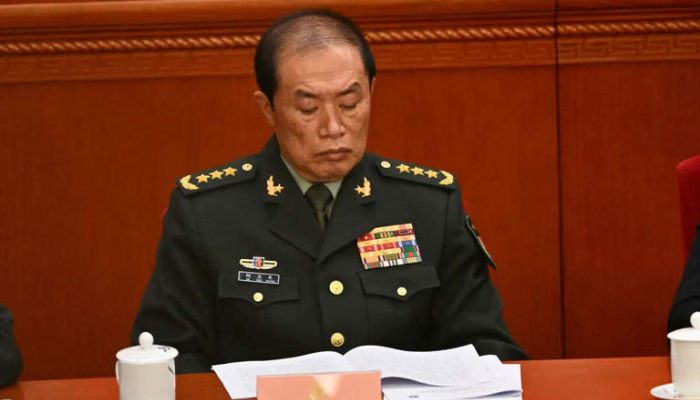
China’s ruling Communist Party has publicly fired nine of its top generals, including the military’s second-in-command, He Weidong. The defence ministry announced on Friday,17th October, that the generals were kicked out of both the army and the Communist Party for “serious violation of party discipline” and work-related crimes involving a huge amount of money.

For the last 12 years, China’s leader, President Xi Jinping, has been leading a massive anti-corruption campaign. This crackdown has affected over a million officials across the country, from local leaders to the very top brass of the military. While the government says the goal is to create a cleaner, stronger party, many critics believe it’s also a political purge used by Xi to remove anyone who isn’t completely loyal and to secure his total control over the party and military.

Who are the fired Generals

The biggest name on the list is He Weidong. He was one of the most powerful men in China, serving as the vice-chairman of the Central Military Commission (CMC), the body that controls the entire armed forces. He was also a member of the 24-man Politburo, the party’s top decision-making circle. His removal is especially significant because he’s the first serving Politburo member to be investigated in this way. He hadn’t been seen in public since August, which had already fueled rumours that he was in trouble.

The other eight high-ranking officials who were removed include:
Miao Hua, The military’s head of political work and personnel; He Hongjun, Miao Hua’s deputy; Wang Xiubin, A top director at the military’s joint operations command centre; Lin Xiangyang, Commander of the Eastern Theatre; Qin Shutong, The Army’s political chief; Yuan Huazhi, The Navy’s political chief; Wang Chunning, Commander of the Armed Police Force.

A pattern of disappearances

The crackdown has created visible instability within China’s military leadership. He Weidong is the third member of the CMC to be removed since 2022. In fact, of the seven leaders appointed to the powerful commission just a few years ago, only four remain. This level of turnover at the top is something that hasn’t been seen in decades.

This follows the removal of other top figures, including two former defence ministers, Wei Fenghe and Li Shangfu, and the sudden disappearance of the foreign minister, Qin Gang, in 2023. Ironically, one of the newly fired generals, Wang Houbin, was himself a replacement for another group of Rocket Force commanders who were purged earlier.

Why the timing of the announcement matters

The timing of this announcement is no coincidence. It comes just before a key meeting of the Communist Party, called the plenary session, scheduled from October 20th to 23rd. At this meeting, top leaders will discuss the country’s new five-year plan and major economic challenges. By making such a bold move now, Xi Jinping is sending a powerful message of strength and control.

A military spokesman said the investigation was a significant achievement that shows there is no place for corrupt officials to hide within the military. However, analysts like Neil Thomas from the Asia Society Policy Institute suggest there’s a downside. While the purges might make the system more obedient, they also create a climate of fear, making officials more cautious and at times, more brittle.

Everyone is now watching to see who actually shows up at the big party meeting. Low attendance would be the clearest signal yet of just how deep this political purge really goes.

Bihar Elections: Mahagathbandhan turns into maha-mess, no candidate list, no seat sharing agreement, candidate clashes on multiple seats on the last day of nomination

As the upcoming assembly elections in Bihar are nearing, the faultlines within the opposition Mahagathbandhan in the state have started emerging. Contesting with the hopes of a regime change in the state, the opposition alliance appears to be struggling to put up a unified and strong opposition before the ruling NDA.

Coping with internal conflict and confusion, the Mahagathbandhan failed to announce any seat-sharing agreement on Friday (17th October) as the deadline for filing nominations for the first phase of the two-phase assembly elections ended. The Mahagathbandhan allies the RJD, Congress, CPI (ML-L), CPI (M), CPI and Vikassheel Insaan Party (VIP) filed nominations for all 121 seats in the first phase of polls, out of the total 243 assembly seats of the state. The nominations for the seats in the second phase of polls end on Monday (20th October).

Opposition allies field candidates against one another on several seats

The opposition alliance’s internal tussle over seat sharing became public after their candidates filed overlapping nominations against their Mahagathbandhan allies on several seats. There are six such assembly seats, viz. Bachhwara, Vaishali, Gauda Baram, Rosera, Lalganj and Rajapakad in the first phase of elections, where Mahagathbandhan party candidates have filed nominations against their alliance partner. For example, at the Vaishali and Lalganj assembly seats, both Congress and the RJD have fielded their candidates. On the Vaishali assembly seat, Congress has fielded Sanjeev Singh from Vaishali, while the RJD has nominated Abhay Kushwaha. Similarly, on the Lalganj assembly seat, the Congress has fielded Aditya Raj, and the RJD has put up Shivani Singh, daughter of former Lalganj MLA Munna Shukla. A similar equation is said to have emerged on the Kutumba assembly seat, where Congress and RJD have pitched their candidates against each other. On the Bachhwara and Rosera assembly seats, the Congress and CPI candidates are contesting against each other.

Besides, the Congress has unilaterally released a list of 48 candidates and has given out tickets for five constituencies of Kahalgaon (Praveen Kushwaha), Pranpur (Touqir Alam), Jale (Rishi Mishra), Chainpur (Achala Singh) and Gaya Town (Mohan Srivastava). In the Kahalgaon assembly, the Congress is facing a challenge from the RJD.

Moreover, the CPI (ML-Liberation) has also independently announced the names of its 18 candidates for the first phase of polls. The VIP is holding on to its demand to project its leader, Mukesh Sahani, as the Deputy Chief Ministerial candidate. The party has also finalised 14 seats for the first phase of polls. After failing to reach an agreement regarding the seat-sharing, Mukesh Sahani announced that he will not contest the upcoming Bihar Assembly elections.

The Mahagathbandhan parties’ inability to agree on the seats has exposed a lack of unity and consensus within the alliance. While the opposition alliance is grappling with internal discord and unending negotiations over seats and candidates, their rival, the NDA, has finalised the list of candidates for all 243 assembly seats and kick-started the election campaign with full fervour.

Confusion regarding CM candidate of the alliance

The discord within the opposition alliance is not limited to the seat-sharing arrangement, and also extended to the decision regarding the Chief Ministerial candidate of the alliance. After prolonged negotiations, a consensus seems to be building among the Mahagathbandhan regarding the CM candidate. The Congress party recently proposed Rashtriya Janata Dal (RJD) leader Tejashwi Yadav as the Bihar CM face of the alliance. This comes after Congress leaders sought clarity on the name of the CM candidate of the alliance.

Discord within opposition alliance is a usual pattern

The internal conflict of the opposition alliance is not something happening for the first time; the lack of concord among the opposition alliance partners surfaces before every state-level or national-level election. The reason behind this perpetual lack of consensus and unity is that the alliance is an blend of political parties with different and sometimes opposing ideologies, which came together to put up a fight to throw the NDA out of power. However, election after election, the struggle has hardly yielded favourable results for the grand alliance. One of the reasosns behind this is that instead of putting their might in fighting their rival, the opposition alliance parties end up struggling among themselves to protect their own petty interests. This stems from the fact that the opposition alliance units do not have an underlying unified vision for either the national or the state-level elections. Their sole mission is to grab power by hook or crook by defeating the NDA. The election strategy of the INDI alliance keeps changing from one state to another, which leads to the voter being confused. In some states, the opposition alliance partners contest independently, while in other states, they fight in alliance.

The opposition parties are fixated on their sole objective of defeating the NDA. Instead of trying to connect with the voter by focusing on their issues and problems and offering solutions for them, the opposition’s entire strategy revolves around attacking the ruling NDA but manufacturing imaginary problems, which fail to resonate with the voter. Looking at the trajectory of the opposition alliance ahead of the Bihar assembly elections, it will be no surprise if they end up continuing with their role of opposition after the elections.

The voting for the 121 seats in the first phase of the Bihar Assembly Elections, 2025, will happen on November 6, 2025. The second phase of voting for the remaining 122 seats will take place on November 11, 2025. The election results will be announced on November 14, 2025.

No misleading products, only WHO-approved ORS: Read the meaning behind FSSAI’s new rulling and how harmful sugary drinks were sold with the misleading label

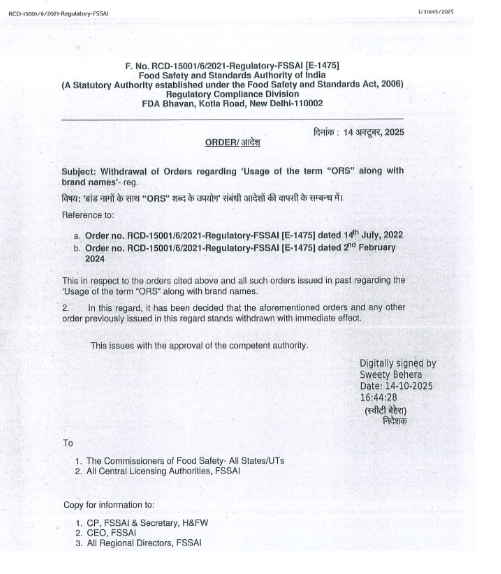
The Food Safety and Standards Authority of India (FSSAI) has issued a significant regulatory decision asking brands not to put ORS (Oral Rehydration Salts) labelling on their products unless they comply with World Health Organisation (WHO) formula for ORS recommended for diaorhea. The directive was issued on 14th October and places stringent restrictions on the usage of the label by food business operators. Furthermore, the earlier order allowing the ORS with disclaimer has been revoked effective immediately.

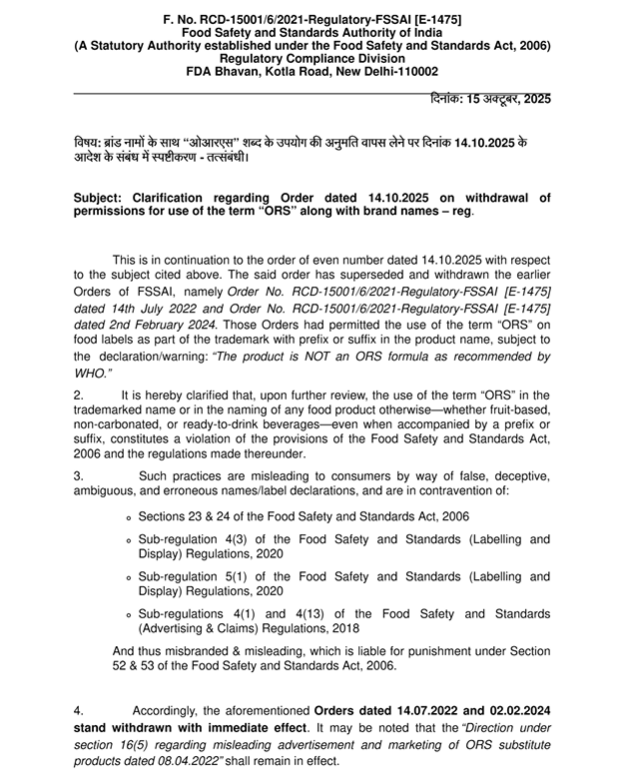
A second notification was released on 15th October. It explained that prior rulings in 2022 and 2024 authorised the use of the term “ORS” on food labels, even with a prefix or suffix in the product name, provided that the following statement or caution was included: “The product is NOT an ORS formula as recommended by WHO.” But now this has been withdrawn.

The official statement conveyed, “It is hereby clarified that, upon further review, the use of the term ORS in the trademarked name or in the naming of any food product otherwise-whether fruit-based, non-carbonated, or ready-to-drink beverages even when accompanied by a prefix or suffix, constitutes a violation of the provisions of the Food Safety and Standards Act, 2006 and the regulations made thereunder.”

FSSAI now says that the use of ORS branding in non-ORS products deceive consumers by using misleading, ambiguous and inaccurate names as well as label declarations and it violates several rules and regulations. It futher added, “Direction under section 16(5) regarding misleading advertisement and marketing of ORS substitute products dated 08.04.2022 shall remain in effect.”

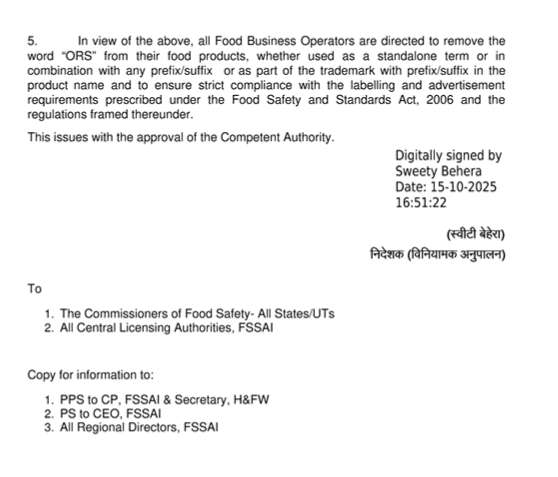
Hence, the notice declared that all food business operators are required to eliminate the term ORS from their food products, regardless of whether it is used alone, together with any prefix or suffix, or as part of a trademark. They are told to strictly adhere to the labelling and advertising requirements set forth in the Food Safety and Standards Act, 2006, and its implementing regulations.

Growing worries about the ORS label being misused and endangering children prompted this adjustment. The objective is to guarantee that only safe and efficient products are accessible to people who require them, emphasising the significance of maintaining children’s well being, particularly during public health emergencies.

Foundation of the regulation

The initial guidelines to curb deceptive advertising that promotes items as “ORS substitutes” was issued by the FSSAI in April 2022. The goal of the action was to stop consumers from believing that electrolyte or flavor-infused drinks are medically equal to ORS that have been approved by the WHO which is utilised to treat dehydration caused by diaorhea.

The regulator allowed non-ORS products to use ORS branding in July 2022 in response to submissions from impacted food companies and a Delhi High Court case. It allowed food business owners who had legitimate trademarks that included the term “ORS” to continue manufacturing these products until the Controller General of Patents, Designs and Trademarks (CGPDTM) reached a decision.

Operators of food businesses without such trademarks would have to stop using them, since the FSSAI made evident that the CGPDTM’s conclusion would be legally obligatory. Companies were additionally required to prominently display a notice on the front of the package mentioning, “The product is not an ORS formula as recommended by WHO,” and that they should not be used in Diarrhea.

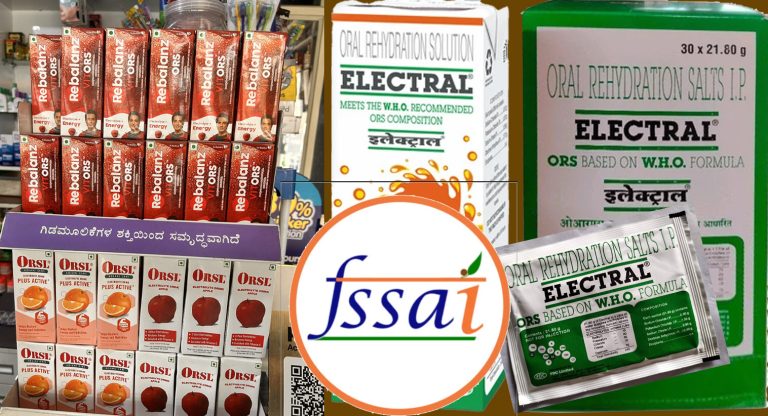
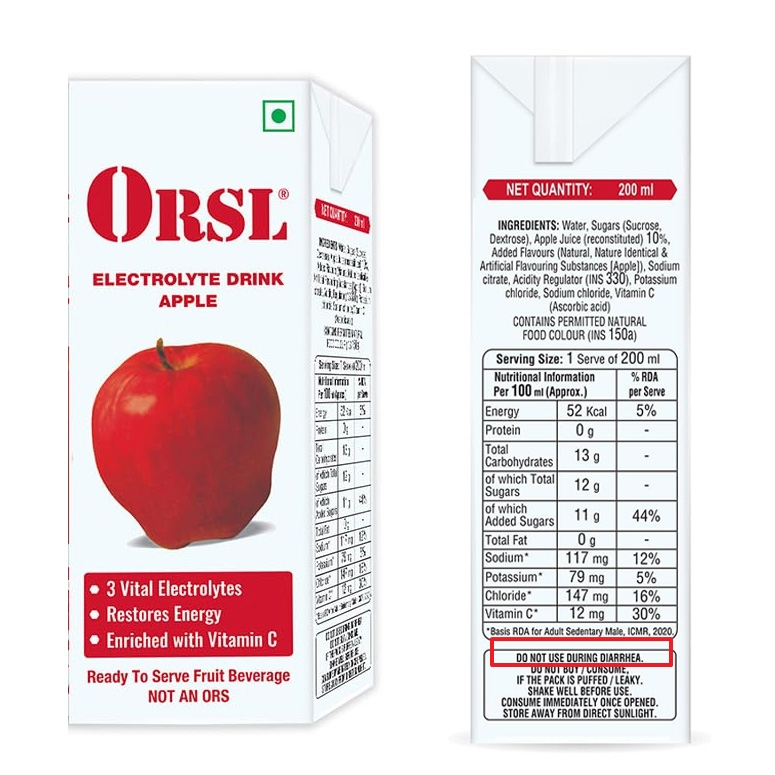
Declaration on the packaging of ORSL, sold in pharmacies and often mistaken to be ORS

Companies were permitted to use “ORS” with prefixes or suffixes for as long as they conform to Section 17 of the Trade Marks Act, 1999, which regulates the use of composite trademarks, the FSSAI further stated in February 2024. The order reaffirmed the need for businesses to specify that their use of “ORS” was merely a brand or fancy moniker.

More importantly, it did not accurately represent the nature of the product in accordance with the Food Safety and Standards (Advertising and Claims) Regulations, 2018. The regulator had set precise font size specifications for these disclaimers, scaling them to match the measurements of the product’s main display panel to prevent customer confusion. These guidelines went into effect on 1st April 2024.

The FSSAI has removed all of the aforementioned restrictions with the latest notification. Now, only the Trade Marks Act and basic labelling laws prohibiting misleading claims will apply to the use of “ORS” in trademark names.

A paediatrician’s 8-year long battle for the victory

The landmark ruling by the central authority was not an unforeseen event. It followed years of dedicated advocacy by Dr Sivaranjani Santosh against the misuse of sugary drinks that are advertised as ORS. This paediatrician and first-aid trainer based in Hyderabad had been fighting for the same for at least 8 years.

She has long been a promoter for the safe use of ORS and run a campaign to expose dishonest marketing tactics used by companies who label non-medical beverages as such without appropriate clinical support. Her efforts centred on the dangers that such mislabeling posed, particularly to children who are experiencing dehydration or diarrhoea.

“We have won it. A clarification was issued today. No one can use ORS on their label unless it is a WHO recommended formula and no one can sell it right from today,” the doctor rejoiced.

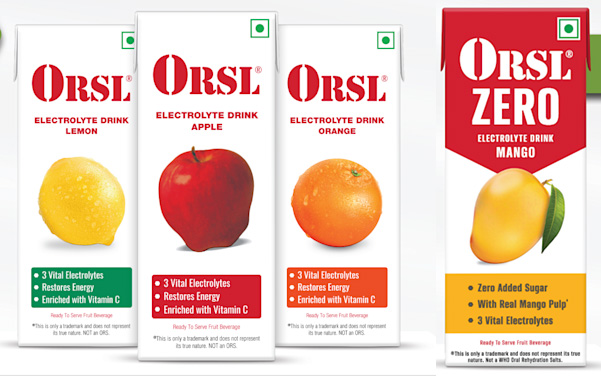
“During diarrhoea, high-sugar drinks should be avoided because excess sugar can worsen the condition. When ORSL (Oral Rehydration Salts Liquid) was introduced, manufacturers met with paediatricians, leading many to believe it was ORS. But in reality, the sugar content in ORSL is as high as in packaged soft/fruit drinks, with only a little extra sodium. We noticed that many children’s diarrhoea worsened. When we investigated we realised ORSL is not the same as ORS,” Dr Santosh pointed out earlier.

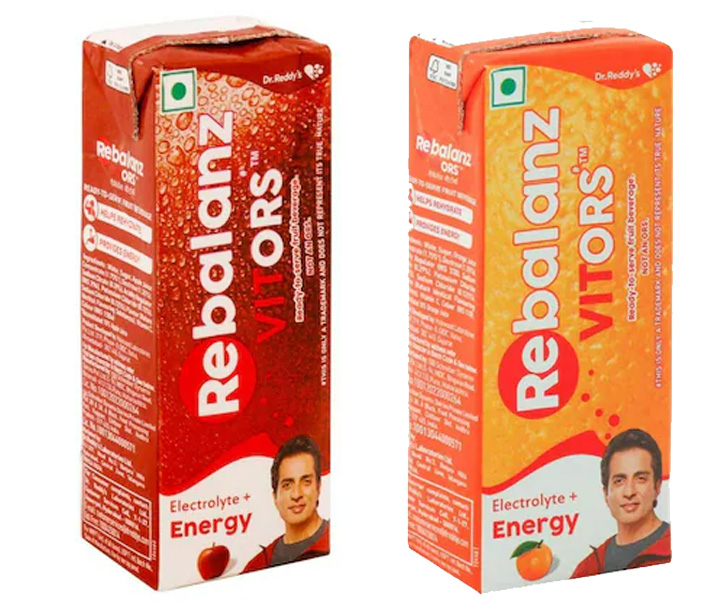
Products like ORSL, RebalanzVitORS and ORSFIT which purport to be ORS but do not comply to the World Health Organization’s formulation guidelines sparked her reservations. Dr Santosh cautioned that using liquids with high sugar alternatives to cure diarrhoea could prove dangerous.

Many child fatalities driven by complications from diarrhoea are unrecognised. However, these deaths are frequently reported as “diarrhoea and dehydration” without taking into account the possibility that these sugary drinks might be a contributing factor. She even requested her colleagues to maintain a record of the particular fluids administered to children who pass away from diarrhoea.

“ORS is a life-saving therapy that has saved millions of lives. But we are now seeing a surge in products that misuse the ORS label to sell high-sugar drinks with osmolarity levels that can actually worsen diarrhoea,” Dr Santosh similarly stated.

She underlined that despite having sugar levels six to ten times greater than the WHO radvised formula, many well-known brands are frequently marketed as rehydration solutions. These products are licensed under the Food Safety and Standards Authority of India (FSSAI) rather than the Central Drugs Standard Control Organisation (CDSCO) which oversees therapeutic ORS products, despite being sold in pharmacies and frequently recommended for dehydration associated with diseases like dengue and typhoid.

“Disclaimers are not enough. Most parents, and even some doctors, are misled by the packaging. These drinks are not only ineffective but dangerous for sick children and people with diabetes,” the paediatrician added in reference to “This is not an ORS” written on the products.

She demanded greater regulatory action, calling for the outright prohibition of the use of “ORS” on such products, their removal from hospital and retail pharmacies alongside the enforcement of WHO-approved formulations as the sole accepted method of addressing dehydration. She also urged medical professionals to refrain from endorsing these dubious substitutes.

Dr Santosh approached Telangana High Court

Dr Santosh spread awareness on the issue through workshops, media outreach and social media sites like Facebook and Instagram. The Central Drugs Standard Control Organisation (CDSCO) directed her to the Food Safety and Standards Authority of India (FSSAI) after she brought the matter to their attention in 2023.

The FSSAI issued an order in April 2023 to prevent ORSL from being mislabeled. The decree was changed in July, though, to permit enterprises with a legitimate trademark retain using the term ORS if they incorporated a disclaimer.

Some companies started including warnings on ORSL tetra packs that read, “Do not use during diarrhoea.” However, these were frequently printed in tiny fonts which were easy to miss. Dr Santosh outlined, “Pharmacists also prefer selling ORSL because they earn a higher margin, as ORSL is twice as expensive as standard ORS solutions.”

She challenged the sale of drinks that were mislabeled as ORS even though they didn’t meet WHO-recommended electrolyte and glucose requirements, in a Public Interest Litigation (PIL) brought before the Telangana High Court, in 2022.

According to the petition, a number of businesses sold “fruit juices” and other sweetened beverages as oral rehydration treatments, which is harmful especially for diabetes patients and children. Rajesh Bhushan, the then-secretary of the Ministry of Health and Family Welfare, was also notified of her complaints which led to regulatory and judicial investigation.

However, companies promoted ORSL in response to the plea by introducing the false notion of “silent dehydration,” a phrase that is not used in any medical literature.

“It was a war. Eight years of battle, three years of filing PILs, and four to five years of fighting indifference. This victory belongs not to one person, but to people’s power, all the doctors, advocates, moms and influencers who stood with me. I stood steadfast, and we won,” she expressed after the fresh FSSAI decision.

Healthcare experts warned against taking sugary drinks imitating ORS

“Diarrhoea leads to quick fluid loss, electrolyte imbalances, and dehydration. ORS is a straightforward yet highly effective method to replenish these lost fluids and electrolytes, preventing complications and aiding faster recovery, especially in young children. It’s crucial to recognize that ORS is both safe and effective. Using incorrect salt or sugar mixtures can be harmful. Proper management of dehydration requires an exact balance of water and electrolytes,” Dr Pankaj Garg stated during a press conference last year.

“Using incorrect homemade solutions or sugary drinks can disrupt this balance, causing severe health risks like worsening dehydration or even death in extreme cases,” warned Garg who is the President-Elect, Indian Academy of Pediatrics, Delhi Chapter & Senior Consultant, Neonatology in Sir Gangaram Hospital.

Additionally, he said that there were several “ORS-like” treatments on the market that can exacerbate symptoms, particularly in young patients. Likewise, Dr Mohsin Wali, Padma Shri and Consultant Physician at Sir Ganga Ram Hospital also stressed the importance of choosing the right ORS in view of rising temperatures and demand.

He highlighted, “Choosing the right ORS is crucial for effectively managing diarrhoea and dehydration, especially during the hot summer months. It’s essential to distinguish between ORS and sugary drinks available commercially. While these beverages may offer some electrolytes and fluids, they lack the critical glucose-sodium and potassium balance necessary for rapid and effective rehydration.

Wali further mentioned, “Sugary drinks may provide temporary relief but do not address the core issue of dehydration. Therefore, opting for WHO-approved ORS formulations, which are specifically designed for this purpose, is vital for maintaining overall health and ensuring quick recovery, particularly in vulnerable populations such as children.”

The experts stressed the value of making well-informed decisions. They emphasised that ORS solutions that have been approved by the WHO should be given priority over other sugar-filled drinks that are not suitable for relieving dehydration. They added that the correct knowledge could save thousands of children’s lives anually.

Meanwhile, these ORS imitations also impacted the health of diabetic patients. A 52-year-old diabetic who had managed his blood sugar levels for many years ended up in the emergency department following a stomach ailment and was found to have kidney failure, in 2024, reported The Times of India.

Doctors confirmed that he had consumed roughly seven packs of ORS lookalikes which contributed to his diarrhoea and caused his blood sugar to jump sharply.

There had been around ten such cases in just one week at the emergency rooms of significant tertiary care facilities including Gandhi Hospital and Osmania General Hospital (OGH). Additionally, endocrinologists also witnessed some cases of blood sugar spikes due to mislabeled ORS drinks.

Likewise, a 42-year-old businessman fell at home from severe dehydration and uncontrolled blood sugar after attempting to continue his daily walking routine in spite of the heat after downing a few of these “ORS” drinks. “I was given these energy drinks every time I asked for ORS and it happened at three different pharmacies in my area,” he voiced.

Three other patients with diabetes were also in the emergency rooms with diabetic ketoacidosis (DKA). All of them, age from eight (Type 1) to forty (Type 2), took these drinks.

“When we consume more glucose, the body requires additional insulin to digest it. But in case of diabetics, when the body cannot produce enough insulin, it leads to build up of acids in the bloodstream called ketones. This results in DKA, which makes the blood too acidic and it needs immediate intervention,” informed Dr KVS Hari Kumar, consultant endocrinologist.

Dr R Santosh, another endocrinologist, conveyed, “These sugary ORS lookalikes not only cause a spike in blood sugar but also pull out water from the kidney, causing extreme dehydration. The more a patient drinks these, the more the condition worsens.”

What is ORS

ORS is employed to treat dehydration specifically in kids who have severe diarrhoea, sweating, heat stroke or other conditions that result in considerable fluid loss. It is an exclusive mixture of sugar, salt and electrolytes that dissolves in purified water. When administered properly, ORS helps prevent diarrhoea and replenishes lost fluids. It’s critical to utilise oral rehydration solution under a doctor’s supervision as misuse could trigger salt poisoning.

Electrolyte solutions with or without glucose were used to empirically develop oral rehydration therapy in the 1940s, primarily for mild or convalescent patients. However, it was not widely used for rehydration and maintenance therapy until the 1960s when it was discovered that glucose improved the absorption of water and sodium during cholera. It is listed as an essential medicine by the World Health Organisation.

As of 2017, 44% of children with diarrhoea worldwide were receiving oral rehydration treatment. The rate of mortality among children under five has dropped substantially as a result of this. Approximately 61% of Indian children under five who had diarrhoea were given Oral Rehydration Solution (ORS), per a survey conducted in 2021.

This emphasises the necessity of authorised formulations and precise labels which would now be achievable due to the FSSAI order.

WHO-approved ORS vs sugar-loaded substitutes

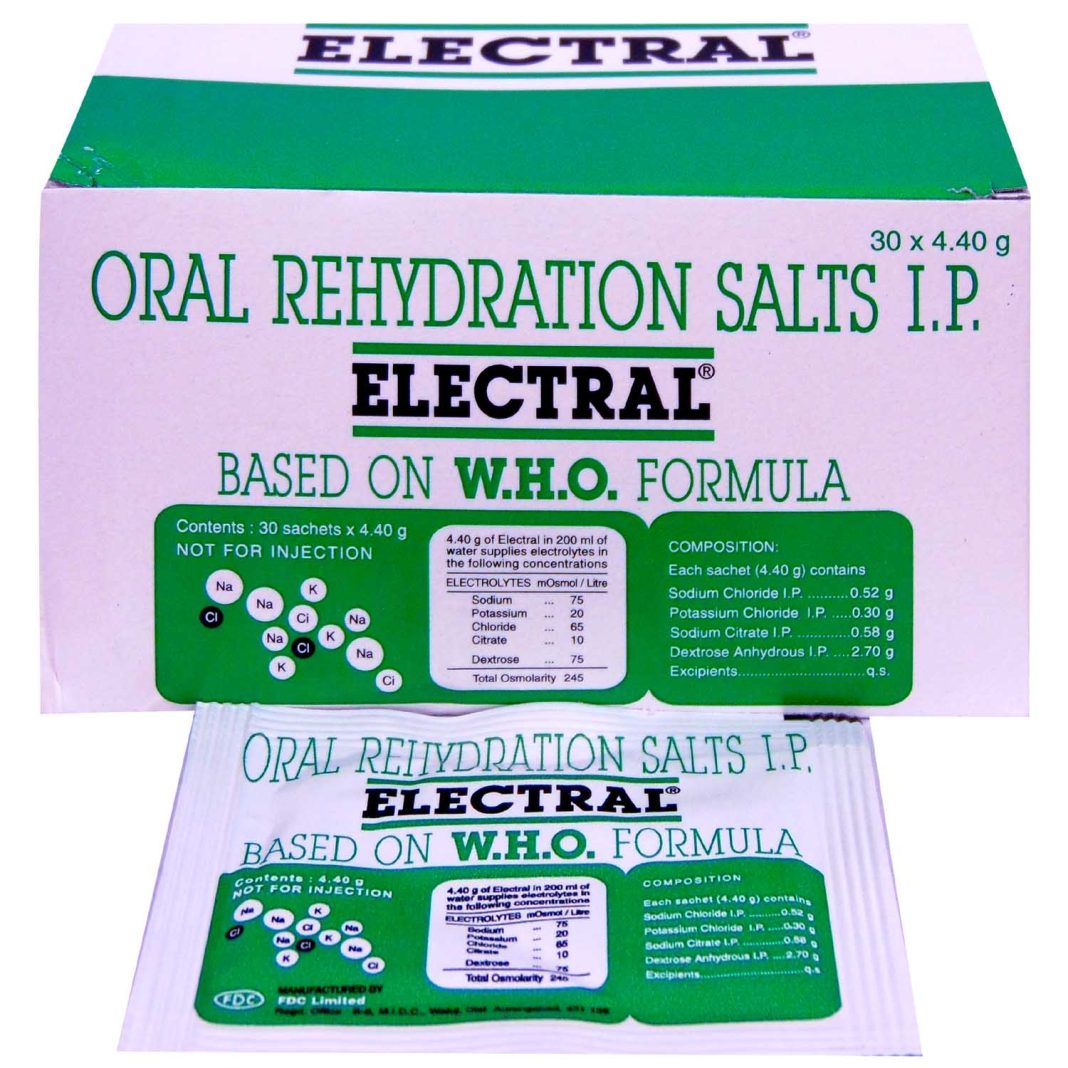
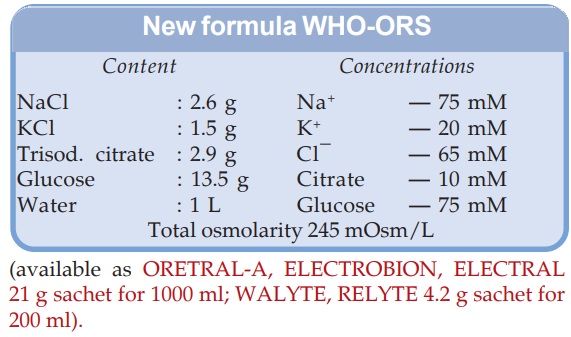
An oral rehydration solution with a total osmolarity of 245 mOsm/L is recommended by the World Health Organisation. For each litre of water, it contains 13.5 grammes of dextrose anhydrous (sugar), 2.6 grammes of sodium chloride, 1.5 grammes of potassium chloride and 2.9 grammes of sodium citrate.

Image via Pharmacy 180

On the other hand, ORS products sold by several pharmaceutical companies have far greater sugar contents, about 120 grammes of total sugar per litre of which over 110 grammes are added sugar. They only provide 1.17 grammes of sodium, 0.79 grammes of potassium and 1.47 grammes of chloride a litre which is also out of line with WHO standards for electrolyte balance.

WHO and UNICEF (United Nations International Children’s Emergency Fund) have been urging for the adoption of a new ORS formulation since 2003 since it is more effective than the previous one. The solution serves as a simple, inexpensive and effective treatment for diarrhoea which is administered orally to patients in all age groups and in all except the most severe instances.

A basic ORS mixture advised by the WHO including six teaspoons of sugar, half a teaspoon of salt in one litre of pure water. Doctors warn that adding other items such as fruit powders or spirulina and consuming excessive amounts of sugar or salt could hinder its effectiveness.

How to identify genuine ORS

The WHO-recommended mixture of water, salt and sugar should be used in the proper oral rehydration solution (ORS) and it should be verified that the packet complies with these requirements. Stevia and monk fruit sweetener are examples of sugar replacements that should be avoided as these could delay rehydration and do not provide glucose.

Some products might make claims about the addition of healthy substances like herbal mixtures, fruit powders or spirulina. However, they are not a part of the original ORS recipe and might lessen its potency. It’s critical to seek medical advice from qualified specialists and be cautious about the information acquired on the internet.

The safest course of action is to get WHO-approved ORS sachets from a reputable pharmacy. These are pre-measured and guarantee the mix is right and safe to ingest.

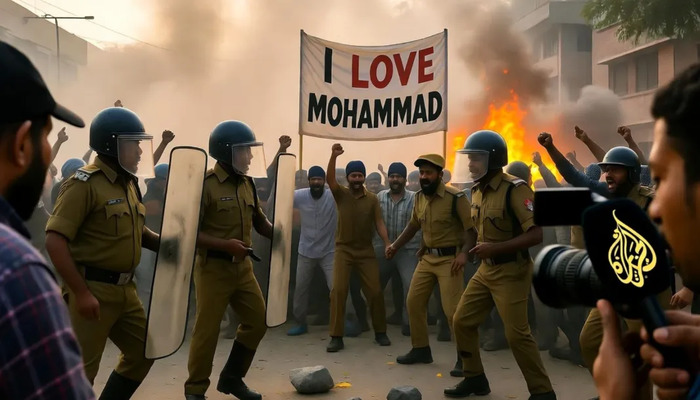
‘I Love Muhammad’ protests: Propagandist media outlet Al Jazeera hides Islamic violence, peddles Islamophobia narrative to malign India

Al-Jazeera, the Qatar government-funded international media outlet which is notorious for spreading anti-India and anti-Hindu propaganda, has once again exposed its anti-India bias. The propagandist media outlet has published a lengthy article about the recent “I Love Muhammad” protests in India. However, in this article, Al-Jazeera has maliciously concealed facts and attempted to portray Muslims as victims of persecution.

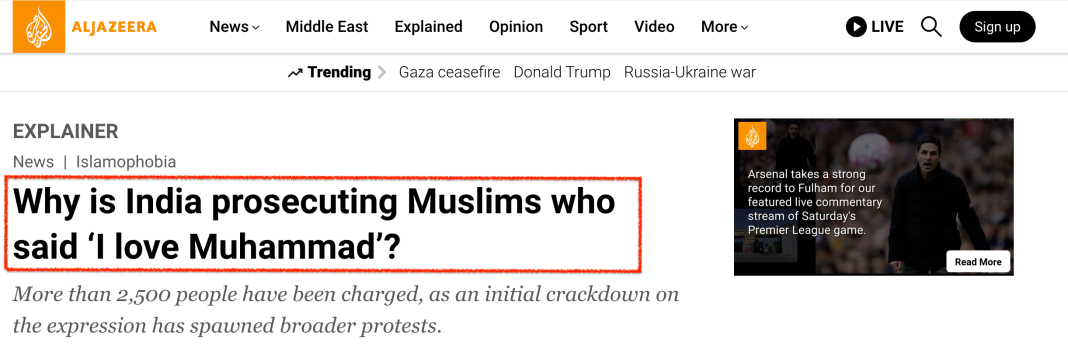
Al Jazeera news headline

The anti-India propaganda in the article begins right with its headline, which reads, “Why is India prosecuting Muslims who said ‘I love Muhammad’?” It’s clear from the headline itself that Al-Jazeera has pre-decided that Muslims are being prosecuted, and then it goes on to explain why the prosecution is taking place.

Is Al-Jazeera lying about the beginning of the ‘I Love Muhammad’ protests?

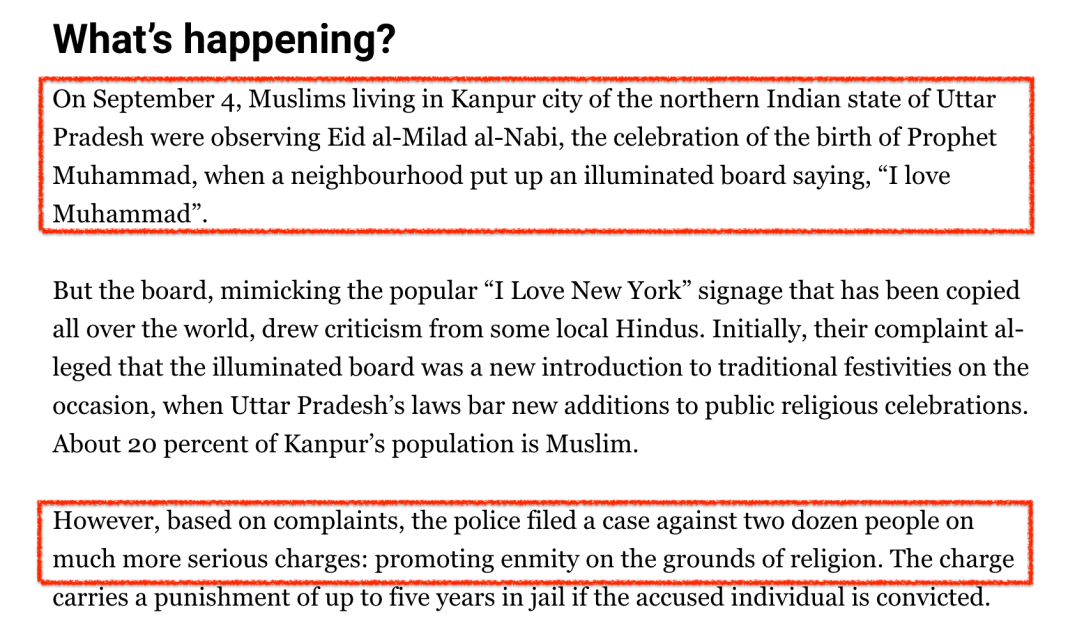
Al-Jazeera concealed the truth about the origin of the ‘I Love Muhammad’ protests. Al-Jazeera reported that on 4th September, a dispute arose in Kanpur over Muslims displaying a sign that read “I Love Muhammad,” and that an FIR was filed based on a complaint. The information provided in Al-Jazeera’s report is incomplete.

Excerpt from Al-Jazeera article

It’s true that there was controversy over the “I Love Muhammad” banner, but the real story is what happened after that. The matter was settled after the billboard displaying the words “I Love Muhammad” was relocated, well within the knowledge of both parties. However, the real controversy erupted the following day, on 5th September.

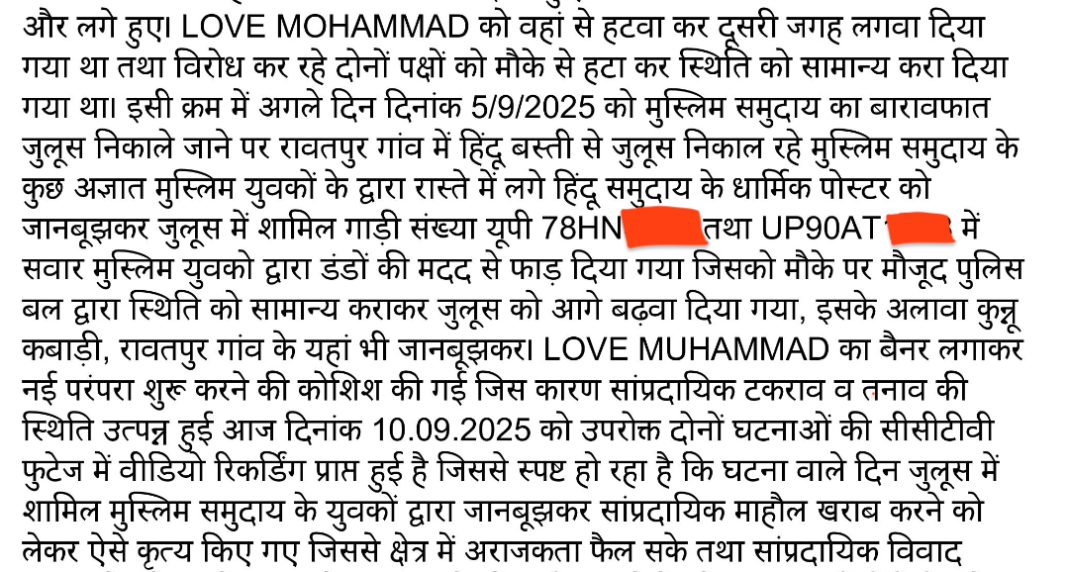
A Barawafaat procession was taken out on 5th September, in which Muslim men deliberately tore down religious posters of Hindus. According to the FIR, “When the procession was being taken out through a Hindu locality in Rawatpur village, some unidentified Muslim men participating in the procession on their vehicles, deliberately tore down religious posters belonging to the Hindu community along the route using sticks…by Muslim youths travelling in a vehicle participating in the procession.”

A portion of the FIR registered by the police

If you pay attention to these words, it becomes clear that this matter is not just about the “I Love Muhammad” banner. The story Al-Jazeera is trying to sell is actually a half-baked, self-selected “truth,” which, in many ways, is more dangerous than a lie. Al-Jazeera’s propaganda isn’t limited to this.

Al-Jazeera also spread lies about Bareilly and Gujarat.

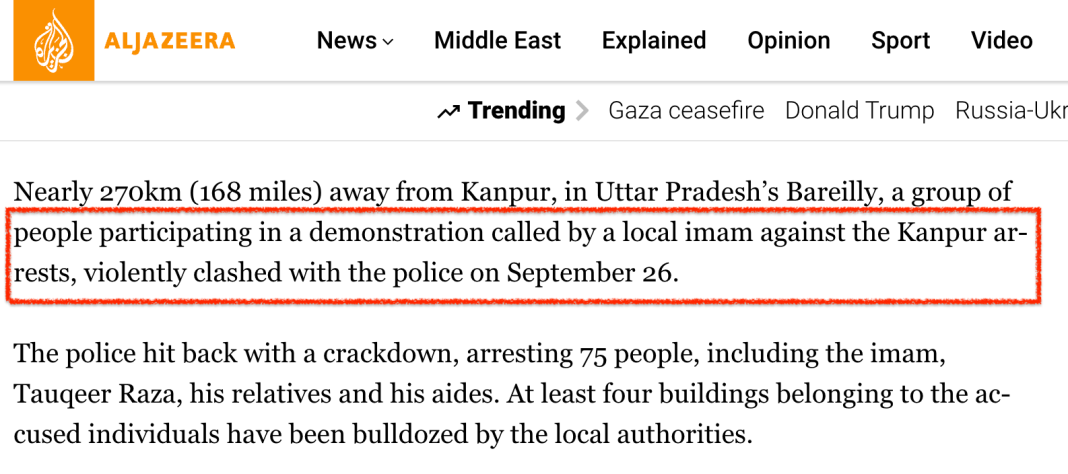
Although there was unrest in several states, the intensity was most pronounced in Bareilly and Gujarat. Al-Jazeera mentioned both incidents in its report, but here too it concealed the truth. Al-Jazeera stated that in Bareilly, protesters clashed violently with police.

Al-Jazeera on Bareilly riots

The media outlet failed to report that the protesters in Bareilly did not just have violent clashes with the police, but that the so-called protesters had arrived there with plans to attack the police. The investigation revealed that Maulana Tauqeer Raza, founder of the Ittehad-e-Millat Council, had plotted to kill policemen.

The so-called protesters had conspired to incite a riot in Bareilly. Hundreds of people were called in from outside and housed in various mosques. On the day of the purported protests, the rioters attacked the police with petrol bombs, opened fire, and pelted stones. Al-Jazeera dismissed this entire conspiracy by Islamic fundamentalists as simply a “violent clash”.

Al-Jazeera also failed to report the violence that erupted in Gujarat, Prime Minister Narendra Modi’s home state. “Muslims have been arrested in several states, including Gujarat, for social media posts and videos that included slogans like ‘I Love Muhammad,” Al-Jazeera wrote.

Al-Jazeera on action in Gujarat

In Godhra, Gujarat, Islamic fundamentalists pelted stones at police. A post that read “I Love Mahadev” caused widespread uproar in Gandhinagar, Gujarat. Extremists selectively targeted Hindu homes and shops. Stones were even pelted at the Garba pandals and surrounding areas, yet Al-Jazeera, blinded by its love for Islamic fundamentalists, failed to see this.

Al-Jazeera further attempted to create propaganda in this story by citing statements from individuals associated with organisations like Amnesty International, but none of them contained any facts. The crackdown on encroachments on drains, ponds, and other government land was portrayed as the targeted demolition of houses of Muslims. However, it failed to disclose that these homes were built on encroached land.

The battle of narrative, not bombs and guns

Organisations like Al-Jazeera, the BBC, and the Washington Post repeatedly attempt to portray every internal incident in India through their default “Muslim versus the state” lens. They do not report the plain news, but rather attempt to create a narrative portraying India as a Hindu-majority and anti-Muslim country. This, of course, aims to undermine India’s reputation in the international community. It is natural for any religion to have love for its prophet. But when such emotional slogans are used to incite mobs, politicise, or mobilise against a community, they become a ‘religious weapon,’ not ‘religious love’.

In such circumstances, radicals use this weapon, and whenever the police take legal action against them, the foreign media portrays it as a conspiracy against Muslims. These media outlets never question whether stone-pelting, rioting, or planning violence are part of any religion. Should the police be held accountable simply because the culprits belong to a particular community?

Today’s era isn’t just about bombs and guns, but about narrative. When India strongly enforces its law and order measures, the global media seeks to exploit them against India to their advantage. Such organisations strive to garner international support by portraying Muslims as victims in any way possible.

(This article is a translation of the original article published in OpIndia Hindi.)

TMC MP Yusuf Pathan shares pictures of disputed Adina Mosque, gets fact checked on social media how it was the Mandir of Adinath

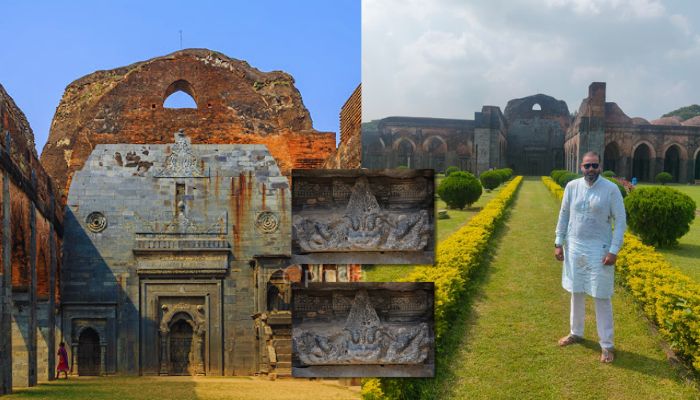
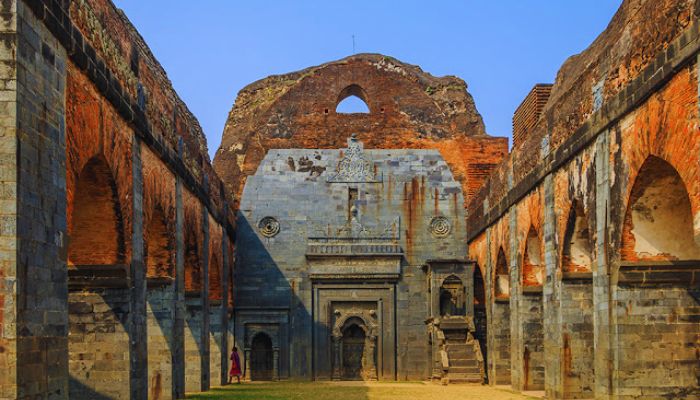
On 16th October, Trinamool Congress (TMC) MP Yusuf Pathan shared pictures from his visit to the Adina Mosque in West Bengal’s Malda district on his social media pages. Pathan’s description of the mosque, however, invited a factcheck from netizens.

Hailing Adina Mosque as architectural marvel, the cricketer-turned-politician wrote, “The Adina Mosque in Malda, West Bengal, is a historic mosque built in the 14th century by Sultan Sikandar Shah, the second ruler of the Ilyas Shahi dynasty. Constructed in 1373-1375 CE, it was the largest mosque in the Indian subcontinent during its time, showcasing the region’s architectural grandeur.”

In no time, netizens stepped in to factcheck the TMC MP by bringing up Hindu history of the structure in question.

Advocate Shekhar Kumar Jha shared an image of Lord Ganesh carving on the wall of the Adina ‘mosque’, and wrote, “Historic: Adinath Mandir became Adina Mosque.”

An X user “PlanH”, who ratioed Pathan’s post with reply, wrote, “Dear Yusuf Pathan, you are standing in the campus of one of the largest Hindu Temples, Adinath Temple, which was desecrated and occupied by Islamic invaders. Attached are some images for your reference. It is time to undo the injustice and barbarity, and reestablish the temple’s glory.”

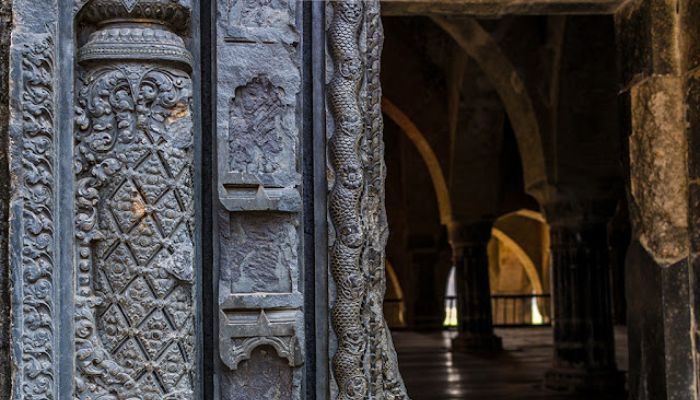
One “Abdul Kitabi” shared pictures of Hindu sculptures found inside the Adina Mosque complex and replied, “Dear Yusuf Pathan (@iamyusufpathan), you are standing in the campus of one of the largest Hindu Temples, Adinath Temple, which was desecrated and occupied by Islamic invaders. Attached are some images for your reference. It is time to undo the injustice and barbarity, and reestablish the temple’s glory. As a true Muslim we must give this mosque back to Hindus.”

Another one wrote, “Adinath Temple is now Adina Mosque! Beauty of our secularism!”

One X user asked, “Have you people made anything of your own, or have you just taken over everything by demolishing others’ religious sites and claimed it as your own?

Adina Mosque or Adinath Temple: Another Hindu temple converted into a mosque by Islamic barbarians

The Adina Mosque is located in the historic town of Pandua in West Bengal’s Malda district. Conventional historical sources say that the construction of this masjid was commissioned in 1373 and completed in 1375 by Sultan Sikandar Shah of the Illyas Shahi dynasty of the Bengal Sultanate. Largest mosque in the Indian subcontinent at that time, symbolised Shah’s military victories against the Delhi Sultanate.

However, historical and archaeological evidence indicate that the mosque was built using materials and stones salvaged from destroyed pre-existing religious Hindu structures from the Pāla–Sena era of 8th-12th centuries.

In fact, sculptural remnants indicate that what stands as Adina Mosque today was originally a temple dedicated to Lord Shiva, in his Adinath or First Lord form. The temple was known as the Adinath Temple. The complex also housed a temple dedicated to Lord Vishnu. Archaeological evidence indicates that temple doorway in black stone was used to make the pulpit of the Adina Masjid.

Terracotta and stone carvings on walls, doors, arches and mihrabs or prayer niches, depict Hindu deities like Lord Shiva and Ganesh. In addition, there is a significant presence of motifs like flowers, caitya arches, kiritmukha (face of glory) masks, beaded necklaces, and chain-and-bell designs. The Islamic architecture is devoid of this type of adornments, indicating that these motifs and carvings date back to Pāla–Sena era.

The central mihrab of this mosque carries clear indications that the structure’s Hindu history. The front of this mihrab is placed in the cured wall decorated with a tri-foiled arch and the spandrel on either side arch has been decorated with rosettes and the panels inside the mihrab are also adorned with the designs of foiled arches and rosettes having chain and bells motifs hanging from the apex of the arches. These are Hindu decorative motifs as these sorts of chain and bell motifs are noticed on the shaft of the columns engraved during the Hindu period.

Broken Shivling, and other idols of Hindu deities have been reported visible on the temple premises and embedded walls. In fact, the nearby structures, including the Pandua Bridge has incorporate materials from Hindu ruins, indicating a broader spoilation of the area by Islamic barbarians.

While Yusuf Pathan intended to pass off a mosque erected on the ruins of an ancient Hindu temple as some sort of Islamic architectural marvel and that Sikandar Shah should be remembered and respected as an Indian Muslim ruler, the Islamic tyrant’s political and religious orientation Arabia and Ctesiphon in Iraq, not India.

The site’s abandonment after 19th-century earthquakes as well as its current status as a Protected Monument of National Importance under the Archaeological Survey of India (ASI) have curbed the scope of further excavations.

However, the issue of Adinath Temple has been raised by the BJP in the past and it reignited in 2024 when senior advocate Hari Shankar Jain appealed to Hindus to come forward and start worshiping in the disputed ‘Adina mosque’.

Advocate Hari Shankar Jain said, “In the Malda district of West Bengal, there is a so-called mosque. It is called the Adina Mosque. It was built by demolishing a grand Hindu temple. This took place during the reign of Sikandar Shah who ruled that area from 1363 to 1374. He demolished the temple and built the mosque.”

He also wrote a letter to Prime Minister Narendra Modi in this regard.

In February last year,  a group of Hindus led by a young priest named Hiranmoy Goswami performed puja inside disputed mosque’s premises. Goswami, who had visited the Archaeological Survey of India (ASI)-listed monument, spotted idols of Hindu deities and a Shivling. Soon after, he along with his followers began performing puja and reciting mantras next to the Shivling. However, the Police eventually barred them from continuing puja rituals there.

Thousands of Hindu temples were destroyed during Islamic invasions in the medieval era. Many ‘historic’ mosques today stand atop the ruins of Hindu temples or have repurposed temples into mosques with significant architectural modifications. Babri structure in Ayodhya, Shahi Idgah Masjid in Mathura, Gyanvapi in Kashi are all examples of the Islamic takeover of Hindu temples. The legal manifestation of the political imposition of one-sided secularism–the Places of Worship Act of 1991, stands as a massive obstacle in the reclamation of destroyed or encroached Hindu temples, although the successful reclamation of the Ayodhya Ram Janmabhoomi gives renewed hope to the Hindu cause.

Supreme Court denies bail to PFI extremist Wasid Khan, who wanted to establish ‘Mughal order’ in India: Read how the banned outfit was arming Muslim men to achieve its ‘Vision 2047’

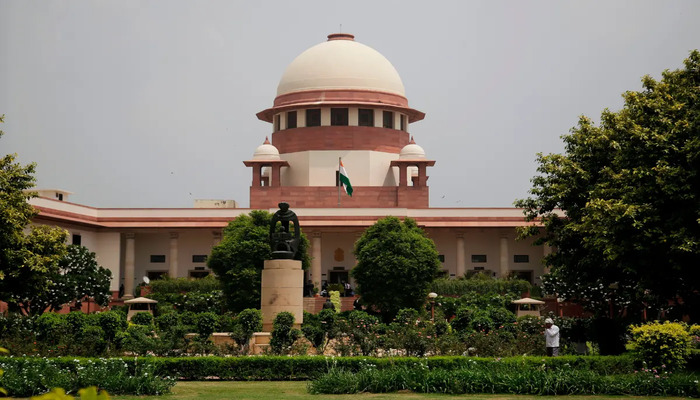
The Supreme Court, on Thursday (16th October), denied bail to PFI extremist Wasid Khan, who is facing charges under the Unlawful Activities (Prevention) Act (UAPA).

While refusing to interfere with the Madhya Pradesh High Court order, which upheld the trial court’s order denying bail to Wasid Khan, a Bench of Justice MM Sundresh and Justice Vipul M Pancholi dismissed Khan’s criminal appeal.

Citing the availability of material against him, the apex court noted that it prima facie revealed an attempt on his part to disrupt the communal harmony and wage war.

Appearing for the accused, Senior Advocate Shoeb Alam contended before the Supreme Court that the High Court concluded the existence of incriminatory evidence against Khan without considering the claim that he was not associated with the Popular Front of India after the Islamic outfit was banned in 2022. However, the argument was not accepted by the Supreme Court.

Wasid Khan had been working towards achieving a ‘Mughal order’ in the country

Notably, the Madhya Pradesh High Court, while refusing bail to Khan, observed that the seizure memo revealed that incriminating material like Books, CDs, a Computer, a pen drive, a bank account, pamphlets, certain lectures and written materials seized from the house of the accused indicated that he was working “to achieve and object of establishing a Mughal Order as it existed prior to Britishers taking over reign from the hands of the Mughals”.

“We have gone through the seizure memo and the seizure memo reveals that incriminating material like Books, CD, Computer, Pen-Drive, Bank-Account, Pamphlet, certain lectures and written materials have been seized from the house/office of the appellant which prima facie reveals that attempt is being made to cause disruption in the communal harmony amongst the members of the Society, so to achieve and object of establishing a Mughal Order as it existed prior to Britishers taking over Regin from the hands of the Mughals and started ruling the country before independence,” the High Court noted in its order dated May 17, 2025.

Opposing Wasid Khan’s bail plea before the Apex Court, Senior Advocate Nachiketa Joshi, appearing for the National Investigation Agency (NIA), pointed out that the evidence found against Khan included a “Vision 2047” document, which aims to transform India into an Islamic country with the application of Sharia law. Wasid Khan was arrested by the NIA on February 3, 2023. He has been facing charges under the following Sections of the IPC-

121-A (Conspiracy to commit offences punishable by Section 121-Waging or attempting to wage war),

153-A (Promoting enmity between different groups on grounds of religion, race, place of birth, residence, language, etc.),

120-B (Punishment for Criminal Conspiracy),

201 (Causing disappearance of evidence of offence, or giving false information, to screen offender), read with the following Sections of the UAPA-

13 (1)(b) (Whoever advocates or abets unlawful activity),

18 (Punishment for Conspiracy),

18-A (Punishment for organising terrorist camps),

18-B (Punishment for recruiting of any person or persons for terrorist act) of the Unlawful Activities (Prevention) Act (UAPA).

Other accused named in the case are Abdul Kareem alias Bekariwala, Mohd. Javed, Abdul Khalid, Abdul Zameel Sheikh, Abdul Rauf Belim, Mohsin Qureshi, Imran Tanwar Hussain, Mohd. Shakir Khan, Mohd. Shamsad, Tohsif Ahemed Cheepa, Shahzad Beg, Ishahk Khan, Mohd. Zuber Ahemed, Akib Khan, Mohd. Yusuf Molani, Khawaja Hussain, Sheikh Nasir alias Nasir Nadvi Sheikh, Anwar Khan alias Doctor Anwar Siddique, Wasid Khan, Gulam Navi Khan alias Sajid Gulam Navi, Gulam Rasul Shah, and Parvej Khan. The trial of the case has been going on in the sessions court.

PFI giving arms training to Muslim men to achieve “Vision 2047”

In its order rejecting the bail plea of Wasid Khan, a Special NIA Court noted that during an interrogation by the NIA, Khan revealed that he worked as the General Secretary of an organisation named National Confederation of Human Rights Organisations (NCHRO), which is the legal wing of the banned Islamic outfit PFI.

As the General Secretary of the NCHRO, Khan handled legal matters of radical Islamic organisations like PFI and SIMI, which advocate for the Sharia Law in India. Khan joined PFI in 2017 and was entrusted with the recruitment of new members to the Islamic outfit, imparting legal knowledge in the classes organised by the PFI, and working towards achieving the objectives of “Vision 2047”.

Khan is also said to have participated in a secret meeting organised in August 2022, in which other accused delivered speeches about Vision 2047, explaining the roadmap for achieving the vision. He further revealed that the objective of the PFI is to form an Islamic government in India with the support of the OBC and SC/ST communities and implement the Sharia Law by 2047.

To achieve this objective, the PFI has been giving arms training to Muslim men to carry out killings using knives smaller than 6 inches and 2-foot-long rods.

What is “Vision 2047” document

In July 2022, the Bihar police seized an 8-page document during a crackdown on a secret PFI operation in the state, in which it planned to launch an attack on PM Modi during his visit to Patna. The document titled “India 2047: Towards Rule of Islam in India” contained a detailed plan for the Islamisation of India in the coming years. The PFI circulated the document among its cadre to motivate them to act on the plan that aimed to dominate the ‘coward Hindus’ and subjugate them, a goal which, according to the PFI, would be achievable even with the support of 10% of Muslims.

Furthermore, the document mentioned a conspiracy to launch a full-fledged armed uprising against the Indian State with the help of their trained cadre and with the help of Islamic countries like Turkey. The plan also included appealing to other Islamic nations seeking their help in bringing the Indian state and the majority Hindus ‘to their knees’.

This was followed by two rounds of raids conducted by the NIA at multiple locations, in which the agency seized several incriminating documents and materials from PFI organisations settled in almost 17 Indian states. The documents included a training module to make IEDs and bombs from available domestic material, and also the ‘Vision 2047’ document and a CD, underlining the PFI’s goal of Islamisation of India.

After the discovery of the PFI’s vision document, the central government passed an order banning the radical outfit and its associated or affiliated fronts in September 2022 for a period of 5 years. The government maintained that the organisations operated as unlawful associations under the Unlawful Activities (Prevention) Act (UAPA). The affiliations banned along with the PFI include All India Imams Council, Campus Front of India (CFI), Rehab India Foundation, National Confederation of Human Rights Organisation (NCHRO), National Women’s Front, Junior Front, Empower India Foundation, and Rehab Foundation, Kerala.

Supporters of RJD candidate Osama, son of Shahabuddin, say they are hunting for the person who removed the ‘I Love Muhammad’ poster: OpIndia Ground Report

0

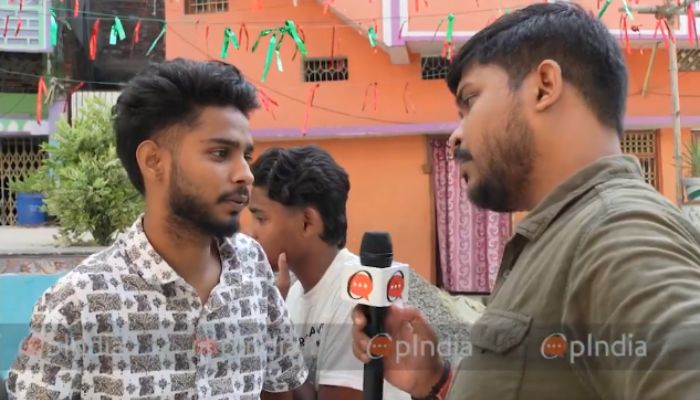
The controversy around “I Love Muhammad” posters, which began in Kanpur, refuses to die down even after nationwide riots, violence, and unrest. Islamists are still baying for blood of the youth who allegedly tore down the “I Love Muhammad” poster. In conversation with OpIndia, a Muslim man from Bihar’s Siwan said that he is searching for a young man who allegedly tore down the “I Love Muhammad” poster and that if he is found, he will be burned alive.

OpIndia arrived in Siwan to cover the Bihar elections. The RJD has given the assembly election ticket to Osama Shahab, son of strongman Shahabuddin, from the Raghunathpur constituency in this district. During the coverage, we met a supporter of Osama Shahab.

Open threats and fear of Shahabuddin

Speaking to OpIndia reporter Anurag Mishra, the Muslim youth said, “Bhaijaan (Osama) said, ‘I should not be defeated. Anyone who tears the posters of I love Muhammad should be hunted down” He also stated that they are searching for a person in the nearby Baniya Toli area who has reportedly torn down one such poster, and if they find him, he will be taken directly to Shahabuddin’s house. The youth also said that no one would have dared remove the poster if Shahabuddin had been alive, because people know what would have happened then.

I Love Muhammad’ controversy not confined only to Siwan

The controversy over the posters with ‘I Love Muhammad’ is not confined to Siwan only. Earlier, such posters have become the cause of controversy in many other states as well. The row erupted first in Uttar Pradesh’s Kanpur, when a signboard with ‘I Love Muhammad’ written on it was put up during the Barawafat procession. After this, this controversy spread to Kanpur, Unnao, Bareilly, Baghpat, Kaushambi, Lucknow, Maharajganj, Shahjahanpur of UP. Besides, it also happened in Kashipur of Uttarakhand, Nagpur of Maharashtra, Godhra of Gujarat, Hyderabad of Telangana.

Siddaramaiah boasts of ‘London Book of World Records’ certificates, but are they real? Company shut down, dubious antecedents and more: What OpIndia found out

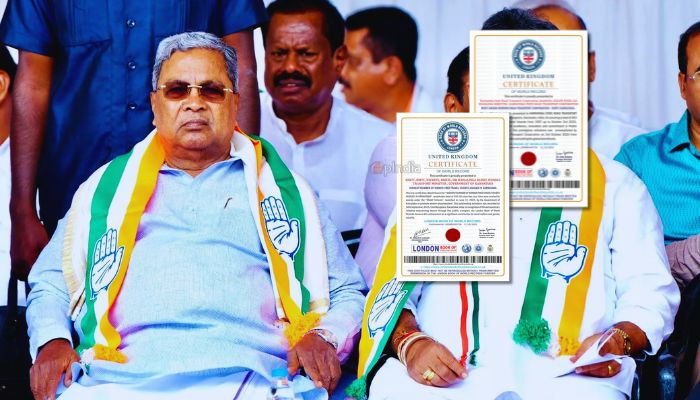
On Tuesday (16th October), Karnataka Chief Minister Siddaramaiah announced that his government’s “Shakti Scheme”, which provides free bus rides for women domiciled in the state, has been certified by the London Book of World Records (LBWR) for the highest number of free bus rides availed by women. He also claimed the Karnataka State Road Transport Corporation (KSRTC) has also been ‘recognised’ by the LBWR. However, the ‘world records’ Congress government boasted has sparked speculation if it is even real with a genuine value or a dubious PR exercise.

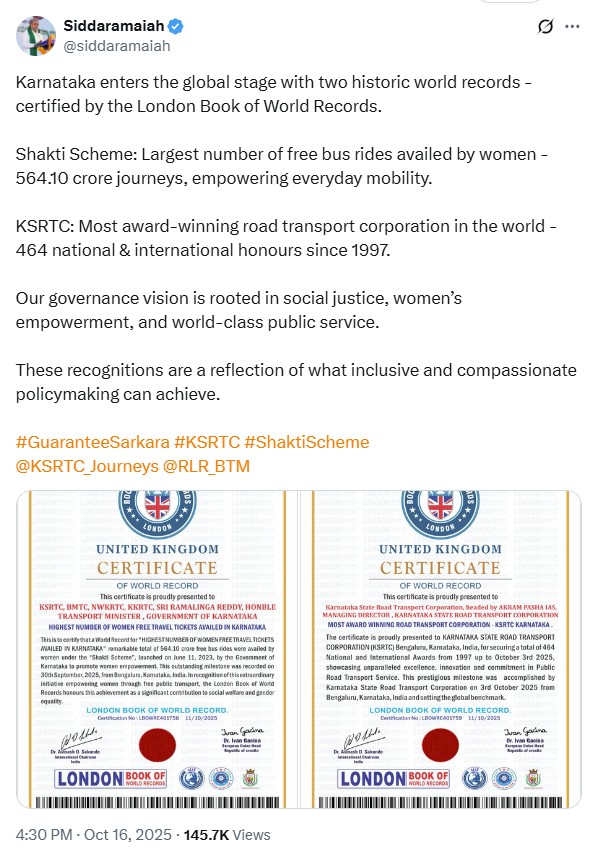
Taking to X, Chief Minister Siddaramaiah wrote, “Karnataka enters the global stage with two historic world records, certified by the London Book of World Records. Shakti Scheme: Largest number of free bus rides availed by women, 564.10 crore journeys, empowering everyday mobility.”

Post by Karnataka CM

“KSRTC: Most award-winning road transport corporation in the world, 464 national & international honours since 1997. Our governance vision is rooted in social justice, women’s empowerment, and world-class public service. These recognitions are a reflection of what inclusive and compassionate policymaking can achieve,” he added.

The X post by the Chief Minister also includes two ‘certificates’ each issued for the Shakti Scheme and KSRTC.

This is to certify that a World Record for “HIGHEST NUMBER OF WOMEN FREE TRAVEL TICKETS AVAILED IN KARNATAKA” remarkable total of 564.10 crore free bus rides were availed by women under the “Shakti Scheme”, launched on June 11, 2023, by the Government of Karnataka to promote women empowerment. This outstanding milestone was recorded on 30th September, 2025, from Bengaluru, Karnataka, India. In recognition of this extraordinary initiative empowering women through free public transport, the London Book of World Records honours this achievement as a significant contribution to social welfare and gender,” the LBWR certificate recognising the Karnataka government’s Shakti Scheme reads.

“The certificate is proudly presented to KARNATAKA STATE ROAD TRANSPORT CORPORATION (KSRTC) Bengaluru, Karnataka, India, for securing a total of 464 National and International Awards from 1997 up to October 3rd 2025, for showcasing unparalleled excellence, innovation and commitment in Public Road Transport Service. This prestigious milestone was accomplished by Karnataka State Road Transport Corporation on 3rd October 2025 from Bengaluru, Karnataka, India and setting the global benchmark,” the certificate recognising KRSTC reads.

Both certificates are signed by one Dr Avinash D. Sakunde, who is mentioned as LBWR’s ‘International Chairman’ from India and Dr Ivan Gacina, the European Union Head from the Republic of Croatia.  

Notably, while CM Siddaramaiah is patting his own back, the Congress government in Karnataka has been facing criticism for introducing freebie schemes like the Shakti, which allowed free bus travel to all women in all state-owned buses, while the four state transport corporations have been facing a severe financial crunch. KRSTC, Bengaluru Metropolitan Transport Corporation (BMTC), North Western Karnataka Road Transport Corporation (NWKRTC), and Kalyana Karnataka Road Transport Corporation (KKRTC) have consolidated liabilities worth Rs 6,330.25 crore.

Who is Avinash Sakunde, the ‘member of advisory committee to Delhi Minorities Commission’ and Ivan Gacina, the ‘President of Balkanofantastika’

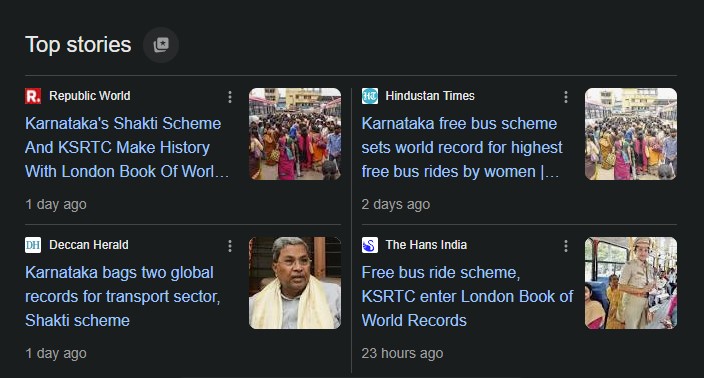
Interestingly, the mainstream media widely reported on Chief Minister Siddaramaiah’s announcement of receiving the alleged certificates by the London Book of World Records. However, none delved into the background of this entity and who runs it.

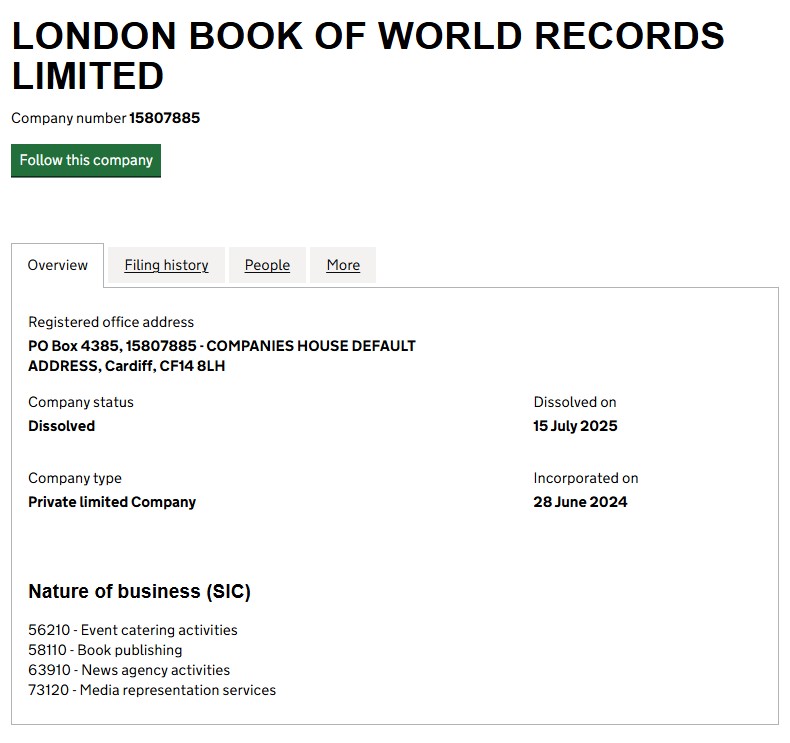
During our investigation, OpIndia found that London Book of World Records, is a private company that was dissolved on 15th July 2025 as per the official records of the UK government. The LBWR’s nature of business is listed as event catering activities, news agency activities, book publishing, and media representation services.

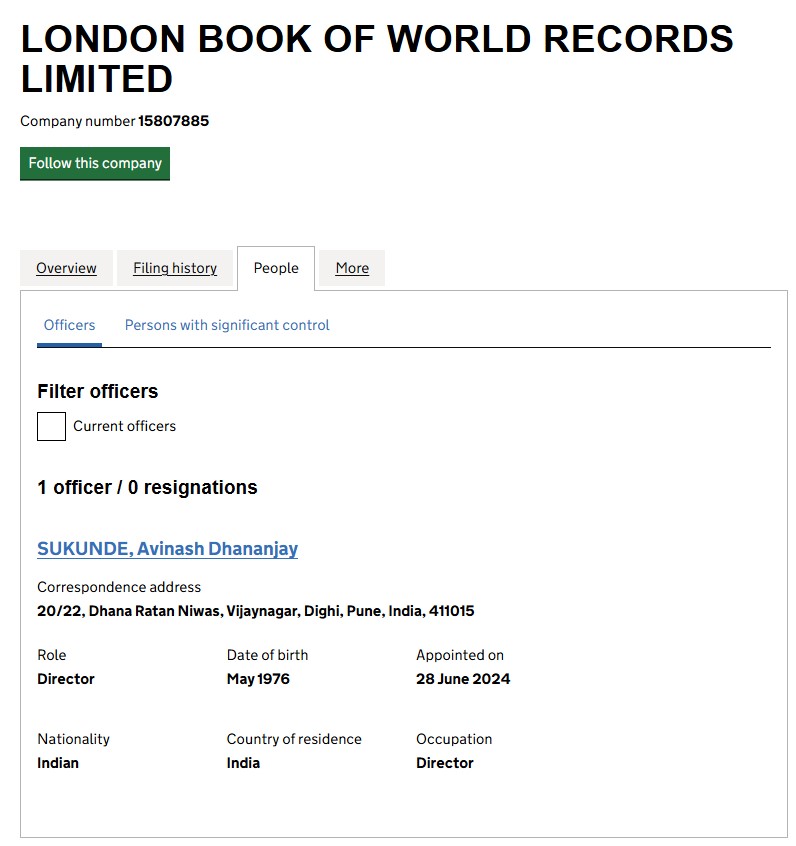
The records show that Avinash Dhananjay Sukunde was appointed at the director of the London Book of World Records on 28th June 2024.

We checked social media profiles of Sakunde, including his Instagram and LinkedIn page. As per his Instagram bio, Dr. Avinash Dhananjay Sakunde is a “member” of an Advisory Committee to the Delhi Minorities Commission of the Delhi Government. However, upon checking the DMC’s website, we found no mention of Sakunde as a member of any advisory committee or of the commission.

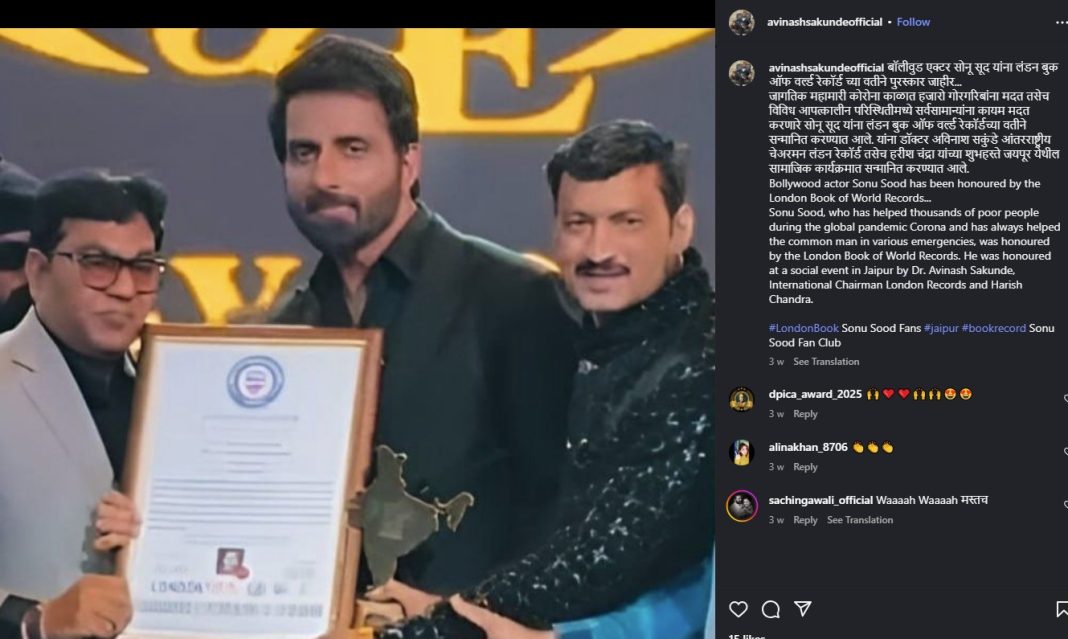
On his Instagram, Sakunde has posted videos of him awarding ‘London Book of World Records’ certificates to various individuals. He handed one such certificate to actor and activist Sonu Sood at an event in Rajasthan’s Jaipur.

Our quest to find out more about Ivan Gacina, the ‘European Union Head’, as per the certificate shared by CM Siddaramaiah, turned out to be very interesting.

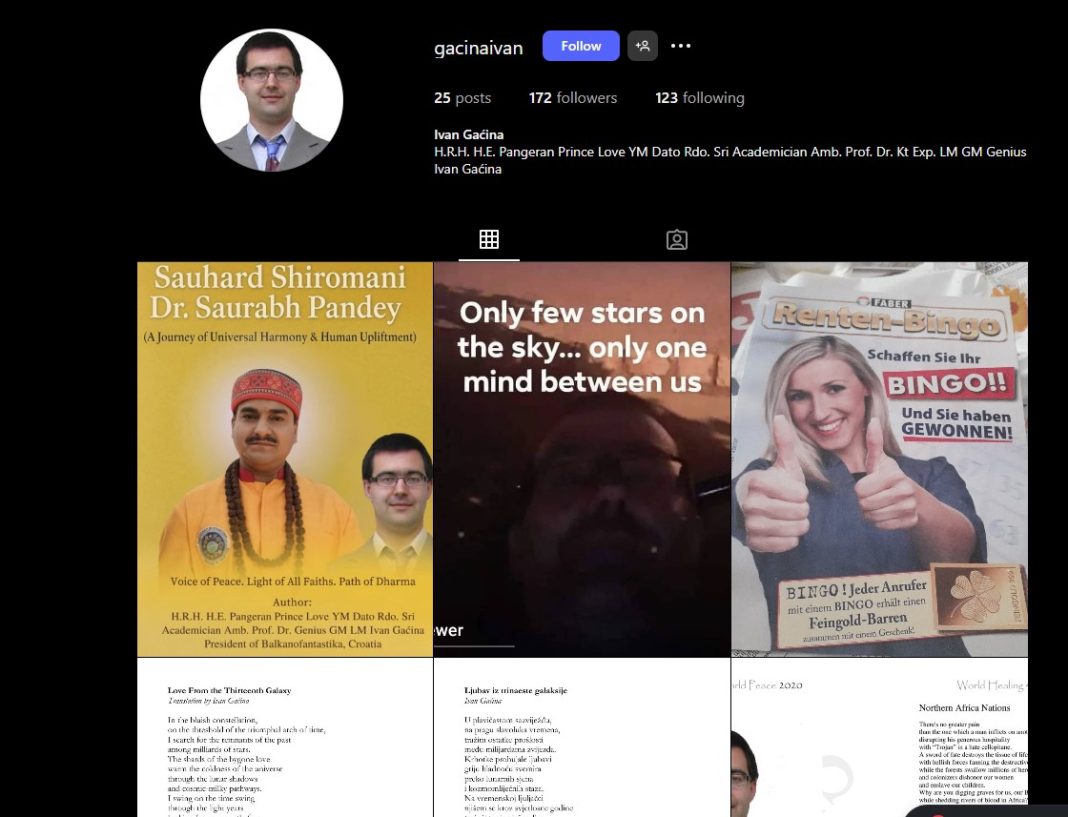
According to Dr Ivan Gacina’s Instagram profile, he is “H.R.H. H.E. Pangeran Prince Love YM Dato Rdo. Sri Academician Amb. Prof. Dr. Kt Exp. LM GM Genius.” In fact, as per one of his posts, Gacina is also the “President of Balkanofantastika”.

Another curious fact is that the word ‘Pangeran’ is of Malay and Indonesian origin. It is the Malay and Indonesian word for the son of a king and queen.

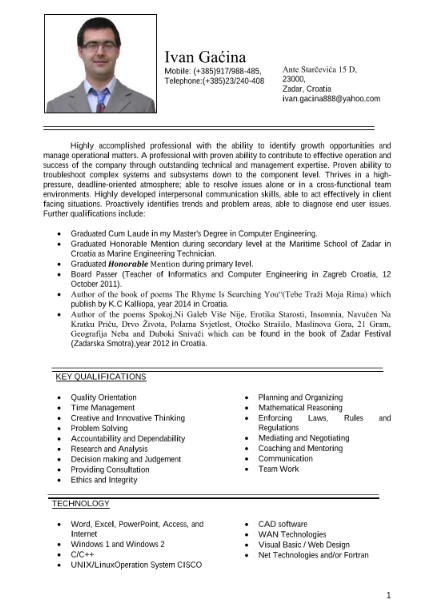
We also came across his resume on his LinkedIn profile. Gacina’s resume states that he from Zadar, Croatia. As per his employment history, Gacina has been a Computer Engineering teacher, a physics teacher, “teacher of mathematics in ADULT education”, cashier and waiter, among other things. He is also a poet. Everything about Gacina is odd, his social media presence, countless certificates, and yet there is just one or two images of this person found on the internet.

Source: Gacina’s LinkedIn profile

Besides the dubious profile of Sakunde and Gacina, another notable fact about the London Book of World Records is that this ‘UK-based’ private company has its office in Delhi’s Pahar Ganj. On its website, LBWR has mentioned one Hotel Superb in Tilak Gali, Chuna Mandi, Pahar Ganj, New Delhi as its “Head Office”.

The LBWR’s website also lists, 71–75 Shelton Street, London, United Kingdom as its “international office (UK branch)” and a “registered office in USA at the address: 30 N Gould St Ste R, Sheridan, WY 82801.

‘Karnataka govt applied for certificate’: Avinash Sakunde tells OpIndia

OpIndia contacted Avinash Sakunde, as per the contact info on the website, to gather more information about the ‘London Book of World Records’ and its activities. When asked about the criteria involved in deciding individuals or institutions to be awarded certification by LBWR, Sakunde said that there are many categories like sports, art and entertainment, social service etc, and the work done by individuals, groups or institutions is taken into note for certification.

We asked about Karnataka government and KRSTC receiving getting LBWR’s ‘world record’ certificate, he claimed that they (government) applied for the certificate.

“We gave them appreciation certificate based on the analysis of the paper filed by the Karnataka government in their application. Our decision was based on their paper. We gave them appreciation certificate for the good work they are doing. We also recently gave a certificate to (actor) Sonu Sood,” Sakunde said.

OpIndia also asked about Ivan Gacina and his role in LBWR. Regarding this, Sakunde said, “He is there only for name. He is my colleague. I handle everything, the administration is in my name.”

We further questioned if LBWR is a registered entity in India, if it is then whether it is an NGO or a private company. We also asked about LBWR’s status in the UK.

About this, Sakunde said, “We are registered in India as an NGO. In the UK, we are registered as a private company. A book publishing company.”

It is amusing that a ‘book publishing’ company in the UK, which is supposedly registered as an NGO in India, is issuing appreciation certificates for “world record”.

Another interesting point to note is that throughout the conversation with OpIndia, Avinash Sakunde nowhere mentioned that his company, London Book of World Records, was dissolved in the UK in July this year.

OpIndia’s investigation into the LBWR raises many questions. Firstly, why would the Congress government in Karnataka apply (as claimed by Sakunde) for a world record certification from a UK-based private company? Secondly, how is a company that was dissolved months about, as per the official records, still issuing world record recognition or appreciation certificates? Lastly, did the Siddaramiah government indulge in a dubious PR exercise from a dubious entity?

Is Rahul Gandhi trying to manufacture Gen Z anger with paid rappers? OpIndia talks to one such agent who admits to recruiting for Congress. Exclusive details

A rap song criticising the Modi government has been going viral on social media. The rap song, sung by a struggling rapper, is being promoted by the Congress IT cell as an expression of the Indian Gen Z’s anger against the government. A similar propaganda was seen being peddled on social media in India after the Gen Z protests in Nepal.

This video of the rap song, which portrays the age-old leftist rhetoric, was also shared by x user Ankit Mayank, who describes himself as Rahul Gandhi’s “Babbar Sher.” Sharing the video, Ankit wrote, “So, Gen Z in India is now using music to expose and speak out against the fascist regime. Fiery rap song, must share. Interesting times are ahead”.

The truth about the rap song

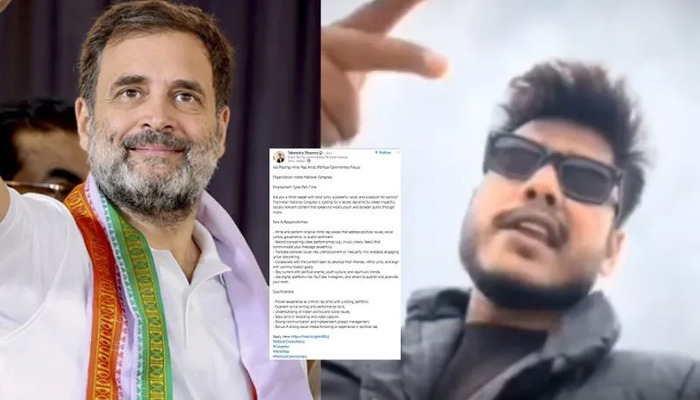
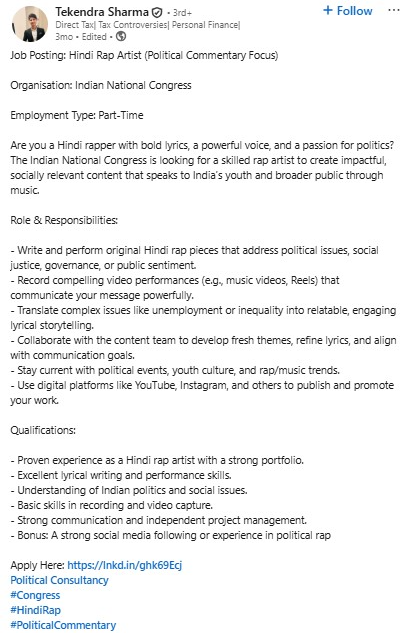
However, the truth about this rap song purportedly portraying Gen Z anger is far from what the Congress IT Cell is claiming. To find out, OpIndia launched an investigation, which led us to several LinkedIn posts about some job vacancies published by the Congress party.

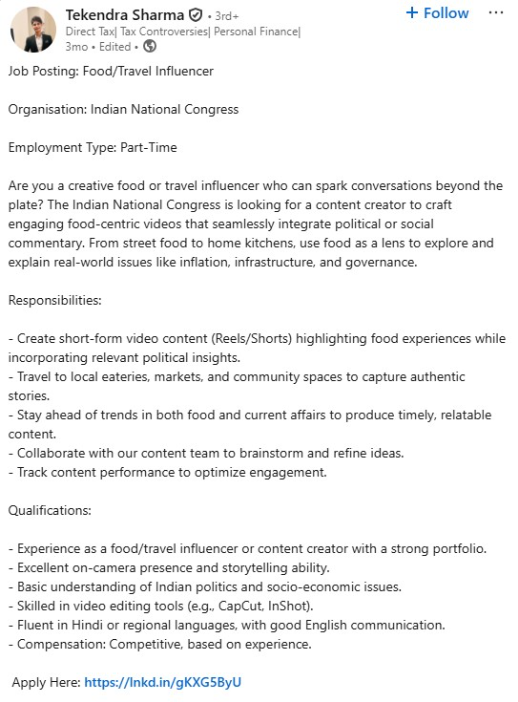
In fact, for the past three months, Congress has been hiring rap songwriters, cartoonists, and food and travel influencers. OpIndia found three such vacancies posted from the account of a person named Tekendra Sharma. These posts clearly stated that these hirings were for Congress.

To understand the full story, OpIndia spoke to Tekendra Sharma over the phone. Sharma said that he had posted the recruitment advertisement for the Congress party, but he is not a member of the Congress party. He added that his job is to shortlist CVs and send them to the Congress party. In other words, Tekendra Sharma admitted that he posted recruitment for rap songwriters, influencers, and other vacancies at the behest of the Congress party.

Congress Party did not respond to OpIndia’s questions

This leads to the question of why the Congress party is hiring rap songwriters, influencers, and bloggers. OpIndia attempted to contact Congress for a response by sending emails to Congress media chief Jairam Ramesh and spokesperson Pawan Khera. The email contained several questions regarding Congress’s relationship with Tekendra Sharma, whether the party was actually conducting such a recruitment drive, and whether Congress views the anti-government content as organic or its own.

It’s been over 24 hours since this email was sent, but we haven’t received a response. The rapper who made the rap song is nowhere to be found. This is the usual pattern of the Congress party; first, they peddle propaganda, and when confronted with facts, they avoid responding. This clearly shows that the anti-government content that social media users believe to be Gen Z anger is being sponsored and spread by the Congress party.

Rap song videos on Congress’s social media

It’s no coincidence that after the recruitment of rap songwriters, the Congress party’s YouTube page has suddenly started posting rap songs. Whether it’s vote theft or PM Modi’s relationship with the United States, the Congress party has released rap songs targeting the government on all sorts of issues.

A rap song was recently posted on the Congress YouTube channel, in which PM Modi’s relationship with Donald Trump has been trolled with memes. The song has gone viral on social media.

There is another Congress-sponsored rap song titled “वोट चोर, गद्दी छोड़” (Vote Theaf, Leave the Throne). The video of the rap song portrays Rahul Gandhi as a leader with a spotless image, supports claims of vote theft and questions the Election Commission’s findings refuting Gandhi’s claims.

This suggests that Congress hired a rap songwriter to create anti-government content, spread it on social media and inciting Gen Z by portraying it as public anger.

After witnessing how the “Gen Z revolution” in Nepal led to the fall of the KP Oli government, Rahul Gandhi appears to be attempting a similar playbook in India. Over the past few months, he has increasingly tried to position himself as the voice of India’s youth, amplifying anti-establishment rhetoric, encouraging social media-driven dissent, and promoting influencer-led campaigns that mimic the Nepali model. From rap songs to meme-driven narratives, Congress’s ecosystem seems focused on manufacturing an image of “Gen Z outrage” against PM Modi, trying to incite online frustration and hoping it would turn into a political movement that becomes the undoing of the current dispensation.

Congress ecosystem’s anti-government ‘paid campaign’ on social media

This isn’t the first time the Congress ecosystem has promoted fake social media content in the name of Gen Z anger. Recently, Congress launched a “vote theft” propaganda campaign on social media. Numerous influencers and content creators created Reels on the issue, and some even apologised later. It was later revealed that the entire “vote theft” propaganda was part of a Congress-sponsored “paid campaign,” costing around ₹20,000 to ₹30,000. These are Congress’s tactics of brainwashing India’s Gen Z, who rely on social media for information.

This article is a translation of the original article published in OpIndia Hindi.