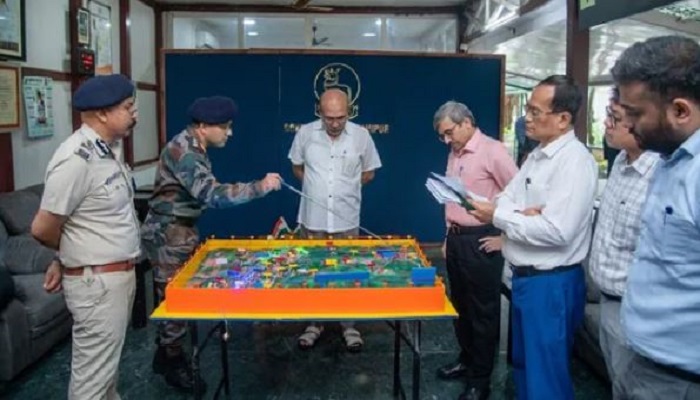
On Sunday (24 September), Manipur Chief Minister N Biren Singh held a meeting with the senior officials of the Border Roads Organisation (BRO) regarding plans to extend the India-Myanmar border fencing by 70 kilometres. The aim of extending the border fencing is to curb the influx of illegal immigrants in Manipur from the neighbouring nation Myanmar.
The State Chief Secretary and BRO officials, the state police, and the Home Department were present at the meeting.
Taking to X, the Manipur CM wrote, “Held a meeting with the officials of BRO and deliberated the plan to begin construction of an additional 70 km of border fencing along the Indo-Myanmar border. I was joined by Chief Secretary, DGP & officials from the Home Department.”
Held a meeting with the officials of BRO and deliberated the plan to begin construction of an additional 70 km of border fencing along the Indo-Myanmar border. I was joined by Chief Secretary, DGP & officials from the Home Department.
Calling it an urgent necessity, the Manipur CM added, “In view of the rise in illegal immigration and drugs smuggling from the neighbouring country, safeguarding our porous borders has become an urgent necessity.”
Notably, the meeting regarding the extension of border fencing comes a day after the Manipur CM urged the Centre to ‘permanently close’ the Free Movement Regime (FMR). This FMR policy permits individuals from both sides of the border to travel up to 16 kilometres within the neighbouring country without any documents or visas.
The aim of the FMR policy was to facilitate trade and commerce while also permitting unrestricted movement for people from ethnically related communities in both nations. However, it has been criticised for enabling cross-border illegal activities and the influx of illegal immigration along with the smuggling of drugs and arms from Myanmar.
Manipur has a 400-km long international border with Myanmar and less than 10% of it is fenced. The remaining porous border is prone to cross-border illegal activities.
The challenging topography of the region, among other factors, makes it difficult to fence the entire border. Nevertheless, experts maintain that certain areas, where most illegal activities occur, can be more easily secured with fencing.
Earlier in July, the Manipur government started the process to collect biometrics of illegal immigrants from Myanmar. The ministry said that the campaign will continue in all districts until biometric data of all illegal Myanmar immigrants in the State are successfully captured. The campaign is targeted for completion by September 2023.
It is notable that the union home ministry has directed the states of Manipur and Mizoram to complete the process of capturing biometric data of illegal migrants by September this year.
Under the campaign, the biometric data of anyone who enters India from Myanmar will be collected. This will help the government identify illegal immigrants easily. Reportedly they will be included in a “negative biometric list” so they cannot become citizens of India later.
Additionally, the authorities completed the border fencing along 10 km of the Manipur-Mizoram border by July, this year.
It is notable that illegal immigration from Myanmar is a major cause behind the recent violence in Manipur. The Meiteis alleged that a large number of Kukis from Myanmar entered the state with the help of local Kukis, and later settled in forest lands.
It is also found that such immigrants carry out large-scale poppy cultivation on forest land. Moreover, the Manipur government in July had informed that at least 718 Myanmar nationals illegally entered the state in a week’s time alone.
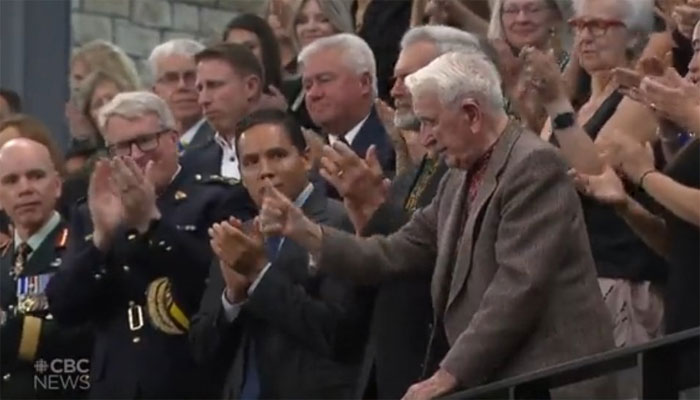
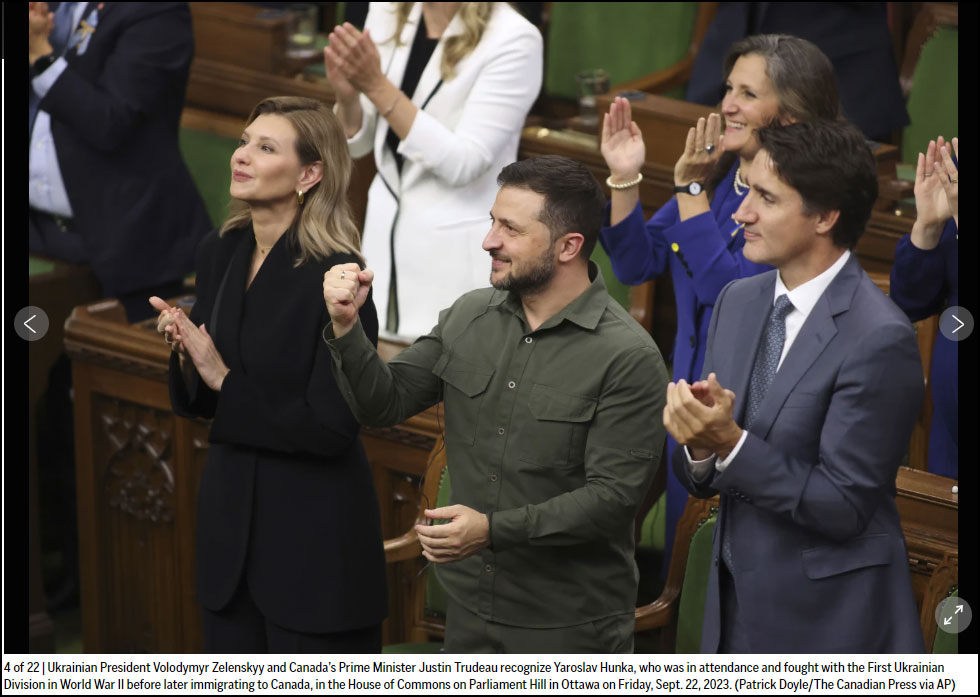
On 22nd September, the Canadian House of Commons gave a standing ovation to Yaroslav Hunka, a World War II veteran who fought for “Ukrainian independence” against Russian aggressors. This is how the speaker of the House, Anthony Rota, introduced him. The 98-year-old war veteran, however, was a member of a SS unit established in 1943 by the Nazis. Ukrainian President Volodymyr Zelenskyy was also present during the occasion.
A 98-year old Ukrainian who fought for Hitler's Nazis in World War II just received a huge round of applause in the Canadian Parliament
In his address, Rota said, “We have here in the Chamber today a Ukrainian-Canadian World War II veteran who fought for Ukrainian independence against the Russian aggressors then and continues to support the troops today, at the age of 98. Mr. Yaroslav Hunka is in the gallery, and I am so proud to say he is from North Bay in my constituency of Nipissing–Timiskaming. He is a Ukrainian hero, a Canadian hero, and we thank him for his service.”
Associated Press identified Hunka as a war veteran who “was in attendance and fought with the First Ukrainian Division in World War II before later immigrating to Canada” in a caption of the image that had Ukrainian President Volodymyr Zelenskyy and Canadian Prime Minister Justin Trudeau applauding Hunka in the House of Commons on Parliament Hill in Ottawa, Canada.
AP identified Hunka as a war veteran linked to the First Ukrainian Division. Source: AP
The First Ukrainian Division and its history
The 14th SS-Volunteer Division “Galicia” was a World War II Nazi Germany military formation made up predominantly of military volunteers with a Ukrainian ethnic background from the area of Galicia. This region was under Soviet control but had a population that didn’t support communism. When the Germans attacked the Soviet Union in 1941, they were initially seen as liberators by Ukrainians in the area.
In his book ‘The SS: Hitler’s Instrument of Terror [Archive link], Gordon Williamson gave details about the formation and fall of the First Ukrainian Division. According to the book, The First Ukrainian Division, originally named the 14th Waffen-Grenadier Division der SS (Ukrainische Nr 1), also known as the “Galicia” Division, was created during World War II in the western part of Ukraine. The division was formed in 1943 by SS-Brigadeführer Wächter, a Nazi Party leader and a high ranking high-ranking member of the SS, with as many as 70,000 volunteers coming forward to join.
It is notable that SS was the main paramilitary group under Adolf Hitler and the Nazi Party in Nazi Germany, and was primarily responsible for running Holocaust operations. 14th SS-Volunteer Division Galicia was made up of volunteers, which means that Yaroslav Hunka joined the unit on his own will, and was not conscripted.
In mid-1944, the division faced its first major combat in an attempt to halt the Soviet summer offensive. The division formed a battle group known as SS Kampfgruppe Beyersdorff for action against Soviet and Polish partisans. It succeeded initially and was praised by German military bosses.
However, Galicia faced major setbacks in subsequent battles, and the unit was almost completely destroyed, leaving only 3,000 survivors out of 14,000 troops. After the war, many lost soldiers operated as partisan units behind Soviet lines due to their solid anti-communist views.
Later, new volunteers joined the division and were dispatched to Czechoslovakia to quell the Slovak uprising and to Yugoslavia to combat Tito’s partisans. In the war’s final days, it fell under the command of the Ukrainian National Army and surrendered to the Anglo-American forces. However, due to some confusion, many members were able to avoid being forcibly repatriated to the Soviet Union.
It is safe to say that Yaroslav Hunka, who has been presented as a Canadian and Ukrainian war hero, fought for Hitler during World War II.
The war criminals of World War II and Canadian connections
The members of the First Ukrainian Division have been deemed war criminals by several experts. However, Canadian inquiry into their history did not recognise them as war criminals. Interestingly, there is clear evidence that Canada housed at least 3,000 war criminals. Canadian authorities established a commission to look into war criminals, and the commission headed by Justice Jules Deschenes submitted its report in December 1986 titled “Commission of Inquiry on War Crimes“.
According to the commission report, in February 1949, the immigration applications of the members of the Galicia division were rejected by the Canadian authorities on the groups of them being members of the German Wehrmacht or the SS. However, in May 1950, the Canadian Cabinet decided to give Ukrainians who were lodged in the United Kingdom at that time to be admitted to Canada following special security screening. The cabinet categorically said that they should “not be rejected on the grounds of their service in the German Army”.
The Canadian Jewish Congress opposed the admission of war criminals into Canada, or then termed as “prisoners of war” in the documents after the objections by the CJC, the Ministry of Immigration issued instructions to hold the immigration and assured the CJC that the individuals would be carefully scrutinised.
The CJC furnished two sworn statements, out of which one had events posterior to the hostilities, an indeterminate date, and a list of 94 suspects from the Galicia Division. Sadly, they could not bring witness statements to the table to support the allegations, giving the Ministry of Immigration a clear path to let the division members into Canada. The report noted that approximately 600 Galicia Division members were living in Canada in 1985.
‘It was acceptable to admit war criminals as Canada overall benefitted’
There are some alternate views on Canada allowing POWs. In his book, ‘Unauthorised Entry: The Truth about Nazi War Criminals in Canada, 1946-1956’, [Archive link] Howard Margolin pointed out that at one point, the preoccupation of immigration officials shifted from the threat of Nazi infiltration to the possibility of entry of communists in the country. He also argued that based on the country’s laws, Canada was not a “safe haven” for war criminals, as suggested by some experts.
He further argued that the entry of Nazi war criminals and collaborators into Canada after World War II was caused by those who entered the country using forged identities or false information about their wartime history. He added that those individuals were not intentionally admitted into Canada. Rather, their entry resulted from insufficient information or accessibility to verify their wartime activities. According to Margolian, the immigration of 1.5 million people to Canada between 1945 and 1955 was considered an overall benefit. Therefore, it was deemed acceptable to take the risk of admitting approximately 2,000 war criminals.
Clean chit to the First Ukrainian Division
In its report, the Commission gave “clean chit” to the Galicia Division. The report noted that the Galicia Division could be held collectively responsible for war crimes. Every member of the division underwent individual security screenings before entering Canada, and there was no “concrete evidence” supporting accusations of war crimes against them. These allegations were first made in 1950 and renewed in 1984 but were never proven. Simply being a member of the Galicia Division is not enough for prosecution, especially when there was no proof of involvement in or awareness of specific war crimes. Therefore, no members of the Galicia Division can be prosecuted for citizenship revocation or deportation, as Canadian authorities were aware of the facts in 1950. Their admission to Canada was not based on false representation, fraud, or concealing important information. Out of the 217 officers reported to Canadian authorities, 86 per cent never entered Canada, 11 have passed away in Canada, 2 left for other countries, 16 lack a clear case against them, and the last one could not be located. The Galicia Division members were given clean chit not because they were not involved in war crimes but because of the fact that there was no enough evidence available against them.
Jewish groups condemn the development
The Centre for Israel and Jewish Affairs, an advocacy group of Jewish Federations across Canada, said that they are deeply troubled & disturbed that a veteran of a Nazi SS division was given a standing ovation in Canadian Parliament. CIJA said that while the Canadian Jewish community backs Ukraine in the war with Russia, they can’t ignore whitewashing of war crimes committed by Ukrainians during Holocaust.
CIJA tweeted, “We are deeply troubled & disturbed that a Ukrainian veteran of the infamous 14th Waffen Grenadier Division of the Nazi SS – which actively participated in the genocide of Jews – was celebrated with a standing ovation in the Canadian Parliament. Canada’s Jewish community stands firmly with Ukraine in its war against Russian aggression. But we can’t stay silent when crimes committed by Ukrainians during the Holocaust are whitewashed.”
We are deeply troubled & disturbed that a Ukrainian veteran of the infamous 14th Waffen Grenadier Division of the Nazi SS – which actively participated in the genocide of Jews – was celebrated with a standing ovation in the Canadian Parliament. #Canada's Jewish community stands…
Friends of Simon Wiesenthal Center, a Canada-based Holocaust education and antisemitism promotion organisation, also expressed dismay over the ovation to Yaroslav Hunka, and demanded an apology from the Canadian government.
“FSWC is appalled that Canada’s Parliament gave a standing ovation to a Ukrainian veteran who served in a Nazi military unit during the Second World War implicated in the mass murder of Jews and others. An apology and explanation is owed,” they tweeted.
FSWC is appalled that Canada’s Parliament gave a standing ovation to a Ukrainian veteran who served in a Nazi military unit during the Second World War implicated in the mass murder of Jews and others.
FSWC also issued a press release saying that it “is deeply disturbed over the Canadian Parliament’s recognition of a Ukrainian veteran who served in a Nazi military unit during the Second World War implicated in the mass murder of Jews and others.”
“FSWC is further outraged that parliamentarians in the House of Commons gave a standing ovation to the former soldier on Friday,” said the group. They added that the Canadian parliament ignored that Yaroslav Hunka “served in the 14th Waffen Grenadier Division of the SS, a Nazi military unit whose crimes against humanity during the Holocaust are well-documented.”
Canada a ‘haven’ for war criminals
In 2014, National Post quoted Nazi Hunter Steve Rambam saying that Canada was a haven for World War II war criminals and they would likely never face justice. Back in the 1990s, he posed as a university researcher and interviewed one of the war criminals, Antanas Kenstavicius. He told Rambam that he was a police chief in Lithuania, and his unit, under the supervision of Germans, rounded up 5,000 Jews. They were locked up for a week. Women among them were raped. Then, they were all lined up naked in a ditch and were shot dead. It took the police unit six days to kill them all by gunfire. In 1997, Canada finally started proceedings to deport Kenstavicius, but at that time, he was 90 years old and died on the same day. This was one of the many cases that went unnoticed due to a lack of evidence or evidence being destroyed with time.
India called Canada a ‘safe haven’ for terrorists and gangsters
On 21st September, the Ministry of External Affairs spokesperson, Arindam Bagchi, said that Canada has a growing reputation as a safe haven for terrorists, extremists, and organised crime. Taking a strong stance on Canada for its inaction against the criminals even after sharing the information, and making an important remark on the current diplomatic issue, Arindam Bagchi said, “If you’re talking about reputational issues and reputational damage, if there’s any country that needs to look at this, I think it is Canada and its growing reputation as a place, as a safe haven for terrorists, for extremists, and for organized crime. And I think that’s a country that needs to worry about its international reputation.”
He added, “Safe haven is being provided in Canada, we want the Canadian govt to not do so and take action against those who have terrorism charges or send them here to face justice. We’ve sought either extradition request or assistance related to that, at least more than 20-25 individuals we’ve requested over the years, but the response has not been helpful at all.”
The diplomatic relations between India and Canada have been severely strained due to the Canadian government’s expulsion of a top Indian diplomat on 19th September. The expulsion followed an inquiry into the killing of Khalistani terrorist Hardeep Singh Nijjar. Canadian Prime Minister Justin Trudeau considers Nijjar to be a “Canadian citizen” and suspects the involvement of “agents of the Indian government” in his murder despite lacking evidence. In retaliation, the Indian government expelled a Canadian diplomat. Amid the ongoing diplomatic tensions, the Canadian High Commission in India has announced a temporary adjustment in its staff presence and has requested security for its diplomats and consular officers in India. These actions have created a significant diplomatic controversy even though Canada had previously made baseless allegations.
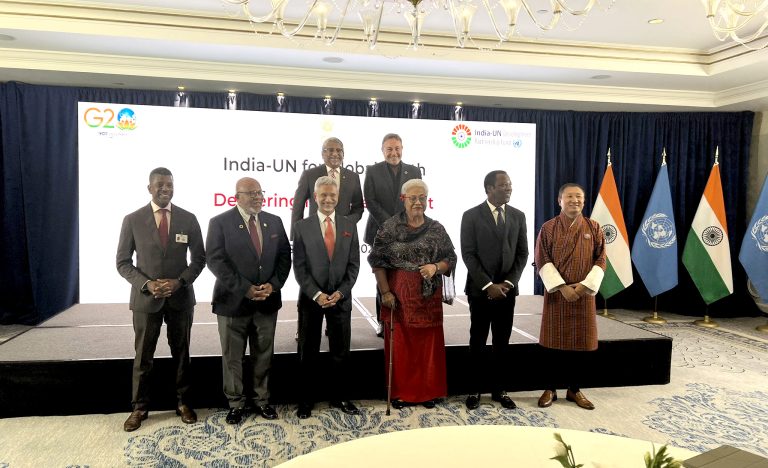
India and the United Nations have launched a joint “India-UN Capacity Building Initiative” that aims to share India’s development experiences, best practices and expertise with partner countries in the Global South through capacity building and training programs, said a release from the United Nations.
According to the official release, the initiative was announced at an event titled “India-UN for the Global South–Delivering for Development” in New York on 23 September 2023 in the presence of the External Affairs Minister S Jaishankar.
The event also saw the participation of Dennis Francis, President of the 78th General Assembly, Fiame Naomi Mata’afa, Prime Minister of Samoa, Tandi Dorji, Minister of Foreign Affairs, Bhutan, Vince Henderson, Minister for Foreign Affairs, International Business, Trade and Energy, Dominica, Hugh Hilton Todd, Minister of Foreign Affairs and International Co-operation, Guyana.
Maneesh Gobin, Minister of Foreign Affairs, Regional Integration and International Trade, Mauritius, Alva Romanus Baptiste, Minister for External Affairs, International Trade, Civil Aviation and Diaspora Affairs, St. Lucia, Ahmed Khaleel, Minister of State for Foreign Affairs, Maldives, Achim Steiner, Administrator, UNDP, Shombi Sharp, UN Resident Commissioner for India were also present in the event.
The “India-UN Capacity Building Initiative” builds upon the extensive cooperation in development and capacity building that India already has bilaterally with its partner countries, the release said.
The India-UN initiative also complements the India-UN partnership in the form of “India-UN Development Partnership Fund” which has developed a portfolio of 75 development projects in 61 countries in the last 6 years.
As part of this initiative, the UN India team and the Bill and Melinda Gates Foundation will partner to leverage India’s Technical and Economic Cooperation platform to share India’s development experiences and best practices across the world.
The release informed that a Joint Declaration of Intent was also exchanged on Sunday between the UN Resident Coordinator in India and the Bill and Melinda Gates Foundation to this effect.
This Initiative will also operationalise the development-relevant deliverables of India’s G20 Presidency, including the G20 Action Plan for Accelerating Progress on the SDGs, technological transformation and building Digital Public Infrastructure, among others.
The united nations marked the initiative as a significant contribution to global efforts towards accelerating momentum for achieving the Sustainable Development Goals (SDGs), by strengthening South-South Cooperation and reflects India’s continuing efforts to strengthen its development partnership with the Global South. The release added that the initiative carries forward the successful G20 Presidency of India which saw inclusion of the voice of Global South into the G20 agenda and entry of the African Union into the grouping.
(This news report is published from a syndicated feed. Except for the headline, the content has not been written or edited by OpIndia staff)
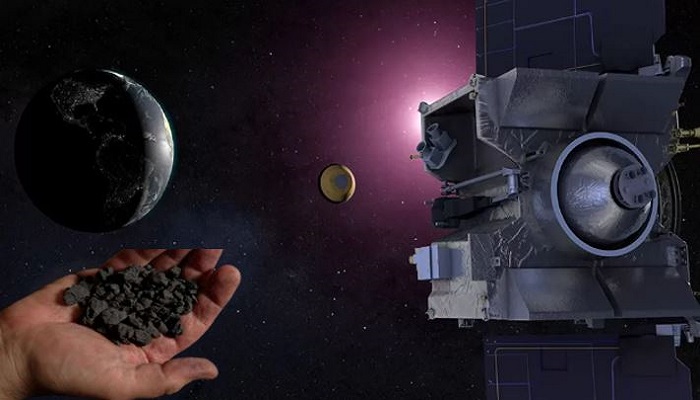
On Sunday (24 September), US space agency NASA’s OSIRIS REx spacecraft released the capsule that contains a piece of near-Earth asteroid named Bennu. As per official information, the capsule descended through space for four hours and then entered the atmosphere over California, subsequently landing about 13 minutes later in Utah.
The #OSIRISREx spacecraft has released the capsule containing a piece of asteroid Bennu. The capsule will plummet through space for four hours, enter the atmosphere over California and land about 13 minutes later in Utah. https://t.co/lK5QmILjtjpic.twitter.com/gECoNC1sHU
The sample capsule contains an estimated 8.8 ounces (250 grams) of asteroid rocks and soil from asteroid Bennu and it landed near Salt Lake City at 10:55 AM ET today (8:25 PM IST). A recovery mission has been launched to locate and retrieve the capsule.
Earlier in the day, the Osiris-Rex spacecraft reached within 63,000 miles of Earth’s surface which is about one-third the distance from Earth to the moon. From there, the spacecraft released the sample capsule at around 6:42 AM ET.
The capsule then travelled for four hours at 27,650 miles per hour and entered Earth’s atmosphere at around 10:42 AM ET (8:12 PM IST) off the northern California coast at an altitude of about 83 miles above the surface. 13 minutes later, the capsule finally landed at an area on the defence department’s Utah Test and Training Range near Salt Lake City. Parachutes were deployed to slow the capsule to a gentle touchdown at 11 miles per hour (17.7 kilometres per hour).
Notably, NASA’s OSIRIS-REx spacecraft stands for Origins, Spectral Interpretation, Resource Identification, Security and Regolith Explorer. This seven-year mission planned to study what scientists have described as the most dangerous rock in the Solar System began in 2016 when it lifted off with an aim to collect samples from the Bennu asteroid. It then began orbiting Bennu in 2018 and the spacecraft later collected the sample in 2020 using a long sting vacuum and subsequently set off on its lengthy return trip to Earth in May 2021.
Now, the Osiris-Rex spacecraft has brought back the pristine sample collected from the near-Earth asteroid Bennu. It’s NASA’s first time returning an asteroid sample from space. Earlier, Japan had collected around a teaspoonful of samples in two asteroid missions.
The capsule has no GPS tracker onboard so it was spotted using long-range telescopes and infrared cameras, BBC reported. Recovery and researchteams are reaching the landing site in 4 helicopters, and they will take lots of precautions before retrieving the capsule. First, they will conduct an aerial study to confirm that it is not damaged. After that, they will wait for the capsule to cool down so that it is safe to handle. The capsule reached temperatures up to 2,760° Celsius while descending through the atmosphere. The teams have been training for it for months and conducted several simulations of the capsule recovery.
A clean room has also been set up by NASA at the location to handle the capsule.
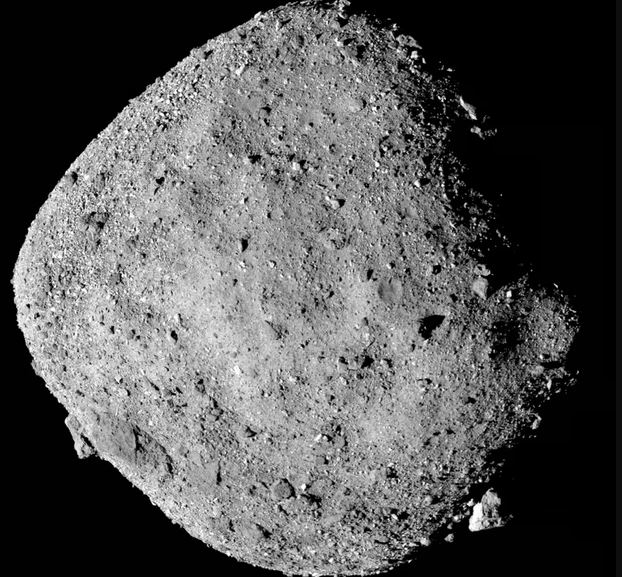
As per official information, Bennu is a carbonaceous asteroid which means that it has a lot of carbon in it, perhaps 5-10% by mass. It is expected that Scientists could see a mix of rocky fragments in a range of sizes – from a few millimetres across down to dust-sized. The material will appear very dark, almost black, and very crumbly.
(Image Source – NASA/BBC)
The asteroid Bennu was discovered in 1999. It is a ‘rubble-pile asteroid’ meaning that it is a large jumble of space rocks compressed together by gravity. It is believed that these rocks got broken off from a larger body, and are about 4.6 bn years old which means it is approximately the same time as the solar system, the Guardian reported.
The asteroid is orbiting the sun 81 million kilometres from Earth, and its surface is so loose that Osiris-Rex’s vacuum arm sank a foot or two into the asteroid. As a result, it sucked up much more sample than anticipated, and the lid of the container was jammed.
Regarding the sample, NASA said, “Pieces of 4.6bn-year-old space rock ‘act as a time capsule from the earliest days of our solar system.” The samples will be flown to a new lab at NASA’s Johnson Space Center in Houston, where the container will be opened.
Strikingly, the asteroid is known to be rich in carbon-based substances and water-containing clay minerals. This suggests that liquid water was once present on the larger body from which Bennu formed.
Researchers believe the samples collected could help scientists understand the ingredients that went into making planets including our own. It could also help them understand how those materials came together to create environments suitable for life.
It is believed that Bennu will likely also have a lot of water bound up in its minerals, perhaps as much as 10% by mass. Similarly, akin to carbon chemistry, the delivery of water through asteroid impacts might offer an explanation for the abundant presence of H2O on our planet.
After the release of the capsule, OSIRIS-REx resumed its tour of the solar system and is now headed towards a different asteroid named Apophis for a detailed study.
A 6-month-old baby boy in the United States was nearly eaten alive by rats that bit him over 50 times while he slept in his crib this past week, On September 13, the incident occurred in Indiana. Officers from the Evansville Police Department arrived at a “rodent-infested” home after the child’s father David Schonabaum called to report that his 6-month-old son seemed to have sustained major bite injuries.
The police found that the baby’s fingers had been chewed and the infant suffered over fifty bite wounds on his forehead, cheeks, nose, thighs and foot. After his fever dropped to 93.5 degrees, the baby boy was transported to an Indianapolis hospital, where physicians gave him a blood transfusion. The normal body temperature is 98.6 degrees, according to the Mayo Clinic. As per the boy’s vitals, he had moderate hypothermia as well as hypoxemia.
According to Sergeant Anna Gray of the Evansville Police Department, the doctors told the police that due to severe blood loss, the baby required blood transfusions and his fingers were amputated due to the damage caused by rat bites.
Highlighting the neglect on the part of the wounded infant’s parents, Sgt. Gray said, “Their excuse was that they did not hear the child cry.”
Inside the victim’s room, detectives reportedly discovered clutter and trash, including discarded food items. There looked to be rodent footprints in the blood, as well as rodent faeces and several items in the room that appeared to have been chewed on by rodents, according to police. Authorities allegedly discovered rodent faeces, rat traps, and a bait box in other rooms of the house. According to police, the residence had a terrible stench in the kitchen and basement.
Meanwhile, police have arrested and jailed the baby’s father David Schonabaum, and his wife Angel Schonabaum is being held on a bond of $10,000. In an arrest affidavit, police detective Jonathan Helm stated, “All four of (the victim’s) fingers and thumb on his right hand were missing the flesh from the top of them, exposing fingertip bones. The damage to (the victim’s) index and pinky fingers was the most severe, as they were missing flesh halfway down each finger.”
The victim child’s aunt Delania Thurman told the police that her oldest child and eldest child of the Schonabaum couple told their teacher on September 1 that they were bitten by rodents. On September 5, Thurman told the Child Services Department officials that their house had a “normal” number of rats. Now, the Schonabaum couple and Delania Thurman are facing multiple charges of child neglect.
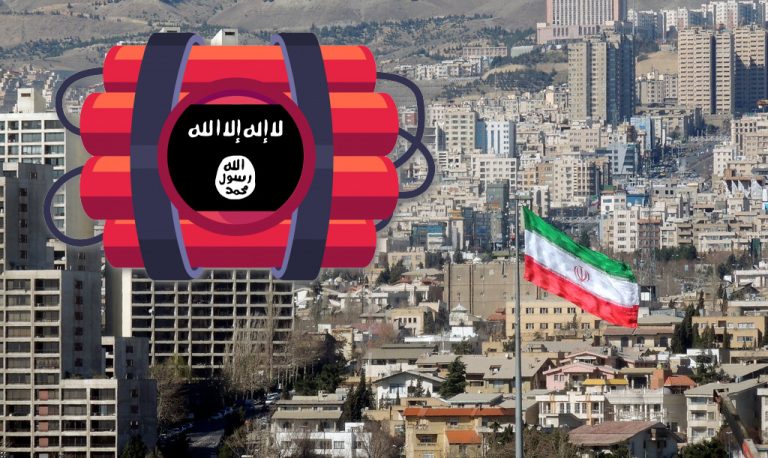
The Iranian intelligence forces have foiled a major terror plot to carry out a string of simultaneous bombings in Tehran and arrested 28 terrorists linked with the ISIL (Islamic State) (Daesh) terrorist group, Iran’s Tasnim news agency reported on Sunday (24 September). The Iranian media report added that the authorities neutralised 30 bombs that were planted to go off simultaneously in populated areas in Tehran, the country’s capital.
In a statement, Iran’s intelligence ministry said, “Some of the members are of Islamic State (IS) and the perpetrators have a history of being affiliated with Takfiri groups in Syria, Afghanistan, Pakistan, and the Kurdistan region of Iraq.”
According to the Iranian Ministry’s statement, the bombing attacks were planned to ‘undermine Iran’s security, display a false image of instability in Iran, foment disappointment and terror in the society, and provoke chaos.’ The Ministry added that the planned attacks in densely populated areas of the capital were intended to occur on the anniversary of last year’s anti-regime protests, which were triggered by Mahsa Amini’s death over hijab issue.
The explosions “were precisely planned for the anniversary of last year’s riots” and “aimed at breaking the security authority and presenting an unstable image of the country, creating despair and fear in the society and inciting riots and protests,” the Intelligence Ministry said.
In recent days, the ministry noted that the Iranian forces conducted a series of simultaneous operations in the provinces of Tehran, Alborz, and West Azarbaijan. During these operations, they raided the houses of terrorists and arrested 28 members of the terrorist network.
As per the statement by the Iranian ministry, the Iranian forces also seized weapons and equipment from the terrorists in these recent operations. The seized material includes a huge amount of explosives, bombs, a large number of explosive device materials, a package of 100 explosive primers, electronic devices used in time bombs, 17 American handguns and bullets, diverse smart and satellite telecommunication devices, military outfits, suicide vests, modems used in the Kurdistan Region of Iraq, and foreign currencies, Iranian media Tasnim reported.
Further, it also noted that during one of the operations at a house, the terrorists tried to carry out a suicide attack which could have endangered the lives of nearby residents.
The intelligence personnel swiftly prevented the suicide explosion, however, two Iranian intelligence personnel were injured in the operation.
According to media reports, the militant group has claimed several attacks in Iran. This includes the deadly twin bombings in 2017. They were targeted at Iran’s parliament and the tomb of the Islamic Republic’s founder, Ayatollah Ruhollah Khomeini.
Last year in October, the Islamic State (IS) claimed responsibility for an attack on a Shia shrine. The attack took place in the southwestern city of Shiraz in which 15 people had lost their lives. It is notable that ISIS has a history of attacking and persecuting Shia Muslims, and Iran remains their major target as it is a Shia country.
Amid Canada’s allegations against India based on American intelligence reports, External Affairs Minister Dr. S Jaishankar criticised the Global North on Saturday (23 September) and accused them of exercising “double standards”. He asserted that it is still a world of “double standards” and those countries that are occupying positions of influence have been resisting the pressure to change. He further added that those countries who have institutional or historical influence have actually weaponised a lot of those capabilities.
Notably, he took a dig at Global North while speaking at a Ministerial Session titled ‘South Rising: Partnerships, Institutions, and Ideas’. The event was hosted by the Observer Research Foundation (ORF), in partnership with the Permanent Mission of India to the United Nations, United Nations India, and the Reliance Foundation.
In New York, Jaishankar said, “I think more than political will, there is political pressure for change.” He added that there is a growing sentiment in the world and the Global South in a way embodies it. He, however, highlighted that there is political resistance to this growing sentiment.
He said, “Those who are occupying positions of influence, we see this in the UN Security Council most of all, are resisting the pressure to change. Those who are economically dominant today are leveraging their production capabilities and those who have institutional influence or historical influence have actually weaponised a lot of those capabilities as well.”
Citing the example of COVID-19, he added, “They will all mouth the right things, but the reality is still today, it’s a world very much of double standards.”
The Minister noted that the Global North includes nations or territories that are very resistant to change. Regarding the reform in the international system, he said, “But I think this whole transition will really be, in a sense, the Global South putting more and more pressure on the international system. And, the Global North is not just the North. There are parts which may not think of themselves in the North, but are very resistant to change.”
Speaking at the event, Jaishankar talked about cultural rebalancing and explained that it means recognising and respecting the diversity of the world and giving due respect to other cultures and traditions. He added that respecting others’ heritage, tradition, music, literature, and ways of life, is all part of the change that the Global South would like to see.
Citing the example of millets, he referred to the G20 Summit in Delhi which was held earlier this month, and noted that the Global South historically ate less wheat and more millets.
He emphasised, “In the name of the market, a lot of things are done, like in the name of freedom, a lot of things are done.”
Meanwhile, India’s Permanent Representative to the United Nations (UN) Ambassador Ruchira Kamboj, Reliance Foundation CEO Jagannatha Kumar, and ORF president Samir Saran among others also addressed the event.
While, Minister of Foreign Affairs of Portugal, Joao Gomes Cravinho, and the Minister of Foreign Affairs and Foreign Trade, Jamaica, Kamina Johnson Smith participated in the panel discussion at the event.
Highlighting that India’s G20 Presidency still has a couple of months remaining before Brazil assumes the presidency in December 2023, he said, “We hopefully get something moving on the reform of international financial institutions”.
Responding to ORF President Saran, Jaishankar denied the assertion that he is tough on Europe for making the remark that “Europe’s problems are the world’s problems but the world’s problems are not Europe’s problems”.
He categorically highlighted that the main issues that were troubling the entire world were debt, SDG (Sustainable Development Goal) resourcing, climate action resourcing, digital access, nutrition, and gender.
He added that partly because of Covid-19 and partly due to the focus on Ukraine, these subjects were driven out of the global conversations.
He noted that to get actually the G20 to talk about what the world wanted it to talk about — that was a real problem in the G20.
Explaining the reason why India held the Voice of Global South Summit 2023, he asserted that Prime Minister Narendra Modi was right when he said, “First let’s talk to the people who are not going to be on the table, let’s find out what they have to say.”
He highlighted that hosting the Voice of Global South Summit gave India the credentials, actually the empirical basis really to say that we have spoken to 125 countries and this is really what is troubling them and that is why we need to focus on these issues.
The issue of the murder of pro-Khalistan terrorist Hardeep Singh Nijjar has led to intense tension between Canada and India. Canadian Prime Minister Justin Trudeau claimed that his assassination was carried out by agents of the Indian government, however, he did not provide any proof to support the same. Interestingly, he has levelled the charge when he is being strongly cornered in his country on internal issues and is consistently trailing his rivals in the polls.
According to accounts in the Canadian media, he reportedly brought up the matter because his popularity is rapidly declining and would be marked for both national and international disgrace if he is not able to substantiate his allegation with tangible proof.
The prime minister acted hastily in an attempt to improve his slipping poll numbers and serve his domestic politics, based on a large section of the country’s media. “It’s important to remember Trudeau’s accusation has yet to be proven. He has so far failed to provide any evidence to Canadians,” Canada’s leading newspaper, the National Post wrote in an editorial which pointed to “his use of vague language and lack of any specific intelligence.”
The piece further read that if it turns out that he sparked this storm without any proof it would be a matter of domestic and global implications. The National Post has cited a recent poll by the Angus Reid Institute in which Justin Trudeau has got only a 33% approval rating while 63% of people dislike him. His government is in power with the support of the New Democratic Party which has twenty-four MPs. The head of this party, Jagmeet Singh is considered a Khalistan supporter.
An article in the Canadian newspaper Toronto Sun stated that India won’t stay quiet regarding the allegations that the Western nation has made against the Indian government. The Modi administration’s sole response that Canadians should anticipate is that India would make an effort to punish Canada for the accusation. Therefore, it is crucial that Justin Trudeau’s government releases whatever evidence it can produce to establish the Indian government’s link to Hardeep Singh Nijjar’s death.
The tabloid newspaper highlighted that Hardeep Singh Nijjar was not a saint and the court should have made the determination whether he was a terrorist, as per the assertion of the Indian government. If India is indeed behind his murder and the Trudeau government still stands by its word, then the South Asian country should be held accountable.
It claimed that the Modi government should have presented its evidence in a Canadian court and followed the legal route for the extradition process if it had proof connecting the Sikh radical to criminal acts. The Trudeau administration’s inaction in the face of violent pro-Khalistan elements was also questioned by the newspaper.
Toronto Sun pointed out that Prime Minister Justin Trudeau vowed that he would protect the Sikhs and that the entire community cannot be judged based on the actions of a few people. This is true, but if certain bad actors are encouraging violence or engaging in terrorist activities, including talking about attacking diplomats then the government ought to take action. The prime minister has failed to do anything on this front.
It emphasised that he has done nothing to deal with the violent extreme sections of the Khalistan movement that go beyond advocating for the motherland. The article concluded that neither Prime Minister Narendra Modi nor his Canadian counterpart is facing any problems due to the dispute, however, it is directly affecting the people of Canada who do business with India as well as those who are trying to arrange visas to visit the Asian nation. It also asked both leaders to stop playing international poker and put their cards on the table.
National Post in another piece reported that India considers Hardeep Singh Nijjar a militant and had declared a reward of Rs 10 lakh on him after his name appeared in a conspiracy to kill a Hindu priest in Jalandhar, Punjab. He was believed to have planned a blast in Punjab state and trained militants in a small city southeast of Vancouver.
The Canadian daily also conveyed that India has halted visa services citing security concerns amid the tension. This suspension prevents Canadians who do not already possess a visa from visiting India until services are restored. Canadians are among the top travellers to the country. According to India’s Bureau of Immigration, 80,000 Canadian tourists visited India in 2021.
Canadians of Indian descent are concerned about how they are going to travel to India now that visa services have been discontinued, based on a story in the Canadian newspaper Vancouver Sun. It quoted a Canadian of Indian ancestry Anil Kumar who lives in Surrey who voiced, “The suspension of visa services shows what a bad time this is. People are worried about travelling to India. I know some people who were going to India for Diwali. Now, they won’t be able to go and this is very worrying.”
Justin Trudeau’s absurd allegation and its aftermath
Prime Minister Justin Trudeau accused India of executing Khalistani terrorist Hardeep Singh Nijjar in Canada on 18 September and the charge was vehemently refuted by India in a statement which urged the Canadian government to take strict action against anti-Indian groups present there. India also summoned Canadian High Commissioner Cameron MacKay and expelled a Canadian diplomat in retaliation.
Furthermore, India has ceased providing visa services to Canadian citizens until further notice. The Ministry of External Affairs of India issued a warning to its residents in Canada on 20 September advising them to use caution in light of the rise in anti-Indian activities and politically sanctioned hate crimes there.
He reportedly implored the allies of Canada, including the United States for weeks to denounce India for the murder but was refused by everyone. They refused to participate in his story of “foreign interference” or to be dragged into it. He was snubbed by them fearing diplomatic backlash from India.
The murder of Hardeep Singh Nijjar did not even merit a mention during the crucial G-20 Summit, despite private discussions among the Five Eyes nations, an intelligence alliance made up of Australia, Canada, New Zealand, the United Kingdom, and the United States.
More importantly, the Indian government has repeatedly affirmed that the Canadian government has not provided any specific proof of Indian involvement in the killing of the Sikh extremist. It seems that Justin Trudeau’s decision to attack India, a fellow democratic nation without showing any evidence was motivated by short-sightedness and petty electoral ambitions which have now snowballed into a serious humiliation and created multiple challenges for his country.
His administration is now seen as siding with a terrorist instead of addressing the grave pro-separatist Sikh movement growing on his country’s soil that poses a serious threat to the lives, temples and properties of Hindu minorities along with the safety of Indian diplomats posted there.
Hardeep Singh Najjar (46) who had been profoundly involved in pro-Khalistan activities was shot dead on 18 June outside a Gurdwara in Surrey, British Columbia.
A Delhi court has ordered the release of the electronic devices seized from the editors of the leftist propaganda website The Wire. The devices were seized following raids at the residence of The Wire founders Siddharth Varadarajan, MK Venu, and staffer Jahnavi Sen and their office in Delhi in October 2022 after the publication of a series of fake reports by the portal regarding Meta-owned Instagram.
The searches were conducted by the Delhi Police in connection with the FIR filed against the leftist publication for publishing false and malicious Meta reports against BJP leader Amit Malviya.
The court said that there was no reasonable ground for not releasing the devices to the portal’s editors and product-cum-business head Mithun Kidambi. The order was passed by Chief Metropolitan Magistrate Siddhartha Malik of Tis Hazari Courts on the applications filed by The Wire editors.
The editors sought the release of the electronic devices which were seized by the investigating officer (IO). The court ordered that the devices be released within 15 days citing that they have been in the IO’s custody for a very long time.
It said that their mirror images are available with the Forensic Science Laboratory (FSL) for any subsequent investigation.
“The argument of the IO that the devices might again be required for some subsequent investigation is speculative in nature based on the presumption of coming to light some new fact at a later stage, which may or may not happen. The devices of the accused persons cannot be kept indefinitely by the IO only on the speculation of an uncertain future event/discovery,” the court said.
The Delhi Police argued that the mirror images of the devices may not be enough for the retrieval of data if some new facts come to light during further probes. The court said that reasonable conditions can be imposed on the editors to ensure that the devices are available to the IO for investigation if required at a later stage.
The court directed the editors to furnish an affidavit before the IO to keep the devices in their own custody. The matter is fixed for filing of compliance report by the IO on 21 October.
The devices are crucial for the investigation because The Wire had published a large number of forged and fabricated documents to frame Amit Malviya and Meta. It is important to know who prepared the fake documents. Although The Wire had claimed that they were conned by Devesh Kumar, one of the contributors of the story, Malviya has named editors of the portal in his complaint.
On 10 October 2022, The Wire published a report with the title ‘If BJP’s Amit Malviya Reports Your Post, Instagram Will Take it Down – No Questions Asked’ authored by Jahnavi Sen, deputy editor, and executive news producer at the portal.
In the report, The Wire claimed that Bharatiya Janata Party’s IT Cell Chief Amit Malviya has such power in Meta, the parent company of Facebook and Instagram, that if he reports any post on the platform, it gets removed by the system, no questions asked.
It further claimed that even if the publisher of the post that was removed from Instagram appeals against the removal, it does not get accepted by the system as “Malviya has privileges of being on the XCheck list.”
However, Meta had denied all the allegations, and alert netizens and experts have found glaring holes in Wire’s claims. The portal proceeded to provide ‘proofs’, including screenshots of emails of Meta officials and videos, all of which were found to be forged and fabricated. For several days The Wire tried to defend its stories, despite the fact that even leftist tech experts exposed their lies. However, when two experts including a Microsoft official cited by the portal said that they never verified the Wire’s claims to be true, as claimed by Wire, the portal had to finally take down the story.
However, instead of admitting that they published a fake story, they blamed Devesh Kumar, who had contributed to the reports, and even filed a complaint against him.The Wire also withdrew its other fake Teg Fog stories, also authored by Devesh Kumar.
Following this, Amit Malviya filed a criminal complaint against The Wire and its editorial team for their Meta reports against him, which were suspended by the portal in an implicit admission that they had erred in the reportage. On 29 October last year, Delhi police registered an FIR against The Wire, its founding editors Siddharth Varadarajan, Sidharth Bhatia and MK Venu, and Deputy Editor Jahnavi Sen, on the basis of the complaint. Subsequently, the residences of the accused were raided, and seized their electronic devices for investigation.
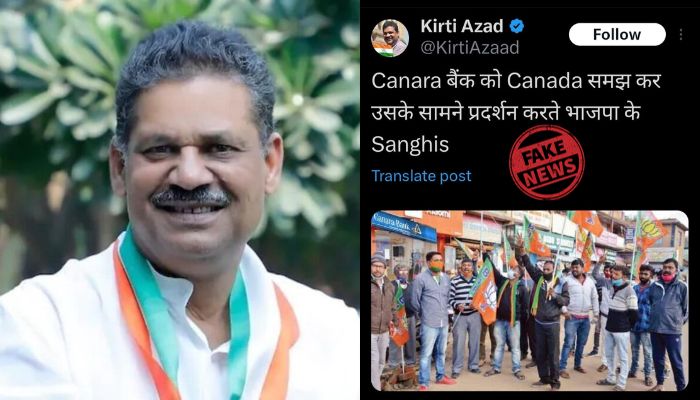
On Sunday (September 24), Trinamool Congress leader Kirti Azad courted controversy after he falsely claimed that BJP workers mistook Canara Bank for Canada and had been protesting outsides its premises.
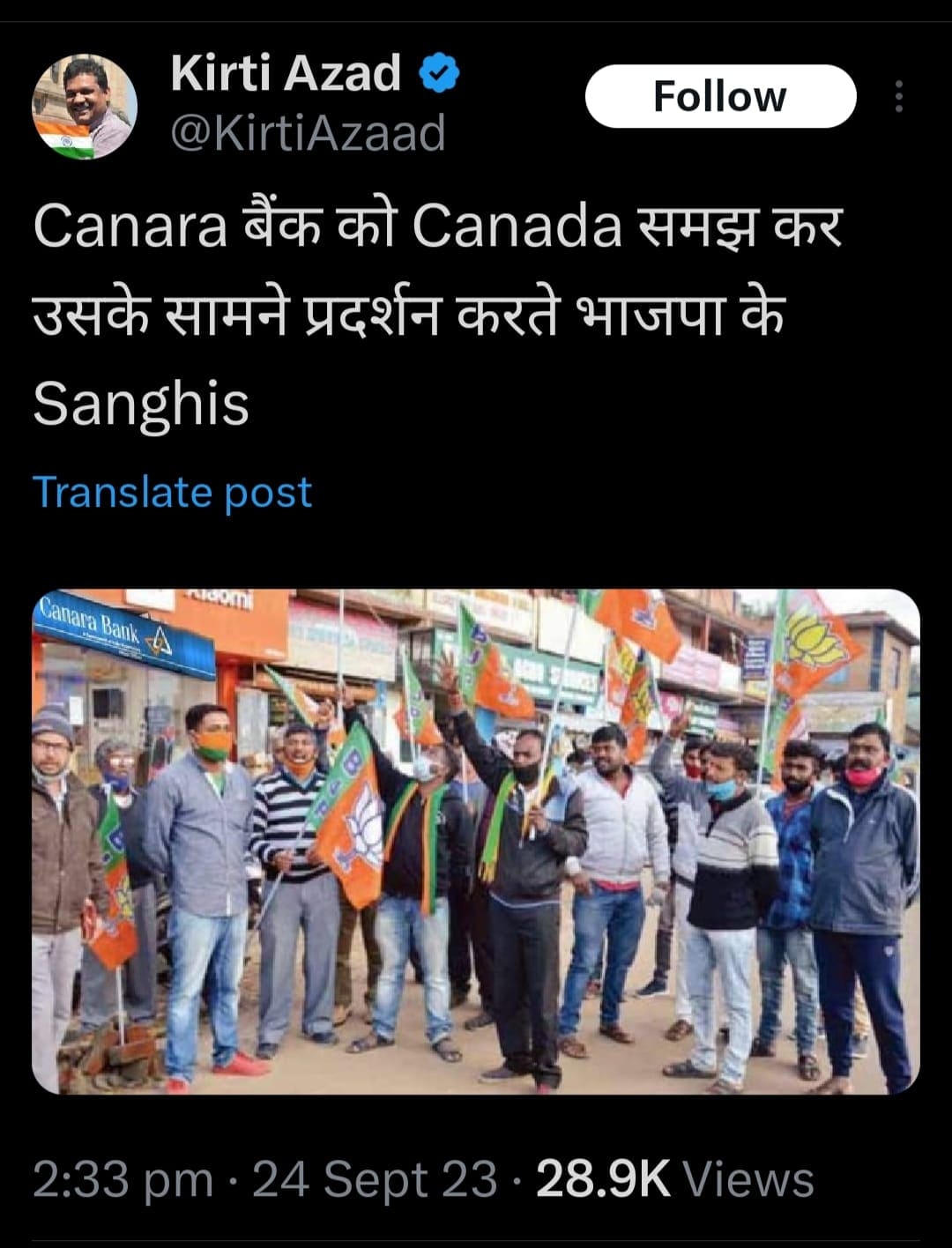
In a tweet (archive), the 64-year-old politician wrote, “BJP Sanghis assumed Canara Bank to be Canada and held demonstrations in front of the bank’s building.” The tweet was accompanied by a picture of a group of people, standing outside Canara Bank with BJP flags in hand.
At the time of writing, the contentious tweet had more than 2000 likes and 500 retweets. The former cricketer-turned-politician sought to exploit the ongoing diplomatic tension between India and Canada to score political brownies.
Screengrab of the tweet by Kirti Azad
The Truth behind the image
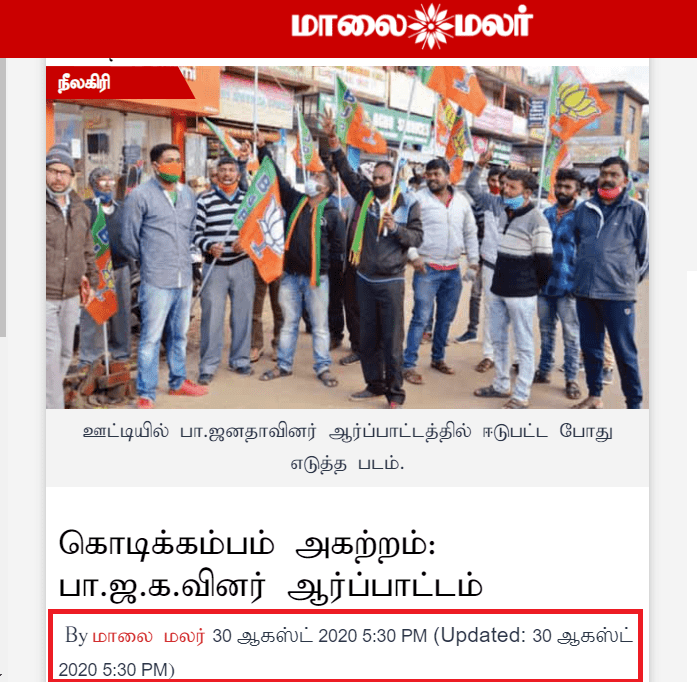
A quick ‘reverse Google image search’ of the image led us to a news report, published by Tamil daily ‘Maalai Malar’. The said report was published on August 30, 2020 i.e. 3 years ago.
At the very onset, it became clear that the picture shared by Kirti Azad had nothing to do with the ongoing diplomatic standoff between India and Canada.
The Maalai Malar report stated that BJP workers held demonstrations in Ooty against the city administration for removing a flagpole, which was installed to hoist the party flag. The municipality had alleged that no prior permission was sought from them by the BJP.
‘Screengrab of the news report by Maalai Malar’
Thus, it clearly shows that the BJP workers were not protesting against Canada in any form or manner. It is also interesting to note that the original picture was photoshopped with another image of Canara Bank by Kirti Azad to lend credence to his dubious claims.
This is however not the first time that Kirti Azad has resorted to peddling fake news on social media. Earlier in February 2022, he falsely claimed that BJP leaders were being thrashed by the common people during the second phase of polling in Uttar Pradesh.
In reality, the video is not from Uttar Pradesh but from the State of West Bengal. The victim in the incident was BJP leader Anirban Ganguly, who informed that he was attacked by Trinamool Congress-sponsored Jihadis.
Hi Kirti, amusing to see that you,Bhagwat Jha Azad’s son,can’t distinguish between the hinterlands of #WestBengal & #UttarPradesh!This is clip of a jihadi attack engineered by TMC on me on Election Day, April 30 2021.Having become a FAMILY DOORMAT you have lost your rationality! https://t.co/qfkH1XGlV4
— Dr. Anirban Ganguly অনির্বাণ গঙ্গোপাধ্যায় (@anirbanganguly) February 12, 2022
In October 2022, Kirti Azad shared a fake quote attributed to RSS leader MS Golwalkar on Twitter, which claimed that he was willing to tolerate British subjugation but not a government in the nation that granted Muslims and Dalits equal status.