In yet another mass shooting in the United States of America, several people were shot in Willowbrook, Illinois, near Chicago on Sunday, June 18. Reportedly, the incident took place during an unlawful street takeover. According to local reports, a notable police presence was reported at Burr Ridge along Route 83, where rounds were fired into a crowd of roughly 200 or 300 persons.
Emergency services, including fire officials and ambulances, responded to a ‘mass casualty’ event at Willowbrook Shopping Mall in Illinois after gunfire erupted and ‘multiple people’ were shot, reports said.
As per the latest reports, 29 people have been shot. However, there is no reports of any fatalities so far. At least two of them are said to be in critical condition. The precise number of victims has yet to be confirmed by police.
BREAKING: At least 29 people shot at an illegal street takeover in Willowbrook near Chicago, Illinois.pic.twitter.com/5phAPG8C6f
— The Spectator Index (@spectatorindex) June 18, 2023
Battalion Chief Joe Ostrander with the Tri-State Fire Protection District said the shooting took place about 12:30 a.m. on Route 83 near Honey Suckle Lane. According to witnesses, the shooting occurred during an illegal street takeover outside a small shopping centre. A crowd of 200 to 300 people, mostly teens and young adults, had assembled for a Juneteenth celebration in a parking lot, but it turned violent.
Seems like several people shot in Burr Ridge near Willowbrook , with about 300 people near the crime scene . https://t.co/rspNs0o0SH
— 16th & 17th District Chicago Police Scanner (@CPD1617Scanner) June 18, 2023
“It was supposed to be like a Juneteenth celebration; we just started hearing shooting, so we dropped down until they stopped. They just kept going. After that, we literally scattered away,” witness Markeshia Avery said.
Another woman said, “I got kids to come back home to. I’m not used to this. I wasn’t expecting it, but you just never know. Anything can happen anywhere.”
This comes just days after a mass shooting in San Francisco left nine injured in a “targeted and isolated incident” as stated by the police. The shooting took place at around 9 pm during a party hosted by a clothing store Dying Breed near the intersection of 24th Street and Treat Avenue in the Mission district.
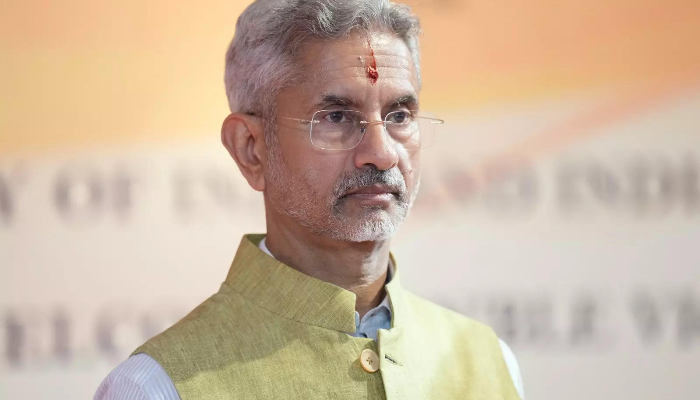
External affairs minister Dr S Jaishankar recently addressed the March 19 violence at the Indian High Commission in London in ‘The Ranveer Show’ hosted by Ranveer Allahbadia on YouTube. He also discussed a number of subjects pertaining to the difficulties faced while handling the foreign policy of the country.
In the podcast, Dr Jaishankar stated, “I had actually landed from a plane when I saw the picture of this man climbing up the Indian High Commission in London and was trying to pull down the flag. It got under my skin. When people try to score points, personal points, I just shrug it off. But if the collective ‘I’ that is not me but India is demeaned or attacked, then yes it does get under my skin. That sense that you are not given respect and people are condescending, sometimes ambush you.”
On March 19, pro-Khalistan elements staged demonstrations outside the Indian High Commission building in London and attempted to vandalise it and tear down the national flag. The incident took place the day after Punjab Police launched a crackdown against radical Sikh preacher and Waris Punjab De chief Amritpal Singh who was nabbed on the 23rd of April after being on the run for over a month.
“Diplomacy is an art of detail. There are a lot of nuances like body language, dressing, how you hold your hand, etc. It depends on the person and national relationship. It depends on the situation of how we react with other diplomats,” he remarked while offering a brief note on diplomacy. In reference to the current difficulties the nation is facing, he observed that “the world is a tough place.”
The External Affairs Minister added, “The young people need to know it is all about making India. Our infrastructure needs to be strong for people to set up work here. At the end of the day, it is about creating new job opportunities. Our job is to market India. To make India a magnet for people to do business with us.”
“When we get up, the first thing we do is reach out to our phone. It has completely connected us to the world. Once you start getting used to global content and comparisons. What you eat, what you read and everything becomes global. That is why we call it globalisation,” he highlighted while responding about the growing popularity of foreign politics.
The union minister earlier declared that India will not accept different security standards. Additionally, he charged that the United Kingdom had failed to uphold its duty to guarantee the protection of the mission’s diplomats.
Gujarat, once again, showcased its resilience and disaster management capabilities as it bravely faced Cyclone Biparjoy. Despite the severe storm originating in the Arabian Sea and making landfall in the coastal districts of Kutch and Saurashtra, Gujarat’s advanced planning and proactive measures ensured minimal damage and, most importantly, zero loss of life.
Home Minister Amit Shah’s visit
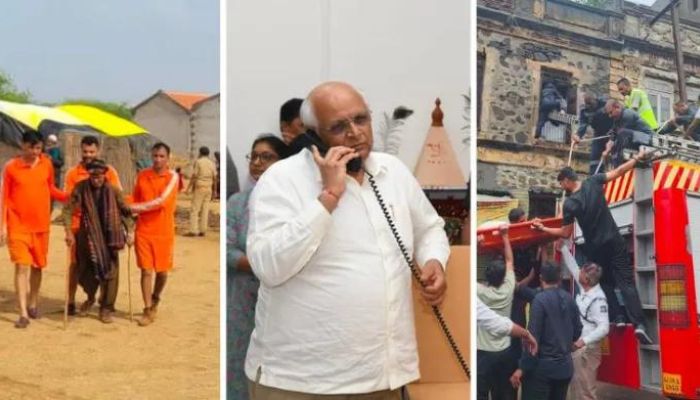
On Saturday, June 17, 2023, Union Home Minister Amit Shah, accompanied by Gujarat Chief Minister Bhupendra Patel, conducted an extensive aerial survey of the areas impacted by Cyclone Biporjoy in Kutch. The visit was aimed at assessing the situation and evaluating the extent of the damage caused by the cyclone.
Union Home Minister Amit Shah along with Gujarat CM Bhupendra Patel conducted an aerial survey of areas affected due to #CycloneBiporjoy, in Kachchh, Gujarat pic.twitter.com/cj52qtdFKU
During his visit, Home Minister Amit Shah paid a visit to Mandvi Civil Hospital, where he met with the individuals who had been admitted there. Additionally, he held a meeting with Chief Minister Bhupendra Patel and other senior officials to discuss the response efforts and necessary measures to support the affected areas.
Gujarat | Union Home Minister Amit Shah visited Mandvi Civil Hospital and met the people admitted there. pic.twitter.com/JLVbovreQd
The purpose of Shah’s visit to Kutch was to review the conditions in the regions affected by the cyclone, as stated by a home ministry official. Following the aerial survey, Shah proceeded to Jakhau port in Kutch and Mandvi to gain a firsthand understanding of the impact on these areas.
Moreover, Amit Shah took the time to visit shelter homes and personally interact with the affected individuals. He also visited the Swami Narayan Temple in Bhuj, where he reviewed the distribution of food and other essential supplies to those affected by the cyclone. The visit by Union Home Minister Amit Shah showcased the union government’s commitment to addressing the aftermath of Cyclone Biporjoy and ensuring that necessary support reaches the affected communities.
How Gujarat combated this calamity?
Gujarat successfully combated this calamity thanks to the key strategies employed by the state government, the involvement of various ministries, support from charitable and Hindu organizations, successful evacuation efforts, the preparedness of the medical and energy departments, and the restoration work that followed.
Gujarat’s government exhibited a steadfast commitment to proactive disaster planning, leaving no room for negligence or shortcomings. Every department, agency, district guardian minister, and Chief Minister Bhupendra Patel himself worked in unison, dedicating their full efforts to combat the storm. As a result, Gujarat successfully withstood the impact of a significant natural disaster, minimizing damage and protecting its inhabitants from harm.
Chief Minister Entrusted Responsibilities to Ministers
In response to Cyclone Biparjoy’s shift towards Gujarat, the government swiftly activated its disaster management protocols. On June 11, 2023, Chief Minister Bhupendra Patel convened a meeting and assigned senior ministers the responsibility of guiding planning and disaster management efforts in the coastal districts.
These ministers, including Rishikesh Patel, Praful Panseria, Kanu Desai, Harsh Sanghvi, Raghavji Patel, Kunvarji Bavaliya, Mulubhai Bera, Jagdish Vishwakarma, and Parshottam Solanki, promptly mobilized to their designated districts. Their unwavering commitment was evident as they remained on-site throughout the ordeal.
Minister of State for Home Harsh Sanghvi actively engaged with the affected population, constantly assessing the situation, maintaining communication with authorities, and persisting with work even in the face of heavy winds and rain. Minister of State for Education Praful Panseria independently contributed to the relief efforts. Rishikesh Patel demonstrated commendable leadership and coordination in overseeing the district of Kutch. Together, these ministers demonstrated their utmost dedication and spared no effort in fulfilling their responsibilities.
Charitable and Hindu Organisations extended support
During this critical period, charitable institutions and Hindu temples extended their support. Organisations such as the Rashtriya Swayamsevak Sangh and the Vishwa Hindu Parishad-Bajrang Dal have consistently demonstrated their unwavering commitment during times of disaster, selflessly serving the community.
RSS and several other organisations are working together to help people affected by #CycloneBiparjoy.
This time was no exception as they continued their dedicated service. The BAPS and other Hindu religious institutions also remained actively involved, providing assistance in various areas, including arranging provisions of food and water for migrants and participating in advance preparations. Collaboration and unity were evident as everyone worked together, leaving no aspect unaddressed.
Evacuation efforts safeguarded 1 lakh people
Following Chief Minister Bhupendra Patel’s meeting, a remarkable evacuation effort took place, relocating over 108,000 individuals residing in high-risk areas. This mass migration in such a short span of time is an impressive feat. During the evacuation process, special attention was given to the well-being of pregnant women, ensuring they faced no hardships through organised initiatives. Additionally, in cases where people became trapped despite evacuation, they were promptly rescued through airlift operations.
To effectively address the storm’s impact, a total of 19 National Disaster Response Force (NDRF) teams were deployed across nine coastal districts of Gujarat, namely Kutch, Devbhoomi Dwarka, Jamnagar, Morbi, Porbandar, Gir Somnath, Junagadh, Rajkot, and Valsad. Furthermore, 12 State Disaster Response Force (SDRF) teams were assigned to seven coastal districts, including Kutch, Devbhoomi Dwarka, Jamnagar, Morbi, Porbandar, Gir Somnath, Junagadh, as well as Patan-Banaskantha, with an additional SDRF team stationed in Surat.
Vigilant Medical Department
Before the cyclone struck, a comprehensive medical infrastructure was established in the potentially affected regions, with a total of 1,005 medical teams actively operating. The allocation included 504 ambulances, consisting of 202 ‘108 ambulances’ and 302 government ambulances, to cater to the needs of the affected population. Additionally, to ensure adequate healthcare facilities, a substantial number of 3,851 critical beds were arranged in the areas at risk. Furthermore, a total of 197 DG sets were assigned to these regions, enabling the provision of an uninterrupted power supply.
The health department took meticulous measures to secure an ample supply of medicines and logistics in the potentially affected areas. In all the hospitals across the impacted districts, diesel generators were installed to ensure uninterrupted functioning. Moreover, the Health Department compiled a list of pregnant women residing in the vulnerable zones, including their estimated delivery dates, and successfully relocated 1,152 pregnant women to safer locations, prioritizing their well-being and safety during the cyclone’s potential impact.
Ensuring animal welfare while saving people
To address the significant impact on the power supply caused by the cyclone, the energy department proactively took action. A notable total of 1,127 teams were deployed across 3,751 villages in 8 districts, with an additional 889 teams on standby, ready to address any power-related issues that may arise. Simultaneously, the forest department efficiently responded to fallen trees in the affected districts, deploying a comprehensive fleet of 237 teams for their removal.
મુખ્યમંત્રી શ્રી ભૂપેન્દ્ર પટેલના માર્ગદર્શનમાં બિપરજોય વાવાઝોડા સામે માનવજીવનની સાથોસાથ પશુઓ અને વન્ય પ્રાણીસૃષ્ટિને સુરક્ષિત રાખવાનું રાજ્ય સરકારનું સુદ્રઢ આયોજન.#CycloneBiparjoypic.twitter.com/oM5JJuwJUy
Furthermore, comprehensive measures were taken not only to ensure the safety of the people but also to safeguard the well-being of wildlife, including the revered lions of Gir and other animals in sanctuary areas. A strategic deployment of 184 teams was carried out in the Lions Zone, focusing on rescue operations, swift response, and the clearing of fallen trees. Moreover, in the sanctuary area of Kutch, 13 operational teams and six special wildlife rescue teams equipped with necessary equipment were deployed.
Recognizing the importance of infrastructure restoration, the Roads and Constructions Department had readied 132 teams, equipped with essential machinery and equipment. This included 328 JCB machines, 276 dumpers, 204 tractors, 60 loaders, and 234 other necessary tools. These teams remained on standby in the potentially affected areas, prepared to promptly restore roads and buildings in the aftermath of the cyclone.
Constant oversight by Prime Minister Modi
Over the past three days, Chief Minister Bhupendra Patel has demonstrated unwavering dedication by consistently overseeing operations from the State Emergency Operation Center. With a vigilant eye on all situations, he has provided instructions to effectively manage the crisis. Additionally, Prime Minister Narendra Modi held a meeting and personally engaged with Chief Minister Bhupendra Patel to gather updates on the preparedness as the storm approached the coast. Home Minister Amit Shah remained actively involved, closely monitoring the situation alongside the central agencies, which also played an instrumental role.
માનનીય વડાપ્રધાન શ્રી નરેન્દ્રભાઈ મોદીએ આજે મોડી રાત્રે મુખ્યમંત્રી શ્રી ભૂપેન્દ્ર પટેલ સાથે ટેલીફોનીક વાતચીત કરીને ગુજરાત પર તોળાઈ રહેલા બિપરજોય વાવાઝોડાની પરિસ્થિતિની સંપૂર્ણ વિગતો મેળવી હતી. માનનીય વડાપ્રધાનશ્રીએ ગીર ફોરેસ્ટના સિંહ સહિત વન્ય પ્રાણીઓની સલામતીની વ્યવસ્થાની વિગતો…
The Government of Gujarat adhered to the principle of ‘Zero Casualty’ and achieved remarkable success. Despite the severity of the storm, with its powerful winds and heavy rainfall, there was no reported loss of lives. The government’s prompt actions and efficient rescue efforts ensured the safety and well-being of the people affected by the cyclone.
Swift restoration work
Immediately after the cyclone’s intensity diminished, the restoration efforts commenced with full force. Within a few hours, a significant number of roads were reopened, and electricity was reinstated in numerous villages where the power supply had been disrupted. Despite the challenging weather conditions, repair work persisted, ensuring Gujarat swiftly resumed its normal functioning.
Gujarat has demonstrated resilience and resilience in the face of previous natural calamities. Once again, through meticulous planning, proactive preparations, and decisive actions by the government, the state effectively confronted Cyclone Biparjoy and successfully emerged from yet another disaster.
The cyclone moved ahead to Rajasthan
Following the impact of cyclone Biparjoy, the western districts of Barmer, Sirohi, Udaipur, Jalore, and Jodhpur in Rajasthan witnessed heavy rainfall on Saturday morning accompanied by winds blowing at speeds of 50 to 60 kph. Jalore, Sirohi, and Barmer experienced the most significant effects of the cyclone, with heavy rainfall reported in these areas. The Meteorological Department issued an ‘orange’ alert for Barmer, Jalore, Sirohi, and Pali on Saturday. Fourteen trains passing through Barmer were cancelled, and two flights from Udaipur to Delhi and Mumbai were also affected.
More than 5,000 individuals from five villages near the Pakistan border in Barmer were evacuated to safer locations. The entire state was covered in clouds due to the impact of Biparjoy. Churu’s Bidasar recorded three inches of rainfall on Friday night, and strong winds of 62 kph were observed in many areas of Sirohi. Over the past 24 hours, Sedwa in Barmer and Mount Abu in Sirohi received the highest rainfall, measuring five inches each. Intermittent rain persisted in Sanchore, Jalore district since Friday night, leading to power outages in several villages. Bus and rail services have been completely suspended due to the cyclone.
Cyclone Biparjoy reached Rajasthan on Friday night, although its speed has decreased. The impact of the cyclone is expected to continue in the state until Sunday. Prior to its arrival, heavy rain caused flooding in low-lying areas of Jalore, Barmer, and Jodhpur, resulting in uprooted trees and electric poles in various locations. Factories in Pali have been closed for two days, and an orange alert for heavy rain remains in effect in Jodhpur on Saturday. In response, district collector Himanshu Gupta has instructed the closure of all educational institutions, coaching centres, gyms, tourist places, and summer camps in the district. Some areas in Jodhpur are expected to receive approximately 100 mm of rain on Saturday.
“But Hindu men also commit crimes against Hindu women.”
This is the argument many people put forward when the issue of Love Jihad comes up.
On the face of it, it is true. Of course, Hindu men commit crimes against Hindu women, just like Muslim men commit crimes against Muslim women, Sikh men against Sikh women, Christian men against Christian women and so on. These crimes are of diverse nature, some very serious. (For that matter women also commit crimes against men but let us keep that out of scope for the sake of clarity). As a society, we have acknowledged the seriousness of these crimes and made laws, often very strict, to prevent them. Often these crimes have a prominent social dimension, hence only law is not sufficient to deal with them. We also teach our young the rights and wrongs and try to mould society in the desired manner to supplement the law.
Having acknowledged these crimes exist, let us now see why these crimes are different from what is popularly called “Love Jihad”.
“Love Jihad” or “Grooming Jihad” cases often exhibit the following traits.
1. Hate crime: A crime is considered a hate crime if the victim was targeted based on their identity. For example, muggings happen in the New York subway, but if someone mugs only Jewish people, then it is not just a mugging, it is a hate crime and the criminal is charged with stricter laws. The same applies to Love Jihad cases where Hindu women are specifically targeted. In the Ajmer sex scandal, out of the hundreds of victims, how many were Muslim? It was a hate crime, not a social crime. Clubbing them with regular crimes is deliberate obfuscation to lower the seriousness of these crimes.
2. Genesis in Islamic doctrine: Islam treats Kafir and Muslim women differently in every aspect. For example, Kafir women can be kept as slaves but cannot be married. On the other hand, you cannot enslave a Muslim woman. These attitudes are extremely misogynistic and kafir-phobic which, it would be fair to assume lead to at least some of these crimes. When your ideology dehumanizes an entire group of people, your ideology is encouraging crimes against that group. Hence some criminals feel no shame in hiding their identity or in forcing Hindu women to convert and worse. Add to this the Islamic obsession with converting others to Islam and it becomes a deadly combination where Kafir women are seen as a legitimate target. These are not regular crimes, this is religious.
3. Backed by the wider society: As seen in the recent case in Pune, where a Hindu underage girl was abducted, it is observed that Muslim society often seems to hush it up. The mother of the accused, the Maulvi who converts and marries the underage girl, the family, and even the first wife or wives often support these criminal acts. Ever heard of a whistle-blower saving a Hindu girl? This points to a very unhealthy mindset that is different from regular crimes. This makes saving these girls far far more difficult.
4. Repeating modus operandi: Many patterns repeat in these cases. It may appear simplistic, but faking identity, use of force and intimidation, targeting underage girls, conversion, involvement of more than just one person, violence etc are seen in many cases. Not to deny other complexities, but this obvious presence of recurring patterns itself makes these crimes different from other crimes. The reason we are discussing crime is to prevent it right? Then failing to identify patterns will only lead to failure to prevent such crimes.
5. Organized apologia: A tell-tale clue is the existence of an organized intellectual class that keeps denying the existence of Love Jihad. No such gangs exist to deny regular crimes. On the other hand, popular media keeps glorifying relations between Hindu girls and Muslim men, but not the other way around. How many Feminism and Youth forums on Instagram have covered the 100s of attacks on Hindu men for talking to Muslim women? None. The very existence of such people in media, academia, entertainment etc reveals that the nature of these crimes is indeed different.
6. Disturbing no of underage cases: A truly disgusting but common aspect is the shocking no of underage girls being groomed by older men. If you look at the recent cases from Delhi, Uttarakhand, Pune etc, ALL of them involve underage girls incapable of consent. This phenomenon is the clearest evidence of organised grooming. Islamic doctrine permits relations with underage girls as long as they have hit puberty, but very young girls are also easy to brainwash and turn against their families and society. Anyone calling this organized paedophilia “just interfaith love” is part of this paedophilia grooming gang, nothing less.
These aspects clearly bring out that Hindu-on-Hindu crimes are different than Muslim on Hindu crimes. In Muslim on Hindu crimes, bias may exist. Research in the West has shown that bias-motivated crimes are more likely to involve violence, injury and psychological trauma (Commentary: Why hate crimes are different – CNN.com). This is reason enough to treat Love Jihad as a hate crime in law and in public discourse.
Going back to those who say ‘but Hindu men also commit crimes against Hindu women’, understand these people are not denying the existence of Love Jihad crimes. They are merely saying ‘Love Jihad crimes should not be treated as more serious than normal crimes’. They say this knowing well that bias-motivated crimes do more damage. This makes no sense, and one wonders what is the real motivation of those who provide cover for hate crimes. In every ethical sense, those who make such whataboutism arguments are unwitting enablers of hate crimes against Hindu women.
Recently, I had an interaction with a friend of mine who is from the movie industry. His views came from a content creation and creative freedom point of view and mine, out of personal interest in the production process of audio-visual content.
Bharat, Hindus, are the oldest cultural civilisation that has stood proud over thousands of years despite the repeated onslaught of invaders and colonisers. A civilisation that our forefathers fought and laid their lives down for. We owe it to our ancestors to conserve the glory of our civilisational ethos and uphold its pride and sanctity.
Cinema is a great medium to break down our complex culture and carry out a message to the world. Hindus hoped Adipurush would do just that. I have not seen the movie but I see that we as Hindus face a double-edged sword.
Should we appreciate the effort and output while evaluating it on the basis of global standards so much that the criticism-based factual inaccuracies take a back seat? Should we recognise the efforts of hundreds of people and thousands of man-hours of work? Or, express our dismay when our expectations as consumers and as culturally rooted Hindus were not treated adequately with respect to the sensitivity, respect and accuracy that one should approach Hindu epics with.
I have met daily wagers who cut corners out of their minuscule earnings so that they could watch their favourite stars and be in awe of the story he tells. Use cinematic grandeur to escape the mundane and insurmountable odds of his life. In the recent past, some movies and celebrities were criticised for their work. Some of them were questioned on social media too. Boycott calls were made. However, instead of carefully understanding the moot point, these drunk-on-money-power celebrities mocked the public sentiment. It was appalling that some of them even challenged the very audience that they hope to serve and tell them not to watch their movies as they only want their movies to be consumed by people who can appreciate their ‘creativity’. From star kids like Kareena Kapoor asking people to not watch them if they don’t like them, to Arjun Kapoor threatening viewers and Alia Bhatt mocking people for calling out rampant nepotism in the industry with bereft of talent star kids getting a free run.
Commercial “masala movies” which are purely aimed at entertainment can be taken with a pinch of salt but even they have caused considerable damage towards subverting our general view towards our history, culture and social outlook in a self derogating direction. Loose cultural references and foul depictions of our rituals have already been normalised. We as Hindus have let it pass as an artistic representation or creative freedom and made our peace with it. We don’t see the same level of tolerance reciprocated by the so-called minorities. In fact, even their inhuman actions are glorified and presented as some kind of a struggle for survival and acts of revolution. Amidst all of this the only hope that we as Hindus have is that when movies which are attempted with elements of our history, culture, dharma and civilisational pride should be treated with utmost respect and attention to detail to ensure that the sanctity of the messaging is preserved.
Movies have a considerable contribution to shaping our society. They influence the evolution of our society at both, the individual level as well at the regional or global level. The success of movies at the regional level indirectly becomes a testimony of cultural and civilisational acceptance. Therefore, it’s essential that the movie industry recognises its responsibility. The industry cannot afford to turn a blind eye or have its way in the name of creative freedom without considering the demographic fabric of our civilisation.
Our epics are not just mythical stories or fairytales which should be appropriated at the whims and fancies of anyone. They must be respected and they must be approached sensitively in the creative processes.
One example of such a movie is “Jai Santoshi Maa” – 1975. It changed the public discourse like few movies in the cultural space. It mainstreamed Santoshi Maa in every household. There was nothing dramatic about the movie even for its time. A movie like Mughal-E-Azam (1960) had more production richness and aesthetic appeal than Jai Santoshi Maa which was released a whole 15 years later. Yet checked all the boxes. The visuals had the audience teary and in awe of Santoshi Maa. The background score invoked a sense of Bhakti in the audience. The music of this movie is considered one of the most popular spiritual hymns and most people today do not even consider it as a mere original soundtrack. It is now played as devotional music at Jagran and religious festivities. In fact, the entire concept of ‘Maata ki Chowki’ and ‘Jagraataa’ became part of mainstream culture. It made such an impact that no one needs to make a Santoshi Maa movie with the same depiction again. That’s the power of cinema and that’s called making the most of the opportunity.
It clearly shows that one doesn’t need a fat budget, popular star cast, or social media noise (paid or otherwise) if the subject is approached ethically and mindfully. The audience would reward a sincere effort at the box office and be happy about their culture and reverence being showcased with due respect.
Defending the plethora of criticism, which ranged from trashy dialogues being attributed to Hanuman and Bhagwan Ram, to the misrepresentation of Ramayan itself, Manoj Muntashir only yesterday essentially said that anyone criticising the plebeian dialogues attributed to our Gods was those who had a problem with the chants of Jai Shree Ram.
He very ‘eloquently’ narrated some other dialogues he had written for the character of Prabhu Shri Ram. Then quickly cried a victim of being targeted by some people on social media for specific dialogues he had written for Hanuman’s character.
He went on to admit that it was a creative decision that came out of careful deliberation. The reason cited was – children of today do not know anything about Maryaada Purushottam Prabhu Shri Ram beyond him supposedly being a God whose picture is hung on the wall in their homes. The crux of Muntashir’s argument was that for our children to understand the glory of Maryada Purushottam Ram, all Maryana has to be broken.
Today, he took to Twitter and yet again, said he was being victimised. However, to his credit, he did say that the team of Adipurush had decided to change the offending dialogues with immediate effect.
रामकथा से पहला पाठ जो कोई सीख सकता है, वो है हर भावना का सम्मान करना. सही या ग़लत, समय के अनुसार बदल जाता है, भावना रह जाती है. आदिपुरुष में 4000 से भी ज़्यादा पंक्तियों के संवाद मैंने लिखे, 5 पंक्तियों पर कुछ भावनाएँ आहत हुईं. उन सैकड़ों पंक्तियों में जहाँ श्री राम का यशगान…
— Manoj Muntashir Shukla (@manojmuntashir) June 18, 2023
While the audience backlash resulted in the team of Adipurush retracting the dialogues, it is important this notion that those offending dialogues somehow taught Ramayan to our kids has to be addressed.
As a father, he should speak for himself. And I, as a father, refuse to submit to his justification for using crass, pedestrian language which was then delivered by the actor who characterised Hanuman.
I refuse to let my children get the impression that Bhagwan Hanuman was a cocky strong-man who lit Ravan’s gothic charcoal black kingdom on fire at the wag of his tail.
Our kids know the kind of language they can use when they are amongst their peers and at the same time maintain dignity, love and respect in their behaviour. And so, I refuse to accept using pedestrian language to depict the messaging of our Gods for the sake of mass appeal and providing a ‘simpler’ understanding to our kids.
The unintended (or perhaps intended, we would never know) consequence of this debauchery would be a mainstreaming of a mauled version of Ramayan and a deracinated version of our Gods. This results in a great disservice to us as Hindus who wish to take pride in our history, culture and civilizational richness.
We missed the bus this time because the makers of Adipurush have managed to destroy the content streams by misrepresenting the relevant elements of our Gods. They now hide under the garb of creative freedom after turning our revered Gods into shallow, ranting war creatures. What kind of creativity are we talking about here?
When movie makers approach messaging and fail to create an impact for such a significant and prime subject like Ramayan, it closes the door for all cultural movies for a long time. Every cultural subject will now be analysed for things which may or may not be relevant. All upcoming movies will lose the opportunity to be evaluated in the fair spirit. It doesn’t seem that our so-called stars realise the disservice they do not only to society but to their own industry.
In the meantime, we as the audience are left with some questions, to which, given Muntashir and Om Raut’s arrogance, I do not expect answers.
What do we settle for? What do we do?
Yes, a cultural movie was attempted and its commercial success should be celebrated along with appreciation that it has brought a fraction of the youth to recognize at least some part of our roots. But, are we supposed to accept the inaccuracies and push them under the carpet in the name of artistic freedom? Is our cultural pride so cheap and can be taken for granted or loosely handled?
Should we call out this misadventure and recognise all the inaccuracies?
Should we hold the movie makers responsible for the compounding impact on our future generations because of their little creative debacle?
Should we allow this disinformation to be mainstreamed over a period of time and find its place in being recognised as another credible version of our history? This will not only impact our social discourse but will be seen as an element of our identity globally.
And given that this debacle, over a period of time, might become acceptable as another version of our history, just like the Jodha-Akbar debauchery was, should we be far more infuriated at the sleight of hand by the makers of Adipurush.
Should literature be created to document the inaccuracies so that it stays on record that the movie had these deficiencies and they should be treated as such, thus, not allowing it to have any association with our history at all?
I would want my teenage children to think of Lord Ram as the ideal King and ideal leader. I would want them to learn that Dharma must be fulfilled no matter what the cost is. I would want my children to learn unbridled bhakti from Hanuman – that even Arjun won because he decided to mount his rath. I would want my daughter to learn pride, dignity and duty from Maa Sita. I would want my children to grow up with gratitude for the Dharma they were fortunate enough to be born in. Turning our Gods into cheap rip-offs of some lifeless Marvel characters is not what my children need to learn about their roots. Adipurush is not for my children and will never be.
On Sunday (June 18), the National Commission for Protection of Child Rights (NCPCR) took suo motu cognisance of a viral video wherein minor children were seen pelting stones at the police in Junagadh city of Gujarat.
In its letter to the SP (Junagadh), NCPCR said, “It has been brought to the notice that a massive violence took place in Junagadh, Gujarat on 17th June 2023 after the Junagadh Municipal Corporation issued notice to a Mosque near Majewadi Gate for illegal encroachment.”
“Through the said video, it is evident that many minor children have been seen stoning…as part of the mob,” it noted. NCPRC pointed out that it is a prima facie violation of Section 75 and Section 83(2) of the Juvenile Justice Act of 2015 and other relevant provisions of the Indian Penal Code (IPC).
National Commission for Protection of Child Rights (NCPCR) writes to Junagadh SP and requests his offices to initiate necessary inquiry, appropriate and necessary action in Junagadh Violence in which minor children are made to be part of the violence activities: NCPCR https://t.co/2ezmjvKkb6pic.twitter.com/sb01otgp7c
Whoever, having the actual charge of, or control over, a child, assaults, abandons, abuses, exposes or wilfully neglects the child or causes or procures the child to be assaulted, abandoned, abused, exposed or neglected in a manner likely to cause such child unnecessary mental or physical suffering, shall be punishable with imprisonment for a term which may extend to three years or with a fine of one lakh rupees or with both.
Similarly, Section 83(2) of the said legislation makes it clear –
Any adult or an adult group that uses children for illegal activities either individually or as a gang shall be liable for rigorous imprisonment for a term which may extend to seven years and shall also be liable to a fine of five lakh rupees.
NCPRC has requested the Superintendent of Police (Junagadh) to initiate an inquiry into the matter and register a First Information Report (FIR) against those found violating the above-mentioned Sections. The Commission has also asked the police to submit a report within 7 days of receiving the letter.
Violent mob attacks police and sets vehicles on fire in Junagadh
On Friday (June 16), a mob comprising hundreds of people attacked a police post in Majievadi Chowk in the Junagadh district of Gujarat after a notice was issued to demolish an illegal dargah located near Uperkot Extension.
The angry mob vandalised public property and set fire to vehicles parked outside the police post. The mob pelted stones at the police personnel present there, leaving several police officers including Deputy SP and a woman PSI injured.
The visuals of the incident emerged online wherein it is seen that the large mob hurls stones at the police while officers try to bring the situation under control by using tear gas shells.
An additional police force was deployed and a lathi charge was done to control the violent mob. Several vehicles were burnt and multiple police personnel were injured.
On Sunday, June 18, Prime Minister Narendra Modi addressed the 102nd edition of his monthly radio show ‘Mann Ki Baat.’ The flagship radio programme, which is traditionally broadcasted on the last Sunday of every month, aired a week earlier this month because of PM Modi’s upcoming State visit to the United States from June 21 to 24.
During his address, the Prime Minister remarked, “As you all know, I will be in America next week, and the schedule there is going to be very busy, so I thought what could be better than the blessings of the people to give me energy.”
"Usually 'Mann Ki Baat' comes to you on the last Sunday of every month, but this time it is happening a week earlier. As you all know, I will be in America next week and the schedule there is going to be very busy, so I thought what could be better than the blessings of the… pic.twitter.com/vKPO8SANL7
The PM called India the mother of democracy and reminded the country of the emergency and described it as a dark era in the country’s history when crimes were committed against people who supported democracy. “India is the mother of democracy. We cannot forget June 25. The day when emergency was imposed. It was a dark period in the history of India. Millions of people opposed the emergency with all their might. The supporters of democracy were tortured so much during that time that even today, the mind shudders.”
He mentioned, “Today, when we celebrate Azadi Ka Amrit Mahotsav we must also observe such crimes. This will teach the young generations the meaning and importance of democracy.”
In addition, he highlighted that many books have been written on these atrocities; the punishment meted out by the police and administration and pointed out that he had also got the opportunity to write a book titled Sangharsh Ma Gujarat at that time. He talked about another book on the subject titled ‘Torture of Political Prisoners in India.’
PM Modi also hailed the courage of the people of Gujarat who successfully braved cyclone Biparjoy. He asserted that the teamwork of the people reduced the damages inflicted due to the cyclone which made landfall in Gujarat on June 15.
“The strength of disaster management that India has developed over the years is becoming an example today. Cyclone Biparjoy wrecked so much havoc in Kutch, but the people of Kutch faced it with full courage and preparedness”, PM Modi said.
“There is a great way to combat natural calamities – conservation of nature. Nowadays, in the time of monsoon, in this direction, our responsibility increases even more,” he observed and stressed the need and significance of conservation of nature.
PM Modi praised Chhatrapati Shivaji Maharaj and noted that there is much to be learned from his managerial and leadership abilities. “When it comes to management, we should look at Chhatrapati Shivaji Maharaj. Along with his bravery, a lot is to be learned from his governance. His management skills particularly water management and the Navy still remain the pride of India”, he added.
He revealed the theme for this year’s International Yoga Day which is celebrated on June 21. “Yoga for Vasudhaiva Kutumbakam,” which means “Yoga for the Welfare of All as One World-One Family,” is the concept and it embodies the inclusive and all-encompassing nature of yoga. He is scheduled to lead the international event at the headquarters of the United Nations.
PM Modi will travel to the US from June 20 to June 24. President Joe Biden will host him at the White House, where the Indian Prime Minister will address a joint session of Congress. This is the third State visit that the US President has hosted in his tenure so far, the others being for Presidents of France and South Korea. Afterward, PM Modi will take a flight to Egypt on June 24 and 25, where he will meet with President Abdel Fattah El-Sisi and further develop bilateral trade and strategic ties. This will be PM Modi’s first visit to the country.
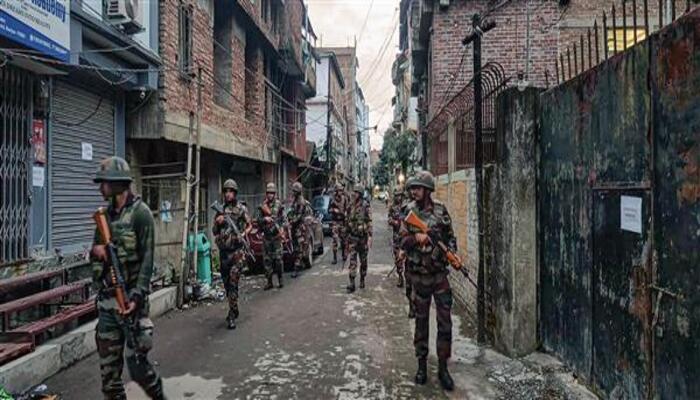
The curfew in a violence-hit Imphal Valley of Manipur has been relaxed from 5 am to 5 pm on Sunday, June 18, while the Indian Army conducted a flag march there.
#WATCH | Manipur: Indian Army conducted a flag march in the violence-affected area in Imphal Valley
The circular issued by the district magistrate, Imphal East, Khumanthem Diana Devi stated, “Total public curfew under Section 144 CrPC, 1973 prohibiting the movement of any person outside their respective residences imposed in Imphal East District vide this Office Order dated 3rd May 2023 is hereby relaxed from 5 AM to 5 PM on 18th June 2023 except for the area for which the schedule is given below in order to facilitate the general public to purchase essential items including medicines and food supplies”.
Hatta crossing to RDS crossing, the Imphal river from Sanjenthong to Minuthong, Minuthong to Hatta crossing, and RDS crossing to Sanjenthong are among those areas where the curfew would be relaxed.
In Manipur, a curfew has been imposed under Section 144 following conflicts between the Kuki and Meitei communities on the third of May. The ensuing violence took over 100 lives while thousands were displaced.
The state government has extended the internet shutdown until June 20.
A mob vandalised the BJP office in Manipur’s Thongju on Friday, according to officials. Reportedly, nine people were killed and more than ten were injured during fresh violence in Manipur on Wednesday.
Union Minister Rajkumar Ranjan Singh’s residence in Kongba, Imphal, was set on fire on Thursday night when the minister was in Kerala. Despite being a member of the Meitei community, he has continued imploring both sides to stop violence and allow the state to return to peace. Miscreants also attempted to set fire to Manipur minister Nemcha Kipgen’s official residence in Imphal West, partially destroying it.
On Saturday, officials informed that protesters clashed with security personnel through the night. Attempts were also made to set Bharatiya Janata Party leaders’ houses on fire, which led to the injuries to two individuals.
A mob of around 1000 individuals assembled to torch buildings adjacent to the palace grounds. It was dispersed by the Rapid Action Force (RAF) using tear gas and rubber bullets. It also cleared out an additional crowd that wanted to set MLA Thongam Biswajeet Singh’s residence on fire.
Manipur was rocked by violence on May 3 this year when confrontations broke out during a rally called by the All Tribals Students Union (ATSU) to protest the demand that Meitei be included in the Scheduled Tribe (ST) list. Since the Manipur High Court ordered the state administration to consider incorporating the community into the ST list, ethnic violence has been continuing in the state for more than a month. In order to quell the unrest, central paramilitary forces are stationed there.
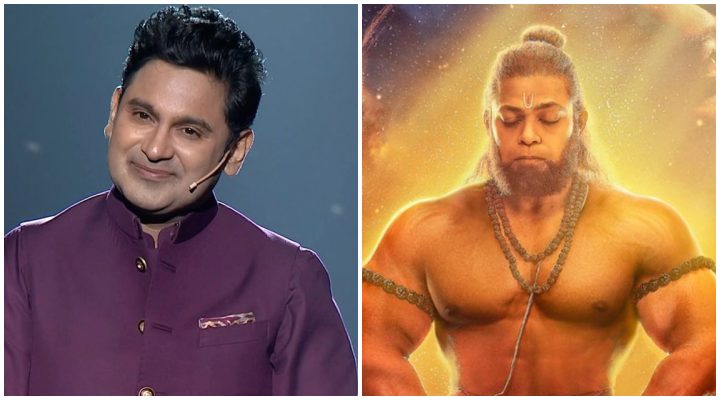
Manoj Muntashir, who wrote the dialogues for the movie Adipurush, has said that the ‘problematic’ dialogues of the movie will be replaced. This follows a day after he had defended the dialogues after there was massive outrage over the language used by the characters in the movie based on Ramayana, especially lines spoken by the character of Hanuman.
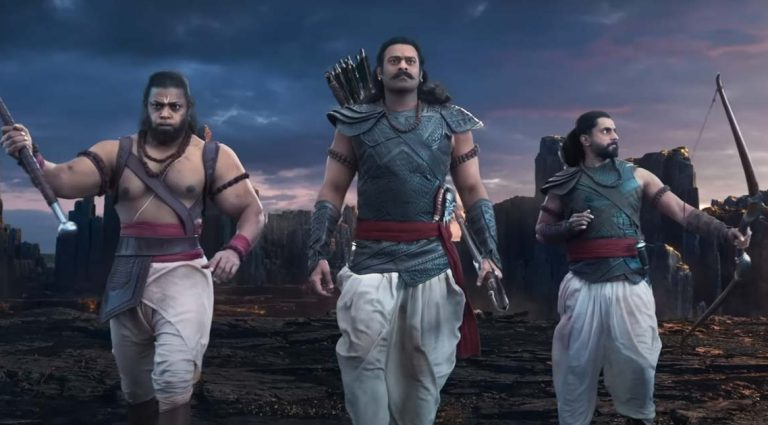
Released on the 16th of June, Adipurush has found itself stuck in one controversy after another. At the centre of it lies the ‘problematic’ dialogues including those attributed to Hanuman, named Bajrang in Adipurush. Now, Adipurush’s writer Manoj Muntashir has come out publicly to address those concerns.
Following widespread criticism, Muntashir has announced that the problematic dialogues of Adipurush will be revised within this week itself. He shared this announcement through his official Twitter handle. However, he claimed that the team created Adipurush for Sanatan Seva, which audiences are seeing in large numbers and will keep seeing in the future as well.
Message from Adipurush’s writer Manoj Muntashir
In his tweet, Muntashir claimed that the first lesson anyone can learn from Ramakatha is to respect every emotion. He added that with time, right and wrong keep changing and only feeling remains. He asserted that he wrote more than 4000 lines in Adipurush and out of those, 5 lines hurt the sentiments of some people.
Muntashir claimed that he deserved praise for hundreds of lines where he glorified Shri Ram, and described Maa Sita’s chastity but he got none of it. He further claimed that instead of praises his own brothers (fans or Twitter supporters) wrote indecent words for him.
Further, he expressed, “The same people who I regarded as my own, for whom I recited poems in honor of their respected mothers on television, directed indecent words towards my own mother.”
Highlighting the fact that he wrote songs like ‘Jai Shri Ram’, ‘Shivoham’, and ‘Ram Siya Ram’ in the same film, he claimed that it was quick and inappropriate to label him as Sanatan-Drohi.
Muntashir added that the team has created Adipurush for Sanatan Seva, which audiences are seeing in large numbers and will keep seeing in the future as well.
Respecting the feelings of the fans, he said, “..for me there is nothing greater than your feeling. I can give countless arguments in favor of my dialogues, but this will not reduce your pain. Me and the producer-director of the film have decided that some of the dialogues which are hurting you, We’ll revise them, and they’ll be added to the film this week.”
रामकथा से पहला पाठ जो कोई सीख सकता है, वो है हर भावना का सम्मान करना. सही या ग़लत, समय के अनुसार बदल जाता है, भावना रह जाती है. आदिपुरुष में 4000 से भी ज़्यादा पंक्तियों के संवाद मैंने लिखे, 5 पंक्तियों पर कुछ भावनाएँ आहत हुईं. उन सैकड़ों पंक्तियों में जहाँ श्री राम का यशगान…
— Manoj Muntashir Shukla (@manojmuntashir) June 18, 2023
What was the controversy?
Adipurush makers drew flakes from fans and the general public alike for using uncouth language in Adipurush. Several dialogues of Adipurush went viral on social media where netizens claimed that they demeaned, trivialised Hindu Mahakavya Ramayana, and hurt the sentiments of Hindus.
In the film, there are several characters that have used street-level language like “Bete”, “Tere Baap ki Jali” and ”Bua ka Bagicha” among others. A few of those dialogues are as follows –
“कपड़ा तेरे बाप का! तेल तेरे बाप का! जलेगी भी तेरे बाप की”
“तेरी बुआ का बगीचा है क्या जो हवा खाने चला आया”
“जो हमारी बहनों को हाथ लगाएंगे उनकी लंका लगा देंगे”
“आप अपने काल के लिए कालीन बिछा रहे हैं”
“मेरे एक सपोले ने तुम्हारे शेषनाग को लंबा कर दिया अभी तो पूरा पिटारा भरा पड़ा है”
Earlier, Muntashir defended his approach and asserted that he intentionally crafted relatable dialogues to connect with the audience. The makers also claimed that they had not altered the original Ramayana. However, when the controversy spiralled they claimed that Adipurush is not an adaptation of Ramayana rather it is heavily inspired by Ramayana.
Despite intense criticism and fans registering their protests, Adipurush has entered Rs 200 crore club.
Manoj Muntashir had defended the dialogues
Earlier, Manoj Muntashir had defended the use of uncivilized dialogues, claiming that a very meticulous thought process has gone into writing the dialogues. In an interview given to Republic, he had said that it was not an error, and it was done deliberately. He stated that he wrote the dialogues keeping the ‘modern, contemporary’ speaking styles of the general public in the country.
Talking on Lallantop, he even went on to compare the controversy with the opposition faced by poet Tulsidas for writing Ramcharitmanas in Awadhi language instead of Sanskrit.
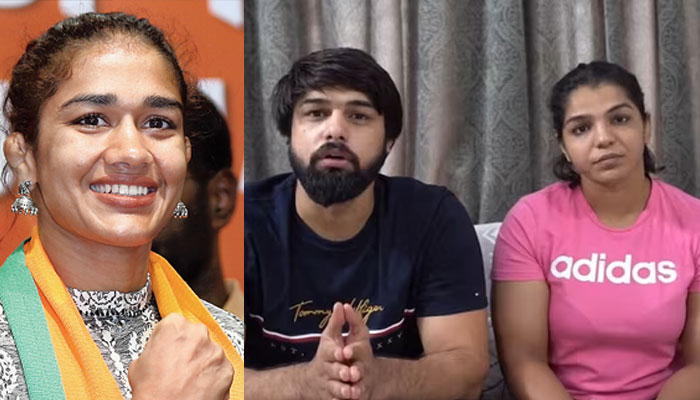
On June 18, wrestler and Bharatiya Janata Party leader Babita Phogat refuted the claims of one of the protesting wrestlers Sakshi Malik and her husband, Satyawart Kadian, that she helped in getting permission for protests at Jantar Mantar in January. In a detailed statement on Twitter, Babita called Sakshi a puppet of Congress and urged her to answer the public about their real intentions.
Babita Phogat’s statement
Babita said, “There is a saying, Don’t say such a thing about a friend that you need to hide it later. It will leave a sign of stigma on your forehead for a lifetime.”
एक कहावत है कि ज़िंदगी भर के लिये आपके माथे पर कलंक की निशानी पड़ जाए। बात ऐसी ना कहो दोस्त की कह के फिर छिपानी पड़ जाएँ । मुझे कल बड़ा दुःख भी हुआ और हँसी भी आई जब मैं अपनी छोटी बहन और उनके पतिदेव का विडीओ देख रही थी , सबसे पहले तो मैं ये स्पष्ट कर दूँ की जो अनुमति का काग़ज़… https://t.co/UqDMAF0qap
Yesterday, while watching the video of my younger sister and her brother, I was sad and laughed too. First of all, let me be clear that the permission letter shown by my younger sister has no proof of my signature or my consent anywhere, nor do I have anything to do with it far and wide.
Since day one, I have been saying that I have faith in our honourable Prime Minister and the Judicial System of the country. The truth will definitely come out. As a female sportsperson, I was always with all the country’s players; I am with them and will always be with them. However, I was never in favour of a sit-in protest since the beginning. I always told the wrestlers they should meet the PM or Home Minister as the solution would come from there.
However, you saw the solution in Deepender S Hooda, Congress, Priyanka Gandhi and their accomplices, who themselves are accused of rape and convicted in other cases. The country’s people have now recognised the faces of the opposition, and now they should come out in front of the country and answer soldiers, farmers and women wrestlers whose emotions were used for political gain.
The views of the women players who sat together on the sit-in were given a direction with all the prejudices where only your political benefits were visible. Today, when this video of yours is in front of everyone, now the people of the country will understand how much your protest on the holy day of the inauguration of the new Parliament building and the matter of flowing the medal won for the nation into the Ganges was embarrassing the country.
The country’s people have understood that you have become a puppet in the hands of Congress. Now the time has come for you to tell your real intention because the public is asking you questions.”
Sakshi Malik and Satyawart Kadian’s video statement
Babita’s tweet responded to an 11-minute video statement released by protesting wrestler Sakshi Malik and her husband, Satyawart Kadian. In the video statement, Kadian said that there were allegations in the media that Congress leader Deepender S Hooda instigated them to sit in protest. Contrary to the media reports, Kadian claimed that the permission for protests at Jantar Mantar in January 2023 was taken by two BJP leaders, Tirath Rana and Babita Phogat. Kadian said, “How could Congress be behind the protests?”
He further claims wrestlers and people aware of the matter knew such incidents, including harassment, were happening to female wrestlers. He added, “Some proof was given by coaches in media. People wanted to raise their voices against it, but there was a lack of support in the wrestling community.” He further accused the former WFI president of creating problems in the career of wrestlers who raised voices against him individually.
He further added the fight was not against the government as both the accused and those who got permission for the protests were from BJP.
Speaking about the delay in raising a voice against the WFI president, Sakshi claimed no one came forward because of a lack of support. Further, she claimed there was a lot of pressure on the minor victim to change the statement. She said, “The top wrestlers raised voices there, and you saw what all they had to face after that”.
Kadian further claimed that Khap leaders called the Mahila Mahapanchayat, and they were unaware of the inauguration of the New Parliament Building on May 28. He then claimed they felt broken after what happened on May 28 and decided to submerge their medals in the Ganga River. “But we became a victim of the system’s conspiracy. On that day, a man from the system pulled Bajrang away and made him talk to several leaders. They urged Bajrang to wait till 7 PM as a meeting was going on.” He further claimed at 7 PM, more people linked to some “system” came in large numbers. The situation was created, so there would have been violence if we immersed medals after that. So we decided not to immerse.”
He then thanked Sanyukt Kisan Morcha, Bhim Army chief Chandrashekhar Ravan, Satyapal Malik, women’s organisations and others for their support.
Kadian then thanked Rana and Phogat for supporting the wrestlers from the beginning. He said they became mediators and got a committee formed for investigation, but there was no result.
Discrepancies in Sakshi and Satyawart’s statement
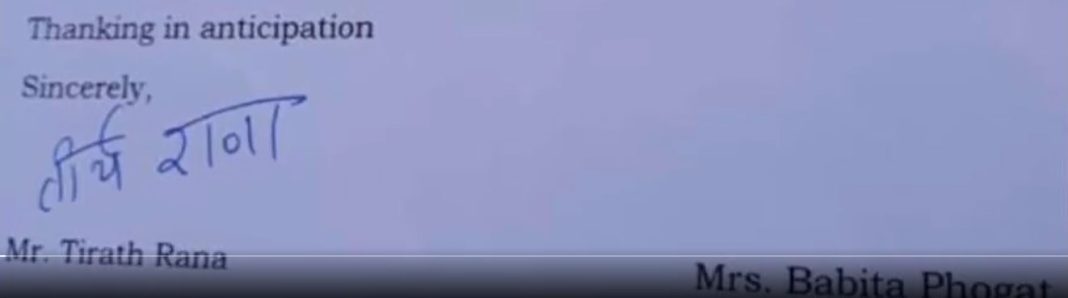
OpIndia found a few discrepancies in the statements of Sakshi and Satyawart. First, they claimed that Tirath Rana and Babita Phogat got permission from the police station for the protest. While Babita denied involvement in the matter, the letter had no signatures of Phogat.
Babita Phogat’s name appeared without signature in the letter in question. Source: Sakshi Malik video
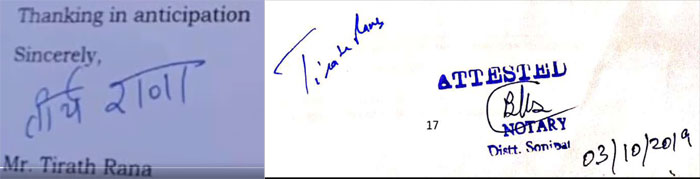
OpIndia spoke to Tirath Rana, who refused to comment on it. He said he was always with the protesters and would stand with them to get justice. When we talked about the signature in Hindi on the letter, it did not match the signature on the affidavit that he submitted to Election Commission in the 2019 Haryana Assembly Elections, Rana again said he would prefer not to comment. Here are the two signatures. On the left, you can see the signatures as shown on the letter presented by Malik and Kadian. On the right, you can see signatures from the affidavit available on ECI’s website.
Signatures of Tirath Rana mismatched. Source: Sakshi Malik video+ECI
Furthermore, Kadian claimed they were unaware of the inauguration of the new building scheduled for May 28. The decision to hold Mahila Mahapanchayat was taken by Maham Chaubisi Khap, a cluster of 24 villages in Maham town of Haryana’s Rohtak district. By that time, the inauguration was announced on May 19, 2023. The decision to hold Mahila Mahapanchayat was taken on May 21, two days after the announcement by the government.
One of the protesting wrestlers, Bajrang Punia, issued a statement after attending Khap Panchayat on May 21. He said, “We had declared that we’ll take some big decisions today if Singh is not arrested in 15 days. It has been decided that a Mahila maha panchayat will be held outside the new parliament building on May 28, and the wrestlers will attend.”
Some posts clearly show Sakshi Malik at the Maham Khap Panchayat.
लड़ेंगे और जीतेंगे
आज महम चबूतरे पर आयोजित पहलवानों के समर्थन में खाप पंचायत में हिस्सा लिया और अपने विचार रखे। जो पंचायत में हमारे बड़े बुजुर्गो ने फैसले लिए हम उनका सम्मान करते हैं। मैं पहलवानों को कहना चाहती हूं की इस लड़ाई में हम सब आपके आखिरी सांस तक खड़े हैं। pic.twitter.com/RiEV38jvGl
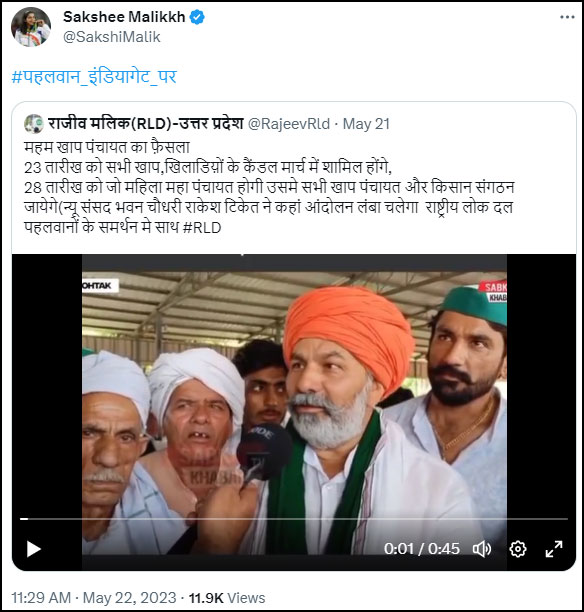
On May 22, Sakshi Malik shared a post that clearly mentioned that the Mahila Mahapanchayat would occur at New Parliament Building.
Source: Twitter
On May 23, Vinesh Phogat issued a statement to the media about the May 28 Maha Panchayat. Sakshi was standing next to her. When Vinesh said, “outside Sansad”, Sakshi interrupted her and said, “Nai Sansad”.
#WATCH | We have decided to hold a peaceful women's Maha Panchayat in front of the new Parliament on 28th May: Wrestler Vinesh Phogat pic.twitter.com/O2WPu7AFhw
It is unclear why they claimed no one among them knew that the inauguration of the New Parliament Building would take place on the same day announced Mahila Mahapanchayat outside the new building when the dates were announced two days before the decision by Khap was made.