Home Blog Page 2148

As Ram Charan announces maiden production on Veer Savarkar’s birth anniversary, read the forgotten history of India House in London and its association with Savarkar

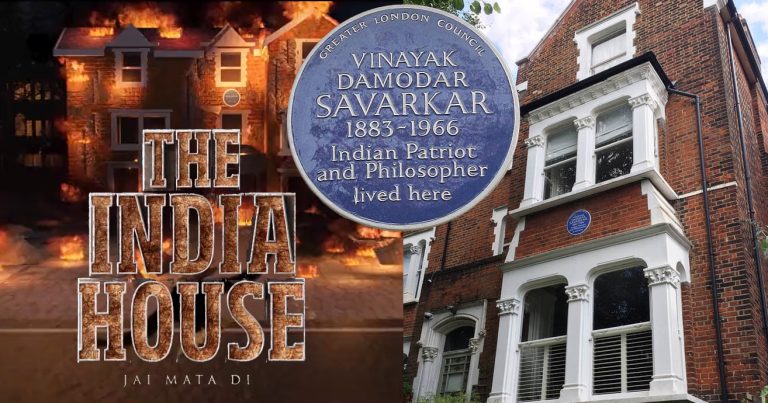
On the 140th birth anniversary of renowned freedom fighter Veer Savarkar, megastar Ram Charan announced the film ‘The India House’, the first film under his production banner ‘V Mega Pictures’. The RRR star has joined hands with Abhishek Agarwal, producer of blockbusters like ‘The Kashmir Files’ and ‘Karthikeya 2’. The Ram Vamsi Krishna directorial ‘The India House’ starring actor Nikhil Siddhartha and veteran actor Anupam Kher is inspired by the life of Veer Savarkar and his stay at India House in London during the freedom struggle.

Taking to Twitter to announce his debut production, Ram Charan wrote, “On the occasion of the 140th birth anniversary of our great freedom fighter Veer Savarkar Garu we are proud to announce our pan India film – THE INDIA HOUSE headlined by Nikhil Siddhartha, Anupam Kher ji & director Ram Vamsi Krishna! Jai Hind!”

‘The India House’ promises to lead audiences back in time and captivate them with a heartwarming story. The film’s teaser is set in the pre-independence era in London and indicates that the film unfolds a love story during a time of political unrest around ‘The India House’. The teaser concludes with the dramatic sight of a burning India House, hinting at the action to come.

Veer Savarkar’s connection with the iconic India House in London

The promo of the movie posted by Ram Charan says that it is ‘based on a forgotten chapter in Indian history’. That chapter in history refers to India House in London, a student hostel for Indians, and the period when Veer Savarkar stayed in the house while studying law.

The India House at 65, Cromwell Avenue, Highgate, London was a hostel for Indian students studying in Britain, founded by prominent freedom fighter Shyamji Krishna Varma in 1905. Varma is remembered as a staunch nationalist who launched the Indian Home Rule Society (IHRS), and The Sociologist—an outlet that played a major role in disseminating nationalist ideas. Varma founded the India House in July 1905 at a time when revolutionary nationalism gained prominence among the Indian masses following the portion of Bengal in 1905. 

The India House is a large Victorian mansion in North London, which was inaugurated on 1 July 1905 by Henry Hyndman. Several prominent persons, including Dadabhai Naoroji, Charlotte Despard and Bhikaji Cama attended the event. Apart from being a hostel, the house also became the headquarters of several organisations, including the Indian Home Rule Society (IHRS). The hostel had a lecture hall, library and reading room.

The hostel became a hub of meetings of the nationalists and hosted students like Veer Savarkar, Madan Lal Dhingra, and Lala Har Dayal among others. Every Sunday, the meeting of IHRS was held at India House. Veer Savarkar arrived at India House in London in 1906 on a scholarship from Varma. After Shyamji Krishna Varma left for Paris in 1907, Savarkar emerged as the leader of IHRS. Having founded the Abhinav Bharat Society in India in 1905, Savarkar continued with the society’s activities while in London. Copies of the bomb manual were also printed at the India House in London. From 17 August 1906 to 26 November 1909, Savarkar sent 43 newsletters from India House. These were regarding politics and current events, and they were published in the Marathi journal Vihari.

Savarkar founded the Free India Society (FIS) in London and also opened a branch of Abhinav Bharat. He had organised regular public meetings and demonstrations from the India House. Apart from the Indian Sociologist, the Savarkar also distributed other pamphlets like Bande Mataram and Oh Martyrs. Such revolutionary literature was camouflaged, and shipped to India from different addresses to prevent detection.

India House quickly became the headquarters of the Indian revolutionary movement in Britain. Its newest recruits were young Indian men and women who arrived in London for higher studies. These members regularly attended the Sunday evening gatherings at India House where Savarkar delivered lectures on subjects like the revolution’s guiding philosophy and assassination tactics.

Several Indian leaders had visited the hostel when they visited London during that time. MK Gandhi also stayed at the India House during his London visit in 1906, where he met Savarkar for the first time. During the stay, Savarkar had offered him prawns he had cooked, and staunch vegetarian Gandhi was horrified by it. To it, Savarkar had responded, “If you cannot eat with us, how on earth are you going to work with us? Moreover, this is just boiled fish, whereas we want people who are ready to eat the British alive!” This marked the stark difference in approach to the freedom struggle by the two freedom fighters.

Savarkar believed in an armed revolution against the British and had started working towards the same from India House. Apart from revolutionary meetings, explosive workshops were also held in the hostel. Reportedly, the residents of India House and members of Abhinav Bharat also practised shooting at a range in Tottenham Court Road in Central London, and rehearsed assassinations.

However, its activities attracted the attention of politicians and it was discussed in the parliament, and newspapers like Time demanded action against its leadership. By 1909, the India House came under the surveillance of Scotland Yard. The police were able to plant a mole in the hostel, an Indian student named Kritikar. He was reporting the activities of the hostel to Scotland Yard, but later he was caught by Savarkar and forced to confess.

The India House closed down in 1909, following the assassination of Curzon Wyllie, the political aide-de-camp to the Secretary of State for India, Lord George Hamilton. Curzon Wyllie was shot dead using a revolver by Madan Lal Dhingra, a member of the India House, at the Imperial Institute, South Kensington. After the event, Savarkar refused to condemn the assassination in an article in The Sociologist. It is also alleged Savarkar had supplied the gun to Dhingra.

This followed a crackdown on India House by the police, forcing several of the leaders to move to France, Germany and other countries. Moreover, the students also stopped supporting the activities due to threats to their education and career. After that, India House was shut down, and it was sold in 1910. However, London’s India House inspired Indians in other countries to open such Indian Houses in many other countries, including USA and Japan.

Savarkar had also moved to Paris in 1909 following the crackdown on India House. But he returned to London in 1910, ignoring the advice of his friends asking him not to do so. He was arrested and charged with multiple offences, including procurement and distribution of arms, waging war against the state, and delivering seditious speeches, and was extradited to India. He was tried and convicted in India, and was sent to the Cellular Jail in Andaman and Nicobar Islands.

The India House still exists today in London. A plaque at India House unveiled by Lord Fenner Brockway on 8 June 1985 reads, “Vinayak Damodar Savarkar, 1883 – 1966, Indian patriot and philosopher, lived here.”

A replica of the India House has been built at Kranti Teerth, the memorial dedicated to Shyamji Krishna Varma, located near Mandvi in Gujarat.
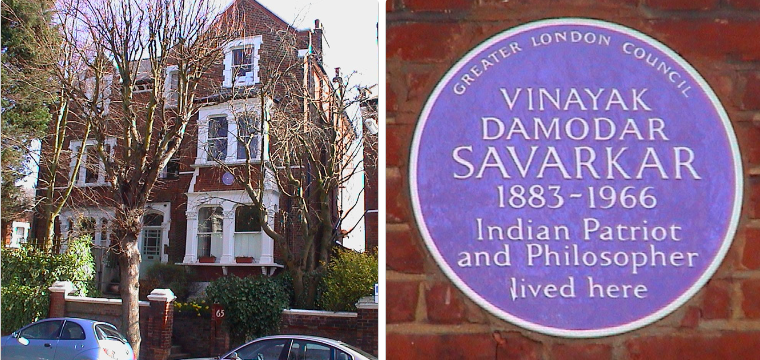
India House in London, image via London Remembers

Trailer of Randeep Hooda’s ‘Swatantrya Veer Savarkar’ launched

The teaser of the much-awaited film ‘Swatantrya Veer Savarkar’ starring actor Randeep Hooda in the titular role has also been released. Anand Pandit and Sandeep Singh have produced the film, which also stars Ankita Lokhande and Amit Sial. The teaser was released on Sunday to commemorate Savarkar’s 140th birthday.

The teaser begins with Randeep stepping into the jail premises and saying, “The struggle for freedom lasted 90 years, but only a few fought this war.” The rest were desperate for power.”

Randeep is seen walking towards the gallows as a voice-over says, “Gandhiji was not a bad person, but India would have gotten freedom 35 years earlier if he had not insisted on his non-violent policies.” Randeep, who plays the title character in the film, is shown being tortured in jail.

“Moolyavaan toh sone ki lanka bhi thi lein baat agar kisi ki swatantrata ki ho toh dahan toh hoke rahega (Even Ravan’s Golden Lanka was precious, but when freedom is at stake, then be it Ravan Raj or British Raj, it shall be burnt down,” Randeep as Savarkar is heard saying in the trailer.

Taking to Twitter, Randeep Hooda shared a poster of the film and wrote “The most wanted Indian by the British. The inspiration behind revolutionaries like – Netaji Subhash Chandra Bose, Bhagat Singh & Khudiram Bose. Who was #VeerSavarkar? Watch his true story unfold! Presenting  @RandeepHooda in & as #SwantantryaVeerSavarkar In Cinemas 2023.”
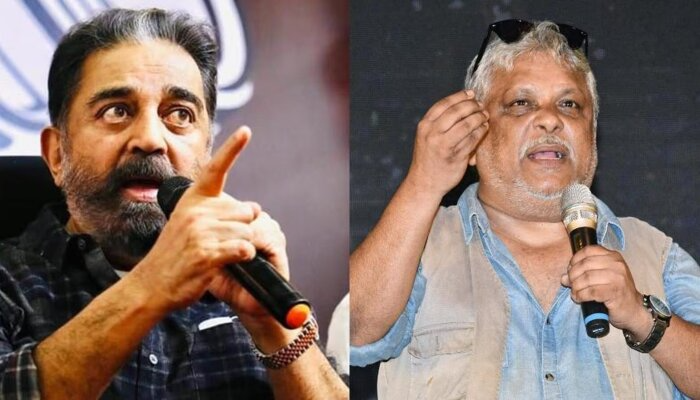
A person is indulging in propaganda by calling it a propaganda film without watching it: Kerala Story director on Kamal Haasan’s criticism

On Saturday, actor Kamal Haasan shared his thoughts on The Kerala Story and declared that he opposes ‘propagandist films’. Now, the multilingual project’s director Sudipto Sen has responded to the Tamil movie star’s criticism by asserting that those labelling it ‘propaganda’ haven’t seen it themselves and are thus engaging in their own kind of propaganda and disinformation.

“Propaganda films I am against. It’s not enough if you just write ‘true story’ at the bottom as a logo. It has to really be true, and that (the film) is not true,” Kamal Haasan said while addressing the media in Abu Dhabi on the sidelines of the IIFA Awards ceremony.

However, Sudipto Sen has come in defence of his venture and stated, “I don’t react to (such statements). Earlier I used to try and explain, but today, I don’t do that because people who called it a propaganda film, after watching it said it was nice. Those who didn’t see it are criticising it. In the same way, it was not released in West Bengal and Tamil Nadu. These guys didn’t see the film so they think it is propaganda. There are very stupid stereotypes in our country. Life has to be black or white, they don’t know life exists in the grey.” while talking to Hindustan Times.

“If BJP is liking the film, that doesn’t mean it’s their film. Not only BJP, but Congress and any other political party, internationally in 37 countries, people are liking it. Even if they have a criticism, they are calling and discussing it with me. I don’t have any regrets about that. A person is indulging in propaganda by calling it a propaganda film without watching it and making his opinion. What else would the words be than hypocrisy or petty? I have stopped explaining to them,” he added.

Due to the constant promotion and advertising of the movie after its release, he is presently being treated in a hospital for dehydration and an illness.

The Kerala Story which has become the second highest-grossing film of the year after Pathaan, was released in the theaters on May 5. The film has driven flak from Muslims, liberals and the opposition parties particularly Congress and the left alike since its trailer was released.

It was officially banned in West Bengal by Trinamool Congress but the government had to take back its decision after Supreme Court’s intervention. The people associated with the movie have also faced threats from radical elements of society.

It is produced by Vipul Amrutlala Shah and has Adah Sharma in the lead role and Yogita Bihani, Siddhi Idnani and Sonia Balani in the supporting cast. The movie narrates the gut-wrenching story of Shalini Unnikrishnan, a Hindu girl who is converted to Islam with the help of her Muslim friends. She then married a Muslim and is manipulated into joining ISIS and ended up imprisoned in Afghanistan.

PM Modi has always stood proudly with the Tamil culture, Tamil people and Tamil Nadu: Madurai Adheenam head priest

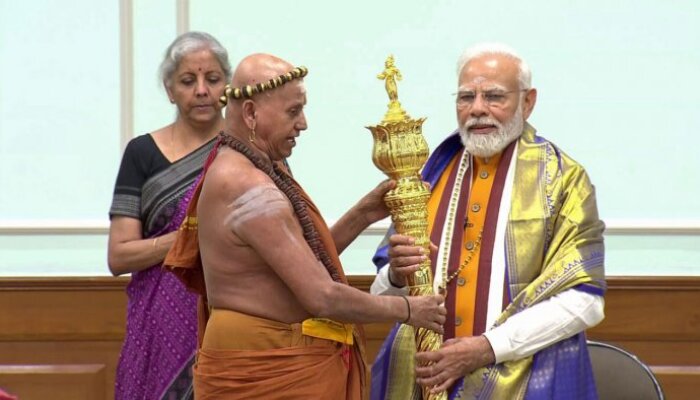
The 293rd head priest of the Madurai Adheenam, Sri Harihara Desika Swamigal, lauded Prime Minister Narendra Modi on Sunday for inviting Tamil Adheenams to the inauguration ceremony of the new Parliament building.

He stated, “I feel very proud to participate in the inauguration ceremony of the new Parliament building. PM Modi has always stood proudly with the Tamil culture, Tamil people and Tamil Nadu. Modi ji is the first PM who invited Tamil Adheenams and proudly encourages the Tamil culture in the Parliament.”

“I like Modi ji very much because he was the first prime minister to create houses for Sri Lankan Tamils when he visited Sri Lanka. He also participated in Pongal festival. Till now 14 prime ministers have ruled our country, but Modi ji is the first one to invite Tamil Adheenams,” he remarked.

At a ceremony in 2015, the prime minister Modi had handed over 27,000 homes to Tamilians at Ilavalai North-West Housing Project site in Jaffna, Sri Lanka.

Additionally, he charged the Congress and Rajapaksa governments with the murder of Tamils including children in Sri Lanka.

The head priest has previously hoped for the return of Narendra Modi as the country’s prime minister for the third time in 2024.

“PM Modi is a leader who got global appreciation. He is doing good things for people. Again in 2024 he has to become PM and should guide people. We are all so proud as world leaders are appreciating our PM Modi. I will be meeting PM Modi and presenting the Sengol to him on the inauguration of the new Parliament building,” he had commented before presenting the iconic gold studded sceptre to the PM.

Notably, Narendra Modi today inaugurated the new parliament building today and placed the auspicious Sengol which was presented to him by the Madurai Adheenam head priest behind the chair of the Lok Sabha Speaker amid religious chants. Many Union Ministers, Members of Parliament, politicians and foreign dignitaries graced the historic occasion which was concluded with an address by the prime minister.

Manipur: Security forces kill 33 Kuki terrorists in heavy gunfire, were responsible for torching of civilian houses

After fresh violence erupted in several places in Manipur in the ongoing conflict between Kuki and Meitei communities, chief minister N Biren Singh strongly condemned the attack on civilians by Kuki militants on 27 May. The CM addressed a press conference today to talk about the current situation in the state.

Referring to the Kuki militants as terrorists, the CM said that civilians are constantly being attacked despite repeated appeals to maintain peace. He also informed that as many as 33 Kuki militants were killed during the attack, where heavy gunfire took place with security forces. Apart from that, several militants were also arrested by security forces.

The N Biren Singh stressed that the clashes took place between security forces and Kuki militants, not between people of the two communities. The CM said that the terrorist groups are using sophisticated arms against the civilian population. “The gunfight is between the armed terrorists and the security forces and not between the communities. So I urge common people to maintain peace and stay united,” he said.

The clashes took place at around half a dozen places in Manipur, as army and central armed forces began operations to de-arm the communities involved in the conflict over ST state demand by Meiteis and eviction of encroachment on forest land by Kuki immigrants from Myanmar.

The CM said that clashes broke out in the early hours of the morning at several places in different districts surrounding the Imphal Valley. Giving more information, an official said, “According to our information, firing has been reported from Sugnu in Kakching, Kangvi in Churachandpur, Kangchup in Imphal West, Sagolmang in Imphal East, Nungoipokpi in Bishenpur, Khurkhul in Imphal West and YKPI in Kangpokpi.”

The gunfire took place after Kuki militants torched many houses in several areas in the state. When security forces launched an operation to nab the arsonists, they opened fire, resulting in a heavy gunfight. Several civilians were injured in the attacks, with at least two deaths.

Following the violence, an operation has been launched to locate the Kuki militants involved in the gun attack last night. Helicopters are also used for surveillance of the area to spot the militants, now dubbed terrorists by CM Singh.

The CM said that the recent spurt in violent attacks on civilian houses in and around Imphal Valley seemed “well-planned and simultaneous” to show their capacity. He said that the government will not allow the disintegration of Manipur, will protect the state’s integrity and uproot the armed terrorists from the state. He also reassured that the government will face every challenge against the territorial integrity of the state and attacks on the life and property of the people.

Earlier in the day, Army Chief General Manoj Pande met Singh and discussed the current security situation in Manipur and the steps taken by the Army to restore peace. 

Earlier on 26th May, the house of BJP MP and union minister Rajkumar Ranjan Singh was attacked by a mob in Imphal. A large crowd had surrounded the house, but the security forces successfully thwarted their efforts to enter the premises. The came after the Union Minister of State for External Affairs and Education expressed concern over demand of demand for a separate political administration by the Kuki tribals in Manipur, which he said was same as a demand for a separate state.

In a letter written to the prime minister, Rajkumar Ranjan Singh said that Kuki leaders, including their 10 MLAs, have demanded a separate political administration for the tribals under tremendous pressure from various quarters, including the militants. He had said that the demanding a separate political administration, equivalent to a separate state, is a very dangerous proposition for a small state with 35 ethnic groups.

The house of BJP MLA Khwairakpam Raghumani Singh at Uripok in Imphal West was allegedly vandalised and his two vehicles were set on fire. On Wednesday, the residence of Konthoujam Govindas, the Minister of Manipur PWD, Youth Affairs, and Sports, located in Bishnupur district, was vandalised by a mob.

Manipur saw massive ethnic violence earlier this month following a ‘Tribal Solidarity March’ organised by tribal groups on May 3 to protest against the Meitei community’s demand for Scheduled Tribe (ST) status. They were also protesting against eviction of Kuki villages from reserve forest land. According to the CM and Meitei groups, most of those Kuki people are from Myanmar.

The state govt’s action against poppy cultivation by the tribal communities have also contributed to the tension.

Around 140 columns of the Indian Army and Assam Rifles, totalling over 10,000 personnel, besides personnel from other paramilitary forces had to be deployed to bring back normalcy in Manipur.

New Parliament House: Iconic images and moments from the day that underlined the cultural contours of Bharat and reinforced the civilisational roots

On Sunday, May 28, Prime Minister Narendra Modi dedicated the new Parliament House to the nation. While the inauguration ceremony was in itself a great moment of pride for every Indian, the images and moments around the ceremony underlined the cultural contours of Bharat and reinforced its civilisational roots.

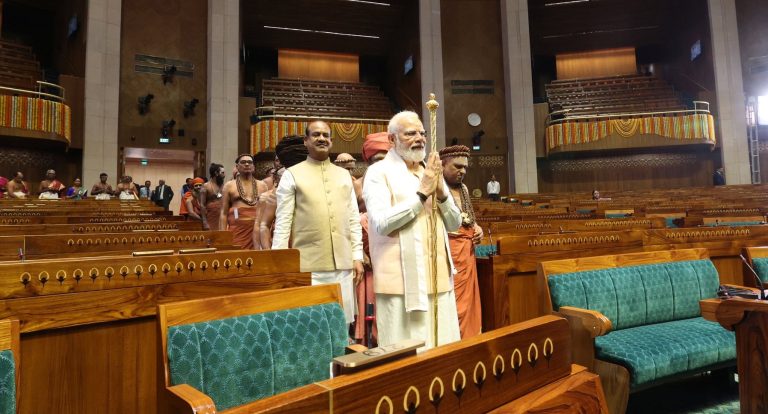
The day of the inauguration started with the installation of the sacred Sengol at the Lok Sabha House next to the Speaker’s chair. PM Modi, who was holding the Sengol, entered the Lok Sabha house amidst Vedic chants by the high priests of various adherents (maths) in Tamil Nadu and tunes of ‘nadaswaram’.

To begin the ceremony, PM Modi offered Sashtang Pranam to Sengol.

The video of the moments of him entering the house and then installing Sengol will remain in the minds of every Indian forever. It represents the rich culture of India.

Speaking on the establishment of sacred Sengol, he underlined that during the great Chola empire, Sengol was seen as a symbol of the path of service, duty, and nation. He added that under the guidance of Rajaji and Adheenam, the Sengol became the sacred symbol of the transfer of power. “It is our good fortune that we could restore the dignity of this sacred Sengol. This Sengol will keep on inspiring us during the proceedings of the House”, he said.

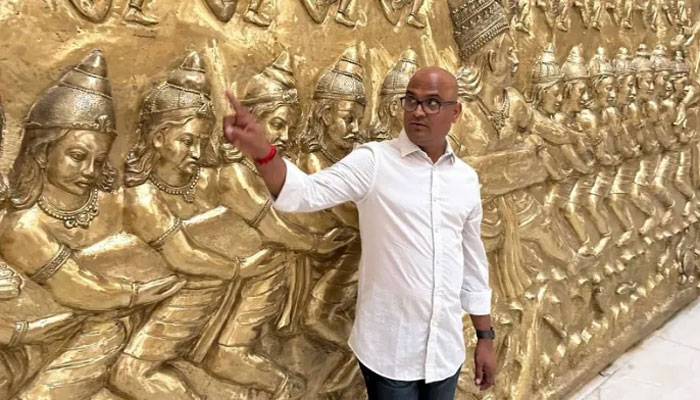
The ‘Samudra Manthan’ sculpture

Another aspect of the new Parliament House that became the topic of the day is the Samudra Manthan sculpture installed along one of the walls of the building. Created by Murtikar Naresh Kumawat, the sculpture depicts the historic story of churning the sea. As the story goes, thousands of years ago, Devtas and Daanavs joined hands to churn the sea with the hope to get Amrit and other precious items. The scene depicts how the event took place.

Kumawat believes that the new Parliament Building is a symbol of India’s growth and prosperity. He was involved in creating several sculptures in the new Parliament building including the sculpture of Sardar Vallabhbhai Patel and Dr Bhimrao Ambedkar.

The ‘Akhand Bharat’ display

A dedicated display depicting the ‘Akhand Bharat’ in its true form is also present inside the New Parliament Building. The display has an old sculpture, a stone with ancient scriptures, and an old map of Bharat with regions mentioned by their historic names. You can see Kurukshetra, Hastinapur, Sindhu, Sauveer, Saurashtra, Dakshinapath, Amravati, Sidhpur, Chol, Kanchipuram, Keralputr and other regions written in Devnagri script.

Other sculptures include Chanakya, Hand Mudras, and more.

The majestic interiors

Following the Prime Minister’s address, several leaders shared photographs and videos of the Lok Sabha House. Karnataka MP Tejaswi Surya shared a video of the Lok Sabha House and said, “Our new Parliament building is magnificent and awe-inspiring.”

Union Minister Nitin Gadkari shared his photograph while sitting in the Lok Sabha House with HM Amit Shah.

MP Hema Malini shared several photographs of the galleries of the building.

Prime Minister Narendra Modi inaugurated India’s new parliament building on Sunday. “This new complex will be evidence of self-reliant India,” PM Modi said in his address. The old parliament will be converted into a museum.

Wrestlers protest: Delhi police remove tents, clear Jantar Mantar protest site after detaining wrestlers who wanted to protest at the new parliament

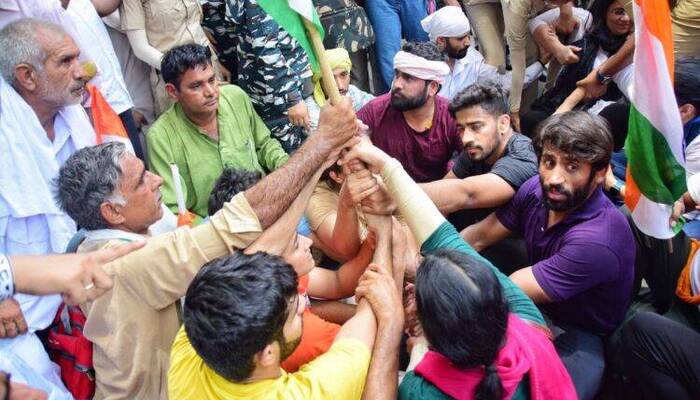
On Sunday, May 28, following the detention of protesting wrestlers Sakshi Malik, Vinesh Phogat and Bajrang Punia as they breached the security cordon while trying to march towards the new parliament building for a ‘Mahila Samman Mahapanchayat, the Jantar Mantra protest site has been cleared by the Delhi Police.

Right after the wrestlers were put into buses and transferred to undisclosed locations, police officials began removing makeshift tents placed by the protesting wrestlers at Jantar Mantar, The police cleared the protest site by removing the wrestlers’ tents, beds, mattresses, coolers, fans, and tarpaulin ceiling, as well as other possessions.

Although no official statement has been issued, media reports suggest that the police will not allow the wrestlers to return to the protest site. The wrestlers had been advised not to approach Parliament, but they did so anyhow, resulting in the scuffle.

The wrestlers had announced that they planned to hold a women’s Maha Panchayat in front of the new Parliament as part of their protest against Wrestling Federation of India (WFI) president Brij Bhushan who has been accused of sexually harassing women wrestlers.

Meanwhile, Bhartiya Kisan Union (BKU) chief Rakesh Tikait and several farmers were stopped by the Delhi Police at the Ghazipur border when they attempted to enter the national capital to join the agitation called by the protesting wrestlers outside the new parliament building. 

Permission for the protest has not been given to the wrestlers who have been on a sit-in at the Jantar Mantar, demanding the arrest of Wrestling Federation of India president Brij Bhushan Sharan Singh over allegations of sexually harassing women grapplers.

“All others (farmers) have been stopped (by the police). We will sit here for now and decide what to do next. This is police’s misbehaviour, if people are going to join the protests, you will make them sit?, Tikait, who had spearheaded the anti-farm law protests, said after being stopped by the police at the heavily fortified Ghazipur border.

Earlier Delhi Police said that “unsocial elements” won’t not be allowed to enter the national capital to ensure smooth conduct of the inauguration ceremony of the new Parliament building.

Additionally, Special Commissioner of Police (Law and Order) Deependra Pathak, who was at Jantar Mantar where wrestlers have been staging a sit-in since last month, stated that the Delhi Police has made tight security arrangements across the national capital, strategic locations, and bordering areas, ensuring that law and order would be kept up. He said, “We will not allow anything to disrupt the inauguration of the new Parliament building. The entire Delhi Police is on its toes to make sure the inauguration ceremony is conducted smoothly.”

“Any attempt to cause disruption during the inauguration of the new Parliament building will be met politely and firmly.” “I politely request that our esteemed athletes refrain from doing any such thing today,” he stated.

Pathak further stated that the police will not tolerate any anti-national activities on such an important day and will handle any situation professionally.

India is a culture, a tradition: PM Narendra Modi dedicates new Parliament House to the nation

On May 28, Prime Minister Narendra Modi dedicated the new Parliament House to the nation. Calling India a culture, a tradition, PM Modi said that the people of India have given themselves a gift for the ‘Amrit Mahotsav’.

Earlier in the day, the PM installed the historic Sengol with Nandi at the top facing East-West direction in the new Parliament House next to the Lok Sabha Speaker’s chair.

Addressing the nation on the occasion, the PM said there are few moments in every nation’s history that are immortalised and May 28, 2023, is one such date. He added that the new Parliament House is not just a building but a reflection of the aspirations and dreams of 140 crore Indians. He said, “This is a temple of our democracy that gives a message of India’s resolution to the world. This new Parliament building connects planning to reality, policy to realization, willpower to execution, and Sankalp to siddhi.”

He added that the new building will be a medium for realizing the dreams of the freedom fighters. It will witness the sunrise of Aatmanirbhar Bharat and will see the realisation of a Viksit Bharat. He called the new building an example of the coexistence of ancient and modern.

Pm Modi remarked that there is new energy, new zeal, new enthusiasm, new thinking and a new journey for the nation. “There are new visions, new directions, new resolutions and a new trust,” he exclaimed. He said the world is looking at India’s determination and the vigour of its citizens with respect and hope. “When India moves forward, the world moves forward”, he remarked. He pointed out that the new Parliament House would invoke the development of the world from the development of India.

Speaking on the establishment of sacred Sengol, he underlined that during the great Chola empire, Sengol was seen as a symbol of the path of service duty and nation. He added that under the guidance of Rajaji and Adheenam, the Sengol became the sacred symbol of the transfer of power. “It is our good fortune that we could restore the dignity of this sacred Sengol. This Sengol will keep on inspiring us during the proceedings of the House”, he said.

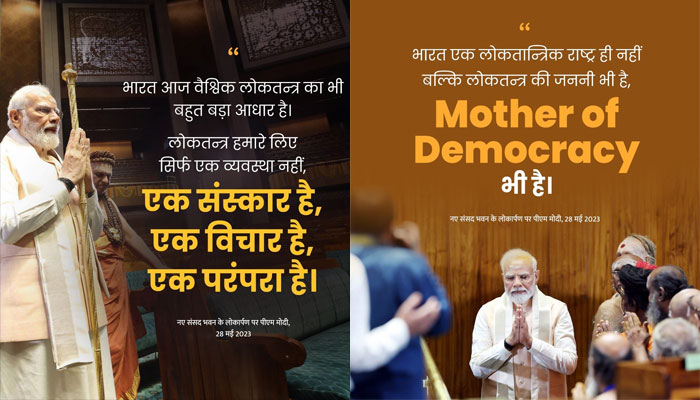
He noted that the nation is the principal foundation for global democracy. The PM underlined that democracy is not just a system that is practised in India but it is a culture, thought and tradition. Referring to the Vedas, the Prime Minister highlighted that it teaches us the principles of democratic assemblies and committees. He also mentioned the Mahabharata where one can find the description of a Republic and said that India has lived and breathed democracy in Vaishali. “Our democracy is our inspiration and our Constitution is our resolution”, he said.

PM Modi said after years of slavery and losing so much, India resumed its journey and reached Amrit Kaam. He said, “Amrit Kaal is a period of forging new dimensions of development while preserving our heritage. This is Amrit Kaal of giving a new direction to the nation. This is Amrit Kaal of fulfilling innumerable aspirations.” He recalled the golden period of India’sprosperity and architecture. He said, “Today’s India is leaving behind the mentality of slavery and embracing that ancient glory of art. This new Parliament Building is a living example of this endeavour.”

PM remarked, “This building has Virasat (heritage) as well as Vastu (Architecture), Kala (art) as well as Kaushal (skill), sanskriti (culture) as well as notes of Samvidhan (Constitution). He pointed out that the interiors of Lok Sabha are themed on the national bird peacock and Rajya Sabha on the national flower lotus. The Parliament premises have the national tree Banyan. The new building incorporates the specialities of different parts of the country.”  He mentioned granite from Rajasthan, timber from Maharashtra and carpet by Bhadhoi artisans. “We witness the spirit of Ek Bharat Shreshtha Bharat in every particle of this building”, he added.

The PM pointed out the difficulties in terms of modernisation, sitting arrangement and other aspects that the Parliamentarians were facing in the old building. He said that after discussing the need for the new building for decades, it has finally materialised. He expressed his happiness about the fact that the new building is equipped with all the modern technology and will be sufficient for the increased number of Parliamentarians in the coming future.

He further said that the new building will give new energy and strength to the largest democracy in the world. Stressing the importance of the Parliament, the Prime Minister said that it is the resolution of 140 crore Indians that consecrates the Parliament.

He expressed the hope that every decision taken here will adorn the coming centuries and strengthen the coming generations. He underlined that the path of empowerment of the poor, Dalit, backwards, tribal, disabled, and every deprived family of the society, along with prioritizing the development of the deprived will pass through this Parliament. “Every brick, every wall, every particle of this new Parliament House will be dedicated to the welfare of the poor”, the PM said.

Uttar Pradesh: Muslim woman and her Hindu husband attacked by an Islamist mob in the name of Bhagwa Love Trap in Moradabad

The fictitious ‘Bhagwa Love Trap‘ has led to the targeting of Muslim women and Hindu men at the hands of radical Muslims and many such incidents have come to the fore across the country, particularly in the past few weeks. Their videos have also gone viral on social media startling everyone.

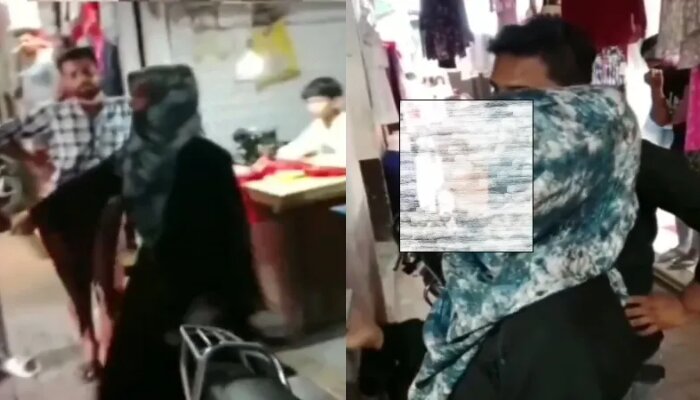
Now, another similar occurrence has come to light from the Bilari town of Moradabad neighbourhood in Uttar Pradesh where a burqa-wearing female from the Muslim community was spotted with her Hindu husband which incensed the Islamic fanatics who proceeded to target the couple.

This instance reportedly took place on May 22 when the Muslim youths first misbehaved with the woman and when the husband objected, he was also attacked. The victim has lodged a complaint with the police and they initiated the action by registering a First Information Report (FIR).

She was in a tailor’s shop when she was surrounded by her co-religionists and asked, “What are you doing being a Muslim with a man of another religion?”

The woman is a nurse by profession who lives in a village and is employed at a private medical facility in Bilari. She was involved romantically with Akash, a resident of the nearby village and they both got married in court. However, out of concern for threats, neither one has made their marriage public knowledge.

Afterwards, the Muslims began filming the duo and when their action was opposed, they started harassing the woman. The Muslims also tried to extort money from them and asked for Rs 4600 in order to delete the footage and not make it viral.

However, the clip was uploaded online and people started commenting, but the woman said that she is an adult who left of her own free will.

Notably, this is the second time in five days in Moradabad that radical Muslims have attacked an inter-religious pair where a Muslim female is with a Hindu male. Superintendent of Police (Rural) Sandeep Kumar Meena has assured the arrest of the accused soon.

‘Democracy is our Sanskaar. India has left behind colonial mindset that took away our pride from us’: PM Modi in new parliament

0

Stating that the ‘Amrit Kaal’ will give a new direction to the nation, Prime Minister Narendra Modi said that the new parliament building should be a shining example of the country’s vision and resolve of New India.

PM Modi said that the construction of the new complex gave employment to over 60,000 labourers, and a digital gallery has been created to honour their hard work. Addressing the ceremony, PM Modi said, “Several years of foreign rule took away our pride from us. But today, India has left behind that colonial mindset. India is the mother of democracy. It is also the foundation of global democracy. Democracy is our ‘Sanskaar’, idea and tradition”.

He further said that there was a need for a new parliament and the new building is equipped with modern facilities and the latest gadgets.

“There was a need for new parliament. We also have to see that the number of seats and MPs will increase in the coming time. That’s why it was need of the hour that a new Parliament is made,” he said.

PM Modi added, “This building is equipped with modern facilities and has latest gadgets. It has given employment to over 60,000 labourers. We have created a digital gallery to honour their hard work”.

The Prime Minister further said that the inspiration is the same from Panchayat Bhawan to Sansad Bhawan.

“As we sit in the new parliament, I find immense satisfaction in the accomplishment of building 4 crore homes and 11 crore toilets for the people, constructing 4 lakh kilometres of rural roads, constructing 50,000 Amrit Sarovar, and creating 30,000 new Panchayat Bhavans. From Panchayat Bhawan to Sansad Bhawan, our inspiration is the development of our country and its people,” the Prime Minister added.

He added that ‘Amrit Kaal’ will give a new direction to our nation to fulfil our vision of New India and this new building should be a shining example of our vision and resolve.

“This new Parliament will become witness to the rise of a self-reliant India. When India surges ahead, the world also moves forward. Along with India, the new Parliament building will also contribute to the world’s progress,” the Prime Minister said.

After concluding his speech in the Parliament, PM Modi interacted with several leaders in the new Parliament.

The Prime Minister’s address was followed by that of Rajya Sabha Deputy Chairman Harivansh and Lok Sabha speaker Om Birla.

Prime Minister Modi installed the sacred ‘Sengol’ in the new Lok Sabha chamber, right next to the Speaker’s chair, after performing puja. PM Modi also performed sashtang pranam as a mark of respect before the ‘Sengol’ during the ceremony.

“It is our good fortune that we have been able to restore the pride of the holy ‘Sengol’. Whenever proceedings start in this House the ‘Sengol’ will inspire us,” said PM Modi.

PM Modi was handed over the historic ‘Sengol’ by Adheenams before it was installed in the new building. The Sengol marked the transfer of power from the British to the Indians in 1947.

After dedicating the new parliament building to the country earlier this morning after a ceremony that saw a multi-faith prayer, Prime Minister Narendra Modi this afternoon walked into the new building amid chants of “Modi” “Modi” and a standing ovation for the second phase of the inauguration ceremony.

The new Parliament building is designed to enable 888 members to sit in the Lok Sabha. In the present building of the Parliament, there is a provision for the sitting of 543 Members in the Lok Sabha and 250 in the Rajya Sabha.

Keeping in view the future requirements, arrangements have been made for a meeting of 888 members in the Lok Sabha and 384 members in the Rajya Sabha in the newly constructed building of the Parliament. The joint session of both Houses will be held in the Lok Sabha Chamber.

(This news report is published from a syndicated feed. Except for the headline, the content has not been written or edited by OpIndia staff)

“Insult to Adheenams”, BJP slams Swami Prasad Maurya’s ‘fundamentalist Brahmin gurus’ remark

0

In a sharp retort to the Samajwadi Party’s allegations of “Brahminism”, the government on Sunday termed the remarks as “comical and reek of ignorance”.

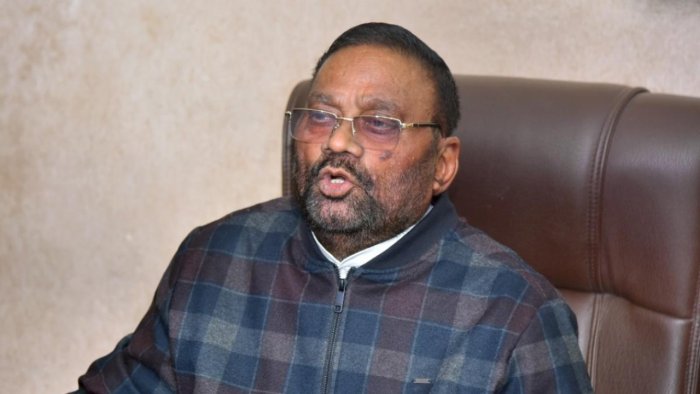
Samajwadi Party leader Swami Prasad Maurya had accused the BJP-led Centre of inviting only “Brahmin gurus” for the inauguration of the new parliament building while ignoring other religious leaders. 

“The allegations of Brahminism made by the Samajwadi Party are comical and reek of ignorance. These Adheenams are run by communities that come under backward caste and OBC categories. They have a rich history of Tamil literature that worships Lord Shiva,” government sources told ANI.

The remarks were termed as an insult to the Adheenams (chief priests of Shaivism mutts) and to the diversity of Hinduism.

“It is an insult to these holy Adheenams and to the diversity of Hinduism to make such comments,” the government sources said.

Maurya, in a tweet, had said, “It is extremely unfortunate that only fundamentalist Brahmin gurus of the South were called in the installation worship of Sengol. If the BJP government had faith in India as a secular sovereign nation, then all the religious leaders of the country, such as Buddhist Dharmacharyas (monks), Jain Acharyas (sages), Guru Granthis, Muslim religious leaders (Maulana), Christian religious leaders (Pastor) etc. should have been invited”.

“By not doing so, BJP has shown its corrupt mentality and disgusting thinking. Although the BJP government is going on the path of monarchy by establishing the Sengol, it is also trying to establish Brahminism by calling the Brahmin religious leaders of the South,” he added.

Prime Minister Narendra Modi on Sunday dedicated the new parliament building to the nation by unveiling a plaque and installing the ‘Sengol’ in the Lok Sabha chamber.

The prime minister felicitated some of the workers involved in the construction of the new building. He handed over mementos to them.

Prime Minister Modi installed the sacred ‘Sengol’ in the new Lok Sabha chamber, right next to the Speaker’s chair, after performing puja. PM Modi also performed sashtang pranam (prostration) before the ‘Sengol’ as a mark of respect during the ceremony.

A ‘sarva dharma prarthana’ (multi-faith prayer) ceremony was held at the new parliament building on Sunday.

At the sarva-dharma prarthana, the religious leaders chanted prayers of their respective faiths.

The newly constructed building of parliament, which will work to further enrich India’s glorious democratic traditions and constitutional values, is also equipped with state-of-the-art facilities that will help the parliamentarians to perform their functions in a better way.

The new complex is designed to enable 888 members sit in the Lok Sabha.

In the present building of the parliament, there is a provision for the sitting of 543 members in the Lok Sabha and 250 in the Rajya Sabha.

Keeping in view the future requirements, arrangements have been made for a meeting of 888 members in the Lok Sabha and 384 members in the Rajya Sabha in the newly constructed building of the Parliament. The joint session of both Houses will be held in the Lok Sabha Chamber.

(This news report is published from a syndicated feed. Except for the headline, the content has not been written or edited by OpIndia staff)