Home Blog Page 222

Blaming EVMs to claims of “vote chori” and campaign against Bihar SIR drive: Congress-led opposition’s relentless assault on electoral process for over a decade

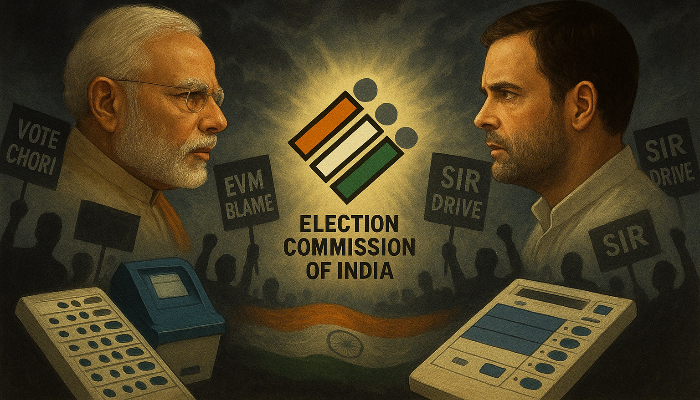
The controversy regarding elections, which was initially triggered by the disgruntled I.N.D.I. Alliance unable to come to terms with its humiliating defeats in repeated elections and blaming EVMs, has once again taken center stage. However, it is now entering a fresh chapter, while still echoing the same old rhetoric of election manipulation, this time it is labeled as “stolen elections.”

This is a quintessential case of rebranding an obsolete product in a new format to trick the populace. However, as predicted and similar to before, the Election Commission is their target just because people aren’t voting for them.

The Election Commission of India (ECI) was accused of “criminal fraud” by Rahul Gandhi in the recent attack. He alleged that more than 1 lakh bogus votes were cast in the Mahadevapura Assembly segment of the Bangalore Central Lok Sabha constituency to guarantee the Bharatiya Janata Party (BJP) victory in the general election of 2024.

Rahul Gandhi specified five distinct methods of “vote chori” including the use of Form 6 improperly, duplicate voters, bulk votes at a single address, phoney and incorrect addresses as well as invalid pictures.

“The Congress won all the Vidhan Sabha (six out of seven) except Mahadevapura, where the BJP swept and secured a victory margin of 1,14,046 votes. This seat significantly contributed to their election win and the Lok Sabha result went in their favour on that seat,” the Leader of Opposition in the Lok Sabha said.

The remark explicitly demonstrated his irritation with yet another loss in the general election which the Congress leaders celebrated as an exceptional victory with 99 seats. However, it seemed that the party eventually realized that it was indeed a failure, culminating in the current frustration.

The Karnataka Chief Electoral Officer (CEO) treated the accusations with gravity and requested that he submit his evidence under oath. “I am a politician, what I say to the people is my word. I am saying it to the people publicly, take it as an oath. Interestingly, they haven’t denied the information,” the Rae Bareli MP responded conveniently.

This serves as a prime illustration of political hit-and-run tactics aced by the opposition where they make critical allegations without accepting any accountability or presenting proof. The same was evident in the Pegasus affair, the Rafale deal and various other instances where the even Supreme Court had to reprimand Rahul Gandhi for disseminating lies.

“Using words like vote chori to mislead people is a disrespect to the Constitution,” the Election Commission also lashed out at the opposition. A period of 45 days following the elections is allocated for candidates to challenge any election results in the Supreme Court. Nevertheless, no such matters were brought up at that time.

“It is an insult to the Indian Constitution if election petitions are not filed within 45 days but allegations of vote chori are raised,” the Election Commission emphasised. It added, “During that period, no candidate or political party finds any irregularity, then today, after so many days, the voters and people of the country understand the intention behind making such baseless allegations.”

“The machine-readable voter list is prohibited. This decision of the Election Commission is after the judgment of the Supreme Court and is from 2019,” it replied after Congress alleged that the Election Commission gave electoral rolls in formats intended to evade examination, such as digital files that were locked as non-machine-readable PDFs and reams of printed paper piled “seven feet high.”

Opposition hits out at SIR drive, wants to bring impeachment motion against CEC

The opposition is reportedly contemplating about filing an impeachment motion against Chief Election Commissioner Gyanesh Kumar amid the growing hostility between the Election Commission and the opposition. Leading the assault, Rahul Gandhi charged that the Election Commission conspired with the BJP to steal elections in the entire country and the Special Intensive Revision (SIR) drive in Bihar is the “latest conspiracy” to replicate the same.

He launched a 16-day 1300 kilometre “Voter Adhikar Yatra” (right to vote march) from Sasaram with his Mahagathbandhan partner and Rashtriya Janata Dal leader Tejashwi Yadav and argued that he was directed to provide an affidavit following his “vote chori” charges, however, no similar demand was issued to BJP leaders after their presser.

“In the whole country, assembly and Lok Sabha elections are being stolen and their latest conspiracy is to delete and add voters through SIR to steal the elections in Bihar. We have come here to tell you that we will not let them steal the election in Bihar. People of Bihar will not let them steal elections. The poor only have the power of vote and we will not let them steal polls,” he insisted.

“The entire country knows what the election commission is doing. Earlier, the country did not know how votes were being stolen. But we made it clear in the press conference how votes are being stolen,” the Gandhi scion stressed. He added, “Wherever this theft is happening, be it Bihar, Maharashtra, Assam, West Bengal, we will catch their theft and put it before the people.”

Mallikarjun Kharge, the president of the Congress accused the Election Commission of serving as a “agent” of the “dangerous” Modi government at the centre which he described as a “threat” to the Constitution and the right of the people to vote, at the yatra’s launch. “Modi government decided to have a union minister in the selection committee for the Election Commission, ignoring the Supreme Court’s advice that the Chief Justice of India be included,” he added.

The apex court pronounced that Election Commissioners is going to be appointed on the advice of the Prime Minister, the Leader of Opposition and the Chief Justice of India, in 2023. However, it highlighted that the order would only hold merit “until a law is made by Parliament.” Notably, Kharge disregarded to mention the fundamental part of the judgment.

Likewise, Rahul Gandhi has initiated an offensive against the SIR program which is genuinely aimed at curbing fake voters and exclusively facilitate voting for legitimate citizens, strengthening the democractic exercise. Ironically, he has taken issue with the Elections Commission, which is proactively working to address the voter fraud concerns he repeatedly articulated.

More importantly, the matter was not only brought to attention by the constitutional body but also research papers from the distinguished IIM institutes which have pointed out that Bihar and West Bengal are rife with a significant number of fraudulent voters. The campaign also showcased the presence of illegal foreign nationals including Bangladeshis with Indian documents like Aadhar Card.

The claims of “disenfranchisement” and “voter fraud” by the Mahagathbandhan alongside threats to boycott elections were also dismissed by the Supreme Court. It stated that the Aadhaar Card is not definitive evidence of citizenship and backed the Election Commission. The latter’s authority to add or remove citizens and non-citizens from the voter list was also recognised by the highest court.

“But something will be needed to see whether they are resident or not,” the bench conveyed, refuting the assertions of the petitioners as a “sweeping argument.” It added, “There are family registers, pension cards, etc, a very sweeping argument to say that people do not have these documents.”

Notably, the members of all political parties have been an integral part of the SIR drive at all stages. The Booth Level Agents (BLAs) have exhibited their complete trust in the transparency of the entire process and no official complaint has been submitted by any political party to the Election Commission regarding the campaign.

Nevertheless, the rhetoric has only been intensified ignoring the ground realities as most of the fraudulent voters were supporters of the Congress-led coalition, in an attempt to provoke the general public.

Old playbook at work again

The Congress-led bloc’s penchant for ludicrous accusations concerning EVMs is neither new nor novel. This is a strategy that has been proven ineffective on several occasions in the past but it continues to be employed repeatedly in the hope that the Indian populace will accept their preposterous statements and rally behind them.

Casting doubts on the electoral process began with the attacking the EVMs not only during the Lok Sabha elections but also during state assembly elections. The victory of the BJP in the state assembly elections last year led to a renewed wave of allegations from Congress and ecosystem. Notably, in a manner reminiscent of past events, the controversy only arose when the BJP won.

For example, the reliability of the EVMs came under scrutiny in Haryana and Maharashtra assembly polls but not in Jharkhand or Jammu and Kashmir, where Congress partners Jharkhand Mukti Morcha and Jammu & Kashmir National Conference were successful, respectively. This striking selectivity renders the truth behind the claims and the intentions rather apparent.

The grand old party’s stalwarts Jairam Ramesh and Pawan Khera declared that the BJP triumphed in EVMs with a battery charge of 99% while the Congress did in those with a charge of 60% to 70%, following Haryana assembly elections.

The outrageous remarks were soon rebuffed by Chief Election Commissioner Rajiv Kumar who affirmed, “The public answers the questions by participating in the voting. As far as EVMs are concerned, they are 100% secure and foolproof.” The body underlined that even though EVMs are pre-installed with fully charged batteries, the charge level decreases as they are used for counting, mock polls and actual voting.

The assertions made by a suspended police officer were similarly magnified by the Congress ecosystem regarding EVM tampering in Maharashtra assembly polls which were promptly countered by the Election Commission. A man named Syed Shuja also announced that he could rig the results in 281 of the 288 seats in the state.

He added that EVMs could be managed by “frequency isolation.” Notably, electronic voting machines are incapable of wireless communication. Additionally, Syed claimed that he could pre-program EVMs to favour a particular political party and operate the voting machines using “specific apps” for Rs 52-53 crores.

The Congress ecosystem latched onto the video as the one and only truth and designated it as “empirical evidence.” However, the Election Commission had disproved the falsehood in 2019. The Delhi Police were even instructed by the nodal election body to file a complaint against him for spreading conspiracy theories and eroding faith of the voters in the voting equipment.

Syed Shuja initially gained notoriety in January 2019 after contending that the 2014 elections had been “rigged” to ensure BJP’s vitory. If his statement contained even a semblance of truth, it would imply that the United Progressive Alliance, headed by the Congress, was so inept that an opposition party managed to manipulate the elections while those in authority remained passive spectators.

He added that the EVMs were vulnerable to hacking during a Skype press conference in London. The scammer made a number of preposterous allegations on “rigged elections” in India. He even suggested that Gopinath Munde was killed as a result of finding out about the EVM tampering. Kapil Sibal also participated in the event, however, the party later tried to distance itself from the same.

“The charges made are very serious. I cannot vouch for them or deny them, as they have not been investigated. But they certainly need investigation. These should be looked into with an open mind by the Election Commission,” Abhishek Manu Singhvi had stressed attributing credibility to the claims.

He added that to reassure the nation about the reliability of electronic voting machines, the Congress and other parties demand a system in place to verify 50% of voter verifiable paper audit trails (VVPAT).

Congress and its allies consistently overlook an essential feature of Indian elections: since EVMs are constantly monitored by security forces and agents of the candidates, tampering with them is impossible. The EVMs are stored in secure rooms, where candidates and their designated representatives are permitted to watch over them around-the-clock until the day of the result.

The agents have access to live CCTV footage from within the strong room while they remain in a camp outside of it. Any dubious movement could lead to an alarm and provoke complaints. However, no such official complaints have been mabe by any candidate of the opposition.

Lies fall flat after Election Commission’s challenge, observations of courts

Various courts across the nation have rejected the allegations that EVMs could be compromised. Madras High Court, the Kerala High Court, the Karnataka High Court, the Bombay High Court, the Uttarakhand High Court and the Supreme Court, all of which have considered petitions on this subject and upheld the integrity of the EVMs.

“Prima facie, it is evident from a combined reading of the entire press release of ECI that this system is safe. The EVMs are not hackable. There cannot be any manipulation at the manufacturing stage. The results cannot be altered by activating a Trojan Horse through a sequence of key presses. The ECI-EVMs cannot be physically tampered with,” the Uttarakhand High Court highlighted.

The Bombay High Court stated, “The Bombay High Court ordered a detailed forensic examination of the EVMs from Central Forensic Science Laboratory (CFSL) Hyderabad for checking any manipulation etc. The CFSL report clearly ruled out any tampering, alteration or manipulation in the EVMs. The said report was accepted by high court and the petition was dismissed.”

The Karnataka High Court conveyed, “This invention (EVMs) is undoubtedly a great achievement in the electronic and computer technology and a national pride.”

A petition requesting 100% matching between the Voter Verifiable Paper Audit Trail (VVPAT) and the Electronic Voting Machines (EVMs) during the vote-counting on 23rd May 2019, was termed as “nonsense” and junked by the Supreme Court. “We won’t entertain such a plea over and over again. Can’t come in the way of people electing their representatives. Let country elect its government,” it pronounced.

The Election Commission, in 2017, had already challenged all parties, especially the Opposition, to hack the EVM amid repeated accusations by Congress, Left and the Aam Aadmi Party of rigging to benefit the saffron party. Nevertheless, in spite of the intense reactions regarding the alleged tampering, no political parties, scientists or technical experts stepped forward to substantiate their claims, even when given a prime opportunity.

Conclusion

The issue is straightforward and clear-cut. It is not about EVMs or anything else but power. Congress never imagined that Chief Minister Narendra Modi would become the prime minister and the BJP would govern the country not merely for five years but for 15 or maybe more.

“I promise you in 21st Century Narendra Modi will never become the Prime Minister of the country. But if he wants to distribute tea here, we will find a place for him,” Mani Shankar Iyer’s derogatory remarks during an All India Congress Committee (AICC) event exposed their bigoted mindset and overconfidence.

This comment later returned to haunt the party dramatically and now they fear that they might have to remain in opposition for the unforeseeable future. As a result, conspiracy theories have been circulated and every nonsensical claim is projected as truth in an effort to bring down the government by any means possible.

The attack on EVMs, the election commission and the SIR is a continuation of this. Congress has an entitled mentality, convinced that it is the only party fit to rule India, and that democracy functions properly only when they are in control. Once they are removed from power, they begin to point fingers at everything, from the Election Commission to the judiciary.

It is also evident from the facts that such issues are only raised when the BJP succeeds and not otherwise. If Congress or the opposition were truly earnest then their concerns would not be restricted solely to the victory of their rival. The dismissal of their claims by the courts coupled with their failure to respond to the challenge from the Election Commission to support their allegations, indicates the same.

It is nothing but noise without any real substance or proof for the last decade and the opposition thinks that the people of this country will somehow be persuaded by it and stand with them.
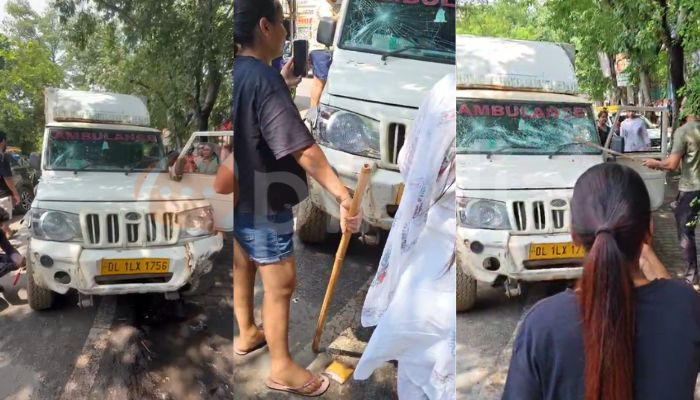

OpIndia Exclusive: Self-styled ‘dog lovers’ attack MCD officials, damage van during Supreme Court-ordered stray dog removal drive in Delhi’s Rohini

0

On 18th August, self-styled “dog lovers” attacked Municipal Corporation of Delhi (MCD) officials who were out to pick aggressive dogs following the Supreme Court’s 11th August orders in the suo motu case on stray dogs in Delhi-NCR. OpIndia received several videos from multiple sources showing MCD officials being attacked in the Rohini area of Delhi.

The attackers were heard threatening officials with dire consequences. In three of the videos, the so-called dog lovers damaged the MCD van, creating a hostile environment for those engaged in court-mandated duty.

OpIndia talked to its sources about the incident. It was revealed during the conversation that, following the apex court’s order, several Resident Welfare Associations (RWAs) across Delhi sent requests to MCD to remove dogs with a biting history and those deemed dangerous. The request was in sync with the Supreme Court’s detailed order of 11th August that made it clear that MCD authorities were required to actively act on complaints regarding aggressive strays, emphasising that citizens’ rights to safety cannot be violated by forced re-release of biting dogs under the ABC Rules, 2023. The court also underlined that such dogs must be removed immediately to prevent further attacks.

Despite the clarity in the order and no immediate stay on the apex court’s judgment by the larger bench, so-called “dog lovers” opposed the removal attempt and obstructed the officials by resorting to intimidation and violence. It has to be noted that the Supreme Court, in its order, made it clear that any such obstruction will be seen as contempt of court and will be dealt with strictly. However, it appears that these self-styled dog lovers have no respect for the order of the apex court or for the safety of the general public, which is facing severe trauma on a daily basis because of the uncontrolled population of stray dogs on Indian streets.

Upon further investigation, OpIndia came across several Instagram pages and handles that actively shared these videos as their “victory” against MCD. In one of the videos, they forced an MCD official to issue a statement asking other MCD officials not to pick dogs if they wanted to save themselves from being beaten.

The vandalism of government property and threats issued against workers underscore how sections of “dog lovers” have resorted to terrorising those tasked with upholding the law and protecting public safety.

It is important to note that the officials were not carrying out indiscriminate removals but were following clear court directions and citizen complaints. Obstructing them undermines the judiciary’s authority and puts ordinary citizens at risk. If civic staff cannot act without fear, implementation of the court’s order will be paralysed, leaving residents vulnerable to dog attacks.

The incident has raised urgent questions about how far certain groups will go in shielding aggressive strays, even at the cost of human safety.

During Operation Sindoor, Pakistan’s Navy ran away and hid its ships in commercial docks and near Iran border

For the first time, satellite images have come out that show Pakistan’s Navy pulling back during India’s attack as part of Operation Sindoor in May. According to a report by India Today, these images provide rare proof of how Islamabad was forced to reposition its naval fleet after India’s strikes.

The pictures reveal that several Pakistani warships were shifted from their main naval bases. Some were moved to Karachi’s commercial docks, while others were pushed further west, closer to the Iran border. The retreat was significant, as it happened right when India was carrying out precision strikes against the terror state between 7th and 10th May.

This new evidence directly challenges Pakistan’s earlier claims of giving a “strong response” to India. The images suggest that Islamabad had to retreat to even protect its naval assets. On 8th May, just a day after India’s strikes, key warships were found missing from their usual berths. Instead, three were spotted together at Karachi’s commercial port, while another had been relocated separately.

Notably, on the intervening night of 7th and 8th May, India carried out a major retaliatory strike following the Pahalgam terror attack that killed 26 people. The operation was a joint effort by the Indian Army and the Air Force.

Within a span of 25 minutes, between 1:05 am and 1:30 am, Indian forces conducted 24 precision missile attacks on nine terror locations within Pakistan and Pakistan-occupied Kashmir (PoK). Targets included Muridke and Bahawalpur—locations that are the centers of Lashkar-e-Taiba and Jaish-e-Mohammed.

New Delhi said clearly that the action was a “measured” step, meant to punish those responsible for the Pahalgam attack, not to escalate tensions further.

The satellite imagery, however, speaks for itself. They amply illustrate how Pakistan’s navy had to relocate its frontline warships almost 100 km away from Karachi to Gwadar on the Iranian border. For Islamabad, which had proclaimed resilience, this withdrawal is an abject acknowledgment of just how forcefully India’s Operation Sindoor rattled its defenses.

US brings bizarre excuse for China to justify tariff on India, White House adviser accuses India of ‘funding Putin’s war machine’, 2 days after his own President meets Putin

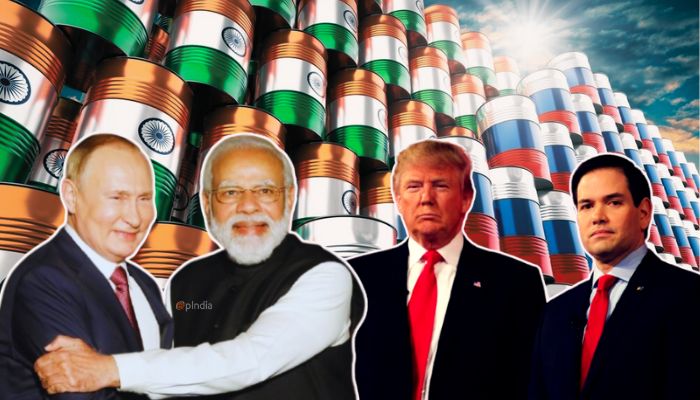
The American hypocrisy knows no bounds. US President Donald Trump has since late July launched a tirade against India, imposing 50 per cent tariffs citing India’s oil and defence trade with Russia. Now, US Secretary of State Marco Rubio has not only admitted to having double standards regarding China and India, but also justified Washington’s hypocrisy.

Recently, Trump had alleged that India, being the second-largest buyer of Russian oil, is “fuelling the Russian war machine” against Ukraine. However, despite China being the top Russian oil buyer, purchasing about 2 million barrels per day, the US keeps it exempt from tariffs.

Justifying China’s exemption from Trump tariffs, Marco Rubio said on 17th August, unlike India, the majority of Russian oil that China is purchasing is being refined and then sold in the global marketplace. He further argued that imposing sanctions on Beijing could result in global prices surging dramatically.

“Well, if you look at the oil that’s going to China and being refined, a lot of that is then being sold back into Europe. Europe’s also buying natural gas still. Now, there are countries trying to wean themselves off it, but there’s more Europe can do with regard to their own sanctions,” Rubio said in an interview with Fox Business.

Further defending America’s inaction against China for buying Russian crude oil, Rubio said, “If you put secondary sanctions on a country – let’s say you were to go after the oil sales of Russian oil to China – well, China just refines that oil. That oil is then sold into the global marketplace, and anyone who’s buying that oil would be paying more for it or, if it doesn’t exist, would have to find an alternative source for it.”

Rubio also said that European nations which purchase Russian oil from China have expressed ‘unease’ over taking punitive measures against China.

“We have heard, when you talk about the Senate bill that was being proposed – where there was a hundred per cent tariff on China and India – we did hear from a number of European countries – not in press releases, but we heard from them – some concern about what that could mean,” Rubio said.

China buys Russian oil, Europe buys Russian oil sold by China, the US continues trade ties with Russia, but India is fuelling the Russian war machine: The great American hypocrisy

Basically, the US will not impose sanctions or secondary tariffs on China for buying Russian oil because European consumers are not in favour of doing so. The US will not penalise European nations still buying Russian oil and gas directly since Washington does not want to indulge in a tit-for-tat with Europe.

Convenient much! No additional tariffs on China because Europe would be upset. No sanctions against Europe because the US cannot afford to be at loggerheads with the EU. So, China and Europe can buy, sell and consume Russian oil, but somehow India is the sole villain and is ‘fuelling the Russian war machine’.

Who would have thought that even a ‘dead economy’, as Trump calls India’s, can fuel another country’s ‘war machine’?

After Trump, Rubio, now White House trade adviser Peter Navarro has also jumped on the bandwagon to put the sole blame of the Russia-Ukraine war on India, while giving a clean chit to China, Europe and the US itself.

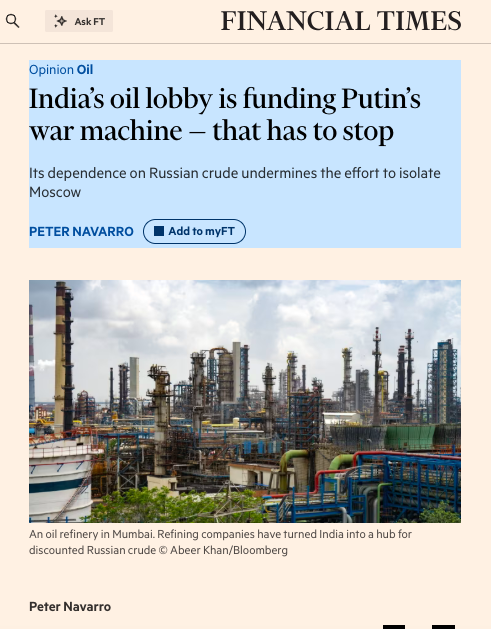
In an opinion piece published in the Financial Times, Navarro alleged that India’s purchases of Russian crude oil were funding Moscow’s war against Russia and that New Delhi needs to stop this. He asserted that India needs to stop cosying up to Russia and China if it wants to be treated as the US’s strategic partner.

Navarro decided to sermonise to India on how it should act to be treated as the US’s strategic partner; however, the White House advisor did not give any advice to Washington on what it should do to make India feel equal in this partnership. For starters, the US should stop cosying up to the state sponsor of anti-India cross-border Jihadi terrorism, Pakistan.

“India acts as a global clearinghouse for Russian oil, converting embargoed crude into high-value exports while giving Moscow the dollars it needs,” the Financial Times article headlined “India’s oil lobby is funding Putin’s war machine — that has to stop”, reads.

The White House trade and manufacturing advisor further laments that, backed by India, Russia continues to hammer Ukraine, and in turn, American and European taxpayers are “forced to spend tens of billions more to help Ukraine’s defence.”

“More than 300,000 soldiers and civilians have been killed, while NATO’s eastern flank grows more exposed and the West foots the bill for India’s oil laundering,” Navarro writes.

Even India sells refined petroleum products to Europe, as much as USD 15 billion

It seems that there is a common sense crisis in Washington. Much like China, even India sells Russian oil to Europe in the form of refined petroleum products. Ever since the Russia-Ukraine war erupted in 2022, India’s petroleum products export to the European Union increased to USD 15 billion during this period. India is not benefiting from a crisis. India is ensuring that even as there is a crisis, global energy supplies are not disrupted, and New Delhi’s domestic needs are also covered.

If Europe and the US are so keen on bringing Russia to its knees, they themselves should do a total boycott of Russian crude oil. But they don’t. In fact, they continue to purchase Russian oil and gas via indirect routes while imposing sanctions after sanctions on Moscow to cripple the Russian economy.

While the US may have cut its Russian crude oil imports from Russia due to sanctions, it continues to trade with Russia in various sectors. Even three years after Russia invaded Ukraine, the United States has not fully cut off its trade ties with Moscow. The US has imported more than $24.5 billion worth of Russian goods since January 2022. This year alone, it bought $1.27 billion worth of fertilisers, $624 million in uranium and plutonium, and nearly $878 million in palladium.

Import of non-ferrous metals such as palladium and aluminium was valued at $876.5 million for the period January to November in 2024. Inorganic chemicals made up $683 million, followed by power-generating machinery at $79 million and cork and wood manufacturers at approximately $64 million.

Other commodities included nuclear reactors and machinery worth $80.81 million, prepared animal feed, iron and steel, and oil seeds, although these contributed smaller shares to the overall imports. The US government’s own data indicates that U.S. exports of goods to Russia fell to $528.3 million in 2024, while imports were worth an amount phenomenally higher. In the year 2023,  the U.S. exports to Russia stood at around $598.8 million. Despite Russia enjoying a massive surplus and being involved in a war with Ukraine, there was never really a hiatus in the Russia-US trade.

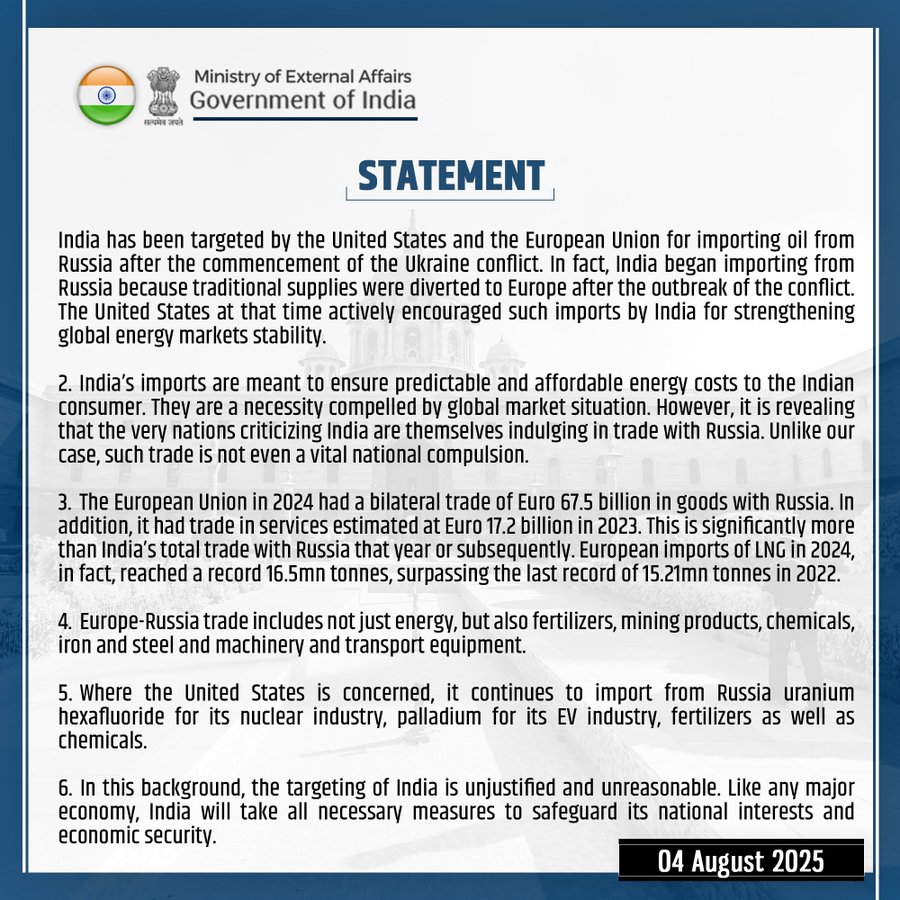
Meanwhile,  the European Union had bilateral trade of Euro 67.5 billion in goods with Russia in the year 2024 alone. Furthermore, trade in services between the EU and Russia in 2023 stood at around Euro 17.2 billion. In 2024, EU imports of LNG reached a record 16.5 million tonnes, up from 15.21 million tonnes in 2022 when the conflict started. Europe and Russia not only trade in energy but also fertilisers, mining products, chemicals, iron and steel, and machinery and transport equipment.

Refined crude is no longed ‘Russian’, as per EU Council’s own regulations

Deliberate ignorance or common sense crisis, but the Trump administration needs to understand that once refined by Indian refineries, Russian oil is no longer “Russian” as per EU Council regulations. In 2023, Indian External Affairs Minister S Jaishankar had cited European Union Council Regulation 833/2014 while replying to a media query about the remark made by Foreign Policy Chief Josep Borrell, who wanted the EU to act against India for selling refined “Russian oil”.

In response to Trump’s attacks on India for buying Russian oil, the Indian Foreign Affairs Ministry on 4th August, pointed out that India started importing oil from Russia because traditional supplies were diverted to Europe after the outbreak of the conflict between Russia and Ukraine. At that time, the United States actively encouraged such imports by India for strengthening the stability of global energy markets.

Clearly, it seems that the sudden villainisation of India by America is not due to the continued purchases of Russian crude oil but a consequence of Trump’s bruised ego. Donald Trump expected India to behave like the failed state of Pakistan, heap praises on him for his imaginary role in brokering a ceasefire understanding between India and Pakistan in May, and nominate Trump for the Nobel Peace Prize.

However, India did not indulge in any such absurd sycophancy, not even for the ‘trade deal’ Trump claimed to have used as leverage to convince India to stop attacks on Pakistani terror and military establishments. No Trump flattery, no Nobel Peace Prize nomination and no opening of Indian dairy and agriculture markets for the US, has collectively enraged and perhaps traumatised Trump to such an extent that now Washington is hell bent on blaming India for the Russia-Ukraine war.

OpIndia reported earlier how the European Union capitulated before Trump in the US-EU trade deal and compromised the EU’s interests. Apparently, the EU’s capitulation had emboldened Trump, who thought that his tariff tactics would work against any country; however, India shattered his delusion.

Interestingly, the Trump administration is busy painting India as the financier of Russia’s military action against a NATO-backed Ukraine. However, during his meeting with the US President in Alaska on 16th August, Russian President Vladimir Putin revealed that US-Russia bilateral trade had expanded by over 20 per cent in the past few months, exposing Trump’s persistent claims that the US has been pressuring Moscow to end its war in Ukraine.

Perhaps Donald Trump, Marco Rubio, Peter Navarro or at least Lindsay Graham can explain how the US is not ‘fuelling Russian war machine’ by expanding bilateral trade with Moscow by 20 per cent. Or, the Russian war machine is fuelled only when New Delhi imports a few barrels of Russian crude for domestic needs and exports to Europe? It’s high time the US either shuns this hypocrisy and punishes itself for funding the Russian war machine or stops vilifying India for not turning its back on affordable Russian oil.

Donald Trump, who during his presidential campaign made tall claims of ending the Russia-Ukraine war within 24 hours of assuming office, has failed to secure even a temporary ceasefire between the two warring nations even after eight months. India is in no way obliged to burden itself with the blame for Trump’s failures, whims and hypocrisy.

“There is no god but Allah, and none is worthy of worship except Him”: Ghaziabad cop Sohail Khan’s video inside a temple sparks outrage, faces inquiry

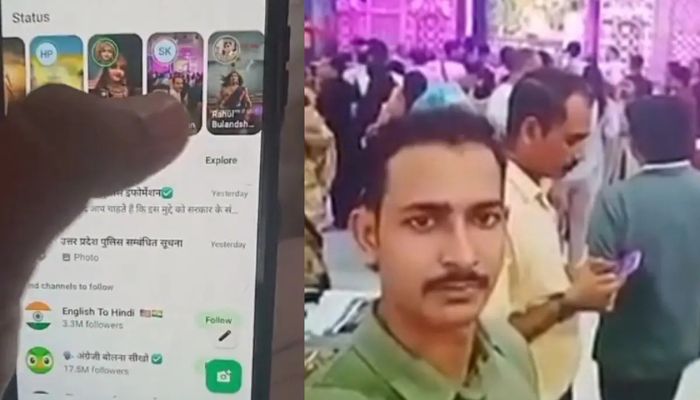
A constable of police in Ghaziabad district of Uttar Pradesh has landed in trouble after a video of his WhatsApp status went viral and sparked protests by Hindu groups. The Ghaziabad Police opened an investigation into the matter after public outcry on social media and then benched the constable.

As per media reports, the constable, Sohail Khan, who was stationed at Madhuban Bapudham police station, had visited a temple on Janmashtami. There, he clicked a selfie and upload it as his WhatsApp status. 

The picture itself wasn’t that of concern, but the background song he used for it led to outrage. The track had the line which stated that “no one except Allah is worthy of worship.”

Within days of the status going viral online, it was widely shared and criticised, particularly by some Hindu organisations. Numerous activists asserted that Khan’s status was an effort to defame religious sentiments. 

President of Hindu Raksha Dal Pinky Chaudhary went so far as to state on X (formerly Twitter) that the constable was employing his police attire to spread Islam and provoke religious conversions.

As the outrage grew, several users mentioned the Ghaziabad Police on social media, calling for stringent action. When reacting to the outrage, the police confirmed that the issue was being investigated.

Further CP Alok Priyadarshi later added that the inquiry was entrusted with the ACP of Kavinagar. According to findings, Constable Khan was benched (shifted from active duty), and a departmental inquiry has also been ordered.

The event has again pointed out how individual social media messages by uniformed men can make huge controversies, particularly if they are associated with religious sensitivities.

Alwar shocker: Woman and her lover slit her husband’s throat, stash body in a blue drum, flee with 3 children

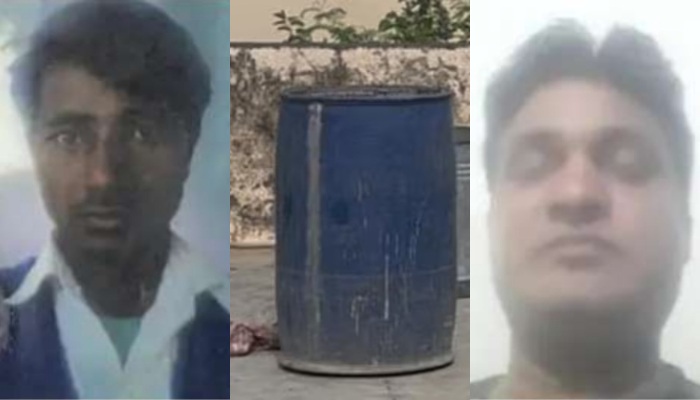
A young man’s body was discovered in a blue drum in Adarsh Colony, situated in the Khairthal-Tijara region of Alwar district, Rajasthan. This is reminiscent of the infamous Meerut case, where a woman and her lover conspired to murder her husband and stored his corpse in a similar drum. The recent incident was revealed on 17th August when Mithlesh Devi (60) went to the terrace. Her 35-year-old son Jitendra is also an accused in the case.

The deceased, Hansram alias Suraj, who was about 30 years old, originally hailed from Uttar Pradesh and had moved in with his family into a rented home around one and a half months prior. He was employed as a laborer at a local brick kiln. He stayed in Adarsh Colony of Kishangarh Bas with his spouse Lakshmi Devi alias Sunita and their three children who have been missing since 16th August along with Jitnedra.

“Seven to eight days ago, she visited me and requested a blue drum. She claimed that water would be coming in three days and she needed it for storage. I had several drums available in my house so I gave one to her. I was completely unaware that a murder conspiracy was being plotted in my home,” Mithlesh Devi disclosed, reported Dainik Bhaskar.

According to Deputy Superintendent of Police Rajendra Singh Nirvan, the remains of Hansram known as Suraj from Navadiya Nawazpur in the Shahjahanpur district of Uttar Pradesh have been found. On 17th August, Mithlesh Devi, the wife of Rajesh Sharma who is the homeowner, called the police when a foul odor was detected from the roof. The authorities spotted a blue drum on the roof upon their arrival and the body was uncovered inside it. Hansram’s throat had been slashed with a sharp weapon, according to the post-mortem report.

The initial investigation disclosed that salt and a certain amount of water were placed in the drum to dissolve the body. The victim was known to be an alcoholic, having shared many drinking sessions with Jitendra whose wife had already passed away.

Background of the case

Mithlesh Devi stated, “We had our own brick kiln in Pur village in Kotkasim town which is 27 kilimetre from the Khairthal-Tijara district. My husband managed the kiln, but it has been closed for many years. There were numerous drums used for water storage and we kept 10-15 at our residence after it shut down. Sunita wanted one and I handed it over without knowing her intentions.”

She further conveyed, “My son and Suraj were employed at a brick kiln located in Bhindusi village, approximately 35 kilometers from Khairthal-Tijara. Jitendra served as the accountant while he and his wife worked as laborers. The two men shared a friendship. They often enjoyed meals and drinks together and occasionally consumed alcohol.”

“The brick kiln’s operations were interrupted by rain in June. Therefore, my son invited them to stay at the house as tenants. They resided in a room on the roof and payed a rent of Rs 1500 per month,” the woman added. She mentioned that Sunita would often express her concerns about her husband’s alcohol addiction and complained that he had destroyed everything.

Afterward, the former told them to leave their house and the family was on the verge of vacating it, however, the shocking instance transpired prior to that.

The police’s disclosures

According to police sources, Jitendra brought the family to his residence for rent one and a half months ago. He lied to his father about their names. He referred to Hansram as Suraj and his wife Laksmi as Sunita. During the investigation, the police recovered Hansram’s Aadhaar Card which unveiled the truth.

As per police accounts, Jitendra and Laksmi were engaged in an affair during their time at the brick kiln. He gained Hansram’s friendship using alcohol. The two often drank together in the evenings. This allowed Jitendra to meet Lakshmi without any obstacles. When work at the kiln ceased, Hansram began preparations to return to Uttar Pradesh. However, Jitendra convinced Lakshmi to rent a room in his home to keep her close. He promised Hansram that he would find him another job shortly, but in reality, he was plotting to dispose of him.

Nirvana reported that Mithlesh Devi and her 14-year-old grandson were found inside the house. She indicated that Jitendra’s wife had died 12 years ago. Rajesh Sharma, works as a property dealer and comes home every 2 to 3 days. On 16th August, she went to the market for Janmashtami shopping and did not find Sunita or her children when she returned. Jitendra had also not come back by evening. She approched the police after noticing the revolting smell.

The authorities have initiated a search for Jitendra and Lakshmi. Four specialized teams have been established to probe the case, conducting raids across various locations in Rajasthan, Haryana and Uttar Pradesh. Nirvana highlighted that preliminary findings suggested this case might involve a love affair. “We are exploring multiple other angles and the arrest of the suspects is anticipated soon which will expose everything.” he assured.

Lakshmi’s kids could also be involved in the killing. The drums also questioned the drums manufacturing companies since it appeared to be in pristine condition. Although no arrests have been made so far, police sources declared that they are in the process of tracking the locations of the perpetrators.

Indian Oil Corporation to produce Sustainable Aviation Fuel from used cooking oil: All you need to know

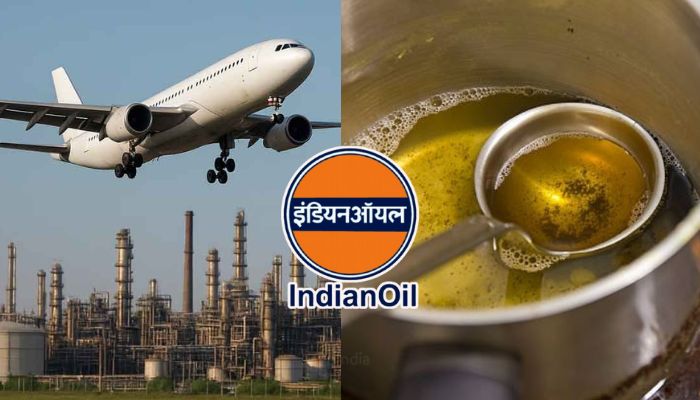
Who would have thought that used cooking oil, often discarded after frying samosas, pooris and pakoras, could be used as a reliable Sustainable Aviation Fuel (SAF)? However, after US, Indonesia, China, Singapore, Japan, Malaysia, and various European nations, India is set to produce SAF using used cooking oil (UCO) at a commercial scale.

Recently, India’s largest refiner and fuel retailer, Indian Oil Corporation (IOC) became the first in the country to receive the prestigious ISCC CORSIA Certification for Sustainable Aviation Fuel production at its Panipat Refinery. 

What is Sustainable Aviation Fuel

Similar in chemical composition to traditional aviation turbine fuel (ATF) or jet fuel, which is made from crude oil, SAF is a biofuel made from sustainable feedstocks. This implies that the SAF-ATF blend is easily compatible with current aviation engines.

Depending on the efficiency and sustainability of the feedstock and production process, SAF can reduce carbon emissions—one of the harmful greenhouse gases—by up to 80% over the course of a conventional jet fuel’s lifecycle.

Various studies have found that commercial aviation produces 2.5% of the world’s CO2 emissions. According to an Air Transport Action Group report, in 2023 alone, commercial aviation’s contribution to CO2 emissions wasat roughly 882 million tonnes. This makes it imperative to switch from traditional to more sustainable fossil fuels to bring down carbon emissions to optimal level and protect the environment.

Interestingly, the aviation industry estimates that more than 60% of the global aviation sector’s decarbonisation efforts will likely come from SAF alone.

What is ISCC CORSIA certification

The ISCC CORSIA certification, i.e., International Sustainability & Carbon Certification (ISCC), developed under the Carbon Offsetting and Reduction Scheme for International Aviation (CORSIA) by the International Civil Aviation Organisation (ICAO), validates that SAF meets the highest international sustainability and lifecycle carbon emission standards.

SAF produced at Indian Oil’s Panipat Refinery has undergone rigorous assessment for lifecycle carbon emissions and traceability, creating a clear pathway for Indian airlines to integrate certified SAF into their operations. The certification also sets a benchmark for other domestic refiners and industry players to scale up SAF production. This is in line with the government’s vision of achieving net-zero emissions by 2070.

Earlier this month, Civil Aviation Minister Ram Mohan Naidu Kinjarapu announced that Indian Oil’s Panipat Refinery has been certified as the country’s first Sustainable Aviation Fuel producer.

IOC’s Panipat Refinery to start SAF biofuel production at commercial scale

IOC has said that by end of this calendar year, its Panipat Refinery will start producing SAF from used cooking oil at a commercial scale. By December 2025, IOC will have the capacity to produce 35,000 tonnes per year of SAF from used cooking oil. This used cooking oil will be sourced from large hotel chains, restaurants, and sweets and snacks companies like Haldiram’s. While these companies normally discard cooking oil after single use since it becomes unhealthy, now the same oil will be used to produce sustainable aviation fuel.

Speaking about the significance of producing SAF and used cooking oil collected for the same, IOC’s Chairman Arvind Sawhney said, “The capacity (35,000 tonnes per year) will be sufficient to meet the country’s 1 per cent SAF blending requirement (for international flights) by 2027… For feedstock (used cooking oil), we will be engaging aggregators to collect it from big hotel chains and restaurants. There is a large amount of such oil available in the country. The only challenge is collection. While it is easy to collect from large hotel chains, a solution needs to be found for collection from small users, including households.”

SAF production, however, comes with its own challenges as despite offering a lower carbon footprint, SAF made from used cooking oil is currently three to four times more expensive than conventional fuel due to its higher production costs, which are caused by issues including feedstock constraints and evolving production technology.

Unable to relocate, or remove stray dogs from streets, Shimla Municipal Corporation gives them QR and GPS based collars ‘to monitor their location’

On 16th August, the Shimla Municipal Corporation launched an extensive sterilisation and anti-rabies vaccination drive for stray dogs in the city amid rising cases of dog bites. Shimla, which is known as a tourist hub, has seen over 2,500 cases of dog bites in around 20 months, raising serious concerns for public health and safety.

Alongside the sterilisation and vaccination drive, the civic body has introduced QR and GPS-based collars for the stray dogs in what it described as a solution to “monitor their location” and maintain digital records.

Each collar will hold key details of the dog, including whether the dog has been sterilised, dates of anti-rabies vaccination, health check reports, approximate age, and behavioural patterns including aggression level. The GPS system will allow authorities to track their movement in real time and the QR codes can be scanned with a smartphone by any resident to instantly view the records.

The civic body has claimed that it will help people identify vaccinated and sterilised dogs and officials will be able to keep a centralised database of the city’s stray population. However, the civic body did not explain how this is going to help in reducing stray dog bite cases, as sterilisation and vaccination drives do not ensure that a dog would not bite.

Mayor Surinder Chauhan said in a statement that veterinary experts from Goa, Maharashtra and Delhi have been brought in to assist. Four vehicles and facilities have been arranged for catching and tagging dogs across wards.

Unable to remove dogs due to ABC Rules 2023

Despite rising dog bite cases in the city, the Shimla Municipal Corporation is bound by the Animal Birth Control Rules 2023, which prohibit the removal or relocation of stray dogs. Even if a dog has bitten someone, the civic body can only keep it in observation for 10 days, and if found to be healthy without any infection such as rabies, the dog must be released at the same location where it has a history of biting people. This has left civic bodies with little choice but to sterilise, vaccinate, and now digitally tag the dogs. The aggressive ones, according to the civic body, will be housed in a “dog hut” at Tutikandi.

Dog-bite cases rise in Shimla

Shimla is not only Himachal Pradesh’s capital but also a major tourist hub. Despite the importance of keeping streets safe, the data shows there were 2,500 cases of dog bites in the city in just 20 months. In 2025 alone, there were 800 cases of dog bites recorded. Most of the victims were children and school students. Some of the victims suffered serious injuries.

Congress councillor Narendra Thakur recently raised the issue during an MC meeting, stating that officials hide behind “dog rules” while the public lives in fear. The uproar led to a ten-minute adjournment of the House, with BJP councillors also staging a protest.

Residents trapped in fear, demand action

The menace is not confined to dogs. More than 2,700 cases of bites by dogs and monkeys have been reported in the past year, forcing women and children indoors. Critics accuse the municipal corporation and the Himachal Pradesh government of being mute spectators while the threat grows.

Mayor Chauhan, however, insists the MC is committed to public safety and is acting within legal limits. On demands for compensation for bite victims, he said a proposal would be sent to the state government.

Supreme Court order sparks debate

The move comes in the backdrop of the Supreme Court reserving its order in the ongoing stray dog case in Delhi-NCR. The court had earlier directed the removal of all stray dogs from Delhi-NCR in a phased manner, which led to protests by dog lovers, celebrities and politicians. Senior advocate Kapil Sibal and others are contesting the case on behalf of dog lovers, while SG Tushar Mehta is representing the government at the Supreme Court. Despite rising dog bite cases and deaths due to dog attacks in the country, the dog lovers want the canines to roam free on the streets.

OpIndia is doing a series on Stray Dog Menace in India which can be checked here.

Madhya Pradesh woman says her in-laws didn’t allow treatment for child ‘because she was a girl’, doctors had asked family multiple times to bring her to nutrition centre

A tragic case from Madhya Pradesh has again highlighted the state’s long battle with malnutrition. On Saturday, 16th August, a 15-month-old girl called Divyanshi, from Shivpuri district, died at the district hospital. Disastrously, she weighed just 3.7 kg, well short of the normal weight for her age.

According to media reports, doctors treating her disclosed that her haemoglobin reading was as low as 7.4 g/dl, critically low for survival. She had already been identified in the state’s Dastak Abhiyan, for which health workers had persuaded her family to take her to the Nutrition Rehabilitation Centre (NRC). 

Her mother said that her in-laws prevented her from undergoing treatment, just because the child was a daughter. “Whenever she was sick, they used to tell, “Let her die, she is just a daughter.”

This case follows only two days after the death of another girl, Radhika, who was one-and-a-half years old, in Sheopur district of Madhya Pradesh. At the time of her death, she was merely 2.5 kg in weight. According to her mother, although she was born normal, her body gradually weakened and her limbs became thin as sticks. In Bhind district as well, recently a toddler passed away under the same conditions, with the families attributing her death to malnutrition, although doctors provided contrasting views.

These recurring deaths underline a harsh truth: in spite of government assurances and campaigns, Madhya Pradesh remains one of the worst-hit states when it comes to child malnutrition.

Malnutrition cases in different states

Malnutrition just refers to the fact that the body is not receiving enough of the proper nutrients that it requires to live and develop. In children, it is much worse. It can prevent growth, impair immunity, and in extreme cases, cause death.

Government data released by the Women and Child Development (WCD) ministry in 2024 reveal the gravity of the situation. Uttar Pradesh leads the list with 46.36% of children being stunted, or nearly half the children of the state failing to grow based on age. Lakshadweep is close second with 46.31%, Maharashtra (44.59%) and Madhya Pradesh (41.61%) also reporting terribly alarming numbers.

In case of underweight children, Madhya Pradesh again has the highest figure of 26.21%, followed by Dadra & Nagar Haveli and Daman & Diu (26.41%) and Lakshadweep (23.25%).

When it comes to wasting, a symptom of acute malnutrition in which children rapidly lose weight – Lakshadweep leads the pack once again at 13.22% of children suffering from it. Bihar (9.81%) and Gujarat (9.16%) are not far behind, indicating that a large number of children there are either not consuming sufficient food or are repeatedly falling ill.

Who is Chandrapuram Ponnusamy Radhakrishnan, the NDA candidate from Tamil Nadu for Vice-Presidential election

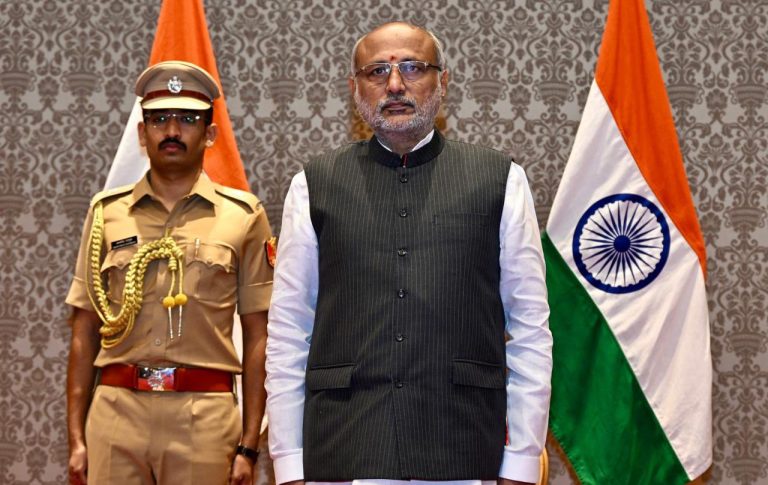
The National Democratic Alliance (NDA) on Sunday announced that Maharashtra Governor CP Radhakrishnan will be its candidate for the upcoming Vice-Presidential election. The election is scheduled to be held on September 9.

A veteran BJP leader from Tamil Nadu, Chandrapuram Ponnusamy Radhakrishnan has had a long career in politics, marked by his association with the Rashtriya Swayamsevak Sangh (RSS) and various leadership roles within the BJP. He is a seasoned political leader with decades of experience in parliamentary politics, state leadership, and constitutional offices.

Radhakrishnan was born in Tiruppur, then part of Madras State (now Tamil Nadu), in October 1957. From the age of 16, he became involved with the RSS and the Jan Sangh. In 1974, he became a member of the Bharatiya Jana Sangh’s state executive, laying the foundation for his long association with the Sangh Parivar and the Bharatiya Janata Party (BJP).

His major breakthrough in national politics came in 1998 when he was elected as a Member of Parliament from Coimbatore, a victory by over 150000 votes made significant by the fact that it came soon after the Coimbatore bombings. He won again in 1999, defeating a DMK candidate.  

In Parliament, Radhakrishnan served as Chairman of the Standing Committee on Textiles and as a member of committees on Public Sector Undertakings, Finance, and the Stock Exchange Scam inquiry. He also represented India at the United Nations General Assembly in 2003, addressing issues of humanitarian coordination and disaster relief. In 2004, he was part of India’s first parliamentary delegation to Taiwan.

Radhakrishnan was appointed as the President of the BJP’s Tamil Nadu unit in 2004, and he remained in the position till 2007. During this period, he organized a 93-day, 19,000 km Ratha Yatra to advocate for interlinking rivers, fighting untouchability, countering terrorism, and pressing for a Uniform Civil Code.

He later conducted two more padyatras, cementing his image as a leader who could connect with grassroots issues. His organizational skills and ideological clarity helped strengthen the BJP’s presence in Tamil Nadu, a state where the party has historically faced challenges.

He contested Lok Sabha elections in 2014 and 2019, but was unsuccessful. Between 2020 and 2022, he was the BJP’s in-charge for Kerala. Radhakrishnan was also appointed Chairman of the Coir Board in 2016, where he oversaw record exports worth ₹2,532 crore during his tenure.

In 2023, Radhakrishnan was appointed Governor of Jharkhand. He earned praise for visiting all 24 districts of the state within four months and engaging directly with citizens. Later, he was also given additional charges as Governor of Telangana and Lieutenant Governor of Puducherry. In July 2024, he was sworn in as the Governor of Maharashtra.

If the opposition fields a candidate, CP Radhakrishnan is almost certain to win the polls and become the next vice president of India.

The Vice President of India is elected by an electoral college consisting of members of both Houses of Parliament, Lok Sabha and Rajya Sabha. Unlike the Presidential election, state assemblies are not part of this process. Currently, the BJP-led National Democratic Alliance (NDA) enjoys a comfortable majority in the Lok Sabha and has significant strength in the Rajya Sabha, even though it does not have an outright majority in the Upper House. Taken together, the NDA’s numbers in both the Houses place its candidate in a strong position.

The only real challenge to Radhakrishnan’s chances lies in whether the opposition can present a united candidate and mobilise all its MPs. In recent years, opposition parties have struggled to maintain cohesion, particularly in contests for constitutional posts. Even if the opposition fields a candidate, the numerical arithmetic in Parliament Favors the NDA.

By choosing Radhakrishnan, a leader from Tamil Nadu, the BJP has signalled its intention to strengthen its presence in southern India, where the party is still trying to expand.