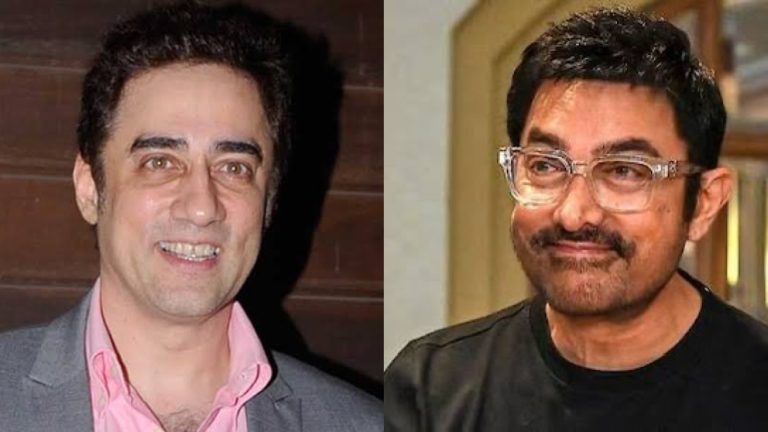
Actor Faissal Khan, best remembered for his role in Mela and more recently for his public fallout with brother Aamir Khan, has once again stirred controversy with explosive claims against his family. Days after officially cutting all ties with them, Faissal called his life since 2005 “a nightmare,” pointing to years of mistreatment, a bruising legal battle in 2016, and even pressure to marry his mother’s cousin, his own aunt.
Revealing details of the alleged family demand, Faissal said, “I was busy with work and not at all interested. My refusal led to endless fights, so I chose to distance myself. Even my mother was furious that I wouldn’t marry my aunt.”
The feud worsened, he claimed, after he wrote a letter exposing uncomfortable truths about his siblings. He alleged that Aamir had a child out of wedlock with journalist Jessica Hines while living with Kiran Rao, and that his sister Nikhat had been married multiple times. “They all turned against me and wanted me declared insane,” Faissal alleged.
In a recent interview with Pinkvilla, Faissal alleged that his family branded him schizophrenic, calling him “mad” and a danger to society. He further claimed that Aamir once confined him in their Mumbai home for over a year, forcing him to take medication and even stationing guards outside his room.
It's INSANE that we have not heard more about this in the media.
Faissal Khan says that his brother Aamir Khan, yes, the Bollywood Superstar, forcefully locked him up against his will and forced him to take medicines for his mental health, claiming that he suffered from paranoid… pic.twitter.com/KP5wBirhOj
This isn’t the first time Faissal has accused his family of conspiring against him. In a 2020 interview with Bollywood Hungama, while preparing for his directorial debut, he insisted he never suffered from mental illness and was wrongly branded schizophrenic. He claimed he was forcibly given heavy medication, kept under house arrest for a year, and pressured to surrender his signatory rights. A court battle followed, and JJ Hospital eventually deemed him mentally fit.
“I was never depressed or schizophrenic. My family assumed I was ill, locked me up, and gave me illegal medication,”Faissal had said, adding that he eventually fled home to reclaim his independence.
He also recounted feeling humiliated at Aamir Khan’s 50th birthday party, alleging that filmmaker Karan Johar insulted him publicly because of his “flop” status. Speaking about the film industry at large, Faissal lashed out at nepotism and groupism, calling Bollywood no different from “Kalyug.”
Interestingly, Aamir Khan had offered a very different account back in 2007, claiming doctors at JJ Hospital had indeed declared Faissal mentally ill and that he had even sought custody of him, though the court eventually granted it to their father.
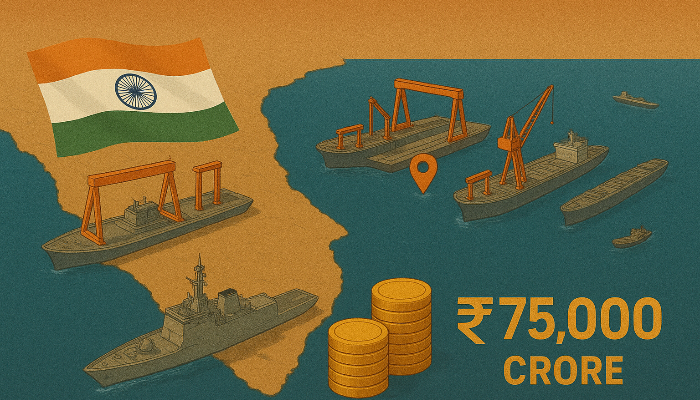
The Modi government has been taking concerted effort to develop India into a prominent maritime hub for shipbuilding. The centre is now considering investing ₹75,000 crore in the three new shipyards that are expected to be built along its east and west coasts, in a yet another significant step in this direction, reported Mint. The yards would be able to build and fix ships after the investment which is spread out over four to five years.
The union ports ministry informed, “The government is seeking to set up three greenfield shipbuilding clusters and support the existing shipyards carry out brownfield expansion. Overall, the government is targeting about ₹25,000 crore investment per greenfield cluster, which may be subject to significant changes based on the final locations and the shipyard sizes.”
According to the government, five states are negotiating with domestic and international shipbuilders to determine the best sites for the facilities. A shipbreaking plant might also be located at one of the shipyards, providing materials for production. “MoPSW (Ministry of Ports, Shipping, and Waterways) is also finalizing schemes to support these clusters (greenfield). For the brownfield expansion of existing yards, there is a scheme under finalization to support the expansion efforts of all the yards,” the ministry conveyed.
Greenfield manufacturing signifies the creation of facilities entirely anew, in contrast, brownfield relates to the development of current structures. The anticipated total sum of ₹75,000 is projected to be sourced from central government and multiple firms. Indian state-run companies had been seeking to collaborate with international shipbuilders and were looking to Korea and Japan for shipbuilding projects.
While current public sector shipbuilders are independently negotiating joint partnerships with Korean companies, discussions are underway with Japanese and Korean shipbuilders regarding participation in Indian clusters.
Massive boost to “Make in India”
The shipbuilding initiative is part of the government’s strategy to manufacture ships of all sizes domestically and to foster the development of cargo ships that are built, owned, and flagged in India. At present, the country’s share in the global shipbuilding market is below 1%. The government aims to increase the proportion of Indian-built ships in the national fleet from the current 5% to 7% by 2030 and to staggering 69% by 2047.
According to shipping secretary T.K. Ramachandran, five potential sites in Andhra Pradesh, Odisha, Tamil Nadu, Gujarat and Maharashtra are being evaluated for the creation of shipbuilding clusters. Tamil Nadu, Gujarat and Odisha have been selected for the first three where land identification and notification for the project has been completed swiftly. These states have also formed special purpose vehicles and commissioned a techno-economic feasibility report (TEFR) for the same.
Initial viability studies have been conducted at a few of the sites and more are about to follow. According to the ministry, shipbuilders would be informed of the results and asked to invest in there. Anshuman Magazine expressed, “A significant capital commitment under a public-private partnership model underpins the ambitious objective of becoming a leading shipbuilding power by 2047. While the challenge is massive, the opportunity is equally substantial.”
He is the chairman & CEO, India, South East Asia, Middle East & Africa, at CBRE (Global Commercial Real Estate Services), a global consulting firm. Magazine futher noted, “India is a classic example of peninsular geography, with an extensive coastline spanning nine states, which provides a distinct competitive advantage in maritime logistics across the Arabian Sea, the Bay of Bengal and the Indian Ocean.”
He added, “The regional market, particularly the supply chains of emerging Southeast Asian economies, presents a huge opportunity for India to position itself as a reliable and cost-competitive alternative in the shipbuilding industry.”
Significant efforts underway
Indian authorities have visited traditional shipbuilding sites in Korea, Japan, and a few Scandinavian countries to discuss collaboration and joint ventures. Some partnerships between international shipbuilders and Indian state-owned and private sector businesses will likely be announced during the coming months.
The Maritime Development Fund, a ₹25,000 crore government-industry cooperation, was proposed in the FY26 budget to support the growth of manufacturing clusters with an emphasis on shipbuilding and breaking. Additionally, the budget suggested that the current Shipbuilding Financial Assistance (SBF) policy be redesigned to alleviate cost disadvantages and offer shipbreaking Credit Notes to assist in the purchase of ships built domestically.
Large ships have also been included to the infrastructure harmonised master list (HML) by the budget which makes it easier to buy ships. Moreover, it extends the baseline customs duty exemption for a further ten years on raw materials, components, consumables, or parts used in shipbuilding. The official government announcement is pending for these programs.
According to the government’s Maritime Vision 2030 and Vision 2047 plans, India intends to be among the top 10 and top 5 shipbuilding and ship-owning nations in the world, respectively. The goal is to invest between ₹3 to ₹3.5 lakh crore in ports, shipping and interior waterways.
The shipbuilding program would also address the trade’s fear that their competitiveness in the market will be impacted by the unpredictability and escalation of shipping costs. The volatility of freight rates brought on by black swan events including Covid-19, the Russia-Ukraine war, the Red Sea crisis, the Iran-Israel conflict, among others might also be reduced with the improvement of availability of domestic shipping lines at reasonable rates.
Steering through the challenges
India is presently positioned 22nd in the worldwide shipbuilding sector. Meanwhile, China and South Korea today hold a dominant position in the global shipbuilding industry. China constructed over half of all merchant ships in the world in 2023, with a gross tonnage of (33 million GT) meaning that 51% of all merchant ships built in the globe that year were built in the country. According to reports, 62% of shipbuilding orders worldwide are placed in China.
India has been investigating collaborations with South Korea and Japan to address the challenge posed by China in a methodical and careful manner. India is also attempting to reduce its reliance on foreign ships through expanding its capacity to construct ships natively. It should be mentioned that India only owns 2% of the world’s maritime tonnage, while spending over $75 billion a year on ship leasing.
Notably, one of the biggest obstacles facing India’s shipbuilding sector has been funding. The usual lifespan of a ship is between 25 and 30 years, therefore making money is a long-term endeavour. Hence, the Modi administration chose to implement the much-needed legislative change after realising the difficulties the Indian shipbuilding industry has been suffering.
Notable announcements in the union budget
Union Finance Minister Nirmala Sitharaman declared in the budget 2025-2026 that ships of a certain size will be included into the harmonised master list of infrastructure which would qualify them for financial incentives. In addition to improving fleet modernisation, this will draw private investment to the shipbuilding sector.
A Maritime Development Fund (MDF) with a corpus of 25,000 crore was also launched. Long-term funding for the nation’s marine sector, especially ship acquisition, would be made possible this amount. The central government will contribute up to 49% of the corpus with the remaining portion coming from the private sector, port authorities, other government agencies, central PSEs and financial institutions.
New massive shipbuilding clusters around the nation were also revealed in the budget. Direct financial assistance shall be given to the shipbuilders in the form of capital dredging and breakwater construction. If not offered at a low cost, this plan also suggested a 10-year rent holiday for the land.
Likewise, the central government disclosed that the investment is intended to facilitate the development of trunk infrastructure, including utilities, roads, and sewage treatment, among other things.
The Shipbuilding Financial Assistance Policy (SBFAP) 2.0 which seeks to give Indian shipyards direct financial assistance was extended in the budget. With the Shipbreaking Credit Note program, ship scrapping will be encouraged by issuing a credit note worth 40% of the scrap value which can be refunded for the purchase of new “Made in India” ships.
The development of skilled workers in the shipbuilding industry was another priority for the central government. The budget set aside particular monies for human resource development and training in this sector, striving to capitalise on India’s standing as a global leader in maritime human capital.
The funding allocated for Shipbuilding Capability Development Centres (SCDC) is intended to support the testing and assessment of shipping projects as well as the creation of novel ship design and technical solutions.
8 mega shipbuilding clusters
OpIndia previously reported how the plans to establish eight massive shipbuilding and repair clusters along India’s coastline have been revealed by the Modi administration, in July. The project is at the heart of India’s Aatmanirbhar Bharat and Maritime Amrit Kaal Vision 2047. It intends to directly challenge China, South Korea and Japan’s supremacy in the $220 billion global shipbuilding market by placing the country among the top five shipbuilding powers in the world by 2047.
Five greenfield hubs in Andhra Pradesh, Odisha, Tamil Nadu, Gujarat and Maharashtra are included in the plan. These hubs are intended to serve as integrated ecosystems for the manufacture of ships, equipment, and related services. These are complemented by three brownfield expansions that concentrate on large vessel construction and specialised ship repair at Vadinar and Kandla in Gujarat and Cochin in Kerala.
The state governments have established Special Purpose Vehicles (SPVs) to expedite development and land with statutory approvals and road-rail connectivity has been secured. With an objective of ₹1.5 lakh crore ($18 billion) in sectoral investments by 2030, the Union Budget 2025-2026 created a ₹25,000 crore ($3 billion) Maritime Devlopment Fund to finance ship acquisition and infrastructure.
₹18,090 crore ($2.2 billion) is set aside for subsidies under the updated Shipbuilding Financial Assistance Policy (SBFAP 2.0) which includes 30% support for ecologically conscious vessels. It is anticipated that granting large ships infrastructure status will result in a 20–25% reduction in capital expenditures.
The project’s scope is exemplified by a flagship ₹57,000 crore investment at Kandla Port that includes a VLCC shipyard for 320,000-ton oil carriers. India is establishing strategic international alliances to close technological disparities. HD Hyundai of South Korea is completing a ₹10,000 crore joint venture for container ships with Cochin Shipyard in Tamil Nadu.
While Japanese corporations Imabari and Mitsubishi are being courted for green hybrid vessel projects in Andhra Pradesh, European partners like Denmark’s Maersk and Norway’s Kongsberg Maritime are pushing projects in smart ports and green shipping.
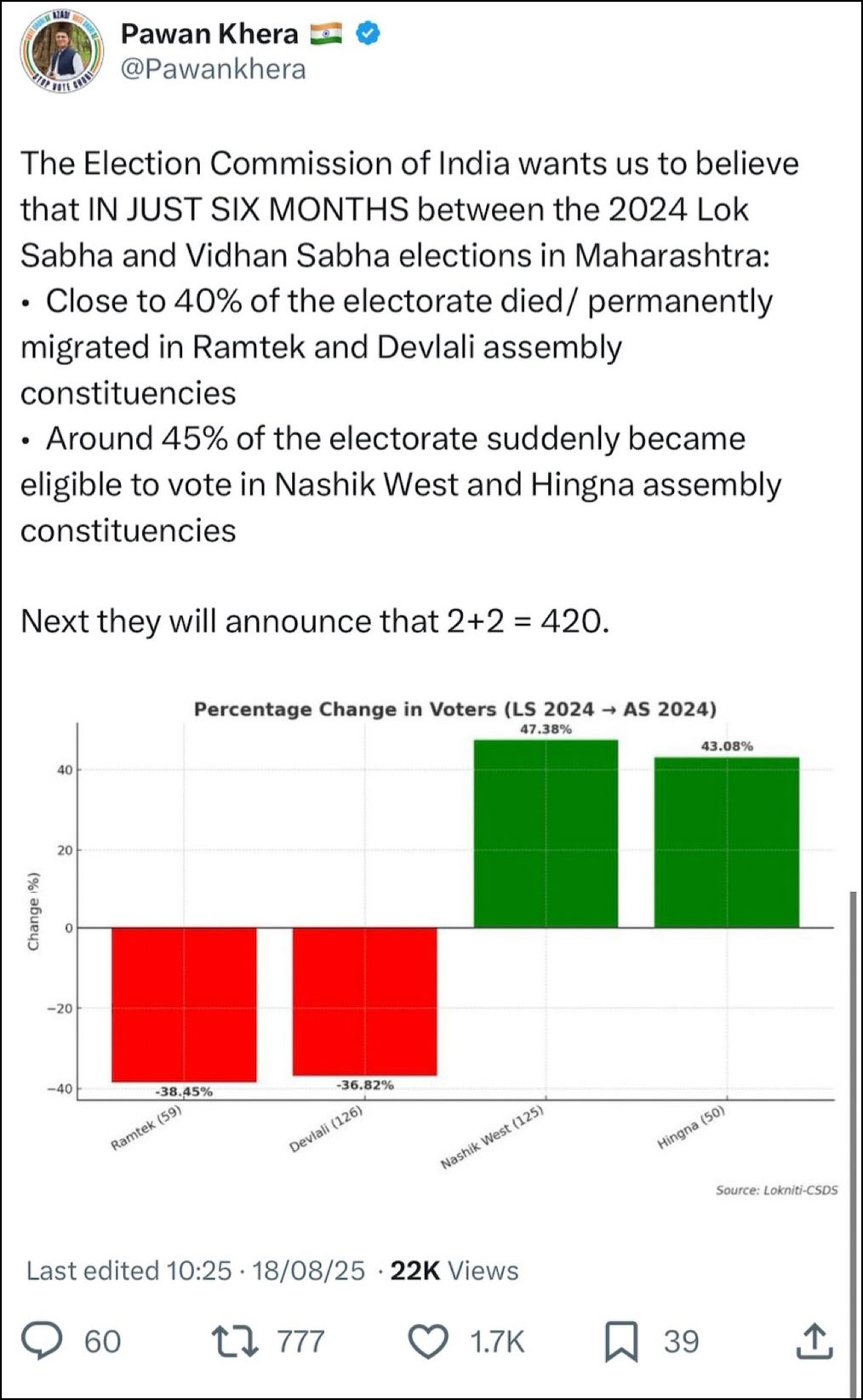
On 18th August, Congress spokesperson Pawan Khera posted a graphic on X to question the Election Commission of India. In his post, he claimed that within six months between the 2024 Lok Sabha and the Maharashtra Assembly polls, around 40% of the electorate were deleted from Ramtek and Deolali constituencies. On the other hand, Nashik West and Hingna gained around 45% of the electorate. Taking a jibe at the Election Commission, he wrote, “Next they will announce that 2 plus 2 equals 420.” The source of the data was Lokniti-CSDS.
Now-deleted post by Congress spokesperson Pawan Khera. Source: X
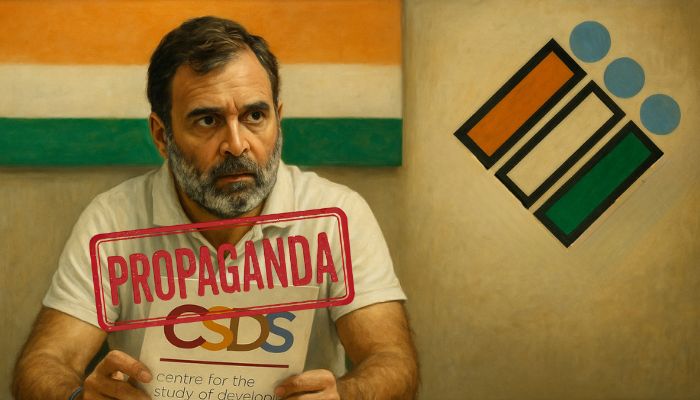
Notably, his post was based on the figures first pushed by Sanjay Kumar of the Centre for the Study of Developing Societies (CSDS) who, on 17th August, posted the figures raising doubts on the working of the Election Commission of India. However, within 48 hours, the claims by both Sanjay Kumar and Congress leaders who shared the data collapsed like a house of cards.
What Sanjay Kumar had said before deleting the post
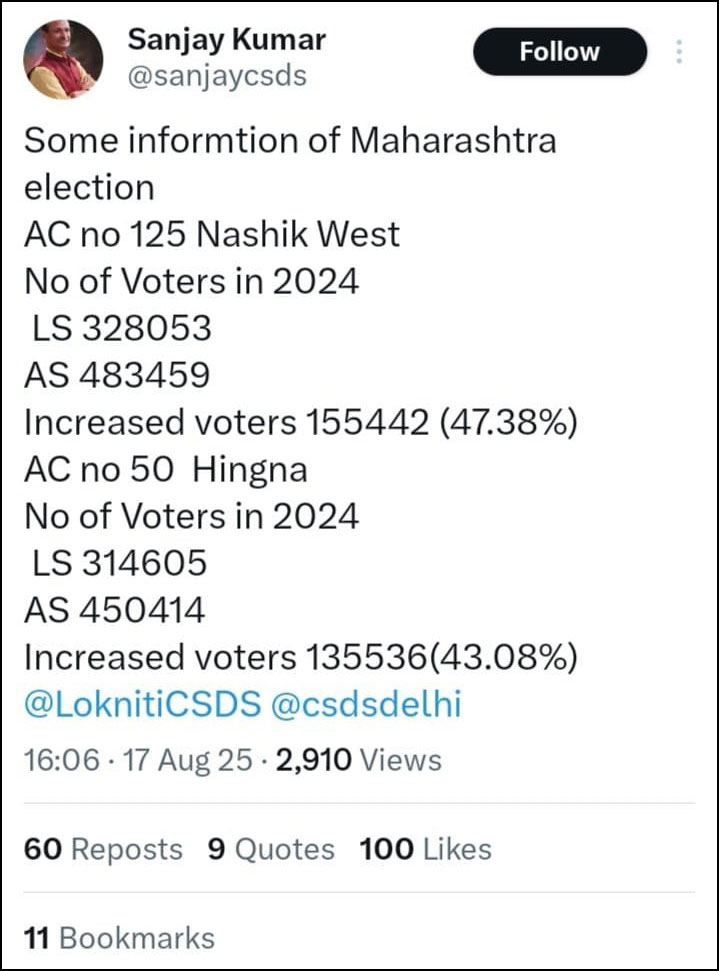
In his now-deleted post on social media platform X, Kumar spotlighted two seats as examples of abnormal surges. He claimed that for Nashik West, the Lok Sabha roll was 3,28,053 and the Assembly roll was 4,83,459, which he presented as an increase of 1,55,442 and 47.38 per cent.
Now-deleted post by Sanjay Kumar of CSDS. Source: X
Similarly, for Hingna, he claimed that the Lok Sabha roll was 3,14,605 and the Assembly roll was 4,50,414, an increase he put at 1,35,536 and 43.08 per cent.
The framing of the post suggested that the Assembly electorate had swelled beyond plausible bounds within a few months. His figures were then amplified not only by Congress and other opposition party supporters but also by Congress leaders like Pawan Khera himself to question the Election Commission’s credibility.
The apology from Sanjay Kumar
Within 48 hours, on 19th August, Sanjay Kumar took a U-turn and issued a public apology on X. He accepted that the numbers in his earlier post were incorrect. He said the error occurred because his “data team misread rows” while comparing the 2024 Lok Sabha and 2024 Assembly datasets.
I sincerely apologize for the tweets posted regarding Maharashtra elections. Error occurred while comparing data of 2024 LS and 2024 AS. The data in row was misread by our Data team. The tweet has since been removed. I had no intention of dispersing any form of misinformation.
He further informed in the post that the previous social media post was deleted and said there was “no intent to spread misinformation”. However, the misinformation is already out and there is a possibility that it will be used for months to come for propaganda forwards on WhatsApp and social media posts without much chance of scrutiny.
What the official data shows and why he had to apologise
His claims fell apart after he was fact-checked by several social media users. Data verified by OpIndia confirmed that Sanjay Kumar’s numbers were inflated beyond doubt.
For example, in Nashik West, Lok Sabha electorate numbers were at 4,56,319 compared to the number of electorates in Maharashtra Assembly elections which were at 4,83,719. The increase is 27,400, which is about six per cent. There is no jump of 1.5 lakh as claimed by Sanjay.
Similarly, in Hingna for Lok Sabha, the number stood at 4,24,454 and for Assembly elections, the number stood at 4,50,439. The increase is 25,298, which is far below the 43.08 per cent claimed in the viral post.
In the case of Ramtek, for Lok Sabha the number of the electorate was 2,76,827 compared to Assembly elections which stood at 2,87,301. The increase is 10,474, which is about 3.8 per cent. The chart Khera shared showed a collapse of nearly forty per cent. The official record shows a small rise.
Similarly, in the case of Deolali, for Lok Sabha, the numbers stood at 2,77,600, and for Assembly elections, it was 2,88,816. The increase is 11,216. The claim of a massive fall is false.
These four entries are enough to establish the point. The sensational percentages that travelled through politics and media were not drawn from constituency abstracts. They came from a spreadsheet that was “misread” by the “data team” of CSDS. A simple double check would have stopped the error at source.
There is a basic rule that any serious analyst must follow before publishing comparisons, that is, double check the numbers. In fact triple check, and check them again to ensure there are no mistakes. Lok Sabha and Assembly rolls are prepared for different electoral events and are revised on different schedules. If one still chooses to compare, one must match the same Assembly segment across both cycles, cite the certified counts, and explain the additions and deletions. Nothing like that was done by Sanjay Kumar’s team, which shows a lack of any groundwork. The apology reduced the fiasco to “rows misread”. The facts show that fundamental verification was missing.
BJP hits back at CSDS
The controversy around Sanjay Kumar’s misleading voter roll claims prompted a sharp counter from the Bharatiya Janata Party (BJP). Its IT Cell chief, Amit Malviya, accused the CSDS of being more than just a research institution and accused it of playing a dangerous game of narrative-building for years.
Malviya pointed to repeated infusions of foreign funds into CSDS from organisations including the Ford Foundation, IDRC Canada, DFID UK, NORAD Norway, the Hewlett Foundation and others. He suggested that these donors are not neutral but carry political agendas. According to Malviya, their interests lie in weakening India’s social fabric by nurturing division, especially within Hindu society.
CSDS and the Dangerous Game of Narrative-Building
The Centre for the Study of Developing Societies (CSDS) has long positioned itself as a research institution, but a closer look at its funding sources, survey designs, and outputs reveals a troubling pattern.
He argued that the Lokniti-CSDS programme has consistently projected Hindu society through the prism of caste. On the other hand, Muslims have been presented as a monolithic bloc. CSDS has carefully avoided their own internal stratifications such as Ashraf, Ajlaf, Arzal, and others. The result, he said, is an artificial reinforcement of caste division among Hindus, giving Congress and sympathetic media convenient points every election cycle.
The very institution whose data Rahul Gandhi leaned on to defame the voters of Maharashtra has now admitted that its figures were wrong — not just on Maharashtra, but even on SIR.
Where does this leave Rahul Gandhi and the Congress, which brazenly targeted the Election… pic.twitter.com/4o99YDvsMx
He also pointed out that CSDS surveys lack scientific rigour, with caste identities often guessed rather than systematically recorded, and yet newspapers of record like The Hindu and The Indian Express give their findings legitimacy. The institution, in his words, is not producing scholarship but playing strategy, manufacturing divisions and presenting them as research.
In his framing, CSDS’s errors are not innocent mistakes like “rows misread” but deliberate agenda-driven settings gone awry. He further asserted that these agendas are designed to reinforce narratives favourable to the Congress while undermining public faith in institutions like the Election Commission.
Conclusion
Pawan Khera and other Congress supporters used Sanjay Kumar’s claims to attack the Election Commission. Within 48 hours of the initial post by Sanjay Kumar, an apology came and the post was deleted. He admitted the mistake. However, Pawan Khera did not apologise. He simply deleted the post.
This must be seen as a cautionary tale. When a researcher with institutional authority publishes unverified numbers, political actors will weaponise them at once. By the time the correction arrives, the false narrative has already done its work. The responsibility therefore lies first with the source. If you plan to allege dramatic swings in electorates, you must show your tables, cite Form 20, and present the arithmetic clearly. None of this happened in this case. The result, a needless dent in public trust and a readymade talking point handed to the propagandists.
In an interesting incident, some Chennai Corporation officials resolved a problem of exposed power cables on a road in Chennai using Artificial Intelligence tools. Yes, you read that right!
According to The Times of India, an individual posted on X last week raising the problem of exposed power cables on Sunnambur Kolathul Road in Chennai, which was frequently used by people, including school-going children. The person tagged the Greater Chennai Corporation (GCC) in the post to draw their attention to the problem and urged them to take action.
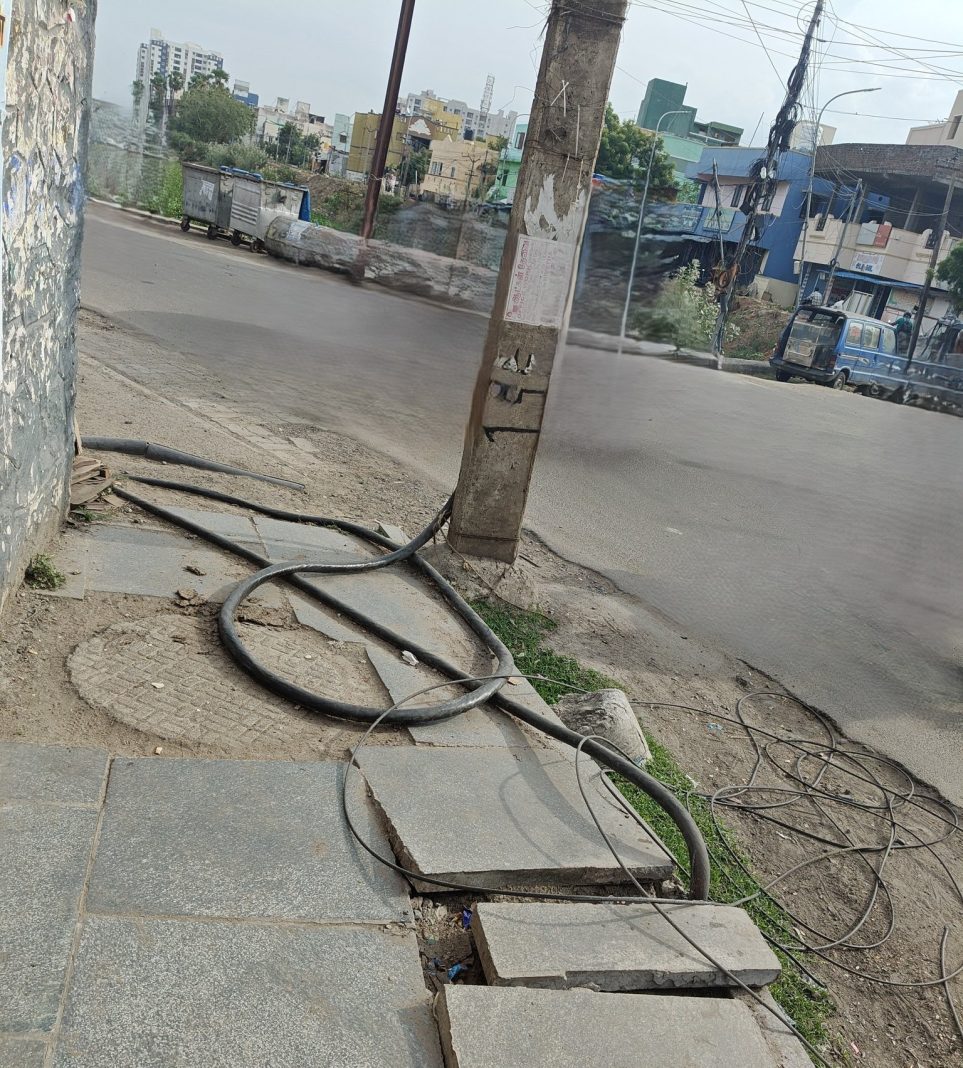
“Outside DAV school Pallikaranai, the walking platform is not in a good state and also has a lot of EB wires. A lot of children are using this platform to walk daily. Please take necessary action before any mishap happens @chennaicorp @Tambaram_Corp @TANGEDCO_Offcl @jvidyasagar,” wrote an X user named Kanna Palani on 13th August.
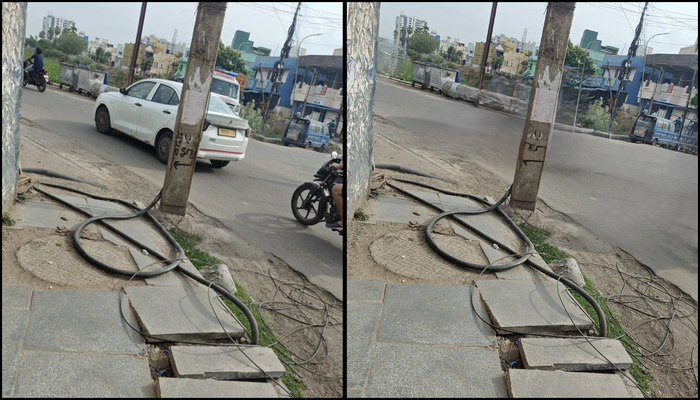
In a swift response to the complaint, the Assistant Executive Engineer (AEE) of the corporation uploaded an image on the GCC website to show that the complaint had been resolved. Interestingly, the image uploaded by the AEE was the same as the one uploaded by the X user, except that it was modified using an AI tool. The original image posted by the complainant was modified using artificial intelligence to claim that the grievance had been resolved.
Image uploaded on the GCC website (via erp.chennaicorporation.gov.in)
However, leaving aside actually resolving the problem, even the AI editing was so shoddily done that instead of removing the exposed power cables, which were the subject of the complaint, a car and other vehicles in the background were erased using a widely available AI tool.
Apparently, the official did not bother removing the shadows of the vehicles erased using the AI tool, resulting in blurred and distorted parts being visible in the background. Even a plain look at the image makes it clear that some kind of AI tool has been used to alter it.
The complainant reportedly expressed disappointment with the closure of the complaint by the GCC without redressal. As per TOI, originally, GCC had the option of escalating complaints, which were closed, to the regional deputy commissioners. But this option is not available on the portal for residents.
Notably, the concerned AEE Perungudi zone, Manoharan, denied modifying the image using AI. “It’s a highways road in the GCC zone. I forwarded it to the highways department. I did not use AI. GCC will remove the cables on its own,” the AEE was quoted as saying by the TOI. Perungudi zonal chairman SV Ravichandran clarified that the government was serious about grievance redressal and that any isolated incidents like the present one would be taken seriously. He assured that the erring officials would be punished.
On the contrary, Jayaram Venkatesan, a convenor of an NGO named Arappor Iyakkam, said that this is not the first time that the GCC has closed a complaint in this manner.
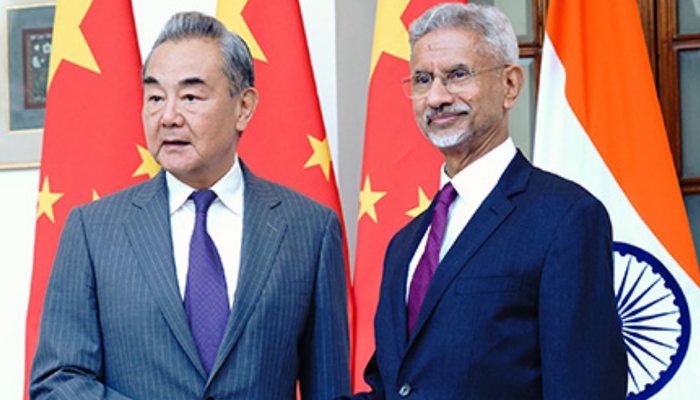
After a prolonged period of hostilities, India and China have renewed efforts to improve their bilateral relations as both countries face punitive US tariffs. To ease tensions ahead of the Shanghai Cooperation Organisation (SCO) Summit to be held in Tianjin, China, between August 31 and September 1, 2025, External Affairs Minister S. Jaishankar and Chinese Foreign Minister Wang Yi met in Delhi on Monday (18th August). In a move to repair diplomatic ties, the two leaders addressed several issues, including trade, borders, and terrorism, during their meeting.
In his opening remarks, EAM Jaishankar welcomed the two nations’ efforts to improve bilateral relations. He emphasised that differences between the two countries should not become disputes and that the relations between the two countries should be founded on mutual respect.
“Having seen a difficult period in our relationship, our two nations now seek to move ahead. This requires a candid and constructive approach from both sides. In that endeavour, we must be guided by the three mutuals – mutual respect, mutual sensitivity and mutual interest. Differences must not become disputes nor competition, conflict…” Indian Foreign Minister Jaishankar remarked during the meeting in Hyderabad House.
#WATCH | Delhi: In his meeting with Chinese Foreign Minister Wang Yi, EAM Dr S Jaishankar says, "Having seen a difficult period in our relationship, our two nations now seek to move ahead. This requires a candid and constructive approach from both sides. In that endeavour, we… pic.twitter.com/LOmJNjSrVq
Chinese Foreign Minister Wang Yi, in his remarks during the meeting, underscored the Chinese efforts to maintain peace between the two countries by maintaining peace at the border and opening the route for the Kailash Mansarovar yatra. “We maintained peace and tranquillity in the border areas and resumed the Indian pilgrimage to Mount Kailash and Kailash Manasarovar in the Tibet Autonomous Region,”said Yi, who arrived on a two-day visit to India at the invitation of NSA Ajit Doval.
“We shared confidence to dispel interference, expand cooperation and to further consolidate the momentum of improvement and development of China-India relations so that while pursuing our respective rejuvenation, we can contribute to each other’s success and provide the most needed certainty to Asia and the world…”, he added. Yi is set to meet PM Modi and NSA Ajit Doval on Tuesday (19th August).
#WATCH | In his meeting with EAM Dr S Jaishankar, Chinese Foreign Minister Wang Yi says, "…We maintained peace and tranquillity in the border areas and resumed the Indian pilgrimage to Mount Kailash and Kailash Manasarovar in the Tibet Autonomous Region. We shared confidence to… pic.twitter.com/rorLRCmTeD
China to address India’s concerns relating to rare earths, fertilisers and boring machines
As per reports, the Chinese Foreign Minister Wang Yi assured EAM Jaishankar that China is addressing India’s three main concerns relating to rare earths, fertilisers and tunnel boring machines. In April this year, China put curbs on the export of seven medium to heavy rare earth elements and several magnets by mandating exporters to obtain licenses citing national security and non-proliferation concerns. The rare earth magnets form a crucial component of electric and petrol vehicles, defence equipment, and clean energy systems.
China promises to address three key concerns of India. Foreign Minister Wang Yi assured EAM that China is addressing India’s needs of fertilisers, rare earths and tunnel boring machines: Sources https://t.co/liCzB57nz2
In addition to that, the delivery of three giant Tunnel Boring Machines (TBMs), needed for the construction of underground section of Mumbai-Ahmedabad high-speed bullet train corridor was halted after the Chinese authorities did not provide clearance without citing any reason. The TBMs were manufactured in Guangzhou by the German tunnelling firm Herrenknecht, two of which were to be transported to India by October 2024 and the third earlier this year. The machines are vital to excavate a 21-km-long underground part of the high-speed rail corridor, from Bandra-Kurla Complex (BKC) to Shilphata.
US-tariffs push India-China closer
During the discussion, EAM Jaishankar drew Yi’s attention to the situation at the Line of Actual Control (LAC) following the Galwan Valley standoff in April-May 2020 and called for de-escalation at the border. “The basis for any positive momentum in our ties is the ability to jointly maintain peace and tranquillity in the border areas. It is also essential that the de-escalation process move forward,” Jaishankar said.
The India-China relations took a downward turn following violent clashes, which started in April-May 2020, between the Chinese and the Indian soldiers in Eastern Ladakh’s Galwan Valley. At least 20 Indian soldiers, including the Commanding Officer, had attained martyrdom in the clashes. The Chinese casualties, as estimated by the Indian government, stood at 43-45.
However, faced with fresh geopolitical challenges posed by the Russia-Ukraine War and the US tariffs, the two countries have revived attempts to improve their bilateral ties and ensure regional stability.
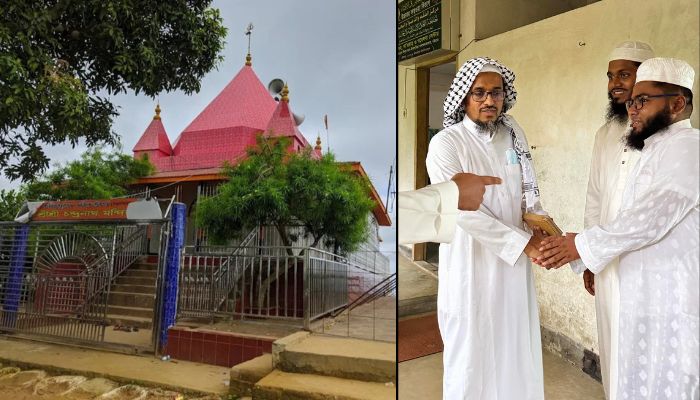
The Chandranath temple, which is located in Sitakunda in the Chittagong district of Bangladesh, is yet again faced with imminent threat of encroachment and desecration.
Islamists are re-classifying the Hindu pilgrimage site of Chandranath Hill as a ‘tourist spot’ with the intention to taking over the sacred land and building mosques and prayer halls for ‘Muslim tourists.’
For the unversed, the Chandranath Hill houses one of the 51 Shakti Peethas. The Chandranath temple, dedicated to Lord Shiva, was built in the 8th century by Hindu ruler Chandrasena.
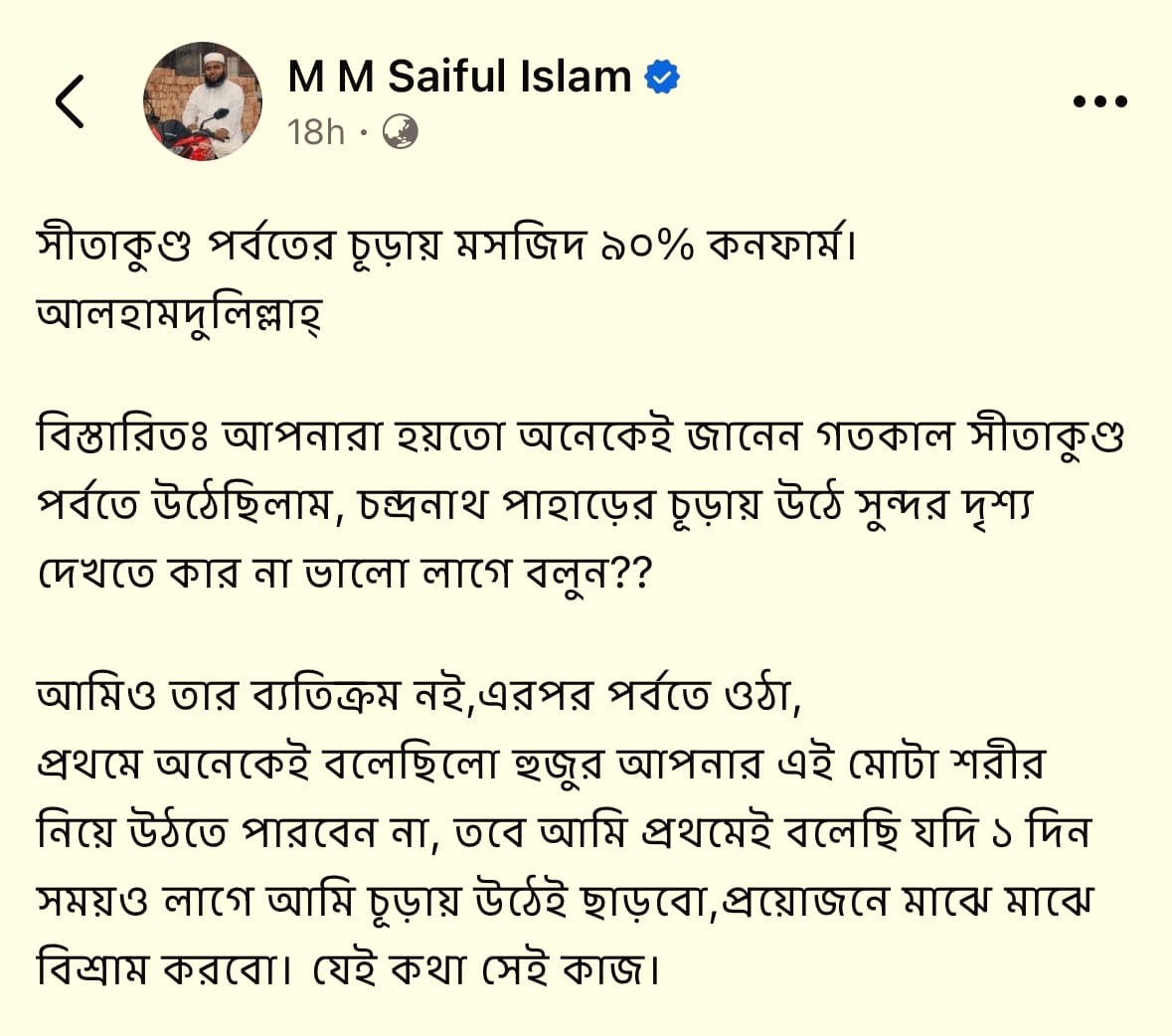
Screengrab of the tweet by M M Saiful Islam
While a well-coordinated effort is underway to encroach upon Chandranath Hill since atleast December 2023, a renewed campaign was launched by one M M Saiful Islam on Saturday (16th August).
Saiful is a radical Islamic preacher and Chairman of ‘SKM Shoe Shop’. In a Facebook post on Saturday, he declared, “The construction of a masjid on top of Chandranath Hill is 90% confirmed. Alhamdulillah“
Saiful lamented that he was not allowed to offer ‘Namaz’ after he climbed to the top of the sacred Hindu land.
“In a country with 93% Muslim population, there can be two temples on the Chandranath Hill but not a single mosque. We, Muslims are being treated like tenants and are not even allowed to pray,” he said in his post.
Screengrab of the post by M M Saiful Islam
M M Saiful Islam then met a Deobandi extremist by the name of Harun Izhar, who has previously been associated with Hefazat-e-Islam Bangladesh.
“Discussions are underway to build a mosque atop Sitakunda Hill…I seek the prayers of everyone to make this happen. Share this post to ensure that everyone knows about it and can pray to make our mission successful,” he said in another Facebook post.
Saiful took a pledge to build a mosque on Hindu land under any circumstances. The radical Islamic preacher declared, “I want to say this clearly. Since you did not allow me and my friend to offer Namaz, today or tomorrow, I will make sure that there is a dedicated space for Namaz on Sitakunda Hill. Inshallah.“
Screengrab of the post by M M Saiful Islam
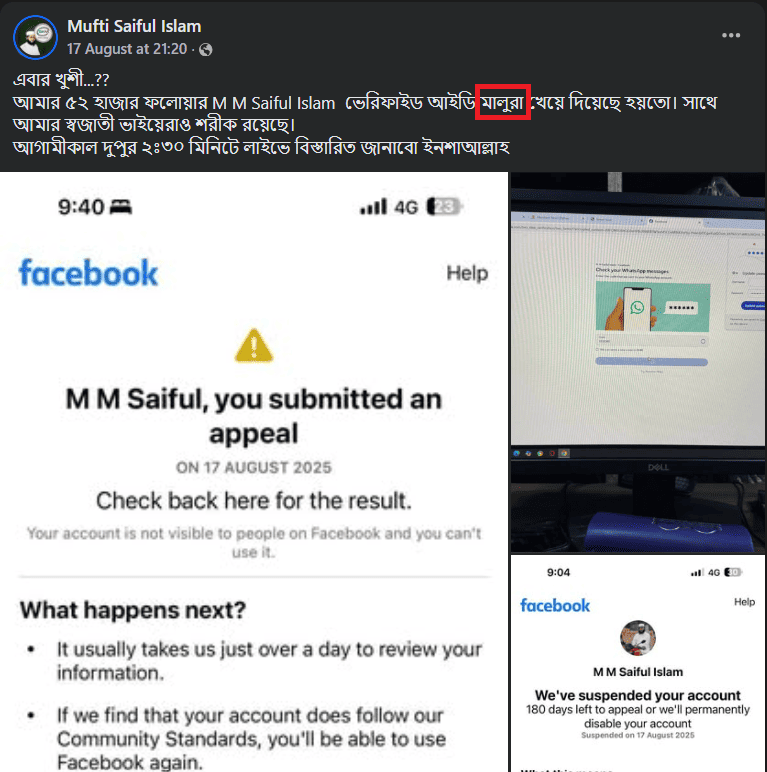
After his hate filled posts targeted at the Hindu community went viral on Facebook, the social media platform suspended his account. M M Saiful Islam had 52000 followers at the time of his account’s suspension.
On Sunday (17th August), he confirmed the development via his another Facebook account ‘Mufit Saiful Islam’ and went on to dehumanise the Hindu community as ‘malu/ malaun.’
Since November 2024, Islamists in Bangladesh have been running a campaign called ‘TMD’ (Total Malaun Death) wherein they are advocating the eradication of Sanatan Dharma followers from the country.
In July this year, an extremist named Mohammed Abir brutally murdered a Hindu trader named Bhajan Kumar Guha and described the victim as ‘malaun’ to justify his heinous crime.
Screengrab of the Facebook post
Deobandi extremist Harun Izhar later issued a clarification in an attempt to justify his resolve to construct a mosque on a Hindu land.
He dubbed the Chandranath Hill as ‘so-called Hindu pilgrimage centre’, thereby insinuating that the status of the land is somehow disputed.
Izhar, who was previously arrested in 2021, claimed that the plan is not to build a mosque near Hindu temples but adjoining areas where Muslims go as ‘tourists.’
He said that it was within his right as a Muslim to advocate for construction of mosques and prayer sites on ‘unclaimed lands.’
The Deobandi extremist then alleged that he had helped free Hindus lands in Chittagong from encroachment to lend credence to his claim that the mosque construction is not aimed to occupy Chandranath Hill.
He further claimed that the entire controversy is a cxonspiracy of political masters of the Hindu community and ‘communal forces’ in India.
It must be mentioned that Harun Izhar is wanted in 11 cases including grenade attack in Lalkhan Bazar Madrasha, which was carried out Hefazat-e-Islam Bangladesh in 2013.
Islamists have been eyeing to capture Chandranath Hill since atleast 2023
Despite being a sacred pilgrimage destination, the Chandranath Hill has been transformed into a trekking spot by the Muslim community in the past couple of years.
In December 2023, an Islamist named Raihan Riad organised a ‘Beef Barbecue party’ at the Hindu pilgrimage destination. Several other Islamists expressed their support for desecrating the sacred Chandranath Hill.
Thereafter, the local Hindu community in Sitakunda went to the Hindu shrine and distributed pamphlets calling for the protection of the Chandranath Temple and thwarting attempts to defile the pilgrimage destination.
Bangladeshi extremists r chanting Allahu Akbar at the Hindu pilgrimage site Chandranath Temple.The Temple is famous among Hindus as Shakti Peeth.But the Jihadists r trying to build a mosque by occupying the land.We sought help from the Indian Embassy but got no response.@ihcdhakapic.twitter.com/GftvirEfsY
In a video posted on YouTube, human rights activist and exiled Bangladeshi blogger Asad Noor informed that Islamists assaulted the Hindus.
He stated that the local Muslims threatened to shove the Hindu deities in the posterior of the worshippers.
When Hindus protested against it, they were attacked by the same cabal of Islamists who were armed with sharp weapons. As per reports, a total of 10 Hindus were seriously injured during the attack.
Facebook post of Mohammed Shibbir bin Nazir, image via ‘Struggle for Hindu Existence’
In the meantime, pictures and videos of Islamists giving ‘call to prayer’ (Azaan) on the Hindu pilgrimage site had also surfaced on social media. One extremist by the name of ‘Tigers Tamim’ was seen putting his feet up on the temple walls.
In a Facebook post, one Islamist named Mohammed Shibbir Bin Nazir was seen boasting about giving Azaan on Chandranath Hill. “Inshallah, the flag of Islam will fly here soon,” he had announced.
Another extremist Innamul Haq responded to his post, “I have been to that place twice and felt the absence of a masjid at that site (Chandranath Hill). Shirk (idolatry) is still going on in that mountain.”
They want to occupy the site of Chandranath Temple and build Babri Masjid there. All of them are students of the Hathazari Madrasa, famous for producing Wahhabi Terrorist . pic.twitter.com/0V15XIyhiH
In February 2024, several videos came to light where scores of Muslim men, wearing skull caps, were seen roaming around the Chandranath Temple in Sitakunda and raising Islamic slogans at the Hindu pilgrimage site.
While speaking about the matter to Swarajya, an official of Bangladesh Hindu Buddhist Christian Unity Council said, “Since April 2023, a few clerics started organising namaz near the mandir every Friday and we have heard there are plans to build a masjid on the hill. A false narrative is also being spread that there was a mosque atop the hill and that it was demolished by Hindus to build a mandir.”
Last year, a poster calling upon the Hindu society to preserve the Chandranath temple went viral on social media. ‘Sabdhan, Rahur kobole Chandranath Dham,” it read.
Poster in Bengali pleading Hindus to preserve Chandranath Temple from ‘Rahu’
The Chandranath Temple in Chittagong is significant for the Hindu community. It follows the Nagara architectural style, which is seen in many Hindu temples across the Indian subcontinent.
This style is characterised by a curvilinear tower (shikhara) with multiple tiers, topped by an amalaka (a circular disk-like structure) and a kalasha (a finial).
Conspiracy theories such as the Chandranath temple was built by pulling down a mosque are being peddled to justify illegal takeover of the Hindu land.
It is now crystal clear that Islamists have taken up the cause of encoraching Chandranath Hill and build a mosque atop it on a mission-mode. With appeasement from the Muhammad Yunus regime, their nefarious campaign is likely to intensify in the coming days.
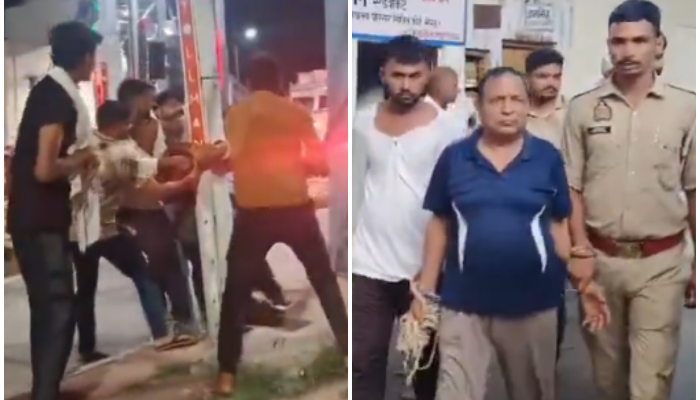
On 17th August, a 26-year-old Army personnel named Kapil Kavad who is with the Rajput Regiment was assaulted at a toll booth in Uttar Pradesh’s Meerut. A video showing the toll booth employees attacking the soldier went viral online, leading to the arrest of six accused.
Furthermore, a case has been submitted against more than 8 persons including main accused Bittu. The cops are now seraching for the others. The shocking instance transpired at Bhuni Toll Plaza on Meerut-Karnal section of NH (National Highway)-709A.
#मेरठ के भूनी टोल प्लाजा पर भारतीय सेवा के जवान को पीटने वाले 6 आरोपी पुलिस में गिरफ्तार किए हैं
8 से अधिक आरोपियों के खिलाफ मुकदमा दर्ज हुआ है जिसमें बिट्टू नाम का एक आरोपी नामजद है. केस में बिट्टू मुख्यारोपी है
National Highway Authority of India (NHAI) have also taken strict action in the matter. “NHAI has imposed a penalty of Rs 20 lakhs on the toll collecting agency, M/s Dharam Singh and has initiated the process of terminating & debarring the toll collection firm from future participation in toll plaza bids. NHAI strongly condemns such behaviour by the toll plaza staff and is committed to ensuring safe and seamless travel on National Highways.”
NHAI has taken strict action on the incident of misbehaviour with army personnel by toll staff deployed at Bhuni Toll Plaza on Meerut-Karnal section of NH-709A on 17th August 2025. NHAI has imposed a penalty of Rs. 20 lakhs on the toll collecting agency, M/s Dharam Singh and has… pic.twitter.com/wpL2rN6Lug
The incident happened in the Sarurpur area at the Bhuni toll plaza. Kapil is from the nearby village of Gotka. He was on vacation at home and was on his way to the Delhi airport to catch a flight to his post in Srinagar.
What happened
Kapil was stranded at the packed Bhuni toll booth with his cousin (or brother) Devendra. The former stepped out of the car and began talking to the toll booth workers, worried that he would be late for his trip. A dispute erupted when he requested them to allow him to pass because he had to catch a flight from Delhi to Srinagar at 5am and even showed them his ID as well.
However, the staff started an argument after which Bittu (32), the security supervisor at the toll plaza and a resident of Sardhana’s Chhur village, arrived shortly there and began abusing Kapil. Afterward, they started to attack him and he sustained nose injury. Devendra was also beaten as he tried to save his cousin.
The culprits were seen using a stick to assault Kapil in the footage. As one of the them hurled insults and thrashed him, the othes pinned him to a post and pulled his hands back.
उत्तर प्रदेश – मेरठ में टोल प्लाजा कर्मचारियों ने इंडियन आर्मी के जवान कपिल को खंभे से बांधकर बर्बरता से पीटा। स्टाफ ने टोल मांगा तो कपिल ने I-card दिखाया। फिर भी टोलकर्मी नहीं माने। जिसके बाद विवाद बढ़ता गया। pic.twitter.com/RE7HqOepgw
“Kapil is in the Indian Army. He was returning to his post. There was a long queue at the Bhuni toll booth. He was in a hurry and he spoke to the toll booth staff. An argument began and the toll booth staff assaulted him. Following a complaint from his family, a case was registered at Sarurpur police station,” Superintendent of Police (Rural), Rakesh Kumar Mishra informed.
According to him, attempts are on to track down the other perpetrators in addition to the six who were arrested based on CCTV evidence. Ten to fifteen villagers hurried to the scene when the injured Kapil contacted his family and started a demonstration. The commotion persisted until law enforcement arrived and subdued the gathering.
After the footage went viral on social media, the event infuriated the residents who stormed the toll booth and damaged property, resulting in tensions in the area.
Independent India’s first Prime Minister Jawaharlal Nehru will be remembered forever, among other things, for the countless blunders he made during his tenure. His blunders continue to harm and haunt India to this day. One such blunder was the signing of the Indus Waters Treaty in 1960.
As Prime Minister Narendra Modi said in his Indepenedence Day speech from the ramparts of the Red Fort, the now-scrapped Indus Waters Treaty signed between India and Pakistan, was “unjust and one-sided” as it inflicted monumental harm to the Indian farmers while benefitting the Pakistanis. Notably, just five years later, Pakistan waged a war against India, only to lose though.
However, not only the terms of the treaty were unjust, Prime Minister Nehru agreeing to it was against the will of the India and its parliament.
The Indus Waters Treaty was signed in Karachi on 19th September 1960. The issue was then brought up for debate in the Indian parliament on 30th November 1960. With most of the MPs, even those from Congress, against this treaty for its provisions favouring Pakistan in a one-sided manner.
The parliamentary debate on IWT was held a month after its signing. This debate was allotted a two hours time. Yes, for a treaty signed without taking the elected representatives of the country into confidence, the treaty that essentially decided the destiny of Indian farmers, the treaty that decided India’s control or a lack of it on its own waters, mere two hours were allotted for discussion. PM Nehru did not even care to take the parliament or opposition leaders into confidence before relinquishing India’s control over its own precious rivers and signing the Indus Water Treaty which was no less than a second partition.
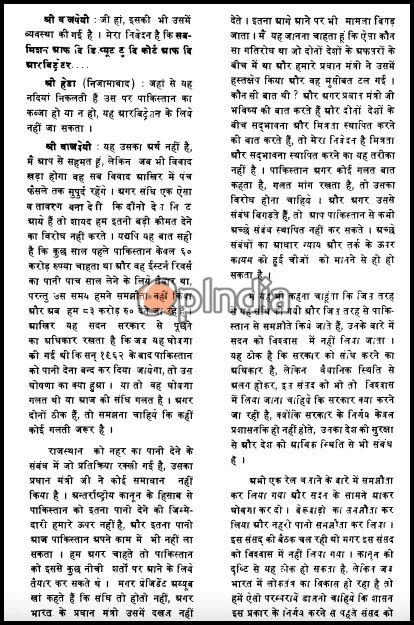
Back then, Atal Vihari Vajpayee, the MP from Balrampur, launched a scathing and unforgettable attack on PM Nehru, calling the Indus Waters Treaty a dangerous concession to Pakistan.
Vajpayee drew attention to the fact that the government had previously declared that water would be cut off to Pakistan by 1962, but was now granting permanent rights. Vajpayee declared, “This treaty is wrong, or that announcement was wrong.”
Vajpayee cited Pakistani President Ayub Khan as saying that India had agreed to share river control: Vajpayee cautioned, “Joint control comprehends joint possession. When such agreements are made, Parliament is not taken into confidence,” he stated.
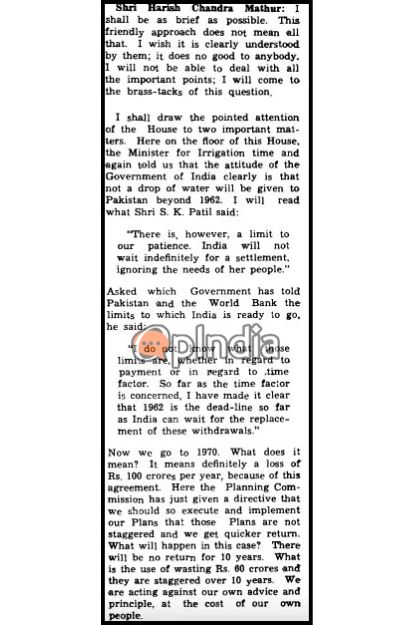
Similarly, Pali MP Harish Chandra Mathur had also fiercely criticised Nehru’s blunder calling the Indus Waters Treaty was “all to the disadvantage of this country.”
“…unfortunately, the facts of the case as they are before us give us an inevitable feeling that this treaty is all to the disadvantage of this country. It is all to the advantage of Pakistan. I shall convey through you (speaker) to the Government that the general feeling, at least in my part of the country, particularly in Rajasthan, is that Rajasthan has been very badly let down in this treaty. Not only that. I think I am quite right when I say that this is the general feeling all over the country. If you were to look at the newspaper comments, you will find that when facts of the treaty were made known to this country, all the leading newspapers of this country made adverse comments,” Mathur said.
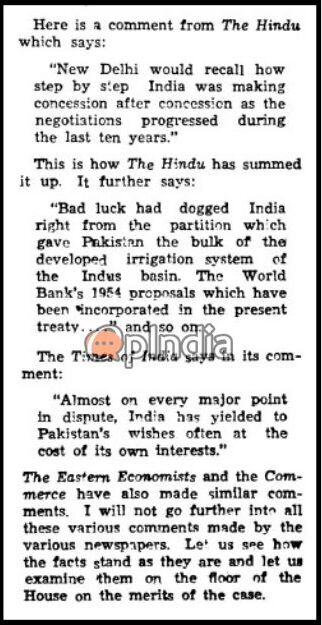
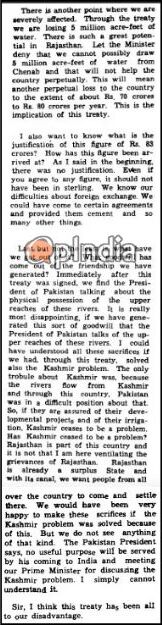
He further read out the headlines of the leading newspapers which aptly captured the unfairness of the Indus Waters Treaty and nation’s anger over the same. He issued a warning that his home state of Rajasthan will suffer ongoing annual losses of Rs 70–80 crore as a result of five million acre-feet of lost water.
“There is another point where we are severely affected. Through the treaty we are losing 5 million acre-feet of water. There is such a great potential in Rajasthan. Let the Minister deny that we cannot possibly draw 5 million acre-feet of water from Chenab and that will not help the country perpetually. This will mean another perpetual loss to the country to the extent of about Rs. 70 crore to Rs. 80 crores per year. This is the implication of this treaty,” Mathur told the Parliament.
MP Mathur went on to say that India had surrendered step by step since 1948, and while Pakistan kept raising its demands, India yielded under pressure.
“I could have understood all these sacrifices if we had, through this treaty, solved also the Kashmir problem. The only trouble about Kashmir was, because the rivers flow from Kashmir and through this country, Pakistan was in a difficult position. So, if they are assured of water, Kashmir should cease to be a problem,” Mathur said, criticising Nehru for not linking the water settlement to the treaty. “Is Kashmir no longer a problem?” he questioned.
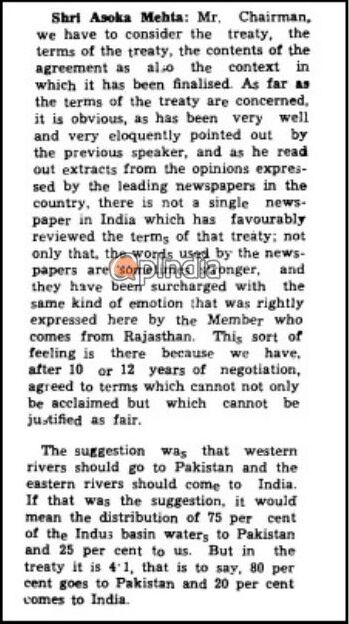
Congress MP Ashok Mehta also sharply criticised Prime Minister Nehru. In his historic speech in the parliament, Ashok Mehta equated the World Bank-mediated Indus Waters Treaty to India’s “second paritition”.
Calling this treaty a second paritition at that time was significant as the wounds of partition and Pakistan’s betrayal in 1948 were fresh, however, Nehru failed to read through the deceit of Pakistan.
“We are reopening all the wounds of 1947…this is being done again with the signature of our Prime Minister,” Mehta said, adding that after 12 years of talks, India had settled on terms “which cannot be justified as fair”.
Mehta stated that, in contrast to the previous 75:25 proposal, the treaty handed Pakistan 80% of the waters and India only 20%.
“Now we are faced with this new problem that the Kashmir dispute, instead of getting settled, instead of the solution of the canal waters problem leading us, helping Us towards the easing of the tentions in that area, have really aggravated the situation,” he said and also expressed surprise over the absence of PM Nehru in the parliament.
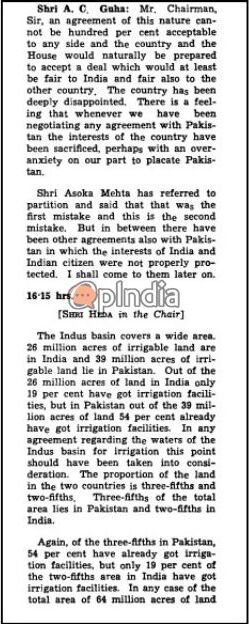
Meanwhile, MP AC Guha also highlighted the economic aspects of the historical mistake Nehru travelled all the way to Karachi to make. Guha said that India had 26 million acres in the Indus basin, however, only 19% irrigated, while Pakistan’s 39 million acres were 54% irrigated.
“By land share, India should have received 40% of waters. Instead, it got only 20%. Pakistan received Rs 400+ crore in grants, India just Rs 27 crore in loans,” Guha said. He added that “the more regrettable thing is that waters which India would need badly would be allowed to flow into the sea unutilised and yet we shall be denied the opportunity of developing our own land with that water,” the Congress MP said.
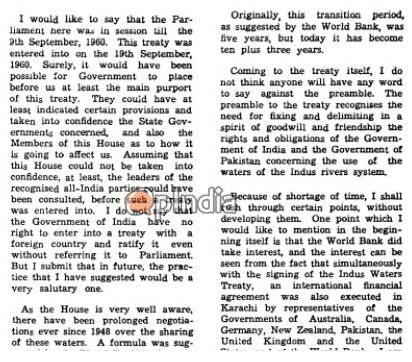
K.T.K. Tangamani, the Communist party MP, raised question over why the parliament was not run till 9th September 1960 so that the MPs could be taken into confidence as the treaty was signed on 19th September.
“I would like to say that the Parliament here was in session till the 9th September, 1960. This treaty was entered into on the 19th September, 1960. Surely, it would have been possible for Government to place before us at least the main purport of this treaty. They could have at least indicated certain provisions and taken into confidence the State Goverrunents concerned, and also the Members of this House as to how it is going to affect us. Assuming that this House could not be taken into confidence, at least, the leaders of the recognised all-India parties could have been consulted, before such a treaty was entered into. I do not say that the Government of India have no right to enter into a treaty with a foreign country and ratify it even without referring it to Parliament. But I submit that in future, the practice that I have suggested would be a very salutary one,” he said.
Jawaharlal Nehru’s unconvincing and nonchalant defence of the Indus Waters Treaty
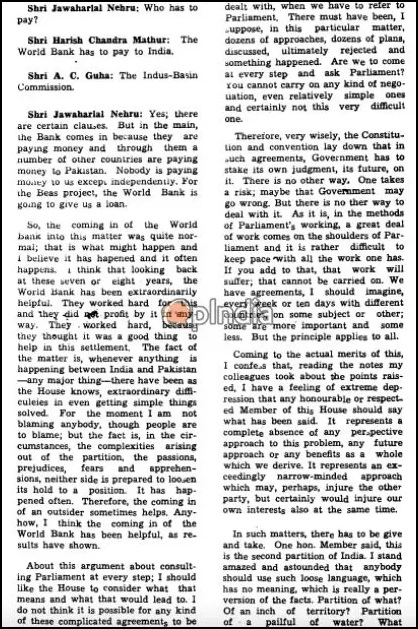
At last, Prime Minister Nehru rose to address the parliament. Nehru, though sounded depressed, yet was resolute in calling the Indus Waters Treaty a “good treaty for India”.
Nehru defended his decision of not consulting the parliament or taking the MPs into confidence before signing the Indus Waters Treaty, let alone expressing any remorse over the blunder that he made. He essentially said that he does not need to take parliament’s permission before signing such complicated agreements.
“About this argument about consulting Parliament at every step; I should like the House to consider what that means and what that would lead to. I do not think it is possible for any kind of these complicated agreements to be dealt with, when we have to refer to Parliament. There must have been, I suppose, in this particular matter, dozens of approaches, dozens of plans, discussed, ultimately rejected and something happened. Are we to come at every step and ask Parliament?” Nehru asked.
He dismissed the “second partition” argument made by the MPs and called it “loose, meaningless language”. PM Nehru went on to ask a audacious question “Partition of what? A pailful of water?”
“Coming to the actual merits of this, I confess that, reading the notes my colleagues took about the points raised, I have a feeling of extreme depression that any honourable or respected Member of this House should say what has been said. It represents a complete absence of any perspective approach to this problem, any future approach Or any benefits as a whole which we derive. It represents an exceedingly narrow-minded approach which may, perhaps, injure the other party, but certainly would injure our own interests also at the same time. In such matters, there has to be give and take,” Nehru said,
“One honourable Member said, this is the second partition of India. I stand amazed and astounded that anybody should Use such loose language, which has no meaning, which is really a perversion of the facts. Partition of what? Of an inch of territory? Partition of a pailful of water?” he continued.
As if these outrageous remarks were not enough, PM Nehru went on to defend the Rs 80 crore per year payments to Pakistan.
“We have given a crore or two more or some money more. You may say that we have allowed them water for another two or three years, which we should not have allowed. Those are presumably the two main things. How, I should like to know, is this House now to judge of the quantum of supply of water or the quantum of money to be given. I confess I cannot judge it off hand. Of course, I can say that Rs. 70 crores is less than Rs. 80 crores. That is a question of arithmetic and one could say: If I could give Rs. 70 crores why should I give Rs. 80 crores, whatever the figure might be. But about the relative rightness of the figure, nobody can say. When you deal in this matter it is a balance struck after a hundred factors are taken into consideration; it is a balance struck after ten year of long and bitter argument. Something is done because it is considered, in the balance, that is desirable,” Nehru said.
PM Nehru claimed to have purchased peace, and even boasted that Pakistan had initially demanded Rs 300 crore, however, India had settled for Rs 83 crore. Basically, giving in to Pakistan’s demands and intransigence at a lesser cost was described as an achievement by PM Nehru.
Source: World Bank
Notably, India paid $174 million ($1.6 billion today) to Pakistan even before the treaty was signed.
The debate ended with no significant result as no voting took place and the treaty was already signed. Nehru left the parliament to meet Japan’s Crown Prince who was on a visit to India. The flow of India’s waters was decided in Pakistan’s favour. A parliamentary debate was held weeks after the IWT’s signing, and yet countless questions remained unanswered.
Indus Waters Treaty: What is was and why the Modi government decided to do away with it?
It all started in 1948, when India temporarily cut off the Indus water to Pakistan but reopened it later. Pakistan, however, approached the United Nations (UN) in 1951, alleging that India had cut off water to numerous Pakistani villages. Eventually, the Indus water agreement was prepared in 1954 by the World Bank based on the recommendations of the United Nations. After years of discussions, India and Pakistan agreed on shared ownership of six rivers. Pakistan was the lower riparian state at the time of India’s independence in 1947, since the border between the two countries was defined across the Indus Basin.
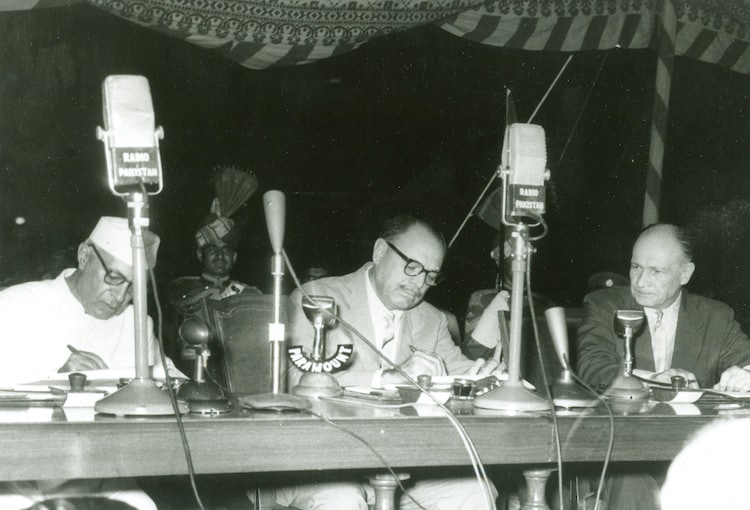
Signed on 19th September 1960 in Karachi, the Indus Water Treaty between India and Pakistan was brokered by the World Bank. This water-sharing agreement governs the use of the Indus River system by India and Pakistan. Signed by Prime Minister Jawaharlal Nehru and Pakistan Field Marshal Ayyub Khan, this treaty allocates the waters of six rivers originating in the Himalayas, broadly divided into two categories: the eastern rivers and the western rivers. The eastern rivers Ravi (origin in Himachal Pradesh), Beas (flows through Himachal Pradesh and Punjab, and Sutlej (originates in Tibet, flows through India into Pakistan) were allocated to India, while Indus, Chenab and Jhelum were allocated to Pakistan.
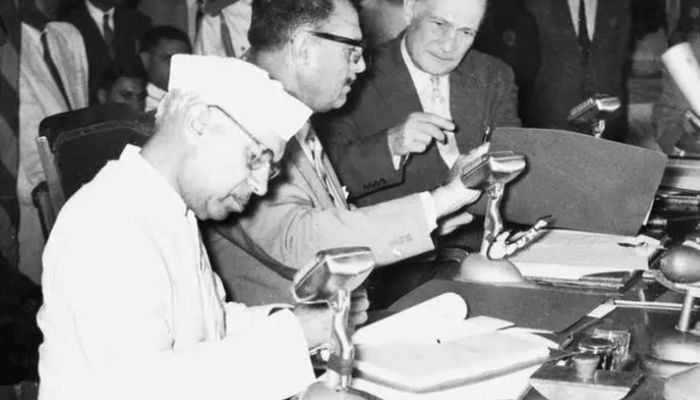
India’s Prime Minister Jawaharlal Nehru and Pakistan’s Field Marshal Ayyub Khan signing the Indus Water Treaty in Karachi in 1960 (Source: TheHindu)
India effectively utilises the waters of eastern rivers for hydropower, irrigation and other purposes. Meanwhile, Indus, Jhelum and Chenab are essential for Pakistan’s hydropower, irrigation and other needs, with Indus being nothing short of Pakistan’s lifeline.
While the signing of IWT was touted as a historic step towards mutual cooperation and peace, this treaty was not essentially balanced; in fact, it actually benefited Pakistan more due to the higher water flow in its assigned rivers, the western rivers.
Notably, under this arrangement, India controls around 20 per cent of the total water flow, which translates into 33 million acre-feet or 41 billion cubic meters annually, and Pakistan gets 80 per cent, which is approximately 135 million acre-feet or 99 billion cubic meters. This agreement allowed limited non-consumptive uses of the western rivers, such as hydropower generation, however, it restricted blocking or dramatically altering water flow into Pakistan.
In addition, the treaty also gave Pakistan the right to object to the designs of Indian hydropower projects on western rivers. Under the IWT, the commissioners of India and Pakistan are supposed to meet once a year, alternatively in India and Pakistan.
“The Government of India and the Government of Pakistan, being equally desirous of attaining the most complete and satisfactory utilisation of the waters of the Indus system of rivers and recognising the need, therefore, of fixing and delimiting, in a spirit of goodwill and friendship, the rights and obligations of each in relation to the other concerning the use of these waters and of making provision for the settlement, in a cooperative spirit, of all such questions as may hereafter arise in regard to the interpretation or application of the provisions agreed upon herein, have resolved to conclude a Treaty in furtherance of these objectives, and for this purpose have named as their plenipotentiaries…” the Preamble of the Indus Water Treaty reads.
Call it humanitarian grounds or lack of political will, in the last 60 years, India never considered scrapping the Indus Waters Treaty, silently suffered the injustice this treaty did to lakhs of Indians, even as Pakistan continued to inflict one wound after the other on Bharat. From violating the 1972 Shimla Agreement to betraying the 1999 Lahore Declaration, carrying out countless terror attacks on innocent Indian citizens, starting conventional wars only to lose, to attempting to destabilise through proxy wars and cross-border terrorism and internationalise the Kashmir issue while illegally occupying PoJK, Pakistan proved to be a hostile neighbour with its army and governments, regardless of which party is in power.
It took over six decades, the many Islamic jihadist terror attacks sponsored by Pakistan, with the Pahalgam terror attack of April 2025 being the final trigger, and the leadership of Prime Minister Narendra Modi, that the wretched Indus Waters Treaty was relegated to the veritable dustbin it belonged to.
Discontinuing the one-sided ‘Aman ki asha’, the Modi government took a strong stand and decided that blood and water cannot flow together adding that no bilateral talks can be held with Pakistan until it stops sponsoring Jihadi terrorism against India. Pakistani establishment’s support to Islamic terrorism once again in Pahalgam, however, confirms that they are not ready to shun their intransigence.
Pakistan has repeatedly cited the IWT to lay claim over the waters of the Indus river system. Pakistani politicians and its rogue jihadist military leadership continues to threaten to stop India’s breath if the IWT is not restored. Pakistan even approach the international court-of-arbitration to force India into resuming the treaty. But the Modi government remains undeterred even in the face of nuclear attack threats.
This situation, however, had never arose had PM Nehru decided against signing the Indus Waters Treaty on Pakistan’s terms. His Himalayan blunder has been undone by the Modi government for good.
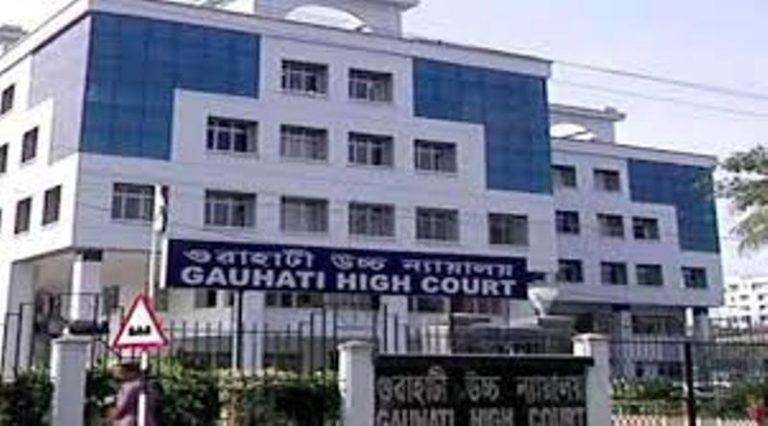
The Gauhati High Court, in its hearing last week, made scathing remarks over the allotment of 3,000 bighas of land (roughly 4 square kilometres) in Dima Hasao district to Mahabal Cement Private Limited for the establishment of a cement factory. The court, while hearing two petitions related to the allotment, including one by locals alleging eviction from their land, expressed strong disapproval over what it termed as an “extraordinary” grant of land in a Sixth Schedule tribal region.
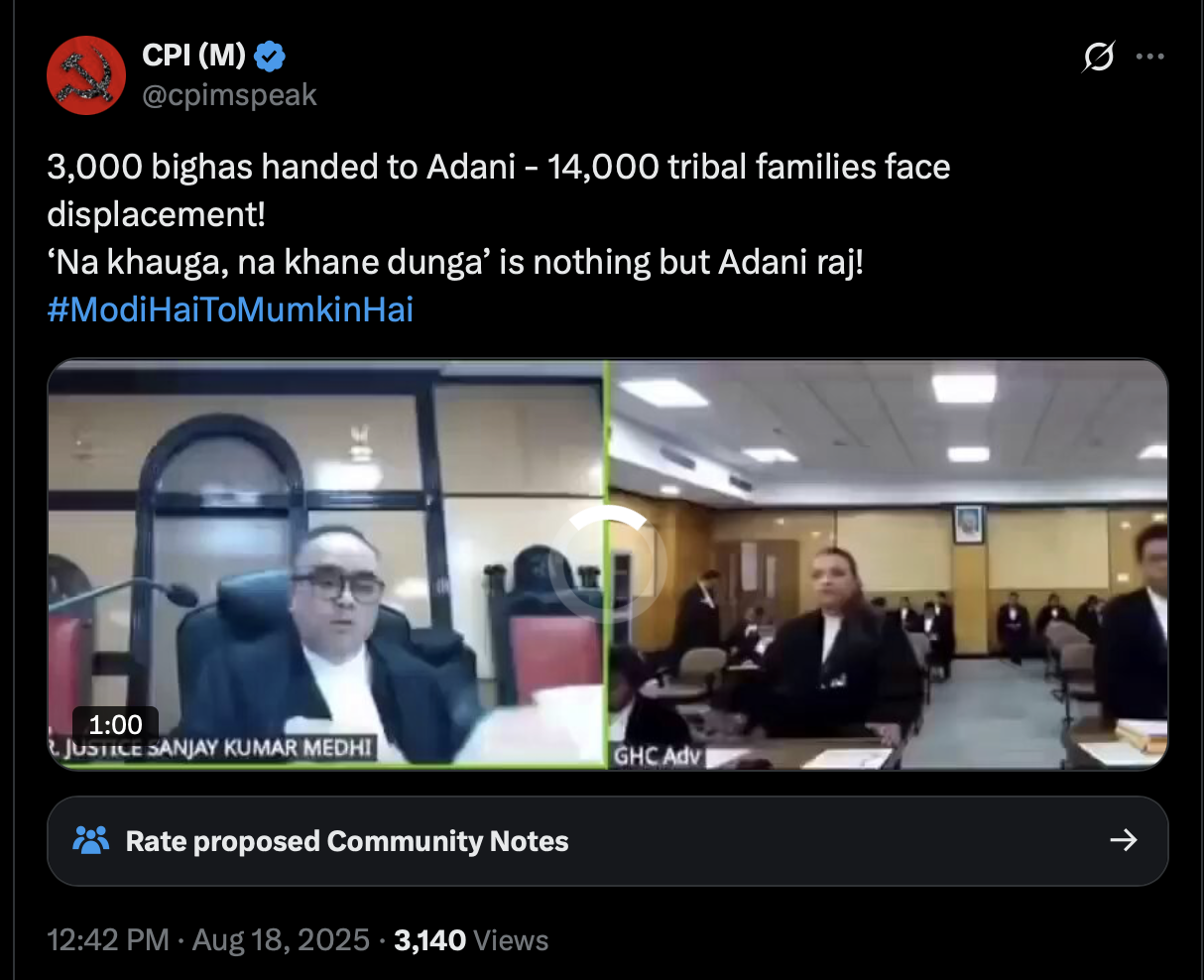
Justice Sanjay Kumar Medhi, reacting to the disclosure by the company’s counsel that 3,000 bighas had been allotted, was visibly incredulous.
“3,000 bighas! What is going on? 3,000 bighas allotted to a private company? What kind of decision is this? Is this some kind of joke or what?” he observed in open court.
The bench directed the state to furnish the policy under which such a large allotment had been made and sought the records of the process followed by the North Cachar Hills Autonomous Council (NCHAC) and the state revenue department.
The court went further to emphasise the unique constitutional and environmental sensitivities of the region. Dima Hasao, being under the Sixth Schedule, enjoys special protections intended to safeguard the land and rights of tribal communities. Additionally, the Umrangso area, where the land is located, is widely known as an ecological hotspot, featuring hot springs, migratory bird stopovers, and rich biodiversity.
The order explicitly noted that any industrial activity in such an area must be weighed against the rights of indigenous inhabitants and the need to preserve fragile ecosystems.
The bench also reminded the state government of the extraordinary size of the allotment, demanding to know whether such a decision was consistent with established policy. While counsel for Mahabal Cement argued that the allotment was made pursuant to a mining lease under a tender process, the court maintained that the sheer scale of 3,000 bighas warranted closer scrutiny.
On the face of it, the concerns raised by the court appear grounded in constitutional protections, environmental responsibility, and the principle of safeguarding tribal interests. However, a closer look at industrial norms and the economic context suggests that the High Court’s assessment is alarmist, even misplaced. By focusing narrowly on the figure of 3,000 bighas, the judgment risks ignoring both precedent and the realities of large-scale industrial projects.
Why 3,000 bighas is not “extraordinary”
At first glance, 3,000 bighas, around 4 sq km, may sound like a massive tract of land. But when placed in context, the scale becomes entirely ordinary for the cement industry. Cement plants are uniquely land-intensive because they rely on captive limestone mines. Unlike a factory that can operate on a few acres of industrial estate, cement plants require secure and sustained access to limestone deposits, which means that leases for hundreds of hectares are the industry norm.
A comparison helps. In Himachal Pradesh, the state government allotted a limestone mining lease of 324.479 hectares, equivalent to nearly 2,500 bighas, for 50 years to a cement company. That project produces around 5,000 metric tonnes of cement per day. Mahabal Cement’s project in Assam, by contrast, is backed by a proposed investment of ₹11,000 crore. Such a scale of investment naturally requires even larger raw material reserves to ensure viability over decades.
Seen this way, the 3,000 bighas allotted in Dima Hasao is not extraordinary but entirely consistent with industry requirements. Without sufficient limestone reserves secured through land allotments of this size, a cement plant of such scale would be economically unfeasible.
Less than 0.1% of district land
The court’s shock also misses a crucial geographical reality. Dima Hasao district spans 4,900 sq km. The 4 sq km allotted to Mahabal Cement is less than 0.1% of the district’s area. It is implausible to suggest that such a fractional allotment fundamentally undermines either the land rights of tribals or the ecological balance of the region.
Even if we focus narrowly on Umrangso, the region already hosts multiple quarrying and cement activities. Limestone and coal mining are well-established industries there, with existing cement factories operating for years. The allotment to Mahabal Cement must be seen as a continuation of that industrial base, not as some unprecedented diversion of land.
Precedents of larger allotments
Historical precedents show that governments across India have routinely granted even larger parcels of land for mining leases connected to cement production. Mining leases of 300–400 hectares (upwards of 2,500 bighas) are standard practice, as the Himachal Pradesh example illustrates. In Rajasthan, Madhya Pradesh, and Andhra Pradesh, land allotments for limestone mines connected to cement plants have often exceeded these numbers.
By singling out the 3,000 bigha allotment as “extraordinary,” the Gauhati High Court risks creating an impression of arbitrariness that does not align with industrial realities. Such impressions can be damaging, particularly when Assam has been aggressively courting investors through summits like Advantage Assam 2.0. If projects promised during such platforms are later subjected to judicial ridicule, it undermines investor confidence and discourages future capital inflows.
Economic stakes of the project
Mahabal Cement signed an MoU earlier this year pledging an ₹11,000 crore investment in Assam, and the implications of this go far beyond the headline number. A project of this scale promises multi-dimensional benefits for the state and local communities. Cement plants are major employers, both directly and indirectly, and this one is expected to create thousands of jobs spanning mining operations, plant management, logistics, and ancillary services. The revenue impact is equally significant, with lease payments, mineral royalties, GST, and corporate taxes flowing into both the state exchequer and the autonomous council, strengthening public finances.
Such a large plant will also necessitate supporting infrastructure in the form of roads, power supply, and housing, which will have lasting benefits for surrounding communities. In addition, ancillary industries, small businesses, and service providers inevitably emerge around such projects, triggering a multiplier effect across the local economy. To jeopardize such a transformative investment over the perception that 3,000 bighas is “too much” land is to overlook the enormous developmental gains it could bring.
Addressing the court’s concerns
None of this is to suggest that tribal rights or environmental considerations should be ignored. The Sixth Schedule is a constitutional safeguard, and ecological preservation is vital. But these are not mutually exclusive with industrial development. What is required is a framework of safeguards to ensure that the project is implemented responsibly. The state should make the allotment process fully transparent, if the lease was indeed granted through a competitive tender, the details must be placed in the public domain to dispel any doubts.
For local residents who may be displaced, proper rehabilitation and compensation must be guaranteed, alongside priority in employment opportunities at the plant itself. Environmental safeguards, too, must be non-negotiable, with strict compliance under the Environment Protection Act and regular audits to monitor ecological impact.
Fact-Check: No, Gauhati HC’s remarks don’t concern Adani Group
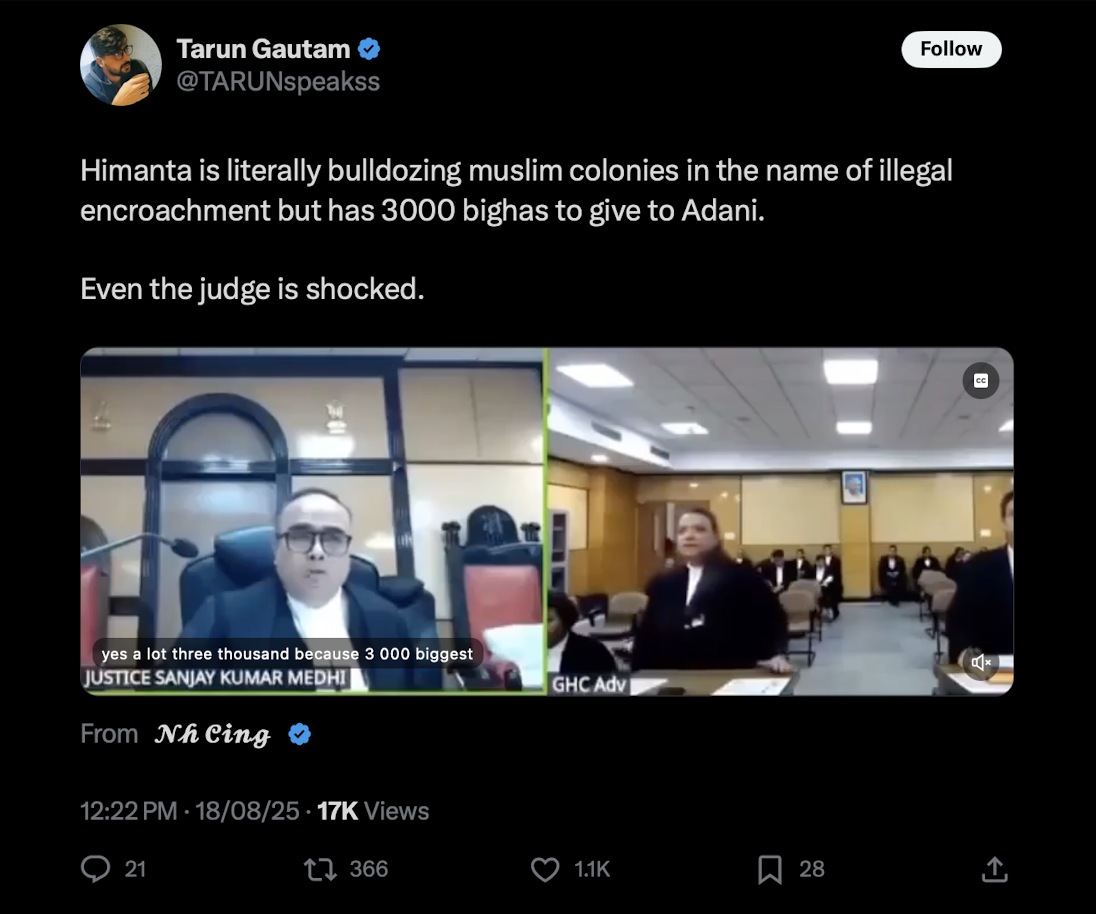
The High Court’s remarks have also sparked a storm of misinformation online. Some Congress-supporting social media handles, such as @Tarunspeakss, claimed, “Himanta is literally bulldozing Muslim colonies in the name of illegal encroachment but has 3000 bighas to give to Adani. Even the judge is shocked.”
Source: X
The official handle of CPI(M) alleged, “3,000 bighas handed to Adani – 14,000 tribal families face displacement! ‘Na khauga, na khane dunga’ is nothing but Adani raj!”
Source: X
In fact, social media is rife with claims that the Gauhati HC has rebuked the Assam government for allotting the land to the Adani Group, with the Congress ecosystem working overtime to mislead users into believing it was the Adani Group that had gotten the 3,000 bighas of land in Assam.
However, these claims are patently false. The company in question is Mahabal Cement Private Limited, a Kolkata-registered firm. It has no ownership link, stake, or connection whatsoever to the Adani Group.
Adani Group issues statement rubbishing malicious rumours
The Adani Group itself issued a statement clarifying: “It has come to our notice that certain news reports, social media posts and clips from court hearings are being circulated, claiming that the Assam Government has allotted 3000 bighas in Dima Hasao to the Adani Group for a cement plant. We categorically state that these reports and references are baseless, false and misleading.”
“Linking the Adani name to Mahabal Cement is mischievous. Mahabal Cement is not related to, owned by or connected with the Adani Group in any manner whatsoever. We strongly urge members of the media, digital platforms and the public to verify facts before making or sharing such claims,” the statement further said.
Gauhati HC’s critical remarks misplaced, 3000 bighas of land for mining less than industry norms
The Gauhati High Court’s critical remarks stem from a legitimate concern for tribal rights and environmental protection. Yet, in branding the 3,000 bigha allotment as “extraordinary” and questioning whether it is “some kind of joke,” the court risks missing the larger picture. For a project of ₹11,000 crore involving cement production, such a land size is neither unusual nor excessive; it is the industry norm.
More importantly, the land in question represents less than 0.1% of Dima Hasao’s total area. Previous allotments for cement mining leases in India have been of comparable or larger magnitude. The potential benefits in terms of jobs, infrastructure, and revenue are immense.
The real challenge is not the number “3,000 bighas” but how the state ensures that this industrial push respects local communities and ecological balance. By framing the debate around sensational numbers, the court risks undermining investment sentiment and turning a developmental opportunity into a needless controversy.
And as the fact-check makes clear, dragging unrelated corporate names into the debate only adds to public confusion. The focus should remain where it belongs: on balancing development with safeguards, not on fuelling misinformation.
Editorials are often described as the “soul” of a newspaper. For decades, they have been the space where editors set the tone for public debate, shape opinions, and comment on the issues of the day. But gradually, their significance has waned.
Readers nowadays skim them, and even authors do not seem to give their heart to them anymore like before. Nevertheless, all serious papers still have editorials, because there is tradition involved.
In this context, a recent editorial published in the Gujarati daily ‘Gujarat Samachar’ has sparked a debate in the state. Known for its fiery journalism in the past, sometimes rattling even leaders like Narendra Modi or Donald Trump, the paper published an editorial on 18th August titled “Challenges Before the Nation.”
At first glance, the headline promised a scathing criticism of the administration. Since the paper is known for its journalistic integrity, people expected an article with a lot of nuance but alas.
What the readers got was an average write-up presented in the dry and impersonal style of editorials everywhere.
What’s in the editorial
The editorial started by mentioning the Independence Day celebrations last month. It had noted that there was no dearth of reasons to celebrate. In spite of its several differences and internal conflicts, India had continued to become a stronger nation, the editorial said.
The article cited Operation Sindoor, discussed national integration, and indicated that the nation’s achievement as one of the world’s fastest-growing economies was a fact. It even pointed out that poverty has reduced.
In the second half, the article addressed the issues of the future. It mentioned global politics, such as the United States and the issue of trade tariffs, very briefly, and emphasized the value of strong institutions and a rules-based order.
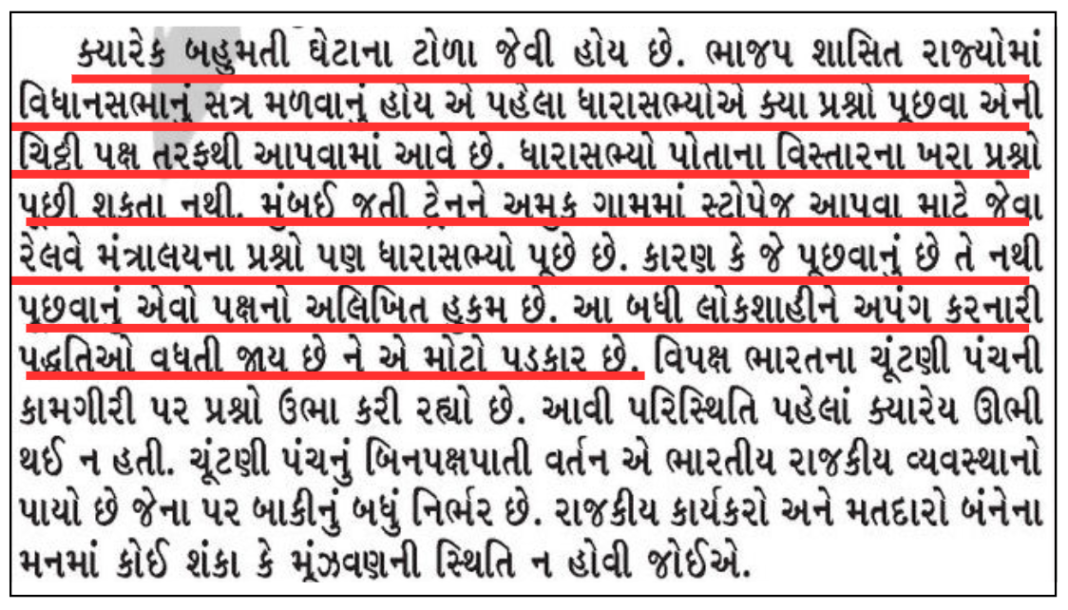
The final paragraph, though, brought in a political twist. It contended that at times a parliamentary majority acts like a flock of sheep. Referring to BJP-governed states, it said lawmakers were handed a list of pre-approved questions to be asked in assemblies, rendering them incapable of raising the actual issues of their constituencies.
The underlined part is not in the original Hindi editorial
This, the editorial noted, undermined democracy. The article also questioned the Election Commission, pointing out that opposition parties had questioned its impartiality in the open, something, it asserted, was never previously done. An impartial and equitable Election Commission, the article contended, formed the cornerstone of Indian democracy.
Similar editorial published in Business Standard’s Hindi edition earlier
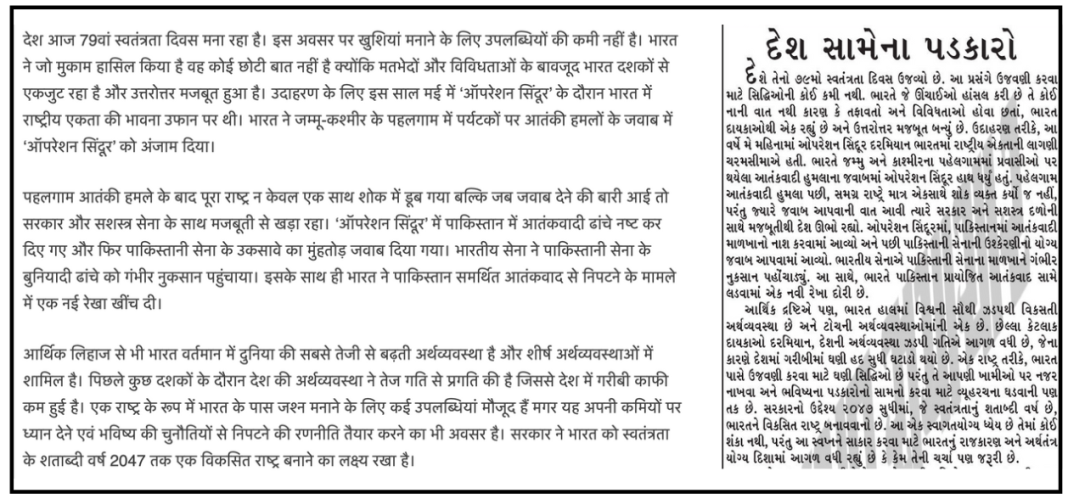
It appeared to be just another ordinary editorial at first glance. On closer inspection, however, a strange thing became evident. Pratically the same article had been published four days earlier, on 14th August, in the Hindi edition of Business Standard.
That one had been published with the title, “On the 79th Independence Day: India’s Achievements and Challenges, the Need for Strong Institutions.”
The parallels were remarkable. Right from the introductory paragraph to the composition of the arguments, almost everything was the same. The only variation was that the Business Standard news item was in Hindi and Gujarat Samachar editorial was in Gujarati.
With the exception of the concluding anti-BJP observations, which were not included in the Business Standard version, the two editorials were more or less the same. Paragraphs, words, phrasing: everything was word-for-word.
In the world of journalism, it is not uncommon for the content of one newspaper to be carried by another. Lots of Indian papers have no qualms about reproducing reports or opinion pieces from foreign newspapers, particularly The New York Times or The Washington Post. But this is done on formal terms and always with acknowledgement. The reader is informed that the piece originally appeared elsewhere.
Editorials are distinct. They are the voice of a newspaper. It is rare to the point of impossibility for them to be duplicated, or “borrowed”—from another newspaper. When such a situation does occur, the source will normally be credited.
Gujarat Samachar did not provide any such explanation in this instance. The editorial was presented in the form of the paper’s voice, with no reference to Business Standard.
No collaboration between the two newspapers
When OpIndia contacted Business Standard to seek clarification, the response was clear: There is no understanding whatsoever between the two newspapers. Neither the English newspaper nor its Hindi counterpart has licensed Gujarat Samachar to reprint its content.
This makes the issue all the more strange. In the absence of a syndication arrangement or a mention, reprinting another newspaper’s editorial, practically word-for-word raises grave doubts.
According to sources, the matter is being examined by Business Standard. The management is considering the issue and will take a decision regarding further action after ascertaining facts.