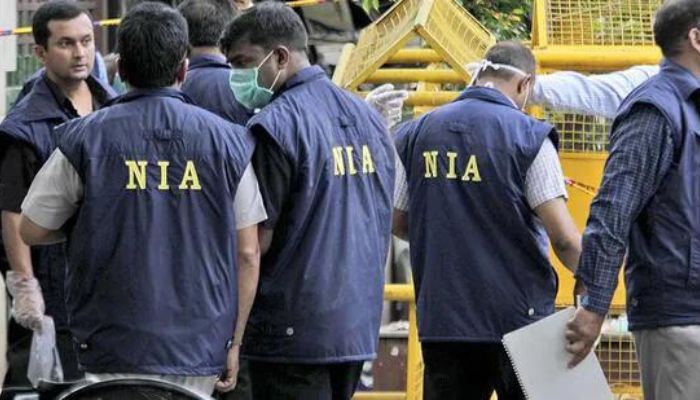
The National Investigation Agency (NIA) has alerted Mumbai police regarding the movement of a suspicious person in the capital city of Maharashtra here, Mumbai police sources said.
The NIA apprised the Mumbai Police through an email and stated that a person identified as one Sarfaraz Memon has reached the city and asked the police to be alert. The NIA email referred to Memon as “dangerous” to India. According to Mumbai Police sources, the NIA has informed that Memon, a resident of Madhya Pradesh has taken training in China, Hong Kong and Pakistan.
NIA has sent the person’s Aadhaar card, driving license and passport over email to Mumbai Police. The investigating agency has been alerted since the receipt of this email, the source added.
The Mumbai Police have also informed the Indore Police about the matter.
Earlier this month the NIA received a mail from an unidentified individual claiming to be a Talibani member threatening to carry out a terror attack in Mumbai, police sources had said.
According to the sources, the NIA apprised the Mumbai Police about the development following which various cities of Maharashtra were put on alert.
Also, last month the Dhirubhai Ambani International School in Mumbai received a threat call where an unidentified caller threatened to blow up the school. In October last year, a threat call was received at the HN Reliance Foundation Hospital during which the unknown caller threatened to blow up the hospital and issued death threats to the Ambani family.
(This news report is published from a syndicated feed. Except for the headline, the content has not been written or edited by OpIndia staff)
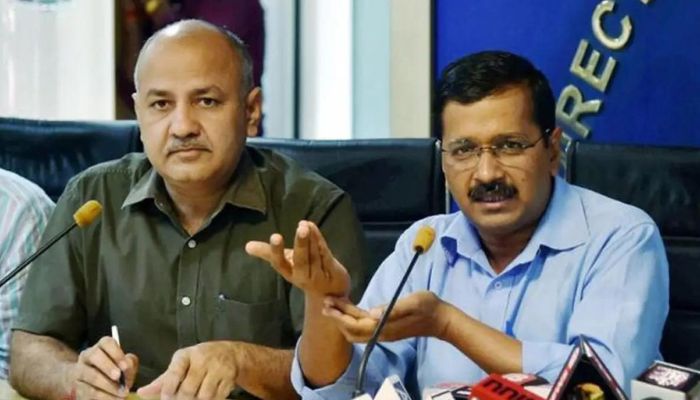
On Sunday (February 26), the Central Bureau of Investigation (CBI) arrested Delhi Deputy CM Manish Sisodia in connection with the liquor policy scam case. Sisodia was grilled by the central agency for several hours prior to his arrest.
Even before Sisodia appeared before the CBI, Aam Aadmi Party (AAP) workers created a ruckus outside the office of the central agency. Some of them were detained for creating chaos in the garb of ‘protests’.
Other heavyweight leaders in the party wrote ‘premature obituaries’, cast aspersions on the integrity of the CBI, and tried to deviate public discourse from the matter at hand to Sisodia’s credentials as Education Minister.
Manish Sisodia reportedly waived off ₹144.36 crores on the license fee, to be paid by the private liquor vendors, under the garb of the Coronavirus pandemic. He also allegedly caused a loss to the Excise Department and benefitted liquor licensees by waiving the import pass fee of ₹50 per beer case.
This, however, did not stop Arvind Kejriwal from crying foul over the interrogation and subsequent arrest of fellow party leader and his deputy, Manish Sisodia. It must be mentioned that not long ago, the AAP supremo was out with all guns blazing against corruption and had tried to promote himself as an anti-corruption crusader.
In October 2012, Arvind Kejriwal called upon the people of India to overthrow the ‘corrupt regime’ of the Congress-led UPA government.
Two years later, in February 2014, Kejriwal even announced that he is willing to sacrifice his Chief Ministership 100 times to remove corruption from the country.
Desh se corruption mitane ke liye 100 baar CM ki kursi kurbaan
A year later, he was seen boasting about dismissing his own Minister for the latter’s involvement in corrupt activities. “I am the only CM who dismissed, on my own, a minister n a senior officer on charges of corruption and handed their cases to CBI,” Arvind Kejriwal had tweeted.
I am the only CM who dismissed, on my own, a minister n a senior officer on charges of corruption and handed their cases to CBI(1/2)
In May 2016, he said that he is ready to relinquish his job as Delhi CM and join CBI instead, provided it became an independent entity. “Will send corrupt to jail n get India rid of corruption,” he had stated.
If u make CBI independent, m ready to take up this job. Will send corrupt to jail n get India rid of corruption https://t.co/3vL792HVwr
Arvind Kejriwal, who came to power by posing as an anti-corruption crusader, had stated in 2018 that he would take exemplary action against those guilty of corruption. “No one will be spared,” he had emphasized.
Exemplary action will be taken against the guilty in each case of corruption or irregularity pointed by CAG. No one will be spared.
Kejriwal attributed Delhi’s development to a lack of corruption
In February 2022, Arvind Kejriwal claimed that the infrastructure development in the National Capital under the AAP government was due to a lack of corruption.
While blaming the Sheila Dixit government, he had said, “From officer level to employees, and from sentries to ministers, everyone was involved in corruption. As a result, even low-cost projects became prohibitively expensive.”
“The government has thus saved crores of rupees in many projects, and with this money, basic amenities such as free electricity, water, education, and healthcare are being provided to the people of Delhi,” Kejriwal went on to browbeat.
Ahead of the Punjab elections, he even claimed that corruption had been eradicated altogether from Delhi. Arvind Kejriwal said, “It’s been 75 years since we have gained independence but we still have to pay bribes. All parties have indulged in corruption. Aam Aadmi Party is the first party to run an honest government.”
“Kejriwal and his ministers, Mann, and his ministers are not corrupt. We don’t want ‘hafta’ (protection money). Just like we eradicated corruption in Delhi, we will end it in Punjab as well,” he gloated.
Delhi CM on the arrest of Dr Vijay Singla
In May last year, the AAP-led-Punjab government sacked its Health Minister, Dr Vijay Singla, following ‘concrete proofs’ of corruption. It had come to light that Dr Singla was taking a 1% commission in all tenders floated by the health & family welfare department.
After the AAP leader was removed as Minister and arrested, Arvind Kejriwal hailed Punjab CM Bhagwant Mann for taking action against one of their own. “Corruption is betrayal to the country. We will handle everything but not betrayal to India,” he had said.
Arvind Kejriwal to MCD councilors on corruption
Following the victory of the Aam Aadmi Party at the Municipal Corporation of Delhi (MCD) polls, Arvind Kejriwal told the newly elected councillors that they should refrain from corrupt practices at all costs.
“Don’t get greedy otherwise this 5-year term will be your last opportunity in public life. If you work honestly, people will stand with you. People are sick and tired of corruption in MCD,” he had said.
“This time, we have fought against the corruption by the BJP. It should not happen that BJP will fight an election against our corruption next time…We have to work together against corruption, garbage, and social ills,” Kejriwal stated in December 2022.
However, when it came to one of his close aides, the Delhi CM deserted his anti-corruption stance and resorted to blaming institutions, questioning the motives of the Centre instead of cooperation with the investigating authorities in unearthing the corruption.
Arvind Kejriwal, who mouthed platitudes over the years about making India corruption free, decided to retract his own rules when it came to Manish Sisodia.
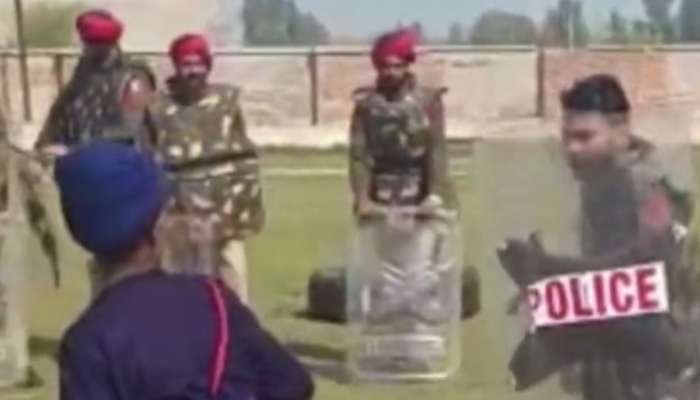
Days after a clash between the supporters of Khalistani preacher Amritpal Singh and the police at Punjab’s Ajnala police station, the Muktsar police Sunday, February 26, started learning ‘gatka’ (Sikh martial arts skills) from ‘nihangs’ at the district Police Lines here.
A video has been going viral on social media wherein a Punjab police official is seen learning the form of martial art from a Nihang Sikh.
After a clash between the supporters of Amritpal Singh & the police at Ajnala Police Station, The Muktsar Police started learning ‘gatka’ (Sikh martial arts skills) from ‘nihangs’ at the district Police Lines. pic.twitter.com/OxHtpjqjjK
Speaking to The Tribune, Avtar Singh, DSP (Headquarters), Muktsar, said, “Two ‘nihangs’ were called to the district Police Lines to show their ‘gatka’ skills to the quick reaction team (QRT) and armed police. Nearly 250 policemen participated in this anti-riot drill, which will continue in future as well.”
Meanwhile, the news agency also quoted a retired police officer as saying, “It is good to hear that the police are learning ‘gatka’ skills in Muktsar. It will make them active and prepare to face any untoward situation in the field. Such drills are the need of the hour. Other districts too should follow this practice.”
Gatka is a traditional martial art discipline associated with the Sikh gurus. It instills sword and stick fighting abilities as well as self-control. Gatka is thought to have started when the 6th Sikh Guru Hargobind used ‘Kirpan’ for self-defense during the Mughal rule. It is a stick fighting style involving two or more participants which is a milder form of the more lethal Shastar Vidya. In Gatka, the sharp swords of Shastar Vidya have been replaced with wooden sticks (soti) and shields (farri). The weapons were made mandatory for everyone to employ for self-defense by the 10th Guru Gobind Singh. Gatka was earlier confined to gurudwaras, nagar kirtans and akharas, but now it finds presence in thesports category after the formation of the Gatka Federation of India (GFI) in 2008.
The Ajnala incident
In the aftermath of the Ajnala incident on February 24, where frenzied adherents of radical preacher Amritpal Singh stormed over barricades and attacked the Ajnala police station, the Punjab police have considered adopting this traditional technique. Police on duty had to defend themselves against attacks from Amritpal Singh’s extremist supporters, who were armed with lathis, swords, and even weapons.
#WATCH | Punjab: Supporters of ‘Waris Punjab De’ Chief Amritpal Singh break through police barricades with swords and guns outside Ajnala PS in Amritsar
They’ve gathered outside the PS in order to protest against the arrest of his (Amritpal Singh) close aide Lovepreet Toofan. pic.twitter.com/yhE8XkwYOO
The police were quick to give in and release Singh’s aide, Lovepreet Toofan, even though he was arrested a few days earlier on February 18 in connection to a kidnapping and assault case.
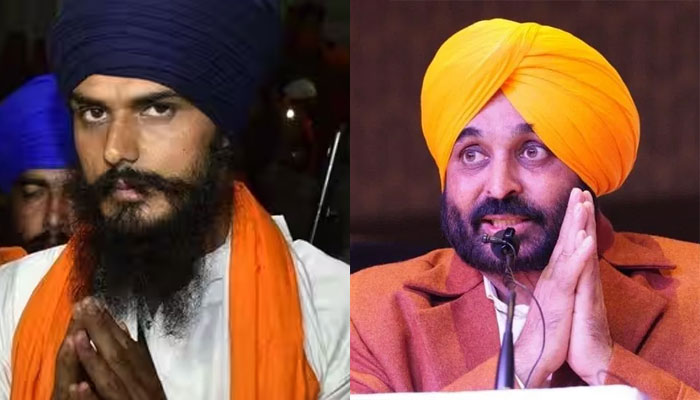
On February 26, Chief Minister of Punjab Bhagwant Mann claimed the law and order situation in the state was under control. He further added that the state Police are capable of controlling any anti-social elements. Speaking to the media, CM Mann criticised Amritpal Singh and his followers for using Shri Guru Granth Sahib as a shield during a protest outside Ajnala Police Station.
He said Amritpal Singh is being funded by Pakistan to destabilise Punjab and assured the state’s people are against the calls for Khalistan. However, the reports coming from Punjab and the way Amritpal Singh is rising to fame are not in sync with the statements of the Chief Minister.
#WATCH | In wake of the recent turmoil in Punjab regarding Khalistani sympathiser Amritpal Singh & his supporters, CM Bhagwant Mann says, “Do you consider 1000 people, Punjab? It’s just a few people funded by foreign, by Pakistan…Their masters want to disturb Punjab…” (26.02) pic.twitter.com/fPoroeM9sZ
While CM Mann has repeatedly claimed that law and order was under control in the state of Punjab, in reality, the state has been pushed into lawlessness ever since AAP came to power. Even recently, as Punjab was being held hostage by Khalistani Amritpal Singh, Mann along with Arvind Kejriwal was in Mumbai discussing politics.
KPS Gill in 2017 had sounded an alarm, saying that Arvind Kejriwal and AAP were espousing radical elements. IPS Kanwar Pal Singh Gill who was responsible for quelling the spread of separatism in Punjab had slammed AAP for providing a platform to the ‘radical Sikh diaspora’ which aimed to create a base to operate. In an interview with The Indian Express in 2017, KPS Gill had called the 2017 Maur Mandi blasts ahead of assembly polls “very very serious” and that the Aam Aadmi Party is “not aware of what they are doing.”
KPG Gill had underscored that the Khalistan supporters abroad were looking for a window of opportunity to return to Punjab and work on their separatist designs, however, over the years they were not able to do so but with the presence of Aam Aadmi Party in Punjab, that window has opened leading to an influx of them from foreign countries.
“Now with Aam Aadmi Party, there is an influx of them from foreign countries. They think this is the opportunity which is very good for them and they would be able to create a big base from which to operate”, he said.
Gill also asserted that AAP has ‘unwittingly’ provided a platform to radical NRIs who have a sole agenda of spreading terrorism in the state.
Funding from Pakistan
In his statement, CM Mann claimed that the likes of Amritpal Singh are getting funding from Pakistan and other countries intending to destabilise the state. He said Punjab has seen over a decade of insurgency, and the state police can tackle such situations. CM Mann did not reveal if the state has any concrete plan to tackle the rise of Khalistani elements. Notably, Mann, in a press conference in Gujarat when he gave the statement.
Mann said Rajasthan shares a larger border with Pakistan, but Punjab’s disturbance is being created. “Why do drones land in Punjab and not in Rajasthan? Because their masters are sitting there, they want to disturb Punjab,” he added.
‘Do you consider 1,000 people, Punjab?’
When asked about the calls for Khalistan, a sovereign state for Sikhs, he claimed that only a handful of people in the state are raising their voices for Khalistan. He asked, “Do you think 1,000 people (who have been seen shouting pro-Khalistan slogans) represent entire Punjab? You come to Punjab and see who are all shouting such slogans.”
‘Not Punjab’s Waris’
Speaking about the violence outside Ajnala Police Station, Mann criticised Amritpal Singh and his followers for using Shri Guru Granth Sahib as a shield. He termed it a “minor” incident and watered down the threats of violence issued by Amritpal Singh. He said, “This is khayali pulao (daydreaming). Punjab has seen such dark days in the past. The Punjab Police can handle them, and we will never allow anyone to vitiate the peaceful atmosphere.” He added, “Such people cannot be Punjab’s waris”.
While Punjab CM, some reporters and so-called experts claim it is just a ‘law and order’ problem in the state, the reality is far grimmer. Notably, it has been reported that following the violent incident at Ajnala Police Station, Amritpal Singh and his followers visited Golden Temple in Amritsar.
Thousands of people flooded the premises of the holy shrine just to get a glimpse of the rising pro-Khalistani leader. Amritpal Singh has extended support to different sections that call for Khalistan, including the terrorist organisation Sikhs For Justice founded by Gurpatwant Singh Pannu who is currently running Referendum 2020, a so-called voting demanding a separate country for Sikhs.
Furthermore, when we compare how Bhindranwale gained popularity in the late 1980s, it is similar to the methods being adopted by Amritpal Singh. From local panchayats and courts based on Sikh teachings to resolve problems to doctrines against “social evils” to save Sikhi, Amritpal is doing everything that Bhindranwale did in the late 1980s to establish confidence among the masses.
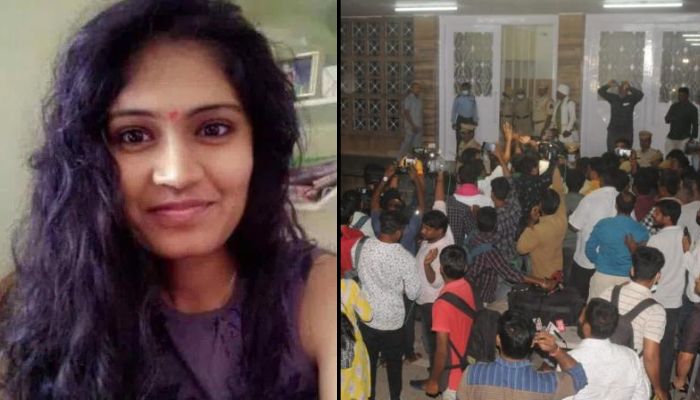
Days after Dr Preethi Dharavath attempted suicide following harassment by her senior Dr Saif, the junior anesthesiologist breathed her last on Sunday (February 26).
A post-graduate student of Kaktiya Medical College in Warangal, Dr Preethi reportedly fought for her life for close to 85 hours. She was undergoing treatment at Nizam’s Institute of Medical Sciences (NIMS).
In a statement released by NIMS Medical Superintendent Dr Satyanarayana, he said, “Despite continuous efforts by a multidisciplinary team of specialist doctors, Dr Preethi could not be saved and was declared dead on February 26, 2023, at 9.10 pm.”
The news of Dr Preethi’s death led to mild tension at the hospital. Some groups had gathered outside the hospital premises to demand that the State government provide ex gratia to her family. A large contingent of police was deployed to prevent any law and order situation.
Reportedly, the family members of the junior anesthesiologist refused to allow doctors to shift her body from NIMS to Gandhi Hospital for a post-mortem examination.
“We want to know what has happened till now. The details of the treatment provided to my sister and also an assurance on the action against Saif,” the deceased’s brother, Vamshi Prudhvi, had demanded.
Meanwhile, the Panchayat Raj Minister, Errabelli Dayakar Rao, announced an ex gratia of Rs 10 lakh for the medico’s family on behalf of the State government.
He also stated that the government would investigate the incident to prevent such incidents from recurring and would take strict action against those responsible for her death.
The Background of the Case
On February 24 this year, the Telangana Police arrested Dr. MA Saif, a second-year MD student at Kakatiya Medical College in Warangal district in connection with the suicide attempt by Dr. Preethi, his junior at college.
Earlier on February 22, Dr Preethi was discovered unresponsive in the MGM Hospital staff room while on duty. She is said to have attempted suicide by injecting anaesthesia drugs due to Dr. Saif, who is accused of harassing Preethi and forcing her to try ending her life.
The Telangana police have cited ragging-related laws and the SC/ST (Prevention of Atrocities) Act in addition to charges of abetment to suicide against the accused.
After examining Preethi and Saif’s cell phones, the police concluded that Preethi had been subjected to harassment. Commissioner A V Ranganath said that police had mostly relied on discussions between the two and their group chats, as well as personal chats with other classmates.
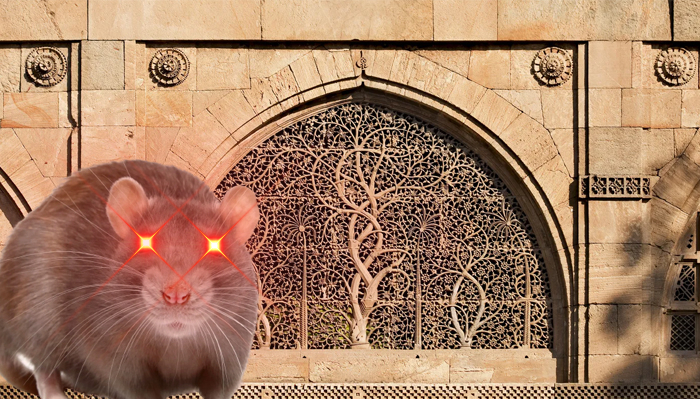
The foundation of the historic Sidi Saiyyed Jali mosque in Ahmedabad is rotting, thanks to cat-sized rats that have made it their home. The community has demanded swift action to save the mosque.
As per local media reports, the administration failed to maintain the mosque, which resulted in the rat infestation. The rats have made the foundation of the mosque their home by digging through it and hence the land there has softened leading to weakened structure. The mosque in question is one of the prominent tourist spots in the city and attracts tourists from India and abroad.
Both the Archeological Survey of India (ASI) and the local administration are responsible for its maintenance. There is a garden on the back side of the mosque that has turned into ruins because of a lack of maintenance. The fountain in the garden has also been damaged.
The mosque was built in 1572. The presence of rats in the mosque’s premises was reported last year and in 2018 as well but no action was taken. In a 2018 report, it was mentioned that the problem of rats persisted since 2014.
A caretaker has told Ahmedabad Mirror in 2018 that whenever he filled up old holes, rats would dig up new ones. “It is a pointless exercise,” he said. “We had to put tiles in the Maulvi’s room because the rats had infiltrated there as well. They continue to enter the mosque. I had placed rat poison a few times, but even that did not help,” the caretaker added.
Local activists have demanded that the administration immediately take action to preserve the mosque or it will turn into rubble.
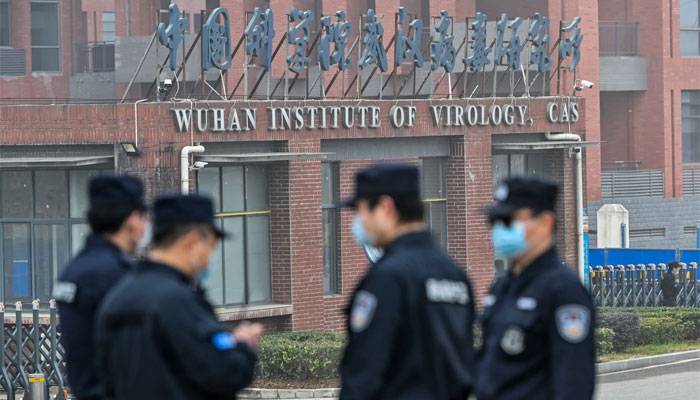
The United States Energy Department, in its latest classified intelligence report, has concluded that the Covid pandemic most likely originated from a laboratory leak. The report was submitted to the White House and key members of Congress. Notably, earlier, the Energy Department report by Director of National Intelligence Avril Haines’s office in 2021 had said the virus’s origin was inconclusive.
While different parts of the intelligence community highlighted the possible origin of the pandemic from a lab in China, National Intelligence Council and four other agencies, along with a national intelligence panel, still believe that it was a natural transmission. The Energy Department and Federal Bureau of Investigation (FBI) have concluded an accident at a lab resulted in the pandemic. Two agencies, including Central Intelligence Agency, have not given any conclusive reason.
Notably, the Energy Department oversees a network of US National Laboratories, including those that conduct advanced biological research. Its expertise, along with the new intelligence, resulted in the conclusion submitted in the report. According to the report in Wall Street Journal, the judgment was made with “low confidence”.
WSJ noted that the US Intelligence Community comprises eighteen agencies, including Energy, State and Treasury Departments. National Intelligence Council and eight others participated in the Covid-origins review.
The report has not been made public, and WSJ quoted unnamed people who have read the report. One of the unnamed US Intelligence officials told WSJ that the update was done in the light of new intelligence, further study of academic literature and consultation with non-government experts.
Earlier, the FBI stated in its report with “moderate confidence” that Covid-19 resulted from a lab leak in 2021. The agency held its position in the latest report. Notably, the FBI has a long list of experts, including microbiologists, immunologists and other scientists who analyze anthrax and other possible biothreats.
While the details of the new intelligence based on which the Energy Department reached a conclusion are unknown, the updated document noted that the intelligence officials are in the process of putting the pieces together over the origin of Covid-19. People familiar with the matter told WSJ that the report reaffirmed that the spread was not a result of a biological weapons program under the Chinese Government.
In a statement, the US national security adviser Jake Sullivan said, “President Biden specifically requested that the national labs, which are part of the Energy Department, be brought into this assessment because he wants to put every tool at use to be able to figure out what happened here.” He added that the intelligence community has different views on the origin and claims insufficient information. He refused to confirm or deny the new update while speaking to CNN.
It is believed that the Covid-19 virus first circulated in Wuhan, China, back in November 2019. However, experts have different views on when it began. Initially, it was said that the virus jumped from animal to human as it happened in the past. As time passed by, the scientists could not zero down on a host animal. The focus slowly shifted to the coronavirus research happening in Wuhan and the possibility of a lab leak.
There were assumptions that the virus originated from the seafood market in Wuhan. However, later the scientists said it could be the ground zero for the community spread but not the place where the first human infection happened. On the other hand, while limiting the investigations by the World Health Organization, China claimed the virus emerged outside China.
In the 2021 report, the Intelligence analysts stated that China has a flourishing trade in a diverse set of animals that may carry unknown pathogens. Thus, it was possible that the Chinese government did not have foreknowledge of the virus. Some scientists have also argued that the virus possibly emerged naturally and jumped from an animal to a human.
On the other hand, a 2018 report from the US State Department and internal Chinese documents showed the biosafety procedures of the labs in the country possessed high levels of concern. Many labs in China mushroomed after the SARS epidemic of 2002, including campuses of the Wuhan Institute of Virology, the Chinese Center for Disease Control and Prevention, and the Wuhan Institute of Biological Products.
Globally, 75,72,64,500+ cases have been reported so far since the pandemic began. In the last seven days, 10,48,235 cases have been reported. The United States, Japan and China have reported over 5,00,000 cases in the last seven days. A total of 68,50,594 people have lost their lives affecting the US, Brazil and India the most in terms of deaths.
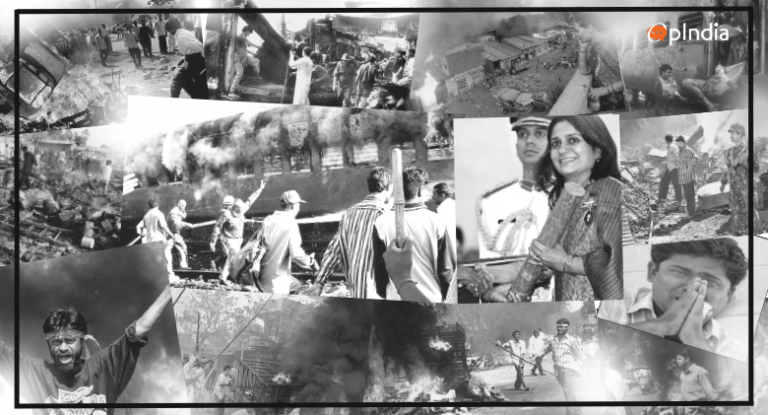
It has been over twenty years since the Sabarmati Express train was set on fire by a rioting Muslim mob at Godhra triggering riots across Gujarat. The ones burnt alive were karsevaks returning from Ram Janmabhoomi in Ayodhya. Hindus had been having faith in the judiciary that at some point the ruling will be in the favour of Ram Lalla and they wanted to be prepared for the time comes when Bhavya Ram Mandir can be constructed.
When the Muslim mob set the train on fire on 27 February 2002 at little before 8 AM, 59 karsevaks were burnt alive. A few hours later, when the burnt compartments were detached and the train was finally moving again towards its destination, another Muslim mob had come to set the train on fire again. Except, this time, they were thankfully not successful. Hours later, as news spread, violence broke out in the state.
In the post-Godhra carnage riots, hundreds lost their lives. The Indian Army was called in and law and order situation, which was getting out of hand, was controlled. Violence has no place in civil society and citizens must have faith in judiciary that the law will take its course. The riots that broke out in Gujarat in reaction to burning alive of Hindus by Muslim mob were unfortunate. People of Gujarat, Indians, died. They were both, Hindus and Muslims.
However, the unfortunate death of Indians has been milked by ‘activists’ and propagandists in and outside India for over two decades now. It is almost as if the corpses of Indians were a cottage industry for them to mint money, earn fame and act as agents of regime changers who see India as a market with huge potential to have their own puppets in government.
Scientist turned lawyer-activist-turned politician Mukul Sinha and his wife built their entire political career and nexus on Gujarat riots. Sinha was instrumental in planting the ‘accidental fire’ in train theory and various other conspiracies eventually debunked by a committee in investigation. He and his network went to great lengths to shield the Muslim mob that set the train on fire and to blame the Hindus for their own death.
Sinha’s son, Pratik Sinha, now runs an Islamist propaganda website ‘Alt News’ with one Mohammed Zubair, who recently dog whistled against BJP’s Nupur Sharma and painted a target on her head alleging blasphemy. Islamists have been baying for her blood since. The fire that was lit by the father is now being taken forward by the son who regularly gets validation from international media for ‘being fearless’ when all they do is cry fear in Modi’s India.
And while we’re talking about charlatans, how can Teesta Setalvad be far behind. Setalvad built her entire career on the Gujarat riots. No, really. She has been accused of embezzling money collected in name of riot victims. She has also been accused of tutoring people for testimonies so as to implicate the then Modi government in state.
She had allegedly collected funds for the 2002 riot victims and instead used it for personal luxury and expenses. The allegations had come to light after one of the residents of the Gulbarg Housing Society filed a complaint against her alleging that she had embezzled funds collected for the 2002 riot victims through her NGOs Sabrang Trust and Citizens for Justice and Peace.
On her tutoring victims, the Supreme Court categorically said, “the antecedents of Ms Teesta Setalvad need to be reckoned and also because she has been vindictively persecuting this for her ulterior design by exploiting the emotions and sentiments of the appellant – Zakia Ahsan Jafri, the real victim of the circumstances.”
In multiple instances, she tried her best to take the case off track using fake testimonies and tutoring the eyewitnesses. She even sent two letters to the Office of the High Commissioner of Human Rights at the United Nations (OHCHR) about the case. The Court had called it ‘misadventure’ and took an undertaking that she would not repeat it. She not only raised questions over the SIT but also questioned the integrity of the honourable courts of the country by sending notes to the OHCHR.
In its judgment, the Court noted that Setalvad was in a position to influence Zakia. The Court noted, “It is submitted that Ms Teesta Setalvad, for reasons best known to her and out of vengeance, was interested in continuing with her tirade and persecution on the basis of unsubstantiated allegations in the complaint in the name of the quest for justice with real purpose to keep the pot boiling and sensationalise and politicise the crime.”
Like her, other ‘activists’ like Harsh Mandar and many more established their careers on 2002 riots. He quit his active civil services and became full time activist, visiting relief camps. You see, every aspiring ‘activist’ knew that hating Modi and painting him a villain has huge potential. He continued his ‘activism’ and in 2020 Delhi riots, was found inciting mob violence. Mandar has close ties with George Soros.
Speaking to a gathering in Delhi, the foreign-funded activist was seen inciting mob, calling them to descend on streets to decide for themselves based on the show of the strength. Mander claimed that time has now come for people to hit the streets as both Supreme Court and parliament have failed them. Needless to say the 2020 riots also had their roots in 2002 riots, which had their roots in 1992 Babri demolition. It was not about ‘citizenship’, but about avenging the Babri demolition.
One more propagandist Sinha has mentored and trained well has been financial fraud accused Washington Post columnist Rana Ayyub. She wrote an entire ‘book’ based on so-called sting operations of those who claimed to have been privy to more tails about the law and order situation on those few fateful days. The hatchet job has been hailed as a brilliant piece in ‘investigative journalism’ by the international cabal and the Indian ‘liberal’ lobby, but Supreme Court had trashed it as not having any substance and rightly so.
It was such a bad piece that even her own Editors at Tehelka, which was built on nothing but low level sting operations which defy journalism ethics, found Rana Ayyub’s work sub-par. Ayyub, however, claimed victimhood there also and claimed how Modi didn’t want it published. Except, it was Congress-led UPA government in Centre back then. Shoma Chaudhury, who was Managing Editor of Tehelka at the time Rana worked on the sting, said that Rana was made aware of loopholes in his ‘exposé’ and asserted it was not due to any political pressure as even after that, they had published anti-Modi articles.
Rana continues to milk the 2002 riots for her own personal agenda and an audience for that sort of fearmongering because they want to believe the worst case scenario she paints.
There are so many more, ‘activists’, ‘journalists’ and even media houses that thrive only and only on hating Modi with 2002 riots as the trigger point. Recently, Congress tried to revive their own political relevance by giving validation to the propaganda documentary of the BBC based on 2002 riots. When the usual suspects realised the BBC propaganda video would not hold water, they invoked Adani and ‘crony capitalism’.
And when the regime changers saw this was not going the way they wanted, George Soros himself decided to take matters in his own hands, which again, was endorsed by Congress. It is like they no longer want to even pretend they have India’s best interests in their hearts. For them, defeating Modi is more important than India’s interests.
These people have built their empires on the dead bodies of Indians.
An Indian Army officer posted in Assam has been arrested for the murder of a woman from Chennai. Lieutenant Colonel Amrinder Singh Walia, who is posted as the Public Relations Officer (PRO) of IV Corps headquarters in Tezpur in Assam, was arrested by Assam Police on Friday, 10 days after the body of the victim was recovered near Guwahati. The police have said that the army official has confessed to the crime.
The victim has been identified as 36-year-old Vandanashree, a native of Chennai in Tamil Nadu. Reportedly Lieutenant Colonel Amrinder Singh Walia was having an affair with her for a long time.
The matter came to light after Assam police recovered the body of an unidentified woman wrapped in plastic sheets near the National Highway 31 in Changsari in the Kamrup district, located just north to Guwahati city, on 15 February. While the woman was determined to be aged around 35 years, her identity was unknown, and Kamrup Police had posted her photographs on social media seeking help from the public in identifying her.
যোৱা ১৫.০২.২৩ তাৰিখে চাংসাৰিত ৰাষ্ট্ৰীয় ঘাইপথৰ পথৰ কাষত প্ৰায় ৩৫ বছৰীয়া এগৰাকী মহিলাৰ মৃতদেহ উদ্ধাৰ হয়। জিএমচিএইচ ত পি.এম. কৰাৰ অন্তত, মৃতদেহ চিনাক্তকৰণৰ বাবে বৰ্তমান মৰ্গত সংৰক্ষণ কৰা হৈছে। যদি কাৰোবাৰ হাতত কিবা তথ্য আছে, তেন্তে কামৰূপ আৰক্ষীক যোগাযোগ কৰে যেন। @assampolicepic.twitter.com/XB7DRgZWBY
She was wearing a pendant depicting Linga Bhairavi, indicating that she was from South India. After a thorough investigation, she was identified as Vandanashree from Chennai, and link of the army officer in the crime also emerged. After that, Changsari police arrested Lieutenant Colonel Amrinder Singh Walia from Punjab with the help of Tezpur police from the IV Corps headquarters in Tezpur.
According to the police, there is enough evidence proving that Walia killed the woman and dumped her body in Changsari, and he has confessed to the crime. He knew her for a long time and were in a relationship, said Hitesh Chandra Roy, Superintendent of Police of Kamrup district.
Sonitpur additional SP Madhurima Das, said, “A case against Lt Col Walia was registered with the Changsari Police in this regard. A team of Tezpur Police, in collaboration with a team of Changsari Police, picked him up on Friday night.”
Lt Col Walia has been booked under sections 365/302/201/34 of the IPC, and he was produced before a court on Sunday.
The women had travelled from Chennai to Varanasi recently, from where she had gone to Delhi. On 14 February, she boarded a Guwahati bound train in Delhi to meet Walia, and reached the next day. He went to Guwahati to pick up her from Guwahati Railway station at Paltan Bazaar, and they were travelling to Tezpur, which is around 170 kms from Guwahati.
But presumably, after crossing the Saraighat bridge over the Brahmaputra, he killed her and dumped the body near the highway at Changsari. The body was found in the next morning.
The victim’s four-year-old daughter was also rescued from Howrah in West Bengal. According to the police, Walia had kept her with him till February 21. However, it is not clear how she reached Howrah alone.
“The girl has been recovered by Howrah Police and has been sent to our custody. The other family members are also here,” the police officer said.
Defence sources have said that it is a civilian crime and therefore the officer will be tried under civil courts, not by a court marshal. “As per Section 70 in the Army Act, 1950, the case doesn’t come under our jurisdiction. A person subject to this Act who commits an offence of murder against a person not subject to military, naval or air force law, or of culpable homicide not amounting to murder against such a person or of rape in relation to such a person, shall not be deemed to be guilty of an offence against this Act and shall not be tried by a court-martial,” the source said.
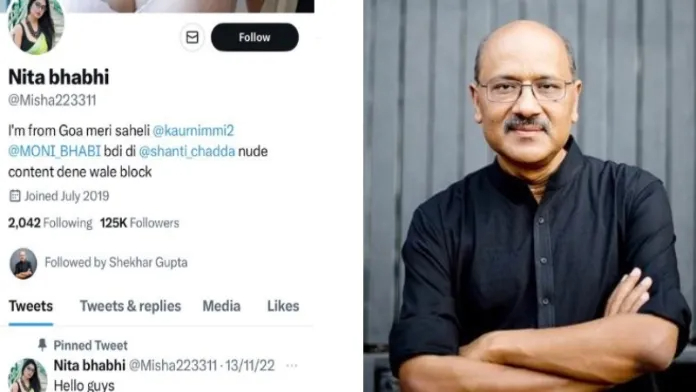
Shekhar Gupta, the founder of the left-leaning media outlet The Print, is once again in the limelight on social media. This time the reason is not the fake news or propaganda usually associated with him or his ‘news’ portal, but a Twitter account by the name of ‘Neeta Bhabhi’ followed by Shekhar Gupta on the social media platform.
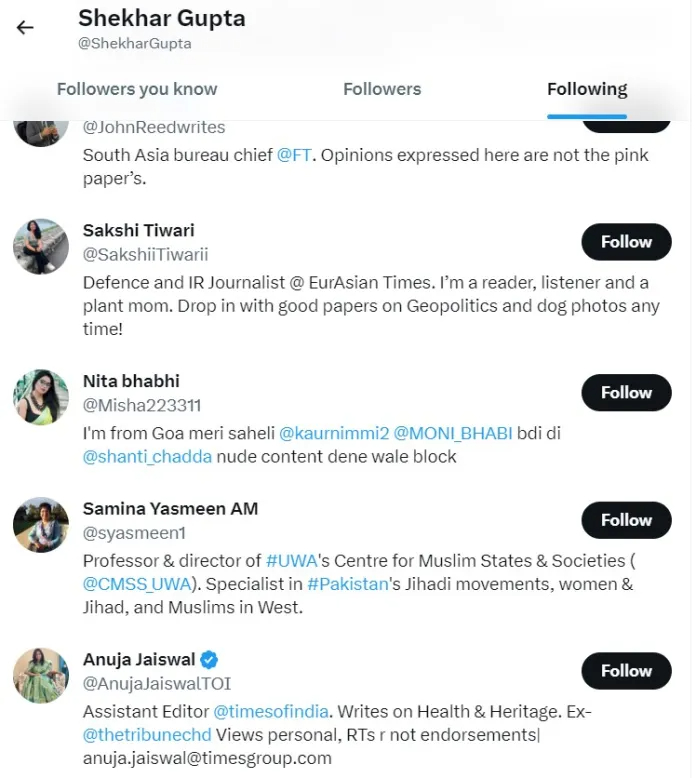
A screenshot is being shared showing The Print’s founder following a certain ‘Neeta Bhabhi’ from his personal account. Actually ‘Neeta Bhabhi’ is not any run-of-the-mill account, it is a ‘soft-porn’ account with a bio linking to other similar accounts and an added disclaimer that people sending nude content will be blocked.
Apart from this, if you explore the account of Neeta Bhabhi (@Misha223311), you would see pictures of girls sitting in bikinis somewhere or lying in bikinis. Not just her, the accounts that are followed by Neeta Bhabhi also evidently serve soft porn content online.
This name, from Shekhar Gupta’s following list, has been brought to light by the Twitter handle @Befittingfacts. After cross-checking, OpIndia found that Shekhar Gupta, the founder of The Print, is indeed a follower of Neeta Bhabhi.
People are giving all sorts of reactions after seeing the screenshot of Shekhar Gupta’s following list. Some are calling him a tharki old man while others are calling it a natural phenomenon. A user said, “Kaun kehta hai ki buddhe ishq nahi karte, who ishq to karte hain lekin un par koi shaq nahi karta (Who says that old people don’t love, they love but nobody suspects them).”
कौन कहते है बूढ़े इश्क़ नही करते वो इश्क़ तो करते है लेकिन उनपर कोई शक नही करता ??