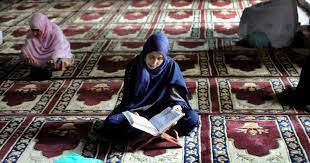
On Wednesday, February 8, 2023, the All-India Muslim Law Personal Board (AIMLPB) told the Supreme Court there is no bar on Muslim women offering Namaz in mosques, provided there is no intermixing of men and women in the mosque. In an affidavit filed in the apex court, the Muslim Personal Law Board told the Supreme Court that as per Islamic texts, traditions, and beliefs, women are permitted to enter mosques for namaz as long as there is no free intermixing of men and women in common areas.
“Considering the said religious texts, doctrines, and religious beliefs of the followers of Islam, it is submitted that entry of women into mosques for offering namaz inside mosques is permitted,” the affidavit filed through advocate M R Shamshad said.
— All India Muslim Personal Law Board (@AIMPLB_Official) February 8, 2023
The affidavit was filed in the hearing of a petition filed by one woman, advocate Farha Anwar Hussain Shaik, who urged the apex court to declare the prohibition of entry of Muslim women into mosques as illegal and unconstitutional. She said that this only violates the constitutional rights of Muslim women, it is also not allowed as per Quran. She argued that no Islamic holy text mandates keeping men and women separate in mosques.
The petitioner also claimed that women are allowed to perform hajj and umrah rituals in Mecca and Medina along with their male companions.
However, the Muslim Personal Law Board completely dismissed her arguments, saying that intermixing of men and women in mosques is not allowed in Islam. The affidavit claimed that no Islamic religious text authorised the mixing of genders in any mosque.
It further stated that when it comes to practising namaz around the Kaaba in Mecca, temporary arrangements are made by constructing barricades to separate men and women worshippers during the prayer.
The etiquettes of prayer, particularly no open intermixing of both sexes, are freely, scrupulously, and truly observed by all devotees, men and women alike, AIMLPB said. In reality, aside from Masjid Al-Haram, there are scores of mosques in Mecca where, since the time of the Prophet Muhammad, no intermingling of the sexes is permitted, the affidavit further read.
It is worth noting that almost every mosque has separate entrances for men and women, as well as separate cleansing and washroom spaces.
According to the affidavit, the AIMPLB, as a body of experts with no state authority, can only provide advisory opinions based on Islamic principles. It stated that the AIMPLB and, for that matter, the Supreme Court cannot delve into the realm of particular arrangements of a religious place, which is a completely privately managed entity for religious practises of believers in religion.
“Thus, a Muslim woman is free to enter into a masjid (mosque) for prayers. It is her option to exercise her right to avail such facilities as available for prayers in a masjid,” the affidavit said.
According to the affidavit, Islam does not mandate Muslim women to join daily five times prayers in congregation, nor does it require Muslim women to offer weekly Friday ‘Namaz’ in a congregation, but Muslim males must.
“The Muslim woman is differently placed because, as per doctrines of Islam, she is entitled to the same religious reward (sawab) for praying as per her option, either in the masjid or at home,” it said. The board further appealed to the community that the issue of making appropriate space for women should be kept in mind wherever new mosques are constructed.
The next hearing in the plea is likely to be held in March.
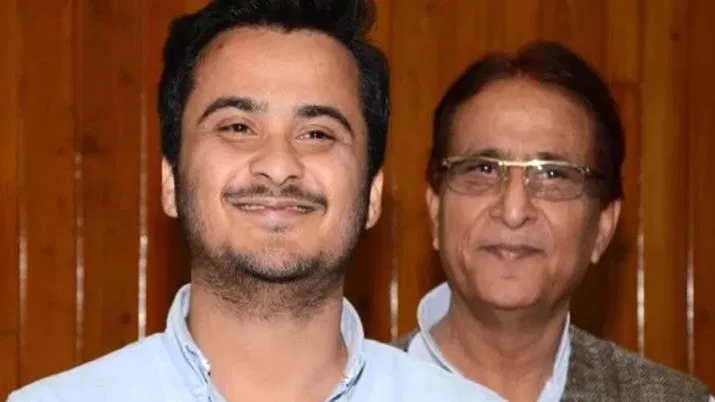
The Supreme Court has rejected Abdullah Azam Khan’s review petition challenging its order upholding Allahabad High Court’s verdict disqualifying the former legislator for not having attained the minimum qualifying age on the date of the election.
“We make it clear that what has been observed by this court is with reference to the election petition assailing the election of the returned candidate (Mohammad Abdullah Azam Khan) from 34, Suar Assembly Constituency of District Rampur,” the apex court stated.
The court further stated that the result of the election was declared on March 11, 2017, and the criminal cases, if any, pending in reference to the same subject may be decided on their own merits.
“The review petitions are accordingly dismissed,” a bench of justices Ajay Rastogi and BV Nagarathna said in an order delivered on November 7, 2022.
The Supreme Court ruled that there was no manifest error by the Allahabad High Court, which annulled Samajwadi Party leader Azam Khan’s son Abdullah Azam Khan’s election as Uttar Pradesh MLA, and it did not require any intervention by the top court.
“The present review petitions have been filed against the final judgment dated November 7, 2022. We have perused the review petitions as well as the connected papers’ support thereof and find no manifest apparent error on the face of the record. In our opinion, no case for review is made out,” the court said.
The top court turned down the appeal filed by Abdullah Azam Khan challenging his disqualification as MLA by the Allahabad High Court order on the ground that he was underaged and not qualified to contest the poll in 2017. The Allahabad High Court had declared the election of Azam Khan’s son from the Suar Assembly segment of Rampur district null and void as he was less than 25 years of age. Abdullah Khan was elected as MLA on an SP ticket on March 11, 2017.
“In the instant case, the date of birth of the appellant throughout in his records is January 1, 1993, and only in the year 2015 when the appellant became keen to enter into active politics, the mother of the appellant submitted an application for the first time on January 17, 2015, claiming that the appellant was born on September 30, 1990, and birth certificate may be immediately issued to her and within three days, the birth certificate was issued by the Nagar Nigam, Lucknow on January 21, 2015,” the HC had noted earlier.
“In support thereof, the documentary evidence which the appellant has placed on record obtained from the Queen Mary’s Hospital, Lucknow, as a foundation on which the birth certificate has been issued as alleged from the Nagar Nigam, Lucknow, in our considered view, no probative value could have been attached to it,” the court had noted. “The High Court, in our considered view, has examined the documentary and the oral evidence available on record in extenso, we find that no manifest error was committed by the High Court in passing the impugned judgment, which may call for our interference,” it said.
Section 13(3) of the Registration of Birth and Death Act, 1969, clearly postulates that delayed registration of birth and death is permissible provided the procedure prescribed has been followed after taking orders from the Magistrate and proving the correctness of the date of birth, the court had observed.
Noting that the defence of the appellant is that since his name was already registered in the records of Nagar Nigam, Lucknow, Section 13(3) of the Registration of Birth and Death Act, 1969 may not apply, the HC said this submission appeared to be misplaced.
(This news report is published from a syndicated feed. Except for the headline, the content has not been written or edited by OpIndia staff)
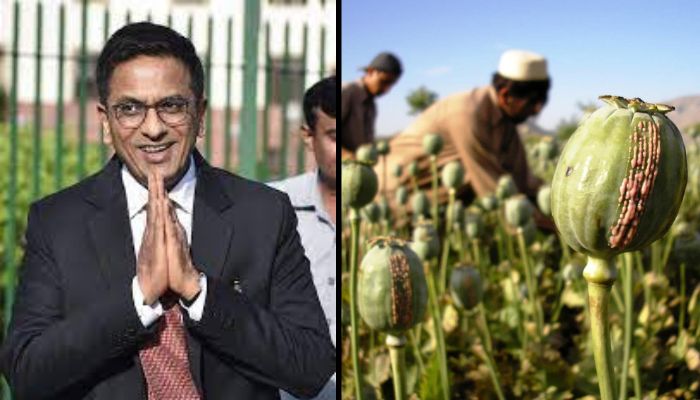
On Friday (February 10), the Supreme Court of India granted bail to one Sabir, who was accused of illegally cultivating 8 kg of opium in Madhya Pradesh.
The matter was heard by a Bench headed by the Chief Justice of India, DY Chandrachud. While granting the accused bail, the apex court remarked, “What are you doing about real offenders who are running international syndicates? “
“Try and catch them and then save the people…You are catching small-time peddlers, farmers, etc but the not real culprit,” it further remarked. Sabir was booked under the Narcotic Drugs and Psychotropic Substances Act, 1985.
#cjichandrachud : Stop running behind these small peddlers, do something about those who are running these international rackets..#SupremeCourt#drugs
His bail application was opposed by the Additional Solicitor General (ASG), Vikramjit Banerjee, who pointed out that Sabir had previously been convicted twice.
The Supreme Court noted that Sabir had served 5 years in jail for an offence that carried a maximum punishment of 10 years and was thus ‘entitled’ to bail. The apex court rejected the argument of ASG and claimed that opium was not found in a car/ truck but in the agricultural land of the accused.
The Background of the Case
The case (titled Sabir Vs State of Madhya Pradesh) dates back to March 1996 when Sabir and his father Hamid were caught cultivating poppy opium in excess of the area, which was originally licenced to them.
“It was found that accused Sabir had planted poppy plants exceeding 10 array land for which he was licensed to produce the opium poppy. The raiding party also found that the crop of opium poppy has been attributed from the exceed area and kept concealed in the Nala near his field,” the prosecution had revealed.
“During the inspection, the search team come to know that after lancing, the opium collected by the accused persons from the illegally cultivated poppy have been kept in their house and neither this excess area nor the opium collected out by this excess area has been entered into the records of the Village Lumberdar,” it added.
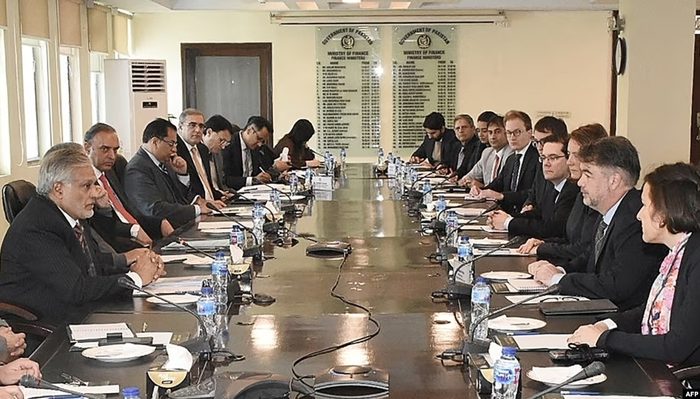
In a major blow to a cash-strapped Pakistan, the talks for a much-needed bailout package between International Monetary Fund (IMF) and Pakistan have failed, posing a serious question on the country’s ability to repay international loans. Pakistan is talking with IMF on a $1.1 billion funding round, which is part of a $6.5 billion bailout package signed in 2019. While an IMF team was in Pakistan to discuss the deal, the talks collapsed as they failed to reach a staff-level agreement within the stipulated time.
The development comes as talks between the IMF and Pakistan, which took place from January 31 to February 9 in Islamabad, came to an end. The IMF delegation had arrived in Islamabad to meet with the Pakistani authorities. However, despite not reaching an agreement, the two parties have decided to continue the talks on the bailout deal via video calls.
IMF Pakistan Mission Chief Nathan Porter stated in a statement that “Key priorities include strengthening the fiscal position with permanent revenue measures and reduction in untargeted subsidies, while scaling up social protection to help the most vulnerable and those affected by the floods; allowing the exchange rate to be market determined to gradually eliminate the foreign exchange shortage; and enhancing energy provision by preventing further accumulation of circular debt and ensuring the viability of the energy sector. Virtual discussions will continue in the coming days” and added that significant progress had been made.”
Ishaq Dar, the finance minister of Pakistan, was scheduled to hold a press conference to announce the program’s resumption, which was not held.
Despite the inconclusive meeting in Islamabad, Pakistan is convinced that the deal will go through and IMF will sanction the funding after resolving the issues. Finance minister Ishaq Dar told reporters that Pakistan has agreed with the IMF on the conditions to release the funds. He said that talks with the IMF would resume virtually on Monday, and the delay in reaching an agreement was due to “routine procedures.” Dar further said they will implement whatever has been agreed upon between their teams.
Hamed Sheikh, Pakistan’s secretary of finance, stated in a statement on Thursday that “Actions and prior actions have been agreed but the staff level agreement will be announced subsequently.” He further said, “The discussions with the IMF are now over. The MEFP (Memorandum of Economic and Financial Policies) paper has been given to Pakistan by the IMF,”
Credibility crisis
The IMF was unwilling to completely trust Pakistan this time due to a credibility crisis and has established certain prerequisites. The Pakistani govt failed to provide adequate and convincing assurances to the IMF mission, which resulted in the failure of the staff-level talks.
IMF has set several conditions to release funds under the bailout package, and while Pakistan has implemented some of them, IMF is still not convinced. Some of the conditions include a return to a market-based exchange rate and higher fuel prices, which were implemented recently, causing massive inflation and a surge in fuel prices. Pakistan has also agreed with the IMF to introduce fiscal measures, including new taxes.
The IMF raised its concerns at the policy-level discussions about the projections presented by Pakistan’s Ministry of Finance regarding the inflows of external financing from multilateral, and bilateral creditors, and commercial loans.
Shehbaz Sharif, the prime minister of Pakistan, and Nathan Porter, the head of the IMF mission, had a virtual meeting in order to resolve the impasse.
Reportedly, the IMF has sought assurances from China, Saudi Arabia, and the United Arab Emirates about the fulfilment of the loans they had committed to providing to Pakistan.
Since its foreign exchange reserves have dropped to just $2.9 billion, the lowest level since February 2014, Pakistan urgently needs the staff-level agreement and subsequent board approval for the ninth review to release $1.1 billion. The country needs at least $7 billion to pay off its external debt, but the reserves are not sufficient to finance imports even for two weeks.
The State Bank of Pakistan (SBP) said in a recent weekly statement that the week ending February 3, 2023’s external debt repayments caused the country’s foreign exchange reserves to drop by $170 million to $2,916.7 million (or $2.92 billion).
The risk of failing to repay foreign debt has increased due to the concerning levels of Foreign exchange reserves. Pakistan’s finance minister despite the declining forex reserves was hopeful that the country will be able to conclude the IMF bailout programme however, things did not go as he thought.
The staff level agreement is the first but most crucial step in asking the IMF board for permission to finish the 9th assessment.
As per Pakistani media reports, a cash-strapped Pakistan government removed the dollar cap to the conditions laid down by the International Monetary Fund. It resulted in the historic fall of Pakistani currency in the interbank market. Currently, it is trading at 277.81 Pakistani rupees per US Dollar. Removing the dollar cap was one of the conditions to resume the bailout. Other conditions included easing fuel subsidies and more. The letters of credit (LCs) were also restricted by the government amidst the falling foreign exchange reserves.
Economic crisis in Pakistan
Pakistan is experiencing its worst economic crisis in years as the country is dealing with a shortage of food, a shortage of power, sky-high inflation, and a collapsing currency. The economy of Pakistan has been spiraling out of control due to the vicious cycle of debt and partial payments.
In addition to running out of money, Pakistan has also run out of flour to feed its population, and the country is facing massive power cuts as well.
As the government of Pakistan failed to end the economic crisis in Pakistan, over 7 million workers in its textile industry have been laid off. The country’s textile associations have blamed the mass layoffs on the Shehbaz Sharif government’s incompetence and shrinking exports.
Even in the midst of the severe economic crisis, it was reported that the Pakistani government was importing expensive luxury BMW cars for its cabinet ministers instead of focusing on measures to increase exports.
With expanding debt, rising energy import costs, depleted foreign reserves, political instability, a protracted decline in GDP growth millions losing jobs, the country desperately needs a bailout.
The situation in several cities of Pakistan is so grave that flour is being rationed and guarded by armed guards. Prices of flour and wheat have witnessed a dramatic surge.
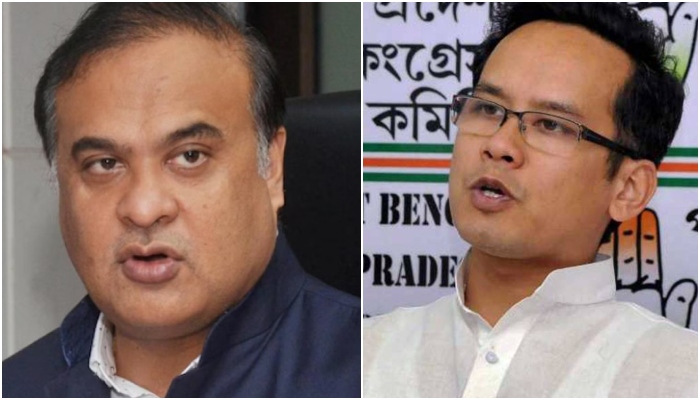
On Friday, Congress MP Gaurav Gogoi criticized the Assam government’s ongoing crackdown on child marriages in a bizarre argument. He said that the minor victims of child marriage who are already impregnated by their ‘husbands’ are scared of the campaign and so are not seeking medical help during their pregnancies. He said that the pregnant girls are not going to doctors as they fear that their husbands and fathers might get arrested.
“Girls under 18 who are pregnant are choosing to deliver their child at home, not going to the hospitals because they are afraid of getting their fathers and husbands arrested,” Congress MP Gogoi said on February 10.
“Today, we got to know a teenage mother died because she bled to death due to complications during childbirth in the absence of community and ASHA workers. Even ordinary families feel that ASHA workers will report the matter to govt and local police,” he added blatantly attempting to defend the child marriage practice in the state.
Delhi | Today, we got to know a teenage mother died because she bled to death due to complications during childbirth in the absence of community & ASHA workers. Even ordinary families feel that ASHA workers will report the matter to govt & local police: Gaurav Gogoi, Congress MP pic.twitter.com/VDfoN01UoQ
This is reportedly a day after a 16-year-old pregnant minor woman lost her life while she was on the way to a hospital in Assam’s Bongaigaon district. The family members of the girl tried to execute her delivery at home amid the massive crackdown but her health deteriorated. She was rushed to Chalantapara health center. From there, the medical authorities recommended her to Bongaigaon hospital.
The minor girl could not bear the labour pain and breathed her last while on her way to the hospital. The police took cognizance of the incident and arrested the girl’s husband and father. The duo has been identified as Sahinur Ali and Aynal Haque.
Gogoi’s argument sought to justify not only child marriages, which are already illegal under Indian law but tried to twist the horrific scene where the families of those minor girls are keeping them away from basic medical facilities to cover up their own misdeeds. Surprisingly, being a lawmaker himself, Gogoi tried to oppose the government’s crackdown on illegal child marriages while batting for families who are subjecting underage girls to life-threatening pregnancies and childbirth without the slightest consideration for their health.
The Assam government launched a campaign to eliminate the practice of child marriage in the state and said that action would be taken against the family members, pujaris, and Kazis involved in child marriage. Accordingly, the state police arrested around 2528 persons for their involvement and alleged participation in child marriage and further declared such marriages as illegal.
The government earlier stated that there are more than 4074 cases filed amid the campaign and actions would be taken against all the accused involved. As reported earlier, there are around 8000 accused named in around 4074 cases from across various districts of the state.
According to the data provided by the state, among the 4074 cases, the largest number, 370, has been registered in the Dhubri district. Following that are 255 in Hojai, 235 in Uddalguri, 224 in Morigaon, 204 in Kokrajhar, and 192 in Guwahati. Hailakandi has the lowest case with just 1.
The crackdown on child marriage was started after the Assam govt in a January 23 cabinet meeting announced that strict measures will be implemented across the state to keep a check on the spike in child marriages in the state. The government had said that legal action against men who marry girls below 14 years of age would be initiated under the POCSO Act and the Prohibition of Child Marriage Act. Similarly, action will be taken under the prevention of child marriage act in cases where the age of the bride is between 14 and 18 years.
The cabinet also decided to designate all 2,197 Gram Panchayat Secretaries to as ‘child Marriage Prevention (Prohibition) officers’ under The Prohibition of Child Marriage Act, 2006 to reduce Infant Mortality Rate & Maternal Mortality Rates and prevent child marriages in rural areas. The CM said that the move was based on a thorough discussion of the National Family Health Survey (NHFS) 5 by the state government.
Earlier even as Assam police started nabbing people accused in child marriage cases, some people attempted to flee from the state. Many Qazis accused of performing the marriage of minors have also disappeared from several places.
On the 2nd of February 2023, Maharashtra Anti-Terrorist Squad (ATS) filed a charge sheet against 5 PFI terrorists, who were arrested during nationwide raids against the proscribed Islamic organization, for being involved in unlawful activities and conspiracy against the nation. The five accused – Mazhar Khan, Sadiq Shaikh, Mohammad Iqbal Khan, Momin Mistry, and Aasif Hussain Khan were arrested by the Mumbai unit of the Maharashtra ATS for their association with PFI.
Brief facts about the crime are given in the charge sheet
Briefing the facts about the crime, the charge sheet submitted by the anti-terrorist squad said, “Mr Rohit Raviraj Rasam, Assistant Inspector of Police, Anti-Terrorism Squad, Kala Chowki, Mumbai received confidential information that Sheikh Sadiq Qureshi, Mazhar Khan, Momin Moinuddin Ghulam Hussain alias Mohan Mishri Mahal Wahim Khan, Mohammad Asif Adhikari, and others, members of the Popular Front of India, were conspiring to revolt against the Government of India. On 17/02/2022, the Popular Front of India held events at Dharavi, Kurla, Chembur, and Trombay in Mumbai, and Nerul, Panvel in Navi Mumbai. Similarly, on 15/04/2022, events were held at Mumbra, District Thane, and on 03/06/2022 at Trombay and Vashi Naka. After these events, the above-mentioned accused and others have planned to carry out anti-national activities by holding secret and open meetings from time to time.”
Giving more details about the conspiracy, Maharashtra ATS mentioned in the charge sheet, “According to this plan, the aims of the above-mentioned persons are to establish the rule of Islam in India by bringing the majority community of India under their own control, as well as to implement sharia law instead of the constitution of India in this conspired Islami state; to create hatred among the youth of the Muslim community towards other classes by spreading propaganda about the atrocities being committed on the Muslim community in India.”
“At the same time, they are working to erase their identity as Indian citizens in the minds of Muslim youth and only to establish the identity of Muslims on the basis of religion. In the same way, they are conspiring to create an atmosphere of terror and fear in society as well as in the minds of their opponents who are coming in the way of their above-mentioned objectives by using violence against them. They imparted physical training to selected youth of the community to serve their purpose,” the charge sheet read.
The charge sheet added, “These persons plan to get weapons and ammunition and use them in the future to serve their purposes. They also intend to overthrow the law-based polity in India by taking foreign or foreign aid and disrupting Indian sovereignty and integrity. Of the above-mentioned accused, Sheikh Sadik Qureshi and Mohammad Asif Adhikari know about the loopholes in legal matters mentioned above and guide them. Mazhar Khan works to identify young people who can commit anti-national activities and involve them with the PFI organization. Momin Moinuddin Ghulam Hussain alias Moin Mistry has technical knowledge of computers, and mobiles and he imparts to his colleagues the knowledge about how to keep mobiles and other devices safe from the supervision of investigative agencies. Mohammad Iqbal Ibrahim Khan works to provide physical training to his colleagues.”
Charges framed against the accused
The charge sheet reads, “All the five arrested accused, along with other office-bearers of the Popular Front of India and Madrasa, conspired to impose Sharia law in India by bringing Islamic rule in India during the centenary year of India in 2047. In order to fulfil this planned conspiracy, the people of the Muslim community in India are provoked by whipping up sentiments against the majority Hindu community and against the country by sharing provocative speeches, video clips, posters, audio clips, and posts on WhatsApp, Instagram, Facebook and other such social media platforms inciting religious sentiments against the people of the majority Hindu community and the country.”
It added, “Also, taking advantage of the rift between the two groups, during the centenary celebrations of India in the year 2047, there is a conspiracy to impose Sharia law in the country by disrupting Indian sovereignty and integrity and overthrowing the state system established in India according to the constitution and bringing religion-based Muslim power in India.”
The charge sheet further reads, “Pretending that the Popular Front of India is working for the welfare of the people, the Popular Front of India is bringing together more and more Muslims under the banner of this organization and in the name of recruiting its youth for joining the police and the army, giving physical training to the youth in lathi-sticks, swordsmanship, karate, during the training, the trainees are changing their minds against the majority of Hindus as well as against the BJP-sponsored government.”
The charge sheet says that PFI is also creating anger in the minds of Muslims against the national-level political party BJP, its government that is democratically elected with a clear majority according to the Constitution, and Prime Minister Narendra Modi by circulating provocative speeches, video clips against the government through social media in the Muslim community.
The charge sheet also says “Investigations have revealed that electronic devices such as mobiles, laptops, etc. from the office bearers and members of the PFI organization are being cleaned from time to time by the PFI members with technical knowledge so that the investigators or the confidential branches do not get the information of this conspiracy, as well as the leaflets of topics taken up for discussion during the meeting of the Popular Front of India (SYNOPSIS) are being destroyed from time to time so that the confidential branches do not get access to them.”
The anti-terrorism squad concluded in its charge sheet, “According to the planned conspiracy, in order to create a sense of hatred against the majority Of Hindus in the minds of the people of the Muslim community, the office bearers and members of the Organization of the Popular Front of India are encouraging people from the Muslim community to commit crimes punishable with imprisonment by making various provocative speeches/statements as well as by giving provocative suggestions on how to make the agitation violent, how to attack the police in the agitation. Therefore they are charged under Section 120-B, 121-A. 153-A, 201, 116 of the IPC and Section 13(1)(b) of the Unlawful Activities (Prevention) Act, 1967.”
On Friday, the Supreme Court rejected the Hindu Sena’s public interest litigation (PIL). The plea sought a ban on the British Broadcasting Corporation (BBC) for airing the documentary ‘India: The Modi Question’, on the 2002 Gujarat riots, and launch an NIA probe into its plot to undermine India’s unity and integrity.
[BREAKING] Supreme Court dismisses Hindu Sena plea for ban on BBC, says cannot impose censorship
“The plea was ill-conceived, and the Court cannot impose censorship”, a bench of Justices Sanjiv Khanna and MM Sundresh ruled.
“Completely misconceived, how can this be argued also? You want us to put complete censorship. What is this”, the court asked. Senior Attorney Pinky Anand, a senior leader of the BJP, who represented the petitioner, was questioned by the court. “You are asking a court to force a decision,” the bench remarked.
Anand asserted that the High Court had overturned the ban in the “India’s Daughter” documentary about the Nirbhaya Case. She requested that the bench list the case along with the ones that are disputing the decision barring access to the documentary.
“Same thing happened in India’s Daughter. We have Kashmir. We had the Mumbai riots. Let it be heard,” Anand said requesting that the petitioner should be allowed to present his side.
“Let us not waste any more time, Writ plea is entirely misconceived. it has no merit. Thus, dismissed.” The court flatly refused to address the petition.
Vishnu Gupta, the national president of the Hindu Sena, filed the lawsuit through attorney Barun Kumar, claiming that BBC is to blame for spreading false information to undermine India’s integrated society and fomenting anti-India activities. A farmer from Muzaffarpur, Beerendra Kumar Singh, also requested an investigation into BBC’s reportage.
Gupta submitted, “The broadcast against India is selective and pointed to destabilize the integrity of India and divide the social integration of the country. Such an act in the name of free journalism cannot be permitted and therefore, such illegal, biased and divide and rule policy of the BBC requires complete banned from Indian soil.”
It was argued that the documentary film making false allegations against the current PM is reflective of both anti-Narendra Modi propaganda to damage his reputation and anti-Hinduism propaganda by the BBC to dismantle India’s social fabric.
It was also said that the BBC has held an anti-Indian stance ever since India gained its independence.
According to the plea, the BBC was previously prohibited from transmitting in India on August 29, 1970, by the Central Government, under the leadership of Prime Minister Indira Gandhi, as a result of the BBC’s cold war broadcasts against India.
Moreover, it had been mentioned that, since 2014, India’s general growth has accelerated under the leadership of Narendra Modi, something the anti-India lobby, media, and especially the BBC can not understand. The BBC has been prejudiced against India and the Indian Government as a result.
In his appeal, the petitioner said, that despite his representation to the Union Home Ministry on January 27 to outlaw the network, no action had been taken as of yet. It was affirmed, that the right to free speech under Article 19(1)(a) of the Constitution is not an absolute right but is qualified by Article 19(2).
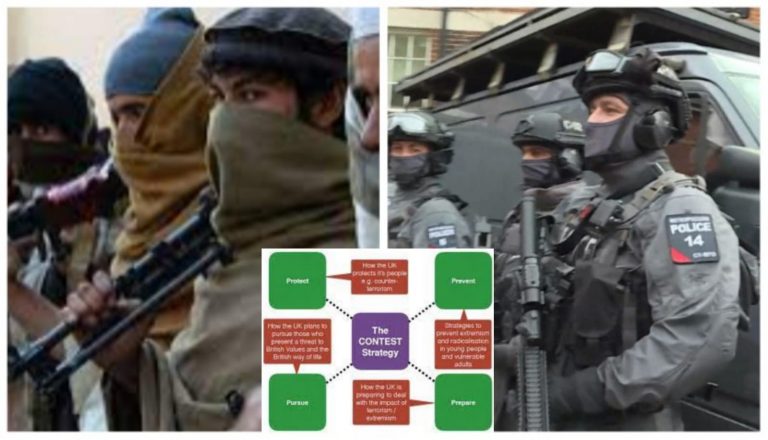
An assessment of ‘Prevent’, one of the four strands of the United Kingdom government’s anti-terrorism strategy ‘Contest’, released on Wednesday has declared Islamist terrorism as the “primary threat” to the country, “consistently accounting for the majority of terrorist attack plots both carried out and thwarted by the intelligence services.”
Further noting that currently, 80 per cent of the Counter-Terrorism Police network’s live investigations are Islamist, the report offered recommendations to combat it.
‘Prevent’ is one of the four main areas of the UK government-led programme- Contest, to prevent British people from being drawn into terrorism. The other three strands of the program are: Pursue, Protect and Prepare.
The independent review of the UK’s scheme to prevent terrorismwas carried out by Commissioner for Public Appointments William Shawcross and published Wednesday (February 8).
Islamist terror termed the deadliest and greatest threat in UK
The report identified pro-Khalistan extremism and the radicalisation of British Muslims by rhetoric emanating from extremist clerics in Pakistan relating to blasphemy and Kashmir as among the emerging terrorist threats facing Britain.
The report cautioned that Pakistani rhetoric is “inflaming anti-India feeling, particularly around the subject of Kashmir” in UK Muslim communities. It also warned against a false narrative being spread by a small number of pro-Khalistan groups operating in the UK.
“There is an element of crossover between those who seek to impose limits around blasphemy with those who voice incendiary rhetoric on Kashmir. I have seen evidence of UK extremist groups, as well as a Pakistani cleric with a UK following, calling for the use of violence in Kashmir. I have also seen evidence demonstrating that flashpoints related to Kashmir lead to a significant surge in interest from UK Islamists,” Shawcross said in the review.
On the issue of pro-Khalistan extremism, the report added, “Prevent should also be mindful of pro-Khalistan extremism emerging from the UK’s Sikh communities. A false narrative is disseminated by the tiny number of pro-Khalistan groups operating in the UK that the government is colluding with its counterpart in India to persecute Sikhs.”
“Such groups’ narratives glorify violence carried out by the pro-Khalistan movement in India. While the current threat is low, praise for violence overseas and a simultaneous belief in a state-led campaign of repression domestically is a potentially toxic combination for the future.”
Commissioner for Public Appointments William Shawcross, who carried out the review, suggested 34 recommendations to counter Islamist terrorism, which the report said remains the primary and the deadliest terrorist to the UK.
The review was commissioned by Priti Patel when she was home secretary, and current home secretary Suella Braverman has accepted all the recommendations.
Taking to Twitter, Suella Braverman said she intends to “swiftly implement” all of the recommendations from the review into the Prevent strategy. She said that the review underlined where real reform is required to strengthen the nation’s fight against radicalisation. The recommendations suggest a need to better understand the Islamist ideology which underpins the predominant terrorist threat facing the UK.
“For everyone to feel at home here, extremism must be rooted out”
“I wholeheartedly accept all 34 recommendations and am committed to quickly delivering wholesale change to ensure we are taking every possible step to protect our country from the threat posed by terrorism,” said Suella Braverman.
Islamic terrorism has become an emerging problem in the United Kingdom. Last year, amidst the anti-Hindu attacks in Leicester, British MP Bob Blackman had come forward in support of the community and raised concerns about the Islamist attacks in Leicester.
Attacks on Hindus in Leicester and Birmingham
The Hindu community in the UK, particularly in Leicester and Birmingham, is under attack by the Islamists. What initially appeared to be a clash between the two communities following the T20 match between India and Pakistan turned out to be a well-planned and well-organized attack on Hindus, their homes, businesses, and properties in Leicester.
Several arrests were made by the Police following the attack on Hindus in the city. Later, calls were made by the “Islamist influencers” to gather in Birmingham to circle a Hindu temple to mark a “peaceful protest” against an event where Sadhvi Ritambhara was scheduled to appear.
Despite the event being postponed a week before the scheduled date, the Islamists circled the Hindu temple, hurled abuses, and threatened to attack Hindus if they were followers of BJP and RSS.
On Friday, February 10, Indian Space Research Organisation (ISRO) achieved yet another milestone as it successfully launched its new offering, Small Satellite Launch Vehicle (SSLV-D2), from Satish Dhawan Space Centre at Sriharikota. The SSLV successfully placed the earth observation satellite-07 (EOS-07) and two co-passenger satellites — Janus-1 and AzaadiSat2 — in a 450-km circular orbit around the Earth in its 15 minutes flight at around 9:18 AM.
#ISRO launches Small Satellite Launch Vehicle #SSLVD2 carrying EOS-07and 2 co-passenger satellites Janus-1and AzaadiSAT-2 into 450km circular orbit pic.twitter.com/f6wxLLnGVJ
Taking to Twitter, the space agency informed about the success of the mission and wrote, “SSLV-D2/EOS-07 Mission is accomplished successfully. SSLV-D2 placed EOS-07, Janus-1, and AzaadiSAT-2 into their intended orbits.”
SSLV-D2/EOS-07 Mission is accomplished successfully.
SSLV-D2 placed EOS-07, Janus-1, and AzaadiSAT-2 into their intended orbits.
After the successful launch of the SSLV-D2, ISRO chief S Somnath said, “We now have a new launch vehicle. In its second attempt, SSLV has accurately placed the satellites in orbit. Congratulations to all three satellite teams. We had a near miss owing to a velocity shortfall during SSLV’s first flight. We have analyzed the issue, determined the corrective course of action, and qualified the system at a fast pace.”
“We have a new launch vehicle. SSLV, in its second attempt, has placed the satellites in orbit very accurately. Congratulations to all three satellite teams,” says ISRO chief S Somnath.#SSLVD2#Sriharikota#News@isro#ISROpic.twitter.com/NSFwJpdGLv
The launch takes place months after this LV’s first flight in August last year, which was partially unsuccessful due to an orbital anomaly and a divergence in the rocket’s flight path.
Small Satellite Launch Vehicle
The SSLV is the sixth launch vehicle that ISRO has designed and developed in a bid to share the burden of the Polar Satellite Launch Vehicle (PSLV) and to cater to the small satellite launch market.
SSLV offers a “launch-on-demand” facility for smaller satellites weighing up to 500 kg into low Earth orbit. It offers low launch infrastructure requirements, quick turnaround times, flexibility in accommodating multiple satellites, and affordable access to space. It is set up with a velocity terminal module and three solid propulsion stages. It is a 34 m tall, 2 m wide, and 120 t lift-off mass vehicle.
The SSLV has the capability to launch mini, nano, or microsatellites weighing between 10 and 500 kg into a 500 km planar orbit. It is a three-stage vehicle with a velocity trimming module (VTM) at its terminal stage that is based on solid and liquid-based propulsion.
It is notable that a launch vehicle is declared operational only after it completes two successful development flights. The GSLV Mk III, now known as LVM 3, was the latest launch vehicle to be deemed operational when it carried Chandrayaan-2 in 2019. The Launch Vehicle Mark 3 (LVM3) is ISRO’s latest medium-heavy lift launch vehicle and the space agency’s heaviest rocket. The rocket, formerly identified as the Geosynchronous Satellite Launch Vehicle Mark III (GSLV Mk III), is designed to primarily launch satellites into geostationary orbit at 35,000 kilometres.
In October last year, ISRO launched the LVM3-M2, on its debut commercial mission. The rocket carrying 36 satellites was launched from Satish Dhawan Space Centre in Sriharikota as part of the space agency’s OneWeb India-1 mission.
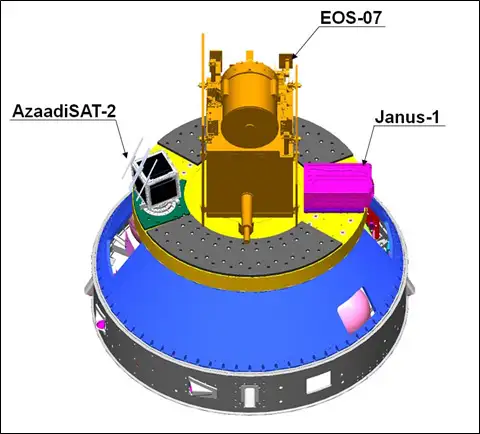
The SSLV successfully placed three satellites in orbit, ISRO’s earth observation satellite-07 (EOS-07), and two passenger satellites Janus-1 and AzaadiSat2. Janus-1, a 10.2 kg satellite, belongs to ANTARIS, USA. About 750 girl students from all over India collaborated to develop the 8.7 kg satellite AzaadiSAT-2 under the direction of Space Kidz India, Chennai.
Earth Observation Satellite-07
The 156.3-kilogram EOS-07 satellite was designed and developed by ISRO, and it was manufactured at the U R Rao Satellite Centre in Bengaluru. The Earth Observation Satellites are used to gather high-quality images which are used in various applications such as Agriculture, Forestry & Plantation, Soil Moisture & Hydrology and Flood mapping. The new experiments added in the EOS-07 are mm-Wave Humidity Sounder and Spectrum Monitoring Payload.
The EOS-07 satellite has two solar arrays and Li-ion batteries to power it.
Payloads accommodation in SSLV-D2 (Image via ISRO)
Janus-1
The smart satellite mission Janus-1 is a technology demonstrator built on the US-based Antaris software platform in partnership with India’s XDLinks and Ananth Technologies. . It demonstrates a modular bus, multiple tenant payloads, onboard edge computing, programmable smart EPS, secure telemetry, tracking, and control (TT&C), as well as digital twinning with SaaS platform. It is noteworthy that TT&C is a subsystem of a satellite that connects the satellite to the ground-based facilities.
Janus-1 satellite (Image via Antaris)
A press release by Antaris describes JANUS-1 as a 6U or six-unit CubeSat satellite that has five separate payloads running on its ‘SatOS’ satellite software once in orbit. The JANUS-1 satellite was primarily manufactured by XDLINX Labs and Ananth Technologies, with ground station services supplied by ATLAS Space Operations.
AzaadiSAT-2
AzaadiSAT-2 is aimed at demonstrating LoRa and amateur radio communication capabilities, measuring radiation levels in space, and also demonstrating expandable satellite structure.
The payloads have been built by 750 girl students from across India. In August of last year, SpaceKidzIndia, an aerospace startup had launched a similar satellite aboard SSLV-D1. Although the payloads are still LoRa amateur radio, a radiation level sensor, and sensors to gauge the satellite’s health including temperature, reset count, and inertial data, but this second satellite has an extra function.
AzaadiSAT-2 (Image via SpaceKidzIndia)
The satellite has been made expandable by SpaceKidzIndia. The satellite uses a novel expansion technique to expand eight times bigger after it has reached orbit, giving it the ability to generate four times as much power as it can in a stowed configuration.
The satellite carries the G20 logo to space and the NCC song to celebrate 75 years of the organization. Devi Sri Prasad, better known by his stage as DSP, wrote the “space song” about rural Indian girl students and children of rural India to dream and inspire of becoming Space Scientists. A song that shows the journey of a village girl to Space in her Dream. The satellite also carries the G20 logo as India holds its presidency this year.
In 2047, India will complete 100 years of independence from the British and by extension, it will also complete 100 years of the deadly partition that tore India into two – Islamic Pakistan and “secular” India. In the run-up to 100 years of the partition, a nefarious design seems to be unfolding, where Islamists and Leftists seem to be actively pushing India towards circumstances which led up to the first partition of India.
In July 2022, OpIndia exclusively covered the details of a document that was being circulated by PFI to its members. The document, ‘Vision 2047’ detailed the roadmap to Ghazwa-e-Hind – a plan to turn India into an Islamic nation by the year 2047. The document had, in excruciating detail, the plans to radicalise Muslims, create a nexus between SC/ST Hindus, especially Dalits and Muslims, replace the Indian Constitution with Sharia, commit genocide of Hindus and turn India into an Islamic nation.
On the 2nd of February 2023, Maharashtra Anti-Terrorist Squad (ATS) filed a chargesheet against 5 PFI terrorists, who were arrested during nationwide raids against the proscribed Islamic organisation, for being involved in unlawful activities and conspiracy against the nation. The five accused – Mazhar Khan, Sadiq Shaikh, Mohammad Iqbal Khan, Momin Mistry and Aasif Hussain Khan were arrested by the Mumbai unit of the Maharashtra ATS for their association with PFI.
The 5, who have now been chargesheeted, were among 20 others who were arrested by Maharashtra ATS. Over 100 terrorists associated with PFI have been arrested by multiple agencies since the crackdown against PFI started.
The chargesheet filed against the 5 accused by Maharashtra ATS spans over 600 pages and details how the accused were working towards turning India into an Islamic nation by 2047. The Vision 2047 document, which was detailed exclusively by OpIndia back in July 2022 was also attached to the chargesheet as a document recovered from the accused during raids.
The chargesheet contains chilling details of the nefarious designs by the PFI and how its operatives were working to fulfil those plans.
The chargesheet makes the following revelations about the 5 accused, who were office bearers of PFI:
PFI and the Islamists working with the terror organisation were conspiring against the state.
Secret meetings were held by PFI members at Chembur, Dharavi, Kurla, Thane, Nerul, Panvel and Mumbra in Maharashtra. In these meetings, they planned how to work against the state and also hatched theories to radicalise Muslims and turn India into an Islamic Nation by 2047.
PFI had planned to induct Muslims, convince them that the state was working against Islam and mobilise them against Hindus.
PFI intended to work towards replacing the Constitution of India with Islamic Sharia.
They wanted to turn India into an Islamic State.
They wanted Muslims to only be identified as ‘Muslims’ and not Indians.
PFI pushed the propaganda of Muslims being in danger and atrocities being heaped upon them. Using this trope, they wanted to train Muslims to use arms.
PFI wanted to raise money and take help from foreign organisations to subvert Indian democracy and fulful their plans to turn India into an Islamic Nation.
Two of the accused had knowledge of law and would guide the team accordingly.
One of the accused was against the task of recruiting Muslim youth.
2047 is not just a deadline that is being given by the PFI, but even the Leftists, under the garb of social justice, are peddling a similar agenda of creating unrest in India.
On the 8th of February, author and academician Rajiv Malhotra tweeted about an event being held at Harvard where India would be on trial over ‘caste’. He tweeted that many Indian donors were sponsoring this event.
Happening at Harvard. India on trial over caste. This conf is sponsored by many Indian donors. pic.twitter.com/FR3EBc3P8j
The event, which is to be held on the 11th of February 2023, has been titled India Conference at Harvard 2023. The event brief on the Harvard website says:
Organized entirely by students at Harvard University, the 20th edition of the annual India Conference at Harvard is taking place on the weekend of February 11-12, 2023, at the Harvard Kennedy School and Harvard Business School. The conference will be in-person with some panels in a hybrid/ virtual format. As India completes 75 years of independence and looks forward to the next 25 years, the theme for the conference is “Vision 2047: India at 100 Years of Independence”. There will be panels covering topics on policy, business and culture. The conference is supported by our title sponsor WNS, and additionally by contributions from Zydus and The Lakshmi Mittal and Family South Asia Institute at Harvard University.
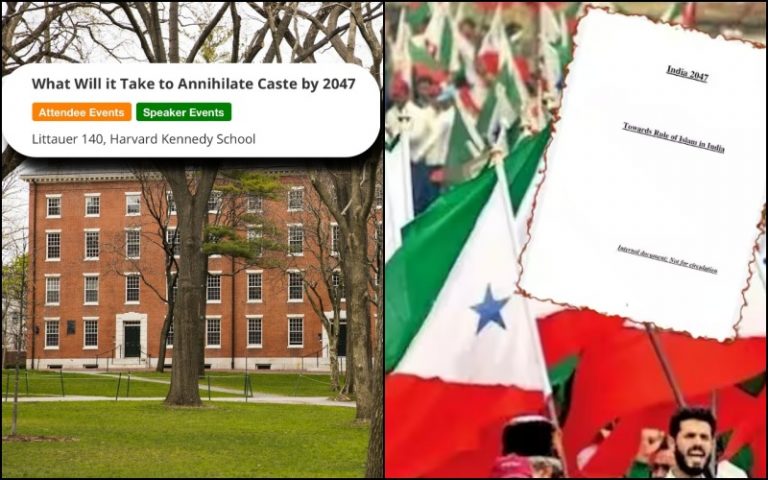
One of the panel discussions that is to take place during the annual India Conference at Harvard is titled, “What will it take to annihilate caste by 2047”.
Screenshot from the Harvard event schedule
The speakers who are included in this panel have often peddled the usual tropes that break the unity of India and peddle the same trope against Hindus as the PFI does.
Satyendra Kumar, the co-founder and Director of the Centre for Social Equity and Inclusion (CSEI) and National Youth Equity Forum (NYEF). A quick look at his Twitter profile would reveal which side of the fence he sits on.
Days before the Delhi Anti-Hindu riots broke out, which were specifically aimed to “teach Kafirs a lesson”, Kumar had tweeted that they will not let the govt implement CAA.
ना तो हम CAA-NPR-NRC आने देंगे, ना ही मोदी को ज़िम्मेदारी से भागने देंगे ! https://t.co/KHfzH448tG
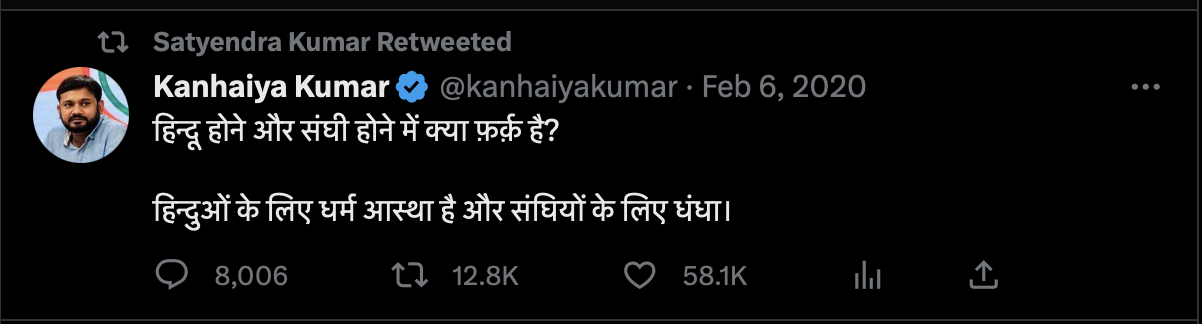
He had also retweeted Kanhaiya Kumar who had furthered the same trop as PFI and several other Islamists, trying to demonise Hindus.
Tweet retweeted by Satyendra Kumar
The other panellist for the talk, Dalit author Chandrabhan Prasad is a veteran of spreading propaganda. In 2018, when a well-funded, organised riot, by the Naxals broke out after the Bhima-Koregaon event, Chandrabhan Prasad blamed the “orange brigade” for it.
The Elgar Parishad-Bhima Koregaon case pertains to an event organized at Shaniwar Wada called Elgar Parishad on December 31, 2017. The following day, i.e January 1, 2018, large-scale violence broke out at Bhima Koregaon, where lakhs of Dalits had gathered to celebrate the 200th anniversary of the Battle of Bhima Koregaon, won by the British Army—comprising mostly soldiers from the Dalit community—against the Peshwas in 1818.
An FIR was filed in connection with the violence on January 8 after which Pune Police kickstarted a probe into it. The Pune police continued the probe into the matter for 2 years after which the investigation was transferred to the National Investigation Agency in January this year. The agency said that incriminating documents and letters were found on the devices of some of the accused, tying their links to the banned CPI(M) group. The court has gone on the record to reiterate several times that the accused were attempting to break the unity of India and were furthering the agenda of the Maoists through violence.
He had also recently extended support to the Congress party and Rahul Gandhi.
The next panellist is Thenmozhi Soundararajan, the executive director of Equality Labs. Equality Labs is an extremely prominent anti-Brahminism Caste activism group in the United States. Twitter CEO Jack Dorsey had once stoked a massive controversy when he held an anti-Brahmin placard that said ‘Smash Brahminical Patriarchy’. Incidentally, that poster was designed by Thenmozhi Soundararajan, the Executive Director of Equality Labs. Equality Labs had collaborated with the Organisation for Minorities in India (OFMI), among other organisations, for a report titled ‘Caste in the United States: A Survey Of Caste Among South Asian Americans’. The OFMI was founded by Bhajan Singh Bhinder, a known ISI operative, and his puppet Pieter Friedrich was part of the organisation too.
Equality Labs holds great influence among the ‘Justice Democrats’ wing of the Democrat Party. They were campaigning hard against the Citizenship Amendment Act in the United States while accusing India of committing genocide with the hashtag ‘Stop Hindu fascism’. Equality Labs also campaigned hard against Amit Jani, who had worked in the Joe Biden campaign, accusing him of supporting ‘Hindu Fascism’.
Further testament to the Equality Labs’ influence among Justice Democrats is that they have worked with Congressman Ro Khanna for a seemingly benign project. Ro Khanna worked with them to introduce a resolution in celebration of the 129th birth anniversary of B.R. Ambedkar.
In a press statement, he said, “Bhimrao Ramji Ambedkar was a pioneer in the movement to make India a free, fair, and just society for everyone in it,” said Rep. Ro Khanna. “He mobilized a generation to push back against discrimination and to instead celebrate equality, human rights, and universal tolerance. Today, we stand at a moment in world history when we could all use more of that compassionate spirit. I’m proud to work with Equality Labs and South Asian Americans Leading Together (SAALT) to make this landmark resolution a reality.”
Equality Labs, Khalistani Poetic Justice Foundation and ISI operatives have found themselves on the same side of the fence several times and featured in the farmer’s protest toolkit as well. A detailed report can be read here.
Dalit author Yashica Dutt is also a panelist at the event. Apart from regularly dog-whistling against Hindus, she had also extended support to violent protests against CAA and attempted to shield the Muslim perpetrators.
There is a clear thread emerging:
‘Demonize’ protestors by characterizing them as exclusively Muslim (instead of Hindus, Sikhs + Christians)✓
Target Muslim-dominated areas + Muslim appearing protestors with brutal violence ✓
Even while Islamists had gone on a rampage against Hindus during the Delhi Riots, she had attempted to paint the Delhi Anti-Hindu riots as a pogrom against Muslims.
This is not all. Another event at the Harvard conference will predictably bash Hindus and whitewash the atrocities being met out to them by Islamists and paint the Muslim community as the victims.
Screenshot from the Harvard event schedule
The panel is titled, “Polarisation in India as it exists and building towards an ecosystem of tolerance as we turn 100”. The panel member is Harsh Mandar.
Harsh Mander of the Centre for Equity Studies, a foreign-funded NGO, apart from being associated with George Soros, Harsh Mander was also a member of Sonia Gandhi’s National Advisory Council which drafted the nauseatingly anti-Hindu Communal Violence Bill. He has also been very active in filing petitions in the Court and has found himself in the heart of the violent protests against the Citizenship Amendment Act.
Harsh Mander is a senior member of the Ara Pacis Initiative, an organization backed by the Italian Foreign Ministry that works in tandem with the Italian Secret Service as well. In other words, Harsh Mander is a member of an organization that is an arm of the State of Italy’s Foreign Policy. API is a weapon in the arsenal of the Italian State and Harsh Mander is a member of it. Through Radio Rozana, we learned that the API also collaborates with propaganda outlets funded by Western Powers, the purpose of which is to create a narrative in order to benefit the foreign policy objectives of the said power.
In India, Harsh Mander and his NGO the Karwan-e-Mohabbat have been very active in the protests against the Citizenship Amendment Act. Harsh Mander spoke on the ‘importance of solidarity’ and “how we can practice civil disobedience in today’s India”. Karwan-e-Mohabbat urged people to join the protests at Shaheen Bagh. He has landed himself in trouble after a video where he can be seen inciting Muslim mobs against the Indian State and judiciary went viral on social media. Details about his dangerous connections can be read here.
It is also pertinent to remember that in March 2020, OpIndia reported Harsh Mandar had attempted to incite violence by asking Muslims to take to the streets. “From now on, the decision will not come from the Supreme Court or Parliament. We saw what the Supreme Court did in Ayodhya, NRC and Kashmir matters. The SC has failed to honour secularism, equality and humanity. We will try fighting there too, but, the decision will not happen in neither Supreme court nor Parliament, it has to be made at the streets,” said Harsh Mander at Gate no. 7 of Jamia Millia Islamia University in Delhi. This was an undated video that had emerged when there was violence in Delhi by Islamist mobs against CAA.
As evidenced by the panellists in these two events, the Leftists who have been attacking India, its sovereignty and Hindus are now peddling their agenda at conferences that talk about what shape India must take by 2047. If that agenda is coupled with the PFI vision document, which aimed to turn India into an Islamic nation by 2047, it would not be a stretch to say that Islamists and Leftists seem to be working in tandem to create unrest in India and create circumstances that would mirror those that led to India’s partition and genocide of Hindus in 1947.
While the Islamists of PFI planned to directly slaughter Hindus and spoke about furthering the Muslim victimhood narrative to ensure that they could radicalise Muslims enough to achieve their aims, the Leftists, who are now delivering talks about India in 2047 at Harvard, seem to regularly shield Islamists and demonise Hindus, making the job of organisations like the PFI much simpler. With the ban on PFI, it is perhaps time to ensure that action is taken against the Leftists as well who act as the ideological backbone of Islamists and give them covering fire by demonising India, Hindus and everything it stands for.