Home Blog Page 2502

No, there is no specific scheme for Muslim prisoners, misleading reports in the media create confusion: Details

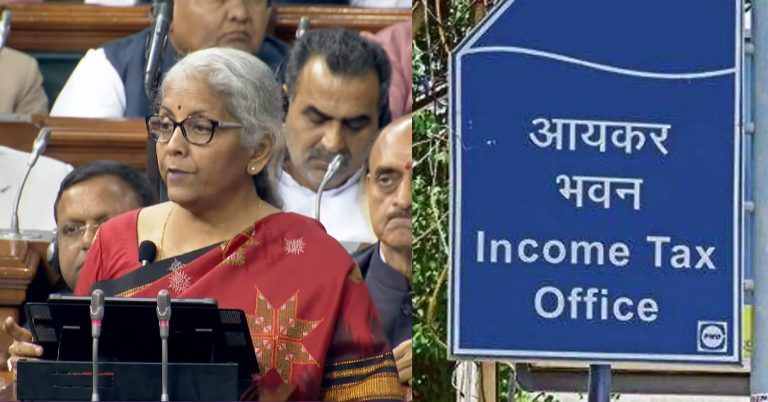
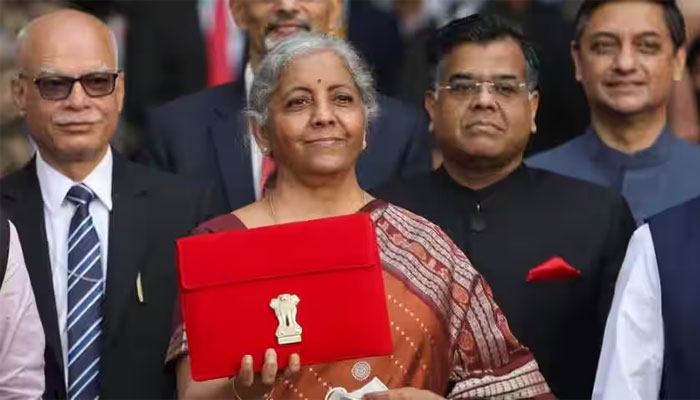
Confusion swept social media after media reports claimed that the Union Budget 2023 announced by FM Nirmala Sitharaman could help Muslim prisoners with release and bail amounts. 

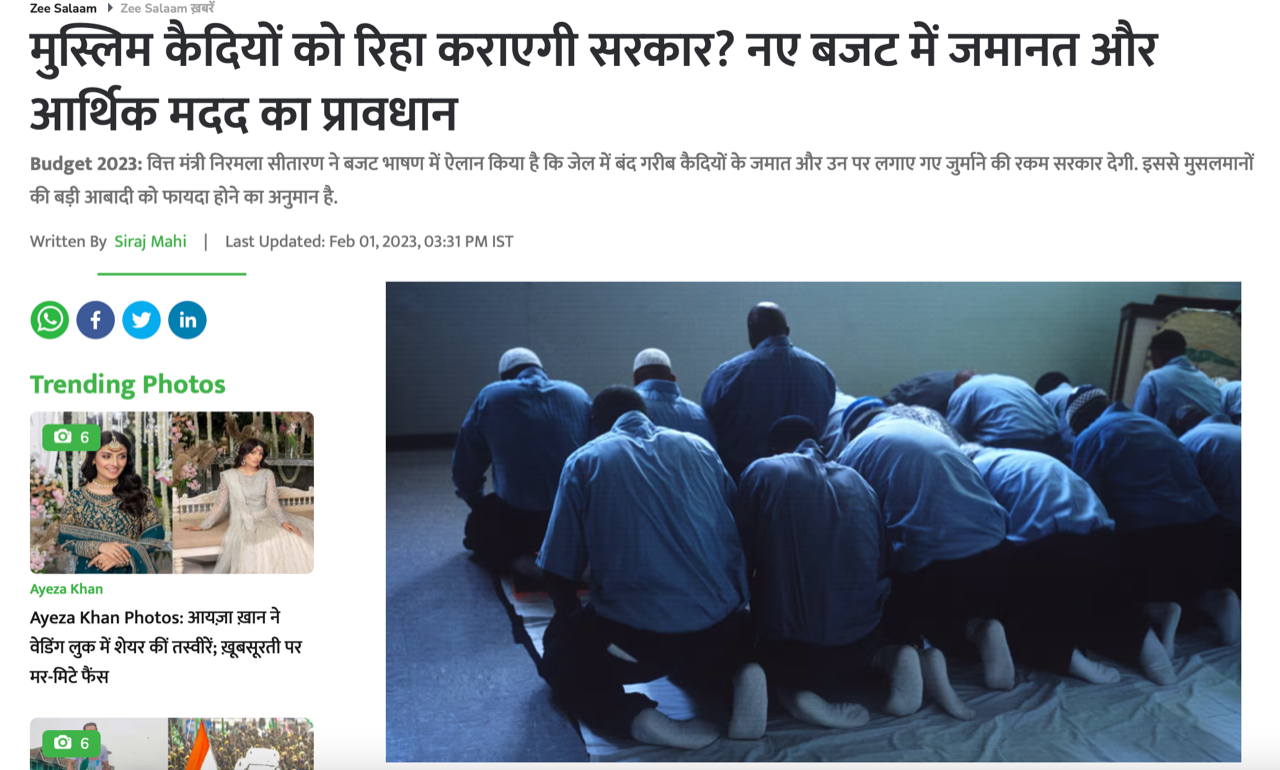
A report published in Zee News implied that the Centre’s new schemes for poor prisoners might end up helping Muslim inmates. 

Source: Zee News

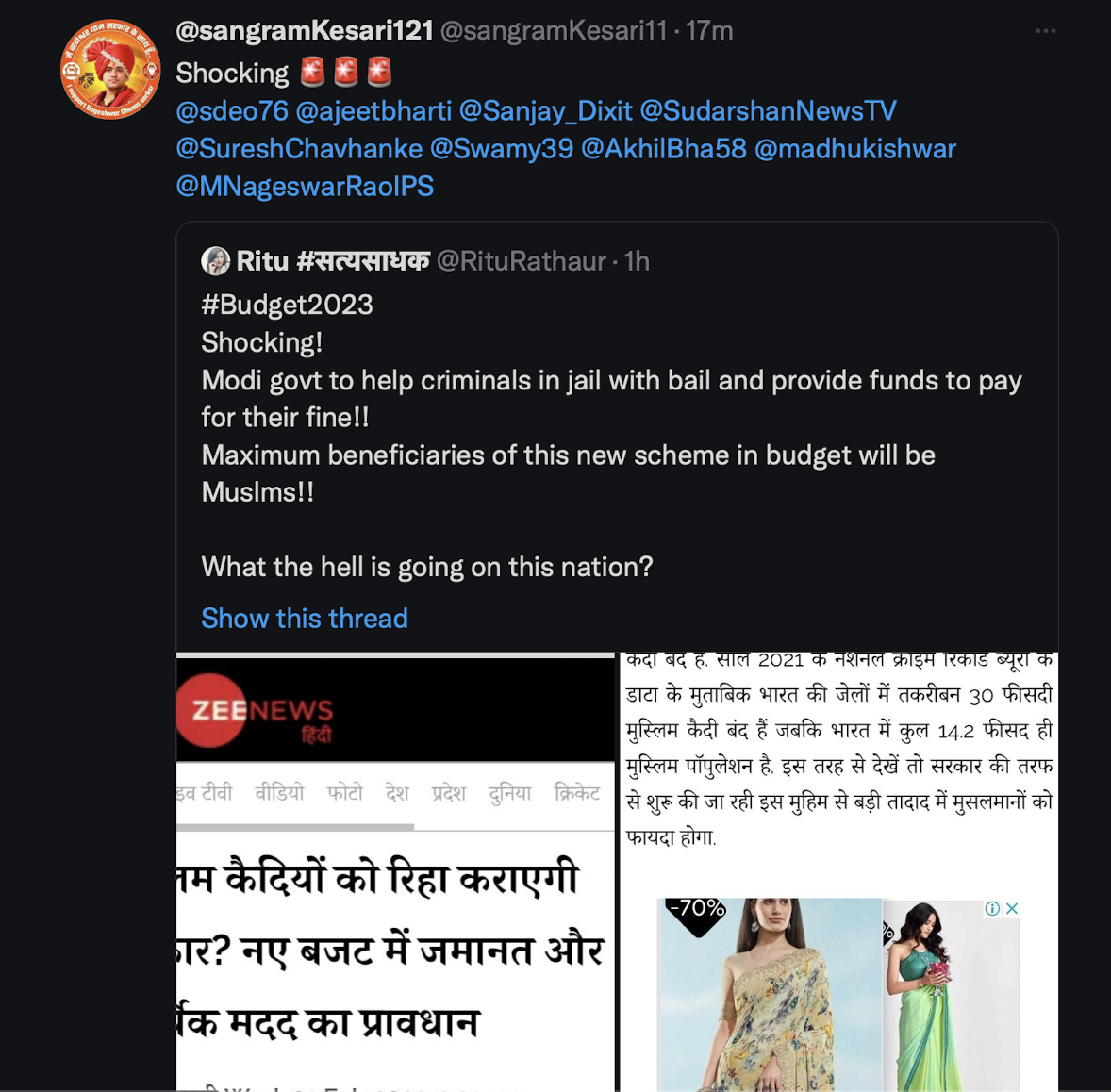
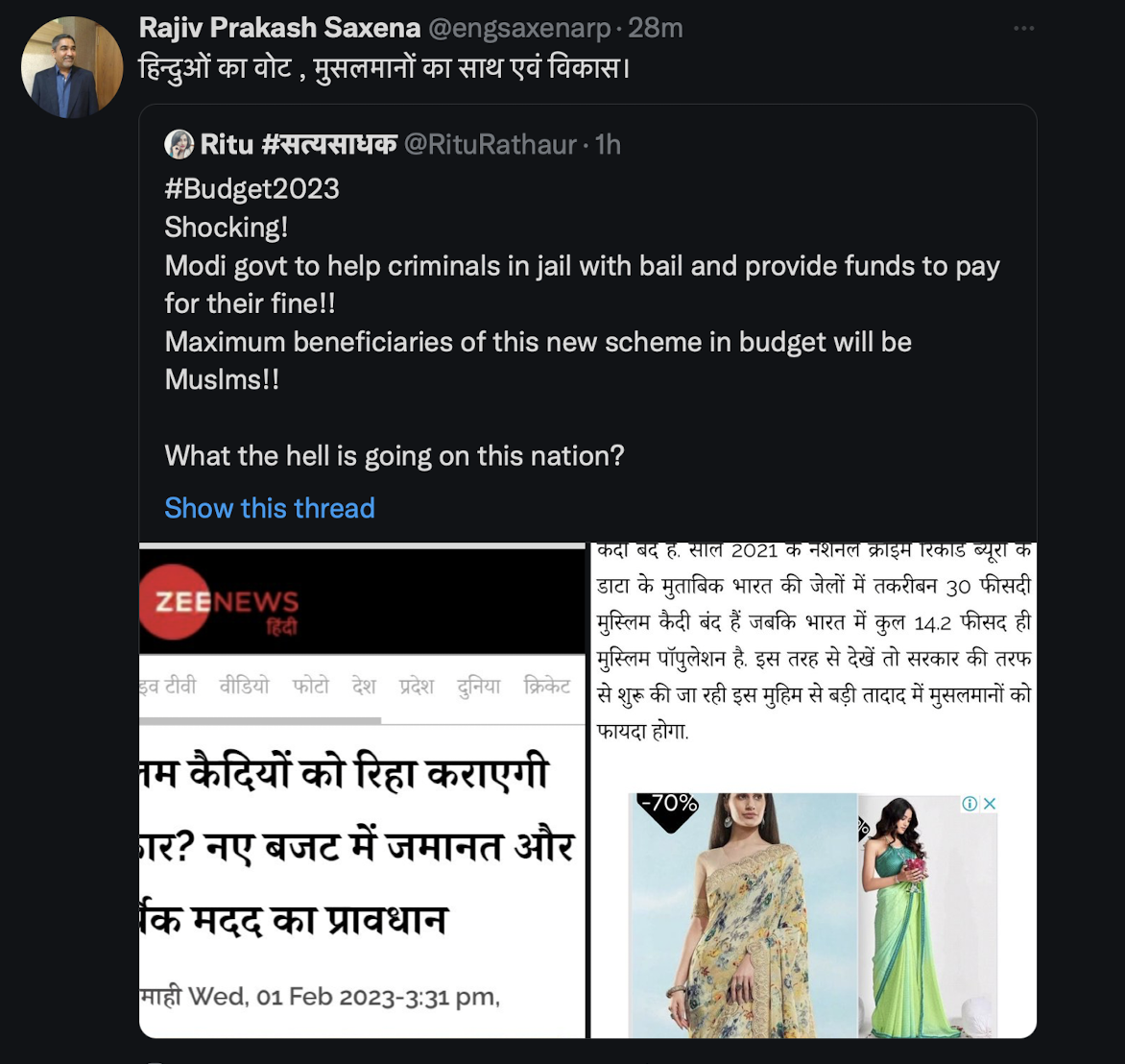
Before long, several social media users took to Twitter to accuse the Modi government of minority appeasement by releasing Muslim convicts and providing them with bail amounts. 

Source: Twitter
Source: Twitter

Does Union Budget 2023 talk about releasing Muslim prisoners?

No, the Union Budget 2023 announced by Finance Minister Nirmala Sitharaman earlier today does not include specific schemes aimed at early release of Muslim inmates or providing them with bail relief. Instead, the Finance Minister spoke about providing financial support to people who are unable to afford prison penalties and bail amounts. 

“Support for poor persons who are in prisons and are unable to afford penalty or bail amount required financial support will be provided,” the Minister said. 

The announcement came in line with PM Modi’s appeal last year wherein he asked chief ministers and chief justices of high courts during a joint conference to grant priority to cases related to undertrial prisoners languishing in jails and release them, as per law, based on human sensitivities. 

The Prime Minister had then stated that a committee, headed by the district judge, exists in each district to review cases and release eligible prisoners on bail whenever possible.

Nine years after marriage, Hindu woman discovers that her husband Rahul is actually Azhar, arrested by Uttarakhand Police

0

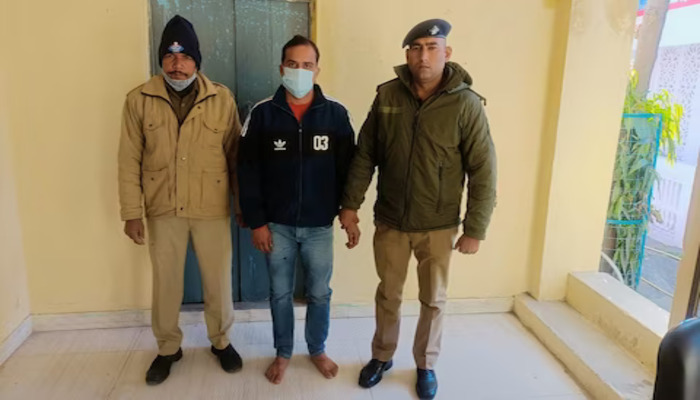
In Haridwar, Uttarakhand, a latest instance of love jihad has come to light. Police have arrested man Azhar, a labor contractor, who married a Hindu woman by posing as a Hindu man. Following nine years of marriage, the wife filed a complaint with the Kankhal police station, accusing the guy of changing his name and concealing his religious affiliation. The police then apprehended the man and jailed him.

Azhar lured her into his love trap

According to the Senior Superintendent of Police, SSP Ajay Singh, the woman who is a resident of Shivapuram Rajagarden area made a complaint, that the accused Azhar Ahmed, son of Zafar, of Mohalla Nabab Tehsil Road Kasganj, Uttar Pradesh, has duped her into marrying him by hiding his religion. She said that she met Azhar, who lives in the Kasganj district of Uttar Pradesh, nine years ago while working for a company. Azhar had, however, identified himself as Rahul at that time. He had also claimed that he has no family. As their bond deepened, the two fell in love, got married, and went on to have two children. One of their kids is seven and the other one is four.

The wife discovered a second Aadhaar card of her husband a few months prior to the complaint, which contained his original name, his father’s name, and his home address. Nine years into their marriage, her husband finally revealed the truth and pushed her to become a Muslim. Not only that, but the accused spouse also threatened to kill her when she refused.

She had moved away from the accused and was living in the Kankhal area, for three months.

The woman hails from Delhi, but refused to disclose her address. She proclaimed that she has nothing to do with her family.

Two Aadhaar cards were discovered

Superintendent of Police (SP), City Swatantra Kumar provided information, stating that following the victim’s complaint, the police have taken the culprit into custody and brought him before the court. Furthermore, the accused was found to have two Aadhaar cards bearing the names of Azhar and Rahul.

Saints assert love jihad

President of Swami Jagannath Ashram Mahant Lokesh Das advises Hindu females to be wary of love jihadists. After the Shraddha murder case became public knowledge, the entire country witnessed the horrors of love jihad and how its female victims are cut into 35 pieces. The government ought to enact severe legislation against it.

Massive protest against love jihad

Hindu groups had organized a huge demonstration against “love jihad” and called for anti-conversion laws in Dadar, Maharashtra, on Sunday.

The protestors marched almost 4 kilometers, beginning at Shivaji Park in Dadar and ending at Kamgar Maidan in Parel, under the banner “Hindu Jan Aakrosh Morcha,” which was arranged by Sakal Hindu Samaj, an umbrella body of Hindu organizations.

Hindu organisations such as the Rashtriya Swayamsevak Sangh (RSS), Bajrang Dal, and Vishwa Hindu Parishad (VHP) leaders and members were also in attendance. The gathering also featured a number of BJP officials and MLAs as well as representatives from the Shiv Sena’s Eknath Shinde faction. Ashish Shelar, the head of the Mumbai BJP, Pravin Darekar, Atul Bhatkhalkar, and Nitesh Rane were among the BJP leaders present at the event.

Bengal CM Mamata Banerjee calls Budget 2023 ‘anti-poor’, says she can make a better budget in 30 minutes

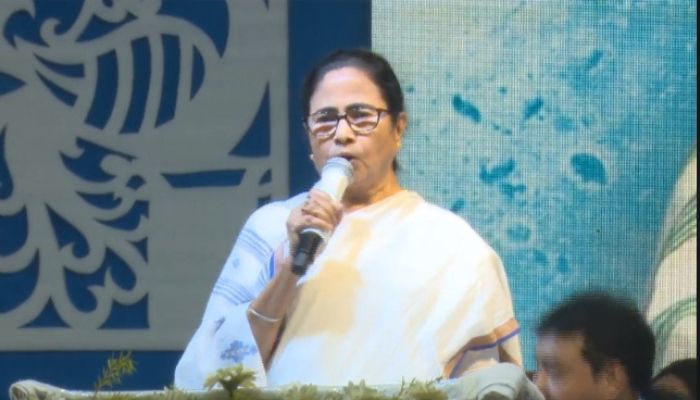
Hours after Union Finance Minister Nirmala Sitharaman announced tax rebates in the Union Budget 2023-2024, Trinamool Congress supremo Mamata Banerjee criticised the Centre’s actions as ‘anti-people.’

She made the remarks while addressing a government function at Bolpur in the Birbhum district of West Bengal. “The Budget did not address anything for the unemployed people. Whatever jobs existed are now being removed by the Central government.”

“They are selling everything, disinvesting government assets,” she claimed without elaborating that only those assets are disinvested, which are making losses for years and have no future of making a financial recovery in near future.

“This Budget is not futuristic but totally opportunistic. There is no ray of hope in this budget but the darkness of Amāvásyā. Totally anti-poor budget. It has neglected the poor,” the West Bengal Chief Minister said.

She claimed that the tax rebate will not help anyone due to ‘rising inflation.’ “Give me half an hour and I will show you how to prepare a Budget for the poor,” she was quoted as saying.

Mamata Banerjee then went on to repeat the misleading claim that Prime Minister Narendra Modi promised ₹15 lakhs to everyone. “Did anyone get it? You did not,” she asked. Mamata Banerjee also reiterated the fake news that the Indian Prime Minister promised 2 crore jobs per year.

She alleged that the Centre had withheld the wages of those involved in ‘100 Days of work’ under the Mahatma Gandhi NREG Act. “How can you stop our payments? Is it not a criminal offence,” Mamata Banerjee inquired.

Union Budget 2023 gives major relief for the middle class 

In the last full-fledged budget of the second Narendra Modi government presented by the finance minister Nirmala Sitharaman, major reliefs have been announced for the income taxpayers. The finance minister announced 5 major changes to the personal income tax regime under the direct tax proposals of the budget, which will reduce the income tax burden of the middle-class taxpayers significantly.

Under the revised income tax system, the rebate limit for the new tax regime has been increased to ₹7 lakhs from ₹5 lakh. This means, no income tax will be payable for those people who have income up to ₹7 lakhs, provided they opt to file their income tax returns under the new income tax regime. However, the rebate limit remains ₹5 lakhs for the taxpayers that choose to remain in the old tax regime.

Under the new income tax regime, the income tax rates are lower, but it does not have several deductions and exemptions which are available in the old tax regime. At present, both regimes are available for taxpayers. The new tax regime means that taxpayers do not need to invest in tax-saving instruments to save tax.

How much money the taxpayers will save after the newly announced income tax structure in Budget 2023: Some illustrations

In the last full-fledged budget of the second Narendra Modi government presented by the finance minister Nirmala Sitharaman, major reliefs have been announced for the income tax payers. Under the revised income tax system, the rebate limit for the new tax regime has been increased to ₹7 lakh from ₹5 lakh, meaning no tax for people who have taxable income upto ₹7 lakh. Apart from this, the number of income tax slabs has been reduced to five from the existing six, with each for ₹3,00,000, while it was ₹2,50,000 earlier.

These two changes will cause major benefits for the income tax payers, especially the middle-class citizens. Here we present some illustrations of how the changes will benefit taxpayers compared to the existing rates under both the old and new tax regimes.

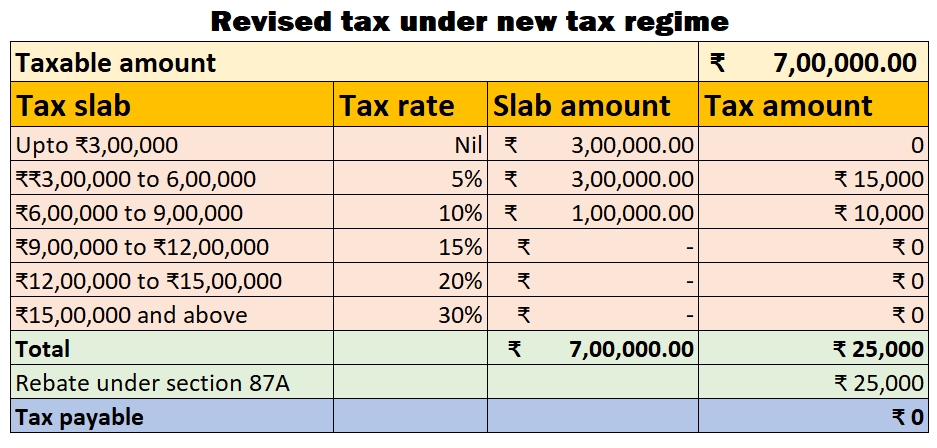
Before going into the illustrations, let’s clear a confusion some people are having. Some people are asking why there are tax slabs for 3 lakh to 6 lakh and 6 lakh to 9 lakh if there is no tax for income upto 7 lakh. This is because, the slabs are for the calculation of income tax, and the entire slab will be applicable if the income is above the rebate limit.

While it is correct to say there is no tax upto ₹7 lakh, it is a bit misleading, because the correct system is, while the income tax is calculated using the slab structure, if the taxable income is ₹7 lakh or less, the calculated tax becomes rebate. This rebate is deducted from the income tax, therefore the tax payable becomes nil. But if the taxable income is above ₹7 lakh, then there will be no rebate, and the entire calculated tax will be payable.

In the existing tax structure, the limit is ₹5 lakh, but the system works the same way.

It is also notable that the changes have been made only to the new tax regime, and the rebate and slabs remain the same in the old tax regime. Under the new income tax regime, the income tax rates are lower, but it does not have several deductions and exemptions which are available in the old tax regime. At present, both regimes are available for taxpayers. The new tax regime means that taxpayers do not need to invest in tax-saving instruments to save tax. Taxpayers can choose the income tax regime at the time of filing the return.

Now coming back to illustrations, please note that the taxable amount taken here means the amount on which income tax will be calculated, after any deductions and exemptions. This means, it can be lower than the income for the financial year, as there can be various deductions and exemptions allowed under the Income Tax Act, like contributions for tax-saving instruments, donations, educational expenses and so on.

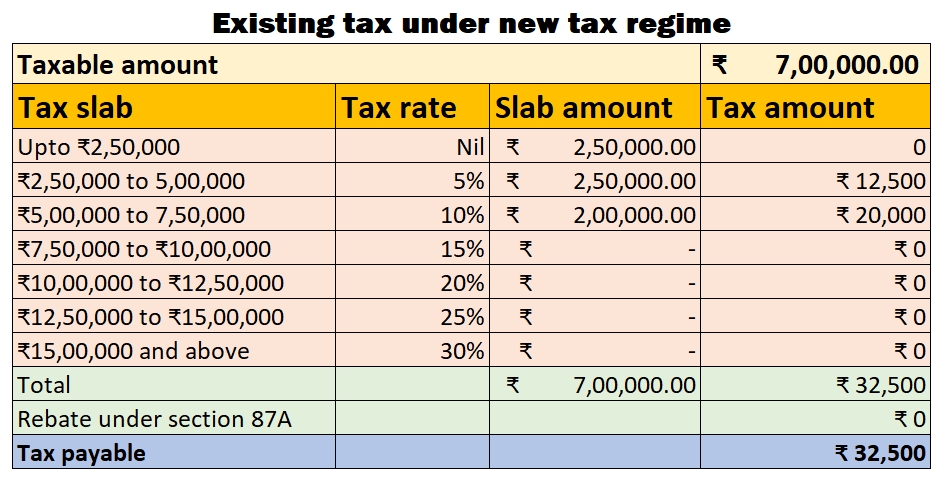
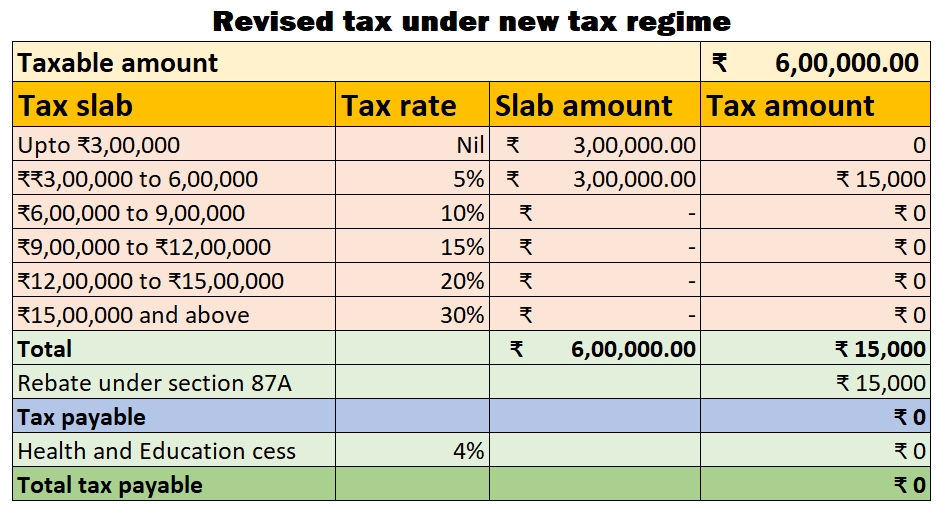
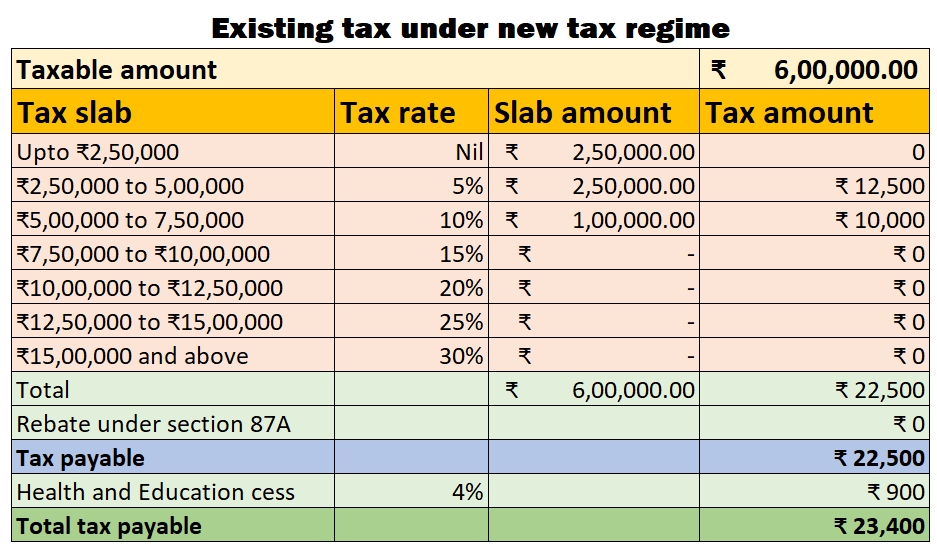
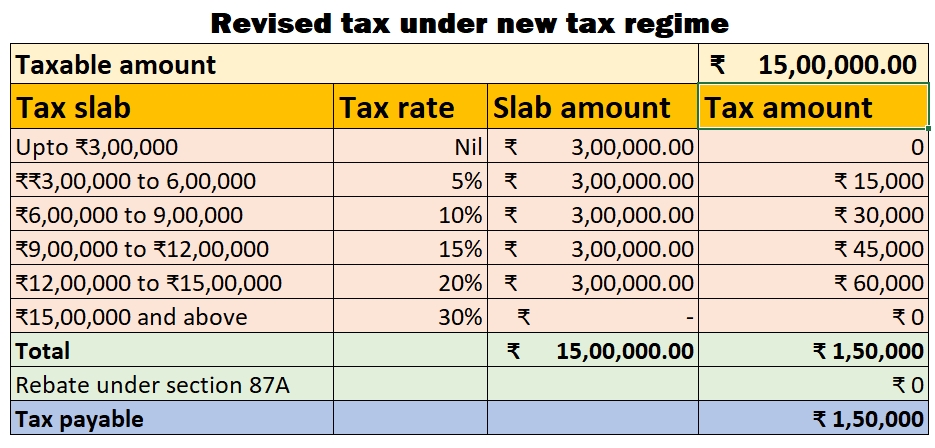
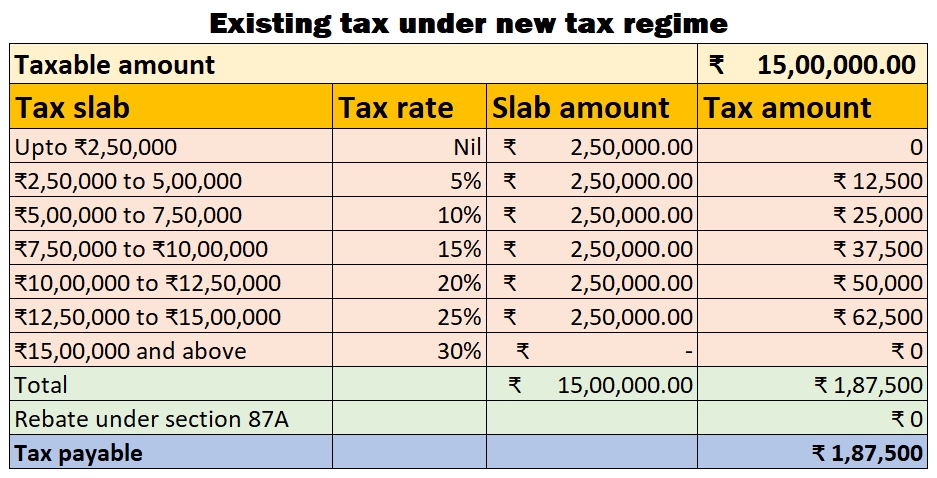
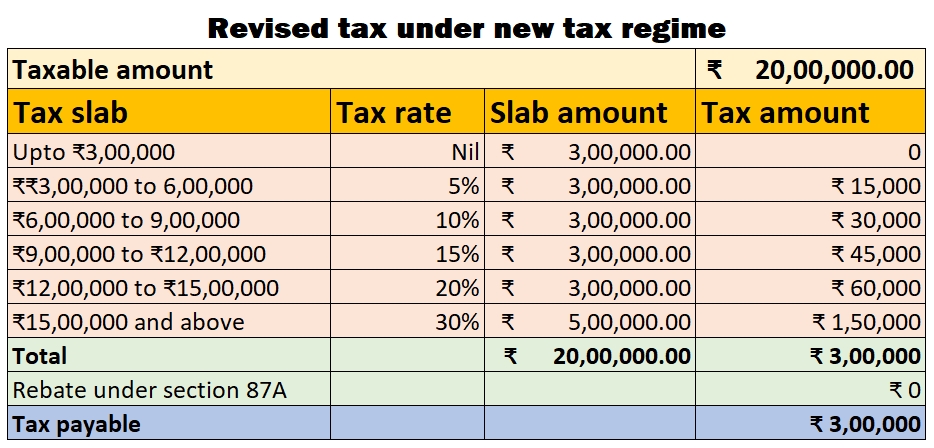
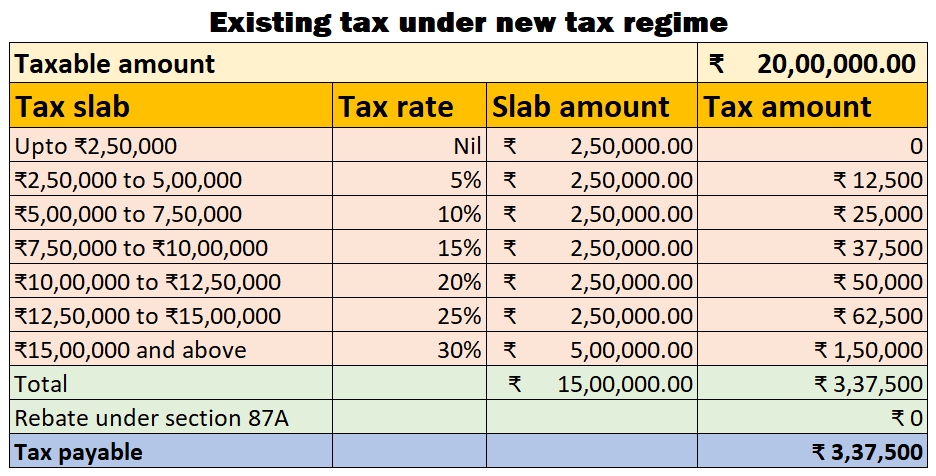
For a taxable income of various amounts, here are the tax calculations in two scenarios, tax for the assessment year 2024-25 under the new tax regime, and tax for the assessment year 2023-24 under the new tax regime. The calculations under the old regime have not been shown, as the same has not been changed. Moreover, the old regime has much more deductions and exemptions, therefore it can’t be compared with the new regime for the same taxable income.

For ₹7 lakh income under the revised system under the new regime, the calculated tax is ₹25,000, but this entire amount becomes rebate as the taxable income is ₹7 lakh. Therefore, the tax payable will be zero.

Now for the same amount in the existing structure, the tax payable will be ₹32,500. It is notable there is an additional 4% health and education cess on the tax amount, which has not been shown in the calculations. If the cess is included, the final tax will be ₹33,800 for ₹7 lakh taxable income under the existing structure.

If we take an income of ₹6 lakh, the tax will be ₹22,500 under the existing structure. But under the new structure, the tax will be zero as the taxable income is below ₹7 lakh.

For an income of ₹10 lakh, the tax will be ₹60,000, compared to ₹75,000. The amounts are ₹1,50,000 and ₹1,87,000 for 15 lakh income.

Therefore, it can be seen that the net tax outgo for the taxpayers will reduce significantly under the revised tax structure. Today’s budget also announced other reliefs in income tax, including an increase in the standard deduction for salary income, a cut in the highest surcharge rate, and an increase in the limit of tax exemption on Leave Encashment to ₹25 lakh from the current limit of ₹3 lakh. For those whom these changes are applicable, they will get these additional benefits which will reduce their tax amount.

As mentioned earlier, the tax structure only for the new tax regime has been changed, and the old tax regime remains unchanged. Taxpayers have the option of choosing the regime under which they want to pay their tax. However, from next year, the new regime will be made default in the Income Tax portal. Unless a taxpayer has a substantive amount of deductions and exemptions, the new tax regime will be more attractive for most people. It is clear that the govt wants the entire taxpayer base to move to the new regime, with more direct rebate and less complicated deductions and exemptions, and that is why the rebate limit has been increased to ₹7 lakh in the new regime while it remains ₹5 lakh in the old regime.


‘Everything for Adani, nothing for common man’: Opposition reacts to Budget 2023 in the usual way

On February 1, 2023, Finance Minister Nirmala Sitharaman announced the Union Budget for Financial Year 2023-24. While the government announced a comprehensive budget that benefits a larger section of the working class and middle and lower income groups, the opposition criticised the budget by calling it ‘corporate friendly’.

In a statement, Congress leader Shashi Tharoor said though there were good aspects of the budget, the Finance Minister did not mention MNREGA, poor rural labour, employment and inflation.

JD(U) MP Rajiv Ranjan called it ‘sapno ka saudagar’ and claimed there was no mention of how inflation and unemployment will be controlled. He said there was nothing new in the budget for 2023.

Calling it a pro-corporate budget, Congress leader K Suresh said that the budget would fulfil the interests of Adani. He further claimed that the common man has been ignored in the budget. “This budget is for Adani, Ambani, Gujarat,” he said.

PDP leader and former chief minister of Jammu and Kashmir Mehbooba Mufti claimed the budget has nothing new and it has been the same for the last 8-9 years. She suggested that the taxes have been increased and money is not being spent on welfare schemes and subsidies. She said, “Tax being collected for some crony capitalists & big businessmen.”

Samajwadi Party MP Dimple Yadav said the budget was announced keeping elections in mind hence the relaxation was given to the middle class. She said there was no mention of farmers, employment and youth in the budget.

BRS leader Kavitha Kalvakuntla called it a ‘mathematical confirmation of the failure of Modi govt’. She claimed that as the salaried persons get “good salaries” in Telangana, the additional rebates announced were of no use. “We hoped tax rebate of up to Rs 10 lakhs,” she said.

Congress leader Gaurav Gogoi said, “No solution to price-rise, inflation, unemployment. Poor got just words & rhetoric. Budget benefits only the big industrialists. Tax rebate up to Rs 7 Lakhs is insignificant considering the inflation & price-rise, it’s like a drop in the ocean for the middle class.”

Contrary to the claims made by the opposition leaders, there were many aspects of the Union budget FY 2023-24 that are being praised as middle-class and poor-friendly. Not to forget, major relief has been announced for the middle-class section in personal income tax. Furthermore, the tax rebates for MSMEs and cooperations will help in reducing expenses and increasing employment. The budget has seen a major jump in the funds for PM Awas Yojana. It has been increased by 66 per cent to Rs 79,000 crores. Detailed budget reports can be seen here.

Media portraying PFI spy Sonu Mansoori’s family secular: Mansoori continuously changing statements, lawyer Noor Jahan on the run

0

Sonu Mansoori, who was arrested by an Indore court in Madhya Pradesh on charges of spying for the banned Islamic extremist organization Popular Front of India (PFI), has made new revelations. Police have found several call recordings in Mansoori’s mobile, in which instructions have been given by her bosses.

According to reports, the police have arrested lawyer Noor Jahan and her flat has been sealed. Details of his phone number are being extracted. On the other hand, the police say that Sonu Mansoori is changing her statement repeatedly during interrogation. Mansoori’s family members who call themselves secular have expressed suspicion that her daughter is being implicated by the agencies.

However, Sonu Mansoori has not yet given any satisfactory explanation about the Rs 1.16 lakh recovered from her. Sometimes she is telling the money belongs to a client of Noor Jahan, while other times she is claiming that someone gave it to her for a bounced cheque. Police say she is changing her statement frequently.

During the investigation, it has also been revealed that Sonu Mansoori was given a flat by a person named Riyaz. In this flat, there was a girl named Varsha, the partner of Mansoori. Police have also summoned Riyaz and Varsha and questioned them. At the same time, information has also been revealed that persons named Tarun and Mukund have also been questioned. Sonu Mansoori’s flat partner Varsha has denied having knowledge of Sonu’s PFI-related activities.

According to another report, the police have received many call recordings from Sonu Mansoori’s mobile. Some call recordings have also been deleted by Mansoori. Most of the recordings on the mobile are such that she has been instructed by her bosses. Some of these instructions are also from fugitive advocate Noor Jahan.

The number of recovered recordings is said to be 6, which the police have saved in pen drives as evidence. The police also took Sonu Mansoori to Noor Jahan’s flat. Police say they will ask for an extension of Sonu’s remand period which ends on February 1, 2023 (Wednesday).

Sonu Mansoori’s brother Iqbal Mansoori has said that his sister is innocent and her arrest is a conspiracy. Iqbal says that the real truth will come out after interrogating Noor Jahan. At the same time, Sonu Mansoori’s family members also talked about celebrating Hindu festivals, calling themselves secular.

Speaking to OpIndia, Sohan Vishwakarma, an office-bearer associated with the Hindu organization in Indore, said that the secularism being shown by Sonu Mansoori’s family is just a hoax. He said that Sonu Mansoori was involved in anti-national activities at the behest of PFI.

Sohan Vishwakarma also told about advocate Noor Jahan, who is on the run. He said that many people in Indore are aware of Noor Jahan’s action. Due to her image, Noor Jahan lost badly in the bar association election.

Budget 2023: Here is what Nirmala Sitharaman said about ‘Shri Anna’ and the International Year of Millets

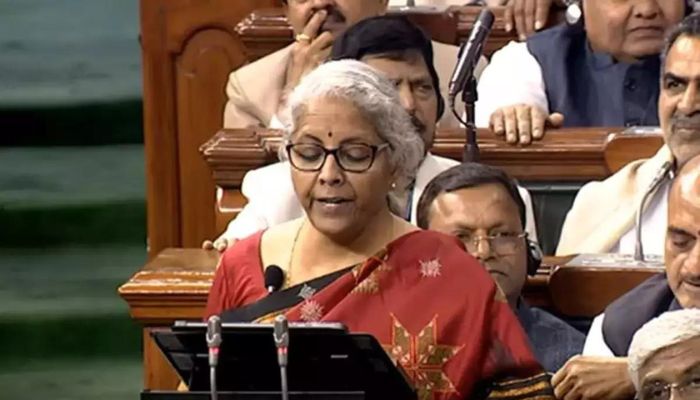
On Wednesday (February 1), Union Finance Minister Nirmala Sitharaman laid special emphasis on millet cultivation in the country during her Union Budget 2023-2024 speech in Parliament.

“India is the global hub for millet or Shri Anna. India is at the forefront of popularising millets whose consumption furthers nutrition, food security and welfare of farmers, said the Prime Minister,” she informed.

“We are the largest producer and second-largest exporter of Shri Anna in the world. We grow several types of Shri Anna such as jowar, ragi, bajra, kuttu…These have a number of health benefits and have been an integral part of our food for centuries ” the Union Finance Minister emphasised.

“I acknowledge with pride, the huge service done by small farmers in contributing to the health of fellow citizens by growing this Shri Anna,” Nirmala Sitharaman added.

She further emphasised, “Now to make India a global hub for Shri Anna, the Indian Institute of Millets Research in Hyderabad will be supported as the centre of excellence for sharing best practices, research and technologies at the international level.”

While presenting the Union Budget last year, Nirmala Sitharaman said, “2023 has been announced as the International Year of Millets. Support will be provided for post-harvest value addition, enhancing domestic consumption, and for branding millet products nationally and internationally.”

Massive boost to millet cultivation under PM Modi

The Indian government, led by the Prime Minister, proposed the ‘International Year of Millets (IYM) 2023’, which was approved by the United Nations General Assembly (UNGA).

The declaration has allowed the Indian government to take the lead in celebrating IYM 2023. PM Modi has made it clear that he wants to use the opportunity to make the event a “People’s Movement” and make India the “Global Hub for Millets.”

In India, millets are grown as a Kharif crop, requiring less water and other agricultural inputs than other staples. Millets are crucial due to their potential to generate livelihoods, increase farmers’ income, and ensure food and nutritional security globally.

Recognising the immense potential of millet, which aligns with several UN Sustainable Development Goals (SDGs), the Indian government has made them a priority.

Millets were rebranded as “Nutri Cereals” in 2018, the same year it was declared the National Year of Millets, to increase promotion and demand. The global millets market is expected to grow at a CAGR of 4.5% from 2021 to 2026.

On December 6, last year, the Food and Agriculture Organization (FAO) of the United Nations hosted the opening ceremony for the International Year of Millets 2023 in Rome in Italy.

In January 2023, the Agricultural and Processed Food Products Export Development Authority (APEDA) and DA&FW participated in a trade show in Belgium, showcasing the diversity of Indian millets through ready-to-eat and ready-to-cook millet-based products marketed by Indian companies.

Here is how much has been allocated to the Ministry of Minority Affairs in Budget 2023: Why it may disappoint the Left

On Wednesday, February 1, India’s Finance Minister Nirmala Sitharaman presented her 5th Union Budget and the last full budget of the Modi 2.0 government that came to power in 2019. The Finance Minister made a slew of announcements, from raising the personal income tax limit from Rs 5 lakhs to Rs 7 lakhs to a steep increase of 33 per cent in the capital investment outlay to Rs 10,00,000 crores.

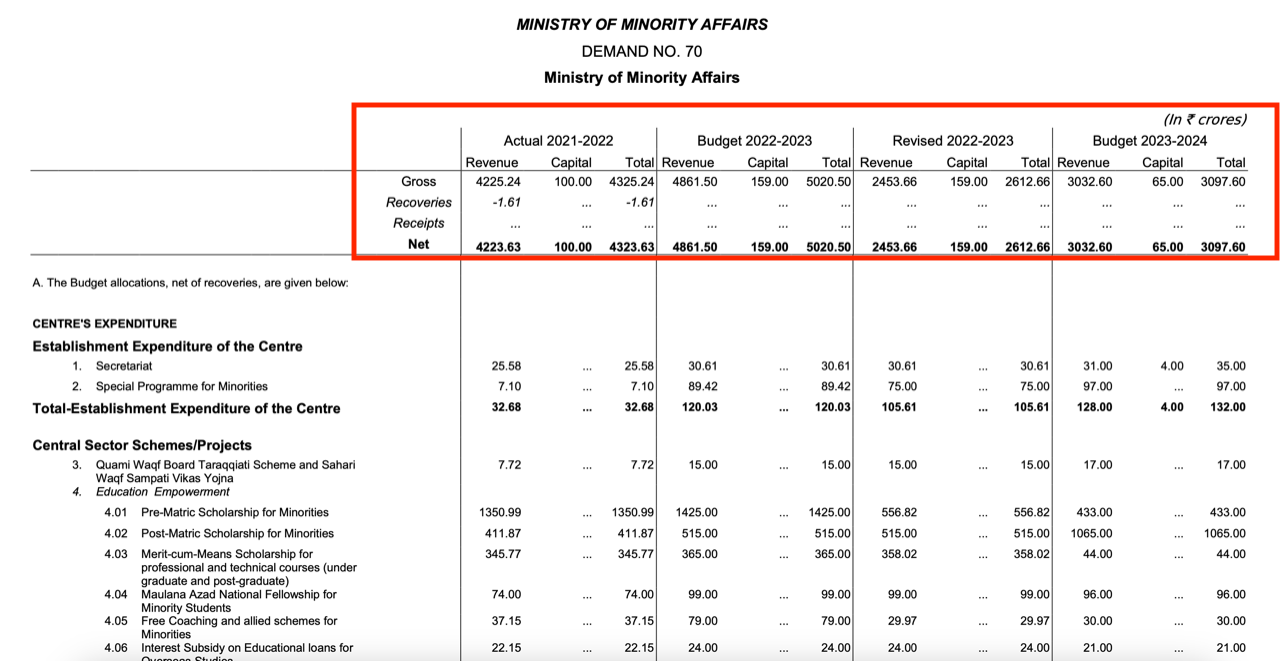
The Minority Affairs Ministry is allocated Rs 3097.60 crore in the 2023-24 Union Budget on Wednesday, which is Rs 484.94 crore more than the revised figures of the previous fiscal.

In the budget presented for 2023-24 by Finance Minister Nirmala Sitharaman, the Centre proposed to allot Rs 3,097.60 crore to the Ministry of Minority Affairs.

Source: https://www.indiabudget.gov.in

The budget estimate for the Ministry of Minority Affairs in the financial year 2022-23 was Rs 5,020.50 crore and later the revised allocation was Rs 2,612.66 crore.

Of the proposed allocation to the Ministry, Rs 433 crore is for the pre-matric scholarship scheme and Rs 1,065 crore is for the post-matric scholarship.

A total of Rs 540 crore has been allocated for Pradhan Mantri Virasat Ka Samvardhan (PM VIKAS), a skilling initiative from MoMA focussing on the skilling, entrepreneurship and leadership training requirements of the minority and artisan communities across the country. 

The scheme is intended to be implemented in convergence with the Skill India Mission of Ministry of Skill Development & Entrepreneurship and through integration with the Skill India Portal (SIP). The scheme has components aiming to benefit approximately 9 lakh candidates the 15th Finance Commission Cycle, which includes Skilling and Training Component, Traditional Training sub-component (earlier known as USTTAD and Hamari Dharohar), Non-traditional Skilling sub-component (earlier known as Seekho aur Kamao), Leadership and Entrepreneurship Component (earlier Nai Roshni), and Education Component. 

Furthermore, the Budget allocates Rs 600 crore for PMJYK (Pradhan Mantri Jan Vikas Karyakaram), a special area development programme that aims to address the development, deficits in the selected Minority Concentration Areas (MCAs i.e identified districts headquarters blocks/towns/clusters of villages having substantial minority population which are relatively backward). The MsDP has been resturctured and revamped for implementation as Pradhan Mantri Jan Vikas Karyakaram. 

The budget earmarks Rs 10 crores to grant financial assistance to introduce modern subjects in madarsas, teacher’s Training and augmenting school infrastructure in minorities institutions. In FY 2022-2023, Rs 60 crores were allocated to ‘Education Scheme for Madrasas and Minorities’ while a year before that, the centre had spent Rs 161.53 crore on the same. 

How incrementally progressive changes and the Centre’s financial prudence has the usual suspects upset

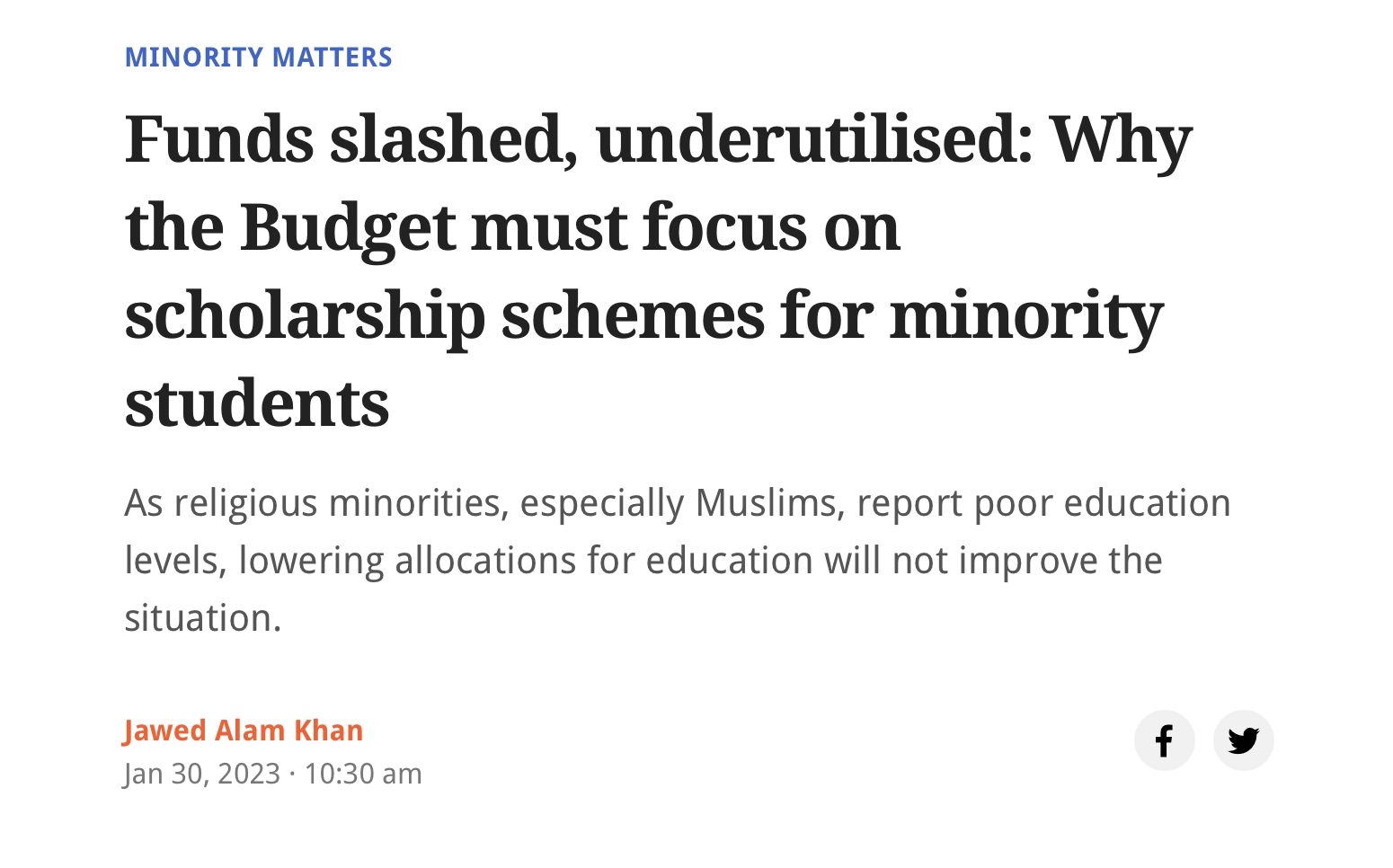
As expected, the broad changes the Minority Ministry has been instituting in the last couple of years had cheesed off the usual suspects and leftist media organisations. Two days before the announcement of the Union Budget 2023, the leftist propaganda portal Scroll published an article lamenting how the Centre had slashed the budget for minorities.

Source: Scroll

However, it is worth noting that the Centre had allocated Rs 5,000 crore for minority affairs last year, of which a large portion (~Rs 2,300 crore) remained unutilised, as per the budget figures. This year, the Centre drew lessons from their past actions and allocated Rs 3,097, about 18 per cent higher than Rs 2,612.66 crore (revised estimates) of the current fiscal year, instead of allocating greater share only to have them unutilised.

The leftist media outlet grumbled about the Centre scrapping the Nai Udaan Scheme as well as the Maulana Azad National Fellowship for higher education. 

However, the restriction of Pre-Matric Scholarships to Classes 9 and 10 was due to the fact that students from Classes 1-8 are protected under the Right to Education Act, 2009, requiring the government to provide free and compulsory elementary education to all children. The notification by the Centre further said that the decision was taken to ensure parity with similar scholarships offered by the Ministry of Social Justice and Empowerment and the Ministry of Tribal Affairs, which cover students of Classes 9 and 10.

But the Scroll argued that the reasoning by the Centre did not hold scrutiny. In essence, the Scroll wanted the Centre to pay for scholarships to minority students who are anyway receiving the education for free, at taxpayers’ expense. 

The author of the Scroll article also bemoans the steep decline in the grant for madarsas. From 160 crore two years ago, the Centre has, this year, earmarked only Rs 10 crore for funding Islamic schools. However, this is in line with the Indian government’s push to promote modern education for education over madarsas, which are reportedly centres propagating traditionalism parochial outlook.

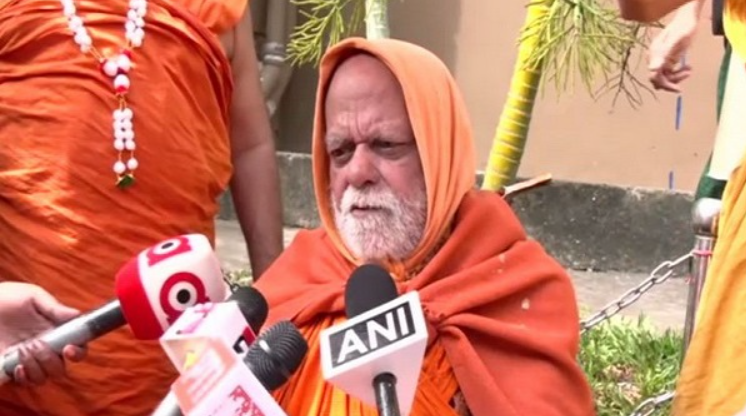
Puri Shankaracharya Swami Nischalananda Saraswati says ‘ancestors of Prophet Muhammad, Jesus were Sanatani Hindus’: Reports

0

On Tuesday, Puri Shankaracharya Swami Nischalananda Saraswati said that the ancestors of Prophet Muhammad and Jesus Christ were Sanatani Hindus and the same has been proved in the past. “Opposition members in America have raised this issue in Parliament. Ancestors of Prophet Muhammad and Jesus Christ have been proved to be Sanatani Hindus,” he was quoted as saying.

The seer also stated that Prophet Muhammad and Jesus Christ were themselves Hindus for years before they accepted Islam and Christianity respectively. According to reports, Shankaracharya Swami Nischalananda Saraswati has been repeating this for years. He sparked outrage last year when he said that Jesus Christ and Prophet Mohammed were Hindus. He said that Jesus’ ten years of existence were not mentioned in the Bible and that he was in India throughout that time.

He said that Jesus had spent three years in Puri and that Christ was a Vaishav who practised Hindu ceremonies. His comments sparked outrage back then. “This is not the first time Shankaracharya has many times said that Jesus Christ was in India for 10 years and his ancestors were Hindu. If you take the birth of Christ into account, then Hinduism is way older than him. Naturally, his ancestors would be Hindus,” PRO of the Govardhan Peeth, Matrudatta then had responded.

At that time, there were also comments that he was following the path of RSS. However, Shankaracharya Swami Nischalananda Saraswati denied the claims and said, “I do not follow RSS. If they want, they can follow me. Even the RSS Chief, Mohan Bhagwat sits in front of me like ‘Bal Gopal’ (Baby Krishna).”

Swami on Tuesday also stated that the governments shouldn’t have control over the temples and math. ““The governments shouldn’t have control over temples and Matth, and there is a need to spend money for the development to every corner,” he said.

When questioned about the lost key of the Puri’s Ratna Bhandar, Shankaracharya remarked, “The Odisha government and Jagannath temple administration never consulted over any issues regarding the temple. Why should I interfere in the missing key issue of Ratna Bhandar?”

Reports mention that there are a total of seven treasuries within the temple, one of which is always open. The keys to four treasuries were lost around 38 years ago, but only two keys are there with the District Collector.

Meanwhile, Swami also commented on the Joshimath issue and said that proper balance should be maintained between development and the nature. “The word development should be understood in its proper context. Earth, water and air are sources of energy. It is our job to keep the earth and environment clean and pollution free. Proper balance should be maintained,” he added.

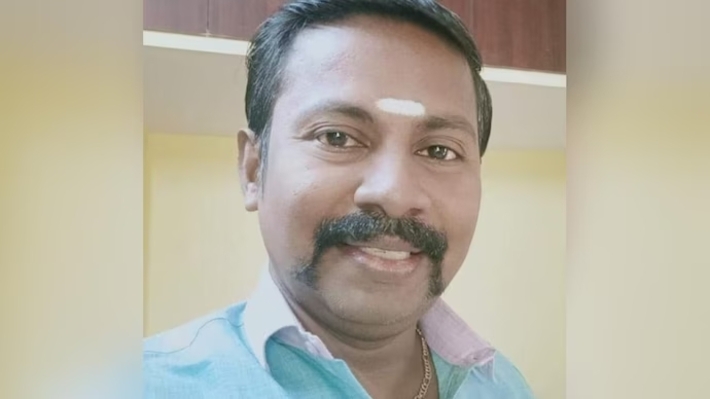
Tamil Nadu: Hindu Makkal Katchi leader Manikandan murdered in Madurai by unknown persons

0

On the night of Tuesday, January 31st, a senior member of a Hindu rights group was murdered in Tamil Nadu’s Madurai by a group of assailants. The accused fled the spot after attacking the deceased victim and are still absconding.

The deceased victim has been identified as G Manikandan. He was the Southern Madurai Deputy Secretary of a local Hindu rights group called Hindu Makkal Katchi. 

The 40-year-old owned a jewellery shop in MK Puram of Madurai. Manikandan was attacked near Jaihindpuram-MK Puram junction by unidentified assailants when he was walking near his shop. At around 8:30 pm, the assailants reportedly attacked Manikandan with a sickle and stones. The attackers fled the spot after stabbing the victim multiple times. 

Manikandan was rushed to Rajaji Hospital where he was declared brought dead. Jaihindpuram police have registered a case and are investigating the motive behind the murder. The police are also trying to nab the unidentified and absconding assailants. 

Notably, a similar case was reported in 2019, when a Hindu activist Ramalingam who was a member of a local group Pattali Makkal Katchi (PMK) was murdered in Kumbakonam in Thanjavur district on his way back home by PFI goons and his hands were chopped off. Ramalingam died on the way to the hospital due to excessive bleeding.