Home Blog Page 2677

Gujarat: Dancers entertain the crowd at election campaign meeting of Congress MLA, the MLA says his workers organised it without his knowledge

Ahead of phase two of the Gujarat polls, a video has gone viral wherein some women dancers can be seen performing on the stage with a poster of Congress Borsad candidate Parmar Rajendrasinh in the background. Reportedly, the dancers were hired by Congress MLA Parmar Rajendrasinh Dhirsinh for his election campaign.

Parmar Rajendrasinh Dhirsinh is a sitting MLA of Congress from Borsad, a seat the party has been winning since 1967. He is also the vice chairman of Amul.

In the video of the event that is being widely shared on social media platforms, female dancers are seen enthralling the ‘audience’ by dancing to Gujarati songs. Congress flags along with posters are visible on the stage and a person is also seen showering cash on the dancers. Dozens of people are in attendance.

The event was reportedly organised for Rajendrasinh Parmar’s campaigning ahead of the second phase of voting on December 5.

Nothing obscene in the dances, says the Congress MLA

Responding to the controversy over the dancers in the election campaign, Dhirsinh said that no obscene act took place during the election campaign, and it was just dance performances. When an ABP Asmita asked him about ‘obscene video’, he said that there is no obscene video. He also distanced himself from the program, saying that he has no idea what program the local supporters had organised for his election campaign.

The MLA agreed that it was his election campaign when the reporter mentioned that the stage was filled with his posters and Congress flags, but said that when he went there to address the meeting, there was no dancer. He said that the local workers might have organised a dance and music program after the meeting in the night for entertainment, and he was not aware of it.

However, Parmar Rajendrasinh Dhirsinh also added that many other parties bring film stars etc for election campaigns, and this is the first time such a thing took place in his meeting. He claimed that he came to know about it in the next morning only, and said that he will call his workers to know why this happened.

AAP worker in Gujarat bribes members of Koli community to vote in party’s favours

Recently reports emerged on how an Aam Aadmi Party (AAP) worker had attempted to entice voters with money in Gujarat’s Gariadhar assembly constituency in the Bhavnagar district.

As per reports, the accused was identified as Deepak Khunte. He gave ₹3 lakh rupees to 8 members of the Koli community in exchange for voting for the Aam Aadmi Party (AAP).

Deepak had tasked the 8 men to convince his community to vote en masse for the AAP, which is desperately trying to make in-roads in Gujarat.

The second round of the Gujarat Assembly elections is slated for December 5, with voting for 93 of the 182 assembly seats. The first phase of voting covered 89 seats, with an overall voter turnout of 63.14 per cent. Votes will be counted on December 8.
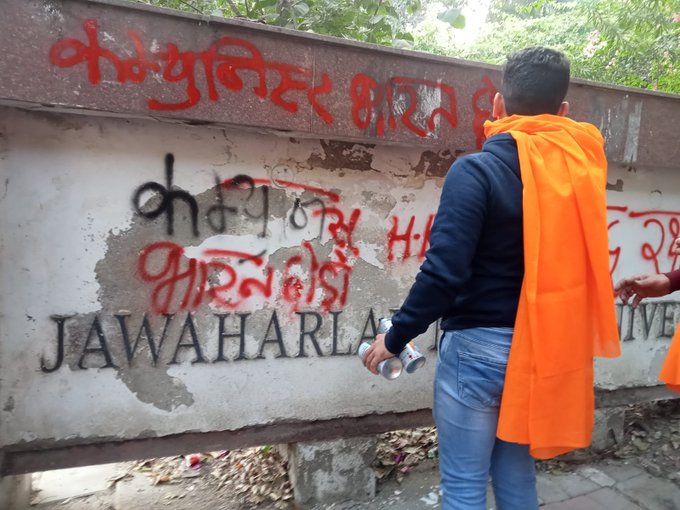
Days after anti-Brahmin graffiti appeared on JNU walls, Hindu Raksha Dal paints ‘Communists Bharat Chhodo’ slogans at the main gate of the campus

0

Two days after JNU campus walls were defaced with anti-Brahmin and anti-Baniya graffiti, slogans against communists appeared on the wall next to the main gate of the campus. The slogans against communists were reportedly painted by Hindu Raksha Dal. In the slogans, communists were equated with the Islamic terrorist organisation ISIS apart from asking them to Quit India.

The spray-painted slogans included “Communists Quit India”, “Communists = ISIS”, and “Jihadis Quit India.” 

The JNU administration stated that it would take action against such acts and that an investigation has been launched. Meanwhile, members of the Hindu Raksha Dal believe Communists initially wrote hate slogans against Brahmins inside the campus. In response to the anti-Brahmin graffiti, Dal’s associates wrote a letter condemning them.

Hindu Raksha Dal leader Pinky Chaudhary reportedly said they (the communists) want us to leave India, but we will make them leave. When asked about using the same method used by the communists, Chaudhary said that “unlike them, we did not hide after writing slogans.”

Notably, two days back, many offensive slogans against Brahmins were painted on several walls inside the campus. The offices of some professors were also defaced with highly objectionable graffiti. “Go back to Shakha” was written on the doors of the chambers of several professors, asking them to return to Rashtriya Swayamsevak Sangh (RSS).

The anti-Brahmin and anti-Baniya slogans were reportedly scrawled on the walls of the university’s School of International Studies-II building. “Brahmin-Baniya, we are coming for you,” “We will avenge,” “Brahmins Leave the Campus,” “Brahmins Leave India,” “Now there will be blood,” “Go back to Shakha,” and other slogans were painted in the building. The professors whose offices were targeted by the miscreants included Nalin Kumar Mohapatra, Raj Yadav, Pravesh Kumar, and Vandana Mishra.

Meanwhile, the Vice-Chancellor of the University, Santishree Pandi issued a statement condemning the act of ‘exclusivist tendencies’ after the anti-Brahmin slogans appeared, and said that these tendencies have no place in JNU.

‘Most severe policy-induced mortality crisis in human history’: New Research shows British colonialism killed 100 million Indians in 40 years

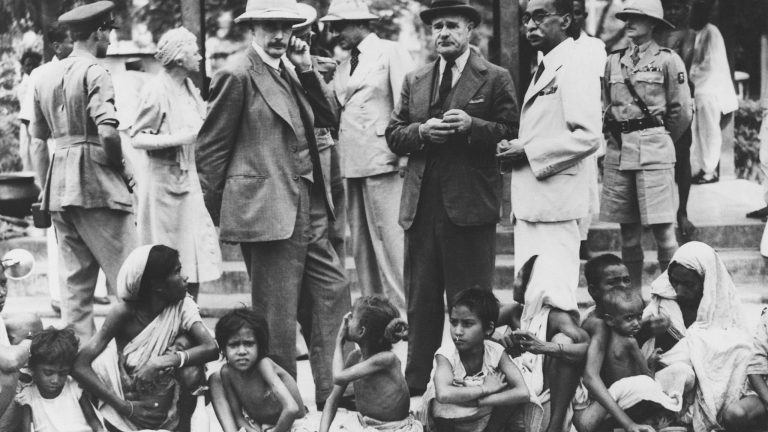
The British colonialism in India led to the death of over 100 million people in 4 decades from 1880 to 1920, the peak of British imperialism, a new study published in the journal World Development said. The research, titled ‘Capitalism and extreme poverty: A global analysis of real wages, human height, and mortality since the long 16th century’ and authored by Dylan Sullivan and Jason Hickel, underscores the depth of human tragedy colonialism inflicted on India with few parallels in the recorded history. 

The study found that extreme poverty was unusual and only appeared during periods of profound social and economic turmoil, particularly during colonialism. As capitalism has developed since the late 16th century, wages have fallen below subsistence levels, human height has declined, and the number of premature deaths has increased.

The research paper.

Native populations in parts of South Asia, Sub-Saharan Africa, and Latin America have not yet fully recovered, according to the report. Only around the turn of the twentieth century did human well-being begin to rise significantly, concurrent with the rise of democratic and anti-colonial political movements.

The authors estimated the number of individuals who perished because of British colonial practices throughout four horrific decades from the 1880s to the 1920s using census data. Reliable statistics on death rates in India go back to the 1880s. Using it as the baseline for “normal” mortality, it was discovered that 50 million additional fatalities occurred under the auspices of British colonialism between 1891 and 1920, taking the count of total deaths caused by imperialism to above 100 million—a scathing indictment of the British colonialism and a grim realisation for the apologists who yearn for Britain’s colonial legacy and believe it brought prosperity and development to the colonies it governed.

Fifty million fatalities is a startling number, yet this is only a conservative estimate. According to data on actual earnings, living standards in colonial India had already fallen considerably from their prior levels by 1880.

If the mortality rate in India before colonisation was comparable to that in England in the 16th and 17th centuries (27.18 deaths per 1,000 people), then 165 million more individuals died in India between 1881 and 1920. While the exact number of fatalities is dependent on the assumptions used for baseline mortality, it is evident that between 1880 and 1920, during the height of British colonialism, around 100 million individuals died before their natural age.

This is one of the most severe policy-caused mortality crises in human history. It exceeds the total number of fatalities from all famines in the Soviet Union, Maoist China, North Korea, Pol Pot’s Cambodia, and Mengistu’s Ethiopia.

There are various ways in which British control contributed to this massive loss of life. For starters, Britain virtually devastated India’s industrial sector. Prior to colonial rule, India was one of the world’s major industrial suppliers, sending high-quality textiles to every corner of the globe. However, this began to change in 1757, when the British East India Company took control of Bengal.

The colonial regime, according to historian Madhusree Mukerjee, virtually abolished Indian tariffs, allowing British goods to flood the domestic market, but it also established a system of absurdly high taxes and internal duties that prevented Indians from selling, let alone exporting, textiles within their own nation. India’s industries were wiped out by this unjust trade policy, thus deindustrializing it.

To make problems worse, British colonists developed a system of legal thievery known as the “drain of wealth.” Britain taxed the Indian people and used the proceeds to purchase Indian items like indigo, grain, cotton, and opium, thus acquiring these things for free. The British government received the revenues from the sale of these goods, which were either consumed in the UK or exported once again.

This approach depleted India of products worth trillions of dollars now. The British were ruthless in implementing the drain, compelling India to export grain even when drought or floods endangered domestic food security. Historians have determined that tens of millions of Indians perished of starvation during three significant policy-induced famines in the late nineteenth century, as their resources were diverted to Britain and its colonial possessions.

The effects of their policies were well understood by colonial officials but they stood by as millions went hungry, refusing to change direction. They continued to willfully deprive them of basic survival essentials.

The authors of the study also established a solid argument for reparations, which has a long history in international law. They argue that while history cannot be reversed and the sins of the British empire cannot be erased, reparations can assist address the legacy of deprivation and unfairness left by colonialism as a key step toward justice and reconciliation.

Pakistan tops the list of nations at risk of mass killings for the third time in a row: Says Early Warning Project Report

0

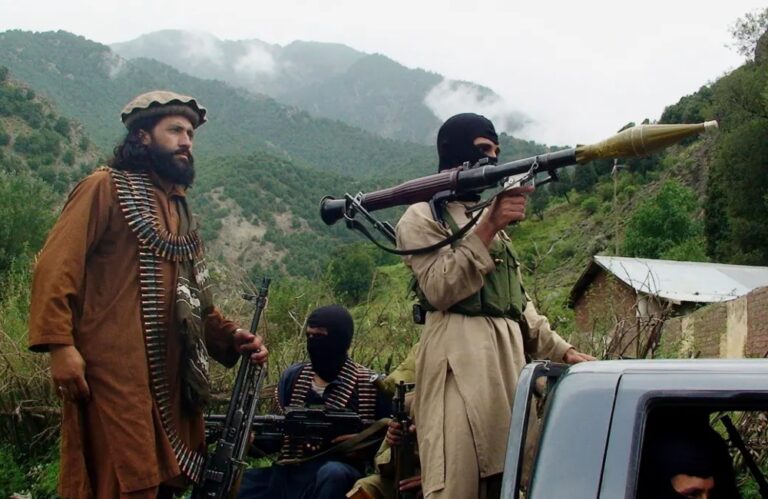
Pakistan, for the third time in a row, has topped the list of nations at the highest risk of witnessing mass killings, as per the recent report by the US think tank Early Warning Project. 

In its 28-page report, Early Warning Project (EWP) outlined that Pakistan is faced with numerous security and human rights challenges, including increased violence by the Tehreek-e-Taliban Pakistan (TTP).

Notably, Early Warning Project is a joint initiative of the US Holocaust Memorial Museum’s Simon-Skjodt Center for Genocide Prevention and Dartmouth College’s Dickey Center for International Understanding. The Early Warning Project is a research organisation that identifies nations that are at high risk of mass violence.

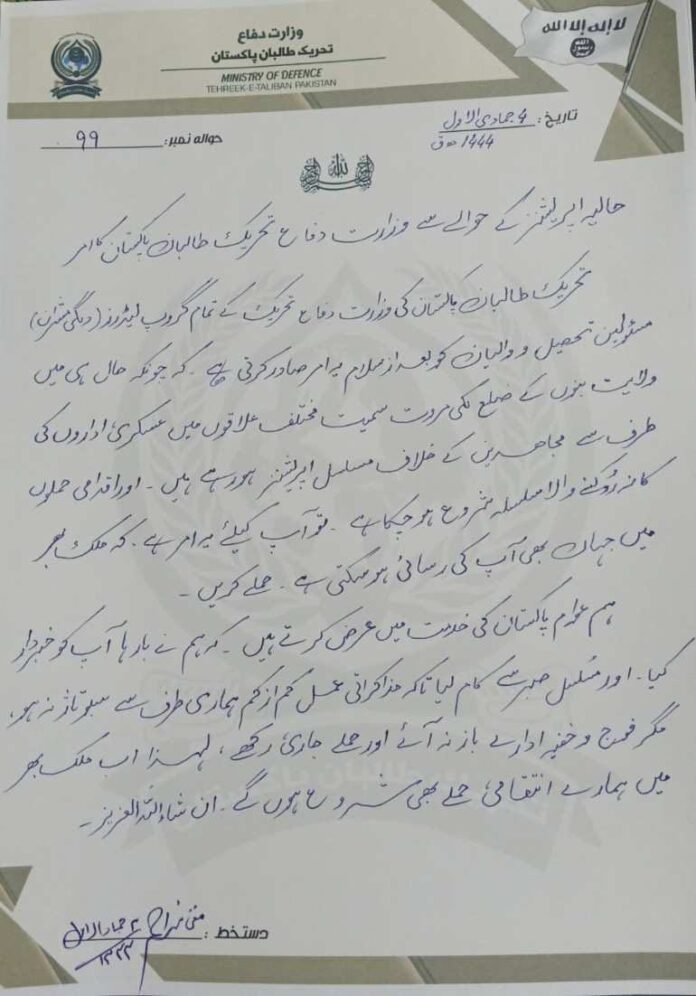
Notably, this report comes as the Tehreek-i-Taliban Pakistan (TTP) broke the ceasefire with the government earlier this week. TTP violated the ceasefire agreement reached with the government in June, ordering terrorists to launch attacks across the country.

Tehreek-i-Taliban Pakistan’s statement (Image credit: Pakistan Today)

“As military operations against mujahideen are ongoing in various areas […] it is imperative that you carry out attacks wherever you can in the entire country,” the statement said, addressing its militants.

The decision was made “following a series of continuous attacks launched by military organisations on TTP in Baanu’s Laki Marwat district,” the TTP statement read.

The EWP report further mentions ‘militant violence’ and separatist movements active in the country. The report cites the ISIS attack on a Shiite mosque in Peshawar which claimed 56 lives. Other than terrorism, the report states that Pakistan’s blasphemy laws are the major cause behind increased mob violence against religious minorities. 

Notably, there have been countless cases wherein people belonging to minority communities, particularly Hindus have been assaulted and killed over mere suspicion of insult of Islam. 

The removal of Imran Khan from power through a no-confidence motion and the debate around the current government’s response to the severe floods in the country prompt that the upcoming general elections in Pakistan are likely to be ‘highly contentious’, the report asserts.

According to the Early Warning Project’s assessment model, Pakistan’s high estimated risks are its “lack of freedom of movement for men, high infant mortality rate, large population as well as a history of mass killings.”

It is notable that Pakistan has been at the forefront of terrorism, whether it is state-sponsored cross-border terrorism targeting India, crushing rebellions in Balochistan, or targeting its own religious minorities such as Hindus, Shiites, and Ahmadiyyas, among others.

In the report, Yemen comes in second place and Myanmar is ranked in third place. While Afghanistan is ranked 7th, India is ranked 8th, which do raise questions about the methodology of the study. While most other countries in the top ten have seen mass killings both by terrorists and state forces, no such incidents have taken place in India in recent times.

Interestingly, the report says that it is designed to assess the risk of a new mass killing, not of the continuation or escalation of ongoing episodes. This means the report projects the possibility of mass killing in future. In fact, India was placed in second place in the last year’s report, but no such mass killings were seen in the year. This year, the report states that there is a 7.4% or approximately 1 in 14 chance of a new mass killing beginning in India in 2022 or 2023.

Delhi riots: Umar Khalid, Khalid Saifi discharged in Khajuri Khas FIR case, will remain in judicial custody

0

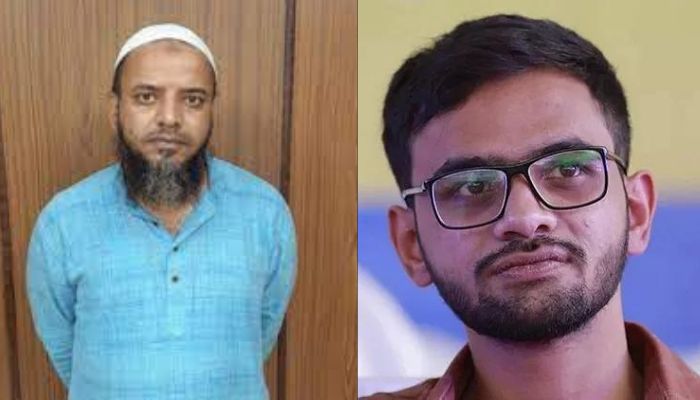
On Saturday (November 3), a Delhi court discharged ‘activists’ Umar Khalid and Khalid Saifi in a case connected to the 2020 anti-Hindu riots in Delhi.

As per reports, the matter was heard by Additional Sessions Judge Pulastya Pramachala. The duo was booked for violence, vandalism, and arson in the Chand Bagh area, following a complaint by a police constable.

Khalid Saifi and Umar Khalid were booked under relevant Sections of the Indian Penal Code (IPC), Arms Act, and Prevention of Damage to Public Property Act.

The constable had said that a mob initially resorted to stone pelting in the Chand Bagh area on February 24, 2020. He claimed that the mob then assaulted people, set vehicles on fire, and vandalised a parking lot.

The mob had used the terrace of ex-AAP councillor Tahir Hussain to perpetrate violence in the area. Reportedly, Umar Khalid and Khalid Saifi were not part of the mob but were booked for criminal conspiracy. After the case was registered, it was transferred to the Crime Branch within 4 days.

Additional Sessions Judge Pulastya Pramachala granted bail to the two accused and said that they “cannot be made to incarcerate in jail for infinity merely on account of the fact that other persons who were part of the riotous mob have to be identified and arrested in the matter.”

Although Khalid Saifi and Umar Khalid have secured bail, they will remain in judicial custody in another case against them for being a part of a larger conspiracy behind the Delhi riots.

Assam: Hindu Yuva Chhatra Parishad and Assam National Council file complaint against AIUDF leader Badruddin Ajmal for his comments on Hindu girls

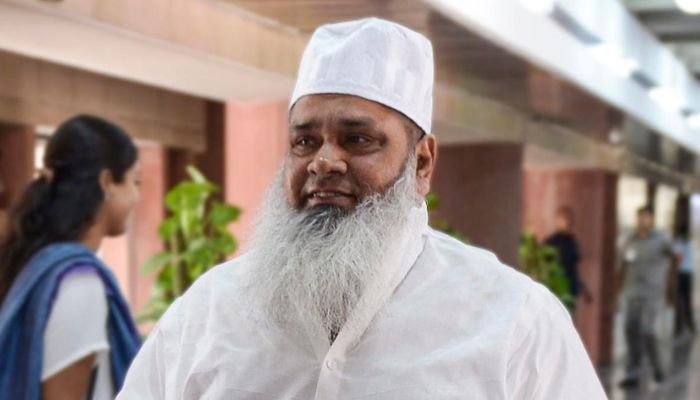
On Saturday, 3rd December 2022, two FIRs were filed against the AIUDF chief and Assam MP Badruddin Ajmal over his remarks on Hindu girls. These FIRs are filed by Hindu Yuva Chhatra Parishad and Assam National Council. Ajmal has made controversial statements many times in the past. However, after the controversy escalated, he apologized.

Assam’s Hindu Yuva Chhatra Parishad has lodged a complaint against Ajmal at Naugaon Sadar police station over his remarks. In the complaint, it has been said that indecent statements have been made against Hindus.

Dulu Ahmed, vice-President of the Assam National Council has filed an FIR against the Dhubri Lok Sabha MP Badruddin Ajmal in the Hatigaon police station and demanded that action should be taken against him for his remarks on Hindu girls.

While the Hindu Yuva Chhatra Parishad filed the complaint in support of Hindu girls and women, Dulu Ahmed had a different stand in his complaint. He said, “Badruddin Ajmal has been making such comments to benefit the BJP over a period of time. This communal comments as an MP.”

AIUDF president and MP Badruddin Ajmal had said that Hindus should adopt the Muslim formula of getting their girls married at the age of 18-20 years. He said that this will increase the population of Hindus. Badruddin Ajmal said that Hindus get married after 40 years of age, and therefore, they do not have many children.

Badruddin Ajmal has apologized after the controversy escalated. He said, “If my words have hurt anyone’s sentiments, I take back my words. I had no intention to hurt anyone’s sentiments. I only want the government to do justice to minorities and give them education and employment.”

The BJP strongly condemned Ajmal’s statement. Criticizing the MP, BJP spokesperson Ranjiv Kumar Sharma said, “Badruddin Ajmal is the second version of Aurangzeb and these words will not be tolerated.” The BJP has also demanded that Ajmal’s Maulana title be withdrawn.

Blast at the residence of TMC leader leaves three dead, BJP says it is bomb-making gone wrong

0

On Friday (November 2) night, a massive explosion rocked the residence of a Trinamool Congress (TMC) leader in Nariabelia village in Bhupatinagar area in the Purba Medinipur district of West Bengal.

As per reports, a total of three people died during the incident while two others are said to be injured. The deceased included the local booth President of TMC, Rajkumar Manna, his brother Debkumar Manna, and a man named Biswajit Gayen.

The blast destroyed the house of the TMC leader, who is now survived by his wife and daughter. While speaking to TV9 Bangla, Rajkumar’s wife alleged that a few men barged into her house after the blast and took away the dead bodies of the three men.

She claimed to have no idea about the whereabouts of the bodies of her husband and the two other deceased men. Her daughter told Tv9 Bangla, “I was not there at the time of the incident. I came home in the morning after learning about the blast. My mother told me that my father is no more.”

“She said that someone took the body of our father. I don’t know who took him away,” she further added. Meanwhile, the BJP has demanded a probe by the National Investigation Agency (NIA) and alleged that the TMC leader died while manufacturing bombs at his home.

“TMC leader Rajkumar Manna was making bombs at his home when this high-intensity explosion happened,” BJP heavyweight leader Suvendu Adhikari said in a tweet.

He further alleged that the deceased died while trying to manufacture bombs in a hurry. “Bombs are WB’s most successful Cottage Industry products & are widely produced in TMC leaders’ homes across Bengal,” he added while sharing visuals from the site of the blast.

BJP State President Sukanta Majumdar also accused the ruling Trinamool Congress of creating an atmosphere of fear, prior to the panchayat elections in West Bengal. He also sought the urgent intervention of the Union Home Ministry in this matter.

In another tweet, he said, “This bomb blast happened at the house of TMC leader when he himself was making the bomb. In Mamata Banerjee’s rule, bomb-making is their favourite business. Many of the TMC leaders are a threat to the security of the Bengal and Nation.”

Meanwhile, the Trinamool Congress has cried foul over the incident and accused the BJP of orchestrating the attack and trying to disrupt the public meeting of Abhishek Banerjee.

“The BJP attacked Manna’s home Friday night. They wanted to spoil Abhishek Banerjee’s meeting because they knew if this rally is successful, they will be finished in East Midnapore. But they will not be successful and after Banerjee’s rally, they will be decimated,” TMC MP Shantanu Sen claimed.

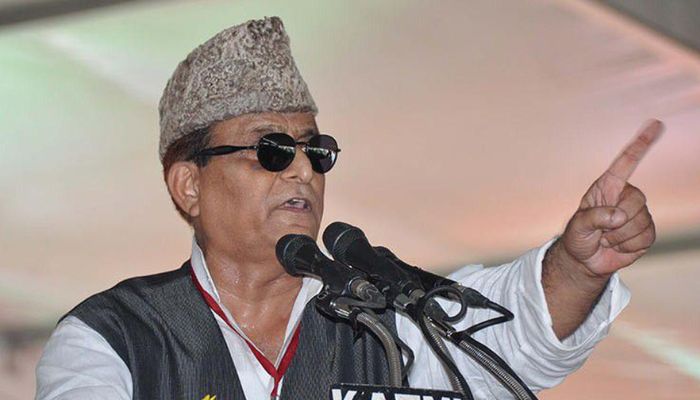
Another FIR against Azam Khan as he makes aggressive remarks against the election commission

On Saturday, 3rd December 2022, a case was registered against Samajwadi Party national general secretary Azam Khan for his provocative speech during the Rampur by-election campaign. This is the second FIR against the SP leader filed within the last 48 hours.

Samajwadi Party national president Akhilesh Yadav visited Rampur on December 1. Akhilesh Yadav addressed a public meeting in support of SP candidate Asim Raja in the assembly by-election. During this, Azam Khan also gave a speech, in which he targeted the police and administration as well as the Election Commission.

Azam Khan said, “Chief Election Commissioner Sir, please come here and give the certificate of the elected MLA. We will also clap like sycophants. It is necessary to do all the sycophancy yourself, let us do a bit of sycophancy too. Let us be a sycophant.” Azam Khan added, “Politics does not run on sycophancy. Country cannot be ruled by sycophancy.”

A case has been registered against him in this regard. Suresh Kumar Sagar, under-engineer of the canal section and in-charge of the video surveillance team, has lodged a case at the city Kotwali police station under Sections 153(A), 505(1)(b) of the IPC and Section 125 of the Representation of the People Act.

Superintendent of Police Ashok Kumar Shukla said, “Azam Khan has been accused of violating the code of conduct as well as making false statements against constitutional institutions, that is why the report has been filed against him.”

Two days ago, a case was registered against Azam Khan at the Ganj police station for allegedly making indecent remarks about women and making inflammatory speeches. Now the number of cases pending against him has gone up to 95.

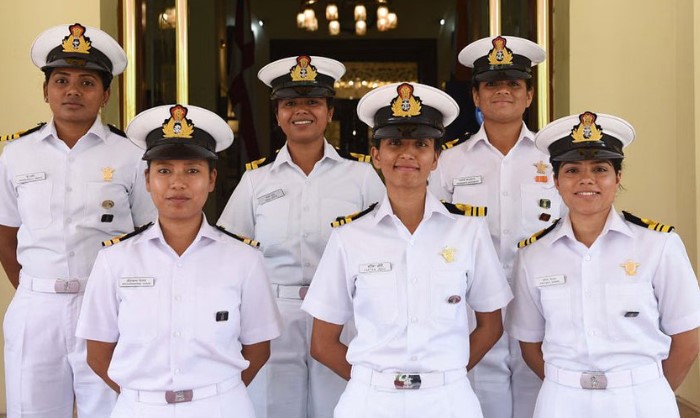
341 women Agniveers inducted into the Indian Navy under same criteria as their male counterparts:: Chief of Naval Staff Admiral R Hari Kumar

0

In a first, 341 women sailors have been inducted into the Indian Navy through the Agniveer scheme. Addressing a press conference ahead of Navy Day, Chief of Naval Staff Admiral R Hari Kumar said that around 3,000 Agniveers have been inducted into the Navy, out of which 341 are women. He said that 82,000 of the 10 lakh applicants who sought available positions in the Indian Navy were women. The Navy chief also confirmed that there was no discrimination in the selection process and that to qualify, both men and women had to pass similar tests.

“We’re not inducting women separately. They’re being inducted in the same manner as their male counterparts. It’s a uniform method of selection. They undergo similar tests,” said the Naval chief.

To emphasise the gender-neutral nature of the services, Kumar stated that the Indian Navy has already admitted fighter pilots and female air operations officers and that women sailors are now being enlisted. Admiral R Hari Kumar added that in the coming year, women would be allowed to join all remaining branches.

“Come next year, we are looking at women officers being inducted across all branches and not just the 7-8 branches they’re restricted to as of today,” he said.

“Services are gender-neutral. Already there are women doing combat roles. There are fighter pilots and air operations officers in the Navy. Now all branches are being opened in the coming year, we have started inducting women sailors as well. It is a landmark achievement,” the Navy chief said.

“We have had a good response, for 3000 vacancies, we had almost 10 lakh applicants, out of whom 82,000 were women. We don’t know finally how many of them will meet all the standards because we do not have separate standards as the job is the same,” he added.

Indian Navy had assured the government it will become ‘Aatmanirbhar’ by 2047: Navy Chief Admiral

The Navy Chief further stated that the Indian Navy had assured the government it will become ‘Aatmanirbhar’ by 2047. “Recent global events such as the Ukraine conflict demonstrated that we can’t remain dependent on others for our security requirements,” Admiral R Hari Kumar explained.

He also said during the event that the Navy’s goal is to find “Made-In-India security solutions” for the country. “The government has given us clear guidelines on Atmanirbhar Bharat. We have given assurances that the Indian Navy will become Aatmanirbhar by 2047,” the Navy Chief said.

He called the recent commissioning of the indigenous aircraft carrier, INS Vikrant, a “landmark event for the Indian Navy” and “torch bearer of atmanirbharta”.

“There are very few countries that have the capability to make an aircraft carrier and we now form one of the elite,” he said. “It inspires self-confidence among us and it’s a shining symbol of our indigenous capability. It has contributed to enhancing the stature of the nation in the world. I’m sure Vikrant will proudly fly the Tiranga across the wide reaches of Indo-Pacific in years to come,” he said.

Speaking on the docking of a Chinese spy ship at Sri Lanka’s Hambantota seaport recently, the Navy chief assured that the Navy keeps a strong vigil over the movements of various Chinese military and research vessels in the Indian Ocean Region.

Supreme Court to hear bail pleas of Godhra train burning case convicts on December 15, Gujarat govt opposes the applications

0

On December 2, 2022, the Supreme Court agreed to hear the bail applications of 15 convicts in the 2002 Godhra train burning case on December 15. A bench of Chief Justice of India DY Chandrachud and Justice PS Narasimha directed the State of Gujarat to detail the particular roles of the prisoners so that their bail pleas may be examined. The bench also observed that all of them had served 17-18 years in prison.

Solicitor General Tushar Mehta appeared for the state of Gujarat. He contended that the case was not “mere stone-pelting” by the convicts, as their acts prevented people from escaping the burning train coach. The bail application of the sole convict, Faruk, was heard before the bench on Friday. When the Solicitor General sought an adjournment till January, Faruk’s attorney asked the bench to postpone the matter until after the holidays, claiming that the State was requesting an adjournment for the second time.

A counsel representing the other convicts requested the judge to hear their bail applications as well, citing a total of 15 appellants. The judges questioned, “Why don’t they submit bail applications?” The attorney responded that the bail applications had previously been submitted in conjunction with the special leave requests in 2018.

According to the Solicitor General, the bail petitions would be heard alongside the major appeals. He said, “If the appeals are set down for hearing, everything can be settled. Main appeals could be listed for hearing.” However, the court said that it will hear the applications on December 15.

The Chief Justice of India said, “Perhaps what you can do Mr Solicitor is that ultimately you can tell us the individual roles. Once you do that exercise, then that obviates the need for us to insist that everybody should file bail applications. So once you identify them, then we can keep all those matters on board and say that these persons can be released on bail, based on their role. Because they have undergone 17-18 years. That will be fair also.”

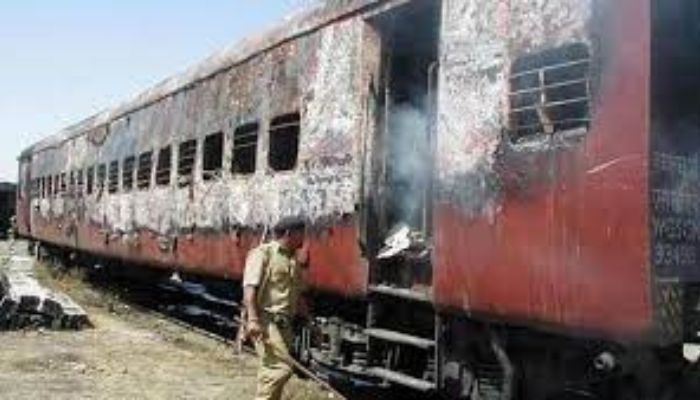
On February 27, 2002, 58 people were killed as the S-6 coach of the Sabarmati Express which was transporting karsevaks from Ayodhya was set on fire near Godhra station by Islamists. The Godhra massacre sparked communal rioting in Gujarat.