Elnaz Rekabi hit the headlines in October when the sports climber competed in Seoul, South Korea, without wearing a hijab. Amidst the ongoing protests against the oppressive hijab rules in Iran, her bravery to openly defy the regime was applauded by everyone. However, now the family villa of Rekabi has been demolished by the Iranian authorities.
Rekabi was hailed as a hero in Iran for competing without a hijab, even though she later claimed that her hijab had fallen off accidentally and she apologised for it. The apology from her was reportedly a forced one and she was pressurised by the Iran government.
The undated video footage of the demolition obtained byCNNfrom IranWire showed a demolished structure and medals on the ground. The man filming the video went on to describe what happened to the house. The video then showed Rekabi’s brother, Davood, crying. Davood is himself a decorated sports climber, having won multiple medals in the sport.
Semi-official Tasnim news agency has claimed that the demolition took place before Rekabi competed in South Korea without a hijab. They did confirm that the house has been demolished but said that this was due to the family not having a valid permit for its construction. The family was also fined around $4,700.
Anti-Hijab protests in Iran
The ongoing protests in Iran began after a 22-year-old woman named Mahsa Amini died on September 16 in Tehran. She was arrested and tortured by the ‘Morality Police’ for wearing the hijab inappropriately on September 13, 2022. Iranian media reported that Amini fell into a state of coma and was eventually declared brain dead.
Mahsa Amini succumbed to her injuries on September 16. Following her death, there have been large-scale women-led protests in Iran. Videos of women surfaced where they cut off their hair and burnt hijab as a mark of protest against the enforcement of compulsory hijab for women.
Many celebrities and sportspersons, including the country’s highest-ever goal scorer Ali Daei have been questioned or had their passports confiscated during the course of the protests for speaking in support of the protestors.
Union Carbide, the company responsible for the death of over 15000 people and illness of over half a million victims in the Bhopal disaster, resumed business in India just three years after the tragedy through a dummy company, a report by Al Jazeera citing internal company documents claims. The report states that Visa Petrochemicals Private Limited based in Mumbai is actually the front company of Union Carbide, which was formed to continue business in India after Carbide was banned in India after the 1984 disaster.
Al Jazeera states that The Reporters’ Collective accessed internal company documents of Union Carbide Corporation (UCC), which show how the company plotted an elaborate scheme to resume its business in India bypassing the authorities and courts in the country. According to the report, this front company operated for 14 years in India, which means the company was active in India from 1988 to around 2002.
According to the report, UCC sold its products covertly to several firms owned by the central and state governments, as well as some large private corporations. Among them was a buyer from Bhopal itself, a company owned by the Madhya Pradesh government. The company was a joint venture partner with a cable company that purchased UCC products through the front company.
UCC and its associates established three firms in India, the United States, and Singapore to create a discrete backdoor into India, because UCC was seen as the devil of the Bhopal Disaster by the public, and courts were pursuing it. Union Carbide employees referred to these three companies as “front” and “dummy” companies in internal documents.
Sometimes, they referred to these companies as their “extended arms”. These front companies took orders from Indian customers, rebranded UCC products, routed them through multiple ports to hide the true source, and delivered them to customers. The company sold materials used in the manufacture of household goods in everything ranging from telephone cables to paints.
In the internal documents, UCC admitted that these dummy companies were “a legal requirement” to help it maintain its “distance from India.” This admission was made in an internal business plan for UCC to continue selling goods in India despite the fact that Bhopal District Court had ordered the seizure of all of its moveable and immovable assets in the country.
The report also claims that the government entities that did business with Visa Petrochemicals knew that it was a front company for Union Carbide, because the company itself informed them during tender procedures. This arrangement ended in 2002, after American giant Dow Chemical acquired Union Carbide for $9.3 billion.
The Al Jazeera report claims that the records show that the company sold more than 55,800 tonnes of wires and cables in India between 1995 and 2000. The report further states that Indian media had earlier reported that Union Carbide was selling its products in India after relabelling them, but its true extent was not known.
Earlier in 2012, it was reported that UCC products were continued to be sold in after relabelling them and rerouting them through other companies. This was revealed in US courts during a litigation against Dow Chemical over pricing of products in the early 2000s.
A 2001 email by Graham Fox, Dow Chemical regional GM for Middle East & Indian subcontinent had stated that UCC was selling its products in India through Mega Visa. In the email to Ravi Muthukrishnan, country manager, Dow Chemical International Pvt. Ltd. (Mumbai), Fox had stated that UCC had used Mega Visa to handle many of their sales of specialty chemicals, some bulk chemicals and wire & cable products. “They work across our Dow businesses and have some several million $ sales revenue as I understand it,” the mail had added.
Al Jazeera adds that while this covert operation was reported earlier, its actual scale was not known at that time. It says that the extent of the operation by Union Carbide is being published for the first time now, including the fact that the covert business went on for 14 long years.
Surya Samachar has reported a case of alleged love jihad from Faridabad in Haryana where a Muslim youth named Javed Khan married a Hindu girl after converting her to Islam. A case in this regard is registered against Javed and 8 others after Dhiraj Kumar Shukla – the father of the girl – filed a complaint at the police station. It is alleged by the complainant that Javed Khan forcefully converted his daughter and married her. The police have started investigating the case.
According to the report by Surya Samachar, Javed’s family members had visited the girl’s home and asked her parents to get their daughter married to Javed. The girl’s parents had, at that time, clearly refused citing different religions. However, Javed’s family members said that they don’t need anyone’s permission. After this, the girl and Javed did a court marriage.
The victim Hindu girl works in the HDFC bank. One day she left for her office but after some time, her father received a phone call from the bank asking why she hasn’t come to work that day. As the father started searching for his daughter, he came to know that she has married Javed after converting to Islam. The complainant also got a notice from the Faridabad court stating that his daughter has filed a plea seeking protection from him after the marriage.
As the complainant reached court and saw the relevant documents, he came to know that his daughter has already converted to Islam and married Javed Khan. The father of the girl has alleged that the prescribed procedure for conversion under the Haryana Prevention of Unlawful Conversion of Religion Bill, 2022, has not been followed in this case.
According to this law, a citizen in Haryana state has to file an application in the SDM office stating that he or she wants to change his religion. After this, there is a specific notice period during which objection can be raised and the family of the applicant is bound to be informed. However, in this case, no such rule was followed and the girl declared her conversion on a simple affidavit.
Apart from Javed Khan, others named in the complaint include Javed’s family members, the people who signed as witnesses during the marriage. The Qazi who solemnized the marriage, and one is the registrar who provided the stamp have also been named in the complaint.
This is reportedly the first case registered under the Haryana Prevention of Unlawful Conversion of Religion Bill, 2022. The parents of the girl said that this is clearly a case of love jihad and they are worried that their daughter will meet the same fate as Shraddha Walkar.
As per the provisions of this law, everyone named in the FIR can be arrested by the police. However, so far police are yet to make the arrests.
Nurul Haque, an enterprising mechanic from Karimganj southern Assam, presented a car that he modified into a Lamborghini to Assam Chief Minister Himanta Biswa Sarma today. He had reached Guwahati yesterday, but could not meet the CM as his schedule was busy. Today evening Nurul Haque finally arrived at the CM’s residence and presented the ‘Lamborghini’ car to Sarma.
Nurul Haque, a resident of Anipur in Bhanga area in Karimganj modified a Suzuki Dzire car to look like a Lamborghini sports car. He spent over ₹10 lakh in this task, and took four months to complete the modification.
Nurul Haque considers Himanta Biswa Sarma as his biggest idol and said that it was his dream to present his modified car to the CM.
Earlier on Thursday, Nurul Haque had driven the car from Karimganj to Silchar where the CM was present for a cabinet meeting. It is notable that Assam cabinet meets every week, and one meeting every month is held outside Guwahati. Himanta Biswa Sarma had posted photographs saying that he “had the thrill of being at the wheel of a ‘Lamborghini’ assembled by Nurul Haque”.
Wrapped up my day at Silchar with a walk from Itkhola to Circuit House along with our karyakartas. Happy to meet a lot of warm-hearted along the way.
Also had the thrill of being at the wheel of a 'Lamborghini' assembled by Nurul Haque, a car enthusiast from Karimganj. pic.twitter.com/7EMsG4MtbT
Haque said that he had made the car to gift to the CM, and came to the Circuit house in Silchar for the same. But the CM invited to his residence in Guwahati instead. The mechanic said that he was very happy that the CM is accepting his car, and his biggest dream is being fulfilled.
Soon after that, Nurul Haque drove the car to Guwahati. As the road to Guwahati from Silchar goes through Meghalaya, the car was provided escort by Assam police, in light of the recent tension in the state against Assam.
Nurul Haque arrived at Himanta Biswa Sarma’s residence yesterday evening, but the CM could not be present as he had several meetings. But he promised Nurul that he will be available on Saturday evening, accordingly, Nurul Haque left the CM’s residence, stayed in Hatigaon area in Guwahati, and returned to the residence today evening.
Delighted to receive a modified Lamborghini lookalike car from innovator Nurul Haque of Anipur, Karimganj.
Accepting the car from Nurul Haque, CM Himanta Biswa Sarma wrote on Twitter, “Delighted to receive a modified Lamborghini lookalike car from innovator Nurul Haque of Anipur, Karimganj.” He wished him best in his all his future endeavours.
A large number of people were present at the CM’s residence when he was handed over the key of the ‘Lamborghini’ by Nurul Haque.
In a horrifying case reported from the state of Maharashtra, the Vasai Police in Mumbai has registered an FIR against Pramod Joginder Sahu, a man reportedly belonging to the Christian community, for allegedly raping his minor daughter (15). The Police have also booked Pramod’s younger brother, Gauri Shankar Sahu, for sexually assaulting the girl, who has now been shifted to the child care centre of the city.
The case has been registered under sections 376, 376 (2) (n), 376 DA, 376 (3), and 506 of the IPC and sections 4, 6, 8, and 12 of the Protection of Children from Sexual Offences Act, 2012.
According to the FIR copy obtained by OpIndia, the sexual abuse of the girl started on November 1 of this year, but the case was registered on November 27 as the girl had been forcefully taken by the father to their native home in Bihar after the assault. The primary accused in the case, Pramod Joginder Sahu (48), is a resident of Nalasopara, Vasai, and the second accused named in the case named, Gauri Shankar Sahu (44), is a resident of Kandivali, Mumbai.
FIR copy obtained by OpIndia
The complaint was filed by the minor girl at Vasai Police Station in which she mentioned that she was brutally raped by her father and her uncle several times. She said that she lived with her four brothers, her father (accused), and her stepmother and the incident happened when she was all alone at her home with her father.
The victim said that her uncle Gauri Shankar Sahu from Kandiwali had arrived at her place post-Diwali and sexually assaulted her in the presence of her father. “Nobody was there at home. My stepmother had gone out for some work, my elder brother had gone to the jeans manufacturing company where he works, and my younger brothers had gone out to play. I took shower and as I came out of the bathroom, my father who was sitting in the drawing room grabbed me and forced me onto the floor in the kitchen. He then raped me. Later my Uncle who was sitting in the drawing room arrived and brutally assaulted me,” the girl said.
According to the FIR, both the accused threatened the girl and asked her to keep her mouth shut. They told her that they would kill her brothers if she reported the incident to anyone in the family. “I was scared, so I decided to keep quiet. My uncle left, but my father continued to rape me. He also sexually assaulted me after the Chhat Puja day,” the girl added.
Both the accused named in the case
The accused, as per the FIR, then took the girl to his sister in Thane (the girl’s maternal aunt) where she managed to tell her aunt the truth. “I told my aunt that I was being sexually abused. But she also asked me to keep my mouth shut and let no one know about the crime. She clicked some photographs of mine, and requested me to stay quiet,” the girl narrated. She added that she was raped at her aunt’s place as well by her father and uncle who executed the crime in her aunt’s absence.
The accused then happened to take the girl to their native home in Darbhanga to restrict her from narrating the incident to anybody in the family. He prohibited her from stepping out of the house and talking to anyone. The girl somehow managed to escape from the spot on November 24 and contacted her elder brother who works in a jeans manufacturing factory in Vasai. He assisted her and helped her reach Thane Station in Maharashtra. He also gave her the child life helpline number (1098) and asked her to go home to Nalasopara.
Complaint registered by the minor victim in FIR (Copy obtained by Opidnia)
The accused was reportedly involved in another child abuse case in 2015
Some members of the Child Life Center arrived at Sahu’s home in Nalasopara and took her to the Child Care Center in Palghar. At present, the victim girl is at the Child Care Center and is being taken proper care of. According to the sources, the accused belongs to the Christian community and was also booked in the year 2015 in a child abuse case. Sahu is accused of sexually assaulting two minor boys following which a complaint was filed against him. The accused then filed a countercase alleging that the victim’s parents had thrashed him and vandalised his residence. He also alleged that the photographs of Jesus Christ placed at his home had been torn apart by the parents of the two boys. The case (State of Maharashtra vs Indrajeet Tiwari, Umakant Surendrakumar Tiwari, 64/2015), as per the sources, is still pending at the Vasai Court.
The sources further stated that the accused had persuaded around 1,500 people from Vasai to change their religion and accept Christianity as their new religion. However, OpIndia cannot independently verify the claim. The police in the current case have registered an FIR but have not yet arrested the accused Pramod Sahu and his brother Gauri Shankar Sahu.
The Legal Rights Observatory took cognizance of the incident and alleged that a lady police officer API Manisha Patil at Vasai Police Station tortured the victim and her brother and asked them to withdraw the complaint. The elder brother and the stepmother of the victim have also been restricted by the Police from meeting the victim who is in the Child Care Center at present.
POCSO accused Pastor P J Sahu repeatedly raped own daughter n impregnated her; victim approached Mira Bhayender Police but lady officer kept her waiting whole night n threatened her to withdraw complaint; We urge @NCPCR_@DGPMaharashtra to immediately intervene as he is criminal pic.twitter.com/sezqhCuCAI
“In Meera Bhayandar, Maharashtra, it has been reported that the victim, who went to a police station to report sexual abuse against a pastor, was kept in the police station overnight and the procedures of JJ, POCSO Act were not followed. Necessary action is being taken by @NCPCR_ @Dev_Fadnavis @DGPMaharashtra,” he tweeted.
महाराष्ट्र के मीरा भयंदर में एक पास्टर के विरुद्द यौन शोषण की रिपोर्ट करने पहुँची पीड़ित बच्ची को रात भर थाने में बिठाए जाने एवं जेजे,पोकसो ऐक्ट की प्रक्रियाओं का पालन न किए जाने की सूचना मिली है।@NCPCR_ द्वारा आवश्यक कार्यवाही की जा रही है।@Dev_Fadnavis@DGPMaharashtra
— प्रियंक कानूनगो Priyank Kanoongo (@KanoongoPriyank) December 3, 2022
OpIndia meanwhile established contact with API Manisha Patil of Vasai Police Station who refused to reveal any information about the case. “This is a POCSO case. No information can be given out right now. The case has been registered and the investigations are underway,” she said.
Football legend Pele has been moved to ‘palliative care’ or ‘end of life care’ in hospital after he stopped responding to treatment, according to a report by the Brazilian daily Folha de Sao Paulo. The three-time world cup winner was moved to hospital on Tuesday amid his battle against cancer with swelling all over his body and heart conditions.
After the hospitalisation at Albert Einstein Hospital Pele’s family had said that there was no cause of worry and his daughter Kely Nascimento had said that there was no emergency. Pele himself had said that it was his regular monthly health checkup, as part of his ongoing treatment after he was diagnosed with cancer in 2021.
In September 2021, tumour was removed from the colon of the 82-year-old former footballer and since then he is undergoing regular treatment. Subsequently, metastases in the intestine, lung and liver were also diagnosed.
But today Folha de Sao Paulo reported that the Brazilian legend has stopped responding to chemotherapy, and he has been moved to palliative care. This means the chemotherapy and other invasive procedures have been suspended, and now he is being provided with comfort measures to relieve pain. Palliative care is given to patients with progressive and potentially life-threatening diseases or conditions.
Pele was admitted to the hospital with generalized swelling, generalized edema and decompensated heart failure. On Friday, the hospital released a statement saying that the legend has been diagnosed with a respiratory infection.
Pele has been active on social media, and following the World Cup in Qatar. He has been posting messages and photographs on Instagram.
His last Instagram post was posted yesterday, where he said that he was in the hospital for a monthly visit. He thanked Qatar for lighting up a building with his image and a ‘get well soon’ message and posted a photograph of the same.
On Saturday, 3rd December 2022, massive protests were held in the New Government Law College in Indore of Madhya Pradesh after an anti-Hindu book promoting religious fanaticism was found in the library of the institute. The protests were held a day after the college administration sent six of its professors off their duty. Besides, details of the matter brought to the fore shocking facts about the professors as the Akhil Bharatiya Vidyarthi Parishad’s protests culminated in the resignation of the principal Dr Inamurrahman, who tendered his resignation to the commissioner of the Higher Education Department.
Six professors of Indore college instigated students
Six professors of the Government Law College had instigated the students against a particular sect. A controversial book (Mass Violence and Criminal Justice System) written by Dr Farhat Khan has also been found in the college library, in which objectionable words have been written against Hindus, RSS (Rashtriya Swayamsevak Sangh), and VHP (Vishwa Hindu Parishad).
The state government has intervened in the matter
Now the government has intervened in this matter. The Higher Education Minister of the Madhya Pradesh state government Dr Mohan Yadav has handed over the investigation of the matter to the Additional Chief Secretary of the department. He said, “The role of six teachers in the case of spreading religious fanaticism in Government Law College, Indore, and the controversial book will also be investigated. The controversial book is said to be from a private publication. Strict action will be taken against whoever is guilty in the cases as per rules.”
The students protested and requested to file an FIR
Meanwhile, on Friday, student leaders reached Bhanwarkuan police station and submitted an application seeking registration of an FIR in the case of the objectionable book. It is said that the college management has purchased the controversial book, which is present in the library there.
Why two separate committees to investigate the matter?
The college management has also started a local inquiry into the six teachers accused of spreading religious fundamentalism and the controversial book. At the request of the college management, the retired judge and the Lokpal of Devi Ahilya University Narendra Satsangi will investigate the whole matter. The Higher Education Department has also formed an inquiry committee.
The committee comprises additional director Dr Kiran Saluja, Holkar College’s Principal Suresh Silawat, and Atal Bihari Vajpayee Government Arts and Commerce College’s professor Anup Vyas. After the investigation was handed over to the Additional Chief Secretary of the department itself, there are doubts about the efficacy of the committee. Members of both the inquiry committees will discuss the issue with different groups of students of the college’s first-year to final-year course. In such a situation, questions are now being raised as to what is the point of forming two committees.
Additional director Dr Kiran Saluja called the principal of the New Government Law College of Indore on Friday and enquired about the entire matter. Incorporating the allegations made by ABVP student leaders and the information given by the college principal, she sent a report to senior officials of the higher education department on Friday.
Earlier incidents in the Indore law college
Six professors were suspended for five days after the ABVP staged a protest in the college on Thursday with the allegations of anti-Hindu activities against the college professors. The ABVP had alleged that the college professors were opposing the removal of Article 370 from Kashmir in the college. Apart from this, they also allegedly talked against the country and the Indian Army. Not only this, the professor used to ask girl students of the college to meet them alone. It is speculated that all six professors will be transferred.
Anti-Hindu excerpts from the controversial book
Farhat Khan, the author of the book, has written several controversial passages in her book ‘Mass Violence and Criminal Justice System’, which has sparked controversy. Some of the excerpts in this book are as follows:
The Hindu sect is emerging as a destructive ideology.
2. An organization like the Vishwa Hindu Parishad wants to establish a Hindu majority state. It justifies the establishment of the Hindu state with barbarism.
3. Hindus have opened a front to fight against every sect.
4. In Punjab, a new trident-bearing organization like Shiv Sena has formed a front against Sikhs.
5. The truth of Punjab today is that the main terrorists are Hindus and Sikhs are turning terrorists in response.
6. The amazing thing is that earlier Muslims used to shout that minority Islam is in danger, but today Hindus are shouting that majority of Hindus are in danger.
7. Today, the Hindu majority is working to impose its will on the minority Muslims, which is leading to communal conflict.
8. When it was decided by law that the 1947 status of religious places will be maintained, why was the temple of Ayodhya excluded from the purview of this law?
9. When the RSS stopped the BJP from opposing the Congress, it also ordered the Congress to keep the Ayodhya dispute out of the law, so that the BJP continues its communal politics.
10. Of all the social, political, and religious organizations of Hindus, their only aim is to destroy Muslims and enslave Shudras, and the rule of Hindu monarchy has to be brought back and Brahmins to be worshipped by making them gods of the earth.
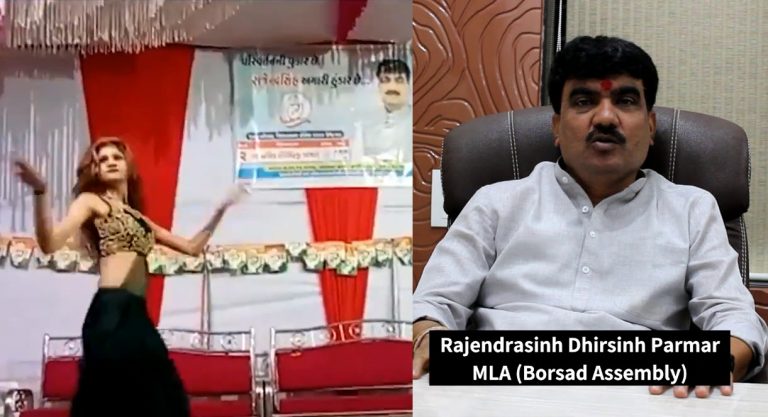
Ahead of phase two of the Gujarat polls, a video has gone viral wherein some women dancers can be seen performing on the stage with a poster of Congress Borsad candidate Parmar Rajendrasinh in the background. Reportedly, the dancers were hired by Congress MLA Parmar Rajendrasinh Dhirsinh for his election campaign.
Congress party landed itself in a massive controversy ahead of the second phase election. Rajendra Parmar who is a sitting MLA of the Congress from Borsad hired multiple dancers for his campaigning. The videos of the event went viral on social media platforms. pic.twitter.com/kBlkWerWUo
Parmar Rajendrasinh Dhirsinh is a sitting MLA of Congress from Borsad, a seat the party has been winning since 1967. He is also the vice chairman of Amul.
In the video of the event that is being widely shared on social media platforms, female dancers are seen enthralling the ‘audience’ by dancing to Gujarati songs. Congress flags along with posters are visible on the stage and a person is also seen showering cash on the dancers. Dozens of people are in attendance.
The event was reportedly organised for Rajendrasinh Parmar’s campaigning ahead of the second phase of voting on December 5.
Nothing obscene in the dances, says the Congress MLA
Responding to the controversy over the dancers in the election campaign, Dhirsinh said that no obscene act took place during the election campaign, and it was just dance performances. When an ABP Asmita asked him about ‘obscene video’, he said that there is no obscene video. He also distanced himself from the program, saying that he has no idea what program the local supporters had organised for his election campaign.
The MLA agreed that it was his election campaign when the reporter mentioned that the stage was filled with his posters and Congress flags, but said that when he went there to address the meeting, there was no dancer. He said that the local workers might have organised a dance and music program after the meeting in the night for entertainment, and he was not aware of it.
However, Parmar Rajendrasinh Dhirsinh also added that many other parties bring film stars etc for election campaigns, and this is the first time such a thing took place in his meeting. He claimed that he came to know about it in the next morning only, and said that he will call his workers to know why this happened.
AAP worker in Gujarat bribes members of Koli community to vote in party’s favours
Recently reports emerged on how an Aam Aadmi Party (AAP) worker had attempted to entice voters with money in Gujarat’s Gariadhar assembly constituency in the Bhavnagar district.
As per reports, the accused was identified as Deepak Khunte. He gave ₹3 lakh rupees to 8 members of the Koli community in exchange for voting for the Aam Aadmi Party (AAP).
Deepak had tasked the 8 men to convince his community to vote en masse for the AAP, which is desperately trying to make in-roads in Gujarat.
The second round of the Gujarat Assembly elections is slated for December 5, with voting for 93 of the 182 assembly seats. The first phase of voting covered 89 seats, with an overall voter turnout of 63.14 per cent. Votes will be counted on December 8.
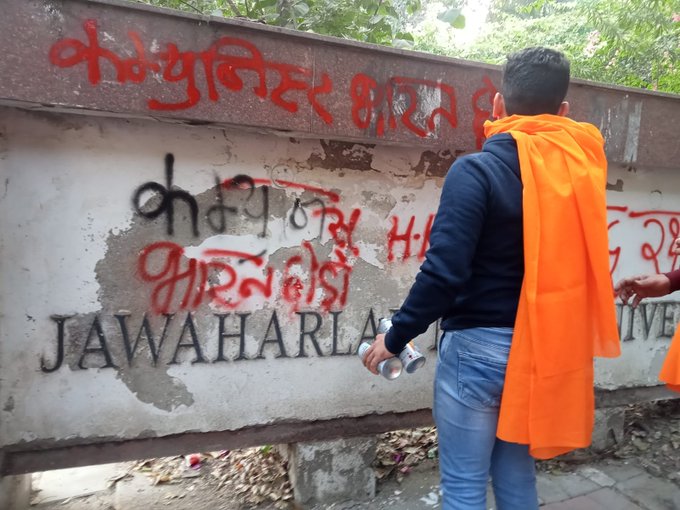
Two days after JNU campus walls were defaced with anti-Brahmin and anti-Baniya graffiti, slogans against communists appeared on the wall next to the main gate of the campus. The slogans against communists were reportedly painted by Hindu Raksha Dal. In the slogans, communists were equated with the Islamic terrorist organisation ISIS apart from asking them to Quit India.
The spray-painted slogans included “Communists Quit India”, “Communists = ISIS”, and “Jihadis Quit India.”
अब JNU की दीवारों में हिंदू रक्षा दल ने लिखा- ‘कम्युनिस्टों भारत छोड़ो’. साथ ही लिखा Communist=ISIS
हिंदू रक्षा दल के अध्यक्ष पिंकी चौधरी ने इसकी जिम्मेदारी लेते हुए कहा- हम केवल और केवल सनातनी हिंदू हैं. pic.twitter.com/O7f67t39xs
The JNU administration stated that it would take action against such acts and that an investigation has been launched. Meanwhile, members of the Hindu Raksha Dal believe Communists initially wrote hate slogans against Brahmins inside the campus. In response to the anti-Brahmin graffiti, Dal’s associates wrote a letter condemning them.
Hindu Raksha Dal leader Pinky Chaudhary reportedly said they (the communists) want us to leave India, but we will make them leave. When asked about using the same method used by the communists, Chaudhary said that “unlike them, we did not hide after writing slogans.”
Notably, two days back, many offensive slogans against Brahmins were painted on several walls inside the campus. The offices of some professors were also defaced with highly objectionable graffiti. “Go back to Shakha” was written on the doors of the chambers of several professors, asking them to return to Rashtriya Swayamsevak Sangh (RSS).
The anti-Brahmin and anti-Baniya slogans were reportedly scrawled on the walls of the university’s School of International Studies-II building. “Brahmin-Baniya, we are coming for you,” “We will avenge,” “Brahmins Leave the Campus,” “Brahmins Leave India,” “Now there will be blood,” “Go back to Shakha,” and other slogans were painted in the building. The professors whose offices were targeted by the miscreants included Nalin Kumar Mohapatra, Raj Yadav, Pravesh Kumar, and Vandana Mishra.
Meanwhile, the Vice-Chancellor of the University, Santishree Pandi issued a statement condemning the act of ‘exclusivist tendencies’ after the anti-Brahmin slogans appeared, and said that these tendencies have no place in JNU.
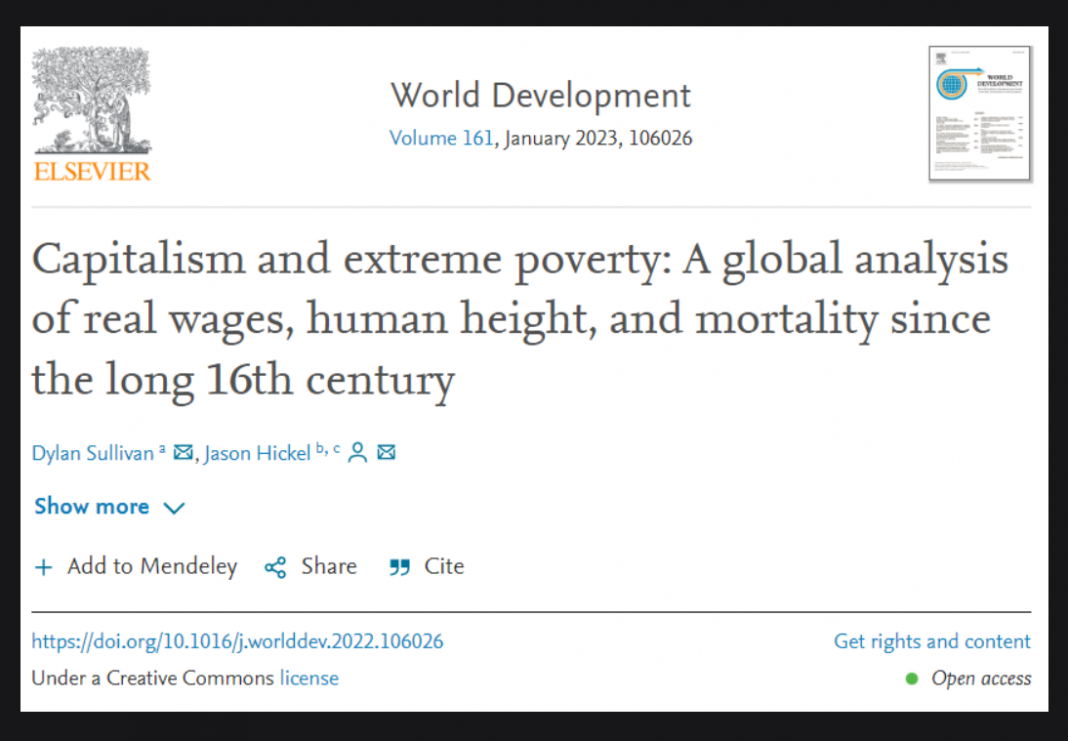
The British colonialism in India led to the death of over 100 million people in 4 decades from 1880 to 1920, the peak of British imperialism, a new study published in the journal World Development said. The research, titled ‘Capitalism and extreme poverty: A global analysis of real wages, human height, and mortality since the long 16th century’ and authored by Dylan Sullivan and Jason Hickel, underscores the depth of human tragedy colonialism inflicted on India with few parallels in the recorded history.
The study found that extreme poverty was unusual and only appeared during periods of profound social and economic turmoil, particularly during colonialism. As capitalism has developed since the late 16th century, wages have fallen below subsistence levels, human height has declined, and the number of premature deaths has increased.
The research paper.
Native populations in parts of South Asia, Sub-Saharan Africa, and Latin America have not yet fully recovered, according to the report. Only around the turn of the twentieth century did human well-being begin to rise significantly, concurrent with the rise of democratic and anti-colonial political movements.
The authors estimated the number of individuals who perished because of British colonial practices throughout four horrific decades from the 1880s to the 1920s using census data. Reliable statistics on death rates in India go back to the 1880s. Using it as the baseline for “normal” mortality, it was discovered that 50 million additional fatalities occurred under the auspices of British colonialism between 1891 and 1920, taking the count of total deaths caused by imperialism to above 100 million—a scathing indictment of the British colonialism and a grim realisation for the apologists who yearn for Britain’s colonial legacy and believe it brought prosperity and development to the colonies it governed.
Fifty million fatalities is a startling number, yet this is only a conservative estimate. According to data on actual earnings, living standards in colonial India had already fallen considerably from their prior levels by 1880.
If the mortality rate in India before colonisation was comparable to that in England in the 16th and 17th centuries (27.18 deaths per 1,000 people), then 165 million more individuals died in India between 1881 and 1920. While the exact number of fatalities is dependent on the assumptions used for baseline mortality, it is evident that between 1880 and 1920, during the height of British colonialism, around 100 million individuals died before their natural age.
This is one of the most severe policy-caused mortality crises in human history. It exceeds the total number of fatalities from all famines in the Soviet Union, Maoist China, North Korea, Pol Pot’s Cambodia, and Mengistu’s Ethiopia.
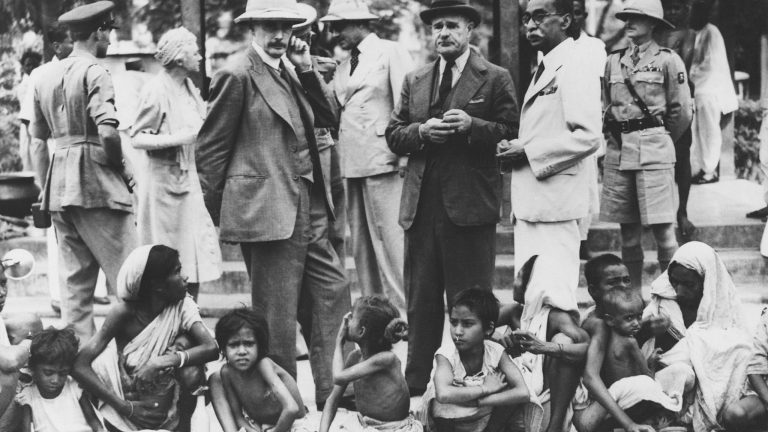
There are various ways in which British control contributed to this massive loss of life. For starters, Britain virtually devastated India’s industrial sector. Prior to colonial rule, India was one of the world’s major industrial suppliers, sending high-quality textiles to every corner of the globe. However, this began to change in 1757, when the British East India Company took control of Bengal.
The colonial regime, according to historian Madhusree Mukerjee, virtually abolished Indian tariffs, allowing British goods to flood the domestic market, but it also established a system of absurdly high taxes and internal duties that prevented Indians from selling, let alone exporting, textiles within their own nation. India’s industries were wiped out by this unjust trade policy, thus deindustrializing it.
To make problems worse, British colonists developed a system of legal thievery known as the “drain of wealth.” Britain taxed the Indian people and used the proceeds to purchase Indian items like indigo, grain, cotton, and opium, thus acquiring these things for free. The British government received the revenues from the sale of these goods, which were either consumed in the UK or exported once again.
This approach depleted India of products worth trillions of dollars now. The British were ruthless in implementing the drain, compelling India to export grain even when drought or floods endangered domestic food security. Historians have determined that tens of millions of Indians perished of starvation during three significant policy-induced famines in the late nineteenth century, as their resources were diverted to Britain and its colonial possessions.
The effects of their policies were well understood by colonial officials but they stood by as millions went hungry, refusing to change direction. They continued to willfully deprive them of basic survival essentials.
The authors of the study also established a solid argument for reparations, which has a long history in international law. They argue that while history cannot be reversed and the sins of the British empire cannot be erased, reparations can assist address the legacy of deprivation and unfairness left by colonialism as a key step toward justice and reconciliation.