After months of delay and anticipation, Bengaluru is expected to inaugurate its Yellow line remotest metro route in early August. The 19.15 km long route will help to connect people to its area.
The new route will connect the RV road to Bommasandra via the bustling electronic city corridors. The project is nearly in the completion phase. As the city’s problem of dealing with traffic congestion, the long stretch of land is likely to ease commute times for lakhs of residents in the southern tech belt.
MP Tejasvi Surya calls for a march demanding operationalisation of the critical public transport the city needs.
Bengaluru is choking in traffic. But the Yellow Line is still not open.
The lifeline of our IT corridor lies idle – years after construction began. Broken promises, missed deadlines, and no answers from BMRCL.
The delay has been caused by to shortage of trains. The train will be also running driverless in this line. Currently, the Bengaluru Metro Rail Corporation Limited (BMRCL) has only three stations. It will knock on the doors of 16 stations and will run every 25 minutes.
Since the train in the yellow line will run driverless, it needs an independent safety assessment (ISA) certification, a very crucial document to validate signalling tests.
The yellow line’s signalling contractor, Siemens India Ltd- Siemens AG, has submitted a draft report to a third-party assessor for the clearance of the certification, which is expected by July 7 to 8. The next step will be the BMRCL approach to the commissioner of Metro Railway Safety to conduct a thorough inspection of safety. ‘The expected date for the safety inspection is July 15. The statutory exercise will take three to four days, as this is a long route with many stations’ says a senior official of BMRCL.
The inspection will include a visit to all 16 stations, track checks, and various operational tests. One day will be dedicated to visiting the Operational Control Centre (OCC) at the Baiyappanahali depot, according to the official
The discussion has been made to the CMRS, and the progress report is being shared by ISA.
Critical traction and braking system tests have now been completed, and all trains meant for this corridor have undergone extensive trial runs, as per a report by Bangalore Mirror. The BMRCL gave confirmation that civil works, including all 16 elevated stations across the Yellow Line, have been completed. Interior station finishing, platform installations, passenger amenities, and Communication-Based Train Control (CBTC) signalling systems are now fully in place.
Prime Minister Narendra Modi is likely to inaugurate the ceremony, and it will be noted that the dates do not clash with the monsoon session of parliament. For now, the BMRCL plans to hold the ceremony at the KSRP Grounds near Silk Route.
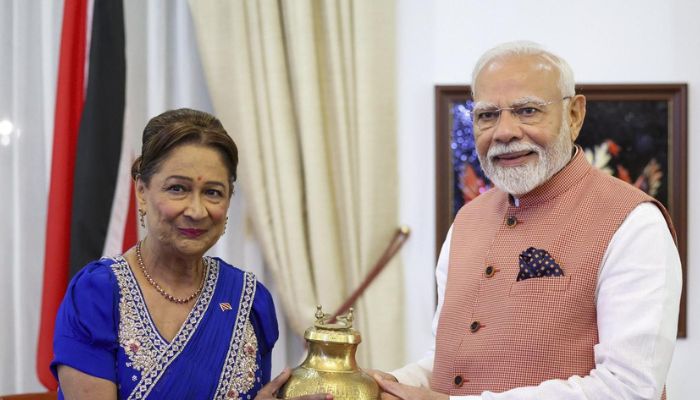
Prime Minister Narendra Modi, on his first official visit to Trinidad and Tobago, addressed the Indian diaspora in the capital city Port of Spain and referred to the deep cultural and ancestral roots between the two nations. This was not only ceremonial, this was an emotional gesture to honour India’s centuries-old spiritual and cultural connection with the Indian diaspora in the Caribbean country.
During his speech, PM Modi remembered that the people of Trinidad and Tobago had previously sent holy water and ‘shilas’ (holy stones) to be used for the Ram Mandir in Ayodhya.
He added that it was a subject of great pride and dedication for him to present a replica of the Ram Mandir and holy water of the Sarayu River in Ayodhya as a present for the Indian community there.
“I know how much you all revere Prabhu Shri Ram. Your Ram Leelas are just wonderful. I am sure you were all pleased to witness Ram Lalla returning to Ayodhya after 500 years,” PM Modi added.
The Indian Prime Minister also spoke about his previous visit to Trinidad and Tobago some 25 years ago. He mentioned how Indian culture there still flourishes, with festivals such as Navratri, Mahashivratri, and Janmashtmi being celebrated enthusiastically, and traditional songs such as Chautal and Bhaitak Gana are still popular.
PM Modi complimented the courage and resilience of the Indian-origin people, stating, “Your ancestors abandoned the Ganga and Yamuna, but took the Ramayana in their hearts. They were not mere migrants; they were bearers of an ageless culture.”
Referring to the Indian diaspora as “our pride,” the Indian PM continued, “Each one of you is a ‘Rashtradoot’, an ambassador of India’s values and heritage.”
He also said that Trinidad and Tobago Prime Minister Kamla Persad-Bissessar is originally from Buxar, Bihar, and she is a “Bihar ki Beti” to many. PM Modi appreciated Bihar’s history in democracy, education, and politics.
Notably, last year, on 22nd January 2024, a grand ceremony was organised in Trinidad and Tobago to commemorate the consecration of Ram Lalla in Ayodhya. More than 5,000 people attended the ceremony, watched cultural performances and devotional songs dedicated to Lord Ram. The Ram Janmbhumi Sthapana Samiti, together with Indian community organisations, lit 550 lamps during the ceremony.
#WATCH | Ram Janmabhoomi Sthapna Samiti, Trinidad and Tobago in association with Overseas Friends of Ram Mandir and the Indian diaspora celebrate ahead of the Pran Prathishtha in Ayodhya. pic.twitter.com/jiEZmyUYyp
The Indian High Commission shared on X at the time, “Indeed, an honour to be part of the grand celebrations by the Indian Diaspora in Trinidad & Tobago on the eve of Pran Pratishtha of Shri Ram Lalla in Ayodhya.”
Indo-Trinidadians and Tobagonians comprise roughly 42% of the population and have maintained their link with Indian culture through generations.
Bangladesh is witnessing a rapid increase in crimes against women under the watch of ‘chief advisor’ to the interim government, Muhammad Yunus. More than 24 cases of rape have been reported in the country within a span of just 9 days.
According to a report by Dhaka Tribune, the heinous crimes were committed between 20th June and 29th June this year. The situation has become so grim that Sharmeen S Murshid described the sexual violence as ‘pandemic-level crisis.’
Murshid, who serves as the adviser to the Ministry of Women and Child Affairs in Bangladesh, informed that her Ministry’s toll-free number has received 2.81 lakh complaints over the past 10–11 months of the Yunus regime.
She added that only about 100 women have so far received support. Murshid did not mince words before highlighting the deplorable state of affairs under the ‘chief advisor.’
“Violence is being committed in families, workplaces, public spaces, and online. Despite Section 14 of the Women and Children Repression Prevention Act and the High Court’s directives, victims’ photos are still being published in the media. Offensive video clips are aired, which is a violation of the law. Instead, it is the perpetrators—rapists and abusers—whose identities must be exposed,” Sharmeen S Murshid remarked.
She also talked about the rising cases of sexual violence in madrassas by Islamic clerics, who have been bolstered under the Yunus regime.
“Madrasas often remain out of sight, but child sexual abuse is taking place there too. We’re not getting the data. Our officials will now go directly to schools and madrasas to ensure accountability,” Sharmeen S Murshid pointed out.
The adviser to the Ministry of Women and Child Affairs in Bangladesh later attempted to divert focus from the current law and order situation under Muhammad Yunus.
She had claimed, “I have been working on violence against women and children for 40 years. Governments have come and gone, but none have been able to tackle the issue.”
The recent brutal rape of a Hindu woman in Muradnagar in Cumilla by BNP leader Fazor Ali and subsequent attempts to character assassinate the victim has left the minority Hindu community of Bangladesh in a state of shock and trauma.
Deteriorating law and order situation in Bangladesh
In March this year, the Human Rights Support Society (HRSS) published its report exposing the deteriorating law and order situation in Bangladesh
The report revealed the grim human rights situation in Bangladesh. Human rights violations highlighted by HRSS include mob lynching, extrajudicial killings, political violence, child abuse, harassment of women and journalists and attempts to suppress freedom of speech.
The report highlighted an atmosphere of anxiety and fear among the common people due to increase in crimes such as murders, rapes, extortion, theft, snatching, and robbery.
The human rights body reported that at least 9 people were killed and 755 others were injured in political violence in February. A total of 104 incidents were found by HRSS for the same period.
HRSS also reported 10 deaths and 13 injuries in 17 different incidents of mob violence. It also pointed out that at least 107 children and women were tortured. 53 (comprises of 38 children) of them were subjected to brutal rape.
On 12th February this year, the Office of the United Nations High Commissioner for Human Rights (OHCHR) published a 104-page report detailing atrocities committed against vulnerable Hindu minorities in Bangladesh.
The report titled ‘Human Rights Violations and Abuses related to the Protests of July and August 2024 in Bangladesh.’ Its publication becomes crucial since the interim government in Bangladesh, led by Muhammad Yunus, is pandering to Islamists.
The findings of the OHCHR expose the grim reality that Muhammad Yunus tried to brush under the carpet. He has largely remained a ‘mute spectator’ to targeted attacks, aimed at erasing the history of Awami League in the context of Bangladesh’s independence and politics.
Bangladesh is witnessing a drastic rise in vigilante Muslim mobs, unleashing violence under the pretext of protecting the tenets of Islam. These mobs are largely unorganised but they call themselves ‘Tawhidi Janata (meaning Revolutionary People).’
They have come under the spotlight over recent acts of vandalism and harassment of people. Following the undemocratic ouster of former Prime Minister Sheikh Hasina in August 2024, violent Muslim mobs operating under the banner of ‘Tawhidi Janta’ have become bolstered.
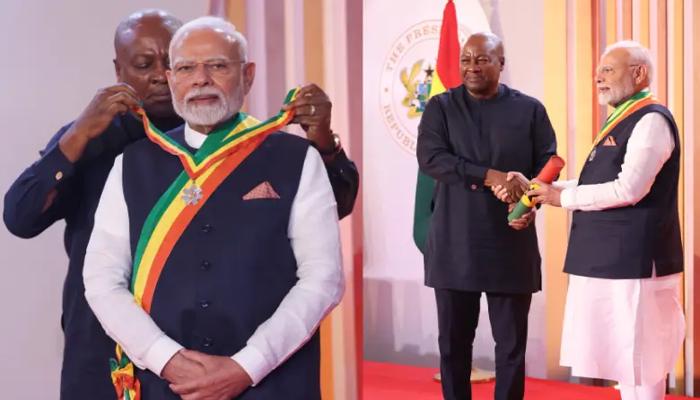
Prime Minister Modi is on an official five-nation visit, which will last 8 days. He landed in Ghana and was welcomed by President Dr John Mahama. The visit to Ghana marks a turning point in India’s engagement with West Africa. From trade to defence, culture to healthcare, the agreements signed and the conversations held reflect how New Delhi is repositioning itself as a trusted partner in Africa’s development story. Let’s break down why this matters, what was agreed upon, and how it could shape the future for both countries.
Doubling trade: Ambitious targets and new opportunities
One of the most important announcements during the visit was India and Ghana setting a target to double bilateral trade from $3 billion to $6 billion in the next five years. This is a big leap, but not an unrealistic one.
Ghana is rich in gold, cocoa, and oil, while India exports pharmaceuticals, machinery, and textiles. By improving trade logistics and reducing barriers, this target can be met. For Indian companies, Ghana is a gateway to the wider Economic Community of West African States (ECOWAS) market of over 400 million people. For Ghana, India is an enormous market for its raw materials and agricultural products.
Defence cooperation: Building security together
Another important aspect of the visit was Ghana’s interest in acquiring Indian defence equipment and training. This shows growing trust between the two nations and India’s defence capabilities.
Ghana faces challenges like piracy in the Gulf of Guinea and terrorism threats in the Sahel region. Indian naval training and counter-terrorism expertise could strengthen Ghana’s capacity to protect its people and economy. Unlike many Western defence partnerships that come with political strings attached, India’s defence cooperation is often seen as more respectful of sovereignty. This is why more African countries are looking towards India for military partnerships.
Ghana’s BRICS aspirations: India’s support
Ghana expressed its interest in joining BRICS, the group comprising Brazil, Russia, India, China, and South Africa. During the visit, India’s Ministry of External Affairs officials said they would be “happy to support Ghana’s aspiration.”
However, there is a legal hurdle—BRICS works on consensus, meaning all current members must agree before a new country joins. So, while India’s endorsement is valuable, Ghana will also need to engage with China, Russia, and others. Still, this public expression of support is a signal: India wants emerging economies like Ghana to have a bigger role in global governance. For Ghana, BRICS membership would mean more investments, technology exchanges, and diplomatic clout.
Health and Agriculture: Priorities for Ghana’s development
India also promised support for Ghana’s ambition to become a vaccine manufacturing hub. This is crucial in a post-COVID world where African countries want to reduce dependence on imports for critical medicines. India, being the “pharmacy of the world,” is well-placed to help with technical know-how and capacity building.
Additionally, India has committed to supporting Ghana’s agriculture sector. Agriculture still provide source of living in large part of Ghana’s population. By sharing Indian practices in irrigation, storage, and value addition, Ghana can improve food security and create rural jobs. This collaboration is not just charity—it opens up markets for Indian agro-technology and machinery companies.
Four MoUs: Building blocks of a comprehensive partnership
During the visit, both nations elevated their relation to the Comprehensive level and four Memoranda of Understanding (MoUs) were signed:
Cultural Exchange Programme – to promote deeper people-to-people ties through art, education, and tourism.
Standardization and Certification – to make it easier for goods to meet each other’s quality standards, boosting exports.
Traditional and Alternative Medicines – allowing Ayurveda and other Indian systems to contribute to Ghana’s healthcare.
Joint Commission Meeting – a formal mechanism for regular high-level dialogue, ensuring that promises do not remain on paper.
These MoUs may sound technical, but they are vital. When two countries sign such agreements, it means they have committed to regular engagement and follow-up. This turns warm diplomatic statements into practical cooperation.
Maritime security and counter-terrorism
The Gulf of Guinea is now considered one of the world’s most dangerous regions for piracy. Indian help in anti-piracy operations may assist Ghana protect its maritime trade routes. This not only benefits Ghana but also secures Indian shipping routs in West Africa.
Similarly, counter-terrorism cooperation is increasingly important. As the Sahel region is one of the largest hotspots of religious terrorism, Ghana’s stability could be threatened. Indian experience in counter-terrorism, such as intelligence sharing, surveillance, and capacity building, will be crucial in fighting such threats.
Why this matters for India’s Africa policy
PM Modi’s visit is part of a broader effort to reset India-Africa relations. For decades, India was seen as a partner primarily in capacity building and development assistance. Now, India is also positioning itself as a strategic partneroffering defence, technology, and infrastructure investments.
Ghana is an influential democracy in Africa with strong institutions and economic ambitions. Elevating ties to a “Comprehensive Partnership” shows India recognizes Ghana’s growing role and wants to anchor its West Africa engagement here.
It can also be seen as a geopolitical move to counter Chinese influence. At a time when China has made deep inroads into Africa through large-scale investments and loans, India’s approach is different—less about debt and more about partnerships built on mutual respect.
Challenges remain
While this visit has laid a solid foundation, the real challenge is implementation. Trade targets require improvements in logistics and banking systems. Defence cooperation must be respectful of Ghana’s sovereignty concerns. The BRICS aspiration will need patient diplomacy.
Still, there is no denying that the visit has injected fresh momentum into India-Ghana relations. As both countries look to diversify their partnerships in an uncertain world, this comprehensive partnership is timely, necessary, and full of potential. In the coming years, expect India-Ghana ties to become a model for how emerging economies can build modern, respectful, and mutually beneficial partnerships.
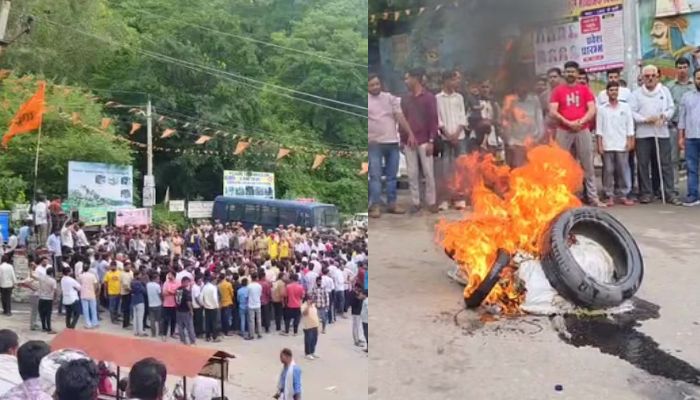
On 3rd July 2025, the Kelwara town of the Rajsamand district in Rajasthan remained closed as Hindu rights organisations protested against permission for Tajiya procession to be taken out on Muharram (6th July) in Kumbhalgarh Fort. The local Hindu activists expressed discontent against the Archaeological Department as Kumbhalgarh Fort is a protected monument and demanded a ban Muharram procession inside the fort.
In compliance with the Bandh called by Hindu groups, all the shops in the market were found locked throughout the day. On Thursday evening, many people gathered and surrounded the Kumbhalgarh fort. They protested and demanded a ban on Muharram Tajiya procession. At the same time, more than 200 policemen reached the spot to control the situation. But people started moving forward by breaking the barricades.
The Hindu Sangharsh Samiti member Rajneesh Sharma said that according to the Archaeological Department, permission is not given to enter the fort after 5 pm. In such a situation, permission should not be given to take tajias in the evening. Permission is also not given to enter the fort for organising events on Hanuman Jayanti and Maharana Pratap Jayanti.
He further said that the protest will continue on 5th of July as well. Sharma added that shops will be opened in the market from 6 am to 8 am and from 6 pm to 8 pm for buying essential goods. Apart from this, the markets will remain closed for the whole day.
On the other hand, Kumbhalgarh MLA Surendra Singh Rathore has assured the Hindu organization that the problem will be resolved. If this does not happen, the MLA will retire from politics and join the protest.
In view of the prevailing tension in the area, the police department has also deployed a large police force in Kumbhalgarh Fort and Kelwara town.
On May 5, Times Now published an article titled “Top 10 Indian States With Highest Crime Rate Revealed!.” The article claimed that Uttar Pradesh has a crime rate of ‘7.4 per capita according to 2024 NCRB’s comprehensive crime report’. Following the report, Times of India and MyPunePulse also published the same on May 6. Coming late to the scene, Jagran also published this on May 22. All of these reports made the same claim in similar language, using a mostly common set of words.
However, not only the numbers mentioned in the reports are wrong, the unit used is also completely wrong. The phrase ‘per capita’ means per person, it is generally used in economic indicators, like per capita income. For a state to have 7.4 per capita or per person crime rate, it would translate to a whopping 7,40,000 crimes per 1,00,00 population.
While Jagaran published the same data, they added in the heading of the table that ‘per capita means per 1000 people’. This is also completely wrong, as per capita means per person only. It is a standard statistical term, and not subject to interpretation differently.
NCRB releases crimes rates in terms of per lakh population, they do not use per capita. If NCRB report says that a state has crime rate of 7.4, that will mean an average of 7.4 crimes per 1,00,000 population.
Therefore, the use of the term ‘per capita’ by major media houses like Times of India, Times Now and Jagaran is a major error, as it presents a completely misleading information about the crime scene in the country.
Use of wrong term was only part of the problem, the bigger issue, the numbers mentioned in the report are completely baseless and imaginary.
The Claim:
The reports claim that Uttar Pradesh has a crime rate of 7.4 crimes per capita, means 7.4 crimes per head. The reports claim that this figure is from the 2024 NCRB report. Similar high figures are claimed for nine other states, indicating a drastic increase in crime,as all numbers are given as ‘per capita’ which means ‘per person’.
All of those reports claimed that the top 10 states with the highest crime rate in India are as follows:
Uttar Pradesh – 7.4 crimes per capita
Arunachal Pradesh – 5.8 per capita
Jharkhand – 5.3 per capita
Meghalaya – 5.1 per capita
Delhi (NCT) – 5.0 per capita
Assam – 4.4 per capita
Chhattisgarh – 4.0 per capita
Haryana – 3.8 per capita
Odisha – 3.8 per capita
Andhra Pradesh – 3.6 per capita
As per the reports, all these states have more crimes that the population, as they have over 1 per capita crimes. The same claim was also reported by websites which claim to house UPSC Preparation materials like PW IAS, Adda 24 7 and Study IQ.
Those articles highlighted certain causative factors behind high crime rates in these states. “Theft, violent crimes, and communal disturbances” in Uttar Pradesh are the key factors for the high crime rates. In Arunachal Pradesh and Meghalaya, the extreme inaccessibility of remote tribal areas precludes proper police verification, thereby causing underreported complaints and unresolved crimes.
In Jharkhand and Chhattisgarh, the continuing Maoist (Naxalite) insurgency and illegal mining-related problems keep violence and lawlessness at bay. Street crimes and a considerable number of crimes against women keep Delhi’s crime rates high. In Assam, ethnic conflicts and border disputes account for more frequent violent incidents. Gender crimes and rural inequality have been on the rise in Haryana and Odisha, therefore accentuating social tensions. Meanwhile, Andhra Pradesh has emerged as a new hub for cybercrime and financial fraud, which bolsters its crime records while posing new challenges for law enforcement agencies.
The Reality:
These claims are entirely baseless and not supported by any official NCRB report. The latest “Crime in India” report by the National Crime Records Bureau (NCRB) is for the year 2022, not 2024. It was released on December 3, 2023, and no NCRB report for 2023 or 2024 has been published yet on the NCRB website. We rechecked the information regarding the 2022 report by calling NCRB officials, who confirmed that the 2022 Report is indeed the latest.
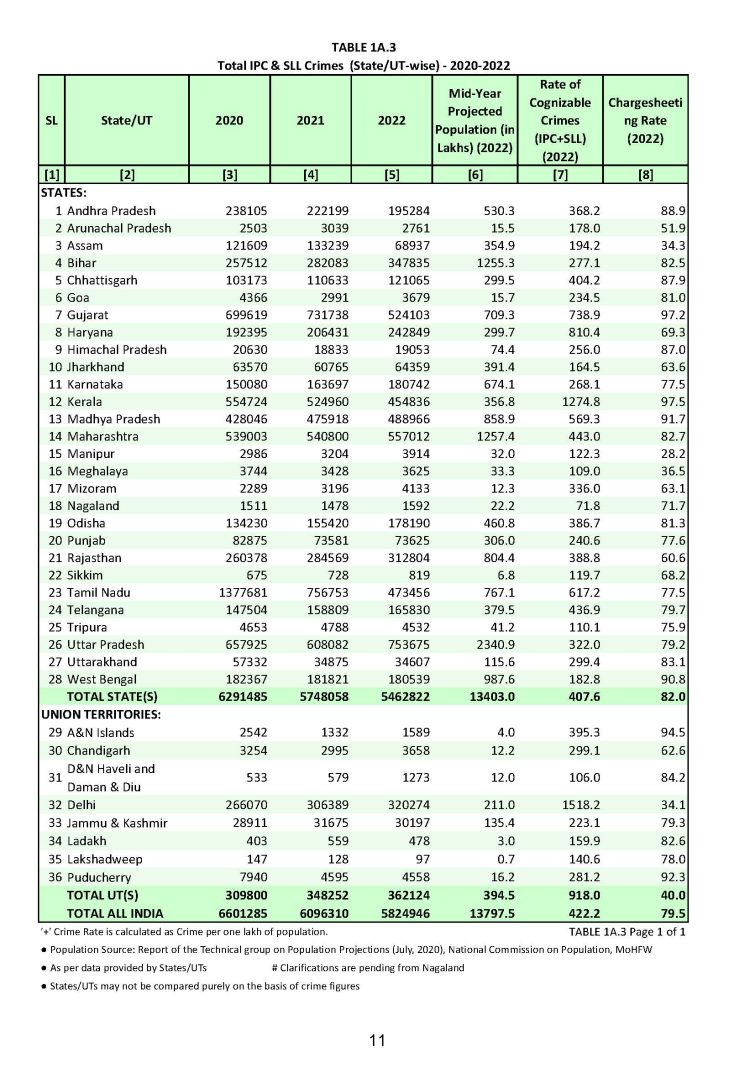
The data provided in the 2022 report is given below. It shows that total crimes under IPC along with State and Local Laws.
TABLE 1A.3 from NCRB 2022 report
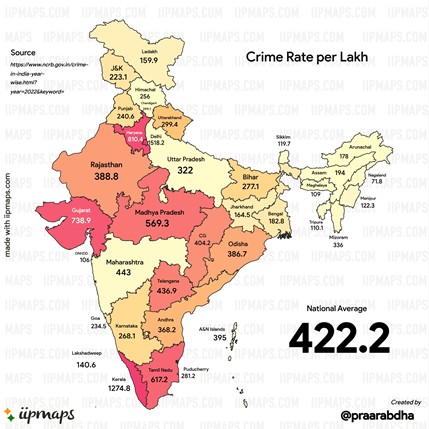
The cartographic representation of 2022 data is as follows.
Therefore, it is clear that no official crime report for the 2024 has been published by NCRB so far, and the report used by the media houses is an imaginary report with numbers which was nowhere close to actual numbers.
What does the NCRB 2022 report actually say
The NCRB report for 2022, with detailed data of all states and UTs, shows precisely the opposite of what these reports say. According to Table 1A.3 of Crime in India 2022, the all-India crime rate stood at 422.2 per 100,000 population, whereas the purported crime rate in Uttar Pradesh, is shown as 322 per 1,00,000 population, not 7.4 per person as claimed by the reports.
The NCRB data clearly indicate that Delhi has the highest the crime rate, at 1512.8 per lakh population. Kerala has the highest crime rate among the full states, recording 1274.8 crimes per 100,000 people in 2022. This is in comparison with a crime rate in Uttar Pradesh of 322 per 100,000 population, or 0.00322 per capita, which is lower than several other states including Kerala, Haryana, Gujarat, Tamil Nadu etc.
A claim that Uttar Pradesh has a crime rate of 7,40,000 per 100,000, translating into more than 1.7 billion crimes in a state with an approximate population of 240 million, is mathematically untenable and is a direct staring-in-the-eyes contradiction of the verified government data.
The propagation of these fabricated figures by major media outlets raises concern as they seek to misinform the public, undermine official data, and be used in political rhetoric with a special emphasis on framing specific states or administrations negatively. This framing of Uttar Pradesh raises many more eyebrows, as articles like this have a greater tendency to be misused. Such incorrect reporting erodes the credibility of journalism, especially when multiple outlets disseminate the same falsehood without verifying the report’s existence or cross-checking the data against publicly available NCRB records. Many vultures are always ready to take on Yogi Adityanath’s model, which is ensuring low crime in UP, taking care of mafia and bahubalis by putting them behind bars.
In the first place, there is no “2024 NCRB comprehensive crime report” in the public domain, while the last available data from the NCRB is for 2022. This data indicates that Uttar Pradesh is not a contender for being the state with the highest crime rates and does not even make the top ten. By resorting to citing fake reports and providing exaggerated figures, various articles by Times Now, The Times of India, Jagran, and Pune Pulse have distorted readers’ perceptions of the crime situation in India.
Readers are advised to verify crime-related claims on official sources, such as the NCRB website, and be cautious of reports that claim sensational figures without linking to or citing any verifiable source. While crime is indeed an issue in India, responsible reporting cannot be based on non-factual data fabricated from one’s own imagination, which distorts public perception. An honest, data-driven dialogue is the only way to allow a genuine understanding of crime trends to unfold, enabling public accountability, informed policy responses, and robust debate in a democratic setting.
While the world is rapidly becoming digitally savvy, the digital boom has brought with it a new wave of crime, the cybercrime. Scammers are evolving. Gone are the days of phone calls urging unsuspecting victims to transfer money to a stranger’s account, the game has changed—and so has the strategy of deception.
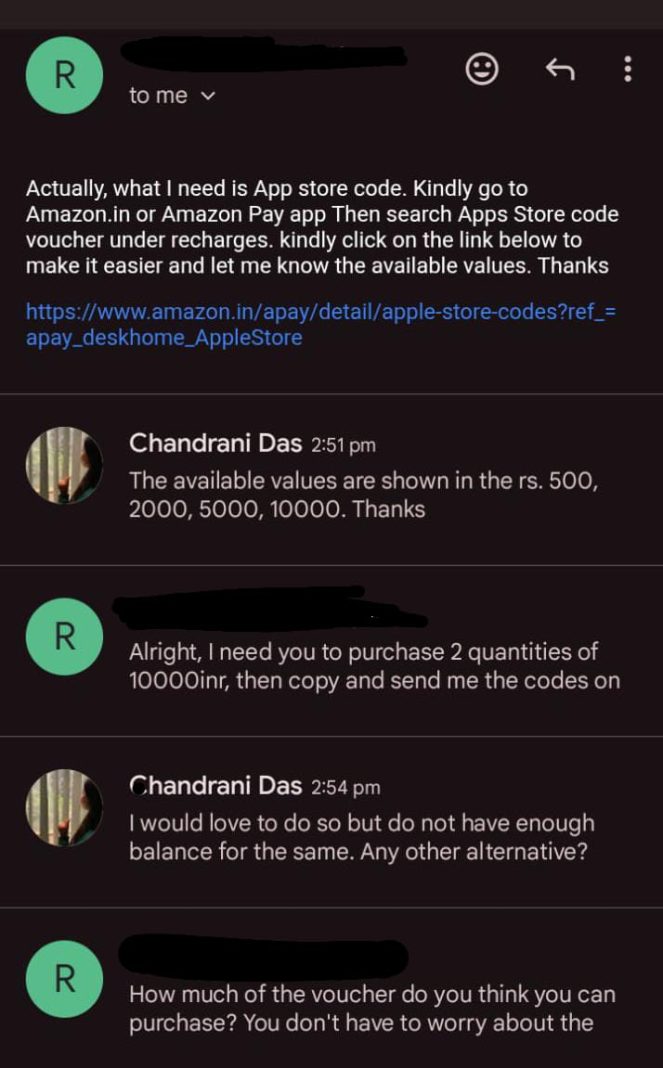
Just a few days ago, I became a victim of one such scam. But this wasn’t the typical phone or WhatsApp scam. There were no calls or text messages. Instead, it came via email. Preoccupied with office work, I didn’t check the sender’s email address—something most of us tend to overlook—and simply noted the display name.
The display name appeared to be my boss’s. That’s where the story took a turn. A seemingly normal email conversation began around 2:00 PM. The impersonator, posing as my boss, asked me to buy Amazon vouchers. The values suggested were ₹500, ₹2,000, ₹5,000, and ₹10,000. I had never purchased such vouchers before, so I struggled to navigate the process.
Sensing my hesitation, the scammer—playing the role of a concerned boss—sent me a link to assist. That link turned out to be the trap. It made the voucher purchase easier, but the next hurdle was the payment. When I informed him of insufficient funds, he insisted I borrow money, assuring me he would reimburse it by the end of the day. His words were persuasive.
Trying to be helpful, I borrowed money from my sister and a colleague. Though I hadn’t made any payments yet, the situation escalated.
Unable to make the payment using my debit card, credit card, or net banking, I sought help from another colleague. He bought the vouchers and shared the codes with me. I forwarded them to the impersonator. Within minutes, they were likely redeemed. Soon after, I was asked to buy three more ₹5,000 vouchers. This time, I refused—and the conversation abruptly ended.
This scam has been in fact explained by Amazon too naming “boss scam”. I immediately lodge a complaint within 24hr at Government of India’s cyber crime reporting site.
Think about it—today, scammers can pose as your boss, tomorrow, it could be a friend or colleague or a relative.
Rising cybercrime in India
According to recent reports, India recorded over 19.18 lakh cybercrime complaints in 2024, a significant jump from 15.56 lakh in 2023. The rise is actually tenfold since 2019.
Financial fraud remains the most common motive. Indian citizens lost an estimated ₹22,812 crore (USD 2.78 billion) to cybercrime in 2024. This is nearly three times of the amount lost in 2023, and almost ten times the ₹2,306 crore lost in 2022. The data also shows that India ranks as the second most targeted country globally for cryptocurrency-related cyberattacks in 2024, with over 95 incidents—second only to the United States.
Most disturbingly, senior citizens, women, and children are increasingly being targeted through phishing, impersonation, and social engineering techniques that exploit the lack of cross-verification.
India’s fightback against online scams
In a major breakthrough against cybercrime, the police have recovered ₹53 crore stolen through digital fraud over the past 17 months, according to official data. The extensive crackdown, which began in January 2024, has also led to the arrest of 553 cyber fraudsters, primarily from Delhi and Uttar Pradesh.
DCP (Cyber) Preeti Yadav stated that law enforcement teams have been consistently retrieving over ₹3 crore every month, thanks to strong coordination with bank officials and other digital stakeholders. Of the total recovered sum, ₹25 crore was traced through complaints filed on the National Cyber Crime Reporting Portal (www.cybercrime.gov.in), while an additional ₹27.9 crore was recovered through formal FIRs lodged with local police stations.
“Time is crucial in cyber fraud cases,” emphasised DCP Yadav. “Complaints filed within the first hour carry a 50% chance of recovery, with most early reporters successfully getting their money back.”
The police have urged citizens to report any suspicious financial activity immediately by dialing 1930 or lodging a complaint via the government portal, especially as cybercrime tactics continue to evolve rapidly across the country.
Crackdown on mule accounts
In Rajasthan, police have launched a crackdown on individuals who allow their bank accounts to be used by cybercriminals in exchange for small commissions. These “mule account holders” are being arrested even if they have not directly committed any cybercrime.
Authorities are invoking Section 170 of the Bharatiya Nagrik Suraksha Sanhita (BNSS)—a preventive provision that allows arrests to avert criminal activity. In Churu district, police reviewed a list of 30 such individuals and found Banwari Lal Soni’s account linked to cyber fraud. He was arrested under Section 170 of the BNSS.
And this is just one example. Across the nation, cybercriminals are deploying sophisticated techniques to trap unsuspecting individuals. These crimes often have cross-border implications, and the CBI has called for global cooperation among law enforcement agencies.
Techniques used by cyber criminals
Criminals use social engineering tactics to manipulate people into revealing sensitive information. Many victims are unaware of common scam techniques, making them easy targets. Fraudsters exploit emotions like:
Fear (e.g., threats of legal action)
Excitement (e.g., fake lottery wins)
Urgency (e.g., emergency fund requests)
They cleverly impersonate trusted sources like banks, government agencies, and close friends, using online payment systems to circulate fraudulent UPI requests, QR codes, card skimming tools, SIM swaps, and fake investment/crypto schemes.
Operation Chakra-V
The Indian Computer Emergency Response Team (CERT-In) regularly issues advisories on ransomware and phishing attacks. The dark web, they note, is increasingly being used as a marketplace for stolen data, hacking tools, and illicit services.
In response to the rising threat, the government has significantly strengthened its cybercrime response infrastructure. The Ministry of Home Affairs has established the Indian Cyber Crime Coordination Centre (I4C), integrating it with state-level law enforcement. Over 50,000 cyber commandos have been deployed across police stations. A dedicated portal has also been launched to report cybercrime—particularly cases involving women and children. To enhance this framework, the CBI launched Operation Chakra-V, a multi-agency initiative for intelligence gathering, case registration, and large-scale raids. As part of this effort:
Raids were conducted in Rajasthan, Delhi, Haryana, Uttarakhand, and Uttar Pradesh. Nine individuals were arrested for operating 8.5 lakh mule accounts across 700 bank branches that were used to launder the proceeds of cyber fraud and digital arrest scams.
Cybercrime continues to grow at an alarming pace, and while the government ramps up its defenses, victims must act quickly. Filing a complaint immediately may help recover some of the lost funds—and, more importantly, warn others. In a digital world, digital awareness is your first shield. Let’s spread the word.
The Defence Acquisition Council (DAC) on Thursday cleared 10 capital acquisition proposals worth approximately Rs 1.05 lakh crore for procurement of indigenously sourced quick reaction surface-to-air missiles, naval vessels and more.
The DAC accorded Acceptance of Necessity (AoN) for capital acquisition proposals, including the procurement of Armoured Recovery Vehicles, Electronic Warfare System, Integrated Common Inventory Management System for the Tri-Services, and Surface-to-Air Missiles, according to an official statement from the Defence Ministry.
The Council met for the first time after Operation Sindoor, which was launched on May 7 in response to the heinous Pahalgam attack in Jammu and Kashmir, which killed 26 people. India’s response was deliberate, precise, and strategic. Without crossing the Line of Control or international boundary, Indian forces struck terrorist infrastructure and eliminated multiple threats.
“These procurements will provide higher mobility, effective air defence, better supply chain management, and augment the operational preparedness of the Armed Forces,” according to the Ministry of Defence.
Additionally, the ministry said that AoNs were also accorded for the procurement of Moored Mines, Mine Counter Measure Vessels, Super Rapid Gun Mount and Submersible Autonomous Vessels, to enable the mitigation of potential risks posed to the Naval and Merchant Vessels.
Earlier on June 30, defence sources said that the tri-services submitted various proposals for procurement, including the Quick Reaction Surface-to-air missile system, made by the Defence Research and Development Organisation (DRDO)
The project, worth around Rs 30,000 crore, would be critical for the Indian Army’s air defence capabilities as the system can be effective against targets up to 30 kms.
The three aircraft would be acquired from an original equipment manufacturer and then be modified by the DRDO lab Centre for Airborne Systems in partnership with private partners.
The DAC is the highest decision-making body regarding procurement for the Indian Army, Air Force and Navy. Including the Defence Minister, the council also has the Chiefs of all three services, the Defence Secretary, the Secretary of Defence Production, the Secretary of Defence Research and Development, the Chief of Integrated Defence Staff, the Director General Acquisition, and the Chief of Integrated Staff Committees, who are also members of the council.
(This news report is published from a syndicated feed. Except for the headline, the content has not been written or edited by OpIndia staff)
Guwahati police have issued fresh summons to CNN News18 anchor Akanksha Swarup, and Shrasti Raghuvanshi, sister of late Raja Raghuvanshi killed in Meghalaya, over their highly objectionable comments on Kamakhya temple in Guwahati. They were originally issued notices on June 13, directing them to appear at the Crime Branch police station on June 23 and 24. However, none of them arrived for questioning.
A case was filed against Swarup and Raghuvanshi over their comments on TV claiming that human sacrifice takes place at Kamakhya temple. The controversial remarks were made by anchor Akanksha Swarup while talking to Raja Raghuvanshi’s sister Shrasti Raghuvanshi on air on 11 June, claiming that Raja Raghuvanshi ’s murder allegedly by his wife can be a case of human sacrifice at Kamakhya temple, adding that such sacrifice takes place at the Shakti Peeth.
? Absolutely shocking & deeply offensive!
Anchor @akankshaswarups, while sitting in the studio of @CNNnews18, has casually and falsely claimed that human sacrifices are part of rituals at the revered Maa Kamakhya Temple in Assam.
She had said, “It has been said that it can be a case of human sacrifice. We have talked to Raja Raghuvanshi’s brother, who said that this can be called a human sacrifice because he was stabbed from behind and he was also had a garland on him. And because they had visited Kamakhya, where human sacrifice takes places or sacrifices are made.”
The anchor had asked Shrasti, “So do these things raise a suspicion that this can be a tantric murder?” In reply, Shrasti said that while she can’t say anything on this, she knows that human sacrifice takes place at Kamakhya. CNN News18 later apologized for its anchor’s false comments, and removed the offensive comments from its video.
A case was then registered against Akanksha Swarup and Shrasti Raghuvanshi under Sections 196(2) (promoting enmity between different groups), 299 (deliberate and malicious acts intended to outrage religious feelings) and 302 (“ttering words, etc., with deliberate intent to wound religious feelings) of the Bharatiya Nagarik Suraksha Sanhita (BNS), and notices were issued to them under section 35(3) of BNSS on June 13 to appear in Guwahati on 23 and 24 June. However, as they have ignored the same, fresh summons have been issued.
“The IO has sent 35 (3) BNSS notice to the accused named in the FIR including the anchor of the news channel and Shrishti Raghuvanshi of Indore on 13-06-2025 to appear before the Investigation Officer at Crime Branch PS on 23 and 24 June, but they did not appear before IO till date,” Joint Police Commissioner Ankur Jain stated.
He said, “The statements are against the revered temple of Hindu deity Maa Kamakhya of Assam, thereby hurting the religious sentiments of a particular community and disturbing public peace and communal harmony in the society. Hence, the case registered.”
Shrasti’s brother Vipin Raghuvanshi said that they have already apologised over the false statement, and alleged that police have issued the summons again due to her recent social media popularity.
#WATCH | Indore, Madhya Pradesh: On Assam police summoning Raja Raghuvanshi's sister, Srashti Raghuvanshi, his brother, Vipin Raghuvanshi, says, "They asked to apologise, so we apologised. The police asked Srashti to provide them with all the evidence she had and apologise… The… pic.twitter.com/KKBwrjT3NX
“Due to the reel on Instagram, Shrasti’s followers are increasing, which has led the police to suspect that she is diverting the investigation in another direction,” Vipin told while talking to ANI.
In a stunning split verdict, hip-hop mogul Sean “Diddy” Combs was acquitted of federal racketeering and sex trafficking charges but convicted on two counts of prostitution-related offences on Wednesday, July 2. This capped a seven-week trial that exposed harrowing allegations of abuse and exploitation against the celebrity rapper.
The mixed outcome represents both a significant legal victory and a devastating reputational blow for the once-revered music icon.
The charges and the verdict against Diddy
Acquitted Charges: • Racketeering conspiracy (carried a potential life sentence) • Two counts of sex trafficking by force, fraud, or coercion (involving ex-girlfriends Cassie Ventura and “Jane”).
Convicted Charges: • Two counts of transportation to engage in prostitution under the Mann Act, related to transporting Ventura and Jane across state lines for “commercial sex acts”.
The jury of eight men and four women deliberated for 13 hours over three days before reaching their decision. Combs, 55, faces up to 20 years in prison (10 years per count) at his October 3 sentencing, though legal experts suggest federal guidelines may recommend 21 months to 5¼ years.
Immediate aftermath
Combs collapsed to his knees in prayer upon hearing the verdict, mouthing “thank you” to jurors while his family applauded. Defense attorney Marc Agnifilo hailed it as a “great victory for the jury system,” acknowledging prosecutors “came at him with all they had”.
However, U.S. District Judge Arun Subramanian swiftly denied Combs’ $1 million bail request, citing his “years-long pattern of violence” and ruling it “impossible” to prove he poses no danger. Combs will remain jailed at Brooklyn’s Metropolitan Detention Center, where he’s been held since his September 2024 arrest.
The core allegations
Prosecutors alleged Combs ran a “criminal enterprise” using Bad Boy Records staff to facilitate crimes including
1. Freak-offs: Multi-day, drug-fueled sexual marathons with male escorts, where Combs allegedly coerced Ventura and Jane through threats, violence, and blackmail.
2. Evidence Presented: • Hotel surveillance video showing Combs assaulting Ventura in 2016. • Testimony about 200 bottles of baby oil and 900 bottles of lubricant seized from Combs’ homes . • Graphic accounts from Ventura—testifying while nine months pregnant—that Combs forced her into hundreds of such events .
Prosecution vs. defense strategies
• Prosecution: Called 34 witnesses, including Ventura, Jane, rapper Kid Cudi (who accused Combs of arson), and male escorts. Argued Combs used “violence, power and fear” to control victims. • Defence: Conceded Combs was violent and engaged in “unconventional sex” but insisted encounters were consensual. Framed relationships as “toxic” but not criminal, attacking Ventura’s credibility by noting her $30 million in settlements.
Key moment
Defence attorney Agnifilo stunned the courtroom by declaring, “We own domestic violence,” while disputing the racketeering charge.
Fallout and the next step
• Reputational Damage: Combs has lost all major business ties, including his Revolt TV chairmanship and liquor partnerships. Howard University revoked his honorary degree. • Civil Liability: Over 70 sexual assault lawsuits remain pending against him. • Public Reaction: Outside the courthouse, supporters doused themselves in baby oil—a reference to trial testimony—while advocates for survivors condemned the partial acquittal.
Legal analysts suggest the racketeering acquittal reflects prosecutors’ struggle to prove an organised criminal enterprise. “The jury likely saw a deeply flawed individual, not a mob boss,” noted former federal prosecutor Sarah Krissoff.
What lies ahead
Combs’ sentencing on October 3 will determine his immediate future, but his legacy as a hip-hop pioneer is irrevocably tarnished. As victims’ attorney Douglas Wigdor stated, Ventura’s testimony “paved the way for accountability,” ensuring this trial’s disturbing revelations will overshadow Combs’ once-glistening empire.