Home Blog Page 3246

Khalistani outfit Sikhs For Justice calls Kashmiri Muslims to block Amarnath Yatra to take revenge against sentencing of Yasin Malik in terror-funding case

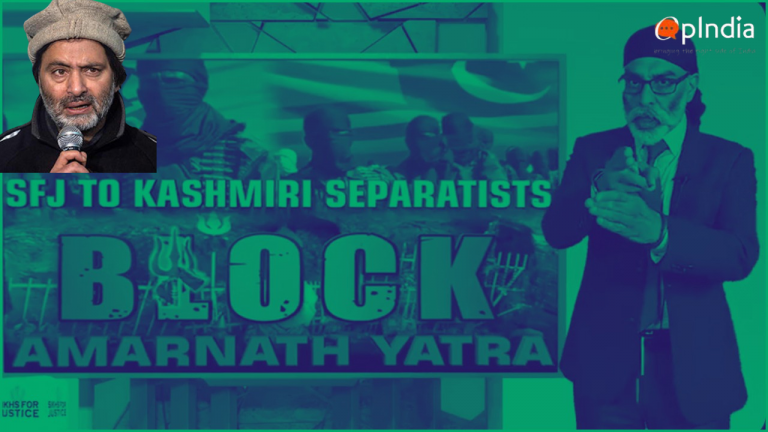
A day after a special NIA court sentenced pro-Pakistan Kashmiri terrorist Yasin Malik to life imprisonment in a terror funding case, Khalistan terror outfit ‘Sikhs for Justice’ has come in support of the terror accused and has called on terrorists in the valley to block the upcoming Amarnath Yatra. 

In a video statement, the banned Khalistani terror outfit Sikhs For Justice (SFJ) chief and designated terrorist, Gurpatwant Singh Pannu, came out in defence of Jammu and Kashmir Liberation Front chief Yasin Malik, who was sentenced to life imprisonment in a terror funding case. The Khalistani terrorist incited Kashmiri people saying that the Supreme Court of India is always biased against the minority Muslims.

Calling Yasin Malik an “iconic freedom fighter of Indian-occupied Kashmir”, Pannu said the pro-Pakistan terrorist did not believe in the Indian Constitution. “Funding separatism is not terrorism”, said the Khalistani terrorist as he accused the Indian government of committing crimes against the minority community. 

Gurpatwant Pannu also asked the Kashmiri people to come out in support of Yasin Malik and block the Amarnath Yatra to highlight the Kashmir independence movement internationally.

“This is my call to Kashmir freedom fighters, come out to support Yasin Malik and block Amarnath Yatra. This will highlight the Kashmir Independent movement internationally. We (SFJ) will support your blocking of Amarnath Yatra,” Pannu is heard saying in the provocative video.

Pannu also claimed that the Sikh community, especially the pro-Khalistan Sikhs, would support the blocking of the Amarnath Yatra. He also warned the Kashmiri Hindus to stay out of the issue as it is the issue between Kashmiri Muslims and India.

The call for violence during the Amarnath Yatra by pro-Khalistani terrorist groups comes just a few weeks before the start of the annual pilgrimage, scheduled to begin on June 30 and expected to end on August 11.

Yasin Malik convicted in terror funding case

Kashmiri separatist terrorist Yasin Malik was found guilty in a terror funding case. On May 10, 2022, Yasin Malik pleaded guilty to all charges, including those under the stringent Unlawful Activities and Prevention Act (UAPA), before a Delhi Court in a case related to terrorism and secessionist activities in Jammu and Kashmir that convulsed the valley in 2017. Yasin Malik had admitted that he was involved in terrorist activities, had also hatched criminal conspiracies, and that the sedition clauses against him were also correct.

Yasin Malik told the court that he did not wish to challenge the charges against himself under Sections 16 (terrorist activity), 17 (raising funds for terrorist activities), 18 (conspiring to commit terrorist activity), 18 (conspiring to commit a terrorist act), and 20 (being a member of a terrorist group or organisation) of the UAPA and sections 120-B (criminal conspiracy) and 124-A (sedition) of the Indian Penal Code.

Under the sections under which a case is registered against Yasin, he can get a maximum punishment of lifelong imprisonment. Yasin Malik has been active in Kashmir politics. He is one of the key instigators and secessionist leaders in the Kashmir valley.

Malik has been in jail since 2019 as a part of the crackdown against the anti-India and secessionist elements in the valley in the aftermath of the Pulwama attack. He was later remanded to the NIA custody and was shifted to Delhi’s Tihar jail from Jammu’s Kot Balwal jail.

Karnataka: Hindu youth Vijaya Kamble killed by a mob over Interfaith love affair in Kalaburgi

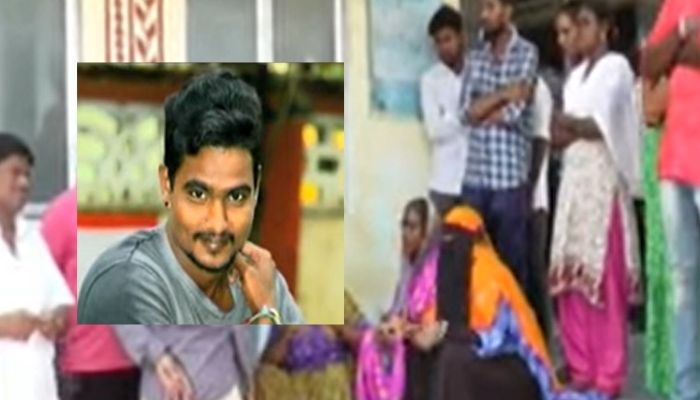
Wednesday saw a brutal killing of a 25-year-old young man in Karnataka’s Kalburgi for having an inter-faith love affair. Identified as Vijaya Kamble, the deceased was in love with a woman of different faith and was beaten up by a gang of miscreants who avenged his death over the relationship.

Kamble, who hailed from a Hindu family, was in love with a girl belonging to another religion. He was a resident of Bheema Nagar Layout in the Wadi town of Kalburgi district. The victim who wanted to marry the woman faced opposition from the woman’s family over their relationship. The religion of the girl has not been disclosed in reports on the incident.

The Police have informed that on the night of May 25, 2022, Kamble was taken down under a railway bridge by a mob who attacked him using weapons, stones and bricks. The Police said that the victim had been attacked brutally and finally succumbed to death. He suffered heavy bleeding on the spot and lost his life after the attack.

After the incident, the situation in Wadi has turned intense. The Police has beefed up the security in the area. While the case has been taken for investigation, the Police team is monitoring sensitive areas in the town to avoid any escalation of communal violence among different religious groups over the incident.

Earlier this month, 25-year-old Billapuram Nagaraju, a resident of Marredpally, Hyderabad was stabbed to death by the family of his Muslim wife after family members of both Nagaraju and Sultana were not happy with their inter-faith marriage. In a different case, A 24-year-old Hindu man from Gujarat’s Sarkhej was beaten up by three of his wife’s family members and also kidnapped his wife after they objected to their interfaith marriage.

Pakistani journalist cites Jogendra Nath Mandal to boast about Jinnah’s secularism: Here is why their first law minister had returned to India

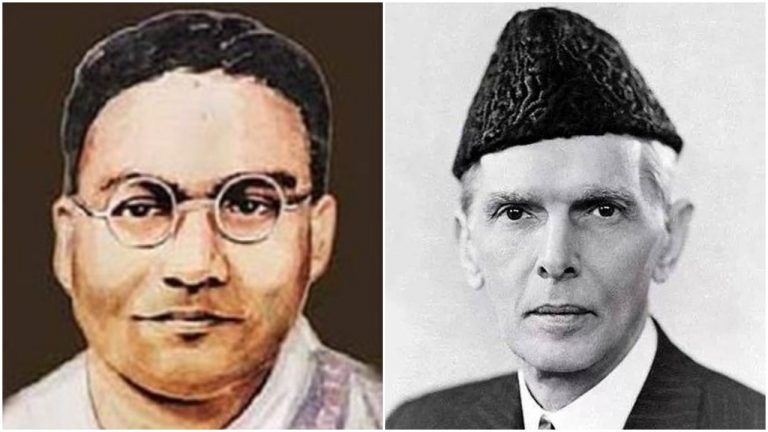
On Wednesday, May 25, Pakistani journalist Hamid Mir took to Twitter to counter an open threat of Hindu genocide given by Pakistan minister Ali Muhammad Khan. In his efforts to do so, the Pakistani journalist boasted about how ‘secular Jinnah’, the founder of Pakistan, had inducted Jogendra Nath Mandal, a born Hindu, into the then Pakistan government. Here is how the Pakistani journalist is completely wrong.

The fact is that Mandal had to resign from the Pakistan government due to the systematic persecution of Hindus in Pakistan with the tactical support of the founding fathers of Pakistan, like Jinnah.

“First Law Minister of Pakistan Jogindra Nath Mandal was a Hindu and he was appointed by Jinnah. As for as a term used by @Ali_MuhammadPTI is concerned it doesn’t mean genocide of Hindus this term was used 1500 years ago in some history books. Pls read history again,” Tweeted Hamid Mir defending a statement made by Imran Khan’s minister Ali Muhammad Khan on his show.

The Pakistan minister had openly called for Hindu genocide by threatening Ghazwa e Hind, an Islamic fantasy that refers to the complete conquest of India by invading Islamic forces.

The fact is that Jogendra Nath Mandal had, in fact, resigned from the newly formed Pakistan government soon after the partition and decided to return to India, precisely because of the systematic persecution of Hindus and other minorities in Pakistan with the active support of the founding fathers of Pakistan to commit such crimes against the Hindus in their quest to transform Pakitan into an ‘Islamic’ republic.

Born in 1904 in British Bengal, Jogendra Nath Mandal went on to serve as a legislator and also Pakistan’s first minister of law and labour. Later, he was appointed as the second minister of commonwealth and Kashmir affairs. However, a series of incidents in Pakistan, especially the targeted persecution of minorities made him realise that the idea of Pakistan was bound to fail eventually.

As Jogendra Nath Mandal decided to quit the newly formed Pakistan government soon after the partition, he wrote a letter to the Prime Minister of Pakistan Liaquat Ali Khan, which itself was explanatory as to why he chose to return to India.

His resignation letter revealed not only how Hindus and other minorities in Pakistan were persecuted systematically, but also how the founding fathers of Pakistan actively supported such atrocities against Hindus in their goal to transform Pakistan into an ‘Islamic’ country.

In his letter to Prime Minister Khan, JN Mandal cited a series of incidents where Hindus and other minorities were persecuted by the Islamists in several communal riots that took place after the partition. 

As per Mandal, the military not only oppressed these people and took away stuff forcibly from Hindus’ houses, but also forced Hindus to send their women-folk at night to the camp to satisfy the carnal desire of the military. Mandal says despite appraising the matter to Prime Minister, no action was forthcoming.

He further spoke about how this persecution of Hindus by Pakistan authorities went on to become perhaps one of the principal reasons for the Dacca and East Bengal riots in February 1950, in which hundreds of innocent Hindus were killed in trains, on railway lines between Dacca and Narayanganj, and Dacca and Chittagong.

The letter spoke in length about how Pakistani officers helped the Muslim mob to loot Hindus. It threw light on how the continuous persecution had led to a large-scale exodus of Hindus from Bengal. Addressing the condition of Hindus in East Bengal, Mandal had talked about fifty lakh Hindus that had left since the partition of the country.

In his letter to the Prime Minister in 1950, Mandal strongly asserted that the present condition is not only unsatisfactory but absolutely hopeless and that the future is completely dark and dismal Confidence of Hindus in East Bengal.

He further referred to the atrocities of non-Muslims in West Pakistan, by writing how in Sindh, after partition, about a lakh of Scheduled Castes people were converted to Islam.

In terms of the Hindu community in Pakistan, Mandal stated that Hindus in Pakistan have been rendered “stateless” in their own homes for all intents and purposes. He had gone on to say that the only flaw of these Hindus was their religion.

While making these scathing observations, which rose out of the personal experience of Jogendra Nath Mandal, the latter had tendered his resignation from the Pakistan government and returned to India.

Despite court orders to demolish illegal tomb of Afzal Khan at Pratapgad, Maharashtra govt continues to protect it: Here is what we know about it

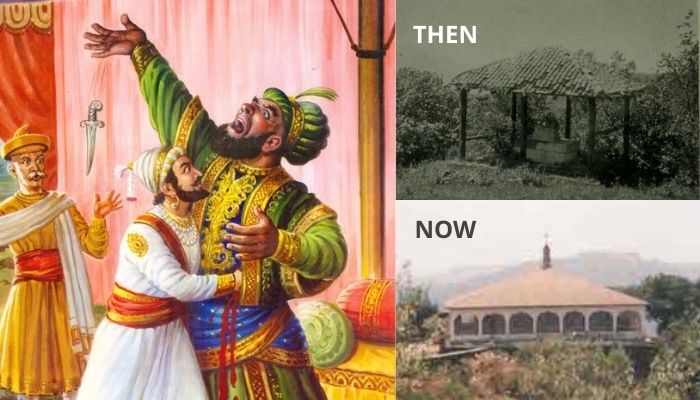
On November 10, 1659, Afzal Khan – the magnanimous Bijapur General barged onto the fort of Pratapgad near Mahabaleshwar in Maharashtra. A few metres above its base, a Shamiyana was erected to welcome Khan over his meeting with Shivaji. With open hands, Khan welcomed Shivaji as he entered the setting. Soon, during his paternalistic cuddle, he tried to clench Shivaji and removed a dagger from his pocket.

Aware of his motives, 19-year-old Shivaji swiftly scratched out Afzal Khan’s intestine with tiger-claws. Khan collapsed on the spot with a scream calling his almighty and collapsed on the spot. The incident went into history as one of the glorious chapters of the life of Shivaji Maharaj who later went on to become the first Chhatrapati of the Maratha Empire. To honour Afzal Khan’s right to be laid after death, he was buried at the same spot and a decent tombstone was placed over it.

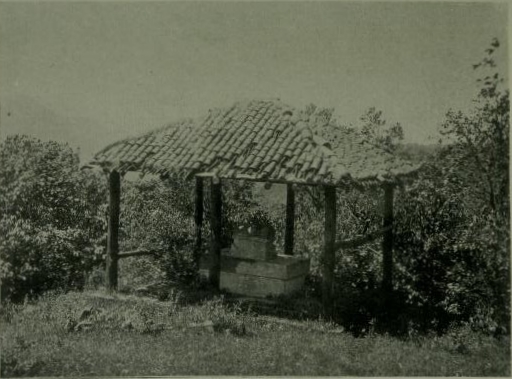
Afzal Khan’s tomb on Pratapgad in 1916. Source: Mahabaleshwar by D.B. Parasnis

Until over two decades ago, the grave of Afzal Khan was lying unnoticed in a jerkwater condition. One could see it on the right side after climbing a few steps after passing the main entrance gate of the fort. However, it gained prominence only after some Muslim ascetics in the 2000s claimed the grave and decided to build a shelter over it. According to unverified shreds of information, the state forest department had allotted reserved land to the dargah trust and allowed new construction in the tomb’s vicinity a decade ago.

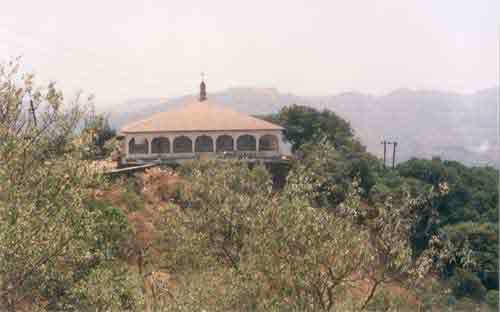
Gradually over a decade, a permanent structure with an arcade from all the four sides was raised on the grave. Covered with a tapering roof of asbestos sheets, the interior is said to have independent rooms for wandering Muslim ascetics who often take refuge in the newly developed ‘Shrine’. Soon, Afzal Khan – the tyrant from Bijapur who was a staunch enemy of Shivaji, was being gloried on his own fort.

Present-day encroached structure upon Afzal Khan’s tomb on Pratapgad

Apparently, the construction was carried out illegally in the name of a “Hazrat Mohammed Afzal Khan Memorial Trust” which had occupied around 5,500 square feet space on the fort. Soon, the glorification of Afzal Khan was naturalised on Shivaji Maharaj’s Paratapgad, with Maulavis asking visitors to pay respects to the Afzal Khan’s shrine. According to local superstitious folklores, praying before the tomb of Afzal Khan was said to have healed mental illnesses. Soon nearby villagers followed suit and started abiding by the Maulavi’s requests.

In 2004, however, The Vishwa Hindu Parishad raised an objection against the illegal capture of land on the ASI regulated site. Furthermore, questions were raised by VHP activists over the alleged transfer of land to the Shrine trust. When the VHP threatened to lead an agitation on the fort, the nearby Mahabaleshwar Police bolstered security around the fort and tomb.

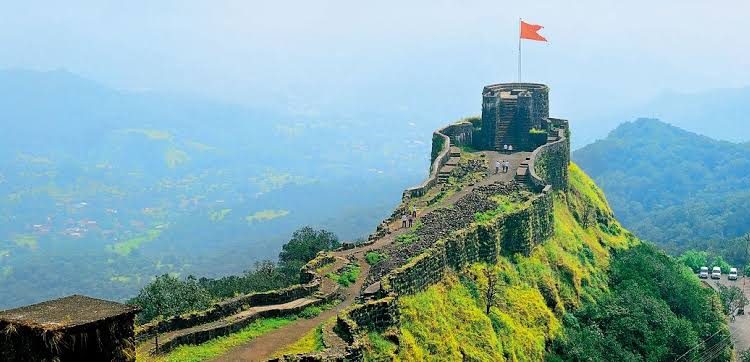
The iconic Pratapgad fort was one of the important bastions of power in the Hindavi Swarajya.

Unaware of the true history of the place, Prabhavati Shetye, deputy chairman of the Mahabaleshwar Municipal Council, said, “Enough is enough. We will not tolerate the VHP anymore. Who are they to make a controversy over this tomb? What do they know about it?” Unhappy with the state government for allotting official forest land to the trust, the Pratapgad Utsav Samiti was constituted by some of the members of the VHP. The group got active support from Vijayatai Bhonsale, who represented the royal lineage of the Bhonsales, hailing from Wai, Satara.

Vijayatai Bhonsale says in an interview that she was appalled to see the growing influence of the newly constructed shrine for Bjiapuri tyrant Afzal Khan, who was one of the staunch enemies of Shivaji Maharaj. When she made complaints with local authorities and sought appointments when officers, none of them paid heed to her concerns. However, when she desired to dig into the case further, she found that a provision for upkeep of the grave was being funded by the state government itself. “I saw garlands coming on a daily basis to the fort. When I enquired the reason behind the garlands, I was told they are for Afzal Khan,” she notes in an interview with Saam TV.

“At a time when Shivaji Maharaj’s statue and the Bhavani temple on the fort continue to be in a neglected state, garlands were being decorated upon a fictitious shrine of Afzal Khan,” she says. She has noted that the illegal encroachment over the tomb of Afzal Khan has been receiving state protection from the local authorities and the state government as well.

Ignorance by the government to remove the illegal construction

The Pratapgad Utsav Samiti, headed by local corporator Milind Ekbote and backed by Vijayatai Bhonsale had filed public interest litigation in 2007 to remove the dargah at the tomb of Afzal Khan who was killed by Chhatrapati Shivaji at Pratapgad. In an order, A bench of Justice J N Patel and Justice S K Kathawala of Bombay High Court had ordered to demolish the illegal structure. The order stated that the land belonged to the forest department and hence no structure would be allowed there.

However, the state government failed to comply with the order. Milind Ekbote again filed a contempt petition in the High Court which was challenged by the state government in the Supreme Court. However, after a two-year delay in asserting its position concerning the demolition, the state government failed to defend its stand protecting the unauthorised dargah at the tomb. The bench comprising Justices D K Jain and Anil Dave in its order on February 13, 2012, said the SPL filed by the state government will be dismissed if the government fails to file a better affidavit.

In 2017, a PIL was again submitted to the Bombay High Court after which the ruling gave an ultimatum to the government to bring down the structure. In 2020, some local politicians demanded to open the structure for public use. However, while the Maharashtra state government has continued to defend the encroached structure over the years, MNS Supremo Raj Thackeray has recently given calls to demolish the grave.

On Sunday, MNS chief Raj Thackeray said at a rally in Pune, “Afzal Khan who was killed by our Chhatrapati Shivaji Maharaj. His tomb is there and is being offered flower garlands on his grave by the people of a particular community. The Maharashtra government is sitting quietly on this issue. If the state government does not demolish this grave, then MNS party workers will demolish it soon.”

With Thackeray’s open threats, the state government has now deployed Rapid Action Force (RAF) personnel around the grave of Afzal Khan at fort Pratapgad in the Satara district of Maharashtra. According to SP Ajay Kumar Bansal, Afzal Khan’s tomb has been a restricted area since 2005. Hence, an additional police force was also been deployed at the spot.

Dear Liberals, the blood of Texas children is on your already blood-soaked hands: Here is how

Dear liberals, let us face the facts and come straight to the point – Blood of Texas children is on your already blood-soaked hands. 

Let me explain why.

For years, you have been soft on crime. 

You deliberately lied about “peaceful protests”, standing right in front of burning neighbourhoods and looted shops. You even came up with “research” to justify what was there was anyone not blind to see.

You were mealy-mouth about arson, looting, violence, and murder. You offered anarchy as a “solution” for racial tension and discrimination, problems that require a soft touch and long-term action, not empty words and new pronouns.

You justified and dismissed murderous anarchist ANTIFA thugs as “just an idea”.

You embraced and provided direct, as well as indirect support for Islamist killings and hate using a variety of camouflage tactics. You helped cover up the genocide of Hindus in Kashmir and made it a crime even to talk about it. 

You mainstreamed Hinduphobia, antisemitism and holocaust denial. Your thought leaders are the likes of Ilhan Omar and Rashida Tlaib. Of course, you can invent “context” and “nuance” to justify your venom and hate. Let a prominent BJP ideologue say “some people did something” and watch the outrage!

Instead of going after criminals, you went after law enforcement – calling for defunding the police. Well, be careful what you wish for – it is happening now. Police officers are quitting in record numbers and murders and violent crimes are up – guess who are the victims? Mostly blacks!

But then maybe that is exactly what you wanted – after all, as rich mostly white elites with a comfortable lifestyle, you just want virtue signalling and vote bank politics – not genuine solutions. 

And you are busy punishing Wisconsin middle school kids for not using “them” to describe transgender students.

Your wish for America is not that much different from your wish for India – a country looted by corrupt fascist dynast figureheads remote-controlled by Stalinist mass butcher left, some in liberal masks.

Perhaps your wish for gun control is simply to make sure law-abiding citizens don’t carry any but criminals who don’t care anyway will continue to do so. Because that fits in with your strategy of encouraging crime and painting anyone to the right of you as a ‘redneck racist’, or in the Indian context, ‘Hindutva fascist’.

And you will take another 50 years to go through the process as slowly as you can so that you can milk the issue for votes and demonise opponents in the meantime. Just as poverty and illiteracy suited the Indian left, its NGO frauds and the fascist dynasts – know their business model shuts down when there is less of it.

You have argued for “liberal” sentencing, repeated bails for criminals and other foolish policies that send signal to criminals that they are free to do as they wish. 

I have news for you – you don’t get to decide which crime is permissible and justifiable and which one isn’t. The criminals do it for you. The slippery slope doesn’t forgive.

I know you and your media ecosystem is using this incident as just another weapon to blame the conservatives instead of trying to address the real issue. 

I know you will find ways to attack Trump and everyone that is not hardcore fringe left, including some in your own camp that are not rabid left enough, using your extensive media and academia ecosystem. 

This technique is something you share with your Islamist friends and allies – the constant search for the purity that makes today’s pure tomorrow’s infidel. 

You will try to find connecting lines where they don’t exist. But you will not take ownership of crimes or apply those lofty standards to yourself. 

You will do everything other than doing what is necessary – sending a clear signal in talk and action that crime is a crime and there must be consequences. Right now, your talk and action simply give them the secure feeling that they can get away with it if they are of the right profile.

And you continue to do what you do best – fake outrage.

Delhi anti-Hindu riots accused Shahrukh Pathan, who had fired bullets at policeman gets hero’s welcome during 4-hour parole: Watch

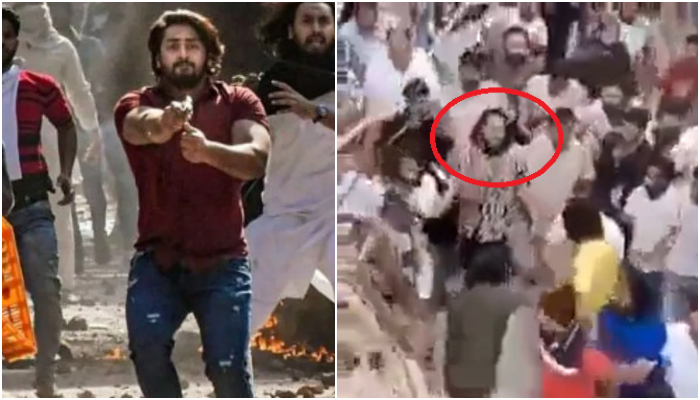
Delhi riots accused Shahrukh Pathan, who had fired bullets at policeman Deepak Dahiya, recently arrived at his family residence on a four-hour parole. The criminal was given a ‘heroic’ welcome by the local Muslim community who cheered, screamed, and also whistled on his arrival.

According to the reports, the court adopted the humanitarian approach and granted Pathan four hours of parole to meet his father whose health condition is precarious. The court was informed that the father was continuously insisting to meet his son for at least a few hours. His father, aged 65 has been suffering from various ailments and has undergone surgery in March 2022.

“In these circumstances, the court is inclined to take a humanitarian approach and thus, the present application is allowed on the following terms. Accordingly, custody parole is granted to the applicant/accused Shahrukh Pathan @ Khan for four hours for 23.05.2022, as per Rules for taking him to the residence and he shall be allowed to meet his parents at the said house,” the Court ordered.

However, the Court had strictly mentioned that Pathan was granted permission to meet his aged parents only and that he should not meet anybody else. But in the videos that went viral over the social media, many people from his community could be seen gathering and cheering for Pathan.

Also, Pathan could be seen enjoying the attention in presence of the Delhi Police personnel who were busy controlling the gathering on May 26. Reportedly, the Delhi riots accused was granted custody parole in March as well for attending the surgery of his father.

Accused Shahrukh Pathan was arrested in the year 2020 on the charges of opening fire at the Delhi Police officials and inciting riots in the national capital during the Anti-Hindu riots. He has been charged in two cases. He has been booked under rioting and relevant sections for allegedly pointing a gun at head constable Deepak Dahiya during the riots on February 24, 2020. His name is also included in a charge sheet in connection with the Maujpur incident on February 24, where violence erupted between pro-CAA and anti-CAA groups and later spread to other parts of Northeast Delhi.

CCTV videos of head constable Deepak Dahiya standing resolute on duty, fearlessly facing the criminal Shahrukh who fired bullets at him had gone viral on social media.

Two policemen named Raman and Deepak and a passerby Rohit Shukla had sustained injuries because of the violence that had broken out at Maujpur Chowk on February 24. Shukla had then confirmed that there were two groups of people, one of which was shouting ‘Allah­hu­Akbar’ and protesting against CAA and NRC.

The Delhi Court had later ordered an FIR against Pathan and booked him under Sections 147 (rioting), 148 (rioting armed with a weapon), 149 (unlawful assembly), 186 (obstructing public servant in discharge of public functions), 188 (disobedience to order duly promulgated by public servant), 153A (promoting enmity between different groups on grounds of religion, etc.), 283 (danger or obstruction in public way or line of navigation), 353 (assault or criminal force to deter public servant from discharge of his duty), 332 (Voluntarily causing hurt to deter public servant from his duty), 323 (voluntarily causing hurt), 307 (murder attempt), 505, 120B and 34 of the Indian Penal Code along with Section 27 of the Arms Act.

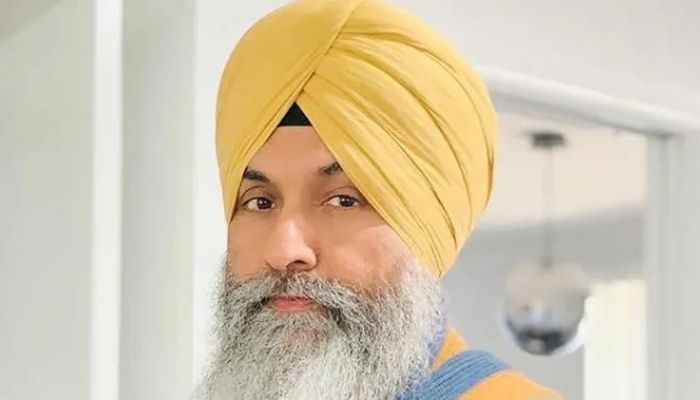
New Zealand: Jaspal Singh sentenced to jail for attempted murder of radio commentator Harnek Singh, court says religious extremism was prime reason

A High Court in Auckland of New Zealand has sentenced five years and three months of jail term for Jaspal Singh who is accused of participating in the near-fatal attack on a well-known radio host Harnek Singh. In this attack that took place on the night of December 23, 2020, Harnek Singh was stabbed 40 times in the driveway of his South Auckland home. He was followed by a group of the attackers from the temple to his home.

The attack against Harnek Singh came after he had supported the farm laws passed by the Modi government and criticized the so-called farmers protesting against them. The Auckland High Court has observed religious extremism as the prime reason for the crime. It is notable that pro-Khalistani elements were involved in the so-called farmer protests against the farm laws.

Jaspal Singh (age 41), who had pleaded guilty, owns a business in New Zealand. The prosecution said that the incident was sparked by religious sectarian fervor. Harnek Singh, who was 53 at the time of the attack, is a DJ at Radio Virsa. This is a Radio channel dedicated to discussions around religious and cultural issues within the Sikh community of Auckland.

Harnek Singh was found by a Radio Virsa colleague, slumped in his car’s seat on Glenross Drive, surrounded by a pool of blood and shards of glass. The severity of the attack can be gauged by the fact that dozens of injury scars and stab holes extended up to his arms, across his shoulders, neck, and up to the top of his head.

Defense counsel Ron Mansfield said in the court, “It was religion that had given Jaspal Singh a stable life after dalliances with a crime when he was younger. It was his faith that provided for his rehabilitation. It also helped him serve as a caring husband and father and helped give him the resilience to start his own business, which then led to selfless community work. But sadly, it was the manipulation of that same faith that led his involvement in this very serious offense. He now accepts it wasn’t right and it cannot be justified.”

Justice Geoffrey Venning noted that Harnek Singh had to undergo multiple surgeries as a result of his wounds and still suffers from scarring and ailments to this day. Justice Venning also noted that Harnek Singh’s family felt it necessary to move from their home after the attack and continues to fear for their lives.

Crown prosecutor Luke Radich told Justice Geoffrey Venning, “Had the defendant not accidentally dropped his weapon and had officers not arrived on the scene so soon, the defendant likely would be facing a murder charge. It is in some regards difficult to find a more serious attempted murder than this. He suffered some very, very serious injuries. It’s a matter of good fortune there’s no brain injury or spinal injury.”

The defense described the victim Harnek Singh in court documents as a controversial religious commentator who had been exiled from the Sikh community. Prosecutor Luke Radich objected to this and told the court that Harnek Singh is a progressive member of the religion when compared to more orthodox groups.

Justice Venning observed, “The victim is known throughout New Zealand and internationally for his commentary on Sikh issues and politics in India. The defendant attended a different temple. The impetus for the attack appeared to be religious extremism or political disagreement. There is no place for such attacks in our society. I accept you were not the ringleader or the mastermind behind the plan.”

Justice Venning further ruled, “The accused hadn’t offended for about a decade prior to the attack on the radio host. A minimum non-parole period would not be necessary, in part because of the steps the defendant had taken at rehabilitation prior to the attack.”

It is notable that Harnek Singh was constantly speaking on his radio and YouTube channel against the farmers’ protests. He had appealed to the protesting farmers to withdraw the politically-motivated protests in Delhi. In the last few years, the authorities in New Zealand had heard eight complaints against Singh for comments he had made in the Punjabi language to a caller about the Sikh sect Damdami Taksaal in response to recent violent incidents in India.

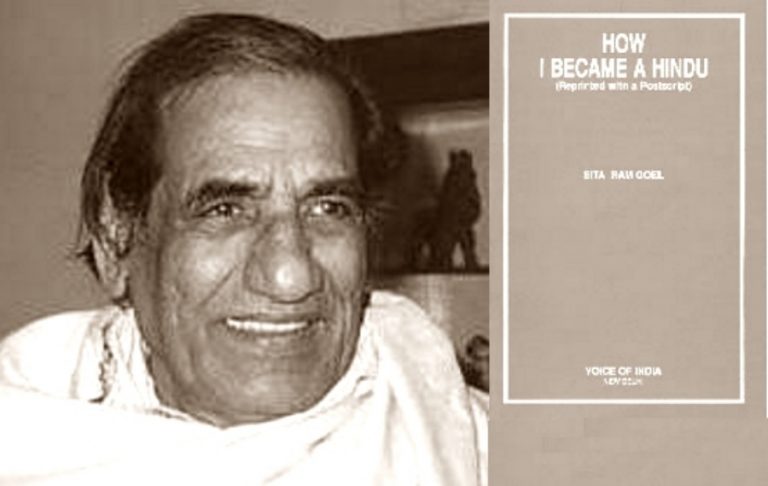
Here is what happens when a millennial Bengali, raised in a Communist family, reads “How I Became a Hindu” by Sita Ram Goel

I just finished reading my first Sita Ram Goel book, the famous ‘How I Became A Hindu’ with its original chapters written in 1982 and the last chapter specifically on the “Nightmare of Nehruism” added by Goel in 1993. I am a 30-year-old Bengali from Kolkata born and raised in a “Communist” family and I mention this specifically to signal to the reader that almost everything I read in the book was a shock or surprise.

First of all, it’s an extremely low-priced book for the level of its content. Secondly, because I purchased it from the Vishwa Hindu Parishad (VHP) bookstall at Kolkata Book Fair, 2022 and seeing it’s such a thin book, in my arrogance, a part of me was under the impression that the book might be a glorified political pamphlet meant to be distributed among party cadre to arouse Muslim hate in them (although I specifically looked for his books). Other than the fact that 5 pages into the book I realised the magnitude of my misconception, I also observed that even its size is a misleading veil. Let me declare this once and for all: this book is not short because Goel didn’t have much to say on the topic; it’s short because he is extremely proficient at constructing precise and concise sentences and paragraphs that bundle a lot of information, metaphors, analysis and explanations in fewest words possible.

If I was forced to describe the genre of this book, I would probably conclude it to be, essentially, a “travelogue” or “adventure”. The travelogue bit being the varying locational and cultural settings described in the book: Haryana, Delhi, Kolkata, Lahore etc, with the extensive depiction of Kolkata of the late 40s and 50s. Although “travelogue” does not imply dynamic cerebral introspection, retrospection and the like, in this case, his metaphorical “travel” from Arya Samajism to Gandhism to Communism to simply a self-respecting Hindu, is a fascinating journey in itself and could be categorized as a travelogue because the different ideologies he experiences are almost attached to different locations in pre-partition Bharat. I would, as a reader, categorize this book as an “adventure” as well because of how exciting and fast-paced the authorship is while depicting the turbulent political times of late 40s Bharat as well as the various nuances of political philosophy and thought that he experiences.

For example, he writes about an instance in Kolkata when he is asked to write editorials for a Socialist paper, but he ends up writing it with Communist inclinations and in the process, gets heavily scolded by the person who had hired him for the job. In a different section of the book, he mentions Socialists being his allies in his work against Communism. This gives the reader a chance to time-travel to a fascinating period in Bhartiya politics where nuance was given importance, was obvious and the order of the day. Although a negligible percentage of leftists still crib amongst themselves about these nuanced differences, largely, no Socialist would side with an anti-Communist publicly.

Coming to my favourite aspect of the book, knowingly or unknowingly, Goel seems to have written this book specifically addressing Bengalis. I say this because it has pages after pages of descriptions of the early 40s and 50s Kolkata. It is especially fascinating to me as a Bengali because this is the first time, that I am reading the perspective of someone who was not originally from Bengal nor lived his life here but did spend a significant decade or two in total in Kolkata. He talks of Bengali literature, Bengali politics, Bengali Socialists and Communists, and Marwari Communist businessmen of Kolkata (a phrase that’s overflowing with conceptual and ironic contradictions because, in later years, which continues up until this day, the Marwaris faced the wrath of leftists in Bengal until they had to go work for one and in some cases, even while being under their employment).

Goel even befriended the legendary Bengali novelist Tarasankar Bandyopadhyay and gives short reviews of a few of his works. From this book, I came to know never-heard-before tales of Bengal’s post-Independence politics. Goel describes the lifestyles and political strategies of the then leftists some of which have changed a lot now and some which have not at all. Goel describes an instance of the screening of the Russian propaganda film “Ivan, The Terrible” and how leftists appreciated its filmmaking techniques simply because they liked the message of the film while criticising Hollywood’s filmmaking because they are opposed to “American Imperialism”. The striking similarity to modern leftists who will not discuss the cinematic brilliance of The Kashmir Files simply because they don’t like the facts highlighted in the movie. Goel talks about the time when author Ram Swarup, his college senior and friend, philosopher, and guide, came to live with him in Kolkata for a while and about Swarup’s debates with Goel’s leftist friends and colleagues which were borderline witty and mischievous on the part of Swarup.

This brings us to the significance of Ram Swarup, both in the book and in the life and psyche of Goel. Ram Swarup had been conversing, debating, and corresponding with Goel since the time Goel thought of himself as a leftist. Goel describes his first impression of Swarup as a man with “Shavian humour”. Although Swarup was against leftism, in all the years of Goel’s left inclination Swarup never tries to actively convince Goel that he is wrong, except perhaps to some degree the one time Swarup wrote to Goel, “You are too intelligent not to become a Communist. But you are also too intelligent to remain one for long”. I love this quote personally because this, along with the entire point and premise of the book aptly describes my 20s. If not anything else, this book should be solely read for the fascinating insights of Ram Swarup on Indian politics, religions and Dharma along with his own intellectual evolution.

Another fascinating realisation of mine and angle of this book is its role in making you re-fall in love with the pursuit of more books and knowledge. Both Goel and Swarup were avid readers. Intentionally or unintentionally, this book recommends and glorifies countless other books by great representatives of the human race from all schools of political and philosophical thought. For example, Plato, Aristotle, Marx, Freud, and Laski. Therefore, regardless of whether you like or dislike the topic of the book, you will definitely find value in this book for the culture of knowledge it endorses. Also, the intellectual Indian left’s impression of anything relating to Hinduism being limited to the so-called “cow belt” or Hindi speakers hilariously falls flat in this book because of a) Goel’s tremendous grasp of the English language and b) Goel’s drawing extensive inspiration from various Bengalis like Swami Vivekanand, Bankim, Rishi Aurobindo etc.

Interestingly, the last chapter, which is the longest in the book, is a drastic shift in tone from the rest of the book. Up until the last chapter called “Nightmare of Nehruism”, the reader will get the impression that the book is written by a sweet and polite, wide and starry-eyed kid bouncing around from this ideology and philosophy to that ideology and philosophy. On the contrary, Goel writes the last chapter 11 years after the book’s first publication and is now a focused, clear-headed and intentional grown-up man who seems very angry with what he has seen in these 11 years.

He writes with a pure vengeance and has gotten rid of any niceties he might have had earlier, knowingly or unknowingly. He diagnoses and intellectually destroys the ideological disease called Nehruism which has been called by many other names in different decades, but one whose source Goel traces to Jawaharlal Nehru. The casual, misinformed secularism, the inferiority complex unfoundedly peddled as humility, phobia of the word “Hindu”, and general generalisations of any politically pro-Hindu voice or movement as “communalist”. All of which can be word for word observed in many Indians to this day, a phenomenon that J Sai Deepak would call “coloniality”.

What is perhaps even more interesting is, that he observes and heavily criticizes Nehruism even among Rashtriya Swayamsevak Sangh (RSS), VHP and other groups who are in the current setting known to be vehemently against Nehru and everything that could be termed “Nehruism”. He points out flaws, weaknesses and lack of courage in their actions. He specifically and repeatedly mentions a leader in those parties as a “windbag” who my guess, was meant for future Prime Minister Atal Bihari Vajpayee.

One significant takeaway from this book is, that both Goel and Swarup were economically opposed to the left and not just culturally. Which was extremely rare in their times. Almost all significant pro-Hindu/pro-Hindutva voices used to be socialists which is not the case anymore among current Bhartiya millennials and Gen-Z but we owe our lineage to Goel and Swarup.

Here are some of my favourite quotes from the book:

  1. “…in India there was a multiplicity of parties but a unity of slogans” – which aptly describes the fascination of both the left and non-left parties of India with freebies and welfare schemes in their misinformed pursuit of eradicating poverty.
  2. “The Ramakrishna Mission and the Shri Aurobindo Ashram were busy proving that they were “universal” rather than Hindu” – this aptly describes the fear of the tag of “Sanghi” even among those Hindus who are not atheists or Communists.
  3. “He (Swarup) had tried his best to rescue me from the twin morass of a false self-esteem and a degrading self-pity” – this phrase is relevant to anyone who knows a leftist or has been a leftist. The unearned moral superiority for simply identifying as a Socialist or Communist, while at the same time being in a state of perpetual self-pity implying their life is getting destroyed because of patriarchy and capitalism.

In conclusion, I hope this book and the author get their due respect in the Bhartiya mainstream. I hope its purchase and readership increase because of my humble contribution. And I strongly hope every Bengali kid in their 20s reads this book to get a fresh perspective on his/her land, culture and philosophical lineage.


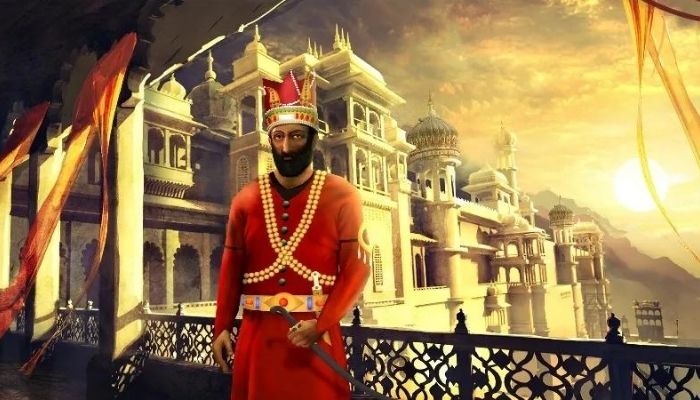
30000 men slaughtered in 6 hours: When Nadir Shah of Iran wreaked havoc in Delhi, and Mughals had to give away Afghanistan

Before the middle of the 18th century in Iran, there was a ruler whose stories of cruelty are still told by the people living in the territories he invaded. The name of that Islamic ruler of Persia was Nadir Shah, who was the founder of the Afsharid dynasty. During the attack on Delhi, he committed atrocities far and wide. Then the weak Mughal regime had to hand over the whole of Afghanistan to him. Because of his military successes, historians also call him ‘Napoleon of Persia’.

Timur and Genghis Khan, the two most expansionist and ruthless rulers of Central Asia were the inspiration of Nadir Shah. Nadir Shah, who ruled Iran from 1736 until his assassination in 1747, took advantage of the revolt of the Hotaki Pashtuns to overthrow the then ruler Sultan Hussein. His empire in its peak extended to Armenia, Azerbaijan, Georgia, northern Caucusus, Iraq, Turkey, Turkmenistan, Afghanistan, Uzbekistan, Pakistan, Bahrain, and Oman.

Nadir Shah’s invasion of India

Nadir Shah sent a message to the Mughal ruler of Delhi, Muhammad Shah. At that time, he was carrying out his war campaign in Afghanistan and he made it clear to the Mughals that no fugitive from there should get shelter in the Mughal Empire. After Nadir Shah’s occupation of Kandahar, many people there fled to Kabul. The Mughals assured the Persian ruler that things would happen as he said.

But, when many Afghans took refuge inside the Mughal regime and Nadir Shah came to know of this, he took offence. Nadir Shah then sent one of his envoys to Delhi for the third time and asked him to return after a maximum stay of 40 days. However, in Delhi, the Mughals did not give him any importance or attention and also prevented him from going back. When a year had passed, Nadir Shah sent him an order asking him to come back irrespective of whether he would get a response from the Mughals or not. Nadir Shah had no intention of going towards Delhi, but he could not bear this insult.

Nadir Shah had no problem reaching Kabul because no one dared to stop him on the way and he was given the way out of fear. At Kabul, he must have had a mild war, but the Mughal army there had to surrender. By the summer of 1738, Persian troops had advanced from Kabul. On the way, he went on a rampage and recruited the strong muscular Afghans into his army.

When the chieftains of Kabul left for Delhi with Nadir Shah’s emissary with his message, the messenger was killed by Jalalabad’s governor Mir Abbas on the way. Mir Abbas had to bear the brunt of this in the form of Nadir Shah’s attack, in which he was murdered and his family was chained and presented before Nadir Shah. It is also worth knowing that when Nadir Shah reached Delhi, it was only thirty-two years since Aurangzeb’s death.

The Mughal Empire was steadily weakening, as the power of the Marathas in central India and the western part was constantly increasing. Many Muslim chieftains who ruled under the Mughals had also declared their independence. The Pashtuns in the north had started a rebellion, which had weakened the capacity of the Mughal regime in Afghanistan. Like the Ottomans and Persians, the wealth of the Mughals was also famous all over the world, so Nadir Shah also had the intention of committing heavy looting.

Nadir Shah first stopped at Kararbaug, located in the south of Ghazni, from where he entered the Mughal-ruled territory. His son Nasrullah went ahead with an army and captured Bamiyan. The governor of Ghazni ran away, but the other Muslims there welcomed Nadir Shah. Nadir Shah started ruling Afghanistan from Kabul itself and appointed his own people. He had a war with the Mughals near Khyber and Peshawar was occupied by Nadir Shah.

In February 1739, Nadir Shah built a bridge over the Indus river and after that, in the Battle of Karnal, the Mughals again suffered defeat. 120 km from Delhi, Muhammad Shah had arrived with a large military force, spanning a width of 3 km and a length of 25 km. Apart from the army of 4.5 million, there were also thousands of guns, cannons, and elephants in it, but most of the soldiers were untrained. It was Nadir Shah’s ploy that he forced Muhammad Shah to fight the war at the place of his choice. He had already done the whole recce.

Persian army wreaked havoc in Delhi

Nadir Shah killed 20,000 Mughal soldiers and Muhammad Shah had to surrender. The Mughal resistance was feeble. Muhammad Shah had to appear before Nadir Shah. When Nadir Shah entered Delhi, the defeated Mughals welcomed him with the firing of cannons and guns. Nadir Shah celebrated Persian New Year ‘Navroz’ in Delhi itself. But, the people of Delhi rebelled against Nadir Shah.

To crush the revolt, he came down to terrible cruelty. The Persian army killed 30,000 people within six hours. Many people were taken to the banks of river Yamuna and beheaded there. The Persian army entered the houses of the people and started killing them. After that, they set the houses on fire. Many people committed suicide with their families because they preferred it over getting killed at the hands of the Persian army. Two Mughal chieftains, Syed Niaz Khan and Shahnawaz Khan, were involved in the rebellion. They were brought along with hundreds of their supporters and killed in front of Nadir Shah.

After this, Nadir Shah sent his people to collect taxes in every locality of Delhi. The Persian army also took over the ‘Peacock Throne’ of the Mughals. Kohinoor and Diya-e-Noor diamonds were also offered to Nadir Shah. Peace came only when the Mughals themselves quickly presented a part of their empire and wealth to Nadir Shah. All the lands west of the Indus River became part of the Persian Empire of Nadir Shah.

In early May 1739, Nadir Shah began preparing to go back to Persia. It is said that he had looted so much money from India that after going back, he did not have to collect taxes for the next three years in his country. He also took thousands of elephants, camels, and horses with him. An impoverished, and weakened Mughal regime then became an easy target for the British.

Germany recognises Bharat Biotech’s Covid-19 vaccine Covaxin, removes testing requirements for travel from next month

Germany has become the latest country to recognise Bharat Biotech’s Covid-19 vaccine Covaxin for travel to the country starting June 1.

According to the reports, the German Ambassador to India, Walter J Lindner, on Thursday took to Twitter to announce that the German government has decided to recognise WHO-listed Covaxin for travels to Germany starting June 1. He also added that the Germany Embassy in India has been pushing very actively for such a decision.

Following the recognition, there will be no more checks for Covid vaccination or testing for travelling to Germany from any country that is not a virus-variant region from next month. Covaxin will officially be recognised effective June 1.

Earlier in November, the World Health Organization (WHO) had issued an emergency use listing (EUL) for COVAXIN, adding to a growing portfolio of vaccines validated for the prevention of Covid-19. WHO’s EUL procedure assesses the quality, safety and efficacy of Covid-19 vaccines and is a prerequisite for COVAX vaccine supply. 

The recognition also allows countries to expedite their own regulatory approval to import and administer Covid-19 vaccines.

“This emergency use listing expands the availability of vaccines, the most effective medical tools we have to end the pandemic,” said Dr Mariangela Simao, WHO Assistant-Director General for Access to Medicines and Health Products said.

Earlier, the United Kingdom had recognised India’s indigenous Coronavirus vaccine Covaxin as valid in the country.

Covaxin for minors

In April, the Drugs Controller General of India (DCGI) granted an emergency use authorisation (EUA) to Covaxin for the age group of 6-12 years.

In a statement, the Hyderabad-based Pharma company Bharat Biotech had said that it had conducted phase II/III, open-label, and multicenter studies to evaluate the safety, reactogenicity, and immunogenicity of Covaxin in healthy children and adolescents in the 2-18 age group.

The company said that the clinical trials conducted in the pediatric population between June 2021 to September 2021 have shown robust safety, reactogenicity, and immunogenicity.

Covaxin is a ready-to-use liquid vaccine, stored at 2-8 degrees Celsius, with 12 months shelf life and a multi-dose vial policy.