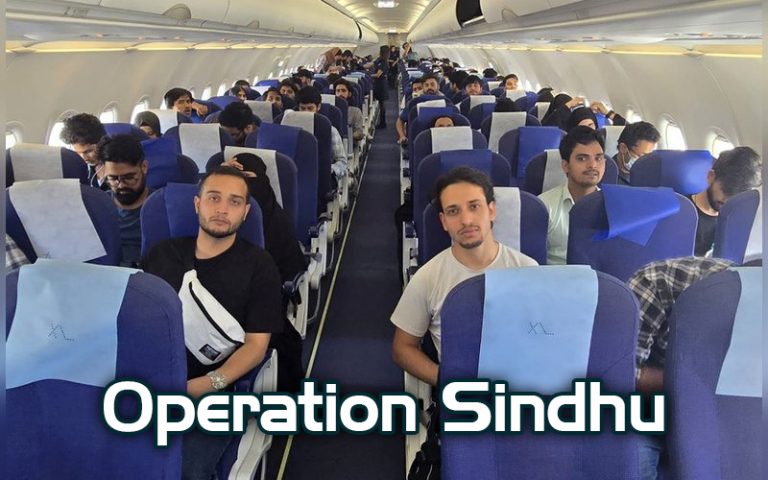
Amid the ongoing Iran-Israel war, the govt has launched an operation to evacuate Indian nationals from Iran. A press release issued by the Ministry of External Affairs said that Operation Sindhu has been launched in view of the deteriorating situation as a result of the ongoing conflict between Iran and Israel.
The MEA said that as a first step, the Indian Embassy has evacuated 110 Indian students from northern Iran, assisting them in safely crossing over into Armenia on 17th June 2025. The students travelled by road to the Armenian capital, Yerevan, under the supervision of Indian Missions in Iran and Armenia. These students departed Yerevan on a special flight at 14:55 hours on 18th June 2025 and will arrive in New Delhi in the early hours of 19th June 2025, as part of the initial stages of Operation Sindhu.
The statement said that the Government of India is grateful to the Governments of Iran and Armenia for the smooth facilitation of the evacuation process.
“India accords highest priority to the safety and security of Indian nationals abroad. As part of the ongoing operation, the Indian Embassy in Iran has been assisting large numbers of Indian nationals in moving from areas seeing increased hostilities to relatively safer areas within the country and to subsequently evacuate them using the available and feasible options,” the statement added.
MEA said Indian nationals in Iran are advised to stay in touch with the Indian Embassy in Tehran through its emergency helpline, and with the 24×7 Control Room established by the Ministry of External Affairs in New Delhi.
The emergency helpline numbers are:
Emergency Helpline numbers of Embassy of India in Tehran for calling only: +98 9128109115, +98 9128109109
Emergency Helpline numbers of Embassy of India in Tehran for WhatsApp: +98 901044557, +98 9015993320, +91 8086871709
Helpline numbers of 24 X 7 Control Room set-up by Ministry of External Affairs in New Delhi: 800118797 (Toll free), +91-11-23012113 , +91-11-23014104, +91-11-23017905 WhatsApp: +91-9968291988 ; Email- [email protected]
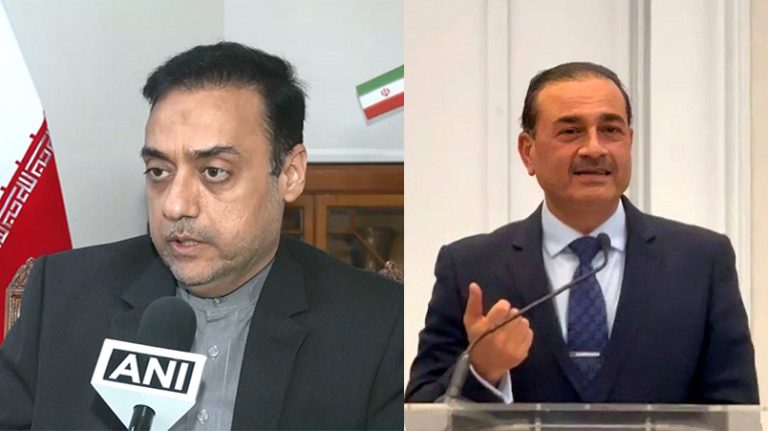
Amid speculation over Pakistan Army Chief Asim Munir’s meeting with US President Donald Trump amid Iran’s conflict with Israel, a senior Iranian diplomat has hoped that Pakistan airspace and airbases will not be used for operations against his country.
In an interview with ANI, Iranian Deputy Chief of Mission in India, Mohammad Javad Hosseini answered queries on a range of issues and said his country has not talked of mediation and has called upon the international community to stop “aggression” by Israel as it is not beneficial to anyone.
He hoped the United States will not enter the conflict because it would “not benefit” any of the players in the region.
“I hope it would not use this one,” Hosseini said when asked about Asim Munir’s meeting with Trump and the possibility that Pakistan airspace and airbases could be used for operations against Iran.
“The truth is that since June 13, we were attacked by the Israeli regime in an aggression which is a flagrant violation of international law and a violation of the sovereignty of an independent state. It was highly expected that the free nations would condemn such aggression, a blatant international law violation. We are in a position to defend our people, our government, our country in the best way. We have shown that we are able and we will continue because we are under attack and we have to defend,” he said.
Hosseini said his country’s retaliatory action is based on self-defence, which is enshrined in Article 51 of the United Nations Charter, “which gives us this power to defend our people”.
“The Israeli government and the Israeli officials officially announced some threats against Iranian high-ranking officials. They assassinated some of the Iranian military officials, which is totally against any regulations,” he said.
He also referred to Iran cancelling next round of nuclear talks with the United States amid rising tensions in the Middle East.
“We were at the negotiating table. It was America that gave the green light to the Israelis to have these military attacks against Iran. They have made a lot of accusations, but there was no proof… We are still at the negotiation table, but nobody can force us to do whatever they want. They cannot tell us to stop or continue the war, or defend ourselves. We hope that America doesn’t enter into this conflict because it would be to the benefit of none of the players in the region,” Hosseini said.
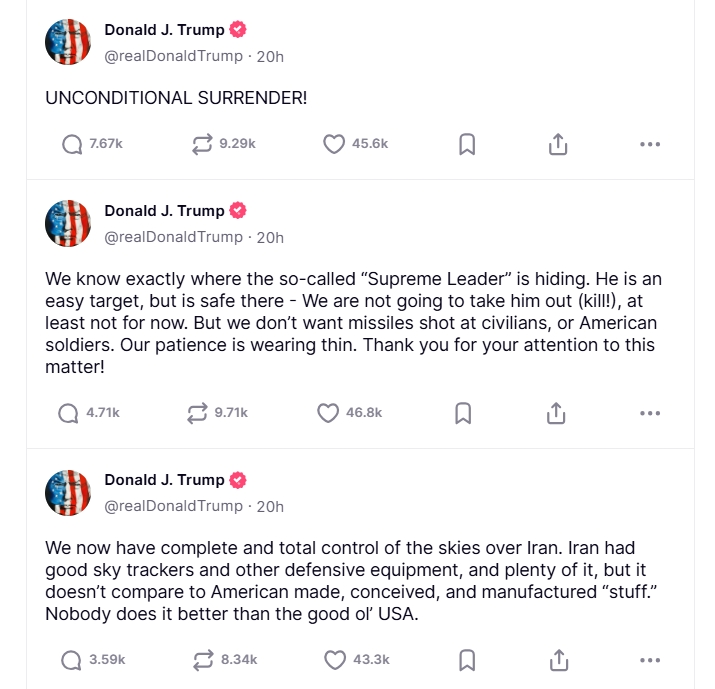
US President Donald Trump on Tuesday said “we” now have “complete and total control of the skies over Iran” and “we know exactly where the so-called ‘Supreme Leader’ is hiding”.
“We now have complete and total control of the skies over Iran,” Trump wrote on his social media ‘Truth Social’.”
“Iran had good sky trackers and other defensive equipment, and plenty of it, but it doesn’t compare to American-made, conceived, and manufactured ‘stuff.’ Nobody does it better than the good ol’ USA,” he said in a post.
“We know exactly where the so-called ‘Supreme Leader’ is hiding. He is an easy target, but is safe there – We are not going to take him out (kill!), at least not for now. But we don’t want missiles shot at civilians or American soldiers. Our patience is wearing thin,” he added.
Israel launched a series of airstrikes on Iranian military and nuclear targets, prompting retaliatory attacks from Tehran.
Trump has been vocal in his support for Israel, emphasising that Iran cannot be allowed to develop nuclear weapons.
Earlier, speaking aboard Air Force One, Trump emphasised the need for a “real end” to the conflict, arguing it’s better than a ceasefire while also suggesting that giving up entirely on negotiating is a possibility.
Trump said, “an end, a real end, not a ceasefire. An end. Or giving entirely. That’s OK, too.”
“Iran cannot have a nuclear weapon. It’s very simple — you don’t have to go to too deep into it. They just can’t have a nuclear weapon,” he added.
Trump said that he expects the next 48 hours will reveal more about whether Israel plans to slow down or accelerate its attacks on Iran, as per CNN.
“You’re going to find out. Nobody’s slowed up so far,” Trump said.
Trump left the G7 summit in Kananaskis, Canada, after Monday night’s dinner, citing the need to attend to pressing matters in the Middle East.
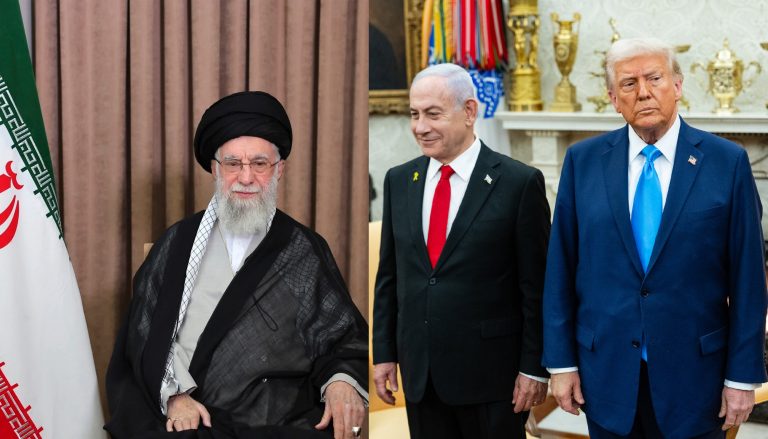
Iran’s supreme leader, Ayatollah Ali Khamenei, on Wednesday warned Israel and said that the “Zionist regime made a grave mistake” and will face the consequences of its actions.
“Our nation will not forsake the blood of their martyrs, nor will they remain silent in the face of violations of their airspace,” Iran’s First International News Network reported Khamenei’s statement.
Iran “will stand firm against an imposed war, just as it will stand firm against an imposed peace”, the supreme leader said in a televised address reported by the Tasnim news agency.
“This nation will not surrender to anyone in the face of imposition,” he said.
Khamenei also pointed to statements made by Trump, saying those who know Iran and its history “know that Iranians do not answer well to the language of threat”.
“And the Americans should know that any US military intervention will undoubtedly be accompanied by irreparable consequences,” he stated.
Earlier in the day, he also said that Tehran will harshly retaliate against Israel’s attacks as aerial attacks between the two nations continued overnight, marking the sixth day of the war.”
We must give a strong response to the terrorist Zionist regime. We will show the Zionists no mercy,” Ayatollah Ali Khamenei wrote in English on X.
Meanwhile, the Iranian armed forces chief warned of imminent “punitive operations” against Israel.”
Chairman of the Chiefs of Staff of the Iranian Armed Forces: The operations carried out so far have been a warning for deterrence, and punitive operations will be forthcoming,” IRNA News Agency posted on X.
(This news report is published from a syndicated feed. Except for the headline, the content has not been written or edited by OpIndia staff)
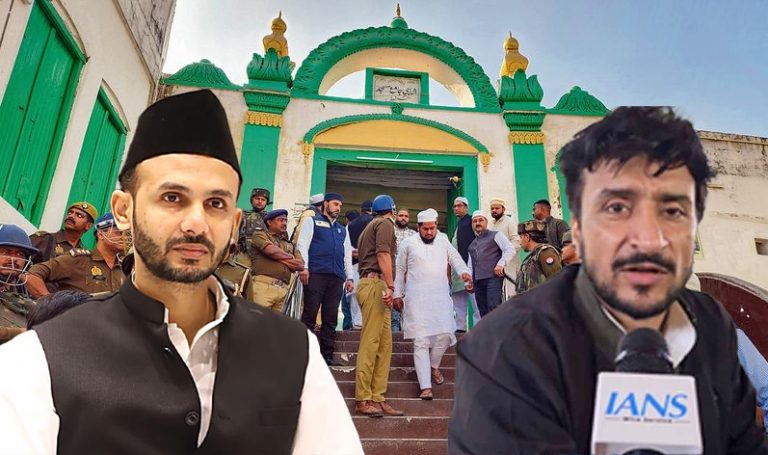
In a major development in the Sambhal violence case, police have filed a chargesheet against 23 individuals, including Samajwadi Party (SP) Member of Parliament Zia-ur-Rehman Barq and Suhail Iqbal, son of SP MLA Iqbal Mehmood. The chargesheet of over 1,000 pages was submitted before the special MP/MLA court on Tuesday.
The case pertains to communal violence that broke out in Sambhal last year against an ASI survey of Shahi Jama Masjid. This chargesheet has been filed in the case related to crime number 335, in which Ziaur Rahman Barq and Suhail Iqbal along with 700 to 800 unknown people have been made accused.
The police investigation has found that inflammatory speeches and incitement to violence led to the outbreak, resulting in arson, stone-pelting, and damage to public and private property.
According to the chargesheet, SP MP Barq is accused of inciting the crowd by giving provocative speeches before the violence. Suhail Iqbal is also alleged to have played a key role in mobilizing the crowd.
Four people were killed in the violence while over 30 policemen and administrative officers were injured.
According to officials, the chargesheet is based on electronic evidence, including video footage, call data records, and witness testimonies. The accused face multiple charges, including criminal conspiracy, rioting, incitement, and damage to public property under various sections of the IPC and other relevant laws.
Police sources say that the investigation was thorough and impartial. “We have strong digital and forensic evidence. This is a case against instigators, not communities,” an official said.
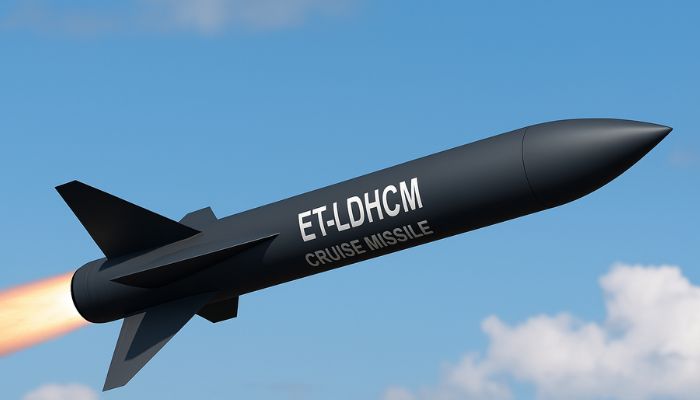
India is all set to test its most formidable missile yet, the Extended Trajectory-Long Duration Hypersonic Cruise Missile (ET-LDHCM). The missile has been developed under DRDO’s top-secret “Project Vishnu”. The indigenous weapon is three times faster and boasts over triple the range of BrahMos. It has the ability to strike targets at 11,000 KMPH and has a range of 1,500 KMs. Once deployed, the ET-LDHCM will put India alongside the US, Russia and China in the exclusive club of nations that have operational hypersonic missile capabilities.
Technological leap from BrahMos
The ET-LDHCM operates at hypersonic speeds of Mach-8 while BrahMos can achieve a max speed of Mach-3. The high speed enables the ET-LDHCM to reach targets within minutes. It uses an air-breathing scramjet engine that allows it to draw oxygen from the atmosphere for combustion. The technology eliminates the need for heavy onboard oxidisers. It results in greater speeds and reduced launch weight. Furthermore, it can carry both conventional and nuclear warheads weighing between 1,000 and 2,000 KG.
Designed to defeat modern defences
The ET-LDHCM is not just fast, it is also extremely versatile and stealthy. It flies at low altitude, making it difficult to detect using radar. Furthermore, its ability to manoeuvre mid-flight allows it to evade most air defence systems. It is also capable of operating in extreme conditions, including heat levels up to 2,000°C, with heat-resistant and oxidation-proof coatings that ensure high performance even after sea or air launch.
Strategic dominance across land, air and sea
The missile can be launched from land, air, or sea. It provides unmatched operational flexibility. Whether targeting strategic military bunkers, enemy command centres, radar stations, or naval destroyers, ET-LDHCM offers precision with minimal warning. This makes it an ideal deterrent against both Pakistan and China, particularly in the current climate of heightened regional tensions.
More than just a missile
While the ET-LDHCM represents a significant military achievement, its implications go beyond warfare. The underlying hypersonic technologies could benefit space launches, disaster response, and even boost India’s defence manufacturing ecosystem by creating jobs and opportunities for domestic industries.
The narrow Strait of Hormuz is once again making global headlines. Iran has recently warned that it might close this vital waterway as its conflict with Israel escalates. Hormuz is not an ordinary waterway. It is the world’s most important oil transit checkpoint, funnelling around 20% of global oil consumption, which translates to around 21 million barrels per day.
If the passage shuts down because of the Israel-Iran conflict, oil prices would surge and the supply chain would be impacted worldwide. Unlike other routes, there is no alternative path out of the Persian Gulf. Every tanker leaving Gulf ports has to pass through the Strait of Hormuz. Even countries that do not rely on Gulf oil would feel the pain, as a major supply shock would spike global energy prices.
This is not the first time Iranian forces have used the Strait of Hormuz as a bargaining chip during a war. During the 1980s “Tanker War”, Iran and Iraq attacked oil vessels, but the pathway was not fully shut. Closing it now would hurt Iran’s own exports and almost certainly provoke the United States’ military intervention. Notably, the US 5th Fleet patrols these waters.
However, the mere threat is a powerful weapon. For Iran, attacking shipping lanes is a card to play amid hostilities. It is a way to pressure adversaries without direct confrontation, and Iran is, anyway, a master in proxy wars. The world is reminded that a single strait, only a few kilometres across, can hold global trade hostage. Hormuz’s plight points towards a broader historical truth, that is, whoever controls the marine trade chokepoints controls the flow of wealth and power. This reality has driven empires and ignited wars for centuries.
Vasco da Gama at Calicut – Ports as Gateways to Empire
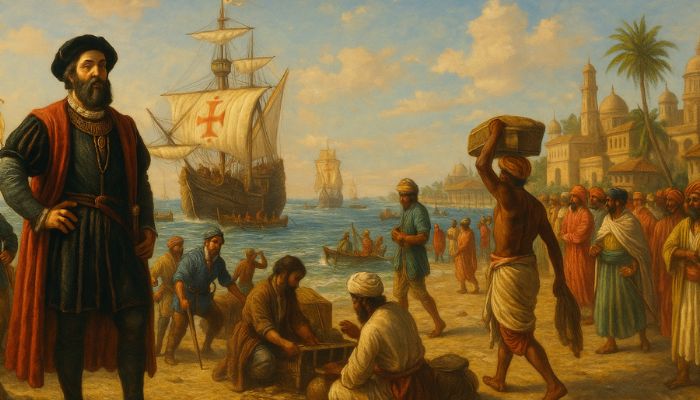
The strategic grip of ports on power is not new. There have been several instances that shaped the world we see today. Over 500 years ago, a voyage to an Indian port altered the course of history. In 1498, Vasco da Gama landed at Calicut on India’s Malabar Coast. He became the first European to find an alternative sea route to India, without relying on the Arabs and Ottomans. It was a breakthrough that shattered the old world order in the coming years and paved ways for the colonisation of India by European powers.
Source: Dall-E
For centuries, spice trade to Europe was dominated by Venice and its Middle Eastern partners, who controlled overland routes. Da Gama’s arrival by sea, however, opened direct ocean commerce and broke the Venetian monopoly. It allowed Portugal to tap into the fabulous profits of pepper, cinnamon, and cloves at the source. Notably, Portugal was a tiny country with a population of less than 1.5 million.
The Portuguese quickly understood that controlling key seaports was the key to imperial dominance. Admiral Alfonso de Albuquerque, their colonial architect, believed in focusing on a few strategic ports and maritime chokepoints to command the Indian Ocean trade. By force and treaty, the Portuguese seized a string of port fortresses, Goa in India (1510), Hormuz at the Gulf entrance, Malacca in South Asia (1511), aimed at diverting all spice traffic to Lisbon.
Though only temporarily, the plan worked. Venetian spice revenues fell to a third of previous levels in the early 1500s, as trade got re-routed via Portuguese harbours. Though Portugal’s Eastern empire eventually overextended and declined, the lesson was clear: secure the port, and you secure a foothold on unprecedented wealth and power. Other European powers took note. The British arrived in India a century later and similarly began with a coastal takeover.
The British East India Company established fortified trading ports at Madras in 1649, Bombay in the 1660s, and Calcutta in 1690. These were all prime harbours granted by local rulers. From these port bases, the British could project military force inland. By the mid-18th century, India’s Mughal Empire had fractured, and the British used their coastal strongholds and private armies to pick off Indian states one by one. Eventually, they got hold of the entire subcontinent. In short, the colonisation of India began from the sea. Whoever held the ports of entry, whether Portuguese galleons or British East Indiamen, held the gateway to conquest.
Sevastopol – Russia’s Lifeline to warm waters of trade
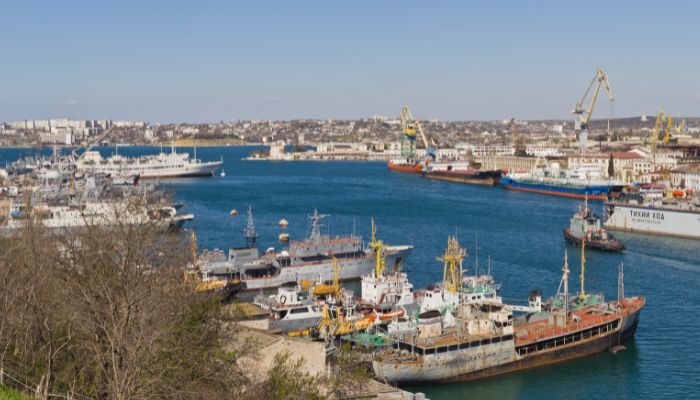
Seaports gave power not only to colonial traders but also to would-be great powers starved of access. Consider Sevastopol, the prized port on the Crimean Peninsula. From the era of the Tsars to Putin’s Russia, Sevastopol has been seen as a lifeline to the world’s oceans. It is Russia’s only warm-water naval port, which it can use year-round, unlike the ice-prone harbours of the North and East.
Source: Wikivoyage
Catherine the Great first seized Crimea in 1783 explicitly to secure this warm-water outlet. It fulfilled Russia’s age-old quest for a year-round port. Ever since, the Black Sea port of Sevastopol has been Russia’s springboard into the Mediterranean and beyond. Because of this, Crimea has been a flashpoint of conflict for centuries.
In the Crimean War of 1853–1856, Britain and France went to war to check Russian expansion and protect Ottoman Turkey. The Allies knew that Sevastopol was Russia’s naval nerve centre in the Black Sea. In 1854, they invaded Crimea specifically to capture Sevastopol, which housed the Tsar’s Black Sea Fleet.
The port was strategically important as it was the location of the Tsar’s Black Sea Fleet, seen as a threat to the Mediterranean. Following a bloody year-long siege, Sevastopol fell and Russia’s fleet was neutralised, at least for some time. Fast-forward to 2014, and once again, Sevastopol was at stake.
When the pro-Russian president was removed in Kyiv, Moscow feared losing its leased naval base in Sevastopol to a hostile government. The Kremlin resorted to a dramatic response. Russian troops annexed Crimea outright and reasserted control over Sevastopol’s harbour. President Putin did it openly, keeping NATO out and keeping Russia’s Black Sea Fleet in.
For Russia, it was not only strategically important to maintain a naval base at Sevastopol, but it was also a matter of self-esteem. Sevastopol housed Russia’s only warm-water port. There were around 15,000 military personnel, and it was impossible for Russia to choose an alternative, as there was none. Losing Sevastopol would bottle up Russia’s navy. Sevastopol is the only way Russia can send warships from the Black Sea through Turkey’s straits to the Mediterranean and project power abroad.
The need to hold Sevastopol drove Russia to seize Crimea in 2014, just as it had driven Catherine in 1783. The port is the prize, national pride and naval strategy altogether.
Turkey’s Gatekeeping of the Black Sea
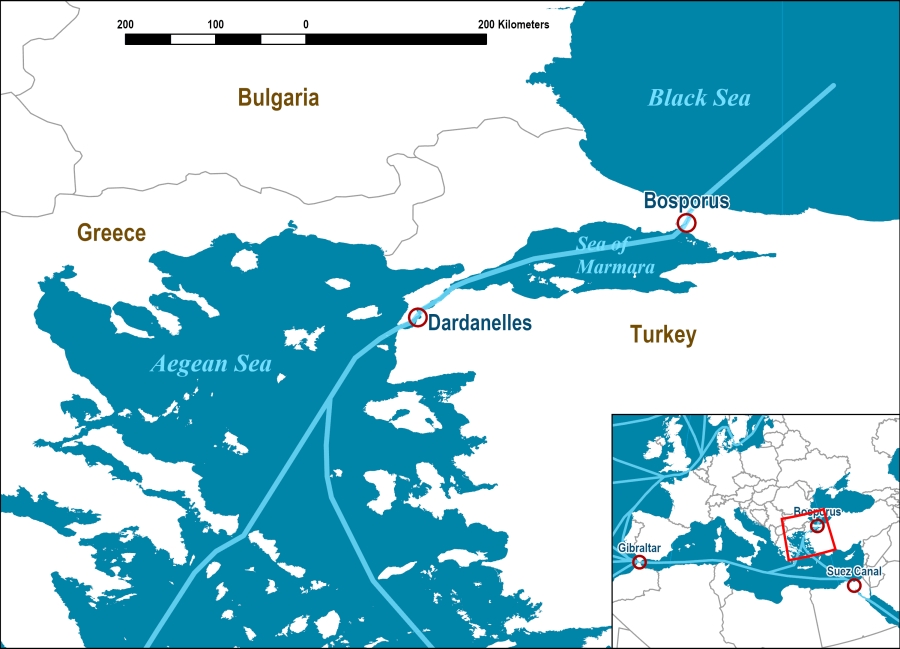
As Sevastopol is Russia’s sea gate, Turkey holds two key waterways, the Bosphorus and the Dardanelles. These are the only outlets from the Black Sea to the Mediterranean. These Turkish Straits have given Istanbul, once called Constantinople, enormous geopolitical clout as a maritime gatekeeper. Since the Montreux Convention of 1936, Turkey has had sovereign control over the straits. It can regulate naval traffic in both peace and war.
Image via: porteconomicsmanagement.org
In peacetime, commercial ships pass through these straits peacefully. However, Montreux Convention sharply limits the size and stay of foreign warships in the Black Sea and effectively bars outside powers from having permanent deployment there. Only six Black Sea nations, including Turkey, Russia, Ukraine, Georgia, Romania, and Bulgaria, are allowed to have full-fledged navies in those waters. In practice, such an arrangement has made the Black Sea a joint Turkish-Russian lake.
In wartime, Turkey uses its leverage. Montreux empowers Ankara to close the straits to military vessels of any warring state. In February 2022, when Russia invaded Ukraine, Turkey invoked Montreux to close the Bosphorus and Dardanelles to all warships not returning to home port.
Turkey played neutral, but in practice, it trapped a number of Russian naval assets outside the Black Sea, since Ukraine’s navy was negligible compared to Russia. It showed how Turkey’s control of a mere few miles of waterway can have great influence on a powerful country’s operations.
Historically, the Turkish Straits have been coveted and contested. In the 19th century, Russians fought several wars with the Ottoman Empire with the aim of gaining control over Constantinople and the straits. During World War I, the Allied powers launched the Gallipoli campaign in 1915 in an attempt to storm the Dardanelles, knock out Ottoman defences, and open a sea supply route to Russia. However, it was a costly failure. Today, with the help of its geography and treaties signed with different nations and organisations, Turkey sits astride one of the world’s most important naval crossroads. It exerts quiet control over who enters the Black Sea. Its role of diplomatic leverage is far beyond its size. NATO allies and Russia alike have to follow Turkey’s rules in these narrow waters.
Global Chokepoints from Singapore to Gibraltar
Beyond Hormuz and the Turkish Straits, there are several maritime chokepoints that shape global trade and security. These narrow passages and pivotal ports act as valves in the circulation of global commerce. In times of conflict, these passages are also used as pressure points.
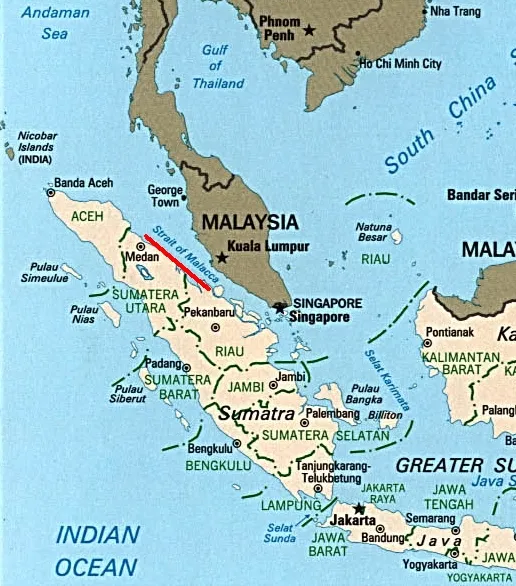
Strait of Malacca in Singapore
The Strait of Malacca connects the Indian and South China Sea near Singapore and Malaysia. It is one of the busiest shipping lanes on Earth. Around 30% of all globally traded goods pass through this corridor. Everything from Middle Eastern oil to Chinese manufactures squeezes between Sumatra and Singapore’s island.
Source: Namuwiki
For the British Empire, Singapore was the “Gibraltar of the East”, a fortified port guarding this artery of empire. In today’s time, Singapore’s port (among the world’s largest) and the strait remain vital to Asian trade. However, it is also a vulnerability. A blockage or conflict in this passage could send tremors through the world economy. Furthermore, there is a limit to this strait’s capacity, and experts believe it will reach its maximum traffic by the end of this decade. Regional powers are exploring alternatives, including the possibility of diverting traffic to a Thai canal or a rail “land bridge” to bypass Malacca.
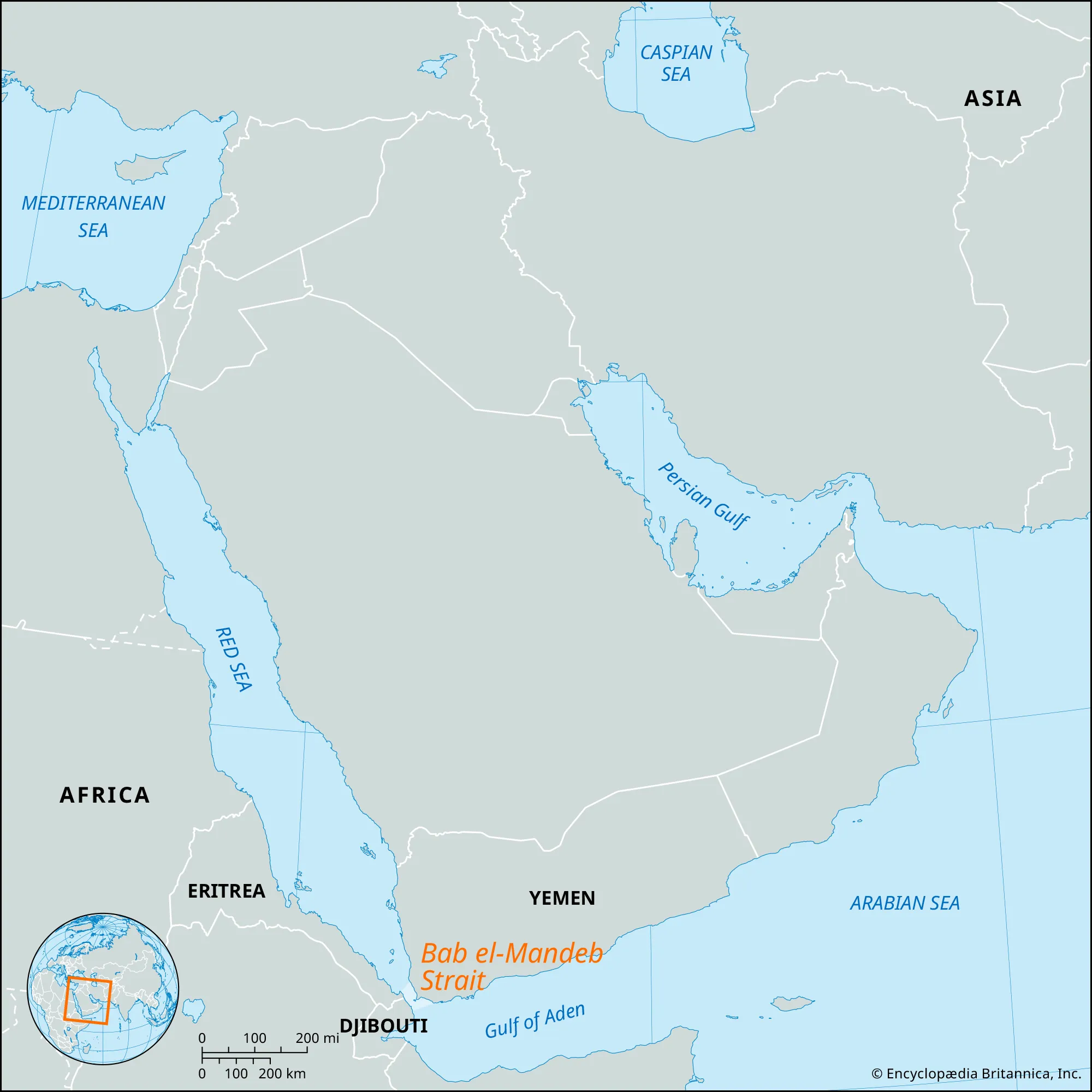
Bab-el-Mandeb in Djibouti
Bab-el-Mandeb links the Red Sea and Suez Canal to the Indian Ocean. It is flanked by Djibouti and Yemen at the Horn of Africa. Though it is less famous, Bab-el-Mandeb still sees around 10% of global trade, including much of Europe’s Asia-bound oil. It has also become heavily militarised, as it has attracted foreign bases from the US, China, France and others due to its strategic location.
Source: Britannica
The ongoing conflict in Yemen has exposed this strait’s vulnerability. In late 2023, terrorists from the Houthi group started attacking ships in the Red Sea and threatened merchant vessels. An attack or closure of this strait would force ships to detour around Africa, much as a Suez Canal blockage would. Indeed, Bab-el-Mandeb and Suez are interlinked components of the Europe-Asia route. The presence of great power navies in Djibouti is a 21st-century echo of the 19th-century scramble for coaling stations, a reminder that the value of a chokepoint rarely escapes strategic notice.
Due to the ongoing Houthi attacks on Israel and US vessels, many commercial ships have been avoiding this route, instead choosing to spend extra days and extra fuel to go around Africa.
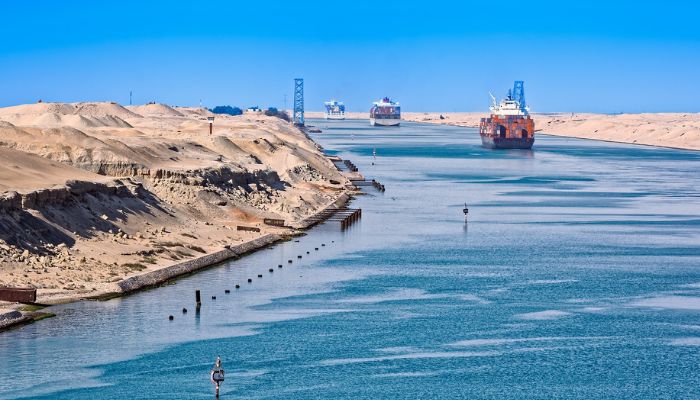
Suez Canal
The Suez Canal was carved through Egypt in 1869. It is an artificial chokepoint that has become one of the world’s most strategic waterways. It connects the Mediterranean to the Red Sea. It saves ships from the 7,000 kilometre detour around Africa’s Cape of Good Hope. By the 1950s, two-thirds of Europe’s oil was sailing through Suez.
Source: Royal IHC
The canal handles over 20,000 ship transits a year. Its importance has been proven whenever it is closed. During the 1956 Suez Crisis and again from 1967–75, after the Arab-Israeli wars, global shipping had to reroute around the Cape, increasing costs. In 2021, a single grounded container ship (EverGiven) blocked the Suez for six days, resulting in a loss of $10 billion in trade losses each day.
Suez’s centrality also makes it a geopolitical chess piece. Control of the canal was so prized that it sparked an invasion in 1956. Egypt’s government heavily secures the waterway, given modern threats like militant attacks in the Sinai or, more recently, spill-over from Red Sea clashes.
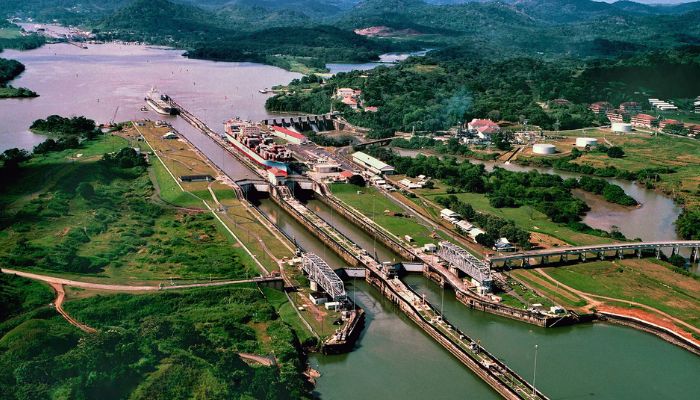
Panama Canal
The Panama Canal is yet another man-made shortcut. It was opened in 1914 and links the Atlantic and Pacific through Central America. It enables vessels to avoid the stormy Cape Horn route, making it crucial for both commercial shipping and naval mobility. The canal connects nearly 2,000 ports across 170 countries. The importance of the canal can be understood by the fact that in 2023 alone, it handled over 14,000 ship transits.
Source: Britannica
The United States long controlled the canal zone, 1903 to 1999, to be precise. It still regards its neutrality as vital. However, supersized cargo ships and US Navy carriers now test its limits. Panama remains a key conduit for grain exports, LNG shipments, and the US Navy’s ability to rapidly shift forces between oceans. Recent droughts, however, have lowered water levels and forced Panama Canal authorities to restrict large ship transits, reminding the world that even this engineering marvel is a fragile resource.
Notably, United States President Donald Trump recently expressed a desire to seize control of the Panama Canal once again, resulting in diplomatic tensions between the two countries.
Strait of Gibraltar
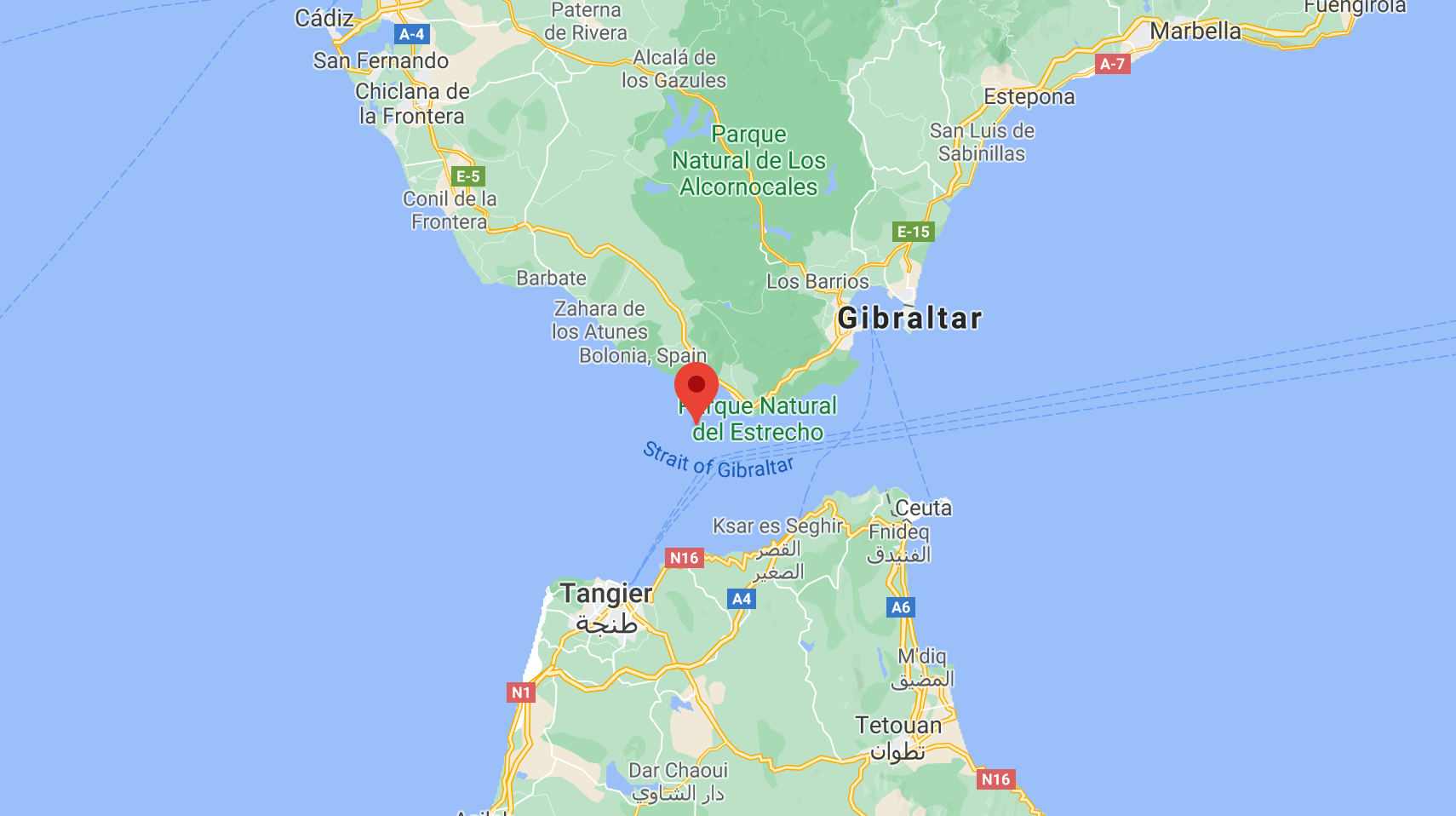
The Strait of Gibraltar is a storied strait at the mouth of the Mediterranean. It has been a strategic prize since antiquity. It is only 12 kilometres wide and serves as a gate between the Atlantic Ocean and the Med. On one side, there is the Rock of Gibraltar, which has been a British-held fortress since 1704, and on the other side, there is the coast of Morocco and Spain.
Source: Marine Insight
Gibraltar’s position allows whoever controls it to monitor and potentially seal off naval traffic into the Mediterranean. The British recognised this and have clung to “the Rock” through countless challenges, enduring several sieges by Spain and France. It was so pivotal that during the Napoleonic Wars, it proved essential to defeating the French Navy in the Med and keeping trade routes to India open.
Even today, the UK’s naval base there helps it project power into the Med and North Atlantic. The strait sees a constant flow of tankers and cargo ships; closure would trap shipping in (or out of) the Med. Thus, the Rock’s strategic value far exceeds its size. It is a stationary aircraft carrier of sorts, anchoring British (and NATO) influence at a global chokepoint.
Each of these locales, whether a man-made canal like Panama or a natural strait like Malacca, illustrates the same principle: that the control of a seaway confers outsized influence. They are the pressure points of globalisation. Little wonder that throughout history, rival powers have schemed to possess them or built fleets to secure access.
Wars for the Waves: Gibraltar, Singapore, Suez and More
As these straits and ports are so crucial, they have often been flashpoints of warfare for maritime dominance. Great powers in history have repeatedly fought over harbours and sea lanes. They knew that the victor would command trade and projection of force.
Crimean War of 1853 to 1856
As discussed before, this war was fundamentally about Russia’s bid to challenge the status quo in the Near East, and the Anglo-French resolve to contain Russia’s naval power. The focal point became Sevastopol, the Russian naval base. The British and French poured armies and fleets into besieging Sevastopol in 1854–55 precisely because destroying Russia’s Black Sea Fleet would remove the Russian threat from the Mediterranean.
The epic siege, immortalised by events like the Charge of the Light Brigade, ended with the city in ruins and Russia humbled. The post-war treaty forced Russia to temporarily forfeit the Black Sea Fleet. The result of the war illustrated how control of a single port could be deemed worth a pan-European war. Sevastopol’s saga would repeat in 2014 when Russia, unwilling to lose its naval foothold, annexed Crimea, a 21st-century annexation motivated by 19th-century-style geopolitics. In many ways, it was the 2014 annexation of Crimea that sowed the seeds of the Russia-Ukraine war, that has been raging for three years now.
Great Siege of Gibraltar of 1779 to 1783
When the American Revolution raged across the Atlantic, an equally pivotal siege unfolded in the Mediterranean. Spain, with the help of France, attempted to take control of Gibraltar from Britain. The war involved bombarding and blockading “the Rock” for several long years. Despite desperate conditions, the British fought until the siege was lifted in 1783. The victory had far-reaching consequences. British determination to keep Gibraltar, even at the cost of diverting fleets from America, showed how vital the strait was to London’s grand strategy.
Historians argue that the resources Britain tied up at Gibraltar might have cost it the war in America. However, in the subsequent Napoleonic Wars, Gibraltar paid dividends. It served as an indispensable base to undermine Napoleonic France’s naval operations and protected British commerce to the East.
In other words, holding that “few kilometres of barren rock” turned out to be crucial for Britain’s global empire. The Great Siege remains the longest in British history, a testament to how fiercely an empire will fight for a strategic port.
Battle of Singapore in 1942
Sometimes, losing a port is all it takes to alter history. In December 1941, the Japanese Army swept down the Malayan Peninsula and attacked Singapore, which was Britain’s mighty naval bastion in Asia. Singapore’s fall was swift and shocking. British forces surrendered on 15th February 1942, with 80,000 troops taken prisoner, the largest capitulation in British military history.
Churchill called it the worst disaster in British military history. Why was Singapore so significant? It was Britain’s foremost military base and economic port in Southeast Asia, anchoring its interwar defence strategy in the region.
Dubbed the “Gibraltar of the East”, Singapore’s docks and big guns were supposed to deter any Asian aggressor. Its loss not only handed Japan control of the Malacca Strait and a superb harbour, but also shattered the myth of Western imperial invincibility. The domino effect was visible. Japanese victory in Singapore emboldened independence movements and sounded the death knell of British rule in Asia. Control of that port had made the British Empire in Asia, and losing it broke their hold. The battle exemplified how maritime power and colonial power went hand in hand. Once the Royal Navy was swept from its eastern base, Britain’s Asian colonies were doomed.
Suez Crisis of 1956
In a 20th-century example of fighting over a chokepoint, Britain and France went to war in 1956 to seize back the Suez Canal after Egypt’s President Nasser nationalised it. For the European powers, Suez was an economic lifeline (the shortcut for oil and colonial trade) and a symbol of residual imperial influence.
In late October 1956, Britain and France, in collusion with Israel, launched military operations against Egypt to topple Nasser and reclaim the canal. Militarily, the Anglo-French forces swiftly occupied the canal zone. But geopolitically, the gambit failed, the US and USSR pressured them into a humiliating withdrawal.
The Suez Canal was closed for months as sunken ships blocked navigation. It demonstrated how easily a chokepoint can be paralysed. The crisis marked the end of Britain and France as global policemen and the rise of new superpowers. It also underlined the importance of the Suez Canal.
At the very moment the European empires were fading, Suez became the highway of oil. By 1955, half of the canal’s traffic was petroleum. Control over Suez was so strategic that great powers were willing to go to war. When they lost that control, it signalled that their era had ended. Ever since, Suez’s status has been an international concern. Egypt takes pride in safeguarding it and, of course, profiting from tolls. The Suez episode shows that even in the modern age, nations will fight to possess a crucial transit route, no matter how costly it may be or even if the profits are much lesser than the losses.
Going further, the Anglo-Dutch Wars of the 1600s can be added to the list, where control of sea lanes and trading posts sparked repeated naval conflicts between England and the Netherlands. Another example from the past is the Battle of Trafalgar in 1805, where Admiral Nelson’s victory ensured British dominance of the seas, and thus its global trade empire, by crushing Napoleonic naval power.
From Athens versus Sparta, to the British Grand Fleet versus the German High Seas Fleet, to modern carrier groups patrolling chokepoints, command of the sea’s strategic arteries has been a deciding factor in power politics.
Cleopatra’s Naval Gambit
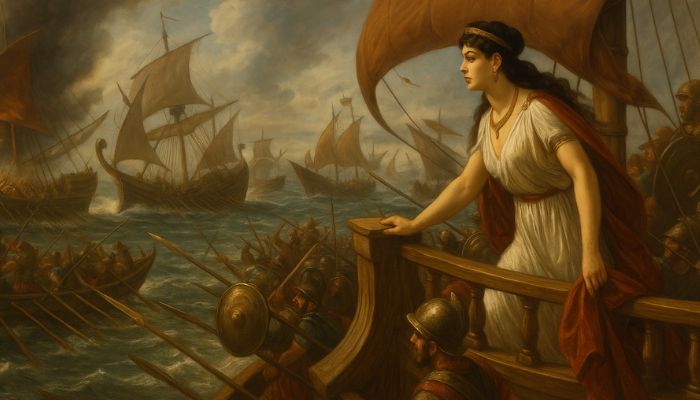
To end with a historical anecdote, let us consider one of antiquity’s most famous figures, Queen Cleopatra VII of Egypt. She was deeply aware of the power of naval dominance. In the last days of the Roman Republic, Cleopatra aligned with Mark Antony in a massive bid to rule the Mediterranean. She personally commanded a fleet alongside Antony’s in the climactic conflict against Octavian, who would later become Emperor Augustus.
Source: Dall-E
The showdown came at the Battle of Actium in 31 BC, a naval engagement off the coast of Greece. Antony and Cleopatra’s combined fleet of giant galleys faced Octavian’s smaller, more agile ships. Despite Cleopatra’s wealth and Egypt’s naval resources backing Antony, by some accounts she brought 60 ships herself, and Antony had around 500, the battle went poorly for them.
Octavian’s navy, led by Admiral Agrippa, outmanoeuvred the heavy Egyptian ships. In the thick of battle, Antony’s lines collapsed. Cleopatra took the chance to break out of the engagement with her squadron of ships and abandoned the battle. When Antony’s forces saw her depart, they lost hope, and Octavian won decisively.
The defeat ended Cleopatra’s naval power and her rule. Antony and Cleopatra fled to Egypt and soon committed suicide as Octavian closed in. Actium’s outcome had huge consequences. Octavian’s victory made him master of the Mediterranean and ushered in the Roman Empire under his new name, Augustus. For Cleopatra, it was the end of her ambitions. She may be remembered for her romances and political intrigue, but her final throw of the dice was at sea, and it was a naval defeat that sealed the fall of Egypt to Rome.
Conclusion
From the Strait of Hormuz in 2025 to Actium in 31 BC, geography has dictated the fate of empires. Seaports, straits, and canals are more than geographic features, they are the lifelines of commerce and conflict. An empire rises by securing trade routes and falls when it loses them. Whether it is Russia holding Sevastopol or Britain losing Singapore, chokepoints shape global power. Despite modern warfare shifting to missiles and cyberspace, sea lanes still decide leverage. As crises unfold, history reminds us, control of the waves, from Gibraltar to Malacca, remains as decisive today as it was centuries ago.
Hero Motocorp on Wednesday introduced the Battery-as-a-Service (BaaS) model for its VIDA VX2, which will help consumers reduce the upfront ownership cost, making electric mobility more affordable and accessible to a wider customer base.
This “pay-as-you-go” battery subscription is intended to make VIDA Electric Vehicle (EV) ownership more flexible and affordable.
This BaaS model will be launched on July 1, 2025.
This subscription model will allow, customers to have the option to finance the scooter chassis and battery separately, reducing significant upfront capital expenditure into manageable monthly payments.
With the help of this BaaS model, VIDA customers will be get an option to improve cost efficiency. Additionally, they will also get access VIDA’s pan India ecosystem which includes over 3,600 fast-charging stations and 500+ service points across 100+ cities.
“By removing conventional barriers and reimagining EV ownership and experience, VIDA aims to democratize electric mobility while offering unmatched convenience, flexibility, and peace of mind”, the company said.
According to Hero Motocorp, consumers can choose from flexible subscription plans tailored to their daily or monthly budget and usage, which will offer greater affordability, convenience, and peace of mind in EV ownership.
Recently, VIDA launched the ‘Charging Simple Hai’ campaign during the ongoing IPL season in May. Showcasing its removable battery technology with the message “Every plug point is a VIDA charging point”, the campaign highlights the ease of charging VIDA’s batteries using any standard 5-amp socket, making electric mobility truly convenient and accessible.
VIDA, powered by Hero MotoCorp, continued to deliver growth with dispatches of 8361 units and 7161 VAHAN registrations for the VIDA V2 electric scooter range. VIDA achieved a Vahan market share of 7.2 per cent, indicating sustained progress. VIDA is set to electrify the market with a new product launch on July 1, 2025.
(This news report is published from a syndicated feed. Except for the headline, the content has not been written or edited by OpIndia staff)
Amid the escalating military tensions between Israel and Iran, the Iranian Supreme Leader Ayatollah Ali Khamenei on Wednesday (18th June) responded to US President Donald Trump’s demand of an “unconditional surrender”. In a televised message Khamenei said that the Iran stands firm against an “imposed war” and that any US military intervention will be met with irreparable message.
“The Iranian nation will stand firm against an imposed war, just as it will stand firm against an imposed peace, and this nation will not surrender to anyone in the face of imposition,” the Supreme Leader said. “Intelligent people who know Iran, the Iranian nation, and its history will never speak to this nation in threatening language because the Iranian nation will not surrender, and Americans should know that any US military intervention will undoubtedly be accompanied by irreparable damage,” Khamenei added. Khamenei’s message came in response to US President Trump’s recent remarks wherein he demanded Iran to surrender.
The Supreme leader of Iran also posted several messages on X (formerly Twitter), saying Iran will never surrender, and warning that US will face the consequences of helping Israel.
Trump had posted on Truth Social that the US military knew the exact location where Khamenei was “hiding” and that it did not want to kill him yet. “We know exaactly where the so-called “Supreme Leader” is hiding. He is an easy target, but is safe there- We are no going to take him out (kill!), at least for now. But we don’t want missiles shot at civilians, or American soldiers. Our patience is wearing thin. Thank you for your attention to this matter!” said Trump.
Describing Trump’s comments as “absurd rhetoric”, Khamenei said that Iran would never surrender before the US. “The US President threatens us. With his absurd rhetoric, he demands that the Iranian people surrender to him. They should make threats against those who are afraid of being threatened. The Iranian nation isn’t frightened by such threats,” Khamenei wrote on X.
The US President threatens us. With his absurd rhetoric, he demands that the Iranian people surrender to him. They should make threats against those who are afraid of being threatened. The Iranian nation isn’t frightened by such threats.
“It isn’t wise to tell the Iranian nation to surrender. What should the Iranian nation surrender to? We will never surrender in response to the attacks of anyone. This is the logic of the Iranian nation. This is the spirit of the Iranian nation,” he said.
It isn’t wise to tell the Iranian nation to surrender. What should the Iranian nation surrender to? We will never surrender in response to the attacks of anyone. This is the logic of the Iranian nation. This is the spirit of the Iranian nation.
Khamenei warned the US that it was entering the war to its own detriment and that it will suffer greater damage than Iran.
The US entering in this matter [war] is 100% to its own detriment. The damage it will suffer will be far greater than any harm that Iran may encounter.
The Iranian Supreme Leader said that the Israel attacked Iran without provocation, at a time when the US and Iranian officials were holding negotiations. “The Zionist regime’s malicious attack on our country took place at a time when Iranian officials were indirectly engaged in negotiations with the US side. There was no indication on the part of Iran that signaled a military move,” Khamenei added.
The Zionist regime’s malicious attack on our country took place at a time when Iranian officials were indirectly engaged in negotiations with the US side. There was no indication on the part of Iran that signaled a military move.
Khamenei expressed the suspicion that the US, which has so far has not been militarily involved in the ongoing conflict between Israel and Iran, of being innvolved in the “malicious move carried out by the Zionist regime”.
It was already suspected that the US was involved in the malicious move carried out by the Zionist regime, but considering their recent remarks, this suspicion is growing stronger day by day.
It has been six days of continued missiles attacks between Israel and Irana since it started with Israel’s ‘Operation Rising Lion’. The conflict does not seem to end soon as the Israeli PM Netanyahu recently said that Israel would not stop without eilimiating Khamenei. The conflict began after Israel launched missile attacks on Iran on 12th June to destroy Iran’s nuclear facilities.
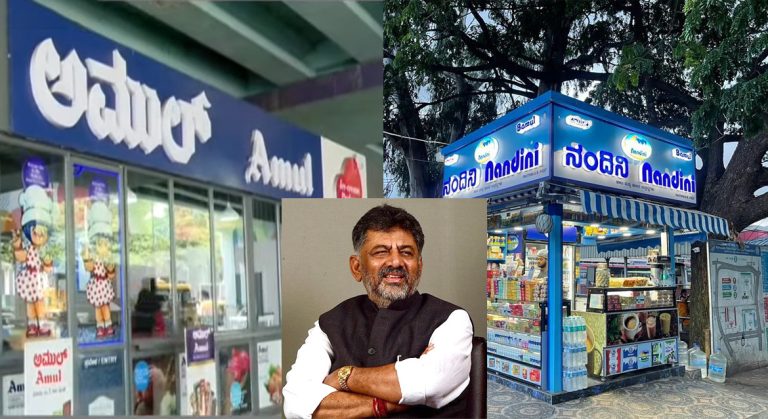
The Amul vs Nandini controversy has yet again revived a political storm in Karnataka after the Bengaluru Metro Rail Corporation Limited (BMRCL) allowed dairy brand, AMUL, to set up kiosks at Bengaluru metro stations. The opposition lashed out at the Congress government in Karnataka after a BMRCL newsletter dated 16th June stated that AMUL kiosks will be set up at ten Bengaluru metro stations, including major stops like Nadaprabhu Kempegowda Station (Majestic), Indiranagar, Baiyappanahalli, Trinity, and Banashankari. The opposition accused the Siddaramaiah government of neglecting the homegrown dairy brand Nandini by signing the agreement with Gujarat-based AMUL.
Amid mounting pressure, Karnataka Deputy Chief Minister, DK Shivakumar, posted a clarification on X saying that the BMRCL invited global tenders to open kiosks at ten metro stations but only AMUL applied and therefore was allowed to open stores at 2 places.
ನಮ್ಮ ನಂದಿನಿ ನಮ್ಮ ಹೆಮ್ಮೆ: ಮೆಟ್ರೋಗಳಲ್ಲಿ 8 ನಂದಿನಿ ಮಳಿಗೆ ತೆರೆಯಲು ಸೂಚನೆ
ಬಿಎಂಆರ್ ಸಿಎಲ್ ಅವರು ಟೆಂಡರ್ ಕರೆದಿದ್ದು, ಅಮೂಲ್ ಹೊರತಾಗಿ ಬೇರೆ ಯಾರೂ ಮಳಿಗೆಗಳಿಗೆ ಅರ್ಜಿ ಹಾಕಿಲ್ಲ. ಕೆಎಂಎಫ್ ಕೂಡ ಅರ್ಜಿ ಹಾಕಿರಲಿಲ್ಲ. ಈಗ ಕೆಎಂಎಫ್ ನವರಿಗೆ ನಾವು ಅರ್ಜಿ ಹಾಕುವಂತೆ ಸೂಚಿಸಿದ್ದು, ಟೆಂಡರ್ ಕರೆಯಲಾಗಿದ್ದ 10 ಕಡೆಗಳ ಪೈಕಿ ಎರಡು ಕಡೆ… pic.twitter.com/XkJqtePtgQ
“Our Nandini is our pride: Notice to open 8 Nandini stores in metros BMRCL has called for tenders, but no one else has applied for stores except Amul. KMF also did not apply. Now we have instructed KMF to apply, and out of the 10 places where tenders were called, Amul has applied in a global tender and opened stores in two places. It is not right to close the stores that have been opened. I have said that KMF should be allowed to open stores in the remaining 8 places,” wrote Shivakumar on Wednesday (18th June).
Launching a scathing attack on the deputy Chief minister, the JDS accused him of having “sold his self-respect for the sake of commission”. Reminding Shivakumar, how before the 2023 assembly elections, his party vehemently opposed dairy brands of other states and used the name of Nandini for election, the JDS said that now his party’s government has allowed AMUL to set up stores by taking commission.
BJP MLC, CT Ravi also cornered the state congress accusing it of fabricating a controversy around the dairy brands AMUL and Nandini ahead of the assembly elections.
AMUL Vs Nandini controversy
The controversy dates back to May, 2023, when Congress, Janata Dal (Secular) and other parties went after the then BJP government in Karnataka after AMUL announced that it was planning to launch its brand in Bengaluru. The opposition parties spread the misinformation that the then BJP government was planning to root out the local Kannadiga brand Nandini by allowing AMUL to sell its products in the state.
Months before that, in December 2022, Home Minister Amit Shah had called for a greater cooperation between AMUL and Nandini to boost cooperative dairy in Karnataka. However, Shah’s remarks were misconstrued by the state opposition leaders who turned it into a ‘North Vs South’ debate. Congress leaders in Karnataka tried to use the Amul-Nandini controversy to whip up regionalism ahead of the state elections and alleged that Nandini would be sold to ‘North Indian businessmen.’
Ironically, Shivakumar back then suggested that there was a larger conspiracy behind the entry of AMUL into Karnataka. He condemned AMUL in the name of ‘saving’ the farmers of Karnataka and said, “We want to protect our milk and our farmers. We already have Nandini which is a better brand than Amul…We don’t need any Amul…our water, our milk, and our soil is strong”. This was followed by Siddaramaiah’s appeal to the people of Karnataka to boycott AMUL. Siddaramaiah went on to link the AMUL’s entry into Karnataka with “language treason” and “land treason” by the BJP claiming that the BJP government was going to betray the farmers by shutting down the KMF. “In addition to language treason by the imposition of Hindi and land treason by trespassing within the state borders, now the BJP government is going to betray the farmers by shutting down Karnataka Milk Federation (KMF), which is the livelihood of millions of dairy farming families in the country,” Siddaramaiah alleged.
This is a classic example of how Congress, a national party, exploits regional sentiments and creates division for the sake of votes during elections. Clearly, the economic progress of a state comes after its political interest for the Congress party. Congress, which suffers from political myopia, is now getting a taste of its own medicine and struggling to save its face after doing the exact same thing which it was opposing ahead of the state assembly elections.
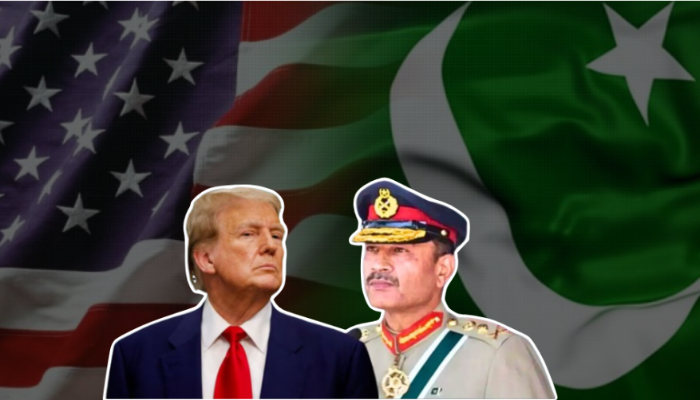
On 18th June, President Donald Trump will have lunch with Pakistan’s Field Marshal Asim Munir. As per the official itinerary from the White House for the day, the meeting is one of the significant engagements scheduled during the day for Donald Trump. The two are expected to interact in the White House Cabinet Room at 1 pm (Washington time), behind closed doors with no press access allowed, as per with the president’s daily public program.
Munir is also expected to hold discussions with Secretary of State Marco Rubio and Defense Secretary Pete Hegseth during his five-day visit to the United States (US). Previously, there were speculations regarding his attendance at the United States Army Day parade which were formally refuted by the country. A White House official declared, “This is false. No foreign military leaders were invited.”
It is clear that the meeting has little to do with the recent India-Pakistan conflict but rather centers on the increasing hostilities between Iran and Israel where the United States may also have to enter the fray. Nevertheless, as a force of habit, the Congress party used the development to attack the country’s diplomacy and foreign policy for political point scoring against the Modi government.
Jairam Ramesh, a Congress Rajya Sabha MP, claimed that India has been given “triple jhatka (loss)” in terms of diplomacy and foreign policy. He alleged, “Today, Field Marshal Asim Munir, whose provocative, incendiary, and inflammatory comments are directly linked to the Pahalgam terror attacks. He is today invited for a one-on-one special lunch with President Trump. This is a setback for Indian diplomacy. We are quiet about it, we have not objected to it.”
Understand the 'triple jhatka' that the Indian foreign policy and diplomacy have received. Today Field Marshal Asim Munir, whose provocative, incendiary, and inflammatory comments are directly linked to the Pahalgam terror attacks.
“Second, General Michael Kurilla, who is the Head of the US Central Command, says that Pakistan is a phenomenal partner in counter-terrorism. We are saying Pakistan is a phenomenal perpetrator. Third, from 10th May onwards, 14 times President Trump has been claiming that he mediated a ceasefire, he used trade as an instrument, he put Pakistan and India together,” the senior Congressman added.
He reiterated the opposition’s call for a special session of Parliament. He insisted that the prime minister should make the same statements in Parliament as Foreign Secretary Vikram Misri did about the 35-minute phone call between PM Modi and President Trump. He also repeated the same points in a social media post.
Field Marshall Asim Munir, the man whose inflammatory, incendiary and provocative remarks were linked directly to the April 22 Pahalgam terror attacks, is having lunch today with President Trump in the White House. Is this why President Trump abandoned the G7 Summit a day early…
Notwithstanding the comments made by the Congress party and its leaders, the meeting between Trump and Munir is occurring amidst a series of chaotic events happening elsewhere. Iran-Israel conflict is escalating with each passing day, and if it snowballs into a full-scale war, US will have to formally enter the fray. And this is where Pakistan comes in as its location next to Iran makes it very useful for the United States.
Historically, the United States has always used Pakistan in the region to achieve its goals, a fact which has been acknowledged by the leaders of the Islamic Republic. Pakistan was used by the US for years for its strategic operations in Afghanistan and others parts of the region.
Nonetheless, the United States president rarely, if ever, hosts a lunch for a foreign army leader. Pakistani military chiefs including Pervez Musharraf, Zia-ul Haq, and Ayub Khan have met modern US presidents, but only after taking power in the wake of coups that overthrew civilian leaders.
It is important to note that the Pakistani army has effectively been the ruling authority of the nation, whether through coups or by establishing puppet civilian governments and managing them from behind the scenes.
Assistance during Iran-Israel conflict
Israeli military attack on Iran’s nuclear facilities has been one of the most critical events in the Middle East. The removal of non-essential staff from diplomatic offices and military installations throughout the region and other recent US actions, hints that there may be serious escalation ahead.
Pakistan’s location could become strategically important during a large scale war and US would look to exploit it. During a larger regional conflict that would involve Iranian proxies in the Middle East, the US could attempt to make sure that Islamabad provides covert assistance, such as the use of its military facilities and assets and maintains cooperation.
More importantly, Iran and Pakistan share a 905-kilometer (562-mile) border through the province of Balochistan in the southwest where anti-Iranian rebel groups have Pakistan’s tacit backing. Pakistan may provide the US military planners with a clandestine front for intelligence or logistical operations if the Israel-Iran war intensifies.
Although Trump’s gesture tacitly acknowledges Munir as Pakistan’s de facto leader, Washington seems to be asking for his cooperation or at the very least, support for its planned attacks on Iran in the event that the Persian nation refuses to give up its nuclear program. Furthermore, the United States and Israel want to ensure that Iran remains isolated in the Muslim world and does not receive any assistance from Islamabad, whose precarious situation leaves it open to pressure and allows it to switch course in exchange for funds.
Pakistan’s support for Iran raises alarm in US
It is also feasible that Munir could be warned about any support for Iran as Israel’s strikes on the country have been formally denounced by Islamabad, which described them as “unjustified and illegitimate aggression” and a “brazen violation of Iran’s sovereignty as well as “blatant provocations” which violated the country’s territorial sovereignty. Notably, Israel is an enemy country for Pakistan as well, and it is entire plausible that Pakistan may get tempted to materially support Iran during the war against Israel.
“The international community and the United Nations bear responsibility to uphold international law, stop this aggression immediately and hold the aggressor accountable for its actions,” Pakistan’s Ministry of Foreign Affairs stated on 13th June.
Pakistan stands with the Iranian government and people, according to statements by Pakistani leaders, notably Ishaq Dar, the country’s foreign minister and deputy prime minister. Khawaja Muhammad Asif, the minister of defense also underlined the necessity for Muslim countries to band together in the face of what he called “Israeli aggression,” urging them to cut their ties with the Jewish nation and demanding an urgent Organization of Islamic Cooperation (OIC) session to develop a coordinated strategy.
Although Khawaja rejected assertions made by an Iranian general, Mohsen Rezaei, that Pakistan had pledged nuclear retaliation against Israel in the event that Iran were hit with nuclear weapons as “fabricated” and “irresponsible,” he cautioned that Jerusalem’s unreported nuclear arsenal could intensify regional conflicts.
Munir himself declared that his nation supported Iran and hoped the war would soon come to an end, in Washington DC.
This tilting towards Iran during the conflict by Pakistan is a cause of concern for the US. They would prefer Pakistan to be at least neutral if they can’t openly come out in support of the US alliance. US is looking to totally isolate Iran and won’t like it if other countries extend their open support to it.
Conclusion
The military, not the civilian administration, controls Pakistan’s foreign policy, notably when it comes to the US, which is interacting with the real authority in Islamabad by dealing directly with the leadership of Pakistan’s army.
The current geopolitical situation with Iran and Israel at each other’s throats dictates that US has to try and keep Pakistan on its side as they will be needing Pakistan’s air bases and air space to attack Iran from its eastern border.
US has used Pakistan’s airbases in the past during its war in Afghanistan and will look to use them again as it looks to counter Iran from there.
So, Congress, this is not a failure of Indian diplomacy or any big win for Pakistan that Asim Munir is meeting Donald Trump at the White House. Pakistan is a useful idiot for USA, one that is easily bought as well, and America need them right now as the tensions continue to escalate between Iran and Israel.
West Bengal Police have arrested three people including two Trinamool Congress leaders for kidnapping a Delhi-based businessman for ransom. The police of Shasan police station under Barasat police district arrested TMC leaders Saddam Mandal and Sajjan Alam, along with their accomplish Jamaluddin Sheikh, for kidnapping fish trader Nazim Chauhan.
Samad Mandal is the vice-president of Trinamool Congress of Charghat Panchayat in Swarupnagar, and Sajjan Alam is also a Trinamool leader from Swarupnagar and his wife Farida Khatun is a panchayat member from the ruling party. They were arrested on Monday, and the kidnapped person has been rescued. However, the main accused in the case is still absconding.
Police said that Nazim used to visit Basirhat area for trading in Magur fish. Nazim Chauhan and Jasimuddin Mandal alias Raju, the mastermind of the kidnapping, had jointly set up a hatchery for breeding hybrid Magur fish. However, that business closed a year ago, and there was a conflict between the two over the due amount for transactions already done.
Recently, the hatchery was sold to a third party, and they decided to resolve the disputes and settle the account. Therefore, Jasimuddin called Nazim Chauhan to come to Basirhat to collect the due amount.
But, when he arrived on Sunday morning, he was abducted from Kachkal area while he was going to Basirhat from Kolkata airport in a taxi. As per police, Jasimuddin went to the airport in a taxi to pick up Nazim after he arrived from Delhi. When the cab reached Kachkal area, Jasimuddin asked the cab driver Mirajul Ghazi to stop.
Soon another car arrived at the spot, and some people from that car dragged Nazim from the taxi and forced him to sit in the car. They also dragged Jasimuddin to make it look like that both of them were being abducted.
They then reached a secluded area in Basirhat, and called the fish trader’s family demanding a ransom of ₹1 crore.
In the meanwhile, cab driver Mirajul Ghazi reached Shasan police station to inform that two people from his cab were abducted by some people. Accordingly, police registered a complaint and started the probe.
After sometime, Jasimuddin called the driver, informing that he was part of the plan to kidnap the Delhi-based businessman. He said that Nazim will be released as soon as they receive the payment. Police then traced the location of the number and reached the place where Nazim Chauhan was held.
After realising that their plan has been busted, kidnappers abandoned Chauhan on the roadside and fled from the spot. Chauhan took shelter at the house of a person known to him, from where he was rescued by the police.
Saddam Mandal, Sajjan Alam and Jamaluddin Sheikh were later nabbed by police. However, Jasimuddin Mandal remains absconding. The arrested persons were produced before the Barasat court on Tuesday, and they were remanded to police custody till June 20.
Investigation revealed that Jasimuddin owes around ₹3 crore in the market. So, he hatched a plan to kidnap Nazim and demand ₹1 crore in ransom. He took the help of TMC leaders Saddam and Sajjam in the plan.