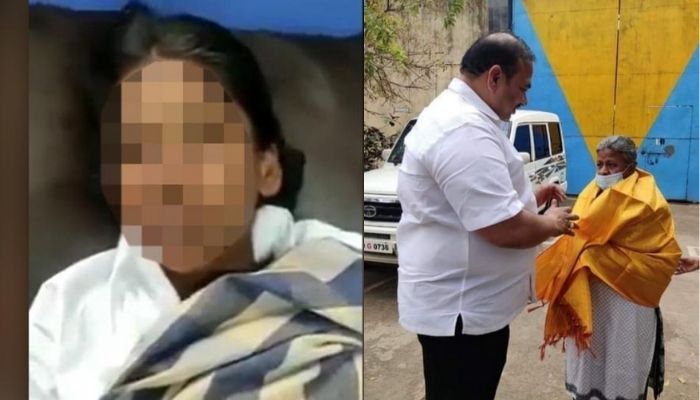
A month after a 17-year-old Lavanya committed suicide following allegations of coercion to convert to Christianity by her school in Tamil Nadu, Dravida Munnetra Kazagham (DMK) MLA Inigo Irudayaraj felicitated the hostel warden accused of torturing Lavanya, reportedThe Commune.
As per a report in Samayam, the Trichy East MLA felicitated the accused hostel warden Sagaya Mary with a shawl outside the Trichy Central jail, after she was released on bail by the Thanjavur District Court.
It must be mentioned that the 17-year-old Lavanya had revealed in her dying declaration that the hostel caretaker Sagaya Mary harassed her for not converting to Christianity. The deceased Hindu girl had informed how she was forced to cook, keep books and clean toilets.
Hindupost reported that the DMK MLA Inigo is also the convenor and founder of the Christian Goodwill Movement. He had also organised an event where a Christian priest openly delivered a hate speech against the Hindu community.
“The majority (Hindus) are nothing but mosquitoes and can be easily swatted away,” the priest had remarked. Ahead of 2019 Lok Sabha polls, the DMK MLA was also seen vying for consolidation of Christian and Muslim vote bank to defeat the BJP in the Southern State of Tamil Nadu.
Lavanya suicide case
Lavanya was a 12 standard student at Sacred Heart Higher Secondary School in Michaelpatti near Thanjavur in Tamil Nadu. She had committed suicide on January 19 this year by consuming pesticides after being forced by the school to convert to Christianity.
The Tamil Nadu government, media and police had tried to suppress the conversion angle in the case and had ignored the dying declaration, prompting her family to approach the HC seeking a CBI inquiry.
On January 31, 2022, The Madurai Bench of Madras High Court had ordered the transfer of the Lavanya suicide case to the CBI, a decision upheld even by the Supreme Court of India. This came after the victim’s father had filed a petition in the Madras High Court seeking a CBI probe into the matter, alleging that the investigation by state police was not going in the right direction.
The government, which has been denying the conversion angle right from the start had filed an SLP with the apex court through the DGP challenging validity of the HC decision. The DGP had also challenged the remarks of the Madras High Court against the State Police for their inaction and lack of concerted effort in investigating the angle of conversion
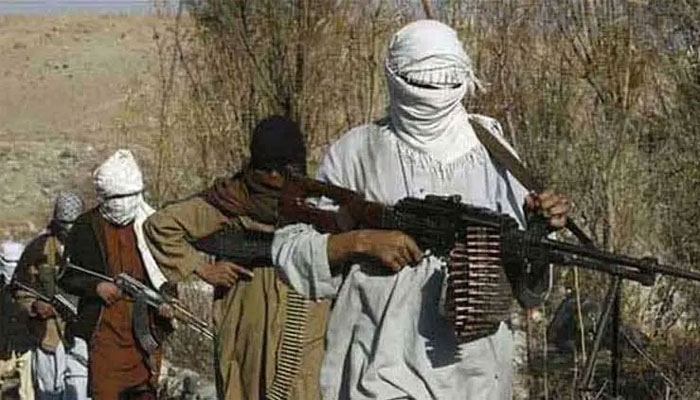
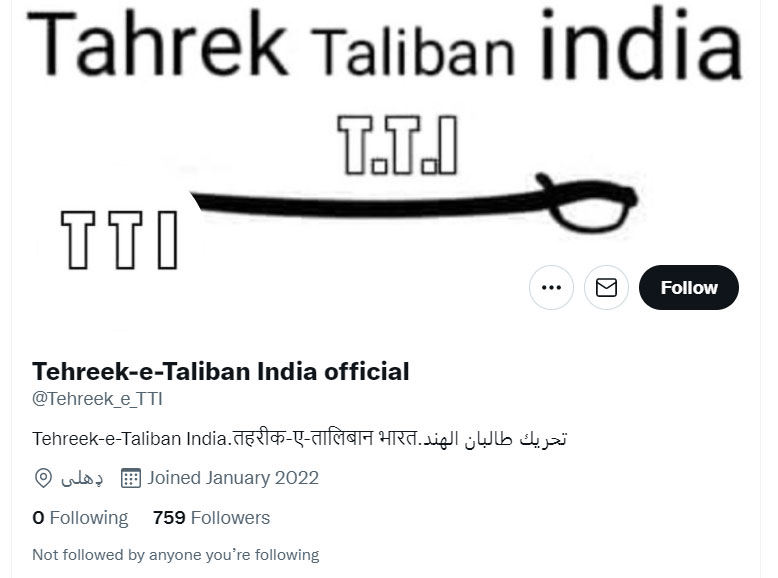
Pakistan’s Tehreek-e-Taliban (TTP) has established its Indian chapter Tehreek-e-Taliban India (TTI). The newly formed chapter’s parent organization is a designated terror organization by Pakistan, US and other countries. It is responsible for widespread riots in Pakistan. The Twitter account, which was created in January 2021, published its first post on February 9.
Screenshot of TTI’s Twitter bio. Source: Twitter
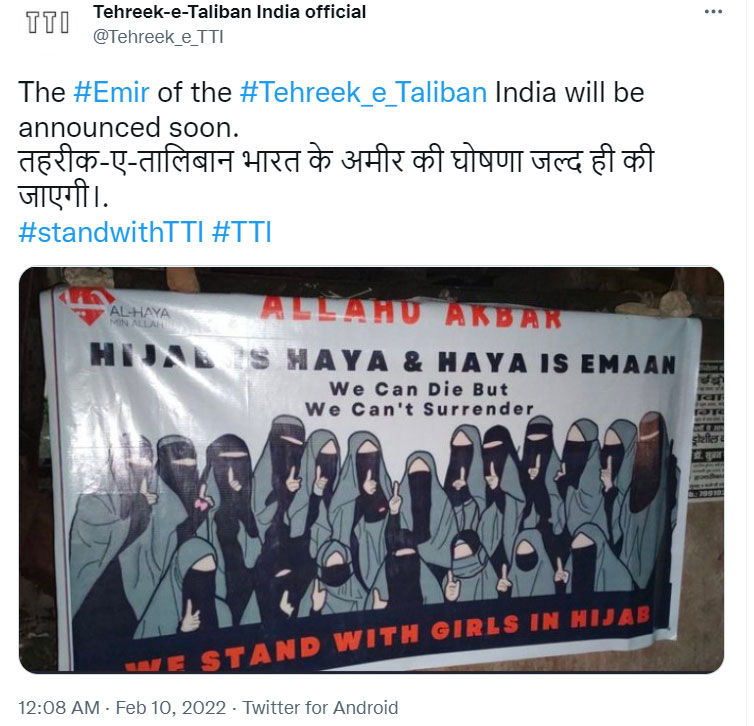
The next day, it said the Emir or the head of the organization would be announced soon. The same day, it said, “The Tehreek-e-Taliban India (#TTI) announced its official activities today, Thursday, following a meeting of its leaders in India.” Later they named Maulana Al Qureshi as their first Emir.
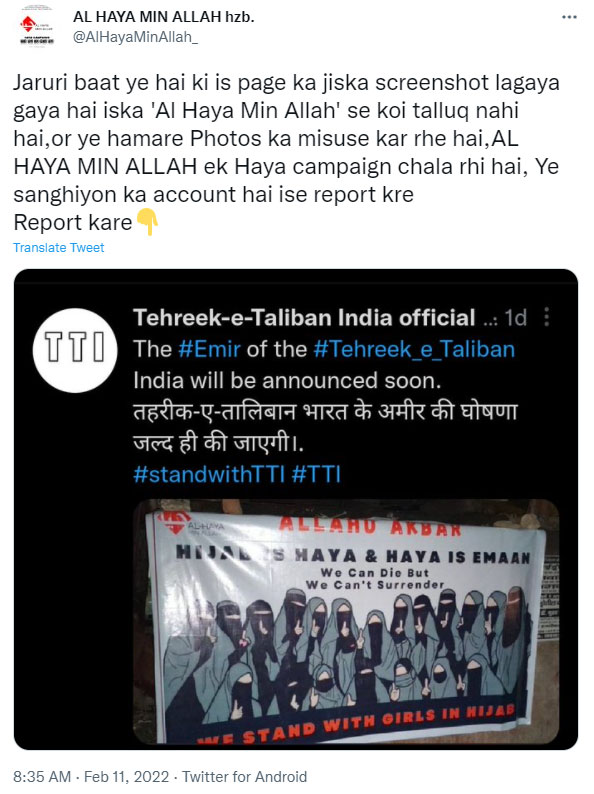
TTI published tweet in favour of Hijab-clad girls. Source: Twitter
There was a photograph of a poster in the Tweet that was in support of the hijab. The poster read, “Hijab is haya & Haya is Emaan. We can die, but we can’t surrender. We stand with girls in hijab.” The poster also had the logo of Al-Haya-Min-Allah, which, according to its Twitter bio, is a month-long “Haya campaign” allegedly to “spread awareness”. The group has come out in support of hijab-wearing girls. Interestingly, the group being Al-Haya-Min-Allah has distanced itself from TTI and called it an account made by “Sanghis”.
Al-Haya-Min-Allah distanced itself from TTI. Source: Twitter
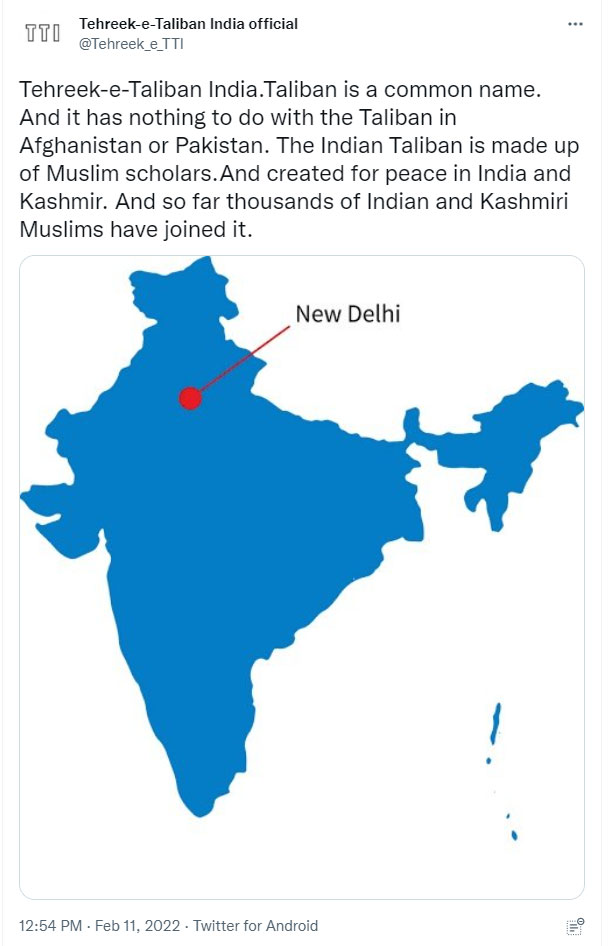
In its tweets, TTI claims that Taliban is a common name and it has nothing to do with Taliban in Afghanistan or Pakistan. It said, “The Indian Taliban is made up of Muslim scholars. And created for peace in India and Kashmir. And so far, thousands of Indian and Kashmiri Muslims have joined it.” It used a distorted map of India with the tweet.
TTI published distorted map of India. Source: Twitter
The government of India approached Twitter for an account ban
The Indian Law Enforcement agencies approached Twitter to ban the Twitter account of Tehreek-e-Taliban India. As a rule, Twitter shared the information with the said account that published a screenshot of the communication. TTI said, “The Indian government has no choice. Without war or peace with Tehreek-e-Taliban India.”
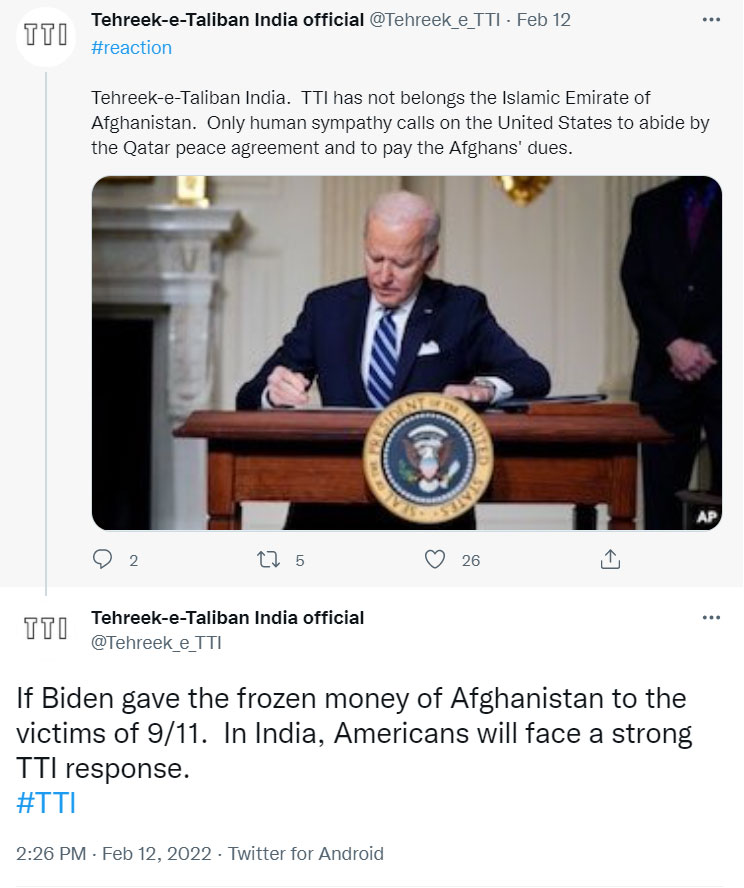
On February 12, TTI alleged if Biden gave Afghanistan’s money to someone else, the Americans living in India would face a strong response from the organization. TTI’s response came after US President Biden announced that America would equally divide $7 Billion of Afghanistan’s aid money to 9/11 victims and humanitarian organizations working in Afghanistan.
TTI threatens Americans living in India. Source: Twitter
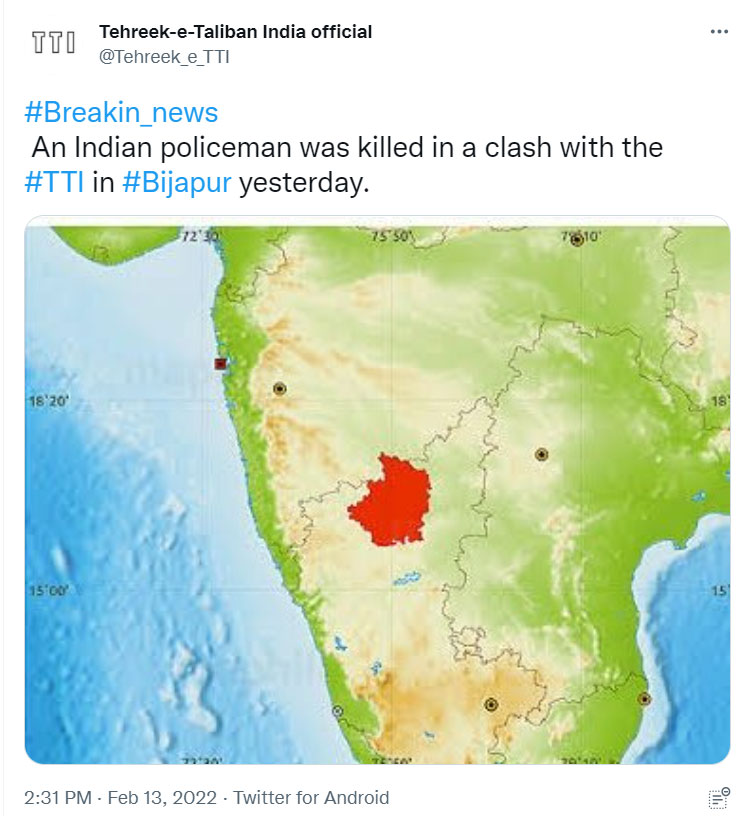
On February 13, TTI claimed to have killed a police officer in Bijapur on Saturday. The location marked on the map was Karnataka. Contrary to the claims, the incident did not take place in Bijapur, Karnataka, but in Bijapur, Chattisgarh, where a CRPF soldier lost his life during an exchange of fire with Naxals.
TTI’s misleading tweet about death of CRPF officer. Source: Twitter
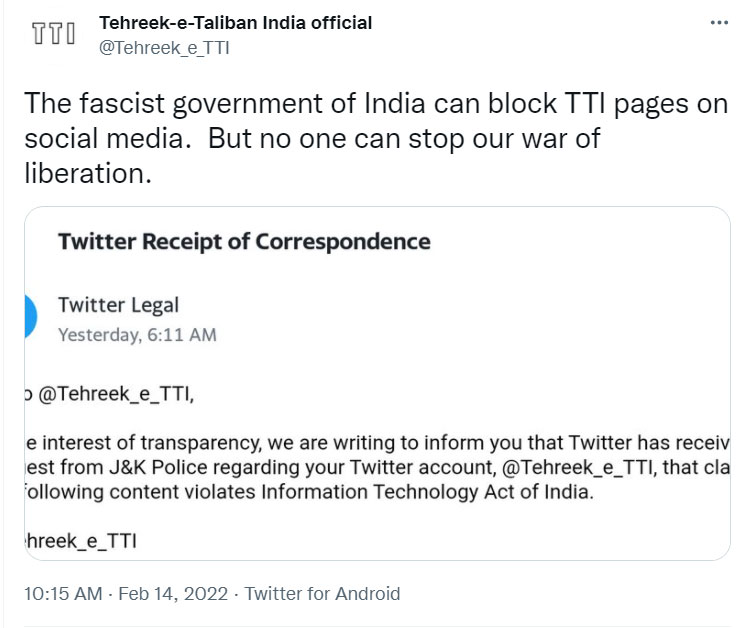
In the latest tweet, TTI called the Indian government fascist and said, “The fascist government of India can block TTI pages on social media. But no one can stop our war of liberation.”
TTI called Indian govt. “fascist”. source: Twitter
The location of the account is set to Delhi, written in Pashto, a language common to Pakistan and Afghanistan.
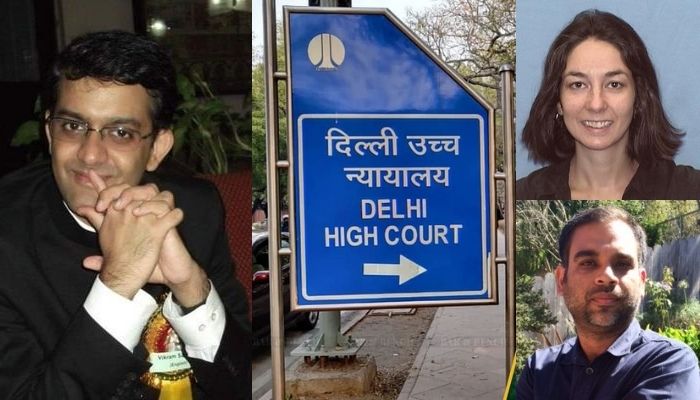
Historian Vikram Sampath has decided to approach the Delhi High Court against controversial author Audrey Truschke and others including social media platform Twitter over defamatory comments and false allegations brought against him on the platform. This came a day after a letter surfaced on Twitter on Sunday, alleging the renowned historian of ‘Plagiarism’ over his speech on Indian revolutionary Veer Savarkar from 2017.
[BREAKING] Indian historian @vikramsampath is approaching the Delhi High Court against historians who wrote to The Royal Historical Society, Twitter Inc, and others for defamatory remarks made against him. Further details awaited. pic.twitter.com/G7xpSQazBa
The letter attempting to accuse Sampath of plagiarism was written by three professors from universities in the US including Ananya Chakravarti, Rohit Chopra and Audrey Truschke. The letter was directed to the Royal Historical Society, UK of which Sampath is a member, in a tone requesting the body to initiate action against him. The case for plagiarism and misattribution has already fallen flat when it was found that Vikram Sampath had already given due citations and credits in all the academic works which he had produced.
Last year, he was elected as a fellow of the Royal Historical Society (@RoyalHistSoc).
This was not the first time when the author and historian was attacked over false allegations over his two-volume work on Swatantryaveer Savarkar. Be it for the continued ranting against him by historians on the left or the trolling faced by the author over his biography of Savarkar, Twitter has not necessitated any action against the trolls and has also refused to take cognizance of the ghastly online attacks.
While it can also be noted that Audrey Truschke and Rohit Chopra are already known for peddling fake news and rabid Hinduphobia on Twitter. Rohit Chopra had to face the brunt of his hate-mongering on Twitter after Delhi-based Think Tank Observer Research Foundation decided to pull down his essays from their website in 2020.
The controversies of Audrey Truschke are well known starting with her glorification of Aurangazeb, the genocidal Mughal tyrant. With her well-known links to Hinduphobic groups, she was one of the primary participants of the ‘DismantlingGlobal Hindutva‘ conference organised in 2021. Apart from her dubious ‘academic’ works, she was also found targeting Hindu students from Rutgers’ University who had flagged her Hindu hatred on the campus.
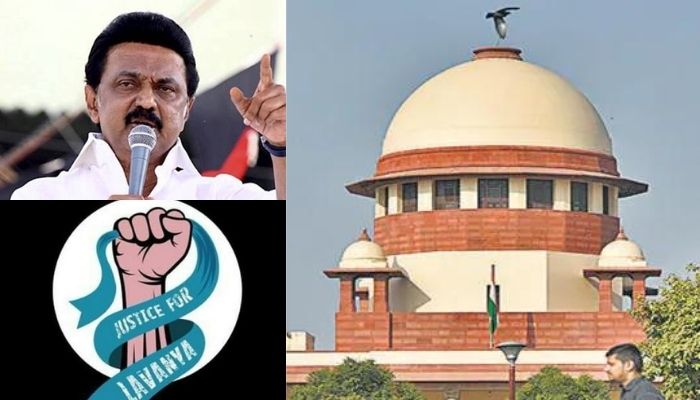
The Supreme Court on Monday refused to interfere in the Madras High Court order directing a CBI probe into the death of a 17-year-old student Lavanya in Thanjavur. While declining the plea of the Tamil Nadu Government challenging the previous Madras HC order, the Supreme Court has requested the government not to make the case a ‘prestige issue’ and hand over all papers to the Central Bureau of Investigation (CBI). Senior advocate Mahesh Jethmalani appeared for the girl’s father.
#CBI probe into #Thanjavur girl suicide case will go on, directs the #Supreme Court as it asks the #TamilNadu Govt not to make it a prestige issue & hand over all papers to the #CBI. The agency needs to also probe the allegations of forced conversion. #LavanyaSuicide
On Monday, The Supreme Court was hearing a plea by the Tamil Nadu Government defended by Advocates Mukul Rohatgi and P. Wilson. The SC Bench asked Rohatgi over which aspect of the HC ruling his party was concerned. The Bench asserted, “On the first aspect of the observations made against state police in Madras HC judgment, we will issue notice but not on the aspect of CBI probe in light of Lavanya’s death.”
Countering this, Rohatgi argued that there is a ‘so-called conversion’ issue that was projected in the case. Advocate P. Wilson on behalf of the state police said that no consent of the state has been kept in mind for the transfer of investigation to the CBI. The Bench arguing that a lot has happened in the case, asked the lawyers not to make it a ‘prestige issue’. Arguing that the government should be happy with the decision on CBI transfer, the Bench replied to Wilson’s request saying, “We are not interfering in the CBI transfer aspect. We have made ourselves satisfied of it”
The case so far
On January 31, 2022, The Madurai Bench of Madras High Court had ordered the transfer of the Lavanya suicide case to the CBI amidst allegations of forced conversion. This came after the victim’s father had filed a petition in the Madras High Court seeking a CBI probe into the matter, alleging that the investigation by state police was not going in the right direction.
The Tamil Nadu government which has been denying the conversion angle right from the start had filed an SLP with the apex court through the DGP challenging validity of the HC decision. The DGP had also challenged the remarks of the Madras High Court against the State Police for their inaction and lack of concerted effort in investigating the angle of conversion that allegedly led to Lavanya’s death by suicide.
On the then ongoing probe by the state police, the Madras HC had observed, “What led the child to suicide has to be investigated. Before the investigation officer, the dying declaration of the child is available. Their authenticity is undoubted. Without doing so, the District Superintendent of Police wanted to completely suppress the conversion angle. The foregoing circumstances cumulatively taken will definitely create an impression that the investigation is not proceeding on the right lines. Since a high-ranking Hon’ble Minister himself has taken a stand, investigation cannot continue with the State Police.”
Lavanya, a 12 standard student, had committed suicide on January 19. In her dying declaration, the young girl had stated that her missionary school had pressurised her to convert to Christianity and she had been subject to harassment for refusing to convert. The state government, media and police had tried to suppress the conversion angle in the case, and had ignored the dying declaration, prompting her family to approach the HC seeking a CBI inquiry.
A 25-year-old Arabic Teacher from Bihar, Shoeb Akhtar was raping a 10-year-old student in the Darul-Uloom madarsa in Shastripuram, Hyderabad. After the incident came to light, the Mailardevapally Police have arrested the accused on February 7, 2021.
It is learnt that the accused Shoeb Akhtar from Bihar has been sodomizing a 10-year-old boy for ten days in the Darul Uloom Madrasa. On February 06, Sunday, after the victim complained to his father of constant back pain, the parents noticed swelling and bleeding injuries on their son’s private parts. Appaled by the circumstances, the victim’s parents along with other locals gathered around the madarsa in protest.
According to the police, The victim’s family had enrolled him in the madarsa after returning from South Africa two months back. The parents have now filed a complaint against Shoeb and the madarsa organisers at the Mailardevapally Police Station. After sending the victim for a medical examination, the Police has arrested Shoeb Akhtar, the Arabic teacher in the school.
Talking about the shocking incident, Inspector K. Narsimha said, “We have arrested Shoeb on a complaint lodged by the victim’s mother. A case of sodomy under section 377 of IPC has been registered against the accused,”
After registering the case, the police is now investigating whether the accused had committed similar crimes against other students. The instances of sodomy, molestation and rape in madrasas have been on an increase over time. Recently on January 27, news came from the Mainpuri district of Uttar Pradesh of the rape of an 8-year-old madarsa student by a 52-year-old cleric making her swear by the Quran not to disclose the incident to anyone. In August last year, a madarsa teacher from Tumakuru, Karnataka was sent to 11 years of imprisonment for sodomising a minor boy in 2015.
The rampant sexual abuse of children inside madarsas is not restricted to the country but goes unchecked in many Islamic countries like Pakistan. Our report exposing the dark side of Islamic religious institutions in Pakistan can be read here.
On February 14, the government of India issued an order to ban another 54 mobile apps linked to China under the emergency provision envisaged in Section 69(A) of the IT Act. As per reports, the Ministry of Home Affairs had sent a request to the Union Ministry of Electronics and Information Technology to block the apps.
The 54 Chinese apps include Beauty Camera: Sweet Selfie HD, Beauty Camera – Selfie Camera, Equalizer & Bass Booster, CamCard for SalesForce Ent, Isoland 2: Ashes of Time Lite, Viva Video Editor, Tencent Xriver, Onmyoji Chess, Onmyoji Arena, AppLock, Dual Space Lite.
Some of the apps that have been included in the list are AliSuppliers and Alibaba Workbench, CamCard — Business Card Reader, Chinese Social, WeDate, TrulyChinese, Isoland 2: Ashes of Time Lite, Viva Video Editor, Beauty Camera: Sweet Selfie HD, Beauty Camera – Selfie Camera, Tencent Xriver, Onmyoji Chess, Onmyoji Arena, AppLock, Dual Space Lite, Equalizer & Bass Booster, and CamCard for SalesForce Ent. The majority of these apps were either cloned versions or had similar functionality, privacy issues and security threats similar to the previously blocked 267 apps in 2020.
In a statement, the IT ministry said these apps allegedly obtain critical permissions and collect sensitive user information that is a threat the security and privacy. It said, “These collected real-time data are being misused and transmitted to servers located in a hostile country. This will enable them to compile huge personal data to mine, collate, analyse and profile by the elements who are hostile to the sovereignty and integrity of India and for activities detrimental to national security.”
The ministry further added there were security concerns associated with these apps that they could carry out surveillance activities and espionage by accessing camera/mic, GPS location and could indulge in malicious network activity. Similar threats were posed by the previously banned apps. The ministry said, “These apps were allegedly engaged in activities prejudicial to the sovereignty and integrity of the country also posing a serious threat to the security of the state and defence of India.”
Apps masked ownership to skip ban
Economic Times quoted an official saying several apps linked to Tencent and Alibaba made changes to hide the ownership. Some of them shifted their host server to countries outside China, such as Hong Kong or Singapore. However, the data was ultimately going to the servers located in China. He added, “Even apps such as ByteDance-owned TikTok and Tencent’s WeChat were available for download through alternative means such as APK files, and the government has taken cognisance of it.”
Google temporarily blocked access to apps
In a statement, Google said, “On receipt of the interim order passed under Section 69A of the IT Act, following established process, we have notified the affected developers and have temporarily blocked access to the apps that remained available on the Play Store in India.”
The govt had banned 267 apps
On June 29, 2020, the central government had announced a ban on 59 Chinese apps, including the very popular short-video app TikTok. Later on August 10, another set of 47 apps was banned that were either related to or clones of the previously banned apps. On September 1, 2020, another 118 apps were blocked, followed by 43 apps on November 19, making it a total of 267 apps. Tiktok and PubG were the most popular apps that were banned by the Government of India for their links to China.
The Karnataka administration has been working hard to enforce the High Court ruling that has barred students from wearing hijab or any religious attire to educational institutions until the matter is resolved as schools till class 10 reopen after a five-day break to alleviate communal tensions over the hijab row.
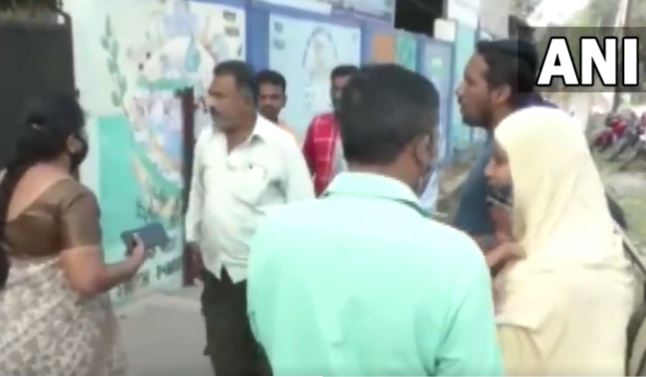
A video has surfaced of a purported altercation between parents and a teacher outside Rotary School in Mandya, in which the parents are seen insisting that their children be allowed inside the school premises with hijabs. Whereas the teacher is seen instructing the students to remove their hijab before entering the school.
A parent insisted: “I am requesting to allow students in the classroom. Hijab can be taken off after that but they’re not allowing entry with hijab.” To this, the teacher explained to the parents how it has been mandated by the High Court that students cannot wear anything religious in nature till the disposal of the case and that the students have to follow the rules to be allowed into the school premises.
#WATCH | K’taka: Argument b/w parents & a teacher outside Rotary School in Mandya as she asked students to take off hijab before entering campus
A parent says,”Requesting to allow students in classroom, hijab can be taken off after that but they’re not allowing entry with hijab” pic.twitter.com/0VS57tpAw0
While schools have reopened in the state, colleges are on holiday till February 16. The police in Udupi and Mangaluru have issued prohibitory orders around colleges for the next six days, until Saturday. From Monday until February 19, Section 144 of the CrPC was enacted in a 200-meter radius around all high schools.
On Monday, the Karnataka High Court will begin hearings on Muslim girls’ petitions to be permitted to attend school wearing hijabs. On Friday, it issued an interim order prohibiting children from wearing religious garb to school in places where uniforms are required.
Speaking on the reopening of schools in the state, the Tehsildar of Udipi was quoted as saying, “Karnataka schools till class 10 re-open today for physical classes, amid hijab row. Students are coming to school, the situation is peaceful, and the district administration is following high court orders”.
Karnataka schools till class 10 re-open today for physical classes, amid hijab row
Students are coming to school, the situation is peaceful, & the district administration is following high court orders: Tehsildar, #Udupi district
While the administration is attempting to calm the state’s law and order situation, which has become increasingly hostile in recent days as a result of the hijab controversy, Congress continues to exploit the issue for self-advantage.
According to reports, Congress legislators have decided to wear black bands on arms to protest the state’s ban on Muslim females wearing hijab in various pre-university colleges in the Udupi district while they attend a joint address to the state legislature by Governor Thawarchand Gehlot.
Meanwhile, on February 11, the Supreme Court had rejected a plea seeking an urgent hearing of the plea challenging the Karnataka High Court’s interim order in the Hijab ban case. Refusing to interfere in the hijab case, SC had stated that the court is hearing it already on an urgent basis and there is no need to spread it to larger levels.
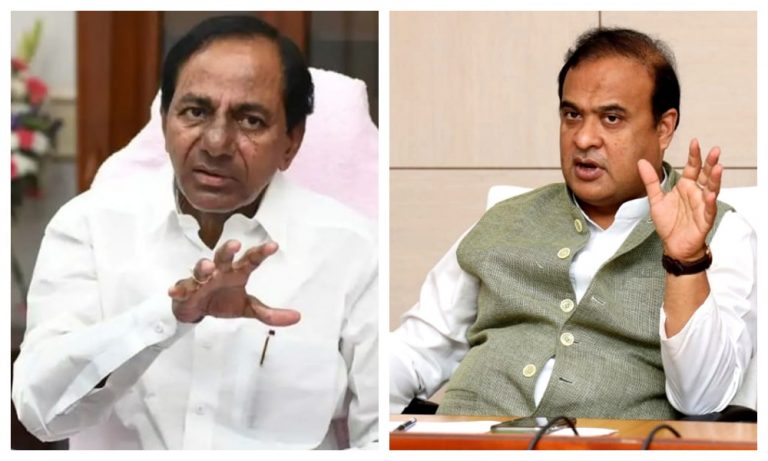
On the eve of third anniversary of the dastardly Pulwama terror attack, Telangana CM K Chandrashekhar Rao questioned the Surgical Strikes done by the Indian Armed Forces that was carried out in Balakot to eliminate the terror camps.
#WATCH Telangana CM K Chandrashekhar Rao questions surgical strike by Indian Army, during a press conference yesterday pic.twitter.com/fyEnfpSjHB
While responding to a question on Assam CM’s statement on KCR not reacting to Rahul Gandhi’s statement casting doubts on the air strikes, he said, “There is nothing wrong with what Mr Rahul Gandhi asking for proof of surgical strike. What was wrong? Even now I am asking. Let the government of India show. It is their responsibility. There are apprehensions amongst people. BJP makes false propaganda. That is why people are asking for proof. In democracy you are not a monarch, not a king.”
Responding to the questions posed by the opposition leaders, Assam CM Himanta Biswa Sarma said “On the anniversary of Pulwama attack, opposition has again insulted our martyrs by questioning the surgical strike. In attempt to prove their loyalty to Gandhi family, they’ve betrayed the Army. My loyalty is with the army. Abuse me all your life, I don’t care.”
On the anniversary of Pulwama attack, opposition has again insulted our martyrs by questioning the surgical strike. In attempt to prove their loyalty to Gandhi family, they've betrayed the Army. My loyalty is with the army. Abuse me all your life, I don’t care: Assam CM HB Sarma pic.twitter.com/Bbpz7JNlIR
On this day three years ago, 40 CRPF jawans were martyred in one of the bloodiest terror attacks on Indian security forces in the country’s history.
On its route from Jammu to Srinagar, a convoy of 70 CRPF trucks carrying 2500 soldiers was attacked by a high-intensity IED bomb. A vehicle carrying explosives slammed into a bus carrying soldiers. It resulted in an explosion, killing 40 CRPF troops from the 76th Battalion on the spot and injuring many more. The news of the deaths of 40 CRPF officers brought the entire country to a halt.
The terrorist organization Jaish-e-Mohammed (JeM), based in Pakistan, claimed responsibility for the attack. They also posted a video of the Islamic terrorist Adil Ahmad Dar, a 22-year-old Kakapora resident who had joined the outfit a year before.
In an official statement, the Ministry of External Affairs (MEA) stated that Pakistan was responsible for assisting terrorist attacks and that JeM founder Maulana Masood Azhar had been “given the freedom to target India.”
Following the attack, the relations between India and Pakistan, which were never that good, began to deteriorate. India did revoke the status of the most favored nation of Pakistan and raised customs duty to 200% on products that were imported from Pakistan.
Alongside that, the central government urged the Financial Action Task Force to put Pakistan on their blacklist as they were explicitly involved in terror-related activities. Days after that terror attack, India did airstrikes on terrorist camps in Balakot which reportedly killed nearly 400 terrorists and destroyed many camps used for training and as launch pads for terrorists.
Soon after the airstrikes, several opposition leaders asked for proof of the strikes. Leaders like Rahul Gandhi, Arvind Kejriwal, Mamata Banerjee, and Akhilesh Yadav sought proof from the government.
Never forgive, never forget
Remembering the martyrs in the attack, several leaders including Prime Minister Modi paid homage to the soldiers who lost their lives in the attack. “I pay homage to all those martyred in Pulwama on this day in 2019 and recall their outstanding service to our nation. Their bravery and supreme sacrifice motivates every Indian to work towards a strong and prosperous country.” PM Modi wrote on Twitter.
I pay homage to all those martyred in Pulwama on this day in 2019 and recall their outstanding service to our nation. Their bravery and supreme sacrifice motivates every Indian to work towards a strong and prosperous country.
Indian armed forces also paid their tributes to the martyrs.
General MM Naravane #COAS and All Ranks of #IndianArmy pay homage to the brave jawans of Central Reserve Police Force who laid down their lives in the Line of Duty during a Terrorist attack in #Pulwama on 14 February 2019.#IndianArmypic.twitter.com/55zkgBLzUM
We salute our brothers who laid down their lives at the altar of duty at Pulwama, this day in 2019. We will forever remain indebted to their families. pic.twitter.com/wRg428lbXV
J&K Lieutenant Governor took to Twitter and wrote “The nation will forever be grateful to our brave soldiers of @crpfindia and their families. We are firmly resolved to eliminate menace of terrorism.”
Humble tributes to the brave martyrs of 2019 Pulwama terror attack. The nation will forever be grateful to our brave soldiers of @crpfindia and their families. We are firmly resolved to eliminate menace of terrorism.
Back in 2019, too, many politicians, including Delhi CM Arvind Kejriwal and others had questioned the Balakot Air Strikes and cast aspersions on the Indian Armed Forces.
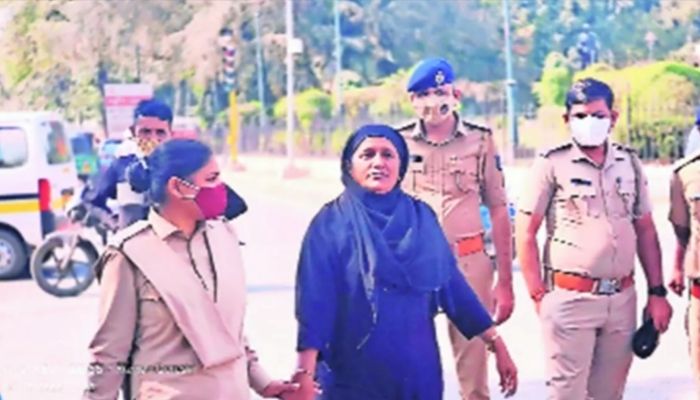
On Saturday (February 12), the police detained 9 members of All India Majlis-E-Ittehadul Muslimeen (AIMIM) in Surat in Gujarat for organising a ‘rally’, without permission, in support of ‘Hijab in schools’ of Karnataka.
As per reports, the Surat police arrested AIMIM Women wing president (Surat unit) Najma Pathan, city unit chief Wasim Qureshi, and 7 others in connection to the Hijab Solidarity march. Although Najma Pathan had sought police permission to conduct the rally in the Athwalines area of Surat, she was denied permission by the cops.
However, on Saturday, a social media post had gone viral that urged AIMIM members and supporters to congregate near the Gandhi statue in Surat. Despite no permission, Pathan and her supporters initiated the protest march from the Mughlisara area to the Gandhi Statue in Chowk Bazar area. She was eventually detained along with Wasim Qureshi. The others were detained near IP Mission school.
While speaking about the matter, Joint Police Commissioner (Surat) Sharad Singhal informed, “We had denied permission to take out the rally keeping in mind the law and order situation. The detainees were released from the police station in the evening.”
The Ahmedabad unit of AIMIM had called for a signature campaign on February 12. Astodia Darwaja was declared as the venue of the protest. However, even before the event could kickstart, the police arrested AIMIM Gujarat general Secretary Shamshad Pathan from his home.
Reportedly, 288 AIMIM members were detained by the police in Ahmedabad. In his defence, Pathan claimed, “Our Constitution gives every individual the freedom to wear clothes of their choice.” The AIMIM Gujarat General Secretary said that 100 party workers were arrested in Khadia. He added that AIMIM workers were also held up in Gomtipur, Danilimda, Rakhial, and Bapunagar.
@aimim_national Leaders & workers are being captured & taken to different police stations of Ahmedabad city, according to the information so far, more than 200 leaders, activists have been arrested/detained by the police in an unconstitutional manner.Adv Shamshad Pathan pic.twitter.com/kDkHYRNZHc
According to AIMIM Surat vice-president Sohel Wadiwala, the party leaders were detained by cops while they were on their way to inform people about cancellation of rally. “We had posted in different social media groups that the rally was cancelled. However, those who did not read it started assembling near the IP Mission School for the rally. Our leaders Wasim Qureshi and Najma Pathan were on their way to IP Mission School to intimate people about the cancellation of the rally when the police detained them mid-way,” he said.
It must be mentioned that AIMIM had made inroads in Gujarat by winning 7 seats in the Godhra Municipality Council. After joining hands with 17 Independent candidates, the party was able to snatch power from BJP in the municipality. The Vidhan Sabha polls in the Western State is scheduled to take place in December this year.
Recently, AIMIM chief Asaduddin Owaisi had claimed that a girl wearing Hijab will rise up to become the Prime minister of India one day. He was speaking at a public rally, an excerpt of which has been shared by him on his official Twitter account. AIMIM is also contesting elections in the poll-bound Uttar Pradesh and has made the ongoing Hijab row, a central point in his election campaign.
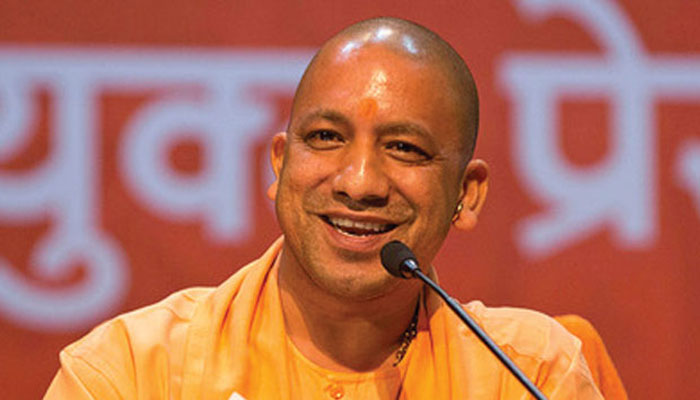
On February 14, during an interview with news agency ANI, Uttar Pradesh Chief Minister Yogi Adityanath gave a warning to those dreaming of ‘ghazwa-e-hind’.
He said, “I want to tell those who are dreaming of ghazwa-e-hind. This is new India. It is under the leadership of the world’s most popular leader Modi Ji. In this new India, development is for all but appeasement is for none. India will run as per the constitution and not shariyat. The dream of ghazwa-e-hind will never be realized.”
#WATCH| “For those dreaming of Ghazwa-e-Hind,this is New India under leadership of PM Modi. New India is for development of all, but appeasement of none. It’ll run as per Constitution not Shariat. Ghazwa-e-Hind’ ka sapna Qayamat ke din tak sakar nahi hoga,”says UP CM on his tweet pic.twitter.com/jwLZJVDpcD
When asked about the hijab row, he said, “I firmly believe India runs as per the constitution and personal belief and rights of anyone cannot be imposed on the country. Can I ask all employees of UP to start wearing the bhagwa? The dress code has to be followed in the schools. One day they will ask for the same in the Police force of the Army. Will that work? There will be no discipline. Personal belief is one thing, but when we talk about an institution, we have to follow the rules and regulations. The country’s system will function according to the constitution.”
The system should run as per the Constitution. We can’t impose our personal religious beliefs & choices on the country & its institutions. Can I ask all employees in UP to wear ‘bhagwa’? Dress code must be enforced in schools: UP CM Yogi Adityanath on #HijabRowpic.twitter.com/yBwNLU05tX
Speaking on AIMIM chief Asassudin Owaisi’s statement about a hijab-clad woman becoming Prime Minister in the future, CM Yogi said the BJP government brought law against Triple Talaq to liberate the same daughters he was talking about. The government is working to provide justice and self-reliance for Muslim women. “When we say the country will function according to the constitution and not Shariyat, it is for the wellbeing of the same daughter.”
#WATCH | PM has scrapped triple talaq to free that daughter, to give her rights&respect she’s entitled to. To ensure respect to that daughter we say system won’t be run as per Shariat but Constitution: UP CM on AIMIM chief Owaisi’s ‘hijab-clad woman will become PM one day’ remark pic.twitter.com/zpF6bqtH1x
CM Yogi was questioned over his statement where he had said the elections would be about 80-20. A number of media houses had presented his statement as if he was talking about Hindu vs Muslim voters in the state. He said, “When I talked about 80-20, it was not about the religion, caste etc. I was saying 80 per cent of people would vote for BJP, and 20 would vote against BJP. Eighty per cent are those who are happy with the government programs. These are the people who like development. These are the people who like transparency. On the other hand, 20 per cent are those who have negative thinking. They support criminals. They will vote for the other side.”
It’s a reaction to action. I said 80% people are with BJP & 20% always oppose us & will do so this time too. I didn’t say it the context of religion or caste. 80% includes those who are happy with Govt’s agenda of security & development: UP CM on his ’80 vs 20′ remark (1/2) pic.twitter.com/uMVVetyAKU
Targeting Akhilesh Yadav-led SP government, CM Yogi said when Yadav’s government came to power in 2012, the first thing they did was to withdraw court cases against those criminals and terrorists who had initiated attacks on Ayodhya, Gorakhpur, CRPF camp in Rampur and courts in Varanasi, Ayodhya and Lucknow. “I would like to thank Allahabad High Court that stopped them from withdrawing the cases,” he said.
CM Yogi further added when his government came into power, they took three decisions in one day that were the formation of the anti-Romeo squad, loan waiver of 86 lakh farmers worth 36,000 crores and closure of illegal slaughterhouses.
CM Yogi listed how the BJP govt worked for the development
CM Yogi stated that to ensure the safety of women, the number of women officers in police stations have been increased three times in the last five years. To provide a banking facility to every panchayat, Banking Correspondent Sakhi has been appointed. The government has connected over one crore women, to ‘Swamsevi Sanstha’ and provided them funds and jobs. “This is why women are voting for BJP irrespective of caste and religion,” he said.
Speaking about law and order, CM Yogi said there was a time when the state would witness a riot every 3-4 days. Since BJP came to power, no riots have taken place. During previous regimes, curfews were common, but curfew has not been imposed in the state since BJP came to power.
Every person who is a threat to public safety should fear the law. Before 2017, there were riots every 3-4 days, with curfew being in force for months. On the contrary, no riots & curfew took place in the last 5 years: UP CM Yogi Adityanath on Opposition’s ‘thoko raaj’ allegation pic.twitter.com/xpbZxt3Wy7
Comparing how BJP worked for the betterment of the state compared to previous governments, CM Yogi said his government had established 35 new medical colleges compared to 12 medical colleges in the past 70 years. 17 of the new medical colleges have already started functioning. The state is moving ahead towards ‘one medical college for every constituency’. He further added the state built only one expressway in the past 70 years, but his government is working on seven expressways.
CM Yogi said, the Akhilesh-led govt had only sanctioned 18,000 houses under the centre’s scheme but did not build any houses. On the other hand, his government has provided 33.5 lakh houses to the poor. Twenty-five lakh people have got land rights in rural areas. Over 2.6 crore toilets have been built. The BJP government has provided over 1.43 crore electricity connections, 1.56 crore gas connections and nine crore people have got medical cover worth 5 lakh per annum, CM Yogi stated.
‘People rejected those who were against vaccine’
Speaking about the vaccine program and Covid management in the state, CM Yogi said the people of Uttar Pradesh rejected those who were spreading misinformation about the vaccine. He said, “100% of the eligible population has received at least one dose of vaccine, and 75% has been fully vaccinated. The state is providing free tests, free treatment and free vaccines. People of UP have rejected those who were against the vaccine by taking the vaccine shot.”
CM Yogi categorically denied the involvement of BJP when he was questioned about the allegations of misusing investigating agencies against opposition during elections. He said, “There is a case against Akhlesh Ji of disproportionate assets. Did this happen during the BJP government? In 2013, BJP was not in power at the Centre or state. There are more cases against him. Was this because of BJP?”
While talking about the income tax raids at SP MLC in December 2021, he said all the money that was supposed to be used for the welfare of the people of UP was going abroad via the associates of Akhilesh Yadav.
He said, “Isn’t it true that this money of the poor, meant for development, was going to his ‘ittar-wale mitra’. Now when ED had found out that his money was going to his ‘ittar-wale mitra’ and today, when investigating agencies had made full-proof arrangements, that ‘ittar-wale mitra’ were eating away the resources like termite when poor were dying of hunger and farmers were committing suicide. It is the agency’s task to submit ill-gotten wealth to the state treasury and investigate it. It has been continuously happening and is a long task.” He added the raids by the central agencies is a continuous process, and it has nothing to do with elections.
Congress doesn’t need outside forces to sink it, Rahul and Priyanka are enough to destroy the party
When asked about targeting Gandhi brother-sister duo, he said they are enough to drown the party. CM Yogi said, “I went to Uttarakhand and had delivered a speech. Uttarakhand is a border state, and it also borders UP. Uttarakhand is important in its own right. Ganga and Yamuna’s water comes from Uttarakhand to enrich our fields, and Army personnel stand at the border to protect the country. UP and Uttarakhand are joined together. Where are the differences between the two? But security is important. To drown Congress, no one else is needed. Brother and sister duo are there. Why do you want to make Congress a burden there; I only appealed to people.”
#WATCH | “The siblings (Rahul Gandhi and Priyanka Gandhi Vadra) are enough to ruin the Congress. No one else is needed for that,” says Uttar Pradesh Chief Minister Yogi Adityanath pic.twitter.com/Oo9GiatNa3
CM Yogi took a dig at BSP-SP and said during their tenure, they indulged in corrupt practices and emptied state treasuries. He added BSP leader Mayawati had pointed fingers at Gorakhpur Math. “He said, “I repeat myself, that the double dose ration that is being given to the poor used to be eaten away by mafias of the SP. Benji’s elephant (election symbol of the BSP) is so huge that things fall short for it.”
#WATCH | “…I say this again and again. The ration being received by the poor today used to be consumed by the goons of SP earlier and the ‘elephant’ of Behenji (BSP chief Mayawati) has such a large stomach that everything is less for it,” says UP CM Yogi Adityanath. pic.twitter.com/pq5hIUIR9F
The first phase of Assembly elections took place on February 10. The second phase of polls happened on February 14. The remaining five phases will be over by March 10. The results of Assembly polls in UP and the other four states will be announced on March 10.