Home Blog Page 3533

Raebareli: Aditi Singh formally resigns as MLA and quits Congress membership, had already joined BJP in November

Former Member of Legislative assembly from Raebareli and rebel Congress leader Aditi Singh has tendered an official resignation of her post as an MLA and as a member of Indian National Congress on Thursday. Aditi Singh, known for her open criticism of Priyanka Gandhi Vadra while being a Congress member herself, had earlier joined the Bhartiya Janta Party in November last year.

The 34-year-old BJP leader, as a then Congress MLA was famous for her criticism of Priyanka Gandhi Vadra and the party leadership and had often praised the current dispensation over policy issues. The news came after she posted her resignations on Twitter. A letter directed to Sonia Gandhi read, “I am writing this to inform you that I am resigning from the primary membership of the INC.” In another letter to the Speaker of Uttar Pradesh Vidhan Sabha, Aditi Singh while resigning as an MLA, writes, ” I am resigning before the house from my position on January 19, 2021.”

It is notable here that Aditi Singh was expected to be the BJP candidate from Raebareilly after she joined the party in November last year.

Aditi Singh is the daughter of Late Akhilesh Singh who was a five-time MLA from the Congress. During her tenure, she was a vocal critic of her party colleagues and took frequent stances over supporting the BJP. For her critique of Priyanka Gandhi falsely claiming of arranging 1,000 buses for migrants stranded in parts of Uttar Pradesh in the Covid-19 lockdown, she was suspended from the party’s women’s wing in May 2020. After her open support for the abrogation of Article 370, the congress party had sought her disqualification as an MLA. However, the request was rejected by the Speaker.

Marital rape debate: Case right now, arguments for criminalisation, and 5 arguments that need to be considered before legislating

A High Court bench is hearing a batch of petitions that argues against the ‘marital rape’ exception in the Indian Penal Code. The discussion has put a spotlight on the issue of marital rape, especially the arguments for and against the criminalisation of marital rape. Rahul Gandhi recently tweeted his comments on the issue, saying ‘consent, as a concept, is underrated’. Supporting the criminalisation of marital rape, Rahul Gandhi said that to ensure the safety of women, consent has to be “foregrounded”.

While Rahul Gandhi has taken to Twitter to support the criminalisation of marital rape, in 2013, when the Congress government was in power, the recommendation of the JS Verma panel was summarily rejected by the Manmohan Singh government. The Justice Verma commission had suggested that marital rape should be made an offence.

In 2013, the Congress government had said that criminalising marital rape would weaken traditional family values in India, and that marriage presumes consent. They had also argued that the burden of proof would almost be impossible to meet in the case of marital rape.

The BJP government, on the other hand, has told the High Court that marital rape cannot be criminalised until talks with all stakeholders end. The Modi government has said that the talks with stakeholders would lead to comprehensive amendments and not piecemeal changes. It further said that even the petitioners can give suggestions to the committee overseeing the talks and those suggestions would be considered.

The affidavit, filed on Thursday, stated that the exception to Section 375 of the Indian Penal Code, which exempts forceful sexual intercourse by a man with his own wife from the offence of rape, cannot be struck down at the instance of the petitioner alone. “Principles of natural justice require a larger hearing of all stakeholders,” emphasised the government.

The Delhi government too opposed the criminalisation of marital rape saying that the court cannot create new laws and that the criminalisation of marital rape would be bad in law, saying that the woman has several other legal provisions that she can take the help of if she is being abused in marriage.

Overall, every government has been circumspect in the issue of criminalisation of marital rape. The issue is a nuanced one and not as cut and dry and “activists” want the society to believe.

What is the background

For the better part of the last century, the concept of marital rape has been missing in narratives of most nations. Some commentators in India try to pin the blame for the lack of marital rape law in India on the usual “Indian regressive culture”, however most nations criminalized Martial Rape only after the UN’s “Declaration on the Elimination of Violence Against Women” in 1993.

It was actually Sir Matthew Hale, Chief Justice of England, who in his book ‘History of the Pleas of the Crown (1736)’ proclaimed – “But the husband cannot be guilty of a rape committed by himself upon his lawful wife, for by their mutual matrimonial consent and contract the wife hath given up herself in this kind unto her husband which she cannot retract” – thus negating the concept of marital rape altogether. Perhaps he was directly borrowing from traditional Catholic preaching that doesn’t accept this concept. His thoughts on the subject continued to form the basis of English law till 1993.

India, having borrowed heavily form British Era laws, of course, also inherits the flaws; one of them being the case of Marital Rape law.

What do the current laws say?

Section 375 of the IPC deals with rape and it criminalizes the act, but it makes an “exception”. The exception says “Sexual intercourse by a man with his own wife, the wife not being under fifteen years of age, is not rape.”

You might wonder why the law says the wife being under 15 years of age, while the legal age of marriage is 18 years. It is because, under the Muslim personal law, a woman can marry when she reaches 15 years of age.

However, on December 15, the Union Cabinet approved a proposal to raise the legal age of marriage of women from 18 years to 21 years. The government had then clarified to OpIndia that the change in marital age would be extended to all personal laws, including Muslims and Christian personal laws. In that case, logic would be extended to the Section 375 exception as well. Once that happens, this law also would logically say, “Sexual intercourse by a man with his own wife, the wife not being under twenty-one years of age, is not rape.”

This exception in the IPC section 375 is the reason why the alleged instances of marital rape are not treated as criminal cases.

What are the arguments that the Modi government made in the court

The Modi government has said that there is a need to overhaul the IPC instead of making piecemeal changes to criminalise marital rape. Reportedly, it relied on parliamentary standing committee reports in 2008 and 2010 to make this argument.

The government also cited the 172nd report of the Law Commission of India on “Review of Rape Laws” in March 2000 that said it would not recommend the deletion of the exception clause in Section 375 “since that may amount to excessive interference with the marital relationship”.

The affidavit by the government, however, does not refer to the JS Verma recommendations of 2013 that the Congress government too rejected in terms of criminalisation of marital rape.

What are the arguments being made to criminalise marital rape

Many argue that such issues related to married couples are covered in the “Protection of Women from Domestic Violence Act 2005” and thus there is no need for a special law to cover marital rapes or to delete that exception part in the IPC section 375.

The Domestic Violence Act can be argued to cover the offense of marital rape because “sexual abuse” is defined as one of the act or conducts that constitutes “domestic violence”.

However, there are two problems with this act, due to which it is considered inadequate to deal with cases of marital rapes:

1. While the term “sexual abuse” is mentioned, the act doesn’t explicitly define “rape” as is defined in the section 375 of the IPC.

2. The Domestic Violence act has been deemed as a “civil law” by the courts and thus the accused can get away without any jail term.

Therefore, there is certainly a void where husbands who rape their wives can get away with it without any jail term. As the Delhi government responded, divorce as an option is certainly available to women, however, it is not nearly adequate when the issue of rape is concerned. Further, a civil law by definition falls short and cannot deal adequately with a heinous issue like rape, even within marriage. The current law has no provision if a woman wants to file a criminal case against her husband if she is being raped by her husband.

The basic assumptions that the exception of marital rape are based on are as follows:

1. It is an assumption that when a couple gets married, the woman gives consent in perpetuity to her husband. The assumption also is that the woman cannot simply retract the consent that she gave her husband at the time or marriage. As explained earlier, this concept was based on colonial-era laws that to a large extent, our laws are based on, thereby importing the flaws of the colonial age as well.

2. The other logic is that there is a reasonable expectation of sex in a marriage and therefore, the wife is obligated to fulfil that expectation of the husband. While intercourse is an important part of marriage and both parties cannot withhold it from their partners, the assumption that there is consent in perpetuity and therefore, the woman can even be forced to have intercourse makes this assumption problematic for those women who are in an abusive marriage where rape is a tool of torture used by the husband.

What are the arguments for not criminalising marital rape or the pitfalls that the law needs to take care of

There are several legitimate concerns that have been voiced that are yet to be answered fully by the activists rallying for the criminalisation of marital rape.

Misuse of the law

Misuse of the law is a big reason why several individuals, jurists and even men’s rights activists have raised alarm over the criminalisation of marital rape. The statistics cited to argue against the criminalisation of marital rape are those of the misuse of 498A, the law that relates to dowry cases. According to some activists, as huge as 85% of dowry cases turn out to be false and India cannot deal with another failed catastrophic law that will amount to “legal terrorism”. Many men’s rights activists are especially wary of criminalizing marital rape, as they feel that it will be misused even more than the anti-dowry law.

Deepika Narayan, a men’s right activist, wrote an article in 2020 citing the misuse of 498A. She wrote:

A total of 111,549 cases were registered under 498A in 2020. Of these, 5,520 were closed by Police citing as false and overall 16151 cases were closed by police either because they were false or there was a mistake of fact or law or it was a civil dispute etc. That is 14.4% of cases were closed by police for not finding merit in the case. 96,497 men, 23,809 women were arrested under 498A last year making total arrests under this section 120,306.

18,967 cases were tried in courts of which 14,340 led to acquittal and 3,425 led to a conviction. 498A cases pending trial at the end of 2020 are 651,404 with a pendency percentage of 96.2%.

There are several cases where the husbands have even committed suicide after being accused in 498A cases where they have said that it was only after the relationship went south when false allegations were hurled, leading to the judicial harassment of the family. The argument is that if marital rape is criminalised, it would be another law that disgruntled wives can use falsely. While this does not dismiss the fact that marital rape does happen and there are real victims out there, the argument is that this law would be used against innocent men far more than being used to get justice for real victims.

2. Burden of proof

The burden of proof is a hugely complex issue that has prevented marital rape to be criminalised. In the case of marital rape, one has to consider that intercourse is a part of any marriage. Now, if marital rape itself is criminalised, the question remains who would the burden of proof be on and what would that burden be. For example, if the burden is on the woman, then the argument remains that mere allegations, like in the case of dowry violence, can ruin the lives of not just the husband but the entire family. If the burden of proof is on the husband, then the fact remains that the husband would have to prove a negative, which is in itself, a problematic concept.

Many have argued that once a woman alleges that she has been raped in a marriage, there would hardly be any evidence, like CCTV footage etc, to prove that the woman has or has not been raped and therefore, the burden of proof would be a difficult concept to apply in these cases.

3. The breakdown of the institution of marriage

In a 2010 paper (‘Rape Within Marriage in India: Revisited’), Prof (Dr) K I Vibhute observed that the “preservation of the institution of the family” is what mainly allows the provision to gain legitimacy. “… the preservation of the family institution by ruling out the possibility of false, fabricated and motivated complaints of ‘rape’ by ‘wife’ against her ‘husband’ and the pragmatic procedural difficulties that might arise in such a legal proceeding”.

Therefore, one of the main arguments to not criminalise marital rape is that it would lead to the breakdown of the institution of marriage with wives falsely accusing husbands. The argument also extends to both parties in a relationship trying to be “legally careful” in the normal course of marriage should such allegations come up.

5. Gender neutrality

Arguments to make the definition of ‘rape’ gender-neutral has been put forward on many occasions, and the same argument is put forward in the case of marital rapes too. Even if the exception of IPC section 375 is removed or criminal provisions are added to the Domestic Violence act, husbands will not be able to use those, many argue.

Some of the above issues could have easy solutions and some could indeed be complex e.g. perhaps, in the absence of clear proof of rape, the law can give one benefit of the doubt to a husband who has never been previously reported for any cases of violence or abuse to not turn a rapist suddenly.

However, it’s imperative that the above issues are also discussed when marital rape is discussed.

So what is the way forward?

Much like every other civilized nation that swallowed the bitter pill, India too will have to criminalize marital rape. The House of Lords in 1991 overturned the exception to marital rape and several other countries like Australia, South Africa etc have done it too.

So the question really is of “when” and “how” and in “what form”. The way forward is to hold more public consultation, get more hard data and create a roadmap for the criminalisation of marital rape.

The solution is not to sweep it under the carpet but to wake up to the fact that the concept of marital rape in itself is not totally outlandish. Unfortunately, the current attempts by the political class – as is evident by the acts of both the UPA and NDA governments – appear to be ignoring the issue rather than taking it heads on.

Tamil Nadu: 12th standard girl ends life after missionary school allegedly pressurised her to convert to Christianity to continue her study

M Lavanya, a student of standard 12th in Sacred Heart Higher Secondary School, Thirukattupali in Thanjavur, Tamilnadu, killed herself after she was allegedly tortured by her school authorities for refusing to convert to Christianity. Reportedly, the school had said that she must convert to Christianity if she wishes to continue her studies in the school.

Lavanya has been living at the St. Michael’s Girls Hostel near her school for the past five years, and the govt-aided Christian missionary school had been pressuring her to convert to Christianity. However, Lavanya was adamant about not leaving her religion and refused to get converted. Angered by Lavanya’s resistance, the school administration cancelled her leave application for Pongal Celebrations. Lavanya who was supposed to visit home during her holidays was forced to do chores like cleaning toilets of the school, cooking and washing dishes. It is reported that dejected Lavanya consumed pesticides used in the school garden to end her life.

Lavanya showed signs of discomfiture on the night of January 9, where she was taken to a local clinic after continuously vomiting. The warden of the hostel called her parents and asked them to take her home. Lavanya was then admitted to Tanjore Government Medical college hospital. She was being treated in the ICU with almost 85% of her lungs intoxicated. It is being reported that Lavanya breathed her last on January 19, battling her condition in the hospital.

A video of Lavanya’s call for help was published on social media where she was seen in an unconscious situation talking about her torture. The video, originally in Tamil (translated by The Commune) says, “My name is Lavanya. They (school) had asked my parents in my presence if they can convert me to Christianity and help her for further studies. Since I didn’t accept, they kept scolding me.” She also named one Rachael Mary who had allegedly tortured her.

Lavanya’s relatives gathered in front of the Thirukattupalli police station on January 17 and protested demanding action against the school. They alleged that Lavanya had consumed pesticides as the hostel warden Sagayamary had forced her to convert.

Taking cognizance of the incident, Hindu organisations like Vishwa Hindu Parishad, Hindu Munnani and political outfit Indu Makkal Katchi have raised voices for demanding justice to Lavanya and against the predatory proselytization of Hindus. VHP State Spokesperson Arumuga Kani said, “The Vishwa Hindu Parishad will not rest until justice is given to Lavanya. As a first step, VHP is to hold a hunger strike today (19th January) under the leadership of Thanjavur district secretary Muthuvel. We need to ensure that such incidents don’t happen again. Until then, we will protest.”

Founder of Indu Makkal Katchi, Arjun Sampath took on Twitter to announce the death of Lavanya and has raised serious questions about the school administration.

The cases of deaths over targetted conversions of Hindus are rampant while the mainstream media refuses to cover them. A similar incident happened in Tripura in 2019 when a 15-year-old student died after being brutally tortured by a hostel warden for opposing forceful conversion to Christianity. Also, In in Tamil Nadu, an activist was brutally murdered after he attempted to stop the forceful conversion of Hindus by Muslim outfits.

Actor Naseeruddin Shah’s brother Zameer Uddin Shah attacked by Islamists for suggesting dialogue between Hindus and Muslims for peace

Actor Naseeruddin Shah’s ex-army man brother, Zameer Uddin Shah has come under the attack of Islamists for suggesting a dialogue between Hindus and Muslims as the only solution to foster amity between the two communities.

A Twitter user named Muslim Spaces was the first to criticise the veteran actor’s brother, sharing an article he wrote for The Indian Express in August last year, titled: “Why Mohan Bhagat’s appeal for Hindu-Muslim communication is a step in the right path.”

Soon many Islamists followed suit. They chastised the ex-army personnel, claiming that his “monkey balancing” attempt would only get him so far.

In the article, Zameer Uddin Shah had weighed in on RSS chief Mohan Bhagat’s address at the Mewar Institute in Ghaziabad on July 4 during the Muslim Rashtriya Manch’s launch of Khwaja Iftikhar Ahmed’s book, The Meeting of Minds – A Bridging Initiative. While analysing Bhagat’s speech, he had stated how he, too, is a supporter of Hindu-Muslim dialogue to promote peace between the two communities.

The Indian Express article by Zameer Uddin Shah

This old article by Zameer Uddin Shah did not go down well with several Islamists on Twitter, who brought up the year-old article to attack a respected member of their own community. Probably, talking about peace and reforms within the religion is not being a true Islamist for the Islamists.

Replying to Muslim Spaces, Zameer Uddin Shah Tweeted on Wednesday: “I firmly believe that only continuous dialogue between Hindus and Muslims is the key to amity and progress . There are unfortunately, hard liners on both sides, but more encouraging is the growing tribe of sensible people who abhor bigotry.”

In response to Zameer Uddin Shah’s Tweet, Muslim spaces shared a screenshot of another article of that of the ex-army man published on October 11, 2019, wherein Shah, who is also the former AMU Vice-Chancellor opined that the “Muslims should handover the Ayodhya land to the Hindus for lasting peace.”

Zameer Uddin Shah again took to Twitter to justify his stance. He wrote: “I had good reasons for saying so. I was aware that Judges seldom go against public opinion and was sure what the Ayodhya verdict would be. We would not have regained the mosque but not have been losers. We have,now, not only lost the case but are all round losers.”

Islamists take offence against suggestions made by Naseeruddin Shah’s brother, asks him to stop ‘monkey balancing’

Since yesterday, Zameer Uddin Shah has been responding to many such radical Islamists, who in their long-established, deep-seated hate for Hindus, have taken serious offence to his suggestions.

Interestingly, the radical Islamists who are today in conjunction bad-mouthing Naseeruddin Shah’s brother for suggesting something that goes against their extremist ideology had not said a word when he had blatantly lied about the 2002 Godhra riots in Gujarat to rebuke the then Gujarat government, led by Narendra Modi.

Charges by Zameer Uddin Shah on delayed Army deployment during 2002 Gujarat riots don’t hold water

On October 6, 2018, some excerpts from Lt. General (Retd.) Zameer Uddin Shah’s upcoming book “The Sarkari Mussalman” was published, claiming that when riots erupted in Gujarat in February 2002, following the carnage of the Sabarmati Express train, in which pilgrims returning from Ayodhya were burned alive, the Gujarat government, led by Narendra Modi, failed to provide immediate transport to the Army, which delayed Army deployment in the riot-affected state.

He claimed that had the Modi government would have provided necessary logistical support, the damage and loss to life would have been contained.

Following the publication of this news, it was widely shared by people over social media. The truth, however, seemed far from these claims. OpIndia had then reported how Lt. General (Retd.)’s claims were absolutely baseless and unwarranted.

‘Feel safe only under BJP govt’: Hindu exodus victims in Kairana say they will leave again if SP comes back to power in UP

Ahead of the Uttar Pradesh Assembly Elections 2022, Hindus from Kairana, which has been the nest to the communal violence, have said that they will shut their businesses, pack their bags and leave Uttar Pradesh if BJP does not come back to power.

Varun Singhal, whose brother was shot dead by Mohammad Fukran in public amidst the exodus of Hindu families, said that they do not trust any other government and were ready to move out of Kairana again.

As actions shift to Kairana in the first phase of elections scheduled on February 10, a crucial ground report by the New Indian has revealed the true fear of the Hindu families who returned to Kairana after the mass migration during the period of 2014-16. Singhal, recalling the brutal crime against Hindus says that many Hindu families, before 2017 were forced to leave Kairana because of several incidences of extortion and murders.

“Atmosphere at the time was very tense and no trader felt secure. Shops used to shut early in the evening at around 6 pm those days. There was fear among the trader community”, he was quoted by the New Indian. Another person Sajan Kumar agreed and said that situation in Uttar Pradesh can never be as dangerous as it was before the BJP government came to power.

According to the report, Kairana local traders feel safe and secure under the BJP regime and do not want gangsters to overpower again at any cost. Before 2017, the traders say ‘murders and extortion used to happen every now and then. The Samajwadi Party used to support the gangsters to create fear in the minds of Hindu traders. Many of Hindus were killed for raising their voices against the murderers’.

Security of Hindus was reassured only after the Yogi Adityanath government came to power, adds trader Vijay Mittal. Reports mention that the BJP government has set up a permanent unit of UP Police’s Pradeshik Armed Constabulary (PAC) at Kairana’s Chowk Bazar, especially for the safety of Hindu traders and their families.

This report comes after the accused mastermind of the Hindu exodus, Samajwadi Party’s Nahid Hasan was arrested on January 15 under the Gangsters Act. Last week, Akhilesh Yadav had announced Hasan’s name for the Kairana seat but his sister Iqra Hasan has stepped up for the campaign as the Court rejected his bail yesterday. It is worth noting that Hasan and his mother, Tabassum Hasan have two dozens of long-pending cases over the last 20 years, all under the Gangster’s Act.

SP’s Nahid Hasan is converted, he was a Hindu-

BJP’s candidate Mriganka Singh told the New Indian that a century ago, there was only one gotra Kalansh Chauhan in Kairana, Uttar Pradesh. Some started preaching Islam and then forced many others to follow Islam. This is how people got converted. Even Samajwadi Party (SP) candidate Nahid Hasan’s family was Hindu, she added.

“Hasan’s gotra was the same as Chaupal family of Kairana. Hasan’s family got converted into Islam, others remained Hindus,” Mriganka said. In 2017, Mriganka had lost to Nahid Hasan and to his mother Tabassum in the 2018 elections.

She also recalled the unfortunate incident of the Hindu exodus and said that it was a fearful situation for Hindu traders and businessmen. They were forced to leave Kairana and were left in fear, she said adding that nobody now wants ‘this MLA Nahid Hasan’ again.

Kairana Mass Migration episode-

In 2014, BJP MP Hukum Singh, who had won the Lok Sabha election from Kairana had claimed that close to 250 Hindus were forced to leave Uttar Pradesh and many of them were left in fear following murders and extortions in the area. The charges were ratified by the National Human Rights Commission (NHRC) who reported that Muslims in Kairana had tortured Hindu families, their females and were coerced to keep shut their mouth.

“The notorious leader Mukim Kala had committed at least 47 cases of robbery, murder, extortion, etc during the span of just 5 years between 2010 and 2015 in the states of UP, Haryana and Uttarakhand. The Hindu exodus had also forced into major demographic changes in the state”, the fact finding report by NHRC had stated.

Saharanpur MP Raghav Lakhanpal had also in 2016 compared the exodus of the Hindus in the town to that of the Kashmiri Pandits from Kashmir. He had alleged that the population of Hindus in Kairana had then gone down to 8 per cent as compared to 52 per cent in 2001.

The primary reason behind the exodus of these Hindu families from Kairana in 2016 was the free reign of gangsters in the town. Most notable of them was Mukim Kala. For years the AK 47 wielding goons of his gang had created an absolute mockery of law and order in Kairana. Mukim Kala even owned a weapons warehouse. The arrest of Mukim Kala had little effect on the situation as he still continued to run his extortion racket from jail.

Things began to change only after Yogi Adityanath took over as the Chief Minister in UP. Under his government, the UP Police started cracking down on criminals like never before and several members of the Mukim Kala’s gang were either shot dead in encounters or arrested in rapid succession.

Kairana currently has about 1.6 million voters, 33 per cent out of which are Muslims, and rest Hindus and other religions.

Sikhs For Justice instigates Islamic terrorists from Kashmir to ‘leave valley’ and reach Delhi to sabotage Republic Day

On January 20, Gurpatwant Singh Pannu of the Khalistani terrorist organization Sikhs For Justice (SFJ) released a video urging “Kashmiri Freedom Fighters” to ‘leave valley – reach Delhi’ to sabotage Republic Day. SFJ’s Pannu has called the anti-India separatists and terrorists “freedom fighters” in the video and the statement was on the line of Pakistan’s ISI’s call of ‘now or never’ for Khalistan.

The video began with a statement by a burqa-clad woman saying, “On January 26, we will raise the flags of Kashmir and Khalistan and stop the path of Modi and Tiranga. Reach Delhi on January 26. Free Kashmir and Khalistan.”

Burqa-clad woman urging Kashmiris to reach Delhi. (Screenshot from the SFJ’s video statement)

Following her statement, Pannu said, “The message is for the people of Kashmir and Freedom Fighters (Islamic terrorists) who are facing the Indian Army. This is a message for the people of Kashmir who are being killed by the Indian Constitution and Indian Army under the pretext of false police encounters. Now it is the time of freedom fighters. Now it is the time for the people of Kashmir. You should reach Delhi. Reach Delhi on January 26 and block Modi and Tiranga. Where Sikh community is raising Khalistan flags, you should raise Kashmir flag.”

He further added, “You are getting killed in fake encounters in Baramulla, Anantnag and Shopian every day, and nobody knows in the world. But when you will reach Delhi on January 26, the whole world will see that Kashmir wants freedom. Sikhs want freedom. To reach Delhi on January 26. It’s now or never.” During the video, images of a group of terrorists appeared.

Terrorists’ photo appeared in the video. (Screenshot from the SFJ’s video statement)

After his statement, the complete statement of the burqa-clad woman appeared in the video. She said, “My Kashmiri brothers and sisters. Sikhs For Justice has said correctly that we should raise the flags of Kashmir and Khalistan on January 26 and stop Modi and Tiranga. We have given blood for the freedom of Kashmir. It is now time when we will raise the flags of Kashmir and Khalistan and uproot the Indian Flag to free Kashmir and Punjab while walking side-by-side with Sikh brothers and sisters. My message is for the brothers and sisters from Kashmir. Reach Delhi on January 26. Free Kashmir and Khalistan. Stop Modi and Tiranga.”

Pannu added, “Under the Constitution of India, Sikhs were killed earlier. Now, the people of Kashmir are being killed under the same constitution.” At this point photograph of terrorist Burhan Wani, former commander of terrorist organization Hizbul Mujahideen appeared on the left side of the frame.

Image of Burhan Wani, a terrorist who was killed by Indian security forces, appeared in the video. (Screenshot from the SFJ’s video statement)

Wani was killed by Indian security forces on July 8, 2016. Pannu further added, “Small children and girls are being raped day and night. The Indian Army, Indian constitution and Modi are responsible. Article 370 was removed, and you were made a part of India. Now you have time, if you want to send a message to the world, then you should not get killed in encounters in Baramulla, Anantnag and Shopian. You should not die while picking up weapons. Reach Delhi so that every power in the world, the world media, and world leaders see that Kashmir wants freedom. It’s now or never. Raise Kashmir flag alongside Khalistan flag.”

SFJ also released a letter urging the secessionists and terrorists to reach Delhi on Republic Day. In the letter, SFJ identified the burqa-clad woman as a Muzaffarabad (Pakistan Occupied Kashmir) based female “activist”. The letter read, “Joined by a Muzaffarabad based female activist, secessionist group “Sikhs For Justice” (SFJ) gave a call to the freedom fighters in Kashmir to “Leave Valley — Reach Delhi” on January 26 to “Block Modi-Tiranga” on the upcoming Republic Day of India to internationalize #Khalistan2Kashmir independence movement.”

SFJ’s letter.

It further added, “Declaring that with the abolition of Article 370 and voting in Khalistan Referendum, #Khalistan2Kashmir movement has entered the phase of “Now Or Never”, SFJ General Counsel together with female Muslim activist called upon the Kashmiri Freedom Fights to raise “Kashmir-Khalistan Flags” at India Gate and Red Fort on January 26.”

Pakistan’s ISI’s call of ‘now or never’ for Khalistan

It is noteworthy that as per the recent intelligence inputs, Pakistan’s Inter-Services Intelligence (ISI) has activated its terror outfits to derail the election process in Punjab. ISI thinks the current assembly elections are ‘now or never’ for the uprising of Khalistan extremism once again in Punjab. ISI has aimed to increase the Khalistani footprint in Punjab using its terror modules in Punjab and some parts of another poll-bound state Uttar Pradesh.

On January 17, it was reported that SFJ called Supreme Court advocates and threatened them with consequences for filing a case against SFJ. The terrorist organization had stated they would not let PM Modi hoist the Indian Flag on Republic Day. A few days ago, SFJ also took the responsibility of blocking PM Modi’s convoy in Ferozpur Punjab on January 5. Last year, on January 13, it was reported SFJ had announced a cash reward of Rs 1.8 crore for anyone who hoisted the Khalistani flag on Red Fort. On January 26, a group of alleged farmer protesters hoisted two flags with the Sikh Holy Symbol on the Red Fort.

Pakistan: 26-year-old woman sentenced to death for sharing ‘blasphemous’ WhatsApp status

0

On January 19, Wednesday, the Rawalpindi Court in Pakistan sentenced a young Pakistani woman to death under section 295-C of the Pakistan Penal Code for a ‘blasphemous’ Whatsapp status. Aneeqa Ateeq, 26, had allegedly sent a blasphemous text message and caricatures of Prophet Muhammad via Whatsapp. She was arrested in May 2020 and was left to languish in jail until her death sentence was handed out on Wednesday.

The verdict was handed out in the garrison city of Rawalpindi, with the court ruling that she should be “hanged by her neck till she is dead”. Besides, she was also awarded a 20-year jail sentence along with a total fine of Rs 2,00,000.

The Pakistan court verdict (source: @nailainayat on Twitter)

According to reports, she had used the messaging platform to send a ‘blasphemous’ text message and caricatures of Prophet Muhammad.

A summary issued by the court stated that when a friend urged her to change her Whatsapp status, she instead forwarded the material to him.

Pakistan has stringent laws against blasphemy with punishment ranging from jail terms to the death penalty. According to the United States Commission on International Religious Freedom, about 80 people have been jailed in Pakistan on blasphemy allegations, with half of them facing the death penalty or life imprisonment.

In January, a sessions court judge in Pakistan’s Rawalpindi district sentenced to death Zafar Bhatti (51), the longest-serving blasphemy convict who has been rotting in Pakistan jail since 2012. Zafar Bhatti who belongs to the Christian community has been sentenced to death under section 295-C of the Pakistan Penal Code.

Unfortunately, such barbarism has become rather common in the Islamic and desperately poor country.

In December last year, a Sri Lankan man Priyantha Kumara was burnt alive by a murderous mob in Pakistan’s Sialkot on allegations of blasphemy. Disturbing visuals of Kumara’s body burning even as the mob gathered around to take selfies and video with the burning man had gone viral on social media.

The mob was heard chanting ‘Gustakh e Nabi ki ek hi saza, sar tan se juda, sar tan se juda’ chants. This chant loosely means the only acceptable punishment for ‘insult’ of Prophet Muhammad is beheading.

However, as usual, instead of condemning such barbarity on the pretext of religion, Pakistan PM Imran Khan had gone on to downplay the heinous crime by referring to the attack on Priyantha Kumara as ‘vigilante attack’. Khan had conveniently skipped the part that Kumara was burnt alive on allegations of blasphemy. The Pakistan police had also stood like mute spectators while the mob chanted, called for the beheading of a man and burnt him alive for ‘blasphemy’ because they were ‘helpless’.

BJP MP says China’s PLA has abducted Indian teen from Arunachal Pradesh

Tapir Gao, the MP from Arunachal Pradesh has claimed that China’s People Liberation Army (PLA) abducted a 17-year-old boy from the Upper Siang district of Arunachal Pradesh.

In two back-to-back tweets, Gao said that the boy, Sh Miram Taron, from Zido village of the district was abducted on 18 January from the Lungta Jor area under the Siyungla area (Bishing village) of Upper Siang district.

According to the BJP MP Tapir Gao, the incident came to light when Taron’s friend Johny Yaiying, who was also abducted by PLA, managed to escape and reported the matter to the authorities.

MP said he informed MoS Home N Pramanik about the incident and urged govt agencies to ensure his early release. He also tagged the Prime Minister Narendra Modi, defence minister Rajnath Singh, union home minister Amit Shah and Indian army for the safe release of the boy.

Both are local hunters who belong to Zido village. According to MP, the incident took place near the place where the Tsangpo river enters India in Arunachal Pradesh. Tsangpo is called Siang in Arunachal Pradesh and Brahmaputra in Assam.

According to the media report, the deputy commissioner of Upper Siang, Shashvat Saurabh, has confirmed the matter. He said that the youth was among a group of local hunters and he was abducted by PLA from the Indian side. He said that they have informed the Indian army and efforts are underway to rescue the youth.

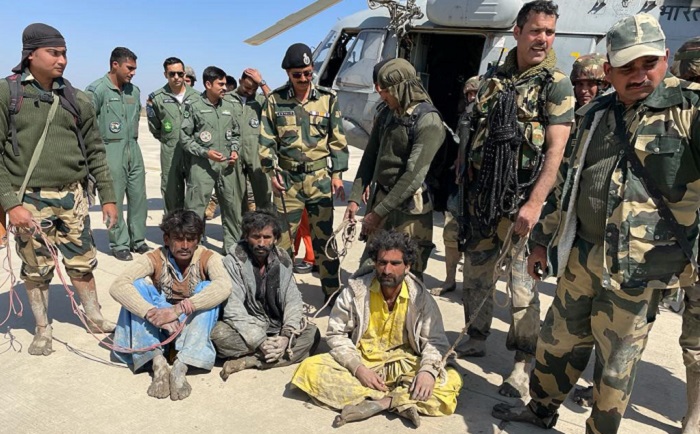
The news agency ANI has reported Indian Army soldiers having rescued two civilians stuck in thick dense vegetation after they jumped from a moving truck that fell down in a gorge in Tuting, Upper Siang, Arunachal Pradesh on January 18. A group of locals and jawans slithered down the gorge using ropes to rescue them.

The official word is still awaited whether youths rescued by the Indian Army are the same persons who were abducted by the PLA.

In September 2020, the PLA had abducted five Indian youths from Arunachal Pradesh’s Upper Subansiri district. They were released after a week following the intervention of the central government.  

Mumbai: Irfan, Ahmad, Imran arrested for operating gay sex racket through Grindr, assaulting and looting client

On Wednesday, the Malvani Police busted a gang that was involved in operating a gay sex racket through the mobile app Grindr. The Police also has arrested three persons for assaulting a 23-year-old person and posting an objectionable video of him on social media.

According to Senior Inspector Hasan Mulani, the three accused Irfan Furkan Khan, Ahmad Farooq Shaikh, and Imran Shafiq Shaikh established contacts with the members of the gay community through the mobile application Grindr and guaranteed them strong young men for sex at affordable rates at their office or home.

The matter came to light when the family of the victim lodged an official complaint of theft and physical assault at the MHB Police Station. According to the reports, the victim had expressed his interest on the app to have a gay sex partner at Rs 1000 per hour. After the deal, the victim reached the accused Khan’s office at around 9:30 pm. Khan was reportedly supposed to offer the ‘service’.

However, Khan reached out to another person saying that he was unavailable for the purpose. Three of the accused co-workers also expressed inability to attend to the victim and said that they were busy already. The victim was made to wait at the office near Mohd Rafique Ground, Malvani for a sex partner.

Later, all of them who earlier had declined to be available for the victim arrived at the office and expressed a desire to have sex with him. As the victim refused the service, three accused snatched his mobile, assaulted him physically and took his money. The fourth accused person recorded the entire episode and uploaded it on social media platforms.

The victim, having returned to his home in Borivli, unfolded the incident to his family who then reached out to the Police. SI Malvani raided the location revealed by the victim and nabbed three accused on Monday. While the police are investigating the case, it is reported that more people have become victims of this gang in a similar way.

The arrested accused were produced before the Borivli metropolitan magistrate court on Monday and were remanded to police custody. The Police has charged the victims under various sections of the Indian Penal Code.

Abusive phone call controversy: BharatPe founder Ashneer Grover to be on leave for ‘best interests of the company’

On January 19, Ashneer Grover, co-founder and Managing Director (MD) of fintech firm BharatPe, went on a “voluntary leave of absence” till the end of March. As per the company’s statement, “Ashneer Grover, our co-founder and MD (managing director), has today informed the Board of his decision to take voluntary of absence from BharatPe till March-end. Ashneer had co-built BharatPe from scratch, and his decision is consistent with his passionate commitment to the future success of the company.”

It is being alleged that his leave of absence is linked to the audio clip of him abusing an employee of Kotak Mahindra Bank that had surfaced on social media platforms a couple of weeks ago, though it has not been officially confirmed.

BharatPe’s Statement. Source: Twitter

Reports suggest his decision to go on voluntary leave was accepted by the board of directors of the company. The board and Ashneer agreed it would be in the best interests of the company, employees and investors. It is notable that since his audio had gone viral, netizens have been discussing the alleged toxic culture at BharatPe and his caustic behaviour on the reality show Shark Tank India.

According to a report in Money Control, the board of directors of BharatPe, investors from Sequoia India, Ribbit Capital, Coatue Management and senior bankers, including ex-SBI Chairman Rajnish Kumar and ex-Union Bank Chairman Kewal Handa, had unanimously insisted Grover to go on leave of absence. Money Control quoted an unnamed person familiar with the matter, saying, “The board was not in favour of firing him and wanted the media dust to settle. They wanted to give him time to settle down and get rejuvenated. This is a personal issue and not a professional one to fire him on.”

Ashneer Grover’s statement

In a statement released on Twitter, Ashneer said, “I’ve been relentlessly at work building up BharatPe for almost four years. After much deliberation and introspection, I plan to take a temporary leave of absence from BharatPe till March-end. I will return on or before April 1 2022. I’ll be utilising this period to rejuvenate and refresh myself for our next sprint of value creation.”

He further added he would use the time to think about the next phase of product development. He said, “I expect to spend the time thinking more deeply about our next phase of product development and BharatPe’s path to profitability and IPO. I will also double down on investing in myself personally. I am a builder, and I know my energy is best spent creating value for the millions of Indians we serve each day.”

He said, “We’ve, at BharatPe, delivered 40 months of absolute growth and have an exceptional team of professionals who have built BharatPe, PostPe, 12% Club and PayBack. The team is passionate about solving the financial needs of small merchants and credit-seeking customers, and I am excited about what we plan to build at UNITY SFB with our partner Centrum. I am confident that under the leadership of our existing CEO, Suhail Sameer, the team will continue to deliver.”

The abusive audio call between Ashneer and Kotak employee

On January 5, an anonymous person tweeted a link to a now-deleted audio clip from Soundcloud, an audio hosting platform. In the clip, there was a conversation between a bank employee and two customers over the inability of the bank to finance their application and buy shares of FSN E-commerce Ventures that runs cosmetics platform Nykaa. The bank employee was heard trying to calm down the two customers over the call. The customers could be heard using abusive language. The audio was deleted from SoundCloud but was uploaded by others on different platforms including YouTube.

Source: Twitter

When the audio was made public, it was alleged that the bank employee was from Kotak Mahindra Bank and the customers were Ashneer and his wife, Madhuri. The customers not only used alleged abusive language but also threatened the employee.

The audio went viral on social media platforms, and the next day Grover issued a statement on Twitter alleging it was fake audio. In his statement, he alleged someone tried to extort money, and when he refused to pay, the scamster published fake audio of him. In the now-deleted tweet, he said, “Folks. Chill. It’s a fake audio by some scamster trying to extort funds (US$ 240K in bitcoins). I refused to buckle. I’ve got more character. And Internet has got enough scamsters.”

Source: archive.org

Things turned sideways when on January 9, Kotak Mahindra Bank issued a statement in the matter and said they were pursuing legal action against the couple over the abusive language they used during the conversation with their employee.

Grover, who had worked as the vice president in Kotak Investment Banking for seven years till 2013, had sent a legal notice to the Kotak group on October 30 last year. In his notice, sent via his law firm Regstreet, Grover had alleged that Kotak Wealth Management failed to finance his and Madhuri’s application for Nykaa IPO.

The notice added the Bank’s refused to comply with the assurances on the pretext that the bank did not want to finance the IPO due to ‘erratic FII movements’ and ‘very high lending rates. In the notice, Grover sought compensation from Kotak against its failure to provide IPO finance and allocate shares worth Rs 500 crores before the offer closed on November 1, 2021.

The notice read, “Kotak’s refusal to provide IPO financing to our clients at the eleventh hour has completely crippled our clients’ ability to participate in the Nykaa IPO and deprived them of a business/investment opportunity about which they had informed Kotak more than a month in advance of the launch of the IPO. Had Kotak informed our clients at the very beginning that it would be unable to provide IPO financing for the Nykaa IPO, our clients would have approached other financiers who were ready and willing to provide IPO financing to our clients for this IPO.”

Kotak Mahindra Bank, however, denied any breach of trust in any manner whatsoever in its January 9 statement. The bank said, “This notice was received by us and was replied to appropriately at the time, including placing on record our objections to inappropriate language used by Grover. Appropriate legal action is being pursued.”

Suhail Sameer, a consumer goods veteran who joined BharatPe in 2020 and became its CEO, along with co-founder Bhavik Koladiya would continue to manage day-to-day operations at the company. Notably, when Sameer was appointed as CEO, Grover was asked to concentrate on the company’s reputation, oversee fundraising and plan the future of the company. Sameer is also a board member at BharatPe.