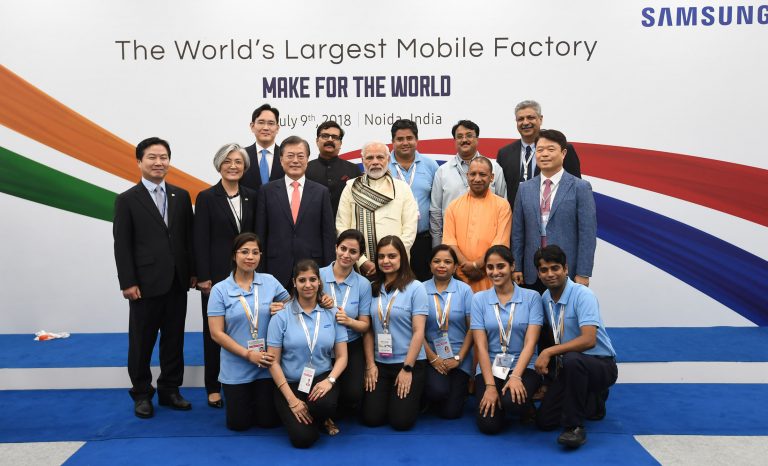
In the financial year 2021-22, Apple and Samsung are set to manufacture smartphones worth over $5 billion (almost Rs 37,000 crore) in India. The two behemoths are on track to outperform the government’s PLI Scheme objectives by more than 50%.
IANS spoke with Pankaj Mohindroo, Chairman of the India Cellular and Electronics Association (ICEA). “The leading global value chains (GVC) firms have got off to a blazing start. Besides Pegatron and Bharat FIH which are now gearing up, the big three — Wistron, Pegatron, and Samsung — will achieve significant production of $5 billion in 2022” he said.
For the first time this year, Apple’s two primary contract manufacturers in India, Foxconn, and Wistron will be eligible for PLI incentives. Pegatron, Apple’s third assembler, is expected to begin manufacturing this year. Samsung, which has its own manufacturing plant in Noida, will take advantage of the scheme’s incentives for the second consecutive year.
Apple and Samsung are already shipping locally manufactured smartphones to the rest of the world in unprecedented numbers. Only iPhone shipments from India have climbed to 5% from 0% a few years ago. Samsung leads in phone exports by a wide margin, with 11.6 million units shipped.
UK, UAE, Germany, Italy, Russia, and South Africa are among the countries to which these companies export from India.
Following the second wave of Covid 19 in India, the government of India announced the Production Linked Incentive Scheme (PLI) for Large Scale Electronics Manufacturing in April 2020. It offers a production-linked incentive to stimulate substantial investments in mobile phone manufacturing and specific electronic components, such as Assembly, Testing, Marking, and Packaging (ATMP) facilities, as well as to boost domestic manufacturing. The Scheme aims to transform the manufacturing and supply chain ecosystem in India, establishing it as a worldwide leader in the industry. India’s involvement and advancement in global value chains have been boosted by the launch of the PLI scheme.
As China recovers from supply chain breakdowns and a trade war with the US, India, as a developing economy, has the ability to fill the market vacuum left by the Chinese. The government is proactively exploring all options for trying to advance in the global technology supply chain. According to certain forecasts, the electronics manufacturing business is predicted to rise by 30% in the next fiscal year, reaching a value of Rs 7 lakh crores. The sector is currently valued at roughly Rs 5.3 lakh crores.
Also, the World Bank estimates that the Modi government’s Production-Linked Incentive (PLI) Scheme would help India’s economy develop at 8.7% in the fiscal year 2022-23, outperforming emerging market rivals such as China.
Earlier last week, three incidents cropped up that underscored the dehumanisation and demonisation of Hindus underway in India. A Hindu girl committed suicide after being pressurised to convert to Christianity. A Hindu man was murdered in cold blood in the national capital. And a Hindu man convicted of Delhi anti-Hindu riots 2020 based on his identity.
These three incidents, all of which happened in a span of just a few days, should have normally warranted a big outcry, with media channels, journalists, human rights activists clamouring for justice for the victims and emphasising the precarious state of Hindus in India. However, since Hindus do not feature in their scheme of things as a community worth fighting for, they maintained a deafening silence over these issues and blissfully moved on to other sources of outrage, in a bid to divert attention away from the pitiable condition of Hindus in the country.
For the so-called liberals and their allies in the media, the case of a Hindu girl being traumatised, coerced, and tortured into accepting Christianity by a missionary school was not worthy of consideration. This, when the girl is dead and a video of her dying declaration stating that she was pressurised into embracing Christianity is already out in public.
M Lavanya suicide case: Media’s propensity to look the other way when Hindus are subjected to forced conversion
The case refers to the suicide of M Lavanya, a student of standard 12th in Sacred Heart Higher Secondary School, Thirukattupali in Thanjavur, Tamil Nadu, who in her dying declaration alleged that the govt-aided Christian missionary school she went to had been pressuring her to convert to Christianity.
However, Lavanya was adamant about not leaving her religion and refused to get converted. Angered by Lavanya’s resistance, the school administration had cancelled her leave application for Pongal Celebrations. Lavanya who was supposed to visit home during her holidays was forced to do chores like cleaning toilets of the school, cooking and washing dishes. It was reported that dejected Lavanya consumed pesticides used in the school garden to end her life.
The incident should have sparked massive outrage over the methods adopted by missionary schools operating in Tamil Nadu. It should have triggered a reckoning among the society, drawing people on the streets and demanding the state government to bring necessary laws to put an end to conversions in missionary schools. However, unfortunately, society and media displayed no such alacrity. Moreover, they also lacked empathy even though a girl was dead and her damning allegations against the missionary school were on record in her video of dying declaration.
This nevertheless underlines the prevalence of dehumanisation of Hindus in India. A rap on the knuckles to a Muslim man for a legitimate reason invariably results in allegations of communal targeting but the death of a Hindu girl hardly evokes any sympathy, let alone anger against missionary school for imposing Christianity on her. It shows that it is no longer just ‘Sanghis’ being dehumanised, which has already become a successful project as even liberal ‘artists’ don’t feel sympathetic on murders of Sanghis, as ‘artist’ TM Krishna himself had put it—he doesn’t feel a shred of empathy when RSS members are killed.
Earlier, it was just ‘Sanghis’ who were dehumanised by the ‘liberal’ media, but now the practice has been extended to all Hindus, including a minor girl who was assertive of her Hindu roots and steadfastly refused to give in to the pressure imposed by her missionary school to embrace Christianity. The death of an innocent girl who surely deserved to live more does not evoke sadness in the secular society. The woke belief that Hindus can’t be victims in a Hindu-majority India is getting mainstreamed and this is bound to spell doom. Even though Christian missionaries using force for conversion might appear as a primary challenge, but is a secondary issue, the primary being the dehumanisation of Hindus.
Hiralal Gujrati murder: ‘Liberals’ and media turns a blind eye to the murder of a Dalit man by an Islamist
Hiralal Gujrati was another unfortunate victim who was quickly forgotten by the media and society. On January 17, 2022, Irfan Siddiqui and his brother Sanu brutally killed Hiralal Gujrati, a 38-year-old Dalit in Delhi’s Sultanpuri area. Irfan had come out of jail a few days back. He was imprisoned for raping Hiralal’s sister. Soon after Hiralal’s death, his terror-stricken family put up the ‘on-sale’ poster outside their house stating that the house is on sale due to the terror of Muslims in the area. The family also alleged that Irfan Siddiqui was a relative of AAP MLA Mukesh Ahlawat.
However, just like the case of M Lavanya, the murder of Hiralal was also given short shrift by the mainstream media and ‘journalists’ who claim to represent the voice of the weak and the downtrodden. While this might not be an outright case of dehumanisation of Hindu lives yet, it nonetheless demonstrates how gruesome crimes like murder in the national capital are not given due prominence so that issues like love jihad can be brushed aside as ‘conspiracy theory’.
This ultimately leads to dehumanisation and lack of empathy as crimes and their causes are not brought to notice of the society, which in turn remains in denial over the existence of social evils like love jihad, forcible conversions, etc. and continue to treat them as ‘conspiracy theories’. And when there are real victims of these crimes, they start casting aspersions on the victims instead of doubting all those reports that declare such crimes as conspiracy theories.
The case of Hiralal’s murder also punctures the imaginary construct of Jai Bhim-Jai Meem, a loose coalition of sorts between underprivileged classes and Muslims that liberals cobbled up in a bid to preclude the larger consolidation of the Hindu society. Like in Hiralal’s case, the underprivileged classes continue to remain at the receiving end of Islamist aggression, but all top universities, commentariats, journalists and activists would continue to peddle the fiction that these two groups are close allies and suffering from what they claim to be ‘Brahminical oppression’.
In fact, even worse, people from these two communities would lap up the fiction as gospel truth and spread it further despite reality on the ground being the exact opposite. There have been countless incidents when Dalit localities were targeted and encroached upon by the Islamists. But it is ‘Brahminical oppression’ that is being bandied about to unite the two communities. Thus, the real oppression gets whitewashed while the fictional one is mainstreamed.
Dinesh Yadav conviction: Accused held guilty largely on account of his Hindu identity than on evidence
The third case is of one Dinesh Yadav, who was convicted in the anti-Hindu Delhi riots 2020 on the assumption of guilt, based on him being a Hindu. There was little evidence to tie him to violence but his Hindu identity was enough for him to be convicted of rioting in the national capital. While the above two cases can be blamed on the complicity of media and politicians in driving a particular narrative, in this case, the questions would lie on the Judiciary’s doorstep.
The conviction of Dinesh Yadav calls to attention the dangers associated with the controversial Communal Violence Bill proposed by the Congress-led UPA government. In 2005, UPA1 introduced a communal violence bill. In 2011, under the guidance of the NAC, UPA2 introduced a revised draft of the same. Although the bill had to be dropped in 2014, grounds for its withdrawal were primarily due to the concerns about overlap with powers of the State government. However, the truly worrying parts of the bill are not related to who exercises control — but the starkly communal and draconian provisions it had.
In the 2005 version of the bill, any “group” that has become a victim of communal attacks could seek redressal. However, in 2011, a new definition of the “group” which is protected, was introduced. This protected “group” included a religious or linguistic minority, in any State in the Union of India, or Scheduled Castes and Scheduled Tribes within the meaning of clauses (24) and (25) of Article 366 of the Constitution of India. Thus, the law, had it been passed, would have meant that only minorities and SCs/STs could be “victims” while the perpetrators of communal violence would always be the majority, which is Hindus.
Though the Congress could not muster numbers to pass the bill and turn it into law, the recent verdict by the court in the Dinesh Yadav case shows how the Congress ecosystem still appears to be formidable, with the judiciary an integral part of it, despite being out of power for close to 8 years now and losing a raft of assembly elections in between. Allowing this case to become a precedent is fraught with danger, for it will mean Communal Violence Bill has already become law even though it was never passed because Congress could not come back to power at the Centre.
Grim challenges Hindus faces in contemporary times
The above-mentioned three cases are not just incidents foregrounding the continuing dehumanisation of Hindus, the indifference towards atrocities meted out on them and the ominous spectre of the judiciary’s proclivity to hew to Congress’ narrative, but they bring to attention the grave challenges faced by the Hindus in contemporary times. More significantly, it shows the strength of the Congress ecosystem, that despite being out of power for 8 years and being decimated from almost all states, the party’s policy of warming up to minorities and cold-shouldering the majority still holds sway in political and media circles.
As the media, journalists, ‘intellectuals’, turn a blind eye to these atrocities, injustice against Hindus, they, however, display excessive concern over the alleged hate speech made at the Haridwar conclave. Apparently, the purported incendiary remarks made at the Dharma Sansad takes precedence over the actual incidents of violence and coercion committed against Hindus, as was the case in Hiralal’s murder and Lavanya’s suicide respectively. The media and members of the left firmament went into overdrive, creating noises over the Dharma Sansad and demanding action against the participants of the event where allegedly inflammatory remarks were made against Muslims. This concern, however, is only limited to minorities. Hindus, on the other hand, are not accorded the same measure of concern and worry from the media and politicians, who continue to treat them as expendables and as fair-game in their attempt to firm up their self-serving narratives.
It is, therefore, of paramount importance that Hindus realise the challenges that lay in front of them and that they become cognisant of the fact that they can no longer rely on pliant media organisations that describe themselves as “neutral” and ‘liberal’ intellectuals who act as apologists for Islamists. Doing otherwise and basing their faith in slanted media and liberal intelligentsia would only compound their challenges, instead of conquering them. Hindus have been victims of not just hate crimes in this country, but they are also victims of media apathy, judicial prejudice and the left’s malevolence. Lavanya, Hiralal and Dinesh Yadav might just be three names but they are, in reality, a reflection of three grim challenges that Hindus are facing in modern times.
In recent times, the tension between Russia and Ukraine has been at its peak since the conflict caught the attention of the world in 2014. At the moment, Ukraine and world leaders have expressed their concerns over possible invasion by Russia on Ukrainian soil. Western powers have warned Russia against any aggressive move against Ukraine. US has started supplying military aid to Russia’s neighbouring nation and authorized its employees in the US embassy in Ukraine to leave the country if they wish to.
On the other hand, Russia has categorically denied any plans to invade Ukraine. It has also been argued that NATO’s support to Ukraine, including weapon supply and military training, poses a threat to the western side of Russia.
The current situation at the Russia-Ukraine border
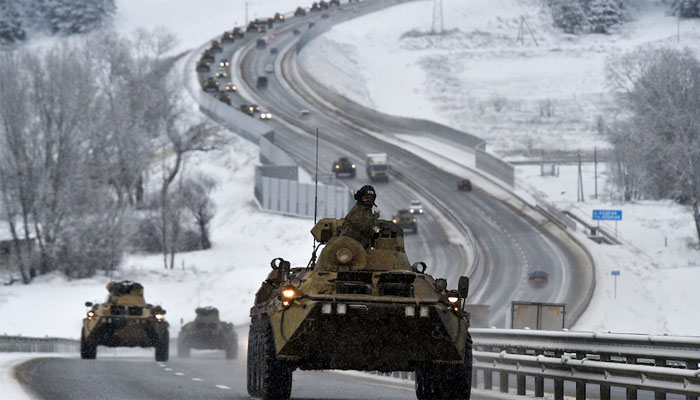
There are as many as 100,000 Russian armed forces troops stationed at the Ukrainian border. The United States and NATO have called the military moment around the border unusual. US President and European leaders have repeatedly warned Russia against the possible invasion of Ukraine. In December, US intelligence reported Russia might begin a military offensive in Ukraine in early 2022.
In late 2021, it was revealed via satellite photos that Russia was moving heavy military hardware, including battle tanks, self-propelled guns and more, across a 300 KM long border between Ukraine and Russia.
As per the latest intelligence assessment of the Ukrainian Defense Ministry, Russia has deployed over 127,000 troops across the Ukrainian border. The West tried to deescalate the crisis between the two nations, but three rounds of the diplomatic talks yielded no result. Notably, the Donetsk and Luhansk regions on the east side of Ukraine have been under Russian-backed separatist groups since 2014. Ukraine claims Russian troops are present in these areas, but Russia has denied it.
It is believed the recent aggression from the Russian side is the result of the deployment of a Turkish-made combat drone in October from Ukraine to strike pro-Russian separatists’ position. A massive naval base of Russia has also come up in Crimea, a Ukrainian territory annexed by Russia in 2014 via referendum. The Crimean peninsula and mainland Russia are now connected by a road bridge giving Russia unhindered access to Ukraine’s territory.
The history of the Ukraine-Russia conflict
The conflict between Russia and Ukraine started when in 2013, the then-President of Ukraine, Viktor Yanukovych, decided to reject a deal for greater economic integration with European Union. A series of protests and conflicts erupted as a result of his decision. The administration tried to stop the protesters forcefully, but it backfired. As a result, President Yanukovych had to flee the country in February 2014.
Following the unrest in Ukraine, Russian troops took control of the Crimean region that is located in the south of the Ukrainian region of Kherson. Though Crimea has been under Russian control since 2014 internationally, it is still considered to be a part of Ukraine. After taking control of the region, Russia held a local referendum and formally annexed the region as its part.
At that time, Vladimir Putin, President of Russia, said that there was a need to protect the rights of Russian citizens and Russian speakers in southeast Ukraine and Crimea. Two months after the annexure, pro-Russian separatists in the Donetsk and Luhansk regions of eastern Ukraine held another referendum and declared independence from Ukraine.
In 2014, things escalated further, and the conflict drew international attention after a Malaysian Airlines flight MH17 was shot down over Ukrainian airspace. There were 298 people on board, including the staff and pilot. No one survived the incident. The incident caused tension between Russia and its western counterparts, including the United States and the European Union.
In October 2015, the investigation into the incident started to answer some lingering questions. According to Dutch air investigators, Russian-built surface-to-air missile was used to shoot down the Malaysian aeroplane. In September 2016, the investigators announced that a missile system was provided by Russia. As per the reports, it was moved into eastern Ukraine and then back to Russian territory before it was used to shoot down the plane.
Since the conflict erupted, Ukraine has accused Russia of repeated cyber attacks. In December 2015, it was reported that around 225,000 people lost power due to a cyber attack. In December 2016, another blackout happened in Kyiv due to an alleged cyber attack. In June 2018, the computer systems of government and businesses across Ukraine were hit by the NotPetya cyber-attack, which was attributed to Russia.
Russia’s stand
Russia has categorically denied any plans to invade Ukraine. Also, Russia sees NATO’s support to Ukraine as a threat to itself, especially when NATO is providing support in terms of weapons, training and personnel. Vladimir Putin, President Russia, had said the West did not live up to the verbal assurances. He also questioned NATO’s deployment of sophisticated weapons in Ukraine, including missile systems. Putin called it “crossing the red line” for Russia.
Ukraine’s stand
Ukraine, in reply to Russia’s objection over its ties with NATO, said Russia could not prevent it from building closer relations with NATO. Foreign Ministry of Ukraine told CNN, “Russia cannot stop Ukraine from getting closer with NATO and has no right to have any say in relevant discussions. Any Russian proposals to discuss with NATO or the US any so-called guarantees that the Alliance would not expand to the East are illegitimate.”
NATO’s stand on the Russia-Ukraine conflict
In April 2016, North Atlantic Treaty Organization (NATO) announced that they would deploy four battalions in Eastern Europe and would rotate troops through Estonia, Latvia, Lithuania, and Poland to counter possible future Russian aggression elsewhere in Europe. Two US Army tank brigades joined them in September 2017 to further strengthen the presence of the NATO alliance in the region.
Since then, Ukraine has also held joint military drills with NATO. Recently, Secretary-General Jens Stoltenberg, NATO, had said, “there will be a high price to pay for Russia” in case it decides to invade Ukraine, a NATO partner. In an interview with CNN, Stoltenberg said, “We have a wide range of options: economic sanctions, financial sanctions, political restrictions.”
The US authorized govt employees to leave Ukraine
the United States government authorized the departure of the US government employees and ordered that the family members of US government employees at the US Embassy in Kyiv, Ukraine leave the country amid escalating tensions. The authorized departure gives the govt employees an option to leave the country if they want to, however, their family members must leave Ukraine.
The US government clearly told its citizens that in case Russia moves ahead with the military action against Ukraine, it would not be in a position to evacuate American citizens. It said, “As President Biden has said, military action by Russia could come at any time, and the United States government will not be in a position to evacuate American citizens in such a contingency, so US citizens currently present in Ukraine should plan accordingly, including by availing themselves of commercial options should they choose to leave the country.”
On January 7, Muhammad Mansoor Mohiuddin, a Pakistan based US doctor, earned headlines as the co-founder of US’ Maryland Medical Center that successfully transplanted a genetically engineered heart of a pig into a terminally ill American man. While the Muslim doctor was hailed by his fraternity for the medical breakthrough, he received severe backlash from his own family members because he used an organ from an animal that is forbidden in Islam.
Speaking to Vice, a Canadian-American magazine, Dr Muhammad Mohiuddin, director of cardiac xenotransplantation at the University of Maryland Medical Center said: “I got quite a backlash from my family.”
“Why are you using this animal? My father used to always ask me, said the doctor, adding that his father kept inquiring “Can you at least try using another animal?”
“My mother used to make me gargle even if I just said it”, Pakistan based US doctor behind pig heart transplant reveals
The doctor further shared how in his family the word ‘pig’ was taboo and he would be punished for even just saying it. “My mother used to make me gargle,” he revealed, adding: “It was a big no-no in my family. It was forbidden in our home.”
He stated how his family’s concerns, as well as his personal faith, led to him questioning using a pig organ for the surgery.
“I try to follow all the tenets of Islam, so that concern was in the back of my mind all the time. So, I used to try to find reasoning for me to continue using this animal,” Mohiuddin said.
“Since I live in a country where pork is consumed on a regular basis it was not an ethical issue here in the Western world. It was easier,” added Dr Muhammad Mansoor Mohiuddin.
The latest treatment, led by Mohiuddin and Bartley P. Griffith, the centre’s cardiac transplant programme director, employed a heart from a genetically engineered pig provided by Swedish biotech company Revivicor, as well as a rare immunosuppressive medication. The heart was given to a 57-year-old guy who is currently recovering.
The transplant has opened up vistas of life-saving possibilities for thousands on national organ transplant lists in the United States, which is experiencing an extreme organ scarcity crisis.
“Almost 150,000 people lose their lives a year just in the U.S., you can calculate how many more throughout the world lose their lives just because organs are not available,” Mohiuddin said, adding: “If this technique is successful, we will be able to save almost all of them.”
Muslims worry whether Covid-19 vaccines are halal as they may contain pork products
It may be recalled how in 2020, there are concerns among Muslim countries around the world regarding Coronavirus vaccines as pork-derived gelatin is widely used as a stabilizer in vaccines to ensure that they remain safe and effective during storage and transport. Though spokespersons for Pfizer, Moderna and AstraZeneca had said that pork products are not an ingredient of their Coronavirus vaccines, Sunni Muslim scholars from Raza Academy, Mumbai, and All India Sunni Jamiyyathul Ulama had issued a fatwa against the Chinese vaccine that contains pork gelatin.
The Raza Academy scholars had claimed that the pork gelatin component of the vaccine makes it “haram” for the Muslim community. Some reports had claimed that the Chinese vaccine contains the said component that has stirred controversy in the Muslim community worldwide.
Aversion towards vaccines by the Muslim community due to their being ‘haram’ or containing pork products is not a new phenomenon. In 2018, the Indonesian Ulema Council, the highest clerical body in the country that issues halal certificates, declared that measles and rubella vaccines were “haram” because of the pork-derived gelatin.
On January 23, Prime Minister Narendra Modi inaugurated the hologram of Netaji Subhash Chandra Bose’s statue at India Gate. The hologram will fill up the space meant for Netaji’s statue till the granite statue is completed and installed at the place.
However, this initiative did not sit well with a section of so-called intellectuals and liberals, who felt no qualms in mocking the legacy of one of the most formidable freedom fighters the country has known in their bid to mount an attack against PM Modi and BJP.
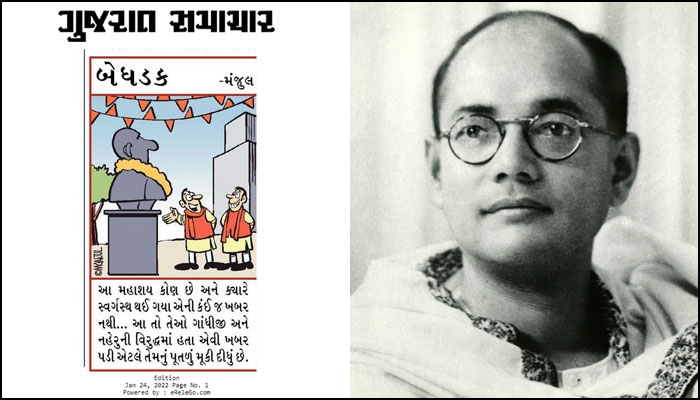
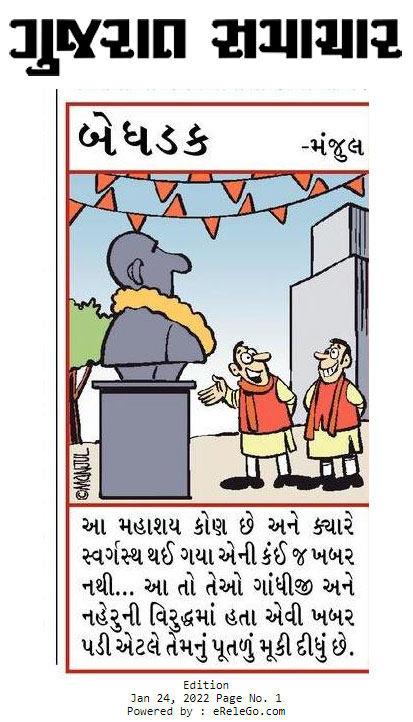
One such attempt was made by Gujarat Samachar and cartoonist Manjul. In the January 24 edition, the media house published a cartoon in the print edition where two men with saffron strolls are talking to each other in front of a statue. The caption written in Gujarati translates to “Who is this guy? And when did he die? Just because he was against Nehru and Gandhi Ji, we have put up his statue.”
Screenshot of a cartoon published in Gujarat Samachar mocking Netaji Subhash Chandra Bose. Source: Gujarat Samachar ePaper
The media house and cartoonist not only mocked the freedom fighter but also belittled the contribution made by Netaji Subhash Chandra Bose towards the country’s struggle for independence. Netaji played a vital role in India’s freedom struggle against the oppressive British colonial rule by establishing Azad Hind Fauj, a military regiment that was going to fight with the British government. Yet, for Manjul and Gujarat Samachar, Bose’s crucial role in India’s fight for independence meant nothing as they proceeded to imply that his statue is only being installed because he was allegedly against Nehru and Gandhi. It was Netaji who was amongst those who first referred to Mahatma Gandhi as the Father of the nation.
However, for Manjul and detractors like him, Netaji and other freedom fighters barring the Nehru dynasty are nothing more than sticks to beat the Modi government with. In fact, a bevvy of social media users, including activist Vijay Patel, took strong objections over the cartoon for demeaning the legacy of Netaji Subhash Chandra Bose and using a towering freedom fighter for pushing one’s political propaganda.
Manjul and history of making derogatory cartoons
This is not the first time Manjul drew derogatory cartoons and got away by claiming freedom of expression. In 2021, after he got an email from Twitter that an Indian law enforcement agency had raised an objection on his account, Manjul, who is an anti-BJP cartoonist, cried foul. He tried to insinuate that the Modi government has been trying to silence his freedom of expression. He had shared a screenshot of an email received from ‘Twitter Legal’, wherein it pointed out that the microblogging platform had received a request from Indian law enforcement authorities regarding his account. “Jai Ho Modi Ji ki sarkar ki (All hail the Narendra Modi-led-government),” he alleged.
In another tweet, he claimed, “Thanks to the Modi government that it did not ask Twitter to shut down the handle for being anti-religion and atheist and not considering Modi Ji as my God.” Manjul further insinuated that the warning from Twitter was received at the behest of the Indian government. He wrote, “It would have been better if the government informed about the tweet that had offended it. I could have re-posted the same tweet. This would have helped the people.”
Gujarat Samachar also has a problematic history. In 2021, Urvish Kothari, one of its columnists, mocked the Gujarat government and used a video of burning pyres to attack the government’s covid management capabilities. In 2019, Gujarat Samachar thought invoking ‘How’s the josh’ catchphrase to question the government was a good move. Islamists were using the phrase to celebrate the Pulwama attack.
The violence that hit the national capital in 2020 was a brutal reminder of India and its tryst with those who wish to annihilate Hindus and balkanise the nation. With the violence, the conspiracy of which started germinating right from the 5th of December 2019, a vicious international campaign was unleashed to paint the violence, initiated by Muslim mobs, as an anti-Muslim pogrom. The fact that the first murder during the violence that erupted on the 23rd of February with Muslim mobs running rampage was that of Ratan Lal and soon after him, Dilbar Negi, a young daily wager, was brutally murdered, was swiftly brushed under the carpet.
With several cases pertaining to the Delhi riots being tried in the court of law, the first judgement has been delivered by the honourable court, in all its wisdom. The first conviction in the case was that of Dinesh Yadav, a young Hindu boy who was seen in the vicinity of a mob vandalising Muslim households on the 25th of February, 2 days after Muslim mobs had unleashed violence against Hindus.
Almost simultaneously, those who were accused of murdering Dilbar Negi were awarded bail. On January 18th, the Delhi High Court granted bail to six persons named Mohd Tahir, Shahrukh, Mohd Faizal, Mohd Shoaib, Rashid and Parvez in the Gokulpuri murder case related to the Delhi Riots of February 2020. The bail was granted by Justice Subramonium Prasad. The six were accused of vandalism and setting Anil Sweet Corner on fire “resulting in the death of 22-year-old Dilbar Negi”.
The conviction of Dinesh Yadav, coupled with the bail granted to the murderers of Dilbar Negi, expectedly, created flutters. While the Muslim organisations and the sympathisers of the rioters were rejoicing the conviction of a Hindu man, those who truly wanted to talk about the truth of the riots rued the inconsistencies in the two judgements passed days apart.
Summary of the basis on which Dinesh Yadav was convicted in the Delhi anti-Hindu riots case
The conviction of Dinesh Yadav hinged on certain fundamental points elucidated in the judgement itself.
Manori, the old woman whose house was vandalised, was not present in the house when the vandalised took place. She said she had left the house at around 4 PM on the 25th and the vandalisation, according to the police personnel (who were also witnesses in the case), began at about 11 PM.
Manori, her family members Ashiq and Asif could not identify any of the rioters, leave alone Dinesh Yadav, since they were not present when the vandalisation took place. In fact, these witnesses were declared hostile by the prosecution where during cross-questioning, they said that they had never told the police that they were in the house when the vandalisation took place. Essentially, it would appear that the police was under the impression that they were present in the house when the vandalisation took place. The family itself had alluded to it several times, even in an Indian Express interview after the verdict was out.
The police personnel, Vipin and Sanoj, named Dinesh because they saw him in the vicinity of the mob. They have admitted that Dinesh was in no way involved in the violence. They said they him with a wooden danda, however, no such danda was recovered from Dinesh. In fact, there was no incriminating material found on his person.
The court in its wisdom said that even though there is no evidence to suggest that Dinesh was involved in the violence, he was a part of the mob and therefore, assumed his intention to further the common goal of the illegal mob – vandalise and commit violence against Muslims.
The court predicated this conclusion on two factors – a) Section 149 applies, which basically says that even if a person is not committing violence but is a part of an illegal assembly creating violence and if he has the intention to further the same illegal goal of the illegal crowd, he should be held liable, b) the mob was Hindu and since he was Hindu too, it can be assumed that he wanted to further the same cause as that of the rest of the mob.
One has to keep in mind that other than this assumption, based on the fact that he is a Hindu, there is no evidence on record to suggest that he was not a bystander and wanted to further the cause of the illegal mob, yet, the court sentenced Dinesh to 5 years in prison.
The full article analysing the Dinesh Yadav judgement and the miscarriage of justice can be read here.
The arguments made in the case of those accused in the Dilbar Negi case
It becomes evident from the analysis of the judgement passed convicting and sentencing Dinesh Yadav that there was a thorough lack of evidence to award a 5-year prison sentence. However, to draw conclusions about how the judgement in the Dinesh Yadav case differs from that of giving bail to the accused in the Dilbar Negi case, and thus how it amounts to a miscarriage of justice, we must now analyse the judgement in the bail case.
The judgement stated:
The FIR states that when the Complainant and the Beat Constable reached the said house, they found the door to be broken and the house to be completely burnt. On inspecting the second floor, the Complainant noticed a semi-burnt body lying in the corner. The FIR further states that the deceased seemed to be about 20 years old and that both the arms and legs of the body were chopped off. It is stated that the chopped limbs could not be found and that on inquiry, it was found that the burnt body belonged to a person named Dilbar who was a waiter at the sweet house. The body was then sent to GTB Hospital and then to the GTB Hospital mortuary. The FIR states that it appears that unknown persons belonging to one of the parties opposing and supporting the CAA killed the deceased with a deadly weapon and then set the house ablaze with the intent to destroy the evidence of the crime.
Salman Khurshid, who was representing the accused, said that he was arrested and implicated falsely and that he is a poor boy who works in a repair shop and is the sole breadwinner of the family.
Interestingly, a similar argument that was made in the Dinesh Yadav case was made here by Salman Khurshid. He said that his brother’s shop is in the vicinity where the accused has been working for the past 15 years and therefore he was in the area. It was argued that the Petitioner was only present before Rajdhani Public School to collect certain articles and that he merely closed his shop and returned to his home.
Khurshid submitted that the only evidence against the Petitioner is the CCTV footage, the statement under Section 161 Cr.P.C. of Amit Pal, and the CDR, and these are matters which must go through the rigours of trial. It is pertinent to note here that while CCTV footage did exist in the case of this accused in the Dilbar Negi case, in the Dinesh Yadav case, there was no CCTV footage either. It was only the word of the two policemen who had said they saw Dinesh in the crowd with a lathi, admitting that he was not involved in any violence that had ensued.
Another argument made by Khurshid to ensure bail for the accused was that the body of Dilbar Negi was discovered on the 26th while the FIR was registered only on the 28th. The delay in the filing of the FIR was used to cast aspersion on the role of the accused by the lawyer.
The Public Prosecutor on the other hand had argued that the accused, Md Tahir, had actively participated in the deadly riots on 24.02.2020 wherein the deceased Dilbar Negi was burnt alive. The PP submitted that the Petitioner was identified in the CCTV footage retrieved from Rajdhani Public School where he could be seen instigating others. Pointing at the CCTV footage (CP IP Cam), the learned APP has indicated that the Petitioner has been identified at 3:37:39 PM in a printed white shirt and that the posture of the Petitioner is not that of a curious onlooker. He has submitted that the Petitioner can be seen gesturing and instigating other members of the unlawful assembly.
Interestingly, the public prosecutor in this case also invoked Section 149 saying that in a mob, it is impossible to identify every member of the mob and therefore, any individual who was a part of the mob and identifiable should be held liable for the actions of the mob.
The prosecution also said that on an earlier occasion, Tahir was denied bail by the court on account of the heinousness of the crime. This argument was made by the prosecution after the defence lawyer (Khurshid) had argued that Tahir had been incarcerated for long enough pending trial and therefore should be awarded bail.
Mr. Mahajan has further argued that that Ld. Trial Court vide Order dated 18.08.2020 had also dismissed the Petitioner’s bail application on the ground of the heinousness of the offence. He has, therefore, submitted before this Court that there has been no change of circumstances and that period of incarceration undergone by the accused is not relevant while considering grant of bail. He has submitted that Section 436A of the Code of Criminal Procedure specifically provides for the maximum period for which an accused can be in custody while the trial is underway, and therefore, it should not be a relevant factor for grant of bail. Furthermore, Mr. Mahajan has submitted that the eyewitnesses reside in the same area as the Petitioner and may be susceptible to being influenced or threatened if the Petitioner is enlarged on bail.
What did the court say while granting bail to the accused in the Dilbar Negi murder case
The judgement by the court said that during the course of the investigation, two CCTV footage were discovered by the police. One from the corner wall of the school covering the sweet shop between Rajdhani Public School and Anil Pastry Shop, and another inside Rajdhani School near the main entry gate. The judgement said that though the murder of Dilbar Negi was committed on the 24th of February, the FIR was filed on the 28th of February and that the charge sheet in the case clearly states that the murder was a part of a well-hatched conspiracy.
The judgement states:
The chargesheet additionally states that the CDR of the Petitioner places him at the location of the scene of crime. Further, the statement of Amit Pal under Section 161 Cr.P.C. ascertains that the Petitioner was in front of Rajdhani Public School, raising slogans against Hindus and provoking a crowd of Muslim boys. It states that the Petitioner was involved in pelting stones and setting fire to the shops. A perusal of the video footage shows that the Petitioner was seen on the CCTV camera of CP IP Cam at 03:41:59 PM which shows him before Rajdhani Public School on the day of the incident. It indicates the Petitioner herein calling out to others present in the mob.
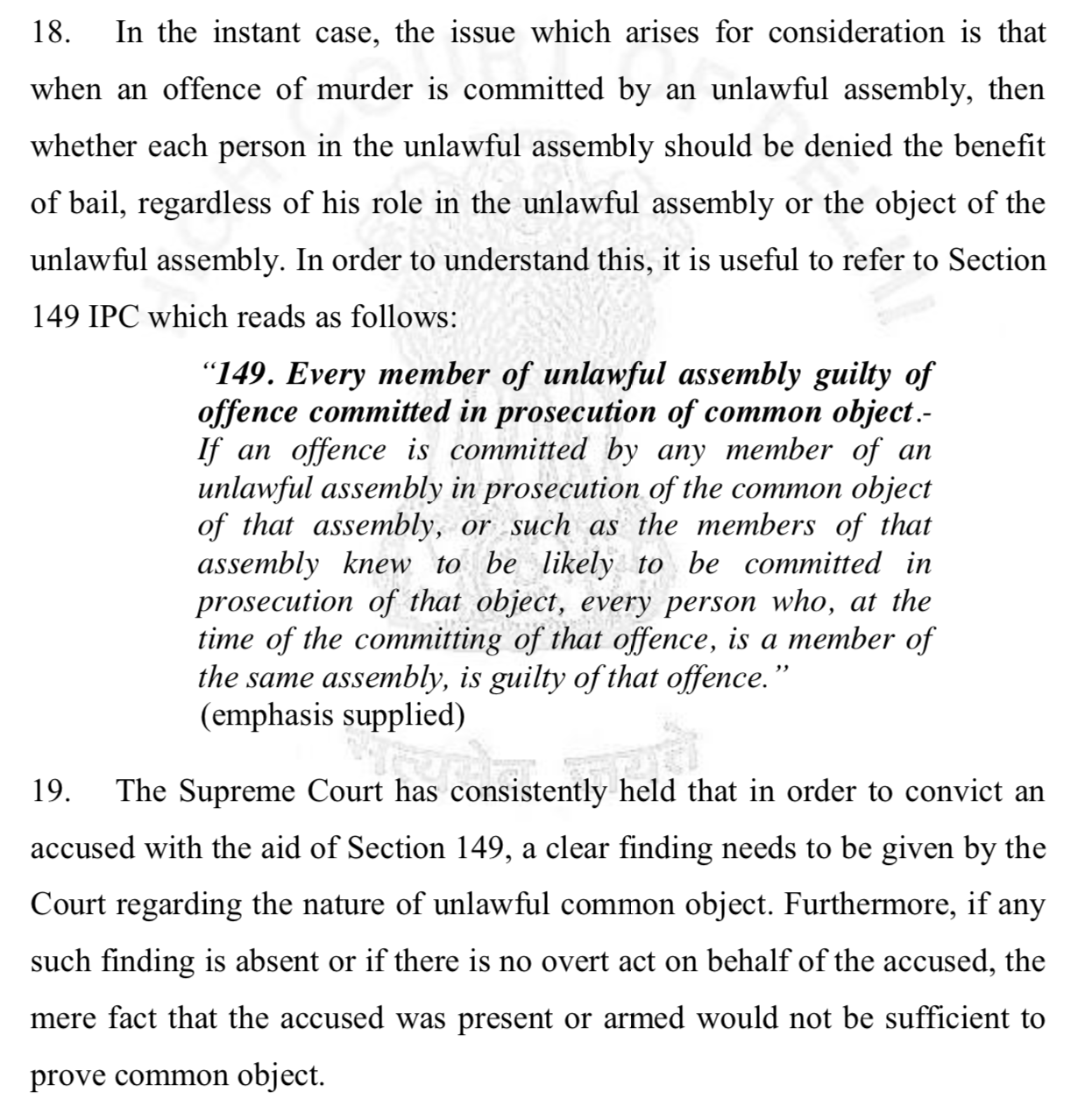
The court, in its wisdom, took exception to Section 149 being applied to every individual who was a part of the illegal assembly.
Judgement giving bail to accused in the Dilbar Negi murder case
This part of the judgement is extremely important and we will analyse how it differs from the one passed in the case of Dinesh Yadav in the next section of the article. The court here observes:
“…clear finding needs to be given by the Court regarding the nature of unlawful common object. Furthermore, if any such finding is absent or if there is no overt act on behalf of the accused, the mere fact that the accused was present or armed would not be sufficient to prove common object”.
The court, therefore, says that just because someone is armed and a part of an illegal crowd, it does not mean that they should be prosecuted for the crime committed by the crowd unless it can be proven that he was a part of the violence.
Citing the case of Sherey and Ors. v. State of U.P., (1991) Supp (2) SCC 437, the court said:
“We feel it highly unsafe to apply Section 149 IPC and make everyone of them constructively liable. But so far as the above nine accused are concerned the prosecution version is consistent namely that they were armed with lethal weapons like swords and axes and attacked the deceased and others. This strong circumstance against them establishes their presence as well as their membership of the unlawful assembly. The learned counsel appearing for the State vehemently contended that the fact that the Muslims as a body came to the scene of occurrence would show that they were members of an unlawful assembly with the common object of committing various offences including that of murder. Therefore all of them should be made constructively liable. But when there is a general allegation against a large number of persons the Court naturally hesitates to convict all of them on such vague evidence. Therefore we have to find some reasonable circumstance which lends assurance…”
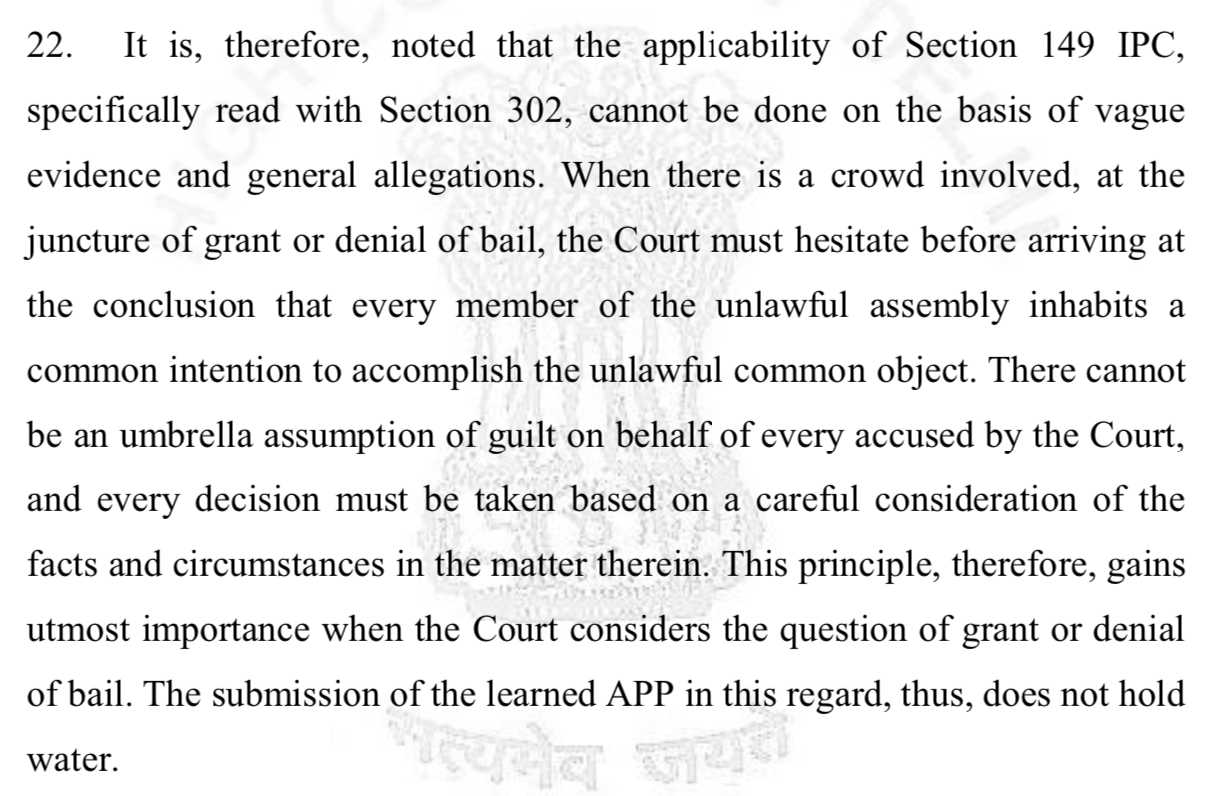
The court further said that Section 149, when read with section 302, cannot be done on the basis of vague evidence and general allegations.
Judgement giving bail to accused in the Dilbar Negi murder case
On the question of bail, the court observed that the accused had been in jail for 21 months and therefore, the court has to ensure that the personal liberty of individuals is not compromised in the face of excess state power.
The court said:
“…Bail is the rule and jail is the exception, and Courts must exercise their jurisdiction to uphold the tenets of personal liberty, subject to rightful regulation of the same by validly enacted legislation. The Supreme Court has time and again held that Courts need to be alive to both ends of the spectrum, i.e. the duty of the Courts to ensure proper enforcement of criminal law, and the duty of the Courts to ensure that the law does not become a tool for targeted harassment”.
The court, granting bail, based their decision on the following:
Court said that the sole evidence available at this juncture against the Petitioner is his presence in the CCTV footage, the statement of Amit Pal, and the CDR which places the Petitioner at the SOC and this evidence has to be examined during trial.
The court said that the CCTV placed the accused at the spot of the crime at 4 PM, however, the murder happened sometime after 8 PM. Therefore, the evidence is inconclusive at this point and it would be a “bit of a stretch” to say that “the petitioner was present at the SoC when the alleged murder was committed after a gap of almost six hours between the petitioner’s presence at the SoC and the deceased’s alleged time of death”.
The court said that in this case, there were 72 witnesses and therefore, the trial would take long. Since it would, the prolonged incarceration of the accused was not justified.
The court, in its infinite wisdom, also said, “The Petitioner has roots in society, and, therefore, there is no danger of him absconding and fleeing”.
The court makes clear that these observations and only for the purpose of bail and would not be applicable during trial and that the court is not commenting on the merits of the case.
How are the two judgements different? Was conviction of Dinesh Yadav in the Delhi Riots case a miscarriage of justice?
The foundational element in both these cases, the bail order in the Dilbar Negi case and the conviction judgement in the Dinesh Yadav case, was the application of Section 149. This section and its interpretation were used differently in both cases, in one, to convict the Hindu boy Dinesh Yadav in the other, to give bail to the Muslim perpetrators in the Dilbar Negi murder case.
In the case of Dinesh Yadav, where he was convicted, the court said that for Section 149, it does not need to be proved that the individual was a part of the violence at all. The mere fact that Dinesh was allegedly a part of the mob, goes to show that he showed a common goal with the illegal assembly. In fact, the court convicted Dinesh on the basis of this mere assumption. Going further, the court said that because the crowd was Hindu, and Dinesh was Hindu, it is a reasonable assumption that he was a part of the mob sharing their goal to harm Muslims. Keep in mind, that while interpreting Section 149 and throwing Dinesh in jail for 5 years, the court categorically admitted that there was absolutely no evidence to prove that Dinesh was a part of the violence that ensued and led to the house of the Muslim woman being burnt.
In the case where Md Tahir was given bail, the court also interpreted Section 149 but in a manner diametrically opposed to the interpretation used by the court in the Dinesh Yadav case.
In the case of giving bail to the Muslim accused in the Dilbar Negi case, the court said categorically that “…clear finding needs to be given by the Court regarding the nature of an unlawful common object. Furthermore, if any such finding is absent or if there is no overt act on behalf of the accused, the mere fact that the accused was present or armed would not be sufficient to prove common object”.
It went so far as to say that the court has to be circumspect of the personal liberty of individuals and therefore, granting bail is the norm that the court must follow.
As evident, in the two cases, the court interpreted the provision of the law differently using one to convict a Hindu boy and using the other to grant bail to the Muslim accused.
One has to also bear in mind that in the case of the Muslim accused, the court judgement says that there are over 70 witnesses to examine but in the case of Dinesh Yadav, where he was convicted on the basis of a flawed interpretation of the law, there were witnesses who could not identify anyone from the mob because they were not even there when the violence took place and two other police officers, who merely said they identified Dinesh standing around in the crowd and had no evidence that he participated in any violence.
This was not an average situation where any individual who was a part of the mob was there to further the common objective of the illegal assembly. There were widespread riots in the national capital on those fateful days and incidents of violence aplenty. There were several individuals who were bystanders or stuck in the violence-affected areas. Further, there were people also moving around in groups to ensure some sort of safety for themselves. With no proof that Dinesh was a part of the violence, on the say-so of two police officers, with no evidence like weapons recovered or CCTV footage, the court incarcerated him on the basis of the fact that he was a Hindu, standing near a Hindu mob. Whereas, in the case of the Muslim convicts, they have been granted bail on the basis of a completely different interpretation of Section 149.
While it is true that at the stage of the bail hearing, there is a presumption of innocence, the glaring difference in interpretation of Section 149 and the standard of burden of evidence points towards a gross miscarriage of justice as far as Dinesh Yadav is concerned.
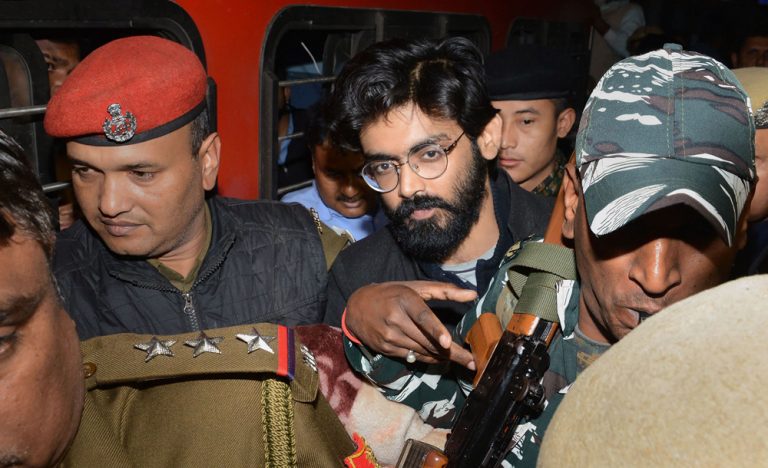
Delhi’s Karkardooma court Monday slapped a fresh sedition charge against Sharjeel Imam over his provocative speeches in Jamia Millia Islamia University and Aligarh Muslim University during anti-CAA protests in Delhi on December 13, 2019, and January 16, 2020, respectively.
Sharjeel Imam was arrested by Delhi Police on 28th January 2020, from Bihar over inflammatory speeches against the Citizenship Amendment Act, advocating for the secession of Assam from the rest of India. Imam, who is currently lodged in Tihar jail, will complete two years in jail this month.
A Delhi court orders to frame sedition charges against Sharjeel Imam, in connection with alleged inflammatory speechs made by him in Aligarh Muslim University, Uttar Pradesh and Jamia area in Delhi.
The accusations against Sharjeel Imam were framed under sections 124A (sedition), 153A, 153B, 505 of the IPC, and 13 of the UAPA as per Additional Sessions Judge Amitabh Rawat.
Imam has been charged with sedition, promoting enmity between different groups on grounds of religion, race, place of birth, imputations prejudicial to national integration, and public mischief under the Indian Penal Code, and indulging in unlawful activities under the Unlawful Activities (Prevention) Act.
A detailed copy of the order is expected to be made available later in the day.
The Delhi Police had filed a charge sheet against Sharjeel Imam in the matter, alleging that he offered statements inciting hatred, contempt, and disaffection toward the central government, as well as instigating the people who resulted in the December 2019 riots.
The charge sheet against Imam mentioned: “He is accused of delivering seditious speeches and inciting a particular section of the community to indulge in unlawful activities, detrimental to sovereignty and integrity of the nation.”
“In the garb of protesting against the Citizenship Amendment Act, he exhorted people of a particular community to block the highways leading to the major cities and resort to ‘Chakka Jam’, thereby disrupting normal life,” it read.
Last year, on November 27, Allahabad High Court had granted bail to Sharjeel Imam in the case of provocative speech against the Citizenship Amendment Act (CAA) at Aligarh Muslim University in December 2019.
In October 2021, a Delhi Court had denied bail to Imam in the sedition case. Additional Sessions Judge Anuj Agarwal has opined that Imam’s speech at Jamia on December 13, 2019, was communal and divisive that could affect the peace and harmony in the society.
Who is Sharjeel Imam
Imam was arrested in 2020 from Jehanabad, Bihar. He is a former Jawaharlal Nehru University, Delhi, and one of the key members of the group that organized Shaheen Bagh protests against CAA. Multiple FIRs were filed against Imam for a speech in which he allegedly asked the protestors to cut off Assam from India. FIRs were filed at Police stations in Assam, Arunachal Pradesh and Manipur. He also got bail in the cases filed at Assam and Arunachal Pradesh.
Imam was accused of making provocative speeches outside Jamia Milia Islamia University in December 2019 that led to violence outside the campus. In April 2020, he was charged with sedition by Delhi Police. According to the FIR, his speech promoted enmity between communities that led to the riots at the area where University is located.
Another FIR in the Jamia case was registered against Imam in the Aligarh district. Both FIRs were registered in January 2020 under Sections 124 A (sedition) and 153 A (promoting or attempting to promote disharmony or feelings of enmity on the grounds of religion, race, place of birth, residence, language, caste or community or any other ground whatsoever), 153B (making statements provoking breach of peace) and 505(2) (statements made which are alarming, false intention to create disharmony) of the Indian Penal Code (IPC).
Mumbai Police has arrested a couple identified as Syed Yusuf Jamal and Naaz Syed from a hotel in the New Market area of Kolkata, West Bengal. Syed Yusuf Jamal has been charged with rape and blackmailing a woman. His wife Naa Syed has been accused of filming the incident and using it to extort money from the victim. With the help of Kolkata Police, Mumbai Police have recovered certain videos from the hotel which the accused reportedly filmed and thereafter used to blackmail the victim. After being produced in the city court, the couple was brought to Mumbai on transit remand.
The incident was brought to light after the victim filed a report with Mumbai’s Nagpara police station. She claimed that Yusuf used to rape her in front of his wife Naaz, who, in turn, recorded the act on video.
In her complaint, the victim alleged that the couple had threatened her that if she complained to the police, they would upload all the videos online. The victim further claimed that both of them blackmailed her and extorted Rs 1.5 crore from her. The complainant alleged that the duo also practised black magic.
According to reports, the victim had met Yusuf at a party in 2015. Following that, the two began to converse with each other over the phone. A few days later, Yusuf called the victim to his house on Dr Babasaheb Ambedkar Road under the Byculla (East) police station area of Mumbai on the pretext of introducing her to his wife.
The accused thereafter spiked the drink he offered to the victim, because of which she fell unconscious. After she regained consciousness, Yusuf and his wife Naaz forced her to watch an obscene video in which Yusuf could be seen raping the victim. They then began blackmailing the victim by threatening to post the explicit content online. Fearing that her films and photos might go viral on social media, the woman began paying money to the accused couple.
Yusuf also used the tapes to coerce her into seeing him, and every time the victim was forced to see him, Yusuf would rape her as his wife recorded the incident on camera.
The woman reportedly remained silent during the coercion, but when the accused attempted to force her minor daughter into doing the same and tried recording her video also, she chose to come out against the duo.
She lodged a police complaint against the accused, following which the couple fled from Mumbai and started living separately in two hotels in Kolkata’s New Market area. When the Mumbai Police got information about this, they arrested them on Saturday (January 22, 2022) evening with the help of the Kolkata Police.
Speaking about the case, a top Kolkata Police officer said: “Mumbai Police wanted our help and we cooperated with them. The couple has been arrested and we have produced them in court, after which they are being taken to Mumbai.”
A cyber fraud module was unearthed by Delhi police sending crypto funds into the wallets of Al-Qassam Brigades, the armed branch of the terrorist organization Hamas. Intel from a foreign intelligence agency to Indian intelligence identifying crypto wallets operated and managed by the military branch of Hamas prompted Delhi Police to investigate a first-of-its-kind crypto hacking case.
Crypto theft case | Delhi police investigation has revealed a cyber fraud module transferring Cryptocurrency into the wallets of Al-QassamBrigates, which is a military wing of Hamas.
The case was reported in 2019 after a businessman from Paschim Vihar, Delhi, lodged a police complaint after losing access to his wallet. The victim possessed 6.2 Bitcoin, 9.79 Ethereum, and 2.44 Bitcoin cash in his blockchain mobile wallet on his Oppo F17 mobile smartphone, according to the complaint. As per estimates, his money was worth around Rs 30.6 lakh at the time. The current value of the cryptocurrencies stands at Rs 4 Crore.
The investigation was soon assigned to the Special Cell for further technical evaluation. Rakesh Asthana, the commissioner of the Delhi Police, requested that the case be investigated as soon as possible. A special team led by DCP KPS Malhotra was constituted under Special Cell’s Intelligence Fusion and Strategic Ops section to launch a multi-angle inquiry. Malhotra then constituted a special squad, which included ACP Raman Lamba, SI Neeraj, and others, to trace out the receivers of the stolen money.
During the probe, the crypto trail led investigators to the al-Qassam Brigades’ accounts. An inquiry employing a variety of tracking techniques indicated that the victim’s device had been hacked and funds had been moved to three separate accounts without his authorization. According to officials, some of the stolen funds were also traced move to a UK-based gaming site and a child pornography site.
“The seized wallet belonged to Mohammad Naseer Ibrahim Abdulla. The other wallets into which a significant portion of the cryptocurrencies was transferred were operated from Giza in Egypt. One of these wallets belonged to Ahmed Marzooq. Another wallet, in which cryptocurrencies had been transferred, belonged to Ahmed QH Safi from Ramallah in Palestine,” the investigation report filed by IFSO states as per reports.
These developments are anticipated to be communicated to relevant authorities at home and abroad through proper channels by Delhi Police Commissioner Rakesh Asthana.
The National Bureau for Counter Terror Financing of Israel’s Defense Ministry announced in July 2021 that it had confiscated a number of digital wallets related to Hamas. After a combined operation with a cryptocurrency tracking agency found a network of electronic wallets used by Hamas to gather cash, the ministry ordered the accounts to be frozen. The list of accounts was distributed to a number of other countries, including India.
The news comes amid calls for the regulation and prosecution of digital wallets, which have long been used by hackers to launder funds obtained via online crimes. In India, trading cryptocurrencies and establishing a crypto exchange are both allowed. However, there is presently no legislation that governs cryptocurrency trading.
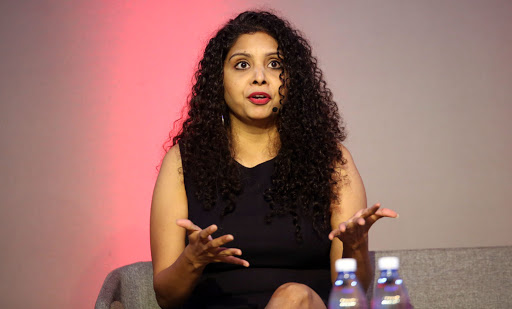
Yesterday, the controversial journalist Rana Ayyub came under attack on Twitter by Saudi Netizens after she posted a Tweet slamming Saudi Arabia for launching a military operation against Yemen. She was accused of peddling fake news and supporting terrorism.
Taking offence to her Tweet, several Saudi Netizens called out the ‘Muslims journalist’, as she was fervently titled by Pakistan for being on common grounds in not only their blind hate for Prime Minister Narendra Modi but also their hatred for Hindus and India, for spreading brazen lies.
Saudi engineer Gassan called it fake news and said that Saudi Arabia has launched military operations in Yemen as part of a coalition of over ten countries in response to a direct request from the legitimate government of Yemen. “We supporting legitimate and you supporting terrorists”, he added.
One Twitter user Abu Sultan called her a “fu**ing liar”, saying all she “said are bullshit”. The user noted that this why Ayyub has disabled replied to her tweets. Many more similar reactions have filled the Twitter space.
Though the controversial journalist has been receiving a lot of backlash for her recent mendacity, these types of retorts are normal for Rana Ayyub, who is known for spreading outright lies under the cover of journalism. From hiding horrendous crimes committed by Muslim radicals against Hindus, fabricating incidents to create a Muslim victimhood narrative to spreading misinformation to discredit the BJP government in the centre, this Washington Post propagandist has done it all.
Below we have tried to compile a list with a few of the endless lies, chicanery, biases and questionable journalism of Rana Ayyub that has been called out not only by Indians on the right and the centre but also by her own on the far-left of the political spectrum.
FIR filed against Rana Ayyub for spreading fake news in Ghaziabad case
On June 15, 2021, the Ghaziabad Police registered an FIR against Alt News cofounder Muhammed Zubair, The Wire, Rana Ayyub, Twitter and others for trying to stoke communal tension by making false claims that an elderly Muslim man was beaten up and forced to chant ‘Jai Shri Ram’.
In the FIR, police noted that these people and organizations spread manipulated video to give a communal twist to a personal fight.
On investigation, it was found that the original video of thrashing had no reference to Jai Shri Ram and the second video of Saifi was shot in Samajwadi Party leader Umed Idris’ house. Even after being called out by the UP police, the fake news peddler had shown no remorse.
When Rana Ayyub lied through her teeth following ‘comedian’ Manuwar Faruqui’s arrest
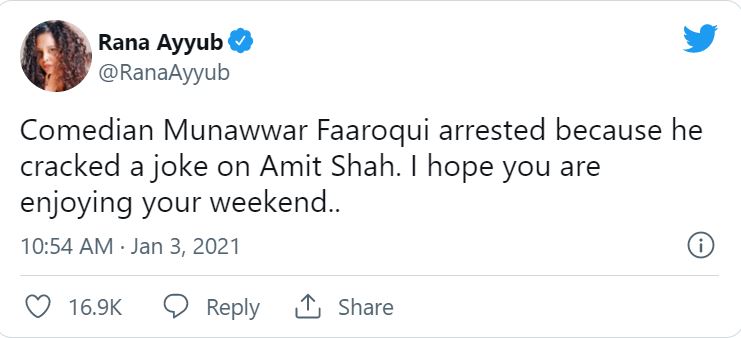
In January 2021, the Islamist propagandist concocted a fabricated story to sympathise with ‘comedian’ Munawar Faruqui, after he was sent to jail for mocking Hindu victims of the Godhra riots of 2002 in his shows. In an obvious attempt to vilify the BJP government at the centre and to portray them as intolerant, she tweeted that Munawar Faruqui was arrested only because he cracked a joke on Amit Shah.
Rana Ayyub’s Tweet posted on Jan 3, 2021
Ayyub’s tweet was quoted by a Pakistani journalist, who compared India and Pakistan and insinuated that freedom of expression is suppressed in both countries. Many such similar tweets were made where it was claimed that Faruqui’s arrest was sole because he mocked HM Amit Shah.
Her assertion was obviously completely devoid of facts and was solely intended to criticise the central government. The truth was that Faruqui was arrested for allegedly mocking and insulting Hindu deities. As per the complaint, indecent remarks were passed against Hindu gods and goddesses along with Amit Shah during Faruqui’s show. Ayyub had purposely omitted the bit about ‘Hindu deities’ in her tweet.
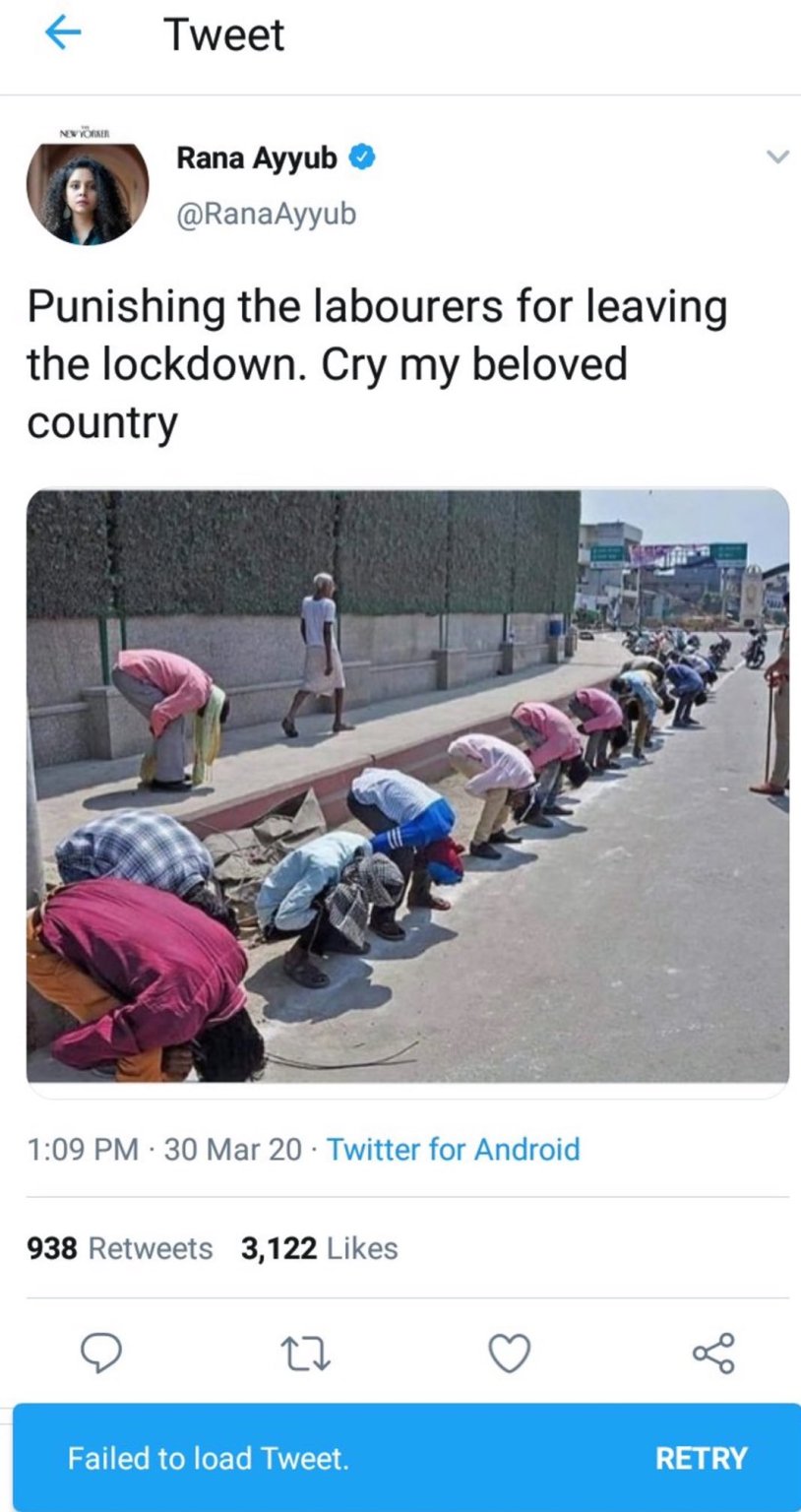
Rana Ayyub shares old picture of curfew defaulters being punished as that of migrant labourers
In 2020, when India was grappling with the first bout of the deadly Wuhan Coronavirus, the Islamist masquerading as a journalist attempted to discredit the government and the administration by sharing an image of some men made to squat and hold their ears as punishment. The men were standing on side of a road in a line.
Deleted tweet by Rana Ayyub
In her later Tweet that she deleted, Ayyub claimed that the labourers were being punished for leaving during the lockdown. However, it was proved almost immediately that the image was not of labourers being punished but of those who broke the curfew. A Twitter user @AttomeyBharti had then revealed that the image was from 24th March 2020 from Kanpur leaving the ‘journalist’ red-faced.
Rana Ayyub and her lies surrounding the central govt’s Citizenship Amendment Act
In September 2020, deliberated by her penchant to lie and spread misinformation, Islamist ‘journalist’ and habitual fake news peddler Rana Ayyub had again told the same lies on CAA, in an article about a Shaheen Bagh protestor in Time magazine.
Writing an ode to Bilkis, Rana Ayyub, in her article, has claimed that the 82-year-old ‘protestor’ was the ‘voice of the marginalized’ in India, who would sit at a protest site from morning to midnight.
Continuing her usual antics, Rana Ayyub blatantly lied that Bilkis, the 82-year-old anti-CAA protestor at Shaheen Bagh, was sitting as a mark of protests at Shaheen Bagh ever since Indian Prime Minister Narendra Modi’s government passed the Citizenship Amendment Act, which “could block Muslims from citizenship in the country”.
Ironically, Rana’s ode to Shaheen Bagh daadi had come days after the Delhi Police has submitted in court that the women at Shaheen Bagh were being paid to sit in protest, like daily wage workers.
Despite knowing the fact that Citizenship Amendment Act passed by the Indian parliament has nothing to do with Indian citizens, Muslim or otherwise, as it seeks to grant citizenship to persecuted religious minorities in Pakistan, Bangladesh and Afghanistan, Rana Ayyub has continuously resorted to openly peddling fake news on the Citizenship Amendment Act saying that the legislation “could block Muslims from citizenship in the country”.
Shockingly, the publications like ‘TIME’ which publishes such lies in its list of influential people across the world, failed to check the misinformation peddled by the likes of Rana Ayyub and instead provides a platform to push fake news on Indian laws.
Rana Ayyub outrightly lies that Muslims protested ‘peacefully’ against CAA
Continuing with usual antics to propagate outright lies regarding the anti-CAA riots that have been unleashed by Muslim mobs in the country, the Islamist troll masquerading as a journalist had gone on to make hysterical claims stating that PM Modi has driven Muslims of this country to a wall, to which the Muslims of the country have reacted by breaking their silence.
She then went on to make fake claims by stating that the Muslims who were opposing the Modi government was passive for the last six years, however, with Modi government taking decisive decisions on abrogation of Article 370 and passing of Citizenship Amendment Act have now made Muslims come out on streets to protest “peacefully” against the government.
However, Rana Ayyub’s claims that ‘protest’ march taken out by the Muslim mobs across the country against the CAA were ‘peaceful’ is an outright lie. In fact, the anti-CAA riots in which extreme violence and vandalism were recorded across the country have been instigated mostly by Muslim mobs. OpIndia complied with a list of violence perpetrated by Muslims across the country during the anti-CAA protests.
Likewise, after fanatic Muslims in Bangladesh unleashed hell on Hindus in Bangladesh attacking Durga puja pandals on October 14 last year, the terrorist apologist, instead of condemning the Hindu bloodbath by radical Muslims had used the opportunity to express her admiration for Muslims in India’s almost endless patience. Spewing hatred for Indians and Hindus, Ayyub stated that she had not stopped thinking about the incredible tolerance displayed by India’s 200 million Muslims in the face of daily attacks and humiliation under the Modi regime.
Basically, while Hindus have routinely come under attack by Muslim mobs, Muslim apologists like Rana Ayyub has continued to promote the myth of “Hindus murdering Muslims”. Rana Ayyub, who is an Islamist masquerading as a journalist had also called the Uttar Pradesh “Islamophobes” when they had taken action against the rioting mobs. It was almost as if she was saying that just because the rioters were Muslims, they should be allowed to riot on the streets of Uttar Pradesh.
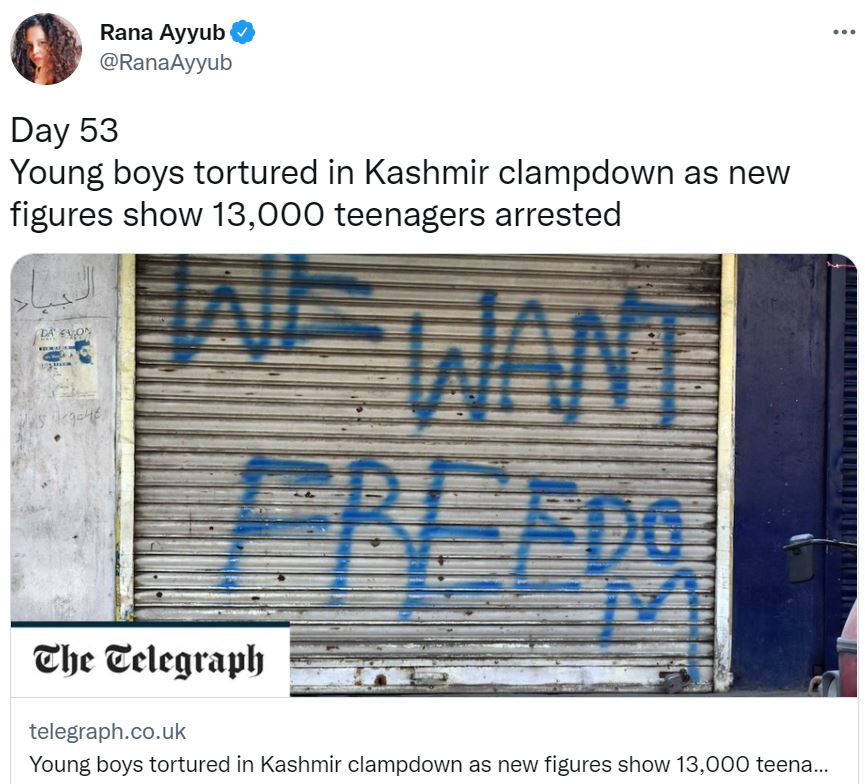
When CRPF busted Rana Ayyub lies about young boys being tortured in Kashmir
In 2019, the controversial journalist had tried to tarnish the Central government by making baseless claims about the situation in Kashmir. In a tweet, she alleged that the Kashmiri school children are being tortured and that there are 13000 teenagers arrested. She had shared a propaganda piece by UK daily The Telegraph to spread the brazen lies.
Rana Ayyub’s Sepetember 26, 2019 Tweet
No sooner than she Tweeted, a CRPF officer named Kashyap Kadaguttar termed journalist Rana Ayyub’s allegations of young boys being tortured in Kashmir completely bogus. He slammed Ayyub’s conviction in the slanted reporting of the western media. He described the article provided by Ayyub as “baseless reportage.” He claimed that no one had been tortured in Kashmir and chastised her for refusing to believe Army and government statements.
Yet another lie from Rana Ayyub’s long list
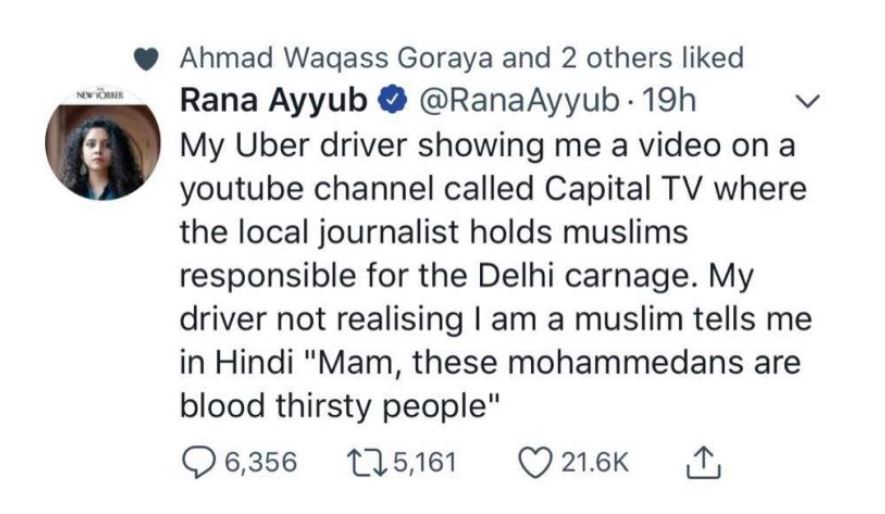
One of Rana Ayyub’s other acts was concocting an imaginary conversation designed to smear a TV channel covering the Hindu suffering of the Delhi riots.
The Uber driver, according to Rana Ayyub, was unaware that she is a Muslim. Rana Ayyub’s long litany of lies now included even another clear falsehood. Every Indian inhabitant knows how Uber works by now. The driver’s name is communicated to the passengers before we board the cab, and the passengers’ names are transmitted to the driver. Every time a passenger enters the cab, the driver verifies the passenger’s identity to verify he is picking up the correct individual. The passenger’s name stays glowing in large letters on the driver’s phone throughout the ride as the driver is driven to the passenger’s location using GPS.
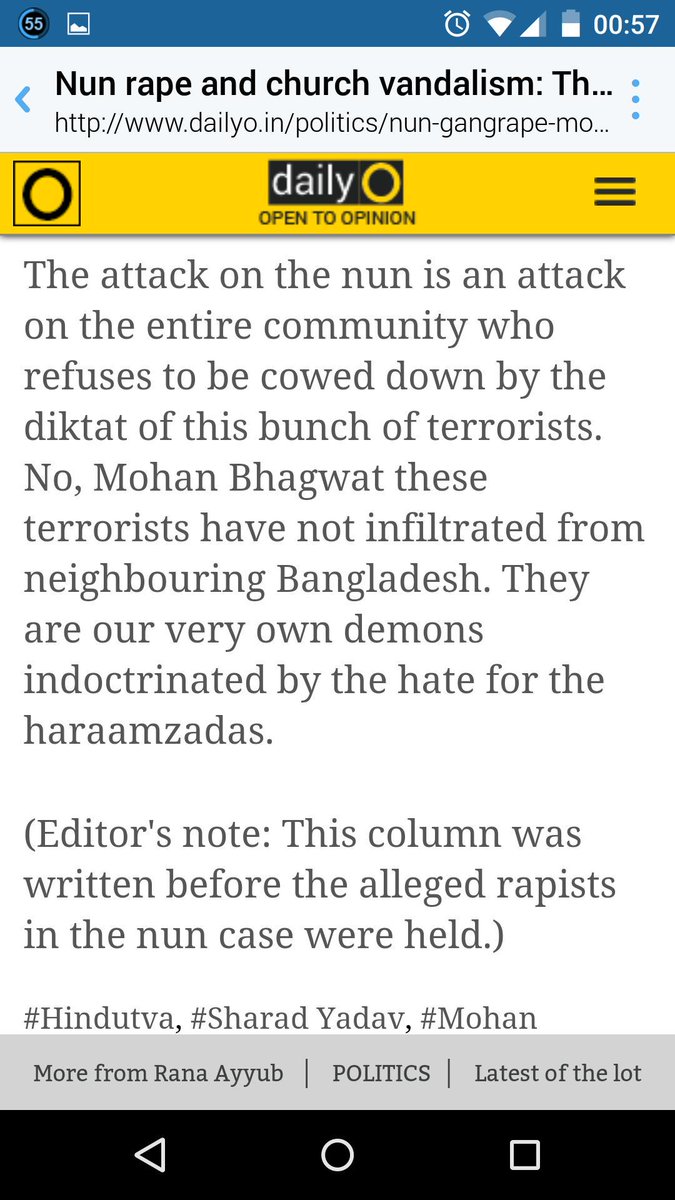
When Rana Ayyub blamed RSS and ‘Hindu terrorists’ for 2015 Ranaghat nun rape
When in 2015, a nun was gang-raped by eight men who plundered a Catholic church in Ranaghat, West Bengal, Rana Ayyub, ecstatic at the prospect of blaming the terrible atrocity on her favourite punching bag, the RSS and “Hindu terrorists,” wrote a comprehensive account of the occurrence for DailyO.
“No, Mohan Bhagwat these terrorists have not infiltrated from neighbouring Bangladesh. They are our very own demons indoctrinated by the hate for the haraamzadas,” she wrote.
All of the accused in this case has turned out to be Bangladeshis, including Salim Sheikh, Khaleda Rahaman Mintoo, and Ohidul Seikh. They were accused of violating IPC sections 120B, 395, 397, 376, 376 D, 212, 216 A, and 109 in 2017.
Despite the truth being revealed, the Hindu-hating writer Rana Ayyub, who dragged the RSS through the mud and slandered Hindus as “terrorists” over the nun-rape case displayed no regret, shame, or need to apologise for her hate-filled article.
SC thrashes Ayyub’s book on Gujarat riots
Rana Ayyub, who has a long-standing agenda against Narendra Modi, was also humiliated by the Court when it threw her “investigative” book on the Gujarat riots out of the window. The court had said that her book was based on conjectures and surmises only proving that Ayyub’s relationship with the truth is complicated, to say the least, while her bond with radical Islamism seems all-pervasive.
One of the innuendoes in Ayyub’s book was that then Gujarat CM Narendra Modi had planned ex-Gujarat Home Minister Haren Pandya’s murder who was shot dead on March 26, 2003, in Ahmedabad during a morning walk.
A trial court found 12 Muslim men guilty of Haren Pandya’s murder, including the main accused Asghar Ali. According to the CBI investigation, the murder was carried out on the orders of a Muslim cleric named Mufti Sufiyan in order to avenge the Gujarat riots.
The men were cleared of murder charges by the Gujarat High Court, citing a “botched investigation” by the CBI, but they were nonetheless charged with criminal conspiracy and attempted murder.
CBI had challenged the High Court ruling in Supreme Court, which eventually upheld the original trial court verdict. The apex court trashed the use of Rana Ayyub’s book ‘Gujarat Files – Anatomy of a Cover-up’ by the defence, stating that it was predicated on suppositions, conjectures and surmises. “The opinion of a person is not in the realm of the evidence,” had held the Supreme Court.
‘Journalist’ lies to draw false equivalence between convicted Indian Mujahideen terrorist Yasin Bhatkal and Sadhvi Pragya
The proverb ‘old habits die hard’ sits perfectly well with Rana Ayyub, a quintessential troll who masquerades as a journalist and often indulges in Hinduphobia and fake news. In 2019, Ayyub, in her new anti-Hindu propaganda, had attempted to equate convicted Islamic terrorist Yasin Bhatkal and Sadhvi Pragya Thakur the now Lok Sabha MP who was accused and not convicted in the Malegaon blast case of 2008.
Rana Ayyub had posted an image of Indian Express news reports, where one of the reports concerning Sadhvi Pragya Thakur, a victim of severe brutality and also, of Congress’ attempt to concoct fake ‘Hindu terror’ narrative, had been published adjacent to a report on dreaded Indian Mujahideen terrorist Yasin Bhatkal.
According to Rana Ayyub, a Hinduphobic troll who often masquerades as a journalist, the two reports depicted the ‘story of new India’. She went on to lament that the Indian Express report was on “two alleged terrorists, one with a Muslim name, another a Hindu name” insinuating, that Yasin Bhatkal was treated unfairly because he has a Muslim name or that Sadhvi Pragya is treated with kid gloves because she has a Hindu name.
Based on Ayyub’s theory of equivalence, there exists no difference between a convicted terrorist belonging to Indian Mujahideen and Sadhvi Pragya Thakur, who was accused and not convicted by any courts for her alleged role in the 2008 Malegaon case. In fact, the court had dropped MCOCA charges against Sadhvi and the NIA had given her a clean chit in the case.
When Rana Ayyub was called out by her own people
It is interesting how Rana Ayyub has been chastised by people across the political spectrum because of her proclivity for lying. It’s not just the right who believes Rana Ayyub is not worth being called a journalist, in fact, individuals on her side of the political spectrum also believe the same thing. It may be recalled how in October 2020, a little battle had brewed on Twitter between abusive troll masquerading as a journalist Swati Chaturvedi and conspiracy theorist masquerading as a journalist Rana Ayyub with the former rebuking the latter for plagiarising content.
She even revealed that the sexual harassment accused Tarun Tejpal had also referred to Rana Ayyub as ‘fraud and lazy reporter’.
Swati then shared an old Facebook post by disgraced cop Sanjiv Bhatt where he had insinuated, without really naming Rana Ayyub, that she had “amorous” relationship with one IPS officer investigating the encounter cases and with an activist-lawyer who was fighting the 2002 riots victims’ case.
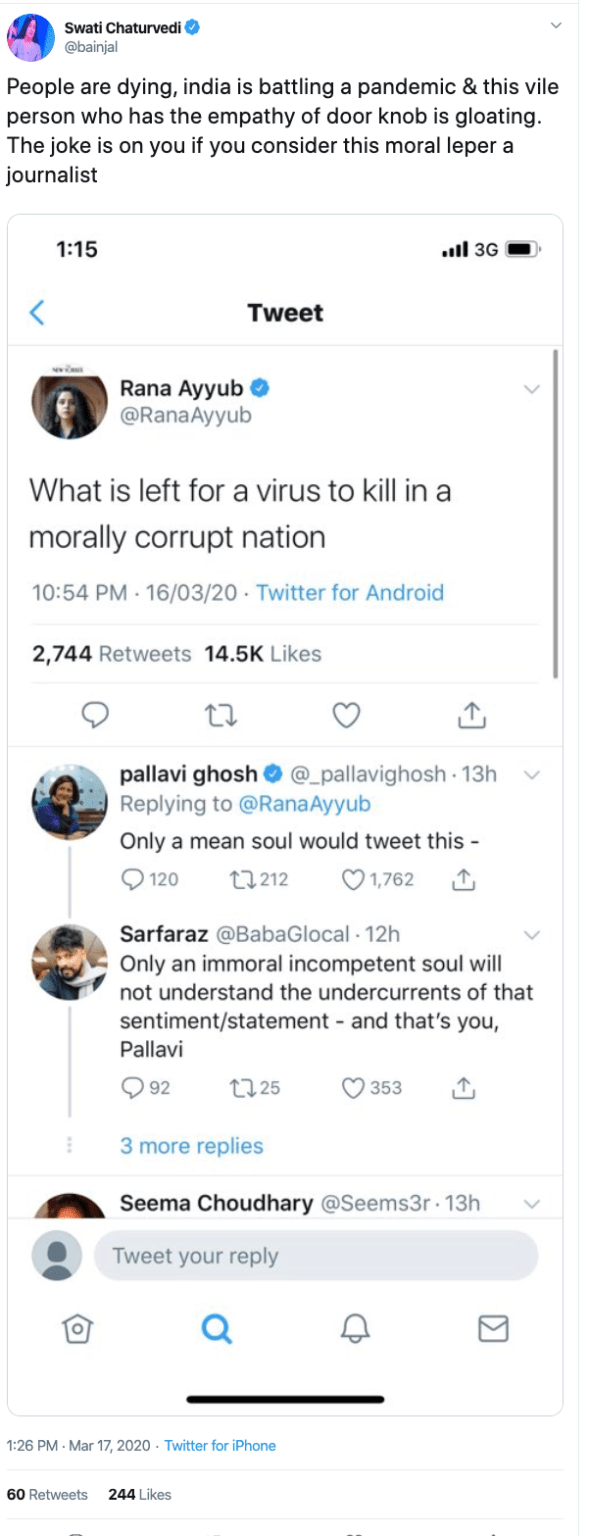
Prior to the, in March 2020, the duo came face to face when ‘journalist’ Swati Chaturvedi attacked Islamist Rana Ayyub for her insensitive tweet on the coronavirus outbreak in India. Amusing, Swati had then called Ayyub a ‘vile person’ and a ‘leper journalist’.
Tweet by Rana Ayyub
Since both Swati Chaturvedi and Rana Ayyub have consistently posted biased and misleading news to support their far-left narratives it was difficult to parse those accusations. But the exchange clearly reinforced one thing- it’s not only the right who believes Rana Ayyub isn’t a journalist; individuals on her side of the aisle believe the same thing.
FIR registered against Rana Ayyub alleging money laundering and cheating
While Rana Ayyub has often come under the fire for her malicious and fake reporting, she has also been accused of money laundering and cheating.
In September 2021, an FIR had been registered against controversial journalist Rana Ayyub over money laundering and fraud related to her fundraising campaign. The FIR was filed on 7th September at Indrapuram police station in Ghaziabad in UP in response to a complaint filed by Vikas Sakrityayan of the Hindu IT cell.
The complaint accuses Rana Ayyub of Money Laundering, Cheating, Dishonest Misappropriation of Property, Criminal Breach of Trust by illegally acquiring money from the general public in the name of charity. It says that Rana Ayyub happens to be a journalist by profession and was receiving foreign money without any kind of approval certificate/registration from the government, which is required as per the Foreign Contribution Regulation Act, 2010. Hence, she liable is also liable for violating the provisions of FCRA, the complaint had stated.
Based on this complaint, the FIR has been registered under sections 403, 406, 418, 420 or the Indian Penal Code (IPC), section 66D of the IT Act and section 4 of the Prevention of Money Laundering Act, 2002.