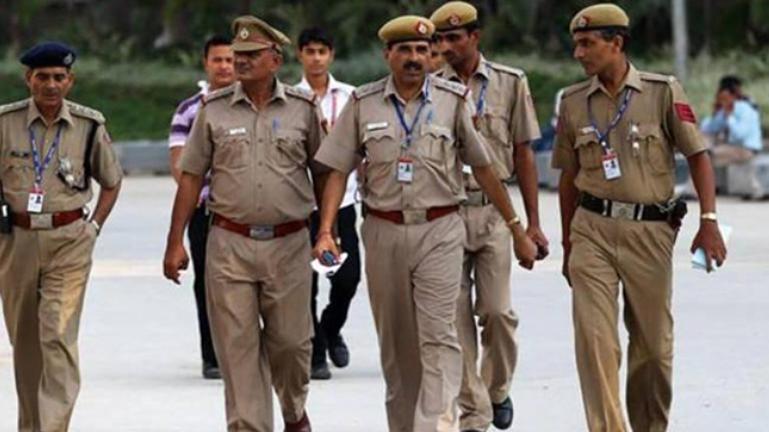
The Uttar Pradesh ATS has arrested 9 Bangladeshi nationals on Monday in connection to a human trafficking racket that involved sending Bangladeshi Nationals abroad by giving them fake Indian passports with Hindu names, according to reports. FIR has been registered against the accused over fraud and criminal conspiracy.
ATS initially informed about the arrests of 8 Bangladeshi nationals who were identified as Asidul Islam, Hussain Mohammad, Alamein Ahmed, Jaibul Islam, Jameel Ahmed, Rajeev Hussain, Shekhawat Khan and Aladdin Tariq. After interrogating these men, UP ATS arrested one Mahfuzur Rehman who received at least Rs. 1 lakh from each of the accused and gave them fake Indian documents with Hindu names.
ATS officials stated, “Acting on the information provided by the Bangladeshi nationals, the ATS arrested Mahfuzur Rehman, 34, from a Madarsa in 24 Pargana Kolkata on Monday. Rehman is also a Bangladeshi national who was found to be living on a fake ID. He is being brought to Lucknow on transit remand,” adding, “Investigation is being done to identify other people linked to the racket and active in the country. The further arrests will be based on the investigation into the matter,”
Reportedly, Asidul Islam became Vijay Das, Hussain Mohammad Fahad became Manik Dutta, Alamein became Rajesh Biswas, Jaibul Hussain Islam became Govinda Das, Rajeev Hussain became Ajit Das, Sheikhawat Khan became Golak Mandal, Aladdin Tariq became Rinkoon Biswas, Jameel Ahmed became Palas Bishwas in the fake Indian passports.
As per reports, the Bangladeshi Nationals were trained to speak and sign in the Hindi language in an abandoned Madrassa. Later, these illegal Bangladeshis were given fake Indian passports with Hindu names and were prepared to be sent abroad.
On October 26 Mithun Mandal, Shaon Ahmed, Mominur Islam and Mahendi Hasan were arrested from Deen Dayal Upadhya Railway Station, Mughalsarai in a human trafficking case. Anti-Terrorist Squad IG Gajendra Goswami has said that the Bangladeshi Nationals in Kanpur were arrested on the basis of information provided by Mithun Mandal, Shaon Ahmed, Mominur Islam and Mahendi Hasan.
Also, UP ATS had apprehended two Rohingyas, Noor Alam and Mohammad Jameel from Kolkata, West Bengal in November for forging illegal documents and facilitating the illegal entry of Bangladeshis and Rohingyas into India and abroad.
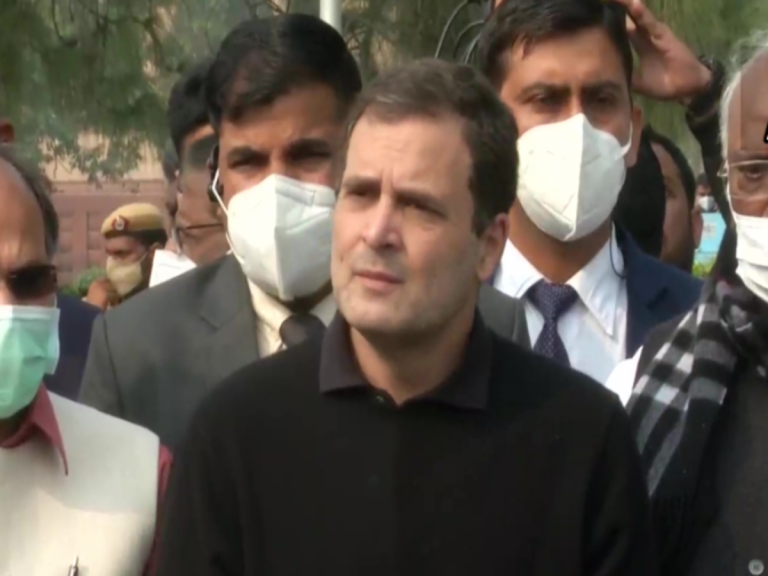
Senior Congress leader Rahul Gandhi seems to be miffed with the way the Parliament is supposed to be functioning, especially since it is functioning the way it seems to be. Earlier today, the Gandhi scion ranted against the Centre and the functioning of the parliament.
Surrounded by a retinue of Congress leaders, Mr Gandhi lamented that bills after bills are being passed in the parliament and that is not how the legislation is intended to work.
The official Twitter account of Youth Congress quoted Rahul Gandhi as saying: “Bills after Bills are being passed in the Parliament. This is not the way to run the Parliament.”
While Rahul ranted about the functioning of the parliament, the textbook definition of the parliamentary form of government says its function is to legislate, advise, criticise, and ventilate the public grievances; and that of the Executive, to govern. Thus, one of the most elementary functions of the parliament is to draft laws and pass Bills. A Bill is a statute in draft and becomes a Law once it receives approval of both Houses of Parliament and the assent of the President of India.
Legislators are elected to the parliament so that they heed their constituents’ demands and formulate policies and pass Bills that address their grievances and facilitate their life.
However, given Rahul’s past antecedents and his penchant for making comments without having knowledge about them, one may be inclined to believe that this might be another instance when the Gandhi scion had shot himself in the foot and fulminated against the basic functioning of the parliament.
Nevertheless, there’s also a video of Rahul Gandhi’s protestations about the way the parliament is working. In the video, Gandhi rails against the Centre, adding that the opposition is not being allowed to speak on any issue. He also bemoans that opposition members have been unjustly suspended and the parliament is functioning without their presence. He also says bills after bills after bills are being passed while the opposition members remain suspended and the Prime Minister remains absent from the Parliament.
विपक्षी सांसदों के निलंबन को 14 दिन हो गए हैं। जिन मुद्दों पर सदन में विपक्ष बहस करना चाहती है, उनपर हमें बहस नहीं करने दी जाती। जहां विपक्ष आवाज़ उठाने की कोशिश की जाती है, उन्हें निलंबित कर दिया जाता है। ये लोकतंत्र की हत्या है।
It is worth noting that the Rajya Sabha on the first day of its business in the Winter Session suspended 12 MPs, including Shiv Sena MP Priyanka Chaturvedi and Trinamool MP Dola Sen, for the remaining part of the current session. The MPs were suspended for misconduct and unruly behaviour in the House.
Rahul Gandhi attacks the Centre to pull a veil over shenanigans of opposition parties
Though Rahul accused the Centre of ramrodding bills in the parliament without seeking consultation from the opposition MPs, it is imperative to mention that it is the opposition legislators who create ruckus in the parliament when they lack numerical superiority to reject the bills. Another tactic employed by the legislators when they are in minority is to stage a walkout at the time of discussion of important bills. They deliberately indulge in such behaviour so that later on they can accuse the government of passing the bills without deliberating upon it in the parliament.
Earlier in February 2021, PM Modi had asked the opposition party members to deliberate upon the three farm laws that were passed by the government in September 2020. The laws, in some form or the other, were promoted by most opposition parties, including Congress, TMC, when they were in power or in their poll manifestos. However, in the wake of the farmer protests against the bill, they back-pedalled on their stance and vehemently opposed the laws aimed at modernising agriculture. So when PM Modi called for an all-party discussion on the laws in Feb 2021, the opposition staged a walkout and refused to debate over the issue.
As for the suspension of the opposition members, the Indian constitution invests power in the chair of the House to suspend legislators he deems to be indisciplined. And the same Constitution allows the working of the parliament in absence of the suspended members, lest legislators would use suspensions as an incentive to disrupt and delay the proceedings of the parliament.
Therefore, Rahul Gandhi’s grumblings against the functioning of the parliament appear nothing more than a disingenuous tirade, aimed at painting the Centre in a bad light while relieving the opposition of its responsibility of putting up strong checks and balances to rein in the government. In a sense, Rahul is trying to pull a veil over the shameful abdication of duty of the opposition parties and passing the buck on the Centre for their own inadequacies.
Moreover, parliament is meant for civilised, healthy debates and not a place where minorities can bully the ruling party into submission with crass, uncouth and extortionist behaviour. The BJP has the numbers and it is but natural that they will leverage its numerical advantage to pass the bills to their liking.
Four people have been arrested by the Karnataka police in Bengaluru for complicity in providing a fake RT-PCR negative report for a South African COVID positive patient, according to reports. The fake RT-PCR report enabled the South African to leave India via Dubai. The 66-year-old South African was confirmed to be the first Omicron case in India.
Karnataka | 4 people arrested for providing a false RT-PCR report to a South African national who was later confirmed to be India’s first Omicron case. The patient, who was in quarantine, managed to leave the country via Dubai after producing a fake report: DCP Central Bengaluru
As per reports, the South African National who arrived in India on November 20 was found COVID positive at the KempeGowda International Airport Bengaluru and was quarantined for 14 days in a hotel called Shangri La. The South African was the owner of a software company in Bengaluru and in order to escape the quarantine, he contacted his company staff who in turn contacted a private lab in Bengaluru and bribed the lab technicians. The swab samples of the South African was replaced with that of a healthy person and a fake report was produced by November 26.
FIR has been filed against the South African by the Bruhat Bengaluru Mahanagara Palike (BBMP). A case has also been registered against the management of Shangri La hotel. Among those arrested were two lab technicians of the private lab and two employees of the software company who helped in obtaining the fake report.
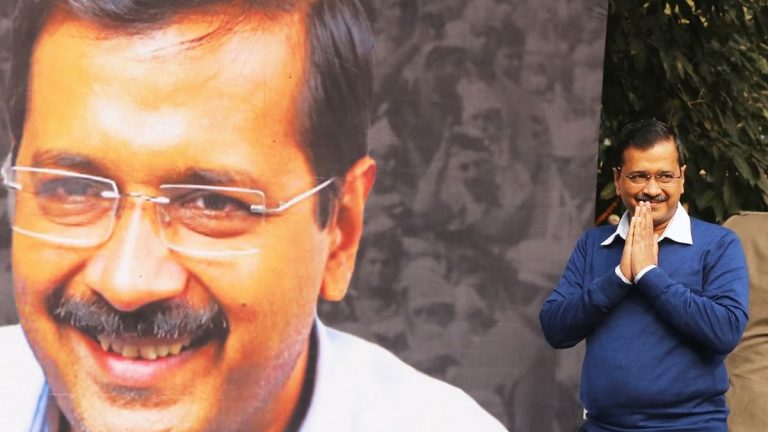
The long run-up to the 2024 general elections has already started. The political space is heating up and not a day passes without some development. Arvind Kejriwal is one of Modi’s challengers and is therefore worth a study.
At first glance, Kejriwal may seem like one of those comedians in Indian movies that come, make silly remarks, and vanish, without any connection to the main storyline. You can cut out those portions and insert them into any movie. But that would be foolish – if he is nothing else, Kejriwal is deviously clever.
Death of hope
To understand the Yugpurush, we must go back to his origins. Do you remember those days? There was the smell of springtime in the air, even burying the stench of UPA loot. Strangers were smiling and hugging each other on the streets. Ok, that was an exaggeration but for sure there was huge ho(y)pe. NRIs were tipping over each other to donate him money – they thought with a man like him running India, at least the next generation of Indians don’t have to be e-coolies like them, living abroad to escape the wretched existence of the Indian middle class, if not worse. Top bankers and Wall Street whiz kids were quitting their job to “change India”. For a while it did seem he will clean the rot of India’s politics like a Hercules, sweeping the muck off Augean stables. Little did they know he will only flood it with even more sewage.
So the great hope turned into a farce. A farce, that is one of India’s biggest tragedies.
How did it happen? It was death by a thousand cuts.
There were enough hints now that you have the benefit of hindsight. How neatly he usurped the apolitical anti-corruption movement into a vehicle for his personal ambitions! Did he not take a train to Varanasi as “aam aadmi”, to challenge Modi but took a chartered flight once the need for virtue-signalling was over? And then told us he wants every Indian to be flying private planes? How deftly he sidestepped and buried his main plank –Sheila Dixit’s alleged corruption – to take on Modi? And knowing how much the Stalinist left controls the media ecosystem and plants narratives, embraced Islamist jihadism, their all-weather ally, by seeking support of a controversial cleric who wanted author Taslima Nasreen killed? This fooled poor Muslims twice over – once by the dynasty and now by him! As if that were not enough, he dropped Hinduphobic sound bites. Today is going around promoting Ram Bhakti. Ideology to Kejri is like a T-shirt. Change it when fashion changes.
Along the way, many of his fellow travellers dropped off – some because they just couldn’t reduce themselves to sickening sycophants of the sort that can survive in his camp. His megalomaniac ambitions and conversion of AAP into a Lala firm where one man’s writ alone runs turned off anyone that had a modicum of self-respect. Do you remember he used to publish a list of donors? Has anyone seen that lately? No wonder starry-eyed bankers bailed out in disgust because they realised they have not discovered some golden cup with amrut from heavens but ditch water.
His dangerous embrace of separatist elements with bloody past in Punjab offered further proof of his sole agenda – to crown himself emperor, even if that means destroying the country. His ridiculous and nonsensical allegations of the “Singapore variant” of COVID” almost affected our friendly ties with this prosperous Asian country home to thousands of Indians. Until they perhaps realized he is just a clown not to be taken seriously. His other actions during the COVID crisis too showed his scant regard for norms, moral fabric and working together in times of crisis. Be it rapes and crime, COVID, pollution or any other matter, he only knows two things – take credit or blame others. Doing real work seems to be beyond his capability or intention as the infamous “AAP builds hospitals” farce showed. Instead of helping during the oxygen crisis, he was hindered. His “solutions” to problems like pollution have bordered on the nonsensical including sprinkling water on the froth in the river!
As I mentioned earlier, this farce is one of the biggest tragedies because Kejriwal has not just destroyed his own aura, he has made life difficult for anyone coming after him claiming to be the next messiah. Every honest man or woman entering politics with a similar message of “cleaning up” or change will be viewed as a charlatan and a possible fraud. That is his contribution to India’s politics thus far and that’s quite an impressive achievement. Isn’t that a tragedy?
Such was the hype, the corrupt media ecosystem, that once tried to paint him as a closet Sanghi because they were still benefiting from UPA loot and didn’t have an alternative source of cash flow in sight, embraced him as the Yugpurush that can deliver them their next farmhouse or Nirav Modi necklace. Now even they are fed up and have gone back to the familiar tastes and smells of dynastic boots they have licked their entire careers.
Today he is trying to buy them off with taxpayers’ money spending hundreds of crores on ads. Have you come across any media elite sitting in a Paris café sipping Bordeaux, objecting to his pictures in those ads? How about making kids stand all day in polluted traffic lights with a placard of his picture on their hands, asking them to turn off their engines?! Do you think some “speaking truth to power” journalist will talk about it? Supreme Court itself slammed the gimmick although it stopped short of mentioning Kejriwal’s pictures prominently displayed by the poor “volunteers”.
But all that makes no difference. That’s Indian politics. Key question is, can he do well in 2024? Who will he damage more?
Hope lives on.
In 2014, AAP contested 432 seats. It turned out to be a great source of revenue for the Election commission to defray the cost of elections because they lost a deposit in 413 of them! 2019 was a bit more realistic bid although that too failed big time. 40 contested, 1 won.
For now, his focus is on Punjab and Goa state elections scheduled for early 2022. If he can do well in 2022, that will power his 2024 ambitions even further. Clearly a majority is a must. Anything else will be a failure.
But he is back to his familiar game in these states. Freebies, courting the separatist votes and the like. And based on current opinion polls, chances look bleak.
Who will he damage more in 2024?
The game is very different for 2024. The majority is out of the question. Know the story of two friends chased by a tiger? One of them starts to put on his running shoes. The other says, “What’s the point? Tiger runs a lot faster!”. This guy replies – “I don’t have to outrun the tiger, only you!”
So if Kejri outruns the next loser, he is in the game. That could mean about 40 seats if Congress does badly and TMC doesn’t sweep WB. He could be the biggest game in town. Of course, we assume Modi/NDA go way below the majority. Implausible? Who knows?!
Looking at his strategy of courting Lord Ram and faux-Ayodhya temples in Delhi, it may appear he is going after BJP votes. But after incessant, rabid and vulgar attacks on Modi, he sealed off that potty sometime after 2019, focusing instead on embracing soft Hindutva. His attacks on Modi/BJP are far more nuanced and subtle now. What does that tell us?
One guess is that he is anticipating a Congress decimation and trying to mop up as much as possible of the dynasty vote before other vultures swoop in. That requires occupying the centrist space that Congress occupied, not the fringe left Bharat-tukde-tukde space Rahul is courting. That’s why he’s been remarkably quiet on issues that rile our comrades, shedding his leftist skin like a reptile.
This strategy, unfortunately, puts him in direct confrontation with Didi who is pursuing the same tactic with much greater vigour (and cash?), aggressively snatching jobless or dissatisfied Congress rebels. In fact, TMC moving into Goa, a state fancied by Kejriwal, adds to the problem.
One wonders how Goa voters are going to choose between these two born again Hindus. A Hanuman Chalisa recital contest? One mispronounced word, you are out? Only one of them is going to emerge out of this arena to tell us the story. Hint: WB has 40+ seats, Delhi only 7 that too with BJP enjoying clear vote share advantage in Delhi Parliamentary elections even if it loses the state ones.
Yet another problem is that in state after state, even if he can subdue Congress, he will run into regional satraps and dynasts who are no pushovers. Most of them are realists, focusing their energies on local politics, where takings can be equally rich and content to get a small share of the takings at the Center and let the famiglia enjoy the biggest piece. They are not going to roll over and play dead.
But ignoring best case scenarios, it is quite likely he will end up with single digit seats and he probably knows this.
Beyond 2024
With age on his side (he’s 53) and a possible complete write-off of Rahul’s career or whatever is left of it, post-2024, Kejriwal is playing a waiting game. Remember, Modi too would be nearly 80 in 2029. Even Didi will be 75. And the regional dynasts, if they are in the game at all, will happily let our Yugpurush occupy the throne in Delhi provided he doesn’t touch their lucrative franchises in the states. Having long given up any pretences of anti-corruption, that shouldn’t pose any moral dilemma for him. Remember the Laloo embrace?
Although mentioning the word moral in the same sentence as Yugpurush seems oxymoronic. That is the tragedy of this farce.
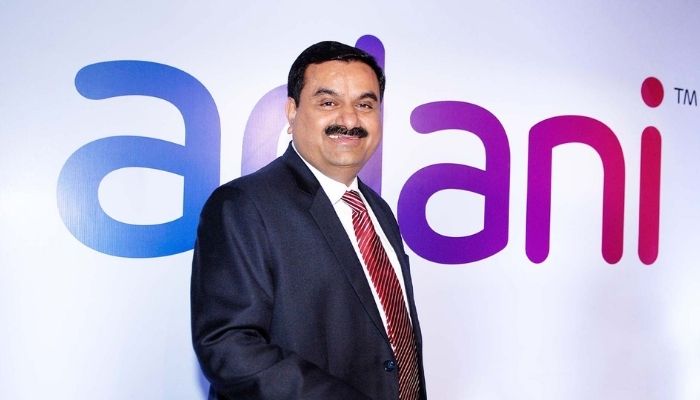
In a major boost to renewable energy generation, Adani Green Energy Ltd (AGEL) has inked the world’s largest power purchase agreement (PPA) with the Solar Energy Corporation of India (SECI).
In a statement, the Adani Group informed, “The AGEL-SECI agreement to supply 4,667 MW is part of a manufacturing-linked solar tender of 8,000 MW awarded to AGEL by SECI in June 2020, which set a record for being the world’s largest solar development tender ever awarded.”
Adani Group chairman Gautam Adani also took to Twitter to confirm the development. “After becoming the world’s largest solar power developer, Adani Green has signed the world’s largest ever green power purchase agreement with SECI to supply 4,667 MW. This will accelerate India’s RE footprint and promote manufacturing under Atmanirbhar Bharat. Jai Hind,” he wrote.
After becoming the world’s largest solar power developer, @AdaniGreen has signed the world’s largest ever green power purchase agreement with @SECI_Ltd to supply 4,667 MW. This will accelerate India’s RE footprint and promote manufacturing under Atmanirbhar Bharat. Jai Hind.
“Following the proceedings at COP 26, it is increasingly evident that the world has to equitably transition to a low carbon economy faster than previously anticipated. This is why the Adani Group has committed US$50-$70 Bn of investment in the renewables space. This agreement keeps us well on track to our commitment to become the world’s largest renewables player by 2030,” Gautam Adani had said in a statement.
As of now, AGEL has signed a pact for a total of 6000 MW of green power generation with SECI. The remaining 2000 MW pact will be sealed in the coming 2-3 months. The firm has a total operational and under construction power generation portfolio of 20.3 GW. AGEL has signed a deal with France’s total for 25GW green power generation by the year 2025. For an investment of $2.5 billion, Total has acquired a 20% stake in AGEL.
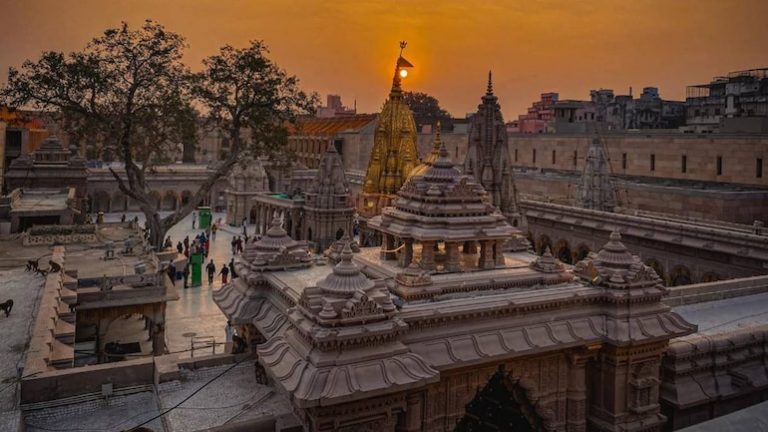
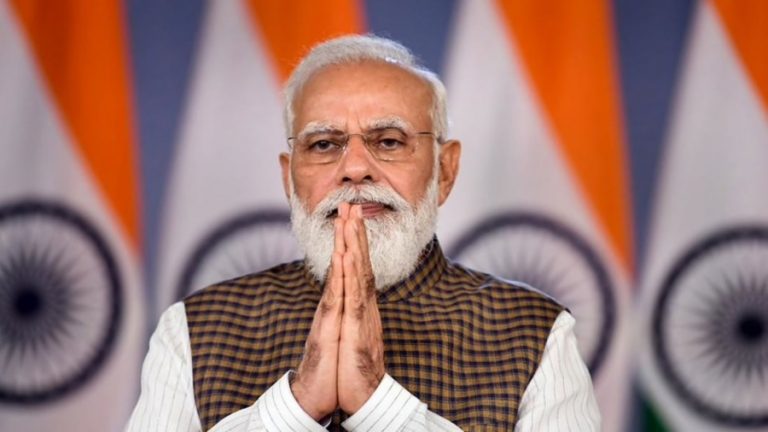
Prime Minister Narendra Modi on Monday inaugurated the Kashi Vishwanath Corridor Project, adding one more feather in his cap about preserving Hindu heritage.
The Shri Kashi Vishwanath Corridor, a pet project of Prime Minister Narendra Modi’s dream project, was dedicated to the nation on December 13, 2021. One of the 12 Jyotirlingams and a prime shrine for the Hindu faith, the Kashi Vishwanath temple, once a grand temple, was surrounded by encroachments and chaos. Now, the same area has everything in order.
Those who have seen Kashi Vishwanath temple before the Corridor project started have witnessed the chaos. For them, the site is now no less than a dream. The Prime Minister’s dream project, his resolution to build a grant corridor to connect Maa Ganga to Vishwanath Mandir, took 33 months to become a reality. On March 8, 2019, PM Modi had laid the foundation of the corridor project. The chief architect of the project is Bimal Patel. He was also behind the Sabarmati River Front project and Central Vista Project.
The Print spreads misapprehensions about The Kashi Vishwanath Corridor Project
Now, as PM Modi inaugurated the Corridor and proceeded in the direction of restoring Varanasi to its past glory, it is worth noting how Shekhar Gupta’s The Print had tried to cast a pal over the restoration project and stoked fallacious notions about it.
In an interview back in January 2020 with the chief architect of the Kashi Vishwanath Project Bimal Patel, Jyoti Malhotra of The Print insinuated that the Kashi Vishwanath Project was PM Modi’s vanity project—a mistaken belief often peddled by the Left to belittle PM Modi’s push for building infrastructure. The journalist then went on to surmise that the project entailed the destruction of centuries-old temples.
However, Bimal Patel promptly corrected her, asserting that her beliefs were not grounded in facts and motivated by anti-Modi propaganda. Patel said it was not temples but buildings that were encroached upon ancient temples that were demolished as a part of the Kashi Vishwanath Project.
“Have you seen the pictures? There are terrific pictures of buildings and their concrete beams resting on temples and only when the buildings were removed did you find the temples inside. In fact, we are weaving them inside the design of the Corridor,” Patel said.
But The Print journalist did not seem to be the one who would be chastened by factual details. She then went on to question Patel if hundreds of buildings that were being demolished for the project had a character of their own. To this, Patel said everything acquires a character of its own if left to its own devices.
“Yeah, you are correct. The buildings had a character of their own. So did the slum in the areas. You had sewage flowing freely. You had encroachments on top of temples, sewage dribbling down the sides of the building. All of this has character. But there are 100,000 pilgrims coming here on certain days, it is a security nightmare. Do you know who first proposed this idea? It was Gandhi,” Patel said.
On December 14, the Madras High Court quashed an FIR registered by the Madurai city cybercrime Police against YouTuber Maridhas over a tweet. In the order, Justice GR Swaminathan said that the offences mentioned in the FIR were not made in the tweet.
Maridhas had posted a tweet after the IAF Chopper crash in which former Chief of Defence Staff (CDS) Late General Bipin Rawat, his wife and 11 others lost their lives. In the tweet, he said, “Is TN turning into another Kashmir under the DMK regime?” Later he had deleted the tweet. However, a complaint was filed against him by Balakrishnan, a functionary of DMK.
In another tweet, Maridhas alleged that many DMK supporters have been posting emojis mocking the death of an army commander in the accident. “They do this every time”, wrote the YouTuber adding that DMK is the “best choice for separatist forces”. This Tweet was available at the time of writing this report.
Based on the complaint, the Madurai city cybercrime Police filed an FIR against him under Sections 124 (A) (sedition), 153A (promoting enmity between different groups on the grounds of religion, race, place of birth, residence, language, etc., and doing acts prejudicial to maintenance of harmony), 504 (intentional insult with intent to provoke breach of the peace) of the Indian Penal Code. He was also booked for under sections 505 (ii) (publishing a statement with intent to cause fear among the public) of the Indian Penal Code.
BJP leaders, including state president K Annamalaihad, had opposed his arrest on December 11. Annamalaidhad had said his arrest has “seriously violated the freedom of expression available to all guaranteed by law. The BJP Tamil Nadu would fight tooth and nail to get all of them out of their judicial confinement. Our party would take care of them and their families in all respects.”
Contemporary politics is highly polarised. Ours is the age of binaries and divisions of convenience. The Right-Left binary that originated in the times of the French Revolution when liberal deputies of the Third Estate would generally sit to the left of the presiding officer’s chair while the nobility (the Second Estate) would sit to the right, in a custom that began in the Estates General in 1789, has become the premise of delineating party politics and ideology the world over. In all this, while the Left maintains a certain identity and unity on what it stands for, a glaring question is: Is there an international Right-wing? Norberto Bobbio, might I add rather controversially, posited that the right-wing has traditionally been seen as being supportive of certain social structures that promote hierarchies, if not outright inequality, seeing it as the natural order of things. This binary copula was developed into one involving inclusion and exclusion by Alessandro Pizzorno, who famously said in an interview in 1995:
“What matters to the individual is knowing whether he is excluded or accepted, whether or not he is considered as being equal to the others.”
Ref: Gnoli, Antonio. Caro Bobbio, ecco dove sbagli. La Repubblica. 1995.
The idea that there is a certain ‘otherness’ defined could be due to ingrained social differences or class structures arising in market economies, among other possible causes. This binary has been fluid many-a-times, with British politics being a prime example of the same: the Right and the Left have seemingly had a synchronised movement towards and away from the centre over the decades (not-quite-centrist John Smith became leader of the Labour party to counter the post-Thatcherite John Major years for the Conservatives, which was fairly Right-wing, even as a centrist like David Cameron came to the Conservative helm-of-affairs to counter the Blairite centrism in the Labour party).
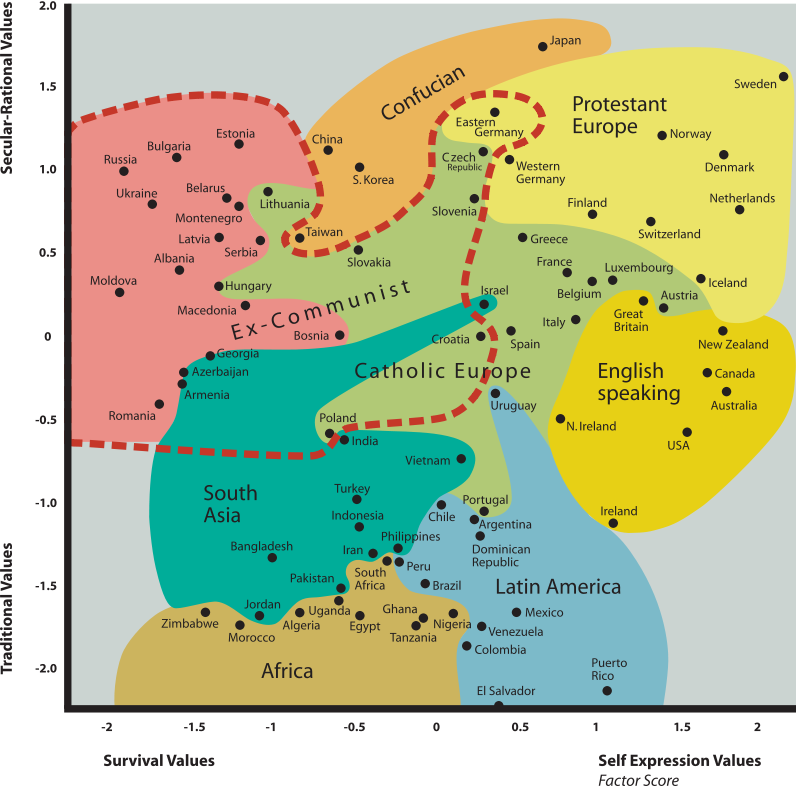
A version of the Inglehart–Welzel cultural world-map, which is based on the World Values Survey. (Source: Koyos)
This fluidity, nay the near-dissolution of distinctions, is particularly expressed when one of the sides of the proverbial aisle becomes predominant. This is primarily because then the dominant side tries to project that there is no real alternative while the weaker side has its interest in playing down any differences with the dominant side. The Right, for one, has not always been as strong as it is in many parts of the world today.
After the second world war, with the fall of Nazi Germany and Italian Fascism, people widely supported collectivist ideals and Right-of-Centre parties such as the Christian Democrats had to at least pretend to align with values like social cohesion. More generally, the Left-Right binary is dynamic and in one age is not necessarily the same as in another, not due to a vacuity in meaning but rather due to relativity and context.
The Intricacies of Inclusivity and Freedom
The Right and the Left do not represent any fixed ideas but are oriented around a political axis that is calibrated and shifted in various generations. In contemporary politics, the binary has increasingly become just an instrument of antithetical politics: what is not us is them. Historically, and particularly in Pizzorno’s formulation, this kind of politics has annotated a certain preeminence to the idea of egalitarianism (which relates to Bobbio’s egualitarista, which specifically talks of a utopian conception than a pragmatic one), either in a utopian regimentation (where one has equality for everyone in everything) or a more pragmatic idea of the same (which engages with questions like equality between whom, in what and on what basis).
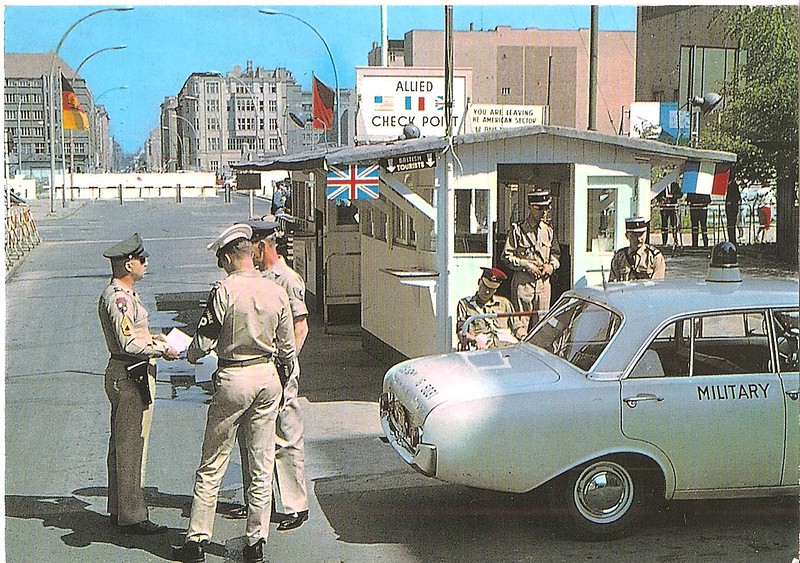
Checkpoint between East and West Berlin. Berlin was divided by the Allied Power and Soviet Union. East Berlin was capital of the Soviet-supported socialist republic known as the German Democratic Republic, while West Berlin was a political enclave occupied by the western Allied forces, after World War II. This was one of the most glaring instances of the Left-Right divide being etched into the borders of a nation-state. (Source: Flickr)
The difference between the Left and the Right has been on the degree of equality-inequality within a specific historical and cultural context. The difference is considered the opposite of regimented equality while inequality is the opposite of pragmatic equality. The difference can be seen as a positive quality since it facilitates the freedom of every individual to develop his or her unique tendencies and particular natures. An interesting idea that early modern thinkers put forth is that equality and distinct development of individuals need not necessarily be at loggerheads with each other. For instance, Massimo Cacciari once famously said:
“Equality makes diversity possible, and makes it possible for everyone to count as a person.”
Ref: Cacciari, M. Dialoghetto sulla “sinisteritas” MicroMega. 1993.
One important point here is that freedom defines autonomy and the possibility of an individual to be distinct, and does not belong as a ‘concept’ to either the Left or the Right, being the individual good that it is. However, these binaries of equality-inequality and inclusion-exclusion have made way to a formulation based on the concept of liberty and social justice. Europe has been guided by the ideal of liberty since the Enlightenment.
The conflict between the Left and the Right has increasingly been about what must be given greater emphasis: social rights or libertarian rights. Funnily both have accused the other of having preferred the latter over the former: the Left accuses the Right of having done so at the expense of the interests of a community structure while the Right has accused the Left of doing so at the expense of traditional social constructs.
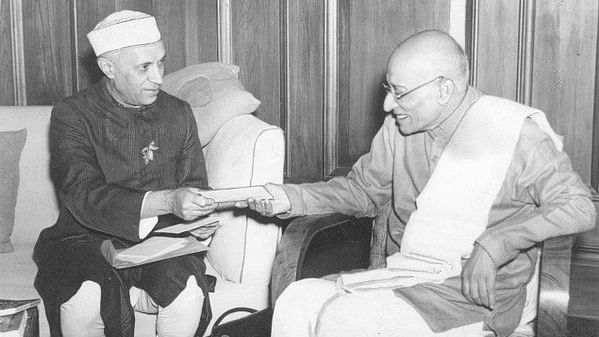
Chakravarthi Rajagopalachari, India’s first Indian governor general, coined the term “license-permit Raj” to describe Nehru’s elaborate red-tapeism that an individual had to deal with, to set up a private enterprise. He founded the Swatantra Party, which stood for equality and opposed government control over the private sector. (Source: @ArchiveIndia)
The modern political Universe comprises two entirely separate axes: libertarianism/authoritarianism and left/right. We have the extreme and moderate Right and Left, with the extremists usually being viewed as authoritarian. In India, we often see a possible anomaly on this count in the Left which seems to often stand for an extreme egalitarianism that they try to dish out with the ideas of market economy, universal suffrage, tolerance and religious freedom, whose last remaining semblances have also all been dismantled as evident from the given citations. This anomaly is easily resolved by accounting for what Gerrard Winstanley once famously mentioned in his dedication of The Law of Freedom in a Platform (1652) to Oliver Cromwell:
“You have the power … to act for common freedom if you will: I have no power.”
Ref: G. Winstanley , The Law of Freedom and Other Writings. Harmondsworth: Penguin. 1973.
We can also discuss an interesting instantiation, although quite different in many ways, in the workings of the Rashtriya Swayamsevak Sangh in India, which has increasingly tried to bring together its strongly revivalist socio-cultural and political advance with inherently liberal and modern tendencies, and in this case, they have done so by curbing and controlling some of the more radical elements in their fold. What has been different in Sangh’s case is that, while there have been instances of violence during the tenure of the current regime and in the past, clout has not been imposed and misused anywhere close to the extent the red scourge of the communists back in the day, where not just scientific rigging and subversion of democracy was undertaken, even massacres (like the Marachjhapi Massacre) and condescension of inherently Indian elements of life and society (such as religious sentiments and practices) were undertaken.
Trajectory of, and Diversity in, the International Right
The Right-wing arose in reaction to the activities of the early Marxist movements, which were in opposition to European monarchies. Some of these monarchies made the advocacy of communism illegal. This included the German, Russian and Austria-Hungary monarchies. These monarchies viewed the hierarchy in wealth and power in society as resulting from a divine natural order. The end of World War I saw the defeat of some of the most powerful monarchies in the world, including the Ottomans and the Germans.
The divine right of monarchs gave way to liberalism and nationalism as the primary forces that stood against communism. It is interesting to note that although Karl Marx and Friedrich Engels saw in the concepts of nation-state and nationalism a bourgeois tint, so to say, both regarded the creation of the centralized state as a facilitator of positive social conditions that could help stimulate class struggle! Stalin promoted revolutionary patriotism, a civic patriotic concept, while Josip Broz Tito promoted Yugoslavism. However, by the end of the first World War, with Stalin himself embracing a more universal cosmopolitan modernity, the communists gave greater emphasis on internationalism, and therefore, the nationalists who opposed them were invariably placed on the Right. Soon, fascist movements, liberal conservatives and colonial powers replaced the traditional Right, in the opposition to communism.
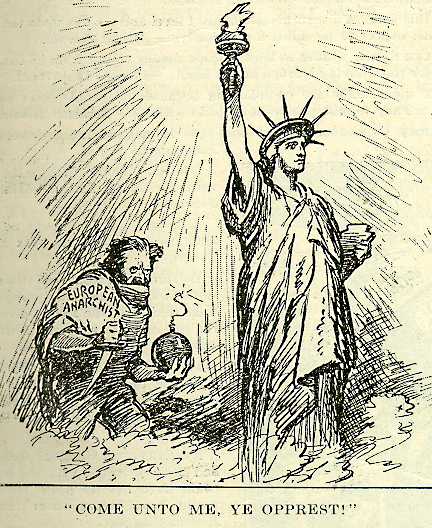
A political cartoon from 1919 depicting a European anarchist attempting to destroy the Statue of Liberty. This was during the First Red Scare, which was the promotion of widespread fear of a potential rise of anarchism, communism or other Left-wing ideologies by a state or society. This was a period of turmoil, when in June 1919, eight bombs exploded simultaneously in eight different cities! (Originally from the Memphis Commercial Appeal)
After the Second World War, anti-communism was an important part of the foreign policy of NATO. The Right, or conservatism to be more precise, started focussing more on traditional values (particularly religious) and on patriotism and nationalism. McCarthyism rose in the US to offset communist influences in the States. Economically, the Right has not had such a clean trajectory. In the early days, the Right was collectivist and against liberalism (with the advocacy of paternalist class harmony). A marked shift took place in the nineteenth century when the Right started favouring capitalists over the working class, instead of being fixated on traditional structures oriented around the nobility and industrialists, even though this movement was not uniform or straightforward (with some outliers like Carlists in Spain). Even today, while many of us may think that being Right-wing means being aligned exclusively with laissez-faire capitalism, that is not true.
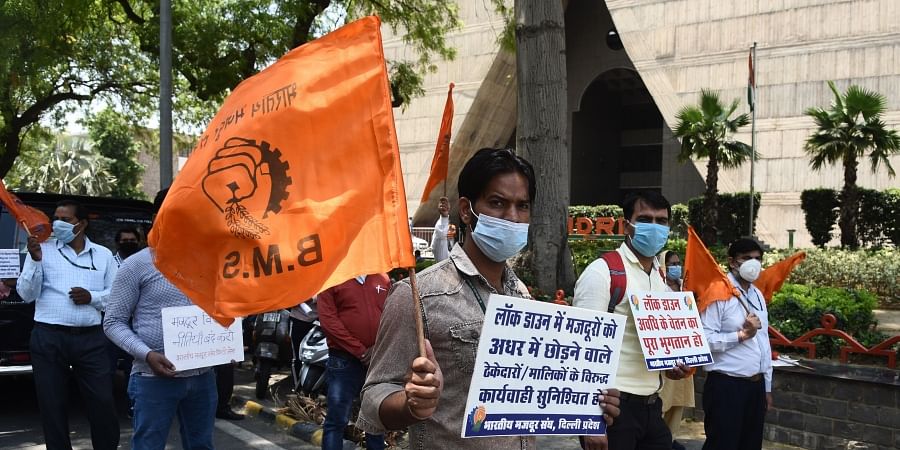
Bharatiya Mazdoor Sangh (BSM) is one of the largest trade unions of the world and is an affiliate of the Sangh Parivar. It has often opposed policies of the BJP government that it feels are anti-workers. Here we can see protests over what they see as the dilution of labour laws. Even though both BSM and BJP belong to the Sangh Parivar and attest to similar socio-cultural ideas, they clearly are at great variance economically many-a-times. (Source: The New Indian Express)
Right-wing movements like the American paleoconservatists oppose capitalists even today since they see them as catalysing the decay of social structures, hierarchies and order. Even though the French Right supported capitalism from the late nineteenth century itself, it was only with Reaganian and Thatcherite political posturing with the neoliberal Right that ideas like liberalisation, privatisation, deregulation and free markets became so deeply intertwined in a significant manner with the traditional Right’s alignment with traditional social constructs, in a curious socio-economic cocktail. Politically, the Right has believed in the idea that the state gets its political legitimacy from a certain organic unity of its citizens, which is built on collectively shared culture, race, religion and language. Culturally, the Right traditionally is conservatist, and supports the idea that the heritage of a culture or nation must be preserved. As historian and journalist Rick Perlstein once said:
“One of the most important things liberals don’t understand about conservatism, obscured by too much lazy talk about conservatism’s various ‘wings,’ is that its tenets form a relatively organic base for its adherents, where ‘traditional morality’ serves the interests of laissez-faire economics and vice-versa.”
Socially, the Right supports social order and stratification, seeing it as a natural and inevitable occurrence. Social conservatives have a certain commitment to traditional values concerned with family structures, sexuality, patriotism and national security. One of the outlying agendas of social conservatives in India is the institutionalisation of the Uniform Civil Code (a proposal to establish secular personal laws of citizens which apply to all citizens equally regardless of their religion). This is because Hindu nationalists do not perceive the Hindu identity only as a religious one, if at all in some cases. They regard it as a national and civilisational identity, which needs to be cherished and maintained.
To understand whether we can regard the conservatives and libertarians along with the widely-purported-as-Right parties in India as truly Right-wing, we must see what kinds of elements are present in the international Right. The New Right comprises of liberal conservatives who speak of free markets, minimal governance by the state and individual initiative. The reactionary right works with a sense of nostalgia, looking towards the past, and often being authoritarian (possibly aristocratic) and standing with traditional values, particularly religious.
The moderates on the Right can tolerate gradual change that incorporates some nuances of liberalism. While they support free markets, capitalism, social welfare, nationalism and the rule of law as important, they also see extreme individualism and radical laissez-faire policies as counterproductive. The radical Right usually involves populists among other subtypes, while the extreme Right is characterised by ultra-nationalism, anti-democratic stances, support for a strong state and possible alignment with racism. More simply, one could talk of the centre-Right and the far-Right. The former is supportive of capitalism and the market economy, liberal democracy, limited welfare state (funnily, it was Otto van Bismarck, a German conservative, who first brought the idea of a pension-based Welfare State, not any communist or Left-wing government!) and private property rights. The latter is more absolutist and seeks to use the power of the state to assert the dominance of a specific religious or ethnic group.
Do we have or need an Indian Right?
Having looked at these myriad aspects of the international Right, the key question is: does India have a Right-wing? You must be jeering at me having even asked the question, but a bit more scrutiny will make clear that it is not as trivial as it may seem to be, as a question. What if I were to say that India has no Right-wing party or homogenous Right-wing political positioning? Ridiculous, you may say! But is it? The Nehruvian socialist model is often purported to be a liability that hampered India’s growth in its early years post-Independence. India has a large middle-class population and an ever-burgeoning young populace, both of which are aspirational.
The political significance of aspiration cannot be understated, with it having been the primary premise on which Tony Blair famously rolled out his New Labour campaign back in the 1990s. Are having aspirations a natural way to adopting the economic Right? Some would argue yes. But it is exactly by the Blairite revolution in England that we can see why this is a false premise. Addressing aspirations can be made to go hand-in-hand with a more egalitarian perspective, with a greater emphasis on social justice. We do not have to look too far to see that. In India, any and every government has to do this balancing act if it has to survive.
The current government, which is projected as the first government formed by a Right-wing party (the BJP) with an absolute majority on its own, has been a champion of egalitarian welfarism. Be it zero-budget farming, programmes like PMAY-Gramin and Pradhan Mantri Gram Sadak Yojana, or the measures such as colossal food and fertiliser subsidies (such as in FY21, which touched a whopping Rs. 6.52 lakh crore), the BJP brings forward a certain social consciousness and compassion that it is made to always stand by due to the ethos of the Sangh, which also happens to have the largest workers’ union in the country – the Bharatiya Mazdoor Sangh. Pandit Deendayal Upadhyaya, who formulated the set of concepts known as Integral Humanism (which is the official doctrine of the Bharatiya Janata Party), stood by centralised planning along with state ownership of productive activity, having once stated that
“To set the process of economic development moving, to keep the economy on an even keel the state must undertake in general to plan, direct, regulate and control economic effort and in certain specific spheres and circumstances to accept the responsibility of ownership and management too”
In his book Two Plans: Promises, Performances, Prospects, he speaks about the nationalisation of industries:
“We not only want the nationalisation of basic industries, but also wish to apply this principle to those industries, which enjoy the monopoly of only a handful of people”
Strange as it may seem, one of the key guiding forefathers of the BJP clearly stood by a path that the likes of Nehru and Indira Gandhi would have quite aligned with! What was, however, very different in his viewpoint was his greater focus on employment generation with small units. He preferred the imposition of low taxes and possibly a slower pace of growth, to facilitate the growth of indigenous small-scale market players at their own pace. He also spoke against the corruption, hoarding and black-marketing in the way planning was undertaken by the Nehruvian regime. Having said that, there were aspects such as the joint ownership of property between the individual and the state that Pandit Deendayal Upadhyaya espoused, and which do not come under the purview of a major cross-section of the traditional international Right. Even luminaries from other cross-sections of the political spectrum have never aligned with any single political lobby or tradition.
Dr. Bhimrao Ambedkar championed individual freedom but also favoured collective action against caste oppression. Dr Manmohan Singh was a Nehruvian economist who ushered in the liberalisation of India. Mahatma Gandhi himself was a supporter of moderated Right-wing economics with trusteeships and Swadeshi goods and services but had certain aspects to his life that would not quite make him a social conservative.
The current BJP government is also placed converse to what many libertarians or conservatives would expect from a Right-wing government. The role of the state has seemingly reduced, particularly by using technology to reduce the government-to-citizen interfaces with local bureaucrats, who have traditionally been seen as being corrupt. However, the role of the government overall may well have increased, even as the governments try to augment such innovations and interventions. This is possibly because the demand of the common man may not be as much on less government but rather on a better and transparent government, which the BJP is trying to deliver. Some of the economic stalwarts aligned with the BJP and the Sangh, such as Dattopant Thengadi and S. Gurumurthy, are also not quite aligned with the libertarian or conservative ideal, in not being dismissive of globalisation but at the same time being strong proponents of the domestic-first model with varying degrees of protectionism, a view that was shared by Veer Savarkar in his push for Swadeshi, and which is best put in his own words
Every step must be taken by the State to protect national industries against foreign competition
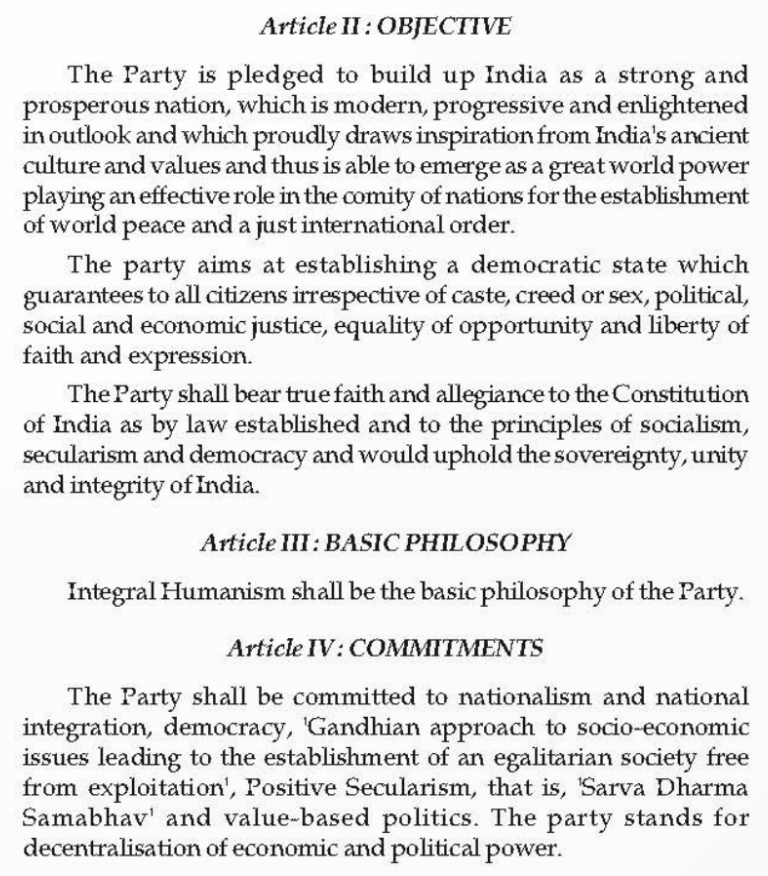
Even the constitution of the BJP has some insightful sections, which highlight the egalitarian push of the party:
Articles II-IV of the Constitution of the Bharatiya Janata Party (Source: BJP Constitutions)
I think that the government’s push to deliver goods and services to the grassroots, more diverse and critical welfare schemes and programmes, protection of MSMEs and promotion of ‘Make in India’, along with pushing for comprehensive economic growth, is a prime example of mixed economy policies and transcendence of the traditional Left-Right binary. Much like Jean-Paul Sartre tried to wed existentialism and Marxism and Pandit Deendayal Upadhyaya tried to move beyond the capitalistic-communist binary, the need of the hour is probably to simply have a compassionate and comprehensive governance model, which caters to the unique needs and interests of our nation, moving beyond antiquated western political binaries.
Moreover, it is not ridiculously primitive to seek to closet causes such as gender equality, caste parity and climate justice into silos of the Right and Left? I remember the time when my apparently Right-wing alignment was something that some of the Cambridge climate justice warriors had a problem with. Only if I could show them how socially conservative groups like temple trusts in Uttarakhand are helping Left-leaning activists and local governments in protecting the unique ecosystem therein. We must rid ourselves of parochial and regressive ideas of identities and ideologies, particularly around exclusivism. I feel India has a unique opportunity to not ape the international political traditions, like the Indian Left has historically tried to do and ground its politics in something fundamentally Indic. In the past, I have formulated a novel political philosophy known as Turiyavaad, which paradoxically speaks of transcending the universal angst and desire of individuals to align with dogma or rigid political constructs and philosophies, relying more on evidence-based policymaking and the pre-eminence of truth.
It is time to discard the tag of the Right wing and simply go for that which is right for the country.
On Monday, Prime Minister Narendra Modi inaugurated the Kashi Vishwanath Corridor at Varanasi. He even offered puja at the temple complex. The entire ceremony was telecast live on all the news channels, streaming of which was courtesy the public broadcaster Doordarshan. Subsequently, many questioned the live telecast of a seemingly religious programme done by the Prime Minister by public broadcaster. Many ‘liberals’ were even upset at the corridor being made on ‘tax payers’ money’ by a government of a ‘secular nation’.
The Kashi redevelopment was part of the governance and one of the many promises made by the ruling party in the manifesto (because of which they were elected to power). Similarly, to claim that the live telecast of the ‘Hindu’ programme by public broadcaster like Doordarshan was on tax-payers’ money is actually quite incorrect.
So easily have we normalised the Indian state’s shift towards majoritarianism that its easy to forget this is a (multi-cam) govt. event, attended by functionaries who have taken an oath under a secular Constitution. https://t.co/vfiIWvGkY8
NDTV’s Sreenivasan Jain was particularly upset that this was a ‘multi-cam govt event’. He even quoted Prasar Bharati, the umbrella organisation of Doordarshan television network, for expressing his displeasure. The tweet was further retweeted by the other ‘secular liberals’ like Rana Ayyub.
However, Doordarshan is not run only on public funding as is the misconception.
How Doordarshan earns money to spend
As per Shashi Shekhar Vempati, CEO of Prasar Bharati, Doordarshan has to earn its money to run the operations.
That is yet another popular misconception. DD has to earn its money to run its operations. Public money does not fund broadcast operational expenditure of DD. Public funding is only to the extent of salaries of government employees on deputation to DD.
— Shashi Shekhar Vempati शशि शेखर (@shashidigital) August 29, 2020
In August 2020, while responding to a Twitter user, Vempati had said that the public money, or tax payers’ money is used only to the extent of salaries of government employees who are on deputation to the Doordarshan. For rest, DD has to earn its own money.
In April 2019, while speaking at Kautilya Fellows Programme, Vempati talked about the public broadcasters in other countries and in India and how they are all different. He had said that for British public broadcasting service like the BBC or Japan’s NHK, funding is not dependent on the government. They work on licence fees which are collected from the citizens who own television sets and have access to the channels. In America, it works on the federal grant as well as funds raised locally.
However, in India, there is a different model. Vempati explained that when Prasar Bharati was created in 1997, all assets of All India Radio (AIR) and Doordarshan were transferred to the corporation. In India, the corporates fall under The Companies Act, 1956. However, Prasar Bharati does not fall under The Companies Act either. It is a statutory autonomous body.
He further explained that once Prasar Bharati was created, the employees of AIR and DD continued to stay employees of government of India. Hence, it was a uniquely hybrid model where corporate was autonomous but those working under the umbrella were government employees. While salaries, pension and other such expenses of employees came from central government, rest of the operations need to be funded on the own as a corporate would.
“So in that sense we are very unique if I take away these wages and related expenses, all of my operational expenditure has to be funded by my revenue generation from commercial advertising and sponsorship and whatever other commercial activities I can undertake, which is a huge challenge because nowhere in the world does a public broadcaster sustains itself through advertising. In India we ended up doing it because of the unique model we have where operations have to be funded from our revenues,” he had said.
Social media giant Facebook (now rebranded as Meta), has conceded that its third-party fact check programs are ‘protected opinions’ that are often used to censor certain viewpoints, reportedThe Federalist. The development came in the backdrop of a defamation suit filed by US journalist John Stossel for labelling his Facebook post about the origins of the 2020 California forest fires as partly false.
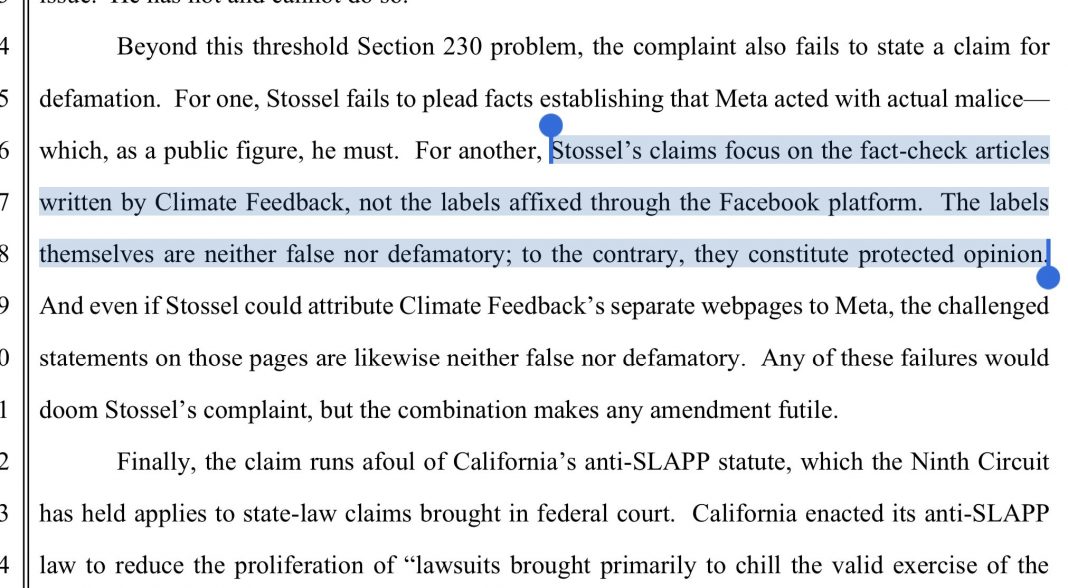
In its defence, the tech firm stated, “Stossel’s claims focus on the fact-check articles written by Climate Feedback, not the labels affixed through the Facebook platform. The labels themselves are neither false nor defamatory; to the contrary, they constitute protected opinion.”
Facebook further added, “And even if Stossel could attribute Climate Feedback’s separate webpages to Meta, the challenged statements on those pages are likewise neither false nor defamatory. Any of these failures would doom Stossel’s complaint, but the combination makes any amendment futile.”
Screengrab of the legal response by Facebook, via Watts Up With That?
The social media giant suggested that its contentious “fact-checking” program is regulated by third-party sites, which are entitled to their opinions. The Federalist reported that Facebook uses fact check to curb the dissemination of information that it wants to censor.
The lawsuit filed by John Stossel read, “The independence of the fact-checkers is a deliberate feature of Meta’s fact-checking program, designed to ensure that Meta does not become the arbiter of truth on its platforms. Meta identifies potential misinformation for fact-checkers to review and rate…”
“It leaves the ultimate determination (of) whether (the) information is false or misleading to the fact-checkers. And though Meta has designed its platforms so that fact-checker ratings appear next to content that the fact-checkers have reviewed and rated, it does not contribute to the substance of those ratings,” it concluded.
John Stossel filed defamation suit against Facebook
Last year, TV journalist John Stossel published a video on Facebook titled, “Government Fueled Fires’ in the aftermath of the 2020 California forest fires. While conceding that climate change was a contributor to forest fires, Stossel pointed out that it wasn’t the reason in the case of California fires. He had squarely blamed poor government forest management as the primary cause.
Facebook was quick to put a label on the video claiming it as misleading. “Missing Context. Independent fact-checkers say this information could mislead people,” it alleged. The social media giant further added, ” Claim — ‘forest fires are caused by poor management. Not by climate change.’ Verdict: misleading.”
Interestingly, Stossel never made the specific claim as determined by Facebook’s fact-checking program. However, it did not stop the tech firm from curtailing the views on his post and causing damage to his reputation.
“This case presents a simple question: Do Facebook and its vendors defame a user who posts factually accurate content, when they publicly announce that the content failed a ‘fact-check’ and is ‘partly false,’ and by attributing to the user a false claim that he never made? The answer, of course, is yes,” the complaint by Stossel read.