According to the press release dated 14.12.2021, NIA has arrested Afghan National Sobhan Aryanfar (28) who lived in Neb Sarai in South Delhi. A case has been registered under sections 17 and 18 of the Unlawful Activities (Prevention) Act, sections 8(c) and 23 of the Narcotic Drug and Psychotropic Substance Act and section 120 (B) of the Indian Penal Code in connection to the seizure of 2988.21 Kgs of Heroin seized at Mundra Port, Gujarat.
NIA said that the arrested Afghan National was a part of the drugs racket that transported narcotic drugs hidden in import consignment of ‘semi-processed talc stones’ from Afghanistan. 7 persons were also arrested earlier in the case. NIA said that further investigation into the case is being conducted.
Notably, NIA conducted several raids on October 12 at multiple locations in Delhi and the National Capital Region (NCR) after the seizure of drugs at Gujarat’s Mundra Port. Raids were conducted at residential premises and godowns at Lajpat Nagar, Alipur, Khera Kalan, New Delhi and Noida.
Earlier, the Directorate of Revenue Intelligence (DRI) had seized 2,988.21 kgs of heroin worth Rs 9000 crores from Mundra Port in Gujarat’s Kutch. Afghanistan was reportedly the source of the drugs seized at the Mundra Port. NIA later took over the investigation of the case in October.
Vicky Kaushal and Katerina Kaif have returned to Mumbai following the Rajasthan wedding. The couple made their first public appearance as husband and wife in front of their fans. Post-wedding pictures of Katerina Kaif and Vicky Kaushal in Mumbai have revealed Katerina Kaif donning a Sindoor which is traditionally worn by Hindu women.
After the grand wedding in Six Senses Fort Barwara, Sawai Madhopur on December 9, the bollywood actors were photographed at the Mumbai airport in matching outfits.
Earlier, the actors had tied the knot at Six Senses Fort Barwara, Sawai Madhopur on December 9. The sangeet ceremony took place on December 7 which was followed by Mehendi on December 8. Guest list included celebrities such as Karan Johar, Farah Khan, Ali Abbas Zafar, Kabir Khan and Mini Mathur and Rohit Shetty, among others.
India has strongly refuted the findings of the panel report concerning the dispute filed by Guatemala and Brazil against the policy measures in the sugarcane and sugar sector at the WTO. It said the findings of the reports are unacceptable to India alleging that there are many loopholes in the panel’s analysis of the measures and findings.
“The Panel’s findings that FRP and SAP measure constitute as market price support is unsupported by treaty text and unreasoned. The Panel has not only ignored India’s arguments but has also evaded key questions that it was obliged to determine,” the Indian government said. With respect to the panel’s findings on export subsidies, India said they are regressive and undermine logic and rationale. The government said its measures are consistent with its obligations under the WTO agreements.
Rejecting the panel report, India said it will continue government support to sugarcane farmers and sugar industries. It claimed that New Delhi has doubled the fair and remunerative price for sugarcane, which is the minimum price that domestic sugar factories, must pay to sugarcane producers.
It is worth noting that India’s current predicament with respect to the sugar dispute in WTO has its roots in the agreement signed by the Congress government at the Centre in 1994. The PV Narasimha Rao-led central government had then signed agreements during the Uruguay round of the WTO in April 1994, which brought agricultural trade more fully under the General Agreement on Tariff and Trade (GATT). It provided for converting quantitative restrictions to tariffs and for a phased reduction of tariffs. The agreement brought India under the ambit of rules and disciplines on agricultural export subsidies, domestic subsidies inter alia, making it party to the penalties imposed on the country for violating the modalities of the accord.
Introduction of the disputes and the establishment of the Panel
The dispute pertains to a complaint filed by Australia, Brazil and Guatemala in 2019 wherein they challenged some of India’s policy measures in the sugarcane and sugar sector at the WTO. The challenged measures included Fair and Remunerative Price (FRP) and State Advised Price (SAP) programmes and certain export assistance measures such as Buffer Stock Schemes, Minimum Indicative Export Quota (MIEQ)/ Maximum Admissible Export Quantity (MAEQ) Scheme and Duty-Free Import Authorisation (DFIA) for sugar sector.
The complainants claimed that domestic support provided by India to sugarcane producers through FRP/SAP schemes is in excess of the limit allowed by the WTO. The complainants also claimed that India provides prohibited export subsidies to sugar mills.
Based on the complainants’ requests, three separate panels were established by the WTO Dispute Settlement Body on 15 August 2019. The timetable for these three Panels was harmonised as if there were a single Panel (hereinafter, “the Panel”). After almost 28 months from its establishment, the Panel circulated its final report to the public on 14 December 2021.
Findings and recommendations of the Panel
As per the report released by the WTO panel, India provided domestic support to sugarcane producers in excess of the permitted level for sugar seasons 2014-15 to 2018-19. It also accused India of providing prohibited export subsidies to the sugar cane and sugar sector through various schemes like Buffer Stock Schemes, MIEQ/ MAEQ, DFIA. It recommended India bring its WTO-inconsistent measures and withdraw its prohibited subsidies.
The panel further noted that India is obliged to bring its domestic support measures within the acceptable level of 10 per cent of the total value of sugarcane production as allowed under the Agreement on Agriculture. Apropos of the alleged prohibited export subsidies, the panel has asked India to withdraw its prohibited subsidies under the DFIA scheme within 120 days from the adoption of the Final Report.
The Indian government has assured that there will not be any impact or effect of the panel’s findings or recommendations on India’s sugarcane and sugar policy measures as it will be filing a request for the appellate review of the findings and recommendations of the panel.
Appellate review procedures
After rejecting the findings of the panel, the way forward for India is the Dispute Settlement Understanding (DSU), which provides for two-stage dispute settlement procedures. Members who are aggrieved by the panel findings can decide to appeal the report of the panel, then Dispute Settlement Body cannot adopt the panel report until the completion of the appeal by the Appellate Body.
For filing an appeal India has to make appellate submissions and notify the Dispute Settlement Body before the panel report is adopted by the Dispute Settlement Body. It is likely that the complainants will request for adoption of the panel report concerning the alleged export subsidies after 10 days of the circulation of the report and within 30 days of the circulation of the panel report. Regarding the other inconsistent measures, the complainants will request for adoption of the panel report after 20 days and within 60 days of the circulation of the panel report.
Additionally, for filing an appeal, India will have to make appellate submissions and notify the Dispute Settlement Body before the panel report is adopted by the Dispute Settlement Body. The complainants might request for adoption of the panel report concerning the alleged export subsidies after 10 days of the circulation of the report and within 30 days of the circulation of the panel report. As per other inconsistent measures, the complainants will request for adoption of the panel report after 20 days and within 60 days of the circulation of the panel report.
Impact of the panel’s findings and recommendations
As of now, there are no members in the Appellate Body to listen to appeals as the process of selection of Appellate Body members has been continuously blocked by the United States of America since July 2017. So far, there are 21 appeals filed by the WTO Members and are pending appellate review. The appeal which India will be filing will be also added to the list of appeals pending appellate review. Accordingly, till the appellate review is completed there will not be any impact or effect of the panel’s findings or the recommendations.
Furthermore, as the demand in the international market for sugar is steep this year, DFPD has declared that they are not providing any export subsidies.
As far as concern for the domestic support provided to sugarcane farmers in the form of FRP/SAP, the overall permitted level of domestic support is 10% of the total value of sugarcane production, and thus, may have wider implications for India’s domestic support and is in line with the arguments put forth by the USA in agriculture-related discussions.
Hours after Prime Minister Narendra Modi offered prayers at the Kal Bhairav temple in Varanasi, journalist Abhisar Sharma had an epic meltdown on social media.
In his show ‘Suniye Sarkar’ hosted on the Youtube channel of HW News, Sharma lamented the supposed ‘politicisation’ of a religious event. He claimed that the Kashi Vishwanath corridor was inaugurated by Prime Minister Narendra Modi, even before its completion, to send out a political message to his voters prior to the 2022 Uttar Pradesh elections.
He then attempted to dissect the video wherein PM Modi was seen offering his prayers at Kal Bhairav temple. “Look at this footage carefully. Why are there cameras in the sanctum sanctorum of the temple? There is not one but multiple cameras… And who is visible in the footage? Not Kal Bhairav sahab but PM Modi… Had this been a politician from another party, BJP and its PR agency would have declared him anti-religion,” Sharma said.
Abhisar Sharma then went on to cite an unnamed Hindu priest to claim that the presence of a camera in the sanctum sanctorum of Rudra cave was against religion. He alleged that the PMO wanted to shoot videos inside the Pashupatinath temple and that the request was turned down by the Nepal government and the temple administration.
Sharma wore the shoes of a video analyst and talked in detail about the different camera angles used to capture the footage of PM Modi taking a dip in the Holy Ganga. The journalist turned Youtuber claimed that the inauguration of the Kashi Vishwanath corridor was an attempt to glorify the image of Prime Minister Narendra Modi, check the growing influence of the Samajwadi party leader and divert attention from the promises made during the previous term.
Abhisar Sharma alleged that PM Modi failed to double farmers’ income, provide housing for all or make the paradigm shift to renewable energy by 2022. He insinuated that Uttar Pradesh Chief Minister Yogi Adityanath had been sidelined by the Prime Minister ahead of the polls to make it a direct contest between the PM and Samajwadi Party leader Akhilesh Yadav.
This meltdown happened regardless of the picture that Yogi Adityanath and PM Modi had posted recently, on the 21st November 2021.
The photographs were perhaps intended to dispel rumours that there are frictions developing between Yogi Adityanath and Narendra Modi. Media reports have often peddled the narrative in the recent past.
The photographs demonstrate that the Chief Minister of UP has the firm support of the top man in the party. In rallies and elsewhere as well, Narendra Modi has been throwing his weight behind Yogi Adityanath and showering him with applause for the development of the state.
“You are wasting taxpayer’s money for your election rallies. Answer my questions. You cannot run from them…I am keeping all my points in front of you on the basis of facts and evidence. What is your answer?” Sharma brazened out. The ace journalist then claimed that the hacking of the Twitter account of PM Modi (for the second time) was a compromise not on the part of Twitter but the PMO. “Whose responsibility is to answer these questions,” Sharma inquired.
Abhisar had no proof whatsoever. It just seemed like Abhisar had a meltdown because PM Modi asserted his religious faith openly and did something for a section of the population that Abhisar has been running a campaign against.
Not just Abhisar, other liberals have been going through a meltdown as well. NDTV’s veteran propagandist Sreenivasan Jain, who had whitewashed bomb blasts by Muslim terrorists, took to Twitter, brooding over how India was descending into Majoritarian rule, by rulers who had taken their oath under a “secular constitution”.
“So easily have we normalised the Indian state’s shift towards majoritarianism that its easy to forget this is a (multi-cam) govt. event, attended by functionaries who have taken an oath under a secular Constitution”, he tweeted.
Other elephantine dodos were not far behind. Erstwhile Congress troll and present TMC foot soldier Saket Gokhale tweeted another asinine conjecture saying that BBC had never telecast religious events, which is completely untrue.
BBC has, in its history, telecast several programs from Westminster Abbey and Canterbury. In fact, the UK is an officially Christian nation. For Saket Gokhale, the political shill for hire, to cite a Christian nation to shame a Hindu nation is not surprising, given that Gokhale would just as easily praise ISIS in his hate for Modi and Hindus.
The inauguration of the Kashi Vishwanath corridor
The Kashi Vishwanath corridor was inaugurated on the 13th of December with much-deserved pomp and show. Prime Minister Narendra Modi offered prayers at the Kal Bhairav temple, took Sankalp at the Kashi Vishwanath temple and presented to the city of Varanasi and the country at large, a corridor that is historic in India’s fight to reclaim its civilisation.
PM Modi started his address to the nation by bowing down to Baba Vishwanath, Mata Annapurna and Baba Kaal Bhairav, the Kotwal of Kashi Vishwanath. He said, “I went to ask permission from Baba Kaalbhairav as he is Kotwal of the city. Without his permission, no one can enter the city.” PM Modi also asked every Indian to take three vows that were Swachchta (cleanliness), Srijan (innovation) and Atmanirbharta (self-sufficiency).
PM Modi praised the residents of Kashi and said without their support, the work of the Kashi Vishwanath Corridor would not have been possible. He said, “My heart is filled with happiness. I would like to congratulate all of you on this auspicious day.” He added it is said in the scriptures, whoever enters Kashi, gets freed from all the worldly ties.
A Twitter user BharadwajSpeaks has destroyed the claims laid down by Congress mouthpiece National Herald’s journalist Mrinal Pande about Kashi Vishwanath Temple. Pande has claimed that the Shiva Linga worshipped in the Kashi Vishwanath Dham is not ‘Swayambhu’ thus, worshipping it is not prescribed. In reply to her claims, BharadwajSpeaks countered her by showing documentary evidence that the Linga is indeed Swayambhu and her claims were baseless.
What did Mrinal Pande say?
In a series of tweets, Pande said in the Temple of Avimukteshwar, Shiva was the head of Old Kashi. Vishweshwara dates back to the 15th century. She added, “Padma Purana, Brahmavaivarta Purana, Kashikhand have considered these two lingas as separate and Avimukteshwar as Swayambhu Adi Linga. It was destroyed along with the temple. Worshipping an ordinary Linga instead of Swayambhu Linga is not prescribed.”
पुरानी काशी में अविमुक्तेश्वर शिव का मंदिर प्रधान था, विश्वेश्वर नाम १५वीं सदी का है। पद्मपुराण, ब्रह्मवैवर्तपुराण, काशीखंड ने इन दो लिंगों को अलग और अविमुक्तेश्वर को स्वयंभू आदि लिंग माना है।यह मंदिर के साथ ही विनष्ट हो गया। स्वयंभू लिंग की जगह साधारण लिंग की पूजा अविहित नहीं है https://t.co/rZbGAbLzBL
She further added that the scholar people of Kashi came to consent and started worshipping Vishwanath Linga. “Avimukt Shiva temple was next to the Vishwanath temple in Gyanvapi according to the Tirtha Vivechan Granth. Todarmal built it again in the 16th century, which was destroyed in 1669. “After 125 years, Ahilyabai built the existing temple.”
अंग्रेज़ों की आज्ञा न मिलने से यह मंदिर आदिविश्वेश्वर मंदिर की मूल स्थली पर नहीं बनाया गया, जो ज्ञानवापी के उत्तर में था। आज इसके दक्षिण में कोई कूप नहीं है। बाद को यहां हेस्टिंग्स ने नौबतखाना बनवाया,राजा रंजीत सिंह ने शिखर पर सोना मढ़वाया और नंदीकी मूर्ति नेपाल के राजा ने लगवाई।
She said, “Due to lack of permission from the British, this temple was not built on the original site of the Adi Vishweshwar temple, which was north of Gyanvapi. Today there is no well to its south. Later, Hastings built the Naubatkhana here, Raja Ranjit Singh had gold plated on the summit, and the Nandi idol was installed by the King of Nepal.”
Here is how Mrinal Pande was wrong
Destroying her claims, BharadwajSpeaks called it a spin. said, “She says Avimukteśvara was original Swayambhu Linga. It was destroyed along with the temple. She says Vishveshvara is an ordinary Linga, and this name appears only from the 15th century.”
Wow. What a spin!
This congress writer says Kashi Vishwanath should not be worshiped. Why?
She says Avimukteśvara was original Swayambhu Linga. It was destroyed along with temple.
She says Vishveshvara is an ordinary (साधारण ) Linga and this name appears only from 15th century https://t.co/qqY8OXSCtJ
He further added, “Further, she says Kashi Vishveshvara is an ordinary linga whose worship is not prescribed.” He called her wrong on both counts. He presented proof from Skanda Purana. He said, “In Skanda Purana, Vishveshvara is very clearly mentioned as Swamyambhu Linga. Not only that, Shiva says Vishveshvara is the greatest of all Linga forms of Shiva. Skanda Purana 4.2.49.20.”
In Skanda Purana, Vishveshvara is very clearly mentioned as Swamyambhu Linga.
Not only that, Shiva says Vishveshvara is the greatest of all Linga forms of Shiva. (परं त्वियं परामूर्तिर्मम लिंगस्वरूपिणी)
He said Skanda Purana 4.2.49.20 mentions that the other Lingas of the world pay respect to the Vishweshvara.
Your 15th century date for Vishveshvara is also horribly off.
I see that you believe Puranas are written in 15th century. I wont even give you the evidence of Puranas. I will give you an islamic date that you believe.
“How on earth did you conclude that Vishveshvara should not be worshipped? Your 15th-century date for Vishveshvara is also horribly off.” He said it was possible Pande believed that Puranas were written in the 15th century. So he gave a reference to the Islamic date.
A 1296 CE Sanskrit inscription was found at Lal Darwaza Masjid (which was constructed using the materials of destroyed Hindu temples). It was found on pillar. It mentions the construction of padmeshvara at the entrance of Vishveshvara temple of Varanasi.
He said, “A 1296 CE Sanskrit inscription was found at Lal Darwaza Masjid (which was constructed using the materials of destroyed Hindu temples). It was found on pillar. It mentions the construction of padmeshvara at the entrance of the Vishveshvara temple of Varanasi. (Published by ASI 1875)”
It is noteworthy that since the Twitter user destroyed Pande’s claims, she has blocked him on the social media platform.
A video of Rahul Gandhi maiden campaign trail in Uttar Pradesh’s Rae Bareli from 2003 is started doing the rounds on social media in the wake of PM Modi’s visit to Varanasi, where he offered puja at the Kaal Bhairav Temple, took a dip in the river Ganga, and inaugurated the Kashi Vishwanath Corridor.
In the video clip, Rahul Gandhi was seen interacting with locals in Uttar Pradesh’s Rae Bareli, performing puja on the banks of a river and addressing public rallies as a part of his campaign trail in May 2003, ahead of the 2004 general elections.
Rahul Gandhi says he has no idea why he is doing puja on the banks of river
One amusing instance in the video is from the Gokaranath Ghat where Rahul Gandhi is seen taking part in a puja. As the priest concludes the puja, a reporter from NDTV innocently asks Rahul Gandhi for what purpose did he perform the puja. The Gandhi scion then candidly answers, “I have no idea. They wanted me to come here so I came.”
In another instance in the video, Rahul interacts with a girl who sought help from him for completing her PhD. The girl provides her “biodata” to Rahul Gandhi, who skims through it and asks her how she would ask someone’s name in English. He then tells the girl that he would keep her “biodata” with him and passes it over to one of his aides seated in his car.
The NDTV reporter then asks Rahul Gandhi what he is his plan to lead the campaign for the upcoming General elections. The Gandhi scion responds saying that the Congress party needs to focus on improving its grassroots connect and understanding what the people at the bottom rung of the organisation expect from it. “Rahul Gandhi cannot obviously understand what are the problems of the 6 lakh villages. We need to reinforce our grassroots connect and address the grievances of local people,” he added.
PM Modi inaugurates Kashi Vishwanath Corridor
The video of Rahul Gandhi was circulated on internet in the wake of PM Modi’s inauguration of Kashi Vishwanath Corridor on Monday. The Kashi Vishwanath corridor was inaugurated on the 13th of December with much deserved pomp and show. Prime Minister Narendra Modi offered prayers at the Kal Bhairav temple, took Sankalp at the Kashi Vishwanath temple and presented to the city of Varanasi and the country at large, a corridor that is historic in India’s fight to reclaim its civilisation. Internet was flooded with pictures of PM Modi offering prayers, taking a dip in the river Ganga and inaugurating the hallowed Corridor, hailed as the first step towards the reclamation of Lord Krishna’s abode.
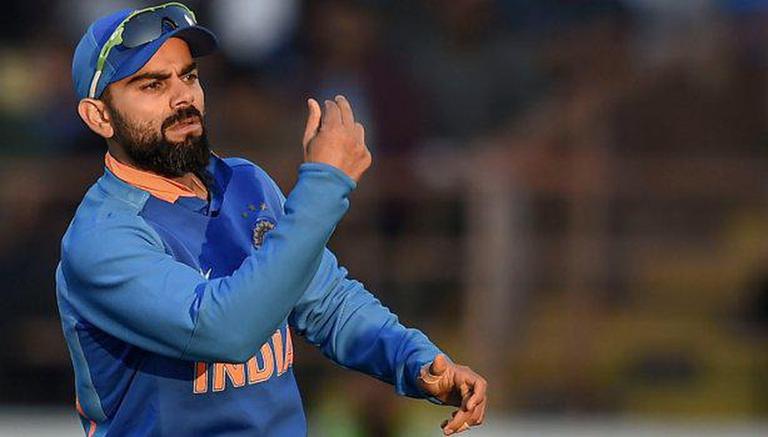
Indian Test match Captain Virat Kohli has reportedly asked for a break in January to spend time with his family and will miss the upcoming ODI matches in South Africa, according to reports. Kohli’s decision to skip the ODI series has fueled speculations of a strife between Kohli and Rohit Sharma who was given the ODI captaincy by BCCI ahead of the SA tour following Kohli’s decision to step down as T20 captain after the T20 World Cup. However, as per media reports, BCCI has not received official request from Kohli to take leave.
India TV report claimed that sources told ANI, “Yes, Kohli has asked for a small break in January to spend some time with his family. It effectively means that he would miss the ODI series against South Africa,” Also, Rohit Sharma has reportedly been ruled out of the Test Series in South Africa to be played from December 26. Sharma has been replaced by Gujarat Batsman Priyank Panchal.
Amidst the recent developments, BCCI president Saurav Ganguly said, “It’s a call that the BCCI and the selectors took together. Actually, the BCCI had requested Virat to not step down as the T20I skipper but obviously, he did not agree. And the selectors then did not feel it right to have two different captains for two white-ball formats,” adding, “So it was decided that Virat will continue as Test captain and Rohit will take over as the white-ball captain. I, as President, personally spoke to Virat Kohli and the chairman of selectors has also spoken to him. We have full faith in Rohit Sharma’s leadership abilities, and Virat will continue as the Test captain. We as BCCI are confident that Indian cricket is in good hands. We thank Virat Kohli for his contributions as captain in the white-ball format.”
Former Indian Captain Mohammed Azharuddin has questioned Virat Kohli’s decision to miss the ODI series and said that the timing could have been better.
Virat Kohli has informed that he’s not available for the ODI series & Rohit Sharma is unavailable fr d upcoming test. There is no harm in takin a break but d timing has to be better. This just substantiates speculation abt d rift. Neither wil be giving up d other form of cricket.
He said, “Virat Kohli has informed that he’s not available for the ODI series & Rohit Sharma is unavailable fr d upcoming test. There is no harm in takin a break but d timing has to be better. This just substantiates speculation abt d rift. Neither wil be giving up d other form of cricket.”
Earlier, Rohit Sharma was declared as the the captain of the ODI team following All-India senior selection committee meeting which also picked the 18-member squad for the upcoming series against South Africa. However, as of now, as per media reports, Virat may not skip the ODIs.
Two months after the Lakhimpur Kheri incident, that resulted in 8 deaths, took place, the Special Investigation Team (SIT) probing the case has ruled that it was a deliberate act.
While speaking about the matter, SIT officer Vidyaram Diwakar informed, “The incident was a deliberate act and not of negligence or callousness.” He has filed an application before the Chief Judicial Magistrate (CJM)’s court, seeking replacement of Indian Penal Sections 279 (rash driving), 338 (causes grievous hurt to any person by doing any act so rashly), 304A (causing death by negligence) against the 13 accused with the attempt to murder (IPC 307).
He had further requested the Court to add other IPC Sections such as 326 (Voluntarily causing grievous hurt by dangerous weapons or means), and 34 (Acts done by several persons in furtherance of common intention) against the accused.
The 13 arrested accused include Dharmendra Banjara, Rinku Rana, Ashish Mishra, Ashish Pandey, Shekhar Bharti, Ankit Das, Luvkush, Latif, Sishupal, Nandan Singh, Satyam Tripathi, Sumit Jaiswal, and Ullas Trivedi. It must be mentioned that charges of murder (IPC Section 302), rioting ( IPC Section 147), and rioting with deadly weapons (IPC Section 148) were earlier pressed against the accused.
The background of the Lakhimpur Kheri incident
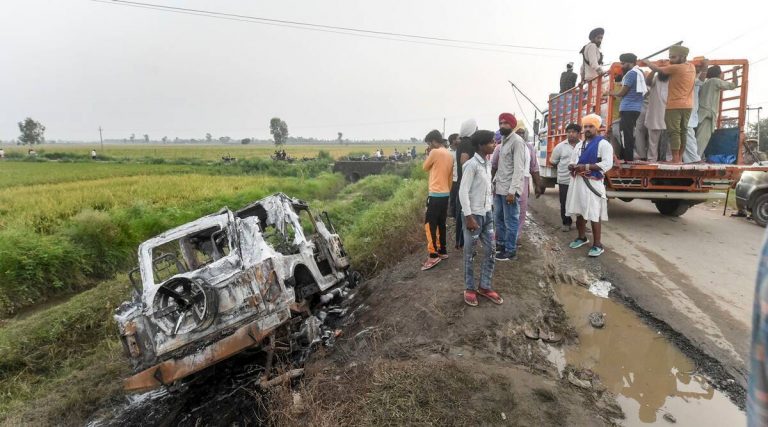
On October 3, a ‘farmer’ mob attacked a BJP convoy with stones and sticks in Lakhimpur Kheri, Uttar Pradesh. Amid the ensuing commotion, a vehicle was seen running over the protestors. Following that, the angry mob of protestors had burned two vehicles, dragged the people inside the vehicle and had beaten them to death.
The incident claimed the lives of 8 people including protesting ‘farmers,’ BJP workers and a journalist. BJP worker Shubham Mishra and his driver Hariom Mishra were also lynched to death at the site by the so-called ‘farmers’. Shubham’s father said in his complaint that Shubham’s gold chain, mobile and wallet were stolen by the protesters who had killed him. He also named Tajinder Singh Virk of Samajwadi Party and Kisan Union leader one of the foremost perpetrators.
The incident soon turned into a major political fight, prompting the Uttar Pradesh government to announce a compensation of ₹45 lakh to the kin of the deceased and promised government jobs to one member of each family. A one-member committee has also been formed to probe the case.
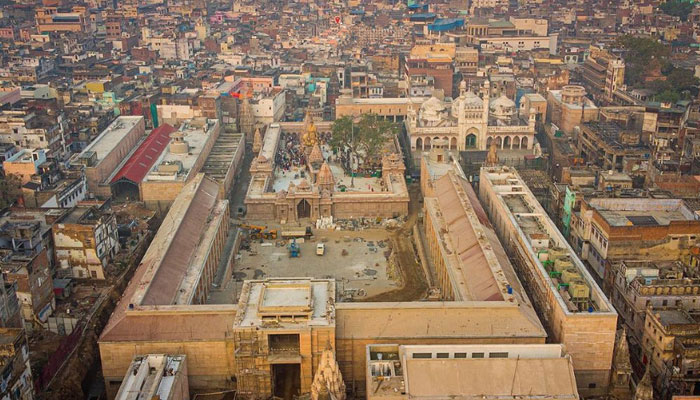
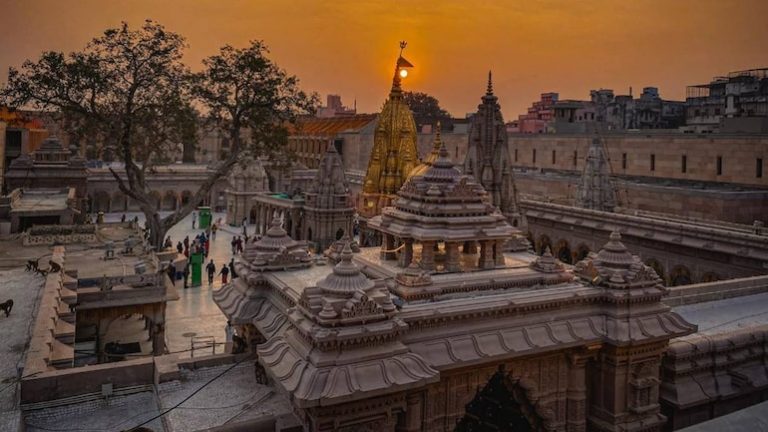
On December 13, Prime Minister Narendra Modi dedicated the newly built Kashi Vishwanath Corridor to the nation. The Kashi Vishwanath Dham, a prime religious pilgrimage centre for the Hindus, was spread across only 3,000 square feet before the project started. It now spreads over a 5,00,000 square feet area.
The famous Nandi Maharaj idol and the Widsom Well have become part of the complex once again after 352 years. A lot of work is still pending and hopefully, there is much more planned for one of the oldest living and continuously inhabited cities of the world. While the world has witnessed the grandness of Baba Vishwanath, one may want to know about its history and how far it has gone in the past.
Kashi Vishwanath Dham finds its roots in many Sanatan Dharma scriptures, including the Rig Veda, Skanda Mahapurana, Ramayana, Mahabharata and many others. Authors like Mark Twain had once called it ‘a city older than the tradition, older than the legend’. Many authors, researchers and historians have extensively worked around Varanasi city and Kashi Vishwanath Dham.
Prof Rana PB Singh of Banaras Hindu University has written several papers and authored two books about the city, and wrote the chronology of development and construction at the Kashi Vishwanath Temple site. Based on his papers and a report in Times of India that is also based on his research work, here is how the evidence supports the millennia-old history of Kashi Vishwanath Dham.
The evidence linked to the temple’s existence in the 9th century BCE
According to Prof Singh, during excavation in Rajghat space, the archaeologists discovered the Avimukteswara seal from that period. He said, “We are able to safely discuss concerning the existence of this temple of Lord Shiva within the 9-10 century BCE after its seal was discovered within the archaeological excavation in Rajghat space.”
He further said that the evidence has confirmed that Varanasi has been inhabited continuously by the people since 1000 BCE. “that’s the reason town is called one of many oldest residing cities on the planet,” he said. The Jain Tirthankara Parsvanatha was born in Varanasi in the 8th century BCE. Mahavira, the final Tirthankara, who lived on earth between 599 to 527 BCE, was from Varanasi as well. He added, “The Jataka tales of eighth to seventh century BCE confer with Banaras as the location of manifestation of earlier Buddhas, the final one being the Gautam Buddha.”
During the Gupta interval, 320-550 CE, the city saw a lot of transformation. This was the period when a grand temple at the Kashi Vishwanath Dham site was built. Notably, there were hundreds of significant temples that were in Varanasi. During the Gupta interval, the earliest Puranas were also composed, the Times of India report quotes Prof Singh.
Kashi Vishwanath Dham was described by a Chinese pilgrim Hsuan-Tsang in 635. He described the city as thickly populated. He mentioned its importance in the field of academia as well. He mentioned there were 20 vital temples in the city.
The repeated destruction of the temple
In 1194, Islamist barbarian Muhammad Ghori ordered his slave general Qutb-ud-din Aibak to demolish Varanasi and the temples, including Kashi Vishwanath Dham. Over 1,000 temples were destroyed, and the city was looted.
Later, between 1210 to 1236, the temple was reconstructed. However, it faced another destruction under Firoz Shah Tughlaq in the 1300s. In the 1400s, the Sharqi kings of Jaunpur ruled the region and further destroyed the temples. A significant part of the city was later destroyed under the rule of Sikandar Lodi.
During 1584-85, the Vishwanath Temple was rebuilt under the supervision of Narayan Bhatt. However, Aurangzeb again ordered its demolition in 1669, and a mosque was built at its place. Later, in 1777, Ahilyabai Holkar, the queen of Indore, rebuilt the temple. In 1893, Maharaja Ranjit Singh had sent gold to plate the temple domes.
In 2019, under the leadership of Prime Minister Narendra Modi, the construction of the Kashi Vishwanath Corridor was started. In 2021, PM Modi dedicated the corridor to the nation.
The significance of Kashi, Vishwanath Temple and Jñānavāpī Koop or the Wisdom Well
The Skanda Mahapurana mentions Kashi Khanda dedicated to the Kashi City, Vishwanath Temple and Jñānavāpī Koop or the Wisdom Well. In the chapter about Kashi in Skanda Mahapurana, it was mentioned that the scion of the family of Dilipa brought Ganga to the place known as Kashi. It added, “It is well-known as Kashi because it is the place where a person attains Nirvana.”
It is also called Avimukta as Shambhu (name of Shiva) never leaves the city. Skanda said, “Oh Maharishi Agastya, the Tīrtha of Cakrapuṣkariṇī was already the place of all welfare. It became more excellent due to the jewel-set earring of Śaṃbhu. In that Ānandakānana, the shrine of Śiva named Avimukta, the attainment of liberation was already possible. By the contact of Gaṅgā, it has become all the more powerful.”
Skanda told Agatsya that if a person dies in Kashi, the person will attain Moksha. The soul of the person gets liberated without Nididhyāsana or the continuous practice of meditation. He said, “without the knowledge that roots out Karmas, a person who dies in Kāśī becomes immortal, with the favour of the Moon-crested Bhagwan.”
The Purana talks in detail about the Wisdom Well in Kashi Vishwanath Dham. Skanda tells Agastya in detail how Jñānavāpī Koop came to existence and why it is important for those who follow Sanatan Dharma. He said in Sata Yuga, Isana, the Rudra form of Bhagwan Shiva, was roaming here and there. When he reached Kashi, also known as Mahashamshana or the Great Cremation Ground, he came across the Swayambhu Shiva Linga.
Isana, in order to bathe the Linga with water, dug up the Jñānavāpī Koop with his Trishul or Trident. The cold water came flowing out of the well. The water was sparkling with colours like the minds of good people. Its lustre was as beautiful as the moonlight. It was holy and pure, like the name of Bhagwan Shiva.
The water of the well was sweet like the divine nectar. It was pleasant to touch, just like the limb of a cow. The scent of the water was like the sweet smell of lotus. Even the touch of the water would give the devotees the ‘Punya’ of Ashwamedh Yagya. The sins would perish by the holy water of the well. The Shiva resides in the well in the form of Jñāna, having assumed the liquid form, who would destroy Jāḍya (sluggishness, ignorance) and impart knowledge. Vishveshra (name of Shiva) said, “If a highly intelligent man bathes the Liṅga with the waters of Jñānodatīrtha, it is certainly on a par with having got it bathed with the waters of all the Tīrthas.”
Skanda praised the Wisdom Well and said, “Jñānavāpī is the Cosmic Form of Śiva himself. It generates Jñāna (perfect knowledge). There are many Tīrthas that sanctify (devotees) immediately. But they are not equal to even a sixteenth part of Jñānavāpī. If anyone listens to the origin of Jñānavāpī with great attention, his knowledge does not become extinct even on death anywhere.”
The Kashi Vishwanath corridor was inaugurated on the 13th of December with much deserved pomp and show. Prime Minister Narendra Modi offered prayers at the Kal Bhairav temple, took Sankalp at the Kashi Vishwanath temple and presented to the city of Varanasi and the country at large, a corridor that is historic in India’s fight to reclaim its civilisation.
“The sparkling water like the minds of good people, excessively sweet like the divine nectar, pleasant to the touch like the limb of a cow, scent excelled the sweet smell of lotuses…”. This is how Skanda described the water of Jñānavāpī or the Wisdom Well to Agastya in Skand Mahapurana. It is believed that the original Shiva Linga that was at Kashi Vishwanath Dham now resides at the bottom of Jñānavāpī Koop. The priest of the temple sacrificed his life and jumped into the well with the Linga before Aurangzeb’s army could destroy the temple. The Koop is now again part of Kashi Vishwanath Dham. It took 352 years for someone to take the initiative and bring back the glory that was lost due to countless attacks on the temple. In the past, when the temple was demolished and the Gyanvapi mosque was built by barbarians, the Koop was a part of the mosque complex itself. Now, however, the historic Koop is a part of the Kashi Vishwanath Temple corridor.
This step is historic by every measure. The sacred well where the original Shiva Linga rests, is no longer a part of the mosque complex. While people now realise the significance of the corridor, just a few weeks ago, that was not the case.
I was a part of an altercation on Twitter a few weeks ago, which was immensely tiring. It started with my response to a Tweet with bizarre observations. Ironically, the link to the news article was also posted, carrying just opposite content in it.
Usually, I would have ignored any other Twitter handle, but the propaganda deserved a response. I have spent my prime youth in Banaras. Every time I would visit Baba Vishvanath Temple and come out through the narrow, congested, catastrophic filthy lanes, I wondered if it could ever be sorted and developed in our lifetime.
Kashi underwent a grand makeover after 1780 AD, when Maratha queen Ahilyabai Holkar of Indore last time renovated the temple and the area surrounding it.
The altercation I had was about certain Twitter yoddhas claiming that Kashi Vishwanath was now to be a “revenue generating machine” managed by a “foreign company” Ernst and Young. The question was posed to the Prime Minister’s Office asking if this was “correct”.
My response was rather polite, though factual. Firstly, E&Y was appointed as a consultant through a tender. The scope was to prepare a model of revenue generation, required for the operations and maintenance of the Dham and develop solutions for crowd management. In fact, the entire operation is to be managed by Kashi Vishwanath Temple Trust. As evident, there was no “foreign company” managing the temple, as was claimed.
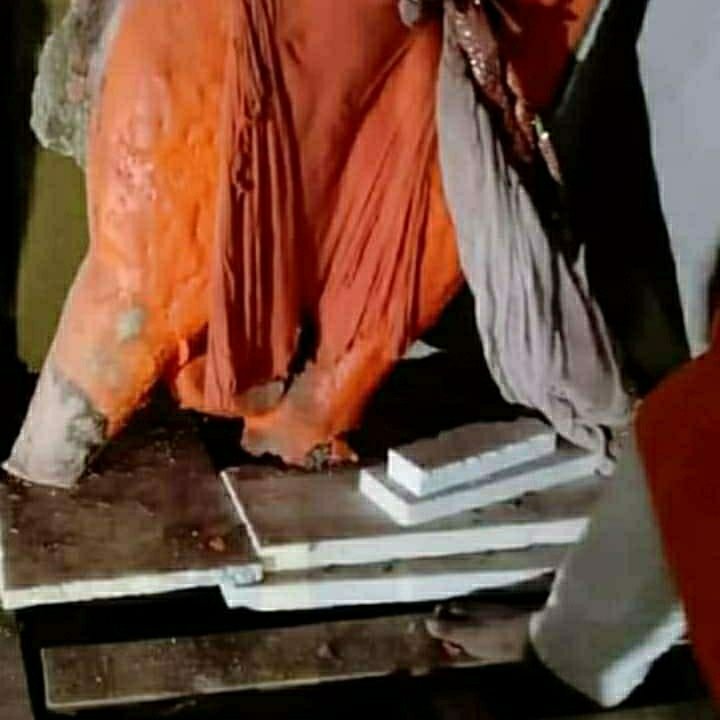
After that was called out, the next twist came with a change in the tone. I was called “sold to the Vikas” (development plan of the Govt) and a “Shiva-Drohi.” The further accusation was that the Modi government was doing all the developmental work by demolishing Temples and its sanctum Sanctorum. These loonies use the following picture every time they want to label Modi Govt anti-Hindu, which is also a hit job.
Picture being shared widely
This thread on Twitter from @ishubhamm (a Banaras resident) dismantles all these hitjobs in detail.
What is essential here is to notice the hysteria of the propagandists over Hindu causes and projecting all that to the Modi Govt. One can check further altercations and all kinds of nonsense peddled to avoid the central contention – development of the Kashi Vishvanath Corridor, despite scores of complex issues, and without any provocations.
Kashi Vishvanath Corridor Project:
One of the most ancient living cities on earth and the epicentre of Hindu religion and Indic civilization, Kashi is undergoing a grand makeover, thanks to its local Member of Parliament, Narendra Modi, Prime Minister of India.
PM Narendra Modi launched this Rs 400 crore project in March 2018. The central idea is to preserve the existing heritage structures, provide new facilities in the temple complex, ease people’s traffic and movement, and connect the temple with the famous Ghats of Banaras through a corridor with direct visibility.
The local court in Varanasi directed the Archaeological Survey of India to survey the Gyanvapi Mosque compound adjacent to the Vishwanath Temple to find out whether it was a “superimposition, alteration or addition or there is structural overlapping of any kind. While this historical civilizational dispute continues, the Gyanvapi Mosque committee has handed over a 1,700 square feet separate plot of land in the periphery of the Kashi Vishwanath Temple for the under-construction Temple Corridor project, in exchange for another plot of land. Whether this reconciliation is enough or not is a separate debate.
A total of 314 buildings surrounding the temple were acquired for this project. On their clean-up, several ancient temples were unearthed on the corridor route. Once the project is complete and all these temples are back to their glory, the world would also witness the “Nandi” facing a Mosque. That debate on reconciliation can be taken up from there. The grandeur of Kashi taking an enormous facelift can’t wait for this legal-historical-civilizational dispute to end.
Read this report on how an 18th-century idol of Maa Annapurna, stolen from Varanasi more than 100 years ago and kept in a Canadian Museum, is brought to Banaras and is scheduled to be installed at the Kashi Vishwanath Corridor on 15th November 2021. It is a moment to cherish our civilizational and cultural glory. The credit goes to the relentless pursuit of the Narendra Modi govt, which has made “Bring Our Gods Home” a part of his stellar statesmanship. And these loonies have the gall to blame the same Govt for idol desecration?
Shri Kashi Vishvanath Temple Trust has appointed private consultants through open tenders for handling the operational planning to ensure the devotees a “memorable pilgrim experience.” The goal is to facilitate two lakh devotees at any time.
The various facilities in the premises include a Mandir Chowk surrounded by emporiums, a spiritual bookstore, Vedic Kendra, Bhog Shaalas, a Ganga-view Cafe, shops, a VIP guest house, Mumukshu Bhawan,a tourist facilitation centre, three Yatri Suvidha Kendras, toilet blocks, and two museums. After completing the project, the visitors will be able to stand on the terrace of the corridor and enjoy the scenic view of River Ganga and Manikarnika and Lalita Ghat.
It is planned that the Parishad will operate each of the facilities listed above through the appointment of an appropriate partner from the private sector in whole or in parts,” says the bid document.
This Hindu hating falsehood peddler, The Wire also runs the same agenda – “The demolition of buildings near the historic temple has triggered resentment and anger against Yogi Adityanath and Narendra Modi”, it says.
It is not an individual’s work. This Khap Panchayat has several elite elders. These self-appointed Thekedars of Hindus have one central agenda – to make vulnerable Hindus feel betrayed by the present BJP dispensation.
Here is another example:
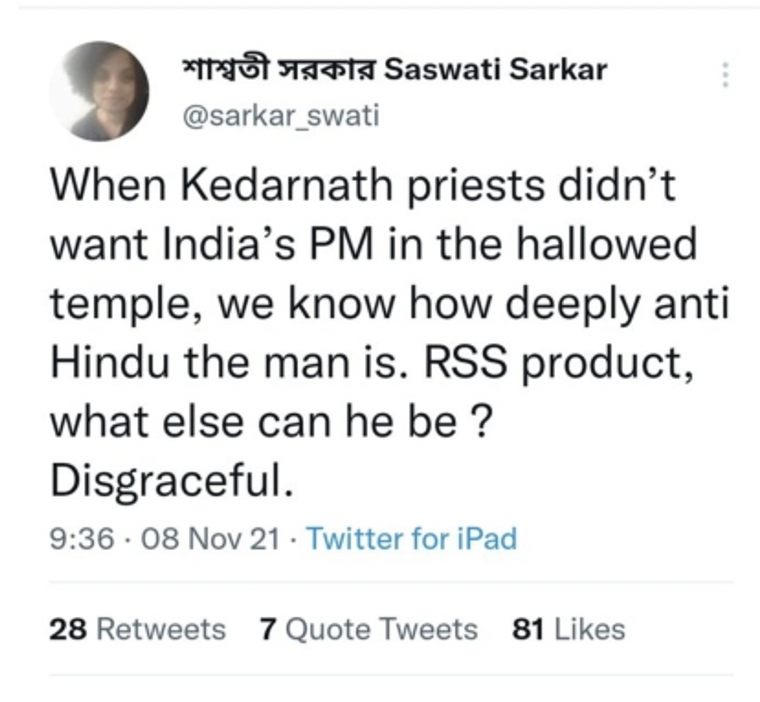
Tweet by Swati Sarkar
Prof. Swati projects herself as a Hindu cause warrior and also despise RSS, an institution that has selflessly served the nation. Her position, as she projects, are all based on random statements of random RSS leaders, that she keeps sharing. How is it to rid oneself of an institution with a history of service only because one disagrees with the views of an office-bearer? How scholarly! But Prof Swati is an old RSS/BJP hater and has been very open about it.
Then there are others who smartly pretended to be well-wishers of Hindus and then began to sow discord.
Interestingly, I once chanced to speak in a ClubHouse Talk and called out his call to teach a lesson to the Modi Govt. for the post-election Bengal violence. As usual, in typical Congress style, they took off my mic immediately.
However, listen to this ClubHouse talk (shared on Twitter by a friend @alok_bhatt) where some individuals who claimed to be in support of Hindus were giving Congress supporters tips to defeat BJP.
The pro-Hindu group can certainly have disagreements, but the propaganda surrounding the Kashi Vishwanath Corridor was self-defeating. When one starts to burn down the entire forest because they may disagree with one tree, who we choose to be our warriors deserves a close, hard look.