Home Blog Page 3945

Dalit Sikhs – Who are they and what is their role in Punjab politics

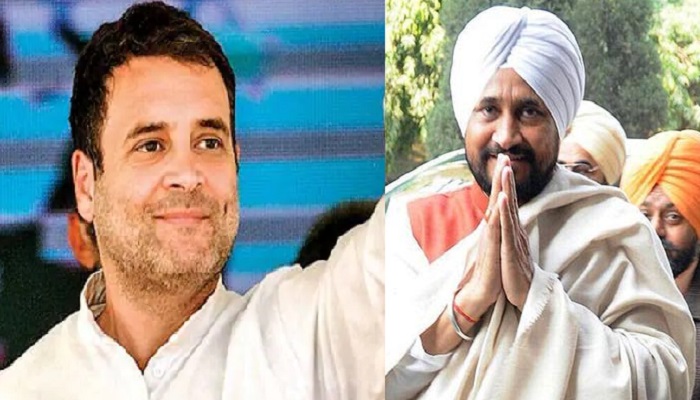
‘Dalit Sikh’, a technically and constitutionally correct term is baffling everyone since the name of the new Chief Minister of Punjab was announced. On September 19, Charanjit Singh Channi was elected as the new Chief Minister of Punjab after former CM Capt Amarinder Singh resigned from the post a day earlier.

All media houses mentioned that new Punjab CM Channi is a Dalit Sikh. While the term is technically correct, a majority of Indians who have a little bit of knowledge of Sikhism got confused as Sikh as a religion rejects the concept of caste and race. However, caste-based discrimination is still observed by the majority of Sikhs across the world.

Sections among Sikhs based on caste

With 63% Sikhs, Punjab is a Sikh-majority state. Notably, 72% of the Sikhs live in the rural areas of Punjab. In her paper titled “Jat Sikhs: A Question of Identity”, Ravinder Kaur, professor of sociology at IIT Delhi, said that “Caste as an occupational division of labour was, and is, very much a part of village life.” This is evident despite the fact that Sikh doctrine rejected the institution of caste. In reality, caste is very much part of Punjab’s rural as well as urban ethos.

If Sikhs go by the rules set by the Gurus, they should not use castes as surnames but use Singh or Kaur as per the gender. However, the census data showed a different picture. Sikhs have over 25 castes recorded in censuses from 1881 to 1921 named Jats, Khatris, Aroras, Ramgarhias, Ahluwalias, Bhapas, Bhattras, Rais, Sainis, Lobanas, Kambojs, Ramdasias, Ravidasias, Rahtias, Mazhbis, and Rangretas.

Jat Sikhs dominate the castes in Punjab, and the majority of them are concentrated in the rural regions. Most of the Jat-Sikhs are landlords and agriculturists. They are often termed as the backbone of the Punjab peasantry, which has enabled them to have a hold on the majority of the posts in Punjab politics as well. Notably, Channi’s appointment as CM of Punjab is termed as the first in history that someone from the Dalit community has become Chief Minister. Before CM Channi, only Giani Zail Singh was CM of Punjab from the non-Jat community.

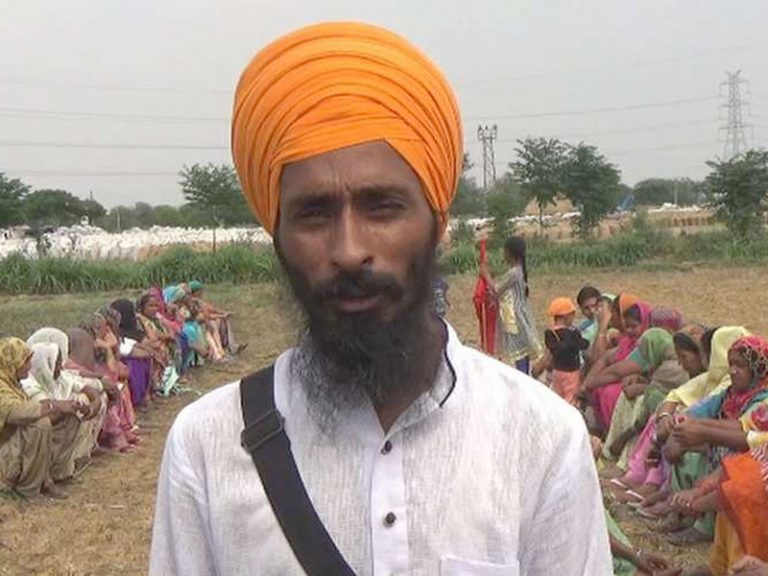
Dalit Sikhs are further divided into two communities with first-named Mazhabis and Rangretas. They are also known as Ad-Dharmis. These were the scavengers or sweepers communities. These communities initially converted to Sikhism to get rid of their ‘caste’. Mazhabis and Rangretas have a glorious history as soldiers, but unfortunately, they never found a place equal to the upper castes in Sikhs. Several studies have suggested that Jat Sikhs and other upper castes often refuse to associate with them during religious ceremonies.

The second community in Dalit Sikhs consists of Ramdasias and Ravidasias. These Sikhs earlier belonged to cobblers and weavers communities who converted to Sikhism. Ramdasias are still indulged in weaving businesses, while Ravidasias are mostly engaged in the professions related to leatherwork.

The perspective of land ownership to show the power

Caste discrimination in the Sikh community is based majorly on land ownership rather than the general perceptions of caste discrimination. According to the 1991 Census, Dalits comprises 28.3% of the population in Punjab. The national average stands at 16.32%. Even though they are in a higher percentage in the state, the Dalit community does not have landowners. The majority of agricultural land in Punjab belongs to Jat Sikhs. Reports suggest Dalits own only 0.72% of the cultivated land in Punjab, and the inequality forces them to work either as labourers in the fields owned by Jat Sikhs or choose other professions.

Harish K. Puri, retired professor of political science and B.R. Ambedkar Chair, Guru Nanak Dev University, Amritsar wrote that the settlements in rural Punjab are divided into upper and lower castes. The lower castes are supposed to live on the side where water flows when it rains and take dirt and debris with it. Dalits are often not allowed to build houses using concrete, often known as pucca houses, as the land where they live is often claimed by the Jat-Sikhs.

The unsaid but very visible division among Sikhs over caste

These days, Dalit Sikhs often interact with Jat Sikhs while working as labourers, the communities do not use utensils used by the upper caste Sikhs. There are separate cremation grounds for Dalit Sikhs. To add more pain to the whole unsaid but visible division, the Gurudwaras for upper caste Sikhs are often deemed not accessible for the Dalit Sikhs.

There have indeed been several attempts to remove the caste system from Sikh communities, the problem is still persisting, especially in the rural areas. There was a movement, the “Singh Sabha movement”, that was started in 1873 to revitalize Sikhism. One of the aims was to remove untouchability among Sikhs. However, after almost 150 years, caste inequality is still evident.

As a result, Dalit Sikhs were forced to establish separate Gurudwaras. The search for alternative cultural space forced Dalit Sikhs to form or associate with Deras and different religious denominations. While people do not see Sikhs as a community that can be divided based on the caste system, the truth cannot be ignored that the Dalit Sikhs are struggling to find their representation not only in government but in every aspect of society.

Effect of caste division on Punjab and political arena in the state

As there is a lack of representation of Dalit Sikhs in politics, their voice often gets suppressed. It is one of the reasons why giving representation to a Dalit has become an important turning point in the politics of Punjab. In May 2021, a video of a Pathi went viral in which he was seen praying for PM Modi’s long life and backed BJP’s reported decision to project a Dalit as CM candidate in the upcoming Punjab Assembly elections. The viral video led to his arrest for ‘hurting religious sentiments. A similar incident later happened in Bathinda, and the Pathi ended up losing his job. 

Another example of how deeply embedded the caste system in the Sikh community can be observed from the fact that the Sikhs from the Dalit community thanked the upper caste Sikhs for providing them food and other relief material during the Covid pandemic. According to a report, if they had not ‘helped’ the Dalit Sikh community, it would have been impossible for the community to survive. It was seen as a major turn of events as it is rare for the upper caste Sikhs to come forward to support Mazhabi Sikhs.

On the other hand, In May last year, Ghanauri Khurd village in Punjab’s Sangrur district was in the news for all the wrong reasons. The ‘dominant caste landowners’, which can be read as Jat Sikh landowners, passed a resolution to stop Dalits from going out of the village to work in fields unless they have completed sowing in the farms in the village. They also reduced the daily wage to Rs. 300 and sowing wage to merely Rs. 3,800 for sowing paddy. But why such resolutions happened across the state of Punjab? The reason was stated as the nationwide lockdown that stopped the labourers from the states of Uttar Pradesh and Bihar to come to Punjab for work. Interestingly, it shows how these landlords had exploited the immigrant workers for decades by paying them less.

Back in 2003, it was the time when the scuffle between Jat-Sikhs and Mazhabi Sikhs in Talhan, Punjab came to the limelight across the country. On June 5, 2003, Dalit Sikhs and the dominant Jat-Sikhs came face-to-face over the management of Shaheed Baba Nihal Singh shrine. Around a decade before the scuffle, donations started to flow in from overseas Punjabis for the Gurudwara. Dalits demanded their representation in the management of the shrine that was refused by the Jat Sikhs. The matter went to court, and the judgement came in favour of the Dalits, but it was again refused by the Jat Sikhs. The matter went to court again, and Dalits got another judgement in their favour resulting in the Jat Sikhs walking out from the management altogether.

The scuffle resulted in fights followed by an economic blockade of the Dalit community in Talhan. The situation was so tense that they were not even allowed to defecate in open areas in the region. On June 5, the two communities came face-to-face and the fight left one person dead, and dozens were injured. Both communities blamed each other, but reportedly Dalits faced maximum damage. Around ten houses were damaged, out of which maximum belonged to the Dalit community.

When Police intervened, it had to open fire, and one Dalit Sikh was killed. It irked the Dalit community that resulted in riots that continued for days. It took two months for the Amarinder Singh government to step in. It was one of the incidents that turned Punjab politics upside down and showed the world how divided the communities are in the “most prosperous state” of the country. Several such incidents prove how deep-rooted the problem is in the state.

Last two cents

I have lived in Punjab all my life. As I am not a Sikh and belong to an upper-caste family, it took me years to realize that how problematic the situation is in Punjab. During the first twenty years that I had spent in my home town in the Malwa region, for 15 years, I did not come across any atrocities against Dalit Sikhs, but it was only after an incident that took place near my house that changed my perspective. A Dalit Sikh was beaten up for drinking water from the table that was meant for the upper caste Sikhs at a wedding. That was the first time I came to know Sikhs do practice caste. Slowly, I came across several incidents where Dalit Sikhs were not paid equally, or they were mocked for being Dalits.

After shifting from my hometown, also in Punjab, I came across five different incidents where during commissioned projects, I was asked not to go to the popular Gurudwara but to visit another one in a village as the client was Dalit Sikh. When asked, he said that his community never visited the main Gurudwara. It was not told but assumed, as per him, that they should go to their Gurudwara only. On questioning the client’s mother, I found out that the Mazhabi Sikhs built the Gurudwara long before as they were not respected if they visited the main Gurudwara in the village.

I believe the discrimination of Dalit Sikhs in Punjab is one of the prominent reasons why these communities are again converting to a different religion. The aim of converting to Sikhism was to shed off the castes, but it lingered on with them. So much so that the government of India also recognize the Dalit community in Sikhs, and they are eligible for the benefits of reservation under different schemes. However, the pain of being mocked and ridiculed by the so-called upper caste in the Sikh community is now forcing the Dalit Sikhs to convert to Christianity as it promises to shed away the castes.

Sadly, Dalit Christians are also becoming a thing, and the Dalit community in Christianity is building their own churches as they are ridiculed by the “upper caste Christians”. Dalits in Christianity are also demanding rights to benefits under different schemes, but it has been denied. In Feb 2021, then-Union Law Minister Ravi Shankar Prasad said that Dalits who had shunned their faith and converted to Islam and Christianity would not be permitted to contest parliamentary or assembly elections from constituencies reserved for Scheduled Castes (SC) and will not be allowed to claim other reservation benefits.

While Dalit Sikh as CM is a refreshing change for Punjab, no one can be sure if it will be a beneficial thing for the state or it will backfire and bite the politicians in coming Assembly elections.
How American soil is used by Pakistan-backed Khalistani elements to sow seeds of terrorism in India

Though the existence of demand for a separate Sikh state can be traced back to the period before Indian Independence, the violence associated with the demand had its origins only in the late 1970s, that surged through 1980s and early 1990s. The fifteen years of Khalistani violence that saw thousands of Sikhs massacred during that period could stage a return if the attempts of the foreign diaspora and foreign influence to reignite and fuel Khalistani sentiments are not curbed. According to the research conducted by the Hudson Institute, Pakistani Intelligence ISI might be involved in the funding and organization of the pro-Khalistani terrorism.

The US Department of State’s Country Report on Terrorism 2019 :Pakistan says, “Islamabad has yet to take decisive actions against Indian- and Afghanistan-focused militants who would undermine their operational capability.” It is widely believed that both the Kashmir terrorism and Khalistani terrorism represent implementation of the Pakistan’s plan for India, which is, “bleeding India with a thousand cuts”. Even when the USA and international community criticize and condemn Pakistan for its role in harbouring terrorists.

Despite the rising public opinion against Pakistan within the United States, America for some reasons never considered reshaping its foreign foreign policy to suppress terrorism and jihad in Pakistan. Instead, peddled the belief that Pakistan’s terrorism is a problem for the regional countries that does not concern the United States. However, when Mumbai was attacked in November 2008 by the Lashkar-e-Toiba terrorists, 174 people were killed including several Americans. After the Mumbai tragedy, the USA acted as if it had taken notice of the Pakistan’s ISI and Pakistan sponsored terrorism and started regular Congressional hearings to discuss terrorism related matters. The United States government, however, ignored the violence perpetrated by the Khalistani separatists who were active in United States, UK and Canada.

The most alarming development which seems taking place is perhaps the co-ordination between the Khalistani and the Kashmiri separatists and terrorists. This was showed in the recent protests and demonstrations held in the western countries. Some examples of this co-ordination are the August 2020 New York demonstration against India and September 2019 incident when these activists captured slogans and images from the Black Lives Matter movement . Similar demonstrations also took place in Washington DC, Houston, Ottawa, London, Brussels, Geneva and other
European areas.

Therefore, proper investigation of the Khalistani separatist activities, especially in North America, under the framework of the law is of utmost importance in determining national security planning. Also, the rise of Khalistani activism in the United States must be understood in terms of the growing India-US ties to counter China’s influence in the Indo-Pacific region. Pakistan, which is an ally of China harbors its own ambitions to weaken India and thus damaging Indo-US relation by covertly supporting Khalistani activism would be in its agenda.

The Khalistani movement and Pakistan’s role in it

In 1947, India was divided into two countries and Islamic Republic of Pakistan was formed on religious lines. According to the 1941 census of the undivided Punjab, 53% of the population were Muslims, Hindus represented 29% while the Sikhs constituted only 15%.

After India gained independence, some Sikh separatists demanded a separate state, much on the lines of Pakistan. Though, this time they wanted a state where they formed a majority. The demand was declined by the Indian government for its communal nature. The Sikh political leadership changed considerably in the years that followed and eventually the demand was for a state based on culture and language and not religion.

This led to the Punjab Suba movement and on 1 November, 1966, Punjab and Haryana were formed. Hill regions were transferred to Himachal Pradesh. However, the separatists were not pleased and soon arms were taken up by these Sikh separatists in order to create a separate Sikh country.

Even though the local causes for the rise of Sikh militancy is debatable, Pakistan’s role in supporting the armed revolt is believed to be true and a direct consequence of 1971 break up of Pakistan, when Bangladesh was formed out of East Pakistan with the help of the Indian armed forces. Following 1971 war, the only thing Pakistan wanted was revenge, and more specifically, “bleeding India with a thousand cuts.” Thus, post 1971 Pakistan’s policy and strategical measures underwent transition and became entirely dedicated to hurt India along the religious, political and ethnic lines. In this way, the foundation of the Khalistan movement was laid.

The ethnic cleansing, forced conversions, targeted attacks on Gurudwaras have reduced the Sikhs, Hindus and the Christians into a small fraction of a community in Pakistan. Yet Pakistan assumes to be the Champion of Khalistani causes and support the Khalistan militancy.

Owen Sirrs in his 2016 book Pakistan’s Inter-Services Intelligence Directorate: Covert Action and Internal Operations gave a description about the role of Pakistan in supporting Khalistan movement. “Pakistanis were reevaluating their UW (unconventional warfare) program” the book says as “the strategy was not achieving its objectives, namely weakening India, forcing a referendum on Kashmir’s future, and eventually incorporating all of 1947 Kashmir into Pakistan.” Special Services Group (SSG) came into existence in 1957 trained by the CIA and US Army, led by the commander Lt. Colonel Abubakar Osman Mitha. Sirrs said “SSG’s creation reflected a broad trend in Pakistani army thinking regarding insurgent warfare.”

After the Operation Gibraltar carried out by the SSG and the 1965 war, the ISI became the principal supporter of Khalistani terrorism and implemented the strategy “West Pakistan providing access to Kashmir and Punjab while East Pakistan enabled ISI and SSG to tap into active insurgencies in India’s remote Assam province”. Sirrs also mentioned that Pakistan’s General ul-Haq saw the Khalistani insurgency as “an opportunity to weaken and distract the Indian government by miring it in yet another insurgent war ‘of a thousand cuts.’”

It is believed that the ISI in Pakistan mostly cater to the Islamists but its association with the Khalistani extremists is based on “a weakened, divided, and distracted India was most certainly a desirable objective even if this required alliances with otherwise unlikely parties such as the Khalistan extremists. As an instrument of state policy, it was ISI’s mission to exploit the Sikh extremists for Pakistan’s national interests.”

Sikhs For Justice or SFJ

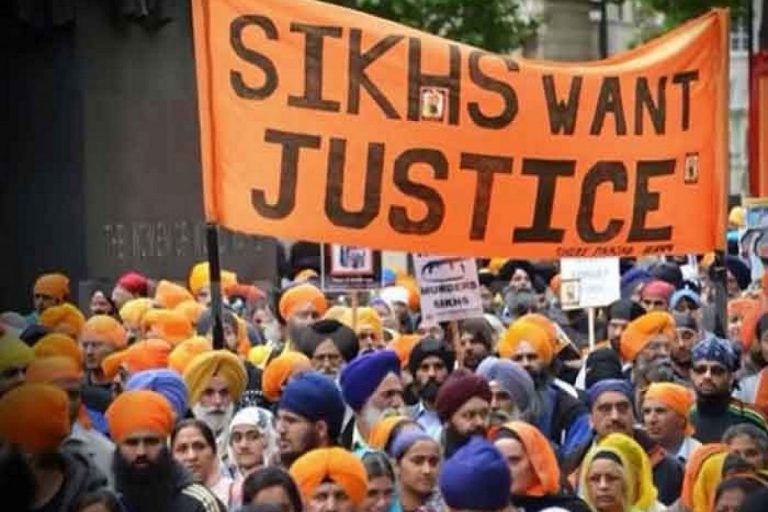
The Ministry of Home affairs under Unlawful Activities Prevention Act (UAPA) banned the UK-based secessionist group called Sikhs For Justice organization in 2019 and declared several members linked to it as terrorists. Later, terrorism-linked charges were filed by National Investigation Agency(NIA) against ten people which also had Gurpatwant Singh Pannun, the leader of the Sikh For justice in the list.

It was also alleged that Pannun was involved with arson and violence in Punjab in 2017-2018. Pannun and Sikhs for Justice supporters were also accused of “carrying out of propaganda activities both online and on ground” and planning Referendum 2020 which was an unofficial poll of the Sikhs and an attempt by the SFJ to gain world wide support for Khalistan ‘independence’. Indian officials defined Sikh For Justice as “a gang of radicalized Sikh youth under the direction [of] and [with] financial assistance from SFJ handlers located abroad as part of an organized conspiracy by the accused for launching a concerted secessionist campaign for creation of Khalistan”.

A letter sent by Pannun to the Prime Minister of Pakistan Imran Khan came under heavy scrutiny of the NIA where the title of the letter claimed that “December 16 ‘Fall of Dhaka’ is the past, ‘Fall of Delhi’ is inevitable”. The letter also mentioned that “Pakistan should be prepared to recognize new neighbor Khalistan”. Unusual Pakistan’s influence and bias could be traced in the letter with shades of propaganda dialogues normally used by the Pakistani military.

Khalistani Separatism in the United States

In 2019, Islamists in the presence of Ghulam Nabi Fai, an agent from Pakistan and other so-called activists and officials from the political party headed by Imran Khan protested in Houston at the time of Prime Minister Narendra Modi’s visit. There was a demonstration featuring “Go Back Modi” in a truck rally arranged by none other than the Sikhs For Justice leader Pannun, Sikh Association of America, Friends of Kashmir’s leader Ghazala Habib, also a representative Kashmiri Hurriyat political alliance. The truck rally carried the message “call by Pro Khalistan Sikhs & Organizations Supporting People of Kashmir”.

It may be important here to note that in another event which occurred in August 2020, where Friends of Kashmir, an anti India organization with international presence supported by Pakistan, co-operated with the Pakistani Embassy in Washington D.C. In a similar manner, it was found that other Kashmiri organizations in the USA have formed alliance with the Khalistani groups. Stand With Kashmir (SWK) for example, is considered as “one of the most influential voices in America on the subject of Kashmir.” It is believed to be backed by Sikh progressivist groups such as Ruthless Collective which was allegedly a British-Canadian Sikh organization. SWK also co-ordinated with Organization for Minorities of India (OFMI) and the Indian American Muslim Council (IAMC) to stage protest against the Citizenship Amendment Act in December 2019.

Another link between Pakistan and Khalistani separatists is that in 2006, a Pakistani national Khalid Awan was found guilty by a federal bench of Brooklyn, New York, of funding the terrorist organization Khalistan Command Force (KCF). US Department of Justice stated “KCF was formed in 1986 and is comprised of Sikh militants who seek to establish a separate Sikh state in the Punjab region of India. The organization has engaged in numerous assassinations of prominent Indian government officials—including the murder of Chief Minister Beant Singh of Punjab in 1995—and hundreds of bombings, acts of sabotage, and kidnappings.”

At Awan’s trial, the US government offered the recordings of his prison telephone calls to Panjwar, Pakistan, in which Awan spoke of recruiting new members for the KCF and admitted having had sent hundreds of thousands of dollars to KCF in the past.

According to the research report, Sikhs for Justice is not the only Khalistani organization based in the United States. SFJ is also accompanied by various other groups and media organizations such as US Media International, Khabardar Punjab TV, Kashmir Khalistan Referendum Front (KKRF). Sikhs For Justice or SFJ is also found to be associating with Global Sikh Affairs Media and Khalistan Affairs Center (KAC). The Sikhs for Justice also allegedly runs a Khalistan Embassy that contains the address of an ashram in California in the website registrant address but at the same time also lists the address where it claims to be the main Sikh gurudwara in the United States on Massachusetts Avenue in Washington, DC.

This Article is based on the research conducted by STUDY GROUP ON KASHMIR AND KHALISTAN MOVEMENTS:
DR. APARNA PANDE, HUDSON INSTITUTE; DR. CHRISTINE FAIR, GEORGETOWN UNIVERSITY; SAM WESTROP, MIDDLE EAST FORUM;
SETH OLDMIXON, LIBERTY SOUTH ASIA; MICHAEL RUBIN, AEI; HUSAIN HAQQANI, HUDSON INSTITUTE

El Salvador: Opposition and media call President Nayib Bukele a ‘dictator’, he says he is, declares that in Twitter bio

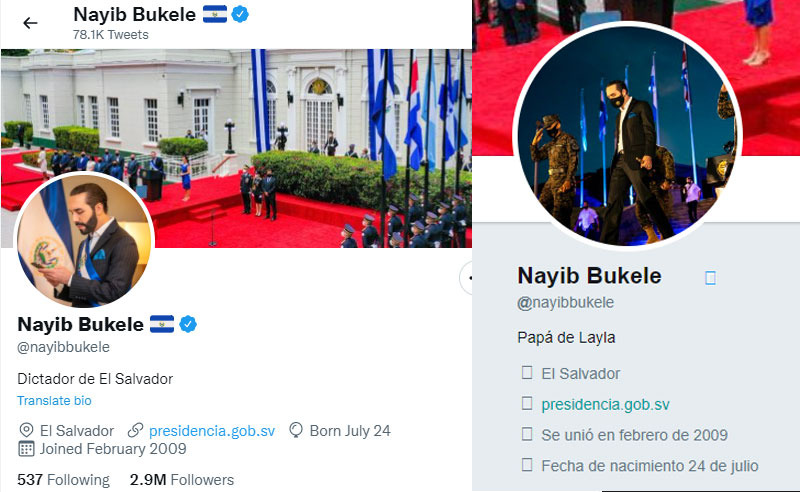
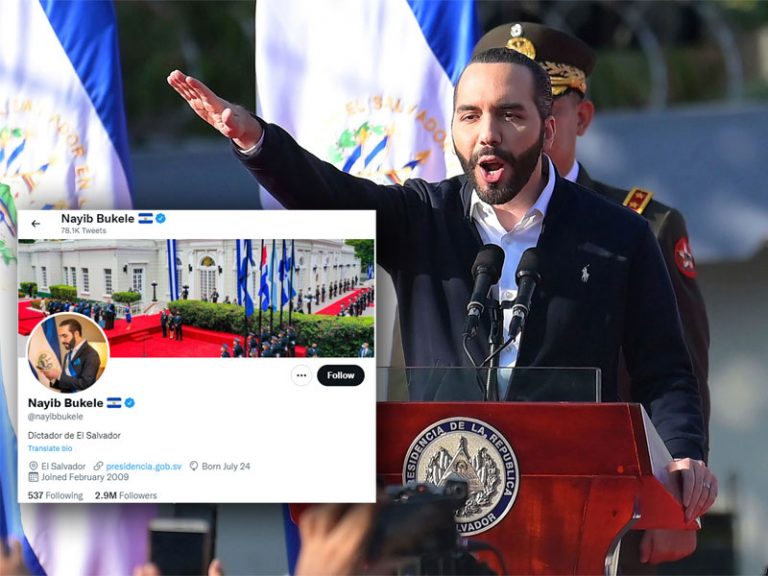
Nayib Bukele, 40-year-old President of El Salvador, has declared himself a ‘dictator’ in his Twitter bio that now reads, “Dictador de El Salvador”, which translates to “Dictator of El Salvador”. Earlier, it used to say, “Papá de Layla”, which means “Layla’s Dad”, referring to his only daughter. The recent change in the bio came after the opposition and media called him a dictator.

President Nayib Bukele changed bio to ‘Dictator of El Salvador’ (Left) from ‘Layla’s Dad’ (Right) recently

On September 15, thousands of Salvadorans came out on the roads to protest against the government’s decision to introduce Bitcoin as legal tender. They also protested against the reforms introduced in the judicial system that the critics deemed as a threat to democracy. The protestors were seen holding placards denouncing a ‘dictatorship’, ‘respect the constitution’ and ‘no to Bitcoins’.

Bukele, in a tweet, condemned the protests and called them out for the destruction of property. He said, “They say the ‘vandalism’ was done by ‘infiltrators,’ but there is vandalism at ALL their protests.” He also added a video of a masked woman who was kicking down a glass security wall. He also blamed the “international community” for fueling the protests by providing funds for the same.

The judges had also joined the protests against the law that deemed judges above the age of 60 or with 30-years of service to be laid off. Reports suggest that it would affect one-third of the judges serving in different courts. The protestors also raised voice against the ruling of the Supreme Court that allowed Bukele to seek a second successive term though the constitution of El Salvador allows only one term. It has been alleged that the ruling was passed by the judges appointed by Bukele.

Bukele has been called dictator before

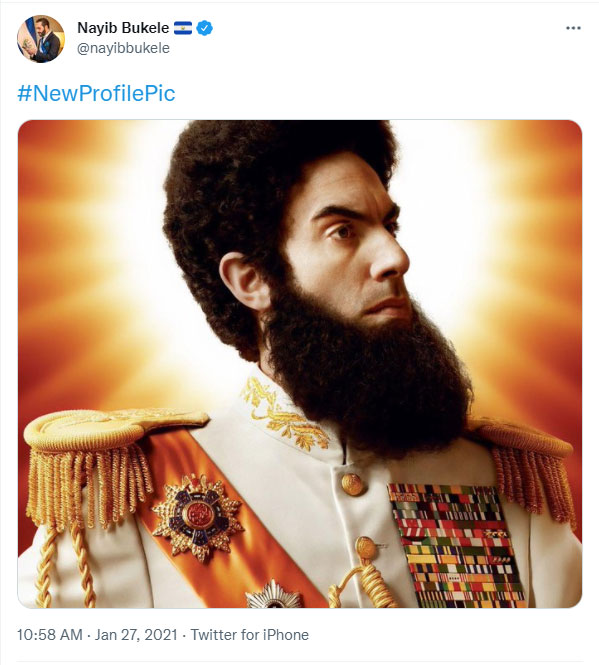
This is not the first time Nayib Bukele has been called a dictator. In January 2021, he briefly changed his profile picture to an image of Sacha Baron Cohen from the movie the Dictator. The brief change happened after being called a dictator multiple times for ruling that came in favour of extending his term as President from five years to six years.

Bukele had minted every opportunity in the past to turn things in his favour, especially the significant drop in homicides during his term since 2019, when he became the President of the country. During his tenure, he has granted additional powers to police and military to control crime, which was, in fact, one of the promised that he had made during elections and paved the way for his win.

Bukele describes himself as the “coolest President”. However, he has been accused of using state agencies to ‘harass’ journalists and investigate opposition parties. A new constitution is being draft for the country, which is expected to be revealed later in 2021. Bukele has said once that he wanted to ensure that his opponents never return to power.

However, his popularity is on the rise in the country for several reasons, including the drop in crime rate and Covid-19 management.

Gujarat: Heroin worth Rs 9000 crore smuggled from Afghanistan seized at Mundra port

0

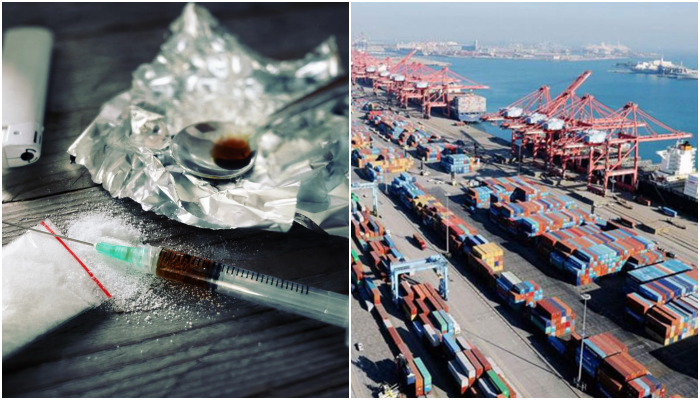
The Directorate of Revenue Intelligence (DRI) have recently confiscated containers carrying heroin worth an estimated Rs 9,000 crore from Mundra Port in Gujarat’s Kutch. The drugs were reportedly smuggled from Afghanistan. The shipment was loaded in Iran’s port and had 7 Iranian nationals onboard.

According to the reports, the officials discovered the contraband after stopping a consignment for inspection. On carrying out the examination, they found drugs worth crores being imported under the name of “talcum powder”.

Initial investigation has linked the smuggled contraband to one Aashi Trading firm based out of Andhra Pradesh’s Vijayawada. As per reports, DRI had got a tip-off about the consignment and has been working to seize it for the last five days. Mundra port is managed by the Adani Group.

The investigating agencies found that the consignment was declared as “talcum powder” by the Vijayawada based firm. As per sources quoted by news reports, the exporting firm has been identified as one Hassan Hussain Ltd., based in Kandahar, Afghanistan.

Initially, the value of seized heroin was estimated to be Rs 2,500 to Rs 3,000 crores. However, after thorough inspection, it was determined that heroin imported from Afghanistan was worth Rs 9,000 crores.

Vijayawada company raided

After the role of the Vijayawada-based firm came to light, the police immediately rushed to the company’s office and detained its representatives. The company representatives have reportedly said that the firm is involved in the transport business and it has got nothing to do with the impounded heroin discovered by DRI officials in Gujarat.

In its investigation, the police found that the plan was to smuggle the drugs to southern states from Gujarat. However, they are yet to conclude what the original plan of the smuggling racket was. They are yet to determine if the plan was to first transport the drugs to Vijayawada and from there to other south Indian cities or directly to Chennai via Vijayawada.

The investigation is currently underway and the authorities are probing all possible angles. The executives of Aashi Trading Company are held in custody and are being probed over the seizure of such a massive amount of drugs found in Mundra port.

The seizure of drugs from Afghanistan came hot on the heels of arrests made by Guntur police a few days back, which involved a gang selling synthetic drugs online. Police are also in shock to learn about Vijayawada being the location from where Rs 9,000 crore of heroin was ordered. Sources believe all the facts of the case will come out only after the police and DRI authorities conduct an in-depth investigation into the incident.

TMC impact? Babul Supriyo loses more Twitter followers in one day than he had gained in previous one month

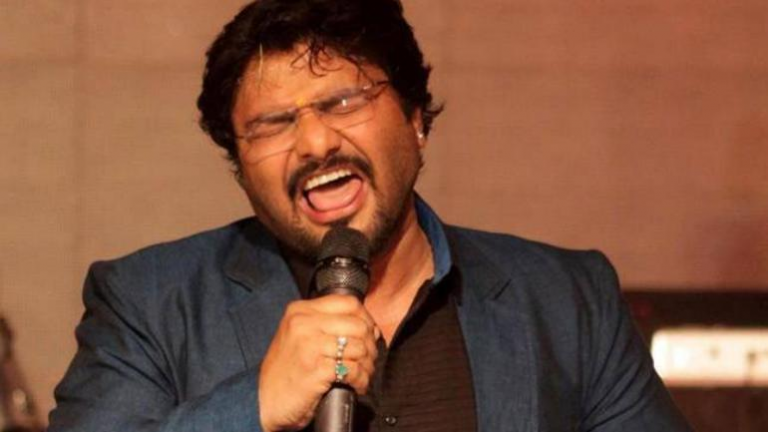
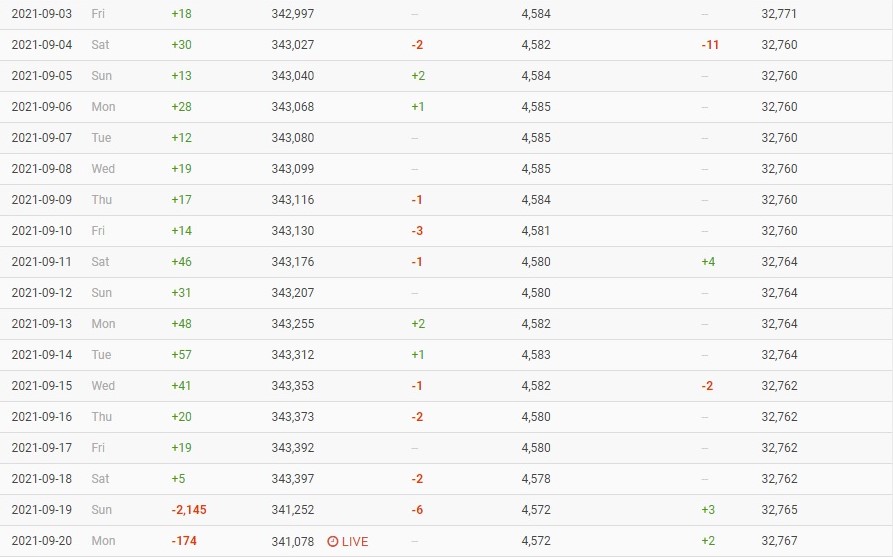
Newly minted TMC leader Babul Supriyo has lost more Twitter followers in one day than the gains he made during the previous one and a half months. The MP from Asansol, who abandoned the BJP to join TMC recently, lost as many as 2145 followers on Sunday and the decline has continued on Monday.

Between the 4th of August and 18th of September, Babul Supriyo gained 1464 followers. Then on the 19th of September, Sunday, he lost 2145 followers on Twitter. On Monday so far, he has lost 174 at the time of writing this report.

In fact, his follower numbers saw a decline on Sunday for the first time in 25 days.

Babul Supriyo loses Twitter followers
The third column indicates followers gained or lost in a day (Source: Social Blade)

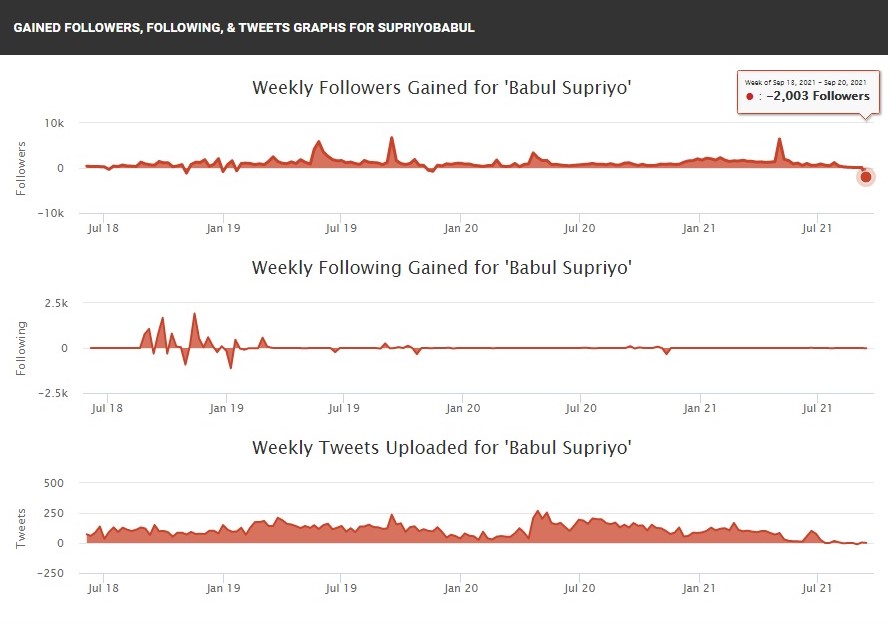
Consequently, weekly followers count for Babul Supriyo showed a distinct decline on the 20th of September.

Babul Supriyo loses Twitter followers
Source: Social Blade

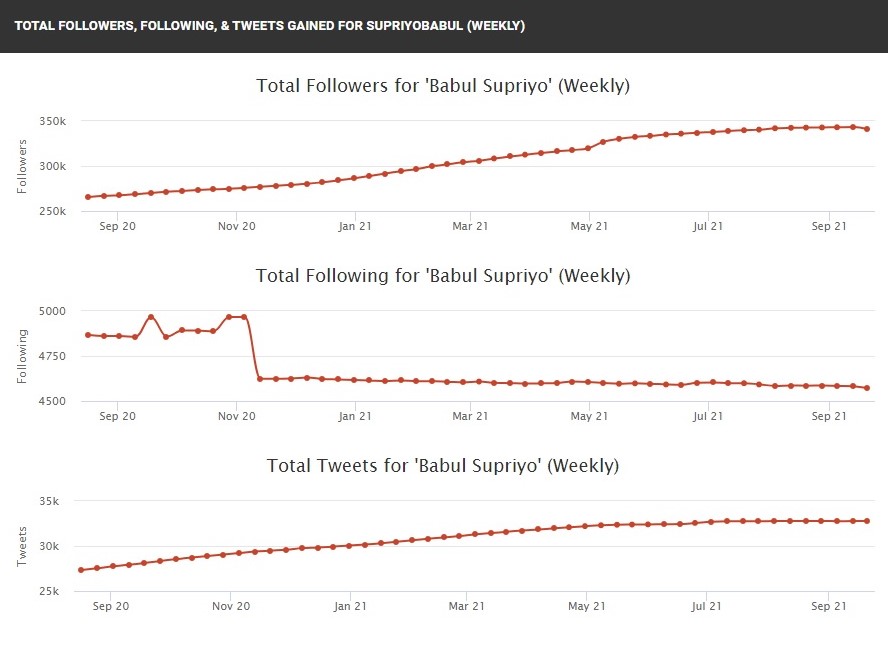
The followers count has slipped from 343,255 on the 13th of September to 341,078 on the 20th of September.

Source: Social Blade

People have been calling for users to unfollow Babul Supriyo since he joined the Trinamool Congress. They were angry with him over what they consider to be treachery.

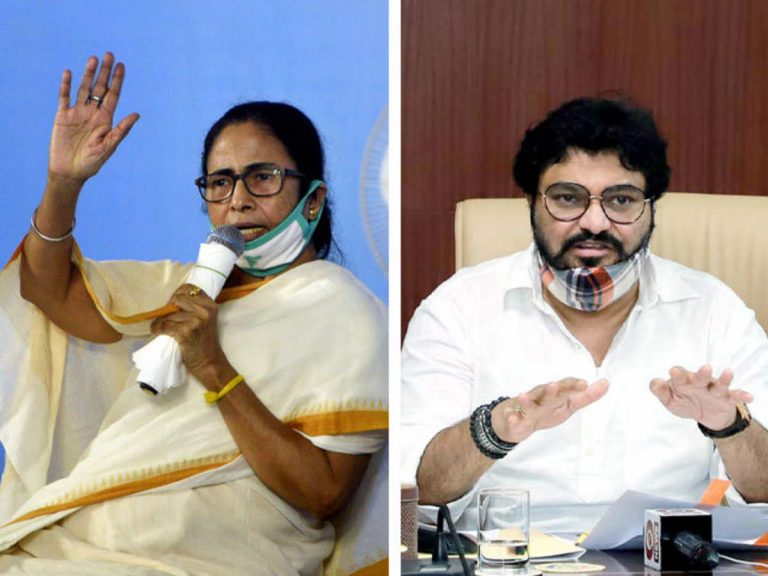
Babul Supriyo has admitted that he joined the TMC because he was made an offer that would permit him to resume his normal public life. “Mamata Banerjee presented with a fantastic opportunity so that I could continue my public life in West Bengal and can resume my public life with grace and purpose… And I can continue singing. There’s going to be a lot of flak, a lot of memes… But the opportunity is worth the challenge,” he said.

Babul Supriyo admits he joined TMC because Mamata Banerjee made an offer that would allow him to sing and resume normal public life

0

Former BJP politician Babul Supriyo has already drawn flak just two days after joining the TMC. In his latest statement, the now TMC member was heard rooting for Mamata Banerjee as the next Prime Minister. According to the Member of Parliament (MP) from the Asansol constituency, TMC chief Mamata Banerjee is among the top frontrunners for the prime ministerial post in 2024.

“I want that the captain of our party Mamata Banerjee becomes the Prime Minister in 2024. Opposition plays an important role in a democratic system. Nobody can deny the fact that Mamata Banerjee is among the top frontrunners for the prime ministerial post,” media reports have quoted Supriyo as saying.

Heaping praises on the Trinamool Congress party supremo within two days of him joining, Supriyo said that Mamata Banerjee offered him a role in the TMC which allowed him to sing. “Mamata Banerjee presented with a fantastic opportunity so that I could continue my public life in West Bengal and can resume my public life with grace and purpose… And I can continue singing. There’s going to be a lot of flak, a lot of memes… But the opportunity is worth the challenge,” he said.

Babul Supriyo had faced strong criticism by BJP supporters for his sudden decision to join TMC, as he had announced that he is quitting politics. He that taken to Twitter to justify his political decision.

Violence in West Bengal under Mamata Banerjee’s regime

Meanwhile, considering that Mamata Banerjee has the qualities to replace Prime Minister Narendra Modi and take on the task of running the entire country is quite wishful thinking considering the West Bengal CM has made no serious attempt to curb violence and put her house in order in the past decade. In fact, her party members have unabashedly carried out bloodshed and mayhem in the state, with no regard for the rule of law.

After BJP gained significance in the state, the ruling Trinamool Congress has waged a bloody campaign against the party. Several BJP workers have been killed allegedly by TMC cadres in the last few months. In fact, the ‘Khela hobe’ slogan, coined by Mamata Banerjee ahead of the West Bengal Vidhan Sabha polls, promptly became a war cry for Trinamool Congress goons to loot, maim, slaughter, and rape rival BJP workers. 

Babul Supriyo takes massive U-turn, joins TMC

On Saturday, September 18, the official Twitter handle of the TMC announced that the former union minister joined the Mamata Banerjee led party in presence of senior TMC leaders Abhishek Banerjee and Derek O’Brien.

Less than two months ago, Babul Supriyo had said that he is exiting politics, saying that he will also resign from the Lok Sabha. However, he has resigned as MP yet. He had taken the decision after he was dropped from the union ministry in the recent cabinet reshuffle. He was the Minister of State for Environment, Forest, and Climate Change in the Modi government, but he was dropped from the govt during the cabinet reshuffle on July 7.

However, his joining the TMC today has meant that he has not quit politics, and he had only left BJP. After ‘quitting politics’ and BJP, he had claimed that he will not be joining any other party. He had even dismissed rumours that he was joining TMC, but he has taken a massive U-turn now.

Russia: 18-year-old Timur Bekmansurov guns down 8 people in Perm State University, several injured

0

As many as eight people have been gunned down and several injured after an eighteen-year-old student opened fire at Perm State Research University in western Siberia, Russia.

The attacker has been identified as one Timur Bekmansurov, a student of the same university. As per a Russian news agency report, he has been neutralized by the security agencies and a hunt for his probable accomplices is on. 

“One of the attackers has been neutralized, we are checking the information about possible accomplices. Students could have mixed something up out of fright, shots have already stopped,” said the governor. 

Visuals of the attack

While the students and staff locked themselves in the rooms, the university urged those who could leave the campus to do so. In a bid to escape, several students were recorded jumping off the university building window. 

A dozen have reportedly been injured either by gunfire or by falling from windows.

A crisis room has been created in the university while the Health Ministry informed that nine ambulances have been deployed at the university.

The attacker’s plan

A local news website in Russia has published some unconfirmed social media posts suspected to be made by the shooter. In these posts, the shooter described his plans and motivation for the attack in detail. 

The post read, “What happened was not a terrorist attack (at least from a legal point of view). I was not a member of an extremist organization, I was nonreligious and apolitical. Nobody knew what I was going to do, I carried out all these actions myself.”

He also confessed that he was “overflowing with hate” and had been planning the shooting for a long time.  

Chhattisgarh: Former Minister and BJP leader Rajinder Pal Singh Bhatia committed suicide, police say

Rajinder Pal Singh Bhatia, former minister of Chhattisgarh from the Bharatiya Janata Party, has committed suicide on Sunday. Bhatia was found hanging at his home at Chhuriya town in Rajnandgaon in the evening of 19th September. He was 72 years old.

Rajnandgaon Additional SP Pragya Meshram said that a suicide note was recovered from the scene. According to the note, Bhatia committed suicide due to health reasons.

“Bhatia lived with his younger brother and his family. He was alone in the house on Sunday and when the family members returned, they found him hanging from the ceiling fan in his room,” a senior officer had told the Indian Express. “We are questioning the family members too.”

Rajinder Pal Singh Bhatia had been infected by Covid-19 in March this year and has been unwell since then, BJP leaders say. Bhatia was the Minister of State for Commerce and Industry between 2003-08 in the Raman Singh led government.

He had a fallout with the party in 2013 after being denied a ticket for the assembly polls, following which he contested as an independent from the Khujji constituency. However, later he returned to the BJP.

NDTV share hits 10 per cent upper circuit over rumours of buyout: Here’s what it means

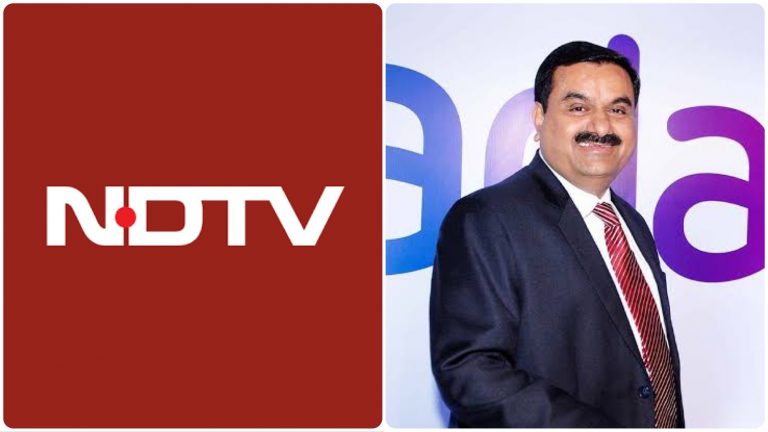
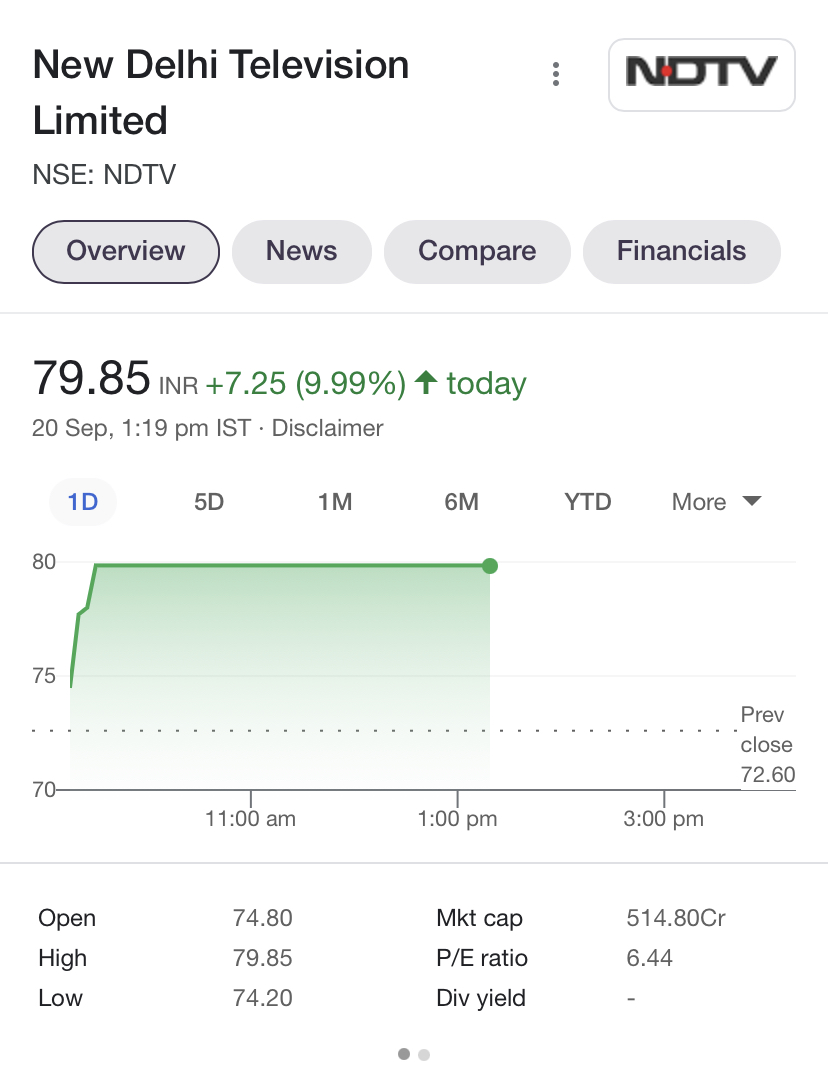
NDTV shares on Monday zoomed to hit its upper circuit of 10 per cent after rumours started doing rounds that Adani Group is going to buy the company.

As of 1:19 PM on September 20, the share price of NDTV was hovering around Rs 79.85, up by Rs 7.25 or 9.99 per cent today, which is its upper circuit limit.

Source: Google

Since stock prices are mostly sentiment-driven, they fluctuate due to positive and negative news, a circuit filter is set up to ensure that there is no extreme price movement and investors are protected from any unwanted surprises. The filters also help limit price variation to a certain extent by stock operators.

The upper circuit limit is the highest price a stock can reach on a particular day. When this limit is touched, there will be only buyers and no sellers. Likewise, the lowest price that a stock can hit is the lower circuit limit and when a stock hits this limit, there will be only sellers and no buyers.

Rumours of NDTV being acquired by Adani Group

The inexplicable surge in the share price of NDTV could be attributed to the rumours that are flying around about its possible acquisition by the Adani Group, which had recently announced its entry into the media industry. However, OpIndia cannot independently verify the speculations.

“Buzz in Delhi: Adani Group going to buy an old TV Channel which always attacked him & signing will be in London-some say Rs.1600 cr total deal value. But the guy currently heading will only get around Rs.100 cr & saved from cases & major shareholder will take Rs.750cr,” tweeted journalist J Gopikrishnan.

According to Gopikrishnan, the speculations surrounding Adani’s entry into the media industry say that a deal worth Rs 1600 crore is finalised between the group and NDTV. As per the modalities of the deal, the current head of the company would get only Rs 100 crores and emancipation from various cases that plague the company. He further added that the major shareholders will get Rs 750 crores.

The Adani Enterprises had recently roped in veteran journalist Sanjay Pugalia as the CEO and editor-in-chief to lead the group’s media initiatives. Pugalia had earlier been associated with Quint Digital Media, CNBC-Awaaz, Star News, Zee News and was among the team that founded AajTak.

On his appointment, Adani Group released a statement: “We look forward to leveraging Sanjay’s wide-ranging experience in media, communications and branding across the Adani Group’s diverse range of businesses and in our Nation Building initiatives.”

NDTV has not had a stable financial performance. Its channels have consistently ranked among the lowest in terms of TRPs. The company’s promoters are also involved in investigations related to tax evasion. However, the company’s stocks have inexplicably performed well in last 24 months, with its stock rising about 130 per cent in the last one year.

But the recent spike in the stock price could be chalked up to the positive sentiments after rumours of the company’s buyout started doing the rounds on the internet. The investors perhaps believe that the acquisition could help rebrand the company and shake off its negative image among the viewers. The buyout could also relieve the company of the chronic tax liabilities it continues to face.

NDTV accused of tax fraud, financial irregularities

NDTV in recent times has been embroiled in controversies over alleged financial irregularities. NDTV is facing multiple cases related to violation of FDI norms, Income Tax violation, and non-compliance with disclosure norms. CBI is probing a case against NDTV in relation to a Rs 375 crore loan from ICICI Bank and a corresponding wrongful loss of Rs 46 crore to the bank. 

There is a chain of borrow, repay and borrow where the Roys took a series of loans in 2008 as they sought to buy back a large chunk of NDTV shares from the market, allegedly violating foreign direct investment (FDI) rules in a 2007-09 investment, a charge denied by the company.

In August 2019, NDTV founders Prannoy Roy and his wife, Radhika Roy, were prevented from leaving the country after authorities had suspected that the accused Roys could run away from the country amidst massive tax fraud allegations against them.

More recently, in December 2020, Markets regulator Securities and Exchange Board of India (SEBI) had imposed a penalty of Rs 25 crore on news outlet NDTV and Rs 1 crore each on its promoters. SEBI had imposed fines on NDTV and its promoters Prannoy Roy and Radhika Roy for “violating various securities” norms by hiding information from shareholders regarding certain loan agreements.

Dalit unions call Congress’ move to make Charanjit Singh Channi Punjab CM ‘poll stunt’, Mayawati criticises move too

0

The Congress on Sunday picked Charanjit Singh Channi, as Punjab’s next chief minister, after the sudden resignation of Punjab Chief Minister Captain Amarinder Singh on Saturday. The Dalit unions in the state are, however, not quite pleased with the Congress party’s game plan to lodge a Dalit leader as the face of the state, with less than six months to go before the assembly polls in Punjab. They have termed Congress’ move as an election stunt, Indian Express has reported.

Slamming Congress’ decision to choose Charanjit Singh Channi amidst all the other deserving candidates like Sukhjinder Singh Randhawa, Navjot Singh Sidhu and Ambika Soni the Dalit unions said the party was trying to kill two birds with one stone since Channi is both a Dalit as well as a Sikh.

The Dalit unions opined that this was Congress strategy to consolidate the divided Dalit vote into a single bloc before the state goes into polls next year.

“It is merely an election stunt. Channi is a Dalit as well as a Sikh. Punjab will go to the polls in another four to five months and a code of conduct will be imposed 40 days before the elections. So what can the new face do? He will just say I am a new person, trying to understand things,” said Zora Singh Nasrali, president of Punjab Khet Mazdoor Union.

The general secretary of the Mandi board Tarsem Singh Sewewala said: “Till the time policies are not changed, a Dalit CM or a Jat Sikh CM will not make any difference. Now we will ask the newly chosen CM to chair the September 23 meeting with our Sanjha Morcha. This will be a litmus test for him and will show how caring he is about Dalits.”

“However, already Punjab has 34 elected Dalit MLAs. What difference have they made to our condition? Making a Dalit CM is to target our vote bank. Every political party is targeting us, so is the Congress,” Sewewala added.

BSP chief Mayawati calls Congress move a ‘poll gimmick’

Dalit leader and Bahujan Samaj Party chief Mayawati has also slammed the Congress for its decision to induct Channi as the new Punjab CM just before the state is scheduled to go into polls. The former CM of Uttar Pradesh called it Congress’ poll gimmick for the upcoming Punjab assembly elections. Mayawati was quoted by ANI as saying that the appointment of Channi merely for a few months ahead of Punjab polls is a gimmick.

“I have also come to know through media that the next Punjab assembly elections will be fought under the leadership of a non-Dalit. This means that Congress still does not fully trust the Dalits. Congress is also scared of the SAD-BSP alliance in Punjab”, added Mayawati.

It is notable here that Congress general secretary Harish Rawat had announced earlier that the next assembly elections will be fought under the leadership of PCC president Navjot Sidhu. Even former PCC president Sunil Jakhar had called it ‘baffling’.

Congress playing ‘Dalit vote-bank Rajneeti’

Castigating the Congress party for playing Dalit vote-bank rajneeti, Bhagwant Samao, the president of Mazdoor Mukti Morcha, Punjab said: “Shiromani Akali Dal did an alliance with Bahujan Samaj Party eyeing Dalit vote bank. They also announced that they will make a Dalit deputy CM while AAP too made a similar announcement. BJP, too, announced that they would make a Dalit CM. So, Congress has made a Dalit CM for few months to settle their internal feud. They are trying to give a message that while other parties have made announcements, they have already made a Dalit CM. It is Dalit votebank rajneeti. If Channi was so concerned, did he ever visit any of the dharnas where Dalits have been protesting? It hardly matters to us who the CM is.”

It should be noted that Punjab has the largest percentage of Dalits in India (32%). While the majority of this group was traditionally a Congress vote bank, it has gradually gotten divided. The Aam Aadmi Party received a large portion of the Dalit vote in the 2017 assembly elections. This time also, the AAP and the Shiromani Akali Dal are expected to split the Dalit vote bank (SAD). So basically, Congress is hoping that by giving the state its first Dalit chief minister, it may tip the scales in its favour in the 34 reserved seats in the 117-seat legislature.

Charanjit Singh Channi accused in #MeToo, illegal construction and illegal mining cases

Meanwhile, Charanjit Singh Channi has taken oath as Punjab Chief Minister, Monday. Channi is an MLA from the Chamkaur Sahib Assembly constituency.

In October 2018, Channi was accused of sending inappropriate messages to a woman IAS officer. The matter was ‘resolved’ to the woman officer’s satisfaction, reports said. The woman officer had alleged Channi had sent her multiple messages to which she had objected but he continued to send them. When one message was sent late at night, she had decided to object and escalate the matter.

Turns out he had sent an Urdu couplet to the woman officer ‘by mistake’ which she objected to. He, however, later apologised for the same.

When Bholath MLA Sukhpal Singh Khaira was the opposition leader in March 2018, he accused Channi of being involved in illegal mining, a claim the minister strenuously disputed.

In another incident, the now Punjab CM was accused of illegally constructing a road from a park outside his official residence in Sector 2, Chandigarh. Within hours, the road was razed by the Chandigarh administration.