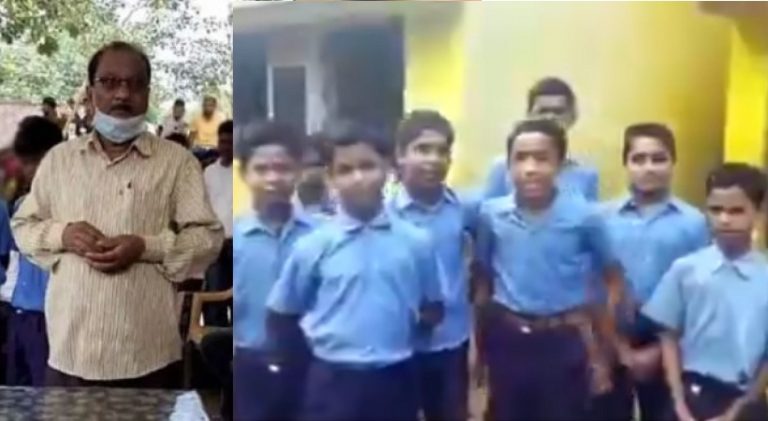
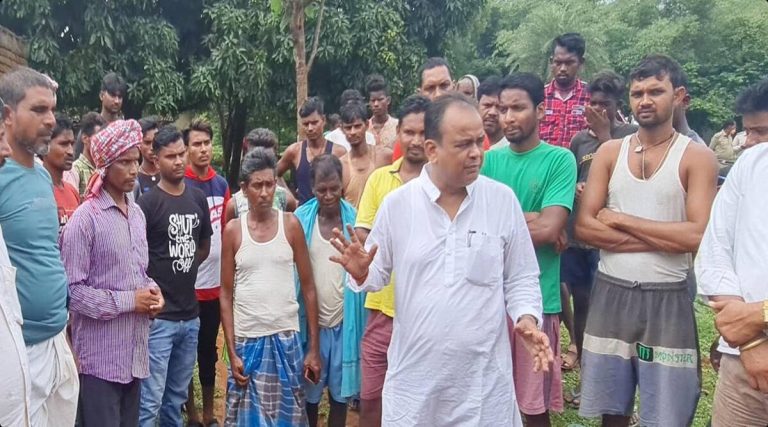
An incident of a Government school teacher in Chhattisgarh making obscene remarks on Shri Krishna and abusing students who fasted on Krishna Janmashtami has come to light. The incident took place in Bundapara Village Middle School, in the Kondagaon district, 200 kilometres away from the capital city of Raipur. According to media reports, the accused teacher Charan Markam has been suspended after preliminary investigation.
As per the reports, the police said that the incident occurred on Tuesday 31 August 2021 and that the villagers and the Gram Panchayat complained about the abuse of class 7 and class 8 students. Authorities said that the teacher Markam had specifically asked about those students who were fasting on the eve of Janmashtami and observing the rituals, and then allegedly picked out those students who raised their hands, and beat them.
A video had emerged on social media where the students punished by the teacher are seen narrating the incident. The video went viral on social media which caused an uproar. The students said that they were thrashed for keeping fast on the Janmashtami, and had asked them to not believe in any gods like Krishna and Saraswati.
Tribal teacher Charan Markam beats students for having a fast on Janmashtmi. He teaches students not to believe in Hindu gods and said objectionable remarks on Shri Krishna. Most of the students who were thrashed are from the non-sc-st category. pic.twitter.com/HjV0LI7tvf
The Collector of Kondagaon, Pushpendra Kumar Meena, said the suspension order of the accused teacher posted in the Government Middle school under the Girola Panchayat was issued after a preliminary investigation based on the complaint lodged on September 1, 2021. The Collector revealed that the Gram Panchayat and local villagers had complained about the alleged incident on Tuesday and also about the obscene remarks the teacher allegedly made on Shri Krishna. According to reports, the teacher also spread falsehood regarding Hindu Gods and Goddesses.
The Collector of Kondagaon, Pushpendra Kumar Meena also said that the villagers submitted audio as well as video evidence to prove their allegations. A government official was sent to conduct the preliminary investigation which led to the suspension of the accused teacher based on its report. The collector has asked for a report from the police for further investigation on the matter.
The suspension order made it clear that to hurt religious sentiments and spread hate is a serious offence. The authorities said that the actions of the accused teacher were in violation of the Chhattisgarh Civil Service Rules 1965 which led to his suspension. The Kondagaon police said that a case was not yet registered against the Teacher. The police said ‘We have got a report from the district administration that a case has not been registered yet but required actions would be taken after a proper investigation’.
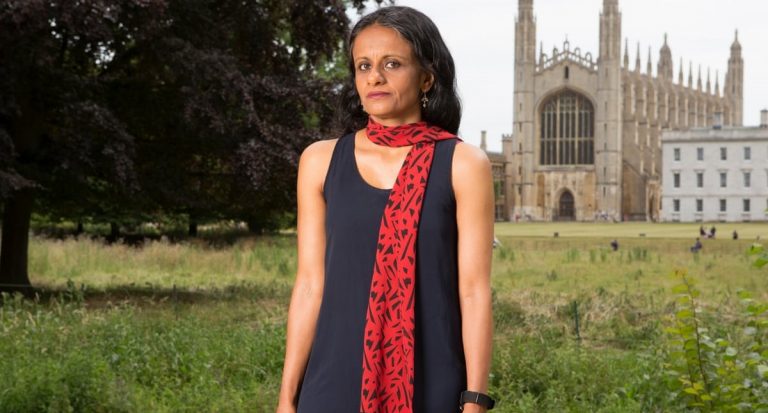
Indian born academic Priyamvada Gopal has acquired widespread notoriety over comments she has made on social media. A quintessential liberal, she appears to harbour a morbid hatred in her heart for Hindus. She happens to be a Professor of Postcolonial Studies at the University of Cambridge.
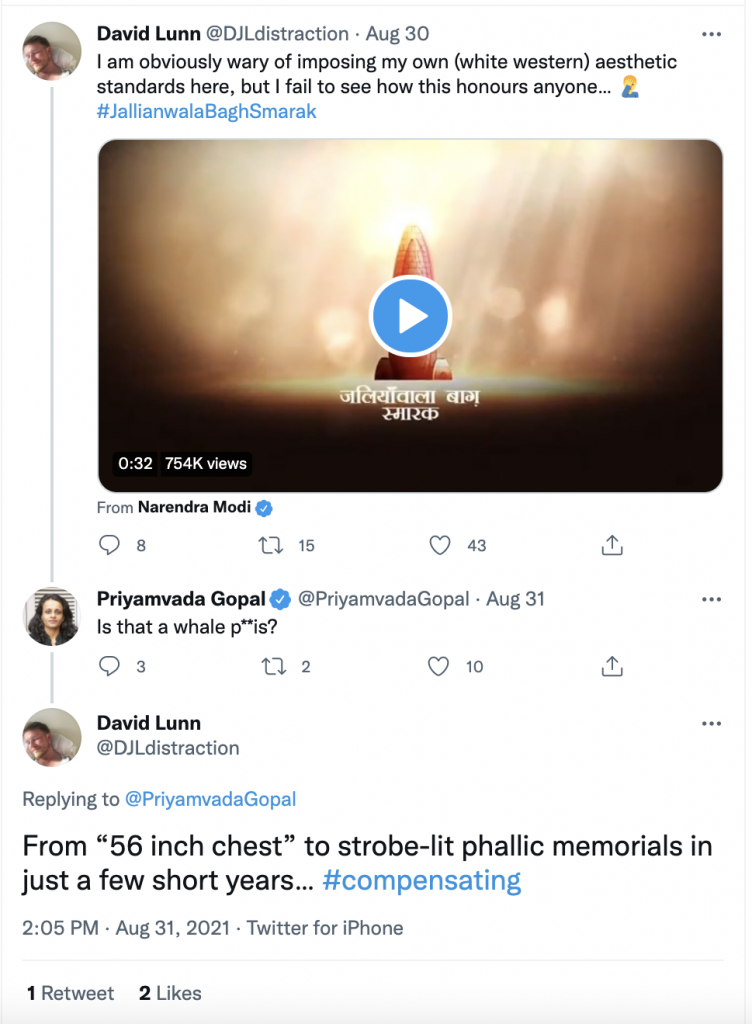
On the 31st of August, Priyamvada Gopal compared the Jallianwala Bagh Memorial to a ‘whale penis’. She made the comparison after an individual said he did not approve of the aesthetics of the memorial. The two individuals involved in the conversation, with levels of IQ demonstrably unheard of in this universe, do not appear to know that the Narendra Modi Government has not constructed the memorial. It has existed for decades.
Source: Twitter
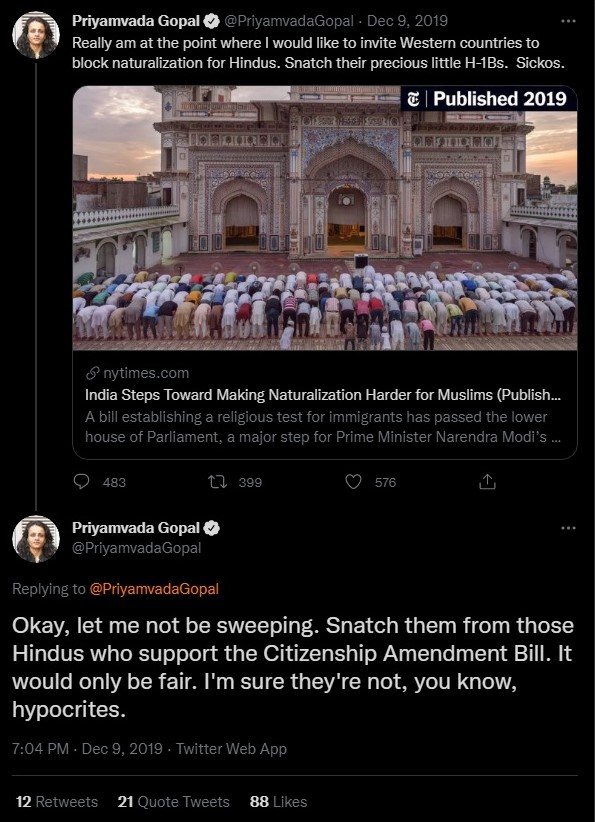
As it so happens, it is not the first time that the academic has made such controversial comments on social media. During the passage of the Citizenship Amendment Act in 2019, Gopal had demanded that the USA block the naturalization of Hindus and “snatch their precious little H-1Bs”, referring to the H-1B Visas.
Source: Twitter
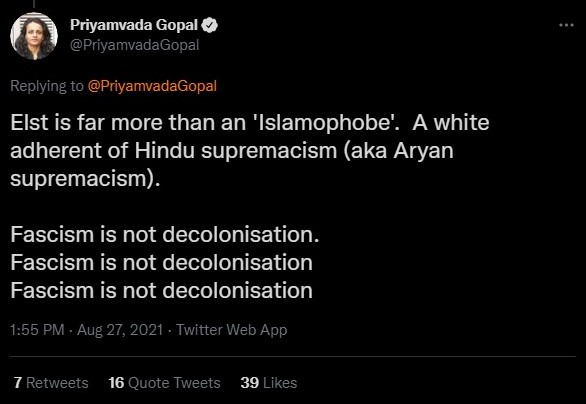
More recently, Priyamvada Gopal claimed that noted scholar Koenraad Elst was a “White adherent of Hindu Supremacism”, which she compared to “Aryan Supremacism” that has notable Nazi symbolism. Elst, of course, is nothing of that sort.
Source: Twitter
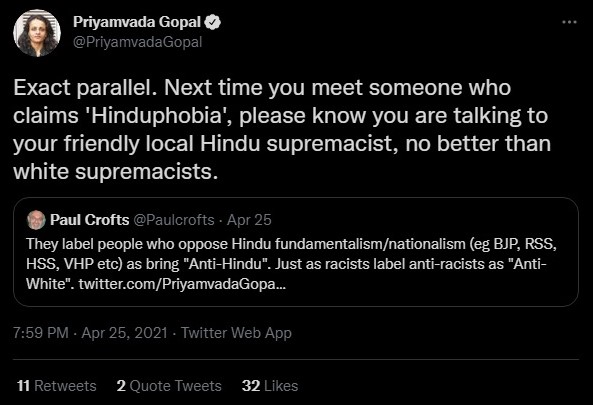
Quite evidently, Gopal is a textbook case of a Hinduphobe. The generalizations and the accusations that she hurls at the Hindu community would be considered unacceptable for any other community. Thus, unsurprisingly, she is at the forefront of denying that Hinduphobia exists.
She claims that Hindus who highlight Hinduphobia are akin to White Supremacists.
Source: Twitter
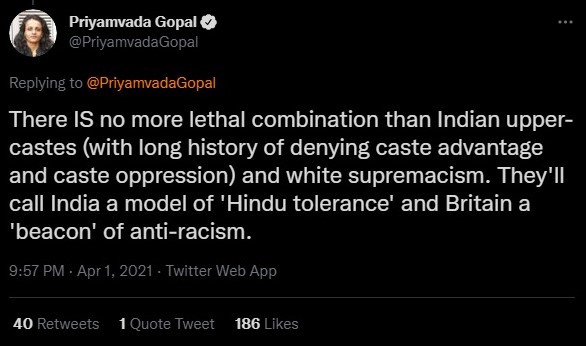
The academic is clearly on a crusade to prove somehow that there is a nexus between Hindus and White Supremacists, a laughable claim.
Source: Twitter
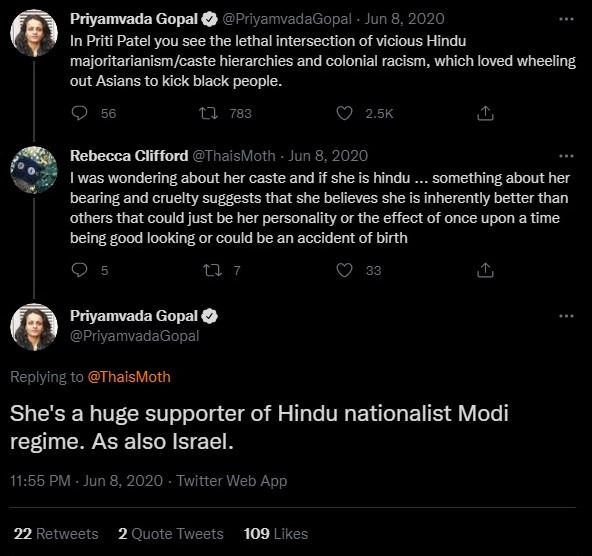
It is clear from her tweets that Gopal has a problem with every Hindu who has been successful in western countries. She made Hinduphobic remarks against Priti Patel, the Home Secretary in the UK Government since 2019.
Source: Twitter
Priyamvada Gopal had landed up in a controversy after declaring that “White lives don’t matter. As White lives”. After receiving severe criticism for the same, she promptly followed it up with a tweet demanding ‘abolish Brahmin-ness’.
While the Taliban has started imposing stringent Sharia laws in Afghanistan, Islamist leaders and politicians in India continue to defend the Jihadi group. In the latest such incident, Congress MLA from Jharkhand, Irfan Ansari has said that the USA is responsible for injustice and violation of human rights in Afghanistan and defended the Taliban. He claimed that Afghans are happy with the rule of the Taliban.
Speaking to media at the Jharkhand assembly after the first day of the monsoon session, Irfan Ansari praised the Taliban for chasing away American troops from Afghanistan. He said, “They should be lauded as they chased the Americans away from Afghanistan. We all know the kind of excesses the American forces committed in Afghanistan.”
When journalists asked whether he is supporting a terrorist organisation, Ansari said, “Yes, they are a terrorist organisation but they have acted as revolutionary in forcing the American occupation out of that country.”
Ranchi MLA Irfan Ansari further said, ‘This is my belief that It is the American administration who is responsible for all the wrongdoings and violation of rights happening in Afghanistan. The truth is something else, we all follow the media, the Taliban and Afghans are absolutely happy in Afghanistan, it is the American forces who is the bully and harassing the Afghan mothers, sisters and children. This is what all this is all about and everything else that is spread in the market/media is not correct, and I will raise my voice whenever there is injustice done against the public.”
#WATCH | American forces are committing atrocities in Afghanistan. They harass mothers, sisters & children. The fight is against it. Taliban & the people of Afghanistan are happy: Congress MLA Irfan Ansari in Ranchi, Jharkhand pic.twitter.com/bgNGksFMXU
He said that the media reports of Taliban atrocities on people are false. Ansari alleged that wherever British and American forces go, they commit atrocities on people. Ansari added that now that US troops have left and British forces have been chased away, there must be peace in Afghanistan. He commented that we don’t have to do anything with what is happening in Afghanistan or Pakistan.
The comments by the Congress leader that Afghans are happy with the Taliban regime comes after thousands of Afghans gathered outside the Kabul Airport trying to flee the country after the group captured Kabul. While the evacuation by western countries has stopped from 31st August, a large number of Afghans are still trying to escape from the country.
In the past, MLA Ansari had made similar rubbish remarks when he made a disgraceful comment on Prime Minister Narendra Modi. He had said, ‘Jo apni maa ka nahin hua, Patni ka nahi hua, wo desh ka kya hoga’ (Someone who couldn’t belong to his mother, his wife, how will he belong to the country). He had also made empty boasts that the Citizenship Amendment Act and NRC would not be implemented in Jharkhand not knowing that state governments do not have any say over matters of citizenship.
The College of Defence Management (CDM) recently conducted an internal study that suggested finding ways to include ‘relevant teachings’ from ancient Indian texts such as Kautilya’s Arthashastra and Bhagavat Gita into the current military training curriculum, a report published by News 18 said. The study also recommended establishing an ‘Indian Culture Study Forum’ and a dedicated facility to explore this possibility.
CDM, located at Secunderabad in Telangana, is a premier tri-services military training institution, where senior officers from the Army, Navy and the Indian Air Force are trained for higher defence management.
A project titled “Attributes of Ancient Indian Culture and Warfare Techniques and its incorporation in present-day strategic thinking and training” was sponsored by the Headquarter Integrated Defence Staff and which aimed to research select ancient Indian scriptures with the view of exploring the possibility of incorporating them in the context of strategic thinking and leadership in the Indian Armed Forces, the report said. The project also sought to set up a roadmap for deducing best practices and thoughts from them, which might be relevant in current times.
“This could be in the sphere of statecraft, military diplomacy, among others,” a top defence source was quoted as saying.
For instance, it calls Kautilya’s Arthashastra a “treasure trove” for the Armed Forces and states that it is relevant in the current context and contains lessons for a foot soldier to a general officer in the Armed Forces.
The three texts, it stated, is relevant in the current scenario with respect to leadership, warfare and strategic thinking.
Congress slams the proposal to include Arthshashtra and Gita in the Indian Army curriculum
The Congress party has objected to the proposal, stating that the inclusion of Bhagwat Gita and Kautilya Arthshastra’s in the Indian Army’s training amounts to the politicisation of the country’s Armed Forces. “At least the government should not do politics in military matters, we won the Kargil war with the help of Muslim soldiers,” said Congress spokesperson KK Mishra while accusing the Centre of politicising the Indian Military.
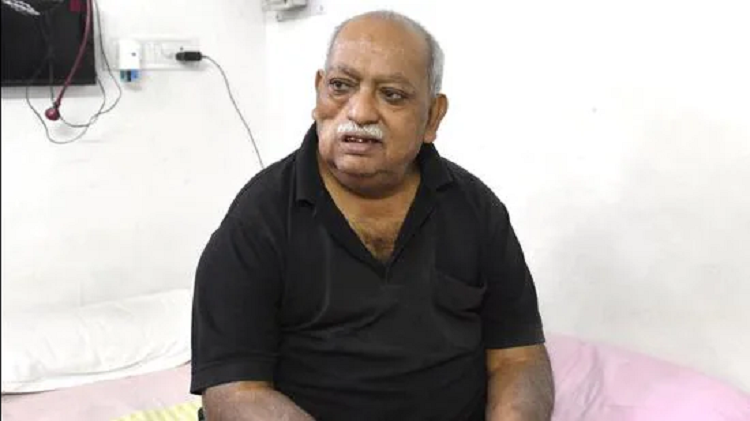
The health of poet Munawwar Rana has deteriorated after the Lucknow bench of the Allahabad High Court refused to grant him an interim protection from arrest over his remarks comparing Taliban to Maharishi Valmiki. Subsequently, he was admitted to the PGI Hospital in the city.
Following the Taliban takeover of Afghanistan, Munawwar Rana had said during an interview, “Do we not have terrorists? One rickshawallah is beaten mercilessly in Kanpur, one politician says Munawwar Rana deserves to be encountered. You do not know the meaning of terrorist.”
He proceeded to add, “Valmiki became a God after he wrote the Ramayan, before that he was a dacoit. A person’s character can change. Similarly, the Taliban, for now, are terrorists but people and characters change.”
“When you speak about Valmiki you will have to talk about his past. In your religion, you make anyone the God. But he was a writer. Okay, so he wrote the Ramayan, but we are not in competition here,” the poet further stated.
Consequently, Munawwar Rana was booked for his comment by the Uttar Pradesh Police. The FIR was registered against Rana on the complaint filed by PL Bharti, a leader of the Valmiki community, who accused Rana of hurting religious feelings by comparing Valmiki with the Taliban. In his complaint, Bharti said that Rana made obnoxious comments against Dalits.
Rana had then filed a petition at the Allahabad High Court seeking a stay on his possible arrest, a request that has been denied by the Court.
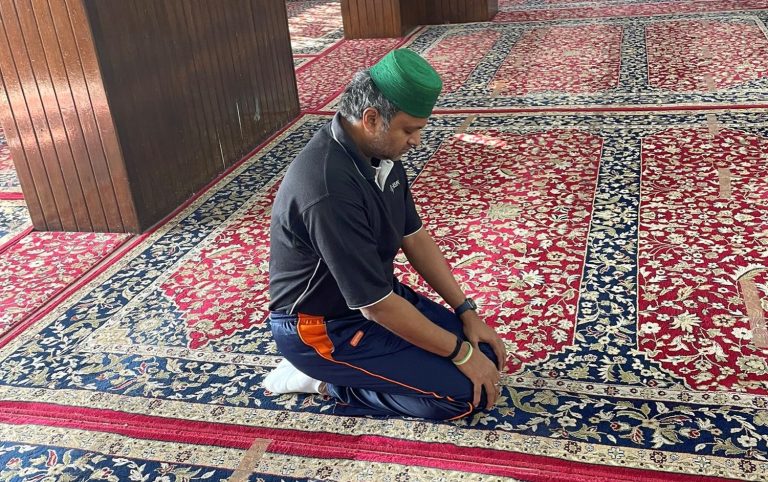
Karti P Chidambaram, son of former Union Minister of Finance, P Chidambaram, shared a picture on social media that showed him offering prayers at the Hazratbal Shrine, Srinagar, Jammu and Kashmir, India.
The visit of Karti P Chidambaram comes shortly after the visit of Wayanad MP Rahul Gandhi to the Shrine.
The Hazratbal Shrine is a Muslim Shrine or Mosque located in Srinagar, also known as Dargah Sharif. The place is believed to be closely related to the Islamic Prophet, Muhammad because of the existence of a relic called the Moi-e-Muqqadas, which many Muslims believe to be strands of hair of the Prophet Muhammad. The shrine is a symbol of love of the Muslims for the Prophet. The construction of the Hazratbal Mosque began in 1968 and ended in the year 1979 with the completion of the white marble edifice and a dome structure.
The place also has a historical relationship with Shah Jahan, who in 1634 re-modelled Ishrat Mahal and a garden that existed before the Hazratbal and built the structure in its place with the purpose of offering prayers. Thus, the Hazratbal shrine represents culture firmly engraved in Mughal history.
The Urs of Chaar Yaar , a Muslim festival, was recently held at the Hazratbal shrine when huge crowd of people gathered to witness the display of the holy relic of prophet Muhammad.
Karti Chidambaram is Congress MP From Sivaganga, Tamil Nadu and son of former Union Finance Minister P Chidambaram. He is currently facing investigation in a number of cases including money laundering and having undisclosed foreign assets. He has been charged in cases like INX Media case and Aircel Maxis case and is facing probe from the central agencies. His father P Chidambaram has also been facing an investigation by the Enforcement Directorate (ED) in the Aircel Maxis case. He was recently released on bail after having spent 106 days in Tihar jail.
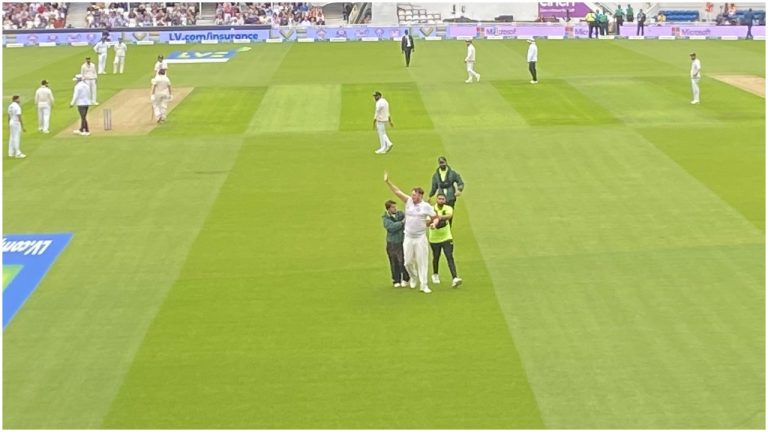
Jarvo 69, who has become the latest internet sensation for his pitch invasions during the India-England Test series, yet again intruded the Oval Cricket Ground in London on Friday disguised as an Indian cricketer.
YouTuber Daniel Jarvis aka ‘Jarvo 69’, an Englishman, who had intruded into the field of play during the second Test match at Lord’s and then again during the Headingley game, made another pitch invasion during the second day of the fourth test between India and England at The Oval, Kennington, London.
Jarvo, who sported the India whites, was spotted running with a ball during the 33rd over of the first innings of England. He ran fast even as Indian speedster Umesh Yadav marked his run-up to bowl to the English batsman. The Youtuber hit Johny Bairstow, who was standing at the non-striker’s end, as Jarvo approached the pitch with all vigour.
The umpires stopped Jarvo, after which the marshals pushed him up forcefully out of the Oval cricket ground. As Jarvo walked back, he received loud cheers as he waved to the crowd.
This is his third pitch invasion in the ongoing India-England cricket series. Earlier, Daniel Jarvis had walked into the Lord’s cricket ground dressed as an Indian fielder during the 2nd Test match. His Indian jersey bore the name ‘Jarvo 69’, and he pretended to be a part of the Indian cricketing side.
His actions left bowlers Mohammed Siraj and Ravindra Jadeja in splits, who asked him about his ‘bowling side’ preference. It was an unusual sight for a white cricket fan to not only invade the pitch but impersonate as one of the fielders. Jarvis was eventually removed from the ground by the security officials.
On August 27, Jarvo came in to bat for the Indian side during the Day 3 of the 3rd Test against England at the Headingley cricket ground. He walked onto the ground casually, dressed in full cricketing gear, and took to the crease after opening batsman Rohit Sharma was dismissed.
Many do not know that Jarvo 69 is not an Indian cricketer or a cricketer at all. He is a serial prankster who hails from Gravesend town in the Kent county of England. The antics of Daniel Jarvis is not limited to pitch invasions during cricket matches alone.
Jarvo – a serial prankster and game intruder
Daniel Jarvis is a member of Trollstation, a group of British pranksters famous for making prank and social experiment videos. In a video shared by him on his official Youtube channel, the prankster was seen setting up a tent named “Trespass” in the middle of the cricket ground. He was then removed from the ground by the security staff.
Over the years, Daniel Jarvis had intruded into several sporting events. During the Diving World Series held in 2015, he had bypassed the security to make his way into London’s Aquatics Centre. In a video shared by him on his Youtube channel, Jarvis was seen stripping his clothes before taking a deep dive into the poll. The video of the incident was originally posted on the group’s Youtube channel ‘Trollstation’. At that time, Jarvis was 26 years old.
There are several such prank incidents Jarvo had pulled off in the last few years. We have recorded some of them in a report.
Although ‘Jarvo 69’ pulls off such stunts with no malafide intentions, they have raised questions about the lack of tight security protocol at International matches. Concerns have also been raised about the safety of players in the event of pitch invasion.
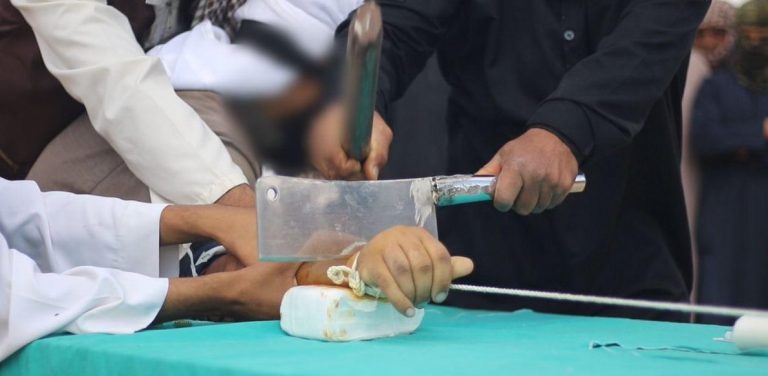
In yet another indicator that the Taliban is anything but “moderate”, the fundamentalist group had recently announced from a Kabul mosque that those who are found stealing and indulging in theft will have their hands chopped as per the Sharia Law of Islam.
Journalist Aditya Raj Kaul took to Twitter to inform about the announcement by the Taliban through a Kabul mosque, wherein it said that people who are caught red-handed stealing or in a case of theft, their hands would be cut as per the law defined in the Islamic Sharia.
Taliban has just announced from a Kabul mosque that those people who will be found stealing or caught in a case of theft, their hands would be cut as per the Sharia Law of Islam. This is Taliban 2.0.
The Islamic Sharia Law ordains Muslims to “cut off the hands” of the perpetrator who is found to have committed a theft. Quran 5:38 says perpetrators of theft and robbery be punished by amputation of their hands. This particular punishment was the order of the day in Taliban-era Afghanistan in the late 90s, demonstrating that the group’s recent claims of being moderate in conduct were nothing more than lip-service, aimed at pacifying internal resistance and seeking international legitimacy.
The hard-line interpretation of Islam had been a hallmark of the Taliban rule in Afghanistan from 1996 to 2001 when inhuman and brutal treatment as a part of the Islamic jurisprudence was imposed on the residents of the country. The Taliban rule came to an abrupt end after the US-led NATO forces stormed the country in the wake of the twin-tower attacks and obliterated the fundamentalist group in December 2001.
During its rule, the punishment inflicted by the Taliban included the public execution of murderers, amputation of hands and legs of robbers and thieves, and stoning and lashing of adulterers. The Taliban had then repurposed the National Sports Stadium in Kabul for executing people and inflicting other forms of punishment for people it deemed criminals every Friday.
Taliban takes over Afghanistan
After US president Joe Biden announced he would honour the withdrawal agreement signed by his predecessor Donald Trump, the Taliban launch a swift offensive, swallowing district after district to take control of the country. On August 15, it stormed Kabul and toppled the US-backed Ashraf Ghani government in a lightning move, effectively taking over Afghanistan. The offensive resulted in people trying to flee the country, including women who feared a return of 1990s-type Taliban rule where they had to stay at home, entertainment was banned, and public executions as punishments were common.
Since the Taliban took over, though they promised a moderate outlook, universal amnesty, and granting some rights to women under strict Sharia law. However, there have been reports emanating from Afghanistan of those promises being not honoured by the Taliban. Women have been told to wear a burqa. Female employees were told to leave business premises, including radio stations. A woman was killed for not wearing a burqa, while another was reportedly killed as she did not cook well. Reports also suggested that the Taliban has been conducting door-to-door search operations hunting their adversaries, and even girls and women between the age of 12 to 45 to use them as sex slaves.
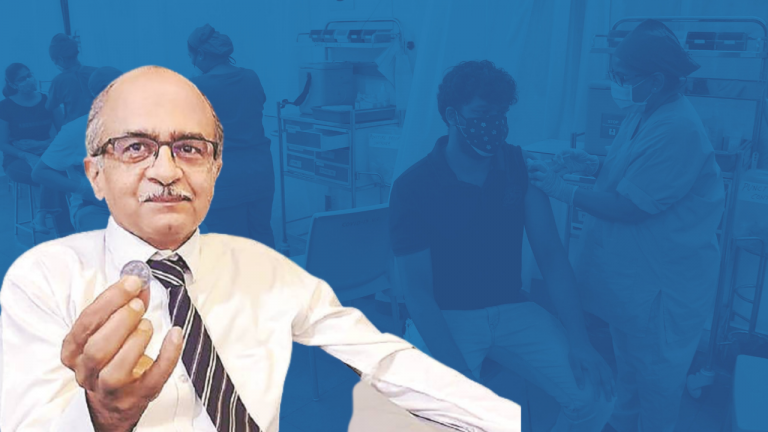
Ever since India started its ambitious vaccination programme, notorious far-left propagandist and PIL ‘activist’ Prashant Bhushan has been pushing anti-vaccine propaganda on social media platforms in an attempt to create vaccine hesitancy among the masses.
For the last few months, Prashant Bhushan has been pushing anti-vaccine propaganda on Twitter by raising doubts about the efficacy of Indian-made vaccines. His anti-vaccine bile had come after Twitter had removed Prashant Bhushan’s anti-mask tweets for spreading misinformation.
Prashant Bhushan, who has a history of spreading misinformation on social media platforms, had come up with conspiracy theories to claim that vaccines did not work in reality. Pushing vaccine hesitancy in the society, Prashant Bhushan had claimed that the Indian government was funding private enterprises in the name of vaccine development.
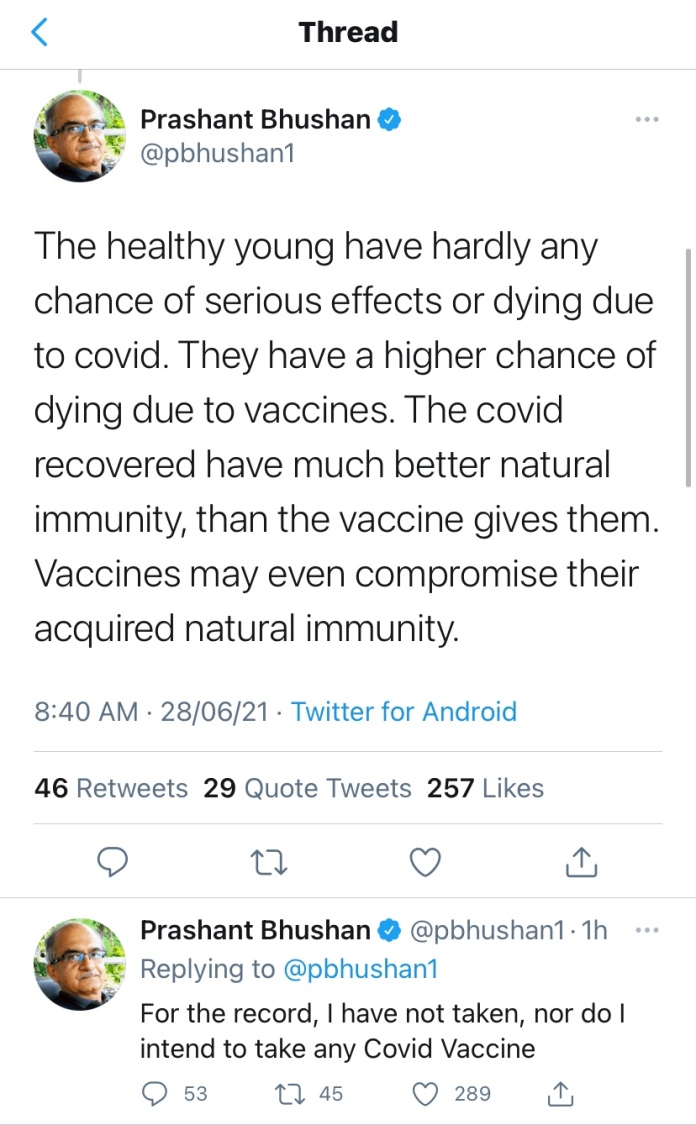
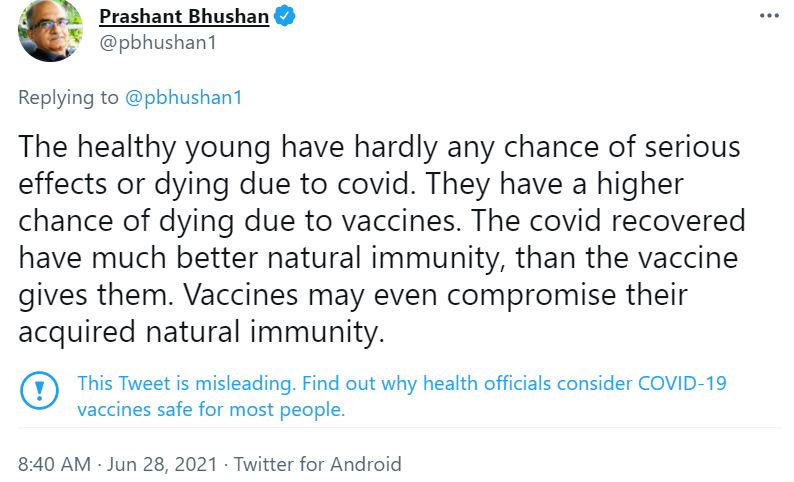
In one of the tweets, Bhushan had claimed that the younger population has a higher chance of dying through vaccination than suffering severe complications or even death due to coronavirus. The far-left activist had said he has not taken any vaccines and he does not intend to take one in the future.
Prashant Bhushan on why he will not take the COVID vaccine
Similarly, he had shared a news report hinting that people are dying of Covid-19 even after taking vaccines. A few weeks later, he had gone on a ranting spree against Covid-19 vaccination, claiming that he is not anti-vaccine but against the promotion of universal vaccination.
In response, Twitter had marked his tweet on the Covid-19 vaccine as ‘misleading’.
“This Tweet is misleading. Find out why health officials consider Covid-19 vaccines safe for most people”, read the disclaimer published by the microblogging site below Prashant Bhushan’s tweet.
Screenshot of Prashant Bhushan Tweet with the warning message from the microblogging site
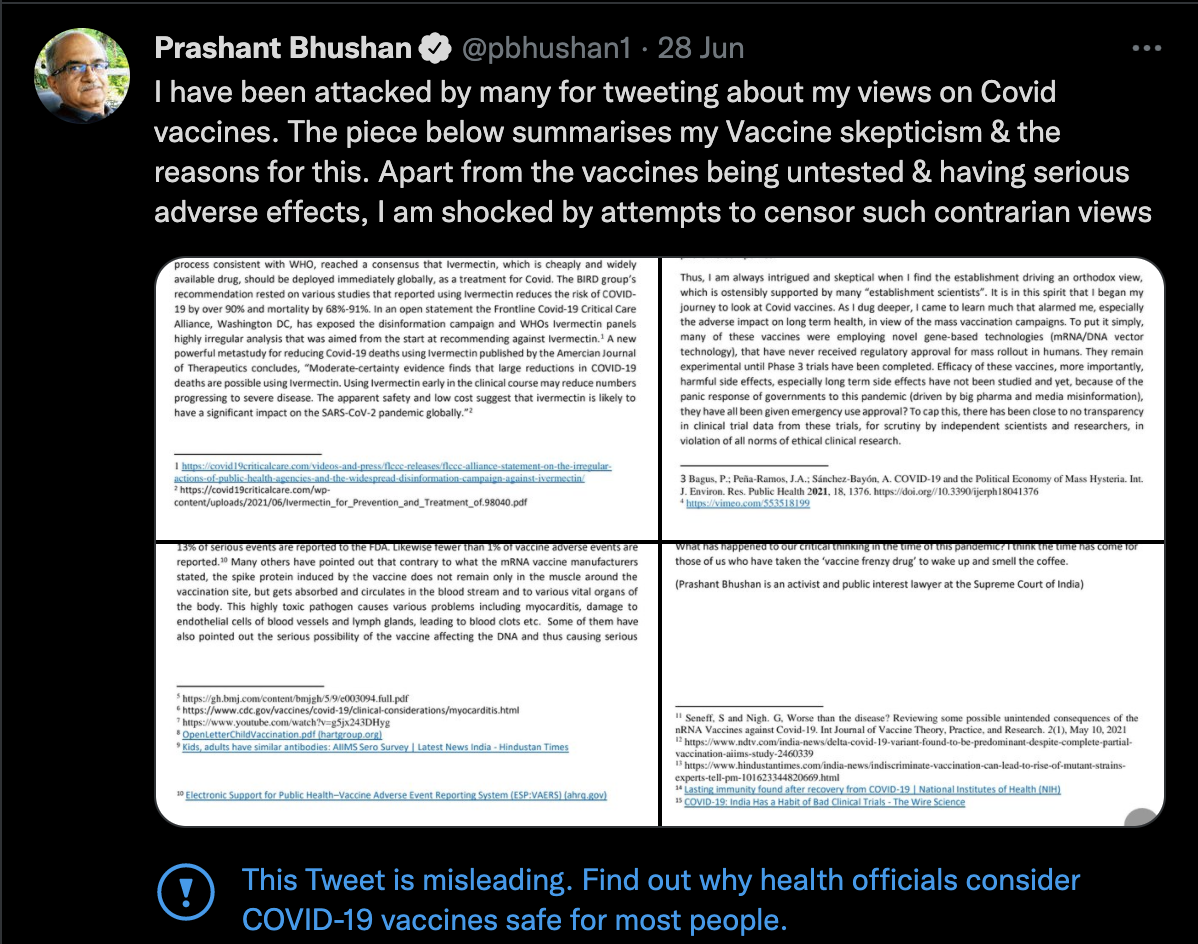
Despite the warning, Prashant Bhushan decided to continue with his rant against the Covid vaccines in India. In a Tweet posted a few hours ago, the SC lawyer wrote: “I have been attacked by many for tweeting about my views on Covid vaccines. The piece below summarises my Vaccine scepticism & the reasons for this. Apart from the vaccines being untested & having serious adverse effects, I am shocked by attempts to censor such contrarian views”.
Prashant Bhushan’s anti-vaccine propaganda flagged by Twitter
Yet again, Twitter flagged the dangerous anti-vaccine tweets put out Prashant Bhushan.
Interestingly, Twitter has been stringent in not allowing its platform to promote anti-vaccine propaganda in the West and suspended people indulging in such behaviour. However, this was not the case with Prashant Bhushan. Twitter has failed to show the courage to suspend Prashant Bhushan for promoting vaccine hesitancy in India, especially at a time when the vaccine has been the only protective measure against the Covid-19.
Prashant Bhushan continues with anti-vaccine propaganda, says vaccine is not working
Well, almost two months after getting flagged by Twitter for spreading his anti-vaccine propaganda, the far-left ‘activist’ Prashant Bhushan has returned on Twitter to put out more conspiracy theories to claim that vaccines are not working.
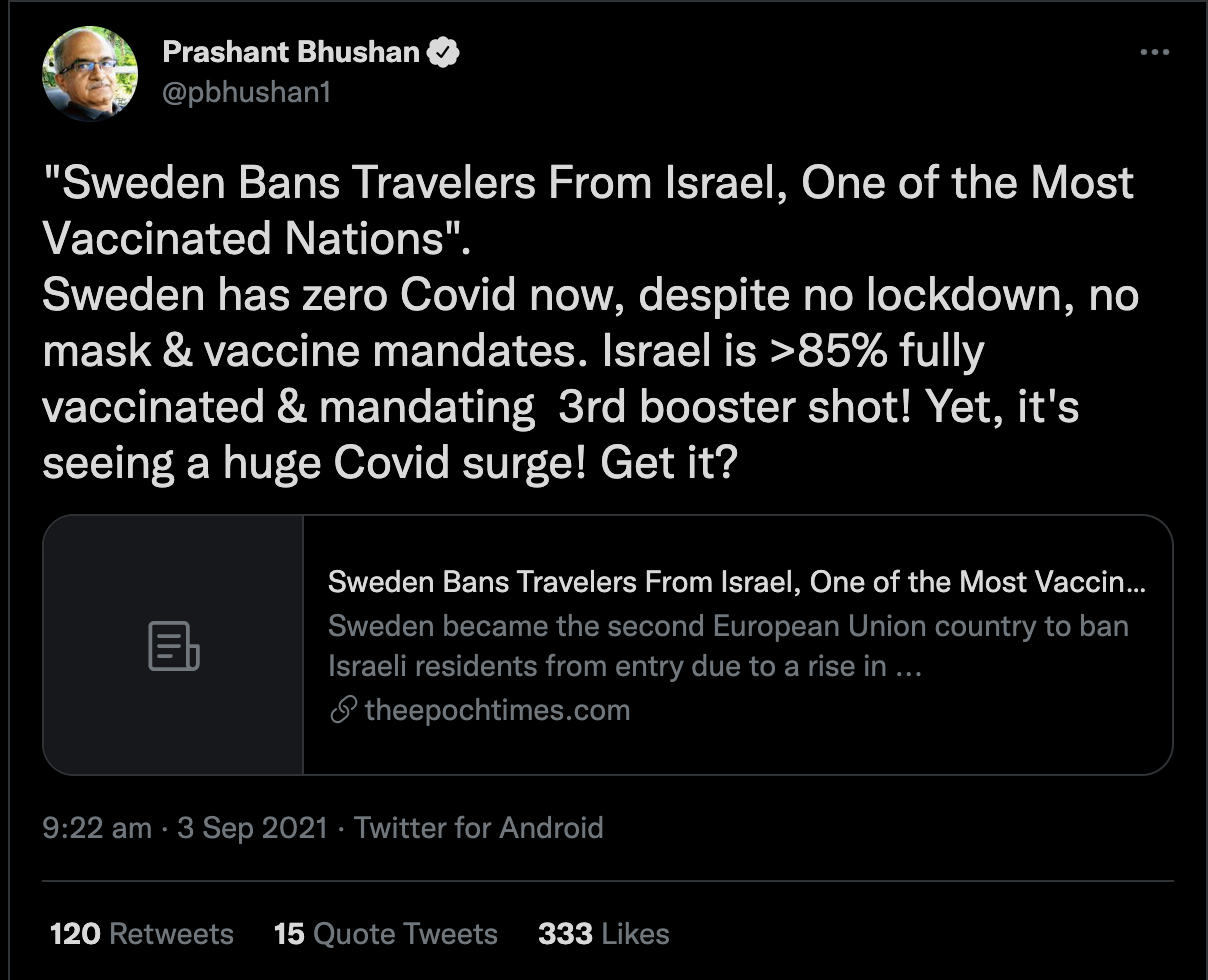
Sharing a news report from a website, Prashant Bhushan said Sweden has banned travellers from Israel, which according to Prashant Bhushan, is one of the most vaccinated nations.
Further, the far-left lawyer claimed that Sweden allegedly had “zero Covid cases” now, despite no lockdown, no mask and no vaccine mandates. However, Israel, with more than 85% fully vaccinated and its third booster vaccine program is seeing a huge Covid surge.
“Get it?” Prashant Bhushan asked, hinting that vaccines are not working as often claimed.
Bhushan’s claims about Sweden are misleading
While it is true that Sweden had announced a ban on all Israelis coming to the country, it was due to recent surge in infections. Portugal has also imposed a similar ban, even on vaccinated Israelis. The move has come after the EU on Monday removed Israel from the list of nations that are ‘epidemiologically safe’.
Sweden has put an entry ban on US arrivals too. The ban is to reflect from September 6 and continue till October 31. Kosovo, Lebanon, Montenegro and North Macedonia are the other nations that are added to the banned list.
However, Bhushan’s claims about Sweden having “zero Covid” cases is misleading. As of August, Sweden’s have seen more Covid cases per 100 individuals than its neighbouring countries. Even the death rates have been higher than its neighbours. As per a report, its Covid death rate of 145 people per 100,000 population is 3 times higher than Denmark, 8 times more than Finland and nearly 10 times more than Norway, all its nordic neighbours.
Also, though Sweden had not imposed a full-scale lockdown, it did impose curbs, shut down schools and put on restrictions on social gatherings. Vaccination is not mandatory in India too. To put an idea that Sweden achieved some success of “zero Covid” by not following any lockdowns or mandates is a misleading statement.
No, Sweden doesn’t have “zero covid”
Bhushan’s claim that Sweden has ‘zero covid’ now is a blatant lie. Sweden has 27,671 active cases as of September 3. So far, it has registered 1,130,525 cases and 14,651 deaths due to Covid.
Bhushan is trying to create an impression that Sweden is not taking vaccination seriously. This is false too. Though Sweden has not made it mandatory for its citizens to take the Covid vaccines, vaccination has been done at a healthy rate. 12,739,829 doses have been administered so far, roughly equivalent to 62% of Sweden’s population.
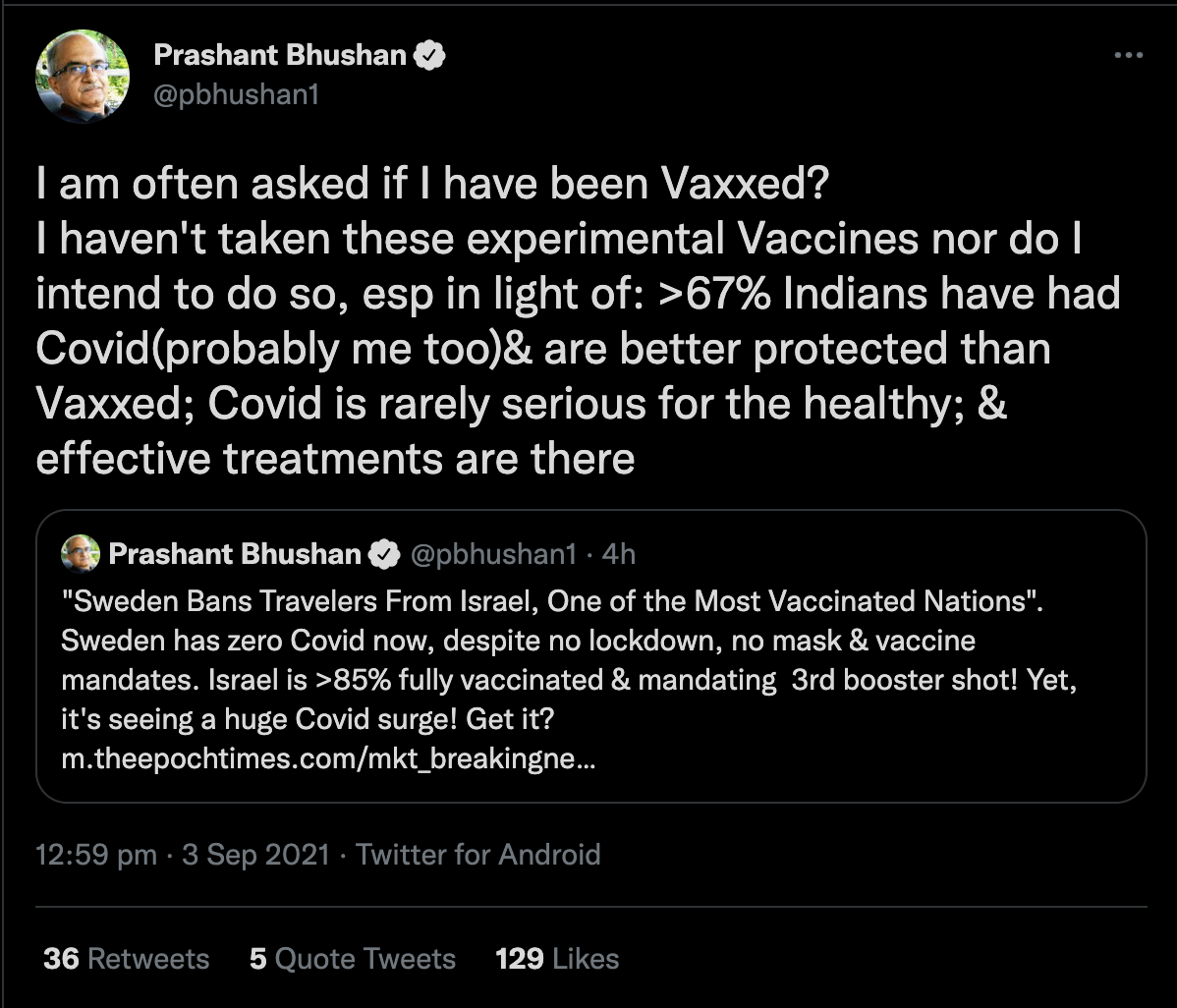
Bhushan’s anti-Vaccine rant
Continuing, Prashant Bhushan said he has not taken any of these experimental vaccines, and he does not intend to do so. Promoting dangerous conspiracy theories against vaccines, Prashant Bhushan put out misinformation saying more than 67 per cent, i.e., two in three Indians, have had Covid-19, including him, who, according to him, are better protected than those vaccinated ones.
“Covid is rarely serious for the healthy, & effective treatments are there,” declared Prashant Bhushan.
Strangely, Twitter is yet to take any action against the tweets put out by Prashant Bhushan that could potentially act as a reason for people to stay away from getting vaccinated.
One has to wait and watch whether Twitter would still allow Prashant Bhushan to remain on the platform even after his continuous tweets that peddle conspiracy theories and unverified news reports promoting vaccine hesitancy among India’s masses.
US forces, a couple of days before completing their withdrawal from Afghanistan, killed at least six Afghan children in a drone strike that claimed the lives of 10 civilians in total. The US claimed that it was a ‘defensive’ airstrike to eliminate terrorists affiliated to the Islamic State of Khorasan Province.
But no information has been provided as to how many terrorists were killed, or indeed, if any were killed at all. While the western media has covered the incident, the outrage that such a monumental scandal is expected to generate was missing altogether.
After all, killing children is not a matter that is to be ignored. And indeed, it is not farfetched to assert that it constitutes a war crime. But the matter has been all but forgotten and has been summarily sidelined. One wonders why that is the case but, perhaps, the reasons are not difficult to fathom.
In this context, an interesting development caught the attention of this journalist on Thursday. It came to our attention that propaganda website The Wire received a prize from the International Press Institute for some obscure reason. The prize was awarded by the IPI in collaboration with International Media Support (IMS).
Source: IPI
The IPI said in its announcement, “Amid India’s press freedom downslide, The Wire’s commitment to public-interest news has also made it a growing target of government harassment. This year alone, three cases have been filed against the outlet and its reporters, including for their coverage of India’s farmers’ protests. In 2020, The Wire and Varadarajan were charged with “spreading panic” for reporting on violations of COVID-19 rules by religious leaders. The site previously faced 14 defamation cases by figures close to the ruling party requesting $1.3 billion in damages.”
It added, “The pressure on The Wire and its journalists took an even darker turn this summer with the Pegasus Project revelations. The phones of Varadarajan and Venu were shown to have been infected with the Israeli-made spyware, presumably at the behest of the Indian government, while The Wire’s diplomatic editor was also on the leaked list of probable targets. The Wire was part of the collaborative global investigation, coordinated by Forbidden Stories, that uncovered the extent of government surveillance of journalists and human rights defenders using Pegasus.”
Source: IPI
Jesper Højberg, executive director of IMS, “Media in Asia experience rising pressure. We have observed how Asia’s independent media and citizens must navigate a tightening operational space while dealing with the economic fallout of the Covid-19 crisis and the risk of being punished for speaking out. The Wire relentlessly finds ways to uphold the right to freedom of expression, in inspiration for others, globally and in the region”.
Under such circumstances, this journalist decided to investigate the background of these organisations.
International Press Institute awarded The Wire
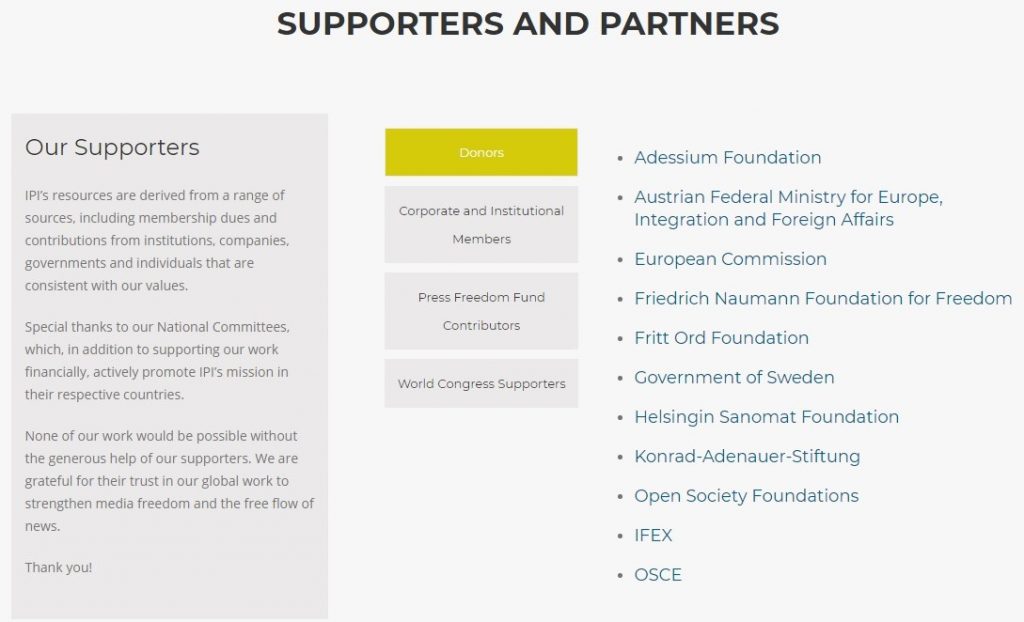
This journalist discovered that the IPI counts as its donors the European Commission, the Government of Sweden, the Austrian Federal Ministry for Europe, Integration and Foreign Affairs and George Soros’s Open Society Foundations.
Source: IPI
We discovered that N Ravi of The Hindu is a member of this western government funded group.
Source: IPI
This western government funded effort has also launched a ‘global independent journalism’ initiative. It is perplexing that a government funded initiative claims to support ‘independent journalism’. A government funded ‘independent journalism’ effort is clearly an oxymoron but such individuals appear to resolutely believe their own lies.
Source: IPI
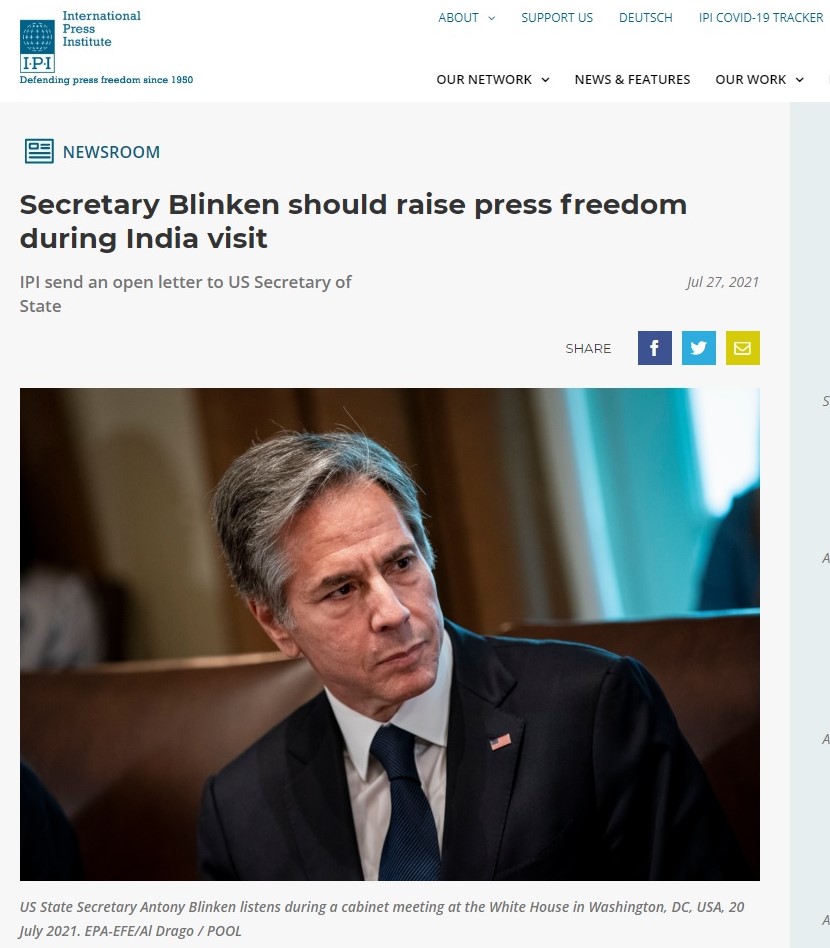
The IPI, we discovered, is involved in politics as well. The group wanted US Secretary of State Antony Blinken to raise the issue of ‘press freedom’ in India during his visit here.
Source: IPI
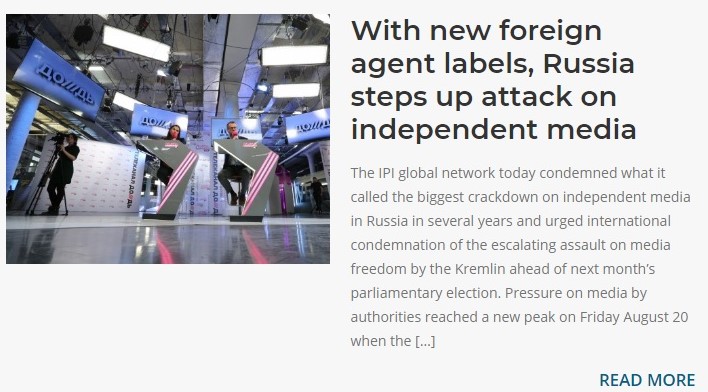
The IPI also initiated a propaganda initiative against Russia over its decision to label certain ‘journalists’ as ‘foreign agents’. The group deliberates obscures the fact that the USA has the same laws, which it does not appear to have any problem with.
Furthermore, Russia has been at the receiving end of a western propaganda campaign ever since Donald Trump was elected the president of the United States of America. Hillary Clinton and the Democrat party have decided to scapegoat Russia for her inability to defeat Donald Trump in the 2016 presidential elections.
Source: IPI
In a World Congress event organised by the IPI, there were several Indian ‘journalists’ who attended it and some even were speakers.
Siddharth Varadarajan of The Wire was himself a speaker at the event and spoke on “Journalism is still the answer to populist governments that mark media as the enemy”. It is pertinent to note that Varadarajan is himself an American citizen.
Here is what the speakers from Indian media spoke about at IPI’s World Cong. Notice the topic Siddharth Varadarajan of The Wire spoke about. “Journalism is still the answer to populist governments that mark media as the enemy” At event organised by a group funded by Western Govts pic.twitter.com/0jxoLJnbp7
Thus, the problematic aspects of the IPI is quite clear. It is a western government effort to encourage propaganda that serves western interests in the name of ‘independent journalism’.
The award to The Wire was in collaboration with International Media Support
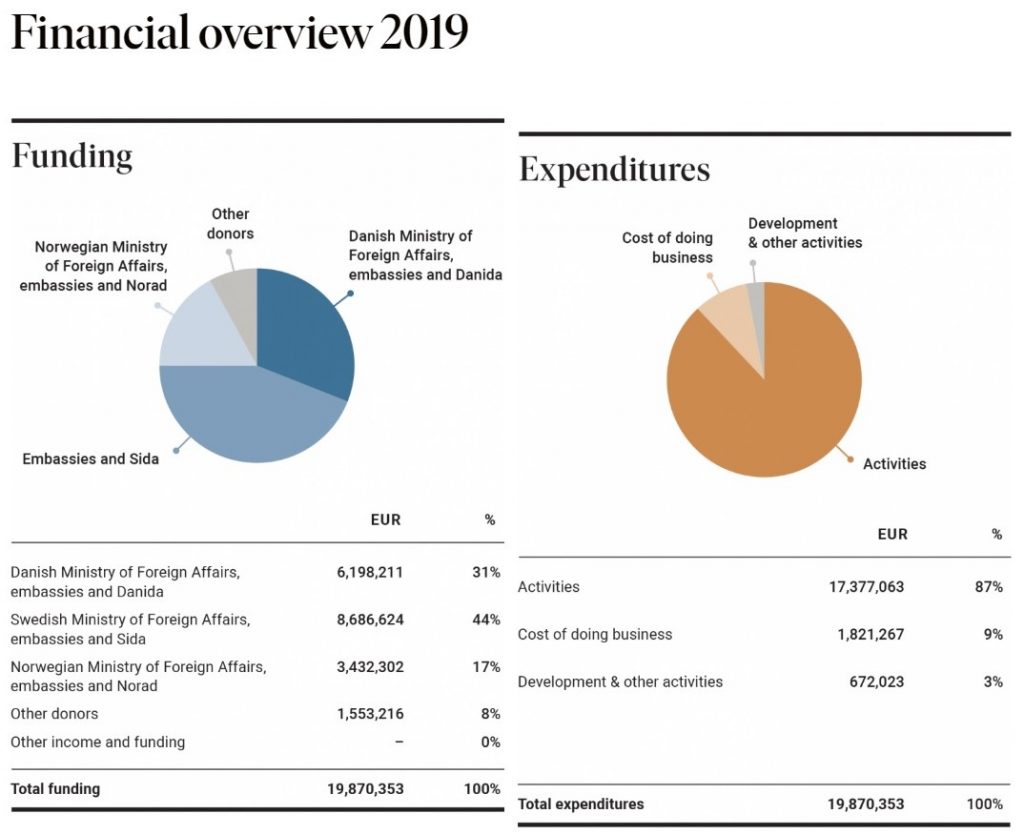
The International Media Support (IMS) is another western government funded group that has funded regime change propaganda in the past. It received as much 92% of its funds from governments of European countries in 2019.
31% of its funds in 2019 came from the Denmark government apparatus, 44% from Sweden and 17% from Norway. The total contributions received amounts to almost 20 million Euros.
Source: IMS
The IMS was one of the prominent funders of Radio Rozana. “The priority is to hear the voice of Syrians inside Syria. They are suffering and being killed every day. We want to support them,” its founder Chawaf had claimed.
Radio Rozana also hosted the Syriaza. Syriaza is “a Syrian-to-Syrian storytelling, archiving, and dissemination project for peace-building, created by the Rome-based international organization Ara Pacis Initiative and led by Syrian poets, defenders of human dignity and human rights, community leaders, and citizen journalists.”
The Ara Pacis Iniative stated on its website, “From the 18th of July to the 4th of August, 2015, with funds from the Italian Ministry of Foreign Affairs, an intergenerational, interethnic, and interreligious group of 30 Syrians convened in Viterbo, Italy, for phase one of the Syriaza project: capacity building.”
The Syriaza apparently “gained the interest of Syrian satellite radio, Radio Rozana, which agreed to host a weekly Syriaza corner, reverberating the peaceful voices of Syrians from different backgrounds.”
In this context, it is important to remember that Syria is currently fending off a civil war incited by the USA. The Syriaza and Radio Rozana, both funded by western governments, clearly appear to be part of a propaganda to justify regime change wars.
It is also pertinent to mention that Harsh Mander is a member of the Ara Pacis Initiative as well.
Western propaganda in the name of ‘independent journalism’
It is not difficult to see what is happening here. Western governments with their huge money bags have established significant influence over international media that serves to create propaganda to further interests.
Indeed, it is due to the significant influence that western governments wield over their media that Joe Biden got a free pass for murdering six Afghan children recently. Worse, Joe Biden is not even the first US President to have murdered Afghan children
All the four US Presidents who have presided over the 20 year Afghanistan war have been involved in the murder of Afghan civilians, including women and children. And yet, it is the alleged ‘human rights abuses’ in other countries that western media is concerned about, far more than the war crimes committed by their own government.