Home Blog Page 4023

Pakistani ‘Human Rights Minister’ celebrates fake news that Afghan vice president fled Kabul, taunts him for ‘not getting rescued by India’

It is no secret that the Pakistan government is actively supporting the Taliban in capturing power in Afghanistan. Pakistan sees the current democratically won Ashraf Ghani government as an enemy the govt is closer to India, and wants to install Islamic rulers which will help in its mission to spread terrorism in India and elsewhere. And therefore, they are cheering the victories of the Taliban in the last few weeks. In such an incident, a federal minister of the Imran Khan government was seeing celebrating over fake news that the vice president of Afghanistan fled Kabul.

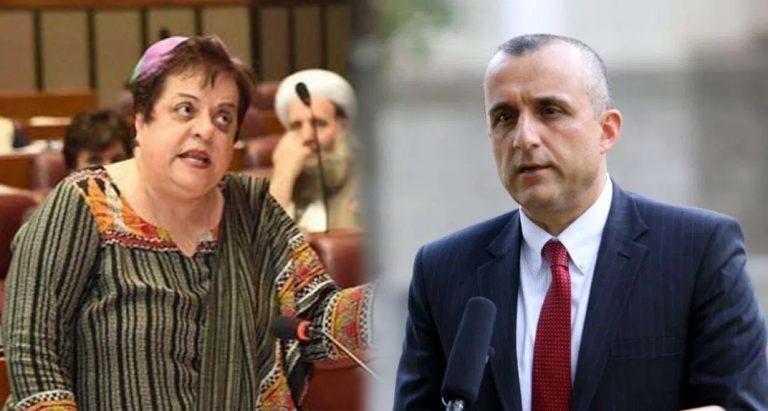
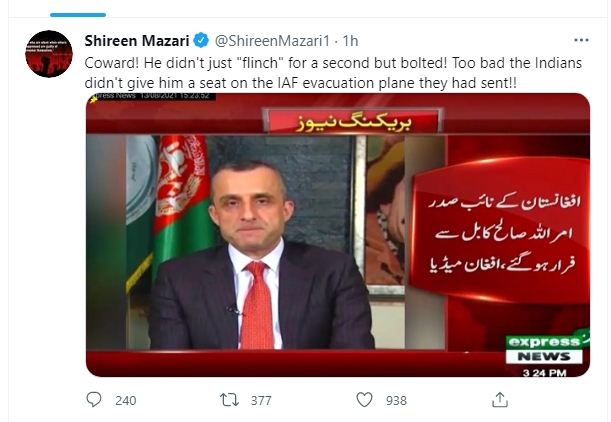
Shireen Mazari, the Minister for Human Rights in the federal government in Pakistan posted a tweet today calling Amrullah Saleh, the vice president of Afghanistan, a coward, after media reports that he has fled from Kabul and gone to Tajikistan.

“Coward! He didn’t just “flinch” for a second but bolted! Too bad the Indians didn’t give him a seat on the IAF evacuation plane they had sent!!” the Pakistani “Human Rights Minister” tweeted, mocking the Afghan VP that India didn’t evacuate him and he had to flee to some other country.

Amrullah Saleh has been highly critical of Pakistan for its support to the Taliban, and therefore the Pakistani leaders don’t leave any opportunity to criticise him. Last month, the vice president had warned that Pakistan will pay a heavy price for openly supporting the Taliban.

Therefore, when some reports said that Saleh had fled to Tajkiskistan, the Pakistani minister Shireen Mazari thought it was a perfect opportunity to mock him. The report about the ‘fleeing’ was spread by several Pakistani journalists and media houses.

But soon it was found to be fake news, as the VP’s office has denied the reports. Calling it propaganda, the office of Amrullah Saleh debunked the reports that he has fled Afghanistan and relocated to Tajikistan. His advisor Rezwan Murad said that the vice president is in Kabul holding meeting with President Ashraf Ghani to plan counter-offensive against the Taliban.

Talking to CNN-News18, the advisor said that it is nothing but propaganda by Pakistan. “Well first of all, this is propaganda war of the enemy, especially by Pakistanis that first vice president has left the country. No, he is right now in Kabul and is meeting President Ghani to tackle the situation, to plan counter offensive against Pakistanis malicious Taliban,” he was quoted as saying. Murad also slammed Pakistan for supporting the Taliban, and asserted that the Afghanistan govt will fight back to protect its country and citizens.

In fact, while Pakistanis were spreading the fake news that Saleh has fled Kabul, the vice president himself posted a tweet informing about the meeting national security that he attended.

He said that in the meeting chaired by President Ashraf Ghani, it was decided that they will stand firm against Taliban terrorists and will do everything to strengthen the national resistance.

Probably after finding out that the news of Saleh fleeing is false, Shireen Mazari deleted the tweet.

NDTV gives platform to Taliban spokesperson to whitewash the terror outfit’s crimes: Its history of apologia for Islamic extremism

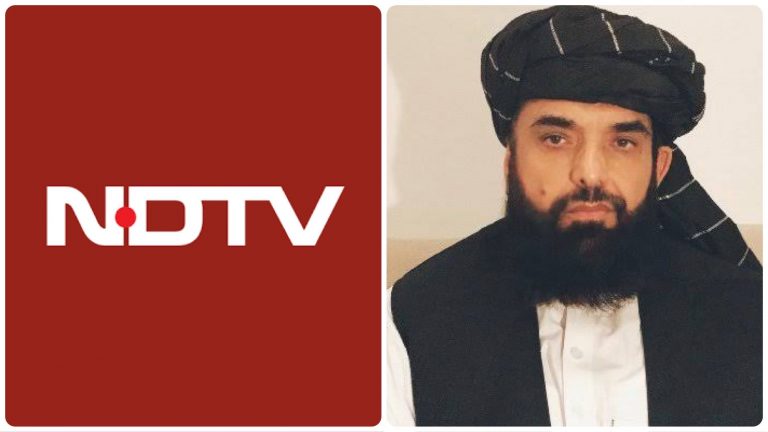
Amidst the escalating Taliban blitz to capture Afghanistan, Indian media organisation NDTV today offered its platform to the terror organisation for whitewashing its crimes.

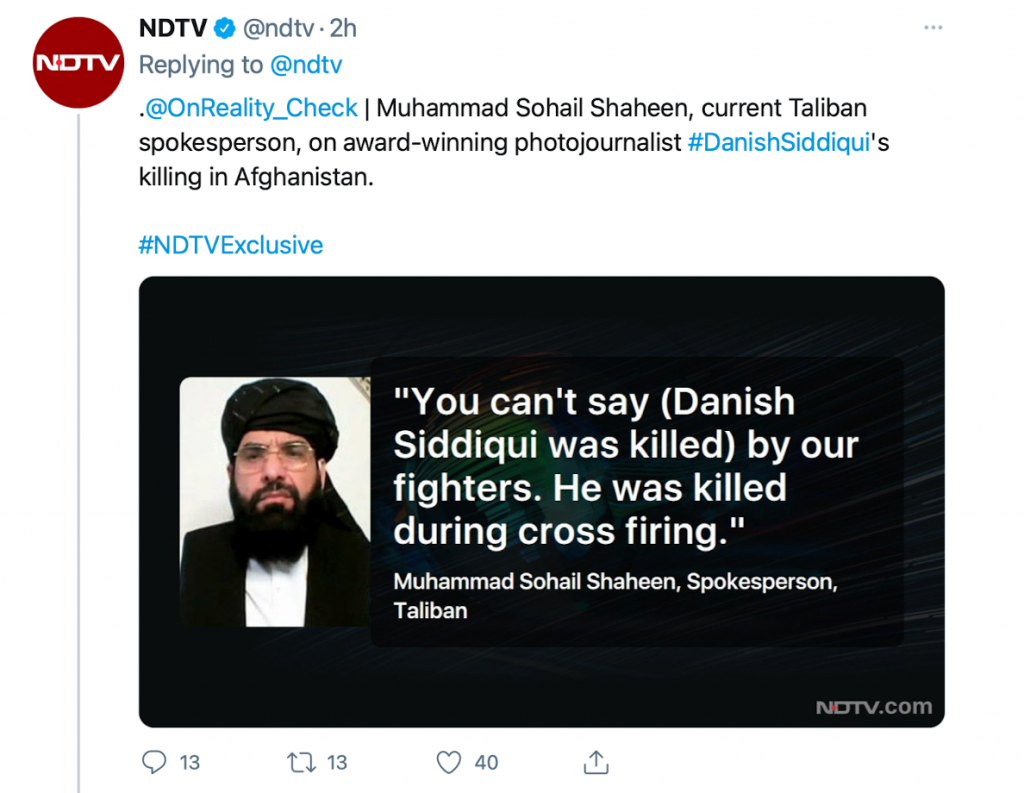
The channel recently interviewed the terror group’s spokesperson, Muhammad Sohail Shaheen, who used the platform to the hilt to distance itself from mindless violence and chaos that enveloped Afghanistan after the Taliban launched a military offensive to capture the country.

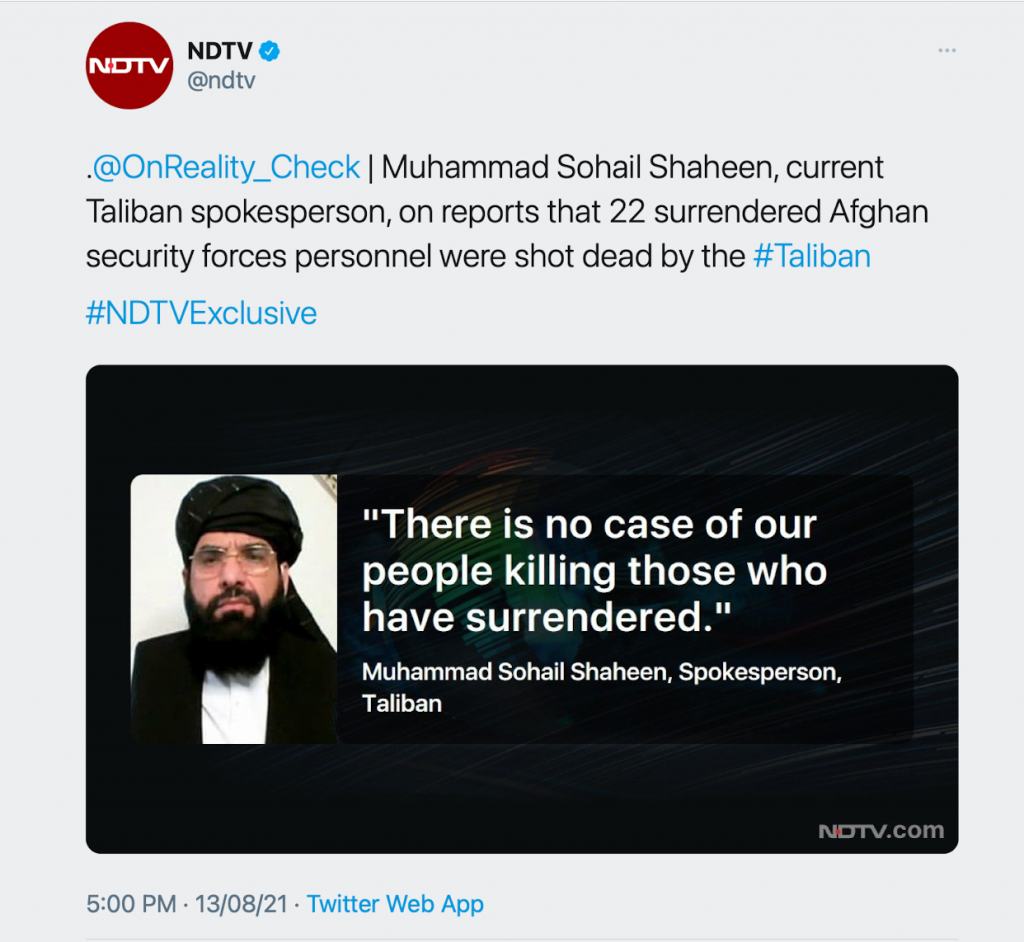
In his interview with NDTV, Shaheen rubbished the reports about 22 surrendered Afghanistan security forces personnel being shot dead by the Talibani terrorists. “There is no case of our people killing those who have surrendered,” Shaheen told NDTV.

Source: Twitter

The Taliban spokesperson also absolved his organisation from its involvement in the murder of award-winning photojournalist Danish Siddiqui, stating that the Reuters journalist was killed during the crossfire and the Taliban could not be held accountable for the same.

Source: Twitter

This assertion is in direct contrast to the reports that said Danish Siddiqui was shot dead in cold blood by the Talibani terrorists after he was verified as Indian. According to the Washington Examiner report, Danish Siddiqui was neither killed in a crossfire in Afghanistan, nor he was collateral damage, however, he was killed by the Taliban, who shot him dead after verifying his identity.

“Siddiqui was alive when the Taliban captured him. The Taliban verified Siddiqui’s identity and then executed him, as well as those with him. The commander and the remainder of his team died as they tried to rescue him,” the report said.

On the terror group’s relationship with India, Shaheen told NDTV that it would be up to India to decide whether they are enemy or a friend.

Shaheen also used NDTV’s platform to rubbish reports that said girls as young as 15 were being forced into marriage by the Taliban. Defending the terror group, Shaheen said Islam did not allow coercing a person to give his daughter in marriage.

NDTV grants legitimacy to the Taliban even as the Islamic terror outfit wreaks havoc in Afghanistan

NDTV seems to have no qualms in allowing its platform to be used by the Taliban to trumpet its propaganda. Instead of calling out the barbarity of Talibani terrorists, who have wreaked havoc across the length and breadth of Afghanistan, NDTV chose to side with the terrorists and offer their “side” of the story.

By hosting a Talibani spokesperson, NDTV is not only granting legitimacy to the terror organisation, which it desperately covets, but it is also undermining the democratically elected government of Afghanistan and lakhs of Afghans who are at the receiving end of the terror organisation’s offensive.

Umpteen media houses, both international as well as Indian, have been reporting on the catastrophe that is underway in Afghanistan. In a matter of a few days, the Taliban has already seized more than 10 provincial capitals and has reportedly established its hegemony in 90 per cent of the districts. According to some estimates, the Taliban is already strong enough to overrun the Kabul government in the next 30 to 90 days.

The violence and fears that the Taliban will once again preside over a brutal, repressive government, all but eliminating women’s rights and conducting public amputations, stonings and executions has led thousands of Afghans to flee their homes. Not just security forces and civilians but foreign journalists too have been attacked and killed by the Taliban, with the murder of Danish Siddique being one of the starkest examples of the Taliban’s depravity.

Yet, the NDTV condoned the Taliban’s brutal repression in Afghanistan and granted it legitimacy by allowing it to use its platform to peddle its propaganda. This is not the first time, and likely not the last, that NDTV has appeared as an apologist for Islamic terrorism. There have been several incidents in the past when NDTV has watered down the role of Islamic terrorists and humanised them.

Apologia for Islamic terrorism

In May 2020, police and security forces averted a major terror attack in Pulwama after they had received inputs regarding the movement of a car laden with explosives. When the car ultimately arrived at night, a few rounds of bullets were fired following which the terrorist driving the car abandoned it a bit further down the road, thus preventing a major terror attack from occurring. NDTV, in its report, referred to the terrorist driving the car as a mere ‘driver’.

Although NDTV mentioned in its report that the ‘driver’ was suspected to be a terrorist associated with the Hizbul Mujahideen and was in touch with Jaish-e-Muhammad that was behind the Pulwama Terror Attack in 2019, it failed to mention the same while sharing the link to the report through its account on Twitter. The terror attack that was averted during the intervening night between the 27th and 28th of May, too, had similarities with the terror attack last year in that this time as well, the terrorists had chosen to use a vehicle-borne IED to achieve their sinister objectives.

NDTV journalists have also been known for speaking the language of Islamic terrorists and understating their criminality. NDTV journalist Saurabh Shukla recently took to Twitter to toe the same line as Ahmed Dar, the Islamist terrorist of terror outfit Jaish-e-Muhammad, who carried out the dastardly attack on the CRPF convoy in Pulwama in February 2019 and killed 40 CRPF soldiers. In a conversation on Twitter, Shukla made a gaumutra jibe to mock the Uttar Pradesh government and hurt the sentiments of Hindus.

Another NDTV journalist, Nidhi Sethi, who worked as Deputy News Editor at NDTV, had posted a comment on Facebook which seemed to glorify the terror attack by Jaish-e-Muhammad. She had written, “where a grisly 44 has been proven to be greater than the mythical 56”. With this, she had added a hashtag #HowstheJaish, a take on the famous dialogue ‘How’s the Josh’ from the recent movie Uri: The Surgical Strike. She was later suspended by NDTV.

Barkha Dutt, when she was with NDTV, had referred to terrorist Burhan Wani as the son of a school headmaster after he was eliminated by security forces. During her time with NDTV, she also justified the ethnic cleansing of Kashmiri Pandits from the valley by providing ‘context’ to the entire matter that gravely mirrored the Nazis.

The Battle of Haldighati: The valour of Maharana Pratap and the history of Raja Man Singh who fought against him

Dhar Vihar Pratap Khadag Dhar, SujBisar Nah PakkarSaer!
Akbar Uber MaalAadhado, Oeeyeney Sevag Bhup Aaner!!

These poetic lines1 – from the song entitled “Akbar and Maharana Pratap” (lyrics’ metric style is in Sannaur linguistic pattern of regional Mewari dialect) – praises Maharana Pratap’s war, diplomacy and strategy against Akbar, the Mughal emperor. The poet beautifully conveys that the august immortal warrior spirit of Maharana Pratap made him daringly stake his life. Maharana, always on his feet, well equipped with arms and armour, became a bottleneck for Akbar’s dream of expansion of his empire in the Southern part of Rajasthan.

At the same, the poet says, for Akbar, the noble king Pratap was also a neckline which is not to be adorned because of his animosity. Akbar had never come across in his life time such a true, noble and brave heart warrior of blue blood.

This is one of the many poems and bards sung in respect of Maharana Pratap, a Sisodia Rajput and the 54th Custodian of the kingdom of Mewar. His story is of the powerful, invincible and dauntless spirit for the protection of freedom, sovereignty and dignity of his kingdom and his people.

Prince Pratap was born in the mighty fort of Kumbhalgarh, straddling the thickly forested hills of the kingdom of Mewar, on 9th May 1540 (or Jyeshtha Sudi 3, 1597 of the Vikram Samvat calendar). His mother, Queen Jayavanta Bai, was the first of his father Rana Udai Singh’s more than twenty wives.

Mewar was a well-established kingdom by that period, much eulogized for its tradition of valour in battle, and tracing its physical entity in the region to more than one thousand years before Pratap’s birth. Sisodia Rajputs of Mewar are Suryavamshi Kshatriyas, from the illustrious line of Raghu and Shri Ram.

The clansmen were once known as Guhilots, after one of their ancestors, Guha. Guha, also referred to as Guhaditya, had eventually wrested power and founded a new kingdom to replace his lost ancestral kingdom. Mewar traditions hold that Guhaditya had begun to rule around 568 ce and ever since then, the Mewari Rawals and later Ranas protected the nation, religion and the people against almost every foreign force.

Four years prior to Pratap’s ascension to the throne, Mewar had already been through a devastating war at Chittor in 1567-68, where Akbar’s forces prevailed and what followed was a disaster with mass killings of almost 30,000 people. Mewar at that point was perhaps at its weakest. As Kaviraj Shyamaldas in his work, Vir Vinod, recorded. Many of the renowned warriors had died defending the country at Khanua in 1527, then exacerbated by a sudden invasion and siege by the Gujarat Sultanate a decade later, followed by short but ruinous reign of the usurper Banbeer2 and finally the war of 1568.

Pratap inherited a vulnerable state but significant nonetheless, its prestige and position of eminence among the Rajput states or even whole of India, was still the same. And more importantly its tremendously significant strategic position. Mewar was enroute to major trade centres and was on road to ports of Gujarat. Crucial trade and campaign route, from Delhi to Gujarat where the major port of Surat was located, and from Delhi via Malwa on to the Deccan – ran through Mewar’s territories.

Mewari army regularly was in practice of tax collection from merchants and travelers taking the routes as it fell under their undisputed sovereignty. Mewar had seen the discovery of silver and lead mines in the village of Jawar years ago. And it was the centre of zinc and copper production3. Zinc was extracted in Mewar since the time of Maharana Lakha and as per an estimate it was valued at around ₹1,82,000 a year.

Blessed with agricultural produces, mining and strategic position, Mewar’s significance multiplied with the political symbolism it carried.

And hence Akbar was adamant as winning Mewar could give once again a strong signal to all other powers and add in the empire an invaluable strength. Akbar had added greatly to his strength. In 1569, Bundi fell to him; and despite strong resistance by the Bundi ruler, Rao Surjan, on 24 March that year, the fort of Ranthambore came into Akbar’s hands after the Bundi ruler agreed to peace terms. With Bikaner, Jaisalmer and later plains of Sirohi in 1572 coming to him, the Mughal emperor was larger than life. But nothing could work with Maharana Pratap. In words of historian RN Prasad, “The Maharana stood like a stumbling block in the Emperor’s scheme of annexing the whole of Rajasthan to his Empire.”

Despite the loss in 1568, a significant part of the Mewar kingdom along with the treasury was still held by Maharana Udai Singh who had retreated further into the relative safety provided by the higher terrain of Mewar, within the Aravalli hills. Fortuitously for the Mewar ruler, the Aravalli range, with an average elevation of over 600 metres above mean sea level, and summits exceeding 1000 metres, provided it with a unique cover.

Or as Virendra Singh Rathore, historian and author of Prithviraj Chauhan : A Light on The Mist in History, explains – “Mewar’s western and southern half is composed of decidious forests, moors, shrubs and narrow valleys. The state was studded with forts resting on hills and their approach welcomed by ravines, valleys and forests. This was the strategic depth to which the Mewari Maharanas fell back whenever the many times larger Muslim armies swept in to overwhelm their defenses.”4 Indeed the hills of Aravalli were one unique and magnificent feature of Mewar which no other kingdom of Rajputana had.

One among those geographically more vulnerable of kingdoms was the kingdom of Amer (later Jaipur). Amer was in plains and mere days march away from the Mughal centres of Delhi and Agra. The rulers of Amer, the Kachhawaha Rajputs, had no hills to take shelters and hence to prevent utter ruin at the hands of powerful Mughal forces – who later proved their worth in destruction – the Amer kingdom found ground in continuing alliance with the Mughals.

Amer was ruled by Raja Bhagwant Das who was dutifully helped by his eldest son and heir to the throne, Kuar Man Singh. Man Singh, with his unique military mind and diplomatic skills, was one of Akbar’s most important nobles. Akbar in June 1573, in his bid to sway Maharana and seek his surrender, asked Man Singh to reach Mewar and talk with Maharana. The meeting which followed is one of the many contentious points in the schemes before the battle.

A popular and greatly misunderstood narrative is that Maharana considered “Mughal siding” Man Singh as outcaste and refused to dine with him. As much as it is cinematic, the event is also devoid of truth. Prominent historians, including Sir Jadunath Sarkar5, Dr Raghubir Singh6 and Dr Gopinath Sharma7 have dismissed the event’s fancies. “This story has no tinge of truth about it. The simple fact of an interview and Rana’s objection of going to the court has been coloured by bardic imagination,” Dr Sharma writes.

Nonetheless Akbar’s attempts to move Maharana failed. He later sent Raja Bhagwant Das but that too failed against the mountain spirit of the Maharana. War was inevitable.

Battle of Haldighati

Akbar arrived at Ajmer in March, 1576 with objective of winning the rest of Mewar and sent a force led by Man Singh for Gogunda. Between Kuar Man and Gogunda was the mountain protection of Aravallis. The only route was through the Haldighati pass.

The pass was extremely difficult for the imperial forces and strategically favoured the Mewaris. As Dr Sharma noted, “Only a few bowmen guarding the ghati could check the rush of hundreds of men. A small body of firm warriors could successfully defend it against a large body of soldiers.” And hence the imperial army, despite being numerically at least four times stronger, had to work very smartly.

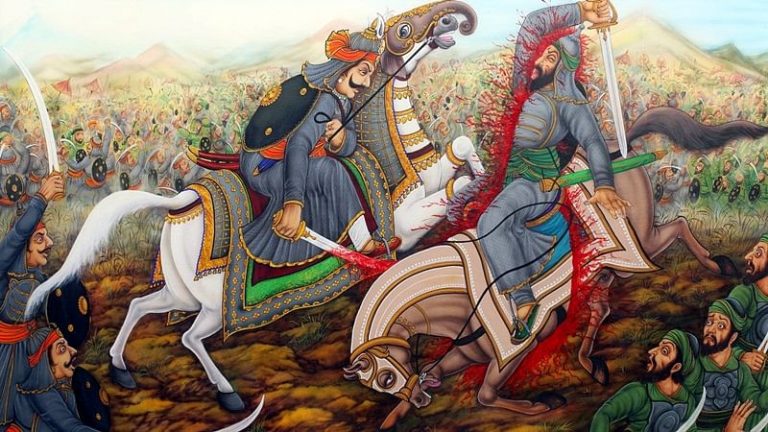
Early in the morning of 18th June, 1576, when lead was taken by the Rajputs whose elephants mounted Mewar’s flag came out from the neck of the Ghati to meet the Mughals. They were followed by Rana’s van headed by Hakim Khan Sur and his Pathans, who, as they were saved by the Ranas earlier, owed their life to the Mewar. As it advanced to meet the enemy, blowing of the trumpets, beating of the drums and songs encouraged the vigour of the warriors.

Maharana’s forces fell upon the centre and the right of the enemies. Strength, valour and agility ensured a bloody battle. In spur of the event, the Mughal left side, being incessantly oppressed, fell into disorder and field was strewn with carcasses, courtesy of Raja Ram Shah who was leading the right of Mewari forces. Valour of Rana’s van, centre and right, was so effective that both the centre and left van of Mughals including Ghazi Khan and Asaf Khan fled away.

Some of them didn’t look back till they had passed ten or twelve miles beyond the river. It appeared a lost day for Mughals when suddenly Mihtar Khan, from the rear, rushed to the front with his party shouting that the emperor had arrived. The trick succeeded and Mughals, stopped fleeing, again engaged with the furious Rajputs.

Second position at Rakht Talai ensued and Rajputs began their courageous assault. The field was littered with bodies and blood. This struggle saw veergati of Raja Ram Shah of Gwalior, his three sons and Ramdas Rathore, son of Jaimal.

Then came turn of Man Singh and tussle of the mighty elephants. Maharana riding his thunderous horse Chetak, reached in striking distance of Kuar Man and hurled a spear at him, which was taken by the elephant, giving time to Man Singh for a swift escape. Maharana’s brave move brought whole of imperial army’s attention and arrows on him. It was useless for Maharana to lose his life here and this defeat of the day did not very much endanger his position. But he would not leave the field to lead the Sisodias hereafter to victory in the end.

As the field felt near impossible, it was extremely important for Maharana to leave from the hopeless situation to be able to fight for another day. He was not ready but his nobles persuaded him. Mana Jhala then played his game and now occurred an event the like of which it would be difficult to find. Mana Jhala snatched the Sisodia standard from his hands and started impersonating Maharana, before the enemy could make out what had happened, he had drawn all the force of the Mughal attack on him. Maharana cut his way through and was able to leave the field.

Mughals had the chance to pursue Maharana but Man Singh did not allow it and so directly saved the Maharana. This move of Man Singh is seen by many as reflective of his soft corner for the Maharana. His tussle with Maharana was about military prowess but still he knew the significance of Mewar’s head.

Maharana, with the skill and strength of his arm, marched round and swayed away from the peril. He was pursued by two soldiers of Mughals only to be slain by Shakti Singh, Maharana’s younger brother who was fighting from the Mughal side till now. Later Mughal officials wanted Shakti to be penalised for helping Maharana but Man Singh didn’t let any harm come to him.

Maharana’s retreat spurred chaos still Jhala Man Singh, Rawat Netsi, Rathore Shankar Das made a firm stand but were made to retreat by the brave band of Man Singh’s bodyguards. Retreat was pursued and many fell. In this way the day was won by Man Singh. Man Singh simply proved himself to be a better war general and an effective military planner. The Mewaris proved their strength, spirit, courage and tremendous bravery.

And in coming years after the battle, Maharana won almost all of his kingdom back in series of battles like Battle of Dewair – where 32,000 strong Mughal force surrendered to Maharana and where Maharana achieved an incredible feat in the world of brave men by chopping Bahlol Khan along with his horse into two pieces8,9 – and other victorious battles like Gogunda, Chawand, Madariya, Kumbhalgarh, Mohi, Idar and Mandal. Man Singh won the battle but Maharana won the war.

Man Singh – Good or Evil?

Man Singh secured the day at Haldighati, a success for which he would pay all his repute and would be treated as a “traitor” by the coming generations. But was he really a traitor? Analysing the history with honesty and nuances rather than politics and emotions give us an opposite image of him from the popular narrative. Contrary to being a traitor, Man Singh was of a very unique personality and vulnerable times.

After the battle of Haldighati, he prevented any plundering or destruction in Maharana’s territory as Tabaqat-i-Akbari noted. He also forbade the soldiers to loot Maharana’s territories, despite his own army starving from food, about which we know from Haqiqatha-i-Hindustan. Man Singh prevented the repeat of 1568’s Chittor. Akbarnama mentions of Akbar’s suspicion and anger at Man Singh and his Rajputs’ conduct. Man Singh was recalled and Shahbaz Khan was sent to command in his place. Not only this, Man Singh’s admission to the imperial court was withheld and the imperial honours and mansabs, not only of Man Singh but also of his father, was forfeited.

Man Singh did not abandon his diplomatic approach rather doubled down on it. He saved around 7,000 temples throughout India and built/rebuilt numerous dharmik places at a pace not seen in history. He built a seven story Govindji Temple costing 1 crore at that time. He built the Jagat Shiromani temple at Amer for Mewari queen and sant Meerabai. He built around ‘1000 temples in Benaras’ and made it a city of temples again which were left in dilapidated condition after the destruction caused by earlier Muslim rule. Among the many temples he built some prominent are – Kashi Vishwanath temple, Ramkot temple, Islamabad; Shiladevi of Amer; Laxminarayan temple and rebuilt Shiv temple of Baikunth, Bihar.

Man Singh was undoubtedly a very dharmic person. He never used to eat before he had finished his puja and always carried his family idol along with him wherever he went. It was Man Singh who patronised perhaps the greatest and noblest of saints in medieval history – author of the holy Ramcharitmanas – Tulsidas.

His military brilliance was unparalleled and still remains to this day. Afghan rule in Bihar, Bengal and Orissa was one of the darkest moments of Hindu history. Man Singh defeated and subdued the Afghans, freed the people and temples out of Muslim tyrannical clutches and built hundreds more. He remains one of the extremely few kings to have won over Afghanistan. Man Singh brought the famously destructive five Afghan tribes10 to their knees and won and justly ruled over the Afghan lands11. Despite fighting for the Mughal empire Man Singh ensured safety and prosperity of Hindu interests. It is because of this, he is still remembered fondly in Bengal and Orissa.

Man Singh was person of an incredibly complex character. Given the vulnerable situation he was in and the geographical weakness of his kingdom, he pulled marvelous feats in his name and saved dharma like no other king.

Man Singh also was a patron of Tulsidas. Tulsidas, belonging to one of India’s most stern and orthodox Vaishnav order, remained the most respected person throughout. His Ramcharitmanas is a household book in whole North India because he made the higher truth available to masses in pleasant language while retaining the whole teachings and meanings of Vedshatra with addition of his magnificent poetic beauty. His importance can not be described in words and so is Raja Man’s for patronising him.

Maharana Pratap and Raja Man Singh chose radically opposite ways for protection and promulgation of Dharma. It is when we disentangle the history from the complex web of politics and prejudices, that we see a clearer fairer picture of our past.

Sources

  • Singh, Jayshree. (2019). FOLK-LORE OF VEER RASA IN CONTEXT OF MAHARANA PRATAP’S VALOUR. 10.33329/joell.61.48.
  • Maharana Pratap : The Invincible Warrior by Rima Hooja Page 18
  • History and Culture of the Indian People by RC Majumdar Vol 06 Page 331
    The tricky road of medieval letters – Maharana Pratap, Shivaji and the Kachwahas by VS Rathore
  • A History of Jaipur – Sir Jadunath Sarkar Page 45
  • Purva Adhunik Rajasthan – Dr Raghubir Singh Page 51
  • Mewar and The Mughal Emperors – Gopinath Sharma Page 89-90
  • Bahlol Vadh – Gordhan Bogsa
  • https://twitter.com/yashasvipratap/status/1310960644552904705?s=21
  • A History of Jaipur by Sir Jadunath Sarkar Chapter 06
  • Raja Man Singh of Amber by Rajiv Nain Prasad Page 62

Editor’s Note: The above article is in response to a ClubHouse discussion hosted by Nupur J. Sharma, the Editor-in-Chief of OpIndia where the historical role of Hindu Monarchs in assisting Mughals consolidate their hold over India was discussed. During the discussion, the role of Raja Man Singh was also discussed.

During the discussion, the role of Raja Man Singh was also discussed to talk about how in Hindu history, it has been Hindus who have allied with the enemy against fellow Hindus. The discussion also included what Hindus can learn today from the mistakes of the past, where Hindu consolidation was thwarted by active participation from Hindus. In the process, certain individuals, including this author believed that Man Singh’s contribution to the Hindu cause should be highlighted far more than it was in the discussion.

As such, OpIndia does not necessarily endorse the views expressed in the article but believes that views concerning the role of Hindu Monarchs in history, even if unpopular or controversial, ought to be discussed within boundaries of decency and good faith. Thus, the above article was published to promote a healthy discussion on the matter.


Gujarat: Akhtar, father of 5 children, poses as ‘Mukesh’ to lure and marry a young Hindu girl, tries to forcibly convert her to Islam

In yet another case of grooming jihad, a 50-year-old Muslim man lured and impregnated a young Hindu girl using a false identity and also tried to convert her to Islam. The incident took place in the Dindoli town of Surat in Gujarat.

As per reports, the accused has been identified as Mohammed Akhtar Sheikh. The victim, a 22-year-old Hindu girl, was an employee at an Idea store in Dindoli in 2018. One day, Akhtar had come to change his sim card at the store. He had introduced himself using the false alias of Mukesh Mahavir Gupta (a common Hindu name). The girl had asked him to bring in new customers at the store. Akhtar complied and brought in 10-15 customers. This led to a friendship between the victim and the accused.

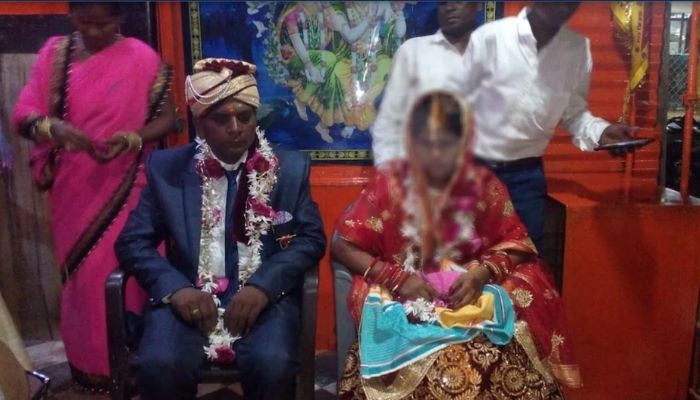
The 50-year-old entrapped the girl in his web of lies and told her that he was unmarried. Akhtar had also falsely claimed that he was an employee with the Indian Railways. A year later in 2019, he proposed to the Hindu girl and the duo got married as per Hindu traditions. The marriage was solemnised at the Hanuman temple, which is located in the Kadodara area of Surat. The accused soon impregnated the girl and the duo had a son together. He also began staying at her house.

Victim discovered the ‘real identity’ of the accused through his Aadhar card

Akhtar also solicited ₹12 lakh from the family members of the girl under the pretext of landing her a job. It was only three years later in 2021 that the girl managed to discover the true religious identity of the accused. To the girl’s horror, she found his Aadhar card a few months ago and realised that her husband was not ‘Mukesh’ but ‘Mohammed Akhtar Sheikh.’ Reportedly, the girl also came to know that Akhtar was already married and have five children with his first wife.

Akhtar forced the victim to convert to Islam, wear burqa and offer Namaz

On confronting him, Akhtar forced her to read Namaz and claimed that Islam was the only true religion. The accused also forced her to convert to Islam and wear a burqa (veil). When she refused to comply, Akhtar began physically assaulting her. He had also threatened to take her son away if she revealed his true identity to the world. Distraught by the fraud and intimidation, she then decided to file a complaint at the Dindoli police station.

Accused arrested, booked under anti-conversion law

However, the cops initially did not act on her complaint. It was only after three months that a First Information Report (FIR) was registered following the intervention of the Hindu Jagran Manch (Surat Division). The accused was then arrested and booked under the relevant sections of the Indian Penal Code (IPC) and the Gujarat Freedom of Religion (Amendment) Act, 2021. The Act came into force on June 15 this year and provides for stringent penal action against any individual or institution for forced religious conversion through marriage.

Three arrested for forcing a Hindu woman to convert to Islam

In June this year, the Gujarat police have arrested three men under the Gujarat Freedom of Religion (Amendment) Act, 2021, for forcing a Hindu woman to convert to Islam. The 23-year-old woman had registered a complaint at the Fatehgunj police station in Vadodara, accusing her husband Mohib Pathan of forcefully converting her religion. The complainant said to the police that she had first met the accused in 2018 when she used to attend his tuition classes.

They both exchanged phone numbers and started talking with each other, the victim said. Further, the lady said that Pathan asked her to marry him and had assured her that she would be allowed to follow her own religion. The couple had registered marriage in August 2020, following which she lived with Pathan at his house in Chhani. In her complaint, the woman accused Pathan of indulging in unnatural sex and thrashed her if she refused to comply. After a month of the marriage, Pathan began to force her to change her name, the police said. Later, Pathan called a Qazi and performed marriage rituals as per Islam.

The vicim had also named Pathan’s father Imtiyaz Pathan and elder brother Mohsin Pathan in the complaint. The woman said the elder brother Mohsin had tried to molest her when she was alone at home. Her husband did not protest even when she informed him about the incident, she added. Following the complaint, the police arrested all the three accused in the case.

Exclusive: Here is how Poetic Justice Foundation plans to target Independence Day with Khalistani campaign, was behind ‘Greta toolkit’

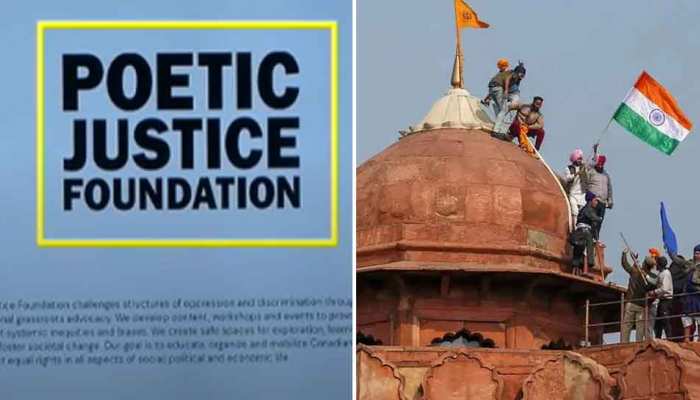
The role of the Poetic Justice Foundation (PJF) and its ‘Ask India Why’ campaign in fueling Khalistani sentiments using the ‘farmer protests’ was exposed when Greta Thunberg shared a ‘toolkit’ on her Twitter account and inadvertently, revealed the dark underbelly of the protests.

The revelation came only days after the Republic Day Riots at the national capital and indeed, people were shocked at the intricacy of the plot. As it turns, the Poetic Justice Foundation and ‘Ask India Why’ are gearing up to spread anti-India propaganda on Independence Day as well.

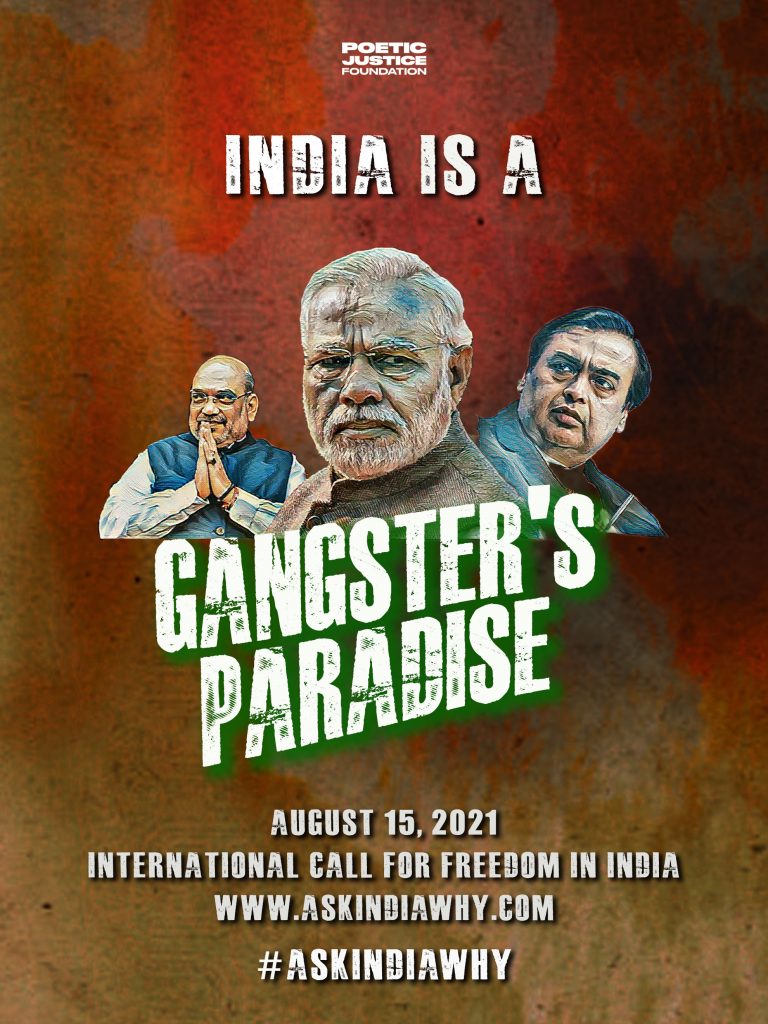
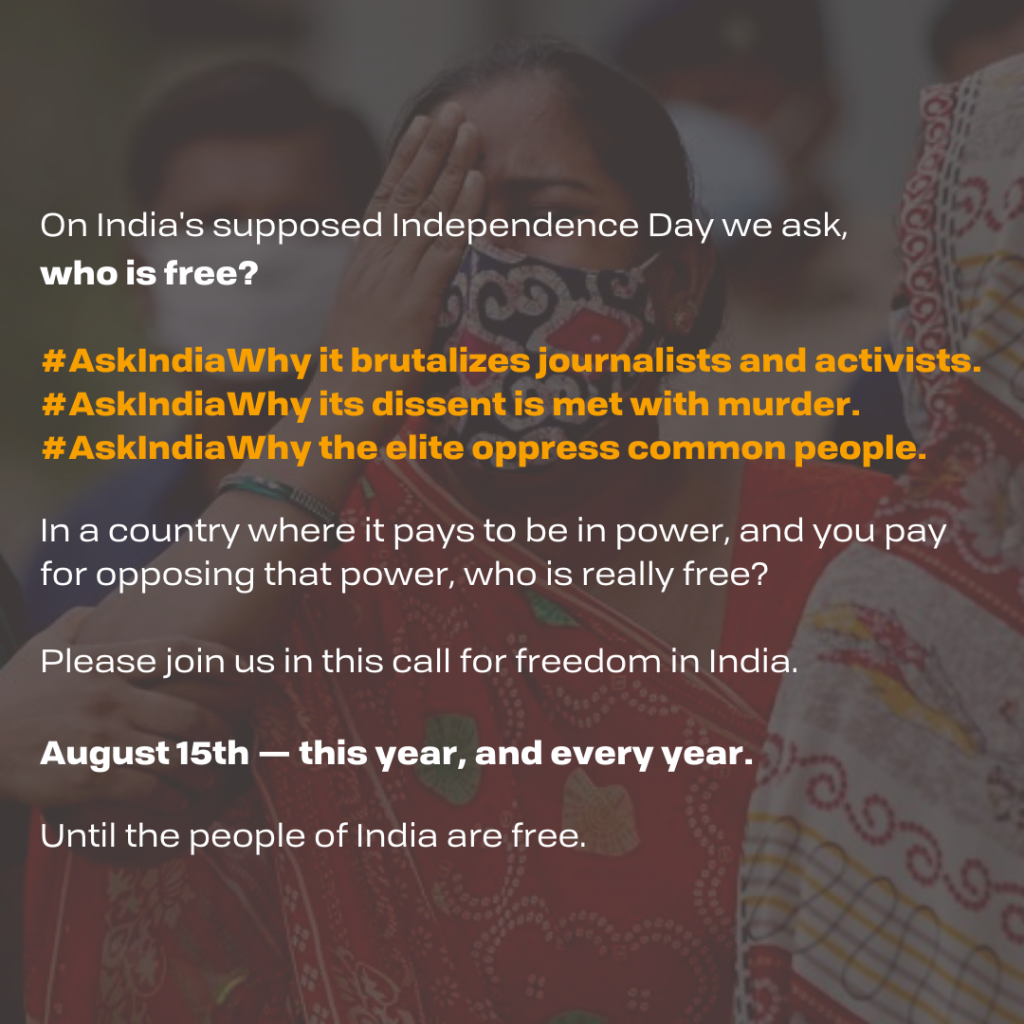
The theme of their Independence Day campaign is, “India is a Gangster’s Paradise”. The campaign says, “On August 15, India celebrates the 75th anniversary of its independence. We ask, who in India is free?” Then it goes on to add, “State violence and crackdowns against dissent existed in India before, however, Modi’s fascist regime has taken it to a whole new level.”

Source: Ask India Why Campaign

It states further, “As the nation continues to slide from democracy to a facist regime run by a criminal mastermind, our hearts go out to the people of India. That’s why we created the #AskIndiaWhy campaign earlier this year, inspired by the #FarmersProtest.”

The campaign also drags in caste into their Khalistani propaganda. It says, “Radicalized Hindu nationalists call for the genocide of minorities with impunity, no consequences at all because they are supported by the leaders and their cronies. Caste and gender violence continues — the fleeting headlines about young Dalit girls violently raped and murdered at the hands of dominant caste men have become a common occurrence — while the governing elite reconfigure India’s economy and institutions to serve corporate thugs.”

Khalistan propaganda by Mo Dhaliwal

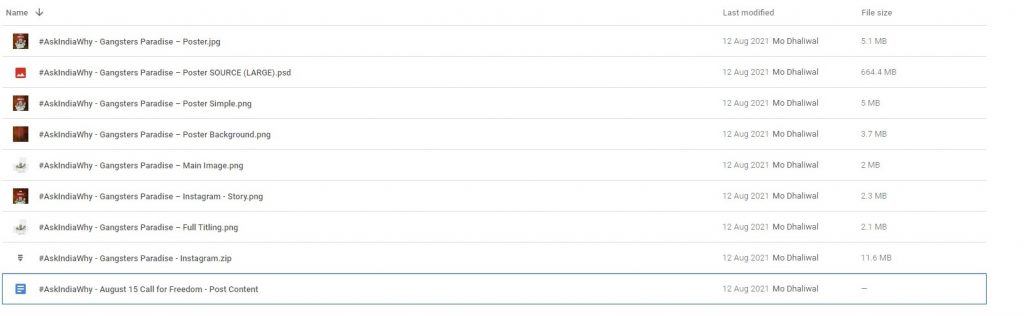
Mo Dhaliwal, the co-founder of the PJF, has created several documents to spread Khalistani propaganda which is accessible through Google Drive. One of the documents which was created for people on social media to copy from for their posts has explicit Khalistani propaganda.

It says, “On August 15, 1947, the ruling class of India gained their freedom, and proceeded to use caste and class to subjugate their people. Since then, India has been an oppressive place where minorities are mistreated and dissent is silenced violently. Now, with 50% of sitting MPs having criminal records, the modern nation is run by thugs and a cabal of corporate interests.”

Source: Ask India Why Campaign

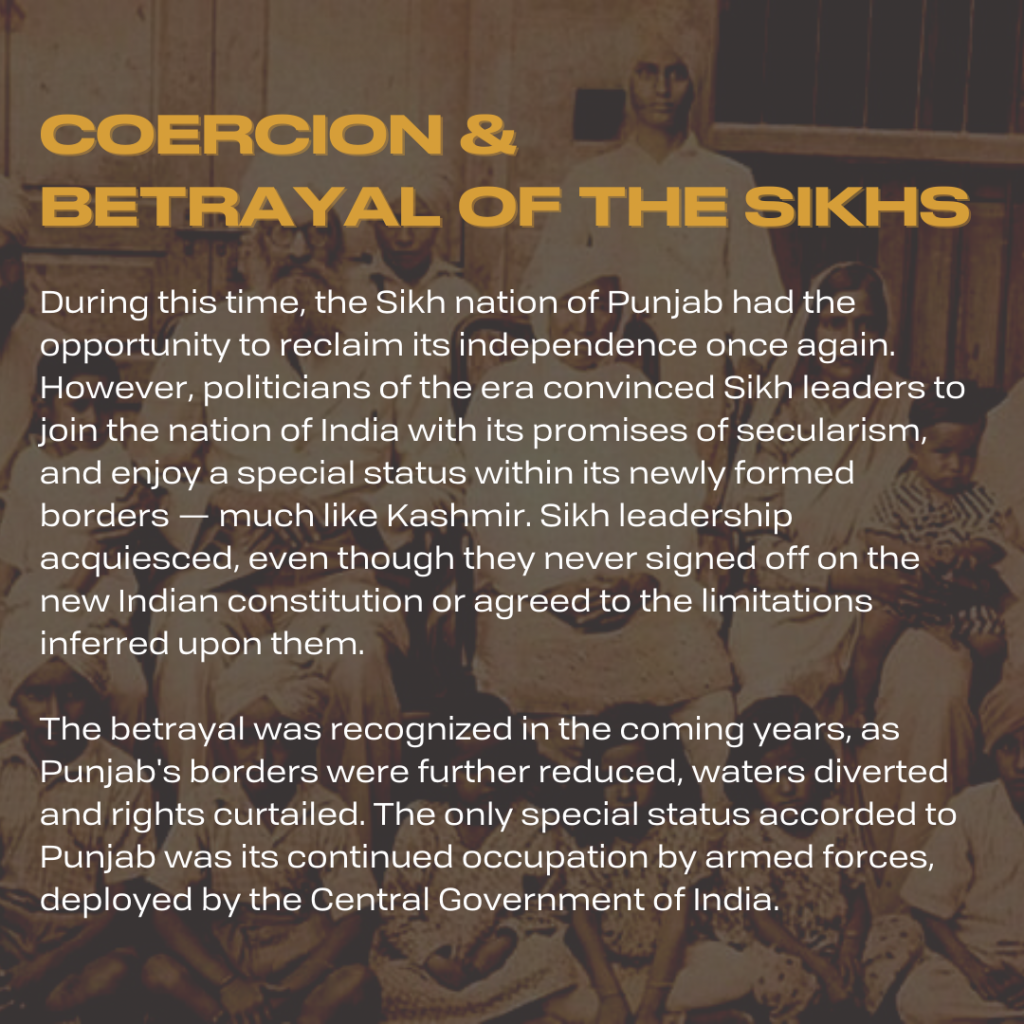
The document further claims that Sikh leaders were convinced to join the Indian Union through false promises. It says, “During this time, the Sikh nation of Punjab had the opportunity to reclaim its independence once again. However, politicians of the era convinced Sikh leaders to join the nation of India with its promises of secularism, and enjoy a special status within its newly formed borders — much like Kashmir. Sikh leadership acquiesced, even though they never signed off on the new Indian constitution or agreed to the limitations inferred upon them. The betrayal was recognized in the coming years, as Punjab’s borders were further reduced, waters diverted and rights curtailed. The only special status accorded to Punjab was its continued occupation by armed forces, deployed by the Central Government of India.”

Source: Ask India Why Campaign

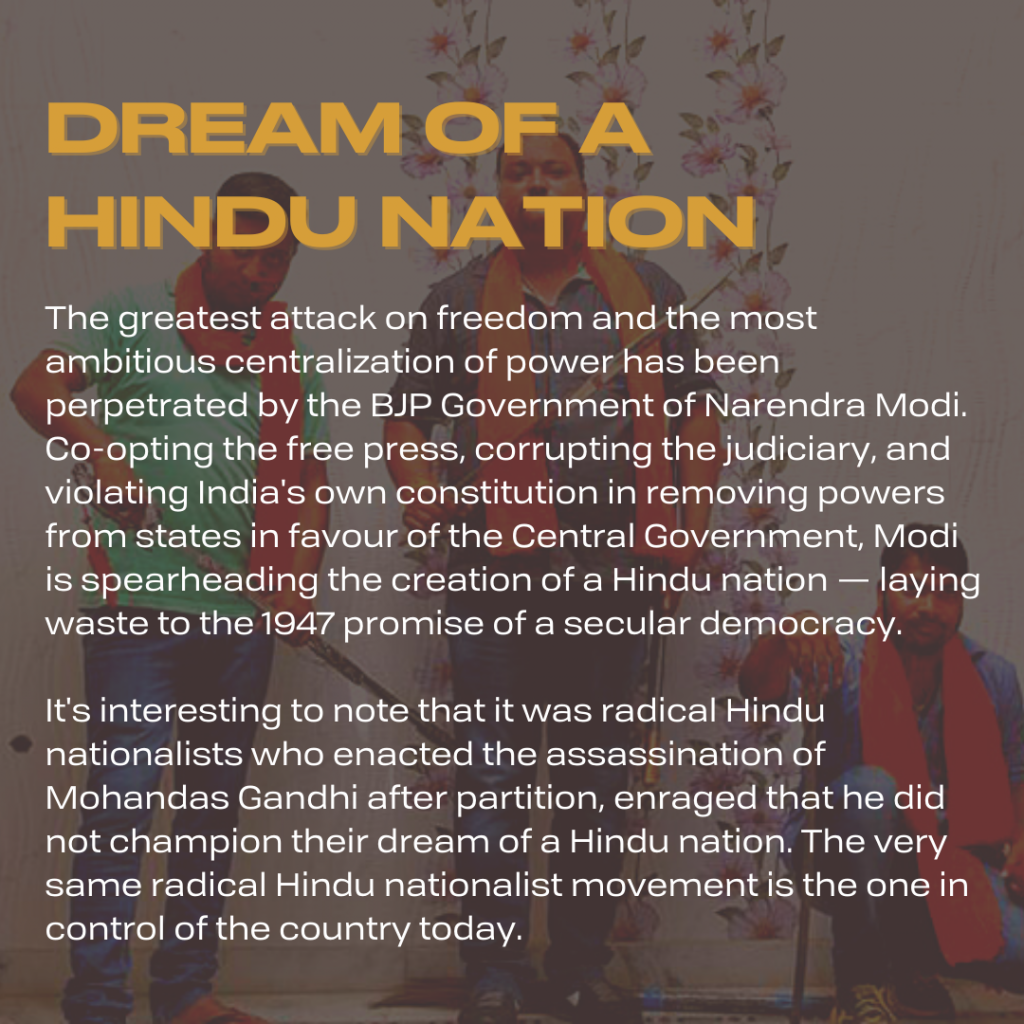
It goes on to assert, “The greatest attack on freedom and the most ambitious centralization of power has been perpetrated by the BJP Government of Narendra Modi. Co-opting the free press, corrupting the judiciary, and violating India’s own constitution in removing powers from States in favour of the Central Government, Modi is spearheading the creation of a Hindu nation — laying waste to the 1947 promise of a secular democracy. It’s interesting to note that it was radical Hindu nationalists who enacted the assassination of Mohandas Gandhi after partition for not upholding their dream of a Hindu nation. The very same radical Hindu nationalist movement is the one in control of the country today.”

Source: Ask India Why Campaign

Then the document proceeds to say, “#AskIndiaWhy it continues to brutalize journalists and activists. #AskIndiaWhy it meets dissent with violence and murder. #AskIndiaWhy the elite continue to oppress common people.”

Source: Ask India Why Campaign

None of this is true and all of it is demonstrably false. Yet, the Ask India Why Campaign has decided to spread malicious propaganda with the explicit intention of targeting the integrity and sovereignty of the Indian Union.

The Ask India Why Campaign by Poetic Justice Foundation on Independence Day

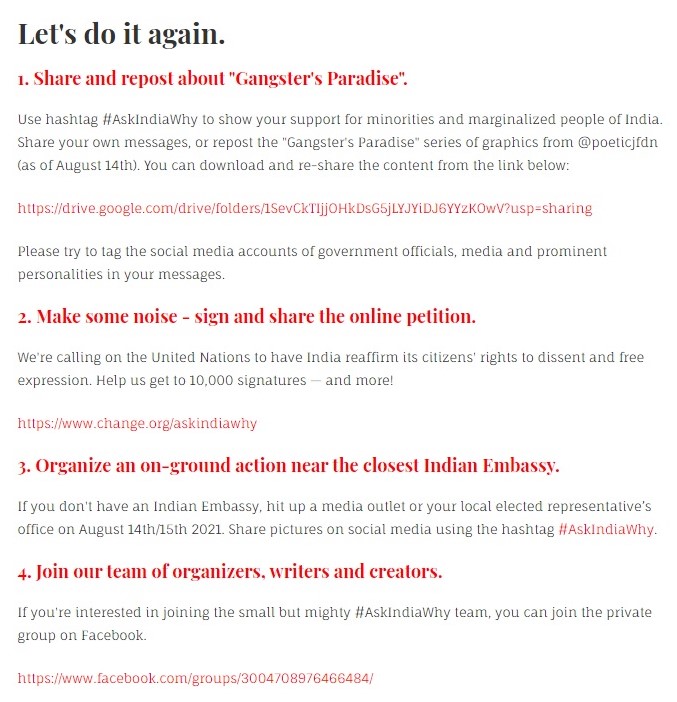
The campaign asks users to use the hashtag #AskIndiaWhy “to show your support for minorities and marginalized people of India.” It also says, “Please try to tag the social media accounts of government officials, media and prominent personalities in your messages.”

Source: Ask India Why Campaign

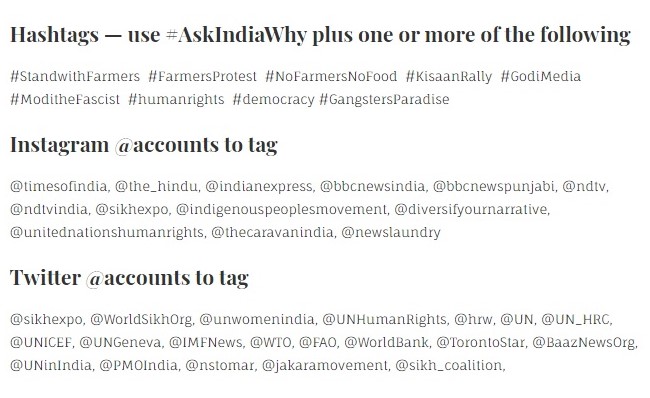
The campaign also urges people to “organize an on-ground action near the closest Indian Embassy.” Apart from that, the campaign also has a list of accounts it wants people to tag in their tweets. The list also contains hashtags related to the ‘farmer protests’ and Khalistani accounts.

Source: Ask India Why Campaign

Soon after the Greta toolkit was exposed, a video of Mo Dhaliwal had gone viral where he could be heard saying, “If the farm bills get repealed tomorrow, that is not a victory. This battle begins with the repeal of the farm laws. It does not end there. Anybody who tells you that this is going to end with the repeal of the farm bills is trying to drain energy from the movement. They are trying to tell you that you are separate from Punjab and the Khalistan movement.”

He emphasised, “The reason Khalistani people are so passionate about this (anti-farm law agitation) is that we are seeing the truth that they predicted in the 1970s. They (Khalistanis) wanted an independent land so that we did not have to live through this movement. I request to all of the young people here – Don’t close your eyes, hearts and minds to each other.”

It appears that continuing with his agenda, Khalistani Dhaliwal has decided to target Independence Day for his propaganda, after he had targeted Republic Day with the same.

Indira Jaising is well aware of the provisions under POCSO Act, she still chose to defend Rahul Gandhi, a remarkable flip in just 3 years. Read details

Last week, the micro-blogging site Twitter temporarily locked out Rahul Gandhi’s account after it received notices from the National Commission of Women (NCW) asking the social media giant to take action against the Gandhi-scion for violating the guidelines under the Protection of Children from Sexual Offences (POCSO) Act.

Twitter also informed the Delhi High Court that it had locked the Twitter account of Rahul Gandhi after the senior Congress leader violated its policy by sharing pictures that revealed the identity of a minor rape victim in a tweet posted by him.

The action against Rahul Gandhi by Twitter, a social media platform often viewed as an ally of the left-liberal establishment supported by the Congress party, did not go well with the Congress ecosystem and they started outraging against Twitter, accusing them of being the puppet of the Modi government.

Congress party supporters even changed their pictures on Twitter to express their solidarity to the Congress leader and alleged that Twitter was “biased” against them.

Well, even Rahul Gandhi too posted a video rant on YouTube where he alleged that his account had been locked because Twitter was beholden to the Modi government, and therefore, the platform was ‘denying the right to opinion’ to his 20 million followers.

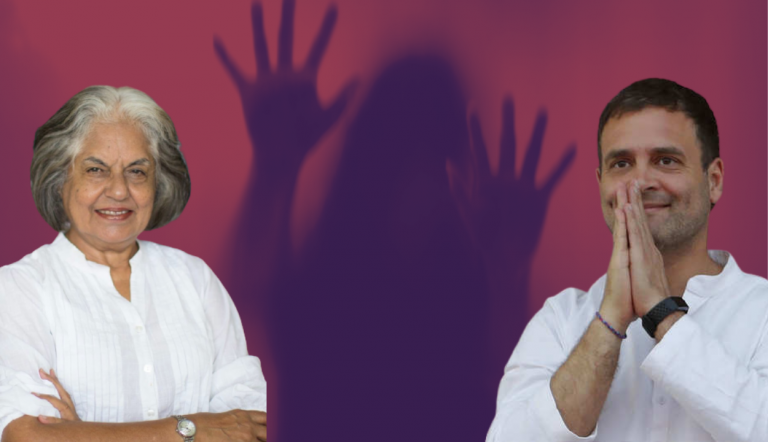
Following Rahul Gandhi’s video, the left-liberal intelligentsia and legal luminaries descended on Twitter to defend their beloved liberal icon Rahul Gandhi and propagated misinformation saying Rahul Gandhi had not violated any provisions of the POCSO act. Indira Jaising, an ’eminent’ Supreme Court lawyer and legal activist, came in support of Rahul Gandhi to lie about the provisions of the POCSO act.

In an attempt to absolve Rahul Gandhi and further his propaganda, Indira Jaising tweeted, “We must understand the prohibition against disclosing the identity of a rape victim is to protect the living survivor, that logic does not apply to the dead victim”.

She had further said that it makes “no sense” to prohibit publishing a photograph of a “dead rape victim”. She alleged that the prohibition was meant for the living.

However, Indira Jaising, a veteran lawyer who fights for terrorists and urban Naxals, seems to have wholly misrepresented the law to shield Rahul Gandhi from the repercussions of his breaking the law that is meant to protect minor rape victims and their families.

Jaising claimed Rahul Gandhi did not violate provisions under POCSO Act

In her tweet, Indira Jaising had made two assertions. First, she had claimed that the law is meant to protect the identity of only the living survivor.

Secondly, as per Jaisingh, if the minor victim dies, then it makes ‘no sense’ for their identity not to be revealed – also insinuating that it was not against the law, to begin with.

The law, however, is rather clear on this aspect. For example, section 74 of the Juvenile Justice Act, 2015 prohibits the disclosure of the identity of a child in any form of media and Section 23 of the POCSO Act, 2012 also states that no information/photo of a child should be published in any form of media which could reveal the identity of the child.

Both the laws – the POCSO (Protection of Children from Sexual Offences) Act and the  Juvenile Justice Act, 2015, have the provision for imprisonment and fine for those who break this law. In fact, the government had in 2018 clarified that these laws would also apply to victims who were dead.

Besides the legislative provisions, the Supreme Court judgment, in the Nipun Saxena vs Govt of India (2019), had issued specific guidelines regarding not disclosing the victims’ details even after their death.

It was not a mistake, Indira Jaising is aware of the provisions under POCSO Act, she was the amicus curiae

Despite glaring evidence of Rahul Gandhi violating the two legislative provisions by posting an image that revealed the identity of a minor rape victim to score a political point against the Modi government, Indira Jaising came to the rescue of the Gandhi-scion. But, unfortunately, in doing so, she ended up exposing her own biases.

Initially, it seemed like Indira Jaising’s defence of Rahul Gandhi came out of her ignorance about the little nuances in the specific clauses of both the POCSO Act and the JJ Act. Some gave Jaisingh the benefit of the doubt that she may have been pressurised to defend the indefensible despite not having the requisite knowledge on the issue and asserted that she might have committed the glaring error.

However, it has now been revealed that Indira Jaising, in fact, has a fair amount of understanding of the POCSO Act, as she was appointed as the amicus curiae by the Supreme Court in a petition that sought the court to examine the provisions of very same POCSO Act.

Ironically, the “legal luminary” Indira Jaising, who has jumped to defend Rahul Gandhi by misinterpreting the laws today, had defended the POCSO act in front of the Supreme Court just three years ago. Then, the “eminent” Supreme Court advocate had argued that disclosing the identity of a victim of sexual assault infringed the privacy of that person, and it should not be allowed at any cost.

A Supreme Court bench headed by controversial former SC judge Madan B Lokur, who himself is a senior member of an NGO funded by the US State Department, had appointed Indira Jaising as an amicus curiae in a case that sought to re-examine the provisions of the POCSO Act that imposed curbs and balances for media in reporting incidents of sexual assault against child victims.

Defending the provisions of punishments against the violations of the POCSO Act, especially when revealing the identity of the rape victim, the Supreme Court advocate had said a balance of rights of such victims and that of the media to report such incidents was required. She had said that the apex court should interpret Section 228-A of IPC (dealing with disclosure of the identity of victims of sexual offences) and provision 23 of the POCSO Act, which deals with the procedure to be followed by media.

“A balance will have to be struck. We do not want a complete ban on the media, but the victim’s identity should be protected. Also, there should not be any media trials,” Jaising had told the bench, also comprising Justices S Abdul Nazeer and Deepak Gupta.

Three years down the line, Indira Jaising, who had herself contended that the disclosing of the identity of the rape victim affected one’s fundamental rights, has now come to the rescue of Rahul Gandhi by misinterpreting the very same provisions of the POCSO Act which she had defended.

From contending that disclosing the identity of a victim of sexual assault infringes the privacy of that person to defending Rahul Gandhi for doing the exact same crime, Indira Jaisingh has come a long way.

It is not clear what caused this, but it is indeed surprising to see a so-called ’eminent’ lawyer doing a flip-flop on her legal opinions just because the person violating the provisions this time happens to be Rahul Gandhi.

Twitter India head shifted out of country amidst ‘shadow boxing’ with Congress, move seen as ‘trick’ to escape punishment for not following IT rules

Amidst the ongoing tussle between the micro-blogging site Twitter and the Indian government over the former’s reluctance to comply with the country’s laws, the social media giant has decided to not appoint any country director for its operations in India. The move comes amidst the shadow-boxing between Rahul Gandhi and Twitter, in a bid to prove that Twitter is ‘neutral’.

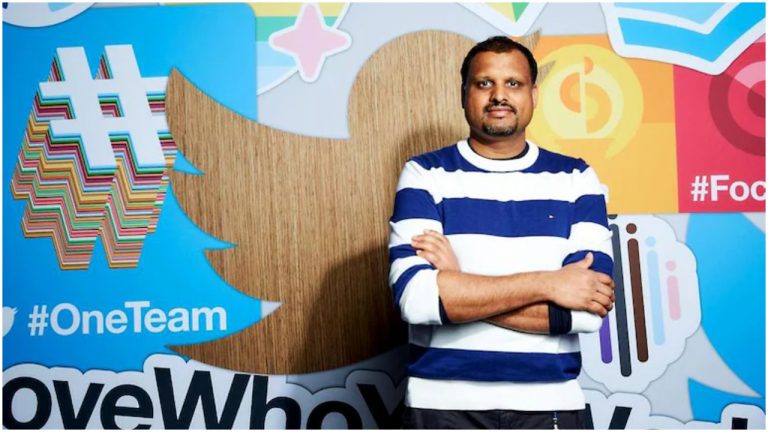
In this regard, Twitter has removed Twitter India’s current Managing Director Manish Maheshwari from his post and has been transferred to a new role in the US.

According to the reports, Twitter India will now appoint a ‘leadership council’ with key executives, who will directly be reporting to Twitter’s overseas executives.

Twitter has confirmed that Manish Maheshwari will not be quitting the company but will be moving to the US. He is appointed as the Senior Director, Revenue Strategy and Operations focused on New Market Entry.

Meanwhile, Vice-President of Twitter JAPC, Yu Sasamoto, tweeted, “Thank you to @manishm for your leadership of our Indian business over the past 2+ years. Congrats on your new US-based role in charge of revenue strategy and operations for new markets worldwide. Excited to see you lead this important growth opportunity for Twitter.”

According to an email accessed by Moneycontrol, Kanika Mittal, current Head of Sales at Twitter and Neha Sharma Katyal, current Business Head, Twitter, will co-lead India and will be reporting to Yu Sasamoto, who is the VP of Twitter JAPAC/Twitter Japan.

The decision to move Manish Maheshwari out of India comes amidst the standoff between the Indian government and Twitter over compliance with new IT rules. Twitter India and the US headquarters have also been named as one of the accused in the case filed by the Ghaziabad police on June 15 for sharing a fake video of an assault on a 65-year-old person in the city.

The UP Police had sent notice to Manish Maheshwari under Section 160 and Section 41A for appearing before the Ghaziabad police for further enquiry. However, this was challenged by Maheshwari, and he filed a petition in the Karnataka High Court. During his hearing, Maheshwari had that despite being the senior-most employee of Twitter India’s subsidiary Twitter Communications India Private Limited, he was not aware of the company’s directors.

Speaking to OpIndia, sources in the government have indicated that Twitter India is deliberately keeping its operations vague in India to try and circumvent the IT guidelines issued by the government of India where Twitter needs to ensure that it has a compliance officer in India and functions as an intermediary, not a publisher. Sources believe that the transfer of Manish Maheshwari is a ‘trick’ to escape the punishment for not complying with the IT guidelines issued by the Modi govt by keeping their operations as vague as they can.

Twitter India engages in shadow boxing with Congress as it falls out of favour with the Centre

Twitter, on the other hand, raised the hackles of the central government with its blatant bias in the toolkit fiasco. The response from the Indian government was severe and unrelenting. A new digital law was soon notified, asking social media organisations operating in the country to abide by the law or risk losing legal indemnity. While all social media companies fell in line and complied with the law, Twitter, in its hubris, did not follow the law and cried hoarse that the Indian government was suppressing the freedom of expression.

The Indian government, however, remained undaunted by Twitter’s objections and asked the social media behemoth to follow the rules or face the consequences. As a result, Twitter lost its intermediary status and was now liable to face prosecution. The BJP government at the centre has made it clear to Twitter that it will be treated at par with other social media organisations, with no special treatment being extended to the social media giant. 

With Twitter falling out of favour with the central government, Twitter India and Congress seem to be engaged in shadow-boxing to once again prove that they indeed do not have a “liberal” bias but are neutral. However, if the above instances are anything to go by, they reveal the symbiotic relationship that Twitter India and the Congress party share with each other. 

In fact, one cannot rule out that this entire charade is being put up so that when Twitter starts suspending BJP or “right leaning” accounts in the run-up to Uttar Pradesh elections, arbitrarily and unfairly, as it has in the past, Twitter can simply claim that it is “neutral” because it even locked the account of Rahul Gandhi. The Congress itself would also shut down any criticism of Twitter later saying that they are not a “biased platform”. It is pertinent to note that Twitter does indeed meddle in democracies and fancies itself as an arbitrator of information, however, that criticism, as true as it may be, seems misplaced when it comes from the Congress party that seems to be using the tech-giant to silent voices of differing political ideologies. 

Therefore, Rahul Gandhi’s latest protestation that Twitter is a “puppet” and acting at the behest of the Modi government is not only profoundly misleading but also a shoddy attempt to cast the social media giant as “neutral” or perhaps “anti-Congress”.

One-third of editorial board members of American medical journal resign over papers that could help China persecute its minorities: Details

One-third of the members of the editorial board of a leading American medical journal has resigned in protest against the publication of several research papers that could help the Chinese regime in its persecution of minorities. According to a report by The Intercept, after a slew of research papers that can help racial profiling of minorities in China were published by the journal named Molecular Genetics & Genomic Medicine, eight of the 25 editorial board members resigned in protest. The members protested after the management of the journal failed to take any action on the papers despite repeated complaints.

According to The Intercept, emails accessed by it shows that the editor-in-chief of the journal was slow in responding to several controversial papers related to Tibetans, Uyghurs and other ethnic groups in China. Molecular Genetics & Genomic Medicine is published by Wiley, a New Jersey based company, and the company also took a long time to respond to concerns about the papers published by the journal.

The papers under question were first flagged by Yves Moreau, a Professor of Engineering and a bioinformatician at the University of Leuven in Belgium, and according to The Intercept, he has been fighting a tireless campaign to get journals to retract troubling or unethical papers. He has been successful in getting an order of Kuwait govt overturned, which had called for compulsory DNA collection from all citizens.

He was studying the DNA profiling of the minorities done by the Chinese authorities. During such searches, he found 18 papers published by Molecular Genetics & Genomic Medicine, which dealt with various genetic topics related to the people in China. Some analysed the genetic differences between ethnic groups, including the genetic gaps between the majority Han community and minorities like Tibetans and Hui Muslims, and some had relied on samples that Moreau suspects were collected without proper consent.

Many of the papers were related to forensic genetics, a problematic subject in the entire scientific community. It refers to the collection of DNA for forensic databases, which is used by the police in criminal investigations. But although in theory it should be used only to find suspect criminals, it has the potential to conduct racial profiling, a highly problematic area. Moreover, scientists also worry about collection of DNA sample from ethnic minorities without their consent, which is happening in China.

The Chinese government is already DNA from its male citizens to build a massive a national forensic DNA database. Reportedly, the Communist government aims to collect and store genetic profiles of around 70 million people, around 10% of the country’s male population. Apart from that, Chinese police also forcibly collecting DNA samples from ordinary citizens, including migrant workers, dissidents, and minority Uyghur Muslims.

Although the Chinese govt says it is being done to fight crimes, researchers don’t believe that, they say it is a part of the government efforts to “deepen” social control. Although most western countries collect DNA sample of convicts, the collection of such samples from ordinary citizens have been described as unprecedented. Human Rights Activists say the only purpose of this genetic profiling is the oppression of ethnic minorities by the Chinese govt.

This concern is being raised because of the kind of data collected by the Chinese govt. They are cataloguing markers known as short tandem repeats (STRs), which are repeating regions of DNA that are specific to the Y chromosome found in men. These STRs are extremely similar between men in the same male lineage, which means, when the authorities nab a dissident man, they can track all his male relatives using the database, even if they are not identified as relatives in official documents.

Since 2019, Molecular Genetics & Genomic Medicine has published several papers authored by Chinese authors on the topic of forensic genetics, which means they used samples collected by the police, many of which could be done without consent. Many of the papers listed institutions as co-authors which work closely with the police or receive funding from the police. One paper even lists the Public Security Bureau in Tibet as the co-author, which is the police agency in the region.

All these show that the research papers published by the American journal were effectively authored or sponsored by the Chinese govt.

After discovering the papers, Yves Moreau had written in March this year to Suzanne Hart, the journal’s editor-in-chief and deputy director at the medical genetics and genomic medicine training program with the U.S. National Institutes of Health’s National Human Genome Research Institute. He noted that before 2019, the journal had published only two papers on forensic genetic studies from outside China, which shows that the Chinese govt has specifically identified the journal where the papers on forensic genetic studies of vulnerable Tibetan and Muslim minorities can be published.

However, although Suzanne Hart acknowledged the mail and promised to look into the matter, he received no update for months after that. As a result, he wrote to the entire Editorial Board in June, describing the concerns with the papers published by them. Many of the board members agreed with him for a probe in the matter, and many said that they were not even aware of the papers.

When the board members wrote to Hart, she said she will get back with further information on how the management intends to address this issue. But when no communication came from her for several weeks, the board members started to resign in protest. Ophir Klein, a board member and a pediatric medical geneticist at the University of California San Francisco said that he left the board as he was really concerned about the lack of communication.

However, not all editorial board members who question the paper have resigned, some have decided to stay on to push for scrutiny of the papers, including Joris Veltman, the dean of the Biosciences Institute at Newcastle University Medical School in UK. After he wrote to the management escalating the issue, they responded that Wiley would begin an investigation immediately.

After that, the company released a statement saying that the Integrity in Publishing Group of the company was overseeing the matter. However, they informed that they are only contacting with the authors and the institutional review boards associated with the published papers to clarify the consent procedures undertaken for collecting the DNA samples.

Although the consent was a major issue, it was not the only one. The company kept silence on the much larger issue of use of scientific instruments in racial profiling and discrimination by authoritarian governments. Moreau said the focus on consent is too narrow, and the larger question is whether the journal should be publishing research on vulnerable minorities, some of which directly involves the authorities persecuting them.

The board members are saying that if the papers are determined to be unethical, at least they should be retracted.

This is not the first time that Wiley has been accused of allying with China. In September 2000, the editor of another journal published by the company had resigned over the issue of freedom of speech. Prof David Curtis, from University College London’s Genetics Institute, had resigned as the editor-in-chief of the Annals of Human Genetics, after he was prevented from publishing an article which said that academic journals should boycott papers from China protesting against China’s human rights violations in Xinjiang.

Wiley, and Lancet which also refused to published the article, had said that publication of the article could pose difficulties for their offices in China. Yves Moreau was one of the co-authors of the article.

Barkha Dutt thanks Netizen for appreciating her interview with Capt Vikram Batra during Kargil war, gets a rude shock: Here is what happened

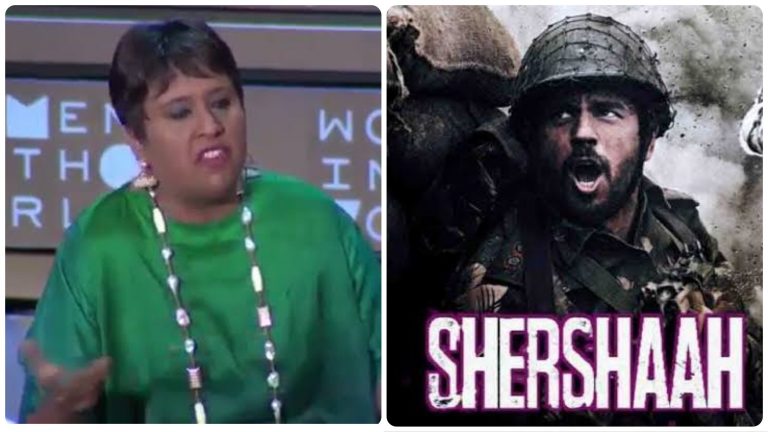
Shershaah, the cinematic retelling of the courage of Kargil war hero Captain Vikram Batra, has recently been released on popular OTT platform Amazon Prime Video.

The movie opened to mixed reactions, with many lavishing praises on the movie for showcasing on reel life the supreme sacrifice made by the Kargil War hero while others panning it for not doing justice to Captain Vikram Batra’s enduring legacy.

The movie once again brought under the spotlight the controversial role of journalist Barkha Dutt during the Kargil war as social media users highlighted her role in aiding the enemy forces with her questionable coverage of the war.

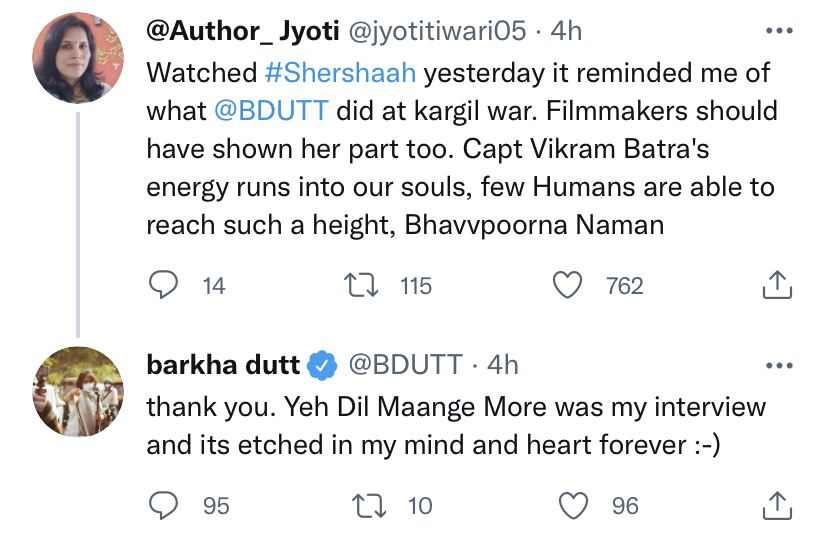
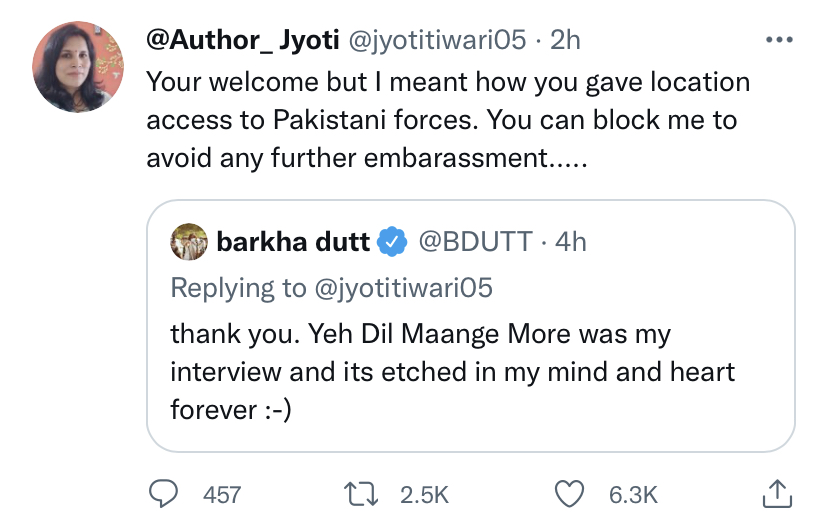
One of Twitter users posted a tweet stating that the movie Shershaah should have included the part of Barkha Dutt. “Watched #Shershaah yesterday it reminded me of what @BDUTT did at Kargil war. Filmmakers should have shown her part too. Capt Vikram Batra’s energy runs into our souls, few Humans are able to reach such a height, Bhavvpoorna Naman,” she tweeted.

Dutt, who thought the tweet to be an appreciation post for her work, responded by expressing her gratitude and stating that “Yeh Dil Maange More” was her interview and it is etched in her mind and heart forever.

Source: Twitter

But the Twitter user quickly disabused Barkha of her fanciful notion that she was being praised for her Kargil coverage. “Your welcome but I meant how you gave location access to Pakistani forces. You can block me to avoid any further embarrassment…” the user sharply responded.

Source: Twitter

Barkha Dutt’s questionable Kargil coverage had the Army spooked

Nevertheless, the conversation on Twitter has once again brought to fore the shenanigans of Barkha Dutt that had even the Army spooked at least once during the Kargil war.

In the book titled “Kargil: Turning the Tide”, author Lt Gen Mohinder Puri provided an account about Barkha Dutt’s irresponsible journalism. In his book, Puri narrated an incident when the Army was alarmed after Barkha was seen live telecasting a military operation that was supposed to be carried out in complete secrecy.

It is worth noting that the book does not prove that Barkha’s reporting caused casualties on the Indian side, however, her reporting was a “concern” for the Army, so much so that a senior army officer had to be called up and asked to take the matter seriously. Her reporting was threatening to hurt the secrecy of the operations, the book hints at that.

Barkha admits television channels’ role in endangering lives of civilians as well as security personnel during Mumbai siege

Similarly, almost a decade after the Kargil war, Barkha Dutt once again came into the crosshairs for her irresponsible journalism during the Mumbai 26/11 terror attacks. On 26th November 2008, ten terrorists from Pakistan wrecked havoc in Mumbai. They held the country on ransom for almost three days as some of them holed up inside star hotels in Mumbai, holding hostages, many of them foreign nationals, as the ghastly scenes were telecast live in our living rooms.

In a 2012 interview with leftist media outlet Newslaundry, controversial journalist Barkha Dutt had admitted television channels’ role in endangering lives of civilians as well as security personnel by not restraining themselves during telecast.

Trehan asks Dutt about allegations that the latter called up someone whose relative was held hostage who inadvertently ended up disclosing location which was used by the terrorists after it was telecast on TV. Barkha denies the allegations by saying that she wasn’t the one who reported it. Another allegation was about her calling up the Oberoi hotel management which was under siege by the terrorists who confirmed that there were hostages in the hotel the terrorists weren’t aware of.

In her defence, Barkha says that like in Kargil war, during Mumbai attack, she became the ‘symbol’ for something every other journalist was doing. Barkha adds, “Chaitanya Kunte said I was responsible for Hemant Karkare’s death. Hemant Karkare died the first night, I was in Delhi. The Chambers’ conversation that you report, that happened with other set of journalists as well. There were other reporters. I know who they were, I am not going to name them. The Oberoi story, I do remember having said at some point… not the exact number but when they was confusion over the fact that the hotel has been cleared, I did say that no, we still have reasons to believe that there are people who are trapped as hostages. That I did say. I don’t believe I was the only one who said it. Journalists across the board said that.”

Barkha admits that perhaps in hindsight did journalists made mistakes during the Mumbai siege. However, she does add quickly that when they ‘realised’, from the second day they started deferring visuals of live coverage of the attacks by 15 minutes. She ups her defence by saying that media wasn’t aware that the handlers of the terrorists were monitoring news channels.

UP: Over 200 murders, rape and organised robbery, Kadim alias Ashad Khan of Chhaimar gang arrested by STF

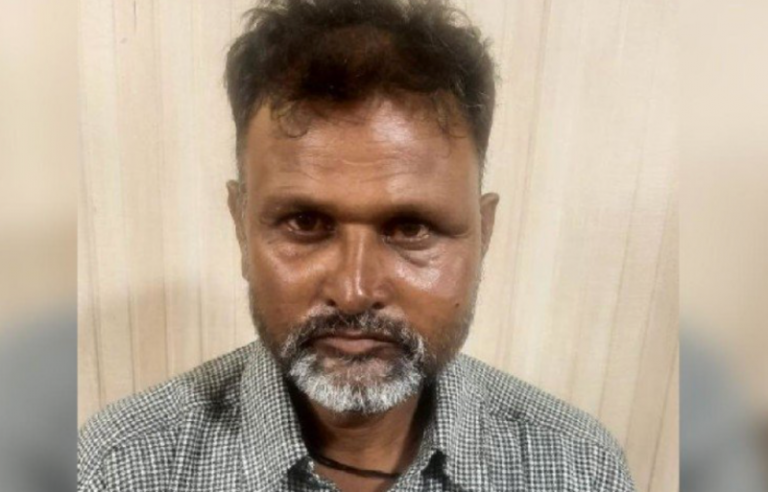
The Uttar Pradesh STF finally arrested the kingpin of the dreadful Chhaimar gang on August 11. As per reports, the Chhaimar gang has been involved in dozens of cases of murder, armed robbery, loot, rape and other such crimes. Kadim alias Ashad Khan alias Fati was arrested from the TP Nagar locality by STF’s Agra division.

Kadim alias Fati had a reward of Rs 25,000 on him by the Jaunpur Police.

Kadim alias Ashraf, the leader of the gang, who originally hails from Teerva in Kannauj, has recently been living in Hapur.

The dreadful and dangerous Chhaimar gang has been involved in dozens of cases of armed robbery and murder in several states like Bihar, UP, Delhi, Haryana, Rajasthan and Madhya Pradesh. Kadim has confessed before the STF that he has dozens of aliases and he has used so many false identities that he has lost track of all the fake names.

The gang leader Kadim has at least 15 criminal cases lodged against him. 6 of these cases are for murder during an armed robbery. Kadim was arrested once in 2016 by the Lucknow STF, but he had managed to attain bail through his contacts and fake signatories of bail bonds.

Robberies highly organised, conducted surveillance through women dressed as beggars

As per reports, the Chhaimar gang carries out armed robberies in a highly organised manner. They used to first send women members of the gang dressed as beggars to conduct surveillance of a specific area and choose potential targets. After a target house was chosen, the gang used to attack at an opportune moment to rob the family of valuables.

The gang members reportedly use the photos of Gods in their begging bowls and conduct recce in residential colonies dressed as beggars. Gang members who murder victims while robbing are rewarded with a bigger share from the loot.

The gang, including the gang leader himself, had committed numerous crimes of murder and rape while carrying out the armed robberies. As per reports. Killing anyone who resisted was the gang’s modus operandi. They used to attack and injure the family and rape the women while robbing a house.

As per the STF, the Chhaimar gang is behind 7 cases of murder in Rajasthan in 1997. 2 of the victims were children. The STF has shared that in total, the Chaimar gang has so far committed over 200 murders. The gang leader Kadim has declared that he can organise and rebuild his gang in just 15 days. He has also been bragging to the STF about how crime is his ‘hobby’ and habit and he cannot go without loot and murder.

It is notable here that the gang roams from one city to another. They cross state borders often and are quick to assume new identities. They even get Aadhar cards and voter IDs made under fake names in every new state.

The gang is one of the dangerous nomadic criminal gangs that have terrorised many states for decades. The gang members never stay at the same place for long and are wanted by the police forces of many states. They often attack wealthy houses and brutally overpower sleeping family members, even killing and raping them. Due to their elusive nature and nomadic lifestyle, the gangs are very difficult to trace and track.