Home Blog Page 4148

Fight for the ‘19%’ – UP assembly elections becomes a battleground of opposition parties for Muslim votes

According to the 2011 census, the state of Uttar Pradesh had a total population of almost 20 crores, out of which around 3.8 crores belong to the Muslim community making it approx 19%. In 2011, around 64% of the total population comprised of eligible voters. According to the Unique Identification Authority of India’s (UIDAI) 2020 population projection, Uttar Pradesh now has a population of approx 23 crores. Assuming the number of eligible voters is the same at 64%, it comes out to be approx 14 crores. The total assumed population of Muslims stands at approx 4.3 crores at the present time. If 64% of Muslims are eligible voters, i.e. at par with the state percentage, that comes out to be 2.7 crores.

The fight for Muslim votes among opposition parties

Traditionally, it is believed that Muslims voters do not vote for Bharatiya Janata Party in UP. It is evident from the fact that in the India Today-Axis survey, 76% of Muslim voters in UP preferred the Samajwadi Party-Bahujan Samaj Party (SP-BSP) alliance during the 2019 Lok Sabha elections. The preferred party for Muslims is not BJP despite the fact that the party works on the theory of “Sabka Saath Sabka Vikas”.

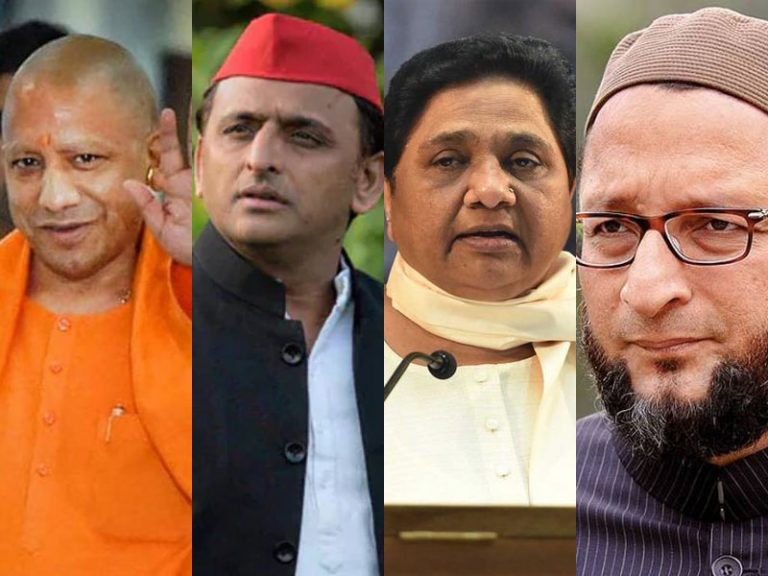
Notably, the BJP government led by CM Yogi Adityanath in Uttar Pradesh does not discriminate among people of the state based on religion. In March 2021, CM Yogi had said that there is no discrimination in UP based on religion as 30 per cent of the welfare scheme beneficiaries are Muslims in the state. From housing schemes, free power connections, free cooking gas to the Ayushman Bharat healthcare plan, Muslims have a higher share in the list of beneficiaries, reports suggest.

As the opposition parties are aware that Muslims hesitate to vote for BJP, they often see them as the game changers in the state. Though the population share stands at only 19%, they can make a difference, especially on the seats where the Muslim population is more compared to other religions. SP, BSP, Congress, and other local parties have been trying to woo the Muslim voters for the upcoming elections, but their plans may not be fruitful as they expected due to the entry of All India Majlis-e-Ittehadul Muslimeen (AIMIM) in the state.

AIMIM is trying to become a national party

Recently, AIMIM chief Asaddudin Owaisi has announced that his party would contest 100 seats in the upcoming Assembly elections in Uttar Pradesh. In the last couple of years, AIMIM has been trying to showcase its power across India by contesting elections in different states. The aim appears to project itself as a national party rather than a state party. In the Bihar elections, Owaisi won four seats, and it gave him a boost to try hand in other states as well. The plan did not work in West Bengal, but in Uttar Pradesh, AIMIM thinks that they have a chance to win seats, especially with a sizeable Muslim population.

AIMIM has also urged all parties to reserve the Deputy Chief Minister post for Muslims. AIMIM leader Asim Waqar had asked SP, BSP and Congress to make their stand clear on the issue. This ‘unexpected’ gameplay by AIMIM can harm the Muslim vote share for the opposition parties in UP who rely on the Muslim voters for the upcoming elections.

In a series of Tweets, AIMIM chief had hit out on opposition parties for failing to win Zila Parishad chairman seats. Reportedly, the Bhartiya Janta Party has swept the polls winning 65 out of the total 75 seats, while Akhilesh Yadav’s Samajwadi Party bagged only 6 seats.

Owaisi said despite of having 19% population share, not even a single chairman seat was won by a Muslim candidate. Without taking Akhilesh’s name, he said despite of claiming to be the largest opposition party in UP, they only won five seats.

He added, “Now we have to adopt a new political pattern. Unless we have a free political voice, our problems are not going to be resolved. Don’t be afraid of BJP, but fight in a strong way.”

BJP’s vote share in Uttar Pradesh

Interestingly, according to the Election Commission of India, BJP had a vote share of approx 40% in the 2017 UP Assembly elections. The party believes that it will have a rather bigger win compared to the 2017 elections in the state. CM Yogi has recently reacted to AIMIM’s chief’s challenge in which he had said AIMIM would not let him become CM again.

Owaisi said, “Inshallah, (we) will not allow Yogi (Adityanath) to become the chief minister of UP again. If our morale is high and we work hard, then everything will happen. Inshallah, our endeavour is that the BJP government is not formed in Uttar Pradesh.”

On July 3, Yogi Adityanath reacted to his statement and said Owaisi is a national leader and he goes to different parts for campaigning. “If he has challenged the BJP, then the BJP worker accepts his challenge,” CM Yogi said. He further added, “The BJP will form the government, and there should be no doubt on this.” Notably, in the Lok Sabha elections 2020, BJP alone had won 62 seats out of 80 in the state.

The attack in on SP more than BJP

One more exciting aspect of the upcoming elections in terms of Muslim voters is that both BSP and AIMIM are not targeting BJP. Their main target is Akhilesh Yadav-led SP. Owaisi has recently called SP an “anti-Muslim” party. Mayawati, chief of BSP, who allied with SP for Lok Sabha elections in 2019, is on the mission to ‘destroy’ SP. So much so, Mayawati, at one point, had announced that her party is ready to form an alliance with BJP in UP to ensure SP does not win. However, she did a u-turn on her statement and now wants to project BSP as the ‘only’ choice for upcoming elections. As a result, she has been attacking every party in her statements.

Aam Aadmi Party’s noisy blame-game

Kejriwal’s Aam Aadmi Party is also planning to contest UP elections. As a way of degrading BJP’s image in the eyes of voters, the party is indulging in half-baked rumour-mongering.

From baseless allegations of a land scam in Ram Mandir land acquisition to the half-baked allegations of a scam in ventilator purchase, it seems that the party would continue to make baseless allegations just to keep BJP leaders busy countering them. Recently, AAP MP Sanjay Singh also met Samajwadi Party chief Akhilesh Yadav that raised a few eyebrows.

The upcoming UP Assembly elections

Uttar Pradesh Assembly elections are still approx nine months away. It is too early to speculate what would be the result of the elections but owning to the current scenario, it seems the elections would not be easy for any party. The recent win for BJP in the Zila Parishad elections gave some positive hope to the BJP leader. However, the fake news and rumours need to curbed at their initial stage if BJP wants to increase its vote share in the state.
Psychedelic drugs such as LSD and ‘Magic Mushrooms’ to treat depression and PTSD? Research investigates effects on mental health

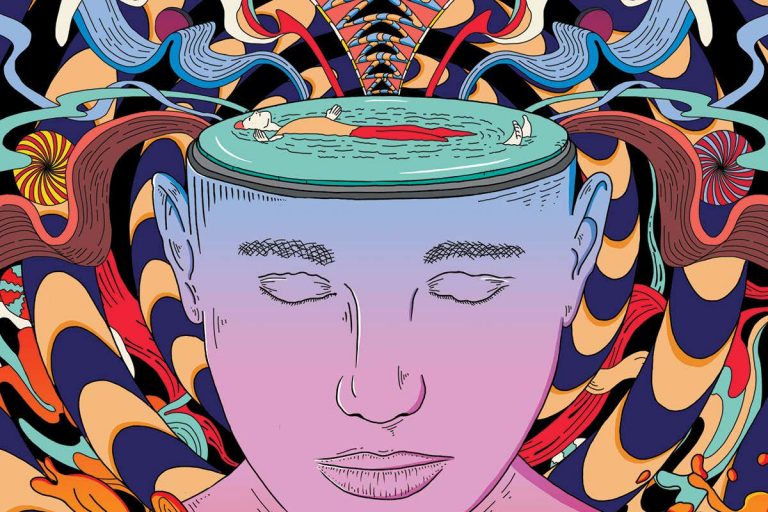
There is a quiet revolution underway in the sphere of mental health. A great deal of research is in progress to determine the effectiveness of psychedelic drugs in treating mental illness and their impact on psychological health. Since the 1960s, psychedelics have been heavily stigmatised in the public arena. However, with the passage of time, more and more people are recognising the positive impact it could have in combating the mental health crisis.

Harvard Law School’s Petrie-Flom Center for Health Law Policy, Biotechnology, and Bioethics has launched a first of its kind research on psychedelics and the law, the Harvard Crimson reported. The three year project will seek to “promote safety, innovation, equity, and access” in both psychedelic research and treatment.

“POPLAR is the first academic initiative focused on psychedelics law and policy, positioned to be the global leader for research and education in this space,” the press release said. “Psychedelics are one of the most exciting and promising new technologies in mental health care to come along for decades, and they could represent a true paradigm shift for mental health care and neuroscience research in general,” said Mason M. Marks, senior fellow at the Petrie-Flom Center and project lead for POPLAR.

“That’s why the Petrie-Flom Center is such a great place to house the project,” he added. According to the POPLAR website, the project will focus on ethics in psychedelics research and treatment, the intersection of psychedelics and intellectual property law, federal support of psychedelics research, increased access and equity of psychedelics, and the function of psychedelics in mitigating trauma.

Research on psychedelics

Apart from that, there are multiple other institutions conducting research on Psychedelics. Such studies often pit psychedelic compounds such as Psilocybin, the active compound in ‘Magic Mushrooms’ against conventional antidepressants. In one such case, one set of subjects were given a placebo and psilocybin and the other set was given an inconsequentially small dose of psilocybin and a conventional selective serotonin reuptake inhibitor (SSRI) antidepressant.

The results demonstrated that there was no significant difference in the antidepressant effects between the two. According to the research, the trial “did not show a significant difference in antidepressant effects between psilocybin and escitalopram in a selected group of patients. Secondary outcomes generally favored psilocybin over escitalopram, but the analyses of these outcomes lacked correction for multiple comparisons. Larger and longer trials are required to compare psilocybin with established antidepressants.”

At the Queen’s University in Canada, David Clements, Executive Director of Psychedelic Research at the university’s Faculty of Health Sciences, is leading a research to study the effectiveness of psychedelic drugs in treating serious illnesses such as Post Traumatic Stress Disorder (PTSD) and severe depression. According to a press release by the University, the team will be an “interdisciplinary space for research, innovation and knowledge translation in the field of psychedelics”.

Psilocybin is not the psychedelic compound under study. Researches are also being conducted on MDMA, popularly known as Ecstasy. The researchers observed that two-thirds of the subjects no longer reported a PTSD diagnosis after 18 weeks and three sessions. According to the trial, 88% of the subjects demonstrated a “meaningful reduction in symptoms”.

Meanwhile, the Hammersmith Medicines Research in London is conducting research on DMT (dimethyltryptamine). “Clinical research suggests that DMT will break or disrupt the neuronal pathways that underlie these negative thought processes and by doing so, may facilitate the benefits of therapy given in combination with DMT. DMT-assisted therapy targets the root cause of depression and other ‘internalising’ conditions and has the potential to provide a treatment with rapid onset and a long duration of activity following treatment,” said Small Pharma, the sponsor of the research.

LSD is also the matter of multiple research.

Skepticism remains despite growing acceptance

Numerous states in the United States of America are leading efforts to conduct research or decriminalise specific psychedelic substances such as psilocybin. On June 18, Texas Governor Greg Abbott authorised the study of psilocybin. Connecticut Gov. Ned Lamont signed a bill order the state department on medical sciences to report findings on the matter by January, 2022. A bill was introduced in New York that seeks to establish an institute to investigate the medicinal benefits of psychedelics. California is condering the decriminalisation of psilocybin.

Apart from that, seven cities have decriminalised psilocybin apart from Oregon, a state. But not all is hunky dory in terms of the research and plenty still harbour skepticism with regards to its positive effects. Suresh Muthukumaraswamy, a psychopharmacologist from the University of Auckland, says that the fact that subjects can easily tell whether they have been given a placebo or a psychedelic given the distinct ‘trip’ inducing effect of the latter has a definitive impact on the results.

“On the basis of the evidence that’s been collected, at this point, I don’t see any reason why you would think that these drugs and interventions are approvable with the current issues they have in terms of design,” he says asserting that the studies are probably overestimating the effects. Efforts are also currently on to remove the ‘trip’ from psychedelics.

Psychedelics have an intimate relationship with spirituality, as we have discussed here at OpIndia earlier. Ayahuasca, one of the most popular psychedelic beverages in the world, is consumed by Amazonian tribes for spiritual purposes. Despite their connections to spirituality and potential medical benefits, psychedelics remains extremely controversial to this day.

‘Twitter allowing terrorist groups to promote terrorism in India using kids’: Activist group files complaint with NCPCR

Trouble continues to mount for Twitter India’s MD Manish Maheswari, who is now facing backlash for allowing Jihadist organisations to use the platform to promote terrorism in India.

A Delhi based activist group Kalinga Rights Forum (KRF), has reportedly filed a complaint against Twitter India MD Manish Maheshwari and its Public Policy Manager Shagufta Kamran with NCPCR “for conspiring and promotion of terrorism using Kids against India & allowing terror organisations to use Twitter to facilitate recruitment activities for terrorism in Union Territories of J&K and L showing small kids as the face of terror organisations”.

In its complaint to the National Commission for Protection of Child Rights (NCPCR), Kalinga Rights Forum alleged that Twitter India is facilitating terror organisations like Ansar Ghazwat-Ul-Hind supporters to operate against India and carry out recruitment activities by using kids for radicalisation, brainwashing of kids to join terrorism against India by providing them with a platform.

Twitter India providing platform to Islamist terrorist organisations: Delhi based activist group writes in the complaint

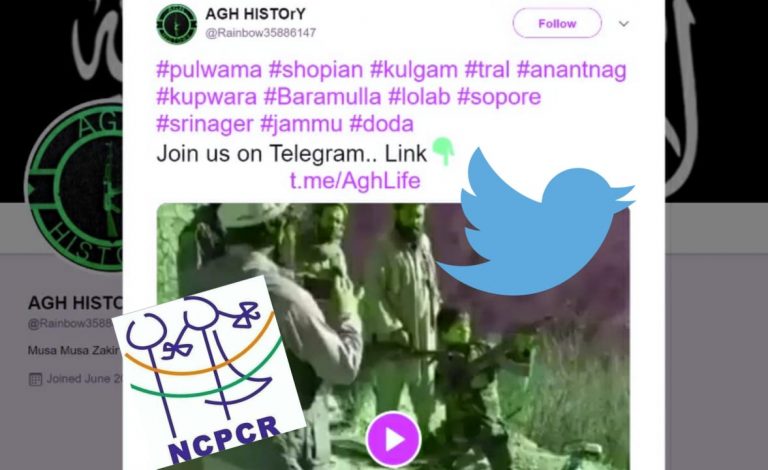
Speaking on how Twitter India is helping terrorist ideologies by providing the terror groups with a platform to spread their messages, recruit members, gather intelligence and also engage with their networks, the Delhi based activist group wrote that Twitter India allows terrorist supporters to post videos which show small children holding AK-47s, shooting in the air while other terrorists closely watch and instruct the kid how to shoot the gun.

The activist group shared the link and the archived link of the Tweet posted by AGH HISTOrY, going by Twitter handle @Rainbow35886147, wherein a small child is being taught how to use an AK-47 by terrorists. The activist group claims that AGH HISTOrY is a supporter of the Islamist terrorist organisation Ansar Ghazwat-ul-Hind, a Kashmiri wing of Al-Qaeda that is active in the Indian union territory of Jammu and Kashmir.

KRF further wrote in its complaint to NCPCR that the Twitter post by the terror organisation itself has a “mention of certain sensitive areas of Union Territory of J&K&L like ” #pulwama #shopian #kulgam #tral #anantnag #kupwara #Baramulla #lolab #sopore #srinager #jammu #doda ” where Pakistan sponsored terrorism is a grave concern”.

The social media giant abetting and supporting anti-India terrorist organisations, says complaint

By allowing such posts on the microblogging site, Twitter India is conspiring against India and abetting and supporting anti-India terrorist organisations to carry out terror attacks against India, read the complaint.

It added that the terrorist supporter, AGH HISTOrY has brazenly mention links to the Telegram groups in its Twitter posts and asked fellow terrorist supporters to join these groups.

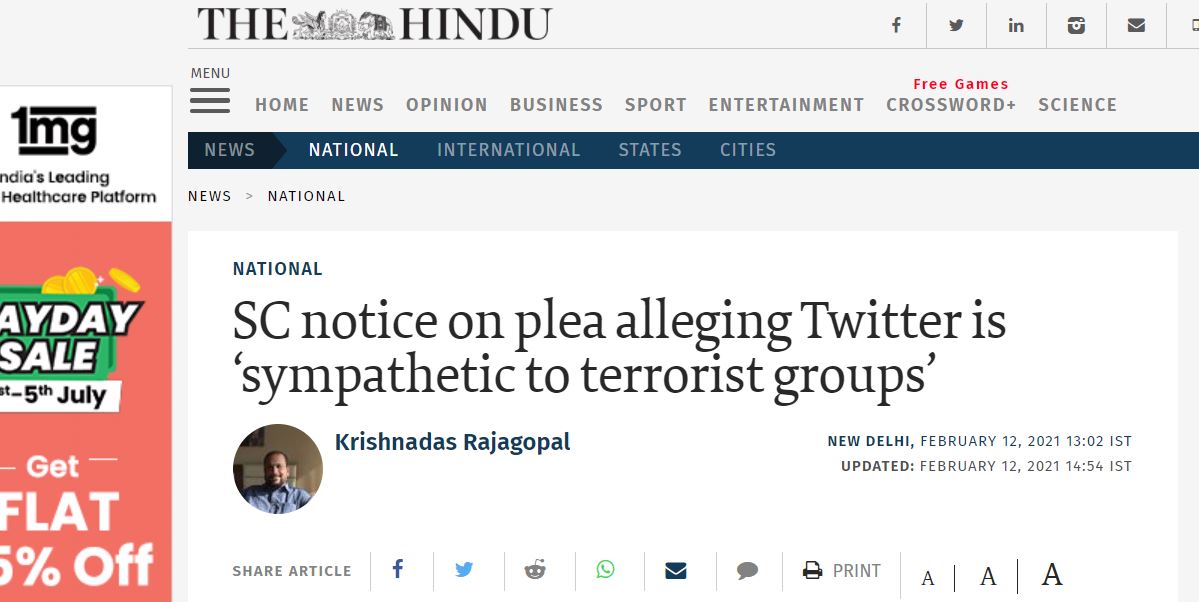
The complaint drew NCPCR’s attention towards how the social media giant has, on various previous occasions, explicitly shown support to these terrorist organisations by providing them with a platform to promote their nefarious anti-India agenda. Calling Twitter India “serial offenders”, the activist group shared the link of a report by The Hindu, which reported how the Supreme Court of India had issued a notice to Twitter India for being sympathetic towards terrorist organisations, in February 2021.

Screengrab of the report by The Hindu dated February 12, mentioned in the complaint filed by KRF

It further mentioned that on February 1, the Ministry of Home Affairs had directed Twitter to block 250 handles “promoting fake and provocative content”.

Govt blocks 250 tweets and accounts that claimed PM Modi was planning farmer genocide

It is pertinent to note here that on February 1, 2021, OpIndia had reported that the Ministry of Electronics and Information Technology (MEITY) on Monday has blocked around 250 Tweets/Twitter accounts that had used the #ModiPlanningFarmerGenocide hashtag and made fake, intimidatory and provocative Tweets on Saturday, 30th January 2021. Sources had then told OpIndia that this has been done at the request of the Ministry of Home Affairs and law enforcement agencies to prevent any escalation of law and order in view of the ongoing farmer agitation. The accounts included that of actor Sushant Singh and columnist with Congress mouthpiece National Herald Sanjukta Basu.

Citing their grave concerns, the Delhi based activist group, Kalinga Rights Forum (KRF) urged NCPCR to order the Delhi police to register FIR against Twitter India MD Manish Maheswari and Twitter India Policy Manager Shagufta Kamran under relevant provisions of Juvenile Justice (Care & Protection Act), 2015, Section 17,18,19 of Unlawful Activities (Prevention) Act, 1967 and other IPC sections deemed fit.

It further requested the statutory body to order the Twitter India MD and its Policy Manager and other officials to take down such anti-India, pro-terrorism content within the next 24 hours.

It also asked NCPCR to direct the Ministry of Home Affairs and the Government of India to take stringent actions against Twitter India for promoting terrorist activities using children as its face.

NCPCR takes cognisance, in the process of sending a notice to Twitter India

Meanwhile, the National Commission for Protection of Child Rights’ has taken cognisance of the complaint. “Noted”, wrote the statutory body’s chairperson Priyank Kanoongo in response to the complaint filed by the Delhi based activist group.

A member of the Delhi based activist group told OpIndia that NCPCR is currently in the process of drafting the notice, which the statutory body would be sending to Twitter India in this regard. OpIndia would update details once it is in possession of the copy of the NCPCR’s notice to Twitter India.

Twitter India a repeat offender

This is, however, not the first time Twitter India has got into trouble. On several occasions prior to this, the social media giant has been penalised for failing to comply with Indian law and refusing to restrict fake news and manipulated media.

On July 3, a complaint was lodged against Twitter India MD in Delhi for allegedly spreading communal hatred. Prior to this, the Uttar Pradesh government had filed a case against Twitter for its failure to take down fake hate crime videos and posts that were made viral on the platform. Furthermore, Twitter India Managing Director Manish Maheshwari has also been booked under Section 505 (2) of IPC and Section 74 of IT (Amendment) Act 2008 for showing the wrong map of India on their website.

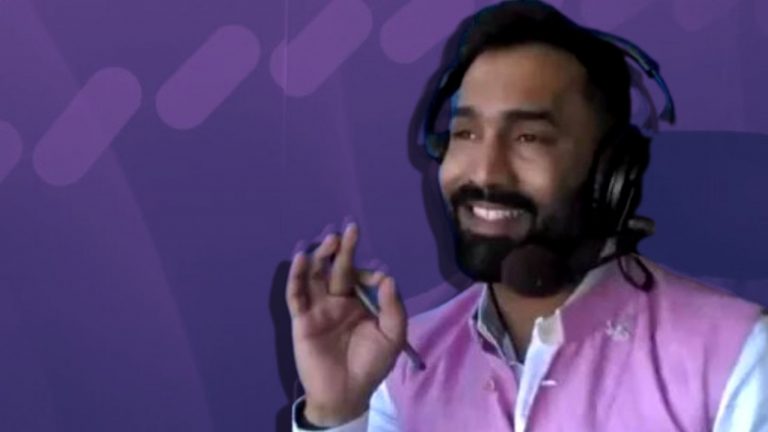
Dinesh Karthik apologises for his controversial commentary, says ‘Got a lot of stick from my wife and my mum’

Cricketer-turned-commentator Dinesh Karthik apologised for a comment made by him on July 02 during the ongoing One Day International between Sri Lanka and England.

While most welcomed his presence in the commentator’s box, Karthik’s recent slip-up was labeled sexist and misogynistic. “Batsmen and not liking bats, they go hand in hand. Most of the batters don’t seem to like their bats. They either like another person’s bat. Bats are like a neighbour’s wife. They always feel better,” Karthik had said jokingly.

However, the statement did not go down well with his fans and even his family as revealed by him on record. “I want to apologize for what happened last game. It’s not really what I intended. I just got it all wrong. I apologize to everybody. It’s definitely not the right thing to say,” remarked Karthik while being on-air during the 3rd ODI on Sunday.

“I got a lot of stick from my wife and my mum for saying that. I am really sorry that it shouldn’t happen again,” he revealed. 

Netizens react to Karthik’s comment

Several netizens took to Twitter to mock Karthik for his remark.

“Dinesh Karthik clearly not keen to have his Sky contract renewed …,” Tweeted a user.

Taking a jibe at the cricketer, another user wrote, “Imagine the conversations that are currently going on between spouses on Dinesh Karthik’s neighbourhood…”

Some predicted that this might be Karthik’s first and last tour as a commentator.

Fans cheer Karthik

However, Karthik is also being loved by his fans in this new role. From calling him a king to complimenting him for his commentary, Karthik’s fans heaped praises.

Some even suggested that they were watching the match only for his commentary. 

Karthik’s new Hawaiian attire has also been the talk of the town lately with even Chris Green appreciating his looks. 

Bhima Koregaon violence accused Stan Swamy passes away during imprisonment, informs lawyer

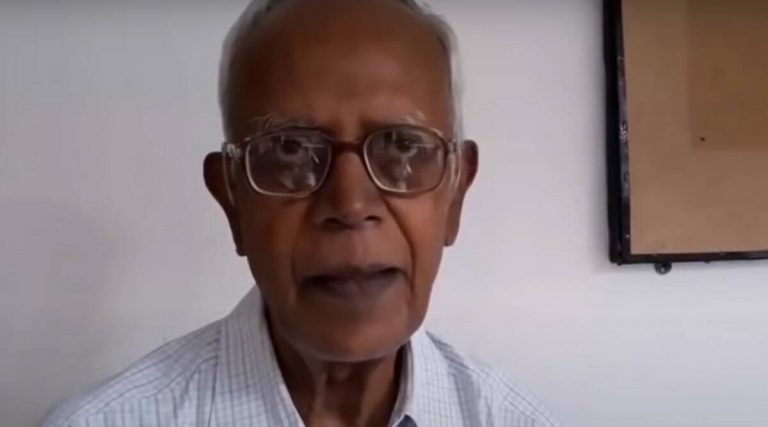
Father Stan Swamy, an accused in the Bhima Koregaon ‘Urban Naxal’ case, has passed away, his lawyer informed the Bombay High Court when the Court took up his bail plea.

According to his counsel, Stan Swamy suffered a cardiac arrest early morning on Saturday at 4:30 a.m., following which he passed away. The counsel demanded a judicial inquiry into the matter.

The Court expressed shock and sadness at the death of Swamy. Earlier in March, while denying his bail plea, the NIA Court had said that Stan Swamy “hatched a serious conspiracy to create unrest in the entire country and to overpower the Government, politically and by using muscle power”.

“The material placed on record thus prima facie denotes that the applicant was not only the member of banned organisation CPI (Maoist) but he was carrying out activities further in the objective of the organisation which is nothing but to overthrow the democracy of the nation,” the Special Judge had said.

Arrest of Stan Swamy and his role in Bhima Koregaon violence

According to the NIA, Stan Swamy was a key conspirator in the Bhima Koregaon Elgar Parishad case of 2017, which witnessed violence, stone-pelting, and arson at Shaniwar Wada in Pune. He was arrested on October 8 and produced before the Special Court in Mumbai the following day. Interestingly, he was never put under police custody and was instead remanded to judicial custody at Taloja Central jail. The NIA had informed that all legal formalities, including medical examination, were undertaken.

As per the Central investigative agency, Stan Swamy is a ‘hard-core CPI (Maoist) activist’ who had received funds from other Maoists for furthering the activities of the banned outfit. He is also the convenor of PPSC. “Incriminating documents related to communications for furthering the activities of the banned terrorist organisation CPI (Maoist) were seized from his possession,” the NIA emphasised.

After denying switch over, ex-President Pranab Mukherjee’s son Abhijit Mukherjee set to join TMC: Reports

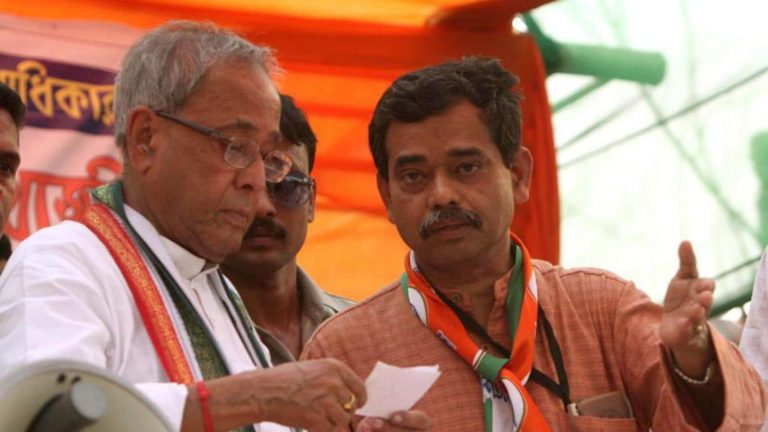
Late President Pranab Mukherjee’s son Abhijit Mukherjee is all set to join the Trinamool Congress in West Bengal today at 4 pm, as per reports. After dismissing rumours of quitting Congress earlier in June, Mukherjee was seen defending Mamata Banerjee through his Tweets off-late. 

As per an India Today report, Mukherjee, a former Congress MP from Jangipur had been in talks with the leaders of the TMC for the past few weeks. Mukherjee had had also paid a visit to Mamata Banerjee’s nephew Abhishek Banerjee in Kolkata last month.

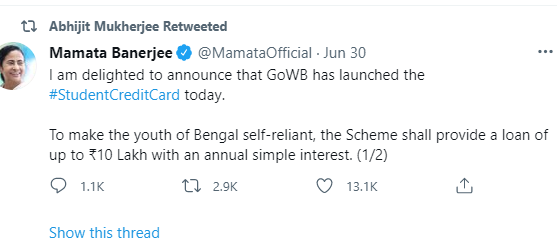
Recently, Abhijit Mukherjee has been sharing updates put out by the TMC and was also seen voicing his support for Mamata Banerjee on Twitter.

Abhijit Mukherjee retweets West Bengal CM Mamata Banerjee’s tweet. Image Source: Twitter

Defending Banerjee and her government in the recent fake vaccination scam, Mukherjee in a tweet said, “If Didi Mamata Banerjee is to be blamed personally for a fake vaccination camp by an impersonating IAS Officer Debanjan Deb, then surely ModiJi is to blamed for all the scams by Nirav Modi,Vijay Mallya, Mehul Choksi etc. So no point blaming the Govt of WB for an individual’s act”.

Mukherjee had refuted claims of joining TMC

Early last month Mukherjee had refuted claims of switching over. Replying to the alleged rumours after he was seen with some TMC leaders, Mukherjee said those were some of his father’s former Congress colleagues “who are now in Trinamool” and had come to have tea with him. 

“But, I have known them for long, as they were close to my father. To speculate that just because friends came to meet me, I will join TMC, is stretching it too far,” Mukherjee said defending himself. 

These leaders were MP Khalilur Rahman from Jangipur, MP Abu Taher Khan from Murshidabad and TMC ministers Akhrruzzaman and Sabina Yesmin.

Speculations in 2018

Similar speculations were made in 2018 about Mukherjee ditching Congress to join the TMC just ahead of the Lok Sabha 2019 elections. 

As per a Financial Express report, Abhijit, then a Lok Sabha MP, was allegedly approached by the TMC to join ranks with the party. However, Mukherjee declined the offer stating that the move would be “disrespectful towards his father”. 

Spat over memoir

Mukherjee was recently in news for a spat with his sister Sharmistha over his father’s memoir. 

A controversy erupted when the former Lok Sabha MP Abhijit Mukherjee asked the publishers to seek his clearance before publishing the book while his sister and Congress leader Sharmistha Mukherjee asked him not to create “unnecessary hurdles” in the release.

Mukherjee had also faced a huge backlash in 2012 after he called the women protestors who were protesting against the then government in the aftermath of the infamous Delhi gang rape case as “dented and painted”.  He was later made to apologize by his father over his insensitive comment. 

Asaduddin Owaisi attacks RSS chief Mohan Bhagwat for propagating Hindu-Muslim unity

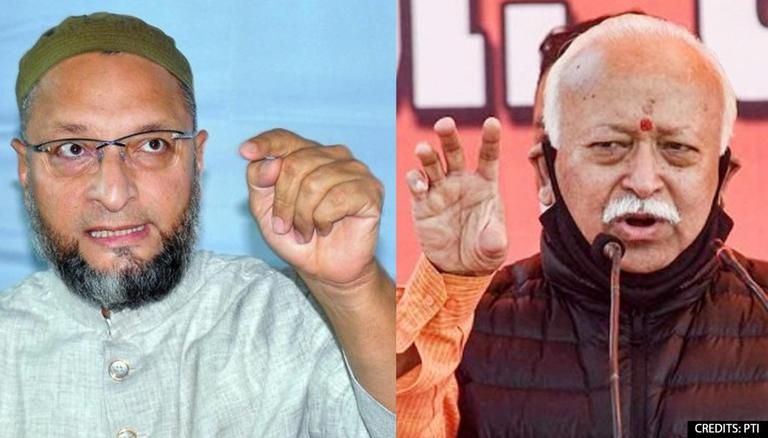
Hours after RSS chief Mohan Bhagwat spoke about the unity of Hindu-Muslim community and condemned mob lynching, terming those indulging in it were not Hindutva believers, the AIMIM chief Asaduddin Owaisi hit out at the Rashtriya Swayamsevak Sangh (RSS) chief.

Retorting to Mohan Bhagwat’s speech at a book launch in Ghaziabad on July 4, Owaisi Tweeted on Monday (July 5) that the lynching of Muslims is the result of Nathuram Godse’s ideology of Hindutva. In a series of controversial Tweets, Owaisi said that ‘cowardice, violence and murder’ have been an integral part of Godse’s Hindutva thinking. 

Listing some Muslim names and claiming them to be victims of mob lynching, the AIMIM supremo lamented that the perpetrators do not know the difference between cow and buffalo, but for them, names like Akhlaq, Pehlu, Rakbar, Alimuddin are enough to kill them.

In an apparent display of his anti-Hindu, anti-Modi bias, Owaisi further claimed “This hatred is the product of Hindutva. These criminals are backed by the Hindutva government.”

Asaduddin Owaisi retorts to RSS chief Mohan Bhagwat’s remarks on mob lynching

Asaduddin Owaisi’s spiteful comments came in retaliation to Mohan Bhagwat’s speech at a book launch in Ghaziabad on July 4, where the RSS chief repudiated those indulging in mob lynching terming them anti-Hindutva. Asserting that such criminals should definitely be brought to justice, Mohan Bhagwat also reminded that nowadays, some false cases of lynching are being reported, especially to target a particular set of people.

RSS chief spoke at a book launch in Ghaziabad on July 4

“Cases are even made up these days, so can’t really say what’s right, what’s wrong”, said the RSS chief.

RSS chief Mohan Bhagwat urged Muslims to alert against fear-mongering that Islam is in danger in India. “The question of uniting Hindu and Muslims does not arise, they are and have always been united. Whenever the feeling of disunity or estrangement has crept in, Hindu Muslims have both landed in trouble,” remarked Bhagwat.

He said that India always promotes equality and social inclusion. We are all united, and the factor which binds everyone together is our motherland. Not only because we were born here, but because of the inherent values which have been imbibed in us, he said.

“Sujalam, suphalam, malayaja shitalam”, invoking the national song of India, Mohan Bhagwat said that this is the tradition we Indians have followed for years together. Batting for Hindu-Muslim unity, the RSS chief furthered that India is so resourceful that, at present, it can take care of everyone, so there is no need to quarrel.

There are three factors that prove that we are all one. First motherland, second tradition and third we’re descendants of the same ancestors from the last 40,000 years, said Mohan Bhagwat, adding that since Indians are descendants of the same ancestors, their DNA is the same.

“We all come from the same ancestors and it is scientifically proven and that it is what unites us, and not politics. Some ‘intellectuals from the minority’ are under the fear that Hindus will overpower them. Those who have come here have survived, this is a proven fact,” said Bhagwat. 

“Sangh never said that only Hindu Rashtra has to be made but Sangh believes that only by taking all the people in our country together, we can make the whole nation better. The Sangh believes that we cannot stop anybody from worshipping someone. This country and society are ours. We have to take everyone along,” he said.

Underlining that development is not possible without unity in the country, the RSS chief stressed that the basis of unity should be nationalism and the glory of ancestors.

“We have the power but since the beginning, we have decided not to get into the party and vote bank politics. Politics will not serve the purpose of connecting people,” he said.

The RSS chief was speaking at the launch event of a book titled ‘The Meeting of Minds’ by Khwaja Ifteqar Ahmed – organised by RSS’ Muslim wing ‘Muslim Rashtriya Manch’ in Ghaziabad.

Sangh and Hindu interests: A note on the RSS by a Sanghi who never went to a Shakha

(The following is an extract from the book ‘Sanghi Who Never Went To A Shakha’, and is being republished here in wake of some social media debate happening over RSS Sarsanghchalak Mohan Bhagwant’s statement about Hindu-Muslim unity and common ancestry)

Since I have self-identified myself as a ‘Sanghi’ and even titled this book as such, I thought I should specifically clarify that I hold no brief for the RSS, and my views or commentary in this book may or may not match with the worldview of an average RSS swayamsevak (volunteer) or ideologue.

Even though I had put this disclaimer in the beginning of the book itself, let me expound it a little more and also share my views on the RSS.

First of all, I am yet (till the point of finishing this book in August 2020) to attend any shakha even though I’ve been vocal about my ideological beliefs for a few years now. I still have no idea about the daily or even weekly activities an RSS member undertakes inside or outside a shakha.

Yes, I’ve been to a couple of gatherings of RSS members and sympathizers to understand the RSS and their beliefs, and to be honest, I can’t say that I agree with all of them. And surely, even the RSS doesn’t expect everyone to agree with them on everything.

From my limited interactions, I have come to the conclusion that the RSS is not ‘Sanghi’ enough! Obviously, I am using the term ‘Sanghi’ as understood or imagined by people in the popular narrative—both by those who like the term as well as those who hate it.

The aggression and belligerence that one may imagine or desire in a Sanghi were hardly there in any senior RSS member whom I met. Most of them preferred an unhurried and persuasive approach towards problem-solving.

I could be wrong in my assessment, but I don’t think the RSS believes in bringing ‘radical’ changes, either in the society or polity. They want things to change at their own pace, without disturbing too many things or people.

If someone brands the RSS as a group of Hindu ‘radicals’, that will be as inaccurate as it can get. Unfortunately, that’s how the RSS is often branded. I actually know a couple of former RSS members who left the organization in frustration, as they found the RSS to be just ‘too soft’ and slow to their liking.

It’s true that there are organizations like the VHP or the Bajrang Dal—they have members who could also be RSS members, but they are not technically ‘RSS-affiliated’ organizations—which are aggressive in comparison, but the RSS in itself talks about ‘vyakti nirmaan’ (development of an individual’s character) and ‘samajik samrasta’ (social harmony, which includes all Indians). It doesn’t really talk exclusively about the Hindu society as such.

And this is where the Sangh often comes under attack by those Sanghis who have never been to any shakha. Not that I agree with all such criticism, but one of the most common criticisms of the Sangh, especially of its leadership, is that it has got its priorities all wrong, and can’t see the existentialist threats the Hindu society faces. When an RSS member is killed in Kerala or Bengal, such Sanghis get angry and start attacking the leadership for not doing enough to protect their own.

The statements and thoughts that tend to include everyone born in India, regardless of his religion, as a Hindu—and such statements have come from no less than the RSS chief himself on occasion—are cited as proof of ideological confusion within the RSS, which makes it blind to the existentialist threats.

For example, during his 2019 Dussehra address, RSS Chief Mohan Bhagwat said, ‘Those who belong to Bharat, those who are descendants of Bharatiya ancestors, those who are working for the ultimate glory of [the] nation & joining hands in enhancing peace, respecting and welcoming all diversities; all those Bharatiyas are Hindus.’

Ironically, such statements should have impressed me in my pre-2012 days, but then I thought that being branded a Sanghi is similar to ‘character assassination’. I am a pragmatist and not an idealist, so I don’t really know what purpose it serves by having such an inclusive and conciliatory approach when no one is really willing to trust or embrace you.

Under no stretch of the imagination could everyone born or living in India be seen as a Hindu, even culturally. I personally would categorize Indians in five broad different categories, based on their approach towards Hindutva, that is, Hinduness. These are:

Hostile : Those who are hostile towards it and openly talk about annihilating Hindutva or Hinduism—they are honest enough to not create a fake distinction between the two terms—such as the Periyarites, neo-Ambedkarites, Islamists or Evangelists. They simply want to eradicate this identity. They see Hinduism either as oppressive or a fundamentally inferior idea, and thus worthy of being eliminated.

Condescending : Those who are prejudiced against Hindutva or Hinduism, but are willing to ‘tolerate’ this identity for various reasons. Most of the so-called liberals fall in this category, who would tolerate Hinduism only when it’s deracinated to their heart’s content. For instance, when all Hindu festivals are either heavily regulated or secularized, such as Onam—which is ‘a festival of harvest and has nothing to do with Hinduism’.

Indifferent : Those who are indifferent towards Hindutva or Hinduism, primarily because they are not aware of the challenges or they are just too busy or motivated by mundane things in life—mostly, the ‘Congressi Hindus’, whom I have mentioned earlier in the book. Their thinking is influenced more by the above two groups than the below two groups. Many non-Hindus can also fall into this category.

Supportive : Those who are conscious of their Hindu identity and also support the Hindu causes. They may or may not be vocal, but they are definitely not indifferent. Many self-identifying Sanghis—not the actual Sanghis—fall in this or the next category. Statements such as those by the RSS chief that I pointed to earlier suggest many non-Hindus fall in this category too, which I hope is true, but I’m not really sure.

Assertive : Those who are not only conscious of the identity, but are willing to take that extra step, including some risks, to celebrate, propagate and defend this identity. However, it’s not a homogenous group. How they defend it, and what exactly they aim to propagate and defend may vary from one sub-group to another.

In my opinion, the RSS should provide clarity and leadership to the last two groups (Supportive and Assertive) and try to convert the middle group (Indifferent). One may have a conversation with the second group (Condescending), but on its own terms (i.e., on the Assertive group’s terms), and defeat the first one (Hostile) without any attempt at reconciliation.

I personally am almost paranoid about the future of Hindus. I think that the Hostile and Condescending groups together account for at least 30% of the Indian population; this can turn into a tipping point quite soon. Furthermore, as I have mentioned at one place in this book, I see eerie similarities between what’s happening now and what had happened in the few decades leading to the Partition of India. I see history repeating itself unless Hindus wake up.

Further, Hinduphobia has been normalized and intellectualized to frightening levels, where a Hindu talking about any injustice against him is branded a bigot. Anything that celebrates or propagates Hinduism will increasingly be argued as being detrimental to creating ‘safe spaces’. This has already started happening both in India and abroad, aided with the rhetoric around ‘Brahminism’.

I feel that Hindus are nicely being fed and fattened for the ceremonial slaughter—that’s how paranoid I am right now. Any attempt to wake them up and show them the civilizational dangers is ironically termed as ‘attempts to distract from the real issues’.

My paranoia may or may not be justified, but owing to that, I feel that Hindus need community leadership that can lucidly and logically explain the threats the community faces. It should be done quickly, before more people turn paranoid like me. I am not really happy being this way!

And I feel that the RSS is best placed to provide such leadership to the community, owing to its size and legacy. But, the organization itself wants to continue being a ‘nationalist’ outfit, focused on character building, rather than a Hindu outfit focused on community-building. That’s where I am not too happy.

Actually what I’m suggesting is not at all different from what Dr. Keshav Baliram Hedgewar, the founder of RSS, had said. The following quote of Dr Hedgewar is mentioned as the vision and mission of the RSS on their own website:

“The Hindu culture is the life-breath of Hindusthan. It is therefore clear that if Hindusthan is to be protected, we should first nourish the Hindu culture. If the Hindu culture perishes in Hindusthan itself, and if the Hindu society ceases to exist, it will hardly be appropriate to refer to the mere geographical entity that remains as Hindusthan. Mere geographical lumps do not make a nation.The entire society should be in such a vigilant and organized condition that no one would dare to cast an evil eye on any of our points of honour. Strength, it should be remembered, comes only through organization. It is therefore the duty of every Hindu to do his best to consolidate the Hindu society.”

Then, has the RSS lost its way or self-declared Sanghis like me can’t see how the organization is still on track and following their founder’s vision? I need answers there.

(The book ‘Sanghi Who Never Went To A Shakha’, authored by Rahul Roushan, was published by Rupa Publications and released on 10 March 2021. The link to buy the book is here.)

Gomti riverfront development scam: CBI files a fresh FIR and conducts raids at 42 locations

The Central Bureau of Investigation (CBI) on Monday carried out raids at least 42 locations in connection with the alleged irregularities in the Akhilesh Yadav-era scam in the Gomti riverfront Development Project case.

According to the reports, raids are being conducted in Lucknow, Ghaziabad and Agra areas of Uttar Pradesh, one each in Rajasthan and West Bengal in what the authorities peg as a Rs 1,400 crore scam in the Gomti riverfront development project. 

The raids come on the heels of a fresh case registered against public officials and unknown people in the development case. The CBI registered the second FIR in the case, naming 189 people as accused. Among the accused, 173 are private persons and 16 are govt officials, including 3 Chief Engineers and 6 Assistant Engineers.

The operation which was carried out early morning can be expanded during the course of the day, officials said.

The Gomti River Front Development Project scam

The Gomti riverfront development project was launched in 2015 by the previous state government which was led by Samajwadi Party with Akhilesh Yadav as chief minister. The Akhilesh Yadav government in UP had sanctioned the Gomti river channelisation Project and the Gomti riverfront development by the state irrigation department during his tenure in 2014-15. The megaproject was sanctioned reportedly at the total cost of Rs 1500 crores.

Taking cognisance of the massive irregularities and corruption alleged to have taken place during the sanctioning and execution of the project, the Yogi Adityanath government, soon after it came to power in March 2017, launched an investigation into the project. CM Yogi Adityanath had conducted an on-spot inspection of the project on the very next day of assuming office.

After the BJP came to power in the state in 2017, the Yogi government constituted a committee under retired Allahabad HC Judge Alok Kumar Singh to launch a probe into the alleged scam. The committee found prima facie irregularities in its report submitted on May 2017. The committee was asked to probe why the project was still incomplete even after an expenditure of Rs 1513 crores of the taxpayer’s money.

In June 2017, the UP police had registered a case on the basis of the findings of the committee. In July 2017, the Yogi Adityanath government had requested for a CBI probe into the matter.

CBI took over the case in November and registered an FIR in on December 1st, 2017, in Lucknow against 8 state government engineers who had been involved in the project. The FIR named 3 chief engineers namely Gulesh Chandra, SN Sharma and Qazim Ali, 4 superintendent engineers namely Mangal Yadav, Akhil Raman, Kamaleshwar Singh, Roop Singh Yadav and one executive engineer named Surendra Yadav. Several of the engineers were retired at the time of the FIR.

In November 2020, the CBI made its first arrest in the Gomti Riverfront development project case. Two engineers who were part of the project Roop Singh Yadav and Raj Kumar Yadav have been arrested by the CBI.

The central agency has been investigating the irregularities occurred during the implementation of the Gomti river channelisation project, and the Gomti riverfront development project. Funds were allegedly diverted and tenders were allegedly pooled in four major works of the riverfront project, namely the construction of a diaphragm wall, the construction of an intercepting trunk drain, the construction of a rubber dam and the preparation of vision documents.

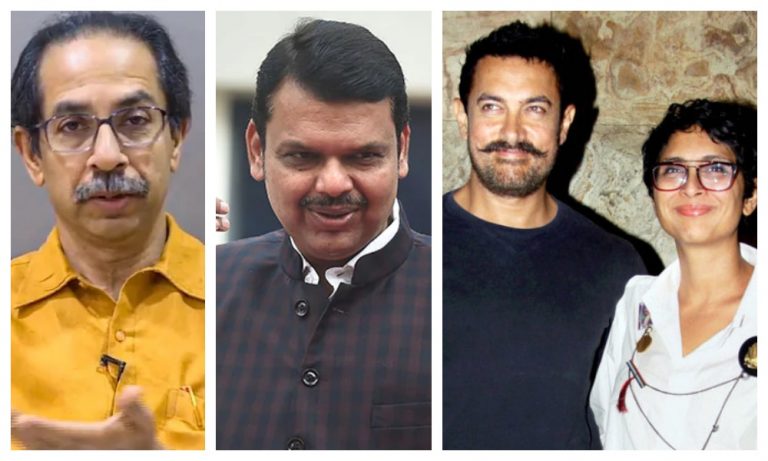
‘Like Aamir Khan and Kiran Rao, not India-Pakistan’: Sanjay Raut on relationship between Shiv Sena and BJP

Shiv Sena MP Sanjay Raut on Monday compared the relationship between his party and the BJP to Aamir Khan and his ex-wife Kiran Rao.

Raut, while interacting with media, claimed that the relationship between Shiv Sena and erstwhile alliance member BJP is not like that of India and Pakistan but more like Aamir Khan and his ex-wife Kiran Rao whom he divorced recently. Raut said that the two parties may be politically different but are still friends.

Raut was reacting to former Maharashtra Chief Minister Devendra Fadnavis’ statement from July 4, 2021 where he had said that the BJP and Shiv Sena are not enemies. “There are no ifs and buts in politics. There might be some differences with Shiv Sena but we are not enemies,” he had said while responding to questions on possibility of alliance between the BJP and Shiv Sena.

Khan and Rao on Saturday announced that they will be getting divorced. The couple said that while they are parting ways, they will continue to be together and be coparents to their son Azaad and also handle their other professional commitments together.