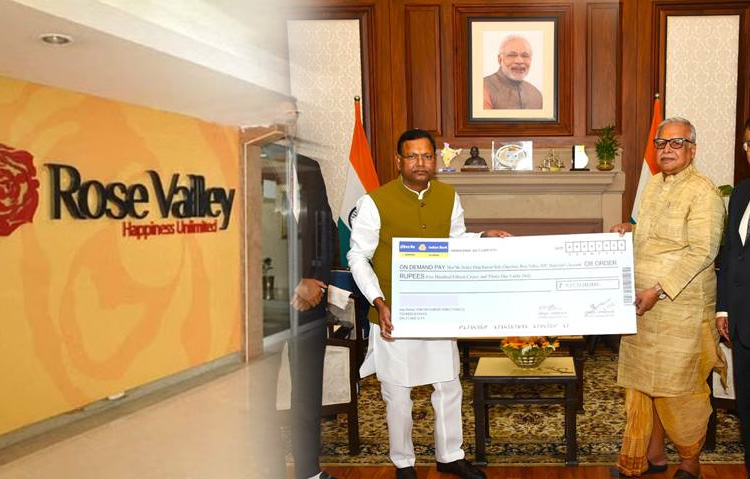
On April 12, 2025, Union Minister of State for Finance Shri Pankaj Chaudhary handed over a demand draft of ₹515.31 crore to Justice D.K. Seth (Retd.), Chairman of the Asset Disposal Committee (ADC), for restitution to victims of the Rose Valley Ponzi scam. The event was attended by Shri Rahul Navin, Director of the Enforcement Directorate (ED), and other senior officials.
This amount is expected to benefit approximately 7.5 lakh victims of the scam, out of the 31 lakh claims registered with the ADC. Previously, the ED had transferred ₹22 crore to the ADC for compensation to 32,319 legitimate investors.
The amount of ₹515.31 crore was attached by the ED between 2015 and 2017 after tracing funds through 2,987 bank accounts. Money collected from innocent victims had been kept in these accounts.
These accounts were seized following legal procedures and then were converted into over 700 fixed deposits after confirmation by the Adjudicating Authority. Additionally, the ED has attached movable and immovable assets worth ₹1,172 crore (), which are in the process of liquidation for further restitution. Estimated current market value of these assets is over ₹2,000 crore.
Investigations under the Prevention of Money Laundering Act (PMLA) revealed that the Rose Valley Group amassed ₹17,520 crore from investors by promising land parcels or hotel time-shares, or high-interest refunds upon maturity. Of this, ₹6,666 crore remains unpaid to investors. The ED is probing five PMLA cases registered against the group across West Bengal, Odisha, Assam, and Tripura, with prosecution complaints filed in all cases.
This is one of the single largest investigation of this type undertaken by the ED, and an order passed by the Special court (PMLA) at Khurda, Bhubaneswar, on 29.03.2025 has paved the way for the return of investors’ money all over the country through the Asset Disposal Committee (ADC).
The ADC was established under the directive of the Calcutta High Court, and it is chaired by Justice D.K. Seth (Retd.), with the ED and other members, to facilitate the return of assets to rightful investors. To date, around 31 lakh investors have registered claims via www.rosevalleyadc.com. The ED continues to assist the ADC in surveying, valuing, and monetizing attached properties to expedite disbursements.
This restitution aligns with Prime Minister Narendra Modi’s commitment to return funds misappropriated from the poor. The government remains dedicated to recovering and restoring money siphoned through fraudulent schemes to its rightful owners, said a statement by the Union Finance Ministry.
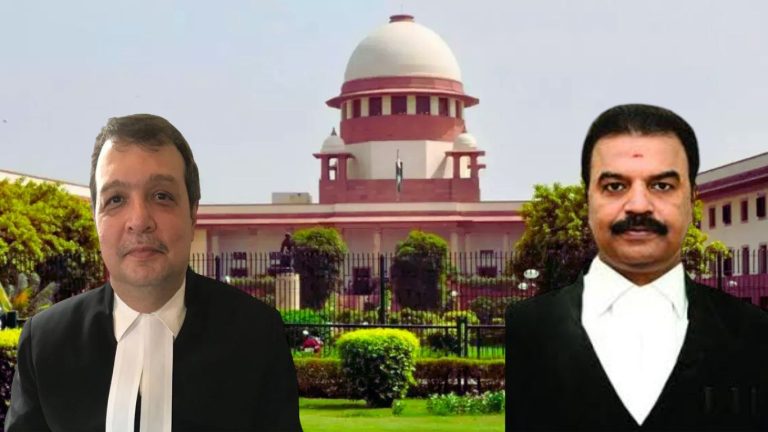
In a latest judgment delivered by a bench of Justices JB Pardiwala and R Mahadevan, the Supreme Court has prescribed a deadline of 3 months on the President’s power to grant or refuse assent to a Bill reserved by the Governor for his consideration. In the verdict passed in The State of Tamil Nadu v The Governor of Tamil Nadu and Anr, the Apex Court examined the ambit of powers of the President and the Governor conferred under Articles 200 and 201 of the Constitution. Notably, the provisions do not specify any time limit for the President to exercise his powers, but the Supreme Court has added a time limit within which the President will now be required to make a decision.
Article 200, inter alia, talks about the Governor’s power to reserve a Bill passed by a state legislature for the consideration of the President. Article 201 elaborates the President’s power to grant or refuse assent to a Bill sent to him by a Governor.
The President is to decide on the Bills within 3 months
Putting a time limit on the President’s power under Article 201, the Supreme Court held that the President should decide on the Bills sent to him by the Governor for consideration within 3 months, and that any delay beyond the prescribed time limit should be justified by recording reasons. “The President is required to decide on the bills reserved for his consideration by the Governor within three months from the date on which such reference is received. In case any delay beyond this period, appropriate reasons would have to be recorded and conveyed to the concerned State,” the court said.
Emphasising that the President and the Governor can not exercise their powers under the Constitution in an arbitrary manner by delaying the Bills indefinitely, the Supreme Court advised against exercising the powers in a piecemeal manner. “While in the preceding paragraphs we have elaborated that the Governor does not hold the power to exercise ‘absolute veto’ on any bill, we see no reason why the same standard would also not apply to the President under Article 201 as well. The President is not an exception to this default rule, which permeates throughout our Constitution. Such unbridled powers cannot be said to remain in either of these constitutional posts,” the Court said. “Piecemeal exercise of the proviso to Article 201 must be dissuaded. This is to prevent the endless loop of sending and re-sending of the bill that may ensue between the President acting under the proviso to Article 201 and the House or Houses of the State Legislature,” the Court added.
The state government can approach the Supreme Court against the President
The court added that if the President fails to decide on a Bill within 3 months, then the State government can seek the issuance of the writ of mandamus from the Supreme Court against the President. “Where the President exhibits inaction in making a decision when a bill is presented to him for assent under Article 201 and such inaction exceeds the time limit as has been prescribed by us in paragraph 391 of this judgment, then it shall be open to the State Government to seek a writ of mandamus from this Court,” the Court said.
Constitutionality of the Bill to be decided by the judiciary and not the executive
Explaining the limitations of the executive in deciding the constitutionality of a legislation, the Supreme Court said that the power to decide this lies with the judiciary and not the executive. “We have no qualms in stating that the hands of the executive are tied when engaging with purely legal issues in a bill, and only the constitutional courts have the prerogative to study and provide recommendations as regards the constitutionality of a bill,” the Court asserted.
The Court added that the President can seek its advice on the constitutionality of a Bill reserved for his assent under Article 143 of the Constitution. “Whenever, in exercise of the powers under Article 200 of the Constitution, a bill is reserved for the consideration of the President on grounds of patent unconstitutionality that are of such a nature so as to cause peril to the principles of representative democracy, the President, must be guided by the fact that it is the constitutional courts which have been entrusted with the responsibility of adjudicating upon the questions of constitutionality and legality of an executive or legislative action. Therefore, as a measure of prudence, the President ought to make a reference to this Court in exercise of his powers under Article 143 of the Constitution, ” the Court explained.
When the executive can deviate from the Supreme Court’s decision on constitutionality
The Supreme Court pointed out the situation when both the legislature and the executive may not act per the advice of the Supreme Court regarding the constitutionality of the Bill. The Court said that the President may deviate from the opinion of the Supreme Court when the grounds of reservation of the Bill include certain policy considerations. However, he must record cogent reasons for the decision. “In our considered view, the only reason for which the legislative or the executive wing may not take note of the opinion delivered by the Supreme Court under Article 143 is when the grounds on which a State bill was reserved for the consideration of the President, are not purely legal but also involve certain policy considerations, which may outweigh the issue of constitutionality. In such cases, if the President acts contrary to the advice of this Court and withholds assent to a bill, he must record cogent reasons and materials that justify not granting assent, ” the Court noted.
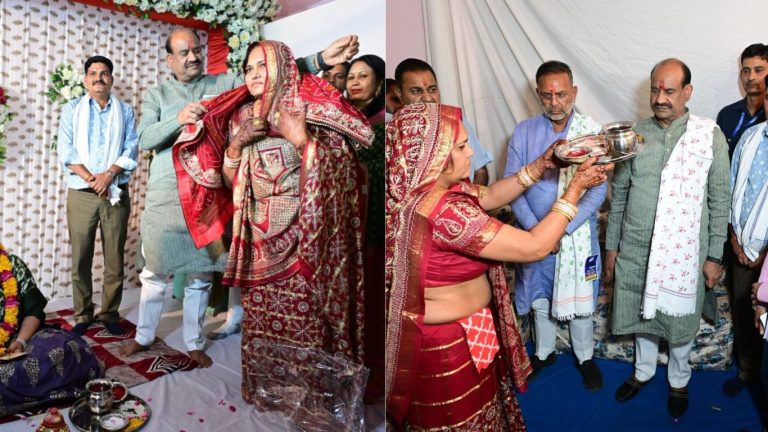
Fulfilling a six-year-old promise made to the wife of Late CRPF Jawan Hemraj Meena, who was killed in the Pulwama attack, Lok Sabha Speaker Om Birla attended the wedding ceremonies of her eldest daughter on 11th April in Sangod, Kota. Hemraj Meena was among the 40 Indian security personnel who were martyred in the ghastly terrorist attack in Pulwama in 2019. At that time, Birla had promised Meena’s wife, Madhubala, that he would shoulder the responsibilities of her family as her brother. Ever since, Meena’s wife has been tying Rakhi to Birla on Rakshabandhan.
Biral performed the ‘Mayra’ ceremony at the wedding
At the wedding, the Lok Sabha Speaker performed a traditional Rajasthani wedding ceremony of ‘Mayra’, in which the maternal uncle of the bride/groom brings gifts and blessings. The ceremony is also known as ‘Bhaat’. Keeping his word, Birla performed all the rituals and traditions in the capacity of Madhubala’s brother at the wedding. Sangod MLA and Minister of State of the Energy Department in the Government of Rajasthan, Hiranlal Nagar, also participated in the event with Birla.
In an emotional moment, during the ceremony, Birla draped a traditional Chunari called ‘Mayra’ on Madhubala, symbolising his support and blessings. Madhubala, in return, performed the ‘Tilak’ and ‘Aarti’ with Birla. Birla also paid tribute to martyr Hemraj Meena.
Lok Sabha Speaker Om Birla attends wedding ceremony of late CRPF personnel Hemraj Meena's daughter Reena in Rajasthan's Kota.
Om Birla also paid floral tributes at the statue of Shaheed Hemraj Meena.
“I had the good fortune of performing the Mayra ceremony on the auspicious occasion of the marriage of Reena, daughter of martyr Hemraj Meena Ji and sister Veerangana Madhubala Ji, in Sangod (Kota) parliamentary constituency. My heart is filled with pride and joy that our daughter Reena is now going to start her new life. This occasion is not only full of emotion for the family, but is also a moment of pride, when the years of loving upbringing, sanskar and hopes have come true. Martyr Hemraj Meena Ji’s unique sacrifice and unwavering patriotism for the nation have always been a source of inspiration for all of us. I pray to God that daughter Reena’s married life be full of love, trust and harmony and that she always moves forward with happiness, prosperity and respect, ” Brila wrote on X, sharing some pictures from the ceremony.
संसदीय क्षेत्र के सांगोद (कोटा) में शहीद हेमराज मीणा जी व बहन वीरांगना मधुबाला जी की सुपुत्री रीना के विवाह के शुभ अवसर पर मायरा भरने का सौभाग्य प्राप्त हुआ। मन गर्व और आनंद से अभिभूत है कि हमारी बिटिया रीना अब अपने नए जीवन की शुरुआत करने जा रही है। यह अवसर न केवल परिवार के लिए… pic.twitter.com/PM8gihNb8b
Birla took responsibility for Meena’s six children
The Pulwama attack had left an indelible mark on the family of martyr Hemraj, plunging them into immense grief. However, Lok Sabha Speaker Om Birla’s timely support helped alleviate some of their pain. He formed a strong bond with Veerangana Madhubala, promising to stand by the family through life’s joys and sorrows. Over the past six years, on Rakhi and Bhai Dooj, Veerangana Madhubala tied Rakhi to him and did tilak. The Lok Sabha Speaker once again stood with the martyr’s family when the occasion of the marriage of martyr Hemraj and Veerangana Madhubala’s daughter came.
The relatives of the martyr’s family said that Birla has been keeping his promise for six years. They said that he has supported the family through thick and thin, and has taken care of the education and other needs of Meena’s six children. Madhubala has six children, including 4 sons and 2 daughters. Her eldest daughter, Rina Meena, is getting married on 14th April.
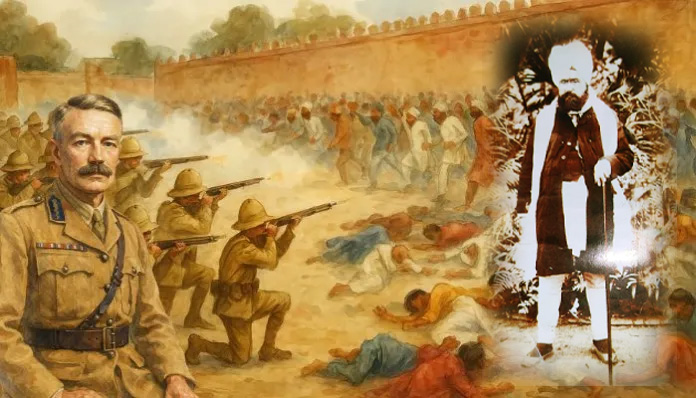
On 13th April 1919, in the heart of Amritsar, a British officer named Reginald Edward Harry Dyer ordered a massacre that shook the conscience of the entire nation. The incident took place at a time when India was witnessing a growing desire to rid itself of the British Raj.
Known as the Jallianwala Bagh massacre, it saw troops, mostly comprising Indian soldiers under the command of British officer General Dyer, fire 1,650 rounds into a crowd of unarmed men, women, and children. While most had gathered at the site to protest peacefully, some were simply there to celebrate the Baisakhi festival. According to British accounts, 379 people lost their lives. However, Indian accounts estimate up to 1,000 lives were lost.
During a commission hearing over the incident, Dyer defended his actions, saying, “It was no longer a question of merely dispersing the crowd, but one of producing a sufficient moral effect… throughout the Punjab.” He faced forced retirement but was met with support—not only from the British elite like Rudyard Kipling, who called him “the man who saved India”, but tragically, from Indian elites as well. Unfortunately, the Shiromani Gurdwara Parbandhak Committee (SGPC) had honoured him as well.
Who was General Dyer – the man behind one of India’s darkest days
General Dyer was a British officer of the Indian Army. He was born on 9th October 1864 in Murree (then in British India, now in Pakistan). In 1885, Dyer joined the army and served in various capacities across Burma, the North-West Frontier, and Persia. His career was marked by loyalty to the Crown and a colonial mindset that viewed Indian subjects as inferior.
In April 1919, India was experiencing unrest following the Rowlatt Act. Dyer was the acting brigadier general in Amritsar. On 13th April, he ordered his troops to open fire on the peaceful gathering without any warning, killing hundreds. His actions ignited widespread outrage in India and intense debate in Britain. Though he was relieved of his command and forced into early retirement, Dyer was hailed as a hero by British imperialists.
The shocking reverence – when General Dyer was honoured in Amritsar
In perhaps one of history’s strangest ironies, the same man who ordered the slaughter of hundreds at Jallianwala Bagh was honoured at the sacred Golden Temple complex in Amritsar. According to several historical accounts, including those documented by biographer Ian Colvin and author Nigel Collet (The Butcher of Amritsar: General Reginald Dyer), he was presented with a Siropa, which is a ceremonial robe of honour, by none other than the then Jathedar of Akal Takht, Giani Arur Singh, a British government appointee.
The word siropa is derived from the Persian word sar-o-pa, which means “head to toe”. It is an item of high honour in Sikh tradition. The event took place just days after the massacre, under British-controlled Sikh religious management. Notably, Jathedar Arur Singh reportedly suggested that Dyer become a Sikh, just like General Nicholson before him.
The offer was, however, declined by Dyer. He cited objections such as keeping long hair and giving up cigarettes. Yet, Arur Singh went as far as to say Dyer could still become a Sikh while keeping short hair and even offered flexibility on smoking, saying they would let him quit smoking gradually, at a rate of one cigarette per year. However, the British General declined to convert to Sikhism. The ceremony reportedly concluded with Dyer being gifted the five symbols of Sikh martial tradition.
Arur Singh Shergill was a magistrate and civil judge who was appointed as the manager of Darbar Sahib and the Akal Takht by the British Raj. He held the position from 1902 to 1920.
Colonial collaboration and the SGPC connection
Simranjit Singh Mann, leader of Shiromani Akali Dal (Amritsar) and grandson of Arur Singh, has supported the actions of his maternal grandfather. He defended the honour given to Dyer, saying that Arur Singh did it to pacify the British General and prevent more attacks. He reportedly claimed, “He did it to save the Golden Temple from bombing on the advice of then principal of Khalsa College GA Wathen.”
Notably, Simranjit Singh Mann also calls Bhagat Singh a terrorist because a Sikh constable was also killed when British police officer John Saunders was assassinated.
Akal Takht’s Jathedar’s support for Dyer was not an isolated incident. Several historical sources, including articles in media houses, state that numerous Punjabi elites openly sided with the British after the massacre. People like Kunj Bihari Thapar, Umar Hayat Khan, Chaudhary Gajjan Singh, and Rai Bahadur Lal Chand contributed to a fund of ₹1.75 lakh for the then Governor of Punjab, Michael O’Dwyer, who had endorsed Dyer’s actions. Meanwhile, General Dyer himself was rewarded with £26,000 (equivalent to millions today) by his admirers, British and Indian alike.
It is believed that they continued to support the British and Dyer with the hope that the benefits they were receiving from the British Empire would continue in exchange for siding with the butcher of Amritsar.
SGPC’s controversial origins and British interference
Before the formation of SGPC, the control of major gurdwaras, including the Golden Temple, rested with mahants or priests. They often collaborated with the British.
Before the formation of the Shiromani Gurdwara Parbandhak Committee (SGPC), control of major gurdwaras like the Golden Temple rested with mahants—priests who often collaborated with the British. Some of the early SGPC leaders were also soft towards the British.
One such name is Sunder Singh Majithia, who not only honoured Dyer but also became the first president of SGPC in 1920. He claimed to protect Sikh interests in a “milder” tone with the British and went on to form the Khalsa National Party. Majithia served as the Revenue Minister of Punjab under British rule from 1936 until his death in 1941.
Some of the prominent voices of Punjab, including Maharaja Bhupinder Singh of Patiala—grandfather of Captain Amarinder Singh—never condemned the massacre. Biographer Natwar Singh even wrote that the Maharaja continued his full support for the British government.
Gandhi’s inexplicable forgiveness for the butcher of Amritsar
What enraged and shook most Indians was the fact that Mohandas Karamchand Gandhi took the route of forgiveness. In Young India (25th August 1920), Gandhi wrote, “It would be sin for me to serve General Dyer and co-operate with him to shoot innocent men. But it will be an exercise of forgiveness or love for me to nurse him back to life if he is suffering from a physical malady.”
Later, when a friend blamed Dyer’s paralysis on his sins in Amritsar, Gandhi refused to accept the idea. He claimed, “I should be very sorry if some good Englishmen were to think that these diseases were due to my fierce opposition… to the English government.” Finally, Gandhi went on to say that he bore no ill will towards Dyer and even aspired to meet him and “reach his heart.” Such sentiments baffled many who saw the massacre as unforgivable.
A propaganda campaign and the public relations clean-up
In his book A History of the Sikhs: 1839–2004, Khushwant Singh mentioned that General Dyer actively campaigned across Punjab and urged local Sikh leaders, Jathedars, and royals to use their influence to support British governance and calm the growing dissent. Villagers were told that the British regime remained strong, and the government was not at fault.
It was not just a military propaganda but a symbolic one. Dyer was presented with a turban, a kirpan, and honoured as a Sikh warrior. This dangerous blend of colonial strategy and religious symbolism created a peculiar and disturbing moment in Indian history—the sanctification of a man responsible for the cold-blooded killing of innocents.
The aftermath and historical whitewashing
On 23rd July 1927, General Dyer died after a series of illnesses, including cerebral haemorrhage. Yet, attempts to whitewash his actions persisted. Some even argued that he had merely followed O’Dwyer’s instructions and was not the true architect of the massacre.
However, Indian revolutionaries like Udham Singh did not forget. On 13th March 1940, Singh assassinated Michael O’Dwyer in London in an act of vengeance for Jallianwala Bagh, ensuring that at least one of the perpetrators faced justice—if only symbolically.
Conclusion – A legacy of betrayal and remembrance
The Jallianwala Bagh massacre gave birth to countless revolutionaries including Udham Singh, Bhagat Singh, and many more. The pain that lived in the hearts of Indians who saw or heard about the massacre sowed the seed of revolution against the British in the decades to come.
Though over 100 years have passed, the memory of Jallianwala Bagh remains a deep scar on India’s soul. What deepens the wound is the fact that there were people among us—including then-religious leaders, royals, and elites—who chose to honour the butcher, not the victims.
From the Akal Takht’s honour to SGPC’s early silence, from Maharajas to ministers, from British propaganda to Gandhi’s puzzling pardon, the episode reflects that India’s fight for independence was much more complex than it has been represented by the left-liberal historians.
The history is remembered. However, there are multi-layers of the historical facts from that time that got buried under the immense pressure of pleasing the British and saving the butcher.
On Friday (11th April), Karnataka Congress Minister Priyank Kharge courted controversy after he attempted to downplay incidents of attacks on inter-faith couples by Muslim mobs in the name of ‘Bhagwa love trap.’
Commenting on the recent incident of harassment of an interfaith couple in a park in Bengaluru by a group of 5 men, Karnataka Minister Priyank Kharge said that the state government would not tolerate any “moral policing” in the state.
Taking a dig at Uttar Pradesh, Bihar, and Madhya Pradesh, which have BJP governments, Kharge said that Karnataka is a “progressive state”, unlike the three states. “This is not Bihar or Uttar Pradesh or Madhya Pradesh. Karnataka is a progressive state,” the Minister was quoted as saying.
What was the incident
The Bengaluru police arrested five men based on the complaint of the woman. The incident took place on 8th April in an area under the Chandralayout Police Station.
A video of the incident went viral, showing five men harassing a burqa-clad woman sitting on a scooter with a Hindu male friend in a park. The men questioned the woman about whether her family knew her whereabouts. They also confronted her male friend and asked him why he was sitting with a woman of a different faith.
“The couple was sitting on a scooter when five people questioned them. The girl was wearing a burqa. We have received a complaint from the woman based on which we have registered a case….We are continuing our investigation,” the Deputy Commissioner of Police, Girish, was quoted as saying.
The police have denied any violence, but another video reportedly showed the men surrounding the male friend and hitting him with an object.
Other incidents of “moral policing” from Karnataka
This is not the first time that such an incident of “moral policing” has come to light in the Congress-ruled state. Last year, in April, a Hindu man, Umesh, was brutally beaten in Chitradurga city of Karnataka by an Islamist mob for offering a ride to a Muslim woman. Umesh was dropping his colleague Parveen at her house when the incident took place. Umesh was seriously injured one the attack.
In a similar incident that happened in the same month last year, a Dalit Hindu man, Sachin Lamani and his Muslim cousin-sister Muskan Patel, were brutally assaulted by a group of Muslim men in Belagavi, Karnataka. The victims were attacked at the Fort Lake premises. They had come to register for the Yuva Nidhi scheme. Lamani’s aunt, his father’s sister, married a Muslim man, and therefore, his cousin is Muslim. A case was registered under the SC/ST Atrocities Act.
In another incident of “moral policing” that happened in January 2024, an interfaith couple was attacked by six Muslim men in a hotel room in the Haveri district of Karnataka. The six men barged into a room in a hotel in Hanagal Taluk of Haveri District, where a Hindu man and a Muslim woman were staying. They abused and thrashed the couple and recorded a video of the attack. The police took action against the attackers after the video went viral. The woman later said that she was gang-raped by the attackers after they took her away from the hotel.
A similar incident was reported from Karnataka in August 2023, a man named Jakir Ahamad was arrested after he harassed a burqa-clad Muslim woman for travelling with a Hindu man. In a viral video of the incident, Jakir was seen stopping the woman travelling on a bike with a Hindu man and abusing her as she stood her ground. A case was registered by the police against the accused.
‘Bhagwa love trap’ conspiracy theory and its aftermath
‘Bhagwa Love trap’ is a baseless theory about Hindu outfits, supposedly training Hindu youth to lure, and entrap Muslim women and turn them into non-Muslims. OpIndia has reported that an Islamic cleric by the name of Sajjad Nomani has been making such outrageous claims since 2021.
The conspiracy theory soon took the form of a social media hashtag, which Islamists used to share videos of random hijab-wearing Muslim women and their male Hindu friends/ acquaintances and partners without their consent. The posts are often accompanied by emotional messages and seek public help in identifying the couples. Soon after, social media was rife with videos of Islamist mobs ambushing random Hindu-Muslim couples. This would then be followed by heated arguments, physical assault on Hindu men, and even molestation of Muslim women. The victims have been targeted on roads, restaurants, eateries, and even hotels.
Based on local reports and social media videos, OpIndia has compiled several cases (here, here and here) where Hindu men and Muslim women were attacked by extremists under the pretext of the ‘Bhagwa love trap.’ OpIndia has also published an investigative report, highlighting how Islamists are using WhatsApp groups to target Hindu-Muslim couples.
Massive violence erupted in Murshidabad in West Bengal as a Muslim mob protesting against the Waqf Amendment Act clashed with police, set vehicles on fire, threw stones at trains and vandalized railway stations. This was the latest in the rounds of violence in Murshidabad during protests against Waqf Act.
As per reports, a large number of people from the Muslim community had gathered in Murshidabad after the Friday prayers and started protesting against the Waqf Act. The protesters blocked the National Highway 12 at Sajurmor intersection in Sutir and the new Dakbangla intersection in Shamsherganj block, demanding the withdrawal of the Waqf Bill.
Later, the situation turned violent in both places as they started pelting stones and bricks at the police. The cops retaliated with batons, lathicharge and tear gas shells. Several policemen were injured in the clash, along with some protestors. The SDPO of Farakka was also injured in the attack.
The situation deteriorated to such an extent that some cops had to take shelter in a nearby mosque to save their lives from the murderous mob.
The mob also pelted stones and crude bombs at police vehicles and set them ablaze. The protestors claimed that the police fired on them, but the police have denied the claim. A police van carrying prisoners was also attacked by the mob, along with government and private buses. Government offices were also target by the mob, smashing windows by throwing stones and bricks.
The mob also targeted railway infrastructure in the area, pelting stones at trains and the railway station. Several passenger trains were affected as a result of the disruption. Railway officials said that protestors stopped train movements by sitting on the tracks.
A statement issued by Eastern Railway said that around 5000 people obstructed train movement near Dhulianganga station on the Azimganj-New Farakka section of Eastern Railway. The mob blocked the line between Dhulianganga and Nimita stations, forcing the railways to divert or short-terminate several trains.
#WATCH | Kolkata, West Bengal: Eastern Railway CPRO Diptimoy Dutta says, "Train services have been affected in the Azimganj-New Farakka section as a group of people were squatting on the railway track between Dhulian Ganga and Nimtita stations… They also damaged the gate no 43.… https://t.co/c86EVFvFnFpic.twitter.com/pYl9Dobdqc
The protestors blocked the Kamakhya–Puri Express near Dhulianganga in the afternoon, delaying it. The train was later diverted via a different route after it was stranded for over 2 hours. Barharwa–Azimganj Passenger, Sahibganj–Azimganj Passenger, Nabadwip Dham Express, Azimganj–Malda Town Passenger were among the other affected trains.
Railway authorities said that all trains going towards north Bengal through Murshidabad have been either diverted or cancelled.
“Eastern Railway expressed deep concern for such obstruction to train movement which not only affects the punctuality but also creates trouble for lots of passengers who are on board,” the statement said.
In response to the unrest, personnel from the Border Security Force (BSF) have been deployed to the area, as it falls within 50 kilometers of the India–Bangladesh international border. Murshidabad has been witnessing violence regularly in recent days in protests against the Waqf law.
Similar violence had erupted in Murshidabad on Tuesday too, as a Muslim mob had pelted stones and torched vehicles.
Fifteen flights were diverted, and several were delayed at the Delhi airport on Friday due to dust storms and gusty winds, as per the Airport sources.
Delhi experienced dust storms on Friday evening. Several parts of Delhi were impacted due to the change in weather that also provided relief from scorching heat.
Air India issued a travel advisory for their passengers after the sudden change of weather in Delhi and northern areas. According to the advisory, heavy thunderstorms and gusty winds, have affected flight operations across parts of Northern India, due to which some of the Air India flights from Delhi have either been diverted or are delayed.
The officials are closely monitoring the situation and are doing the best possible to minimalise the disruptions.
“Poor weather, caused by heavy thunderstorms and gusty winds, has affected flight operations across parts of Northern India. Some of our flights to and from Delhi are being delayed or diverted, which is likely to impact our overall flight schedule. We are closely monitoring the situation and are doing our best to minimise the disruption. We advise our guests to check the latest status of their flights at https://airindia.com/in/en/manage/flight-status.html before heading to the airport”, the travel advisory said.
Several parts of Delhi witnessed a dust storm on Friday evening that led to trees falling in some areas and residents shutting windows to prevent dust from entering their houses.
Traffic was also disrupted as trees or their branches fell. Flight operations were also impacted in parts of northern India. Delhi had witnessed a dust storm on Thursday also.
Earlier, the India Meteorological Department had issued an Orange Alert for thunderstorms, lightning, and hailstorms in four districts of Himachal Pradesh, while Yellow Alerts have been issued for four other districts.
(This news report is published from a syndicated feed. Except for the headline, the content has not been written or edited by OpIndia staff)
In a major political move, the Modi government has finally delivered on its years-old promise by passing the Waqf Bill across the country and implementing the Waqf Act. While this development has been welcomed by many, it hasn’t gone down well with certain hardline Muslim groups and several opposition parties, many of whom are still grappling with the new reality.
Tensions flared in Ahmedabad’s Rakhial area, where a group of Muslims took to the streets in protest. According to a video shared by Sagar Patoliya on X, the crowd gathered near the Kalandari Mosque and blocked a major road, even beginning to offer Namaz in the middle of the street—an apparent attempt to spark disruption under the guise of religious observance.
But the Ahmedabad police were quick to act. Anticipating the situation before it could spiral out of control, they detained the protestors early on, maintaining calm and order in the area.
Order restored swiftly
The crowd had reportedly planned to stage a demonstration right after the Friday prayers. However, thanks to the vigilance and timely response of law enforcement, the situation was brought under control without major incident. At present, all those involved have been detained, and peace has been restored in the area.
“Modi will take our Mosques”: The Old Narrative Resurfaces
Meanwhile, a video from the scene has gone viral, showing a man allegedly trying to incite unrest by peddling inflammatory claims. In the clip, the individual is seen accusing Prime Minister Narendra Modi and Home Minister Amit Shah of planning to seize Muslim mosques and graveyards—an allegation that has been repeatedly used to stoke fear and division.
The man can be heard shouting, “Who are Modi and Amit Shah? Is this their father’s country? This land doesn’t belong to anyone’s father!”
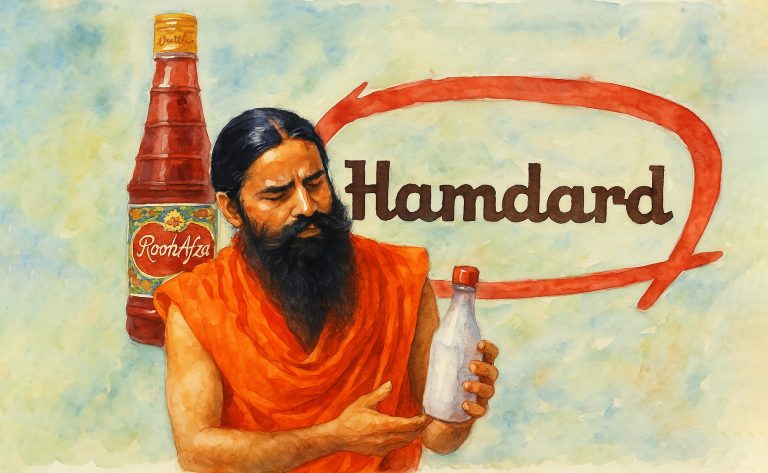
‘Sharbat Jihad,’ this newly coined term, has triggered the Islamist cheerleaders, also known as the left-liberal gang, into mindlessly promoting the sugar-loaded drink Rooh Afza. This comes after Yoga Guru and Patanjali Ayurved’s co-founder Baba Ramdev introduced the term ‘Sharbat Jihad’ while promoting his company’s new rose-flavored summer drink.
In a promotional video posted on Patanjali Products’ Facebook page on 3rd April 2025, Baba Ramdev criticized soft drinks, equating them to ‘toilet cleaners’ consumed under the guise of quenching thirst in summer. Without naming any specific company, Baba Ramdev asserted that this company, although it sells ‘sharbat’, the revenue earned from its sales goes towards the construction of mosques, madarsas and other Islamic institutions.
The inference here, however, appears to be Hamdard Laboratories (India), which makes the popular summer drink Rooh Afza. Contrasting this with Patanjali’s Rose Sharbat, Baba Ramdev claimed that its profits fund Gurukuls, Acharyakulam, Patanjali University, and the Bhartiya Shiksha Board. He further warned that just as there is love jihad and vote jihad, there is also sharbat jihad going on and that people, especially Hindus, need to protect themselves from sharbat jihad. Notably, even though the Yoga Guru warned people against the alleged sharbat jihad, he did not essentially oppose the ‘unnamed’ sharbat-maker’s practice of funding or running Islamic institutions.
“In the name of quenching thirst during summers, people drink cold beverages that are basically toilet cleaners. On one side, there’s the attack of toilet-cleaner-like poison, and on the other, there’s a company selling sharbat, which uses the money earned from it to build mosques and madrasas. That’s fine, it’s their religion…Protect your family and innocent children from the poison of toilet cleaner being sold under the name of ‘sharbat jihad’ and cold drinks. Bring home only Patanjali sharbat and juices,” Ramdev said.
Liberals get triggered over Baba Ramdev’s ‘sharbat jihad’ claim, start promoting unhealthy RoohAfza
The Indian left-liberal cabal has a knack for whitewashing or justifying Islamic terrorism, violence, Jihadist rhetoric, institutionalised Muslim hegemony and exclusionary Islamic practices. Be it whitewashing the Muslim mob violence in Nagpur by blaming Hindus and film Chhaava, opposing the Waqf Act 2023 so as to allow the continuation of Waqf Board’s encroachment of Hindu properties and government lands, villainising Hindus for waving saffron flags on a structure named after Salar Ghazi Masud, an Islamic jihadi plunderer who destroyed Hindu temples and killed Hindus to the general opposition to Hindu efforts at reclaiming their temples, liberals shrewdly deflect attention from the crux of issues to blame the victim and whitewash the perpetrator.
Although, there is no essential victim-perpetrator scenario in the ‘sharbat jihad’ controversy on the face of it, the liberal ecosystem has jumped in to defend and promote Hamdard’s flavoured sugar-syrup Rooh Afza because how dare a Hindu guru claimed that a company which is essentially a Waqf or simply an Islamic charitable endowment, is selling its product to people especially Hindus, while its profits fund construction and operations of mosques, madarsas, Islamic universities etc.
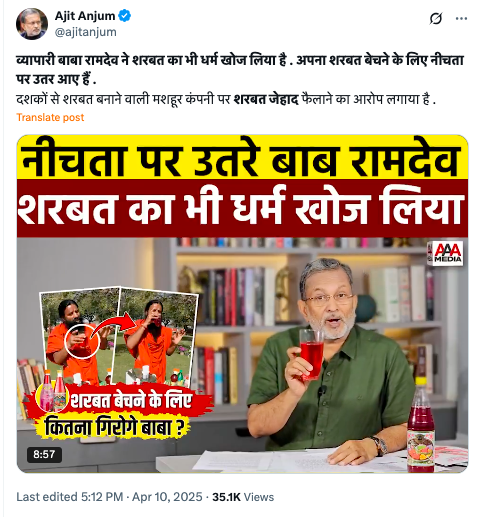
In this vein, pro-Congress propagandist and YouTuber Ajit Anjum alleged that ‘businessman’ Baba Ramdev has resorted to cheap theatrics to sell his sharbat and somehow found religion in sharbat as well. In his unbearable histrionic style, Anjum claimed that Baba Ramdev targeted Hamdard and its flagship product Rooh Afza because that company is owned by a Muslim. Amusingly, after wholeheartedly promoting Hamdard’s sugar syrup, Anjum said that it may appear that he is promoting Rooh Afza.
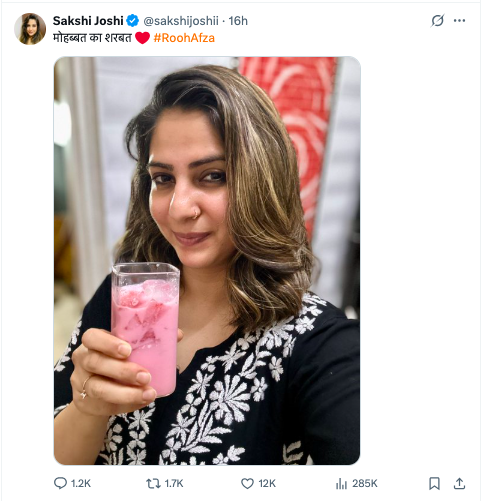
Another liberal ‘journalist’, Sakshi Joshi, also published her picture with a glass of Rooh Afza and called it “Mohabbat ka Sharbat”.
One Habeeb wrote, “Love jihaad, land jihaad, news channel jihad, government job jihaad ke baad ab market mein aaya “Sharbat Jihaad” Baba Ramdev’s attempt to promote Patanjali’s sharbat by calling Rooh Afza “Sharbat Jihaad” is not only disrespectful but dangerous. Using religion to push his own product is a blatant attempt to divide communities for commercial gain.”
Love jihaad, land jihaad, news channel jihad, government job jihaad ke baad ab market mein aaya "Sharbat Jihaad"
Baba Ramdev's attempt to promote Patanjali's sharbat by calling Rooh Afza "Sharbat Jihaad" is not only disrespectful but dangerous. Using religion to push his own… pic.twitter.com/Ozex1kTvyU
— Habeeb Masood Al-Aidroos (@habeeb_masood) April 9, 2025
Meanwhile, AltNews’s Mohammed Zubair, who earned notoriety by dog-whistling Islamists against ex-BJP spokesperson Nupur Sharma and passing off ‘Pakistan Zindabad’ slogans raised by his co-religionists as ‘Nasir Sahab Zindabad’, called Baba Ramdev as ‘Lala Ramdev’ and claimed that the latter is playing Hindu-Muslim card. He further asserted that Patanjali Ayurved obtained Halal certification for some of its products meant to be sold in Gulf countries.
“Sharbat Jihad? Lala Ramdev is now selling his low quality Patanjali Sharbat by playing the Hindu-Muslim Card. He knows that’s the only way to fool Indians. The same Ramdev sold his Patanjali products in the Middle East by obtaining Halal Certification for some of its products, particularly those intended for export to Gulf countries,” Zubair posted on X.
Sharbat Jihad? Lala Ramdev is now selling his low quality Patanjali Sharbat by playing the Hindu-Muslim Card. He knows that's the only way to fool Indians. The same Ramdev sold his Patanjali products in the Middle East by obtaining Halal Certification for some of its products,… pic.twitter.com/R6sP3y5H86
It is pertinent to note that just like Mohammed Zubair, several others of his ilk are using the ‘Lala Ramdev’ term for Baba Ramdev to discredit his spiritual credentials and paint him as a full-time businessman masquerading as a Hindu saint. For Islamo-leftists, a Hindu saint doing business is outright communal for simply saying that a company is using its profits for Islamic purposes; however, an Islamic Waqf business earning profits from non-Muslims and then using those funds for running Islamic institutions is secular by default.
One anti-BJP troll, “Punster”, invoked ‘Islamophobia’ and claimed that Baba Ramdev is using it as a legit marketing strategy. “If you drink that sharbat (Roohafza), madarsa’s will be built. If you drink Patanjali Gulab sharbat, gurukuls will be built.” – Lala Ramdev, who is using islamophobia as a legit marketing strategy to build a business empire.”
"If you drink that sharbat (Roohafza), madarsa's will be built. If you drink Patanjali Gulab sharbat, gurukuls will be built."
– Lala Ramdev, who is using islamophobia as a legit marketing strategy to build a business empire. pic.twitter.com/uwipUge4kt
Hamdard: The 115-year-old Unani pharmaceutical and food company, its transition into a Waqf and its many controversies
‘Hamdard’ is an Unani pharmaceutical and food company established in undivided India in 1906 by Hakeem Hafiz Abdul Majeed. Following India’s bloodied partition on religious lines and the creation of Pakistan, Hamdard was transformed into a ‘Waqf’, an Islamic irrevocable trust with its profits meant to be utilized for Islamic religious, charitable and educational purposes. As India was partitioned, the Humdard family also split, with one branch establishing Humdard Pakistan.
Humdard Laboratories India continues to divert 85% of its profits to the Humdard National Foundation (HNF). Founded in 1964, the HNF runs many healthcare and educational institutions, including Jamia Humdard University, and provides courses in Islamic studies, etc. It runs a Ghalib Academy to promote Urdu literature. HNF also runs Jamia Hamdard Rabea Girls School, which has a reservation policy wherein 50% seats are reserved for Indian Muslims while the rest are open for non-Muslim students.
Notably, while Hamdard’s Waqf status implies that its revenue supports initiatives aligned with Islamic charitable principles, as per the company’s website, HNF’s institutions are open to non-Muslims as well.
While Rooh Afza is a cultural staple for many in India, especially for Muslims in Ramzan, over the years, Humdard has been embroiled in several controversies as well. In 2024, Humdard Laboratories India was accused of cheating millions of customers in Bangladesh, India, Pakistan and the Middle East through false claims.
In February last year, it was reported that Humdard promoted Rooh Afza as a “nutritional drink” that “maintains as well as adjusts the body’s water level, has 13 herbal ingredients and 36 types of fresh fruit juices and fresh flower extracts”. However, the Dhaka South City Corporation had said that the ingredients mentioned in the cooling drink do not exist. Moreover, reports have cited health experts saying that Rooh Afza may cause serious health issues to a large number of people, particularly those suffering from diabetes. The findings were revealed from data collected from the market under the initiative by DSCC. A Bangladeshi civic official had alleged back then that Hamdard had been doing immoral things since the beginning.
Back in 2022, a major outrage erupted in Haryana after demands rose for 50% reservation for Hindus in jobs at Humdard. A Mahapanchayat was held in July 2022, which announced that in case the demand is not met, the Manesar-based company will be forced to shut down. In this panchayat, the Hamdard company was accused of discriminating against Hindus.
A former sarpanch of Manesar had claimed that Hamdard’s factory is built on the lands of local Hindu farmers. Being registered as a trust, it gets a lot of leeway and a free hand to operate in the way it wants. Although these allegations triggered massive outrage, Humdard’s Chief of Operations, Shailesh Tiwari, had denied this.
Halal-certified Rooh Afza is secular, but calling out Halal and Waqf’s exclusionary nature is communal: The ‘liberal’ hypocrisy
While left-leaning ‘journalists’ and commentators, ever-ready to selectively champion Muslims’ causes, are highlighting Rooh Afza’s supposed cultural significance, boasting it as a nostalgic summer drink, however, Humdard’s waqf status and its explicit alignment with Islamic charitable goals cannot be overlooked. While there is no verified evidence that Humdard funds construction or operation of mosques and madarsas as claimed by Baba Ramdev, since Waqf trusts often support ‘community’ welfare, it may include religious institutions like madarsas and mosques. Due to Humdard India’s Waqf nature, there is comparatively less transparency in these matters.
It is pertinent to mention that even if Humdard, being a Waqf entity, operated such Islamic religious-educational institutions, it would have been perfectly legal. However, most of Humdard’s products are Halal-certified. Even if we assume that Humdard does not use its revenue to run Masjids or madarsas, the Halal certification of its products like Rooh Afza itself is notable.
Both Waqf and Halal are mechanisms centred on Islamic principles and meant to promote the Islamic agenda. What could be called as corporate waqf, since Humdard, despite being a waqf entity, is a full-fledged business which complies with company laws, and is a commercial brand competing with conventional secular companies, its compliance with Halal certification contributes to the Halal economy.
Contrary to popular understanding, Halal certification is not confined to meat products alone. Pharmaceutical products, personal care products, cosmetics, and even flour, all come with halal certification now. With its ever-growing scope, it is creating the grounds for restricting the job prospects in these sectors to people from only one religion. Further, this parallel system of certification runs without any effective checks and balances from the government.
The term Halal is used for products, services, or systems that are considered lawful (Tayeib) or permissible under the Islamic Shariah law that do not consist of or contain any part that is considered unlawful (haram) according to Islamic law, and/or the actions permitted by Shariah law without punishment imposed on the doer.
In India, Jamiat Ulema-e-Hind (JUH)’s Jamiat Ulama-e-Hindu Halal Trust is one of the oldest halal certifying trusts. In January this year, the Uttar Pradesh government told the Supreme Court that numerous products other than meat were randomly labelled as ‘halal certified’, requiring the products to meet the specifications of the Islamic Law. Solicitor General Tushar Mehta, while representing the Uttar Pradesh state government in the Supreme Court, stated that the state was shocked to see products other than meat, like cement, iron rods, water bottles, etc requiring halal certification. This revelation was made during the hearing on a plea challenging the UP government’s ban on Halal certification.
The UP govt said that the Halal certification is a parallel system, as the country has the Food Safety and Standards Authority of India to determine the quality of foods, and that it violates the provisions of the Food Safety and Standards Act, 2006, under which FSSAI was formed.
Notably, the Jamiat Ulema-i-Hind is one of the most influential and largest Islamic organisations, which has provided legal support to Muslims accused of terrorism cases for over a decade now. It has defended its actions, saying that they provide legal services to ‘innocent Muslims’. The legal cell, set up by JUH president Maulana Arshad Madani in 2007, takes up the cases and enlists lawyers to defend the terror accused in the courts. The Jamiat Ulema-e-Hind has offered its services to around 700 accused. What is worrying about such interventions is that they have been able to get acquittals of at least 192 terror accused since 2007. Most of the acquittals did not take place owing to the proven innocence of the accused. Jamiat also hired a lawyer to fight the case of the anti-Hindu Nuh Violence accused Congress leader Mamman Khan.
Halal economy, despite its discriminatory and exclusionary nature, thrives with even Hindus and other non-Muslims, most of the time unknowingly contributing to it, and is not opposed. Interestingly, in 2022, Baba Ramdev’s Patanjali Ayurved had also obtained a Halal certificate from JUHHT for some of its products. These certifications are renewed based on annual audits. Before this, in 2020, ‘Halal India’, the halal certification body in India, refused to certify Patanjali products, stating that animal urine is prohibited from being granted halal status and some of the Patanjali products have cow urine as one of their ingredients.
While OpIndia does not back Ramdev’s sweeping accusations against Humdard or any company making rose-flavoured sharbat and using its revenue to fund mosques and madarsas (since he did not name Humdard), obtaining Halal certification specifically for products meant to be sold in Gulf countries is not hypocritical. Rather, it is business pragmatism and respect towards the norms of those Islamic countries. However, India is not an Islamic country. India is a Hindu-majority secular country. Thus, either there should be a complete restriction on Halal certification and Halal economy in India, or there should be no issue if Hindus or other non-Muslim communities come with their own similar exclusionary framework.
The real hypocrisy is when liberals glorify a Waqf entity’s Halal-certified product as a symbol of ‘secularism’, ‘cultural unity’ and whatnot but criticise a Hindu religious figure and businessman promoting their company’s product by promising to work for similar exclusionary systems. Although Baba Ramdev’s ‘Sharbat Jihad’ remark comes across as more speculative than factual, the ‘liberal’ critique against him conveniently skipped to mention exclusionary Halal certification when glorifying Rooh Afza, but raked up the same when bashing Baba Ramdev. The ‘liberal’ hypocrisy begs the question: Are religious rights exclusive to Muslims or Muslim-owned companies in India?
Amidst the outrage and criticism, it must not be forgotten that Baba Ramdev did not oppose, the fact that companies like Hamdard (although he didn’t explicitly mention its name) are utilizing their revenue for supposedly backing Islamic institutions, he only asserted that just as that company, according to him, uses its revenue for Islamic purposes, Patanjali Ayurved would its revenue for supporting Hindu educational institutions like Gurukuls.
Rooh Afza, like soft drinks, is highly unhealthy for regulation consumption given its high sugar content, however, liberals can consume poison if tomorrow someone, especially someone donning saffron robes, claims that a Muslim-owned company’s poison is deadly. They would consume it to prove that the poison was a blend of pre-2014 vibrant ‘secular’ era and sweet Ganga-Jamuni Tehzeeb, although they would probably not survive. ‘Jihad’ or not, high-sugar flavoured drinks are bad for health, just as liberal hypocrisy of defending one side of the same coin while slandering the other is for our country.
With President Droupadi Murmu’s approval, the Waqf Amendment Bill, which was adopted by the Lok Sabha on 3rd April and the Rajya Sabha on 4th April, became the Waqf Amendment Act and went into effect on 8th April. However, during this period, some incidents took place, hinting at something more sinister.
A severed pig’s head was found inside Shahi Jama Masjid, located in the Mantola police station area of Agra in Uttar Pradesh. On 11th April morning, the head was found adjacent to the mosque’s water tank, inciting anger among the Muslim community. The mosque management committee labeled it as a calculated and intentional conspiracy. However, the police said that a man named Nazaruddin was behind this incident.
#Agra : जामा मस्जिद में जानवर का सिर रखने का मामला
शहर की फिजा बिगाड़ने वाले व्यक्ति को किया गया गिरफ्तार
पुलिस ने व्यक्ति को महज 4 घंटे में किया गिरफ्तार
पकड़े गए व्यक्ति का नाम नजरूद्दीन,पुलिस कर रही पूछताछ
Deputy Commissioner of Police (DCP) City Sonam Kumar had promptly arrived at the location with personnel from multiple police stations to retrieve the head and commence an investigation. He stated that the police had been actively searching for the accused since morning and further mentioned that efforts are underway to determine his motive behind the action. The officer confirmed that he will be arrested and sent to jail as part of legal proceedings.
Tensions rose at Agra’s Shahil Jama Masjid just before Friday prayers when a polythene bag with meat and decapitated pig head. The instance sparked unrest, prompting a large gathering of locals at the site. Police responded promptly to control the situation. The people claimed that it was a deliberate attempt to disturb communal peace. The authorities appealed for peace and advised against rumormongering.
The whole area had been transformed into a security zone. The authorities reassured the public that appropriate action would be taken. Religious leaders from the Muslim community were summoned to the location. CCTV footage from the mosque captured a young man with his face obscured, carrying a closed sack in his hand. The police seized the DVR from the CCTV cameras installed in the mosque. Sonam Kumar promised that the suspect would be apprehended shortly and stringent actions would ensue.
A warning has been issued regarding Friday prayers in the wake of the event. During afternoon services, police will be stationed outside mosques and social media activity is closely monitored. Several police teams were engaged in searching for the perpetrator by analyzing CCTV footage and other means. According to the authorities, Nazaruddin from Mantola was identified as the individual who discarded the animal’s head inside the mosque. He has been taken into custody and being questioned. The police sought assistance from local intelligence and residents to ascertain the identity of the perpetrator.
Nazeem detained for tearing pages of Quran
A few days earlier, on 3rd April, tensions flared in Uttar Pradesh’s Shahjahanpur, following the discovery of torn pages from the Quran in the vicinity of the Jalalabad police station. In response, thousands of Muslims congregated on Tehsil Road, calling for action. Subsequent investigations revealed that a Muslim individual named Nazeem was responsible for the act. The incident transpired at around 9 pm when a young man was observed ripping pages from the Quran and scattering them near a local shop.
As news of the incident circulated, the Muslim community became increasingly incensed. Many people took to the streets and created a ruckus. Superintendent of Police (SP) Rajesh Dwivedi arrived with the police force after learning of the situation and pacified the mob. Cops were stationed there to maintain peace. The police then used CCTV footage to identify the offender, who turned out to Nazeem and he was apprehended immediately.
Superintendent of Police Rajesh Dwivedi conveyed, “I personally reached the scene with police personnel, and after ensuring that the crowd dispersed, we checked the CCTV footage. The video showed a man throwing torn pages of the ‘Quran’ into the air. The accused was later identified as Nazeem, a resident of Jalalabad.”
Islamists commit ‘blasphemy’ only to blame Hindus, inflict violence: A universal playbook
Notably, in addition to the rhetoric from opposition parties and Muslim leaders labeling the Waqf Amendment Bill as anti-Muslim and unconstitutional, Islamist groups are actively attempting to incite communal violence in the nation by framing Hindus. Interestingly, this method has been adopted to specifically target Hindus by the radicals by defiling their own religious texts and symbols. Furthermore, this troubling trend is not limited to the country, but it also extends to other nations including India’s neighbourhood such as Bangladesh, where anti-Hindu violence by Muslim mobs remains a serious issue.
A man named Shah Alam entered the Durga Puja Mandap at the Sri Sri Rakshakali Temple located in the Sompura region of Hathazari, Chittagong, carrying a bag filled with copies of the Quran, in 2023. He was nabbed by the Puja Celebration Committee and subsequently turned over to the cops. Nevertheless, the police released him without conducting an investigation, attributing their decision to his alleged mental instability.
“When the person entered the Mandap, his suspicious behaviour raised our concern. Around 8 pm, we detained him for questioning and searched his bag. We found three copies of the Quran Sharif and some jihadist books, among other items. We promptly handed him over to the Hathazari police sub-inspector Jasim, in accordance with the law,” disclosed General Secretary of the Puja Celebration Committee Gobinda Kantinath.
Jyotin Nandi, the Organisational Editor of the Committee, mentioned that he was dressed in white and seated among the devotees. Several members of the committee gathered around him, driven by suspicion. One member observed books that appeared to be the Quran in a bag next to his chair which prompted him to raise an alarm, leading to the man’s apprehension.
In 2021, extremists targeted Hindus in Bangladesh, claiming they had disrespected the Quran. However, an investigation by the police revealed that a Muslim individual was actually behind the alleged “blasphemous” actions. The authorities identified Iqbal Hossain, the son of Nur Ahmed Alam from the Sujanagar area of Comilla, as the individual responsible for the week-long communal violence against Hindus in the country. A slew of violent attacks against the nation’s minority Hindu population was sparked after he put the Quran at a Durga Puja mandap in Comilla’s Nanua Dighir Par.
That same year, local residents captured a Muslim man who attempted to take a copy of the Quran into the Sarbajanin Puja pavilion. This event unfolded in the Chowdhury Bazar area of Habibganj town, situated in Bangladesh’s Sylhet Division. A 25-year-old named Mizan from Luitapur village in the Begumganj region of Noakhali Division, was seen wandering nearby when he tried to access the puja pavilion through a rear entrance. When locals nabbed him, they found a copy of the Quran in his possession.
Considering that Muslim fanatics formerly executed anti-Hindu attacks by infiltrating the Islamic book into the puja pandal, the people swiftly reported him to the police. Officer-in-charge (OC) Dous Mohammad from the Habiganj Sardar Model police station conveyed, “Police are questioning him to know details of his motive.”
Conclusion
There is a persistent tendency among Islamists to target Hindus, often using blasphemy as a pretext for violence especially, in Islamic countries. On 6th April, a crowd of agitated Muslims attempted to lynch a 40-year-old Hindu man named Akhil Chandra Mondal, accusing him of ‘insulting’ Islam and ridiculing Prophet Muhammad. This incident took place in the Tangail district of Bangladesh. He bled from his head as police intervened to escort him away while the bloodthirsty people assaulted him with sticks and rods, in alarming videos that surfaced online.
This occurrence represents merely one of countless instances in which a violent Muslims groups are willing to attack, kill and devastate entire areas over what they deem blasphemous, without considering the validity of the accusations. Hence, Hindus are marked as target by such fake allegations of blasphemy by these individuals to provoke unrest and violence in the country.
Unsurpringly, radical Muslims in Pakistan also exploit false blasphemy accusations to further oppress marginalized minorities, particularly the Hindu community, and others they consider guilty, even in the absence of evidence. A vicious mob is perpetually prepared to respond to calls for murder at a moment’s notice in this highly radicalized nation. The brutal torture, murder and subsequent burning of Priyantha Diyawadana, a 49-year-old Sri Lankan national and general manager at Rajco Industries in Sialkot, Punjab, who faced accusations of blasphemy, amid slogans of “Nara e Takbeer” and “Labbaik Ya Rasool Allah” serves as yet another illustration of this disturbing pattern.
Unfortunately, even in the first world, false blasphemy charges can lead to deadly consequences as portrayed by the infamous beheading of 47-year-old geography teacher Samuel Paty in 2020. During a lesson on freedom of speech, he advised his students to look away if they were likely to be offended by a controversial image from Charlie Hebdo. His life was taken after a schoolgirl, who had not attended the class, informed her father that she had been reprimanded for voicing an objection.
It was alleged online that a few days earlier, he had ordered Muslim students to exit his class of 13-year-olds before revealing controversial images of the prophet Muhammad. The lies cost Paty his life, as he was murdered by Abdoullakh Anzorov, a Chechen-born murderer, outside his secondary school located in the Paris suburb of Conflans-Saint-Honorine. The assailant was shot and killed by police just moments later.
It is evident that the propagation of fabriated charges to invoke accusations of blasphemy is a pretext for the murder of non-Muslims, particularly Hindus and those labeled as offenders as well as unleash mayhem. The Islamists don’t care for legal proceedings, authorities or even law, instead, they act with a sense of entitlement, engaging in violent acts without guilt or remorse, often viewing such actions as a religious obligation. A striking example of the same was observed in Pakistan, where extremists were ready to attack a woman simply for wearing a dress with Arabic script, mistakenly assuming it for Quranic verses.
The false blasphemy allegations that led to widespread violence in Nagpur recently is yet another glaring instance of the same. Now, the passage of the Waqf Amendment Bill has undoubtedly led some vested interests to view it as a chance to create discord and undermine law and order in the country. Furthermore, the deceptive rhetoric from political parties focused on vote bank politics, as well as the remarks of Muslim leaders is only intensifying the issue. The two recent cases could potentially be indicative of a larger controversy to trigger chaos in the country, akin to the events that occurred during the anti-CAA (Citizenship Amendment Act) protests.