Home Blog Page 465

World Wildlife Day: How PM Modi-led India has been a success story in conservation efforts, setting an example for the world

Prime Minister Narendra Modi reaffirmed his commitment to conserve the planet’s amazing biodiversity on 3rd March, “World Wildlife Day,” announced by the 68th session of the United Nations General Assembly on 20th December 2013, by celebrating and raising awareness about the world’s wild fauna and flora.

PM Modi reviewed “Project Lion,” an ambitious endeavor of Rs 2,927 crore, that intends to preserve and increase the number of Asiatic lions as he embarked on a lion safari at Gir National Park and Wildlife Sanctuary in Gujarat to mark World Wildlife Day. He was spotted making the most of his trip, from taking pictures of the lion cubs to savouring the sunrise. He also chaired the National Board for Wildlife’s seventh meeting at Sasan in the Junagadh district, which was also attended by Bhupender Yadav, the Cabinet Minister for Environment, Forest, and Climate Change, and other members. PM Modi also interacted with field-level personnel at Gir, such as eco guides, trackers and other front-line staff.

PM Modi also announced the 16th Asiatic lion population estimation, which would take place in May of this year and laid the cornerstone for the National Referral Center-Wildlife in Junagadh on the occasion. Asiatic lion populations are determined once every five years.

The Prime Minister of India declared that prey augmentation and other habitat enhancement initiatives will be used to help lion conservation at Barda Wildlife Sanctuary as the Asiatic Lions have now established themselves there through natural distribution.

Furthermore, he revealed a book about river dolphins and declared the establishment of SACON (Salim Ali Centre for Ornithology and Natural History), a Centre of Excellence for Human-Wildlife Conflict Management, in Coimbatore of Tamil Nadu.

The National Board for Wildlife examined the government’s wildlife conservation efforts, noting species-specific flagship programs. The creation of the International Big Cat Alliance and conservation initiatives for Asiatic lions and dolphins were also discussed by the board. PM Modi also stressed the significance of raising awareness about dolphin conservation through the participation of local residents and villagers. Additionally, he suggested planning schoolchildren’s excursions to dolphin habitats.

Meanwhile, the government suggested India as a filming destination for Bear Grylls’ popular show, Man vs Wild, citing the country’s vibrant wildlife as a key attraction, in an effort to attract international attention. It was highlighted that the population of Asiatic Lions is prospering in the country as evidenced by the presence of 674 lions in the Gir forest. The government further pointed out that the number of leopards has undergone a massive 75% increase and 75% of all tigers worldwide reside in India now.

On the other hand, poaching of rhinos has almost completely stopped in India. “India isn’t just protecting wildlife – it’s bringing it back,” the post declared with pride.

India is one of the world’s most biodiverse nations, renowned for its rich history and culture. Its topography includes the snow-capped Himalayas, the thick rainforests of the Western Ghats, the dry deserts of Rajasthan and the verdant mangroves of the Sundarbans. Despite having only 2.4% of the global landmass, India is one of the seventeen mega-diverse countries in the world, has 7-8% of all known species owing to its ecosystem, which support an amazing variety of flora and fauna.

It is home to an astounding 7.6% of all animal species, 12.6% of birds, 6.2% of reptiles and 6.0% of flowering plants, which makes it one of the world’s 17 mega-diverse nations. The country includes the Western Ghats, the Eastern Himalayas, Indo-Burma, and the Nicobar Islands, four of the 35 biodiversity hotspots recognized by the world. These areas are vital repositories of earth’s biodiversity.

India has created a network of conservation areas, including more than 106 national parks, 515 animal sanctuaries, 75 wetland sites, and 18 bio-reserves to protect this vast natural diversity. It is noteworthy that ten of these establishments are included in the esteemed World Network of biosphere reserves.

The Wildlife Protection Act of 1972, a comprehensive law that prohibits the trade in rare and endangered species, is one of the notable attempts. This law is essential in preventing unlawful practices that jeopardize the existence of endangered species. India led multiple programs and initiatives to preserve its abundant wildlife, with the Wildlife Protection Act functioning as a statutory aspect of the country’s dedication to conservation.

It launched a number of animal conservation initiatives over the years, working with an array of foreign organizations and non-governmental organizations (NGOs). Project Tiger, Project Lion, Project Rhinoceros, Project Elephant, and Project Dolphin are among the major wildlife conservation schemes introduced in the nation.

Steps taken to ensure wildlife conservation

In India, protecting wildlife is taken into account for both the creatures and the larger goals of development. For example, preserving healthy ecosystems with high levels of diversification is essential to preserving natural balance because it ensures crop pollination, clean air and water supplies and climate change resilience. One of these is maintaining general bio-resiliency against the consequences of global warming. Moreover, millions of people depend in part on wildlife conservation efforts to maintain a sustainable standard of living, primarily those who reside in rural areas close to forests.

Project Tiger: India’s standing in the world for species conservation has improved markedly since the implementation of this program in 1973. Initially, the program was designed to safeguard the dwindling tiger population. It has gradually protected more tiger habitats, raised awareness of them among local community organizations, and placed stringent measures to combat poaching and the illegal trafficking in tiger parks. The number of tigers in India fell to 1,411 in 2006. However, by 2022, India had 3,167 tigers or more than 70% of the world’s wild tiger population, demonstrating the effectiveness of conservation efforts over the years in protecting the species.

Project Lion: The 1,412 square kilometer protected area of Gujarat’s Gir National Park offers a benchmark for the preservation of Asiatic lions in India. In 1913, there were just 20 lions left in the country due to encroachment and poaching. Gir became a wildlife sanctuary in 1965 after the Indian Forest Department intervened with a wildlife protection campaign. Today, this species has been protected primarily as a result of the involvement of people and an intricate forest department rescue operation. With 674 large cats roaming openly in this park as of 2022, it is undoubtedly a huge success.

Project Rhinoceros for protection of the One-Horned Rhinoceros: One of the best examples of effective conservation efforts in Asia, according to the World Wildlife Fund, is the comeback of larger one-horned rhinoceros. Kaziranga National Park has played a major role in this significant development. Poaching, habitat destruction, and yearly floods have historically caused the rhino population in this region to decline. The Special Rhino Protection Force was created in 2019 to stop rhino poaching in the park.

Numerous initiatives have been put in place to assist in the rehabilitation of the rhinos. The outcomes of the different measures have been encouraging. The 2022 census showed that there were 26 more rhinos in the park than there were in 2021 and no poaching instances were reported throughout the region during this time.

Project Elephant: Project Elephant was started in 1992 by the Indian government with the goal of preserving elephants, their habitats, and migratory routes, as well as reducing human-elephant conflict and treating injured animals as needed. As a species that is endangered, this is carried out to guarantee its long-term survival. According to a 2018 census, there were about 26,786 elephants in India. However, there were 29,964 wild Asian elephants in India by 2022, accounting for more than 60% of the world’s total population.

Project Dolphin: The program was announced by PM Modi in 2020. He released the report of the nation’s first-ever riverine dolphin estimation, which calculated a total of 6,327 dolphins. The initial effort involved surveying 28 rivers across eight states, with 3150 man-days dedicated to covering over 8,500 kilometers. Uttar Pradesh recorded the highest number, followed by Bihar, West Bengal and Assam.

Efforts to reach wildlife conservation milestones

While wildlife conservation has been an objective for all Indian governments, the Modi administration has paid particular attention to this effort and turned it into a staggering success.

Budget Allocation 2024-25: The budget for fiscal year 2024-25 allotted Rs 3,330.37 crore to the Ministry of Environment, Forests, and Climate Change, in comparison to Rs 3,231.02 crore the year before. The budget for the National Tiger Conservation Authority grew by more than twofold, from Rs 15.8 crore in 2022-2023 to Rs 35 crore in 2023-2024. Furthermore, the National Biodiversity Authority’s budget rose from Rs 14 crore to Rs 16 crore, while the Central Zoo Authority’s budget jumped from Rs 9.9 crore to Rs 12 crore.

Role of Local Communities: In India, the preservation of endangered species and their ecosystems has been shaped by the presence of local communities. These groups are crucial in preventing hunting of endangered species and preserving the habitats in which the animals dwell. They are a crucial component of India’s conservation accomplishments because their involvement goes beyond protection alone and includes reporting illegal cases and wildlife monitoring activities.

Eco-tourism: India has come to understand that eco-tourism can contribute to the conservation of wildlife while also providing genuine advantages to its people by using natural resources sustainably. The eco-tourism market in India was estimated by Allied Market Research to be worth US$ 2.24 billion in 2019 and is projected to grow at a compound annual growth rate (CAGR) of 15.7% to reach US$ 4.55 billion by 2027.

Industry analysts predict that following the Covid-19 epidemic, India would be one of the top markets for eco-friendly lodging. Increased travel and tourism to far-flung locations, a predilection for wildlife safaris, coral reef diving and other pristine, undisturbed natural regions with the focus on sustainability constitute some of factors driving the Indian eco-tourism industry’s steady growth trajectory.

Overcoming the obstacles

The difficulties associated with wildlife conservatism have also been addressed by India.

Habitat Fragmentation: Wildlife habitats are getting smaller and more isolated as a result of growing urbanization and human population growth. India has been working hard to link disparate areas by developing wildlife corridors. These corridors lessen the consequences of habitat fragmentation by enabling safe animal migration between various places. For example, tigers and elephants use the Karnataka-Tamil Nadu-Nilgiri Biosphere Reserve as a vital corridor.

Human-wildlife Conflict: When elephants, leopards and tigers cross regions or agricultural areas, they frequently run into people. This can result in crop destruction, cattle losses and even human fatalities. Local communities thus grow to have unfavorable opinions of wildlife, which makes conservation efforts in the region even more difficult. The government has put in place compensation plans for farmers and communities impacted by wildlife operations to remedy this issue. The government of Madhya Pradesh, for instance, provides compensation for crop damage inflicted by elephants.

Illegal Poaching and Wildlife Trade: This underground market has been fueled by the desire for animal parts including tiger skins, rhino horns, and elephant tusks, which has hampered conservation efforts and put greater strain on threatened and endangered species. India has improved surveillance in protected areas and expanded the number of anti-poaching units, strengthening its enforcement measures. One instance of such a mission is the deployment of Special Rhino Protection Forces at Kaziranga National Park.

The government of Narendra Modi has been working hard and making significant contributions to the nation’s wildlife conservation and protection. The percentage of the nation’s land covered by protected areas under this administration has increased from 4.90 to 5.03 per cent. According to reports in 2022, which cited government sources, the number of protected areas in the nation has shot up from 740, which had an area of 1,61,081.62 square kilometre in 2014, to 981, an extent of 1,71,921 square kilometre.

Over the years, the area covered by forests and trees grew by 16,000 square kilometers. India is one of the few nations with steadily growing forest cover worldwide. Additionally, the number of community reserves also increased. According to an official source, their numbers are up from 43 in 2014 to over 100 in 2019 and 219 in 2024. With 106 National Parks, 573 Wildlife Sanctuaries, 115 Conservation Reserves and 220 Community Reserves, India boasts a network of 1014 protected areas that span 1,75,169.42 square kilometer or around 5.32% of the country’s total land area, per 2023 official data

Future measures to boost wildlife conservation

The Prime Minister made many announcements on 3rd March that aimed to advance India’s wildlife conservation efforts. States and union territories would receive, through SACON, cutting-edge technology and devices for tracking and warning to Rapid Response Teams, recommending surveillance and Intrusion Detection Systems in areas of high human-wildlife conflict, and enhancing the ability of field practitioners and the community to implement conflict mitigation measures.

The Prime Minister outlined the use of modern technology and involvement of the Wildlife Institute of India with the Bhaskaracharya National Institute for Space Applications and Geo-informatics (BISAG-N). He suggested that the Forest Survey of India, Dehradun and BISAG-N work together using space technology to improve forest fire monitoring and management, particularly in extremely sensitive protected areas, with a focus on prediction, detection, prevention and control.

The entry of cheetahs would be extended to other regions, including Gujarat’s Banni Grasslands and Madhya Pradesh’s Gandhisagar Sanctuary. The prime minister unveiled a plan to save tigers outside of tiger reserves. The effort seeks to ensure coexistence with local residents in order to address co-predator problems, including human-tiger conflicts, in places outside of these reserves. PM Modi also announced the start of a new project on gharials to ensure their conservation, acknowledging their declining numbers and the need to ensure their survival.

The Great Indian Bustard conservation efforts were also praised by PM Modi. He unveiled a National Great Indian Bustard Conservation Action Plan in recognition of the requirement for continued conservation efforts. He asked that the Board and Environment Ministry collect traditional knowledge and manuscripts from different parts of India regarding the management and conservation of forests and wildlife for research and development during the review meeting.

He ordered for the creation of many task teams to work on the conservation and development of the Indian Sloth Bear, Ghariyal, and Great Indian Bustard. He also outlined a plan for the Ministry’s future actions and wildlife conservation strategy. He cited the example of Gir and added that AI should be used to document the traditional knowledge so that it can be applied to other national parks and sanctuaries. He also proposed strengthening coordination within the United Nations Convention on the Conservation of Migratory Species of Wild Animals (CMS) coordination unit.

The prime minister also offered advice on the study and documentation of medicinal plants found in forested areas, which can be very important for managing animal health. He even discussed the potential for global promotion of plant-based medicinal products for the management of animal health. Motorcycles were also flagged off by the prime minister during the meeting to improve front-line forest staff mobility.

Given the ongoing success of wildlife conservation in India under PM Modi’s direction, the recommendations are expected to help India overcome a number of obstacles and proceed in the right direction.

566 under-trials, 225 cases reported in just 8 months in 2024: HRCP report exposes blasphemy laws as a tool to persecute religious minorities in Pakistan

According to the latest report by the Human Rights Commission of Pakistan (HRCP), released on 26th February 2025, a 17-year-old Christian student has been sentenced to life imprisonment over a WhatsApp message. His 22-year-old co-accused is facing the death penalty. This is not an isolated case but just one among many. These young “accused” are being punished under Pakistan’s draconian blasphemy laws, which continue to be used against religious minorities and dissenters.

In its report, HRCP has warned that these laws have created a hostile environment where mere allegations can result in imprisonment, mob violence, and even extrajudicial killings. Cases have been found to stem from personal vendettas or social media entrapment schemes, and such cases have surged notably in 2024. HRCP noted that the authorities have failed to curb the misuse of these laws or hold false accusers accountable.

A legal system stacked against the accused

Pakistan’s blasphemy laws prescribe severe punishments, including life sentences and the death penalty. Accusations, especially against minorities, are often fuelled by disinformation or sectarian motives. According to the Commission, at least 225 blasphemy cases were registered between January and August 2024. In comparison, 329 cases were reported in all of 2023.

Punjab province reported the highest number of blasphemy cases. There are around 566 under-trial prisoners accused under blasphemy provisions, with 47 convicted. The courts have continued to hand out harsh sentences. For example, in one of the cases, four men were sentenced to death over alleged blasphemous content on social media platforms.

In some cases, although bail was granted by the courts, HRCP noted that acquittal does not mean the “accused” would be safe in the future. Once someone is accused of blasphemy, they face lifelong persecution. Many are forced into hiding or exile, while their families too live in fear.

Mob justice on the rise

Another issue is extrajudicial killings and mob violence stemming from blasphemy allegations. HRCP noted that mob violence is a growing threat in Pakistan. Social media platforms, electronic and digital messaging apps, and mosque loudspeakers are often used to incite violent mobs, leading to devastating attacks. Cable platforms, online portals, and citizen journalists often amplify these false cases.

One of the most horrifying examples was the Jaranwala incident in Punjab, which happened on 16th August 2023. Reportedly, a mob of 1,200 men attacked a Christian community over false blasphemy allegations. At least 80 homes, 24 churches, and numerous chapels were vandalised, looted, and torched. The violence was organised and live-streamed, with mosque loudspeakers and WhatsApp messages urging rioters to “not forgive the Christians”.

The Christian brothers, Rocky Masih and Raja Salim Masih, who were accused of blasphemy, were later acquitted. It was confirmed during the course of the investigation that the attack was based on fabricated claims. However, the entire family was displaced. Around 300 rioters were arrested but later released.

Another reported case was the lynching of a Christian factory owner, 62-year-old Lazar Masih, in Sargodha. In May 2024, he was dragged from his workplace and beaten to death by an angry mob after he was falsely accused of desecrating the Quran. Women and teenagers joined the attack, raising slogans of “Sar Tan Se Juda” (beheading). Police failed to intervene. Masih succumbed to his injuries a few days after the attack.

Another case mentioned in the report was that of a Hindu school principal, Nautan Lal, who was jailed for life on blasphemy charges. He was eventually acquitted and released in March 2024. It is one of the rare cases where an accused person was released after being convicted under a false case.

Even Muslims have been accused of blasphemy. A young woman named Aneeqa Attiq was accused of sending blasphemous messages via WhatsApp. In another case, Junaid Hafeez was convicted of blasphemy on Facebook. While Attiq has been on death row since 2022, Junaid has been facing death row since 2019. In August 2023, eight Ahmadi men were arrested in Lahore on charges of preaching their faith.

State complicity and legal entrapment

HRCP’s report has raised serious concerns about the complicity of the state in blasphemy-related violence. Law enforcement agencies and extremist groups often collude to trap individuals in false cases.

According to an internal investigation conducted in 2024 by the Special Branch of Punjab, it was revealed that a “blasphemy business” racket was operating in the province.

The group running the racket would trap individuals in false cases to extort money. Reportedly, it was responsible for 90% of the blasphemy cases registered by the Federal Investigation Agency (FIA) in Rawalpindi and Islamabad.

Some FIA Cyber Crime Wing officers were found to be complicit, helping fabricate cases against innocent people. Despite the exposure of this criminal network, no action has been taken against those responsible.

Urgent reforms needed

HRCP has issued a warning that Pakistan’s blasphemy laws are being exploited for political, financial, and sectarian motives, leading to irreversible human rights violations. The commission has called for urgent reforms including accountability for false accusers, protection for the accused, a crackdown on mob violence and oversight of blasphemy cases.

Conclusion

The HRCP’s findings confirm what rights activists have long feared: blasphemy accusations in Pakistan have become a weapon of oppression. False claims, religious fanaticism, and state inaction have led to innocent people being jailed, lynched, or forced into hiding.

Without immediate intervention, these cases will continue to rise, leaving hundreds more trapped in a cycle of fear and persecution. If Pakistan is serious about justice and human rights, it must act decisively to reform its blasphemy laws before more lives are destroyed.

After antagonising US President Trump and VP JD Vance, Ukrainian President Zelenskyy clashes with US Senator Lindsey Graham, his long-time supporter

Days after getting publicly reprimanded by US President Donald Trump and US Vice President JD Vance, Ukrainian President Volodymyr Zelenskyy has indulged in a war of words with US Senator Lindsey Graham, a long time supporter of Zelenskyy. In response to Graham’s comments calling Zelenskyy “disrespectful” and that he should resign, Zelenskyy, on 3rd March, said Lindsey Graham should move to Ukraine, obtain citizenship and then his voice might hold “weight”.

“I can give him the citizenship of Ukraine. He will become a citizen of our country, and then his voice will gain weight. And I will hear him as a citizen of Ukraine on the topic of who must be the president,” Zelenskyy said.

Notably, the South Carolina Republican is a long-time Ukraine supporter but has now become a strong critic of Volodymyr Zelenskyy after his latest shenanigans.

Taking to X, Lindsey Graham responded to the Ukrainian President’s citizenship comment and said, “Unfortunately, until there is an election, no one has a voice in Ukraine.”

It is pertinent to note that in 2015, the Ukrainian parliament passed a law which barred elections in the country during wartime. Since the war with Russia started in 2022, Ukraine has been under martial law, which bars elections during wartime. Zelenskyy has been accused of occupying office despite his tenure ending in May 2024, though since the war has not ended, he continues to lead Ukraine. The Ukrainian President has claimed that once the war ends, he will hold elections in the country.

As reported earlier, Donald Trump, who returned as the US President in January, met Ukraine’s President Volodymyr Zelenskyy at the White House on Friday (local time). During the meeting, Trump told Zelenskyy that Ukraine didn’t have a chance against Russia if the USA hadn’t supported them.

Ukrainian President Zelenskyy tried to blame the United States administration for the current issues facing Ukraine, and the US Vice President JD Vance stepped up and told Zelenskyy off.

US Vice President accused Zelenskyy of “litigating” in front of the world’s press, criticized him for taking part in photo-ops with Democrats during the 2024 campaign, and said his remarks were “disrespectful” to the administration.

Raising his voice, Trump called the Ukrainian president “disrespectful” and told him he should be thanking the US, saying, “You don’t have the cards. You are either going to make a deal or we are out and if we are out, you will fight it out. I don’t think it’s going to be pretty,” he added.

Trump and Zelenskyy were set to sign a deal that would have created a joint US-Ukraine fund investing in extracting the country’s rare-earth mineral supply. Last Friday’s meeting was supposed to ink a deal on rare earth minerals which are used to make a variety of tech products.

Just hours after the Trump-Zelenskyy meeting which turned into a global embarrassment for the latter, Republican Senator Lindsey Graham told the media outside the White House, “He either needs to resign and send somebody over that we can do business with, or he needs to change.”

Calling the Oval House meeting a “complete and utter disaster”, Graham asserted that Zelenskyy’s leadership has become an obstacle in effective US-Ukraine ties.

Even before the Oval House meeting, Graham had warned Zelenskyy not to indulge in heated arguments with President Trump over security agreements. “Don’t take the bait,” Graham warned, however, Zelenskyy did not heed the Republican senator’s advice and went to embarrass himself in front of Trump and Vance.

Interestingly, Lindsey Graham has been a supporter of Zelenskyy and on many occasions expressed his admiration for the Ukrainian President, however, now Graham has not only criticised Zelensky but also said he can only give advice to the Ukrainian leader and taking it or not is up to him.

“I have tried very hard to maintain support for the efforts of the Ukrainian people to repel the Russian invasion and have expressed admiration for President Zelensky’s leadership during the most difficult times. I, like so many others, can only give advice. It’s up to President Zelensky to determine whether or not to take it”, Lindsey Graham said.

From being trafficked to execution for the alleged murder of an infant: How UP’s Shahzadi Khan ended up in front of a firing squad in Abu Dhabi

An Indian woman sentenced to death in Abu Dhabi for allegedly murdering a four-month-old child was executed on February 15, the Delhi High Court informed during a hearing on Monday regarding her father’s plea about her well-being.

Shabbir Khan, a resident of Banda in Uttar Pradesh, had filed a plea expressing deep uncertainty regarding his daughter Shahzadi’s fate, stating that his repeated requests to the Ministry of External Affairs (MEA) for updates had gone unanswered.

Shahzadi Khan was taken into custody by Abu Dhabi police on February 10, 2023, and sentenced to death on July 31, 2023. She had been held at Al Wathba prison.

In his plea, Khan revealed that on February 14, Shahzadi had called her family from prison, informing them that she would be executed within a day or two and that it would be her final call. Since then, the family has received no updates on her status.

The United Arab Emirates legally enforces capital punishment, with several crimes punishable by death under Emirati law. The only method of execution used is the firing squad.

Deceived by Uzair and sold into human trafficking

Even so, Shahzadi’s journey to the gallows was fraught with deceit and betrayal, much like her life before that, which was full of hardships. As a child, she suffered burn injuries while working in a kitchen. In 2020, Shahzadi, a resident of Goyra Mugli village in Banda, connected with Uzair from Agra through social media. He promised her a better future and treatment for her facial injuries, prompting her to travel to Agra with him in 2021

Uzair reportedly “sold” her to a couple from Agra, who later took her to Abu Dhabi. A case of human trafficking was registered at the Banda Judicial Magistrate Court against Uzair and the couple, who are now residing in Dubai.

In Abu Dhabi, Shahzadi was tasked with caring for the couple’s infant son. However, tragedy struck when the child unexpectedly passed away. The couple accused her of being responsible for their son’s death, leading to an investigation that resulted in her arrest and a subsequent death sentence. Following the verdict, her father, Shabbir Khan, sought help from both the district administration and the government to save her.

“Drug menace in Kerala now becoming extremely serious”: Congress MP from Kerala Shashi Tharoor

0

Congress Member of Parliament (MP) Shashi Tharoor on Monday expressed concern over the growing drug menace in Kerala, calling for a united effort to address the issue. He emphasized the need for collaboration between the state and central governments to identify sources of supply and to punish suppliers and sellers.

“The drug menace in Kerala is now becoming extremely serious. It’s an issue I have raised in Parliament, and I have not had a satisfactory response from the authorities. We need to have a war on drugs in Kerala. We need a very serious consciousness-raising effort which unites all religions and political parties… We need the state government to collaborate with the Central government to identify the sources of supply,” said Tharoor.

Tharoor has proposed a multi-pronged approach to address the issue. He advocated for a “war on drugs” in Kerala, with a focus on consciousness-raising efforts that unite people across religions and political parties. The MP also appealed to the public to come forward and report instances of drug abuse.

“We must encourage friends of students who are into drugs to come forward. They are wrong if they think they are being loyal to their friend by protecting their wrongdoing… The people that need to be punished are the suppliers and the sellers,” said Tharoor.

Tharoor’s concerns are not unfounded. With high unemployment rates, many young people in Kerala are turning to drugs as a distraction from their struggles. The temptation is growing, and the consequences are devastating.

“Unfortunately, with very high unemployment, the temptation for young people to look for distractions including drugs, seems to be growing…,” said Tharoor.

Kerala, known for its lush green landscapes and serene backwaters, is facing a growing threat – the drug menace. The state’s idyllic beauty belies the harsh reality of a rising number of young people falling prey to drug addiction.

(This news report is published from a syndicated feed. Except for the headline, the content has not been written or edited by OpIndia staff)

As Nitesh Rane backs ban on Muslim traders during holy yatra in Maharashtra, read why similar demands are raised during Hindu festivals

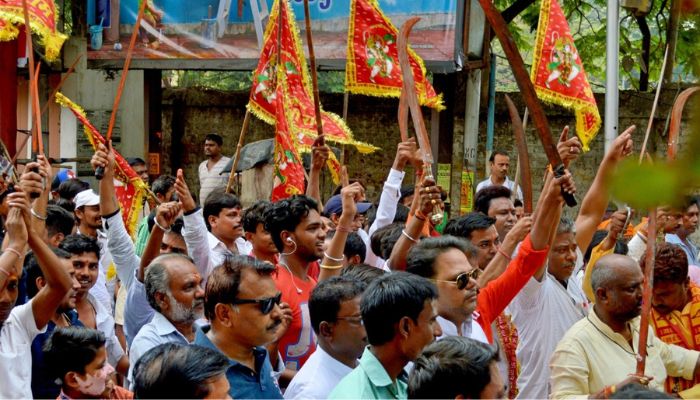
On 22nd February, Madhi Gram Sabha in Pathardi taluka of the Ahmednagar district of Maharashtra passed a resolution prohibiting Muslim traders from operating in Madhi village during the Kanifnath Maharaj Yatra (Madhi Chi Yatra), an annual event that has been observed at the Kanifnath shrine for 700 years. The event commenced on 28th February.

However, the Block Development Officer stayed the decision and reported procedural violations after which Maharashtra Minister and Bharatiya Janata Party leader Nitesh Narayan Rane questioned the move on 2nd March. During a visit to Ahilyanagar he warned, “The BDO should remember that a Hindutva sarkar is in power in Maharashtra. Though the resolution passed by the Madhi gram panchayat has been stayed by him, I urge the villages to again pass the same. If all villagers sign the resolution, then how will the BDO reject it.”

He referred to the declaration as “historic” and added, “The hardcore Hindutva supporters have been awakened in the village. The gram sabha’s decision will provide direction to the nation. If the Hindu religion is challenged, then such a decision will be taken across Maharashtra.” He holds Fisheries and Ports Development portfolio.

Radhakrishna Vikhe-Patil, the District Guardian Minister, has previously backed the gram sabha’s verdict and conveyed, “The gram sabha is well within its constitutional rights to pass such a resolution imposing the ban. The Supreme Court has acknowledged the rights of the gram sabha.” BJP’s Adhyatmik Aghadi Tushar Bhosale announced, “All temples and other Hindu religious institutions across India should take similar steps.” The decision has been supported by Hindu groups who maintained that it is an attempt to preserve “Sanatani traditions.”

BDO Shivaji Kamble was earlier instructed by Ashish Yerekar, Chief Executive Officer (CEO) of Ahilyanagar Zilla Parishad to investigate the resolution’s legitimacy after it was approved.

Kamble alleged that outsiders were used to pass the resolution. “We conducted the enquiry and found that the gram sabha lacked required quorum as per the government guidelines. Besides the resolution had 116 signatures of which 16 signatures could not be confirmed. Also, there were other deficiencies in the resolution and therefore I have deemed the resolution has unconstitutional,” he claimed.

Local leaders who favor the ban asserted that it aimed to preserve Hindu customs during the yatra. “We received complaints from villagers that Muslim traders were not following our traditions and were involved in anti-social and criminal activities during the yatra. Hence, during the recent gram sabha, we passed a resolution barring them from participating,” expressed village sarpanch Sanjay Markad.

The 5,000 residents of Madhi village, which is in the Ahilyanagar district and is roughly 175 kilometers from Pune, include about 650 Muslims. Every year, thousands of traders and devotees from all around the state come to participate in the prominent yatra. Holi marks the start of the month-long celebration which ends on Gudi Padwa. Madhi hamlet is scheduled to host the sacred event on 19th March which is devoted to Kanifnath, also called Kanhoba, a venerated figure of the Navnath Sampraday sect.

Demand to ban participation of Muslims during “Braj ki Holi”

The Vrindavan-based Hindu outfit Dharam Raksha Sangh released a statement indicating mistrust of the Muslim community in light of its objectionable actions and feared that there might be unrest during the Holi festivities in Braj. The former urged Yogi Adityanath, the chief minister of Uttar Pradesh to restrict their involvement. Saurabh Gaur, the national head of the Dharam Raksha Sangh, highlighted that recent instance in Bareilly demonstrated that members of the Muslim community were posing a threat to Hindus. Muslim youths assaulted Hindus and threatened, “If you celebrate Holi, we kill you.”

Gaur informed, “We have decided to prohibit the entry of Muslims in Holi celebrations at major pilgrimage sites like Mathura, Vrindavan, Nandgaon, Barsana, Gokul and Dauji.” He mentioned, “Holi is the festival of love and harmony. We do not want any member of the Muslim community to gain entry into the celebrations and create trouble,” and voiced, “We still perceive a threat from their intentions. They could cause disturbances.”

“The UP government must enforce a ban similar to restrictions placed on Muslim participation in garba celebrations in Gujarat, Maharashtra and Madhya Pradesh. Since they object to colours and gulal, they have no place in our Holi celebrations. They should be kept away and the government must ensure it,” Dharam Raksha Sangh’s national coordinator Acharya Badrish demanded as he likened the community to “separatists and jihadists.”

He proposed that they might be permitted following a written assurance to the majority community. “Otherwise, they should be kept away and the government must ensure it,” he added. Dinesh Sharma, a petitioner in the Sri Krishna Janmabhoomi-Shahi Idgah dispute, also called on the government to prohibit Muslims from attending Braj’s Holi, in a letter to the chief minister, which he wrote in his blood. Muslims might “spit on sweets” during the celebrations, he complained.

Notably, travelers from all around the nation and overseas come to Mathura and Vrindavan to celebrate Holi.

Similar calls made during Kumbh Mela

A similar demand to restrict the entry of Muslims to the Prayagraj Maha Kumbh was raised by the All India Akhara Parishad (AIAP), which is the supreme body of the Akharas in the nation. Nirmohi, Nirvani, Digamber, Mahanirvani, Atal, Bada Udasin, Nirmal, Niranjani, Juna, Avahan, Anand, Agni, and Naya Udasin are among the 13 principal Akharas recognized by the religious body. “Recently, many incidents have come to light such as mixing of urine in juice, and spitting in food, among others. All Sanatanis will be Hindus in the Kumbh Mela so it will not be tolerated if someone defiles things and feeds them,”its supremo Ravindra Puri outlined last year.

In January, he reiterated, “Although Muslims are our brothers and we don’t have any enmity with them, they shouldn’t set up shops during the upcoming Maha Kumbh Mela as they will corrupt our religion. They shouldn’t set up grocery shops, juice shops, food stalls and tea shops, as they spit on the food deliberately.”

“Those who have nothing to do with Hinduism, nor with Hindu rituals nor with our saints and sages, should not be allowed to set up shop. People who know about Hinduism, its importance, people who know how to respect this religion, and the practice of worship can do the job well. Any other person of any particular religion, who does not respect Lord Ram, should not be allowed to do any kind of service during Maha Kumbh,” Bageshwar Dham Sarkar (also known as Dhirendra Krishna Shastri) stated while supporting the akhara parishad.

He added, “A few days back these people sold urine mix food, some spit on fruits and vegetables before selling them, this proves that they are executing some kind of conspiracy. This is the reason why non-Hindus should strictly not be allowed during Maha Kumbh.”

Shastri further questioned, “Mere Angne me tumhara kya kaam (What’s your job at Hindu fairs)? At Maha Kumbh we have Triveni, Sangam, and worship of saints and lords, and it is clear that these people are least bothered and interested in Hindu rituals, festivals, fairs, and overall Sanatan Dharma. When you don’t respect Ram, why do you want to interfere in the service to Lord Ram?”

Meanwhile, the Waqf board asserted ownership of the area where the Maha Kumbh Mela was held and contended that the ground used for the Hindu pilgrimage is part of their property. Chief Minister Yogi Adityanath responded to the absurd argument and conveyed, “Anyone who respects Indian traditions is welcome. Many people had ancestors who converted to Islam under pressure in the past, yet they still take pride in Indian traditions.”

He then warned, “If such people, following traditions, come to take a dip in the Ganga, there is no problem. But if someone comes with the intention of claiming the land, they might face denting-painting.” The comments followed a declaration made by Maulana Shahabuddin Razvi Barelvi, president of the All India Muslim Jammat (AIMJ), suggesting that Waqf owned the site where the Maha Kumbh 2025 preparations were being undertaken and that Muslims were not allowed to enter.

What is the reason behind such demands?

These appeals and regulations might appear illogical and reflect negatively on the majority community which has been the motivation for Islamo-communists and their liberal allies. However, one would comprehend the reasoning behind such demands given the hostile behavior of the Islamists in many areas, particularly during Hindu festivals and celebrations. The Yogi government directive requiring eateries to post the names and addresses of operators, proprietors and managers during Kanwar Yatra was in fact imposed for the same reason.

The Uttarakhand administration also enforced the same order. The decision was made after Hindus were regularly being tricked into consuming contaminated food which led to fights and disputes between adherents of the two faiths. The development sparked a global uproar in the liberal media, supported by radicals in the nation who essentially asked Hindus to eat such food and disregard their religious obligations as well as hygiene in order to maintain secularism. Interestingly, the arguments continue to be same even today.

Even if their actions, like spitting and urinating in food are not considered, the numerous assaults including stone pelting during Hindu festivals that have resulted in extreme violence, fatalities and significant injuries, cannot be ignored. During Maha Shivratri, on 26th February, Muslims protested the placement of loudspeakers and religious flags in Hazaribagh, Jharkhand which prompted a clash between the two sides.

They launched stones from the rooftops of their houses and school premises after which Hindus also hit back. Eight vehicles, including a car, six bikes, a scooter, and a bicycle, were set on fire and at least 6 individuals were injured during the incident.

Earlier, a violent altercation broke out on 24th February when Muslims attacked Hindus for celebrating Maha Shivratri outside a steel factory in the Bilaspur district’s Gwalathai area of Himachal Pradesh. Muslims reportedly opened fire on Hindus who were organizing bhandara. During the conflict, three individuals from both sides sustained wounds and were taken to the hospital for immediate medical attention.

Young Muslim men have even singled out Hindu females and engaged in lewd behavior during such gatherings. Last October, Amir Khan who masqueraded as Aman was caught entering garba festivities with a minor girl by the members of the Hindu Jagran Manch, in Indore. She was later found to be missing from Balaghat. Khan was arrested and further probe unveiled that he went to the event with numerous girls, including underage ones. His phone had graphic images and chats of his victims.

Likewise, Firoz identified himself as Rahul and entered a garba event in Ujjain. He even had condoms with him. However, the Muslim youth was handed over to the authorities after members of the Hindu community grew suspicious and questioned him. Furthermore, sacred Hindu processions have frequently been targeted across the country during these holy celebrations, posing serious challenges to law and order and putting lives in danger.

Nevertheless, Hindus are required to sacrifice everything and submit to the altar of secularism, whose stress is solely on their shoulders, in accordance with the discriminatory principles of brotherhood and harmony practised in India. Despite the freedoms afforded by the Constitution and extended to all other communities, Hindus cannot determine who should be eligible to take part in their religious events without being subjected to severe criticism and unwarranted lectures on universal acceptance and tolerance.

Hindus are required to carry the burden of secularism which takes precedence over everything, while practitioners of other faiths enjoy the liberty to express and celebrate their beliefs and festivals as they decide. The skewed secularism is enforced to the detriment of Hindus, undermining their rights and religion and if someone dares to openly assert their faith, they are painted as intolerant, prejudiced and everything in between. Hindu rights tend to go for a toss for the sake of secularism, time and again.

Cab driver who threw out Pakistani and his Indian girlfriend for abusing people of Delhi now puts up posters of Aurangzeb, Akbar and Babur in public toilets, Pakistan media gets miffed

On 26th February, a cab driver who had thrown out a Pakistani and his Indian girlfriend after they used derogatory language for people of Delhi is making headlines for putting up posters of Aurangzeb in public toilets. Interestingly, Pakistani media has learned about the incident and has been crying foul over it. The cab driver, identified as Gaurav Sharma, recently uploaded videos of pasting posters of Aurangzeb, Akbar and Babur in public toilets and on garbage cans in Pilkhuwa town of Hapur district in Uttar Pradesh.

Pakistan Today, in one of its reports, called the group of men pasting posters “the extremist group wearing saffron scarves”. Miffed by the act, Pakistani media claimed that it was not an isolated incident but part of a “broader, coordinated campaign led by Hindutva groups and far-right politicians”.

The pro-Islamic portal Siasat Daily also covered the incident and called the group of men “radicals”. Siasat objected to such incidents and attempted to claim that it was part of a campaign to erase Mughal history. The portal gave examples of the renaming of cities such as Allahabad to Prayagraj and Aurangabad to Chhatrapati Sambhaji Nagar. However, it failed to acknowledge that the Mughals were invaders who themselves changed the names of historic cities in India. For example, Prayagraj existed long before the Mughals entered India, and it acquired its Islamic name much later, specifically around Akbar’s rule.

Pakistani national and his girlfriend kicked out of cab by Uber driver in Delhi over anti-India remarks

In August 2024, a video went viral on social media in which the man can be seen getting angry at a Pakistani man and his girlfriend. He accused the pair of insulting the people of Delhi which he couldn’t tolerate and asked them to step out of the four-wheeler and then left them in the middle of the road.

The taxi driver initially warned the duo not to offend Delhiites and asserted that he would not put up with it, as witnessed in the widely shared footage. While filming the video, the girl retorted that the person seated next to her hadn’t said anything like that and was instead criticizing the people of Delhi for being selfish. She then argued that no one opposes when Mumbai people talk negatively about Delhiites, but if a Pakistani voices anything, then it becomes unacceptable/ a problem. Furthermore, she pointed out that the cabbie shouldn’t have brought up his Brahmin caste in the conversation.

The cab driver also tried to explain his point of view, which further escalated the matter, following which he refused the two passengers to drop them at their destination.

‘Indians are bad, I beat the sh*t out of that Indian Doctor’: US man who brutally assaulted 67-yr-old Indian-origin nurse inside a hospital to remain in jail without bond

On 25th February, a 67-year-old Indian-origin nurse, Leelamma Lal, was brutally attacked by a man identified as Stephan Scantlebury at a Palm Beach County hospital in USA’s Florida. The attacker made racist remarks like “Indians are bad” and “I just beat the sh*t out of that Indian doctor”, after attacking Lal. While the victim remains hospitalised, the accused, who is reported to be a psychiatric patient, was presented before the court on Thursday (28th February), wherein he was ordered to be held without bond. The attacker will remain in jail as he awaits trial.

As per the witnesses, accused Stephan Scantlebury was in a hospital bed on the third floor when he suddenly jumped up on the bed and then jumped on Lal. The other person in the room rushed out to call for help before a second person ran in and saw Scantlebury on top of Lal, continuously beating her with his fists.

The racist attacker had escaped the hospital after brutally assaulting the Indian-origin nurse and was later arrested from Southern Boulevard. The authorities said that the attack was so brutal that essentially every bone in the victim’s face was fractured. The victim is reported to have lost vision in both eyes. She was airlifted to a trauma centre.  

Reports say that the Palm Beach County Sheriff’s Office has added a hate crime enhancement to Scantlebury’s existing charge of attempted second-degree murder. The prosecution asked the judge to modify the accused’s second-degree murder charge to a first-degree felony based on the hate crime enhancer. The judge, however, did not grant the prosecution’s request.

The prosecution also asserted that given the accused’s ties to Canada, he could be a flight risk.

During the hearing, the accused attacker’s wife Megan Scantlebury claimed that her husband had been paranoid from days before the day he attacked the nurse adding that the accused was hallucinating and feeling like he was being watched, even accusing herself and their neighbours of being involved. She also claimed that the accused had no history of aggression but became paranoid after a car accident, WPBF reported.

From schizophrenia to acute psychosis,  the defence evoked psychiatric conditions to assert that the accused attacked the Indian-origin woman due to his psychiatric condition and not due to his alleged racism against Indians. The defence made no arguments regarding his alleged racist comments after attacking the 67-year-old nurse.

The judge ruled in favour of the prosecution noting that the accused is a threat to the community comparing Stephan Scantlebury to a dynamite that could explode anytime again.

The court ordered that the accused not be granted pretrial release but instead, be held in the Palm Beach County jail without bond.

Reacting to the disturbing incident, the victim’s daughter Cindy Joseph said, “I’m obviously relieved. I was scared, and It’s caused me a lot of anxiety in general, just making sure my doors are locked at night and just really scared at night sometimes. It’s given me some relief. I don’t know a whole lot about his back story, but the fact that he’s in jail is relieving to me in a sense.”

Speaking about coming face-to-face with her mother’s attacker and testifying against him, Joseph said, “This was the first time I saw him face-to-face, and it was hard. The first time I saw his stature and the side of his face, but this was the first time I saw him, looking in the face, his actual face. I mean, it’s hard. I can’t get rid of the image of him on top of my mom just repeatedly beating her.”

The victim’s daughter said that she was pained to hear when the prosecutors detailed Scantlebury’s racist comments about her mother and Indian culture.

“I’m Indian like a lot of our family is, that was really, really hurtful. Racism has no place. It shouldn’t be a reason why you beat someone up,” Joseph said.

Meanwhile, a Health Corporation of America, Florida (HCA Florida) said that Scantlebury had driven himself to the hospital to seek treatment for an issue not related to his alleged psychiatric condition and was admitted.

Can’t reach our homes, can’t perform Puja: 150 Hindu families from Baisi in Purnia share their pain of living in a Muslim-dominated area, Mukhia Sabnoor Alam denies allegations

About 150 Hindu families in Sharma Toli of Shadipur Bhutha village in Baisi block of Purnia are facing a lot of trouble for the last several days. Local people say that the Muslim side has blocked the path to their homes. Due to Muslim settlements and their private land all around the village, these people struggle to even reach their homes.

The situation has become so bad that the sons and daughters of these families have been struggling to even get married. It has become difficult even to take sick people to the hospital. Villagers say that earlier they used to come and go by private road, but now a 100 meter long road has been closed due to a small piece of 12 dismil land.

Local people told that they had given one lakh rupees to the land owner for the road, so that the problem could be solved. However later, under pressure from the Muslim community, that money was returned and the road access was not provided. Now due to the road being closed from all sides, these people are completely surrounded.

The villagers also said that the Muslim side prevents them from performing puja and playing loudspeakers. They say that this is also restricting their religious freedom. Fed up with this problem, local Hindus first appealed to the SDM court. There the decision was also in their favour, but later the civil court overturned that decision and the Muslim side won the case there.

Talking to OpIndia, local Santosh Kumar said, “The need for a road was acknowledged in the investigation conducted by SDM Madam and CO Sahab. The SDM gave a verdict in favour of the affected families, but the civil court overturned that decision.”

Santosh Kumar says that the Muslim side has adopted an aggressive stance. Earlier, the land owners had agreed and it was decided that they would be given money in exchange for the land. They even took Rs 1 lakh, but due to pressure from other Muslims, they returned the money and are again adamant on not granting access to the road. Santosh Kumar says that the local Muslims are showing arrogance. They are not being heard even at the police station. Now these families have sought help from District Magistrate Kundan Kumar.

Baisi SDM Kumari Tausi says that it is clearly written in the law that if more than 100 families live at a place, then no one can block their access road. There are more than 150 families here, yet the problem is not being solved. He said that letters were written several times to the police station and the zonal officer in this matter, but no action was taken.

OpIndia also has a copy of the SDM’s order. In which an order was passed for the road. However, the Muslim side challenged the SDM’s order in the civil court, where the civil court rejected the SDM’s order.

Meanwhile, videos related to the problems of the local people are going viral on social media. A woman said that Hindus are not allowed to go for even idol immersion. The woman said that Muslims say that Hindus chant ‘Jai Shri Ram’, so they will not be given water.

In this entire matter, Shadipur Bhutha’s Mukhiya Sabnoor Alam said that some people are not giving the access because of their private land, but there was talk of them giving the access from the other side. He said that the Sharma people are not ready for the access from the other side. He rejected the allegations of stopping Hindu puja-paath, and said that some people are giving communal color to the issue.

Suresh Kumar, posted in Baisi police station, talked to OpIndia regarding this entire matter. He said that a meeting was held in the police station regarding this matter. Both the parties were present. There is no tension regarding the access path, but the reality is that the path wasn’t found. He said that the administration is ready to make a path, but the Muslim side is citing it is their land so where should they go.

Suresh Kumar told us that there was an agreement in the civil court regarding the path from the other side, but that path has not been found yet. This is the reason why the Hindu side is constantly pleading with the administration about their problem. However, he said that the idol immersion was done at a pre-decided place, and there is no such thing as communal tension at present.

British PM Keir Starmer promises to help Ukraine with full military support, EU agrees, what will it mean for NATO and the USA

There are several people who are apprehensive about a World War III breaking out due to the unfolding events in Ukraine. This apprehension appears to be taking the shape of reality as Ukraine-US tensions mount and the European Union rallies behind Ukraine in its war against Russia.

On 2nd March 2025, British Prime Minister Keir Starmer announced a ‘four-point’ plan to aid Ukraine against Russia. After a summit with European leaders in London on Sunday, the British PM announced a slew of financial aid and military deals for Ukraine.

Britain wants to bring peace in Ukraine, ironically “With boots on the ground and planes in the air”

“Through my discussions over recent days… We have agreed that the UK, France and others will work with Ukraine on a plan to stop the fighting…Then we’ll discuss that plan with the United States and take it forward together. The purpose of today’s meeting was to unite our partners around this effort…To strengthen Ukraine…And to support a just and enduring peace… For the good of all of us. Our starting point must be…To put Ukraine in the strongest possible position now…So that they can negotiate from a position of strength. And we are doubling down in our support,” Starmer said during a press conference on Sunday, March 2.

Just days after US President Donald Trump publicly rebuked Ukrainian President Volodymyr Zelensky at the White House, the British Prime Minister Keir Starmer announced a 2.2 billion British pounds ($2.8 billion) loan to Ukraine to provide military aid to Ukraine funded by frozen Russian assets. Besides, the British Prime Minister also announced a new deal allowing Ukraine to use 1.6 billion pounds ($2 billion) in export finance to purchase over 5,000 air defence missiles made in Northern Ireland’s Belfast. While people are losing their lives in the Russia-Ukraine conflict, PM Starmer boasted that UK-made missiles would not only help Ukraine deter Russia but also create jobs in the British defence sector. Apparently, war is a business.

“I am announcing a new deal…Which allows Ukraine to use £1.6 billion of UK Export Finance…To buy more than 5,000 air defence missiles…Which will be made in Belfast…Creating jobs in our brilliant defence sector. This will be vital for protecting critical infrastructure now…And strengthening Ukraine in securing the peace, when it comes. Because we have to learn from the mistakes of the past,” Starmer said adding that there needs to be a strong deal, unlike the weak Minsk Agreements which the Kremlin defied with ease.

 Starmer also called on the European nations to step up and share the burden as he announced a four-point plan. The first point of this plan, chalked out after discussion with the EU leader,s is to continue providing military aid to Ukraine, and simultaneously, put economic pressure on Russia. The second point emphasised that Ukraine must be at the table of any peace deal to ensure its security and sovereignty. The third point is to boost Ukraine’s defence in the event of a peace deal to deter Russia from future invasions. Lastly, the British Prime Minister asserted that a “coalition of the willing to defend a deal in Ukraine” would be developed.

“First, we will keep the military aid flowing and continue increasing economic pressure on Russia to strengthen Ukraine now. Second, we agreed that any lasting peace must ensure Ukraine’s sovereignty and security, and Ukraine must be at the table. Third, in the event of a peace deal, we will keep boosting Ukraine’s own defensive capabilities to deter any future invasion. Fourth, we will go further to develop a coalition of the willing to defend a deal in Ukraine and to guarantee the peace,” Starmer said.

Asserting that Europe must do the heavy lifting, Starmer said, “Not every nation will feel able to contribute, but that can’t mean that we sit back. Instead, those willing will intensify planning now with real urgency. The UK is prepared to back this with boots on the ground and planes in the air, together with others.”

The British PM, however, emphasised that such an effort would require strong US backing and that he agrees with Trump on the urgent need for a durable peace. “To keep the pace behind these actions…And to keep working towards this shared plan. We are at a crossroads in history today. This is not a moment for more talk – It is time to act….” Starmer said.

Notably, Keir Starmer had in January signed a “100-year partnership” agreement with Ukrainian President Zelensky in Kyiv, committing £3 billion ($3.6 billion) annually in military aid, in addition to providing funding for air defence systems and economic recovery. Keir Starmer had also expressed willingness to deploy British troops as a part of peacekeeping force post-ceasefire, contingent on wider international backing including that of the United States. And now on 3rd March, Starmer reiterated his plans for Ukraine as he announced financial support to procure missiles.

Unsurprisingly, the European leaders also agreed that they must increase their defence spending to counter Russia. In this vein, French President Emmanuel Macron said in an interview that European countries should raise their defence spending to between 3.0 and 3.5 per cent of GDP to respond to the USA’s policy shift after the Trump administration took over, as well as Russia’s militarisation highlighting that the Kremlin has been spending 10 per cent of its GDP on defence.

Italian Prime Minister Giorgia Meloni, however, refuted the prospects of Italy deploying its troops as a part of a peacekeeping force and said that “it was never on the agenda”.

Meanwhile, European Commission President Ursula von der Leyen asserted that there was now an urgent need to “re-arm Europe”. Similarly, NATO General Secretary Mark Rutte also emphasised the need for European countries to make sure that Ukraine has all it needs to “stay in the fight as long as it has to continue”.

The summit held on Sunday was attended by leaders from France, Poland, Sweden, Turkey, Norway, the Czech Republic, Denmark, Germany, the Netherlands, Romania, Finland, Italy, Spain and Canada with most of the countries agreeing on forming a “coalition of the willing” to bolster Ukraine’s defences and guarantee ‘peace’ post-conflict. Meanwhile, French President Emmanuel Macron also floated the idea of deploying European troops for peacekeeping under a ceasefire.

While the European countries are not involved in active combat against Russia, their financial and military aid to Ukraine has sustained Ukraine against Russia in the war which entered its third year in 2025. However, the European nations are now more than willing to engage in deploying “troops and planes” to attack Russia in what they call Ukraine’s defence. This would come with its own set of challenges and implications given the Trump administration, unlike its predecessor, is not very keen on backing Ukraine in the war against Russia and prolonging tensions with the Kremlin.

Implications for the US and NATO if the UK-EU get directly involved in the Ukraine-Russia war

As evident from Keir Starmer’s Sunday statement, the United Kingdom and European Union have consistently been emphasising the necessity of US involvement as a backstop for any Ukraine peace deal given America’s military heft and deterrence against the Kremlin. However, the situation has become complicated since Donald Trump has been pushing for Europe to take more responsibility, evidenced by the US’s reluctance to commit security guarantees and calls for Europe to handle Ukraine’s defences. It is pertinent to note that the USA has been the highest contributing nation to Ukraine and has given around $119 billion while the European Union has given $138 billion in financial, military and humanitarian aid, as per Ukraine Support Tracker.

Meanwhile, the US official data shows that it has contributed over $65 billion to Ukraine since 2022, dwarfing Europe’s contributions. Besides, according to Ukraine, 20% of the military hardware being used in its war against Russia comes from the US and it is the most capable and hardest to replace by Europe.

However, the Trump administration now has made it clear that it would reduce aid to Ukraine with flow of weapons to the warring nation already nearly stopped, shifting the burden onto NATO allies, including the UK and EU nations. The recent showdown between Trump and Zelensky at the Oval Office has further infuriated the Trump administration with the US calling on Zelensky to apologise or for Ukraine to bring up someone else to lead their country.

On one hand, Ukraine-US tensions are mounting, on the other, Ukraine is garnering financial and military support from the European Union so much so that the latter is willing to get involved in active combat against Russia while desperately trying to bring the US on board.

If European forces, say a coalition led by the UK and major EU nations including France, Germany among others enter the Russia-Ukraine war directly to ‘defend’ Ukraine, and Russia retaliates by attacking a NATO member, NATO can invoke Article 5 which necessitates collective defence by all NATO members in the event of any of its member state being attacked.

“The Parties agree that an armed attack against one or more of them in Europe or North America shall be considered an attack against them all and consequently they agree that, if such an armed attack occurs, each of them, in exercise of the right of individual or collective self-defence recognized by Article 51 of the Charter of the United Nations, will assist the Party or Parties so attacked by taking forthwith, individually and in concert with the other Parties, such action as it deems necessary, including the use of armed force, to restore and maintain the security of the North Atlantic area. Any such armed attack and all measures taken as a result thereof shall immediately be reported to the Security Council. Such measures shall be terminated when the Security Council has taken the measures necessary to restore and maintain international peace and security,” Article 5 of NATO’s founding treaty reads.

However, Article 5 only applies to attacks that occur ‘within a member state’s territory’. Since Ukraine has not been admitted to NATO yet, United States won’t be under any obligation to compulsorily join the war in Ukraine. Further, Article 5 doesn’t mandate members to commit Militarily even in case of an attack within a NATO country. They can choose their method of response, which may include financial or military measures.

Notably, while not honouring Article 5 of NATO’s founding treaty does not result in an automatic expulsion from the grouping, the US would want to withdraw from NATO. Although it seems an unlikely step, however, Trump 2.0 has been all about unlikely and unconventional decision-making thus the possibility of the US reconsidering its presence in NATO cannot be ruled out. Also, the US’s refusal to fight alongside NATO allies would obviously undermine NATO’s credibility besides, if the US leaves NATO, it would be a massive challenge for the grouping to manage its expenses since the US has been a major contributor to the grouping.

A direct entry of European Union and NATO allies sans the US would possibly start a major war in Europe which can escalate to other territories. It can trigger a fresh wave of sanctions and economic turbulence, redrawing of boundaries, and new alliances would form and NATO might dissolve.

However, despite the Trump-Zelensky fiasco, the US and Ukraine are still trying to work out the coveted minerals deal. The efforts to secure the US-Ukraine minerals deal, focused on Ukraine’s rare earth deposits of Titanium, Lithium, Graphite, Nickel and Cobalt, continue as a strategic lever.

Ukraine has vast deposits of minerals, including oil and gas. These minerals and elements are essential for modern industries. US President Trump claimed that the deal would allow the US to recover more than what it has spent on Ukraine. Reportedly, the agreement includes a jointly owned fund, allowing revenue from Ukraine’s state-owned mineral resources to be used to rebuild the war-torn nation. As per the terms of the deal, Ukraine would contribute 50% of its future proceeds from oil, gas, and mineral deposits to the fund. These funds would then be invested in infrastructure and economic projects within the country.

After the London summit, Zelensky insisted the minerals deal would be ready if the parties agreed. This suggests that despite what happened between him and Trump at the Oval Office recently, the deal remains a bargaining chip to retain US support. If tied to a ceasefire, it could incentivise Donald Trump to stay engaged, countering his push for Europe to lead, but it doesn’t inherently avert escalation unless tied with robust security guarantees Putin would be willing to accept. If the minerals deal works out between Ukraine and the US without upsetting the Kremlin, likely, the Ukraine-Russia war may not snowball into a world war.