Home Blog Page 4952

A day after Tanishq ad controversy, Titan stock prices drop by 2.58 per cent

0

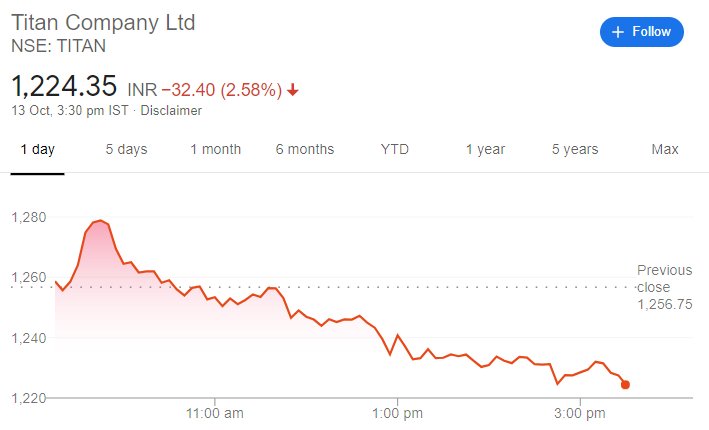
Titan, which owns the Tanishq jewellery brand, did not fare too well at the stock market on Tuesday. Its stock prices fell by 2.58% from Rs. 1,257.55 to Rs. 1,224.35. It was a day after Tanishq faced an outrage on social media due to its culturally insensitive ad glorifying Love Jihad.

Titan Stock prices fell on Tuesday

While we cannot be certain whether there is any link between the fall in stock prices and the calls for boycott Tanishq had to endure, Titan saw its collective wealth eroded by around Rs. 2700 crores. One Tanishq showroom in Gujarat condemned the ad and apologised profusely to the Hindu community for the offensive ad.

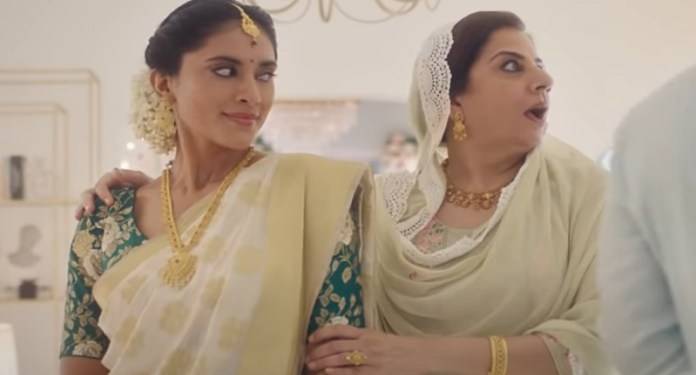
The ad released on October 9 shows a pregnant Hindu woman walking with her mother-in-law, who distinctly belonged to the Muslim faith. The Muslim mother-in-law then leads the Hindu daughter-in-law to the garden area, where the god-bharai ceremony has been set up according to Hindu traditions.

Shocked, the daughter-in-law asks the mother-in-law why the ceremony was set up in that manner since “these things are not followed in the house”. To that, the smiling mother-in-law tells her that while this might not be their tradition (since they are a Muslim family), making daughters happy is a universal tradition.

Following outrage, the ad was subsequently removed from YouTube.

The violence and brutal reality of interfaith relationships: 20 instances were Muslim families were not as ‘accepting’ as ‘seculars’ want you to believe

The recent spate of attacks on Hindu men by the kin of their Muslim love interests has brought under the spotlight the pervasive issue of the relentless subjection of Hindus to religious bigotry and intolerance by their fellow Muslim compatriots.

However, what is horrifying is that for far too long, the mainstream media organisations have studiously concealed such horrors meted out on the Hindus by either omitting the communal angle altogether into such incidents and portraying a filtered version of the incidents, leaving out critical details about their religious connotation.

Even when religions of the perpetrators and the victims are mentioned, great efforts are undertaken to minimise the religious bigotry angle of the incidents. Irrelevant motives are highlighted while the real ones are swept under the rug. Several mainstream media organisations and leftist portals undertake conscious efforts to paint such incidents as stray incidents and not as hate-crimes against Hindus, thereby whitewashing the wrongdoing committed by the Muslim perpetrators.

In this article, we make no bones about the issue at our hands and catalogue the incidents of Muslim families assaulting, killing or actively participating in eliminating Hindu men who dared to fall in love with Muslim women.

We have covered several instances when Hindu men had to pay a dear price, most of the times with their lives, only because they were in a relationship with Muslim women. This is by no means an exhaustive list of the hate crimes committed against Hindus for their love affair with Muslim women, but rather it illustrates the monstrosity faced by Hindu men for simply getting romantically involved with Muslim women.

Here are the list of 20 instances from the past two decades when Hindus have been assaulted and killed by the family members of their Muslim lover/wife:-

Dalit boy Sonu and Muslim girl Dhanishta hacked to death allegedly by the girl’s family

In 2014, a love affair between a Jatav Dalit boy and a Muslim girl in Hapur soured the yearslong relationship between the two families, who had shared sweets on Diwali as well as on Eid.

When the Muslim girl’s family learned about their affair, they issued a stern warning to the duo against meeting each other. However, the couple continued to meet each other, in defiance of the girl’s family. They had to pay with their lives as the Muslim girl’s brothers hacked Sonu to death while slitting the throat of their sister, Dhanishta, for loving a boy who was not Muslim, allegedly in front of the villagers.

18-year-old Rahul Rajput killed by Muslim girl’s brother and his friends

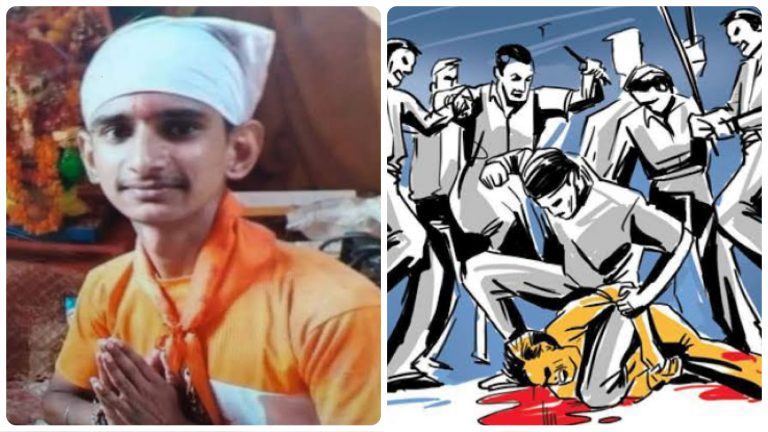
Recently, an 18-year-old Delhi University student Rahul Rajput was brutally hacked to death in a savage attack by at least 5 assailants—Mohammad Afroz, Mohammad Raj and 3 others—for being in a love affair with a Muslim girl. The girl’s brother, one amongst the five assailants, fiercely opposed their inter-faith relationship and sought to teach a lesson to Rajput for his continuing relationship with the Muslim girl in defiance of his strong disapproval.

On Wednesday last week, Rahul was called out Nanda Road in Adarsh Nagar on some pretext. When he reached the spot, he was attacked by a fervid mob of 4-5 people, raining incessant blows on him and mercilessly flogging him. An injured Rajput somehow managed to escape their wrath and crawl back to his house in a mortally injured state. He was then rushed to a nearby hospital, where he succumbed to the fatal injuries in his abdomen while undergoing treatment.

Lakshmipathy murdered by his Muslim girlfriend’s family in Karnataka’s Ramnagara

In another tragic incident from this month, a 24-year-old man named Lakshmipathy was murdered by family members of his Muslim girlfriend in Kudur, Ramanagara district on Tuesday last week. As per reports, Lakshmipathy was invited by the family under the pretext of discussing his wedding with the girl.

After inviting Lakshmipathy to their residence, the girl’s father—a 45-year-old Nizamuddin, his son Sikandar and two other associates named Ibrat and Mohammad—took Lakshmipathy and his elder brother Nataraj to a deserted spot in Kudur, on the pretext of marriage talks where they strangled Lakshmipathy to death after beating him.

Father and son kill daughter and her Hindu lover in Karnataka’s Hampasagara

A Muslim girl named Reshma Banu (20), a final year student at a college in Hagaribommanahalli, and Hindu boy K Nagaraj (18) PUC-II student were brutally murdered by the girl’s family over their love affair in 2017. Babu Saheb and his four sons Razak, Aran, Shabbir and Ibrahim were arrested by the police in connection with the double murder.

On March 24, 2017, the couple were found in Reshma’s house. On finding the boy in their house, Babu Saheb and his four sons thrashed Nagaraj and packed him in a gunny bag and dumped him near G Kodihalli village. When her father and brothers were assaulting Nagaraj, Reshma had come to his rescue. She sustained serious injuries while fending off the attack on Nagaraj. She was lying in a pool of blood inside her house. On his return, Saheb found his daughter alive and strangulated her to death.

Two minors—Mukesh Kumar and Noor Jehan killed by the girls’ brother and uncles in West Bihar’s Champaran

In West Bihar’s Champaran in 2017, a minor boy named Mukesh Kumar and a minor girl named Noor Jehan Khatoon were killed in a case of honour killing. The duo had fallen in love with each other but the girl’s family did not approve of their inter-faith relationship. The couple were reportedly killed by the girl’s brother Alauddin Ansari and uncles Gulsanovar and Amir Miyan who later confessed to their crimes. The bodies of the duo were recovered from two different spots in Nautan block of West Champaran district.

Upset over interfaith marriage, Muslim woman’s cousin hacks the couple to death

An interfaith couple, where the woman was nine-month pregnant, was mercilessly hacked to death by a cousin of the woman who was unhappy about her decision to marry a non-Muslim. The case pertains to 2016 when the culprit identified as Shafiq Shamsuddin Mansuri (28) a resident of Paliya in Uttar Pradesh’s Hardoe district, killed both his cousin and her husband.

Shafiq was a friend of the deceased Vijay Shankar Yadav (30) and had introduced him to his cousin Sufiya Abrar Mansuri, aka Priya Yadav (22). They were both from Uttar Pradesh. It was during Vijay’s visit to Shafiq that his relationship with Sufiya evolved and they both decided to elope and marry in April 2015. Since then, Shafiq was seething with a burning desire to exact revenge on the couple.

In his statement, Shafiq admitted that he has been planning on the murder since the last year after his reputation was tarnished among the villagers for ‘facilitating Sufiya’s escape’. Police also confirmed that Shafiq had reportedly confessed of having committed the murders as his sacrifice for ‘Bakra Eid’.

Youth Congress leader Balakrishnan killed for marrying a Muslim woman

Almost 2 decades back, Youth Congress leader Balakrishnan was ferociously stabbed to death for marrying a Muslim woman in Kerala’s Kasargod. The CBI court held two guilty—Mohammad Iqbal alias Ikku of Thekkil, Chattachal, Kasargod, and Mohammed Haneef alias Jackie Haneef of Thalangara, Kasargod, for Balakrishnan’s murder. 3 months after his marriage, the accused had taken him in a car and stabbed him to death.

Kerala man set ablaze by Muslim girl’s brother-in-law

The vice-captain of Kerala junior football team, Jithu Mohan, was set on fire for his romantic liaison with a Muslim girl. The footballer later succumbed to his burn injuries at General hospital in Kochi in October 2012. Before his death, Mohan recorded his statement, alleging that the Muslim girl’s brother-in-law Wahad, one constable, and others set him ablaze at his residence in Kodungallur. He had gone to Wahad’s residence to meet the girl who was confined there.

Woman killed by brother and father for being in a relationship with a Hindu Man

In August 2018, a Muslim woman was strangulated and mutilated by her father and brother in Purba Burdwan district, West Bengal, for being in a relationship with a Hindu man. The duo, residents of Bihar’s Jamalpur, were later arrested by the police from Kolkata.

The two admitted to killing the woman with a rope inside a moving vehicle, while they were taking her back to Jamalpur and then dumped her body in the agricultural land after defacing her face with a stone, a police official revealed.

Muslim woman alleges her family hatched a conspiracy with the help of police to eliminate her Hindu husband

A love marriage between a Hindu man and a Muslim man came to an abrupt and tragic end when the family members of the woman allegedly got their Hindu son-in-law killed. The man, Rajneesh Sharma, had died in police custody following which his wife, Aanchal, who belonged to a Muslim family, accused her family of hatching a conspiracy to eliminate her husband with the help of police.

Earlier, police had picked Sharma, in connection with the abduction the girl whom he had married, from his brother Pawan Sharma’s house in Sarwal area of Jammu on the intervening night of September 29-30. Sharma was found hanging in his jail cell but his autopsy report revealed that he was tortured before his death. Aanchal, who was Amina before her marriage, alleged her family members’ involvement in Sharma’s death.

Kangaroo court executes a Hindu man for marrying a Muslim woman

About 12 years back in August 2008, a man named Shailendra Prasad was executed by a kangaroo court in Murshidabad after his wife’s father suspected that the man is not a Muslim. Munera Bibi and Prasad fell in love and got married to each other while they were in Mumbai. They also had a 10-month-old child when the duo decided to visit the woman’s village in West Bengal.

The man took up the pretence of a Muslim man to conceal his actual religious identity but his father grew suspicious of his son-in-law’s religious affiliation and reported the same to village elders. A ‘salishi’ (kangaroo court) was called which issued summons to Prasad and discovered his true religious identity. He was awarded ‘death sentence’. Three days later, a beheaded body was found in a gunny bag in a jute field but the police couldn’t identify the man. 10 days later, the woman lodged a complaint with the police after which incident came to light.

Girl tied to a tree and thrashed for eloping with a Hindu man in Bihar

In October 2018, an 18-year-old Muslim girl was tied up to a tree and beaten up for hours just because she eloped away with a Hindu man in Bihar. The girl was brought back by her family and as a punishment, she was publicly flogged by the Village Panchayat members. The video of the Panchayat members meting out the punishment to her had gone viral on the internet.

Dalit man assaulted by the family members of his Muslim wife in Karnataka

A brawl over an interfaith marriage led to an assault of a Dalit man who had married a Muslim woman. The case belongs to June 2018 when a man named Manjunath Gaikwad was physically attacked by his father-in-law Mohammed Chawoos, mother-in-law Nasima Begum, brother-in-law Saif Ali and four other persons near Naukarara Bhavana of Jewargi in Kalaburagi. In his complaint to police, Gaikwad said that he was attacked on the account of his interfaith marriage with their daughter a year ago. The Muslim family was against their daughter Salma marrying a Dalit man. Following the assault, the duo had sought police protection, fearing that Salma’s family members might kill them.

Muslim woman miraculously survives an honour killing attempt by her family members

In 2017, a 20-year-old Muslim woman in Kamalpur Kafirpur village in Sambhal, about 100 km from Meerut, survived an honour killing attempt by her brother, who shot her in presence of their father because she had an affair with a Hindu man.

The brother flew into a rage when he saw her sister talking to a Hindu man and shot the girl in presence of their father. The accused then concocted a story of loot to allege that miscreant shot at his sister while robbing their house but the story fell flat and he was arrested for attempting to murder her sister.

Ankit Saxena murdered in broad daylight in Delhi by the family of his Muslim girlfriend Shehzadi

One of the most high-profile cases of a Hindu man becoming the victim of a hostile Muslim family because they disapproved his relationship with their daughter was of one Ankit Saxena in Delhi. The young man was killed by her Muslim girlfriend’s family because they were strongly opposed to their relationship. Ankit was stabbed and beheaded by the family members of his girlfriend Shehzadi on February 1, 2018.

Eyewitness accounts suggested that Shehzadi’s mother wore a helmet and rode her scooter to the traffic intersection where they knew Ankit was present. She then rammed her scooter into Ankit’s vehicle so that Ankit would be forced to step out to help. As she was wearing a helmet, Ankit could not identify her and stepped out to help.

The woman then confronted Ankit and soon she was joined by her other family members. They all began to heckle and abuse Ankit blaming him that he had influenced Shehzadi to leave the house. When Ankit bent down to help his mother get up, the girl’s uncle and brother then caught him by his hair and pulled him up. At that moment, while the two of them held Ankit’s arms from behind, the girl’s father had slit his throat using his butchering knife.

Dalit Man beaten to death in Rajasthan because he fell in love with a Muslim girl

A Dalit man, Khetram Bhim(22), was beaten to death allegedly because of his romantic links with a Muslim girl in Barmer village of Rajasthan in 2018. Bhim was reportedly having an affair with a member of his employer Mehboob Khan’s family.

The incident came to light when villagers chanced upon the victim’s dead body three days after he went missing. As per victim’s brother, Hariram Bhil, Bhim was called by Sadam Khan and Haiyaat Khan on the day of his death to a field, where a group of seven men were waiting for his brother. Once Khetram reached the spot, he was tied and reportedly beaten to death.

Jaideep Garwa in Bhuj clobbered to death with sharp-edged weapons for being in love with a Muslim girl

Jaideep Garwa, a Dalit resident of Kotai Village of Bhuj Taluka was clobbered to death because he was in love with a woman from the Muslim community. The police concluded that the cause of the murder was his love affair with a Muslim girl.

As per the complaint filed in the case, Jaideep was in love with one Mohammed Sama’s daughter. However, Sama was defiantly against their relationship. Holding a grudge against Jaideep, Sama and his brother Shamsuddin decided to eliminate Jaideep. On the day of the crime, Jaideep was abducted and killed with the help of sharp-edged and blunt objects by the accused. His body was later thrown near Palara Central Jail.

Sanjay Kumar killed by Muslim ex-wife’s family in Faridabad

In yet another case motivated by religious bigotry, a Hindu man named Sanjay Kumar was killed by the members of his Muslim ex-wife’s family. Sanjay was reportedly murdered by the woman’s father and a neighbour, along with her brother in Faridabad of the National Capital Region in August 2018.

What’s particularly horrifying about this case is that the girl’s family had already gotten their daughter to divorce with Sanjay a couple of months before his murder. Even after securing the divorce, the members of the Muslim family brutally murdered him. The body of the victim was recovered a few days later in a decomposed state.

9 years after their marriage, Brijesh killed by her Muslim wife’s family members

Even a lapse of 9 years did not lessen the hatred harboured by the Muslim family of Brijesh’s wife against their daughter’s marriage to a Dalit man. Brijesh was killed by a 24-year-old Azharuddin when the former was working in his field at Allahabas village in December 2019.

After killing Brijesh, Azharuddin walked to the police with an axe in his hand and confessing to the crime of killing his sister’s husband. Defending his actions, Azharuddin said that for 9 years, his family had been facing humiliation after her sister decided to marry a Dalit man in the village and was staying in the same village, following which he decided to kill Brijesh.

Man stabbed to death over a love affair with a Muslim girl

In January 2020, a 19-year-old was stabbed to death over his love affair with the sister of the two accused, who killed him in Shikarpur village of Bhachau in Kutch. Kripalsinh Jadeja, the victim, was killed in broad daylight by the Muslim girl’s brothers, Imran and Mushtaq.

When Imran and Mushtaq came to know about the love affair between their sister and the victim Kripalsinh Jadeja, they called him and asked him to meet them. After Jadeja reached the meeting point, Imran and Mushtaq who were already present at the place launched an assault against him. As per eyewitness account, Mushtaq slit Jadeja’s throat with a knife and then fled away on a motorcycle with Imran.


Sawai Madhopur sex racket: Rajasthan Congress leader Poonam Chaudhary arrested

0

Three weeks after a sex racket scandal was exposed in the Sawai Madhopur district of Rajasthan, the police have apprehended the primary accused and Congress leader, Poonam Chaudhary on Monday. The sensational case came to light after a victim of the flesh trade came forward to narrate her ordeal to the police.

The Sawai Madhopur sex racket

In a First Information Report (FIR) registered on September 22, the minor girl alleged that she was entrapped into the sex racket by Congress’ Poonam Chaudhary, former BJP leader Sunita Verma and her aide Hiralal under the garb of providing a large sum of money. When the victim refused to obey their orders, they intimidated her and threatened public humiliation. Out of fear of bringing disrepute to her and her family, the minor girl was sexually exploited by several people. The victim also claimed that a total of 32-35 other minor girls were entrapped in the racket.

Congress leader and sex racket mastermind Poonam Chaudhary arrested

Based on her police statement, the police initiated a probe in the sensational case. Meanwhile, Poonam Chaudhary had been on the run from the law enforcement authorities. The cops had launched a manhunt, raided over 20 locations and finally nabbed the Congress leader from Soorwal district in Rajasthan. Poonam, who has been a member of Congress Seva Dal, is now being interrogated by the police. As per the police, Poonam Chaudhary was the mastermind who entrapped the minor girl into the sex racket. She had later handed the victim to Sunita Verma, who would force the girl to meet her clients.

Investigation handed over to Crime Branch

The Sawai Madhopur sex racket has exposed the political connections behind flesh trade in the State of Rajasthan. Sunita was earlier the District President of BJP Mahila Morcha in Sawai Madhopur. The BJP has removed her from the party after allegations of flesh trade have surfaced. Besides, Congress leader Poonam Chaudhary and Sunita Verma, the police had also nabbed Hiralal, electrician Rajulal Regar, government employees Sandeep Sharma and Shivram Meena. The investigation of the case has been handed over to the special team of the Crime Branch. The team, led by ASP Anil Kayal had reached Sawai Madhopur for further probe.

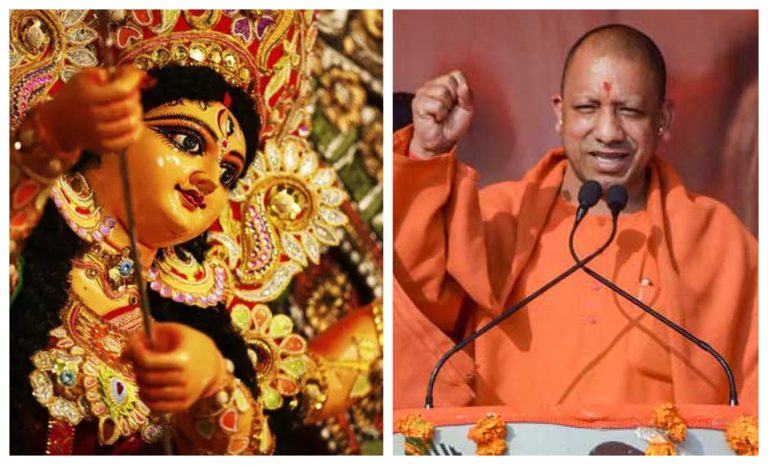
Yogi government to launch Mission Shakti on Navratri festival for women and children’s safety and empowerment: Details

The Uttar Pradesh government is set to launch ‘Mission Shakti with the commencement of Navratri on October 17 to dedicate the Hindu festival of goddess worship for women’s safety and empowerment. The initiative will last six months concluding on Chaitra Navratri in April next year. According to the government statement, various events will be organized at various places including Gram Panchayats, Industrial units, schools, government offices, and even Durga Puja pandals and Ramlilas with the objective of reaffirming the faith and resolve for women empowerment.

The initiative will see the participation of 23 government departments including basic education, secondary education, higher education, MSME. Several non-government agencies will also be participating in the programmes. Private cab drivers will be engaged as partners in the initiative. The events will include short films, street plays, safety pledge, sensitisation about women’s laws and a public display of inspirational stories of women.

CM Yogi has said that the Mission Shakti should start with mass awareness programmes and had directed all the concerned departments to prepare their respective plans for the execution of the initiative. According to Additional Chief Secretary (Home) Avinash Awasthi, the special awareness drive is aimed at boosting the morale of women and children and empowering them by making them aware of their rights.

He said that the intention was to highlight the sensitivity of the government in handling the cases related to women and children while ensuring stringent action against the culprits. Awasthi said that he had a meeting along with Director General of Police Hitesh Chandra Awasthi to prepare an outline for the drive.

A presentation was also made by DG (Women Power Line-1090) Neera Rawat on the successful conduct of the drive. “For wider reach, this special awareness drive, eleven other departments like medical education, technical education, vocational education, higher education, basic education, secondary education, labour, employment exchange, Panchayati Raj, rural development and information and public relations department have also been roped in for this nine-day campaign”, said Awasthi.

According to Awasthi, the rights and the laws related to women and children will be publicised through police stations and government departments. Posters will also be put up at places like schools, colleges, universities and other training centres and at Panchayats where involvement of women is in large numbers in urban as well as a rural area. There will be workshops to make women and children aware of the security measures to keep them safe and to sensitise them to speak out when they victims.

A day after Rajnath Singh inaugurated 44 strategic bridges, China says it does not recognise Ladakh as Indian territory

0

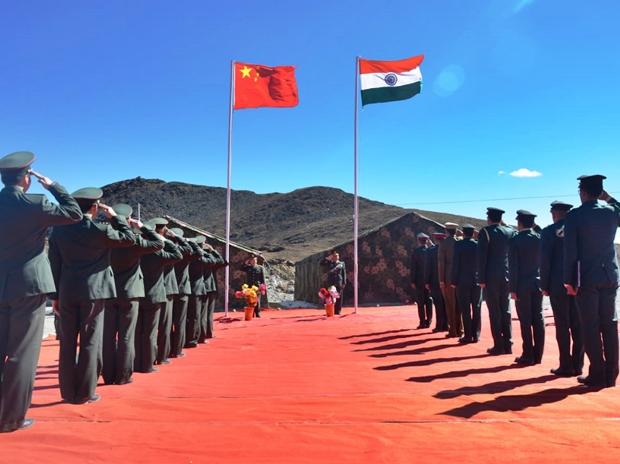
A day after Indian Defence Minister Rajnath Singh inaugurated 44 new bridges built by BRO to ease the movement of the armed forces in strategically important areas along the border with China and Pakistan, Beijing reacted to the development, saying it does not recognise Ladakh as Indian territory.

Raising questions over the sovereignty of Union Territory of Ladakh, China said that it does not recognise the Union Territory of Ladakh, “illegally established by India” and also Arunachal Pradesh. It added that it stands against the development of infrastructure facilities aimed at military contention along the border area.

“Based on two sides’ consensus, neither should take action that might escalate the situation…For some time now, India has been ramping up infrastructure development along the border and stepping up military deployment, that is the root cause of the tensions between the two sides,” Beijing said notwithstanding the vigorous infrastructural development along its side of Line of Actual Control.

It also said, “Neither side should take any action in the area to complicate the situation and China opposes to any infrastructure constructions for the purpose of military monitoring and control.”

This threat is a fresh one in the long series of veiled threats that China has been issuing to India on a daily basis since the Galwan standoff.

India and China have been in a tense face-off along the Line of Actual Control since May this year when Indian forces manning the region found belligerent Chinese manoeuvres in the region. On more than one occasion, there had been flashpoints along the line of control between the two forces, most notably the Galwan Valley skirmishes and the subsequent “strategic readjustments” made by the Indian Forces in the South Bank region of Pangong Tso lake.

Rajnath Singh inaugurated 44 new strategic bridges in border areas

Since the outbreak of the standoff, India has been vigorously working to overcome its infrastructural deficiencies in the 7,000 KM long border it shares with its two hostile neighbours—China and Pakistan. Addressing the pressing issue of disparity in infrastructural development in border areas between India and China, India started on war-footing the construction of 44 bridges in key areas along the border in states that share boundaries with the aforementioned adversaries.

Yesterday, India’s Defence Minister—Rajnath Singh inaugurated the 44 bridges—out of which 8 are in Ladakh, 8 in Uttarakhand, 8 in Arunachal Pradesh, 4 in Sikkim, 2 in Himachal Pradesh and 2 in Punjab. The development of these bridges will help the armed forces in ensuring the quick movement of troops and weapons, which has seemingly raised China’s hackles.

Roshni Act and the Land Jihad in Jammu: An Untold Story

0

Roshni Act also known as the J&K State Lands (Vesting of Ownership to the Occupants) Act, 2001 was enacted by the Government of Jammu and Kashmir in the year 2001, the main aim of such formation of the act on paper was to earn a rather significant amount of money i.e. over Rs 25,000 Crore by the commissioning of hydroelectric power projects in the state and this was the reason why it was named as “Roshni Act”.

As per the provisions of the Roshni Act, the idea was to transfer the state land as well as its ownership rights of around 20.55 lakh kanals (1 acre= 8 kanals) to those who were at the time occupying it in return for a cost set by the government.

There were many amendments made to the act for encroaching the state land and prepare the system for the Land-Jihad. Subsequently, the cutoff dates were changed an ungodly number of times, first, it was set to happen in 1990 by the Farooq Abdullah government, later extended to 2004 by the PDP-Congress government led by Mufti Mohammad Sayeed.

It was during the tenure of Ghulam Nabi Azad that the cut-off was further extended to the year 2007 which practically meant that the land was open for unabashed encroachment till the year 2007 and all the big-wigs of the state, which included some senior politicians, as well as bureaucrats, had, until the said time, encroached upon these state-owned lands, at dirt-cheap rates.

Later, an amendment was made to the Act by the government and the ownership rights of agricultural lands were given to the farmers for free, who was at that time occupying it, and they were charged only for the documentation fees which was limited to Rs. 100/kanal.

This was a well-knit plan which was launched across the border in an attempt to change the demography of the Jammu region and this process was going on under the nose of the authorities in the state for the last 17 years, to accommodate people from Muslim communities in the Hindu-dominated areas of Jammu by legalizing the illegal occupants of the land and making them the real owner. The reason why such activities were peculiar, can be traced back to the fact that the law under which such legalizations were made, has itself been declared unconstitutional. 

According to the Census Reports of 2001, the Hindu Population in Jammu was 65% whereas the Muslim Population was 31% however at the time of the Census that was conducted in 2011, the Muslim Population in the Region saw an increase by 3% whereas Hindu Population declined by 3% in the region, the reason for the same is clearly visible.

The change in the demography of the region was clearly visible by the fact that in the year 1994 there were only three mosques in the Jammu city whereas the number grew to 100+ in the subsequent years. There are more than 25000 illegal beneficiaries of the Roshni Act in the Jammu region 90% of which belongs to the Muslim Community whereas only 4500 beneficiaries are there in the Kashmir region.  

It was in the year 2009 that the State Vigilance Organization found irregularities in the transferring of ownership rights as well as allotment of lands to beneficiaries who did not satisfy the criteria for the same. Numerous government officials were booked under the same but the matter did not come into limelight at the time of its happening.

It was in the year 2014 that a report was submitted by the Comptroller and Auditor General (CAG) which revealed that, instead of earning an estimated revenue of Rs.25000 crore, the government earned only an amount of Rs 76 Crore between the years 2007 and 2013 which simply shows that it was a policy which was meant to make money, as well as change the demography to spread Anti-National ideas and the greater Islamic agenda in the state.

The report mentioned the irregularities as well as the malpractices which were undertaken by the then officials occupying higher positions, the prices were deliberately reduced by a standing committee so as to benefit the big-wigs of the state who will use the same to spread their Islamo-Fascist agenda in the state.

The main beneficiaries under the Act were the sister concerns of the State Political parties i.e. Nawai Subah Trust of the National Conference and Khidmat Trust of the Congress. Lands at prominent locations were transferred to both of these institutions and the rate set by the statutory committee was between Rs 1.10 crore/Kanal to Rs. 1.20 crore/Kanal which was having a market value of more than Rs. 13 Crore, which means that a rebate of 85% was given to the institutions having links with two of the biggest political parties of the state.

This report made by the CAG was sent to the office of the Revenue department of the state and the State Revenue Minister Aijaz Ahmad Khan in the very first instance termed the findings to be “motivated”. A PIL was filled by Prof. S.K Bhalla in the year 2011 through advocate Sheikh Shakeel Ahmed which was aimed at highlighting the instances of land grabbing and encroaching of the state land. The State Government despite many orders delivered by the Court did not provide the list containing the names of the beneficiaries and the details under which the state-owned lands were legalized and transferred to their name.

Moreover, the State Vigilance Organization, which was tasked by the government for investigating the case was not working diligently and the advocate arguing the PIL, vocally argued many times that the officials of the State Vigilance Organization who were investigating the matter were deleting the names of Senior IAS/KAS Officers involved in the scam from the investigation report and including only the lower rank officers like Tehsildars, Patwaris, etc.

The investigation was completed by the SVO in the year 2015 under five different cases clubbed together which caught hold of more than 25 government officials, which included three former deputy commissioners too. Jammu based advocate and social activist Ankur Sharma, founder of IkkJutt Jammu filed a PIL in the Court seeking transfer of the case from ACB to CBI.

The High Court of Jammu and Kashmir in November 2018 restrained the beneficiaries of the Roshni Act from carrying any transaction related to the ownership of land transferred to them through the scheme. The State Administrative Council which was led by the then Governor of the state Satya Pal Malik negated the Roshni Act and cancelled all the pending applications for the same by saying that it did not serve the purpose for which it was made and hence there is no point of having such legislation in the present time which is no longer relevant.

This was a major step for defeating the Jihadi war which was about to commence in the Jammu region in the form of demographic invasion as the illegal occupants had raised multi-story complexes, palatial buildings, luxurious homes on the state land which was allotted to them at very less amount.

Jammu Kashmir Law Commission under the aegis of its chairman Justice (Retd.) M.K Hanjura submitted a detailed 53-page report which revealed shocking results on the Roshni Act. The Commission termed the Act as a “typical example of the fences swallowing the crop. These are covered in dust from top to toe. The state has gone against the grain in legislating the Act and in framing the rules. It prepared the chicken feed for itself and the bees sowed the wild oats. It has blessed its flowers and the weeds. Such legislation where a huge chunk of land comprising thousands of kanals in which the public, in general, had an interest has been conveniently allowed to be transferred to the trespassers and the encroachers by a blatant misuse of the public trust and power cannot find a place in any nook and corner of the Indian State” (Ref: JK Law Commission Report, March 2020)

The Report mentioned that the lands have been transferred to those who weren’t in true possession of the land because their name was not present in the Girdwari made by the Patwaris and the Girdwars and almost all of the Sections under the Act were violated by the government officials. Under Section 6, it was mentioned that lands under the vicinity of highways were only to be given under lease but instances are there where the lands have been transferred illegally to the occupants. It was recommended by the Committee to retrieve the land which was illegally occupied by the illegal beneficiaries of the act.

The Division Bench of Hon’ble High Court of Jammu and Kashmir under Chief Justice Gita Mittal and Justice Rajesh Bindal, on 10th October 2020 declared the Act as unconstitutional and held that all the allotments which were made in the past were to be termed as void-ab-initio, Moreover, it approved the case to be transferred from ACB to CBI. The Court ordered the CBI to file a status report of the same with eight weeks and directed the Chief Secretary, Divisional Commissioners as well as the Deputy Commissioners to cooperate in the investigation process and if they fail to do so, they will be held liable for contempt of court. 

This step is a major breakthrough in this controversial conundrum and there is a great probability that many more influential names shall come out in the public domain once the investigations start. The benefit of this legislation was laundered by those wealthy few, who had strong connections in the political arena and later on, used the same to increase their estates.

The main question which arises is that why most of the land allotted under the act was given to members of only one community, this clearly shows the agendas of the then government of the state who was working under the guidance being given across the borders, this was a type of physical assault on the people of Jammu region. As termed by the Law Commission in its report, the Act was termed as a “Policy of loot and scoot” which is very much true.

The whole population of the Jammu Region is jubilated by the virtue of this order because the same was pending for the decades now, and during that time, nefarious entities earned huge amounts of money from the state-owned lands. This was a proverbial time bomb in the Jammu Region because the region is now surrounded by the people belonging to Muslim Community on all the four sides and if the act would not have been held unconstitutional by the court, the situation could have worsening effects. All thanks to the Judiciary which retained the faith of people and declared the act as unconstitutional and saved the lives of many people of the state who could be in the future be made the victim of the planned conversions.

Touch my feet and apologise: Neighbour slaps SC/ST act after children’s scuffle becomes ugly, sets ex-army man’s wife on fire

In a gruesome act, the wife of a retired Army officer was burnt alive Sunday in the Pushpanjali eco-city colony in Tajganj area, Agra. Sangeeta was rushed to the military hospital by her family and neighbours with critical injuries and later referred to the Army’s Research and Referral Hospital in Delhi where she died during treatment on Monday morning. According to reports, a minor scuffle between the children of the colony had resulted in this heinous crime. It is being believed that a failed Panchayat decision had ultimately led to the incident.

Retired Army officer accuses his neighbour of burning his wife alive

The retired Army officer Anil Kumar Rajawat informed the police about Sangeeta’s death. While the deceased’s body has been sent for post-mortem, the police have filed an FIR based on Anil Kumar’s complaint. The retired army officer has accused his neighbour Bharat Khare and his relatives of burning his wife alive.

What traspired in Tajganj area, Agra on Sunday

According to the police, the minor twins of the retired Army constable were playing with the neighbour’s children on Friday evening outside their house. Sangeeta Rajawat had gone to get milk. While playing, Anil Kumar’s son got into a small quarrel with his neighbour-Bharat Khare’s son. During the scuffle, Bharat’s son sustained some head injuries. This angered Bharat Khare, who filed a complaint against Anil Kumar under the sections of the SC/ST Act.

To resolve the issue, a Panchayat meeting was called at around 8 pm on Sunday evening. More than a dozen relatives of Bharat Khare were present during the panchayat meeting. It is alleged that Bharat Khare first sought Rs 10 lakh in lieu of settlement from the retired Army officer’s family. Bharat later agreed to settle the matter for Rs 5 lakhs. He also demanded that Anil Kumar’s family should touch his feet and seek an apology.

Anil Kumar told the Panchayat that he was ready to bear the expenses for the treatment of Bharat Khare’s son, but expressed his inability to pay such a huge amount as compensation. Anil Kumar’s wife, meanwhile, was ready to apologise but did not agree on touching her neighbour’s feet. Due to this, a mutual agreement between the two parties could not be reached.

Speaking about the incident, Bharat Khare’s neighbour told OpIndia that the SC/ST Act is being widely misused. Since laws under the Act are quite stringent, people often misuse it to get things done their way. He furthered that since the accused, Bharat Khare, is an influential person in the area, he was not ready to take back his case at any cost. “Literally everyone in the village pleaded him to withdraw the case against the retired Army officer, but he did not listen. Later, Bharat demanded Rs 5 lakh from Anil to take down the case, which the army officer could not give. Anil was ready to give Rs 55000, but the accused didn’t agree”, said the neighbour.

Meanwhile, Anil Kumar alleged that after the Panchayat meeting, he was discussing the case with some villagers when Bharat Khare along with his few relatives went to his house, poured kerosene on Sangeeta and burnt her alive. It was only when Sangeeta, engulfed in flames, came running out of the house, the neighbours rushed to her, poured sand on her to extinguish the fire. She was rushed to the hospital in a critical condition. Next day, Sangeeta succumbed to her injuries in the Delhi hospital.

Anil Kumar has said that Bharat Khare has fled with his family after the indent. The police, meanwhile, has recorded the statement of the families living in the colony. Circle Officer Sadar confirmed that the matter is being investigated and assured that the culprits would not be spared.

Anjana Tiwari who became Aisha for Nikah with Asif self immolates outside UP Vidhan Sabha, alleges harassment by in-laws

0

On 13th October, a woman attempted to self-immolate in front of Vidhan Sabha in Uttar Pradesh. When people around her saw her burning, they rushed to her help. She was admitted to the hospital for treatment. As per the doctors, her condition is critical.

As per the reports, Aisa, previously Anjana, was married to one Akhilesh Tiwari in Maharajaganj. The 35-year-old woman got divorced, after which she fell in love with one Asif and got married to him after accepting Islam. Soon after the marriage, Asif left for Saudi Arabia. The woman has accused her in-laws of harassment. The woman has alleged that she had tried to lodge a complaint in the Maharajganj police station but she failed, so she wanted to meet the CM.

Aisa set herself on fire at the assembly gate. The police officials present on duty at the gate quickly came to her aid and doused the fire. She was admitted to the hospital. DCP Central Somen Verma, Lucknow, said that the police had started an investigation in the case.

AajTak anchor questioned on Social Media for sending a WhatsApp message full of praise to herself, journalist says message real

0

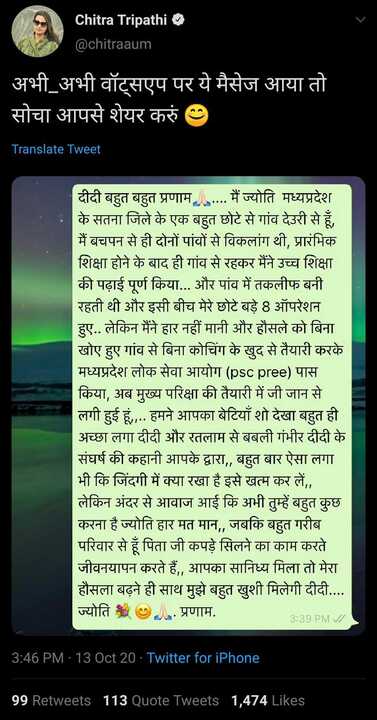
Deputy Editor and Anchor at AajTak, Chitra Tripathi, shared a screenshot of a WhatsApp conversation on Twitter where she claimed she was being praised for her journalism. The only problem was that as soon as that tweet was up, netizens raised questions and wondered if the praise was sent to Chitra Tripathi by Chitra Tripathi herself.

Chitra Tripathi conjures positive reviews for her work

In the text Tripathi allegedly sent herself, she says, “Didi, pranam, I am Jyoti from the Deori village in the Satna district of Madhya Pradesh.” ‘Jyoti’ then narrates that she is physically specially-abled and has pursued her higher education from her village. She further says that she has passed the first level of her Madhya Pradesh public service commission exams and is currently preparing for the mains.

‘Jyoti’ then says that she watched Tripathi’s show ‘Betiyan’ which she found inspirational. She further says that if she were to receive a reply, then she would be extremely happy.

It should be noticed that in the ‘WhatsApp message’ shared by Chitra, there appear two tick marks in the message. Those tick marks only appear when a user sends the message, not when a message is received. Thus, it was assumed that the screenshot shared by Chitra was taken from the phone of the sender of the message, not the receiver.

Further, the message appeared on the right side, whereas, received messages appear on the left side.

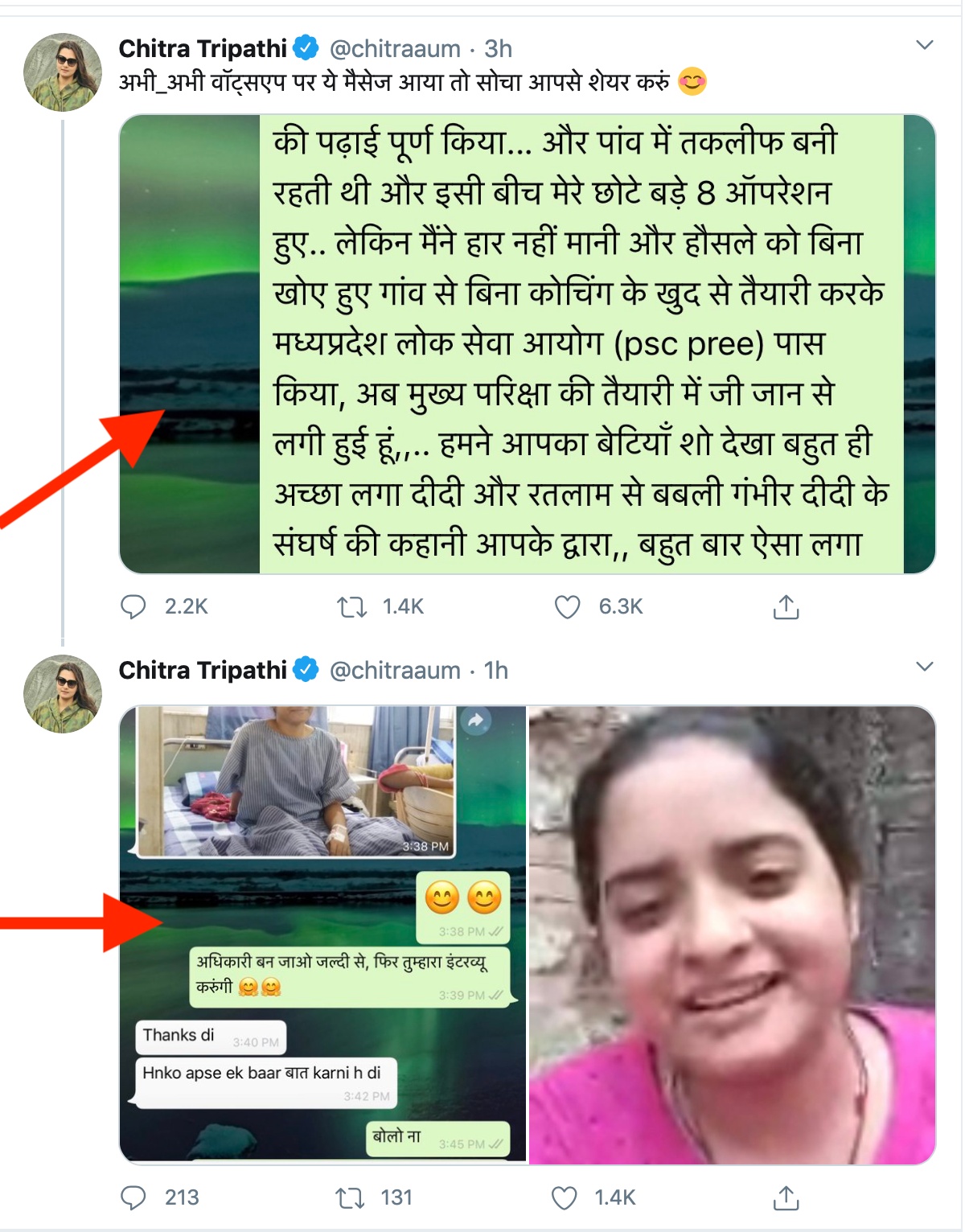
To justify herself further, Chitra shared some follow up screenshots. In a follow-up tweet, the added screenshots of a conversation between her and someone else. However, when one looks closely, one realises that the WhatsApp background of the first message (which was purportedly sent to her by someone) and the following messages are the same.

Screenshot of tweets by Chitra

These questions were raised by many on Social Media.

However, speaking to OpIndia, Chitra said that the message was indeed authentic and she had taken a screenshot from a window where she had shared the message to the group that makes the show. Hence, it appears as a sent message and not as a received message.

AajTak journalist Chitra Tripathi is the same individual who had made a fool of herself while covering the Hathras case. After screaming on the face of the Hathras SDM, she had recently tested positive for the Wuhan Coronavirus. Earlier, she had declared victory for journalists when the media was granted permission to visit the village insinuating that the decision was due to building pressure on the UP administration due to the growing crowd of journalists. In reality, media was allowed to enter as the SIT had completed its probe and she entered the village running frantically claiming victory.

Atmanirbhar Bharat is a journey for not only the Government but also for the people: Here is how

India is a country where we believe in ‘Vasudhaiva Kutumbakam’; where we treat guests like God, acknowledging the spirit of ‘Atithi Devo Bhava’; We believe in ‘Sabka Saath Sabka Vikas’ – and for a country with the principles of ‘Whole World is One Family’, it is quite obvious that India encourages Liberalisation – integrating the world economy to promote economic growth, development, and poverty reduction. Keeping these noble objectives in mind, India opened up its huge market in 1991 bringing the famous LPG Reform.

This policy opened the door of India’s Economy for global exposure for the first time. But the exploitation that Indian Manufacturing sector had to face since the colonial era was never paid its due attention. The Indian manufacturing sector and crafts industry crippled due to the competition from cheap European products and exploitative policies of the British, forcing people to move from industries to land-based activities. The second blow of exploitation came with the introduction of western education and service sector in India by the British to manage their colonial affairs smoothly which later created lucrative and respectful employment opportunities for those who could speak English in colonial India.

Hence, the service sector grew rapidly, straight after agricultural activities in India, thereby suppressing & never letting the manufacturing sector flourish in a country which is called the land of Creativity and Ideas.

After 29 years of opening up its market for the Global Participants to make use of India’s huge population as one of the biggest markets for world businesses, India surely achieved international flow of goods, services, capital, human resources and technology, without much restrictions. But with all the benefits, India also suffered undeniable exploitation of its domestic market being flooded with foreign goods, giving a huge blow to the small-scale local industries.

The people of India became so used to the ready-made quality products available in the Indian market that we never felt the need or the importance of boosting the manufacturing sector in our country and gradually, without even realising, our lives were unbelievably surrounded by the foreign made products to an unimaginable extent.

A weak industrial sector makes India’s economy fragile, vulnerable & highly susceptible to global fluctuations. This is why the call for ‘Make in India’ is being raised so diligently these days. We are late, but it’s better late than never.

Taking lessons from the Indian Epic – Ramayana, we learn how when Jatayu told Lord Ram that it was Ravana who had abducted Sita and it is Lanka where Ram would find his wife, the question of who would go find Sita to confirm her presence in Ravana’s palace arose. Everyone decided that since Hanuman was the son of the Wind God – Vayu, he must leap to Lanka. Hanuman had the swiftness, power and strength but he was cursed to forget his extraordinary strength. It was Jamwant who reminded Hanuman of the glory he was born with. After realising his powers, Hanuman leapt over the ocean, escaping several devouring demons to find Sita Mata in Ashoka Van in Ravana’s Lanka. Here, every Indian is Lord Hanuman who is yet to realise their true potential to achieve self-reliance ― all that is needed is that little nudge.

The capability of India emerging as a global leader is beyond doubt, all we need is to realise our true potential in the spirit of making India a manufacturing hub. We must realise that there is no alternative to self-dependency when it comes to the sovereignty of a nation. And this is why Make-in-India is not just important, it is necessary. It must be taken as a step towards discovering our own lost glory and not to boycott anyone. A step towards making India’s potential bigger, and not to make anyone smaller.

Recently Modi government restricted the imports of Colour TV, PPEs, Rubber tier, and many defence equipments too. All in the spirit to Make-in-India to Make-for-the-World. A positive step which should not be portrayed negatively as a step towards blatantly boycotting any other country. India’s significant achievement in the time of corona has been about discovering its forgotten ability to globally lead as a manufacturer. For instance, India experienced a brilliant transition from zero PPE production in the country to becoming the world’s second-largest manufacturer of PPEs; all this was achieved during the time of the pandemic.

Understanding this potential, Prime Minister Narendra Modi launched a remarkable initiative for self-reliance – Aatmanirbhar Bharat. As the Prime Minister said, making India self-reliant is the only way to make the 21st century as India’s century. The goal is to focus on domestic manufacturing by being Vocal for Local and ultimately to take Local to Global. It is surprising to know that India had even been importing Agarbatties which has now been banned to give a big boost to Agarbatti and Bamboo industries in India. Similarly, the recent restrictions put on the import of rubber tyres and colour TV by the Directorate General of Foreign Trade (DGFT) is yet another commendable step towards boosting indigenous & domestic production, making India self-reliant in these sectors

It should be understood that Atmanirbhar Bharat is a journey for not only the Government but also for the people. Every Indian citizen has a crucial role to play. Cluster Approach is the only way our goal will be achieved. It is a journey to embrace the local starting from our daily use to our leisure activities. The Prime Minister also stated that all famous & renowned global products started locally and are have now gone international only because the local people started using them more, promoting them more, and by being proud of them, more