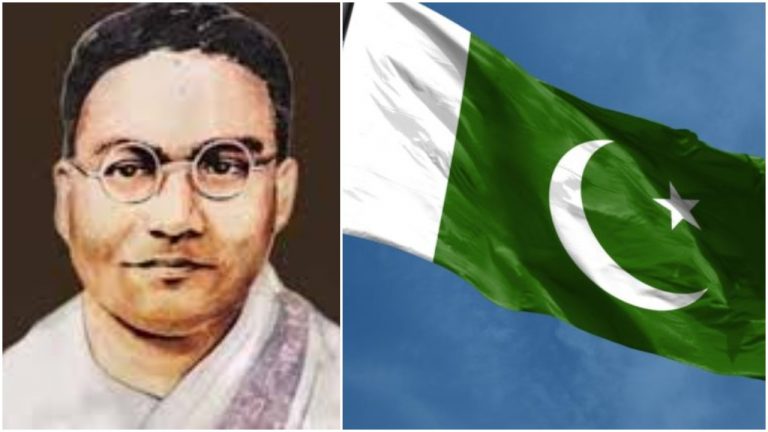
Seventy years after Jogendra Nath Mandal, a born Hindu, who later became one of the central and leading founding fathers of the Islamic Republic of Pakistan, resigned from Pakistan government and decided to return to India, his prophecies regarding the future of Pakistan as a successful nation-state has become true.
Born in 1904 in British Bengal, Jogendra Nath Mandal went on to serve as a legislator and also Pakistan’s first minister of law and labour. Later, he was appointed as the second minister of commonwealth and Kashmir affairs. However, a series of incidents in Pakistan, especially the targetted persecution of minorities made him realise that the idea of Pakistan was bound to fail eventually.
As Jogendra Nath Mandal decided to quit from the newly formed Pakistan government soon after partition, he wrote a letter to the Prime Minister of Pakistan Liaquat Ali Khan, which itself is explanatory as to why he chose to return to India.
Here is a brief summary of his resignation letter that throws light not only on how Hindus and others minorities in Pakistan were systematically persecuted but also on the active support of the founding fathers of Pakistan to commit such crimes against the Hindus in their quest to transform Pakitan into an ‘Islamic’ republic.
On October 9, 1950, JN Mandal sent his resignation to the then Pakistan Prime Minister Liaquat Ali Khan, writing how the sense of utter frustration at failing at his life-long mission to uplift the backward Hindu masses of East Bengal had led him to feel compelled to tender his resignation from the cabinet. In his resignation letter, the Dalit leader JN Mandal has penned in much details on why he decided to not only quit from the Pakistan government but also return back to India years after agreeing to the idea of partition of country and separation of Pakistan from British India.
JN Mandal, in his letter to Pakistan Prime Minister, gives a short background of important events that took place during the period of his co-operation with the Muslim League. According to Mandal, his principal objectives to join hands with the Muslim league was the economic interests of Scheduled Castes in Pakistan and secondly, that the Scheduled Castes and Muslims were both educationally backward.
“I was persuaded that my co-operation with the League and its Ministry would lead to the undertaking on a wide scale of legislative and administrative measures which, while promoting the mutual welfare of the vast bulk of Bengal’s population and undermining the foundations of vested interest and privilege, would further the cause of communal peace and harmony,” JN Mandal writes in the resignation letter.
Partition will not solve Pakistan’s problem
JN Mandal further writes, “I was the only Scheduled Caste member returned to the Federation ticket. I was included in Suhrawardy’s cabinet. The 16th day of August of that year was observed as “The Direct Action Day” by the Muslim League. It resulted, in a holocaust… The “Noakhali Riot” followed the Calcutta carnage in October 1946. There, Hindus including Scheduled Castes were killed and hundreds were converted to Islam. Hindu women were raped and abducted. Members of my community also suffered the loss of life and property.”
Highlighting the communal riots, Mandal wrote that the terrible sufferings of Hindus had overwhelmed him with grief, however, he continued the policy of co-operation with the Muslim League.
Further, in October 1946, upon the invitation of Suhrawardy to join the Interim Government of India, I joined the Interim Government on November 1, 1946, Mandal mentions in his letter. Mandal says after a few months, the British Government made their June 3 Statement embodying certain proposals for the partition of India, the whole country, especially entire non-Muslim India, was startled.
“For the sake of truth, I must admit that I had always considered the demand of Pakistan by the Muslim League as a bargaining counter. Although I honestly felt that in the context India as a whole Muslims had legitimate cause for grievance against upper-class Hindu chauvinism, I held the view very strongly indeed that the creation of Pakistan would never solve the communal problem,” Mandal justifies his support for country’s partition.
However, years later, a disappointed Mandal adds, “On the contrary, it would aggravate communal hatred and bitterness. Besides, I maintained that it would not ameliorate the condition of Muslims in Pakistan. The inevitable result of the partition of the country would be to prolong, if not perpetuate, the poverty, illiteracy and miserable condition of the toiling masses of both the States. I further apprehended that Pakistan might turn to be one of the most backward and undeveloped countries of the South East Asia region.”
Mandal on Lahore resolution and attempts by Pakistan state ot make it Islamic country
On the attempts by Pakistan, establishment to transform the country into an ‘Islamic’ country, Mandal writes, “I must make it clear that I have thought that an attempt would be made, as is being done at present, to develop Pakistan as a purely ‘Islamic’ State based on the Shariat and the injunctions and formularies of Islam. I presumed that it would be set up in all essentials after the pattern contemplated in the Muslim League resolution adopted at Lahore on March 23, 1940”.
He further writes that he has fortified his faith in this resolution and statements of Mohammed Ali Jinnah, who on August 11, 1947, had assured to give equal treatment for Hindus and Muslims alike and calling upon them to remember that they were all Pakistanis.
“There was then no question of dividing the people on the basis of religion into full-fledged Muslim citizens and ‘zimmies’ being under the perpetual custody of the Islamic State and its Muslim citizens”.
JN Mandal, criticising the attempts, adds every one of these pledges made by Jinnah is being flagrantly violated and it is in complete disregard of the Quaid-e-Azam’s wishes and sentiments and to the detriment and humiliation of the minorities.
On partition of Bengal
Mandal, who was opposed to the partition of Bengal, writes how he had to face not only tremendous resistance from all quarters but also unspeakable abuse, insult and dishonour.for doing so. “It is a matter of gratitude that my appeal to 7 million Scheduled Caste people of Pakistan evoked a ready and enthusiastic response from them. They lent me their unstinted support sympathy and encouragement,” notes JN Mandal in his resignation letter to Pakistan PM.
Further, Mandal points out how he had spoken o Khwaja Nazimuddin at Karachi requesting him to take two Scheduled Caste Ministers in the East Bengal Cabinet. He promised to do the same sometime later. However, Mandal says, what happened subsequently in this regard was a record of unpleasant and disappointing negotiations.
Anti-Hindu policy
Pointing out how the then Chief Minister of Bengal Suhrawardy had promised safety to the Scheduled Caste of Bengal from the anticipated dangerous result of partition, Mandal writes that Chief Minister of Bengal had even issued a statement declaring that none of the rights and privileges hitherto enjoyed by the Scheduled Caste people would be curtailed after partition and that they would not only continue to enjoy the existing rights and privileges but also receive additional advantages.
However, these assurances, Mandal writes, “To my utter regret it is to be stated that after partition, particularly after the death of Quaid-e-Azam, the Scheduled Castes have not received a fair deal in any matter…I brought to your notice incidents of barbarous atrocities perpetrated by the police on frivolous grounds. I did not hesitate to bring to your notice the anti-Hindu policy pursued by the East Bengal government especially the police administration and a section of Muslim League leaders.”
Incidents of atrocities against Hindus in Pakistan
In his letter to Prime Minister Khan, JN Mandal cited a series of incidents where Hindus and other minorities were persecuted by the Islamists in several communal riots that took place after partition. He mentions about an incident that took place at a village called Digharkul near Gopalganj, where on the false complaint of a Muslim, brutal atrocities were committed on the local Namasudras. He writes how authorities accepted the complaint made by Muslims as true and sent armed police to the spot to punish the Namasudra Dalits. This brutal action on the part of the local authority created panic over a large area.
“The second incident of police repression took place in the early part of 1949 under P.S. Gournadi in the district of Barisal. Here a quarrel took place between two groups of members of a Union Board. One Group which was in the good book of the Police conspired to punish the opponents on the plea of the attack on the Police Station… The Police, helped by the armed forces, then raided a large number of houses in the area, took away valuable properties, even from the houses of absentee-owners who were never in politics, far less in the Communist Party,” writes JN Mandal.
Mandal says, he wrote to the District Magistrate and the SP for an enquiry, but his letters to the District authorities were not acknowledged. I then brought this matter to the notice of the highest Authority in Pakistan, including yourself but to no avail, he adds.
He continues, “The atrocities perpetrated by the police and military on the innocent Hindus, especially the Scheduled Caste of Harbinger in the Dist. of Sleet deserve description. Innocent men and women were brutally tortured, some women ravished, their houses raided and properties looted by the police and the local Muslims.”.
As per Mandal, the military not only oppressed these people and took away stuff forcibly from Hindus houses, but also forced Hindus to send their women-folk at night to the camp to satisfy the carnal desire of the military. Mandal says despite appraising the matter to Prime Minister, no action was forthcoming.
At Nachole, in the name of suppression of Communists, the police and the local Muslims oppressed the Hindus and looted their properties, which led Santhals then crossed the border and came over to West Bengal, Mandal writes.
“Subsequently, the innocents of the entire village encouraged the neighbouring Muslims to take away their properties. A number of persons were killed and men and women were forcibly converted. Household deities were broken and places of worship desecrated and destroyed. Several women were raped by the police, military and local Muslims,” Mandal narrates about the atrocities against Hindus in Pakistan, especially by the authorities who had vowed to protect them.
He adds, “I visited Kalashira and one or two neighbouring villages on February 28, 1950…When I came to the village Kalshira, I found the place desolate and in ruins. I was told in the presence of S.P that there were 350 homesteads in this village; of these, only three had been spared and the rest had been demolished. Country boats and heads of cattle belonging to the Namasudras had been all taken away.”
Narrating an interesting incident, Mandal writes, “In the second week of February 1950 when the Budget Session of the East Bengal Assembly commenced, the Congress Members sought permission to move the two-adjournment motion to discuss the situation created at Kalshira and Nachole. But the motions were disallowed. The congress Member walked out of the assembly in protest. This action of the Hindu Members of the Assembly annoyed and enraged not only the Ministers but also the Muslim leaders and officials of the Province.”
This was perhaps one of the principal reasons for Dacca and East Bengal riots in February 1950, says JN Mandal.
Officers helped Muslim mobs to loot Hindus
What is more shocking is the authorities joining hands with the mobs to commit crimes against Hindus during Dacca riots. Arson, looting of Hindu shops and houses and killing of Hindus, wherever they were found, commenced in full swing in all parts of the city, which were committed even in the presence of high police officials.
Mandal notes how jewellery shops belonging to the Hindus were looted in the presence of police officers. Mandal says the police did not attempt to stop loot but instead helped the looters with advice and direction.
According to Mandal, the reasons for the Dacca riot were mainly five. First, the Muslims wanted to punish the Hindus for the daring action of their representatives in the Assembly. Second, the differences between the Suhrawardy Group and the Nazimuddin in the Parliamentary Party were becoming acute.
A movement for a reunion of East and West Bengal by both Hindu and Muslim leaders was also the reason for the attacks on Hindus, writes Mandal. To prevent such a move, large scale communal riots were orchestrated in East Bengal was sure to produce reactions in West Bengal were Muslims might be killed.
Fourth, the feeling of Antagonism between the Bengalee Muslim and non-Bengalee Muslim in East Bengal was gaining ground and to avoid hatred between Hindus and Muslims of East Bengal. Finally, the consequences of non-devaluation and Indo-Pakistan trade deadlock to the economy of East Bengal were being felt most acutely first in urban and rural areas and the Muslim League members and officials wanted to divert the attention of the Muslim masses from the impending economic breakdown by some sort of jihad against Hindus.
1950 Dacca riots killed nearly 10,000 people
Mandal reveals that during his nine days stay at Dacca, he received news of the killing of hundreds of innocent Hindus in trains, on railway lines between Dacca and Narayanganj, and Dacca and Chittagong.
“On the 20th February 1950, I reached Barisal town and was astounded to know of the happenings in Barisal. In the District of Hindus killed. I visited almost all riot-affected areas in the District. I was simply puzzled to find the havoc wrought by the Muslim rioters even at places like Kasipur, Madhabpasha and Lakutia, which were within a radius of six miles from the District town and were connected with motorable roads. At the Madhabpasha Zaminder’s house, about 200 people were killed and 40 injured.”
“At Muladi Bandar alone, the number killed would total more than three hundred, as was reported tome by the local Muslims including some officers. I visited Muladi village also, where I found skeletons of dead bodies at some places. I found dogs and vultures eating corpses on the riverside. I got the information there that after the whole-scale killing of all adult males, all the young girls were distributed among the ringleaders of the miscreants.”
“At a place told Kaibartakhali under P.S. Rajapur, 63 persons were killed. Hindu houses within a stone’s throw distance from the said Thana office were looted, burnt and inmates killed. All Hindu shops of Babuganj Bazar were looted and then burnt and a large number of Hindus were killed. From detailed information received, the conservative estimate of casualties was placed at 2,500 killed in the District of Barisal alone. Total casualties of Dacca and East Bengal riot were estimated to be in the neighbourhood of 10,000 killed,” says Mandal in his letter narrating how he was really overwhelmed with grief.
“The lamentation of women and children who had lost their all including near and dear ones melted my hearts. I only asked myself. “What was coming to Pakistan in the name of lslam”,” Mandal questions the very basic idea of creation of Pakistan in his letter.
Exodus of Hindus form Bengal
The large-scale exodus of Hindus from Bengal, according to Mandal, commenced only in the latter part of March. It appeared that within a short time all the Hindus would migrate to India.
“With a view to reviving the already lost morale of the panicky Hindus, I undertook an extensive tour of East Bengal. I visited a number of places in the districts of Dacca, Barisal, Faridpur, Khulna and Jessore. I addressed dozens of largely attended meeting and asked the Hindus to take courage and not to leave their ancestral hearths and homes. I had this expectation that the East Bengal Govt. and Muslim League leaders would implement the terms of the Delhi Agreement.”
However, with the lapse of time, Mandal states that he began to realise that neither the East Bengal government nor the Muslim League leaders were really earnest in the matter of implementation of the Delhi Agreement. The East Bengal government was not only much to set up machinery as envisaged in the Delhi Agreement but also was not willing it to take effective steps for the purpose.
“A number of Hindus who returned to the native village immediately after the Delhi Agreement were not given possession of their homes and lands, which were occupied in the meantime by the Muslims,” says Jogendranath Mandal.
The Liaquat–Nehru Pact or the Delhi agreement was a bilateral treaty between the two South-Asian states of India and Pakistan, where refugees were allowed to return to dispose of their property, abducted women and looted property were to be returned, forced conversions were unrecognized, and minority rights were confirmed. The treaty was signed on April 8, 1950.
Appointment of DN barari destroyed all expectations, says Mandal
Speaking on the appointment of DN Barbari as Minister of Minority Affairs, Mandal had expressed the view that such appointments not only did not help restore any confidence but, on the contrary, destroyed all expectations or illusion.
“He (Barari) was returned to the Bengal Legislative Assembly on the Congress ticket with the money and organisation of the Congress. He opposed the Scheduled Caste Federation candidates. Sometime after his election, he betrayed the Congress and joined the Federation. When he was appointed a Minister he had ceased to be a member of the Federation too. I know that East Bengal Hindus agree with me that by antecedents, character and intellectual attainments Barari is not qualified to hold the position of a Minister as envisaged in the Delhi Agreement.”
Mandal says the action by Nurul Amin, the then Chief Minister of East Bengal, in selecting Barari as a Minister in terms of the Delhi Agreement is conclusive proof that East Bengal government was neither serious nor sincere to implement Delhi Agreement whose main purpose is to create such conditions as would enable the Hindus to continue to live in East Bengal with a sense of security to their life, property, honour and religion.
Pakistan want to squeeze out Hindus
Mandal records, “I would like to reiterate in this connection my firm conviction that East Bengal Govt. is still following the well-planned policy of squeezing Hindus out of the Province. I must say that this policy of driving out Hindus from Pakistan has succeeded completely in West Pakistan and is nearing completion in East Pakistan too.”
“The appointment of DN Barari as a Minister and the East Bengal Government’s unceremonious objection to my recommendation in this regard strictly conform to name of what they call an Islamic State. Pakistan has not given the Hindus entire satisfaction and a full sense of security. They now want to get rid of the Hindu intelligentsia so that the political, economic and social life of Pakistan may not in any way be influenced by them,” the Dalit leader laments about the sorry state of affairs of Hindus in Pakistan.
Dismal future for Hindus
In his letter to the Prime Minister in 1950, Mandal strongly asserts that the present condition is not only unsatisfactory but absolutely hopeless and that the future completely dark and dismal Confidence of Hindus in East Bengal.
“The Agreement is treated as a mere scrap of paper alike by the East Bengal Government and the Muslim League. That a pretty large number of Hindu migrants, mostly Scheduled Caste cultivators are returning to East Bengal is no indication that confidence has been restored.”
Attacking the government over its failure to douse the communal fire, Mandal says, on the contrary, communal propaganda and anti-India propaganda by Pakistan both at home and abroad are continuing in full swing. The acts such as observance of Kashmir Day by the Muslim League all over Pakistan is an eloquent proof of communal anti-India propaganda by Pakistan, says Mandal.
The state of Hindus East Bengal
Addressing the condition of Hindus in East Bengal, Mandal says about fifty lakhs of Hindus have left since the partition of the country. Apart from the East Bengal riot of last February, the reasons for such a large-scale exodus of Hindus are many, he adds.
“The boycott by the Muslims of Hindu lawyers, medical practitioners, shopkeepers, traders and merchants has compelled Hindus to migrate to West Bengal in search of their means of livelihood. Wholesale requisition of Hindu houses even without following due process of law in many and non-payment of any rent whatsoever to the owners have compelled them to seek for Indian Shelter, Payments rent to Hindu landlords was stopped long before.”
“Besides, the Ansars against whom I received complaints all over are a standing menace to the safety and security of Hindus. Interference in matters of education and methods adopted by the Educational Authority for Islamisation frightened the teaching staff of Secondary Schools and Colleges out of their old familiar moorings. They have left East Bengal. As a result, most of the educational institutions ago the Educational Authority issued circular to Secondary Schools enjoining compulsory participation of teachers and student of all communities in recitation from the Holy Koran before the school work commenced.”
“Another circular requires Headmasters of schools to name the different blocks of the premises after 12 distinguished Muslims, such as, Jinnah, Iqbal, Liaquat Ali, Nazimuddin, etc. Only very recently in an educational conference held at Dacca, the President disclosed that out of 1,500 High English Schools in East Bengal, only 500 were working. Owing to the migration of medical practitioners there is hardly any means of proper treatment of patients.”
AIn his letter, Mandal mentions how all the priests who used to worship the household deities at Hindu houses have left Bengal. The places of worship have been abandoned, which has resulted in Hindus of East Bengal denying opportunity to pursue religious pursuits and perform social ceremonies like marriage. Artisans who made images of goddesses have also left, he adds.
“Muslims have replaced Hindu Presidents of Union Boards by coercive measures with the active help and connivance of the police and circle Officers. Muslims have replaced Hindu Headmasters and Secretaries of Schools. The life of the few Hindu government servants has been made extremely miserable as many of them have either been superseded by junior Muslims or dismissed without sufficient or any cause.”
Further, Mandal points out how Hindus are outlawed in Pakistan. The commission of thefts and dacoities even with murder is going on as before. The Thana office seldom records complaints made by the Hindus. The few depressed class girls who live in rural areas with their parents are not even spared by Muslim goondas, writes Mandal. He adds how there has been an increase in the number of incidents of rape of Scheduled Castes girls by Muslims.
Highlighting the discrimination metred out to Hindus by Muslims, Mandal points out that full payment is not made by Muslim buyers for the price of jute and other agricultural commodities sold by Hindus in market places.
Read- As Bhim Army supports Islamist protests against CAA, here is what happened to a Dalit leader who had supported Pakistan
Forced Conversions in West Pakistan
Referring to the atrocities of non-Muslims in West Pakistan, Mandal says, in Sindh, after partition about a lakh of Scheduled Castes people were converted to Islam.
“The condition of the small number of Hindus that are still living in Sind and Karachi, the capital of Pakistan, is simply deplorable. I have got a list of 363 Hindu temples and gurudwaras of Karachi and Sind (which is by no means an exhaustive list) which are still in possession of Muslims. Some of the temples have been converted into cobbler’s shops, slaughterhouses and hotels. None of the Hindus has got back,” Mandal writes about the conversions and forceful abductions of Hindus and destruction of Hindu temples in Sindh.
On the issue of land rights, Mandal says that the possession of their landed properties was taken away from Hindus without any notice and disturbed amongst refugees and local Muslims.
Even the possession of Karachi Pinjra Pole has not been restored to the trustees, although it was declared non-evacuee property some time ago. In Karachi, I had received petitions from many unfortunate fathers and husbands of abducted Hindu girls, mostly Scheduled Castes.
Mandal says he drew the attention of the provisional government in Sindh, but there was little or no effect. To my extreme regret, I received information that a large number of Scheduled Castes who are still living in Sind have been forcibly converted to Islam, he writes in his resignation letter.
Pakistan ‘accursed’ for Hindus
Painting the overall picture of Pakistan so far as the Hindus are concerned, Mandal mentions that Hindus of Pakistan have to all intents and purposes been rendered “stateless” in their own houses. They have no other fault than that they profess the Hindu religion, he adds.
“Islam is being offered as the sovereign remedy for all earthly evils. In the matchless dialectics of capitalism and socialism, you present the exhilarating democratic synthesis of Islamic equality and fraternity. In that grand setting of the Shariat Muslims alone are rulers while Hindus and other minorities are jimmies who are entitled to protection at a price, and you know more than anybody else Prime Minister, what that price is,” Mandal writes in a scathing attack against the perils of Islamising Pakistan.
Mandal further writs that after anxious and prolonged struggle, he has come to the conclusion that Pakistan is no place for Hindus to live in and that their future is darkened by the ominous shadow of conversion or liquidation.
“The bulk of the upper-class Hindus and politically conscious scheduled castes have left East Bengal. Those Hindus who will continue to stay accursed promise and for that matter in Pakistan will, I am afraid, by gradual stages and in a planned manner be either converted to Islam or completely exterminated,” the Dalit Minister predicts the future of Pakistan.
In his support for the persecuted Hindus, Mandal warns the Pakistani establishment, saying, “I may tell you and your fellow workers that Hindus will allow themselves, whatever the threat or temptation, to be treated as Jimmies in the land of their birth. Today they may, as indeed many of them have already done, abandon their hearths and home in sorrow but in panic. Tomorrow they strive for their rightful place in the economy of life. Who knows what is in the womb of the future? When I am convinced that my continuance in office in the Pakistan Central Government is not of any help to Hindus I should not with a clear conscience, create the false impression in the minds of the Hindus of Pakistan and peoples abroad that Hindus can live there with honour and with a sense of security in respect of their life, property and religion. This is about Hindus.”
No civil liberty for Muslims
Not just Hindus, the Muslims in Pakistan, who are outside the charmed circle of the League rulers and their corrupt and inefficient bureaucracy?, have also been looked at inferiorly according to Mandal.
“The fate of Khan Abdul Gaffar Khan then whom a more devout Muslim had not walked this earth for many years and of his gallant patriotic brother Dr Khan Sahib. Mr Suhrawardy to whom is due in a large measure the League’s triumph in Bengal is for practical purposes a Pakistan prisoner who has to move under permit and can’t open his lips under orders. Mr Fazzul Huq, that dearly loved grand old man of Bengal, who was the author of that now-famous Lahore resolution, is ploughing his lonely furrow in the precincts of the Dacca High Court of Judicature,” says Mandal opining that the so-called Islamic planning is as ruthless as it is complete.
Sharing his own bitter experience
“Leaving aside the overall picture of Pakistan and the callous and cruel injustice done to others, my own personal experience is no less sad, bitter and revealing. You used your position as the Prime Minister and leader of the Parliamentary Party to ask me to issue a statement, which I did on the 8th September last. You know that I was not willing to make a statement containing untruths and half-truths, which were worse those untruths. It was not possible for me to reject your request so long as I was there working as a Minister with you and under your leadership.”
“But I can no longer afford to carry this load of false pretensions and untruth on my conscience and I have decided to offer my resignation as your Minister, which I am hereby placing in your hands and which, I hope, you will accept without delay. You are of course at liberty to dispense with that office or dispose of it in such a manner as may suit adequately and effectively the objectives of your Islamic State,”
The scathing observations made in the letter, which rose out of the personal experience of Jogendra Nath Mandal, actually provides the stark reality of the failure of Pakistan as a nation. Seventy years down the line, every word etched by Jogendra Nath Mandal proves to be true.