Home Blog Page 5407

Palghar lynching case: Mumbai based lawyer moves Bombay High Court seeking the transfer of the case to NIA from CID

In a development in the Plaghar lynching case of two Hindu seers and their driver, Mumbai based lawyer Ghanshyam Upadhyay moved Bombay high court seeking the transfer of investigation from Crime Investigation Department, Maharashtra to the National Investigation Agency.

The Petitioner has mentioned in the petition that “the petitioner- who follows the “vaidik Sanatan dharma” has been pained by the brutal murder of two Hindu saints and their driver.”

Upadhyay has stated the inability of CID in investigations quoting the Bhim Koregaon incident and has expressed scepticism because of the involvement of policemen in the crime in the Palghar lynching case.

The Petition further states “the fact that the matter is extremely serious and sensitive in nature and also for reaching consequences and since powerful persons seem to be involved and in fact appear to be kingpins of the criminal conspiracy, in furtherance of which, the murder of the aforesaid Hindu saints and their driver is committed. It is denumerable that if the investigation remains with the local police or state police then investigation will certainly not be fair and instead the same will be just mere rituals and empty formalities, eyewash and perfunctory one and with the result, justice will be eluded and thwarted and being the case the matter needs to be investigated by the National Investigative agency.”

“In the entire episode, the local police and their higher rank officers seem to be a party of the said deep-rooted criminal conspiracy and with the result, every attempt is made by the culprits and local police to show as if, it was a case of mob lynching under the mistake and belief of those saints being thieves,” the plea said. “Not only the video of mob lynching has been stage-managed in a pre-planned manner, but even a fake narrative is created to the effect that those saints were believed to be thieves by the mob on account of there being several incidents of thefts in the area,” the advocate added in the petition.

The petition also sought directions to the Central government and Palghar SP to submit a report to the NIA with a view to enabling the agency to make a decision about taking over the investigation.

Palghar Lynching case

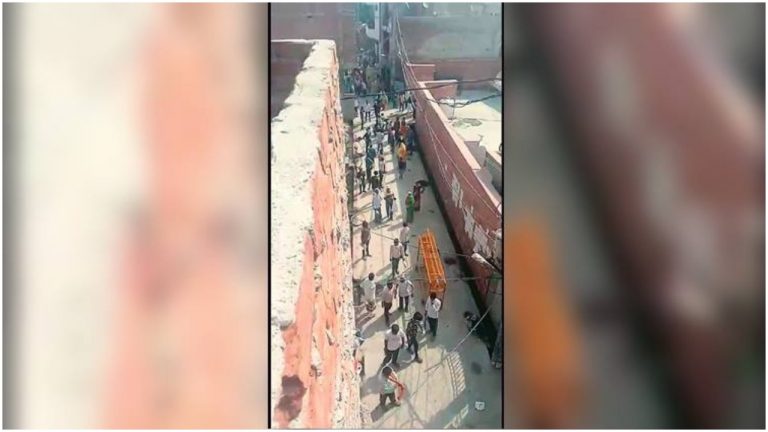
On 16th April 2020, two Seers associated with the Juna Akhara, 70-year-old Kalpavrishka Giri Maharaj, and 35-year-old Sushil Giri Maharaj along with their driver 30-year-old Nilesh Telgadewere were on their way from Mumbai to Gujarat to give Samadhi to another Sadhu. At Gadakchinchale village, a wild and frenzied crowd of over more than 100 people attacked them. The villagers deemed them as thieves and started attacking them. The police claim that their team which had rushed to the spot to rescue the 70-year-old man also came under the attack of the violent mob.

But later videos emerged which completely debunked the claim of police, as it was seen that the sadhus were in the custody of the police, but the police personnel handed them over to the mob. The mob then proceeded them to beat them to death in front of the policemen.

Arrests made in the case

The authorities on Sunday filed an FIR against the villagers and 110 people including 9 juveniles have been arrested so far. 101 have been sent to judicial custody till April 30 while the juveniles have been sent to the juvenile shelter home. Maharashtra Home Minister Anil Deshmukh released the name of those who were arrested alleging that the opposition is trying to make it a communal issue.

Jharkhand: Corpse of deceased dumped in river, recovered later and buried properly under police supervision

0

The corpse of a 60-year old leprosy infected woman was dumped in the Subernarekha river at Baharagora in Jharkhand by her family after local residents refused to permit her burial under suspicion that she died due to the Wuhan Coronavirus. However, her test results came back negative. The body was initially dumped in a well but following objection from villagers, it was dumped in a river. The Baharagora Police recovered the body from the river on Thursday and it was later buried under police supervision.

Reportedly, it is the custom in Baharagora to bury leprosy patients. The deceased, identified as one Chanchala Nayak, was a resident of Mohanpur village in Patpur panchayat. After her death, samples were taken to the primary healthcare center. After the test results came back negative, the dead body was handed over to the family. But the villagers did not permit them to bury the corpse fearing infection.

Jamshedpur Rural SP Piyus Pandey said, “Family member, having no option left with them, dropped the body into a dry well located outside the village to get rid of it. But villagers again objected following which the body was finally thrown into a river near the village. When police were informed about the incident, it rushed to the village and recovered the dead body and got it buried under its supervision.” The body was buried near the river where it was recovered.

Coronavirus Cases in Jharkhand

Jharkhand currently has a total of 55 cases of the Wuhan Coronavirus including 8 recoveries and 3 deceased. The state has been combating a lack of cooperation from certain sections of the citizenry during the pandemic as well. Earlier, it was reported that residents of Hindpiri in Ranchi, which has emerged as a hotspot, spat at sanitation workers trying to disinfect the area. Prior to that, Jharkhand Police had raided a local Madarsa which had held more than 600 girls hostage violating lockdown orders.

Bangladesh refuses to accept Rohingya Muslims stranded at the sea, Foreign Minister says not a single Rohingya will be allowed to enter

0

Bangladesh Foreign Minister AK Abdul Momen on Friday categorically stated that the country will not accept any more members of the Rohingya Muslims, amidst reports of hundreds of refugees stranding at sea trying to enter Bangladesh.

According to the reports, two fishing trawlers carrying an estimated 500 Rohingya women, men, and children were in the Bay of Bengal. The trawlers heading to Bangladesh had arrived there on April 15. The boats had earlier tried to enter Malaysia but they were forced to leave, after which they reached Bangladesh coast.

Foreign Minister Momen said that Bangladesh is opposed to allowing these Rohingyas into the country because the country is always asked to take care of the responsibility of other countries. “We can no longer allow any Rohingya”, he added. The foreign minister added that the country had accepted a batch of Rohingya who was caught in the Bay of Bengal.

“We have decided we won’t allow any new Rohingya. This is for the normal time in addition to the COVID-19 situation. We don’t want to accept any people in areas that we want to keep protected,” Momen said on Thursday.

Momen pointed out that Bangladesh now had to deal with welcoming back thousands of expatriates who had returned home because of the coronavirus pandemic. Bangladesh has ordered increased patrols in the Bay of Bengal to stop the boats entering, Foreign Minister AK Abdul Momen reportedly said.

“Two boats carrying Rohingya are trying to get into our waters,” he said, adding that the vessels could have come from Myanmar’s Rakhine State following fighting between the military and rebel groups, or somewhere else.

“Our Navy and coastguard are on alert. No more Rohingya will be allowed in,” Minister Momen said.

The boats carrying Rohingyas came near Bangladesh borders last week were earlier forced back by the Malaysian navy. The surviving Rohingya have been put into coronavirus pandemic quarantine, organised by the UN refugee agency.

“Previously, we accepted a batch of Rohingya who were caught in the Bay of Bengal. Now, more boats are waiting to enter Bangladesh,” the minister said.

Two weeks ago Bangladesh had rescued almost 400 Rohingya Muslims who were drifting in the sea on a boat for two months after they were denied entry by Malaysia. 28 persons on the boat had died due to starvation during the two months time. More than 400 Rohingya from refugee camps in Bangladesh had gone to Malaysia in January on a fishing trawler, but they were not allowed entry due to restrictions imposed following the Coronavirus pandemic.

Human Rights agencies urge countries to rescue Rohingyas

Amnesty International had said Bangladesh should rescue the stranded Rohingyas and also urged other governments in the region should “fulfil their shared responsibility to carry out search and rescue efforts”.

On Thursday, UNHCR, the UN’s refugee agency, joined Amnesty International in urging countries to welcome in Rohingya refugees.

“In the context of the unprecedented current COVID-19 crisis, all states must manage their borders as they see fit. But such measures should not result in the closure of avenues to asylum, or of forcing people to return to situations of danger,” UNHCR said in a statement on its website.

Nearly one million Rohingya Muslims currently stay in camps on the Bangladesh-Myanmar border due to the alleged persecution in their home region in Rakhine. The Rohingya Muslims are attempting to flee the camps for other more affluent Asian nations.

Prayagraj: Professor who concealed his visit to Markaz Nizamuddin from authorities suspended by Vice Chancellor of Allahabad University

Uttar Pradesh Police had booked a professor at the Allahabad University, Mohammad Shahid, for concealing information about his visit to the Tablighi Jamaat event at Markaz Nizamuddin in Delhi. After receiving information, Prayagraj Police had raided his house and after a brief interrogation, proceeded to quarantine him at a guest house in the city. After the end of the mandatory quarantine period of two weeks, he was formally arrested by the Police on the 21st of April. Now, it is reported that he has been suspended from his job at the Allahabad University by the Vice-Chancellor.

Professor Mohammad Shahid of the department of political science was booked under sections 269 (acting negligently and likely to spread the infection of any disease dangerous to life), 270 (malignant act likely to spread infection of disease) and 271 (disobedience to quarantine rule) of the Indian Penal Code and the sections of Epidemic Diseases Act, 1897, in Shivkuti police station on April 9.

The Vice-Chancellor invoked the powers granted to his office under sub-clause (i) of Clause 23 of The Statutes of the University, as provided by the University of Allahabad Act, 2005 read along with the provision of Clause 7(a) of Ordinance XLI of the same act to place Mohammad Shahid under suspension with effect from the date of detention, that is, 21st of April. The order further stated that the professor will be permitted subsistence allowance as per the applicable rules of the University of Allahabad and Financial Rules of the Government of India.

The suspension order of Mohammad Shahid issued by the Vice Chancellor of the University

Tablighi Jamaat members hiding in Prayagraj mosques

The Tablighi Jamaat members were reportedly living in two mosques in Prayagraj where they had hidden their travel history. On 31st March, 7 Indonesian nationals along with two others were caught living illegally in a mosque at Katju road in Shahganj. Similarly, 11 Jamaatis including 9 Thailand nationals were found living in a mosque at Kareli in Hera mosque. They had all attended the Nizamuddin Markaz event. A case was registered against them all and they were put on quarantine. Later, Police got a tip that one of the professors at Allahabad University had recently returned from Nizamuddin event and was continuing with his life without informing the authorities. Later he, along with his family, was also put on quarantine.

The FIR filed against Mohammad Shahid

Professor Mohammad Shahid is also believed to have lent help to provide shelter to foreign nationals of the Tablighi Jamaat at a mosque. He was also associated with an Islamic organization in Ethiopia. He had also attended events organized by the organization. Last year in December, he had visited the capital of Ethiopia, Addis Ababa, for an event. He could not provide a valid answer to whether he had received permission from the University to attend the event.

The suspended professor of Allahabad University has visited numerous countries and is associated with numerous Islamic organizations in foreign countries. Mohammed Shahid has traveled to places such as Thailand, Qatar, Hong Kong, Netherlands, Malaysia, South Africa, Bangladesh, Japan, Canada, Ethiopia, Ukraine, Dubai, London and Kenya. The Police is also investigating the financial angle in the matter.

Nizamuddin Markaz

The Islamic evangelical event, where Muslims around the world gather to learn to live life as prescribed by Prophet Mohammad, was held in Delhi’s Nizamuddin Markaz in March this year. The event, which was attended by several foreign nationals, ended up being a hot spot for coronavirus cases in India, contributing to as many as 30% COVID-19 positive cases in India. Tablighi Jamaat members have also been accused of misbehaving with healthcare workers, including molesting nurses and pelting stones at doctors and cops.

Doctors write letter flagging mismanagement of Coronavirus crisis in West Bengal, TMC MP Mahua Moitra says ‘you don’t even pay taxes’

TMC leader Mahua Moitra took to Twitter to ridicule doctors who wrote to CM Mamata Banerjee raising concerns on the COVID-19 situation in West Bengal. The TMC leader, impolitely, brushes aside their concerns by saying: “11 of 14 NRI docs writing to WB CM in US, 2 in UK & 1 in Ger. W/due respect you choose to live practise pay taxes elsewhere… Suggest you get down to work in yr adopted countries!

Along with the suppression of facts and fudging of data, the West Bengal government led by Mamata Banerjee has been receiving flak, from all quarters, for its lack of seriousness in efforts against coronavirus. Despite umpteen proofs, the government of West Bengal have been in denial mode. And now, the party loyalists have come out in the open to sneer those who are critiquing or daring to flag the state’s mismanagement of the outbreak.

Non-resident Bengali doctors write to Mamata Banerjee

With reference to six reports published by various media houses flagging the negligence of West Bengal government in handling the ongoing pandemic, the medical staff who introduced themselves as, a group of non-resident Bengali physician, health scientists and healthcare providers born, raised and educated in the state of West Bengal, almost all having families residing in the state, wrote a joint letter to West Bengal CM Mamata Banerjee on April 22. In the letter, they spoke about two specific issues which were concerning them. Firstly, gross under-testing in West Bengal and secondly, misreporting of the data on the cause of death in COVID-19 patients.

The doctors referring to a Reuters report in the New York Times dated April 14, 2020, had pointed out that with a population of more than 90 million, West Bengal has just done 33.7 tests per million compared to a national average of 156.9 per million. Then it reminded the CM that there was evidence that the mortality data in COVID-19 patients emerging from West Bengal are misreported or not fully reported. It revealed that the Coronavirus deaths in the state were being misclassified on the death certificates as deaths due to a comorbid condition or organ failure. The doctor further said that the current mortality data in Coronavirus patients in West Bengal is unreliable and accused the government of fudging the data.

It may be noted that an audit committee formed by the state govt today concluded that out of 57 deaths of coronavirus positive patients, only 18 were due to COVID-19, and the rest 39 were due to co-morbid conditions and they can’t be attributed to the Chinese virus.

Bengal’s 8 healthcare professionals associations flagged similar issues

Eight healthcare professionals associations in Bengal, including the Indian Medical Association (IMA), have also written to West Bengal Chief Minister Mamata Banerjee demanding more transparency on detection, treatment and deaths of coronavirus positive patients in the state.

In a joint letter written to Banerjee, the eight medical bodies asked the govt to share “real-time, transparent data of COVID-19” in Bengal and daily medical bulletins of all healthcare workers under treatment.

The doctors demanded that the government ensure safety and security of frontline workers and also follow ICMR guidelines  regarding issuing death certificates and suggested that committees set up by the state government to combat the pandemic ought to include epidemiologists, virologists and public health experts.

These letters come at a time when there has been massive criticism against Mamata Banerjee-led West Bengal government for lack of seriousness in efforts against coronavirus. There have been allegations that state government has been fudging numbers to show less number of cases in West Bengal.

West Bengal sitting on a “time-bomb”: Health experts

The suppression of facts and fudging of data has become a major worry for authorities and health experts in West Bengal, which has now snowballed into a huge controversy between the Trinamool Congress-led West Bengal government and health-care experts.

The health-care experts believe that the situation in Bengal is very grave as the Mamata Banerjee-led government has not been giving real data to assess the actual seriousness of the pandemic. From threats to doctors for whistleblowing against the state government against lack of facilities to allegations of state government illegally disposing of dead bodies, there have been serious allegations against the Mamata Banerjee government in Bengal.

Only 18 among 57 deaths of Coronavirus positive patients are due to the virus, rest because of co-morbid conditions: West Bengal Audit Committee

0

The West Bengal state-instituted Audit Committee has concluded that out of the total 57 deaths of people tested positive for Coronavirus in the state, only 18 of them can be attributed to COVID-19 while the remaining 39 deaths, it contended, were due to severe co-morbid conditions of the patients.

The panel which was set up by the Mamata Banerjee government on April 3, 2020, after examining the 57 cases of deaths of persons who had tested positive for COVID-19 had submitted its findings on Friday to the state government.

In a letter addressed to the Government of West Bengal, Health and Family Welfare Department, the Audit Committee said that after scrutinising the Bed-Head-tickets, treatment history, laboratory investigation reports, death certificates and other documents sent by the hospitals concerned, it discovered that only 18 of the 57 deaths were due to coronavirus infection.

The letter further adds that the remaining 39 deaths were due to “severe co-morbid conditions” which resulted in the immediate cause of deaths, and COVID-19 was just an “incidental finding”. It added that the patients who died of underlying serious ailments were suffering from co-morbid conditions such as Cardiomyopathy with Chronic Kidney disease, Renal failure, Cerebro-Vascular-Accident, Acute Lymphoblastic Leukaemia, Left Ventricular failure in severe hypertension, Multi-organ failure in Type-II Diabetes & Hypertension, Red Cell Aplasia in a case of severe Diabetes and Hypertension and Severe Diabetes with Hypertension with Hypo-natremia.

However, the inter-ministerial central team(IMCT) has raised doubts over the methodology adopted by the West Bengal Audit Committee in ascertaining the number of deaths due to coronavirus in the state. The IMCT team believes that the deaths reported and attributed to COVID-19 are far less than the actual number. The Additional Secretary to the government of India, Apurva Chandra, in a letter written to West Bengal Chief Secretary on Friday, has sought a meeting with the Audit Committee to understand their methodology.

“The principal Secretary (Health) in his presentation on April 23, 2020, gave some reasons for the establishment of the committee of doctors and also mentioned that if a Covid-19 patient dies in a road accident, he/she cannot be said to have died of the infection. The IMCT did not find the reasoning convincing as there is no comparison between a road death and a death in a hospital due to disease,” the letter read. IMCT wrote this after WB health authorities had said that if a Coronavirus patient dies in road accident, that death can’t be attributed to the virus infection.

Read- West Bengal sitting on a time bomb as many believe Mamata Banerjee government is fudging coronavirus positive and death numbers

It may be noted that majority of Coronavirus deaths worldwide have co-morbid conditions, like heart, kidney and lung ailments, diabetes, high blood pressure etc. But such deaths are still considered as caused by the Coronavirus, as the co-morbid conditions are usually long-term, and people die because of the added complications and reduced immunity caused by the virus. But the West Bengal government has decided to define Coronavirus death differently than the rest of the world.

After a visit to the quarantine facilities and hospitals in West Bengal, the IMCT also found that patients were waiting for as long as five days for the results of their Coronavirus tests. The IMCT wrote to WB chief secretary asking for the reason in such delay, and said that if people are kept in quarantine centres and hospitals even after testing negative, they have the risk of contracting the infections from other probable positive persons living with them. The letter also questions the rationale behind keeping dead bodies on hospital beds for hours while the death certificates are issued.

Will the Chief Minister of Maharashtra, Uddhav Thackeray, step down on the 27th May 2020? A legal explainer

It must be clarified at the very outset that this article is written with a view to articulating only the legal standpoint on the subject and has no political connotation. The rationale of legal points dealt herein is applicable to a minister and Chief Minister and Council of States (Rajya Sabha) and Legislative Council of a state. CM Uddhav Thackeray was not a member of any of the houses (Vidhan Sabha and Vidhan Council) of State legislature when he took the oath of office on 28th November 2019. In accordance with Article 164 (4) of the constitution, he has to become a member of one of the two houses of the legislature within six months i.e. on or up to 27th May 2020, else he will have to step down as a Chief minister. It is a well-settled that chief minister basically being a minister.  

Options before CM Uddhav Thackeray

One is to contest and win election to Vidha Sabha or two To contest and win election to Vidhan Parishad through legislative Assembly or through the constituencies of local self-government, graduates or teachers. The third option is to become a member of Vidhan Parishad through nomination from the Governor.

As it looks increasingly difficult to complete the process of elections and declare their results by 27th May 2020 the only option left before him is of nomination.  

The Council of Ministers has indeed recommended his name to the Governor for nomination.

As per article 171(5), the governor can nominate any person who has special knowledge or practical experience in the field of literature, science, art, cooperative movement and social service. All politicians easily become eligible to be nominated due to their love for literature, commitment to the development of science, excellence in the art of politics, dedication to the cooperative movement and missionary zeal with which they engage in social work.   

Nominated member, ministership and legal tenability

Even assuming that he becomes a nominated member it will be a moot point whether his Chief Ministership can survive as he has not got elected to the legislature, directly or indirectly. 

It is true that there is no provision either in the constitution or in any other law which forbids a nominated member from becoming a minister. However his appointment as a Chief Minister can be challenged in the High court or the Supreme Court on following strong grounds.

Against the basic structure of the constitution

A person not ‘elected’ directly or indirectly becoming a minister or Chief Minister is contrary to the representative parliamentary democracy that we have adopted which contemplates that a government will be run by ‘representatives elected directly or indirectly’ by people. Therefore such an act will strike at the root of “basic structure of the constitution,” which cannot be changed, as pronounced by the apex court in Keshavanand Bharati case. It can, therefore, be vehemently argued that such ministership is unconstitutional. The supremacy of the constitution, a republican form of government and democracy, secularism, separation of power and independence of the legislature, executive and judiciary and federal character of the constitution are some of the facets of the basic structure.   

What does the Apex Court say

Supreme Court in S.R. Chaudhuri vs State of Punjab & Ors 17 August 2001 Appeal (civil) 244 of 1997 has said that the council of ministers headed by a Chief Minister derives it’s power from people directly or indirectly. Parliamentary democracy generally represents the people and the power directly bestowed on it by people is the mainstay of such a democracy. 

Noting that the scope and ambit of article 164 and particularly 164(4) are the important issues involved in this appeal the court has explained and interpreted article 164(4). The court has repeatedly stated that a person who has been appointed a minister but who is not a member of any of the two houses of the legislature must get ‘elected’ within six months. It is true that this appeal is pertaining to Punjab where there is no legislative council but the court has interpreted article 164(4) which has a word *legislature and not legislative assembly*. Therefore if the court ever wanted to say that if a minister becoming a nominated member of the legislative council would constitute a *substantial compliance* of this article and he could become a minister it could have stated so. But it has not done so. Instead, it has repeatedly stated that such a minister must get elected.

Constituent Assembly debate

Many members of the constituent assembly while participating in the debate on this point had stated that there are many learned, studious and knowledgeable persons in the society who do not wish to get into the heat and dust of the election. The assembly contemplated that such persons should be made nominated members of the legislative council so that society benefits from their wisdom. However, no one expressly stated that they should be made the members of the government. This indicates that the assembly did not intend that such members should participate in the governance function also.  

Practice and precedents

One of the nominated members in a State Council, a former senior official of the Legislature Secretariat and a former senior official of Loksabha Secretariat told me during my telephonic conversation with them that they do not recollect any instance from states or at the centre where a nominated member was appointed a minister. The official of Loksabha said that though he did not recollect the details he certainly remembers that there was one such proposal under consideration at the centre but it was abandoned due to all-round criticism.      

In the third part titled “Membership of Rajya Sabha” of a revised publication “Rajya Sabha at work” by Rajya Sabha Secretariat in  October 2016 it is stated “it may be noted here that even though there is no constitutional embargo on nominated members becoming ministers, no such member has, up to now, been inducted into the Central cabinet. Prof. Nurul Hasan was nominated to Rajya Sabha in 1968. He resigned the membership of Rajya Sabha on 30th September 1971. He was inducted into the Union Cabinet on 4th October 1971 and he got elected to Rajya Sabha from UP on 11th November 1971.

Congress leader Mani Shankar Aiyar while speaking in a seminar held on 27th September 2011 at Royal Geographical Society had said “In India if you are a nominated member of Council of States you cannot become a minister. ”You can watch the video of the seminar proceedings here:  

It would not be out of place to note the meaningful observations made by Shri Fali Nariman, a noted jurist (who himself was a nominated member of Council of States) in his autobiography “Before Memory Fades”: The status of a nominated member of a parliament is that he or she is a non-party member to whom the party whips of none of the political parties applied. A nominated member is, strictly speaking, an independent member with no party affiliation or leanings.

It is undisputed that this is equally applicable to the nominated members of the State Legislative Council.

Resignation of Uddhav Thackeray and his reappointment

Some are toying with the idea of CM resigning and he being re-elected as the leader so that on his re-appointment as CM he would get another term of six months within which he could get elected. This is wrong and smacks of ignorance. 

Supreme court in the verdict of S.R. Chaudhuri quoted above has said “Reappointment of such a person, who fails to get elected as a member within the period of grace of six consecutive months, would not only disrupt the sequence and scheme of Article 164 but would also *defeat and subvert* the basic principle of representative and responsible Government. Framers of the Constitution by prescribing the time limit of “six consecutive months” during which a non-legislator Minister must get elected to the legislature clearly intended that a non-legislator cannot be permitted to remain a minister for any period beyond six consecutive months, without getting elected in the meanwhile. Resignation by the individual concerned before the expiry of the period of six consecutive months, not followed by his election to the legislature, would not permit him to be appointed a Minister once again without getting elected to the legislature during the term of the legislative assembly. The “privilege” of continuing as a Minister for “six months” without being an elected member is *only a one-time slot for the individual concerned during the term of the concerned legislative assembly*. It exhausts itself if the individual is unable to get himself elected within the period of grace of “six consecutive months”. It would be *perversion of the  Constitution and even a fraud on it*. Articles 164(1) and 164(4) have, therefore, to be so construed that they further the principles of a representative and responsible government”.

It may be remembered that the constitution has a clear provision of six consecutive months. A Latin legal maxim “Expressio unius est exclusio alterius” is a principle in statutory construction. It means “when one or more things of a class are expressly mentioned others of the same class are excluded” and “Construction ut res magis valeat quam pereat” means the construction of a rule should give effect to the rule rather than destroying it.

His reappointment as a leader of the legislature party will be a *Colourable action*. What it means is that what cannot be done directly cannot also be done indirectly. It is a settled principle of law that this way you cannot make provisions in law or constitution ineffective. While as per the constitution Governor is the head of a state but all the executive authority is de facto with the Chief Minister. Therefore it would be a *constitutional impropriety* if a person who has been a Chief Minister, even if for a very small duration, and who desires to stay in that position for long would approve of such action.       

No constitutional crisis

It may be remembered that the post of a minister or Chief Minister is not a contractual arrangement. The legal maxim “Force majeure” has no application to this case. (“Force majeure” means an unexpected event such as a war or circumstances beyond one’s control and non fulfillment of contractual obligations arising out of this is excused)  There is also no constitutional crisis or fear of breakdown of constitutional machinery. It is because the constitution provides for a Chief Minister, it does not say X Y or Z Chief minister. By an internal mutual agreement, Maha Vikas Aghadi (MVA) (an alliance of Shivsena, NCP and Congress which is in power in the state) can appoint any other elected member of the legislature as a titular or caretaker leader of the house who will step down at an appropriate time. It is true that the state is passing through a very difficult time due to Corona but that does not mean that there will be a constitutional crisis or breakdown of constitutional machinery if Shri Thackerey has to step down. If at all there is a crisis it is within MVA.

It was possible for Shri Thackrey to get elected to Legislative Council from Yavatmal Local self Government constituency in February 2020 from where Shivsena candidate Shri Dushyant Chaturvedi got elected. But he did not avail of that opportunity. While it is true that constitution provides for six months to get elected but considering the fact that this period is a special privilege as stated by the Supreme court and ideal situation is that every minister and the chief minister should be a member of the legislature at the time of his appointment as such minister, a person who is the head of a political party and who has adorned the post of Chief Minister ought to have availed of the very first available opportunity to *comply with a constitutional requirement*. Party politics and it’s gains and losses, personal pride and prejudices must take a *back seat* when it comes to constitutional responsibility and compliance of a constitutional requirement should not be delayed. 

In case it is possible and a petition is indeed filed in the Supreme Court, the chances are quite bleak that the court will exercise the power available to it under article 142 to do complete justice and provide relief.

(The article has been written by Adv. Vijay Trimbak Gokhale who is a lawyer and works for legal literacy)

JNU sanitation workers forced to work with no masks and wages for 3 months amidst Coronavirus outbreak: Report

0

Sanitation workers at the controversial Jawaharlal Nehru University have been cleaning 18 hostels and messes every day, amidst the Coronavirus outbreak, without a single penny from the past 3 months, reports News18. Besides denying their monthly wage, the JNU administration has not provided the sanitation workers with basic protective gear such as gloves and masks.

Until 2016, the JNU administration was in charge of providing salaries and employment benefits to the sanitation workers. Following the elevation of Mamidala Jagdesh Kumar as the Vice-Chancellor of the university, the rules were changed. The administration paid directly to the private contractors who were entrusted to disburse the salary of ₹12,000 to the workers.

Reportedly, a student organisation by the name of The Bhagat Singh Ambedkar Students Organisation (BASO) has raised funds to distribute hand sanitisers, face masks, and gloves among the sanitation workers.

Testimony of the JNU sanitation workers

According to the report, 43-year-old Kamlesh, a sanitation worker at JNU, has dried up her meagre savings in the absence of monthly wages. She has two daughters and a son to look after. In the absence of protective masks, Kamlesh is forced to use her dupatta to cover her nose and mouth.

A sanitation worker Asha who has remained unpaid for over two months alleged that the private contractors change after a period while the workers remain the same. While the JNU administration refuses to identify them as “permanent employees”, the private contractors refuse to provide transparency. In October last year, the workers went on a strike demanding regular pay and review of the employment terms and conditions.

Urmila Chauhan who served as the former President of the Union by JNU’s sanitation workers alleged that she was fired by her private contractor in October 2018 with the approval of the JNU administration for demanding the rights of the workers. She said, “It is a blame game between JNU administration and private contractors like Sudharshan and Rakshak who are on its payroll.”

The biggest lesson taught by the Coronavirus crisis is self-reliance: PM Modi to Sarpanchs across India

Prime Minister Narendra Modi while interacting with Sarpanch across the country through video-conferencing said that the biggest lesson that coronavirus has taught us is to be self-reliant. The video-conferencing was held to mark the Panchayati Raj Diwas.

PM Modi said that the coronavirus epidemic has thrown challenges that the country never faced but it also taught people new things. Modi said, “The biggest message COVID-19 has given, the biggest lesson it has taught us is to become self-reliant.”

He stressed that every gram sabha, every block and every district needs to be self reliant for its basic needs.

PM Modi appreciated them for describing social distancing in simple words like “Do Gaz ki Doori” so that the people can understand it easily.

He said, “With its simple mantra of Do Gaz Ki Doori (maintaining distance of two yards), rural India has described social distancing in simple words, villages have showcased the best of their principles, traditional values to fight coronavirus.”

PM Modi was seen covering his face with a green Gamcha while interacting through video conference. His interaction with gram panchayat members was to mark the Panchayati Raj Diwas on Friday.

Applauded the Indian masses for observing lockdown rules

Prime Minister Modi appreciated Indians for observing lockdown rules. He said that because of them the entire world is talking about how India has responded to coronavirus outbreak.

“COVID-19 is a huge crisis for the world but people of India have shown grit in this fight. We are fighting this and we are moving ahead with new ideas to tackle the virus,” PM Modi said.

Gram panchayat heads shared their experiences

Gram panchayat leaders across the country shared their experiences in handling the crisis and ensured that people are following the lockdown strictly.

A gram panchayat member of Jammu and Kashmir said that during the crisis ‘respect’ and ‘suspect’ for the people should go in hand to ensure the spread of the virus is checked.

PM Modi enquired from the gram panchayat leaders of Assam whether the local people were angry as the Bihu festival could not be celebrated due to lockdown. The gram panchayat leader said that the people understand that the decision is for a larger good. Gram panchayat leader from Pune showed the same feeling.

Concluding the conference, PM said, “We have to get people out of every kind of misunderstanding. Correct information should reach every family. I am confident that all of you will definitely defeat coronavirus with your collective efforts and your determination.”

PM urged people to maintain personal hygiene by washing hands regularly and covering the face with home-made masks like Gamcha. He also stressed on downloading the Aarogya Setu app stating that it is a “bodyguard”.

Coronavirus in India

23077 cases of Chinese coronavirus has been reported in India with a surge of 1377 cases in the last 24-hours. 4749 people have been recovered and discharged while 718 are reported dead due to the pandemic.

5 of the 126 arrested for attacking the healthcare team in Bengaluru test positive for Coronavirus: Details

0

Five amongst 126 arrested in the deplorable attack against the team of health workers and police have now tested positive for the novel coronavirus, raising suspicion among the investigative agencies if the patients had known about their malady in advance and deliberately chose to be a part of the mob that went rampaging against the health officials visiting the minority-dominated area of Padarayanapura in Bengaluru on April 19 to spread the virus.

While the attack took place 5 days ago, in which 126 people have already been arrested, the deputy chief minister of Karnataka CN Ashwath Narayan said Friday that five of those arrested have tested positive for the coronavirus. Narayan added that while two patients were tested positive late on Thursday, three others tested positive on Friday.

A total of 126 arrested in connection with the attack against the healthcare workers on April 19 were all sent to the district jail in a nearby Ramanagara after being remanded to judicial custody by the court. All the inmates were screened for COVID-19, out of which five of them have been found positive for the contagion.

The unruly mob attack against the health workers had elicited a widespread reaction from the Karnataka politicians, with chief minister B S Yediyurappa terming the reprehensible attack as “goondaism” and directing strict action against those who take the law into their hands.

Attack on healthcare workers by a violent mob in Bengaluru’s coronavirus hotspot Padarayanapura

On the evening of Sunday, 19 April, a team of health workers and BBMP officials in Bengaluru was brutally attacked by a violent mob in the Padarayanapura locality, a coronavirus hotspot. The government health team was there to quarantine the primary contacts of coronavirus positive patients.

The violent mob attacked the police after the primary contacts of the coronavirus patients refused to be taken into quarantine. The mob is seen brutally attacking the policemen and health workers and damaging the barricades, tents and other setups made by the officials.

A group of BBMP doctors, nurses and ASHA workers had gone to the Padarayanapura locality to take into quarantine 58 primary contacts of coronavirus positive patients to a government-run quarantine centre.

The Padarayanapura locality is one of the worst affected localities in Bengaluru. It had been declared a hotspot and barricades had been set up by the police to enforce a complete lockdown. The violent mob also broke down the barricades. As per a report in Times of India, two Tablighi Jamaatis who had returned from Delhi’s Nizamuddin Markaz had first tested positive and then 15 of their contacts were found to be coronavirus positive.