Home Blog Page 5432

Joseph Pulitzer – the story of the founder of the Pulitzer Prizes, and the Father of Yellow Journalism

The Pulitzer award, named after Joseph Pulitzer, is often considered to be one of the prestigious marks of recognition in the fields of journalism and literary arts. Since its launch in 1917, the Pulitzer Prize has come to be regarded as one of the foremost awards given to journalists for their excellence in journalism. It was established by provisions in the will of Joseph Pulitzer, who had made his fortune as a newspaper publisher, and the prize is administered by Columbia University.

However, there is a curious story behind the origin of these so-called awards recognising excellence in journalism. Ironically, the top award of journalism is named after a man who is actually known as the origin of a dubious practice in journalism known as “yellow journalism”, a sensationalist way of reporting using eye-catching headline rather than reports based on research.

Yellow Journalism refers to journalism and media houses that present little or no legitimate well-researched news while instead using eye-catching headlines for increased sales. It includes exaggerations of news events, scandal-mongering, or sensationalism.

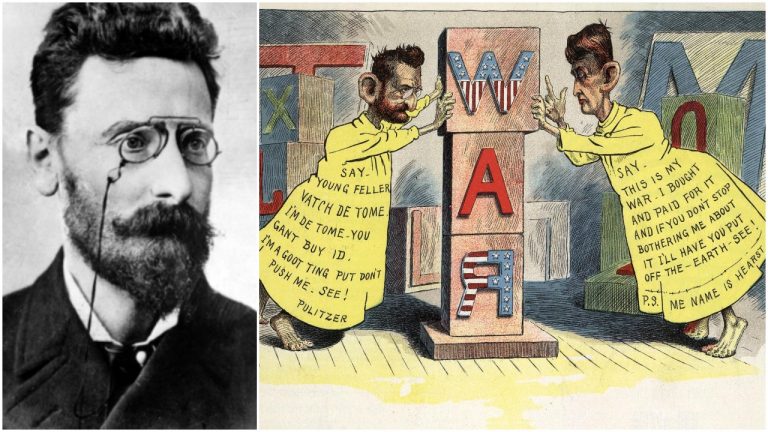
The term originated in an event of competition over the New York City newspaper market between two major newspaper publishers Joseph Pulitzer and William Randolph Hearst. The goal of the two publishers was to create a sensation that would prompt people to buy copies of the paper. In other words, the motive of the reportage was ‘profit’.

Profit-war between publishing houses

Joseph Pulitzer was born in Hungary and immigrated to the United States as a teenager. Pulitzer owned a newspaper named New York World, whose circulation began breaking records in the early 1890s. Pulitzer had a knack of appealing to the masses through his publications.

Pulitzer was also very much active in the Democratic Party. Through his New York World, Pulitizer did some investigative reports and headline-chasing exploits. New York World was doing well after Pulitzer took it over, but he faced competition when William R Hearst, who was running the San Francisco Examiner, bought the New York Journal to enter the business in New York.

Hearst was impressed by the New York World, and had he modelled the reporting of San Francisco Examiner on the same line. So when he bought the New York Journal, he changed the approach of this paper also, which meant a great rivalry was started between the papers. The competition to outsell the other changed the way the stories being reported.

Initially, the term ‘yellow journalism’ had nothing to do with reporting, but instead derived from a popular cartoon strip about the life in New York’s slums called Hogan’s Alley, drawn by Richard F Outcault and published by New York World. Starting in 1895, Pulitzer printed the comic strip featuring a bald boy in a yellow nightshirt, entitled the “Yellow Kid”. The cartoon published in colour by Pulitzer’s New York World became extremely popular and increased the sales tremendously.

The Yellow Kid, dawn by Richard Felton Outcault

In 1896, in an effort to boost sales of his New York Journal, Hearst hired Outcault away from Pulitzer to start a similar cartoon strip in his paper. After that, Pulitzer hired artist George Luks to continue drawing the cartoon for his paper using the same characters. This resulted in both the newspapers in the city having cartoon strips with yellow kids. This battle over the ‘Yellow Kid’ and a greater market share gave rise to the term yellow journalism, which led to the use of “yellow journalism” as a synonym for over-the-top sensationalism in the USA.

Yellow Journalism fueled the outbreak of the Spanish-American war

Once the term Yellow Journalism had been coined, it began to be used for the sensationalist style used by newspapers in their reporting. This was most prominent in the case of reporting on the developments in Cuba, a Spanish colony at that time. The Spanish-American war became the major highlight in the media and fueled the United States’ first media wars in the era of yellow journalism. The attention-grabbing report was evident in the media’s coverage of the Spanish-American War.

Hearst and Pulitzer started covering the Cuban struggle for independence with great emphasis, often highlighting the atrocities of the Spanish ruler, or how noble the revolutionaries were. They also sometimes printed overhyped reports about the revolution which were not true. Although short of facts and filled with hypes, such reports did well for both the papers as they were sold in great numbers.

The peak of yellow journalism came in the year 1898, when a US battleship named Maine sunk in Havana harbour. The US navy ship was sent to the Cuban coast as a display of US power and in conjunction with the planned visit of a Spanish ship to New York, an effort to defuse growing tensions between the United States and Spain.

On the night of February 15, an explosion broke the ship’s hull, and US ship Maine went down. The initial investigation by the colonial government of Cuba concluded that the explosion had occurred on board. However, Hearst and Pulitzer, who had for several years been selling papers by fanning anti-Spanish public opinion in the United States, published rumours of plots to sink the ship.

When a US naval investigation later stated that the explosion had come from a mine in the harbour, the proponents of yellow journalism seized upon it and called for war. By early May, the Spanish-American War had begun.

Pulitzer’s hysteria changed context of US foreign relations

The rise of yellow journalism helped to create a climate conducive to the outbreak of international conflict and the expansion of US influence overseas.

The yellow journalism of this period is significant to the history of US foreign relations in that its centrality to the history of the Spanish American War shows that the press had the power to capture the attention of a large readership and to influence the public reaction to international events. The sensational style of yellow journalism contributed to creating public support for the Spanish-American War, a war that would ultimately expand the global reach of the United States.

So, in retrospect, if Joseph Pulitzer can be considered as the father of the “yellow journalism” as he was the one who set the foundation of sensationalism and Hearst can be viewed as the one who set the course for the tabloids of the future.


Note: After it was pointed out by alert readers that parts of the article were copied verbatim from other websites, some content in this article has been re-written. An open-source article at the Historian website of the US govt has also been properly credited which was not done earlier by mistake. It may be noted that the content on the US govt website is available for use without any copyright, and the website says that the content of the site may be copied and distributed without permission.

Nevertheless, as a responsible media house, we have taken punitive action against the writers and editors involved in publishing this article. We will strive to not repeat such error in future.
One Mohammad Salauddin arrested in Delhi for kidnapping minor girl from West Bengal and trying to sell her to traffickers in Rajasthan, gets bail

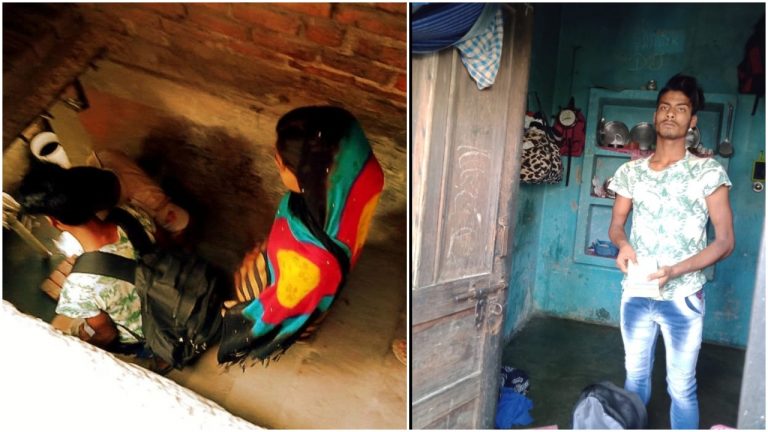
In a joint operation by the National Commission for Protection of Child Rights (NCPCR), Delhi police and a Delhi-based non-government organisation rescued a minor Dalit girl from West Bengal in Delhi, who was kidnapped by a youth on the pretext of marriage.

The minor girl was brought to New Delhi in March by the accused named Mohammad Salauddin to sell her to a trafficker in Rajasthan. However, he got stuck in Delhi due to the nationwide lockdown announced amidst coronavirus lockdown, reports Swarajya.

The investigative report by journalist Swati Goel Sharma revealed that the NCPCR team laid a trap for the kidnapper by posing as citizen volunteers distributing free ration to rescue the minor girl. The victim minor after being rescued was taken to a women’s shelter and will be taken to her parents after the lockdown ends. The accused, Mohammad Salauddin, was arrested but he was granted bail by court.

Accused Mohammad Salauddin flees with minor girl

Kamal Mondal (first name changed), who is the father of the victim, lives in a village in South 24 Parganas district of West Bengal. Speaking to the reporter, Mondal said that on the early morning of 29 February, the family found the girl was missing. The father said that they looked around, but did not find her. Later in the day, they reached out to her friends and classmates.

A Muslim youth, Mohammad Salauddin, emerged as an accused in the case. The father said he was shocked to know that his daughter was seeing someone.

“She had just appeared for her Class 10 exams. I used to pick her up from school every day. Even for her tuition classes, I would drop her and pick her up. I fail to understand where she even met him, he told this correspondent.

Mondal, who belongs to the Poundra community, which is a scheduled caste, said that the village has Muslims in the majority and Hindu families usually accompany their girls outside homes.

The 16-year-old minor girl is one of the two daughters of Mondal, The other daughter is aged 11.

On his complaint, a first information report was registered at Barauipur police station on 2 March. Kamal said as he searched for the girl’s documents to produce her age proof, he found that her Class 10 admit card, Aadhaar card, birth certificate and her bank passbook were missing.

The most shocking was that the police did not mention Salauddin’s name in the FIR, Kamal Mondal said. He added that the police only invoked IPC 363 (kidnapping).

Mohammad Salauddin calls victim’s father

Mondal said that he received a call from Salauddin a week after he had registered a complaint. The father said he had never spoken to him before. Reportedly, Mondal shared an audio recording of the conversation with this correspondent.

According to Mondal, he urged the Salauddin to return back to the village along with his daughter. To which, Salauddin asked Mondal to withdraw the complaint filed against him.

The accused said that the villagers including police are advising him to return to the village immediately. Later in the conversation, Salauddin revealed that all he wanted to know was the case number so his lawyer could file for bail. Mondal refused to give it.

“This relationship is unacceptable to me as the man is Muslim. Moreover, when I inquired about him, I was told he is heavily into weed and has no job. I can’t ruin my daughter’s life,” Mondal told to the reporter.

“If he really loved my daughter, he should have come to me first. She is just a child. His intentions are not good,” he said.

Mondal passed on the phone number to the police, but it was found constantly switched off.

Even after weeks, Mondal helplessly waited for the police to bring his daughter back. However, in the first week of April, Mondal received a call from his daughter in one afternoon.

“All she said was that she was trapped and wanted to come back home. She said she was in Delhi, but did not know her location,” Mondal said. He gave the phone number to the local police.

Delhi police, NCPCR nabs the culprit in a joint operation

As police began to trace the victim, the nationwide lockdown had come into effect, and inter-state travel was prohibited.

The West Bengal police soon passed the information to an NGO in Delhi, Mission Mukti Foundation. The NGO took the case to the National Commission for Protection of Child Rights. Soon, the commission directed the Delhi police to begin the investigation.

The Delhi police traced the number to Khajuri Khas area in the North-East part of the national capital. Incidentally, Khajuri Khas is one of the areas in northeast Delhi hit by communal violence that broke out between 23 and 25 February. It was the same locality where murdered Intelligence Bureau employee Ankit Sharma also resided.

Virendra Kumar Singh, director of the NGO, speaking to Swarajya, said that the police gave him two phone numbers belonging to families living in the colony where the girl had been kept. The police said to him that she was brought to Delhi on 21 March, a day before ‘Janta curfew’.

Singh then dialled the two numbers to state that his NGO would carry out a food distribution drive in the area within two days and they must come at a given spot to collect it.

One of the men, Mohammad Aqib (name changed), however, said to Virendra Singh that the colony had Gujjar-owned houses that have been rented to Muslims, and no ration distribution drive is being carried out in the area.

On 21 April, a team comprising NCPCR officials, cops from Khajuri Khas police station and a few volunteers of the NGO reached the spot.

When the two families reached the spot, the team questioned them about the girl being kidnapped in their colony.

“For a long time, they kept denying any knowledge of it. Eventually, they agreed to speak on the condition that their name would feature nowhere in the police case,” an NCPCR official said.

A woman took the team inside the lane and pointed at the house. The joint team raided the house and detained both the girl and Salauddin.

Accused gets bail, thanks to police negligence

Virendra Singh revealed that the girl in the presence of cops and NCPCR officials said that Salauddin was planning to sell her to someone in Rajasthan.

“She said it in front of all officials. If it weren’t for lockdown, she would have been trafficked to Rajasthan by March end,” Singh said.

Despite the seriousness of the crime, the accused of the crime was successful in getting bail after Delhi police failed to present the FIR copy, which was registered in West Bengal, before the court.

“The accused got a prompt bail. The FIR itself had weak charges. The police should have invoked POCSO and added section 370 at the time of filing it,” Priyank Kanoongo, chairman of the child commission said.

Kanoongo said that it is this inter-state confusion that is failing to put a stop at trafficking, especially that of minor girls.

“Unless trafficking is handled by a central agency, such as the CBI, we cannot tackle it,” he said.

Family awaits their daughter

Speaking to Swarajya, Kamal Mondal said that he has managed to talk to his daughter a couple of times since her rescue. As he awaits her, he said that the girl’s life has been ruined.

He said that as the entire village knows about the case, his daughter and family has no reputation left. We can no longer go out with our heads high, said Mondal.

After Bois Locker Room controversy, Jadavpur University students accused of sharing nudes of women through Google Drive

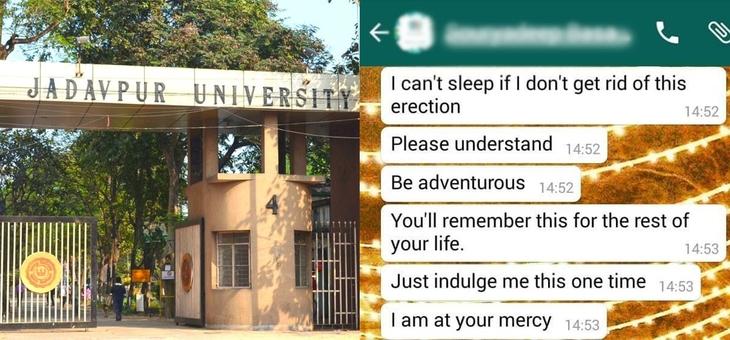
Hours after the controversial ‘Bois Locker Room’ Instagram group came to light, similar allegations were levelled on a group of men from Kolkata who are former students of Jadavpur University.

Twitter user ‘Aiyoobrows’ in a series of tweets on Monday alleged that a group of men from the varsity have been using nude and semi-nude pictures of women in a Google Drive and circulating them amongst their friends. She alleged that the drive has been in existence since 2016.

She named two men, Souryadeep Basak, who allegedly owns the drive, and Imankalyan Ghosh, who had access to the same. Another Twitter user @SadMandalorion added to ‘Aiyoobrows’ allegations and said that when the latter wanted to expose she was requested by potential victims to not go forward with it as it would take a toll on their mental health.

She further alleged that these images were obtained through manipulation of victims.

She even named few more men who were allegedly involved in sharing the nude pictures of women.

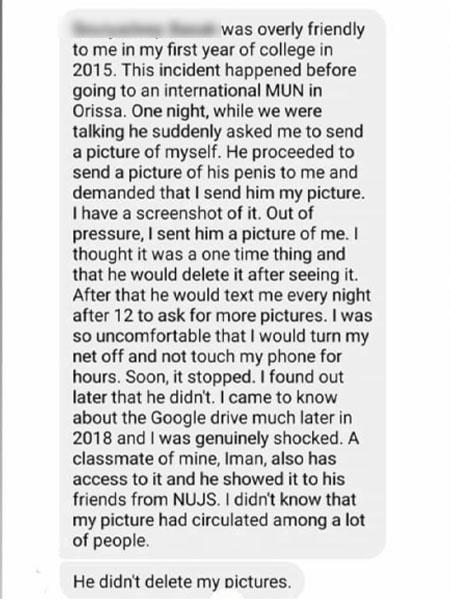
Since then, multiple images of screenshots of women have been in circulation in social media where victims are calling out the behaviour. Speaking about an incident that happened to her in 2015, a woman has alleged that she was attending international MUN (Model United Nations) in Odisha where Basak allegedly asked her to send a picture of herself. To that, Basak allegedly send him his d*ck picture. Out of pressure, she sent him her intimate picture, assuming he would delete it later. She was shocked to find out that her picture was in the Google drive in circulation.

Image credit: iDiva.com

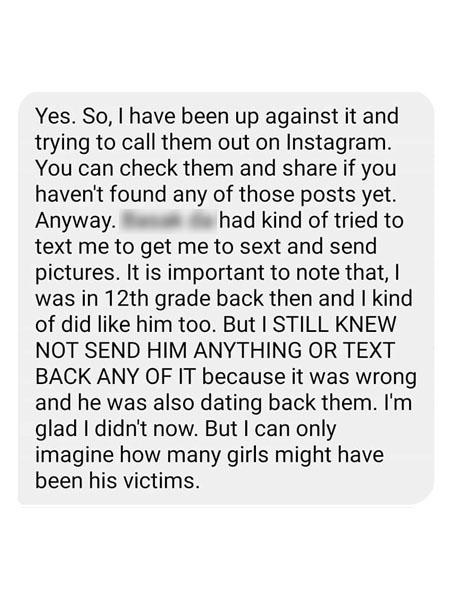
Another screenshot in circulation claims that someone had tried to manipulate her into sharing intimate pictures of her when she was in 12th class, i.e. a minor.

Image credit: iDiva.com

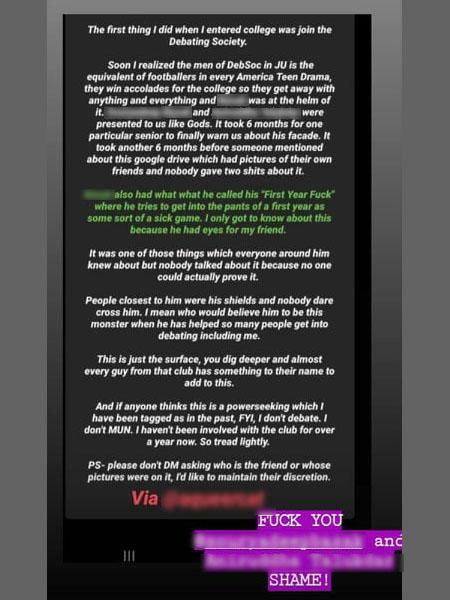
Another woman speaking about her experience at the debating society at Jadavpur University and the said Google Drive. She talks about something called ‘First Year F*ck’ which where the man in question would try to get physically intimate with first year students. She alleges that he was well protected by his close friends.

Image credit: iDiva.com

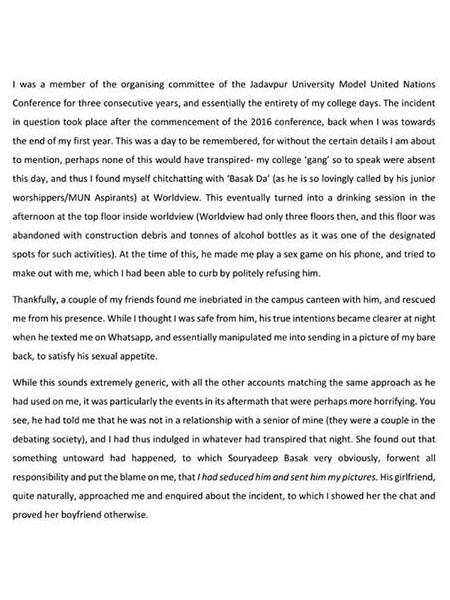
One woman recalled a 2016 incident when she was in the first year of college at Jadavpur University. Furthering about her interaction with Basak, she alleges that after she and Basak consumed alcohol, he made her play ‘sex game’ on his phone and tried to get intimate with her, which she politely refused.

However, he later texted her and manipulated her into sending him a picture of his bare back to satisfy his sexual appetite, she claims.

Image credit: iDiva.com

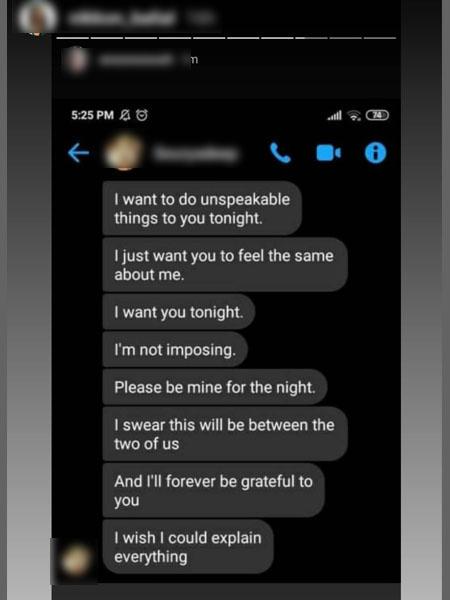
Another image showed a screenshot of a purported sexting between Basak and a woman.

Image courtesy: iDiva.com

As per a report by Times of India, the whistleblower ‘Aiyoobrows’ got to know about the drive in 2018 during the #MeToo movement in India where various women and men had come out to talk about sexual harassment experience at work place. As per the report, Basak started the drive in 2016 to save pictures from his ‘conquests’ of women he has been in relationship with and shared the intimate pictures with his group of friends. She says that she was too traumatised to find her own pictures there as well. She had sent the pictures after Basak allegedly manipulated her into doing so years ago and was traumatised to find that those pictures were being circulated without her consent.

The report further quotes Basak, the one who is accused of owning the Google Drive and sharing the images, who states that these images were the stories of his romantic affairs and never meant to objectify women. He reportedly told Times of India that since he was popular in college, he has had multiple affairs and romantic liaisons. He said that he knew both the women who have put allegations against him and he was having an affair with both of them and had cheated on both of them while in a relationship. He said that the relationships were mutual and that he has not committed any crime. He further claims that he has never circulated the intimated images he received from women.

Iman Kalyan Ghosh, another man who is accused of knowing about the existence of the Google Drive, claimed that he is disgusted that he never questioned Basak and extended support to those calling out such behaviour of men.

Bois Locker Room

Recently, social media was awash with repugnant details of an Instagram chat group comprising of boys that discussed ‘gang-raping’ girls in a group called ‘Bois Locker Room’ (Bois, being a spin on the word ‘boys’). The leaked photos of the “Bois Locker Room” (Boys Locker Room) Instagram group had kicked up a storm over the normalisation of rape culture in the country. The group allegedly ran by teenage boys, involved graphic sexualisation and sharing of private photos of underage girls, objectifying them and planning gang-rapes with minor girls.

Girls Locker Room

Soon after the chats of the ‘Bois Locker Room’ went viral, screenshots of ‘Girls Locker Room’ were allegedly leaked which showed voyeuristic chats between teenaged and presumably underaged girls. Besides sexualising and objectifying men, several screenshots of the girls’ version of Locker Room leaked on Twitter reveal that not just boys but girls are also active partakers in perpetuating body-shaming and making sexually explicit remarks.

Islamic terrorist and Hizbul Mujahideen commander Riyaz Naikoo killed in an encounter in Jammu and Kashmir

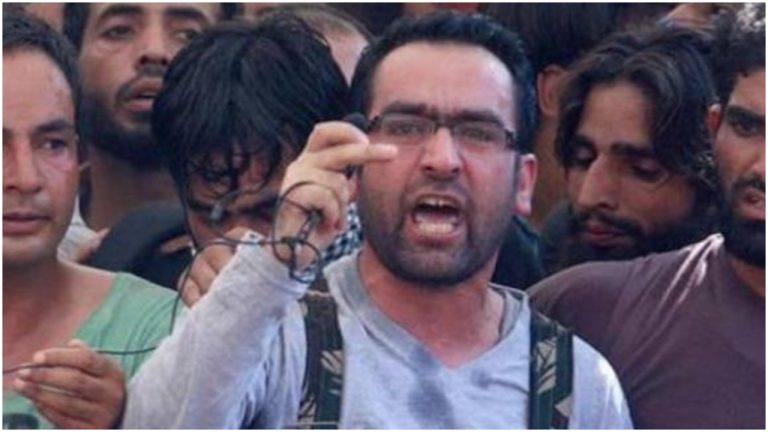
In a massive success to security forces of the country, Riyaz Naikoo – the top Hizb-ul-Mujahideen commander has been killed by the Indian Armed Forces near a village near Pulwama on Wednesday.

According to the reports, the Islamic terrorist Riyaz Naikoo was trapped in a village during an overnight operation in Beighpora village in Jammu and Kashmir’s Pulwama. During the encounter last night, another unidentified terrorist was also killed by the security forces in the Awantipora area.

Riyaz Naikoo took over as the commander of Hizbul Mujahideen after the outfit’s poster boy and commander Burhan Wani was killed in a gunfight with the security forces in Kokarnag area in Anantnag district on July 8, 2016.

The dead Hizbul terrorist was quite active in the valley and responsible for various abductions and recruitment of fresh blood to the Hizbul Mujahideen over the years.

A joint team of the Jammu and Kashmir Police, Army’s 55 Rashtriya Rifles and CRPF had launched a search operation in Beighpora after security agencies were a tipped-off about the presence of terrorists in the area. The operation was reportedly launched to track down Naikoo.

Riyaz Naikoo – one of the most wanted terrorists

The dreaded terrorist – Riyaz Naikoo is a top Hizbul Mujahideen commander. He had carried a reward of  Rs 12 lakh on his head. The killing of Riyaz Naikoo is a big blow to the local terror groups active in the area, especially Hizbul Mujahideen. Riyaz Naikoo is among the oldest surviving members of the Hizbul Mujahideen.

Riyaz Naikoo is also responsible for holding the remaining faction of Hizbul together after it disintegrated when Zakir Musa broke away from the Hizbul ranks to form his own splinter group.

Musa had split from the Hizbul in 2017 and formed his own group called Ansar-Ghazwatul-Hind that claimed to be the Indian affiliate of the Al-Qaeda.

Islamists attack Indian-origin man in Canada over his social media posts, bully authorities to terminate him from job

After Islamist in Gulf nations and Pakistanis started targeting Indians, especially Hindus over their social media posts, a similar incident has been reported in Canada after Islamists in Canada backed by certain anti-Hindu establishments targeted him over his tweets while bullying the authorities to terminate him from his job.

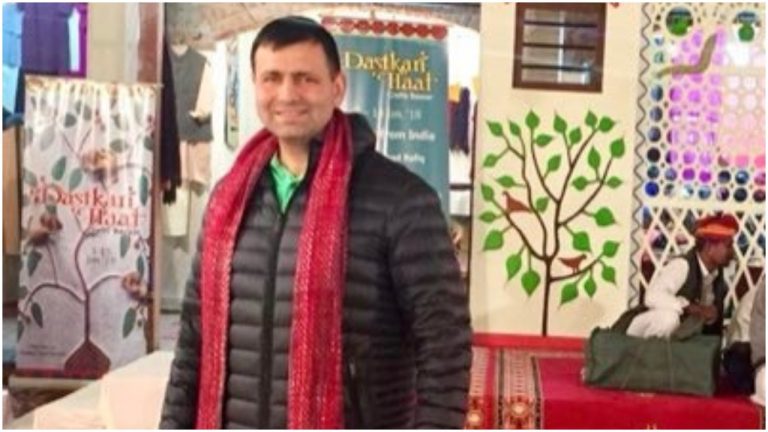
On Tuesday, a group of Islamists attacked NRI Ravi Hooda for expressing his opinion over Canadian authorities allowing Mosques to play azan over loudspeakers every day during Ramzan.

Last week, several Toronto-area municipalities had reportedly granted permission to local Mosques to broadcast the azan over speakers at sunset every day during Ramzan, the Muslim holy month.

Azan from loudspeakers

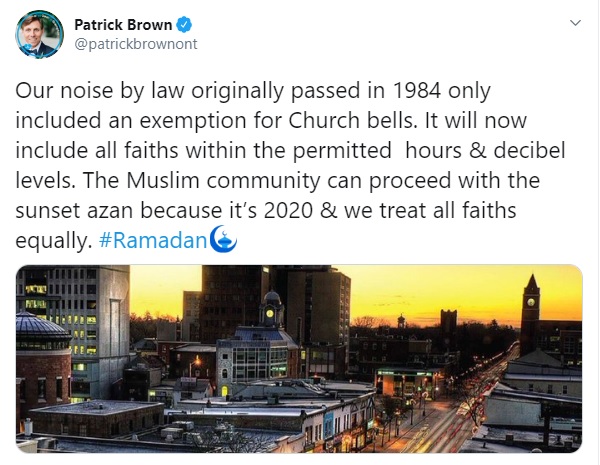
Brampton Mayor Patrick Brown took to Twitter to state that the new laws will allow the Mosques to broadcast azan and claimed that they treated all the faiths equally.

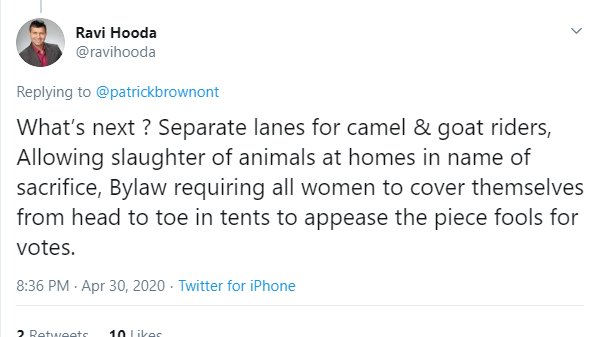
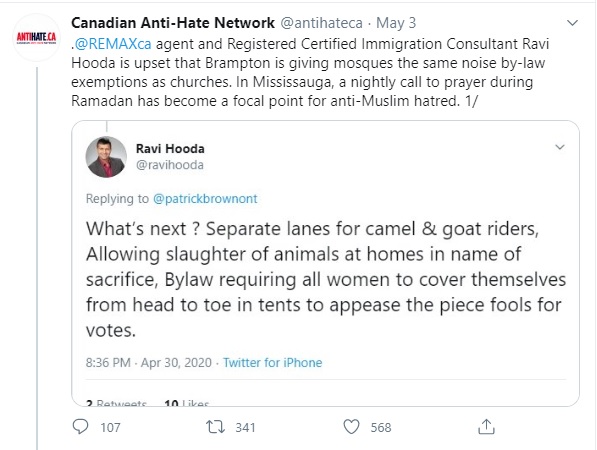
Responding to Mayor’s tweet, Ravi Hooda questioned the decision of allowing Mosques to play the Islamic call for prayer on loudspeakers, which is considered to be a nuisance in most societies. Hooda asked whether they would allow separate lines for camel and goat riders and also allow to slaughter animals at home in the name of sacrifice. It is notable here that blaring Azan from loudspeakers is prohibited even in Saudi Arabia, the centre of the Islamic faith.

As Ravi Hooda expressed his opinion on the need of municipalities granting local mosques permission to broadcast the Azan over speakers, the Islamists and self-proclaimed hate trackers descended on his timeline to attack the Indian-origin Hooda and also bullied the authorities to take strict action against him for the alleged “Islamophobic” tweets he had made.

The user’s Twitter account has since been made private since constant attack on him by Islamists.

The Islamists even doxxed Ravi Hooda’s employment details and bullied the employers to sack him from the job.

Result of Islamists’ outrage

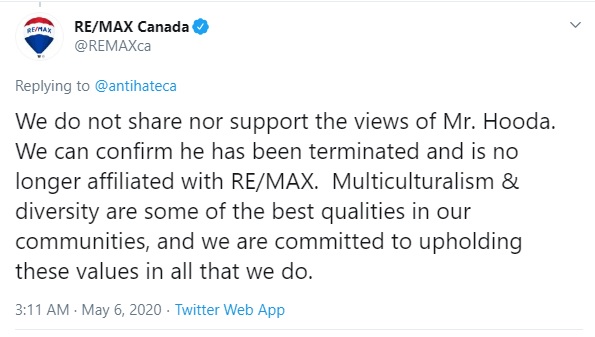
Following the outrage by the Islamists, ReMax Canada, which is one of Canada’s top real estate marketing websites, too informed that it had terminated Hooda’s contract.

It tweeted, “We do not share nor support the views of Mr. Hooda. We can confirm he has been terminated and is no longer affiliated with RE/MAX. Multiculturalism & diversity are some of the best qualities in our communities, and we are committed to upholding these values in all that we do.”

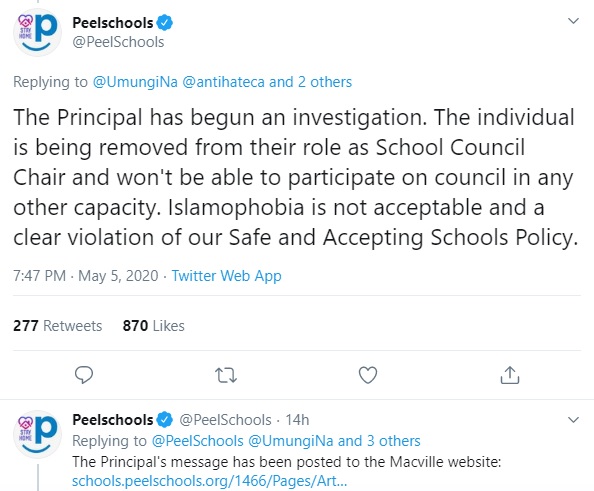
The Peel District School Board in Brampton, where Hooda was the “School Council Chair’, also announced that it had removed Hooda from his position and said an investigation was underway against him.

Hooda was also an executive school council member for the Macville Public School in the city of Bolton.

In a letter posted online, Macville school principal Robin Perri wrote, “Today, we were made aware of a disturbing, Islamophobic tweet that was written and shared by a member of our parent community. We immediately conducted an investigation into the matter.” Perri said the content contravened its Safe and Accepting Schools Policy.

“Please know that this individual’s views in no way reflect the values of the Macville Public School community, nor those of the Peel board. Comments like these are upsetting and hurtful, and never acceptable.”

Hooda says the tweet was misinterpreted

Meanwhile, Hooda said that his comments were “not directed towards any community or entity but just my attempt to state that we should not be going back to the times where such means of communication was necessary”.

“Unfortunately my tweet was misinterpreted,” he said.

Hooda said he removed his tweet and immediately put out another one apologizing “unconditionally,” but that the action hasn’t made much difference.

He says the school board “unilaterally” decided his tweet was directed at a specific community and that did not give him an opportunity to explain himself before removing him from his post. “I am in the process of legally addressing that,” he said.

Fact Check: The truth behind Indian cops dancing while carrying a corpse

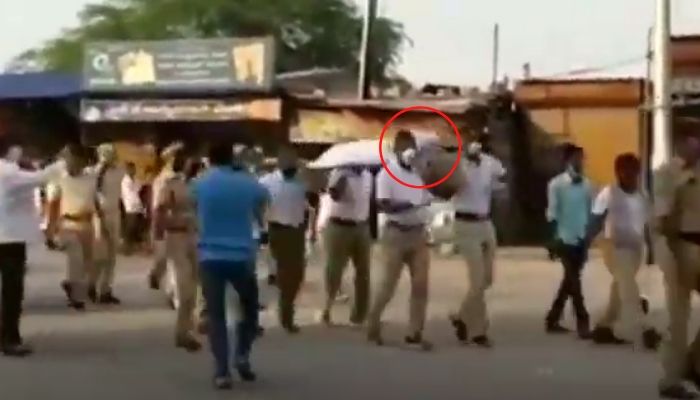
In a video that has now gone viral on social media, a few Indian police officers can be seen dancing while carrying a corpse.

The Inspiration

According to a report by Fact Hunt, the gesture by the police is inspired by a viral meme video of Ghanian Pallbearers who were seen dancing while carrying a dead body. The trope first went viral in 2017 following a BBC report on coffin-carrying dancers in Africa.

Amidst massive casualties caused due to the Wuhan Coronavirus, the pallbearers were in the news again as they symbolised humour at a time of international mourning.

What is the truth?

The video wherein Indian cops can be seen dancing to the tunes of the popular music is a reproduction of the viral meme video. According to Fact Hunt, the video is from Koppal in Karnataka where cops enacted the dance moves to raise awareness about the Chinese virus, amidst the nationwide lockdown.

The ‘corpse’ used by the cops as part of the re-enactment is not a real one. The Coffin Dance Video is aimed at urging people to stay indoors and adhere to social distancing guidelines. The video is available on a Youtube channel named Media Power and is accompanied by the title “Koppal Police Performs Ghana.”

A similar initiative was undertaken by the cops in the Cuddalore district in Tamil Nadu. In the video, a man who had stepped out of his house on a joy ride imagines a group of cops dancing with his dead body. The scared biker then returns home and decides to stay indoors.

Cops turn creative to fight Coronavirus

This is not the first time that Indian cops have relied upon their creative instincts to deter people from unnecessarily wandering around on the streets. In March this year, a police officer named Rajesh Babu has collaborated with a local artist Gowtham and designed a “Coronavirus Helmet” to raise awareness about the deadly Wuhan Coronavirus in Chennai, Tamil Nadu. He wanted to persuade people to comply with the nationwide lockdown by understanding the seriousness of the issue.

Odisha: Health workers, police team pelted with stones, abused by Coronavirus hotspot residents in Rourkela, ASHA workers demand security

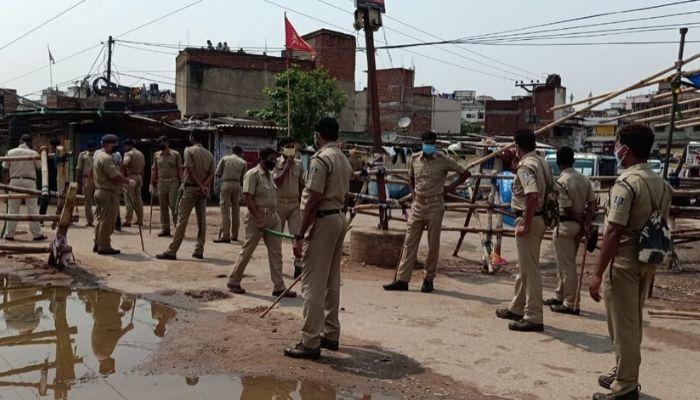
On Monday, May 4 residents of a Coronavirus containment zone (Nala Road) in Rourkela, Odisha, reportedly attacked ground-level health workers who had gone to take away the contacts of a 29-year-old female Coronavirus patient for quarantine.

The patient had tested positive for the Chinese virus on May 4 and was subsequently admitted to Hi-Tech COVID Hospital in Rourkela. The team of health workers came under a volley of stones when they went for contact tracing of the said patient. Barricades that marked the points of entry and exit in the Coronavirus hotspot were also damaged.

When the police team went to tackle the situation, the police team was reportedly attacked too. Locals gathered to pelt stones at the police team.

The situation was brought under control only when DIGP (Western Range) Kavita Jalan and Rourkela SP K.Siva Subramani, rushed to the scene and pacified the situation, on receiving information about the incident. The police interacted with the local leaders and also made it clear that such non-cooperation by the local residents would not be tolerated.

Asha and Anganwadi workers attacked, abused by containment zone residents

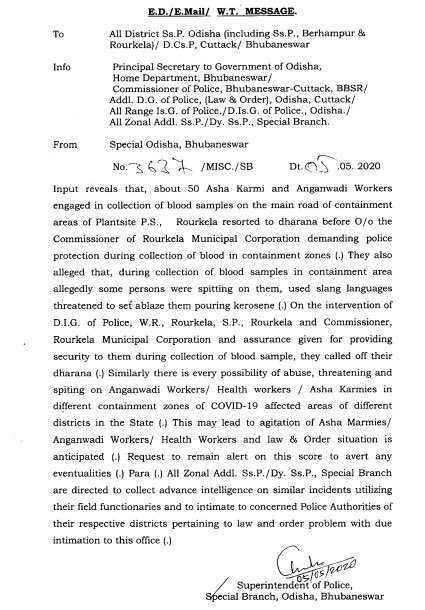
As per reports, the ASHA and Anganwadi workers, when they had approached the containment zone on May 4, were attacked and abused by the locals. The ASHA workers had sat on a Dharna on May 5, alleging that the residents of the containment zone had spat on them, and threatened to burn them with kerosene. The ASHA and Anganwadi workers of the Rourkela city had staged a protest demanding protection.

Following the protest, the DIG and SP assured the ASHA workers that they will be provided with security when collecting blood samples. The SP, special branch of Odisha Police has ordered to SPs of all districts that wherever there is a chance of ASHA workers being attacked in any containment zone, adequate measures are to be taken to ensure safety and provide a security team.

Tribals upset over Jaamatis hiding

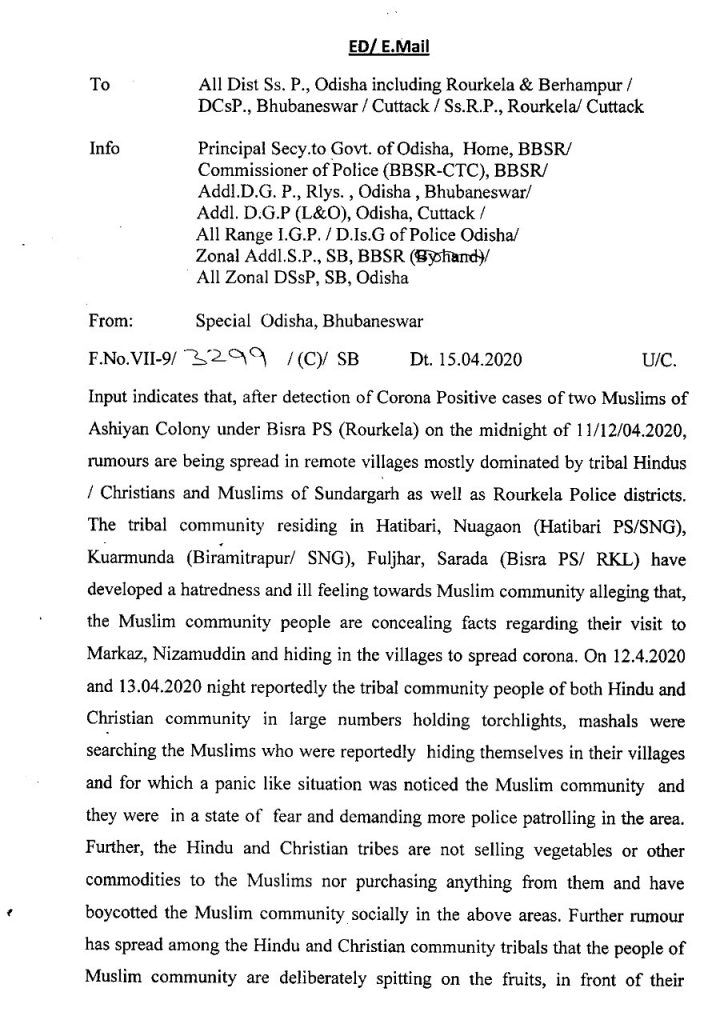
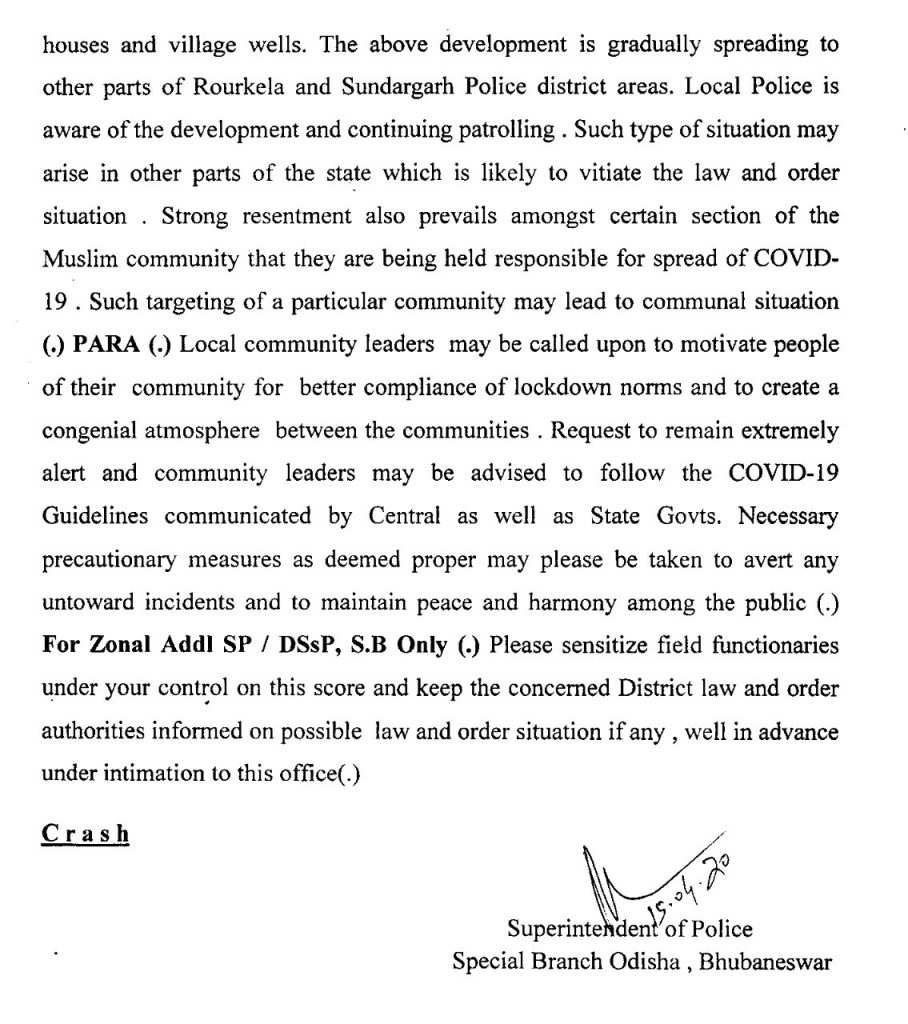
In an April 15 letter written by the Superintendent of Police (Special Branch) to all district SSPs, he had alleged that both the Hindu and Christian tribals in the Sundergarh district have expressed their unhappiness over the fact that several Muslims in the area attended the religious congregation held at the Nizamuddin Markaz between March 13 and March 15.

Following 2 positive cases of Coronavirus found within the Muslim community, the tribals living in the area launched a manhunt to find those Muslims who were reportedly hiding in the village. Coupled with several ‘rumours’ of Muslim men spitting on fruits, the tribals in the area have decided to boycott the Muslim community.

Keeping in mind the need to maintain law and order, amidst the Coronavirus lockdown, the letter called upon all SSPs in Rourkela to remain vigilant and initiate conversations with local community leaders to ensure communal harmony. It is reported that most Coronavirus positive cases from Rourkela were from the Muslim-dominated Nala Road containment zone and the news of Markaz returnees hiding in local areas had created tension among the Hindus and Christians in the area.

Yogendra Yadav spreads fake news over MPs’ salary, claims decreased allowance as increased: Read details

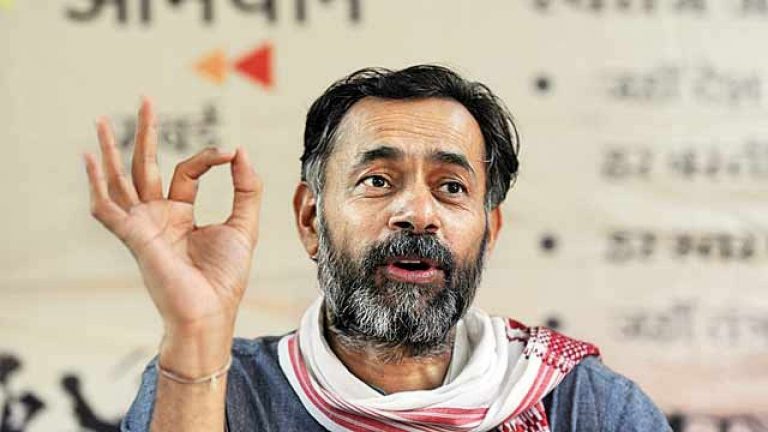
Self-proclaimed activist Yogendra Yadav has been caught again peddling fake news on social media after he indulged in a disinformation campaign against the Modi government on Tuesday by claiming that the government has quietly increased allowances given to the elected Member of Parliament amidst the coronavirus crisis.

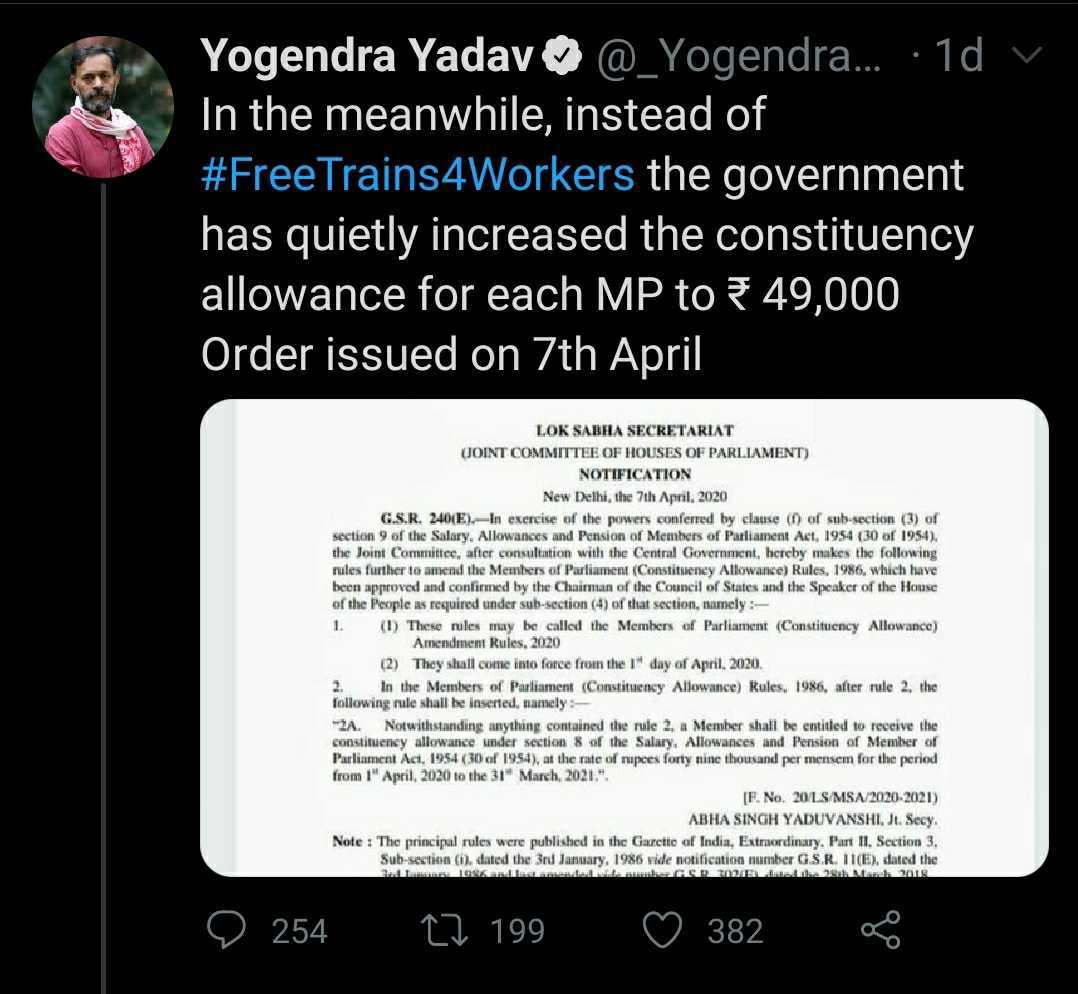
Taking to Twitter, multi-talented Yogendra Yadav lamented that the Modi government, which according to him was supposed to provide free train travel to the migrant workers, had quietly increased the constituency allowance to each MP to Rs 49,000.

The Modi government is providing free train travel to migrant workers, but Yadav, for some reason, refuses to acknowledge.

Citing a government order, he insinuated that the Modi government has increasing allowance given to lawmakers at a time when the country was battling a recession due to the Chinese coronavirus.

Fact check

However, in reality, the claims made by Yogendra Yadav is just an outright lie.

According to reports, the Members of Parliament – who had taken a 30 per cent cut in their salary recently, will now also have to forfeit a total of Rs 21,000 per month from their constituency allowance and office allowance.

The cut of 21,000 is besides the cut in the monthly salary which was made recently. From Rs 1 lakh per month to Rs 70,000.

“Notwithstanding anything contained in the rule 2, a member shall be entitled to receive the constituency allowance under section 8 of the salary, Allowances and pension of members of Parliament Act, 1954 (30 of 1954), at the rate of rupees forty nine thousand per mensem for the period from April 1, 2020 to March 31, 2021,” the government said in a notification.

The new orders have decreased the allowance given to the MPs to Rs 49,000 and have not been increased as claimed by Yogendra Yadav.

Rajya Sabha chairman M Venkaiah Naidu and Lok Sabha Speaker Om Birla accepted the recommendations of Joint Committee and the cut has become effective from April 1, the official order said.

Shocking, despite getting caught spreading fake news, Yogendra Yadav has neither apologised for peddling misinformation nor deleted his tweet.

Yogendra Yadav continues to lie

Yogendra Yadav has been often found resorting to spreading fake propaganda to stay relevant in the public sphere. Recently, he had taken to Twitter to hail lawyer-activist Prashant Bhushan equating him to a “Satyagrahi”, for apologising to Yoga Guru Baba Ramdev through a tweet.

Making a virtue out of lying Prashant Bhushan, apologising, the ultra-Left-wing activist Yogendra Yadav said, “This is what distinguishes a satyagrahi (truth seeker) from a troll. As soon as he finds a factual error, @pbhushan1 offers an apology. His scruples have earned him the respect he enjoys. Can we expect the same from all those celebrating his apology?”

It is pertinent to note that controversial left-wing activist Prashant Bhushan has been caught several times peddling blatant fake news on social media.

Uttar Pradesh: Severed head of calf found amidst reports of stray cows going ‘missing’ from roads

Tension prevailed in Mimlana Road in Muzaffarnagar, Uttar Pradesh, after a severed head of a calf was found in a drain as per a report by Amar Ujala. The police reached the spot and controlled the situation after angry villagers started protesting. As per reports, on Sunday at around 4:15 PM, one man saw the severed head of the calf in the drain. He then informed others who reached the drain and tried to bring out the severed head.

The residents then demanded a probe on reports of cow slaughter in the area. On getting the information, Ramlila Tilla Chowki incharge SI Rajendra Vashisht reached the spot and extracted the severed head of the calf. The police has promised a proper investigation and that the culprits will be punished.

Stray cows and calves are vanishing from roads

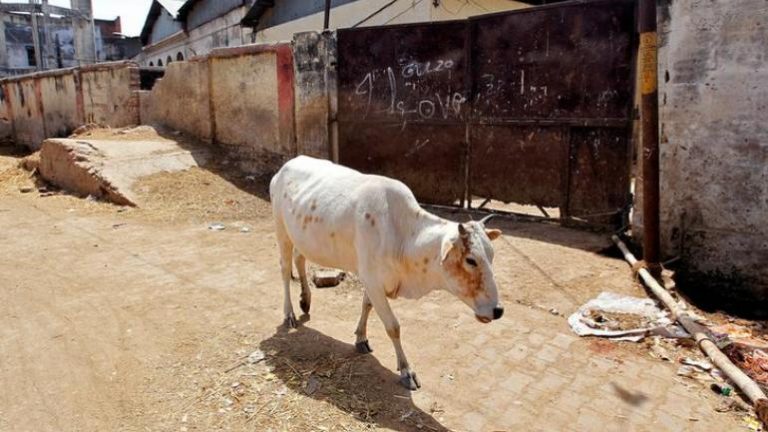
The severed head of the calf is recovered close on the heels of reports that the stray cows and calfs on the roads have suddenly gone ‘missing’ in the lockdown. Amar Ujala report states that in the Ramlila Tilla area, there were over 100 stray cows and calves. The residents used to look after them. However, during the lockdown, the calves and cows have suddenly vanished. People have alleged that the cows may have been slaughtered by those involved in smuggling.

A Jagran report states that a possible reason for the cows to go missing could be due to increased cow slaughter. As per the report, in past 40 days, not a single cow reached a cowshed where earlier around 35 cows were sent to the cowshed in previous two months. Not a single complaint was received of the stray cows walking on the roads.

Bois Locker Room: Class 12 boy in Gurugram commits suicide, police probe his alleged connection to controversial Instagram group

A class 12 boy in Gurugram’s upscale residential area, DLF Phase 5, jumped from the balcony of his flat on 11th floor at around 11 PM on Tuesday. The police is investigating whether he was involved in the controversial ‘Bois Locker Room’ Instagram group.

The teen was a resident of DLF Carlton Estate. His phone has been seized by the police and has been sent to forensic lab for analysis. Cyber crime cell has also been involved to investigate his social media accounts. He has not left any suicide note.

Bois Locker Room

Recently, social media was awash with repugnant details of an Instagram chat group comprising of boys that discussed ‘gang-raping’ girls in a group called ‘Bois Locker Room’ (Bois, being a spin on the word ‘boys’). The leaked photos of the “Bois Locker Room” (Boys Locker Room) Instagram group had kicked up a storm over the normalisation of rape culture in the country. The group allegedly ran by teenage boys, involved graphic sexualisation and sharing of private photos of underage girls, objectifying them and planning gang-rapes with minor girls.

Girls Locker Room

Soon after the chats of the ‘Bois Locker Room’ went viral, screenshots of ‘Girls Locker Room’ were allegedly leaked which showed voyeuristic chats between teenaged and presumably underaged girls. Besides sexualising and objectifying men, several screenshots of the girls’ version of Locker Room leaked on Twitter reveal that not just boys but girls are also active partakers in perpetuating body-shaming and making sexually explicit remarks.