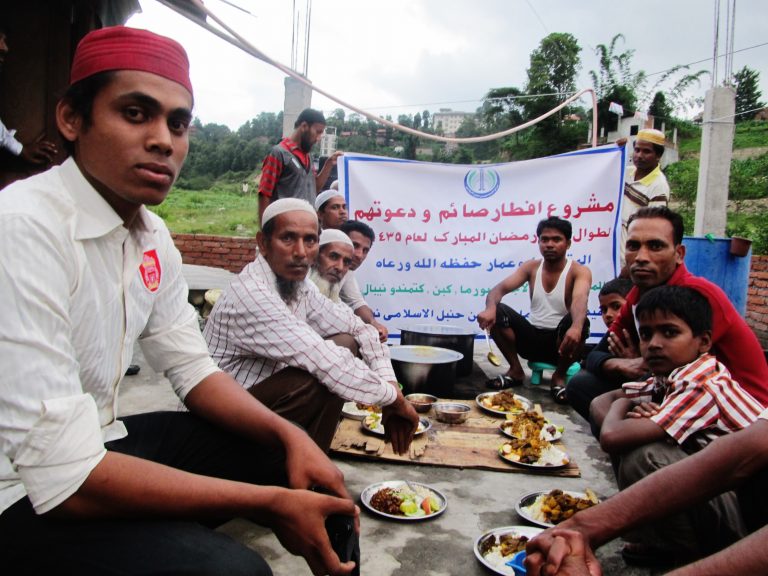
20 Rohingya families have been settled in Nepal along the India-Nepal border. They are settled at the Rupandehi district and have also received funding from some Islamic groups. As reported by Live Hindustan, the Indian intelligence agencies are on an alert after this information. Agencies are reportedly keeping an eye on the movement of Rohingyas near the border regions India shares with neighbouring countries.
The Rohingyas reportedly moved to Nepal after India passed the Citizenship Amendment Act and proposed eventual implementation of National Register for Citizens. The report further states that the sources in intelligence agencies have informed that in recent times a lot of Rohingya families have moved to Nepal and have lodged themselves near Kathmandu. Now they are being shifted to regions near the India-Nepal border. The 20 families who have been moved to Rupandehi have been shifted from Kathmandu. They were earlier funded by some Nepal-based organisations.
As per reports, Rohingyas have settled in other districts of Nepal as well. About 35 temporary homes have been spotted in Dhadhing district. About 104 Rohingyas have also been seen in Panauti district. As per reports, the intelligence agencies have raised concerns over Rohingyas moving to Nepal. Some of the Rohingyas are also in touch with real estate brokers to buy land in Nepal.
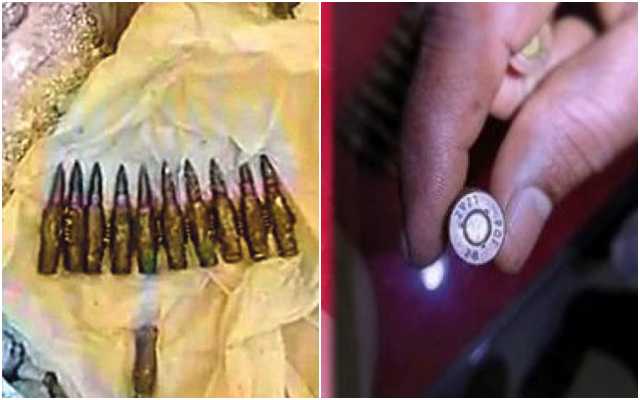
On Saturday, 22 February, two men in Kerala had found an abandoned package which contained bullets. The Kerala police, when alerted had recovered the bullets. As per reports, the seized bullets had carried the markings of “POF”, allegedly pointing towards their origin at Pakistan Ordinance Factory.
As per reports, the package was found in Kulathupuza in Kollam, Kerala. DGP Loknath Behera had reportedly sought the help of central intelligence agencies due to the suspected Pakistani origin of the bullets, suspecting links to a Pakistan-sponsored terror outfit.
Kerala Anti-Terrorism Squad (ATS) investigating the site in Kulathupuzha, Kollam where 14 live bullets with Pakistan Ordnance Factory (POF) markings, were found yesterday. pic.twitter.com/Bfq6siMfQO
The Kerala state ATS had begun its investigation yesterday. Informed by the ATS, a military intelligence squad had also arrived at the spot to assist on the investigation. As per reports, officials from NIA and military intelligence will also help in the investigation.
Officials from military intelligence and NIA had arrived at the spot. As per reports, a total of 14 bullets were recovered. The bullets were of 7.62 mm size and were marked with POF, which is suspected to be ‘Pakistan Ordinance Factory’. Preliminary investigation has revealed that the bullets may have been made in 1981-82. The bullets are used in machine guns. Forensic and ballistic investigations have also begun.
As per tye New Indian Express report, the state crime branch has denied reports that the recovered bullets were the bullets missing from the SAP camp. Crime branch confirmed that the serial number of the bullets stored in the camp have been examined and they do not match with the seized bullets.
The POF is a major firearm manufacturing facility under the Ministry of Defence Production in Pakistan, headquartered in Wah Cantonment, Punjab province in Pakistan. 12 bullets were found inside a bullet pouch and 2 were inside a case. The suspected links to the POF in Pakistan has initiated a major investigation as to persons linked with the supply and use of those bullets.
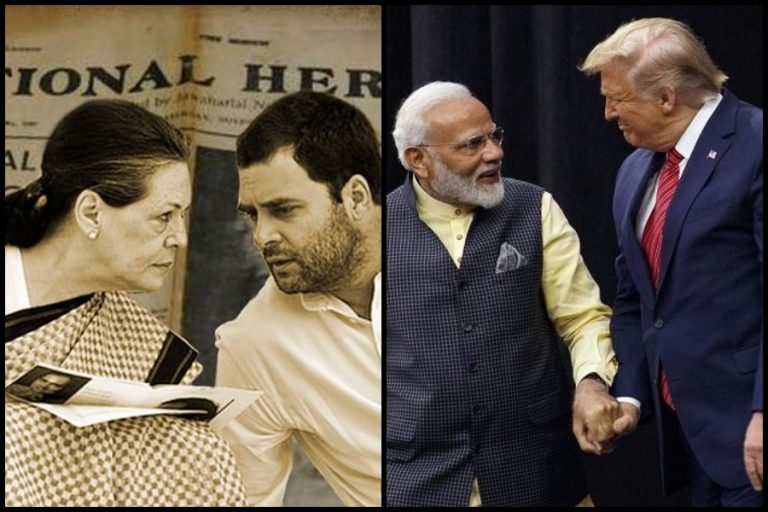
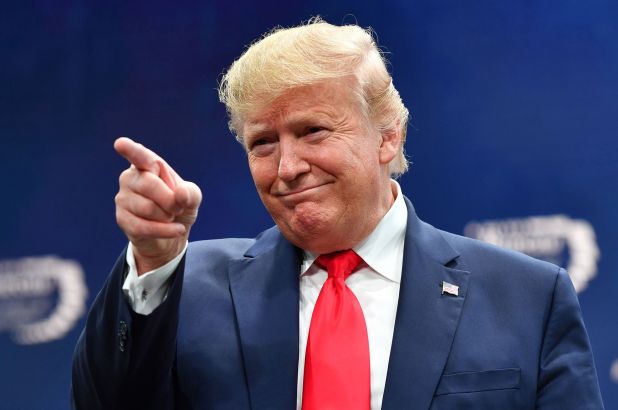
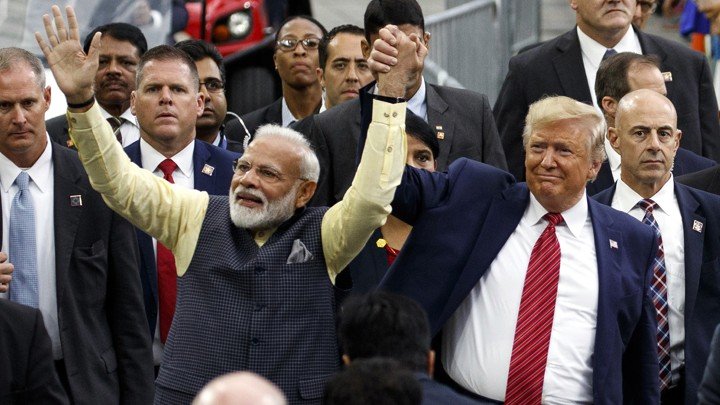
The President of the United States of America, Donald Trump, along with First Lady Melania Trump, daughter Ivanka Trump and the high-level delegation is expected to land in Ahmedabad, India, shortly. Prime Minister Modi will receive him at the airport from where he will go to Motera stadium for the grand Namaste Trump event. Over a lakh people are expected to participate in the Namaste Trump event during his India visit. En route, he will stop by at Sabarmati Ashram and pay respects to Mahatma Gandhi.
Trump will be the seventh American President to visit India. Taking to Twitter on Sunday, Prime Minister Modi tweeted that India looks forward to welcoming US President Trump.
While the event is being touted as a historic milestone in the relationship between India and USA, the usual activists, backed by Congress, have taken it upon themselves to find ways to mar the visit, for petty political reasons.
A shameful article published in the National Herald today bore testament to how the political and civil society dispensation often acts out of hate, against the interests of India.
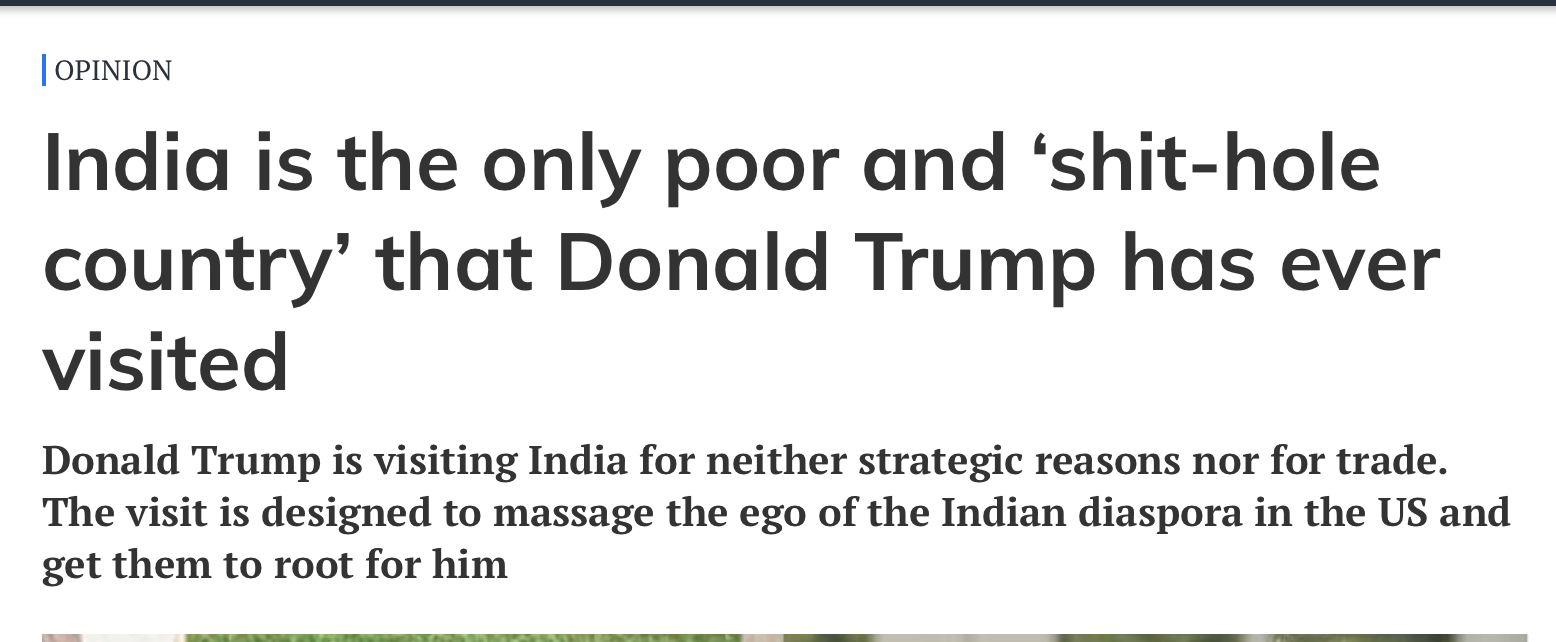
While a historic engagement is about to take off between India and the USA, National Herald, the Congress mouthpiece, decided to publish an opinion article by Aakar Patel headlined, “India is the only poor and ‘shit-hole country’ that Donald Trump has ever visited”.
National Herald article written by Aakar Patel
The article written by Aakar Patel is essentially a rant that gives away the author’s hate, not only for Donald Trump but also for India.
At the outset, Aakar Patel tries to prove, with aa flurry of assumptions, why he thinks, Donald Trump considers India a ‘shit-hole’. First, middle-aged Aakar Patel reminisces and says that when he was 16 and spending time in an American village, there was a desk for exchange student programs where Americans could travel abroad and per him, nobody signed up. Aakar uses this experience, which presumably happened 3 decades ago, to extrapolate and claim that Americans, in general, don’t like to travel, and hence, by extension, neither does Donald Trump.
Then, Aakar Patel proceeds to lie in order to prove why he thinks Donald Trump considers India a shit-hole.
He writes, “Donald Trump since becoming president has visited 20 countries of which the majority are in Europe. He has been to France four times. He dislikes the developing world and doesn’t want immigrants from what he calls ‘shit-hole country’, in which list he presumably includes India”.
Since January 20th 2017, President Donald Trump has actually visited 22 countries, India being the 23rd and unless Aakar Patel considers Philippines, Japan, Vietnam, North Korea, South Korea, Saudi Arabia and Singapore as ‘Europian countries’, he is clearly way off the mark.
Further, Aakar Patel sneakily mentions that Trump has visited France 4 times, in order to somehow insinuate that travelling to “poor, non-white countries” is something Trump considers below his dignity. What he fails to mention is that Trump has also visited Vietnam and South Korea twice.
The rest of his statement, based on these lies, is even more problematic. He uses this lie to essentially peddle his agenda on immigration and his hate for India. He says that Donald Trump dislikes the developing world and does not want immigrants from what he calls ‘shit-hole countries’. While Trump has received serious flak for his immigration policy from the Left-Liberal coterie, what he has essentially stood against is illegal immigration, which is something India is also trying to curb. Aakar brings this up, not because he wishes to critique USA’s immigration policy, but because he wishes to stir that hornet’s nest while anti-NRC riots rage across the country by Muslim mobs and also, to lead into his next assertion. After this, Aakar willy-nilly extrapolates, that since Trump does not support illegal immigration, he must assume that “poor country” India is a shit-hole. That assumption is them added to the headline, which gives the impression that Trump, at some point, has actually called India a ‘shit-hole’, which he has not.
The ideological moorings and bias of Aakar Patel are quite evident when he lashes out at conservatives and praises the liberals, Presidents of the USA or Prime Ministers of India, subtly.
For example, after praising Clinton for having “harsh words about India” when a “Hindutva Govt” under AB Vajpayee was in power, he goes on to deride George W Bush, seen as a conservative and visited India when “Liberal” Manmohan Singh was in power.
Nestled carefully in the body of his article, Aakar Patel reveals the true agenda of writing this hate-rant.
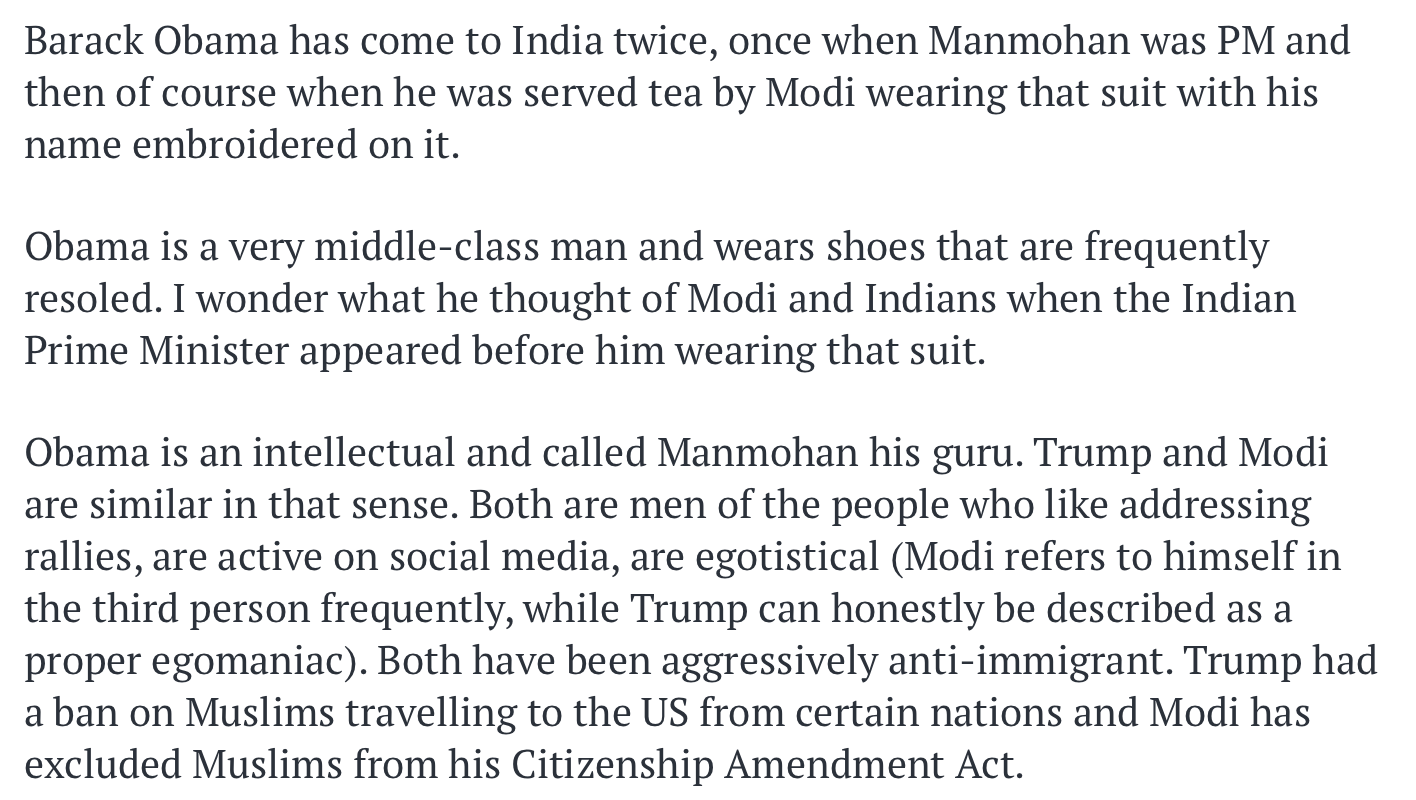
Excerpt from Aakar Patel’s article in National Herald
Hilariously, National Herald, which is a Congress mouthpiece, tries to paint Barack Obama as a frugal middle-class man while Modi, as the flamboyant spend-thrift. Aakar Patel writes how Obama wears re-soled shoes and thus, is a “very middle-class man”.
Interestingly, according to Businessinsider, the net worth of Barack Obama runs into a whopping $40 million. From the time he joined the US senate in 2005 to the end of his presidency, Obama made $20 million alone from his salary, book royalties and the money he charges for speaking engagements – yes – the frugal middle-class do-gooder does not speak to children for free.
The Obamas had entered the White House in 2008 with a little over a million dollars and by the time they left, his net worth was conservatively, over $40 million with the number set to soar higher considering how he has been speaking at several events on a regular basis. Further, in 2017, both the Obamas signed book deals worth well over $60 million. They have also recently signed a production deal with Netflix, the amount of which hasn’t been disclosed yet.
According to Business Insider, in his post-Presidency life, Obama is set to earn well over 242.5 million dollars. Again, a conservative estimate.
While the frugal middle-class Obama is set to be worth hundreds of millions of dollars, Modi, after a political career spanning decades, has assets worth Rs 2.5 crore including a residential plot in Gujarat’s Gandhinagar, fixed deposits of Rs 1.27 crore and Rs 38,750 cash in hand.
He has declared movable assets worth Rs 1.41 crore and immovable assets valued at Rs 1.1 crore.
The prime minister has invested Rs 20,000 in tax saving infra bonds, Rs 7.61 lakh in National Saving Certificate (NSC) and another Rs 1.9 lakh in LIC policies.
His cash balance in the savings bank account is Rs 4,143.
Modi has four gold rings, weighing 45 grams, valued at Rs 1.13 lakh.
With such a massive disparity, it is sheer hate towards PM Modi and India that allows Aakar Patel to lie and for Congress mouthpiece National Herald to publish the drivel.
After this litany of lies, National Herald goes on to equate PM Modi and President Trump as narcissists who hate Muslims, lying that Trump has banned travel of Muslims from certain countries and also, that Modi has excluded Muslims from CAA. CAA is an act that aims to expedite citizenship to persecuted minorities from neighbouring Islamic nations and since the law is aimed towards persecuted, religious minorities, the question of “excluding” the majority people of Islamic nations does not arise – since Muslims being religiously persecuted in Islamic nations does not exactly make sense.
After the blatant lies and assertions that the visit of the US President to India won’t yield much, Aakar Patel finally, albeit unknowingly, admits that this article published in the Congress mouthpiece, was nothing but a propaganda piece aimed to almost campaign for the Democrats in the upcoming presidential elections.
He writes, “A Democrat in the White House will mean greater scrutiny of our actions in Kashmir and over the CAA and National Register controversy. The best thing that Modi can hope for in this visit is that he is able to mobilise Indians in America to vote Republican and try and help Trump return to power”.
Essentially, the Congress party and Aakar Patel would ideally want the Democrats to return to power in the USA so as to ensure that their liberal, Muslim appeasing policies find an audience.
Essentially, the Congress party’s mouthpiece, by publishing this shoddy piece has attempted to cater to their main vote banks – deluded liberals and the rioting Muslims who have taken to the streets since the passage of CAA. For the Liberals, the conservative regime, whether in the USA or India (though both very different principally) is an abhorrent outlier and for the Islamist, USA will always be the big monster out to get them. By equating PM Modi to the big-bad-USA-regime, the Congress effectively caters to its Islamist vote bank and succeeds in fear-mongering. Considering several Congress leaders have been charged in the anti-CAA riots and have actively supported seditious anti-India elements, this motivated article falls completely in line with the official stand the Congress party seems to have taken – Oppose Modi, even if it means breaking India.
“India awaits your arrival. Your visit is definitely going to further strengthen the friendship between our nations. See you very soon in Ahmedabad,” PM Modi tweeted.
US President Donald Trump is expected to land in Ahmedabad at around 11:30 AM from where he will proceed to Motera stadium where Namaste Trump grand cultural event is organised to welcome him. He will also stop by at Sabarmati Ashram to pay respects to Mahatma Gandhi. POTUS is accompanied by his wife, First Lady Melania Trump, his daughter Ivanka Trump, her husband Jared Kushner and high level delegation.
Customs officials at the Kempegowda International Airport in Bengaluru seized five kilograms of ephedrine on Friday. Ephedrine is used for medication and can be abused as a stimulant. It can also be used to manufacture methamphetamine using certain chemical reactions. It is a controlled substance covered under the Narcotic Drugs and Psychotropic Substances Act, 1985.
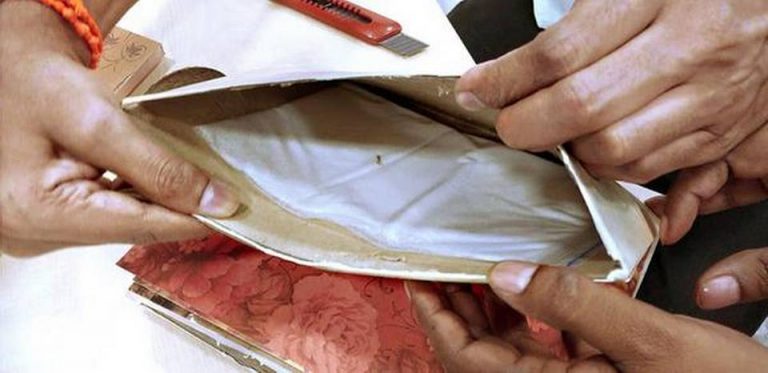
The drug peddlers had concealed the ephedrine in 43 wedding invitations that were due for shipping to Australia.
Customs officials at the #Bengaluru airport seize 5 kg of ephedrine, concealed in wedding invitations that were to be shipped to Australia. Imagine how innovative and alert the officials have to be to counter this menace. pic.twitter.com/GqqWwNDqWR
As per reports, the drug was concealed in 86 pouches and the entire quantity is approximately worth Rs. 5.05 crores. “During verification of export consignment at the courier terminal of Air Cargo Complex, Bengaluru, the officers of Central Intelligence Unit, Air Cargo Complex intercepted an export cargo on February 21. Preliminary scanning of the package indicated the concealment of powder. Detailed examination of the package was done and it was found to contain 43 invitation cards and garments,” Joint Commissioner of Customs, M.J. Chethan, said in a statement.
A total of 86 ephedrine pouches were found expertly concealed within two-sided cardboard of the 43 invitation cards.
“The invitation cards made of cardboard were two-sided and foldable. On cutting open the 43 invitation cards, white crystalline powder was found packed in polythene pouches which had been concealed between the cardboard layers of each side in each of the 43 cards,” he added. Only on the 18th of February, 5 kg of Ephedrine valued at Rs 5 crore in the international market was seized by customs officers of the Air Cargo Complex. This consignment was due to be shipped to Australia as well.
Officials suspect a link between the two consignments. “That consignment of ephedrine, worth over Rs 5 crore in the grey market, was concealed in bobbins, and was also reportedly booked by the same person at Madurai to be smuggled to Australia,” an officer was quoted by The New Indian Express as saying. “We will coordinate with our counterparts in Australia to get a larger picture of the smuggling of contraband drugs,” he added.
It is also reported that the particular courier company was selected because it is the only company in South India to have a gateway to Australia through Bengaluru.
“If you consider both hauls, then the value is estimated to be about ₹10 crores. We are also verifying with the courier agencies and the company that printed the wedding cards,” said a police officer as per The Hindu.
US President Donald Trump along with First Lady Melania Trump, daughter Ivanka Trump and the high level delegation is expected to land in Ahmedabad, India, shortly. Prime Minister Modi will receive him at the airport from where he will go to Motera stadium for the grand Namaste Trump event. Over a lakh people are expected to participate in Namaste Trump event. En route, he will stop by at Sabarmati Ashram and pay respects to Mahatma Gandhi.
Trump will be the seventh American President to visit India. Taking to Twitter on Sunday, Prime Minister Modi tweeted that India looks forward to welcoming US President Trump.
Ahmedabad is India’s first UNESCO World Heritage City. After attending Namaste Trump event in Ahmedabad, the delegation will proceed to Agra where they will visit the Taj Mahal. The US President will then reach Delhi for the main leg of their 36-hour-trip. On 25th February, the US President will receive a ceremonial welcome at Rashtrapati Bhavan as per protocol following which he will go to Rajghat to pay homage at Mahatma Gandhi’s samadhi.
Later, US President Trump and Prime Minister Modi will hold delegation level talks at Hyderabad House in Delhi. After the official meetings have concluded, the US President and First Lady will have a lavish lunch hosted by PM Modi. Later, President Trump will go to ITC Maurya Hotel where External Affairs Minister S Jaishankar and Vice President Venkaiah Naidu are expected to call on him. On 25th night, the US President will leave back for US on his special flight.
Ahead of his visit to Ahmedabad, the city has turned into a fortress with thousands of security personnel deployed for the security. Some people have been detained as well but Ashish Bhatia, the Commissioner of Police, said that he will not be able to disclose the number of detainees as of now. The Defence Research and Development Organisation (DRDO) has been requested for the anti-drone system. and people have been directed not to use drones for any purpose.
The POTUS and FLOTUS will enjoy some Gujarati delicacies like khaman and multigrain rotis during their visit to India. Broccoli-corn samosa, honey-dip cookies and special chai also on the menu.
US President has been particularly excited at the grand reception he’ll be getting which is expected to be attended by lakhs of people.
#WATCH US President Trump ahead of his visit to India: I look forward to being with the people of India, we will be with millions&millions of people. I get along very well with PM,he is a friend of https://t.co/gdvh2zVfyu told me this will be the biggest event they have ever had. pic.twitter.com/2aG6jr1m9G
US President Donald Trump has also demonstrated his excitement towards visiting India in his own unique way by sharing a spoof video of Bahubali on Twitter that superimposed his face over the face of the lead in the movie. Donald Trump retweeted the 81-second video by a Twitter account identified as Sol, who had written, “To celebrate Trump’s visit to India I wanted to make a video to show how in my warped mind it will go… USA and India united!”.
Chief Minister of Uttar Pradesh Yogi Adityanath has said that this generation is privileged as it will witness the construction of the Bhavya Ram Mandir at Ayodhya. The construction of the Mandir is expected to begin within six months and the foundation stone laying ceremony of the proposed Ram Temple in Ayodhya is expected to occur on an auspicious date in April.
The Mahant of Gorakhnath Muth said, “Our generation is fortunate, we all saw the Ram Janmabhoomi movement, we also got the opportunity to, directly and indirectly, participate in the movement and we will also see the construction of the grand temple of Lord Rama with our own eyes.” He made the remark after visiting Ramlalla and Hanumangarhi.
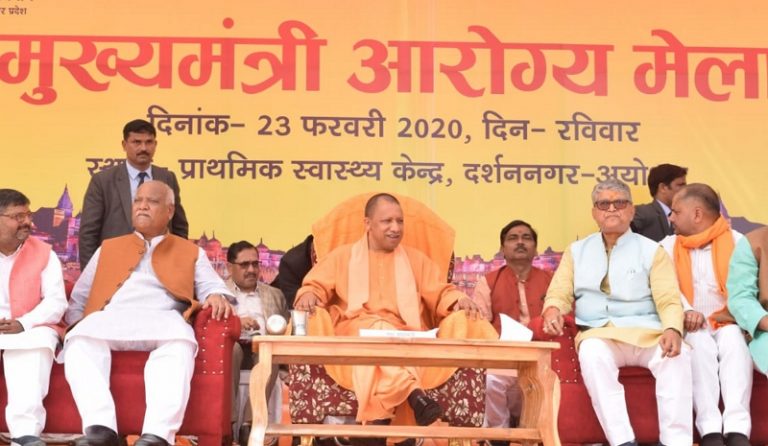
The UP chief minister made the comments in Ayodhya on Sunday, on his first visit to the temple town after the Supreme Court verdict on the Ram Mandir – Babri Masjid dispute. He inaugurated the Mukhya Mantri Aarogya Mela, a health fair, in Ayodhya, after which he attended a gathering of Hindu seers where he made the comments.
UP के मुख्यमंत्री योगी आदित्यनाथ: हम लोगों की पीढ़ी सौभाग्यशाली है, हम सबने राम जन्मभूमि आंदोलन को आंखों से भी देखा, प्रत्यक्ष-अप्रत्यक्ष रूप से आंदोलन में सहभागी होने का सौभाग्य भी मिला और भगवान राम के भव्य मंदिर का निर्माण भी हम सब लोग अपनी आंखों से देख पाएंगे। pic.twitter.com/PrqLGYWrP7
Commenting on the apex court’s verdict paving the way for construction of a Ram Mandir in Ayodhya, the chief minister said, “The Supreme Court has shown its judicial power to the world by its verdict over the issue of Ram Mandir.”
“I always told saints of Ayodhya to have trust in Prime Minister Modi as under his leadership, we will achieve our goal of having a Ram Mandir in Ayodhya,” he added.
The Gorakhpur Muth, with which Yogi Adityanath is associated, itself has contributed significantly towards the Ram Janmabhoomi Movement. Three generations of the Gorakhnath Muth have made significant contributions towards the return of Ramlalla to Rama Janmabhoomi. Mahant Digvijay Nath conceived the idea, Mahant Avaidyanath nurtured it and the dream will be fulfilled by Mahant Yogi Adityanath as Chief Minister.
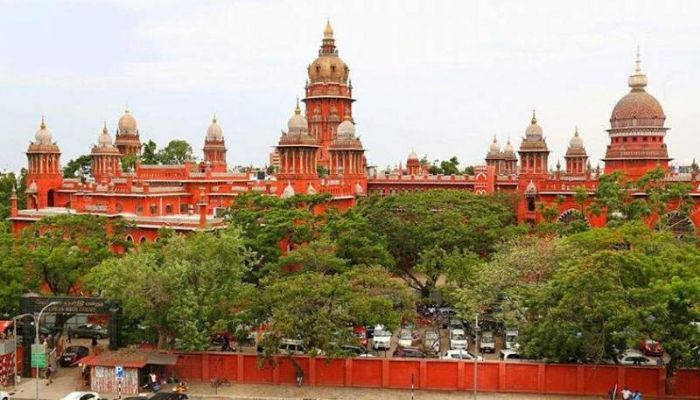
A 2-Judge Bench of the Madras High Court comprising of Justices M Sathyanarayanan and R Hemalatha had observed that a solitary allegation of “intemperate language” against a female employee does not constitute sexual harassment under the Sexual Harassment of Women at Workplace (Prevention, Prohibition and Redressal) Act, 2013.
The Court warned against the misuse of the said Act through “exaggerated” or “non-existent claims.” The Bench noted that discrimination against a female employee on grounds of inefficiency cannot find recourse under the Sexual Harassment Act.
The court said, “though the Sexual Harassment of Women at Workplace (Prevention, Prohibition and Redressal) Act, 2013 is intended to have an equal standing for women in the work place and to have a cordial workplace in which their dignity and self respect are protected, it cannot be allowed to be misused by women to harass some one with an exaggerated or non existent allegations.”
The petition was filed by V Natarajan, Deputy Registrar of Trade Marks and GI, Intellectual Property of India. He was initially accused of “high-handedness” by a fellow female officer. However, a later complaint by the same woman in 2016 talked of “lewd remarks” and “sexual advancements”.
The Madras High Court observed discrepancies between the first and the second complaint and also stated that the complaint that alleged sexual harassment was devoid of details, dates, and sequences of events. The Court also found that the original complaint was generic in nature, detailing the alleged high-handedness of the Deputy Registrar in office. It did not contain any sexual harassment allegations.
As such, the Bench opined, “The complaint repeatedly mentioned the word ‘sexual harassment’ without describing it. It gives an appearance as to that instructing a woman employee to do something officially or even scolding a woman employee itself is sexual harassment. The complainant, it appears, made a futile attempt to settle her personal score with the petitioner. ”
Granting relief to Natrajan, the Court stated that a Chief or an Administrator has every right to extract work and use his/her discretion and prerogatives. The Bench said, “Every office has to maintain certain decorum and women employees cannot be allowed to go scot-free without completing their assignments.”
The Court clarified that a full-fledged enquiry in a case that comes under the ambit of the Sexual Harassment Act. It subsequently quashed the prima facia conclusions arrived at by the district Local Complaints Committee (LCC) which was upheld by a Central Administrative Tribunal against the petitioner.
The administration of the state-run All India Institute Of Medical Sciences (AIIMS) in Delhi has demanded a response from the president of the Resident Doctors’ Association (RDA) of AIIMS Delhi to explain “political” social media messages praising Aam Aadmi Party and calling BJP ‘facist force’ posted from its Twitter account on 12 February.
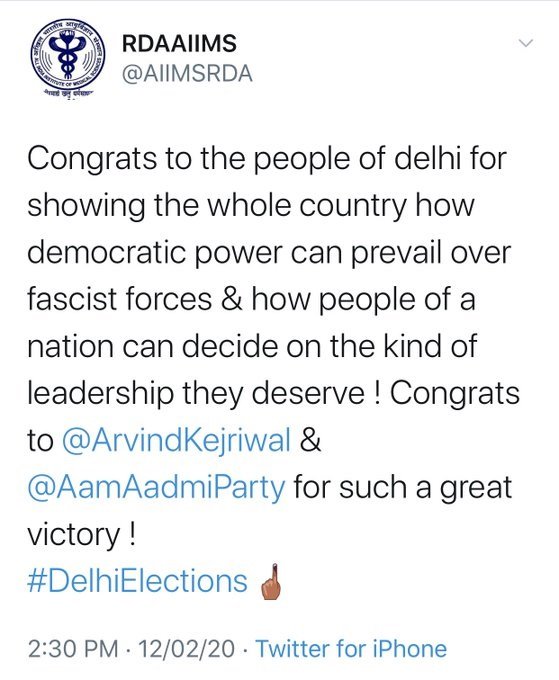
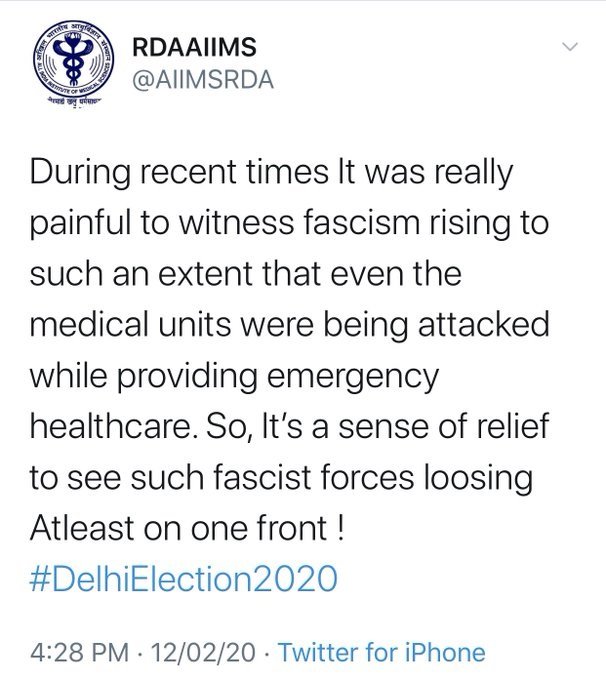
The Resident Doctors’ Association (RDA) of AIIMS Delhi had taken to Twitter a day after the Delhi assembly elections results were announced to make a political opinion on behalf of the AIIMS medical community. In a tweet, the RDA not only celebrated the victory of Arvind Kejriwal-led AAP but also claimed that it was an election that defeated ‘fascist forces’.
The RDA of the AIIMS then congratulated AAP and Delhi CM Arvind Kejriwal for a great victory in the Delhi elections.
In a second tweet, Resident Doctors’ Association of AIIMS claimed that it was a sense of relief for them to see ‘fascist forces’ losing at least on one front as in recent times it was really painful to witness fascism rising in the country. The RDA further alleged that the fascist forces had attacked the medical units that were providing emergency healthcare.
Following these statements, a controversy had erupted as social media users and civil society members condemned the unethical behaviour of the AIIMS Resident Doctors’ Association, which was actually supposed to be politically neutral. Facing widespread criticism, the tweets were subsequently deleted.
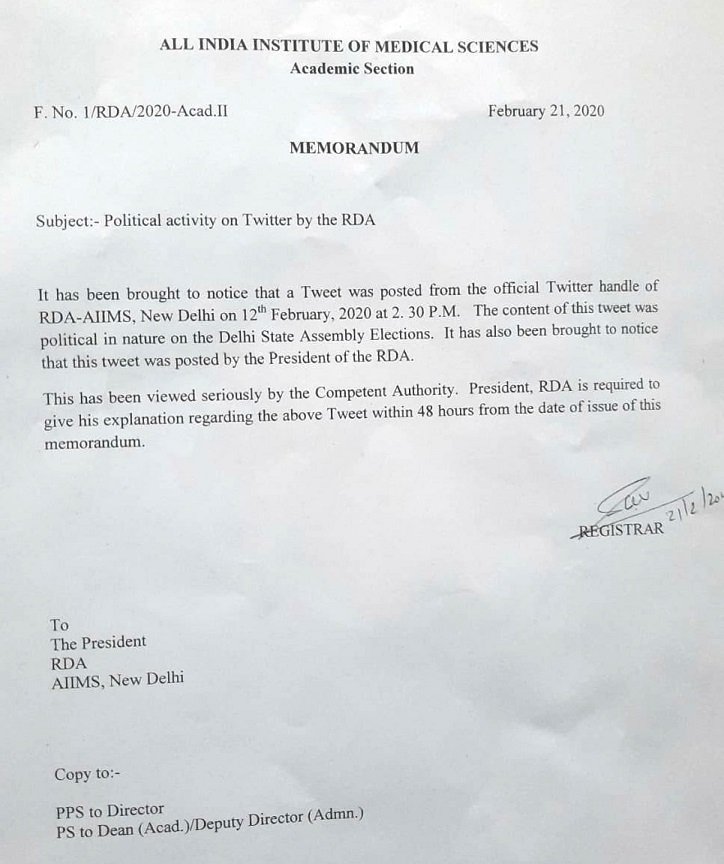
Responding to the controversy, the AIIMS Registrar has now written a letter to the RDA president to explain his act of using official social media handles to tweet political posts.
The letter sent to AIIMS RDA
“The content of this tweet was political in nature on the Delhi State Assembly Elections. It has also been brought to notice that this tweet was posted by the President of the RDA,” the letter reads.
The letter further said, “This has been viewed seriously by the Competent Authority. President, RDA is required to give his explanation regarding the above tweet within 48 hours from the date of issue of this memorandum.”
Copies of the letter, dated 21 February, have been marked to the Director and the Dean of AIIMS Delhi.
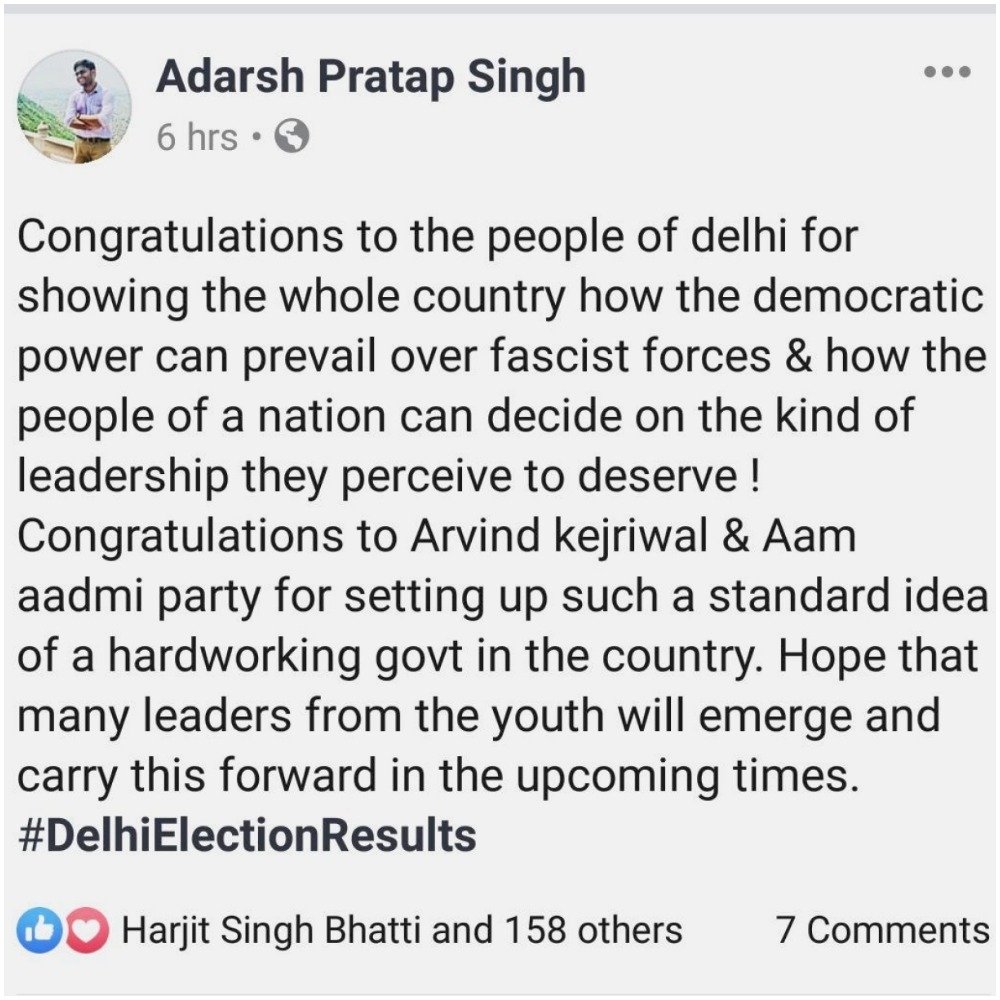
Interestingly, Adarsh Pratap Singh, who is the President of the RDA AIIMS, was caught posting the same post on his Facebook account after the results of the recent Assembly elections in New Delhi.
The Swarajya reported that they tried to contact Adarsh Pratap Singh, the President of the RDA AIIMS. However, he disconnected the call after he realised that he was speaking to a journalist.
A doctor at AIIMS, on condition of anonymity, has also revealed that the tweets had created quite a furore among the RDA members as well the larger doctor community in AIIMS and other Centre-run institutes, and therefore they were subsequently taken down.
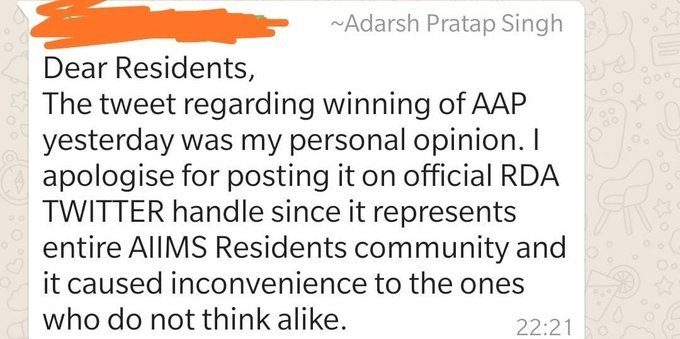
The doctor also shared a message of Singh on a WhatsApp group after deletion of the tweet, which reads, “Dear Residents, The tweet regarding winning of AAP yesterday was my personal opinion. I apologise for posting it on the official RDA Twitter handle since it represents the entire AIIMS Residents community and it caused inconvenience to the ones who do not think alike (sic).
Saurabh Sachar, who is senior resident and Governing Council Member of RDA of central government-run Safdarjung Hospital and Vardhman Mahavir Medical College, said,”RDAs are apolitical organisations and basically mandated to work for the welfare of resident doctors. The political views that their members hold are individual and RDA platforms should not be used to propagate them.”
It is important to note that following the riots that were allegedly unleashed by left-wing forces in the JNU campus, several injured students of Jawaharlal Nehru University (JNU) who are associated with the Akhil Bharatiya Vidyarthi Parishad (ABVP) had alleged “discrimination” on the basis of ideology by doctors at AIIMS Delhi in January.
A doctor, who had issued ‘official’ statement to media on behalf of AIIMS are the violence at JNU, Dr Harjit Singh Bhatti, was found not to be associated with AIIMS, and he is only former president of the Resident Doctors’ Association at AIIMS. He is also activitely involved in anti-CAA protests. Despite being an outsider, he was allowed access to AIIMS wards where the JNU students were being treated.
Security has been heightened at Ahmedabad ahead of US President Donald Trump’s visit to India. 33 Deputy Commissioners of Police, 75 Assistant Commissioners of Police, 300 Police Inspectors, 1000 Sub-Inspectors, 12000 jawans, and 2000 women police personnel have been deployed across the city to provide adequate security for the visit.
Ahmedabad Commissioner of Police, Ashish Bhatia on US President Donald Trump’s visit: 33 Deputy Commissioners of Police, 75 Assistant Commissioners of Police, 300 Police Inspectors,1000 Sub-Inspectors, 12000 jawans, & 2000 women police personnel have been deployed across the city pic.twitter.com/R6F8AyNLWG
Some people have been detained as well but Ashish Bhatia, the Commissioner of Police, said that he will not be able to disclose the number of detainees as of now. The Defence Research and Development Organisation (DRDO) has been requested for the anti-drone system. and people have been directed not to use drones for any purpose. Air Vistara, Indigo and Spicejet airlines have also directed their passengers to arrive early for departure in view of the expected congestion in traffic.
Donald Trump will be attending the ‘Namaste Trump’ programme at the Motera Stadium in Ahmedabad after visiting the Sabarmati Ashram. The event is expected to conclude at 3 PM and Trump is expected leave for Agra by 3.30 PM. Traffic diversions and adequate security arrangements have been made in that area too.
Ahmedabad Commissioner of Police, Ashish Bhatia: The event ‘Namaste Trump’, at Motera Stadium will end by 3 PM. US President Donald Trump is scheduled to depart for Agra at 3:30 PM. https://t.co/siNeVsYEib
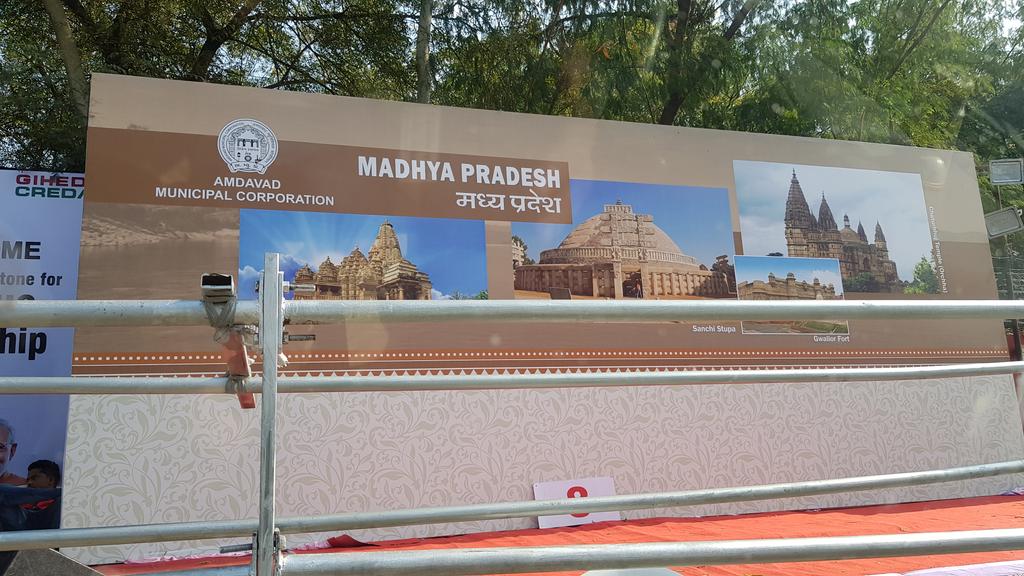
Other preparations have also been made for cultural events. Twenty-eight stages have been constructed for cultural performances at the SVPI Airport road. Classical and western performances will be performed along with performances by children. There will also be state-wise cultural performances during the event.
One such stage created for the event (Source: @DeshGujarat/Twitter)
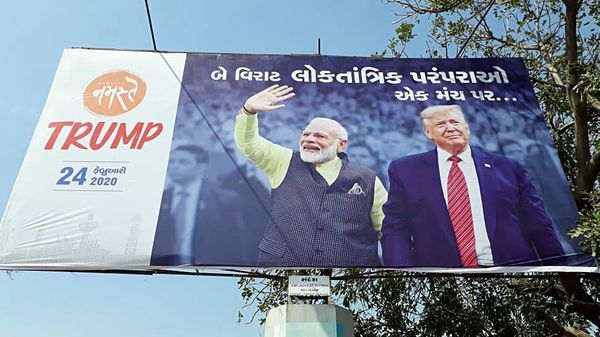
Tall cut-outs of Prime Minister Narendra Modi and POTUS Donald Trump have also been put up ahead of the visit. Various installations featuring Mahatma Gandhi have been set up on the Subhash bridge-Sabarmati Ashram route to mark Gandhi150, a celebration of 150 years since Gandhi’s birth. The 2nd of October, 2020 will be Gandhi’s 150th birth anniversary. Chief Minister of Gujarat Vijay Rupani shared a video on social media that portrays the enthusiasm among people for Donald Trump’s visit. Ahmedabad has been decked up for Donald Trump’s visit and the event will showcase the cultural diversity and prowess of India.
US President Donald Trump has also demonstrated his excitement towards visiting India in his own unique way by sharing a spoof video of Bahubali on Twitter that superimposed his face over the face of the lead in the movie. Donald Trump retweeted the 81-second video by a Twitter account identified as Sol, who had written, “To celebrate Trump’s visit to India I wanted to make a video to show how in my warped mind it will go… USA and India united!”.