After facing a huge embarrassment for failure to garner enough number to form a government, the defeated Shiv Sena is now hoping for a reconciliation with its pre-poll alliance partner BJP.
According to the reports, Shiv Sena after being dumped by both Sharad Pawar led NCP and Congress on Tuesday, seems to have a learnt the lesson the hard way and has now decided to keep its door open for BJP over a possible government formation in the state.
#WATCH Mumbai: Shiv Sena chief Uddhav Thackeray reacts to a question ‘Is the BJP option completely finished?’. Says, “Why are you in such a hurry? It’s politics. 6 months time has been given (President’s Rule). I didn’t finish the BJP option, it was BJP itself which did that…” pic.twitter.com/3pew41hMuF
As per reports, the Sena mouthpiece ‘Saamna’ has today blamed the BJP for the political mess, claiming that the situation has been avoided had they ‘kept their promise’.
This is one of the many flip-flops displayed by the Sena in the recent days exposing its utter desperation to form a government and grab the CM’s post, despite winning just 58 seats, as opposed to the BJP’s 105 seats.
As Maharashtra governor refused to give further time to Shiv Sena to form the government, the party had approached the Supreme Court against Maharashtra Governor Bhagat Singh Koshyari’s decision. It was reported that Sena is going to rope in senior lawyer and Congress leader Kapil Sibal to present its case in court.
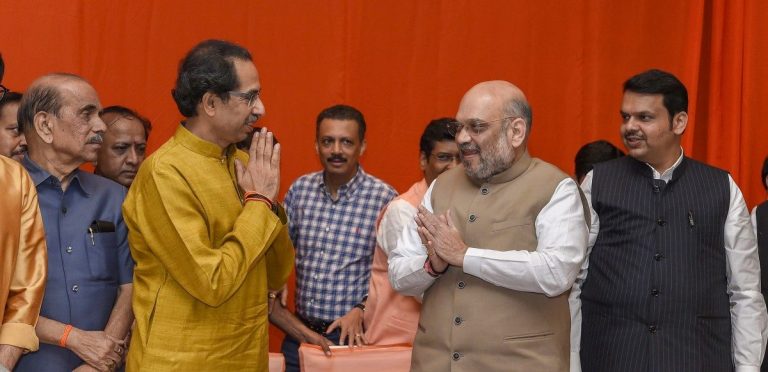
Following this development, party chief Uddhav Thackeray addressed a press conference on Tuesday in which he stopped short of saying that the alliance with the BJP was over. Responding to a question whether the party’s tie-up with BJP is completely over, Thackeray had said, “Why are you in such a hurry? It’s politics. President has given us six months’ time.”
Putting the blame on the BJP, Thackeray had said it was BJP who refused to form the government with Shiv Sena by not keeping the promise that it had made before the Lok Sabha polls. “If the option has been exhausted, it would have been done by them and not me. If the alliance has ended, it is BJP that ended it,” Thackeray said.
Uddhav Thackeray further claimed that BJP was in a situation before the Lok Sabha polls, that it could not win more than 200-220 seats in Parliament. “It was I who went along with BJP in those dark times. So the option of going with BJP again may have been ended by them,” he said.
It is notable here that the Sena’s insistence on the CM post had caused the failure of the pre-poll alliance with the BJP. The BJP had stood on its ground that no 50-50 formula was agreed upon the parties and only Devendra Fadnavis will be the CM.
This comes a day after Shiv Sena had pulled out its MP Aravind Sawant from the NDA government hoping that they would form a government with support from the Nationalist Congress Party and the Congress. Soon, the Shiv Sena had rushed to the Governor to inform that it is willing to form the government.
However, both NCP and Congress backtracked regarding their support to Shiv Sena and clarified that they have not sent any letter of support for Shiv Sena. A press release issued by the Congress mentioned that the party was talking to Sharad Pawar, without mentioning anything about Shiv Sena.
On 24th October when the Maharashtra state assembly elections were declared, nobody would’ve imagined that President’s rule will be imposed in the state. In an assembly of 288 constituencies, the BJP won 105 seats, emerging as single largest party and its pre-poll alliance partner Shiv Sena got 56 seats. But owing to Shiv Sena’s stubbornness, not only did it put an entire state into uncertainty, it also paved way for its own oblivion.
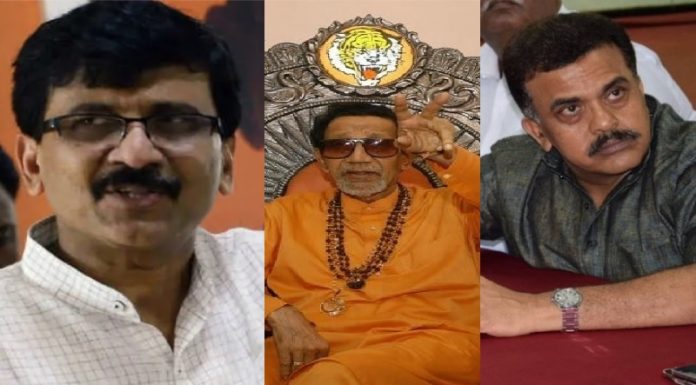
In this entire political drama, one cannot forget the role of Sanjay Raut, who is the Rajya Sabha MP from Shiv Sena representing Maharashtra. He is also the executive editor of Shiv Sena mouthpiece, ‘Saamana’. His extremely vocal politics reminded people of the executive editor of Saamana’s Hindi version, ‘Dopahar Ka Saamana’, Sanjay Nirupam. It was said that whatever Sanjay Nirupam is saying, it is endorsed by Bal Thackeray, the Shiv Sena founder and father of current Shiv Sena chief Uddhav Thackeray. Hence when Sanjay Raut repeatedly said that Maharashtra chief minister would be from Shiv Sena, it was believed that it was endorsed by Uddhav Thackeray.
In 1993, Bal Thackeray made Sanjay Nirupam executive editor of ‘Dopahar Ka Saamana’. Nirupam soon became Thackeray’s blue-eyed boy. He got awarded for his loyalty too. Sanjay Nirupam was sent to the Rajya Sabha by Shiv Sena in 1996. But as soon as he established himself in politics, Sanjay Nirupam jumped ships and ditched Shiv Sena for Congress.
As Sanjay Nirupam moved on to Congress, Sanjay Raut started to gain prominence in Shiv Sena. He may have started his political career in Shiv Sena after Sanjay Nirupam left, but he was the executive editor of Saamana since 1992. Some even say that he was the one who brought Nirupam to Matoshree. Nirupam’s wife is a Marathi and an old acquaintance of Sanjay Raut. After the 1992 riots and 1993 Mumbai blasts, when Bal Thackeray decided to launch a Hindi paper, it was Sanjay Raut only who had recommended Sanjay Nirupam to Bal Thackeray.
After Nirupam left, there was a void of big leader in Shiv Sena. To fill that void, Raut entered active politics. But, Bal Thackeray’s Hindutva politics has taken a blow because of this one step. Matoshree is now dependent on ‘Matashree’. Shiv Sena has tried to form government by forging an alliance with a party whose government was once referred to as ‘a rule of eunuchs’ by Bal Thackeray. Uddhav Thackeray has put trust in the politics of Sonia Gandhi and Sharad Pawar. On their command, he got his central minister to resign from Modi cabinet. Even then, Sonia Gandhi and Sharad Pawar did not welcome him with open arms.
After Sanjay Nirupam left Shiv Sena, Bal Thackeray had once famously said that he has stopped having a pet dog. Uddhav, however, neither has the attitude of Bal Thackeray nor power. So, he may not be able to express his feelings. He perhaps forgot that in the Hindu epic Mahabharat, it was Sanjaya who had relayed the scene from Kurukshetra to Dhritarashtra. These are the Sanjay of today. They will not leave a chance to throw their leader under the bus with their high promises. Whether it is Congress spokesperson Sanjay Jha or Bihar Chief Minister’s close aide and Bihar minister Sanjay Kumar Jha.
Note: You can read the above article in Hindi here.
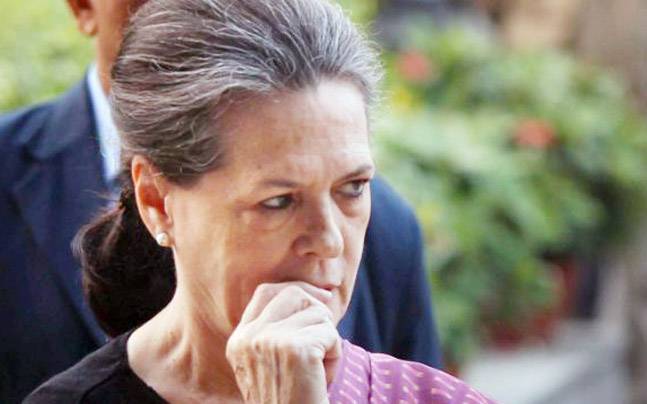
As the drama continues in the state of Maharashtra over the formation of the government, Congress leaders from the state have reportedly warned interim president Sonia Gandhi that the party will be finished in Maharashtra if they fail to take this opportunity of forming an alliance government.
According to a Times of India report, the Congress leaders in the state have predicted a doomsday scenario for the party if they fail to tie up with Shiv Sena and NCP to form the next government in Maharashtra.
Reportedly, senior Congress leaders from the state, Ashok Chavan, Prithviraj Chavan, Balasaheb Thorat Manikrao Thakre and Rajani Patil has explained Sonia Gandhi the need of joining hands with the Shiv Sena to form the government and stressed the need to seize the opportunity offered by the collapse of the saffron coalition after the polls.
Following the meeting of Congress Working Committee in New Delhi on Monday, there was a slight indication that Sonia Gandhi may give up her firm opposition to a tie-up with Shiv Sena. Senior leaders from the state have communicated the restlessness among the elected Congress MLAs and urged the high command to take a decision on forming the government soon.
Reportedly, the newly elected Congress MLAs in Maharashtra are reportedly getting ‘aggressive’ as they have ‘won on their own’. The Congress MLAs are currently housed at a resort in Jaipur to prevent them from defection and probable poaching attempts.
However, the coalition with Shiv Sena is not a cakewalk for the Congress party as some senior AICC leaders have expressed their strong opposition, including veteran AK Antony, Mukul Wasnik and former home minister Shivraj Patil. These senior leaders are reportedly apprehensive over the political ramifications of a tie-up with an ideologically opposite party, given the Sena’s ‘Hindu’ image.
Citing the failure of the alliance with JD(S) in Karnataka, KC Venugopal has also expressed his reservations regarding an alliance with Sena. Importantly, Antony and Venugopal met Sonia on Tuesday morning again.
Even Sonia Gandhi was initially stated to be against an alliance with Sena but changed her position after state leaders warned her. She spoke to NCP chief Sharad Pawar to discuss the modalities of the alliance.
Reportedly, Sonia was upset after Maharashtra leaders were pushing her for an alliance on one side while Pawar was sitting on his decision stating that details had not been finalised yet. It was then that she decided a team of three leaders be sent to talk to Pawar and NCP leaders.
Earlier, Congress MLAs who are currently residing in a resort in Jaipur had expressed their support to an alliance with Shiv Sena to ‘keep BJP out of power’ in the state. The Congress MLAs had even written a letter to NCP urging to support the Shiv Sena- Congress-NCP alliance.
Shiv Sena had also hinted at the possibility of joining hands with the Congress to form the next government in Maharashtra. Speaking on the government formation in Maharashtra, Sanjay Raut had said, “If nobody is ready to form the government (in Maharashtra), then Shiv Sena can take the lead.”
The situation in the state of Maharashtra was in limbo as Shiv Sena failed to produce the majority needed to form a government in the state. After being assured of supporting the Shiv Sena-NCP government from outside, the Congress party, in a last-minute volte-face, denied extending their support to the Shiv Sena.
Even NCP also didn’t send the required letter of support to Shiv Sena. The Sena then sought 48 hours from the governor to prove the majority by procuring the letter from NCP and Congress.
The Governor then asked the third-largest party in the state-NCP to prove majority. Although they have been given time till 8.30 PM on Tuesday, the NCP failed to produce the requisite number of MLAs to stake a claim to the government.
As it became clear that no party will be able to form a government in the state of Maharashtra, the Governor of the state, Bhagat Singh Koshyari recommended the centre that President’s rule should be imposed in the state. Following the Governor’s recommendation, the centre has imposed President rule in Maharashtra.
Interestingly, though the Sena has now approached the Supreme Court against the governor’s decision, NCP and Congress have clarified that they had made no promises to Sena.
On Saturday, Maharashtra governor Bhagat Singh Koshyari had invited Devendra Fadnavis of BJP to form the next government in the state, if they are willing to do so and have required numbers.
Devendra Fadnavis had resigned from the post of the chief minister a day ahead of his term was scheduled to end on Saturday. The governor had him asked to continue as acting-CM following his resignation.
In the October 21 polls, the BJP won 105 seats while ally Sena won 56 seats. The majority mark in the 288-member state Assembly is 145. NCP and Congress won 54 and 44 seats each.
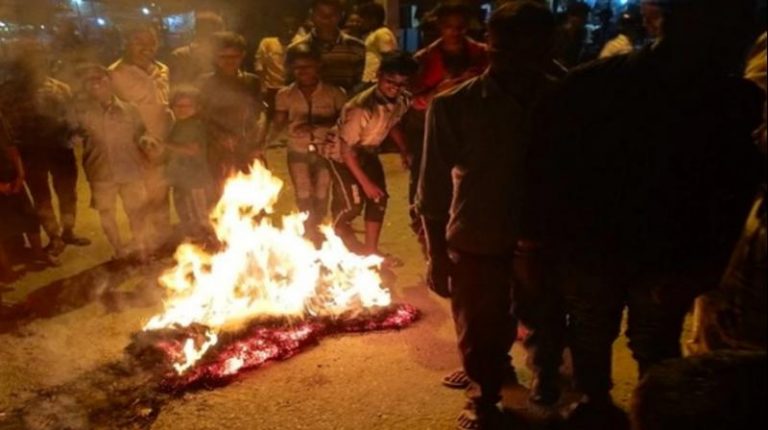
Nepal is on the boil as angry protesters in the country this week burnt the effigies of Chinese President Xi Jinping in a protest against encroachment by China of large swathes of Nepalese land.
According to the reports, the protestors hit the streets of Saptari, Bardiya, Kapilvastu district on Monday and chanted slogans against China after a recent government report suggested that China had encroached on 36 hectares of land belonging to Nepal.
Young protestors with placards with messages like “Go back to China!” and “Return Nepali land” were spotted in various districts during the protests held on Monday, November 11.
Earlier this month, Nepal’s Survey Department had released data which showed Beijing attempted to encroach land for its road projects in at least four districts that share a border with China – Sankhuwasabha, Rasuwa, Sindhupalchowk and Humla. The government data suggested Nepal stood to lose a further several hundred hectares of land to Beijing.
Reportedly, the documents showed that around six hectares of land in the Bhagdare river in Humla district and four hectares of land in Karnali district have been encroached upon, which now falls in Tibet’s Furang area.
Likewise, China has also encroached six hectares of Nepali land in Sanjen river and Jambhu Khola of Rasuwa.
In Sankhuwasabha, nine hectares of land have been encroached due to the road expansion in the autonomous region of Tibet where areas around Kamukhola, Arun river and Sumjung river have now fallen into Tingisyan County area.
According to the ministry’s data, Nepal would lose several hundred hectares of land to encroachment by China. The survey data further showed that some places near Arun Khola, Kamu Khola and Sumjung are now parts of Tibet’s Tingisyan area.
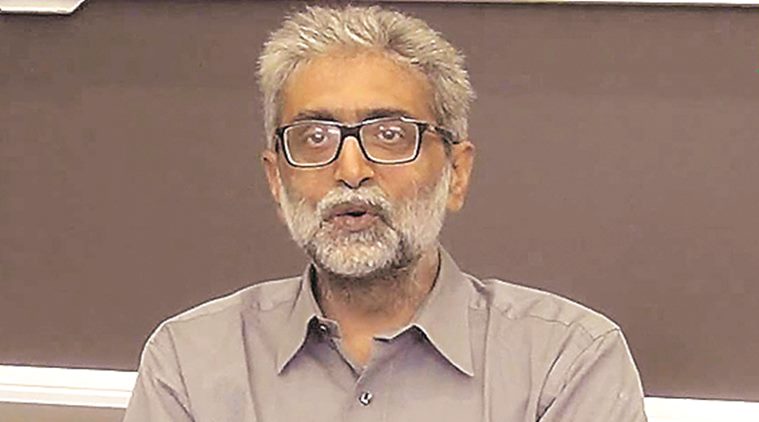
A Sessions Court in Pune today refused to grant anticipatory bail to activist Gautam Navlakha, who is accused of having links with Maoists, Kashmiri separatists, Pakistan’s ISI and banned terror organisation Hizbul. It also rejected Navlakha’s application seeking a three-day extension in protection from arrest.
Bhima Koregaon case: Pune Sessions Court rejects anticipatory bail application of accused Gautam Navlakha pic.twitter.com/JgjoaDGnFZ
While rejecting the bail application the court observed that there is prima facie enough material to show Navlakha is not only a member of the banned organisation- Hizbul “but an active leader” also.
The court’ observation is as follows:
It is clear that there is prima facie sufficient material to show that the applicant is not only a member of a banned organization but an active leader. Prima facie it can be noted that the organisation of Elgar Parishad at Pune was part of a larger conspiracy of the banned organization and Bhima Koregaon episode is one of the instances of execution of the said conspiracy. Therefore, the question of jurisdiction either of Pune Police or of this Court cannot be said to have merits, at least at this stage.”
Navlakha had moved the sessions court here on November 5 to seek anticipatory bail.
On November 6, the sessions court had also rejected bail application of all the nine alleged ‘Urban Naxals’ namely, Surendra Gadling, Varavara Rao, Sudha Bhardwaj, Vernon Gonsalves, Arun Ferreira, Shoma Sen, Mahesh Raut and Rona Wilson, accused of instigating the Bhima-Koregaon violence that took place on 1st January 2018 in Pune.
Earlier, the Supreme Court had granted interim protection from arrest to Navlakha who had appealed against an earlier Bombay HC order refusing to quash his FIR.
Bharadwaj, Gonsalves and Ferreira had been locked in Pune’s Yerawada Jail for almost 14 months. They had moved to the Bombay HC after a special judge in Pune had rejected their bail petitions last year.
On October 15, the Bombay HC had also rejected the bail pleas of alleged Urban Naxals Sudha Bharadwaj, Vernon Gonsalves and Arun Ferreira in the Bhima Koregaon violence case. The bail plea was moved in the month of August and the court had begun hearing on August 27. The court had reserved the judgement on October 7. The three were booked under the Unlawful Activities Prevention Act by the Maharashtra police after it began raids in the Bhima Koregaon violence case.
The five suspected ‘Urban Naxals’, identified as Delhi based activist Rona Wilson, advocate Surendra Gadling, professor Shoma Sen and Mahesh Raut from Nagpur and Mumbai’s Sudhir Dhavle were arrested by the Pune police on 6 June 2018, over charges of organising the Elgaar Parishad held at Pune’s Shaniwarwada on 31 December 2017, which is believed to have instigated the Bhima-Koregaon violence a day later.
The Pune police had filed a 5,000-page charge sheet, which had names of 10 persons, including Nagpur-based lawyer Surendra Gadling, Nagpur University professor Shoma Sen, Mahesh Raut, Rona Wilson and Sudhir Dhawale of Republican Panthers. Addition to these five, absconding underground Maoists Milind Teltumbde, Prakash alias Ritupam Goswami, Prashant Bose alias Kishan da, Manglu and Deepu have also been named in the charge sheet.
Apart from these ten alleged ‘Urban Naxals’, in a nation-wide crackdown, the police had arrested activist P Varavara Rao in Hyderabad, ‘human rights activist’ and ‘journalist’ Gautam Navlakha in Delhi, ‘activists Vernon Gonzalves and Arun Pereira in Mumbai, ‘civil rights’ lawyer Sudha Bhardwaj in Delhi, civil rights ‘activist’ Anand Teltumbde in Goa and ‘activist’ Stan Swamy in Ranchi in relation with Elgar Parishad violence and plot to kill the Prime Minister Modi.
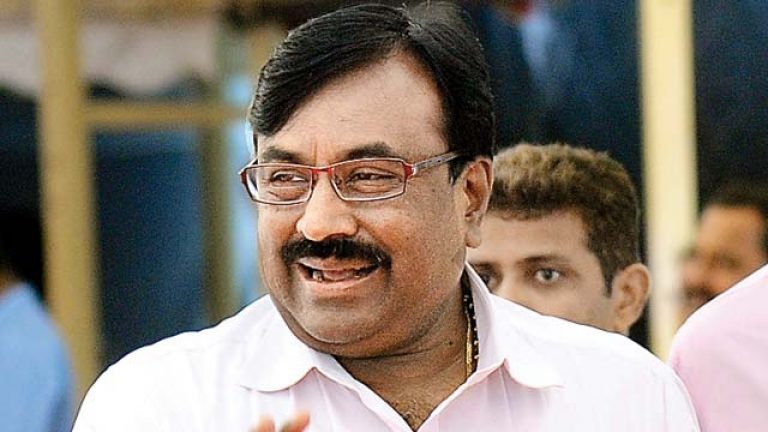
A few days ago, former Finance Minister of Maharashtra, Sudhir Mungantiwar had predicted that the state might be starting at a President rule if the government is not formed until November 7. This was after the disagreement over the modalities of government formation in the state between erstwhile alliance partner Shiv Sena and BJP.
The Shiv Sena was adamant on confirming to what it called a “50-50 formula” pre-decided with the BJP before the polls, wherein both Shiv Sena and BJP would have their respective Chief Minister for 2.5 years each. However, the BJP said that this provision of rotational chief ministerial post was never discussed with the Shiv Sena.
Following Mungatiwar’s assertions, a rattled Shiv Sena took a swipe at the BJP in its editorial piece in Saamana published on November 2, sarcastically questioning the BJP if they have the President in their pocket. Taking a dig at their senior alliance partner, the Saamana editorial piece contemptuously questioned if the President’s rubber stamp is lying in the Maharashtra BJP office and the if the BJP uses it to enforce President rule in the state if they fail to form their government.
In a scathing attack against the BJP, the Shiv Sena mouthpiece termed the assertion made by Sudhir Mungantiwar as “threat that undermines the democracy in the state”. It further slammed the BJP saying it has insulted the people of Maharashtra by disrespecting their mandate.
“BJP thinks that it is their birth-right to form a government in the state, notwithstanding the mandate given by the public. They don’t care if they have numbers or not, all they want is to obstruct those who can form the government. Issuing threats of enforcing President rule, can they even claim to form half-government in the state? President’s office is the highest office in the country. It is not in someone’s pocket,” the editorial read.
The two parties-Shiv Sena and BJP fought the elections in an alliance but following disputes over power-sharing formula, the two parties parted ways. Shiv Sena supremo Uddhav Thackeray in a press conference declared that he doesn’t need Amit Shah and Devendra Fadnavis to form government in Maharashtra and said that Shiv Sena will review all the options available to it.
Yesterday, before visiting the Governor to Thackeray called up Sonia Gandhi, the interim president of Congress, seeking support for the Shiv Sena-NCP government. However, after reportedly agreeing to extend outside support, Sonia Gandhi held back Congress’ support reasoning that it will come to a conclusion after meeting with NCP supremo Sharad Pawar and Congress MLAs.
In the meanwhile, the Governor asked the third-largest party NCP to prove their majority in the house. However, they could not. There were rumours doing the rounds that the NCP was demanding a rotational chief ministerial post with Shiv Sena. Although governor had given NCP time till 8.30 PM on 12th, NCP approached the governor at aroung 11.30 AM and sought more time to stake a claim, indicating that they have not gatherred enough support yet.
Sensing no political party was in the position of forming an alliance to stake a claim at the government in the state or form the government on its own, the Governor, exercising his discretionary powers, sent a report to the Union Home Ministry, recommending President rule to be imposed in the state. The recommendation from the Governor came after 17 days had elapsed since the declaration of the election results on October 24. Subsequently, the Union Cabinet approved the recommendation and sent it to the President, and President granted it imposing President’s rule in Maharshtra.
Rejecting the claims made by Shiv Sena that they have the supports of NCP and Congress for formation of a government, both parties have made it clear that they have not decided on support Shiv Sena in forming an alliance government in the state. After a meeting between Congress and NCP leaders in Mumbai, both parties confirmed that an alliance with Shiv Sena has not been finalised yet.
On a day when President’s rule was imposed in Maharashtra after the governor was convinced that no party is able to form a governor, senior Congress leaders Mallikarjun Kharge, K C Venugopal and Ahmed Patel travelled to Mumbai to hold discussions with NCP leaders including Sharad Pawar. After the meeting, a joint statement was issued by Congress and NCP, which said that they are still in the process of conducting discussions.
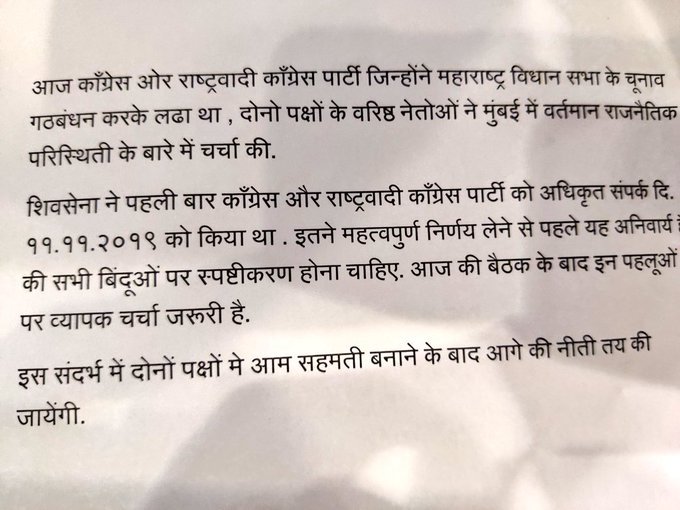
Joint statement of Congress and NCP
Most importantly, the joint statement says that Shiv Sena had contacted Congress and NCP only on 11th November. “It is important to clarify all points before such an important decision is taken. After today’s meeting, detailed discussions on these matters are important,” the statement said.
The future course of action will be taken after arriving at a consensus between both the parties, the statement added.
NCP leader Praful Patel: A meeting was held between senior leaders of NCP and Congress today. On 11th November Shiv Sena first contacted us formally. We will discuss on all the issues and then take a decision. #Mumbaipic.twitter.com/65aprntKXD
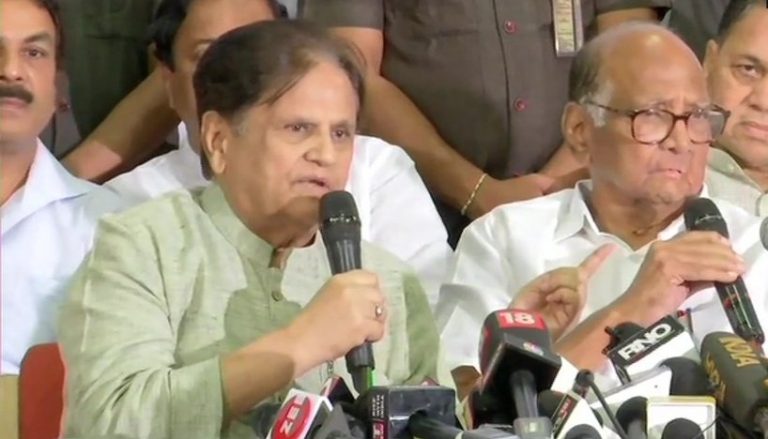
Addressing reporters, NCP chief Sharad Pawar said that no talks took place with Shiv Sena on forming a government. He said that lots of things were not made clear yet, and more discussions are needed to decide on a Common Minimum Program. He said that they are not in a hurry, and will hold discussions with Congress before deciding whether to support Shiv Sena. He also said first Congress and NCP have to decide whether the government has to be formed or not.
Congress leader Ahmed Patel also voiced similar opinions. He said, “We need clarity as Shiv Sena fought election with BJP and now wants to come with us. How can we decide without a Common Minimum Programme? First NCP-Cong will settle all issues then we’ll speak to Shiv Sena.” Patel said that Congress can’t take a decision without consulting NCP as they are alliance partners, that’s why they went to Mumbai to meet NCP leaders and further talks are necessary before taking any decision. He also criticised the governor for inviting BJP, Shiv Sena and NCP but not inviting Congress for forming a government, and slammed the decision to impose president’s rule in the state.
It is interesting to note that in the petition filed by Shiv Sena in Supreme Court against the governor for not granting them to gather support, they have mentioned that they have acquired the support of Congress and NCP. “The Petitioners are given to understand that Respondent Nos. 3 and 4 herein are principally willingly to support the Petitioners in forming the government in the State of Maharashtra,” the petition mentions. Shiv Sena has made Congress and NCP respondents in the petition. But the statements of Congress and NCP make it clear that they have not made any such promise so far.
After the Congress-NCP press conference, Shiv Sena chief Uddhav Thackeray addressed the media and said that Sena, Congress and NCP will sit together to prepare a Common Minimum Program. “If BJP-PDP, or BJP-TDP or BJP-JDU can come together, then we can try for forming a govt with Congress and NCP who are of different ideologies. After chalking out a Common Minimum Program we will stake claim again,” he added. He said that BJP and Sena were together for many years, but now they have to go with Congress and NCP, and they will hold further talks with both the parties.
In another significate development, BJP leader Narayan Rane has said that BJP is still trying to form a government. He said that it is unlikely that Shiv Sena will be able to form government with Congress and NCP. He added that Devendra Fadnavis is putting in all efforts in this direction.
Kashmir has been grappling with terrorism for decades. Pakistan, India’s not-so-friendly neighbour has been exporting gun-toting Jihadis to wage a “holy war” in Kashmir, not just for the land, but for a misplaced sense of Ummah. However, the media has often been sympathetic to the terrorism in Kashmir, even though it has claimed the lives of thousands – civilians and security forces.
According to South Asia Terrorism Portal, since the year 2000, 4,808 civilians have died in 11,442 incidents of killing. These incidents have claimed the lives of 3426 security personnel.
To give one a glimpse into the tinderbox of terrorism that Kashmir is, following are some of the terror organisations that function in Kashmir.
Hizb-ul-Mujahideen (HM), Lashkar-e- Toiba (LeT), Jaish-e-Mohammed (JeM), Al Umar Mujahideen (AuM), Dukhtaran-e-Millat (DeM), Harkat-ul Mujahideen (HuM) previously known as Harkat-ul-AnsarHarkat-ul-Jihad-al-Islami (HuJI), Jammu and Kashmir Islamic Front (JKIF), Jamait-ul-Mujahideen (JuM), Jamaat-e-Islami (JeI), Jammu and KashmirJammu and Kashmir Liberation Front – Yasin Malik faction (JKLF-Y).
As a thumb rule, most terror groups active in Kashmir want to overthrow Indian rule and merge Kashmir with Pakistan. Even the ones that claim to fight for the independence of Kashmir, are mostly ones who are funded and sponsored by Pakistan. Pakistan has been waging a prolonged war against India that essentially depends on exporting terrorists to Kashmir and the rest of the country and deepening the faultlines of India to create internal strife.
While the Kashmir history cannot be possibly be summarised in 200 words, the underlying problem of the Kashmir issue is not unknown, however inconvenient it may be for the ‘Liberals’ to digest. While several names and definitions have been applied to the Kashmir conundrum over the years, the truth of the matter is, however, that the reason why Kashmir burns is because of Jihad and Islamic terrorism. However, the media has been extremely kind to the terrorists of Kashmir valley as history bears witness. One recalls how Barkha Dutt once interviewed an injured stone pelter who kept saying he is doing what he does for Jihad, while Barkha kept prodding him to say he was doing it for Kashmir.
However, earlier, only a certain fringe element of the media, like Barkha Dutt used to indulge in the normalisation of terrorism in Kashmir. Now, one sees that the normalisation has taken root even in normal media parlance.
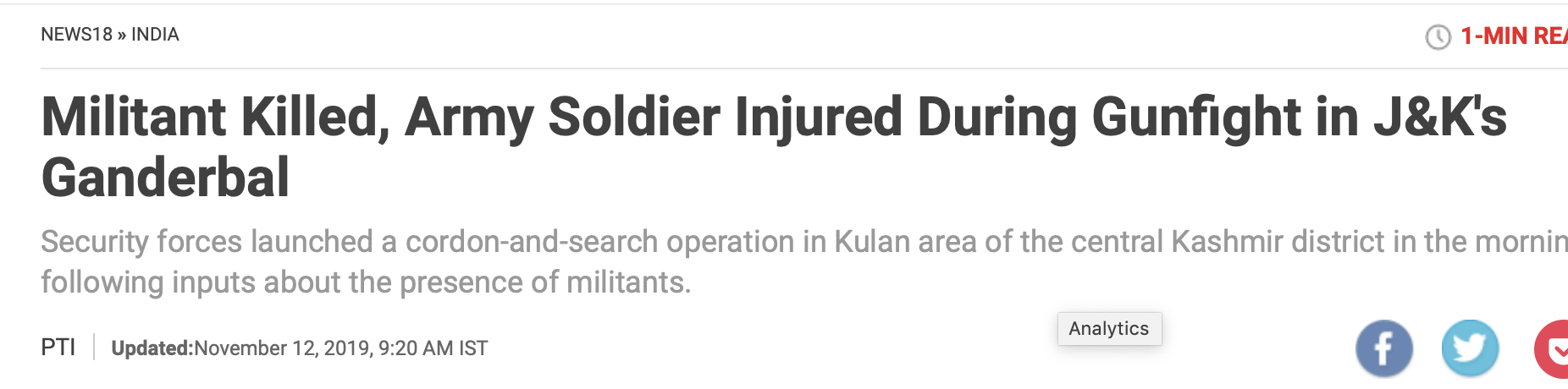
Today, terrorists were neutralised by security forces in Ganderbal district of Kashmir.
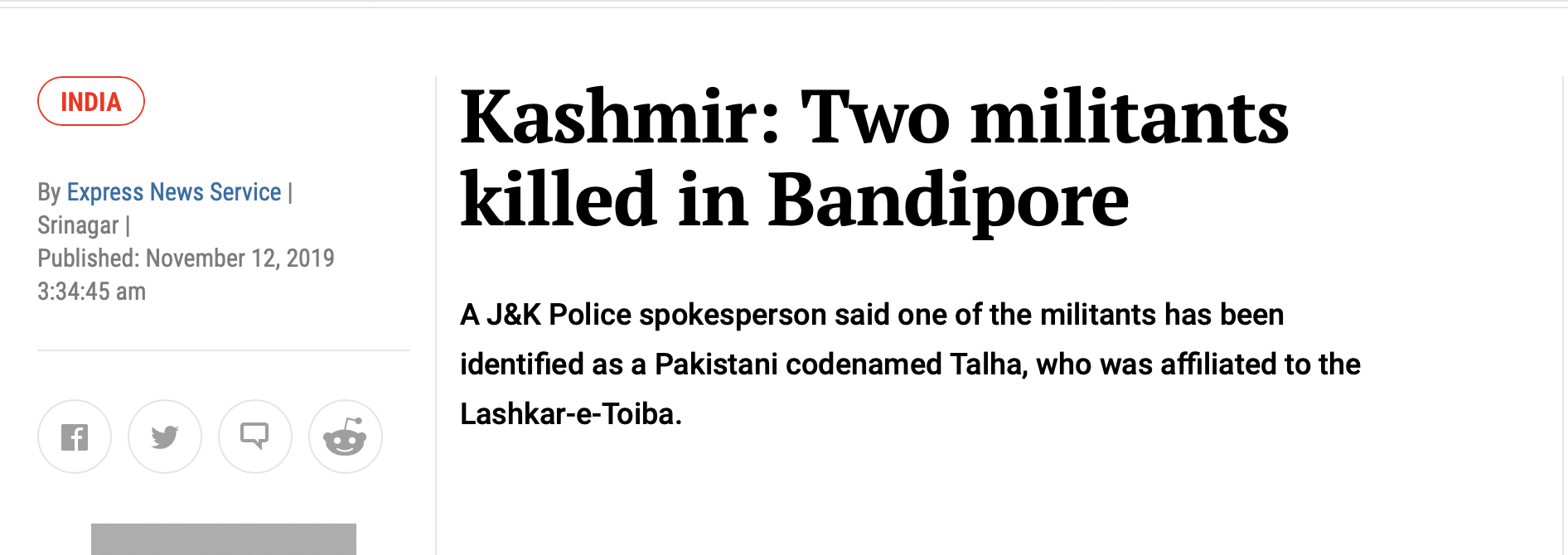
A J&K Police spokesperson said one of the terrorists has been identified as a Pakistani codenamed Talha, who was affiliated to the Lashkar-e-Toiba. The identity of the other terrorist is being ascertained, the spokesperson said. “As per the police records, he was operating as commander of the proscribed terror outfit LeT in the areas of Bandipora and was wanted by law for his involvement in terror crimes and civilian atrocities”. “Identity of the other killed terrorist is being ascertained. People are requested to cooperate with police till the area is completely sanitised and cleared of all explosive materials if any.”
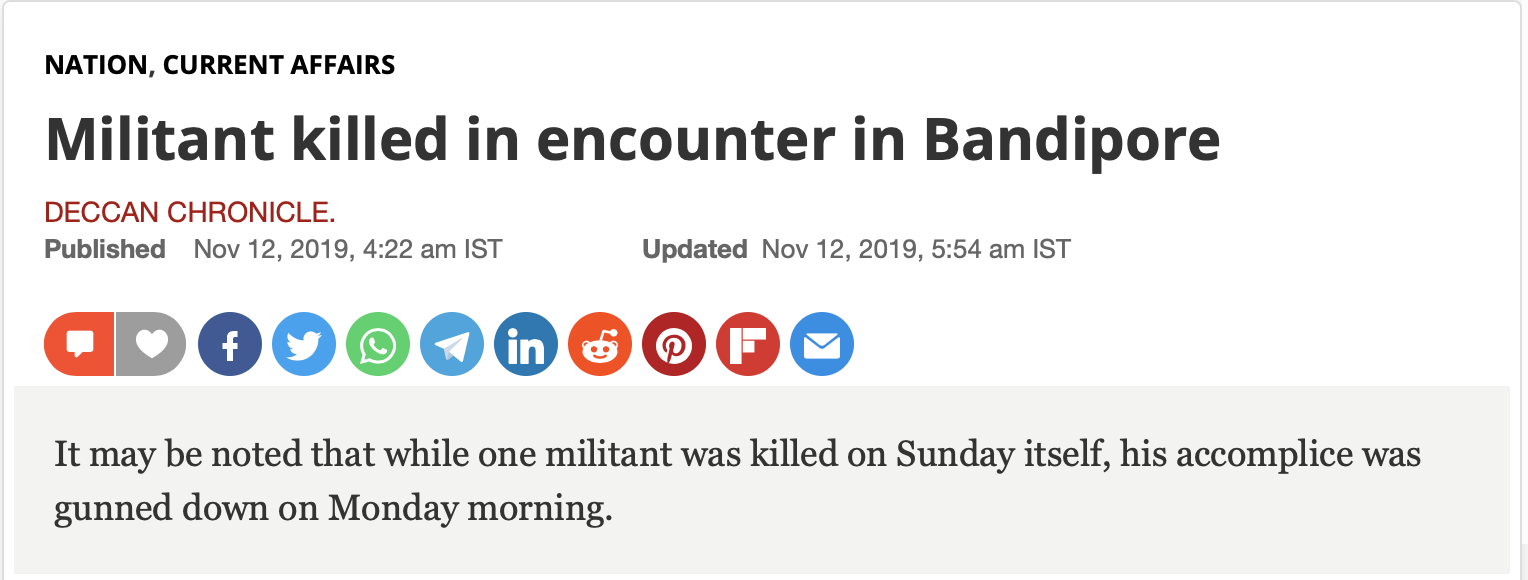
While the police statement mentioned by Indian Express explicitly calls the Jihadis as terrorists, the news agencies themselves have chosen to take a different path and call them ‘militants’.
Indian Express headline
While the very police quote in the Indian Express article referred to the men eliminated as terrorists, Indian Express consciously chose to call them ‘militants’.
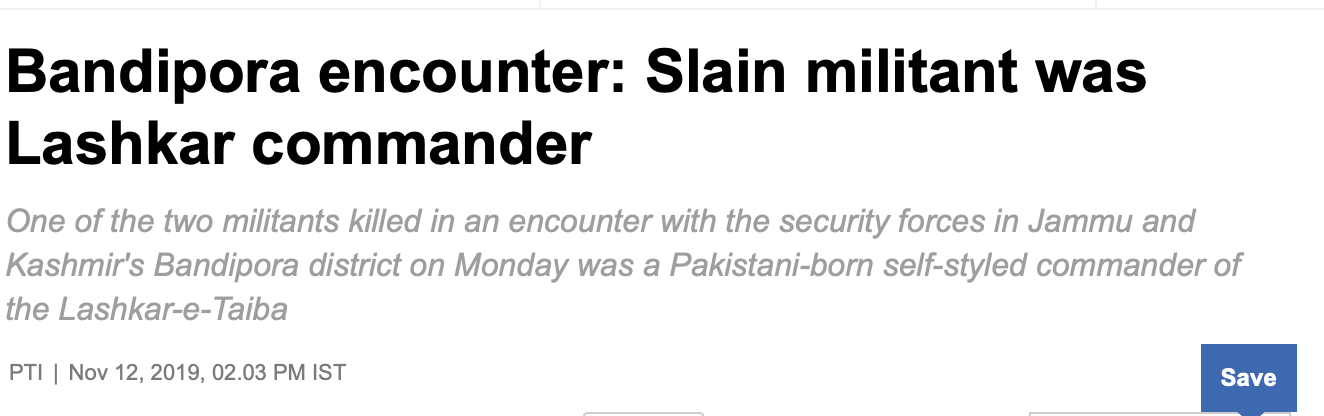
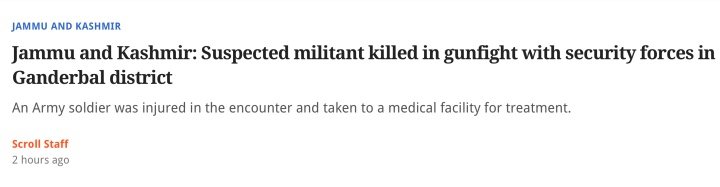
Of course, Scroll went a little further and called the terrorist a ‘suspected militant’.
Scroll headline
The terrorist neutralised in Kashmir belonged to proscribed terror outfit Laskar-e-Taiba. The UN, while listing LeT as a terror outfit said, “Lashkar-e-Tayyiba was listed on 2 May 2005 pursuant to paragraphs 1 and 2 of resolution 1526 (2004) as being associated with Al-Qaida, Usama bin Laden or the Taliban for “participating in the financing, planning, facilitating, preparing or perpetrating of acts or activities by, in conjunction with, under the name of, on behalf or in support of”, “supplying, selling or transferring arms and related materiel to” or “otherwise supporting acts or activities of” Al-Qaida (QDe.004), Usama bin Laden and the Taliban”. Yet, Indian media went ahead and branded the terrorist as a ‘militant’.
Is this a mere case of semantics? While these headlines may seem benign to the uninitiated, they further an extremely dangerous narrative that normalises terrorism, much like the media did Left terrorism in India.
The terms ‘Militant’ and ‘Terrorist’ have extremely different, though subtle differences in connotation attached to them.
Definition of Terrorism
While there is no universally accepted definition of terrorism, the General Assembly has classified certain acts as terrorism.
“Acts intended or calculated to provoke a state of terror in the general public, a group of persons or particular persons for political purposes are in any circumstance unjustifiable, whatever the considerations of a political, philosophical, ideological, racial, ethnic, religious or any other nature that may be invoked to justify them”.
Another example of terrorism-related terminology:
“… criminal acts, including against civilians, committed with intent to cause death or serious bodily injury, or taking of hostages, with the purpose to provoke a state of terror in the general public or in a group of persons or particular persons, intimidate a population or compel a government or an international organization to do or to abstain from doing any act, which constitute offences within the scope of and as defined in the international conventions and protocols relating to terrorism, are under no circumstances justifiable by considerations of a political, philosophical, ideological, racial, ethnic, religious or other similar nature, and calls upon all States to prevent such acts and, if not prevented, to ensure that such acts are punished by penalties consistent with their grave nature”.
By all standards, whether local Kashmiri terrorists or the ones exported by Pakistan are ‘terrorists’.
Who is a Militant?
It is widely accepted that all terrorists are militant but all militants are not terrorists. Several people have tried to define the difference between a militant and terrorists. While there is no universally accepted definition of either, there are certain broad principles that define the usage of the term.
Militancy is widely accepted as a ‘rebellion’ and it need not be armed either. An opinion piece in ORF think-tank essentially said that negotiation is possible with militants but not with terrorists.
An answer posted in IDSA says:
As per the Unlawful Activities (Prevention) Amendment Act, 2012, a terrorist act is an “act with intent to threaten or likely to threaten the unity, integrity, security [economic security] or sovereignty of India or with intent to strike terror or likely to strike terror in the people or any section of the people in India or in any foreign country by…” and it goes on to describe a number of ways and means that can be employed for terrorism. However, the important aspect that defines terrorism is the use of or threat to use violence to strike terror amongst the people. Terrorism can be used as an instrument of an insurgency or extremist ideology. It can, therefore, be a stand-alone option or integral to other forms of violent expression.
Militancy is a condition which experiences the use of violence, being combative or predisposed to fight. Militants can include any individual or group which takes to violence. This need not only include terrorists and insurgents, but also armed religious groups which take to violence to further their beliefs. Since resort to violence is a common factor here, often the term militancy and terrorism tend to be used interchangeably. However, since terrorism has greater acceptability as a term to describe extreme use of violence, both internationally and in India, it has largely replaced the term militancy. While it is difficult to ascribe a relative scale, a militant approach could however also imply a more moderate use of violence or expression of combative attributes, whereas terrorism clearly implies an extreme form of violence.
Essentially, militancy thus becomes a watered-down version of terrorism.
Not just semantics
Essentially, the terrorists functioning in Kashmir meet most of the standards that are prescribed to understand whether an armed struggle is terrorism or militancy. They instil terror, have a stated goal of fighting against the state, have religious motivations, they target civilians, they target security personnel, they even target off-duty security personnel as seen in several cases including Pulwama, so on and so forth. The aim of terrorism is to provoke the state to give a disproportionate reaction and the body count is irrelevant to the terrorists.
In fact, the media often forgets that at the peak of this “struggle”, the present-day Kashmir issue largely started with the genocide of Kashmiri Hindus. Even that was termed as “militancy” by large sections of the media instead of blatant terrorism.
While there should be no reason to term terrorists as militants, there seems to be a larger nefarious plan when terrorists belonging to JeM are branded as militants. JeM, as mentioned, is a proscribed terror outfit.
The aim is rather simple – to water down the threat of terrorism in Kashmir and brand it as some sort of armed resistance against oppression from the state, which it clearly is not. Hence, while the terms militancy and terrorism used in the context could seem like mere semantics, they are far more.
Another example
During the Amarnath yatra terror attack, several national dailies termed the attack as a terror attack as it should have. However, several local Kashmiri papers that have known sympathies with terror organisations termed the attack as a ‘militant attack’. The use of semantics and their importance becomes evident when organisations sympathetic towards terrorists brand a terror attack as a ‘militant attack’.
Media and its sympathies with radical Islamism and terrorism
It is no surprise that today the media would brand a JeM terrorist as a militant in an attempt to water down the severity of terrorism threat in Kashmir. This practice has been a usual by fringe elements in the media and is now only being mainstreamed more and more each day. One recalls how Barkha Dutt tried to brand a stone pelter waging Jihad as someone fighting for Kashmir. That demarcation itself shows that while the stone pelter was admitting that he is a terrorist, Barkha tactfully tried to brand him as ‘militant’ fighting oppression.
Mohammad Rafi Bhat was neutralized by Indian security forces in an encounter with the terror organization Hizbul Mujahideen with which Bhat had aligned himself. He was an assistant professor at Kashmir University. The usual suspects were out in full force to defend him saying that the soft-spoken and humble Bhat took to arms because of unrest in Kashmir.
Controversial publication The Quint, which had declared Kulbhushan Jadhav an Indian spy, decided to show Mohammad Rafi as a victim of the state. In their article, they had even written about how the slain terrorist was a ‘prisoner of conscience and not a religious fanatic’ because he ‘always talked about human rights violation by Indian forces’. In this case too, Quint tried to paint Rafi as a ‘militant’ and not a ‘terrorist’ by attempting to show that he picked up the weapon against oppression and not for Jihad, however wrong their assertions were, the intention was nefarious as best and treacherous at worst.
Essentially, media frequently tries to paint terrorists as ‘those fighting oppression’ in order to ensure that the threat of radical Islam and terrorism in Kashmir can be reduced to a mere armed resistance against the oppression of the state. Branding JeM terrorists as ‘militants’ is just another step in the project.
Following the Supreme Court’s verdict granting the contentious land in Ayodhya to the Hindu parties for construction of a grand Ram Temple over it, the Akhil Bharat Hindu Mahasabha has written a letter addressed to PM Modi, HM Amit Shah and UP CM Yogi Adityanath stating their demands regarding Kar Sevaks. Mahasabha has demanded the withdrawal of Babri demolition cases against the Kar Sevaks.
#BREAKING:
Within 72 hrs of #AyodhaVerdict , Hindu Mahasabha writes to PM, HM and UP CM asking for:
1. Withdrawal of Babri demolition cases against Kar Sevaks
2. Martyr status for those killed
3. Plaque for the killed and stipend for living Kar Sevaks. pic.twitter.com/D5Wlir59eT
In addition to this, the Hindu Mahasabha has also demanded ‘Martyr Status’ for those Kar Sevaks who died in Ayodhya in 1992 due to government action or due to other reasons. Mahasabha has also pushed for providing financial assistance and a government job to the family of the deceased Kar Sevaks.
In its third demand, the Hindu Mahasabha has asked PM Modi, Amit Shah and Yogi Adityanath to grant “Religious Fighters” status to the Kar Sevaks and on the lines of Freedom Fighters, government benefits to them and monthly pension for financially weak Kar Sevaks.
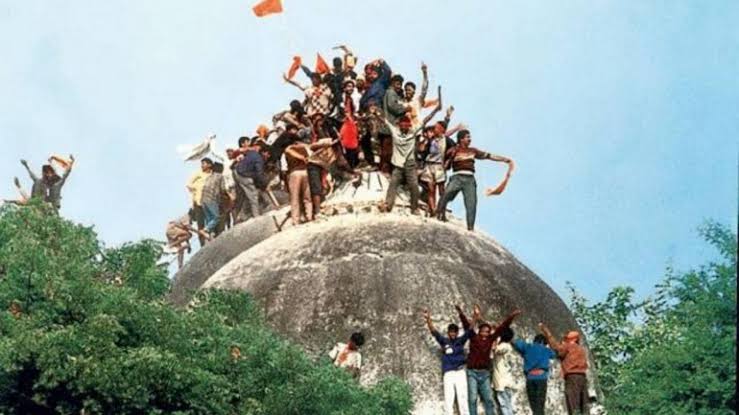
On December 6, 1992, lakhs of Kar Sevaks swarmed around the disputed site of Ayodhya and in the ensuing commotion the dome of Babri Masjid was caved in. The UP government was then headed by Mulayam Singh Yadav, who was known with his “Mullah Mulayam” sobriquet for ordering police action against the Kar Sevaks.
The demand comes within three day of the apex court’s verdict in the protracted Ram Janmabhoomi-Babri Masjid dispute in which the court has handed over the dispute landed to the centre for the construction of a Ram Temple and provided 5-acres of land elsewhere to the Muslim side.
The court verdict says that a trust for the construction of the temple be constituted, involving adequate representation of all the convened parties and asked the centre to commence on the construction of the temple within 3 months.
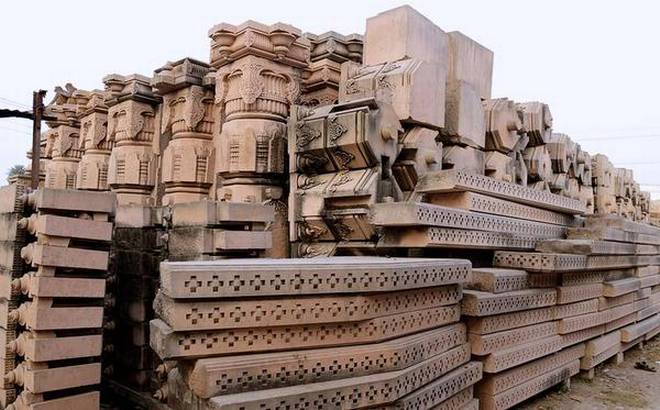
The Vishva Hindu Parishad(VHP) has decided to use crowd-funding method to encourage Ram devotees to come forward and help in the construction of a grand Ram Temple in Ayodha after the Supreme Court passed its verdict in favour of building a Ram temple at the Ram Janmabhoomi site.
In its bid to initiate mass mobilisation for the Ayodhya temple, VHP plans to reach out to Ram devotees across the world to seek financial contributions towards the construction of Ram temple.
As per a report in Times Of India, Vinod Bansal, the national spokesperson for VHP said, “The Ayodhya temple movement struck a chord with millions of people. Scores of people affiliated themselves with the movement and sentiments of many of Hindus were stirred by it. Now they will have to do their bit, including ‘kar seva’. A formal plan will be released soon.”
In addition to this, the VHP has also opened that the trust that has to be instituted within three months to facilitate the construction of temple should bear in mind providing ways for Ram devotees to participate in temple construction and assist them in joining the movement.
Signalling that another round ‘Kar Seva’ might in the offing, a VHP functionary stated that they have plans to invite devotees from all 718 districts of the country and will be provided with accommodation to stay for at least a week and help in construction work. ‘Kar Seva’ was a central part of the movement led by the VHP in 1990.
Confirming the crowd-sourcing plan, VHP working president Alok Kumar said, “There is not a shred of doubt that funds will be sought directly from Hindu devotees of Lord Ram spread across the globe. The process to pool contributions will commence soon for which groups will be made to ensure that it is done smoothly.”
The plan to go crowd-funding comes following the Supreme Court’s much-awaited verdict on the Ram Janmabhoomi title suit. The apex court on Saturday announced that the Ram Janmabhoomi site will be handed over to the centre and tasked it with the responsibility of forming a trust with adequate representation from all the involved parties to start the construction of the temple within three months.