Home Blog Page 705

FCRA license of NGOs to be revoked for being involved in religious conversions, anti-development activities: MHA announces stricter FCRA regulations

0

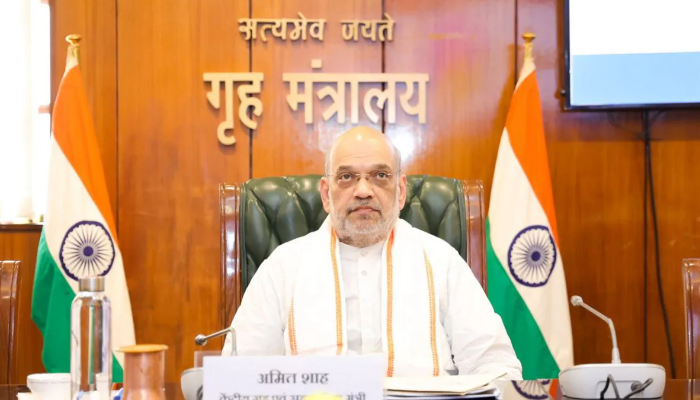
For the first time, the Union Ministry of Home Affairs under Amit Shah has declared grounds for refusing the approval required by the Foreign Contribution Regulation Act (FCRA) to receive foreign funding. These include engaging in religious conversions and anti-development activities, maliciously encouraging protests, and having ties to extremist organizations. Director (FCRA) K Sanjayan released an official notification from the ministry on 8th November which was uploaded on an official website on 11th November.

“The Ministry has received representation from some of the associations stating that reasons for denying their application are unclear. The matter has been examined and is decided to disseminate the consolidated reasons for the denial of renewal/registration applications for the benefit of applicant associations. Accordingly, an illustrative list of reasons for denial of renewal/registration applications is tabulated,” it conveyed.

The press release then listed the reasons and stated that the license would not be granted if ” no activity has been carried out by the association or it has become defunct or the claimed activities could not be corroborated during field inquiry or field inquiry has revealed that no reasonable activity for the welfare of society has been undertaken by the association during the last 2-3 years” under section 12(4)(b).

The same shall be denied in line with section 12(4)(e) read with 12(4)(1)(iii) if there is an ongoing criminal prosecution against any office bearer, member, or key functionary, or if any of these individuals has been convicted under any currently enacted laws. The notice informed, “Prosecution for any offence is pending against any office bearer(s)/ member(s)/ key functionary(ies) or any of the office bearer(s)/ member(s)/ key functionary(ies) is/are convicted under any law for the time being in force.”

“Not responding to clarifications sought or the association has not provided the requisite information/document(s) despite the opportunity given. Concealment of facts/information by the association in its application form or the application form is incomplete,” were also presented as the reasons under section 16(2) read with section 12(4)(1)(iii) in case of renewal and 12(1) and (2) read with 12(4)(f) (iii) in case of registration along with section 16(2) read with 16(1) for renewal and section 12(2) for registration.

The appointment of fake members was also included as a reason under section 12(4)(a)(i). It highlighted, “Any of the office bearer(s)/ member(s)/ key functionary(ies) is/are not found at the given address provided by the association in its form FC-3C/FC-3A or field inquiry has revealed that office bearer(s)/ member(s) / key functionary(ies) is/are fictitious / benami / only for namesake,” would lead to the rejection of the license.

“The association does not exist at the given address provided by the association in its form FC-3C/FC-3A,” under section 12(4)(a)(i) was given as another reason. “The certificate of registration of the association has already been cancelled. Therefore, as per section 14(3) of FCRA, 2010, the association is not eligible to accept FC for three years from the date of cancellation,” under section 16 read with section 14(3) was also added in the notification.

“Association has diverted foreign contributions for carrying out anti-development activities or inciting malicious protests. Field inquiry has revealed the likelihood of personal gain by the association or by the office bearers or the likelihood of utilization of FC for undesirable activities. Jon Field inquiry has revealed adverse inputs against the association (e.g., involvement in anti-developmental activities, inciting protests with malicious intentions, linkage with terrorist organisations / anti-national organisations etc.),” according to section 12(4)(a)(vi), 12(4)(f)(ii), 12(4)(f)(iii), section 12(4)(a)(vi) read with section 12(4)(f)(iii) and section 12(4)(a)(vi), 12(4)(f)(ii) read with 12(4)(f)(iii) were stated as more reasons for the refusal.

“Association or its office bearer(s)/ member(s)/ key functionary(ies) having linkage(s) with radical/terrorist entities. Field agency has reported adverse inputs against the association and acceptance of FC is likely to affect social/religious harmony or the association is involved in induced/forceful religious conversion/ proselytization or the association or its office bearers have a linkage with radical organisations.” under section 12(4)(a)(vi), 12(4)(f)(ii), 12(4)(1)(iii) with section 12(4)(a)(vi) and 12(4)(f)(vi) read with 12(4)(f)(iii) were pointed out as the following conditions for the denial of FCRA license by the home ministry.

The release then underlined more reasons under “Exclusive to Renewal applications (Form FC-3C)” and stated, “During the last 05 years the association has not utilized any FC for projects as per aims and objectives of the association. The association has not uploaded the Annual Returns of any of the previous 6 Financial Years (Non-filing of annual returns is a violation of section 18 of FCRA 2010 read with rule 17 of FCRR, 2011),” under section 12(4)(b) and section 12(4)(a)(vii).

The notice then included further grounds under section 12(4)(a)(vii) along with examples. It mentioned, “Association has violated any one or more of the provision(s) of the act or rules. (Some examples of violations are:- (a) Admin expenses of more than 20% (b) discrepancy in annual returns (c) non-compliance of mandatory intimations (d) not utilizing contribution for the purpose for which the contribution has been received (e) not intimated change of office bearer/member/key functionaries as mandated in Rule 17A (f) not uploaded bank statements, income and expenditure account, receipts and payment account and balance sheet along with annual return in Form FC-4 (g) not intimated any change in details such name/address, nature, bank account, the opening of new account as mandated in Rule 17A (h) transferred FC to a bank account which is a non-FCRA account (i) transferred non-FC fund in FCRA account (mixing of FC and non-FC) (j) the association has utilized FC for speculative activities (k) the association has transferred FC to another association in contravention of Section 7 of FCRA, 2010 etc.).”

The ministry under the “Exclusive to Registration applications (Form FC-3A)” headline informed, “Association has not fulfilled the criteria of spending a minimum amount of Rs 15 Lakhs of its core activities for benefits of society during the last three financial years. The association is not in existence for three years,” both keeping with section 12(2) read with Rule 9.

The notice has also informed, “Applications for the grant of registration and renewal received from the applicants are processed under the provisions of the Foreign Contribution (Regulation) Act, 2010 (FCRA, 2010 on “the Act”) and/or the Foreign Contribution (Regulation) Rules, 2011 (“FCRR, 2011” or “the Rules”). Applications fulfilling the eligibility criteria including the conditions of registration under section 12(4) of the act are granted a certificate of registration. Applications not fulfilling the eligibility criteria including conditions of registration are denied. An E-mail message from the FCRA portal is sent to the E-mail ID of the association whose application is denied, conveying the reason for the denial of application duly mentioning the relevant provision(s) of the act. Applicant associations are also intimated through SMS.”

As of right now, 16,023 NGOs hold FCRA licenses, while 20,711 organizations have had their licenses revoked, according to MHA statistics. Since 2020, the centre has increased its scrutiny of NGOs under the FCRA. At least 335 NGOs and associations that were registered or had been given prior approval under the FCRA were inspected or audited by the MHA’s FCRA unit between 2019 and 2022 to see whether or not they were adhering to the regulations governing foreign funding.

The licences of the Rajiv Gandhi Foundation (RGF) and Rajiv Gandhi Charitable Trust (RGCT) in 2022 were also cancelled based on breaking the law. In September 2020, the FCRA was revised to prohibit foreign funding for public workers and to require Aadhaar Cards for all NGOs’ office-bearers. Additionally, organizations were prohibited by the modified statute from using more than 20% of foreign contributions for administrative purposes. Previously, the threshold was 50%.
Congress ‘Nyay Patra’: Karnataka govt led by CM Siddaramaiah may bring Muslim quota in govt tenders for contractors, says report

The Congress party in the state of Karnataka is reportedly preparing for another level of ‘minority appeasement’. The Siddaramaiah government is reportedly considering the proposal of empowering the Muslim community by offering them reservations in public contracts.

As per a government official quoted by the Deccan Herald, the Siddaramaiah administration is considering a proposal to give Muslims preference in public contracts for building (civil) projects worth up to Rs 1 crore. If the plan is approved, Karnataka will receive a 47% quota in government bids. Politically, this is viewed as Chief Minister Siddaramaiah‘s attempt to unite the Ahinda (minorities, backward classes, and Dalits) community.

Currently, Karnataka has reservations in civil works contracts for SC/STS, 24%, and OBC contractors from Category-1, 4%, and Category-2A, 15%. All of this notably adds up to 43%. The demand to add Muslims to Category-2B with a 4% reservation is being considered, however, the official stated that ‘no decision regarding the same has been taken’ in the case. Notably, the Siddaramaiah government is likely to table a bill in the winter session of the Assembly in this regard.

During his first time in government, Siddaramaiah implemented SC/ST contract reservations, and two OBC categories received the same privilege earlier this year. Besta, Uppara, and Dalit Christians are among the 95 communities classified as Category-1; Category-2A includes Kurubas, Idigas, and 100 other communities.

The government’s decision to expand contract reservation to Categories 1 and 2A is claimed to have irritated other contractors, particularly the Vokkaligas and Lingayats. They are putting pressure on the Karnataka State Contractors Association to hold a meeting and discuss the issue with the administration.

Congress defended reservation for Muslims

It is crucial to note that the BJP ahead of the state polls in the year 2023, had abolished the current 4% reservation (2B category) for Muslims under the OBC quota and transferred them to the 10% pool for the Economically Weaker Sections (EWS) and increased the quota for Lingayats and Vokkaligas by 2% each.

“The Muslims have been shifted from 2A to EWS quota as there is no Constitutional provision for reservation for religious minorities. As per Dr Ambedkar, too reservation is for the caste alone. However, my government has decided to move the minorities to EWS as both the old and new categories have the economic criterion,” Bommai had said.

Notably, Siddharamaiah at that time had criticized the BJP for eliminating the 2A category (which had a 4% quota for Muslims) and allocating it to the Lingayats and Vokkaligas. “It is an effort to breed animosity between the communities,” he had said. 

Also, recently, on October 26th, Chief Minister Siddaramaiah defended the 4% quota given to Muslims, saying that the reservation had been in place in the state since 1994. “The Chinnappa Reddy Commission had recommended the 4% reservation (in 1994). The previous BJP government under Basavaraj Bommai had scrapped it,” he said while speaking to media in Bidar.

Promises made by Congress to appease the Muslim community

Interestingly, ahead of the Lok Sabha polls too, the Congress party had issued a promise of awarding public work contracts to people belonging to the ‘minority community’. In its manifesto issued ahead of the elections, the party promised to give a ‘fair share’ of opportunities to minority communities in public work contracts.

“We will ensure that the minorities receive their fair share of opportunities in education, healthcare, public employment, public works contracts, skill development, sports, and cultural activities without discrimination,” it had said.

Apart from that party announced several schemes in its election manifesto to appease the Muslim community. The grand-old party vowed to send Muslim students abroad and increase their scholarships. It hinted at repealing the Triple Talaq Act, allowing personal laws to supersede uniformity and entertain the wearing of non-essential religious clothing in educational institutes under the garb of the Right to Freedom of Religion.

The Congress further promised to appoint more judges, belonging to the Muslim community, to the High Courts and the Supreme Court. It assured to strengthen the ‘autonomy’ of the Commissions for SC, ST, minorities and OBC. The grand-old party also then suggested implementing the draconian Communal Violence Bill, which is aimed at disproportionately targeting the Hindu community.

It is notable here that no official confirmation regarding the reservation in public work contracts has come yet.

Oxford Union invites ‘activist’, with ties to Pakistan’s ISI and terror funding to speak on ‘independence’ of Kashmir, was earlier thrashed for anti-India propaganda

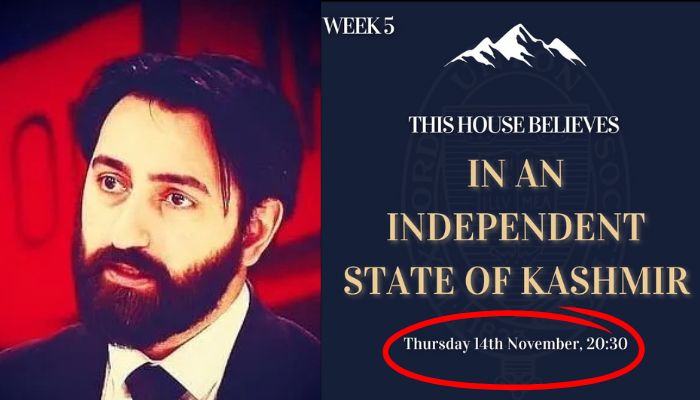
The Oxford Union has invited controversial Pakistani-origin ‘activist’ Muzzammil Ayyub Thakur, known for peddling disinformation on Jammu and Kashmir, to debate over the ‘need for independence’ of India’s integral territory. The event is scheduled for Thursday (14th November).

Muzzammil is infamous for parroting the Pakistani narrative on India’s Union territory with active backing from the military establishment and will speak for the motion ‘This House Believes in the Independent State of Kashmir’.

The Oxford Union in its Instagram post alleged, “The continued push for Kashmiri independence has sustained a long-standing struggle, rooted in the region’s quest for self-determination and autonomy. This has led to persistent unrest, human rights concerns, and renewed demand for autonomy among the Kashmiris.“

The ‘student society’ further claimed, “While nuclear-armed neighbours vie for control and geopolitical influence, the desire for peace among the population remains strong. Could an independent Kashmir be the answer to this enduring crisis?”

For the unversed, Muzzammil is the son of London-based ISI agent Ayyub Thakur. The latter had founded both ‘The Justice Foundation’ and ‘World Kashmir Freedom Movement’, which is now being run by Muzzammil.

During his lifetime, Ayyub Thakur was involved in lobbying for Jammu and Kashmir. He also channelled funds from Pakistan’s ISI to Islamic terrorists in the region including £70000 to Hizbul Mujahideen terrorist Syed Salahuddin.

Screengrab of the tweet by Muzzamil Ayyub Thakur

In an interview in 2015 for ‘Only Kashmir’ YouTube channel, Muzzammil acknowledged his father’s pro-terrorism stance on Jammu and Kashmir. He pointed out how Ayyub Thakur funded terrorism in the region and considered it as ‘Jihad’.

Just like his father, Muzzammil was seen endorsing terrorists after they were neutralised by the Indian security forces. “Final words of smiling Kashmiri shaheeds (martyrs)…A lesson for all of us,’ he tweeted in November 2021.

Interestingly, he was earlier spotted alongside Nitasha Kaul – an anti-India activist who was invited by the Karnataka Congress government in February 2024 but deported after landing in Bengaluru.

Muzzammil booked under UAPA

In May 2022, the Jammu and Kashmir police booked Muzzammil under the Unlawful Activities (Prevention) Act for carrying out anti-national activities and threatening an Indian advocate named Syed Zeeshan.

A police spokesperson said, “Thakur, through his social media account and other platforms, is indulging in activities which are prejudicial to the sovereignty, integrity and unity of India.”

He added, “This apart, a proper complaint was lodged by Advocate Syed Zeeshan before Srinagar Police against Muzzamzil Ayyub Thakur and others. In the complaint, it is alleged by him that Muzzammil Ayyub at the behest of ISI and ISPR is threatening, harassing, carrying out criminal intimidation, besides being involved in cyber-crimes against the complainant.”

Muzzammil had also threatened a Kashmiri woman named Tasleema for exposing Pakistan’s propaganda at the United Nations. His X (formerly Twitter) account has been withheld in India.

Repeating Pakistani talking points on J&K

He had collaborated with the Islamabad Policy Research Institute (IPRI) on several occasions to disseminate Pakistani narrative on the Indian territory of Jammu and Kashmir.

“Post-August 5, 2019, when India illegally annexed occupied Kashmir, turning it from a de facto occupation to a de jure occupation, bifurcating the state and then turning it into a union territory, one of the lies was to bring development to Kashmir, make it prosper. The reality is that India has turned Kashmir into another East India Trading Company, making it open season for Indian businesses and so-called investors to loot, and in the process, destroy even ecology on the way,” Muzzamil said during one of his deranged rants.

In 2020, he was roped in by Turkish state-owned media ‘TRT World’ to spread canards about the situation at ground zero in Jammu and Kashmir.

Muzzammil had previously tried to create global outrage over the ‘Kashmir issue’ at the 52nd Session of the United Nations Human Rights Council (UNHRC) and had endorsed an anti-India magazine by the name of ‘Kashmir Inside.’

Poster featuring Muzzammil Ayyub Thakur as guest speaker in anti-India event

In October 2023, Muzzammil was seen pleading with the British government to interfere in India’s internal affairs during a roundtable conference hosted by ‘Tehreek-e-Kashmir’ in the British Parliament.

He also highlighted the importance of narrative-building exercises and public advocacy to tarnish India’s image and further Pakistan’s agenda among the youth. It partly explains what led to his thrashing during an anti-India event in London on 9th August 2024.

Rajasthan police arrests Rafiq for sexually exploiting women by scaring them with ghosts, media defames Hindus by calling him ‘Tantrik’

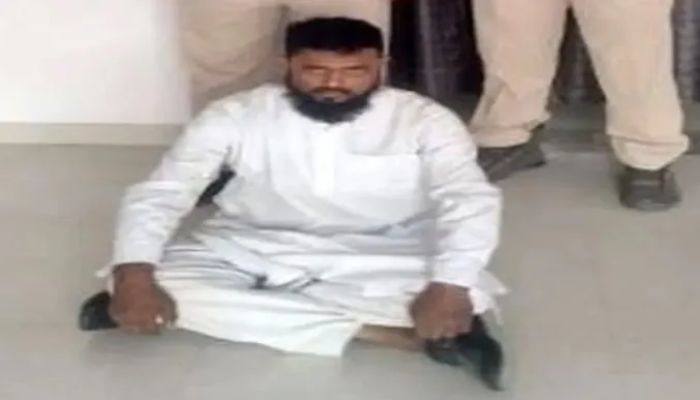
In Rajasthan’s Jhunjhunu, Rafiq alias Ali Khan, a Muslim ‘Aalim’ has been arrested on the accusation of sexually exploiting women by luring them with false promises. According to reports, Rafiq would draw them in by scaring them with ghosts before exploiting them. A victim filed a complaint, and the police arrested him.

An investigation indicated that Rafiq, a West Bengal resident, first attracted girls and obtained all of their information before physically and financially exploiting them. An investigation revealed that Rafiq, who targeted young girls and women, already had two wives. The accused always carried bones with him so he could deceive anyone.

Notably, while our report mentions that the man accused of violating women is Rafiq alias Ali Khan, the media, in reporting on this case, refers to him as a ‘Tantrik’ and uses terms like tantra-mantra. Apart from that, it has written Bengali Baba in the headline leaving the readers with the impression that the arrested accused is a Hindu ‘baba’ and conveniently covering up his Muslim identity.

Tantrik, Tantra-Mantra, and Baba are all related to Hinduism. Other religions have specific terminology for occult practices and occultists, therefore the right wing has long opposed using the term Tantrik to describe a Muslim Aalim involved in criminal activities. Despite the objections, the mainstream media is not refraining from using misleading terms like Tantrik and Baba for Muslim exorcists in such cases.

This is not the first time that the mainstream media passed off a Muslim godman as ‘Tantrik’. In February this year, OpIndia reported how Hindustan Times published a report about the filing of an FIR against accused Muslim ‘godman’ Abubakar with a misleading headline: “Tantrik booked for duping women by offering a cure for cancer, helping secure US visa”. The publication did not mention the name of the accused in the headline and simply wrote ‘Tantrik’ to perhaps ‘secularise’ the crime and give the impression that the accused is a Hindu man who duped the complainant in the name of ‘Tantra-Mantra’.

Karnataka: Congress minister Zameer Khan uses racist slur against Union Minister HD Kumaraswamy, refers to him as a ‘K*aliya’

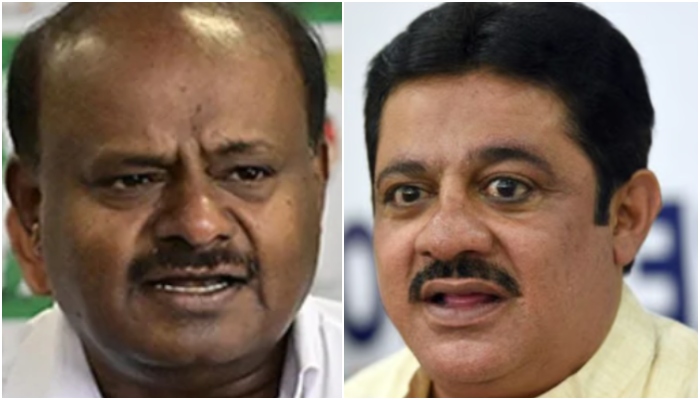
On Sunday, 10th November, Zameer Ahmed Khan, a Karnataka Minister and Congress leader, sparked controversy shortly after he passed racist comments against JD(S) leader HD Kumaraswamy. Referring to the Union Minister, Khan used the term ‘K*aliya’, a derogatory epithet meant for someone with a dark complexion.

Speaking at a campaign gathering in Karnataka’s Channapatna on Sunday, 10th November Khan said, “K*aliya Kumaraswamy is more dangerous than the BJP,” which prompted sharp criticism from opposition leaders.

“Due to some differences in our Congress party, CP Yogeshwar contested as an Independent. He had no option but to join the BJP. He was not ready to join the JD(S) because ‘K*aliya Kumaraswamy’ was more dangerous than the BJP. Now he (Yogeshwar) has come back home,” Khan said.

Yogeshwar switched affiliation from the BJP to the Congress before the Channapatna by-poll, which came about after Kumaraswamy resigned as the constituency’s MLA to join the Union. The JD(S) was enraged and objected to Khan’s statements, demanding that the Congress immediately remove the minister from the Karnataka Cabinet for his racist slur.

“Your power and greed that you will buy the family of Deve Gowda who brought you up politically will not last long,” JD(S) said in a post on X. The party also inquired about the colour of Congress leaders like Mallikarjun Kharge, HC Mahadevappa, Satish Jarakiholi, Priyanka Kharge, and KH Muniyappa.

“The nation vehemently condemns the disgraceful and racially charged remarks by Zameer Ahmed against HD Kumaraswamy. This kind of hateful language marks a new low in political discourse and has no place in a civilized society. We demand accountability from leaders who choose divisive attacks over constructive dialogue,” it added in another post.

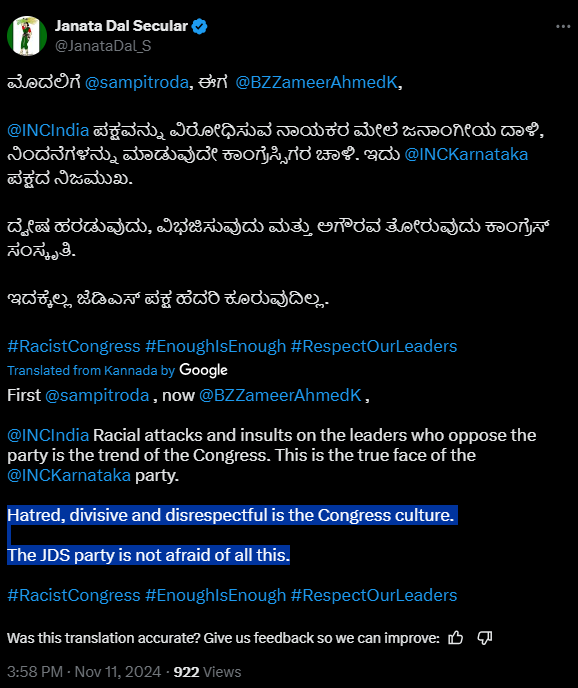
“Racial attacks and insults on the leaders who oppose the party is the trend of the Congress. This is the true face of the Karnataka Congress. Hatred, divisive, and disrespectful is the Congress culture. The JDS party is not afraid of all this. Enough is Enough,” the party said in yet another post.

Meanwhile, Kiren Rijiju, a Union minister and senior BJP leader, also criticized Khan’s racist remarks. “I strongly deplore Congress Minister Zameer Ahmed calling Union Minister & Ex CM of Karnataka Sh. Kumaraswamy as ‘Kaalia Kumaraswamy’. This is a racist remark, same as Rahul Gandhi’s adviser calling South Indians look like Africans, North East as Chinese, North Indians as Arabs,” Rijiju wrote on X.

In the Channapatna assembly by-poll, Yogeeshwara will face Kumaraswamy’s son Nikhil Kumaraswamy, who is seeking office as an NDA candidate on the JD(S) ticket. Khan further alleged that Kumaraswamy indicated he didn’t need Muslim votes. He also challenged Kumaraswamy saying that the Muslim community would buy his entire clan. “Aye Kumaraswamy, tell me your bidding amount. The Muslim community will generate funds that can buy your entire clan,” Khan said amid cheers from the crowd.

Notably, this is not the first time that Khan has commented on the color of Kumaraswamy. He had made similar remarks 3 years ago in Bidar. “I’m short, and God made me short. God made him dark, so he is kala (black). If I called a fair person black, that would be wrong. But black will remain black, isn’t it?” he was quoted as saying.

Bhopal: Hindu girls in Barkatullah University forced to write apology for attending Sunderkand, warden Ayesha Rais tells them to take permission to visit temple

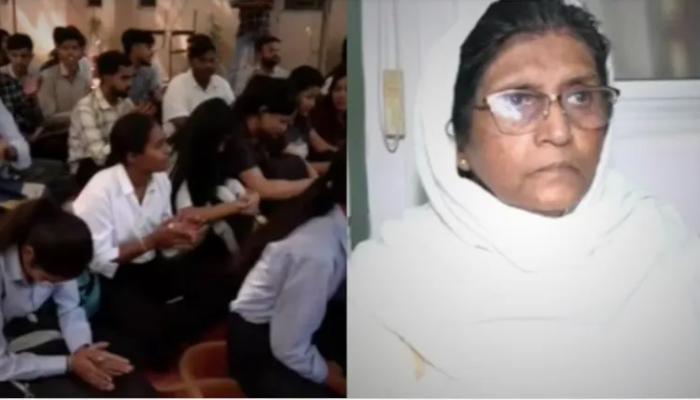
The female students residing in the hostel of the Barkatullah University of Bhopal, Madhya Pradesh, were harassed and made to write an apology letter for going to the temple and reciting the Sunderkand. Following this incident, the Akhil Bharatiya Vidyarthi Parishad (ABVP) launched a protest in opposition to this decision.

The girls shared that the hostel’s chief warden Ayesha Rais said that the Hindu girls would first have to get permission from the university administration before visiting the temple.

Hindu organisations have expressed their outrage over the incident. They have warned that they would take to the streets if appropriate action is not taken in the matter against the warden.

“The ban on Sunderkand and religious events will not be tolerated under the rule of Chief Minister Dr Mohan Yadav”, Rashtriya Swayamsevak Sangh’s affiliated student wing ABVP agitated in the university. Students associated with ABVP gathered at the main gate of the campus and arranged Ramdhun. They offered prayers hoping for wisdom of the administration.

An ABVP leader said that the action of stopping the students from going to the temple and participating in religious programs, is condemnable, and ABVP’s protest against this unfair decree of the warden will continue.

In response to the escalating dispute, Chief Warden Ayesha Rais claimed that students are permitted to take part in cultural events hosted on campus in response to the escalating dispute. According to her, the matter has to do with security and discipline. She further added, “This is not a religious issue. It was resolved. The matter is not about going anywhere, but about discipline. The Vice Chancellor has formed a committee and it will investigate. The girls are like our children. Nothing should happen to them. They live away from their parents. We give them so much love. We provide them with security so that they can enjoy their studies.”

“It is our job to act as guardians. We maintain a register regarding the arrival and departure times of the students. We also keep an eye on the girls to return to the hostel on time. They are also warned to be on time when they get late. The issue has been settled and the girls have agreed. They have completed their entry,” Ayesha Rais alleged.

Sunderkand was reportedly organized on the university campus and girls also took part in it. They reached the hostel late due to this. The hostel warden had instructed them to return to the hostel by the designated hour, which was 7:00 to 7:30 pm. They were told to take permission from the university if there was further delay.

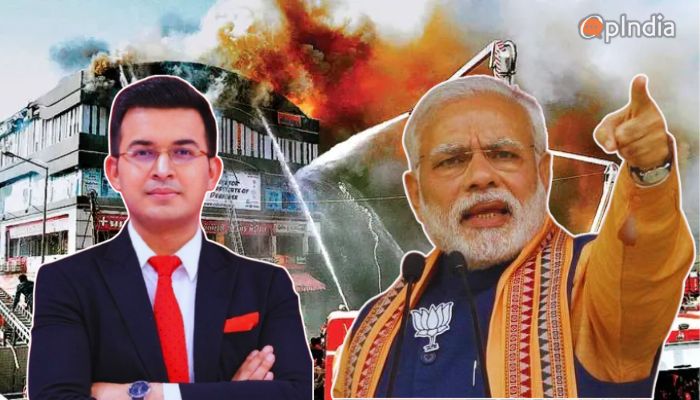
‘Was asked to blame PM Modi for 2019 Surat coaching fire tragedy’: Journalist Shubhankar Mishra reveals in his podcast with Vikrant Massey

0

In a podcast released on 10th November, featuring actor Vikrant Massey, journalist Shubhankar Mishra spoke about how the mainstream media spins narratives around an incident which influences perception about the incident or people involved. Mishra revealed that back in 2019, the television news channel where he worked as a reporter then had asked him to visit the house of one of the victims of the Surat coaching fire accident which claimed 22 lives and get a bite from them blaming Prime Minister Narendra Modi for the incident.

The fire accident at the coaching centre in a commercial complex in Surat’s Jakatnaka area transpired on 24th May 2019. The fire broke due to a short circuit in the air conditioning system. The building did not have a fire safety certificate. Escape routes were blocked trapping the students.

“I was in Gujarat when an incident happened in Surat wherein students were falling from a building to save themselves from fire. Several disturbing videos of girls jumping from the building had emerged back then. It was a tragic incident and we did reporting from there for two days. The coaching centre was sealed, the accused were arrested and the matter came to a closure. Two days after, there was a big leader’s show in Ahmedabad, I asked my editor if I should go to Ahmedabad since the culprits in this case had been arrested, and coaching had been sealed what shall I do. But he (the editor), said no! when the whole world will telecast the rally, you go to the houses of [Surat coaching fire] victims. Grab a child and get a bite from him saying “Modi uncle what did you do?” Mishra said.

He further delved into what could have been the outcome of getting such a statement from the victims and how making the victims say “What did you do Modi uncle, get me my sister back” would have defined the public perception of the incident and Prime Minister Modi.

Notably, while Shubhankar Mishra did not explicitly name which news channel or the editor he was talking about, Mishra’s LinkedIn profile and old videos of coverage of the Surat coaching fire incident confirm that he was working at TV9 Bharatvarsh. Although Mishra did not name the editor who asked him to get a statement against PM Modi, from the coaching fire tragedy victims, netizens are speculating that it may have been Vinod Kapri or Ajit Anjum who worked at TV9 Bharatvarsh in 2019 and are rabid Modi haters.

Jabalpur: Muslims convert a stepwell built during Queen Durgavati’s reign into a shrine, had earlier built an illegal mosque on Gayatri Mandir land

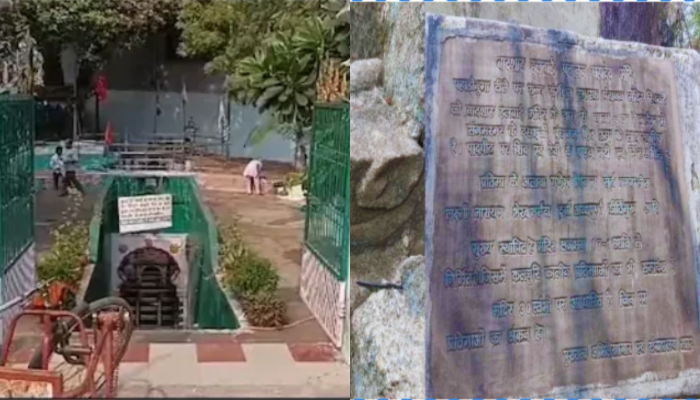
An ongoing matter of grabbing the land of the Gayatri Bal Mandir (temple) to build a mosque in Madai of Ranjhi area of ​​Jabalpur, Madhya Pradesh came to light recently. Meanwhile, the issue of a very old stepwell built on Gwarighat Road has now surfaced. The stepwell of Badshah Halwai Mandir installed during the period of Queen Durgavati of Gondwana has been converted into a mausoleum. Furthermore, the stepwell has been painted with a green colour to incorporate it into the Muslim faith. The development also shocked the Hindu Seva Parishad which observed the fresh changes when they witnessed the green-painted stepwell and the influx of followers of Muslim religion there.

The Hindu Seva Parishad made a video after closely examining the stepwell. They asserted that the statue of Nandi Maharaj, Shivlinga, the Swastika sign and the Shri Yantra are visible at the entry and represent the Sanatan culture. The group’s officials have charged that Muslims have been encroaching upon the land in the past few years and also built a shrine there. The topic of ‘land jihad’ has resurfaced in Jabalpur following the revelation of the stepwell’s altered appearance.

According to the Hindu group, a plot was hatched to erect a mausoleum thereafter members of the Muslim community seized it due to land jihad. Hindu Seva Parishad’s district chief Atul Jaiswani, along with dozens of Hindu activists, protested at the Police Control Room Ghantaghar on 9th November. They unveiled that Urs has also been organised at the location. On the other hand, Hindus have been doing puja at this stepwell for many years, and it has an old temple of archaeological significance.

People reportedly reduced their movement after seeing the increasing interference of the Muslim community and the conflict. Hindu Seva Parishad handed over a memorandum to the sub-divisional magistrate (SDM) in the name of the collector. The Hindu Seva Parishad has submitted a memo to the district administration against the move and demanded to free the stepwell from occupation within thirty days and return to its original form.

Additionally, it warned that the outfit would paint the stepwell saffron if the unlawful occupation was not removed. They have also threatened a major agitation if the administration does not take the matter seriously or initiate any action against it. Badshah Halwai temple and the stepwell are under the Archaeological Department. It has long been a site of worship for the adherents of Sanatan Dharma and it also contains the remains of Hindu idols.

Notably, on 26th September, workers from the Vishva Hindu Parishad (VHP) and Bajrang Dal gathered in large numbers to protest the mosque spanning 3,000 square feet built on the disputed site at Gayatri Mandir According to the Hindu activists, the mosque was built on the grounds of the Hindu religious place. They added that the government had provided the mosque with water and electrical connections as a sizable number of Muslims from all across the city had been gathering covertly at the mosque. The demonstrators challenged the structure on the temple’s property and presented supporting documentation. The Hindu groups have repeatedly protested at the place to oppose the illicit mosque.

Former Indian all-rounder Sanjay Bangar’s son Aryan transitions to Anaya, wants to play international cricket: Read about ICC regulations about transgenders

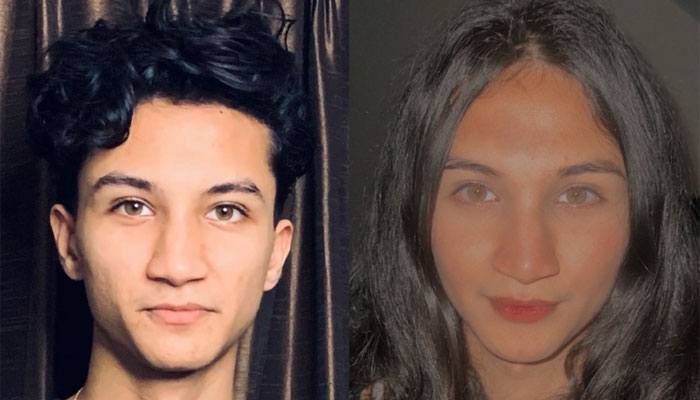
Anaya Bangar, formerly known as Aryan Bangar, child of former Indian cricketer Sanjay Bangar, is making headlines after sharing her journey as a transgender woman. Before becoming Anaya through Hormone Replacement Therapy (HRT) in 2023, she was active in the field of cricket.

However, both the International Cricket Council (ICC) and the England and Wales Cricket Board (ECB) introduced rules barring any transgender person from participating in women’s cricket. In a now-deleted video, Anaya shared her photos before surgery with several prominent names in cricket and wrote, “Chasing my dream of playing cricket professionally has been a journey filled with sacrifices, resilience, and unwavering dedication. From early mornings on the field to facing the doubts and judgments of others, every step has demanded strength.”

Changes through hormone replacement therapy (HRT)

In a recent video shared by Anaya on Instagram, she mentioned that during the 11 months of HRT, she has lost muscle and her body has changed significantly. However, she claimed that she felt happy, and the therapy has reduced her dysphoria. For those unaware, dysphoria can be described as a feeling of profound unhappiness, distress or dissatisfaction, where a person feels uncomfortable in their own body or as if they are in the wrong body.

On 27 October, she shared a report from 20th October in which the ECB announced the banning of transgender women from women’s professional cricket. In the post, she wrote, “It sucks being a trans athlete.”

Anaya’s disconnection from Cricket

In August 2024, when Anaya Bangar was nine months into HRT, she shared a post describing her journey and how she had to disconnect from cricket, which had been a significant part of her life.

In the post, Anaya wrote: “From a young age, cricket has always been a part of my life. Growing up, I watched my dad with awe as he represented and coached the country, and it wasn’t long before I started dreaming of following in his footsteps. The passion, the discipline, and the dedication he showed to the sport were deeply inspiring to me. Cricket became my love, my ambition, and my future. I’ve spent my entire life honing my skills, hoping that one day, I would get the chance to represent my country, just like him. I never thought I’d have to consider giving up the sport that has been my passion, my love, and my escape. But here I am, facing a painful reality. As a trans woman on hormone replacement therapy (HRT), my body has changed drastically. I’ve been losing the muscle mass, strength, muscle memory, and athletic abilities I once relied on. The game I’ve loved for so long is slipping away from me.”

Anaya Bangar further expressed that it hurt her more because there are no proper regulations for trans women in cricket. She added: “It feels like the system is forcing me out, not because I lack the drive or talent, but because the rules haven’t caught up with the reality of who I am. My testosterone levels are down to 0.5 nmol, the lowest it can be for an average cisgender woman. Despite this, I still don’t have a place to represent my country or play at a professional level as my authentic self.”

“To make matters worse, the system says that to compete in women’s sports, I should have transitioned before male puberty. But here’s the contradiction: society and the legal system make it illegal to transition as a minor. So, what am I supposed to do? The system is forcing me into an impossible situation, setting standards I couldn’t have met even if I’d wanted to. It’s heartbreaking that the body I’ve worked so hard to align with my true self is now seen as a barrier to continuing my cricket journey in the women’s category. We need policies that don’t make us choose between our identity and our passions. Trans women deserve the right to compete, play, and thrive”, she said.

ICC regulations on trans participation

While Anaya Bangar decided to undergo a gender reassignment surgery followed by HRT, the regulations regarding the participation of trans persons in cricket were clear. Notably, the ICC had previously allowed trans women to participate in women’s cricket. Twenty-nine-year-old Danielle McGahey was the first transgender player to feature in international cricket in early 2023. However, her participation drew significant criticism, leading to nine months of consultations among ICC members. Finally, on 21st November 2023, the ICC Board approved new gender eligibility regulations for the international game in consultation with stakeholders.

According to the media release, the new policy was based on the principles of protecting the integrity of the women’s game, safety, fairness, and inclusion. This means that any male-to-female participants who have undergone any form of male puberty will not be eligible to participate in international women’s cricket, regardless of any surgery or gender reassignment treatment they may have undertaken.

The review of the policy was led by the ICC Medical Advisory Committee, chaired by Dr Peter Harcourt. The media release specified that it related solely to gender eligibility for international women’s cricket. The board clarified that gender eligibility at the domestic level is a matter for each individual Member Board and may be influenced by local legislation.

At the time, ICC Chief Executive Geoff Allardice said, “The changes to the gender eligibility regulations resulted from an extensive consultation process and are founded in science and aligned with the core principles developed during the review. Inclusivity is incredibly important to us as a sport, but our priority was to protect the integrity of the international women’s game and the safety of players.”

The policy will be reviewed again in 2026.

ECB’s domestic regulation changes

As the policy clearly mentioned that the decision to allow transgender women to play in women’s teams at the domestic level was a matter for each individual Member Board, Anaya Bangar, who currently plays in the United Kingdom, was still able to play for the ECB. However, in October 2024, the England and Wales Cricket Board decided not to allow transgender women to feature in the top two tiers of the new women’s domestic structure or the women’s Hundred.

In a press release, the ECB stated that it had consulted “relevant science and medical evidence” and considered “fairness, safety, and inclusion.” Trans women, however, will be able to participate in tier three of the new domestic system, which will be launched in 2025. Furthermore, they will be allowed to participate in recreational cricket as well.

Other sports regulations

World Athletics, the international governing organisation for athletics, banned transgender women (men who have transitioned to women) from competing in the female category at international events in march 2023. The decision came after several instances came to fore where male athletes competed in women’s tournaments claiming they identify as “women”.

Nephew of judge who stood up to Indira Gandhi, ruled in favour of abrogation of Article 370 and more: Meet Sanjiv Khanna, the new CJI on the target of left-liberals

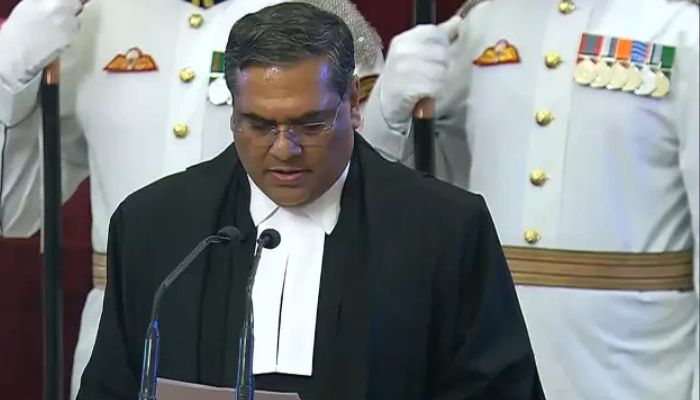
On Monday (11th November), Supreme Court judge Sanjiv Khanna was sworn in as the 51st Chief Justice of India (CJI). He succeeds the retired CJI DY Chandrachud, the erstwhile left-liberal hero now villainised by the same ecosystem in India.

Justice Sanjiv Khanna is the nephew of former Supreme Court Judge Hans Raj Khanna, who infamously took on Indira Gandhi’s government in 1976. In a dissenting judgment, he ruled that the right to life and personal liberty could not be suspended, even during an Emergency.

This cost Justice Hans Raj Khanna his appointment as CJI. Indira Gandhi broke the convention of appointing the seniormost judge as the Chief Justice of India, promoting Justice Hans Raj Khanna to resign.

Inspired by his uncle, Justice Sanjiv Khanna enrolled at the Bar Council of Delhi in 1983 and was appointed to the Delhi High Court as an Additional Judge in 2005.

Justice Khanna was thereafter elevated to the Supreme Court in January 2019. He is set to serve in the capacity of Chief Justice of India for a brief period of 6 months until 13th May 2025.

Key Judgments as Supreme Court Judge

The newly appointed CJI was a part of the 7-Judge Bench that overruled the 1967 Azeez Basha case, which denied minority status to Aligarh Muslim University.

Justice Sanjiv Khanna and three other judges directed that the status of AMU be freshly determined based on the tests laid down in that particular case (Aligarh Muslim University Through its Registrar Faizan Mustafa v Naresh Agarwal).

In April 2024, he along with Justice Dipankar Dutta shot down [pdf] a petition filed by the Association for Democratic Reforms (ADR), seeking 100% VVPAT verification of votes cast on Electronic Voting Machines (EVMs).

He noted that bank officials are aware of the identities of the donors who purchased the bonds. Justice Khanna was previously part of the 2019 Bench that increased the number of booths, which undergo VVPAT physical verification, from 1 to 5 per Assembly Segment. 

In February this year, Justice Khanna was part of a 5-judge bench that dubbed the electoral bond scheme ‘unconstitutional.’ Justice Khanna in a concurring judgment dismissed the argument that donor privacy applied to donations made through banks.

He was part of the 5-Judge Bench that unanimously upheld the constitutionality of abrogation of Article 370. In a concurring judgment, Justice Khanna stated that the removal of Article 370 did not undermine India’s federal structure.

In 2019, Justice Khanna did not interfere with the decision of the Election Commission of India (ECI), which stalled the release of Prime Minister Narendra Modi’s biopic amid the enforcement of the Model Code of Conduct (MCC).

He was also part of the Bench which rejected the Centre’s petition to increase the compensation given to victims of the 1984 Bhopal Gas Tragedy. The apex court contended that the settlement could be set aside only on grounds of ‘fraud’, which was not pleaded by the Centre.

He along with 4 other Judges also upheld that the Supreme Court has the authority to grant divorce to couples using its discretionary powers under Article 142 of the Indian Constitution without the need to approach lower courts. (Shilpa Sailesh v Varun Sreenivasan)

In 2018, Justice Khanna also ruled in favour of the decriminalisation of adultery in Joseph Shine v Union of India.

Key cases where the decision is pending

He is also part of the 2-Judge Bench of the Supreme Court, deciding the constitutionality of the Triple Talaq law enacted by the Modi government.

Justice Sanjiv Khanna is also hearing the case (Youth For Equality v State Of Bihar) to determine the validity of the caste-based survey carried out by the JDU-RJD government in 2023.

He is also part of a Bench tasked to decide the validity of the Chief Election Commissioner and Other Election Commissioner Act enacted by the Modi government. The law removed the CJI from the 3-panel committee meant to choose the Chief Election Commissioner.

Justice Khana is also heading a Bench on a case (Durga Dutt v Union of India) seeking to make Fundamental Duties, which was introduced by the Indira Gandhi govt in 1976, enforceable in India.

He along with two other Judges will also assess the 2006 Nagaraj judgment, which validated reservation in promotions. The newly appointed CJI will also hear the 2023 case, concerning the ban on BBC’s propaganda documentary against PM Modi.

Justice Khanna is also part of a 2-Judge Bench, which will decide if certain provisions of The National Commission for Minority Educational Institutions Act of 2004 and The National Commission for Minorities Act of 1992 are constitutionally valid.

He will further decide whether minority status should be given based on State population or nationwide population.

Conclusion

Justice Sanjiv Khanna has ruled in favour of the Modi government over the abrogation of Article 370 and against it in the electoral bond case.

He has drawn the praise of the left-liberal lobby for decriminalising adultery, declaring electoral bonds invalid, and not interfering with the decision of the Election Commission of India to stall the release of PM Modi’s biopic.

The newly appointed CJI was hailed by the same ecosystem for paving the path for Aligarh Muslim University to attain minority status.

He had occasionally drawn ire from the coterie over holding abrogation of Article 370 constitutional and not entertaining their demand of a 100% EVM-VVPAT match.

As mentioned above, Justice Khanna is part of several Benches which are yet to decide key constitutional matters such as the validity of the Triple Talaq law, Bihar caste census, and legislation pertaining to the appointment of Election Commissioners.

If the incumbent CJI finds merits in the arguments presented by the government and rules in its favour, Justice Sanjiv Khanna will be equally demonised by the left-liberal ecosystem as it did with his predecessor Justice (retd.) DY Chandrachud.

The cabal spares none unless they give favourable verdicts in all cases. They demand a judiciary committed to their ideals like the one once espoused by Indira Gandhi.