Eight Hindu girls including seven underage have reportedly gone missing in two months in Faridabad, Haryana. The shocking occurrences have enraged their families and Hindu organisations who went to the Police Commissioner’s office and demanded appropriate action against the culprits. They have accused Muslim men of engaging in love jihad and trapping their daughters. However, the authorities have refuted their charges. More importantly, they have not been able to recover any girl or identify the perpetrators.
The complainants handed over a memorandum to the Assistant Police Commissioner (ACP) Central Vishnu Prasad and asked for the arrest of the accused. He listened to the workers of the Hindu groups who accompanied the aggrieved families and called the concerned police station in charges regarding all the incidents. He directed them to act promptly and rescue the girls as well as capture the offenders.
Hindu activists charged that Muslim youths have lured and took the girls with them. They urged the authorities to safely retrieve the girls and apprehend the offenders as soon as possible. Meanwhile, a girl’s mother and aunt unveiled that they had regularly asked the cops for assistance but had never received an adequate response. They added that the family members are tired of repeatedly visiting police stations. They revealed that the police didn’t even question anyone after the mother told them about the people she ssuspected. The cops allegedly asked her to bring a car if she wanted them to search for her daughter.
The Hindu outfits and families hoped that their concerns would now be given due consideration after meeting with the ACP. A Hindu activist named Sushil conveyed that all eight instances are from Faridabad and are lodged at various police stations in the area. One girl is an adult while the other seven are juveniles. He accused that the Muslim young men have tricked them into love jihad which led to their disappearance. He wanted them to be arrested as quickly as possible.
On the other hand, a police spokesperson claimed that love jihad has not yet been verified in any case, however, an investigation is ongoing. He added that the adult girl had voluntarily married a Hindu man.
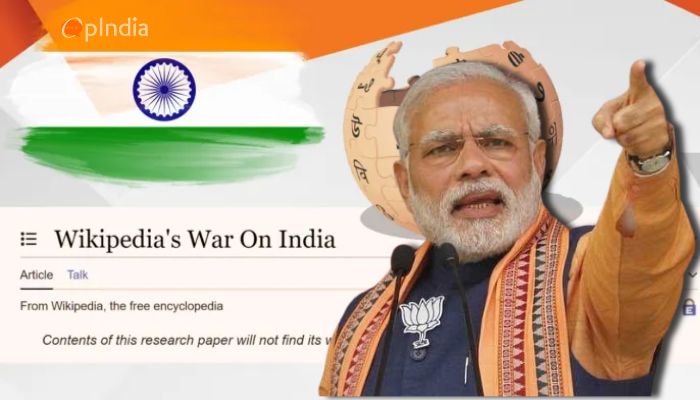
Days after OpIndia released its dossier detailing how Wikipedia is not a free, editorial intervention-free encyclopaedia, the Central government has issued a notice to Wikipedia. On Tuesday (5th November), the Modi government wrote to Wikipedia, citing multiple complaints about bias and inaccuracies on their platform. The government pointed out that a select editorial group has control over the platform and also questioned why Wikipedia should not be treated as a publisher, a demand OpIndia raised recently.
“Government of India puts Wikipedia on notice. Government writes to Wikipedia pointing out many complaints of bias and inaccuracies in Wikipedia, points out a small group having editorial control and asks why Wikipedia shouldn’t be treated as a publisher instead of an intermediary,” news agency ANI reported citing sources.
Govt of India puts Wikipedia on notice. Govt writes to Wikipedia pointing out many complaints of bias and inaccuracies in Wikipedia, points out a small group having editorial control and asks why Wikipedia shouldn’t be treated as a publisher instead of an intermediary: Sources
Notably, Wikipedia is embroiled in a legal battle with ANI as the news agency filed a defamation case against Wikipedia for adverse comments made on its Wiki page. The agency objected to the comment saying that ANI “has been criticized for having served as a propaganda tool for the incumbent central government, distributing materials from a vast network of fake news websites, and misreporting events.”
ANI accused Wikipedia of publishing false and defamatory content with malicious intent of tarnishing the news agency’s reputation and discrediting its goodwill. The news agency also sought Rs 2 crore in damages from Wikipedia.
Is Wikipedia an unbiased intermediary or a biased publisher? What OpIndia research found
OpIndia’s research paper revealed that the structure of Wikipedia itself gives unmitigated power to a handful of individuals who are called ‘administrators’. There are only 435 active administrators in the entire world who have the power to ban editors, blacklist sources, ban contributors and decide the edits that should be made or reverted on articles.
Soon after OpIndia released the dossier, Facebook, another Left-leaning platform that has been accused of election interference in the USA and many such instances of furthering the political interest of a certain ideology, banned the dossier to restrict its viewership.
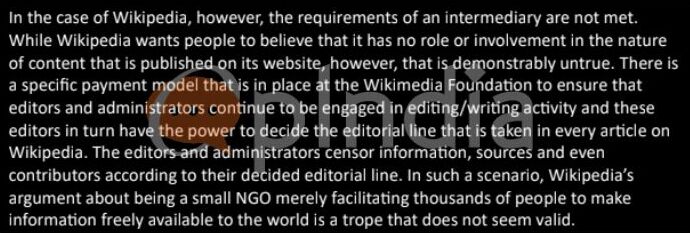
Wikipedia claims to be an intermediary which depends on the wisdom of the crowd without content intervention and editorial line, based on ‘reliable sources’ and maintaining and neutral point of view. This, however, is far from the truth, as evidenced in OpIndia research. Wikipedia meets all the standards of publishers. They collate information on current events and historical events, they pay their editors and administrators and they are easily accessible by the people at large on the internet.
Given that Wikipedia has an editorial stand based on the personal opinions and biases of its editors and administrators, the evidence cited in the OpIndia dossier suggests that they are no longer eligible to be considered an intermediary. OpIndia recommended that once declared a publisher, Wikimedia would have to have their offices in India, set up a grievance redressal system and submit to Indian laws about illegal content which undermines the sovereignty of India or creates disaffection.
Notably, the Information Technology (Intermediary Guidelines and Digital Media Ethics Code) Rules, 2021 applies to Digital Media which includes ‘intermediaries’ and publishers of news or publishers of online curated content. Wikipedia, even as itself claims to be an ‘intermediary’ is qualified to be treated as a publisher given that despite not having any physical presence in India, it not only has a specific editorial line controlled by a small group of administrators and editors but also pays many of them through the Wikimedia Foundation.
Excerpt from the OpIndia dossier on Wikipedia
It is pertinent to recall that Wikipedia had during the controversy around the BBC propaganda documentary against Prime Minister Narendra Modi, declared that it is a foreign entity and thus, the Indian courts have no jurisdiction over it. The findings of the research paper prepared by OpIndia Editor-in-Chief Nupur J Sharma, reveal that despite not having offices or presence in India, Wikipedia has been funding entities and individuals with anti-India ideology and even links to Islamists and Khalistanis, to further its own business and ideological interests in the country. Wikipedia not only collects funds from India in the form of donations but also spends millions of dollars in India and toes an absolutely biased and rigid editorial line, all while claiming to be an intermediary and not a publisher to escape any accountability before the Indian law.
Besides, declaring Wikipedia as a publisher, OpIndia also recommended that Wikipedia’s financial transactions be scrutinised. The OpIndia dossier titled Wikipedia’s War on India can be read here.
In the Siddharth Nagar district of Uttar Pradesh, stones were allegedly pelted on the Maa Lakshmi idol immersion procession, resulting in damage to an idol and injury to some participants of the procession. The incident reportedly unfolded in the Mali Manaiha area in Dumariyaganj, after which the outraged Hindus staged a protest demanding action against stone pelters and blocked the road. As per a News18 report, two female participants of the procession also sustained injuries in the stone pelting allegedly carried out when the Hindu procession was passing near a mosque.
Upon receiving the information about the alleged stone pelting, the local police swung into action. Inspector In-charge Ramesh Kumar Yadav, SDM Dr Sanjeev Dixit, and CO Satish Chandra Pandey rushed to the spot. The officers somehow managed to persuade the protesting Hindu devotees to lift the blockade. Following this, the procession proceeded to immerse the idols. The police have detained one person over alleged involvement in stone pelting and are questioning him.
According to a Live Hindustanreport, DM Dr Raja Ganapati R said that someone threw a stone during the immersion of the idol. Angered by this, people tried to block the road. SDM and CO pacified them and later, the idols were immersed. One person has been detained and a case will be registered.
However, the Siddharth Nagar Police has said that no stones were hurled at the Hindu procession and a false rumour was spread about the same. ASP Siddharthnagar said that the police are investigating how the rumour was spread and who is behind it. Based on the findings of the investigation, the necessary action will be taken. The officer added that at present, the situation is calm and under control in the Mali Manaiha area.
The voting for the assembly elections in the state of Maharashtra is just 15 days away and all the major political parties involved like the Maha Vikas Aghadi Alliance led by the Congress party and the Mahayuti Alliance led by the BJP are giving thought fight. Amid this, an old letter portraying Congress’ alleged support to the terrorists has come to the fore. An old letter that looks like a mercy petition for terrorist Yakub Memon, dated 28th July 2015, signed by a Congress candidate from Mira Bhayandar seat of Mumbai, Syed Muzaffar Hussain is making rounds on social media. Memon played a crucial role in the 1993 Mumbai bomb blasts.
Among the crucial signatories is former legislator Muzaffar Hussain, who recently bagged the Congress ticket from the Mira Bhayandar (145) assembly segment. The other authorities who signed the letter are ex-Minister Arif Naseem Khan, Amin Patel, Aslam Sheikh, Sheik Asif Sheikh Rashid, Husnabano Khulife, Yusuf Abrahani, and Javed Juneja.
“We wish to appeal to Your Excellency for clemency towards the conviction of Yakub Memon. Several eminent personalities like filmmaker Mahesh Bhatt, Actor Nasiruddin Shah, Activist Tushar Gandhi, CPI’s Sitaram Yechury, BJP’s Shatrughan Sinha, Lawyer Vrinda Grover, and 290 others had signed the mercy petition for Memon. We request Your Excellency to grant clemency under article 72 of the Indian Constitution and commute his death sentence into life imprisonment,” the letter read.
Meet Congress candidate from the Mira-Bhayandar seat (Maharashtra) Muzaffar Hussain. He's also the working president of Maharashtra Congress.
He had signed a mercy petition for terrorist Yakub Memon.
MVA led by Congress earlier beautified the grave of Memon, attempted to convert it into Mazar
Yakub Memon was convicted for the 1993 Mumbai bomb blasts and was sentenced to death. In 2015, the death sentence was carried out after his mercy petition was rejected. He was buried on July 30, 2015, at Bada Cemetery in South Mumbai. Notably, Yakub was the only convict awarded the death penalty.
The Congress, the NCP led by Sharad Pawar and the Shiv Sena (UBT) have been allegedly extending support to terrorist Memon. This is clear as Congress MLA Aslam Shaikh who had written the letter to then President Pranab Mukherjee seeking mercy for Memon’s execution, was sworn in as a cabinet minister in the previous Maha Vikas Aghadi (MVA) government led by Shiv Sena chief Uddhav Thackeray.
Not only that but during the MVA alliance’s rule, the grave of terrorist Memon was also being beautified. An attempt was being made to turn Yakub’s grave into a tomb, giving it VIP treatment. The grave was covered with white marble and LED lights were put on to beautify it. It was also guarded 24 hours a day. The Qabrastan authorities when contacted, denied special treatment and stated that the marble slabs and LED lights were part of a general beautification drive and are not specific to the grave of Yakub Memon. However, the scene was exposed only after BJP leader Ram Kadam shared the images of beautification specifically done at the grave of the terrorist, alleging that it had been converted into a Mazar.
He also slammed the Congress, NCP led by Sharad Pawar, and Shiv Sena led by Uddhav Thackeray for glorifying the convicted terrorist like this. After this, the LED lights surrounding Memon’s grave were taken down.
Maharashtra | Lighting arrangements that were put up at the grave of 1993 Mumbai blasts convict Yakub Memon are now being removed. Latest visuals from Bada Qabrastan in Mumbai. pic.twitter.com/i3rOi2VgVl
Notably, BJP leader Shatrughan Sinha’s name was also dragged in the mercy petition signed by Islamists and its supporters, however, he had denied the accusations saying that he never signed any petition concerning Yakub Memon.
Muzzafar Hussain declared INC candidate from Mira Bhayandar
On 24th October, the former legislator Muzaffar Hussain was declared as the candidate from the Mira Bhayander (145) by the Congress party. Hussain’s name appeared in the first list of 48 candidates announced by the Congress party, alongside prominent senior leaders like Nana Patole, Prithviraj Chavan, Vijay Wadettiwar, and Balasaheb Thorat.
Muzaffar Hussain began his political journey as a Youth Congress worker. He was first elected to the Mira-Bhayander Municipal Corporation in 1991 and later served as the State Youth Congress president for an extended period. He is also a builder by profession. In 2004, he was elected to the Legislative Council, where he served until 2009, and has since sought re-nomination to the council. Hussain faced a significant political setback in 2009 when his stronghold, the Mira-Bhayander Assembly constituency, was allocated to the NCP as part of a seat-sharing arrangement, preventing him from contesting the assembly election. Later that year, he ran in a by-election for the Bhiwandi seat vacated by SP leader Abu Azmi but was defeated by a Shiv Sena (then united) candidate.
A dedicated Congress loyalist, Hussain belonging to the Muslim community, has earned widespread popularity among people from all communities, giving a probable tough fight to his contenders including BJP’s Narendra Mehta this time.
He usually is seen wearing a secular cap and expressing intent to combine different communities. Recently, during the election campaign during Diwali, he visited a temple in the Mira Bhayander region and said that he wanted to break the barriers between the different communities. Also during Ramadan this year, he who is also the managing trustee of the Jama Masjid Al Shams Mosque, had extended an invitation to visit the mosque to worshippers of all faiths and castes. However, maximum of the population residing in the Mira-Bhayander region today is Muslims, who dominate Hindus, harass them, and eventually force them to shift to other regions of Mumbai and Thane. OpIndia has reported several incidents from Mira Bhayander where Hindus complain that their daughters and sisters are trapped in love jihad incidents, Hindu businesses are deliberately targeted and minors are influenced to follow Islam. These reports can be read here.
Expressing gratitude to his party leadership for the opportunity, Hussain on 24th October remarked, “In areas like healthcare, water supply, housing, transportation, and infrastructure, the current administration and elected officials have failed entirely over the past decade. Residents have received nothing but empty promises. Much remains to be done.”
In the 2019 assembly elections, Hussain contested unsuccessfully, losing to independent candidate Geeta Jain, who garnered 79,575 votes and defeated her BJP opponent Narendra Mehta too by a margin of 15,526 votes. Hussain received 55,939 votes, capturing nearly 27% of the total vote share.
However, sources on the ground indicate that while Hussain holds a ‘secularist’ image, he has assiduously cultivated his vote bank, 90% of which is composed of the Muslim population.
Hussain’s father, Syed Nazar Hussain was one of the founders of Nayanagar, where Hindus are hardly allowed today
It is further crucial to note that Syed Muzaffar Hussain’s father, Syed Nazar Hussain who recently lost their life due to old age at 90, was one of the founders of the Nayanagar area in Mira-Bhayandar region where today Hindus are hardly allowed as alleged by the Sakal Hindu Samaj. As per the reports, for the foundation of the Nayanagar township, Syed Nazar Hussain had extended an invitation to Hindutva leader Balasaheb Thackeray and Indian Union Muslim League leader G M Banatwala together, attempting to sow the seeds of ‘secularism’.
Today, Nayanagar, Mira Road, and the Bhayander area in the Mumbai district have appeared in the news for all the wrong reasons, especially in the recent past. Several incidents of love jihad and assault on Hindus in the region have been exposed. OpIndia in February this year reported 15 cases of forced conversion, rape, assault, and torture from the last 1 year exposing the criminal den of Islamists in Nayanagar and Mira Bhayander region.
The Islamists deliberately target Hindu women in relationships and then, indulge in conversion – often violently. They believe that India is Dar-ul-Harb which must be changed to Da-ul-Islam and they see the conversion of Hindus to Islam as one of the crucial ways towards fulfilling their dreams. The Islamists are also encouraged by their religious heads to trap Hindus, especially women in relationships and convert their religion to Islam. There is evidence to suggest that Islamists are also provided with financial aid to trap Hindus, especially women, and convert their religion to Islam.
Mumbai’s Mira Road and Bhayander area which has a majority Muslim population has become a hub of ‘Grooming Jihad’ and religious conversion. The Sakal Hindu Samaj members in an exclusive conversation earlier had informed OpIndia that the Mira Road region in Mumbai is dominated by the Muslim majority population and that the community which claims to be a minority and oppressed is moving to become a problem for the other communities.
Explaining the changing demography of the region, Kishor Sant (name changed for security reasons) of the Sakal Hindu Samaj was quoted as saying, “Earlier this Mira Bhayander region, Nayanagar area was dominated by the Hindu population. In the past few years, several Muslims from the Mumbra region or even from different cities migrated to this area claiming their dominance. Later in the Nayanagar and Mira road region these people began deliberately harassing Hindus. They began harassing their daughters, disturbing them in their businesses and even there are many cases where these people have demanded ransom money from Hindus. As a result of this, several Hindus began migrating to other regions of Mumbai and Thane.”
“At present, in the Nayanagar area, no Hindus are allowed. It has now become a Muslim locality. Recently, Hindu devotees were badly assaulted during the Ram Mandir inauguration ceremony that happened in Ayodhya. The Hindus in the Nayanagar area were abused, also derogatory comments were made against Lord Rama. The videos of the incident had gone viral over the internet. This is a growing problem,” he added.
Earlier Mira Road controversies and acts of violence reported by OpIndia
Though Hussain in his election campaigns claims that Hindus and Muslims have always been united and that it is the BJP that has created communal hatred, media reports, and legal pieces of evidence have another story to tell. On 29th October, communal tensions erupted in the Mira Bhayander region as Muslims attacked Hindus for bursting firecrackers while celebrating the Hindu festival of Diwali. The accused persons allegedly attacked around 10-12 Hindus with sharp weapons resulting in serious injuries.
Pls contact to Mira Bhayandar Vasai Virar police commissionerate control room for further action. You can contact them on 022-29452135 Whatsapp no 8657936942 this helpline no. regarding this.
— Thane City Police -ठाणे शहर पोलीस (@ThaneCityPolice) October 29, 2024
As per the Hindu victims, the accused persons used ice-breaker weapons and glass bottles to attack them. Around 5 victims had to be immediately shifted to the hospital and were released after proper treatment. Meanwhile, several Hindus gathered at the spot and at the Navghar Police Station to protest against the incident. The Hindus raised slogans and demanded strict punishment against the accused persons. A complaint in the case was later filed.
In June 2024, the Mumbai Police arrested an individual identified as Amir Chaudhari Sayed Chaudhari after he trapped a Hindu minor girl into a love affair and molested her twice. The incident happened in the JP North society in Mumbai’s Mira Road region. The accused aged 18 was booked and arrested by the Navghar Police Station under section 354 of the Indian Penal Code, 1860, and sections 8 and 12 of the POCSO, 2012.
The accused used to call the girl and also initiate chats with her on social media platforms. He also used to frequently call her to meet her. In March this year, the accused called the girl to meet him near the Max Pro gym where he tried to forcefully kiss her. He pulled her closer without her will and attempted to molest her. The girl pushed him away and escaped to reach home. Recently, on 24th June, the accused again called the girl to meet in the garden close to Seven Square. He again tried to molest the girl by forcefully kissing her. The girl then managed to call her mother who came to rescue. The duo then reached the police station and filed a police complaint.
On June 17th, the Kashigaon Police Station in Mumbai’s Mira Road region booked an individual named Vajud, a resident of Hill Galaxy Apartment, for insulting and threatening Hindus and abusing the religion saying, “Hinduo ke m** ki ch**”. The incident happened on 16th June and was exclusively reported by OpIndia. The Muslim residents residing in the Hill Galaxy Apartment and JP North Celeste Society on Mira Road initially got goats inside the society premises for illegal slaughter ahead of the Bakrid festival. The Hindus then protested against the incident and called the police. However, the police allowed the goats saying that there was no livestock policy within the society.
Amid this, the Hindus launched massive protests and objected to the slaughter on the society’s premises. However, the Muslim residents argued with the Hindus and claimed that they would slaughter the goats on the society’s premises. As reported earlier, Vajud and his associates insulted Hindus. They threatened the Hindus saying they (Muslims) would slaughter the goats within the society premises, come what may. “Do whatever you can. We will slaughter animals here only, within the society premises. Hinduo ke m** ki ch**,” Vajud was quoted as saying as per the FIR.
The Muslims also insulted Lord Ganesh hurting the religious sentiments of Hindus. “You people celebrate the Ganesh festival. Do we say anything then? We feel enraged and puking when we see your Lord Ganesha. We will see how you celebrate your Ganesh festival here,” Vajud said as he threatened the Hindus. The FIR was then filed under sections 295A (Deliberate and malicious acts, intended to outrage religious feelings of any class by insulting its religion or religious beliefs) and 153A (Promoting enmity between different groups) of the Indian Penal Code, 1860.
Residents claim that illegal Masjid has also been constructed at Galaxy Hills by Builder Sheikh. People from other societies come here to offer prayers making Hindus uncomfortable. 'There's almost daily ruckus on this issue', residents say.
In June 2023, a massive controversy erupted after one of the Muslim families living in a society on Mira Road, Mumbai brought two goats a day ahead of Bakrid (Bakra-eid, Eid-Ul-Adha). The society members happened to refuse the Muslim family to get the goats inside the society premises for slaughter and said that they wouldn’t allow any kind of slaughtering activity within the society premises.
The residents of the society on Mira Road protested and opposed the slaughtering of the goats within the society premises on Bakrid and also chanted Hanuman Chalisa. Some of the people also raised the slogans of ‘Jai Shree Ram’, the videos of which had gone viral in the media.
But the couple took the goats to the apartment after which the police were informed. The police who reached the spot immediately tried to maintain peace and communal harmony and assured the other residents in the society that no slaughtering would take place within the society premises.
The Police also allowed the goats saying that there was no such rule or law against a man getting goats or animals into his house. However, the authorities said that the concerned family would face arrest if they slaughtered animals in his apartment or within the society premises. The detailed report on this case can be read here and here.
In the second crucial incident that was reported recently in January 2024, the Islamists attacked Hindus with stones, iron rods, sticks, and bamboo, leaving over a dozen people who participated in rallies to commemorate the return of Lord Ram in Ayodhya injured.
In the incident reported from Mira Road, Mumbai, Islamists also disrespected the Hindu religion and hurt the Hindu religious sentiments by tearing flags bearing images of Lord Hanuman. Islamists are also said to have vomited over the flags causing disrespect to the Hindu faith. OpIndia contacted the Police to know the details of the incident. The police confirmed that around 13 persons had been arrested in the case, however, IO Dilip Rakh revealed no information about the accused persons given the sensitivity of the case.
The videos of the incident had gone viral over the internet in which the Islamists could be heard raising the slogans of ‘Allah-hu-Akhbar’ while attacking the cars. They could be seen using iron rods and sticks to attack the Hindus. Even the videos of women being attacked made rounds on social media.
Islamists raised slogans of 'Allah-hu-Akhbar' after cars on #miraroad attacked. They puked on Hindu flags. I have zero courage to share disheartening videos showing Hindu flags dipped in puke. It hurts to see #Hindus disrespected @NiteshNRane's rally is scheduled today. pic.twitter.com/am8vmVkksl
Later the Police and the local administration took cognizance of the event and bulldozed the illegal properties of the Islamists staying on the Mira road who were involved in the stone pelting. As per reports, the illegal construction of the accused persons involved in the Mira Road clash was razed to the ground in the presence of Maharashtra Security Force and Mumbai Police.
This year in February, OpIndia reported 15 cases in which Hindu girls were deliberately trapped by Muslims in the Mira Road region and then raped, and converted to Islam. Hindu activists while talking about the incident had said that the cases of Love Jihad had been on the rise in the region but were allegedly being ignored by the administration. Detailed reports in this case can be read here.
Conclusion
Syed Muzaffar Hussain, the current Congress candidate from the Mira Bhayander region, who often blames the ruling party for allegedly spreading communal hatred in the society, who wears the cap of ‘secularism’ and who believes in the so-called community building in the region should also answer some basic questions during his campaigns like- why Hindus are often allegedly assaulted for practising their religion in Mira Bhayander and Nayanagar area by Islamists? Why do Hindu women continue to fall prey to incidents of love jihad at the hands of Islamists? Why are Hindus today hardly allowed in the Nayanagar region (as alleged by Sakal Hindu Samaj) which was founded by his father, Syed Nazar Hussain?
It is easy to allegedly make fake promises assuring development, communal harmony, and social development, but facing the ground reality seems tough, all thanks to the local administration. Islamists in the Mira Road, Nayanagar region allegedly target Hindu communities for celebrating Hindu festivals, they target Hindu women, and force them to convert to Islam, and this all is not a hoax. Enough evidence, like FIRs, testimonies, videos, police records, etc have time to time been presented by OpIndia to highlight the problems faced by Hindus in the region. Notably, these incidents occurred during the decade when the BJP was in power in the region. If Congress, known for its history of close association with minorities for votes, were to take power, what more might happen?
As per the activists on the ground, several Hindu businesses in the region are also deliberately targeted by the Islamists. “They install hawkers in the areas which are literally ‘no-hawkers’ zones and indirectly block the customers from reaching into the Hindu shops. Then they slowly start trapping the daughters of the Hindu shopkeepers leading to the incidents of Love Jihad,” Pratap Deokate (name changed for security reasons), one of the Hindu activists said earlier in February while talking to OpIndia.
If Muzzafar Hussain, wearing the cap of ‘secularism’ really wants communal harmony to reside in the region, he needs to look into all such cases and provide justice to Hindus, especially women who are often trapped in Love Jihad incidents at the hands of Islamists. He must make sure that the local administration pays serious attention to such cases, allowing no alleged free pass to accused Islamists. Congress and its supporters often consider Love Jihad as a hoax, but no such reason for disbelief in this conspiracy should exist anymore. In April 2024, one Neha Hiremath was murdered by her former classmate Fayaz in Hubbali, Karnataka for refusing to convert to Islam. Notably, Neha’s father Niranjan Hiremath was a Congress leader who had confirmed that his daughter was a victim of love jihad and that this ‘conspiracy’ exists.
Muzzafar Hussain so far holds a radiant image in the minds of voters today, all thanks to his ‘secular’ approach, clean image, and relentless social service activities. This profile gives a potentially tough fight this time to BJP’s Narendra Mehta given Geeta Jain missing from the picture. As per the sources, Hussain is expected to garner a maximum of the Muslim votes given his association with the Congress and also the community.
A general assembly election is scheduled to be held in Maharashtra on 20th November to elect the 288 members of the 15th Maharashtra Legislative Assembly, the counting and the results of which will be declared on 23rd November.
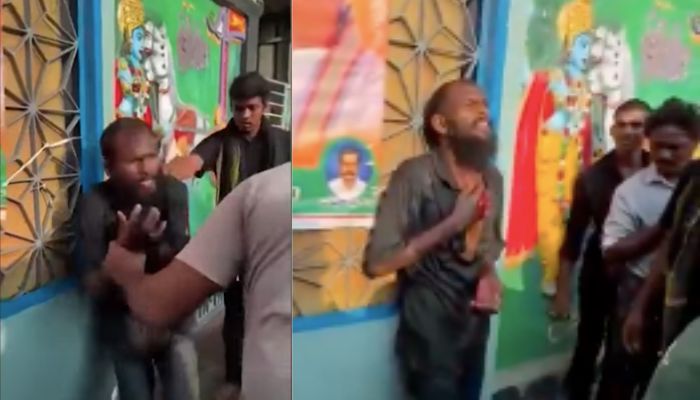
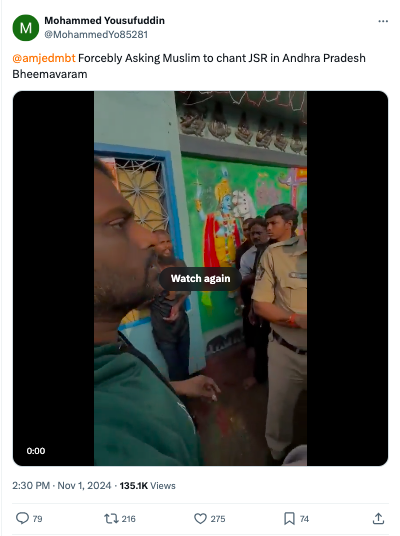
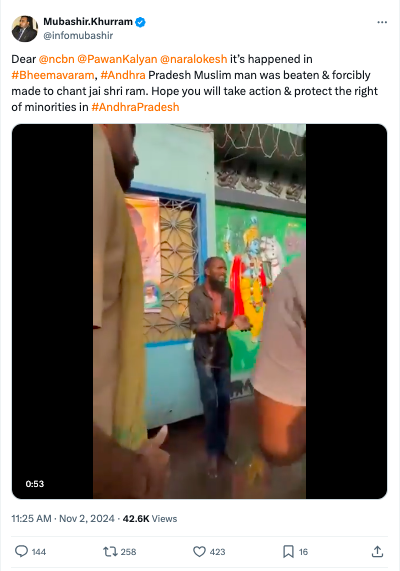
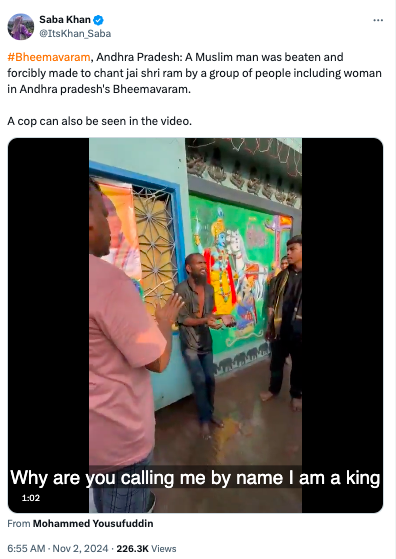
In the latest instance of Islamists spreading lies, laying claim to victimhood and maligning Hindus, the ‘ecosystem’ widely circulated a video showing a group of people surrounding a person and asking him to raise Jai Shri Ram slogans, with the claim that the person being ‘hounded’ by Hindu ‘extremists’ was a Muslim and was being harassed for no reason but his religious identity.
In this vein, one X user Mohammed Yousufuddin shared the video and said, “Forcebly Asking Muslim to chant JSR in Andhra Pradesh Bheemavaram.”
One Mubashir Khurram tagged Andhra Pradesh Chief Minister N Chandrababu Naidu, and Deputy CM Pawan Kalyan and claimed that the Muslim man was forced to chant Jai Shri Ram slogan and was assaulted. “Dear @ncbn @PawanKalyan @naralokesh it’s happened in #Bheemavaram, #Andhra Pradesh Muslim man was beaten & forcibly made to chant jai shri ram. Hope you will take action & protect the right of minorities in #AndhraPradesh,” Khurram posted.
Another one named Saba Khan shared the said video and claimed, “A Muslim man was beaten and forcibly made to chant jai shri ram by a group of people including woman in Andhra pradesh’s Bheemavaram. A cop can also be seen in the video.”
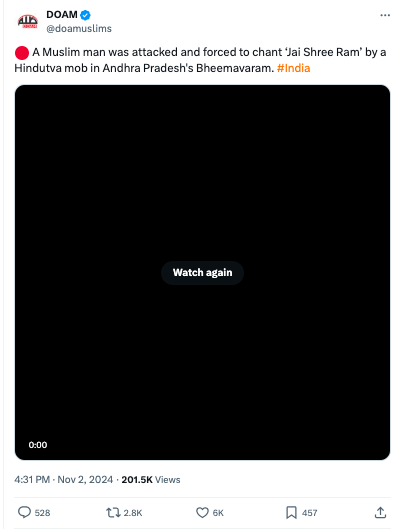
One X handle “Documenting Oppression Against Muslims” shared the said video claiming that the ‘Hindutva mob’ attacked the Muslims.
While the Islamists are portraying the ‘Muslim’ man cornered by Hindus in the video as an innocent victim, none of them cared to question what was he doing inside the Hindu temple. The Islamists are circulating the video in question without giving proper context of the incident.
It has been reported that the man was allegedly attempting to desecrate the Hindu temple in Bheemavaram and was thus caught by the Hindus who cornered him. The accused then began chanting the Jai Shri Ram slogan. He was also paraded by locals on the accusations of desecrating religious places in Bhimavaram, Andhra Pradesh. Thus, contrary to the insinuation that the man was attacked because of his religious identity or that he was innocent is false as he was allegedly involved in desecrating the Hindu temple.
In a no-holds-bar-attack on Shiv Sena (UBT) leader Sunil Raut over his alleged comment on women candidate, Shiv Sena candidate from Mumba Devi seat, Shaina NC on Tuesday said that it is time that the women in Maharashtra wake up and raise their voice against such “regressive” comments.
Reportedly, Sunil Raut while addressing an election rally called the Shiv Sena Shinde faction’s Vikhroli assembly candidate Suvarna Karanje a “goat”.
Reacting to the remark made by Shiv Sena (UBT) leader, Shaina NC said, “This is the most regressive comment coming from Sunil Raut, on one hand, they call us ‘Bakri’ and used word ‘Maal’. Look at the mind and thought process. On one hand, we have a PM who respects women…you have a CM who has empowered us with ‘Ladli Bahin’ scheme and on the other hand we have ‘Maha Vinas Aghadi’ where you have somebody referring to us as objects”
Questioning Priyanka Gandhi’s silence on the remark made by the Shiv Sena leader, Shaina NC asked why has the Congress party not reprimanded a leader from the alliance who has disrespected women.
“The time has come for women of Maharashtra to wake up against this insensitive commentary. Congress is absolutely silent. We are not Bakris, we are not maals, we are the betis of Maharashtra and we will give a befitting answer on 20th November,” she said.
Expressing disappointment over the remarks made by leaders against women candidates in Maharashtra, Former chief of National Commission for Women (NCW) Rekha Sharma said that it is “unfortunate”.
“In Maharashtra, we have seen that many leaders are speaking ill about women candidates, but it is unfortunate,” Rekha Sharma said earlier while speaking to ANI.
Meanwhile, an FIR has been registered against Sunil Raut, the Shiv Sena (UBT) candidate from Vikroli constituency and brother of Sanjay Raut for his reported objectionable comments against a woman candidate of chief minister Eknath Shinde-led Shiv Sena.
The FIR has been registered under Sections 79, 351(2) and 356(2) of Bharatiya Nyaya Sanhita.
Sunil Raut is the candidate for the Shiv Sena UBT from the Vikhroli assembly constituency, from where he contested and won previously in the 2014 and 2019 assembly elections. This time he is contesting against Karanje from the Shiv Sena party and Vishwajeet Dholam from the MNS party.
(This news report is published from a syndicated feed. Except for the headline, the content has not been written or edited by OpIndia staff)
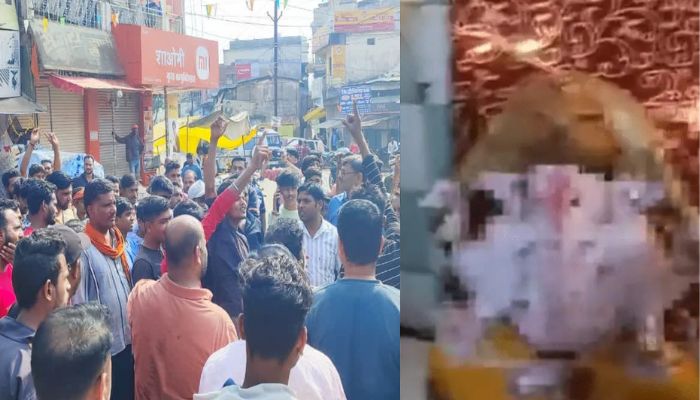
In Madhya Pradesh’s Chhindwara, a Muslim youth Mohammed Taufiq forcibly entered a Ganesh temple and vandalised the idol on Sunday (3rd November). After this, Hindu organisations like Vishwa Hindu Parishad and Bajrang Dal staged a massive protest demanding action against the accused Taufiq. Soon after, the police registered a case against Taufiq and arrested him.
BREAKING: Communal tension erupts in Chhindwara, MP, after Mohd Taufiq infiltrated a Hindu Mandir and broke Bhagwan Ganesh murtis.
Massive protests have started in the area, and the VHP has announced a bandh in the region.
Reports say that the accused Muslim youth entered the Ganesh temple, Junnardeo, at around 10:30 PM and started damaging an idol of Lord Ganesh. When a woman asked him not to do so, Taufiq threatened to kill her. As the accused was vandalising the idol, the Hindu woman screamed and in no time the locals gathered there. The local Hindus nabbed the Muslim youth and turned him over to the police.
Following this, the Hindu rights organisations, joined by BJP MLA Nathan Shah, organised a massive protest outside the police station prompting Additional Superintendent of Police Awadhesh Pratap Singh to reach Junnardeo along with DSP in-charge Rajesh Kumar Banjara.
The police officials assured the protesting Hindus that strict action would be taken against the accused. On Monday, November 4, the Hindu organisations and trade bodies called for a Bandh in the city. Meanwhile, the Jama Masjid Committee issued a letter condemning the accused Mohammed Taufiq’s outrageous act and demanded action against him.
As per an ETV Bharat report, SP Manish Khatri said that another youth, along with Mohammad Taufiq, vandalised the Ganesh idol. SP Khatri said that both the accused have been arrested, adding that additional police force has been deployed in the area to ensure law and order.
A teacher recruitment scam has come to light in Bihar. The investigation has found 4000 fraudulent teachers who used fake certificates and secured the job despite having low marks in CTET. The government has decided to take strict action against the accused, as more than 24 thousand teachers could potentially lose their employment.
It is necessary to pass the CTET exam to become a teacher in the state. Those who score less than 60% in CTET are not considered eligible for the position. However, it has been discovered that over 4,000 teachers have CTET scores below the required percentage. 80% of them received a lower percentage than the mandated score and many of them even acquired less than 50% marks in CTET.
Furthermore, the probe unveiled that the remaining teachers have used fake caste certificates, residence certificates and disability certificates to secure jobs. Some even produced bogus documents and were hired under the sports quota. The teacher recruitment scam puts the jobs of almost 24,000 teachers at risk. It has been uncovered that several of their certificates are falsified. These teachers will now be re-examined and will be removed from their posts as well as face legal action if, even after this evaluation, inaccurate information regarding their certificates comes out.
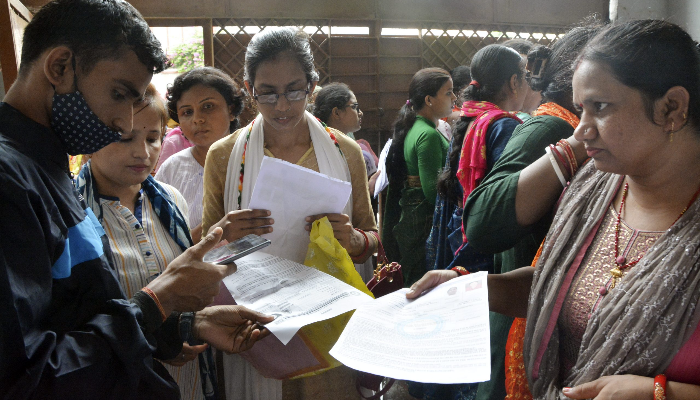
A few days ago, counselling of 1,87,000 candidates who passed the competency test was completed. Over 3000 teachers did not even make it to the counselling, and 42,000 teachers could not be counselled during the sessions held between 1st August and 13th September. More than 10,000 of these 42,000 teachers were unable to be biometrically verified. The education department stated that the counselling will be organised for the remaining individuals following the Chhath festival. Meanwhile, large-scale rigging came to the fore during the counselling of the candidates who passed the competency test.
Multiple certificates were found to be fake during the verification process and the concerned universities were asked to look into the matter. Action has been taken against the 96 teachers whose mark sheets were discovered to be fraudulent during the initial counselling session. According to the information, the education department has sent the suspicious mark sheets to the administrative officers of the universities and asked for details about them. The experience certificates of the teachers are also to be investigated.
Director of Secondary Education Yogendra Singh informed that counselling of more than 40 thousand teachers is still pending in the state and is likely to take place in November. He added that their caste, residency, and educational credentials will be compared to their Aadhar cards using biometric authentication during transfer. Their thumb impressions will also be analysed. Every document will be entered into the service book, and an online digital service book will also be created.
On 4th November, Peel Police arrested three men following an attack on Hindu worshippers at the Hindu Sabha Temple in Brampton and Mississauga, Canada. The incident occurred on the afternoon of 3rd November 2024 at the temple located on The Gore Road in Brampton.
According to a press release from Peel Police, officers responded to a trespassing complaint involving “a group of protesters” identified as pro-Khalistani elements, who were raising anti-India slogans outside the temple. The pro-Khalistani group entered the temple premises and attacked Hindu worshippers.
Arrests Made at Protests in Brampton and Mississauga
Peel Police noted that similar protests took place at the intersection of Goreway Drive and Etude Drive in Mississauga, and another protest occurred near Airport Road and Drew Road. The authorities indicated that although the incidents took place at separate locations, they were interconnected. All the protests were held by pro-Khalistani elements supported by the Khalistani terrorist organisation Sikhs For Justice, based in the USA.
The arrested individuals have been identified as 43-year-old Dilpreet Singh Bouns from Mississauga, who is facing charges of causing disturbance and assaulting a peace officer; 23-year-old Vikas from Brampton, who is charged with assault with a weapon; and 31-year-old Amritpal Singh from Mississauga, who is facing charges of mischief over CAD 5,000. They will appear at the Ontario Court of Justice in Brampton.
A Peel Police officer also sustained minor injuries and was taken to a local hospital for treatment. In a statement, Peel Regional Police reaffirmed their commitment to upholding the rights to peaceful protest, as guaranteed under the Canadian Charter of Rights and Freedoms. However, they emphasised that violence, threats, and acts of vandalism would not be tolerated.
Pro-Khalistani elements attacked Hindus at Hindu Sabha Temple
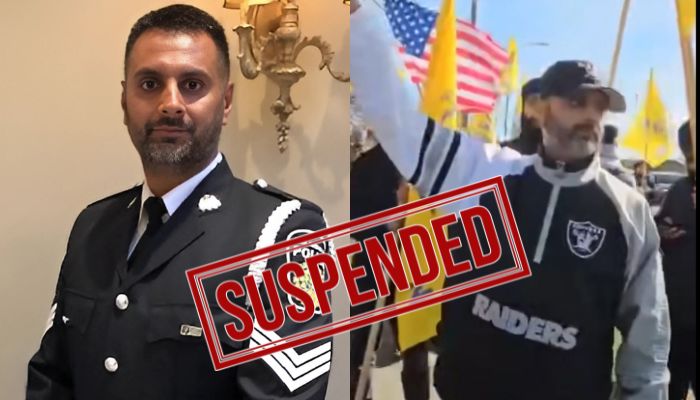
On 3rd November, pro-Khalistani elements attacked Hindus at the Hindu Sabha Temple in Brampton, Canada. Videos of Khalistanis protesting outside the temple went viral on social media. In one of the videos, X user Bellator identified a Peel Police Sergeant protesting with Khalistanis in his off-duty hours. The police official has been identified as Sergeant Harinder Sohi of Peel Police, whose badge number is 3071.
Anti-corruption advocate and former Toronto Police officer Donald Best also posted about Sgt Sohi on social media. In the video, Sohi was seen smiling and possibly saying “Indian Government” in response to the protest leader’s chants, “Who’s the terrorist?” Sohi was also holding a Khalistani flag and waving it in the video. It was later reported that Sohi has been suspended by Peel Police.
On 4th November (local time), Peel Police issued a statement that it has suspended a Peel Regional Police officer from duty after he was caught on camera participating in the pro-Khalistani protest outside the Hindu Sabha Temple in Brampton the previous day. The police officer was identified as Sergeant Harinder Sohi, badge number 3071.
Source: X
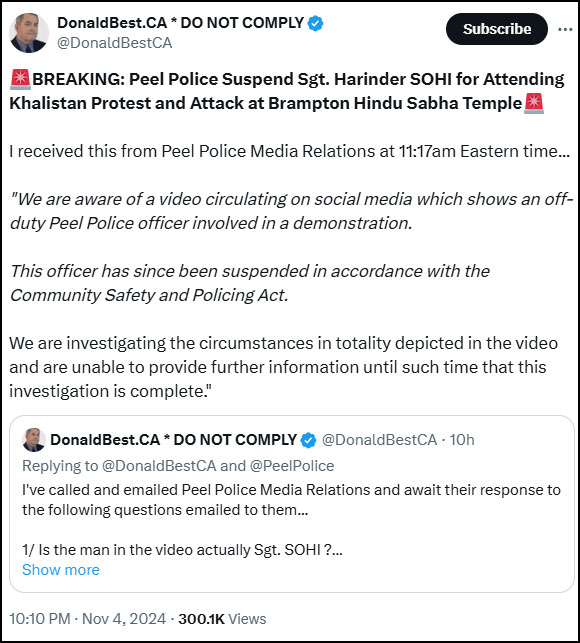
The suspension was first confirmed by former Toronto Police officer and anti-corruption advocate Donald Best, who had raised the issue with Peel Police yesterday. In a post on X, Donald wrote that he received an email from Peel Police Media Relations at around 11:17 AM stating that the police department was aware of the video circulating on social media showing an off-duty Peel Police officer involved in the protest.
“This officer has since been suspended in accordance with the Community Safety and Policing Act. We are investigating the circumstances in their entirety depicted in the video and are unable to provide further information until this investigation is complete.”
A similar response by Peel Police was sent to CBC News, which posed similar questions about viral videos Sergeant Harinder Sohi on social media. Earlier, Peel Police said in a statement that it has charged three people following violence that erupted as Indian consular officials visited the Hindu Sabha Mandir.
Reportedly, similar protests took place at Westwood Mall in Mississauga as well, which was “proudly” shown by the Khalistani organisation, World Sikh Organization. Another protest occurred outside the Malton Gurdwara on Airport Road in Mississauga. Furthermore, pro-Khalistani elements staged a protest outside a Hindu temple in Surrey. Reportedly, these pro-Khalistani elements were linked to a gurdwara in Surrey where the slain Khalistani terrorist Hardeep Singh Nijjar was posing as chief.
Peel Police added in its statement, “Although these demonstrations occurred at three different locations, they appear to be related to one another. Several incidents between protesters and worshippers broke out.” Chief of Peel Police Nishan Duraiappah said, “We respect the right to protest in a peaceful and safe manner but will not tolerate violence and criminal acts. Those who participate in this activity will be pursued, arrested, and charged.”
Canadian police had set-up ‘hiring’ camps at Khalistani protests in May
In an unprecedented move in May 2024, the Canadian Armed Forces had set up a recruitment camp at a Khalistani event glorifying Kanishka bombing mastermind Talwinder Singh Parmar. Investigative journalist Mocha Bezirgan raised the issue in his report at that time. In a post on X, he wrote, “What’s most concerning is the police participation in a parade where the suspected mastermind of Canada’s deadliest terror attack is glorified.” In the video, camps with banners reading “We Are Hiring” were seen, with pro-Khalistani attendees gathering information on how to join the Canadian Armed Forces.
EXCLUSIVE: Canadian Police Participate in Parade Glorifying Terrorists Including Talwinder Singh Parmar
Billed as a "religious parade" in Calgary, Alberta, this event took on a distinctly political tone, displaying posters that accused India of assassinations and featured names… pic.twitter.com/WJcj4JY0De
Former Sikh Bob Rai also commented on the matter of a Canadian police official participating in a Khalistani protest. He said, “Nefarious people will join to obtain data.” He added, “The police agencies in Canada have all been compromised by organised crime and extremist terrorist radical elements.”
“Nefarious people will join to obtain data,” warns former Sikh Bob Rai when asked about Canadian army and police setting up recruitment tents at a Nagar Kirtan parade in Calgary, involving Khalistani separatists group Sikhs for Justice.
Peel Police officer caught on camera doubling as Khalistani protester
On 3rd November, pro-Khalistani elements attacked Hindus at the Hindu Sabha Temple in Brampton, Canada. Videos of Khalistanis protesting outside the temple went viral on social media. In one of the videos, X user Bellator identified a Peel Police Sergeant protesting with Khalistanis in his off-duty hours. The police official has been identified as Sergeant Harinder Sohi of Peel Police, whose badge number is 3071.
Anti-corruption advocate and former Toronto Police officer Donald Best also posted about Sgt Sohi on social media. In the video, Sohi was seen smiling and possibly saying “Indian Government” in response to the protest leader’s chants, “Who’s the terrorist?” Sohi was also holding a Khalistani flag and waving it in the video.