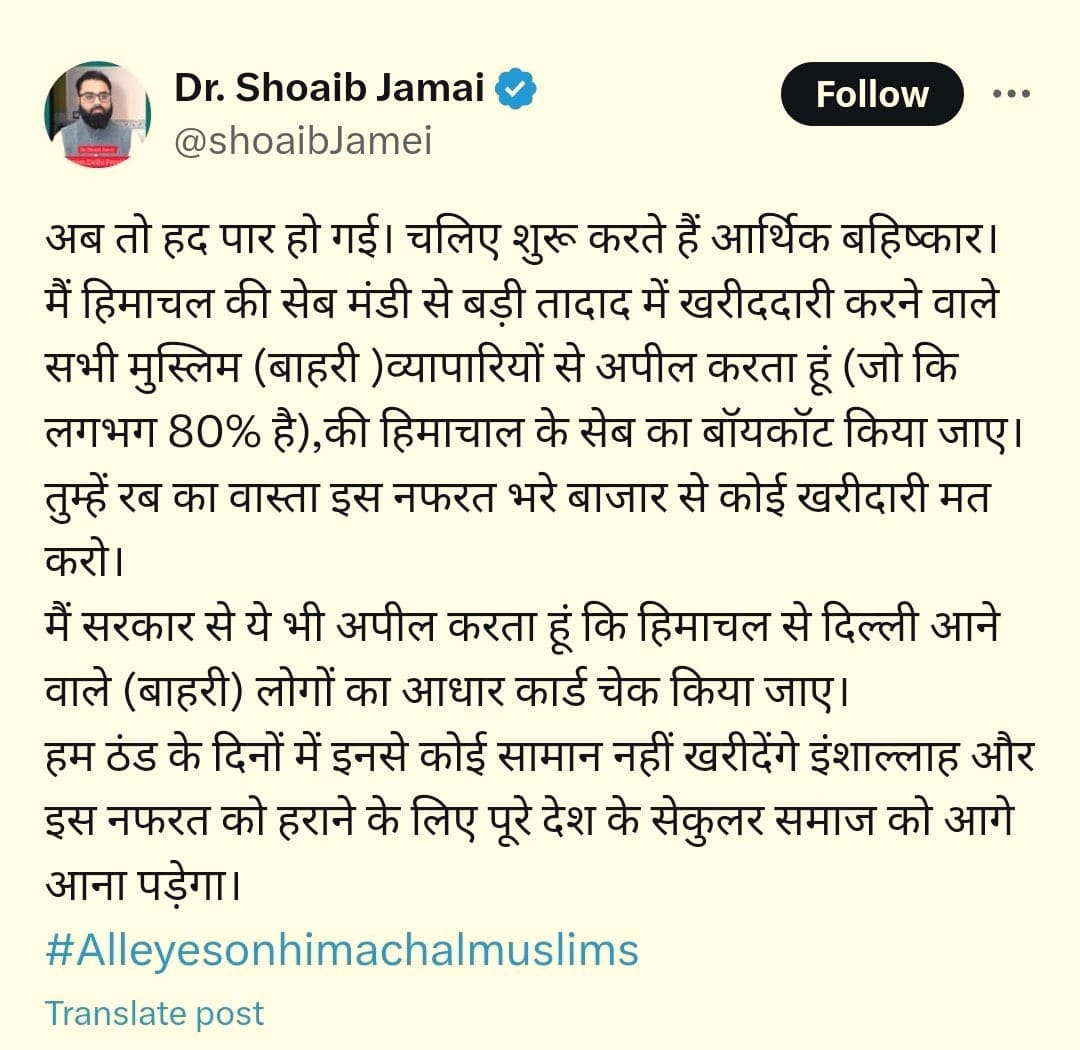
On Friday (11th October), AIMIM Delhi chief Shoaib Jamai stirred the hornet’s nest by asking Muslims to economically boycott the Hindu community in Himachal Pradesh.
In a tweet, the controversial Islamic cleric stated, “All limits have been crossed. Let us start an economic boycott. I request Muslim businessmen, who buy apples from the mandi in large quantities, to boycott purchases from Himachal Pradesh.”
For the unversed, the majority of apple farmers in the State are Hindus who sell their produce in mandi (wholesale market). Shoaib Jamai was essentially asking his co-religionists to boycott the Hindu community.
Screengrab of the tweet
“Do not buy anything from this market of hate,” the AIMIM Delhi Chief continued his tirade. He also invoked Allah and promised to not buy anything from Himachal Pradesh during the winter.
“We need the entire secular society to come forward to defeat hate,” Shoaib Jamai claimed although he was the one dividing the society along religious lines.
However, he took a U-turn in less than 24 hours and began mouthing platitudes about safeguarding the ‘secular fabric’ of India. Shoaib Jamai first tried to downplay his sinister agenda to boycott Hindus by claiming that he got ’emotionally carried away.’
Maybe I got emotionally carried away. No hatred for any community. Absolutely not. I always believe in the secular fabric of the society. Whole bharat is one. Love all. Previous Tweet was misinterpreted. Though I was involved personally with Shimla sanjauli case. In a process to… pic.twitter.com/1HKqopJrgR
No hatred for any community. Absolutely not. I always believe in the secular fabric of the society. Whole bharat is one. Love all,” he alleged.
The AIMIM Delhi chief quietly removed his old tweet, claiming that it was ‘misinterpreted. “I met with Muslim traders there. Understand their pain. Just wanted to echoed their voice when they felt alone. But nobody listen,” he continued.
After asking Muslims to boycott Hindus, he thanked the ‘secular’ Hindu community in Shimla for their unwavering support. The sudden ‘change of heart’ of Shoaib Jamai could be the realisation that a counter-boycott campaign would be an economic disaster for the Muslim community.
Controversies of Shoaib Jamai
Earlier this year, the AIMIM leader unleashed his ‘Sar Tan se Juda’ lynch mob against scientist Anand Ranganathan for supporting Nupur Sharma.
“The Muslim community must take note of the matter,” he tweeted. Shoaib Jamai warned that if action was not taken against Anand Ranganathan, then, his radical followers might create unrest.
In September this year, BJP leader Jairam Thakur demanded the arrest of Shoaib Jamai for creating religious tension over the disputed Sanjauli mosque.
On the 75th anniversary of China’s invasion of East Turkistan, the East Turkistan Government in Exile has issued a statement, condemning what it describes as one of the most brutal occupations in modern history.
Marking October 12, 1949, as the start of relentless persecution and systematic oppression, the statement accuses China of genocide, colonisation, and cultural erasure targeting the Uyghur, Kazakh, Kyrgyz, Uzbek, Tatar, and other Turkic peoples.
#October12, 2024, marks the 75th anniversary of the People’s Republic of China’s illegal invasion of #EastTurkistan. Since October 12, 1949, the people of East Turkistan have faced relentless persecution, systematic colonization, and genocide under Chinese occupation. Over the… pic.twitter.com/XCcfPRRVKI
— East Turkistan Government in Exile (ETGE) (@ETExileGov) October 12, 2024
“Over the past seven and a half decades, East Turkistan has suffered mass incarceration, forced labour, sterilisations, and the destruction of its culture, religion, and national identity under Chinese rule,” the statement reads. The exiled government declared solidarity with the people enduring what it termed a campaign of “genocide and occupation,” renewing calls for the global community to recognise China’s illegal occupation as the root cause of the Uyghur genocide.
China’s claim over East Turkistan, the statement argues, is based on “fabricated narratives” meant to justify its violent subjugation of a once-independent nation. Before Chinese forces invaded with Soviet support in 1949, East Turkistan existed as a sovereign state. Today, the region–now referred to by Beijing as Xinjiang–has become synonymous with forced labour camps, surveillance, and widespread human rights abuses.
“The East Turkistan Government in Exile invoked General Assembly Resolution 3070 (XXVIII) of 1973, which recognises the right of all peoples under colonial rule to self-determination and independence. “This principle applies to East Turkistan,” the statement further said, demanding international recognition of East Turkistan as an occupied country.
#October12, 2024, marks the 75th anniversary of the People’s Republic of China’s illegal invasion of #EastTurkistan. Since October 12, 1949, the people of East Turkistan have faced relentless persecution, systematic colonization, and genocide under Chinese occupation. Over the… pic.twitter.com/XCcfPRRVKI
— East Turkistan Government in Exile (ETGE) (@ETExileGov) October 12, 2024
The movement also called for legal action, urging the International Criminal Court (ICC) to prosecute Chinese officials for genocide and crimes against humanity. The exiled government further requested state parties to the Rome Statute to support its legal complaints and push for justice through the International Court of Justice (ICJ).
Beijing’s oppressive rule in East Turkistan, disguised as national security and development policies, has drawn increasing global criticism. However, the Chinese regime continues to deny all allegations, refusing access to independent investigators and dismissing calls for accountability.
“The time for action is now,” the statement concluded. “We will continue our struggle for independence until East Turkistan is free and our people can once again live in dignity, sovereignty, and security.” As international silence lingers, the suffering of the Turkic peoples under China’s repressive policies remains a glaring reminder of the urgent need for global intervention.
(This news report is published from a syndicated feed. Except for the headline, the content has not been written or edited by OpIndia staff)
On Saturday, 12th October, India condemned the attacks on Hindu temples and mandaps in Bangladesh during the Durga Puja festival and expressed serious concerns over the attacks. In a statement issued by the Ministry of External Affairs, India strongly condemned the desecration of temples and called on the Bangladeshi government to ensure the safety and security of the minority Hindu population in the country.
In its statement, the MEA said, “We have noted with serious concern the attack on a Puja mandap in Tantibazar, Dhaka, and the theft at the revered Jeshoreshwari Kali temple in Satkhira.
These are deplorable events. They follow a systematic pattern of desecration and damage to temples and deities that we have witnessed over several days now.
We call upon the Government of Bangladesh to ensure the safety and security of Hindus and all minorities, and their places of worship, especially during this auspicious festival time.”
The statement by the MEA came at a time when there have been several reports of theft and vandalism in Bangladesh targeting Hindu religious sites. In one of the most recent incidents, a firebomb was thrown at a Hindu temple in the Tantibazar area of Dhaka, leading to panic among the Hindu worshippers present at the temple. Though no casualties were reported, five devotees were injured during the chaos that ensued following the firebomb attack.
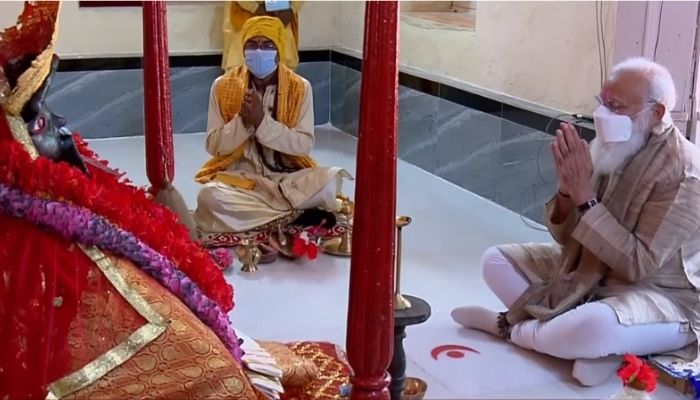
Furthermore, a hand-crafted golden mukut (crown) was stolen from a Hindu temple in Bangladesh’s southwestern Satkhira district during Durga Puja celebrations. The mukut was gifted by Prime Minister Narendra Modi in 2021.
In another incident, a group of Muslim men sang Islamic songs in a Durga Puja pandal in Chittagong. The radicals took to the stage of the JM Sen Hall Puja Mandap and sang the proselytising Islamic song ‘Shudhu Musolmaner Lagi Aseniko Islam (Islam did not come to light only for Muslims).’
So far, Bangladesh police have arrested 17 persons in connection with 35 violent attacks linked to Durga Puja celebrations. The Inspector General of Police (IGP), Md Moinul Islam, assured that authorities were closely monitoring the situation and would take appropriate action against those who attempt to incite unrest. He said, “Anyone involved in these disruptions will be brought to justice. We will take strict action if anyone attempts to create chaos or engage in malicious activities during Durga Puja.”
Hindus make up around 8% of the total population of 170 million. Since Sheikh Hasina’s government was toppled in Bangladesh, there has been a surge in attacks on Hindus across the country. Speaking to the media, a Dhaka resident, Ankita Bhowmick, said, “We won’t need any security if we have the mentality and tendency that each individual can practise their religion according to their customs. There will be no fear.”
Crown that was gifted by PM Modi for goddess Kali stolen from Jeshoreshwari temple in Satkhira
A crown of goddess Kali has been stolen from the Jeshoreshwari temple in Satkhira’s Shyamnagar. This crown was gifted by Prime Minister Narendra Modi during his visit to the temple in March, 2021, as reported by The Daily Star. The theft occurred on Thursday between 2.00 pm and 2.30 pm, after Temple Priest Dilip Mukherjee left following the day’s worship. The cleaning staff later found that the crown was missing from the deity’s head, as reported by The Daily Star. “We are reviewing the temple’s CCTV footage to identify the thief,” said Inspector Taizul Islam of Shyamnagar Police Station. The stolen crown, made of silver and gold-plated, holds significant cultural and religious importance.
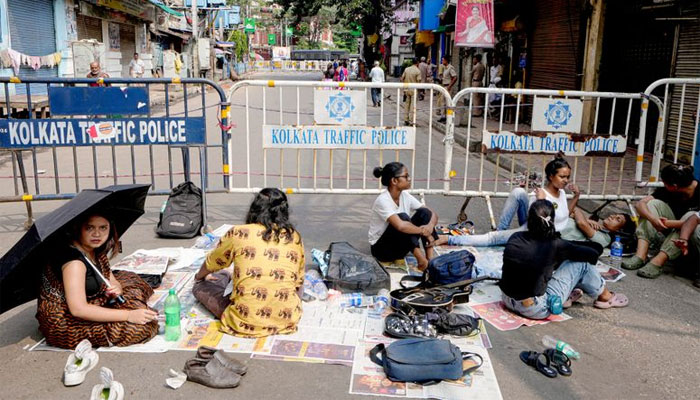
On Saturday, 12th October, two more junior doctors joined six of their colleagues in a fast-unto-death. The six junior doctors entered the seventh day of their fast-unto-death on Saturday. These protesters have been demanding justice for the junior doctor who was brutally raped and killed at RK Kar Medical College and Hospital, along with other crucial demands.
Parichoy Panda from Ramakrishna Mission Seva Pratishthan and Alolika Ghorui from Calcutta National Medical College have been identified as the two junior doctors who joined the fast-unto-death on Saturday. Another two junior doctors joined at North Bengal Medical College in Siliguri, bringing the total number of junior doctors sitting on the fast-unto-death to ten.
The condition of the fasting doctors reportedly worsened on Friday. Fellow doctors said that their health parameters were declining. The hunger strike was started by the doctors on 5th October.
One of the protesting doctors, Dr Debasish Halder, said, “They are very weak and all their parameters are declining. The presence of creatinine in their urine has increased. Seven days of fasting is taking a toll on their health, but it hasn’t weakened their resolve for justice.”
Another protesting junior doctor, Aniket Mahato, was admitted to the CCU of RG Kar Hospital, where his condition was stable but critical. A senior doctor said, “He is responding to treatment, showing improvement in his health parameters due to calculated care, but he will need a few more days to fully recover.” Mahato had joined the protests on 6th October. On 10th October, his health deteriorated, after which he was rushed to the hospital.
Meanwhile, two of the fasting junior doctors alleged that police approached their families and persuaded them to withdraw from the hunger strike. Snigdha Hazra from Kolkata Medical College and Hospital and Alok Verma from North Bengal Medical College reported that they received calls from their families asking them to end the fast.
Videos of Hazra’s house went viral on social media on 10th October, showing police visiting her home. Verma said, “My mother called me to say she received calls from Bengal Police. They told her my health was deteriorating and urged her to ask me to withdraw from the strike. I told her I would continue the hunger strike and wouldn’t listen to them.” When the media approached senior police officials, they declined to comment.
IMA wrote to CM, and FAIMA issued a warning
The Indian Medical Association (IMA) has also written to the Chief Minister of West Bengal, Mamata Banerjee, urging her to intervene before the situation escalates. The Federation of All India Medical Associations (FAIMA) has also warned of a nationwide complete shutdown of medical services if any harm is caused to the junior doctors protesting in Kolkata.
Reportedly, 38 doctors from Arambagh Medical College and Hospital have decided to submit mass resignations to express solidarity with their junior counterparts.
Junior doctors wrote to CS.
Meanwhile, on 10th October, the West Bengal Junior Doctors’ Front on Thursday wrote a letter to Chief Secretary Manoj Pant, expressing frustration over the state government’s silence regarding their concerns. In their letter, the doctors expressed disappointment that securing a meeting took 96 hours of an indefinite hunger strike. They are demanding timely updates on their previous requests and accountability from the government.
The letter read, “As we expressed yesterday, we were disheartened by the fact that it took 96 hours of indefinite hunger strike for you even to call us for a meeting.” They noted that their previous emails on September 26 and September 29 had gone unanswered, despite their hopes that the government was taking their demands seriously.
On Saturday, 5th October, junior doctors protesting the rape and murder of their colleague at the RG Kar Hospital in Kolkata began a fast unto death. The protesting doctors have accused the West Bengal Government of failing to fulfil their demands. Notably, they started a sit-in protest at Dorina Crossing in Dharmatala on Friday, 4th October, and gave the state government a deadline of 24 hours to meet their promises.
RG Kar Medical College and Hospital rape and murder case
On 9th August, the semi-naked, injured body of a 31-year-old woman doctor was found in the seminar hall of Kolkata’s state-run RG Kar Medical College and Hospital. Her autopsy report confirmed rape before the murder. A total of three persons have been arrested so far in this case including Sanjay Roy, the prime accused. After the Courts came down heavily on the State government and Kolkata Police for mishandling the case, the Calcutta High Court transferred the probe from the Kolkata Police to the CBI.
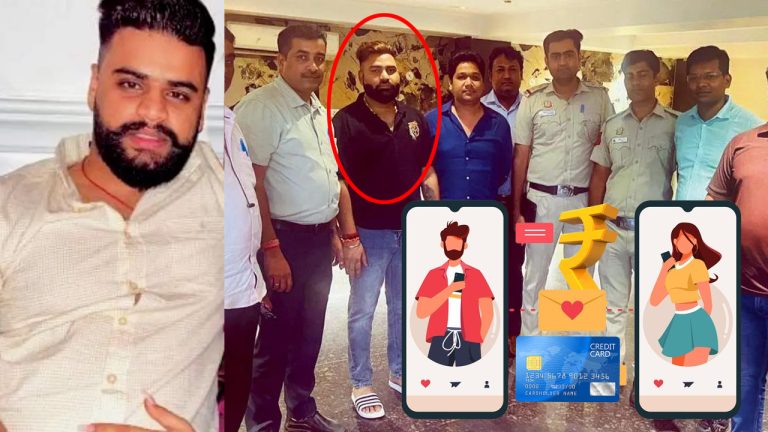
The Mumbai Police on Thursday arrested a man from Delhi in connection with a dating app scam exposed two months ago. 26-year-old Ankur Meena is allegedly the mastermind of the scam involving young women trapping men through dating apps and then making them pay large amounts of money in bills in pubs and clubs. Meena also goes by the monikers Happy and Meena Defaulter.
A team of Bangur Nagar police was stationed in Delhi for the last several days after tracing Meena to Delhi and arrested him from a hotel in a joint operation with Delhi’s Anand Vihar police. After the scam was exposed by an operation by Mid-Day, Ankur Meena left his home and took refuge in Delhi hotels, frequently changing his location.
As per the police, he was still running the scam from hotels in Delhi, targeting nightclubs in Delhi and surrounding areas. The police scanned most of the hotels, including 3 and 4 star hotels, in the Shahdara locality, and succeeded in catching him on Thursday from IP Royal Hotel in Anand Vihar. An official from Bangur Nagar police said that the police team received precise information about Meena’s location, and nabbed him.
Notably, Meena had issued a challenge to the police to arrest him, boasting that no one could catch him. However, at last, he has been arrested.
Police said that although he is not cooperating with the investigation, he has provided names of some clubs in Mumbai involved in the scam. “We are trying to find out which clubs in Mumbai, Pune and Thane were involved in the scam and the names of every racketeer,” said an officer.
As per a report by Mid-Day, Ankur Meena is from a respectable family residing at Sushila Garden in Delhi’s Saboli Extension. His father is a school principal and his brother is a dentist, and they were apparently unaware of his criminal activities. Reportedly, Meena came across people who scammed men through dating apps, and started emulating them.
According to the police, after successfully running his dating app scam in cities such as Delhi, Goa, Jaipur, Dehradun, Agra, Lucknow, Bhopal, Jabalpur, Raipur, and Nagpur, Meena expanded his operations to Mumbai, Pune and Thane. He was working in Mumbai for around two years.
Ankur Meena hired attractive young women to trap wealthy men and hired young men who worked as PR agents. He then used the PR agents to lure the owners of nightclubs, pubs, bars, lounges and restaurants to take part in the scam. Establishments impacted by the pandemic were especially targeted. The gang got the pub owners to agree with the deal by promising rapid growth of business and high profits. After the deal was finalised by Ankur Meena, his key associates including Pratham (using aliases Chandu and Praveen) managed day-to-day operations.
The women, aged between 18 and 27, registered themselves on dating apps such as Tinder, Bumble, Happn and QuackQuack, and contacted men looking for companions on such apps. Most men in the targeted areas get a large number of matches within 24 hours of opening their accounts, and the women who match with them request a date at one of the pubs or restaurants part of the deal.
When they meet their targets at the establishments, the women order expensive drinks and other items, often taking the bill to ₹40,000 to ₹70,000 or even one lakh in just half an hour. At the time of the bill payment, the woman flees from the restaurant under some pretext with the help of the management, forcing the man to pay the entire amount. The women got 25%-30% as a cut from the bill.
The restaurants use all means to make the men pay, intimidating them with serious consequences and using bouncers to assault those who refuse to pay.
The scam was exposed in August this year after Mid-Day sent some reporters posing as men looking for dates on dating apps and published a report based on the findings. After receiving complaints on the scam from readers, the publication in July got its correspondences to open accounts in dating apps. Within 24 hours of opening, they received a large number of matches, with women offering to meet them at pubs and clubs.
In every incident where the reporters arrived for the date, the women ran up hefty bills by ordering expensive drinks in a short period of time, a then fled using some excuse. The reporters also saw the same women going back to the same establishment with a different man after some time.
The clubs and pubs involved in the scam made payments to Ankur Meena, who made payments to women and others involved in the operation.
After Mid-Day published the report, Amboli police registered a case of cheating against unknown individuals based on complaints by victims. But initially there was no progress in the case. A month later, a victim filed a similar complaint at Bangur Nagar police station, alleging that he was were scammed by the gang at Godfather Club in Andheri. When the man could not pay the large amount of bill, Pratham escorted him out to a an ATM and made him withdraw money.
The police booked the club owner, the women involved and others involved in the scam under the charges of cheating, extortion, and conspiracy. Based on the investigation, the police raided a hotel in Goregaon and nabbed six people including two women. Phones recovered during the raid revealed the scale of the racket. The racket and the probe also identified Ankur Meena as the kingpin of the racket.
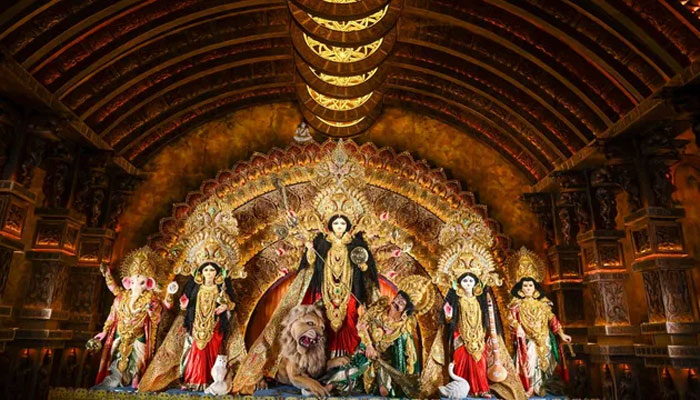
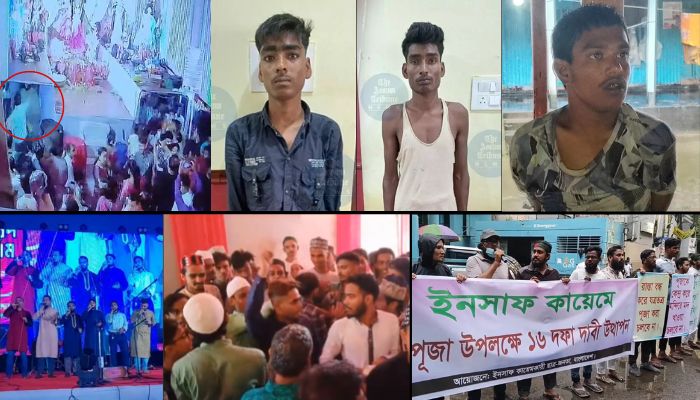
The annual Hindu festival of Durga Puja, celebrated predominantly in India and Bangladesh, has braved multiple attacks from the Muslim community in 2024.
The radicals carried out targeted attacks in the form of idol vandalism, desecration and physical attacks on Durga Puja mandaps and pandals. Hindu devotees were stabbed, attacked with stones and intimidated against celebrating the annual festival.
OpIndia has compiled 7 incidents from both Bangladesh and India, where the Hindu community was targeted by Muslims for celebrating Durga Puja in 2024.
1. Petrol bomb attack in Dhaka
On 11th October, a petrol bomb was hurled at a Durga Puja mandap in the Tanti Bazar neighbourhood in Dhaka city of Bangladesh.
In visuals that have surfaced on social media, a man was seen attacking the Durga Puja pandal with a bomb. The accused was seen standing in a queue and hurling the explosive towards the idol of the Hindu deity.
According to reports, a minor fire broke out at the pandal, but no one was injured. The Hindu devotees present at the scene tried to stop the attacker but he stabbed them. A total of 5 people (4 volunteers and 1 visitor) were injured in the knife attack.
The police have recovered the explosive, which was used in the targeted attack. A total of two accused were identified and arrested by the police. They include Mohammed Hridoy and Mohammed Jibon.
The duo was taken into custody and is now interrogated by law enforcement authorities.
The Durga Puja pandal in Tanti Bazar is now being guarded by Hindu devotees and law enforcement authorities. The Puja committee has demanded strong action against the accused.
2. Singing proselytising Islamic songs at Durga Puja Mandap in Chittagong
On 10th October evening, a group of Muslim men defiled the sanctity of a Durga Puja mandap in Chittagong city of Bangladesh by forcibly singing Islamic songs.
The radicals took to the stage of the JM Sen Hall Puja Mandap and sang the proselytising Islamic song ‘Shudhu Musolmaner Lagi Aseniko Islam (Islam did not come to light only for Muslims).’
The Muslim men, who were involved in the desecration of the Puja Mandap, belonged to the Chittagong Cultural Academy. A video of the incident has now surfaced on social media.
Jihadis are singing Islami jihadi songs in Durga puja pandel in Chittagong Bangladesh. What if Hindus sing hare ram hare krishna during Namaz inside mosques? pic.twitter.com/Lm0UFzflOR
While it is true that the radicals were allowed to sing on stage by the joint secretary of Chattogram Puja Celebration Council Sajal Dutta, he was assured that the group would sing only a patriotic song. No permission was sought to sing proselytising Islamic songs.
Chittagong Cultural Academy attempted to rationalise the desecration of the puja mandap by claiming that the song was about promoting ‘harmony.’
Following the incident, Hindus took to the stage in protest demanding action against the 6 radicals. Chittagong Deputy Commissioner Farida Khanam went to the Puja pandal and assured all-out support.
3. Vandalism of Goddess Durga idol in Mymensingh
On 25th September, a radical Muslim man vandalised the idols of Goddess Durga and other Hindu deities in Gouripur town in the Mymensingh district of Bangladesh.
As per reports, the accused was identified as 22-year-old Yasin Mia. The police arrested him on Thursday (26th September) morning for his involvement in the desecration of Hindu idols.
Mia entered the premises of Gobindajew temple in the wee hours of Wednesday and began destroying the idols, which had been sculpted for the past 20 days. While attempting to take the idols away, he was spotted by a Hindu woman named Dolly Rani.
While the foreign advisor kept telling world about safeguarding hinuds, the reality stands just the opposite.
In yet another systematic attack on hindus, idols meant for celebration of #DurgaPuja are vandalized at a temple at Gouripur Upazila in #Mymansing.
She raised alarm and Mia was quickly apprehended by two locals, Akhil Chandra Bishwasharma and Bipul Ghosh. The accused was then handed over to the police.
The arrested Muslim man is now being interrogated by the police. Yasin Mia, the son of Abdur Hannan, hails from Gajandar village in Gouripura upazila. The accused’s mother Mina Akhtar now claims that her son is mentally challenged.
While speaking about the matter, the President of Bangladesh Hindu Buddhist Christian Unity Council (Gouripur upazila) remarked, “All idols have been more or less broken. I do not understand why this is done. I have never seen such an incident in my life.”
4. Threats against the celebration of Durga Puja in Bangladesh
Muslims in Bangladesh have continued their relentless attack on Hindus and their festivals, despite assurances of safety and protection from the interim government led by chief advisor Muhammad Yunus.
In September, an Islamic extremist outfit named ‘Insaf Keemkari Chhatra-Janta’ staged a march against Hindus utilising a playground for Puja in Dhaka’s Sector 13.
They were seen holding placards, which read – ‘No worship anywhere by closing roads’, ‘No pollution to water by idol immersion’, ‘No worship to idols’. The slogans were meant to deride Hindu practices and rituals.
The organization had put forth a 16-point demand that, citing concerns about environmental damage, asks for limitations on public acts of worship and idol immersion.
It also wanted government assistance funds for festival expenses to be banned along with a prohibition on closing roads for Hindu religious events.
According to Insaf Keemkari Chhatra-Janta, Durga Puja should not be celebrated as a public holiday since it disturbed the life of the majority Muslim community as Hindus make up less than 2% of the population.
5. Idol desecration in Karimganj
On 9th October, the idol of Goddess Durga was desecrated by three radical Muslims in Manasangan village in the Karimganj district of Assam. The accused were identified as Abdul Ahad, Sahabul Ahmed and a minor. They are said to be students of the local madrassa.
The trio attacked the procession of the Bagargool Sarbajanin Durga Puja committee while they were en route to the pandal. The committee members were carrying the idol of Goddess Durga when Abdul and his accomplices threw leftover, cooked rice at it and defiled the Hindu deity.
This sparked communal tension in the Manasangan village. On learning about the matter, Karimganj DC Pradip Kumar Dwivedi and SP Partha Pratim Das reached the spot and de-escalated the situation.
এটা বাংলাদেশ নয়, বরাক উপত্যকার ঘটনা,দুর্গা প্রতিমায় ভাত ছুঁড়ে মারায় করিমগঞ্জ পুলিশ গ্রেফতার করলো আব্দুল আহাদ ও সাবুল আহমদ নামের দুইটাকে . Police arrester Abdul Ahad , Sahabul Haque for Throwing waste rice upon Durga idol in Karimganj, Assam , India . #Hidusunderattackpic.twitter.com/kr60s0Ez9U
A new idol was arranged for by the Karimganj district administration on the demand of the Hindu devotees associated with the Puja committee. The police swung into action and arrested Abdul Ahad and Sahabul Ahmed.
The duo was produced before a judicial court and remanded in custody. The minor accused was sent to juvenile court. Efforts are underway to prevent further incidents of desecration of Durga Puja idols and pandals.
BJP MLA from Karimganj, Kamalakhya Dey Purkayastha, also visited Manasangan village to take cognisance of the situation. He handed over ₹10,000 to the Bagargool Sarbajanin Durga Puja committee.
6. Durga Puja pandal ambushed in Gonda, Hindus pelted with stones
On 9th October, Muslims in the Gonda district of Uttar Pradesh stormed a Durga Puja pandal and pelted stones at the Hindu devotees present there.
They abused the deities and chased children with sticks. The perpetrators were ‘annoyed’ to see Hindu kids bursting crackers outside the Puja pandal.
The aggressive members of a Muslim family arrived there and started abusing the Hindus. They first pelted stones at the devotees and then attacked them with sticks.
SHOCKING NEWS ? 12 Hindus injured after Munna, Sultan, Aslam attacked Durga Puja pandal in Gonda, UP.
ENTIRE NATION IN SHOCK !!
They even pelted stones on devotees, abused Hindu Gods & destroyed firecrackers that were burst by the children.
The perpetrators have been identified as Munna, Sultan and Aslam among other Muslims and their families. Around 10-12 Hindus were critically wounded during the assault.
When Hindus tried to pacify them, they became more hostile and called other Muslims from nearby areas. On learning about the matter, a large police force including the Gonda DM and SP reached the scene and put an end to the violence.
The Hindu worshippers filed a police complaint, naming 12 Muslims as accused in the case. A First Information Report (FIR) was registered by the Gonda police against the perpetrators.
7. Muslim mob threatens to vandalise Goddess Durga idol in Kolkata
On 11th October, the Puja Pandal of New Bengal Sporting Club at Garden Reach area of Kolkata was stormed by a Muslim mob who threatened the Puja organizers to stop the Hindu rituals.
The Muslim mob consisting of around 50-60 members also threatened that they would vandalize Maa Durga idol if the celebrations weren’t stopped.
The organizers of the Hindu religious event, New Bengal Sporting Club at Garden Reach area of Kolkata, wrote a complaint to the Police demanding FIR in the case.
What is this Mr. @CPKolkata; Shri Manoj Kumar Verma (IPS)? How did the goons garner the ability to storm into a Durga Puja Pandal under the Jurisdiction of the @KolkataPolice and threaten to vandalise the idol of Maa Durga if the rituals aren't stopped? The incident happened at… pic.twitter.com/QQmcSf10Jo
The complaint letter was shared by BJP leader, LoP West Bengal Suvendu Adhikari on X. He also shared a video showing a large number of Muslim youths creating a ruckus inside the pandal.
“What is this C P Kolkata Shri Manoj Kumar Verma (IPS)? How did the goons garner the ability to storm into a Durga Puja Pandal under the Jurisdiction of the Kolkata Police and threaten to vandalize the idol of Maa Durga if the rituals aren’t stopped?” he pondered.
“The Office Bearers and Members of the New Bengal Sporting Club have also provided video footage of the incident. How can you allow this to happen? I believe you will take the strictest action possible against the culprits and make them realize that it is Kolkata, not Dhaka,” he added.
Disclaimer: There have been more than 10+ attacks on Durga Puja in both India and Bangladesh this year. Some incidents have been left out of the article due to uncertainty about the perpetrators.
India has “noted with serious concern” the attack on a Puja mandap in Dhaka and the theft at the Jeshoreshwari Kali temple at Satkhira in Bangladesh and termed them “deplorable acts.” India has urged the Bangladesh government to ensure the safety and security of Hindus and all minorities and their places of worship.
In a statement, Ministry of External Affairs (MEA) spokesperson Randhir Jaiswal stated, “We have noted with serious concern the attack on a Puja mandap in Tantibazar, Dhaka and the theft at the revered Jeshoreshwari Kali temple at Satkhira.”
He further said, “These are deplorable events. They follow a systematic pattern of desecration and damage to temples and deities that we have witnessed over several days now.”
MEA spokesperson’s statement comes after an incident of a ‘crude bomb’ being thrown at a Durga Puja Mandap in the Tantibazar area of Old Dhaka. The bomb caught fire slightly and no one was injured in the incident, Bangladesh-based Prothomalo reported.
Calling for the safety and security of Hindus and all minorities, Jaiswal said, “We call upon the Government of Bangladesh to ensure the safety and security of Hindus and all minorities and their places of worship, especially during this auspicious festival time.”
Police have found the bomb made by filling a glass bottle with petrol, according to Prothomalo report. The incident took place around 7 pm (local time) on Friday. According to locals, a group of youths from an alley beside the Puja mandap tossed a bottle aiming at the altar. When the volunteers ran after the attackers, they were attacked with knives.
At least five people have been injured due to the attack. After the attack at the Puja mandap, an additional commissioner of the Detective Branch (DB) of Dhaka Metropolitan Police (DMP), Rezaul Karim Mallik visited the site of the incident.
Later, while speaking to reporters, Mallik said that the attack took place centering a mugging incident. Three people have been detained from the site. He further said that attempts are being made to learn more details by questioning them, Prothomalo reported.
Earlier on Friday, MEA said that India is deeply disturbed by the reported incident of theft of a religious article from a temple in Bangladesh and has urged Bangladesh law enforcement authorities to investigate the matter and bring the guilty to book, according to sources.
The sources stated that the High Commission in Dhaka is in touch with Bangladesh authorities regarding the incident. A crown of the Goddess Kali has been stolen from the Jeshoreshwari temple in Satkhira’s Shyamnagar. This crown was gifted by Prime Minister Narendra Modi during his visit to the temple in March 2021, as reported by The Daily Star.
“BD law enforcement authorities urged to investigate the incident, recover the stolen article and bring the guilty to book,” the sources said.
Meanwhile, the High Commission of India in Bangladesh expressed deep concern and urged the Government of Bangladesh to investigate the theft.
“We have seen reports of theft of the crown gifted by PM Modi to Jeshoreshwari Kali Temple (Satkhira) in 2021 during his visit to We express deep concern & urge Govt of Bangladesh to investigate theft, recover the crown & take action against the perpetrators,” the Indian High Commission in Bangladesh wrote on X.
The theft occurred on Thursday between 2.00 pm and 2.30 pm, after Temple Priest Dilip Mukherjee left following the day’s worship. The cleaning staff later found that the crown was missing from the deity’s head, as reported by The Daily Star.
“We are reviewing the temple’s CCTV footage to identify the thief,” Inspector Taizul Islam of Shyamnagar Police Station was quoted as saying by the Bangladesh daily. The stolen crown, made of silver and gold-plated, holds significant cultural and religious importance.
According to Hindu mythology, the Jeshoreshwari Temple is one of the 51 Shakti Peeths scattered across India and neighbouring countries. The name “Jeshoreshwari” means “Goddess of Jeshore.”
During his visit to Bangladesh in 2021, PM Modi visited the Jeshoreshwari Temple and placed the crown on the head of the deity as a symbolic gesture.
(This news report is published from a syndicated feed. Except for the headline, the content has not been written or edited by OpIndia staff)
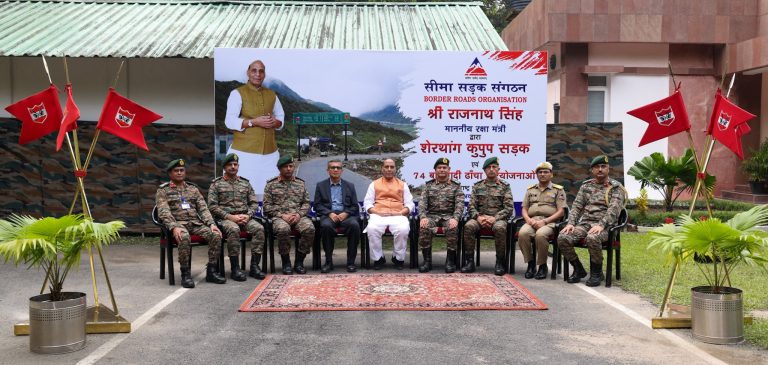
Defence Minister Rajnath Singh, on Saturday virtually dedicated to the nation 75 infrastructure projects of Border Roads Organisation (BRO) at a cost of Rs 2,236 crore.
As per an official release from Ministry of Defence, these projects – 22 roads, 51 bridges and two others – are spread across 11 States/Union Territories with nineteen (19) are in Jammu & Kashmir, 18 in Arunachal Pradesh, 11 in Ladakh, nine in Uttarakhand, six in Sikkim, five in Himachal Pradesh, two each in West Bengal and Rajasthan and one each in Nagaland, Mizoram and Andaman & Nicobar Islands.
Rajanth Singh inaugurated the projects from the Headquarters, Trishakti Corps in Sukna, West Bengal. One of the main highlights was the inauguration of the Kupup-Sherathang Road in Sikkim which serves as a crucial link between Jawahar Lal Nehru Marg and Zuluk axis.
In his address, Defence Minister termed the projects as a testament to the Government’s unwavering resolve to keep strengthening the border infrastructure and ensuring socio-economic progress of these areas. He added that these projects will go a long way in enhancing the defence preparedness of the country.
“Prime Minister Narendra Modi’s vision of ‘Viksit Bharat by 2047’ can be realised through such infrastructure projects,” he said.
As per the release, with the inauguration of these 75 projects, BRO has completed a total of 111 infrastructure projects in 2024 at an overall cost of Rs 3,751 crore. This includes 36 projects worth Rs 1,508 crore, such as the state-of-the-art Sela Tunnel in Arunachal Pradesh, inaugurated by the Prime Minister earlier this year. Last year, 125 infrastructure projects of BRO were dedicated to the nation at a cost of Rs 3,611 crore.
Rajnath Singh commended the grit and determination of the BRO personnel for completing the projects in a time-bound manner even in most challenging terrains and harsh weather conditions, adding that the government, in its third term, aims to further bolster the border infrastructure with more promptness.
Referring to the increased allocation of Rs 6,500 crore for BRO in Union Budget 2024-25, he expressed hope that it would not only contribute to strategic infrastructure development, but will also prove helpful in socio-economic progress in the border areas, including the North East region.
He also pointed out that the governments before 2014 were of the view that the development of border areas can have an adverse impact as it may be used by the country’s adversaries. He emphasised that border infrastructure development has been the priority area of PM Modi-led Government ever since it came to power as these regions, especially the North-east, is crucial from the socio-economic & strategic perspectives.
“In the last decade, we have built a vast network of roads from villages to cities, which has resulted in the country witnessing progress at an unprecedented pace,” he said.
Rajnath Singh assured the people that new dimensions will be added to the development of border areas, adding that India will be one of the safest and strongest nations in the times to come.
(This news report is published from a syndicated feed. Except for the headline, the content has not been written or edited by OpIndia staff)
In a bizarre incident from Uttar Pradesh, 35-year-old woman Alka was killed by the man she had hired to kill her 17-year-old daughter. Alka had hired the assassin to murder her daughter because she was reportedly ‘fed up’ of her behaviour.
However, little did Alka know that the assassin, 38-year-old Subhash, she had hired was actually the lover of her minor daughter and that she was upset because of her daughter’s relationship with the same man. The matter came to light after the mother’s body was found in a field under Jasrathpur police station of Etah.
Alka’s daughter had previously eloped with a man from their area. However, Alka didn’t know the name of the man her daughter had eloped with. Following this incident, the minor girl was sent to her maternal home in Farrukhabad, where the teenager again started a phone relationship with 38-year-old Subhash. When Alka discovered the calls, she decided to act against her daughter.
On September 27, Alka offered Subhash ₹50,000 to kill her daughter. Subhash, in a relationship with the teen, revealed the plan to her. The Teenager proposed an alternative plan, to kill her mother instead, the girl promised to marry Subhash if he did. The pair confessed to the crime during police questioning.
The teenager and Subhash were arrested on Wednesday, October 9. During the interrogation, both confessed to the crime.
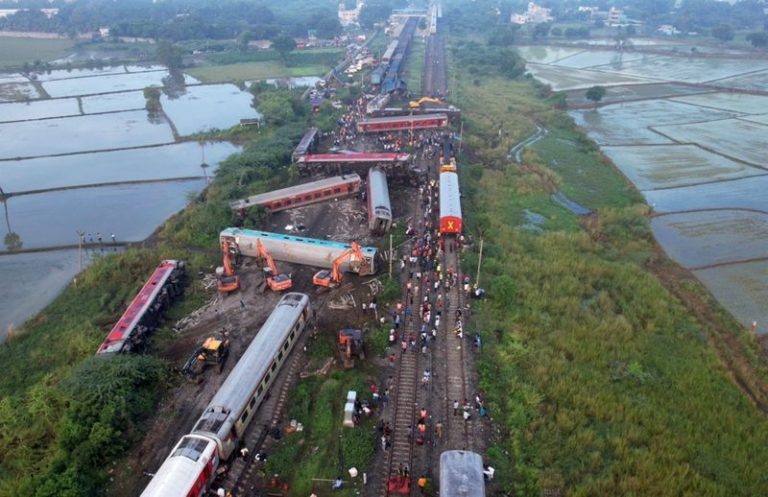
Hours after the Mysuru-Darbhanga Express train rammed into a goods train in Tamil Nadu, the Southern Railway Manager R.N Singh said the train entering the loop line was unusual.
Singh said that the passenger train should have been switched to the main line but something unusual happened and it was switched to a closed section of the track where the goods train was parked. The Mysuru-Darbhanga Express had collided with the goods train leading to the derailment of over 12 bogeys.
It is too early to conclude as to what happened, Mr Singh added, stating that while the signal was set for the main line, the train got switched to the closed loop.
On Friday night, a passenger train crashed into a stationary freight train in Tamil Nadu, causing the derailment of at least 12 coaches and injuring numerous passengers. The accident happened around 8:30 PM at Kavaraippettai railway station in Tiruvallur district, near Chennai.
The train involved, the 12578 Mysuru – Darbhanga Bagmati Express, was reportedly travelling at 75 km/h when it rammed with a parked goods train.
According to Tiruvallur District Collector Dr T Prabhushankar, there were about 1,360 passengers on board, with 19 reported injuries, including four individuals with serious injuries. Emergency services responded swiftly, taking the injured to a nearby hospital. Fortunately, no fatalities have been reported so far.