A 3-year-old girl was reportedly sexually assaulted by Qasim Rehman, an IT expert, inside the school premises. The incident came to the fore after the victim’s mother found several injury marks on the minor girl’s private parts. The mother filed a complaint with the school administration after the discovery of injury marks.
The school principal, however, refuted any complaints made to the administration. In a conversation with Times Now, the principal said, “We had no information about the rape case. We came to know through the police that an FIR has been filed against one of our school workers Qasim Rehman, who looks IT department.”
The accused, Qasim Rehman, has been arrested, and the case has been filed under the POSCO Act.
School Education Minister Udai Pratap Singh condemned the incident, stating, “This is concerning, and there is an urgent need to launch a campaign to raise awareness against such incidents.”
“The law is taking strict action in this case, and firm measures will be taken,” he added. Singh emphasized that the department is taking the incident in a Bhopal school very seriously.
“As the Education Minister, I am fully aware of the situation,” he said. Bhopal Police Commissioner Hari Narayan Chari confirmed the incident involving a 3-year-old girl and an IT expert at the school.
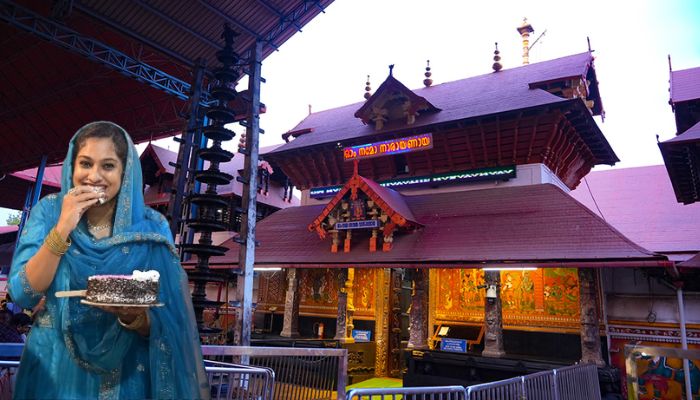
The Kerala High Court has directed the administration of Guruvayur Sree Krishna Temple to ban vloggers from recording videos in the temple premises including Nadapanthal (temple’s outer courtyard). The court, however, gave exceptions that videos can be recorded for marriage functions and other religious rites.
The division bench of Justices Anil K Narendran and PG Ajithkumar issued the directive while hearing a plea filed by the devotees of Lord Guruvayurappan. The devotees submitted a video of a Muslim vlogger, Jasna Salim, creating a ruckus and quarrelling with devotees waiting for darshan in the temple courtyard. According to the order, she was seen “celebrating her birthday by cutting a cake in the Nadapanthal”.
The devotees submitted that her act violated the Kerala Hindu Places of Public Worship (Authorisation of Entry) Act and Rules of 1965. Consequently, they urged the court to ban the entry of non-Hindus in the Guruvayur temple and its premises.
Incidentally, there are already court precedences in this regard. In January 2024, Madras HC restricted the entry of non-Hindus into Temples to protect the sanctity of the place of worship and prevent them from turning it into tourist spots as the arguments involved the entry of burqa-clad visitors. The landmark judgment came in the matter related to the entry of non-Hindus into the Palani Murugan Temple. The ruling specifically stipulated that non-Hindus and those lacking Hindu beliefs are prohibited from proceeding beyond the temple’s ‘Kodimaram.’
Nonetheless, in the present case, the Kerala High Court has prohibited vloggers from doing videography in the temple premises stressing that the temple is a special security zone and “not a place for cutting cakes”. Furthermore, the bench has also issued a notice to Jasna Salim, the Muslim woman involved in the incident. It has listed the matter for further hearing on 18th October.
The court order and observations
The two-judge bench ruled that videography by vloggers, particularly while following celebrities, is not allowed in the nadapanthal or other interior areas of the temple. It noted that such activities could disturb devotees, including children, the elderly, and people with disabilities.
The bench ordered, “We direct the Guruvayur Devaswom Managing Committee and the Administrator to ensure that videography, other than that related to marriage functions and religious ceremonies, is prohibited in the Nadapanthal of the Guruvayur Sree Krishna Temple. The temple is a Special Security Zone under the Kerala Police Act.”
“The videography of the interior places of the temple, especially through the eastern ‘Deepastambham’ cannot be permitted, ” the bench added.
Additionally, the court has assured the temple’s administrator that they can seek police assistance if necessary to enforce the ban.
The court further stated, “No person can be permitted to pick quarrels with devotees in the nadapanthal, and the courtyard is certainly not a place for cutting birthday cakes.”
It emphasised that the temple’s managing committee must ensure proper conduct within the temple, as mandated by the Guruvayur Devaswom Act, 1978. It added that the managing committee is obligated to adhere to temple customs and provide facilities for the proper performance of worship.
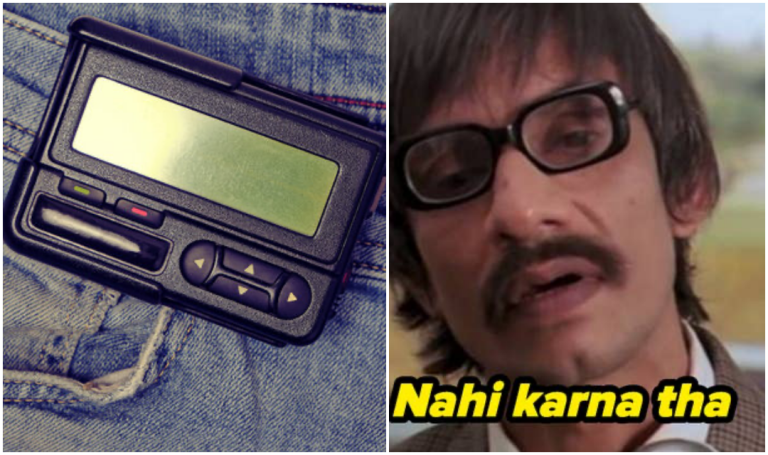
On 17th September, a large number of pagers used by the Hezbollah terror group exploded across Lebanon. The exploding pagers killed at least eight Hezbollah members. At least 2,750 were reported injured in the incident, 200 of them are critical as per available updates.
The majority of the pagers exploded in regions where Hezbollah has a strong presence. Hezbollah, the Shiite terrorist organisation, which also has political presence, is backed by Iran. Several CCTV videos of the blasts were shared online, pointing towards a sophisticated and well-planned attack on the terrorist organisation, possibly by Israel.
It’s reported that possibly over a thousand Hezbollah terrorists were killed or injured when a cyberattack on their secure cellphones and pagers caused them to explode.
Notably, since the Hamas terror attack on Israel on 7th October 2023, tensions between Hezbollah and Israel have heightened. On the same day, Hezbollah also fired rockets at Israel. Israel has been actively neutralising Hezbollah terrorists and destroying its locations amid ongoing tensions.
According to reports, the incident took place in areas covering Lebanon and Syria. Though it is unclear which agency or group was behind the attack on Hezbollah, it is generally believed that the Israeli agency Mossad could have initiated the attack. There are several theories floating around about how the attack was orchestrated. Before diving into the theories, it is essential to understand the chain of events that happened on 17th September and its aftermath that shook the core of the terror outfit.
What happened on September 17?
As per reports, all the pagers that were targeted received a message shortly before the blast. There was a gap of a few seconds between the message and the blast, which can be seen in several CCTV footages circulating on social media.
In one of the footages, a man can be seen standing near a counter in the market. He receives a message, which he checks by removing the pager from the belt holder. He checks the message and places the pager on the counter. Within seconds, the blast occurs and the man falls to the floor. While this particular person had removed the pager and kept it slightly away from his body, not everyone else was that “lucky”. Another blast happened at a vegetable market.
? Breaking: Tens of Hezbollah communication devices are exploding during the past hour. Initial reports state that over one hundred Hezbollah terrorists already injured.
Several videos showed Hezbollah operatives on the floor with severe injuries around their waist and groin area, pointing to the fact that the pagers exploded in their pockets. It appears the idea behind the attack was that the receiver checks the message by pulling the pager close, causing the blast to cause critical physical damage. However, these are just theories.
According to news agency Reuters, locals said explosions were still taking place even 30 minutes after the initial blasts. These multiple explosions have triggered panic and chaos in Lebanon, especially throughout the southern suburbs of the capital Beirut, which is a Hezbollah stronghold.
The battery blast theory
Initially, there was a theory floating around the exploding pagers attack that the simultaneous blasts could have occurred due to explosions in the lithium-ion batteries. In the aftermath of the blasts, a few photographs were published on social media that showed crumbled back panels of the pagers. In some of these photographs, model number AR-9 with GOLD written on them was visible. It matches the back of the AR-924 pager model that is produced by Gold Apollo Co. These pagers use lithium batteries.
These batteries are smaller in size compared to AA batteries. Though they are comparatively safer, there is always a chance of them exploding and causing severe damage to the person or the objects in close proximity. Notably, fires caused by lithium batteries are hard to extinguish, making them a fire safety hazard if not handled or manufactured properly. They can explode if they get overheated to 2,000 degrees Fahrenheit or come into contact with metal.
Speaking to media house Haaretz, an expert claimed that it was “purely a cyberattack”. He added that 50-gram of lithium battery has the potential to generate heat equivalent to the explosion of seven grams of TNT. “If you short-circuit a lithium battery, it heats up extremely fast, within seconds,” he claimed.
However, according to a Washington Post report, experts suggest that it is highly unlikely that the cause of the serial pager blasts were lithium batteries.
Principal expert with Meier Fire Investigation, Richard Meier, said that devices are generally designed to vent the heat produced by lithium batteries. If they fail to do so, the device would explode. In some cases, batteries rely on the device’s software to regulate their use and temperature. In theory, they can be hacked and triggered to heat to the point that they explode.
However, when lithium batteries overheat, they tend to catch fire first and then explode. In the videos available on social media, the devices instantaneously exploded, leading experts to believe that the batteries could not be the reason behind the blast.
Reacting to the exploding pagers attack, Gold Apollo issued a statement that it authorised its brand on the AR-924 pagers used by the terrorist outfit. However, the devices were produced and sold by a company named BAC.
CEO of Gold Apollo, Hsu Ching-Kuang denied manufacturing the explosive pager. When asked abt AR-924, he said “it is produced & sold by BAC…we only provide brand trademark authorisation & have no involvement in design or manufacturing of this product.” See my exchange w him. pic.twitter.com/eb6k65oyKl
Mossad, pagers and PETN: A highly sophisticated ambush
Another theory that has been floating around is that the Israeli agency Mossad is behind the attack. In February 2024, Hezbollah commanders ordered members of the terrorist organisation to stop using mobile phones, as they believed that Israel could be tracking them using GPS locations. The terror outfit decided to shift to a considerably low-tech device, namely pagers. The idea was to “blind” Israel’s surveillance.
According to a report in the New York Times, Hezbollah ordered over 3,000 pagers from Gold Apollo Company located in Taiwan. These pagers were tampered with before Hezbollah received them. Apart from the AR924 Gold model, three other models of pagers were also included in the shipment.
It has been theorised that the Israeli agency intercepted the devices somewhere in the supply chain, possibly in Europe. They implanted explosive material as little as a few grams next to the battery in each pager. A switch was also embedded to trigger the detonation remotely.
The report suggested that the devices were programmed to beep for several seconds before exploding. The beeping sound, according to a member of Iran’s Islamic Revolutionary Guard Corps, was to force the owner of the pager to hold it close to eyes and face to read the message. The beeping sound continued for 10 seconds and then the pagers exploded.
Mikko Hypponen, a research specialist at WithSecure software company and a cybercrime advisor to Europol, said, “These pagers were likely modified in some way to cause these types of explosions — the size and strength of the explosion indicates it was not just the battery.”
Israeli cybersecurity analyst and researcher at Tel Aviv University, Keren Elazari, said that the exploding pagers attack hit Hezbollah where they were most vulnerable. She said, “This attack hit them in their Achilles’ heel because they took out a central means of communication. We have seen these types of devices, pagers, targeted before but not in an attack this sophisticated.”
PETN could have been used
The exploding pagers attack possibly utilised a highly explosive chemical known as pentaerythritol tetranitrate (PETN), a nitrate ester of pentaerythritol. PETN is infamous for its explosive properties and is a key component of the plastic explosive Semtex, making it one of the most powerful explosives ever discovered. When combined with a plasticiser, PETN forms a plastic explosive capable of causing devastating damage. Interestingly, PETN is also approved by the FDA for medical use as a coronary vasodilator in treating heart conditions like angina, similar to glyceryl trinitrate but with a longer duration of action. However, in this context, its primary use is not medicinal but as a potent explosive weapon.
‘Throw the pagers away’ – Hezbollah commanders issued directive
Following the attack, a voice message was circulated to Hezbollah terrorists to throw away the new pager devices. Though Hezbollah has blamed Israel for the attack, Israeli agencies or the government issued no statement taking or denying responsibility for the attack.
The UN Security Management System has advised its personnel in Lebanon to switch off their VHF devices and remove all batteries until further notice. The agency’s radio network was temporarily suspended as well.
On Monday (16th September), the CID Special Branch led a significant drug bust leading to the seizure of narcotics worth more than Rs 6 crore from Myanmar nationals on the outskirts of Aizawl. The operation in Hualngohmun began at 10 pm when officers intercepted two vehicles. A search of the vehicles uncovered significant amounts of Methamphetamine concealed within the door panels.
In the first vehicle, a Renault Kwid with registration number MZ01N-3642, investigators discovered 32.013 kilogrammes of suspected methamphetamine worth Rs 4,14,16,900 and 249 grammes of suspected heroin worth Rs 7,47,000. The driver, Lalthansiama, 26, of Khawmawi, Myanmar, was detained.
Mega Breaking –
*Over 4 crores worth of Methamphetamine seized from Myanmar nationals on the outskirts of Aizawl*@PreetyAxomia reports @CNNnews18
A team of CID Special Branch launched a coordinated covert operation at the outskirts of Aizawl on Monday evening and intercepted… pic.twitter.com/ZDkUSLwbRu
In the second vehicle, a Datsun Redi Go with registration number MZ02A-9053, the authorities found 8.021 kilograms of suspected methamphetamine worth Rs 1,04,27,300 and 565 grams of suspected heroin valued at Rs 16,95,000. The police identified Zoremmawia of Khawmawi, Myanmar, who is currently residing in Muanna Veng, Aizawl as the driver of this vehicle and arrested him.
On Tuesday, the police intercepted a third vehicle, an i10 Magna with registration number MZ01G-5672 in Muanna Veng, Zuangtui. Inside, officers discovered 2.284 kilograms of suspected heroin worth Rs 68,52,000. The driver, identified as David from Zokhawthar, escaped the scene, but an underage passenger was detained.
This operation yielded the seizure of 40.034 kilograms of suspected methamphetamine worth Rs 5,20,44,200 and 3.098 kilograms of suspected heroin for Rs 92,94,000. The arrested accused as well as the seized drugs worth Rs 6,13,38,200, were turned over to the Special Narcotics Police Station. A criminal case has been filed under Special Narcotics PS Case No.36/2024 on September 17, 2024, under provisions 21(C)/29(1)/25 of the NDPS Act and 14A of the Foreigners Act. Further investigations are underway to trace the links of this drug trafficking network.
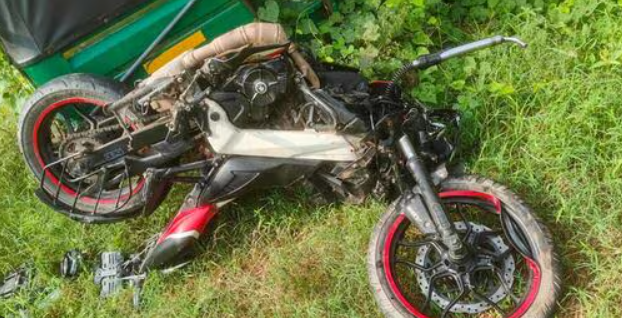
On Sunday, 15th September, a 23-year-old biker got killed after his motorcycle was hit by a car moving in the wrong direction on Golf Course Road near Belvedere Park, DLF Phase II in Gurgaon. The Police conducted an investigation on Monday and said that the man was on a motorcycle with a friend when the tragic crash occurred.
According to investigators, the event occurred at about 5.45 am on Sunday, when the deceased, Akshat Garg of Pochanpur in Dwarka, Delhi, was riding his motorcycle using all the safety precautions. He was wearing safety gear which included a helmet and gloves. His friend and coworker, Pradyuman Kumar, 22, was following him on another motorbike at a distance of about 100 feet away.
As per the report by Hindustan Times, the two men began their journey from different locations. Garg traveled from Dwarka and Kumar from New Palam Vihar and the duo intended to meet a group of riders in Ambience Mall after leaving DLF Downtown. According to authorities, after crossing the Sikanderpur-Cyberhub flyover, they neared a curve when a speeding Mahindra XUV 300 car emerged from the opposite direction. The automobile, which had a political party sticker on it, hit head-on with Garg’s bike, the police said.
Image- Hindustan Times
“Neither the car driver nor Garg had any chance to avoid the collision. The impact flung Garg above the car, and his motorcycle was mangled beyond recognition,” the police said.
After the incident, commuters passing by gathered swiftly and emergency services were notified. The ambulance was called and Garg was immediately shifted to the hospital, however, the doctors declared him dead.
Garg’s friend, Kumar, attempted to help him. “There were two men in their mid-20s and a dog inside the car. Commuters apprehended them and handed them over to the police. Unfortunately, my friend became unresponsive within seconds after I tried to open his helmet,” Kumar said.
Kumar noticed that the car was driving in the wrong direction in the lane designated only for fast vehicles. “My GoPro camera, attached to my helmet, captured the entire accident. But, despite watching the footage, the cops did not take a copy of it,” he said. “Later, I found out the car driver was released from the police station,” he added.
According to Sandeep Kumar, the Gurugram police’s public relations officer, the driver was apprehended on the spot. “He was later identified as Kuldeep Kumar Thakur, 25, from Madhubani, Bihar. He lived in Ghitorni, Delhi, and owned a company that handles social media campaigns for elections,” Kumar said.
“He told police that he was returning from Palwal and was driving as per Google Maps which prima facie doesn’t seem right. He was later granted bail from the police station,” he said. On friend Kumar’s complaint, an FIR under the section of the Motor Vehicles Act, including 106 (causing death by negligence), 281 (rash driving), 324(4) (mischief causing damage of over Rs 20,000), and 166 (compensation after a motor vehicle accident) has been filed.
Every year, as Hindus celebrate Ganesh Chaturthi and take out processions across the country, Jihadis follow their ritual of attacking these processions. This year, several attacks took place not only in India but in Bangladesh as well. Here is a list of 17 such attacks that took place during this year’s Ganpati celebrations.
On 6th September, Hindu youths carrying an idol of Bhagwan Ganesh were attacked by Islamists in the Mundra area of Kutch district, Gujarat. As per the complaint filed by the injured Hindu youth, Yuvraj Singh Jadeja, the incident occurred when he was returning home with two of his friends after buying a Bhagwan Ganesh idol to celebrate Ganesh Utsav.
Hamja-Farooq and three others attack Hindu youths carrying Ganesh idol over trivial issue; threaten them with sharp weapons (Image Source – OpIndia Gujarat)
He, along with his two friends, had come to Mundra on Friday morning to buy a Ganesh idol. After placing Lord Ganesh’s idol in a tempo, they were returning home from Mundra Umiyanagar College. When they reached the petrol pump near the post office, their tempo could not move ahead as its path was blocked by a bike parked in the middle of the road. Two or three persons were chatting there. When they asked the accused, Hamja, Garooq, and three others, to clear the road and park their bikes on the sidewalk, the accused verbally argued with them. The altercation escalated, and the accused brutally assaulted the Hindu youths.
The victim mentioned in the complaint that following the attack, one of the accused brought a sword from somewhere to attack them. The accused threatened the Hindu youths, saying that they would not let them go alive and that they would be finished. Some of the accused also had other sharp weapons. An FIR was filed at Mundra police station against five accused on the complaint of Yuvraj under Sections 115(2), 125(1), 189, 190, 191, 296(b), 351(2), and 351(b) of the Bharatiya Nyay Sanhita (BNS). Meanwhile, two accused have been arrested in this case.
Stones pelted on Bhagwan Ganesh idol in Madhya Pradesh
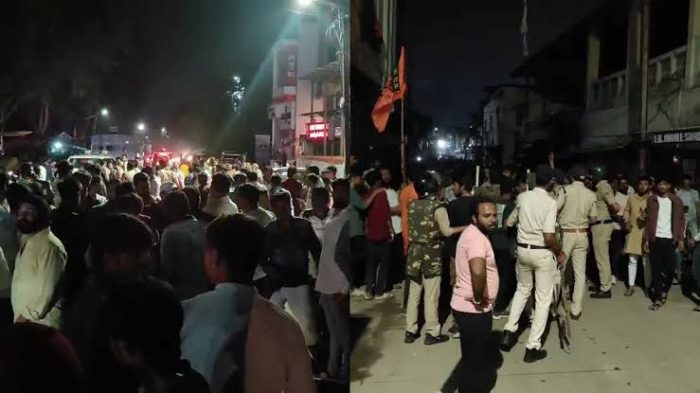
On 7th September, miscreants pelted stones at a Bhagwan Ganesh idol in Mochipura of Ratlam district in Madhya Pradesh. The attack led to massive protests, and around 500 people surrounded the Station Road police station, raising slogans against the stone pelters. An FIR was registered in the matter.
Protests in Ratlam (Image Source: ETV)
When the police initiated the investigation and reached the spot, someone again pelted stones, and one of them hit a police vehicle, breaking the glass. People present at the spot also pelted stones in retaliation. The police swung into action to prevent any further escalation and used mild force to disperse the crowd.
According to the FIR, on the night of 7th September at around 8:30 PM, members of the Puja committee were carrying the idol from Khetalpur to Mehndikui Balaji via Hathikhan Mochipura for the installation of Ganesh Ji. Women and children were also present in this procession. As soon as they reached Mochipura on Hathikhan Road, someone threw a stone at the idol.
Stones pelted at Ganeshotsav pandal in Surat
On the 7th and 8th of September, stones were pelted at a Ganeshotsav pandal in the Lal Gate area of Surat, Gujarat. As per reports, some Muslim minors pelted stones at the pandal, leading to hundreds of Hindus protesting and demanding strict action. The police swiftly swung into action and made some arrests. Security has been increased in the area.
Source: OpIndia Gujarat
According to OpIndia Gujarat’s report, the incident took place at the Ganesh pandal in the Variyali Bazar area of Lal Gate. Some minors, reportedly from the Muslim community, pelted stones at the pandal. After the stones were thrown, Hindus filed a police complaint. The news spread quickly around the city, and crowds swelled, demanding action.
Reportedly, stone-pelting incidents took place on 7th and 8th September, prompting Hindus to inform the police. Speaking to OpIndia, Yagnesh Patel, a Bajrang Dal activist from Surat, said that when police came to investigate the matter, stones were pelted at them from the Muslim area. Hindu organizations have alleged that stone-pelting also took place from nearby mosques.
Home Affairs Minister for Gujarat, Harsh Sanghvi, also took note of the incident and ordered strict action. In a post on X, Sanghvi said, “As I promised, we have caught the stone-pelters before sunrise! 6:30 am #Surat Update. Here are the details: 27 stone pelters arrested. CCTV, video visuals, drone visuals, and other technical surveillance work is still ongoing. Strict action will be taken against all accused. Our teams have worked the whole night to identify the stone pelters and bring them to justice. Jai Ganesh!!”
जैसा कि मैंने वादा किया था, सूरज उगने से पहले हमने पत्थरबाजों को पकड़ लिया है!
Stones pelted on a Ganesha mandap in Kutch, Gujarat
Stones were thrown at the Ganesha mandap in the Kutch village of Nakhatrana where Muslim children are reported to have been used to execute the conspiracy due to which the idol of Lord Ganesha was vandalised. An Islamic flag was also hoisted in a Hindu temple which was a short distance from the mandap. The incident has led to a tense situation in the area. The authorities, meanwhile, registered a case and arrested seven people. Maulana Ghulam Hussain Jafar, Asif Sumra Padhiyar, Sahil Ramzan and Hanif Jusan are among the arrested.
The matter pertained to Kotada Jadodar hamlet. A video of the incident was captured on 10th September and showed the defaced idol. A man in the footage can also be heard accusing the police of not taking any action in the name of “bhai-chara” (brotherhood) for two days.
સુરત બાદ હવે કચ્છના નખત્રાણામાં એ જ મોડસ ઓપરેન્ડીથી હિંદુ આસ્થા પર હુમલો
કોટડા જરોદાર ગામે પથ્થરમારો કરીને ગણેશજીની પ્રતિમા ખંડિત કરાઈ. મંડપથી થોડે જ દૂર એક મંદિર પર ફરકાવી દેવાયો લીલો ઝંડો.
In a shocking revelation, it emerged that a gang of minor Muslim youths were behind the stone pelting. The mastermind of this gang had planned to attack 10 Ganesh Pandals daily. The police investigation also revealed that the leader of the gang of Muslim minors had been receiving ‘madarsa training’ for the past three months.
In Lucknow, Muslim mob attack Ganesh Puja pandal amid “Allah Hu Akbar” slogans, pelt stones and threaten to kill Hindu family
On 10th September, Muslim extremists pelted stones at a Ganesh Puja pandal in Lucknow, Uttar Pradesh and broke the urn (kalash) kept near the idol amid slogans of “Allah Hu Akbar.” Afterwards, Hindu organizations protested at the police station and demanded action. The authorities have registered a case and arrested two suspected minors. The case pertains to the Chinhat police station area of Lucknow.
Islamists attack on Ganpati Visarjan procession in Mandya, Karnataka
On 11th September, communal clashes erupted in the Mandya district of Karnataka after stones were pelted at the Ganesh idol near a dargah in Nagamangala town on Mysuru Road.
According to reports, some Hindu youths were taking out a procession for the immersion of the Ganesh idol in Badarikoppalu village. When the procession was about to cross a dargah on Mysuru Road, people from the Muslim community came and started a heated argument with the Hindu devotees. Following the altercation, members of the Muslim community allegedly pelted stones at the Ganesh idol and displayed lethal weapons. According to a News18 report, slippers were also thrown at the idol.
Stone pelting during Ganesh immersion procession in Nagamangala, Mandya by Muslims objecting that Ganesha procession shouldn’t go in a particular road.
Members of the Hindu community became angry at the attack and approached the police seeking justice. They kept the Ganesh idol in front of the police station and staged a massive protest. As more people learned about the incident, they reached the police station and joined the protest, demanding permission to take out a procession on Mysuru Road.
Following the incidents, some miscreants set shops owned by Hindus on fire. Several shops were ransacked. Bikes and other vehicles parked on the side of the roads were also damaged and burnt.
Communal clashes erupt after Muslims forcefully hoist Islamic flags atop Hindu houses during Ganeshotsav celebrationin Bharuch, Gujarat
Tensions mounted in Bharuch when Hindus and Muslims came face to face after members of the Muslim community forcefully installed Islamic flags and pylons atop Hindu houses during the Ganesh Chaturthi celebration.
The entire incident unfolded on the night of September 10 in the Gokulnagar area, which is home to both Hindu and Muslim communities. While the Hindu festival of Ganeshotsav is currently being celebrated, the Muslim festival of Eid is also approaching. During this time, some Muslims began to install their religious flags and pylons in anticipation of Eid.
Despite requests from Hindus to avoid installing Islamic flags and pylons atop their homes, their appeals were ignored, and the Muslims continued with the installation. This led to a confrontation, resulting in clashes between the two communities, with reports of stone pelting and violence emerging from the brawl.
Stones pelted on Ganesh immersion procession in Mahoba, Gujarat
On 14th September, stones were pelted at a Ganesh Visarjan procession in Mahoba, Uttar Pradesh. The incident led to communal clashes between two groups, and they assaulted each other, resulting in a law and order situation. Following the incident, Hindu organisations raised slogans outside the police station, demanding action against the attackers.
As per reports, two Ganesh idols were taken out for the Visarjan procession in Mahoba. When the procession reached Kasauratori area of Kotwali police station in Mahoba, a firecracker allegedly fell on a kutcha house. There was a piece of polythene on top of the house, which caught fire. The owner of the house put out the fire using water and then threw water on Hindus participating in the procession. When Hindus objected, it turned into a clash between the two sides.
During the argument, Hindus were attacked in the Muslim-majority area with a bucket and faced stone pelting. The police rushed to the spot to control the situation. Following the incident, members of Hindu organisations reached the police station and started sloganeering, demanding strict action against those who attacked them.
Hindu youth attacked for organising Ganesh festival
On Saturday, 14th September, Maharashtra Police in Pune’s Daund area booked one Yasin Ismail Sayyed for assaulting a man for organizing the Ganesh Festival program in the city. The accused used a sharp weapon to it the victim identified as Sitara Torve and threatened him with death for conducting programs amid the Hindu festival, Ganeshotsav.
Muslims attack Hindus for using gulal during Ganpati Visarjan in Jhansi, UP
On September 15, in Jhansi, a clash erupted between two communities during Ganesh Visarjan over the raising of slogans and throwing of gulal. The altercation, which lasted about 15 minutes, involved heavy kicking and punching. Women were also assaulted and thrown into the mud, leaving six people injured. The incident sparked outrage among Hindu organizations after a video of the fight went viral.
Chanting slogans of “Jai Shri Ram,” several Hindu organizations gathered at the police station and staged a protest, demanding the arrest of individuals from a particular community involved in the brawl. As tensions escalated, authorities intervened, calming the situation by addressing both sides. The altercation occurred in Madarganj Mohalla, a Muslim-majority area in Month Town.
The fight broke out after the group returned from the Ganesh immersion. According to Munnalal Raikwar from Madarganj Mohalla, a group of about 20 to 25 people had taken the Ganpati idol for immersion. Initially, a verbal exchange occurred with members of the other community over slogans and gulal, but it was resolved at the time. However, upon returning later in the evening, tensions reignited when members of the other community began hurling abuses. When they objected, a violent confrontation ensued, lasting around 15 minutes, resulting in multiple injuries.
Hindu devotees returning from Ganesh Visharjan attacked in Delhi’s Trilokpuri area
On September 16, Monday, Muslims attacked the Hindu devotees returning after Ganesh Visarjan in Delhi’s Trilokpuri area. Two youths were injured in the attack. An eyewitness said that the attackers were armed. They misbehaved with the women.
The Mayur Vihar police station registered a case under the relevant section and detained two suspects. The police claimed that there was no communal angle in the incident and that it is suspected that a clash broke out between the two groups of residents due to their old rivalry.
Similar incident occurs in Farrukkabad
On Monday, September 16, Hindu devotees in Farrukkabad, Uttar Pradesh were attacked when they were returning after Ganesh immersion. An eyewitness confirmed that the Muslims abused and pelted stones at the devotees when they passed through a Muslim area while returning after immersing the Ganesh idol. Slogans like, “Islam zindabad, Pakistan zindabad” were also raised. The incident was caught on CCTV.
People returning after Ganapati Visarjan attacked with sticks, stones pelted on in Farrukhabad, incident caught on CCTV.
The attackers alleged to be raising Islam & Pakistan Zindabad slogans during the attack. pic.twitter.com/tUGi9vZRfx
Stone pelted on Ganesh idol procession in Chhattisgarh
On September 17th, Muslims pelted stones at a Ganpati immersion procession in the Ara village in Balrampur, Chhattisgarh. A 15-year-old Hindu girl named Sheela Yadav was severely injured in this attack. Angry villagers reached the Bariyon police station and demanded strict action against the culprits.
Rajpur police in charge, Bhardwaj Singh said that after the incident, a case was registered against four people namely Hashib, Imam, Ittakhab and Islam.
Islamists pelt stones and break Ganesh idol when procession nears Hindustani mosque in Bhiwandi, Maharashtra
On Tuesday (September 17), stones were hurled at a Ganpati immersion procession in Bhiwandi, Maharashtra. The incident took place around midnight when a large Ganpati idol from Ghughat Nagar was being transported to the Nadinaka Kamwari River for immersion. As the procession passed near the Hindustani Mosque at Vanjarpatti Naka, some individuals threw stones at the idol, causing reported damage.
This act triggered a confrontation between the groups, leading to a physical altercation.
Similar stone pelting incident on Ganesh Visharjan procession takes place in Lagaon Jamod town and Buldhana, Maharashtra
Similar stone-pelting incidents occurred in several other parts of Maharashtra. In Lagaon Jamod town, stones were thrown at a Ganpati immersion procession at around 8 pm on Tuesday (September 17) in the Chubhara area. According to reports, the stone pelting lasted for around 30 minutes, leaving several injured.
A similar incident was also reported from the Buldhana region.
Muslim mob tries to attack Ganesh Visarjan Yatra in Vaso, Kheda for playing DJ while passing through a mosque
On Tuesday, 17th September, massive chaos erupted in Kheda, Gujarat after a Ganesha Visharan procession was almost attacked by a Muslim mob of around 150-200 Muslims. The Hindu participants of the procession were confronted with sticks and pipes as the procession passed by the mosque. As per the local reports, an argument initially erupted over the DJ music played in the procession. The Muslim mob happened to protest against the DJ sound before confronting the participants over the issue.
The Police arrived at the spot and immediately took control of the situation. 11 people have been arrested in the case and several others have been booked. Notably, all the accused persons are believed to be belonging to the Muslim community.
Ganesha idol procession attacked near masjid in Chittagong, Bangladesh
On 6th September, a procession of Hindu devotees carrying the idol of Lord Ganesha came under attack in the Kadam Mubarak area in Chittagong city of Bangladesh. The incident occurred a day before the Ganesh Chaturthi celebrations were scheduled to be held in the city. As per reports, members of the ‘Batargalli Dhwapara Sarbajanin Puja Committee’ were bringing the idol of the Hindu deity in a van from the factory of artisan Uttam Pal.
Hindu procession attacked near Kadam Mubarak mosque, image via Kalbela/ Dainik Azadi / BNA News
At that time, hot water was thrown on the Lord Ganesha idol and the Hindu devotees from atop a high-rise building on Momin Road. It must be mentioned that the said building is close to the Kadam Mubarak mosque. The deliberate attack led to a heated argument between the devotees and residents of the building.
According to eyewitnesses, bricks were also hurled at the Hindu procession. A young Hindu man, who was hurt during the incident, informed that another Hindu devotee sustained serious injuries to his head.
Stone pelting at Hindu processions has become a disturbing trend in various regions, often leading to communal tensions and violence. In one such latest attack, stones were hurled at a Ganpati immersion procession in Bhiwandi, Maharashtra. The incident took place around midnight on Tuesday (September 17), when a large Ganpati idol from Ghughat Nagar was being transported to the Nadinaka Kamwari River for immersion. As the procession passed near the Hindustani Mosque at Vanjarpatti Naka, some individuals threw stones at the idol, causing reported damage.
This act triggered a confrontation between the groups, leading to a physical altercation.
Bhiwandi, Maharashtra: During Ganpati immersion, stones were thrown at a Ganesh idol near Hindustani Mosque, breaking it and sparking tension between communities. The Ganesh Mandal demanded the arrest of those responsible and refused to proceed with the immersion. Police… pic.twitter.com/IaWbgy4AiZ
Angered by the incident, the Ganesh Mandal demanded the arrest of those involved and refused to proceed with the immersion. The local police intervened and used a lathi charge to bring the situation under control, resulting in several people being injured. Some individuals were detained and an investigation in underway.
Speaking to the media on Wednesday (September 18), Additional Commissioner of Police Dnyaneshwar Chavan said that the Ganpati immersion procession near the Hindustani Mosque had started peacefully and was proceeding without issues. However, tensions arose when a stone was thrown, sparking disputes and altercations among some individuals, which led to a disruption.
“The situation is now under control, and those involved in the disturbances are being identified for legal action. Some individuals have been detained for questioning, and further actions will follow,” he added.
Bhiwandi, Maharashtra: Additional Commissioner Of Police, Dnyaneshwar Chavan says, The traditional Ganpati immersion procession in Bhiwandi started peacefully near Hindustani Mosque and was proceeding well. However, a stone was thrown, causing a dispute and some altercations… https://t.co/NYUxTw84Wwpic.twitter.com/lGRwqoTgqJ
According to reports, similar stone-pelting incidents occurred in several other parts of Maharashtra. In Lagaon Jamod town, stones were thrown at a Ganpati immersion procession at around 8 pm on Tuesday in the Chubhara area. According to reports, the stone pelting lasted for around 30 minutes, leaving several injured.
A similar incident was also reported from the Buldhana region.
In one of the most shocking and effective anti-terrorist operations till date, the Israeli intelligence agency Mossad is believed to have carried out the explosion in pagers held by thousands of Hezbollah terrorists on the 17th of September in Lebanon and Syria. The attack left over 2800 terrorists injured and 9 dead as per latest reports.
While certain theories are floating around how exactly Mossad executed the simultaneous explosions in the pagers Hezbollah terrorists were carrying, it would be interesting to know why these terrorists were using pagers at all in the era of modern technology smartphones.
Following the killings of key commanders in targeted Israeli airstrikes in the past few months, the Iran-backed Islamist terror group Hezbollah had employed certain ‘low-tech’ tactics to avoid its adversary’s advanced surveillance systems. It has also been utilising its own technology, drones, to study and assault Israel’s intelligence-collecting capabilities, a policy described by Hezbollah’s commander, Sayyed Hassan Nasrallah, as “blinding” Israel. However, it seems Hezbollah was blinded to the capabilities of Mossad to beat the terror group at their own game.
REPORT: Israel apparently intercepted the pagers from Taiwan that detonated in the pockets of thousands of Hezbollah fighters before they reached Lebanon.
According to the New York Times, Israel tampered with the devices that Hezbollah ordered.
Notably, ever since Hezbollah extended support to Palestinian Islamist terror group Hamas, the Israeli defence forces and Hezbollah have been exchanging fire. Israel’s sophisticated Electronic surveillance technology has proved vital in its strikes on Hezbollah targets.
As per a Reutersreport, the IDF has stated that it has security cameras and remote sensing equipment trained in regions where Hezbollah operates, and it often sends surveillance drones over the border to spy on the enemy. Notably, Israel’s electronic spying, which includes hacking into cell phones and computers, is widely recognised as some of the most sophisticated in the world.
Hezbollah banned cell phones, switched pagers and couriers to counter Israel’s sophisticated tech surveillance
In response to Israel’s next-level warfare, Hezbollah changed its tactics. Cell phones, which may trace a user’s location, have been prohibited on the battlefield instead more old-fashioned methods such as pagers and couriers are being used. In addition, Hezbollah has also been using a private fixed-line telecommunications network. If conversations are overheard, code words for weaponry and meeting places are used. These are updated almost every day and sent to units through couriers.
Interestingly, the Al Qaeda terrorist Osama Bin Laden had evaded arrest for decades by cutting off from internet and cell phones. Perhaps, Hezbollah took a page from Laden’s book, however, Israel has managed to breach Hezbollah’s old-fashioned counters to the Israeli sophisticated tech warfare.
As per Islamist terror group Hezbollah and Lebanese security authorities, Israel has also begun using local agents to zero down on targets. Since Lebanon is engulfed in economic crises and political rivalry, Israeli recruiters have been doing their job well.
In an interesting incident from 22nd November last year, a woman from south Lebanon received a cell phone call from someone claiming to be a local official. The caller, who spoke fluent Arabic, enquired if the family was home. No, the woman said, adding that they had been to eastern Lebanon. Minutes later, a missile smashed into the woman’s home in the village of Beit Yahoun, killing five Hezbollah jihadis.
While Israel is showing no mercy to the terrorists, the call was made to the woman to confirm if any civilians were present at the target location before launching the strike.
‘Israel was tracking cell phones’, so they switched to pagers
Following the killings of Wissam al-Tawil, Taleb Abdallah, and Mohammed Nasser, commanders in charge of Hezbollah’s operations in the south, as well as Saleh al-Arouri, Hamas’ deputy leader, who was killed while attending a meeting in Beirut, Hezbollah suspected Israel was tracking their cell phones. The terror group used its affiliated Al-Nour radio to caution its terrorists not to heed cold calls from callers claiming to be local officials as they could be Israeli agents. Since then, the cell phone ban is strictly implemented and any Hezbollah terrorist found in possession of cell phone is kicked out of the terror group. Besides, Hezbollah is using small, homemade, unmanned aerial vehicles (UAVs) to gather information about Israeli targets and attack its surveillance systems.
In the 17th September pager attack, it is being said that Mossad got hold of the shipment of pagers ordered by Hezbollah before they were handed over to the Islamist terror group. As per one of the theories on how the attack was orchestrated, Mossad allegedly placed a certain amount of PETN, a highly explosive substance, on the batteries of the devices and exploded them by raising the temperature of the batteries remotely. However, the theories are still being debated with no official confirmation.
Meanwhile, Elijah J. Magnier, a Brussels-based senior political risk analyst opined that an error message sent to all the devices causing them to vibrate, forcing the user to press the buttons to stop the vibration. The combination detonated a small amount of explosives hidden inside and ensured that the user was present when the blast went off.
Bangladesh’s interim government, led by the controversial ‘Nobel laureate’ Muhammad Yunus, has granted the military special executive magistrate powers throughout the country with immediate effect. This information was announced in a notification issued by the Ministry of Public Administration on Tuesday (September 17). The Army officers will act as executive magistrates across the country and exercise the granted powers for the next 60 days, the circular read.
The delegation of magisterial powers to the Army will enable it to perform police and prison-related duties, as well as the responsibilities of executive magistrates. An officer with these powers can arrest individuals without warrants and put them behind bars.
The power vested in the Army officials gives them the authority to open fire in case of self-defence or extreme necessity, said an adviser to the interim government.
Speaking about the development with local media, Supreme Court lawyer Barrister Tapash Kanti Baul said, “The Army didn’t have the power to make an arrest without the presence of an executive magistrate. But now they can place anyone under arrest since they can exercise the power vested upon them under Section 65 of the CRPC.”
It may be recalled that after the violent ouster of Sheikh Hasina on August 5, the army headed by Waker-uz-Zaman had taken charge of Bangladesh briefly before the interim government was sworn in on August 8.
The Bangladesh Army Chief assured that all those who were involved in crimes over the past few days will not be spared and legal action will be taken against them. He added that the Air Force and Navy chief are with him and all of them are working together.
It is evident that even though a new interim government headed by an eminent economist will be installed in Dhaka, it will be under the control of the army.
The United States has said that it was “not involved” and “not aware in advance” about the series of pager explosions that took place in Lebanon.
While addressing a press briefing on Tuesday, US State Department spokesperson Matthew Miller said that the US is gathering information about the incident that happened in Lebanon.
Speaking further on the incident, Miller said, “We are gathering information on this incident. I can tell you that the US was not involved in it. The US was not aware of this incident in advance. At this point, we’re gathering information.”
Miller’s statement comes after Lebanon’s Health Minister confirmed a series of explosions across the country, resulting in the deaths of at least eight people and injuring 2,750 others.
When asked what information the US has gathered, he said, “We continue to collect information. I don’t have any public readout. We are collecting information in the same way that journalists are across the world to gather the facts about what might have happened.”
In response to another query about whether the US has any doubt about Israel’s involvement in the incident, he said, “I don’t have any assessment one way or another at this point.”
He further said that he will not speculate on the impact of any incident, particularly in the early stages. He said that US wants to see diplomatic resolution to the conflict between Israel and Hezbollah.
Asked about any message the US wants to give Israel, Miller said, “I never want to comment or speculate about the impact of any one incident, especially in the early stages of the incident. I am not going to do so here, that has been our policy to try to avoid doing. Our overall policy remains consistent, which is we do want to see a diplomatic resolution to the conflict between Israel and Hezbollah. We want to see one that allows the tens of thousands of Israelis who have been displaced from their homes and tens of thousands of Lebanese who have been displaced from their homes to return home. That’s what we are continuing to pursue.”
Asked if there were indications that Iran could take advantage, given reports that the Iranian ambassador in Lebanon was injured, Matthew Miller said he did not want to speculate until those reports were confirmed. He said that the US would urge Iran not to take advantage of any incident to try to further increase tensions in the region.
“I have seen the reports. I don’t want to speak to what the implications might be before a report is confirmed. But certainly, as is always the case, we would urge Iran not to take advantage of any incident, any instability, to try to add further instability and to further increase tensions in the region. That has been our message to Iran since October 7,” he said.
The blasts in Lebanon were caused by exploding handheld pagers, according to a report by Al Jazeera. Lebanon’s Health Minister Firass Abiad informed that 200 people are in critical condition after the communication devices exploded on Tuesday. He also said that the victims are receiving treatment in over 150 hospitals.
In a statement earlier on Tuesday, Hezbollah said that “pagers belonging to employees of various Hezbollah units and institutions exploded,” killing two of its fighters and a girl. The group further said that it was investigating to determine the causes of the explosions.
A Hezbollah official, speaking on the condition of anonymity, described the explosion of handheld pagers as the organisation’s “biggest security breach” in nearly a year, according to Al Jazeera.
No official statement has been released by the Israeli military regarding the explosions in Lebanon. Earlier, Arab media had reported that some 1,000 Hezbollah operatives so far have been injured by exploding pagers and radios.
Reports suggest that Hezbollah figures in Syria were also injured in the apparently simultaneous blasts. Iran’s ambassador to Lebanon, Mojtaba Amani, was injured by the explosion of an electronic pager, Al Jazeera reported.
Social media is rife with videos that caught the explosions, their aftermath, and chaos in Lebanese hospitals. Unverified Arab media reports have attributed the blasts to an Israeli cyber attack.
Iran’s ambassador to Lebanon, Mojtaba Amani, was slightly injured by the explosion of an electronic pager, Al Jazeera reported.
Notably, Israel’s Security Cabinet on Monday night updated its official war goals. Israel’s ongoing war with Hamas in Gaza’s goals includes the objective of allowing residents of the north to return safely to their homes after being displaced by attacks by Hezbollah, according to Israel’s Prime Minister’s Office, The Times of Israel reported.
In a statement, Israel’s Prime Minister’s Office stated, “The safe return of the residents of the north to their homes” has now been added as a fourth objective to the war,” The Times of Israel reported.
After a late-night meeting of the security cabinet in Tel Aviv on Monday, the statement said, “Israel will continue to act to achieve this goal.” Notably, Israel has been engaged in a conflict with Hamas following the October 7 attacks.
(This news report is published from a syndicated feed. Except for the headline, the content has not been written or edited by OpIndia staff)