Home Blog Page 899

Uttar Pradesh: Student finds changes in PCS (J) Mains-2022 exam copies, says handwriting changed, answer sheet torn; action against 5, 3 suspended

On Monday, July 1st, the Uttar Pradesh Public Service Commission (UPPSC) took strict action against 5 officers and employees for their involvement in a purported incident of changing a candidate’s answer sheets for the UP Judicial Service Civil Judge (Junior Division) Main (Written) Examination-2022, also known as PCS (J) Mains-2022.

UPPSC secretary Ashok Kumar said that section officer Shiv Shankar, review officer Neelam Shukla, and assistant review officer Bhagwati Devi have been suspended for their negligent behavior in investigating this matter.

“The supervisory officer has also decided to take departmental action against deputy secretary Satish Chandra Mishra. Permission has also been sought from the state government for action against retired assistant review officer Chandrakala,” Kumar was quoted as saying.

The incident came to the fore after Shravan Pandey, a candidate for the PCS (J) Main Exam-2022, obtained access to his answer sheets using the RTI Act. Following this, he launched a petition in the Allahabad High Court, alleging that the handwriting on his English answer sheet was different and that certain pages of another answer sheet were torn, stopping him from passing the main examination.

Following this, on June 5th, 2024, the high court instructed the UPPSC to hand over the petitioner’s answer sheets for six question papers to the court.

Following this, the Commission on June 7th appeared in court and filed an affidavit stating that after the case was made public, the internal process of assigning dummy roll numbers to all 18,042 answer sheets of all 3,019 applicants who had taken the main examination was being investigated.

As per the reports, meanwhile, the Commission started presenting the answer sheets to candidates on June 20th. The applicants who appeared in the main PCS-J 2022 examination will reportedly be shown their copies until July 30th as per their roll numbers. So far, 232 candidates have reviewed their answer papers.

This comes amid the ongoing controversy over the NEET-UG exam paper leak in the country. Around 67 NEET applicants received a perfect score of 720/720 marks to share the All-India Rank (AIR) 1 after which several students and their parents complained about glitches, alleged malpractices, ambiguous implementation of grace marks, and above all, an alleged paper leak. Several teachers and authorities have been arrested from Bihar and Maharashtra for their involvement in the case. The opposition parties in the Parliament have been protesting over the matter however, the government has assured strict action in the case.

The U.P. Judicial Service Civil Judge (Junior Division) (Mains) Examination 2022 was held between May 22nd and May 25th, 2023. The results were released on August 30th last year and the scores were made public in November 2023.

“By calling Hindus violent, you are defaming and insulting the entire society”: Swami Avdheshanand Giri condemns Rahul Gandhi’s remarks on Hindus

On Monday, July 1, Swami Avdheshanand Giri condemned Rahul Gandhi’s remarks on Hindus and slammed the Congress leader for defaming and insulting the entire society. He stressed that by calling Hindus violent and accusing them of spreading hatred, the leader of the opposition, Rahul Gandhi, defamed and insulted the Hindu community. Swami Giri asserted that Rahul Gandhi’s remarks have hurt the sentiments of the entire community as well as angered the saint community. The prominent Hindu seer also demanded that the Gandhi scion should apologise for his remarks and take back his words. 

Swami Avdheshanand Giri also stressed that Hindus are non-violent, accommodative, and those who also pray for the welfare of others. 

Slamming Rahul Gandhi’s remarks, the renowned Hindu seer said, “It is not right to call Hindus violent or to say that they spread hatred. By saying such things, you are defaming and insulting the entire society.”

He added, “Rahul Gandhi repeatedly says that Hindus are violent and that Hindus create hatred… I condemn his remarks. He should take back these words. The whole society is hurt and there is anger in the saint community… He should apologize for this.”

He reminded the Congress leader that contrary to his remarks, Hindus are non-violent, liberal, and all-inclusive people who respect everyone. 

Swami Giri noted, “Hindus see God in everyone, Hindus are non-violent, accommodative, and generous. Hindus say that the whole world is their family and they should always pray for everyone’s welfare, happiness, and respect. Hindu society is very liberal and it is such a society which is all-inclusive and respects everyone.” 

Notably, earlier in the day, on 1st July, Rahul Gandhi during his parliamentary speech made controversial remarks on Hindus saying, “Those who call themselves Hindus only talk about violence.” 

During his speech, Rahul Gandhi, said, “All our great men have spoken about non-violence and eliminating fear… But those who call themselves Hindu only talk about violence, hatred, untruth…”

PM Modi raised serious objection to Rahul Gandhi’s comments saying, “Calling the entire Hindu community violent is a very serious matter.”

Following a heated exchange between the Opposition and the ruling NDA’s MPs, Union Minister Amit Shah demanded an apology from Rahul Gandhi.

He stated, “The Leader of the Opposition has clearly stated that those who identify as Hindu speak of and commit violence. He is unaware that millions proudly call themselves Hindu. Associating violence with any religion is wrong. He should apologize.” 

Meanwhile, Rahul Gandhi’s remarks sparked massive outrage and were widely criticised by people from all walks of life including Hindu seers and politicians

Nepal: Muslim mob stops road construction work in Sarlahi, houses of Dalit Hindus attacked in stone pelting. OpIndia exclusive report

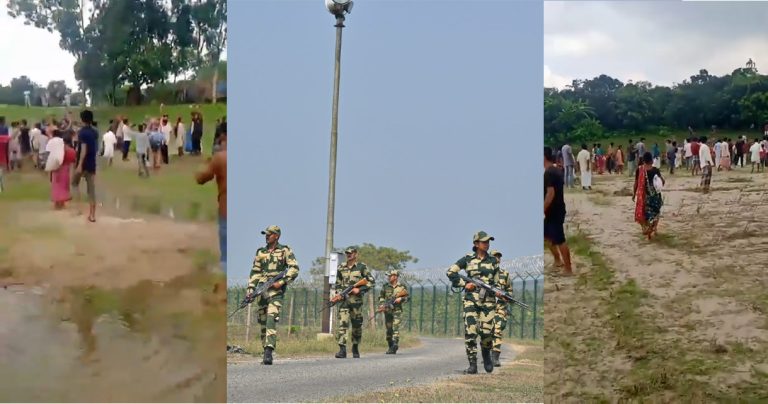
There have been reports of communal tensions in Nepal’s Sarlahi district as a Muslim mob disrupted the government’s development work. After the obstructors were forced away, they targeted Hindu homes in the Muslim-dominated area. Stones were pelted from the roof of Zahir Tailor. Other accused names include Nawazuddin, Jabir, Tariq, Imamul, and Ghulam. The majority of the afflicted Hindus belong to the Scheduled Caste (SC) category in India.

Hindu organisations were outraged over the incident, accusing the administration of protecting the violent Muslims and scheming to suppress the issue.

This incident occurred in Godaita Bazaar, Sarlahi District, Nepal. On Tuesday, 25th June 2024, a road approved by the Nepal government was under construction in Ward 8. It has been alleged that during this time, some Muslim people arrived. They intimidated the contractor and labourers, demanding that they stop doing the work. Reports say that the Muslim side did not have any official documents or land in possession at the location where they wanted to halt the work.

After some time, tensions arose between the two clashing sides and labourers were also threatened. Notwithstanding their antics, the contractor refused to halt the work. According to reports, both parties engaged in abuse and scuffles at the time. Eventually, people banded together and drove away the Muslim mob that had come to disrupt the work. Meanwhile, the local administration was also alerted about the situation. The ‘Hindu Samrat Sena’ claims that the Nepali administration, driven by appeasement politics, failed to take any serious action against those who went to disrupt government work.

The Muslim mob became enraged after failing to halt the work. The mob reached Sarlahi’s Muslim-majority areas including Paswan Tola. It is claimed that after arriving here, the Muslim mob directed its rage onto innocent Hindus who had nothing to do with delaying or carrying out the government’s road construction work. The mob chanted inflammatory slogans and hurled stones at Hindu houses. For some time, the affected Hindus were unable to comprehend the cause of the attack. The majority of the Hindus who were attacked belonged to castes identified as Dalits in India.

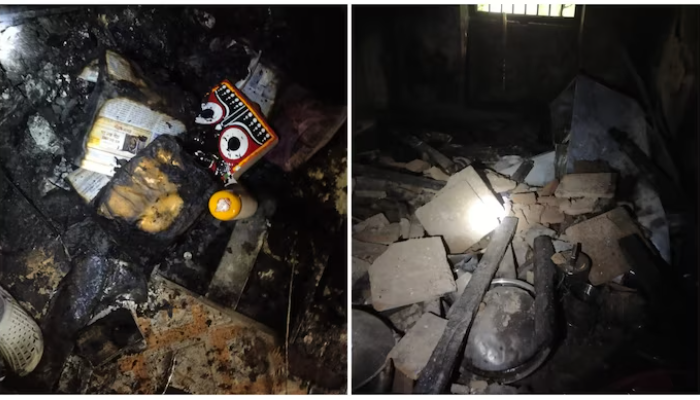
The thatched roofs of the Hindu community’s kutcha homes were destroyed during this sudden onslaught. Several bikes were vandalised. In a viral video, a man named Vinod is heard lamenting that his house was damaged despite not having any involvement in the matter. While some people have described this as a personal conflict rather than a communal dispute, the victim Vinod, denies these claims. Vinod asked, “Did we abuse or insult anyone? So why was our house targeted? The Hindus who were attacked include Vinod Mahato, Jai Kishore Mahato, Chander Das, and Rajendra Das, as well as their families.

This stone pelting occurred from the roof of Zahir who lives in Sarlahi and works as a tailor. The names of the other assailants are Nawazuddin, Jabir, Tariq, Imamul, and Ghulam. According to eyewitnesses, dozens of individuals pelted stones on his roof. In this video, the victim Vinod describes how he was injured in the unexpected stone pelting but managed to save himself. Allegedly, the attackers also broke down the gas cylinders. Those attacked on the 25th June claimed that the victims were Hindus while the attackers belonged to the Muslim community. The person asking the question took the name of a driver about whom the victim Vinod did not know.

A “Hindu Samrat Sena” official informed OpIndia about this incident. We were told that this incident would not have occurred if the administration had taken stricter action against people who were obstructing government development projects in Nepal. He claimed that the present communist government’s Muslim appeasement tactics are to blame for the ongoing attacks on Hindus in Nepal. Rajesh Yadav asserted that no action has been taken against individuals who pelted stones at Hindu houses. The ‘Hindu Samrat Sena’ also sought security for Hindus living in Muslim-dominated areas.

Rahul Gandhi’s rant against Hindus, lies on Agniveer and other comments expunged: Here is how he lied brazenly

Hours after Rahul Gandhi made communally divisive comments about the Hindu community, misled the nation about the Agniveer scheme and peddled lies about the Modi government in the Parliament, the Speaker expunged some of his comments on Monday (1st July).

As per reports, the expunged remarks of the Congress scion from the Parliamentary proceedings include falsehoods about BJP treating minorities unfairly, fearmongering about the NEET exam and Agniveer scheme and vicious targeting of businessmen Gautam Adani and Mukesh Ambani.

On Monday (1st July), Congress scion Rahul Gandhi alleged that the Agniveer scheme was not meant for the Indian army but for the Prime Minister’s Office (PMO). During his 1.5-hour-long speech on the Motion of Thanks on the President’s Address, he also claimed that Agniveers are not eligible for death benefits.

Rahul Gandhi, who is now the leader of the Opposition, had claimed that the Modi government treated Agniveers as ‘use and throw labourers’ and did not provide the status of a shaheed (martyr) on being killed in action.

“That house will not get pension and compensation (death benefits),” he alleged. However, as usual, the claims of the Congress scion are not rooted in truth.

Under the Agniveer scheme [pdf], a jawan is entitled to a one-time ex gratia payment of ₹44 lakhs, besides an insurance cover of ₹48 lakhs. His family will also receive full pay for the period unserved up to 4 years, including the Seva Nidhi fund (interest + contribution made by the government).

Screengrab of the Agniveer scheme death benefits

In case a jawan dies in service while not on duty, he will receive insurance cover of ₹48 lakhs and the amount accumulated in the Seva Nidhi fund (interest + government contribution).

During the debate in Parliament, Defence Minister Rajnath Singh had objected, “I would request the Leader of the Parliament to not mislead the nation by making false statements.” However, Rahul Gandhi kept on insisting that he was speaking the truth.

Times Now Navbharat reached out to the family of an Agniveer, who was martyred in Siachen. His father confirmed that he has received a compensation of ₹1,10,00,000.

Rahul Gandhi targets Hindu community

During his speech in the Parliament, Rahul Gandhi made communally divisive remarks against the Hindu community.

He claimed that those who called themselves Hindus only talked about violence, hatred, and untruth, triggering PM Modi to intervene over his remarks.

“All our great men have spoken about non-violence and eliminating fear… But those who call themselves Hindu only talk about violence, hatred, untruth…” Rahul Gandhi was heard saying.

His hateful remarks forced Prime Minister Narendra Modi to intervene, who said, “Calling the entire Hindu community violent is a very serious matter.”

Following a heated exchange between the Opposition and the ruling NDA’s MPs, Union Minister Amit Shah called for an apology from Rahul Gandhi.

Congress scion fearmongers about NEET

Rahul Gandhi also did not leave any stone unturned to spread canards about the National Eligibility cum Entrance Test (NEET), an exam which is required to secure admission to medical school.

Amid the ongoing controversy, the Congress scion claimed, “NEET students spend years and years preparing for their exam. Their family supports them financially and emotionally. And the truth is NEET students now do not believe in the exam.”

He further alleged, “Because they are convinced that the exam is designed for rich people, not meritorious people.”

“I have met NEET students and ever single one of them tells me that the exam is designed to create a quota for rich people and create a passage for them to the system and is not designed to help poor students,” Rahul Gandhi brazened out.

Majority will become minority if religious conversions continue: What Allahabad HC said, slamming Christian congregations meant to convert poor Hindus, especially SC/ST

On 1st July, while denying bail to one Kailash, the Allahabad High Court issued a stark warning suggesting that if the current trend of religious conversions during congregations continues without any intervention, the majority population of India could find itself in the minority. Kailash was accused of taking villagers from Hamirpur to a religious gathering in Delhi, where they were allegedly converted to Christianity under false promises of medical treatment.

He is facing charges under Section 365 of the Indian Penal Code (IPC) and Section Sections 3/5(1) of the U.P. Prohibition of Unlawful Conversion of Religion Act, 2021. The observation was made by a single-judge bench led by Justice Rohit Ranjan Agarwal. OpIndia accessed copy of the judgment.

Details of the case against accused

As per the court documents, complainant Ramkali Prajapati’s brother Ramphal was taken by Kailash from Hamirpur to Delhi to attend a social gathering and ceremony of well-being. Several people from the village were taken to the event where they were converted to Christianity. Kailash had promised Ramkali that her brother, who is suffering from mental illness, would be treated and would return within a week. When Ramphal did not come back after a week, she asked Kailash about her brother but did not get a satisfactory answer after which she filed a complaint against Kailash.

Applicant’s counsel claimed Ramphal was never converted to Christianity and Kailash had nothing to do with the event. He accused Sonu Paster of holding those gatherings who are out on bail. However, the court found that the allegations against the accused were serious enough to deny bail. Notably, statements from various individuals indicated he was actively involved in taking people to such gatherings for conversion purposes.

During the hearing, the Additional Advocate General appearing for the State submitted that by holding such gatherings, many were being converted to Christianity by these persons who were being paid huge money. Further, he has invited the attention of this Court to the various statements of witnesses, wherein it has been stated that the applicant – Kailash had been taking away people from the village for converting them to Christianity, and for this act, he was being paid huge money.

‘If conversions continue, majority population will become minority’

The High Court emphasised that there is a need to immediately halt religious congregations where conversions take place. Justice Agarwal said, “If this process is allowed to be carried out, the majority population of this country would be in minority one day, and such religious congregation should be immediately stopped where the conversion is taking place and changing the religion of citizen of India.”

The court differentiated propagation and conversion.

Justice Agarwal highlighted the constitutional mandate and noted that Article 25 of the Constitution of India guarantees freedom of conscience and the right to freely profess, practice, and propagate religion. However, it does not extend to the conversion of individuals from one faith to another. The court suggested that the term “propagation” implies promoting one’s religion and not converting others.

Rampant conversions in Uttar Pradesh highlighted by High Court

The court further highlighted that there is a worrying trend of unlawful conversions particularly targeting individuals from Scheduled Castes (SC), Scheduled Tribes (ST), and economically disadvantaged backgrounds, occurring at a rapid pace across Uttar Pradesh. The court said, “It has come into notice of this Court in several cases that unlawful activity of conversion of people of SC/ST castes and other castes including economically poor persons into Christianity is being done at rampant pace throughout the State of Uttar Pradesh.” Though the court said religious propagation is allowed, forced conversions undermine the very fabric of India’s constitutional freedoms.

Kenya: 39 killed, over 360 injured in anti-govt protests against new tax hikes, Human Rights Commission says hundreds have been arrested

0

At least 39 people have lost their lives in recent anti-government protests in Kenya against the new tax hike, reported Al Jazeera, citing the national rights watchdog.

The activists have geared up for a new round of protests this week in Kenya.

The Kenya National Commission on Human Rights (KNCHR) announced the toll on Monday, which is almost double the figure previously disclosed by the government for those killed while demonstrating against a raft of unpopular tax increases that have now been withdrawn.

KNCHR records further indicated that 39 people have died and 361 have been injured “in relation to the protests countrywide”, the state-funded body said in a statement, adding that the figures covered the period from June 18 to July 1, reported Al Jazeera.

It further stated that there had been 32 cases of “enforced or involuntary disappearances” and 627 arrests of protesters.

Moreover, largely peaceful anti-tax rallies, led by mostly young Gen-Z protesters, descended into shocking scenes of deadly violence last Tuesday when lawmakers passed the contentious legislation.

Later, following the announcement of the vote, crowds ransacked the parliament complex in central Nairobi and it was partly set ablaze as police fired live bullets at protesters, as reported by Al Jazeera.

Notably, it is the most serious crisis to be confronted by the government of President William Ruto since he took office in September 2022 following a deeply divisive election in a nation often considered a beacon of stability in a turbulent region.

Ruto, in a televised interview on Sunday, said that 19 people had died in the protests, but insisted that he did not have “blood on my hands” and pledged an investigation into the deaths.

The KNCHR “continues to condemn in the strongest terms possible the unwarranted violence and force that was inflicted on protesters, medical personnel, lawyers, journalists and on safe spaces such as churches, medical emergency centres and ambulances,” the rights body said.

“We maintain that the force used against the protesters was excessive and disproportionate,” it added.

The watchdog also said that it “strongly condemns the violent and shocking acts of lawlessness that were exhibited by some of the protesters” including the parliament and other government buildings.

Moreover, fresh protests have been called by activists beginning Tuesday despite last week, when Ruto announced that he would not sign into law the bill containing the tax hikes.

Additionally, leaflets have been posted on social media with the hashtags “Occupy Everywhere”, “Ruto must go” and “Reject Budgeted Corruption”.

India has also issued an advisory for its nationals in Kenya, as protests against a tax hike turned violent, causing a rampage in the African nation.

The Indian Embassy in Kenya earlier advised the Indian nationals there to “exercise utmost caution, restrict non-essential movement and avoid the areas affected by the protests and violence till the situation clears up.”

“In view of the prevailing tense situation, all Indians in Kenya are advised to exercise utmost caution, restrict non-essential movement and avoid the areas affected by the protests and violence till the situation clears up,” the Embassy stated.

(This news report is published from a syndicated feed. Except for the headline, the content has not been written or edited by OpIndia staff)

As Rahul Gandhi equates Hinduism with Ahimsa, time to remember why Hindus must not fall for ‘another Gandhi’

Calling it as one sees it is a burden that some bear. While it is often branded a virtue, for me, it has been a physiological reflex, often, much to my detriment. It is almost as if I am simply incapable of shutting up, even when shutting up would certainly have its rewards. One subject that I have, yet again, refused to shut up about and invited the anger of many fellow Hindus, is the merciless defanging of the Hindu community by Mohandas Karamchand Gandhi.

I genuinely and truly believe that the bane of the Hindu community was internalising the lessons of misplaced Ahimsa, predominantly spoon-fed by Mohandas Karamchand Gandhi – a man who was ‘christened’, quite literally, as a messiah. The internalised guilt inflicted on the community even when it wanted to defend itself crippled us for generations and to date, we pay the price for trading our right to survival for brotherhood – a sentiment that is delicately nursed by carefully inculcated delusions.

I have, of course, been conferred with several not-so-flattering titles for the views I hold on the issue. In fact, I have often had arguments with my colleague Rahul Roushan on the subject as well. While I believe MK Gandhi was the Hindu community’s undoing, Rahul seems to be far more forgiving. He has repeatedly asserted that he forgives MK Gandhi for his shenanigans because he was a practicing Hindu and was not Hinduphobic – like Nehru, for example. While I insist that MK Gandhi and the ideals he professed must be torn down and dethroned, Rahul believes that Hindus gain nothing by demonising Gandhi and is willing to let him have the throne along with others who perhaps deserve the pedestal.

I had just about moved on from MK Gandhi and started to shift my focus to Dr BR Ambedkar when I heard another ‘Gandhi’ trying the same tricks that MK Gandhi employed, only in a far more sinister manner.

Rahul Gandhi in the parliament said, “Modi ji said once that India has never attacked any other country. There is a reason for that. Because this country is a country of Ahimsa (non-violence), this country is not a country of fear. So all our great personalities spoke about Ahimsa, spoke about removing fear… daro mat, darao mat… and on the other hand, Shiv ji says daro mat, darao mat, shows the Abhay Mudra, talks about Ahimsa and buries his Trishul on the ground. And the people who call themselves Hindus talk about violence, hate and lies 24 hours. You are not a Hindu. In Hinduism, it is clearly mentioned that one should stand with the truth…”. After this, Rahul Gandhi randomly held out his hand to show the Abhay Mudra (essentially, claiming that it was the Congress hand symbol).

Now, we know this rant by Rahul Gandhi is insidious. We know it is sinister. But my reaction to Rahul Gandhi’s rant this time was far more circumspect. I found myself not dismissing him as a blithering fool, but instead, trying to put his speech in context – historical and contemporary.

For those who support PM Modi politically, their immediate reaction would be to say that Rahul Gandhi insulted the entire Hindu community by claiming that Hindus only talk about violence and hate. Of course, this is the simplest interpretation of what he said. I, however, believe there is more to it.

There are two specific components to what Rahul Gandhi said in the parliament. First, Hinduism’s core tenet is that of non-violence. The other is that Modi does not represent all Hindus – this he said after PM Modi made a rare intervention saying that Rahul Gandhi’s characterisation of all Hindus as a people who espouse violence is a serious matter.

Both these components were meant to specifically cater to disgruntled Modi supporters and the young voter – who is fed the “Sabarmati ke sant” delusion as a matter of state policy. As for the second component, I believe it is meant to specifically cater to the ‘disgruntled Hindu voter’ – a segment that has started to look beyond PM Modi for a resolution to Hindu issues. This disgruntled voter believes that the political support base has started hyphenating PM Modi and Hindu issues, often sacrificing the latter for the interest of the former. For both these segments, it is essential to see through the sinister, British-esque designs of Rahul Gandhi.

Ahimsa – a central tenet of Hinduism?

One of the first instances when Hindus were defanged by the British was with the passage of The Indian Arms Act 1878. Right after the revolt of 1857, the British, petrified of another armed resistance to their occupations, passed a law that barred Indians from carrying firearms without a license. The British understood that their best chance to continue their occupation of Bharat was through the de-arming and de-fanging of Hindus.

The de-arming and neutering of Hindus to ensure minimum resistance to their own subjugation became a template – followed not only by the British and MK Gandhi but continued to this day by the party created by the British – the Congress party.

Rahul Gandhi, quite confidently, spoke about Ahimsa being the central tenet of Sanatan Dharma – as if those who pick up weapons to defend themselves and/or the community are committing a cardinal sin. One can’t possibly blame him for his narrow view of Sanatan Dharma, given his Christian mother must have imparted the hollow punchlines that come with religious moral science lectures in Catholic schools as the gospel truth – at least theoretically, which is never followed by the faithful but prove as a great tool for religious brainwashing by inculcating a false sense of moral superiority. Sanatan Dharma has an illustrious history and the Kshatra tradition which revolves around the destruction of evil and is far from the neutered, comatose version of Hinduism that Congress wants to peddle for their own political gains.

One of the primary root words of Kshatra is ‘himsayam’ which relates to the Kshatra’s duty to destroy evil. The etymological explanation of the word Kshatra is, in itself, “one who protects from harm and injury”, the fundamental quality of the Kshatra being to protect Dharma and therefore, the Kshatra-guna itself is related to protection – by force – if necessary.

The pacifists, who follow the path shown by MK Gandhi, often feel squeamish because they believe the Kshatra-guna relates to the promotion of violence, however, that is, again, only a result of the historical brainwashing – a political project to knock Hindus down and keep them there so the pliable community can accept their own subjugation without putting up a fight.

It is, therefore, said that “without the element of protection, Matsya-Nyaya (big fish eat little fish) would prevail”. It is the eternal Sanatan wisdom that says that if there has to be order, there has to be punishment and only if there is punishment, will order emerge. KamandakiyaNitisara, in fact, opens with the praise of the King who holds the sceptre to mete out punishment to maintain order.

In the book Ksattra, the authors write, “Among the Vedas, the Rig-veda has been associated with Brahmanas, Yajur-veda with Kṣattriyas, and Sama-veda with Vaisyas. The Yajur-veda has been hailed as an action-oriented, ritual-intensive Veda; while Rig-veda is more aligned to prayer, Sama-veda is aligned to worship, and Atharva-veda forms a bridge between the physical and the spiritual.

Yajur-veda is a symbol of kṣättra, of the protection of the good, and of destruction of enemies. The upa-veda associated with Yajur-veda is Artha-Veda (or Dhanur-veda). While explaining a mantra, the commentator Mahīdāsa says, “Dhanur-veda (archery) is the science of war.”

Through the Dhanur-veda we see the entire system of war. Yajñas like Rajasuya, Sautramani, Vajapeya, and Aśva- medha that are described in the Yajur-veda are famous as kṣāttra-yajñas. The Vajapeya-Yaga is for preparing various units of the army in order to reclaim lost land. The Sautrāmani-Yaga is for bringing allies together. The Rajasuya-yaga is conducted when an emperor is born or created. The Aśva-medha is for expanding the kingdom and establishing sovereign status over a large portion of land. We see unbridled kṣättra in all these yajñas.

There are elements of kṣättra even in the traditional practices related to worship and invoking the Supreme. The unfortunate situation today is that a worship of cowardice has entered military science. We have infused our military with a narrow, ritualistic mindset, thus sapping bravery and energy. However, our Vedic rşis brought an element of kṣättra even in worship and ritual”.

It is, therefore, evident that Sanatan has a strong, illustrious tradition of Kshatra – where force and punishment are used to restore Dharma, protect the weak, and defend the ideals we hold dear. Nowhere in the Yajur-Veda, or any Veda, is Ahimsa in its bastardized, Gandhi version mentioned – it is only an illusion, a grand lie, sold to Hindus to ensure they remain guilty, neutered, and defenceless.

What betrays the Janeudhari version of himself which Rahul Gandhi projects, is his absolute infantile interpretation of Shiva. To allude that Mahadev buried his Trishul because he believed in Gandhi’s Ahimsa is not just infantile but asinine. Mahadev, is quite literally, the God of Destruction and anyone who is a practicing Hindu would certainly not propagate that he destroys with Ahimsa. The Shivlinga itself is a manifestation of Raudra. His Avatars, like Kaal Bhairav, represent the annihilation of time and preservation of the universe – a symbol of fearlessness, the guardian of Temples, the destroyer of enemies and evil spirits. Of course, there is spiritual symbolism of the Trishul which represents the Nadis, levels of consciousness, and more, however, Rahul Gandhi’s reductionist interpretation of Shiva and his Trishul to talk about some binary of Gandhi-esque pacifism is so outlandish that one has to wonder how someone so oblivious of Sanatan Dharma can even have the confidence to talk about the tenets of the faith.

In his supreme confidence, which is, unfortunately, the hallmark of the unlettered, Rahul Gandhi wanted to present Sanatan Dharma as some sort of a hippy cult where its participants are high on some form of hallucinogens, lying around in their comatose stupor, talking about universal peace. In reality, Sanatan has a long tradition of Akharas where community defence was one of the fulcrums of collective survival.

Yes, Sanatan Dharma guides every shade and stage of existence. From prosperity to happiness, satisfaction, love, peace – inner and community, punya, karma, moksha, and more – however – it does not look down upon self and community defence, it does not glamourise pacifism and cowardice – in fact – it draws lessons from wars fought for the preservation of Dharma and honour.

Non-violence: An age-old political project to keep Hindus neutered and subjugated

I believe the very existence of the Hindu community hinges on one simple question – Do we wish to emulate MK Gandhi or Gopal Patha – in the face of aggression and violence?

In 1946, the massacre of Hindus in Bengal was rather intricately planned. Jinnah is recalled having said that he would either have India divided or India burnt and that he had given up on Constitutional methods to demand the creation of Pakistan. Jinnah had chosen the 16th of August as Direction Action Day because it was the 18th day of Ramzan, the day when the Battle of Badr was fought and won – a war fought by Prophet Muhammad himself, against the Kaffirs, and is considered to be won by Allah’s divine intervention by Muslims. The battle led to the violent occupation of Mecca. 

On the 16th of August, Calcutta was littered with posters lionizing Jinnah and reminding Muslims that they had to follow the footsteps of the Prophet. It is reported that Syed Muhammad Usman, mayor of Calcutta, had issued a widely circulated leaflet that said: Kafer! Toder dhongsher aar deri nei! Sarbik hotyakando ghotbei! (Infidels! Your end is not far away! You will be massacred!). The aim was to make Bengal ‘land of the pure’ and rid it of the Kaffirs (Hindus). The aim was to wage another Battle of Badr, in which the Muslims would conquer the heathens. 

What followed on the 16th right after the Jumma Namaz is Muslims going on a rampage, beheading Hindus, chopping their limbs off, and raping Hindu women. Several women were taken as sex slaves by those who were fighting with the religious fervour of the Battle of Badr. In the Kesoram Cotton Mills at Lichubagan in the Muslim-dominated Metiabruz area, Muslim mobs entered and beheaded over 600 labourers. The Hindus, neutered and asked by Gandhi to die with a smile on their face hardly fought back. There was a mass exodus from Bengal that marked millions fleeing because the massacre seemed too brutal to fight against. 

During the Direct Action Day, on the 17th of August after 2 days of Hindus being massacred, Gopal Chandra Mukhopadhyay rose like a phoenix. Gopal Patha (Patha means ‘lamb’. He was called so because he ran a mutton shop) had already founded the Bharat Jatiya Bahini, an organization of young men to help fellow citizens during a natural calamity. On the 17th, Gopal Patha turned from a philanthropist to a warrior, ready to defend his people. Throughout the night, Gopal Patha, along with his young men from the Bharat Jayati Bahini worked on a plan on how they could defend Hindus from the Muslim barbarians. The Marwaris offered finances, others spent the night making weapons for them. 

Muslim League chief minister of Bengal, Huseyn Shaheed Suhrawardy, and the Muslim League goons had decided on the 17th that they were going to take two more days to complete the annihilation of Hindus. But they had not taken into consideration their greatest roadblock. Gopal Patha. 

From the 18th to the 20th, Gopal Patha and his men put up a brave fight, paying the Muslim League goons back in equal measure, if not more. Historian Sandip Bandopadhyay wrote, “They faced resistance everywhere. Hindu youths counter-attacked with such ferocity that the Muslim League men had to flee. Many were killed. Emboldened by their success in taking on and defeating their Islamist attackers, Hindu youths took the fight to Muslim-majority areas and started killing Islamist men. They did not, however, touch Muslim women and children or the aged and the infirm”.

During the Noakhali riots, countless Hindus were raped and murdered. The converted Hindus were made to write declarations that they had accepted Islam out of their free will and Hindus in the 2000 square mile area were made to pay the Jaziya. When MK Gandhi visited Naokhali, he was rebuked by the Muslim League and after that, he travelled to Bihar to stop the retaliatory violence by the Hindus. There, he is famed to have said that Hindus must leave Noakhali or die – this, because the Muslim League had asked him to quell the violence, the same Muslim League that was raping Hindu women, beheading Hindu women, and waging a war against Kaffirs. 

MK Gandhi famously asked Gopal Patha to lay his weapons down and surrender. Gopal Patha refused. He refused to give into Gandhi’s pacifism to appease the murderous Jihadis. He refused to give into the delusion that surrendering, being cowardly, and dying with a smile on his face was a virtue. Gopal Patha upheld the tenets of Sanatan Dharma – he preserved Dharma. He protected Dharma. He protected Hindus. He did not give up.

In fact, while MK Gandhi wanted Gopal Patha to lay down his weapons, in the same year in a prayer meeting, he advised the women in East Bengal to commit suicide by poison or some other means to avoid dishonour. He told the women to suffocate themselves or to bite their tongues to end their lives.

In 1921, while the Malabar Muslims were slaughtering Hindus, raping women and forcefully converting Hindus, Mohandas Karamchand Gandhi insisted that they had committed a sin against the “Khilafat movement” and not the Hindus. In fact, he went ahead and insisted that Hindus must remain “non-violent” in the face of “extreme provocation”.

While Hindus and Sikhs were being massacred and raped in Pakistan right after the partition, MK Gandhi said, “Hindus and Sikhs should become brave and show that even if all the Hindus and Sikhs in Pakistan were to be killed there would be no retaliation in India. I do not want to live to see our people copy Pakistan. If I am to live I shall ask every Hindu and every Sikh not to touch a single Muslim. It is cowardice to kill Muslims and we must become brave and not cowards”.

On April 6, 1947, Mr. Mohandas Karamchand Gandhi said– “If Muslims want to kill us (Hindus), we must face death bravely. Hindus should not harbour anger in their hearts against Muslims even if the latter wanted to destroy them. If they established their rule after killing Hindus we would be ushering in a new world by sacrificing our (Hindu) lives”. 

There was, indeed, a running theme in what Mohandas Karamchand Gandhi told Hindus. He repeatedly told Hindus that their faith taught them to surrender to evil, murderous mobs who were raping, beheading, murdering, and dishonouring them. He repeatedly told Hindus that his pacifism was a manifestation of the very essence of Sanatan Dharma and if Hindus so much as dared to defend themselves, they would be going against the tenets of their faith.

MK Gandhi told Hindus that cowardice was in fact bravery and bravery was betrayal. He truly and genuinely wanted Hindus to believe that by being cowardly and surrendering to evil unquestioningly, Hindus would be doing the greatest service to this land with Hindu consciousness because that is what Hinduism stood for.

This glorification of cowardice as a virtue, only for Hindus, was diligently furthered as a political project. It was, and still is, accepted wisdom that as long as Hindus are kept under the spell of Ahimsa, the community would give up their bargaining power with the state. For the ultimate retention of political power, it is no secret that the most violent, the most demanding, and the most petulant community has to be kept in good humour. When they get offended, and go on a murderous rampage after Hindus respond with Rangeela Rasool to books insulting Hindus, they need to be kept in good humour by the passage of a special law. When they want to establish a Caliphate in Turkey, they need to be pacified with unquestioning surrender by the Hindu community, willing to be beheaded with a smile on their face.

Rahul Gandhi today did exactly what the political class has done for centuries – twist Sanatan Dharma to convince Hindus that their cowardice is considered a virtue and if they are TRUE Hindus, they would surrender, give in – and die with a smile on their face. It is this political project that leads to the demonisation of Hindutva, the vilification of Raudra Hanuman, the angst at Bhagwan Ram with a bow and arrow, the screaming, screeching uproar at the Ayodhya movement, the aversion to the Ram Temple, the anger at the demystification of history and the unadulterated hate against Hindu organizations – all of it remind Hindus that they are a warrior race, not a herd of sheep who should be led to their slaughter.

Ahimsa, essentially, is doing everything to stop Himsa. Ahimsa is not the absence of Himsa, but the use of Sam, Dam, Danda, and Bhed to achieve peace.

We could see Rahul Gandhi’s speech today in the parliament as just another Hinduphobic rant. Or we could see it for what it was – an attempt to keep the Hindu community ashamed and guilty. India has suffered the consequences of the apotheosis of one Gandhi – we certainly cannot afford another blunder.

US Supreme Court upholds limited immunity for Trump, potentially delaying Jan 6 Capitol attack trial

0

The US Supreme Court on Monday ruled that former President Donald Trump can assert limited immunity from criminal prosecution for actions taken during the final days of his presidency. This ruling is expected to further postpone a trial regarding federal charges of election subversion against him, CNN reported.

The case, widely anticipated as one of the most significant this year, overturned a federal appeals court’s February ruling that denied Trump immunity for alleged crimes aimed at overturning the 2020 election results. Special counsel Jack Smith had strongly advocated for preventing Trump from delaying legal proceedings, a cornerstone of the former president’s legal defence strategy.

Trump, amidst multiple legal battles, while also positioning himself against President Joe Biden for a White House return, faced another setback in May when he became the first former US president convicted of a felony in a hush money trial, according to CNN.

Simultaneously, the Supreme Court is deliberating on cases about First Amendment rights and social media regulations.

Recent polling indicates widespread scepticism towards the Supreme Court’s handling of Trump’s immunity claims.

An AP-NORC poll released last week highlighted a significant lack of public confidence in the institution, with only 16 per cent expressing a great deal of trust in the Supreme Court. A substantial 44 per cent reported having only some confidence, while 40 per cent indicated having hardly any confidence at all. Democrats, in particular, displayed significant distrust, with 58 per cent stating they had hardly any confidence in the Supreme Court.

Regarding specific issues, approximately two-thirds of US adults expressed scepticism about the Court’s approach to presidential powers and immunity (66 per cent), as well as elections and voting matters (63 per cent). Similar levels of doubt were observed on other contentious issues such as abortion and gun policies, as reported by CNN.

A staggering 70 per cent of respondents believed that Supreme Court justices are inclined to shape laws according to their ideological leanings, while only 28 per cent believed they provide an impartial check on other branches of government, CNN reported.

In another survey conducted by Marquette Law School in May, public approval of the Supreme Court stood at a low 39 per cent, with 61 per cent disapproving of its performance. This dissatisfaction has persisted since the Court’s controversial 2022 Dobbs decision.

Public opinion remains sharply divided on the issue of presidential immunity from criminal prosecution. When asked specifically about Trump, 60 per cent of respondents opposed granting him immunity for official acts, compared to 30 per cent who supported it.

On the broader question of whether former presidents should enjoy immunity, 71 per cent believed they should not, with only 16 per cent in favour. Among Republicans specifically asked about Trump, a majority (61 per cent) supported immunity from criminal prosecution, CNN reported. (ANI)

(This news report is published from a syndicated feed. Except for the headline, the content has not been written or edited by OpIndia staff)

Christian youth sentenced to death in Pakistan for blasphemy, mob had attacked 20 Churches last year over the alleged blasphemy

0

An anti-terrorism court in Pakistan has issued a death sentence to a Christian youth, accusing him of sharing a social media post that allegedly sparked riots in Jaranwala (a city in Punjab’s Pakistan) in August last year, Dawn reported.

Dozens of Christian homes and around 20 churches were vandalised and ransacked by mobs in Jaranwala following allegations that a copy of the Holy Quran had been desecrated.

Judge Ziaullah Khan announced the verdict, also sentencing the young man to 22 years in prison and imposing a fine of (Pakistani currency) PKR 1 million, as per Dawn.

Punjab police had claimed last year that around 135 miscreants had been booked for the attacks on the minority community in Jaranwala.

But according to advocate Akmal Bhatti, chairman of the Minorities Alliance, most of the accused had either been discharged or freed on bail. Hardly 12 people are currently facing trials, he said.

The issue of blasphemy allegations in Pakistan is highly contentious and sensitive, often resulting in serious consequences such as violence and fatalities. False accusations of blasphemy are frequently employed to settle personal scores, target religious minorities, or incite communal unrest.

These allegations frequently trigger immediate public outrage and mob violence, placing the lives of the accused and their communities in jeopardy.

According to the Human Rights Commission of Pakistan (HRCP), there have been numerous instances of false blasphemy accusations over the years, disproportionately affecting minority communities like Christians and Ahmadi Muslims.

Several incidents have resulted in lethal violence against individuals accused of blasphemy or their communities. For instance, in 2014, a Christian couple in Kot Radha Kishan was lynched and burned alive following allegations of blasphemy. Similarly, in 2021, a Sri Lankan national faced a similar fate in Sialkot due to accusations of blasphemy.

Blasphemy cases in Pakistan often unfold in an environment of fear and intimidation, with insufficient legal safeguards for the accused.
International human rights organizations have repeatedly highlighted concerns about the misuse of blasphemy laws and the absence of due process in Pakistan.

Despite both international pressure and domestic advocacy, the Pakistani government has faced criticism for its failure to amend or repeal blasphemy laws. 

‘There is no mention of idol worship in Islam, nor is there any kind of mudra’: Muslim cleric rubbishes Rahul Gandhi’s ‘Abhaya Mudra’ in Islam remark

Syed Naseruddin Chishty, Chairman of All India Sufi Sajjadanashin Council, refuted controversial remarks made by Rahul Gandhi in the parliament on Monday. The Gandhi scion had tried to link ‘Abhaya Mudra’ seen in the images of Hindu gods and goddesses to the election symbol of his party and to all other religions, including Islam, which forbids idol-worshipping.

“Islam also says darna nahin hai (don’t be scared). When prayers are done in Islam, abhay-mudra is seen in both hands,” Gandhi said.

However, Gandhi’s comments did not sit well with Syed Naseruddin Chisty, who denounced his claims saying, “While speaking in the Parliament today, Rahul Gandhi has said ‘Abhaya Mudra’ is also there in Islam. There is no mention of idol worship in Islam, nor is there any kind of mudra. I refute it, there is no mention of ‘Abhaya Mudra’ in Islam and I believe that Rahul Gandhi should correct his statement.”

Rahul’s perverse attempt to link all religions to the Congress party’s symbol and forge a faux unity among different sections of society comes after months of divisive political campaigning, which included promising a caste census and redistribution of wealth based on population to exploit the existing faultlines, especially among the Hindu society where caste still holds dominance.

Gandhi’s disdain for the Hindu community was evident earlier today when he made a controversial remark that spurred a rare intervention from PM Modi and Union Home Minister Amit Shah, both of whom corrected the Gandhi scion for his sweeping proclamation that those who call themselves Hindus indulge in violence all the time.

During his speech, Rahul Gandhi, said, “All our great men have spoken about non-violence and eliminating fear… But those who call themselves Hindu only talk about violence, hatred, untruth…”

PM Modi raised serious objection to Rahul Gandhi’s comments saying, “Calling the entire Hindu community violent is a very serious matter.”

Following a heated exchange between the Opposition and the ruling NDA’s MPs, Union Minister Amit Shah called for an apology from Rahul Gandhi.

Union Minister Amit Shah criticised Rahul Gandhi’s comment, insisting on an apology.

“The Leader of the Opposition has clearly stated that those who identify as Hindu speak of and commit violence. He is unaware that millions proudly call themselves Hindu. Associating violence with any religion is wrong. He should apologize,” he stated.