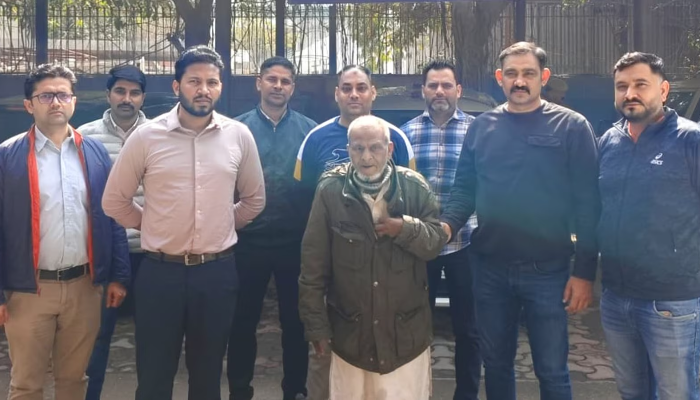
On 11th February (Wednesday), an occultist was taken into custody for killing two men and a woman by giving them poisoned laddus as part of a ceremony that promised them a windfall called “dhanvarsha.” The murder mystery is resolved with the arrest of Kamruddin, also known as Baba, who lived in Uttar Pradesh’s Firozabad, days after the bodies were discovered dead in a car on the Peeragarhi flyover of Outer Delhi.
Three people were found unconscious inside a white automobile in Peeragarhi, after which cops rushed to the scene and found out that they were dead. The trio was identified as Laxmi (40) and Shiv Naresh (42), who were in the back seat, while Randhir (76) was in the driver’s seat.
#WATCH | Delhi: As per Sachin Sharma, Additional DCP, Kamruddin alias 'Baba' has been arrested by Delhi Police in connection with the bodies of three people found in a car on Peeragarhi flyover.
“The case came to light on 8th February (Sunday) when a PCR (Police Control Room) call was received at Paschim Vihar East Police Station regarding three people, including a woman lying unconscious inside a car,” informed Deputy Commissioner of Police (Outer) Sachin Sharma.
“All three were shifted to Sanjay Gandhi Memorial Hospital, where doctors declared them brought dead. During inspection of the vehicle, police recovered liquor bottles, cold drink bottles, empty glasses, mobile phones, cash, helmets, jackets, Aadhaar Cards and other personal belongings and documents,” he stated.
How the case was solved
The authorities opened an investigation when the family members voiced scepticism about the deaths, even though they had ruled out suicide. The bodies showed no immediate indications of external damage either. Hence, the case was granted top priority for investigation.
Both Randhir and Shiv, real estate brokers from the Baprola area of Najafgarh, were acquainted, but their relatives expressed that they had never heard of Laxmi. On the other hand, her family provided the first hint to the police and conveyed that she was in contact with a “godman.”
According to a thorough technical examination that included location monitoring and call data records, Kamruddin had communicated with the deceased and had promised them cash benefits through rituals. The investigators uncovered that they had been to Loni in Ghaziabad just a day prior to the tragedy. They went back to the place on the day of their deaths and continued to communicate with the offender.
The police unearthed that a fourth person joined them as they were travelling back to Delhi. It subsequently emerged that this man was Kamruddin. They highlighted that he entered the car in Loni and then left it where the corpses were located.
The police uncovered that the three were driving back to Delhi and there was another person in the vehicle. “Further analysis established that the person was Kamruddin, who had boarded the vehicle in Loni and later abandoned it at the place where it was found,” Sharma added.
How victims were lured and murdered
Kamruddin was nabbed and interrogated. He made an initial effort to deceive investigators but was unable to deliver adequate responses. During further questioning, he confessed to having an accomplice named Salim who introduced him to Laxmi around two months ago. She later brought Randhir and Shiv Naresh to him.
Afterwards, he persuaded them to perform a rite for “Dhanvarsha” and requested that they set aside 2 lakh in cash for the ceremony, along with cold beverages and alcohol. Kamruddin then gave them poisoned sweets and took their cash.
“He prepared laddoos mixed with poison and accompanied the three in their car. During the journey, he persuaded them to consume liquor, cold drinks and sweets. After they started feeling unwell and eventually lost consciousness, he took the cash and fled, abandoning the vehicle,” Sharma outlined.
“He was apprehended following a detailed technical and field investigation. He was involved in a well-planned conspiracy to eliminate the victims and rob them of cash and valuables,” the official mentioned. The police stated that there is circumstantial and technical proof that he was in the car at the time.
Kamruddin’s dark past and more murder cases
According to police, the perpetrator ran an occult centre in both Loni and Firozabad. Their inquiry revealed that he had used rituals to entice unwary individuals in the name of unexpected cash gain. He would first win the trust of his victims, influence them and then kill them with poison put into laddus. Afterwards, he robbed them of their money and jewels. Police mentioned that he has a history of committing horrible acts and is a habitual offender.
“He lured people by making promises of quick money, claiming that he could multiply wealth through occult practices and tantric rituals. He projected himself as someone who could double or even triple money through tantrik methods,” revealed an officer.
The culprit had been involved in two murder cases. “He was earlier booked in 2014 under sections 143, 363 and 302 of the Indian Penal Code (IPC) at Raja Khera Police Station in Dholpur in Rajasthan. He was also named in another First Information Report (FIR) in 2025 under sections 103(1) and 123 of the Bharatiya Nyaya Sanhita (BNS) at Makhkhanpur Police Station in Firozabad in Uttar Pradesh,” Sharma underscored and remarked, “We are now examining whether he may have targeted others using similar tactics.”
A case has been filed by the police at the Paschim Vihar East Police Station, and an additional probe is underway to find any potential collaborators alongside forensic analysis to identify the precise nature of the poison. They conveyed that some of Kamruddin’s previous clients had either disappeared or passed away in dubious ways.
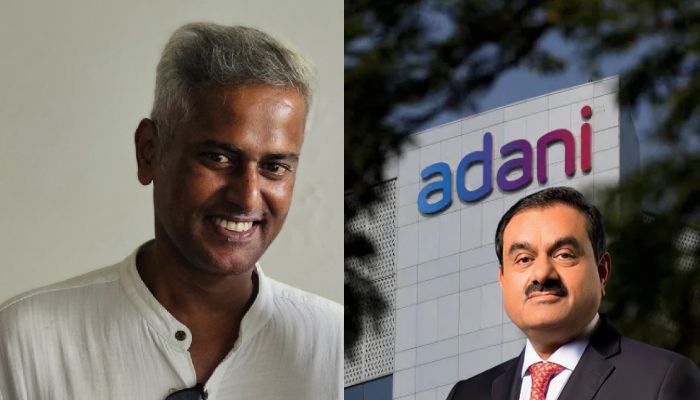
The Judicial Magistrate First Class Court in Gujarat’s Mansa convictedThe Wire columnist and OCCPR partner journalist Ravi Nair under Section 500 of the IPC in a criminal defamation case filed by Adani Enterprises Limited (AEL). In continuation of the practice of elevating accused or convicted liars, rioters, and terror enablers to the status of heroes and martyrs, the leftist cabal is hailing Ravi Nair a ‘martyr’ who has been ‘silenced’ for writing against Adani.
However, contrary to the victimhood narrative the leftist media is spinning, Ravi Nair was convicted for peddling lies against the Adani Group.
Ravi Nair peddled lies about Adani Enterprises: The allegations
The case arose from a complaint by Adani Enterprises, the flagship firm of the Adani Group, in 2021, which accused Ravi Nair of posting and circulating a series of tweets that the company said were false, malicious and damaging to its reputation. According to the company, the posts were aimed at eroding public trust and shaking investor confidence in the conglomerate.
Through its counsels S V Thakkar and K P Raichura, the AEL alleged that between October 2020 and July 2021, accused Ravi Nair published defamatory content, particularly a series of tweets against the complainant on his X handle @t_d_h-nair, in addition to articles published on the anti-Adani website “Adani Watch”.
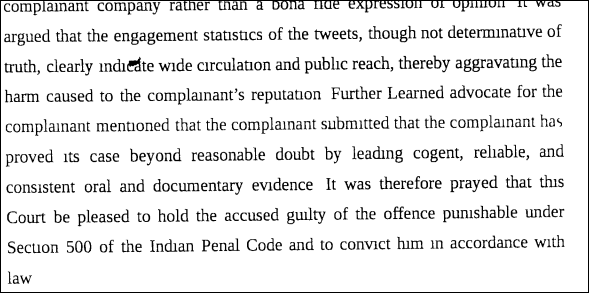
The AEL alleged that Ravi Nair breached the boundary of fair criticism or personal opinions to pass off “scandalous, false, misleadıng, derogatory, and defamatory content as ‘facts’. The complainant attached the details of the series of tweets Ravi Nair published against the Adani Group, along with their engagement statistics such as likes, retweets, and quote tweets.
The AEL argued that the narrative concocted by Nair through his tweets in question portrayed the Adani Group as “beneficiaries of undue political patronage, manipulators of laws and policies, and entities engaged in unethical, illegal, or improper business practices.”
It was further alleged that several tweets published by the accused suggest that environmental laws were “tweaked or diluted to facilitate Adani-backed projects, that public assets such as ports and airports were transferred to Adani entities through misuse of governmental agencies, and that the Adani Group enjoys preferential treatment from the Central Government.”
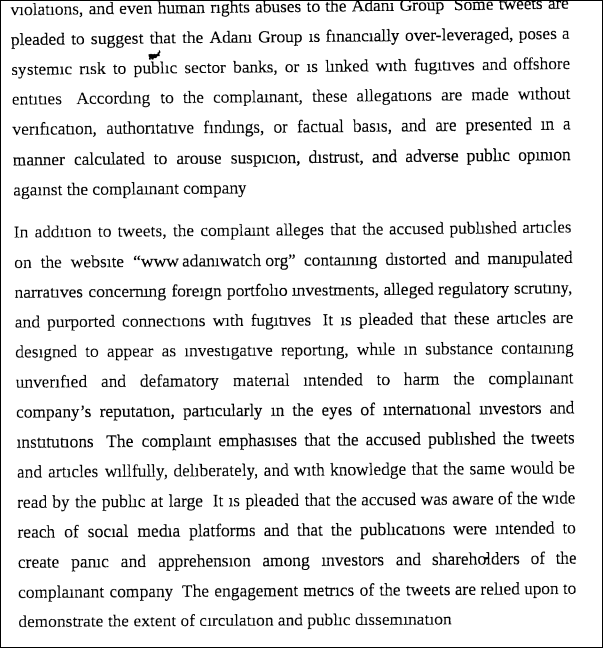
The Adani Enterprises also alleged that the content published by Nair suggested that the Adani Group was involved in corruption, coercive land acquisition, financial impropriety, regulatory violations, and even human rights abuses.
In addition to the tweets, the complainant also brought to the court’s attention the articles published by Ravi Nair in the website “www.adaniwatch.org”, alleging that under the garb of investigative reporting, these articles peddled “unverified and defamatory material intended to harm” the Adani Group’s reputation, particularly in the eyes of international investors and institutions.
The complainant further alleged that, despite claiming to be a journalist, Ravi Nair did not exercise due diligence or journalistic standards, and published defamatory material against AEL “willfully” and “deliberately”. It was further alleged by the complainant that the accused Ravi Nair neither sought to verify facts, rely on credible sources, nor sought clarification from Adani Enterprises.
Highlighting the continuity, frequency, and thematic consistency of the tweets published by Ravi Nair, the complainant alleged that Ravi Nair’s actions were a part of “a deliberate and coordinated campaign to malign the complainant company and the Adani Group.” The AEL contended that the actions of the accused ‘journalist’ resulted in serious injury to the reputation and goodwill of the Adani Group.
The complainant prayed before the court that the accused Ravi Nair be tried and, upon proof of guilt, be convicted for the offence punishable under Section 500 and/or other relevant provisions, the court deemed fit. The legal representatives of Adani Enterprises presented three witnesses and documentary evidence, including the tweets and articles they deemed defamatory.
Prosecution Witness number 2, Brijesh Sureshbhai Gosai, who works as a Deputy Manager in the Adani Group’s Corporate Communication Department, deposed that during his routine social media search for monitoring digital media, Gosai came across the tweets published by accused Ravi Nair about the Adani Group.
Gosai said that Nair’s tweet “falsely” claimed that only Gautam Adanı and Mukesh Ambani were the maın players in the CNG and LPG market, while in reality, there are several other major players like Torrent Gas in the CNG market.
The PW-2 opined that the tweet dated 7th October 2020, was “sarcastic, misleading and likely to adversely affect the reputation of the Adani Group in the minds of readers.”
About tweet number 54 dated 20th October 2020, Gosai said that it alleged that environmental laws were twisted or broken to facilitate the Adani Group projects; however, these allegations were “false, as environmental laws are equally applicable to the Adani Group and the general public, and the success of the Adani Group is due to its efficiency and quality.”
In addition, the PW-2 stated that the “Adani Watch” article was of a defamatory nature and did not specify which environmental laws were ‘violated’. About a tweet dated 15th January 2021, Gosai said that Ravi Nair claimed that there was misuse of government agencies in handıng over the management of Mumbai Airport to the Adanı Group.
Similar deposition was made by PW-3 Maheshkumar Dosabhaı Vadhare, who worked as a Production Coordınator in the Adanı Group from 2018 to 2021, thereafter as Deputy Manager from 2021 to 2025, and is presently working as an Associate Manager.
Arguments presented by the counsel of Ravi Nair
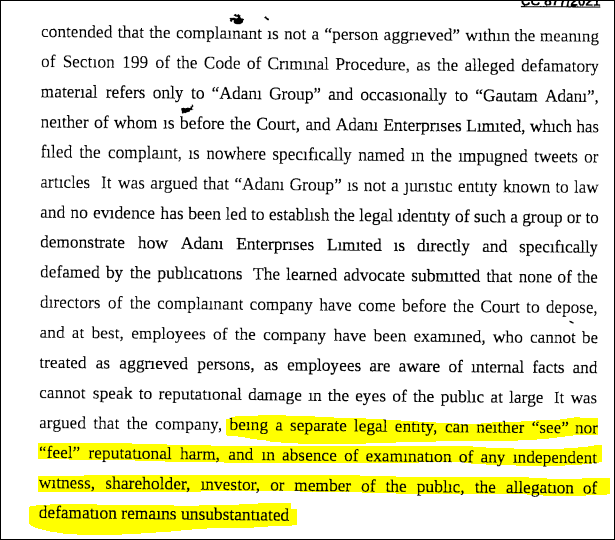
The advocate representing the leftist propagandist, disputed the maintainability of the defamation suit and contended that the complainant company was not a “person aggrieved” as the alleged defamatory material refers only to “Adani Group” and occasionally to “Gautam Adani”, “neither of whom is before the Court, and Adani Enterprises Limited, which has filed the complaint, is nowhere specifically named in the impugned tweets or articles.”
It was further contended that the authorisation relied upon by the complainant was “fundamentally defective”. The defence argued that no valid Board Resolution has been brought on record to show that the Board of Directors consented to the institution of the present complaint, and the alleged authorisation by the Company Secretary and Joint President (Legal) cannot substitute a decision of the Board as per the law.
The defence also raised a question over territorial jurisdiction, arguing that jurisdiction can arise only where the offence is committed or where its consequence ensues, and the prosecution has failed to establish either.
In addition, the defence argued that the very foundation of defamation is missing, as the prosecution has failed to demonstrate which exact part of the tweets constitutes a defamatory imputation. Further, it was submitted that the mere description of the tweets in question as “false” or “misleading” does not amount to defamation unless accompanied by intention or knowledge to harm reputation.”
The defence also argued that the complainant did not furnish any documentary evidence indicating that defendant Ravi Nair’s tweets caused a loss of reputation of the Adani Group in public, nor does it indicate that any of the Adani Group’s shareholders, investors, or third party was influenced or misled by the content in question. A similar argument was made in the context of Nair’s tweets affecting the foreign investors of the Adani Group.
The date of viewing of the allegedly defamatory content by the PW-1 was also disputed by the defence, which argued that no screenshots were contemporaneously taken, nor the links to articles referred to in the tweets examined, nor were the authors of those linked articles arraigned as accused, rendering the prosecution “selective and incomplete”. It must be noted that during cross-examination, PW-1 had admitted to not taking the screenshot of the content deemed defamatory by the prosecution.
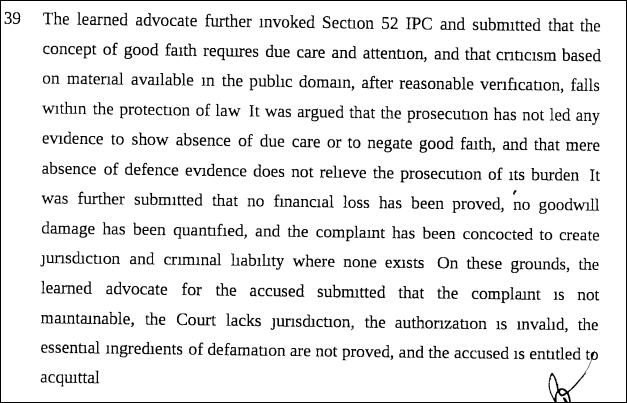
It was further contended that criticism based on material available in the public domain, after reasonable verification, falls within the protection of the law.
Further, the counsel representing Ravi Nair contended that the complainant has failed to establish beyond a reasonable doubt that the accused authored or published the tweets in question. The defence argued that just because the tweets appear on a particular Twitter handle, authorship cannot be presumed in criminal proceedings without strict proof.
Pertinently, the defence submitted that mere falsity or incorrectness of a statement does not amount to defamation, and that the prosecution witnesses have failed to read or reproduce the alleged defamatory statements accurately in their depositions. The defence accused the complainant of giving their own interpretations and conclusions.
On reputational or financial loss supposedly suffered by the complainant company, the defence argued that the AEL “failed to produce any material whatsoever to show that the tweets or articles caused any actual damage.”
It was also contended that the complainant produced no evidence of a decline in market capitalisation, loss of contracts, withdrawal of investments, or adverse regulatory action. In addition, the defence argued that bald assertions of reputational harm cannot sustain a conviction in the absence of corroborative material.
The defence also emphasised that Nair’s tweets were in “good faith” since they were based on “research done from articles”, and that since the authors of the articles deemed defamatory by the complainant are not implicated in the present case, the defendant should be the benefit and the complaint be dismissed.
Arguments presented by Adani Enterprises
The Adani Group’s advocate submitted that the argument of the Nair’s advocate rests on peripheral and circumstantial aspects such as the location of the complainant, the laptop allegedly used, or the absence of a hotel bill, whereas the complainant himself has categorically stated that when he came across the objectionable tweets he was at Mansa, and mere denial without any contrary evidence cannot dislodge the complainant’s version.
The AEL further contended that while the defence was deliberately diverting attention to share price fluctuations and absence of financial loss, “the injury caused by defamation is not limited to immediate economic loss but includes damage to goodwill and reputation, which cannot always be quantified monetarily or reflected instantly in market prices.”
During the proceedings, the territorial jurisdiction became an issue; however, the counsel appearing for the Adani Enterprises submitted that complainant and PW-1 Anshul Rajendraprasad Saini, came across Ravi Nair’s “defamatory” tweets on 27th July 2021 while he was at Navrang Hotel in Mansa, Gandhinagar in Gujarat, for company related work. At that time, Saini worked at the communication department of Adani Enterprises. He was authorised by the AEL to institute and prosecute the present complaint on the company’s behalf.
It was also argued that the defence’s contention about territorial jurisdiction was “wholly baseless”, as merely questioning the absence of a hotel bill cannot negate the complainant’s sworn testimony.
The AEL advocate submitted that PW-1 deposed that he accessed and read Ravi Nair’s “defamatory” tweets against the Adani Group when he was at a hotel in Mansa while on official work. Thus, under Section 179 of the Code of Criminal Procedure, jurisdiction is attracted at the place where the consequence of the offence ensues, and in cases of defamation through electronic publication, the consequence ensues where the defamatory material is read and reputational injury is caused.
It was also emphasised that the accused has not disputed authorship of the tweets posted from his Twitter handle @t_d_h_nar and that the defence has merely raised technical objections without challenging the genuineness of the electronic evidence.
Countering the defence’s argument that no financial loss was caused, the complainant company stated that proof of monetary loss is not a sine qua non for the offence of defamation, and that “injury to reputation is itself the gravamen of the offence and that reputational harm cannot always be quantified in financial terms.”
In response to the defence’s plea of good faith and public interest, the AEL argued that “reckless allegations, insinuations, and sarcastic commentary without due verification cannot be protected under the guise of good faith or public interest.”
Moreover, the complainant company emphasised that the continuity and frequency of Ravi Nair’s tweets demonstrated a deliberate and sustained attempt to malign the Adani Group rather than a bona fide expression of opinion.
Court observation
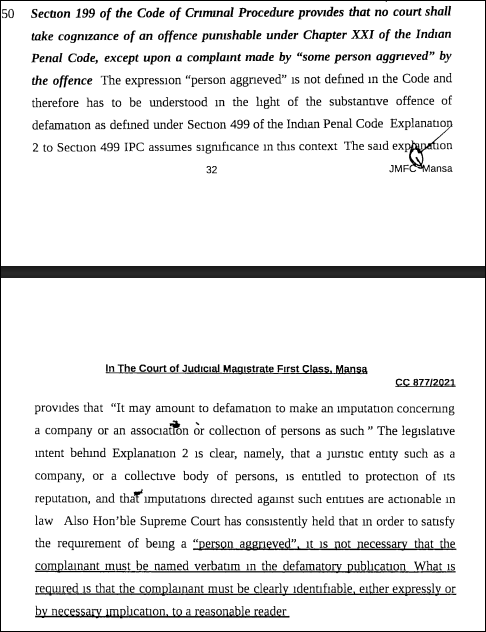
The court rejected the defence’s challenge to the suit’s maintainability and the complainant, Adani Enterprises Limited, being a “person aggrieved”. The Judicial Magistrate, Damini Dixit, cited a previous Supreme Court observation that to satisfy the requirement of being a “person aggrieved”, it is not necessary that the complainant must be named verbatim in the defamatory publication. It suffices that the complainant is clearly identifiable, either expressly or by necessary implication.
“Applying these settled principles to the present case, this Court finds that the complaint, as well as the evidence on record, consistently asserts that the complainant company is the flagship and principal entity of what is popularly and commercially known as the “Adani Group” The publications relied upon by the complainant repeatedly refer to business activities, infrastructure projects, financialdealings, regulatory matters, and governmental interactions associated with “Adani” or “Adani Group” These references are not vague or abstract, but relate to identifiable commercial enterprises operating in the public domain,” the court said, adding that “it would be artificial and contrary to common sense to hold that imputations against the “Adanı Group” do not concern the complainant company.”
Regarding the defence’s argument of no reputation loss to Adani Enterprises, the judge highlighted that the Supreme Court has earlier recognised that the reputation of a company is “not confined to its registered name alone, but extends to the commercial identity by which it is known in the public domain.”
The court found the argument of defence that only a Director of the company could maintain the complaint is “devoid of substance”. “Section 199 CrPC does not mandate that the complaint must be instituted personally by the highest officer of the company. A company, being a juristic person, necessarily acts through authorised representatives. Once it is shown that the complaınt is instituted on behalf of the company by a duly authorised person, the requirement of Section 199 stands satisfied,” the court stated.
On the defence’s argument on territorial jurisdiction, the court stated that the complainant company maintained throughout the proceedings that PW-1, who first noticed the defamatory content by Ravi Nair, was at a hotel in Mansa (Gandhinagar, Gujarat) for official work. The court did not heed the defence’s attempt to discredit PW-1’s version merely due to an absence of hotel receipts, travel bills, etc.
“However, at the stage of determining territorial jurisdiction, the Court is not required to insist upon proof of jurisdictional facts with the same degree of strictness as required for proving guilt,” Judicial Magistrate Damini Dixit stated and emphasised that the court was “satisfied that the alleged consequence of the offence ensued within its territorial jurisdiction.”
Moving further court addressed the complainant, presenting electronic records of the alleged defamatory content, and the defence’s challenge to the admissibility and proof of such electronic evidence due to the complainant’s supposed failure to establish the source, device, and authenticity of the electronic records.
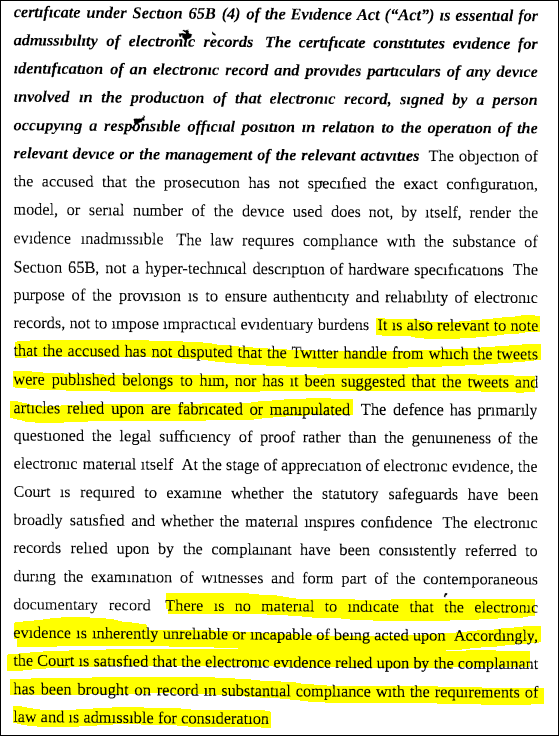
Regarding this, the court said, “The complainant has produced a certificate under Section 65B of the Evidence Act, which has been exhibited on record. PW-1 has deposed that the tweets and articles were accessed on an electronic device and that the printouts produced correspond to what was displayed on the screen at the relevant time.”
The court said that the law requires compliance with the substance of Section 65B, not a hyper-technical description of hardware specifications. The court further emphasised that the accused person, Ravi Nair, did not dispute that the Twitter handle from which the tweets were published belongs to him, nor was it claimed that the tweets and articles relied upon are fabricated or manipulated.
Regarding the admissibility of the electronic evidence submitted by the complainant, the court said, “The court is satisfied that the electronic evidence relied upon by the complainant has been brought on record in substantial compliance with the requirements of law and is admissible for consideration.”
While the accused leftist ‘journalist’ contended that since the alleged defamatory tweets and articles pertained to various subject matters and were published on different occasions, the court found that the publications relied upon by the complainant “cannot be viewed in isolation.”
The court noted that despite the fact that the tweets and articles in question pertain to different events and were published over a period of time, they “consistently target the complainant company and its group by alleging unethical conduct, manipulation of laws, misuse of governmental machinery, environmental violations, and financial impropriety.”
“In the present case, the publications disclose continuity of purpose and design, and cannot be said to be wholly independent or unrelated,” the court noted.
Regarding the core issue of defamation, the court highlighted the evidence on record to note that “the publications attribute conduct to the complainant company which, if believed, would lower its moral and commercial standing in the estimation of the public, investors, regulators, and business partners.”
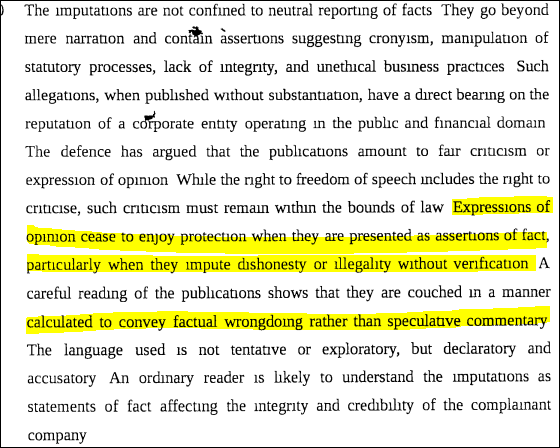
Contrary to the defence’s argument that the content in question was mere reporting of facts, the court found that the imputations were “not confined to neutral reporting of facts. They go beyond mere narration and contain assertions suggesting cronyism, manipulation of statutory processes, lack of integrity, and unethical business practices. Such allegations, when published without substantiation, have a direct bearing on the reputation of a corporate entity operating in the public and financial domain.”
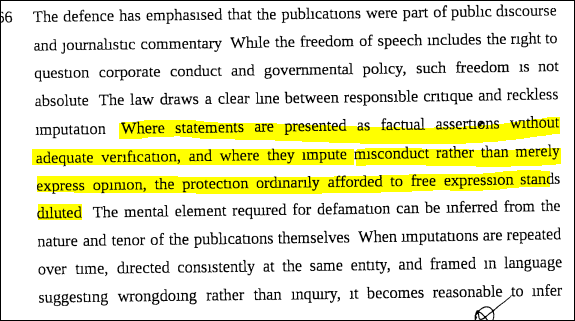
On the defence’s “fair criticism” and “expression of opinion” argument, the court stated that the Indian law provides its citizens the freedom of expression and fair criticism, expressions of opinion “cease to enjoy protection when they are presented as assertions of fact, particularly when they impute dishonesty or illegality without verification.”
Dismissing the defence’s ‘expression of opinion’ argument, the court noted that the manner in which the content against the Adani Group was published and promoted by Ravi Nair indicated that it was not a case of speculative commentary but rather a deliberate attempt at convey factual wrongdoing by the AEL.
“A careful reading of the publications shows that they are couched in a manner calculated to convey factual wrongdoing rather than speculative commentary. The language used is not tentative or exploratory, but declaratory and accusatory. An ordinary reader is likely to understand the imputations as statements of fact affecting the integrity and credibility of the complainant company,” the court noted.
Moreover, the court dismissed the defence’s ‘no financial loss’ argument, stating that “reputational harm is not always susceptible to mathematical measurement…. Viewed in totality, the publications form part of a sustained narrative portraying the complainant company in a disreputable light.”
Explaining the legal technicalities of defamation and reputation, the court noted that the Adani Group is a corporate entity active in various sectors, including infrastructure and energy, etc, and operates in a highly regulated environment and depends on public confidence, investor trust, and regulatory goodwill.
“Any imputation suggesting illegality, manipulation of laws, undue political influence, environmental wrongdoing, 6r financial impropriety is not a matter of mere opinion when directed against such an entity Such imputations strike at the very foundation of its reputation and business standing,” the court stated.
The court further cited some of the tweets made by the accused against the Adani Group.
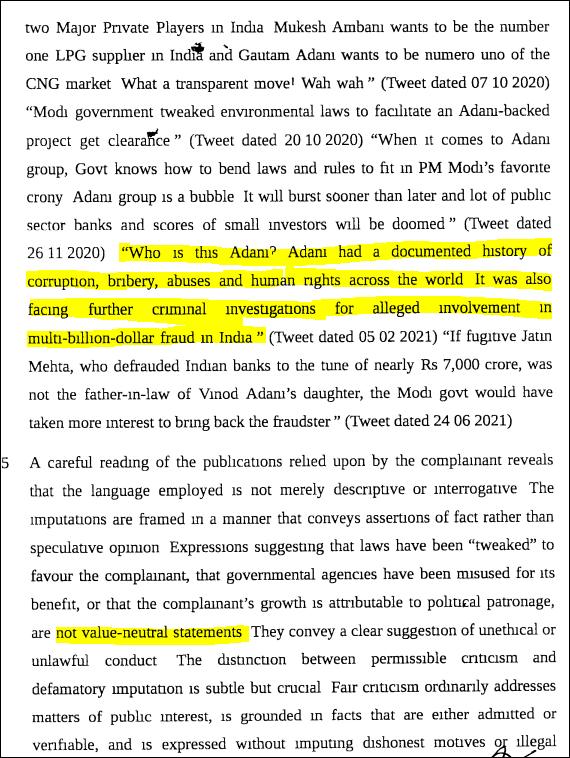
In one tweet dated 7th October 2020, Ravi Nair wrote, “When it comes to Natural Gas, thete are two Major Private Players in India Mukesh Ambanı wants to be the number one LPG supplier in Indra and Gautam Adanı wants to be numero uno of the CNG market What a transparent move! Wah wah.”
In another tweet dated 26th November 2020, the accused ‘journalist’ wrote, “”When it comes to Adani group, Govt knows how to bend laws and rules to fit in PM Modı’s favorite crony Adani group is a bubble It will burst sooner than later and lot of public sector banks and scores of small investors will be doomed.”
Similarly, in a tweet dated 5th February 2021, Nair wrote, “Who Is this Adani? Adani had a documented history of corruption, bribery, abuses and human rights across the world It was also facing further criminal investigations for alleged involvement in multi-billion-dollar fraud in India.”
Citing other such tweets by Ravi Nair, the court noted that the content in question is not merely descriptive r interrogative, rather, “the imputations are framed in a manner that conveys assertions of fact rather than speculative opinion.”
“Expressions suggesting that laws have been “tweaked” to favour the complainant, that governmental agencies have been misused for its benefit, or that the complainant’s growth is attributable to political patronage, are not value-neutral statements They convey a clear suggestion of unethical or unlawful conduct,” the court said, adding that there is a subtle but crucial difference between fair criticism and defamatory imputation.
On the defence’s claim that the publications in question were part of public discourse and journalistic commentary, the court reiterated that the law “draws a clear line between responsible critique and reckless imputation.”
The court also noted that the medium of publication is irrelevant and that the publication of defamatory content on social media has the potential to reach a vast and diverse audience, including investors, regulators, and international stakeholders. The court noted that, given the vast and diverse audience social media platforms have, the probability of reputational harm is “significantly amplified”.
“When imputations of a serious nature are made through such platforms, the author cannot feign ignorance of their likely consequences Viewed cumulatively, the publications relied upon by the complainant disclose a pattern of imputations that go beyond isolated remarks or casual commentary They create a narrative portraying the complainant company as an entity thriving through illegitimate means and improper influence Such a portrayal, if accepted by readers, would unquestionably lower the complainant’s reputation in the estimation of right-thinking members of society,” the court stated.
All excerpts taken from the relevant court order.
The court noted that while the accused claimed to have made the publications after due research and in good faith, “he has not led any independent evidence to establish the truth of the imputations contained in the publications. No documentary material, official record, or verified data has been produced to substantiate the serious allegations made against the complainant company.”
“Good faith is not a matter of mere belief or assertion, it requires demonstrable prudence, verification, and restraint prior to publication, particularly where the imputations are grave and capable of causing serious reputational harm The record does not disclose any material to indicate that the accused undertook verification of facts, sought clarification from the complainant, or exercised caution commensurate with the seriousness of the allegations The language of the publications is categorical and accusatory, rather than tentative or exploratory,” the court added.
The court also rejected the defence’s challenge to the trustworthiness of the witnesses presented by the complainant, stating that “employment with a complainant company, by itself, does not render a witness untrustworthy.
“In the present case, the prosecution witnesses have deposed prmarily with regard to their access to the impugned publications, the nature of the imputations contained therein, and the impact of such publications on the complainant company Their evidence is broadly consistent on material particulars and does not suffer from contradictions that go to the root of the prosecution case,” the court stated, adding that the prosecution witnesses may have an interest in the outcome of the proceedings; however, that sone is not sufficient to discard their testimony.
The court concluded that the complainant provided sufficient oral and documentary evidence to successfully establish the essential foundational facts necessary for constituting the offence of defamation.
“The fact of publication, as well as access to such publications, has been established through the consistent testimony of the prosecution witnesses and the electronic record The defamatory character of the publications becomes evident upon a plain reading of the contents of the tweets themselves. It demonstrates that the accused has attributed to the complainant company and its group serious allegations of illegality, corruption, manipulation of laws, abuse of governmental machinery, financial impropriety, and unethical conduct,” the court stated.
“The imputations are not expressed tentatively or as matters requiring verification, but are stated categorically as assertions of fact Such statements, when published on a platform accessible to the public at large, are clearly capable of lowering the reputation of the complainant company in the estimation of investors, regulators, business partners, and right-thinking members of society Furthermore, these publications do not confine themselves to criticism of governmental policy or expression of opinion They directly impute discreditable conduct to the complainant company and portray its business growth as the product of corruption, cronyism, and illegality,” the court ruled.
The court further stated that far from being a fair comment or a permissible opinion, the content published by accused Ravi Nair “squarely falls within the mischief contemplated under Section 499 of the Indian Penal Code, being imputations made concerning the complainant company with knowledge or reason to believe that they would harm its reputation.”
According to the court, the publications in question “were not confined to abstract policy criticism, but attributed discreditable conduct to the complainant company itself.”
Highlighting the frequency, categorical tone, and dissemination through social media, the court noted that the accused “had knowledge, or at least reason to believe, that such imputations would cause harm to the reputation of the complainant company.”
The court also found that the accused failed to submit any material to justify the imputations on grounds of truth, good faith, or public interest.
“In these circumstances, the ingredients of the offence of defamation, as defined under Section 499 of the Indian Penal Code and punishable under Section 500 thereof, stand duly proved. The accused Mr Ravı Naır is held to be guilty of the offence under Section 499, punishable under Section 500 of the IPC,” the court ruled.
The court also stated that, given the fact that the accused claimed to be a journalist, he “cannot be heard to plead ignorance of the impact, reach, and consequences of statements published through digital platforms.”
The court decided not to give the convict the benefit of probation, noting that the accused is a mature individual fully cognizant of the legal implications of his actions.
“Granting leniency through probation would undermine the deterrent effect of the law and send a message of impunity to others in similar positions of trust Therefore, keeping in mind the social implications of a middle-ground sentence ensures that the offender realızes the consequences of their actions while signaling to the public that such violations will be met with firm judicial resolve,” the court order dated 10th February 2026 stated.
The court convicted and sentenced Ravi Nair to simple imprisonment for a term of one year and imposed a fine of Rs 5000/- under section 255(2) of the Criminal Procedure Code.
Leftists hail Ravi Nair a ‘martyr’ even as the court found him guilty
In what could be deemed an expression of distrust in the judiciary, the left liberal coterie is elevating Ravi Nair to the status of a martyr. In this vein, advocate Prashant Bhushan wrote on X, “This order is totally unfair & wrong. Ravi Nair is one of the finest investigative journalists in the world. He never wrote anything against Adani which was not true or unjustified. But should we be surprised?”
This order is totally unfair & wrong. Ravi Nair is one of the finest investigative journalists in the world. He never wrote anything against Adani which was not true or unjustified. But should we be surprised? https://t.co/XfxPmhHa1T
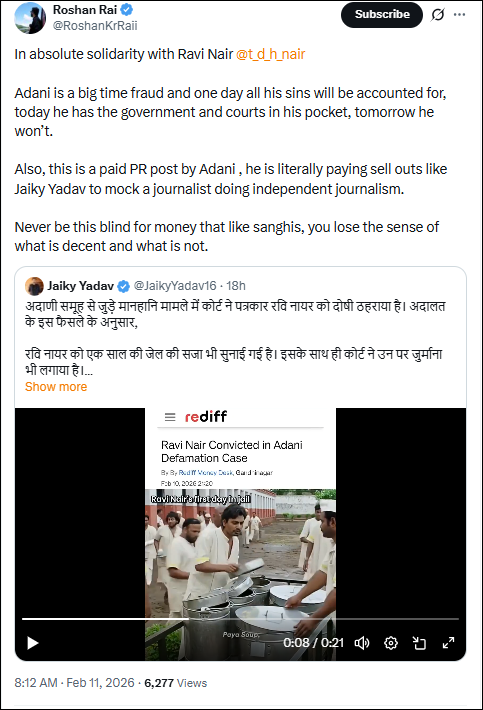
Meanwhile, a pro-Congress troll expressed solidarity with Nair and wrote, “In absolute solidarity with Ravi Nair @t_d_h_nair Adani is a big time fraud and one day all his sins will be accounted for, today he has the government and courts in his pocket, tomorrow he won’t. Also, this is a paid PR post by Adani , he is literally paying sell outs like Jaiky Yadav to mock a journalist doing independent journalism. Never be this blind for money that like sanghis, you lose the sense of what is decent and what is not.”
Similarly, leftist propaganda outlet, The New Minute’s editor, Dhanya Rajendran, wrote, “Ravi Nair’s conviction is nothing to celebrate, even for his detractors. The misuse of criminal defamation poses a real threat to everyone, especially journalists. What was the case about? What were his tweets? What did the judge say?”
Ravi Nair’s conviction is nothing to celebrate, even for his detractors. The misuse of criminal defamation poses a real threat to everyone, especially journalists.
What was the case about? What were his tweets? What did the judge say? Read the story. https://t.co/2VqdzhWT1F
This ‘martyrdom’ claim is nothing but a repeated pattern of painting accused and convicted individuals aligned with the leftist ideology as ‘victims’ of the ‘system’. From 2020 anti-Hindu Delhi Riots accused mastermind Umar Khalid, to now leftist propagandist Ravi Nair, the left liberal media and the extended ecosystem have a penchant for celebrating those convicted of wrongdoing as long as they belong to their ideological fold, even as facts and courts state otherwise.
On Wednesday, February 11, Lok Sabha Leader of Opposition Rahul Gandhi launched a scathing attack against the Modi government over the India–US trade deal. But as has been the case with him, it was rich in drama but poor in credibility.
Accusing the Centre of “selling Bharat Mata” and “compromising national interests,” Gandhi has once again chosen theatrical outrage over substantive argument, leaning on insinuation rather than evidence. His speech in Parliament mixed sweeping claims with emotive slogans, but offered little by way of concrete proof that India’s interests have, in fact, been bartered away.
Gandhi argued that the government itself admits the world is entering a turbulent phase, marked by the decline of a unipolar order, rising geopolitical conflict, and the weaponisation of energy and finance, yet is allegedly allowing the United States to dictate India’s energy and financial choices. He went on to claim that if America says India cannot buy oil from a particular country, then India’s energy security is being “dictated externally.” From this premise, he leapt to the conclusion that the government has “sold” the country.
This is a serious charge. It is also one made without any documentary evidence, without citing the actual text of the trade framework, and without explaining which specific clauses amount to a surrender of sovereignty. Instead, Gandhi relied on insinuations of “pressure,” spoke of “fear in the Prime Minister’s eyes,” and even dragged in references to the sealed “Epstein files”, a claim that has no demonstrable connection to India’s trade negotiations. This is not scrutiny; it is political theatre.
He further claimed that tariffs have jumped from an average of around 3% to 18% and that US imports into India could rise from $46 billion to $146 billion, portraying this as an “absurd” one-sided concession. But trade negotiations are not conducted in slogans. Tariff lines, quotas, minimum import prices, and safeguard clauses matter, and without placing the full set of negotiated terms on the table, Gandhi’s numbers function more as scare figures than as a serious economic critique.
More importantly, for the Congress party to posture as the guardian of national interest is an exercise in historical amnesia.
Nehru was against building capacity in India’s intelligence infrastructure in China
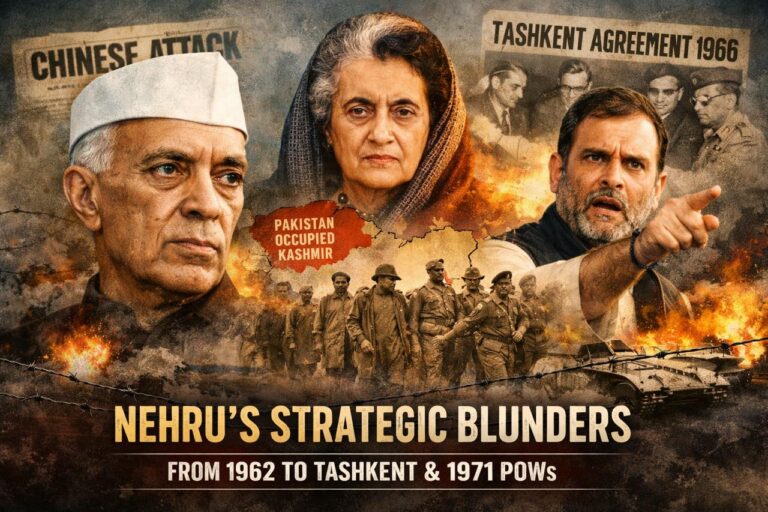
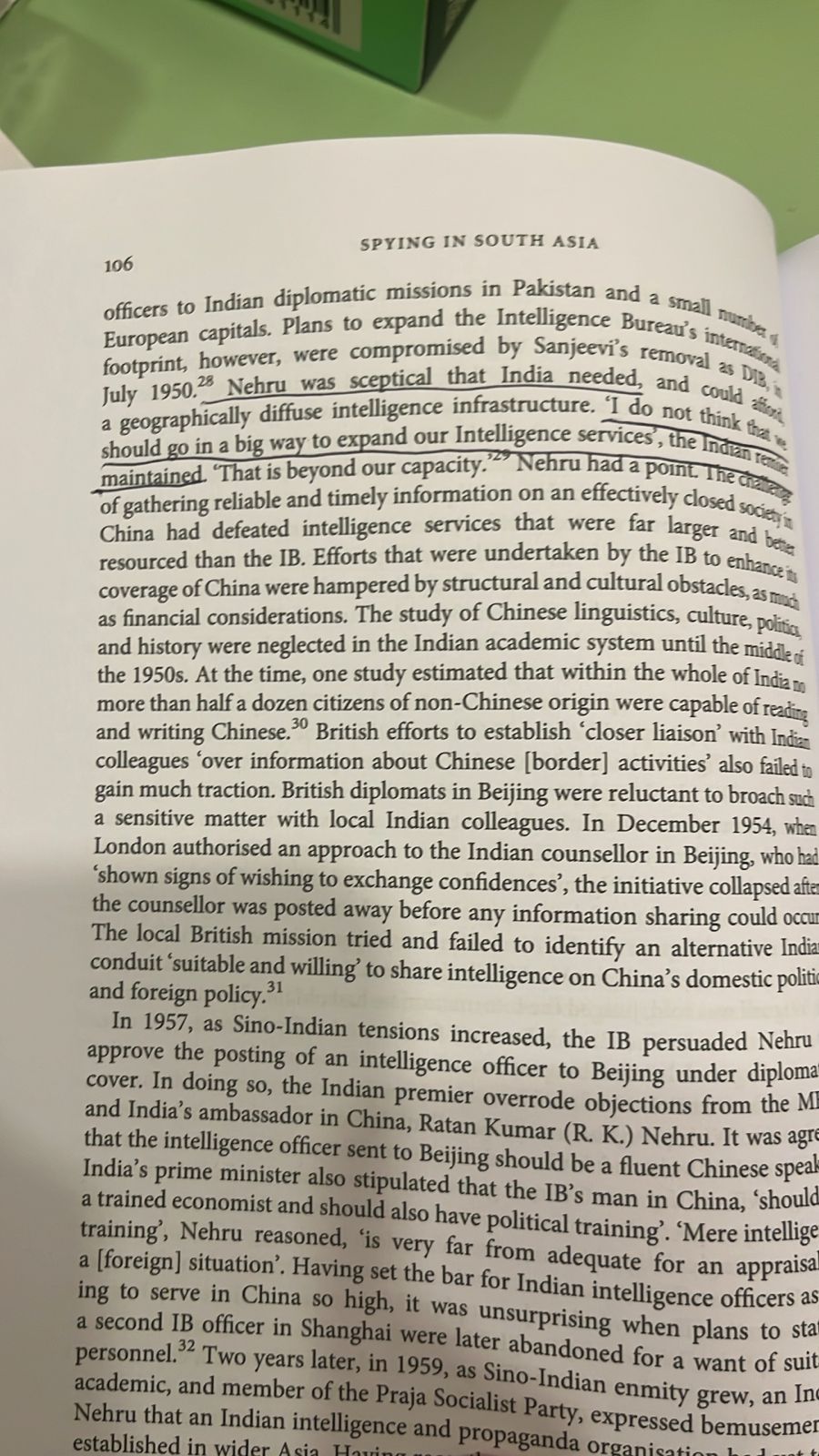
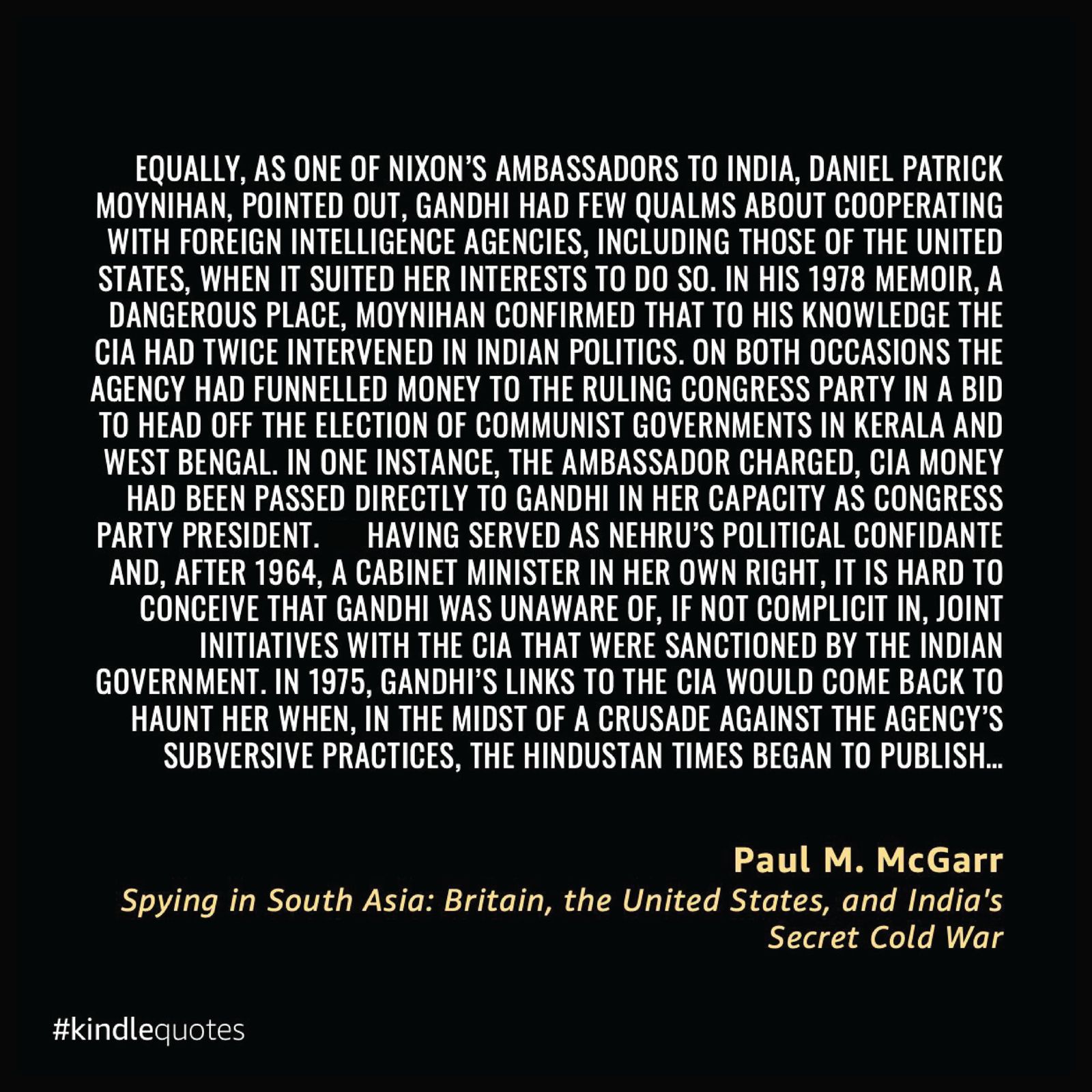
As historian Paul M. McGarr documents in his 2024 book Spying in South Asia: Britain, the United States, and India’s Secret Cold War, the Congress leadership itself has a long and uncomfortable record of decisions that weakened India’s strategic autonomy. McGarr notes that Jawaharlal Nehru actively resisted building a robust, geographically diffused intelligence infrastructure, particularly with respect to China. Nehru argued that expanding intelligence capabilities in a closed society like China was beyond India’s capacity and not worth the effort. This reluctance to invest in strategic capacity proved disastrous when China went to war with India in 1962, brutally exposing the costs of moral posturing combined with strategic neglect.
Excerpt from McGarr’s book
That was not merely an error of judgment; it was a structural failure of statecraft, one that left India blind at a critical moment in its history.
McGarr’s work is even more damaging for the Congress when it turns to the era of Indira Gandhi. Citing Daniel Patrick Moynihan’s 1978 memoir ‘A Dangerous Place’, McGarr records that the CIA intervened in Indian politics at least twice, funnelling money to the ruling Congress party to prevent the election of communist governments in Kerala and West Bengal. In one instance, according to Moynihan, CIA funds were passed directly to Indira Gandhi in her capacity as Congress party president.
Tashkent Agreement: Lahore and Sialkot could have been India’s, but Congress gave it away
That habit of converting battlefield advantage into negotiating-table surrender did not begin or end with the Cold War intrigues described by Paul McGarr. It had already been institutionalised by the Congress party in 1966 with the Tashkent Agreement, one of the most consequential strategic blunders in independent India’s history.
On 10 January 1966, after India had decisively outperformed Pakistan in the 1965 war, the Congress government agreed to return all territories captured by the Indian Army, including strategic gains in the Lahore sector and the vital Haji Pir Pass in Kashmir. These were not symbolic pieces of land; they were hard-won positions secured with blood and sacrifice. Indian troops had reached the Ichhogil Canal, Lahore’s last defensive barrier, and had seized Haji Pir, the key infiltration route into Kashmir.
Militarily and diplomatically, India was in a position of strength. Yet, under international pressure and guided by a Congress foreign policy reflex that prioritised “process” over power, New Delhi chose to hand back its leverage and restore the status quo ante, as if the war had never been won.
The consequences of that decision still haunt India. By returning Haji Pir Pass, the Congress government reopened the very routes that Pakistan would later use to push infiltrators and terrorists into Kashmir, laying the groundwork for decades of insurgency, bloodshed, and attacks that culminated in horrors like Pulwama.
The Tashkent Agreement did not buy lasting peace; it bought Pakistan time, legitimacy, and strategic breathing space despite its defeat. Ayub Khan returned home with nothing lost, while India returned home having converted victory into moral posturing. This was not statesmanship; it was strategic self-harm. When Rahul Gandhi today accuses others of “selling India,” he is speaking for a party whose own record includes giving away battlefield gains at Tashkent and, earlier, internationalising Kashmir in 1948, decisions that weakened India’s hand for generations. Against that backdrop, Congress’s sudden discovery of nationalist outrage over a trade negotiation sounds less like principle and more like historical denial.
Blunder of returning 93,000 PoWs to Pakistan: Throwing away India’s strongest bargaining chip
The pattern repeated itself even more starkly after India’s greatest military victory: the 1971 Bangladesh Liberation War. Under Indira Gandhi, India not only broke Pakistan in two and created Bangladesh, it also took 93,000 Pakistani prisoners of war, one of the largest surrenders since the Second World War. This was an extraordinary strategic asset. New Delhi had in its custody the bulk of Pakistan’s eastern army, its officers, and its command structure.
At that moment, India held overwhelming leverage to press Islamabad on its most critical outstanding disputes, foremost among them Pakistan’s illegal occupation of parts of Jammu and Kashmir, and to secure the return of 54 Indian soldiers and airmen who had been captured by Pakistan and were officially listed as “Missing in Action” since 1971.
Yet, in a move that defies strategic logic, the Indira Gandhi government rushed to return all 93,000 Pakistani POWs under the Shimla Agreement without first securing the repatriation of those 54 Indian servicemen nor extracting a binding settlement on Pakistan-occupied Kashmir. Decades later, the fate of those Indian soldiers remains unresolved.
Evidence has repeatedly surfaced over the years, reports in international and Pakistani media, eyewitness accounts, references in books such as Bhutto: Trial and Execution, and testimonies from former prisoners, that at least some of these Indian POWs were held in Pakistani jails like Kot Lakhpat in Lahore. Even Benazir Bhutto admitted in 1989 that Indian POWs were in Pakistani custody, a claim later walked back by Pervez Musharraf. But diplomatically, India had already thrown away its strongest bargaining chip.
If Rahul Gandhi is serious about talking of “selling the nation,” he might want to begin by explaining why a foreign intelligence agency was allegedly financing his party to shape India’s domestic political outcomes. That looks far closer to a textbook case of compromising national sovereignty than negotiating a trade framework between two sovereign states.
One could even argue, using Rahul Gandhi’s own favourite phrase, that this was the real “vote chori”: external money being used to tilt India’s democratic outcomes in favour of the ruling Congress. Yet, on this record, there is no apology, no introspection, only selective outrage aimed at the present government.
There is a deeper irony here. Rahul Gandhi claims that India today is being “choked” by external pressure. But the historical record shows that it was under Congress governments that India’s strategic capacities were underbuilt, its intelligence apparatus constrained, and, if McGarr and Moynihan are to be believed, its ruling party even entangled with foreign intelligence funding for partisan political ends.
None of this means that the current government’s trade negotiations should be beyond scrutiny. They should not be. Any agreement with the United States must be judged clause by clause, sector by sector, and interest by interest. But scrutiny requires facts, documents, and arguments, not insinuations about “fear in the eyes” or unrelated references to international scandals.
Rahul Gandhi’s speech was heavy on rhetoric and light on evidence. Coming from a party with such a chequered record on strategic autonomy and national security, the moral grandstanding rings especially hollow. Before accusing others of “selling India,” the Congress would do well to answer uncomfortable questions about its own past, questions that history, and now serious scholarship, refuses to let disappear.
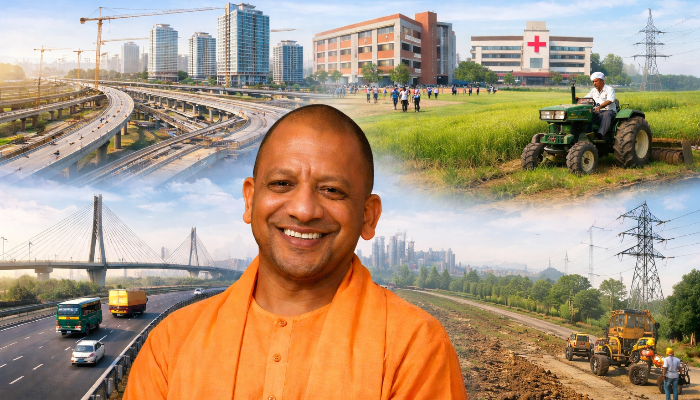
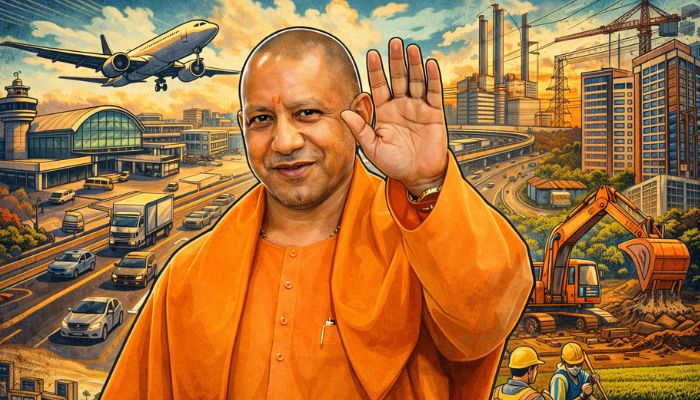
The Yogi Adityanath government of Uttar Pradesh presented its 10th budget for the fiscal year 2026-27 during the legislative assembly session on 11th February (Wednesday). The budget represented the largest allocation by the government so far, with a focus on women, youth and farmers.
It exceeds ₹9.21 lakh crore (9,12,696 crore), reflecting a 12.9 per cent increase compared to the previous budget. Finance Minister Suresh Khanna remarked that there has been a spike in per capita income.
Khanna talked about sectoral allocations and emphasised that the state’s development plan continues to prioritise health and education. “The allocations for education and health are 12.4 and six per cent of the total budget, respectively. Furthermore, the amount allocated for agriculture and allied services is nine per cent of the total budget,” he declared. It demonstrated the government’s steady commitment to infrastructure improvement, rural and capital investment, alongside agricultural expansion. The minister also pointed out their significance in boosting economic growth.
According to him, the leadership remains entirely devoted to debt control and fiscal management. The fiscal deficit limit for the fiscal year 2026–2027 has been fixed at 3% in compliance with the 16th Central Finance Commission’s recommendations. The centre has accepted the limit, which will continue to be in force until 2030-31.
Skill development and job generation
Khanna maintained that the development of human capital, especially among young people, will be a major factor in the state’s long-term progress in addition to infrastructure. He added that individuals who possess technical skills or trade knowledge are less likely to experience unemployment, and hence, the government will give preference to the implementation of extensive training along with skill-building programs in mission mode that are focused on creating jobs.
VIDEO | Lucknow: UP CM Yogi Adityanath and state finance minister Suresh Khanna, holding the Budget Tablet in red sleeve, arrive at state Assembly ahead of state Budget presentation.#upbudget
Together with formal education, efforts will be undertaken to improve skill sets in youth. The minister guaranteed that additional skill development centres would be opened around the state and that the capacity of the current centres would be increased. The plan would encourage private sector participation by launching skill development and job placement centres throughout various districts using the public-private partnership (PPP) model. The facilities specifically designed for women will be built to promote their involvement in the workforce.
The government aims to create employment opportunities for 10 lakh youngsters in the state. According to Khanna, agreements have been reached to establish 200 defence firms through the Defence Industrial Corridor initiative, which would require a proposed investment of ₹35,280 crore and create an estimated 53,263 direct jobs.
From farmers to females and students: A people’s budget
The minister highlighted that ₹10,888 crore is for agricultural schemes. The UP-AGREES (Uttar Pradesh Agriculture Growth and Rural Enterprise Ecosystem Strengthening) scheme, which is funded by the World Bank will launch an agri-export hub to expand farmer incomes and agricultural exports. The government also wants to facilitate business operations by supporting industries with streamlined licensing and registration procedures under the Jan Vishwas reform framework.
UP govt is also putting greater attention on renewable energy sources, and ₹637 crore have been set aside for farmers to convert their diesel pump sets to solar pump sets, while ₹1500 crore is for the PM Kusum (Pradhan Mantri Kisan Urja Suraksha Evam Utthan Mahabhiyan) Yojana.
A substantial portion of ₹25,500 crore allotted for rural development will go to the MGNREGA (Mahatma Gandhi National Rural Employment Guarantee Act and Viksit Bharat GRAM G (Guarantee for Rozgar and Ajeevika Mission) drive. ₹26,514 crore is for urban development
Notably, an estimated ₹18,620 crore is recommended for programs pertaining to the development of women and children which is an 11% jump from 2025-26. ₹37,956 crore is given for medical, health and family welfare.
₹14,997 crore has been put for medical education. ₹1,023 crore is tabled to create 14 new medical colleges. ₹130 crore has been reserved for the provision of free treatment for incurable diseases, and ₹315 crore has been set aside for the Cancer Institute in Lucknow.
₹65,926 crore has been devoted to the energy sector with major sums assigned to renewable and other energy sources as well as irrigation and flood control. Moreover, around ₹2,867 crore has been designated for Ayush (Ayurveda, Yoga and Naturopathy, Unani, Siddha and Homoeopathy), ₹8,000 crore for the National Rural Health Mission and ₹2,000 crore for the Ayushman Bharat National Health Protection Scheme.
Focus on MSMEs, infrastructure and more
An amount of ₹3,822 crore has been dedicated to micro, small and medium-sized businesses (MSMEs). The government also launched a credit card program specifically designed for women to offer interest-free loans for small business ventures for their financial independence.
Khanna conveyed that ₹2,059 crore has been made available for electronics and IT projects. On the other hand, a sum of ₹225 crore is for the UP AI (Uttar Pradesh Artificial Intelligence) campaign. A Digital Entrepreneurship Scheme will be created by the state to encourage innovation, new ventures and technology-based enterprises.
₹27,103 crore will be given to industrial and infrastructure development. ₹34,468 crore has been earmarked for the building, enlargement and upkeep of roads and bridges. The declaration of the high-speed rail lines between Varanasi and Siliguri and Delhi and Varanasi was warmly received by the state.
The development of important historical sites like Sarnath and Hastinapur is also endorsed by the budget. There are also plans for 10,000 tour guides to receive vocational training, dorms for female students and trauma units in district hospitals.
Labour shelters for migrant workers, accident benefits for unorganised workers registered with e-Shram, mobile health vans for construction workers and the formation of the Uttar Pradesh Employment Mission to enhance employment prospects both domestically and abroad found space in the budget.
Furthermore, the projected budget is ₹1,243 crore for residential buildings and ₹1,374 crore for non-residential police buildings. Khanna likewise announced that the financial assistance for the weddings of girls is going to be raised from ₹50,000 to ₹1 lakh. Furthermore, tablets and smartphones are being distributed under the Swami Vivekananda Yuva Sashaktikaran Yojana costing ₹2,374 crore. Additionally, new initiatives worth ₹43,000 crore have been introduced.
The minister highlights Uttar Pradesh’s achievements
The cabinet minister also outlined the accomplishments of the government and mentioned that Uttar Pradesh is seeing a dramatic surge in investment and leads the nation in agricultural output. He informed, “The state government successfully hosted the fourth Global Investors Summit in February 2024. So far, MoUs (Memorandum of Understanding) valued at around 50 lakh crore have been executed, which are anticipated to generate approximately 1 crore jobs.”
“The state has witnessed all-round development during the previous and current tenures of our government, including strengthening law and order, expanding infrastructure, industrial investment, employment generation, women’s empowerment, youth skill development, farmer prosperity and poverty alleviation,” he further highlighted.
Lucknow | While presenting the State Budget 2026-27, Uttar Pradesh Finance Minister Suresh Khanna says, "The state has witnessed all-round development during the previous and current tenures of our government, including strengthening law and order, expanding infrastructure,… pic.twitter.com/6Wrpr7BQ1C
“The state’s GSDP (Gross State Domestic Product) for 2024-2025 (quick estimates) is estimated at ₹30.25 lakh crore, reflecting a 13.4 per cent increase over the previous year. The state’s per capita income is estimated at ₹1,09,844, which is more than double the per capita income of ₹54,564 in 2016-2017. Per capita income is projected to reach ₹120,000 in 2025-2026. We have succeeded in lifting approximately 60 million people out of multidimensional poverty in the state. The unemployment rate has fallen to 2.24 per cent,” Khanna stated.
Khanna outlined that the government has made record sugarcane payments worth over ₹3,04,321 crore, which is ₹90,802 crore more than the entire amount made during the preceding 22 years. The price of sugarcane shot up by ₹30 per quintal for the crushing season of 2025-2026, granting farmers an extra ₹3,000 crore. He mentioned that farmers were paid ₹2,512 crore for wheat during the 2025-26 rabi marketing year, while above ₹9,710 crore was spent on paddy purchases and ₹595 crore was given for buying millets in the 2025-26 kharif season.
“Only those who immerse themselves in toil can sparkle like stars in the heavens,” the minister expressed while lauding the government and triggered a rousing applause. The budget is centred on infrastructure development, but it also seeks at elevating expenditure in social welfare programs to foster prosperity for all sections of society.
The budget came after the publication of Uttar Pradesh’s first economic survey. It revealed that the state’s economy has more than doubled in the last eight years from ₹13.30 lakh crore in 2016-17 to over ₹30.25 lakh crore in 2024-25. Khanna illustrated Uttar Pradesh’s fast-growing economic trajectory by assuring that it is expected to reach ₹36 lakh crore in the current fiscal year.
Uttar Pradesh, India’s most populous state, has witnessed a remarkable transformation in recent years, transitioning from an area plagued by infrastructure constraints to a bustling hub of prosperity and opportunity. The state government, led by Chief Minister Yogi Adityanath, has prioritised infrastructure as a key component of its development program. Significant funds have been allocated to highways, airports, urban housing, industrial corridors, and digital connectivity. In addition to improving accessibility and connectedness, this emphasis has boosted employment, the economy, and the standard of living for millions of people.
The unveiling of the Uttar Pradesh Budget for 2026-27 on February 11, 2026, marks a significant milestone in this journey. With an unprecedented allocation exceeding Rs 9 lakh crore, the largest in the state’s history, the budget underscores the government’s commitment to accelerating infrastructure development. During the budget’s tabling, Finance Minister Suresh Khanna emphasised how it adheres to the principle of ‘Sabka Saath, Sabka Vikas,’ guaranteeing inclusive advancement in areas such as agriculture, infrastructure, women’s welfare, and youth empowerment. Law and order improvements, infrastructural improvements, and general economic vibrancy have all contributed to the state’s 13.4% increase in Gross State Domestic Product (GSDP), which now stands at Rs 30.25 lakh crore.
From bottlenecks to breakthrough
In the past, Uttar Pradesh was frequently referred to as a bottleneck state because of its poor connectivity, insufficient infrastructure, and regional inequalities that impeded development. But since Yogi Adityanath took office in 2017, the state has become a breakthrough state, making noticeable progress in infrastructure, economic empowerment, and governance. Presented before the budget, the government’s first-ever Economic Survey for 2025-2026 predicts a 12% growth in GSDP of Rs 36 lakh crore, placing Uttar Pradesh among the fastest-growing economies in India.
This trend is visible in the large investments received through four groundbreaking ceremonies, which totalled roughly Rs 50 lakh crore in MOUs and are expected to generate 10 lakh jobs. UP is now India’s fourth-largest startup cluster, with exports of services, especially IT and IT-enabled services, surpassing Rs 82,000 crore in 2024-2025. The state’s desire to advance toward a tech-driven future is demonstrated by initiatives like Lucknow’s AI City. A strong infrastructure architecture that has completely changed the state’s terrain supports these advancements.
Roadways and Expressways: Connecting the heartland
The development of road networks is among the most obvious signs of advancement under the Yogi administration. With 22 expressways in operation, proposed, or under construction, the state has emerged as a major centre for national highways. Seven of them are already operational, significantly cutting down on travel times and increasing trade. By connecting the eastern and southern regions, for example, the Purvanchal and Bundelkhand expressways have promoted balanced growth and reduced regional disparities.
The government completed the construction of 161 roads totalling 1,410 km and connected the headquarters of 168 development blocks with double-lane roads. Almost 28,000 km of roads have already been renovated toward the goal of strengthening 46,600 km by 2025-2026. The administration’s emphasis on connectivity and job creation is further supported by the substantial funding of 34,468 crores allotted for highways, bridges, and expansion projects in the 2026-2027 budget. By increasing access to markets, healthcare, and education, these programs have not only improved logistics but also boosted rural economies.
Airports and Aviation: Soaring to new heights
The aviation sector in Uttar Pradesh has grown rapidly, which is consistent with the goal of establishing the state as a logistics powerhouse. Five international airports are among the 24 the government hopes to establish. With projects like the Jewar International Greenfield Airport slated to develop into a significant cargo and logistics gateway for North India, there are now 16 airports in operation.
By drawing in investors and tourists, this growth has established UP as a major participant in India’s aviation landscape. In order to boost development and enhance essential services, the budget places a strong emphasis on bolstering infrastructure, particularly airports, by allotting 2,111 crore rupees. Increased air connectivity has benefited industries, including manufacturing and tourism, which has led to a rise in employment and economic activity.
Urban development and housing: Building sustainable cities
With programs like the Pradhan Mantri Awas Yojana (PMAY) delivering over 3.637 million homes in rural areas, urban infrastructure has been prioritised. Smart city initiatives in Varanasi, Lucknow, and other urban areas have combined traditional legacy with contemporary conveniences. The government has prioritised sanitation, energy, and water delivery while guaranteeing fair access.
In order to reduce disparities in areas like Purvanchal and Bundelkhand, the 2026-2027 budget includes funding for housing and urban growth. Urban congestion has been reduced, and sustainable transportation has been encouraged by investments in metro rail systems, such as the Lucknow Metro and future developments in Kanpur and Agra. Cities are becoming thriving economic hubs thanks to these initiatives, drawing in international investors.
Industrial corridors and specialised hubs: Fostering innovation and growth
The establishment of specialised industrial hubs is part of the Yogi government’s strategic plan. Kanpur is being positioned as a drone manufacturing hub, Noida as an IT and electronics base, and Lucknow as an AI powerhouse. Manufacturing has been anchored by the Defence Industrial Corridor, which has also attracted investments and produced highly skilled jobs.
Intrastate logistics have changed as a result of seven expressways and specialised freight lanes, fostering the expansion of industry. By completing ongoing projects and introducing new ones, the budget’s emphasis on infrastructure will increase the state’s allure as a place to invest. Leading textile and electronics businesses are drawn to Uttar Pradesh, which ranks second in terms of ease of doing business.
Water, electricity and basic services: Ensuring Inclusivity
The Yogi government has been known for providing dependable access to essential services. Power cuts have decreased as a result of significant expenditures in electricity infrastructure, and rural electrification has nearly reached universal coverage. Millions of people have had access to safe drinking water because of water delivery programs like the Har Ghar Nal effort.
Millions of people have access to clean drinking water thanks to the Jal Jeevan Mission’s flagship Har Ghar Nal effort. The central government has committed ₹71,221 crore, of which ₹38,456 crore has already been released, and the state has approved 40,955 drinking water projects valued at ₹1,53,876 crore. It is anticipated that the remaining ₹33,300 crore will expedite construction and guarantee tap water connections in rural communities. The state has requested ₹6,000 crore in central help for water conservation initiatives, including the revitalisation of 60,000 ponds and grey/black water management projects, which are also supported by the budget.
The government’s objective of a dependable power supply has been in line with the notable growth of the electricity infrastructure. In support of green energy objectives, the state has installed 2,815 MW of solar power installations. Nearly all rural areas have been electrified, which powers economic activity and lowers outages. In order to guarantee power availability around the clock, the budget’s emphasis on capital investment supports continuous improvements like smart metering and grid modernisation, which have increased industrial output and improved consumer welfare.
With new hospitals and medical schools opening up in various districts, healthcare and family planning have also been strengthened. The 37,956 crores allotted to healthcare and family planning pays for expanded primary healthcare services, hostels for female medical college students, and emergency and trauma clinics in each district hospital. In addition to it, AAYUSH has been allotted 2,867 crores. These initiatives have been supplemented by Swachh Bharat sanitation drives, which guarantee hygienic living conditions. With inclusive programs that focus on women, youth, and farmers and uphold the Sabka Saath, Sabka Vikas philosophy, these investments have helped millions of people escape poverty.
Digital infrastructure: Embracing the future
By utilising technology for innovation, economic growth, and governance, the Yogi administration has established Uttar Pradesh as a digital powerhouse. This trend is maintained in the 2026-2027 budget, which supports the state’s goal of becoming a trillion-dollar economy through investments in IT ecosystems and digital connectivity.
Increased broadband adoption has made it possible for e-governance programs to be implemented, which expedite services like online property records, bill payments, and public complaints. With intentions to draw in tech investments and support entrepreneurs, Lucknow’s AI City project is a prime example of forward thinking. With exports of IT and IT-enabled services surpassing ₹82,000 crore in 2024-2025, Uttar Pradesh is now India’s fourth-largest startup cluster. As part of the larger 19.5% capital spending (about ₹1.78 lakh crore total capex), the budget allots funding for updating MSME digital capabilities and purchasing new technologies.
UP is positioned as a digital hub thanks to data centres with a 700 MW capacity that are either under development or already operating and cost over ₹22,000 crore. While skill development centres operating under the PPP approach will teach youths digital skills, the Digital Entrepreneurship Scheme seeks to foster innovation. In addition to generating highly skilled jobs in cutting-edge industries like artificial intelligence and cloud computing, these initiatives have revolutionised administration by decreasing corruption and increasing efficiency.
Economic impact and employment generation
Uttar Pradesh’s economy has doubled from ₹12-15 lakh crore to ₹30.25 lakh crore in eight years, thanks to Yogi Adityanath’s infrastructure-led growth, and its GSDP is expected to reach ₹36 lakh crore at a 12% growth rate in 2025-2026. With a 19.5% capital expenditure and a ₹9.13 lakh crore outlay, the 2026-2027 budget is expected to maintain this trend by prioritising infrastructure and jobs.
While skill-building initiatives focus on young employment, the Uttar Pradesh Skill Development Mission will increase opportunities both domestically and abroad. With 96 lakh businesses sustaining 3 crore lives, MSMEs profit from central grants. This has been supplemented by welfare and poverty alleviation programs, which have boosted rural economies and decreased deprivation.
A roadmap to self-reliance
The Yogi government’s plan for Uttar Pradesh places a strong emphasis on balanced development and rapid infrastructure in order to promote self-reliance. With sizeable allotments for finishing off ongoing initiatives and starting new ones, the 2026-2027 budget offers a starting point.
With an emphasis on Purvanchal and Bundelkhand via highways and industrial corridors, regional balance is crucial. Voter-friendly policies in the budget, such as ₹10,000 crore for MSMEs and skill centres, are intended to promote innovation and create jobs. These plans offer long-term prosperity and a key role in India’s development by 2047, as UP aims to achieve a trillion-dollar economy.
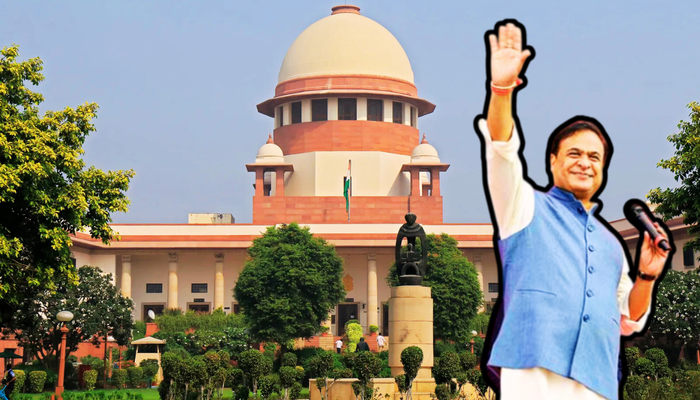
The Supreme Court on Tuesday (10th February) gave a nod to the Assam government’s decision to remove encroachments from 3,62,082 hectares of reserved forest land in the state. A bench of Justices PS Narasimha and Alok Aradhe noted that the process of removal of encroachment proposed by the Himanta Biswa government contains sufficient safeguards and follows due process.
The present petition challenged an order passed by a Division Bench of the Gauhati High Court in August 2025, upholding a Single Bench decision extending the time given to the petitioners to vacate the forest land. The Division Bench directed the state government to frame necessary regulations to prevent unauthorised encroachment of reserved forest land. It further asked the state government to issue show-cause notices to the petitioners, giving them a 15-day deadline to submit an explanation and an additional 15-day period to vacate the encroached forest land if they are asked to do so.
Petitioners claimed that they have been living on the land for 70 years
The matter came up before the Supreme Court after residents of villages located in Doyang Reserved Forest, South Nambar Reserved Forest, Jamuna Madunga Reserve Forest, Barpani Reserved Forest, Lutumai Reserved Forest and Gola Ghat Forest challenged eviction notices issued by the State through a Special Leave Petition. The petitioners, including Abdul Khalek and others, claimed that their families have been residing in the area for over 70 years and that they possess Aadhaar Cards, Ration Cards, and other identity documents. They requested the Apex Court to restrain the eviction or coercive action of the state government against them.
Encroachers have grabbed 19.92% of the state’s forest area: State
The state government, on the other hand, submitted before the Supreme Court that the land occupied by the petitioners falls within the reserved forest and therefore they have no legal right to occupy it. The state government produced substantial data before the court, pointing out that encroachment is rampant in the vast areas of forest land, and currently, 19.92% of the reserved forest area of the state has been illegally encroached upon by the settlers.
Supreme Court highlights the significance of the forest land
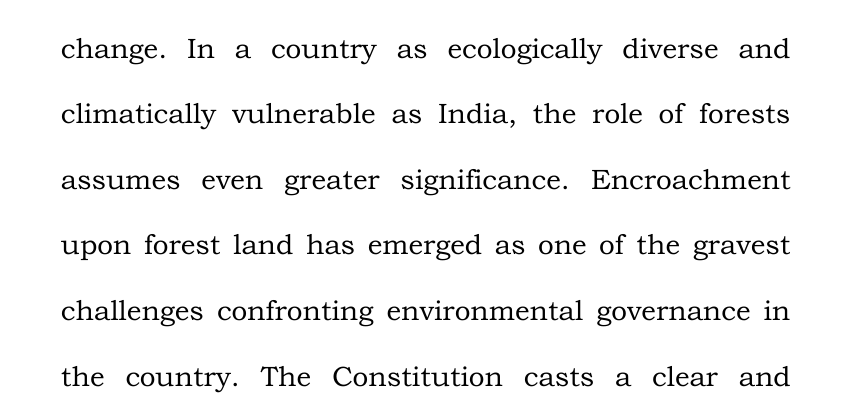
The Supreme Court noted that encroachment on the forest land has “emerged as one of the gravest challenges confronting environmental governance in the country.” The court added that in a “climatically vulnerable” country like India, forests have greater significance. “In a country as ecologically diverse and climatically vulnerable as India, the role of forests assumes even greater significance. Encroachment upon forest land has emerged as one of the gravest challenges confronting environmental governance in the country,” the Supreme Court stated.
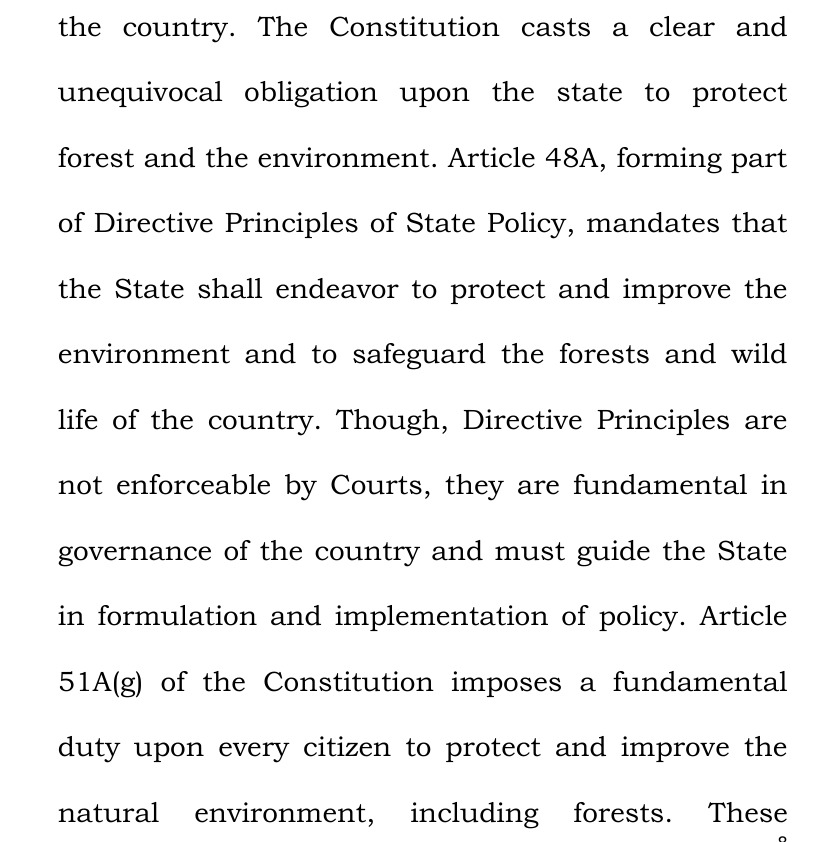
“The Constitution casts a clear and unequivocal obligation upon the state to protect forests and the environment. Article 48A, forming part of the Directive Principles of State Policy, mandates that the State shall endeavour to protect and improve the environment and to safeguard the forests and wildlife of the country,” the Court added.
“Forests constitute one of the most vital natural resources of the nation. They are not merely repositories of timber or land capable of alternate use, but complex ecological systems indispensable for maintaining environmental balance. Forests regulate climate, preserve biodiversity, recharge groundwater, prevent soil erosion, and act as a natural carbon sinks mitigating the adverse effects of climate change,” the court said, highlighting the significance of forest land.
State’s plan for eviction is fair and reasonable: Supreme Court
Solicitor General Tushar Mehta apprised the court that, as per the state’s process to remove encroachment, a committee of forest and revenue officials will issue notices to people in occupation of the land. These people will be given a chance to furnish documents to prove their right to the land. In case the occupants are not able to prove their claim over the land, a speaking order will be passed. Such occupants will be given 15 days to vacate the land, and only after that period will removal action begin. Additionally, if an occupant is found to be within revenue limits and outside the notified forest area, the matter will be sent to the revenue department for further action.
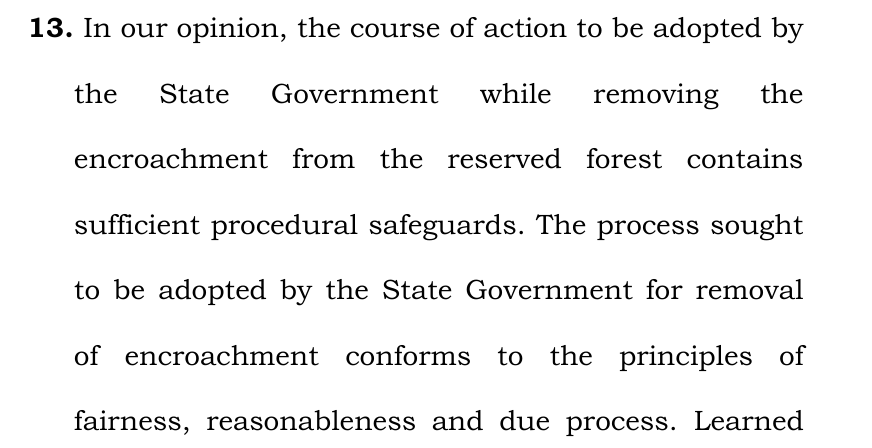
The top court examined the process laid down by the state government for conducting the anti-encroachment drive and observed it conforms to the principles of fairness, reasonableness and due process. “In our opinion, the course of action to be adopted by the State Government while removing the encroachment from the reserved forest contains sufficient procedural safeguards. The process sought to be adopted by the State Government for the removal of encroachment conforms to the principles of fairness, reasonableness and due process,” the Supreme Court said.
Assam CM Himanta Biswa Sarma welcomed the Supreme Court’s decision approving the Assam government’s anti-encroachment drive. “In a landmark judgement, the Supreme Court has empowered Assam to effectively fight encroachments in forests. A committee will be constituted to determine whether an area is forest or revenue land- once that determination is done, evictions can begin in just 15 days,” CM Sarma wrote on X on Wednesday (11th February).
In a landmark judgement, the Supreme Court has empowered Assam to effectively fight encroachments in forests.
A committee will be constituted to determine whether an area is forest or revenue land- once that determination is done, evictions can begin in just 15 days. pic.twitter.com/ETkiqGoT5j
CM Himanta Biswa targeted by the opposition and media for protecting the state’s land
The Assam government under Chief Minister Himanta Biswa Sarma has launched a major crackdown on encroachment across the state. In the past year, the state government intensified its efforts to free government land from the clutches of land grabbers and freed thousands of acres of land. CM Sarma has maintained that the anti-encroachment drive is part of the state government’s resolve to put an end to the “demographic invasion” of Assam by infiltrators. He asserted that the removal of the government and forest land is important to prevent the systematic alteration of the state’s demography.
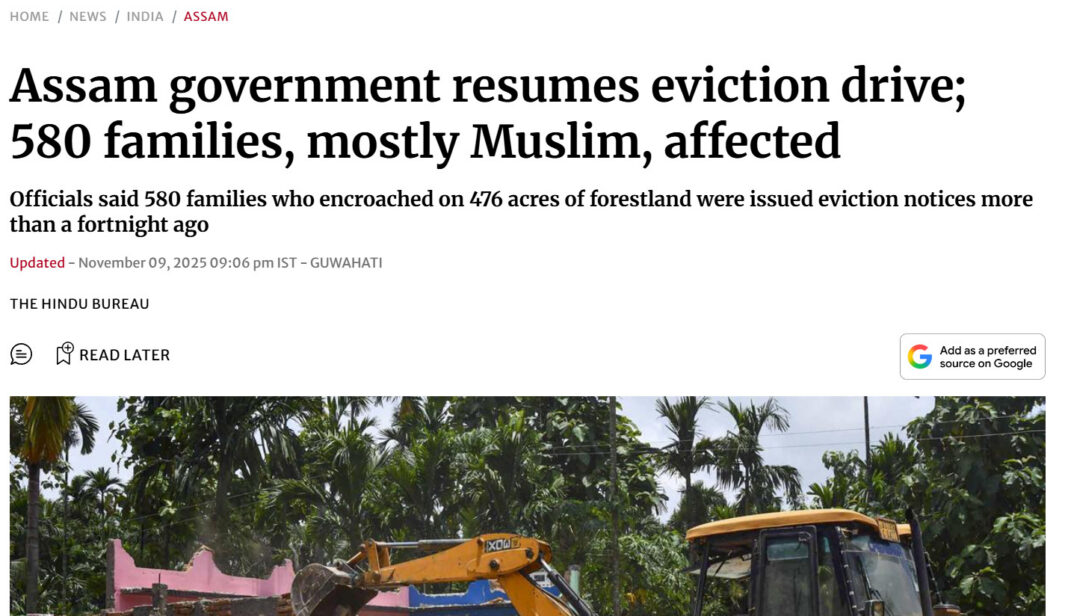
His strong stance against infiltrators and encroachers has put CM Sarma at the target of the opposition as well as the leftist media, who have been maligning his government’s legitimate anti-encroachment action as ‘anti-Muslim’.
Screenshot from The Hindu report
The media have been portraying the Assam government’s legally compliant action of removing land-grabbers from the government land as a targeted action against the state’s Muslim population.
Report against the anti-encroachment drive
CM Sarma has clarified on multiple occasions that the action of his government concerns Bangladeshi infiltrators who have entered the state illegally and have settled here after forging documents to avail benefits meant for natives and not local Muslims.
Now, even the Supreme Court has upheld the Himanta government’s action as fair and reasonable and necessary to protect the forest land.
Ever since India and the United States announced a framework for an interim trade deal, common people are curious about what the final agreement will look like, politicians are either fully endorsing it or trashing it, and traders are seeing the impending agreement with cautious optimism. As part of the India-US agreement, India has agreed to grant the US quota-based concessions on specific agricultural products, including apples. However, the prospect of American apples entering Indian markets has alarmed Indian growers, particularly in Jammu and Kashmir, Himachal Pradesh, and Uttarakhand.
The quota allocation for US apples, concerns of Indian growers and the Central government’s assurance
Under the India-US trade agreement, the Indian government has reduced import duty on US apples from 50% to 25%, coupled with a Minimum Import Price (MIP) of Rs 75 to 80 per kg. This move effectively prevents very cheap apples from flooding Indian markets and harming the business of local growers, as the landed cost would be around Rs 100 per kg or more after duty.
However, despite the quota-based system providing protection, apple growers in Jammu and Kashmir, particularly the Kashmir Valley, Himachal Pradesh, and Uttarakhand, have raised an alarm. They fear that even limited imports of American apples, which are deemed uniform, high-quality and competitively priced, could depress prices, especially for stored domestic apples sold off-season.
Notably, Kashmir accounts for around 70 to 80% of Indian apple production, thus making the fruit immensely significant for local employment and stability. In Jammu and Kashmir, the apple economy is estimated to be worth Rs 12,000 crore, providing livelihood and direct and indirect employment to around 3.5 million people. In the 2024-25 season, around 21 lakh tonnes of Kashmiri apples were sold across Delhi, Bengaluru, Chennai, Ahmedabad, Kolkata, and Mumbai, etc.
Besides Jammu and Kashmir, a section of farmers in Himachal Pradesh and Uttarakhand are also linking the entry of US apples in India to their survival. They argue that surging input costs, climate-related losses, limited cold storage facilities, and transport disruptions have already affected margins for local growers. They fear that the influx of American apples during the peak season would depress prices and disrupt local economies.
The Kashmir Valley Fruit Growers Cum Dealers Union has written a letter to Prime Minister Narendra Modi, demanding an import duty of over 100% on apples from the US and Europe. The traders and orchardists cautioned that a liberal import of foreign apples would turn India’s horticulture sector into a “sick industry”.
In Himachal Pradesh as well, concerns have been raised that domestic premium apples sell between Rs 100 and Rs 150 per kg, and if US apples are available at similar prices, people will opt for the imported apples. While some opine that the MIP on American apples should have been Rs 100 per kg, many other growers are of the view that the India-US trade deal will have very little effect on the domestic apple economy. They believe that the local premium apples are good enough to compete with imports, and that instead of urging the government to raise MIP on American apples, local growers should seek subsidies and better planting material.
Amidst all this, Union Commerce Minister Piyush Goyal has given repeated assurances that the domestic growers are “fully protected”. Not only in the context of apple growers, but the Minister has also maintained that now or ever in future, India also will not enter into any trade agreement with a foreign country that breaches its redlines in the agriculture and dairy sector.
The commerce minister said that the interests of Indian farmers and MSMEs are fully protected. On the specific American apples import issue, the minister said that domestic production of apples is not in surplus against the demand. Domestic production stood roughly at 20-21 lakh tonnes, while the demand is more than 25-26 lakh tonnes. India already imports around 5.5 lakh tonnes of apples annually, with the US being the major supplier. Minister Goyal explained that the eventual price of imported American apples would be around Rs 100, and thus, the local growers and traders should not fear loss of profits.
“We are not surplus in apples. The demand for apples is more than 25-26 lakh tons. We produce about 20-21 lakh tons. As we speak, we import 5.5 lakh tons of apples every year. And a large quantity of that comes from the United States of America. We have not opened up apples. We have given them a quota on apples, which we will procure from there. That is less than the Current imports of apples from the USA,” he said.
“We have been very cautious in our opening up. Today, Apple has a minimum import price of Rs 50. And there’s a 50 per cent duty which adds Rs 25. So, Rs 75 is the base, or the floor, below which goods don’t enter the country. So in some sense, that’s the protection that the apple farmers also get, that nobody can dump material and make it so cheap that apples don’t get a fair value. Even in the quota we have given to the US, the minimum import price is Rs 80. They make high-quality apples. It’s Rs 80. There’s a Rs 20 duty on that. So, the landed price of that will be 100 rupees,” the minister said.
Further asserting that the local apple industry will not be hurt by the regulated entry of US apples, Piyush Goyal said, “It’s not in competition with our farmers. Not hurting the apple industry over here. And again, limited to a quota that is less than what they are exporting to India even today. And certainly, only a portion of the 5.5 lakh tons of apples that we are importing into India. Tell me which farmer in any hill state is hurt by this. Let any farmer explain to me what is the hurt in this.”
The prism of victimhood: Indians must escape the spiral of outrage over every progressive step
Despite the Modi government ensuring a calibrated concession for American apples and not a full market opening, local stakeholders are indulging in and also falling for the fearmongering. However, the issue transcends apples. There is evidently a deep-seated tendency in Indian policy and public discourse to frame exposure to global competition, even when it is in a controlled fashion, as victimisation rather than a catalyst for self-improvement. There is a serious need to pivot from the existing “they are harming us” mindset to “how do we make things better to meet this?”
India has a robust economy and a massive market that every major country wants enter. India aspires to become a developed nation and is relentlessly pursuing this aspiration. Such a purpose-driven country cannot have its business and traders continue using protectionism as a convenient shield. Retaliatory duties, high tariffs, and non-tariff barriers, etc, allowed local producers to avoid hard reforms. In fact, the 2020 farmers’ protest showed that reforms, no matter how good and how well-intentioned they are, are not easily accepted and even get rejected.
Coming back to the US apples issue, Indian apples, despite being flavourful, are inconsistent in quality. Issues like inadequate grading and packaging, weak cold-chain infrastructure, and reluctant adoption of modern orchard management get blamed on ‘external factors’ rather than their own shortcomings. American apples get an edge over Indian apples due to quality, which is backed by the use of advanced technology, better pest management, controlled atmosphere storage ensuring longer shelf life, and adherence to quality standards.
The excuses of ‘sanctions’ and ‘unfair foreign competition’ have already caused delay in investments that competitive markets, be it New Zealand or Chile or the US, made decades ago. If Chilean, Turkish and the previous imports of foreign apples did not wipe out Himachali or Kashmiri apple growers, the sudden hue and cry over US apples does not make much sense.
The fact is that local apples carry cultural appeal, a lower base price, and domestic traders have established supply chains, giving Indian stakeholders an edge over foreign competition. The real differentiator in this scenario would be consumer preference; if US apples gain dramatically high preference, then there will be a noticeable quality or value gap which domestic producers will have to match.
Higher quality, diverse options and competitive prices create value and generate pressure for improvement. It is high time that instead of outraging, protesting and playing victim, domestic producers and traders level up their game, focus on improving quality, going for better branding, and investing in better infrastructure like cold-storage, etc, instead of pressuring the government to shut doors to foreign trading partners. In fact, the domestic stakeholders should seek the government’s help in filling in the quality, technology and infrastructure gaps.
There may be immediate disruptions; however, competition does not devastate capable producers; rather, it weeds out inefficiency and rewards adaptation. The post-1991 liberalisation trajectory of India’s auto, telecom, and consumer goods sectors serves as a fitting example of this. Domestic producers may try to bend the government into giving the desired reprieve; however, it is the consumers who are deprived of diverse and perhaps better options and paying higher prices. Thus, the culture of fostering complacency must be ditched.
Clinging to the idea of monopoly and victimhood at the same time limits the potential of Indian producers. They need to reckon with realities, upgrade practices, enhance post-harvest handling, and become competitive against global standards. Competition is essentially a market mechanism that triggers the raising of standards, not victimisation. This victimhood mindset only keeps producers and the nation weaker in the long run. Understandably, all this is better said than done; however, Indian producers and traders have to choose between stagnation disguised as ‘protection’ and dynamic growth by facing competition.
It is also the responsibility of the state/UT administration as well as the Central government to address the genuine concerns raised by the domestic producers and traders, and provide all necessary transition support to ensure that their interests are not crushed between foreign competition, consumer preferences and existing climatic, infrastructure or high production cost-related challenges.
Mainstream media amplifying the Kashmiri apple grower’s victimhood narrative
However, outrage over every progressive step merely because it may cause immediate discomfort is not good for the country. Every trade deal creates winners and losers. A mature economy like India must absorb the short-term disruptions with confidence, with its people showing the resilience to adapt, upgrade skills, and meet global competitive standards instead of lamenting the loss of a protected advantage.
The mainstream Indian media should also instead of plainly amplifying Kashmiri apple growers’ victimhood narrative; framing the limited and safeguarded import of US apples as some sort of existential threat. Instead of reinforcing a victimhood prism and lending credence to the opposition’s ‘total surrender’ rubbish, the media should have highlighted how India already imports apples year-round from various countries without crushing domestic production. Amidst the whole alarmist and victimhood noise amplified by the media, the fact that American apples will be competing mainly in the premium-urban segments, and not wipe out local ones, is getting suppressed.
A short video clip of Aastha Singh, an employee of HDFC Bank, has gone viral on social media and triggered a heated debate around caste, identity and online judgment. In the video, Aastha is heard saying, “I am a Thakur… don’t do this nonsense.” Soon after the clip spread, many users began accusing her of promoting casteism.
An HDFC branch employee in Kanpur said –
"I am Thakur; don’t mess with me. B*****i mat karna mere saath"
Aastha Singh later responded, saying the video being shared online is incomplete and shows only her reaction, not what led to the confrontation. She said she is being targeted based on a cropped clip and repeated that she is a Thakur and is proud of her identity.
Strong backlash on social media
After the video started circulating, Aastha Singh faced intense criticism online. Several users accused her of showing caste pride inside a bank and labelled her actions as caste arrogance. Some comments went beyond personal criticism and targeted the entire upper caste community, including Brahmins and Thakurs.
An X user, Suraj Kumar Bauddh, wrote that Aastha had flaunted her caste inside the bank and called for strict action against her.
Another user, Nher, claimed the video showed the “real face of casteists” and linked the incident to the need for new UGC rules.
Other users made crude and abusive remarks, with some even demanding reservations in the private sector.
The outrage did not stop at individual comments. Some verified and official social media handles also shared the clip with sharp remarks. In many posts, Rajputs, their history, and even Thakur women were insulted, all based on a short, edited video of about 10 seconds.
The context of the UGC regulations adds fuel
The video gained even more attention because it surfaced during ongoing debates around University Grants Commission (UGC) regulations. While many from Brahmin, Thakur, and other upper caste communities claim they are being sidelined by the new rules, lower caste groups have long accused upper castes of discrimination.
In this atmosphere, the clip of Aastha Singh was quickly framed as an example of caste arrogance by some users, even though the full background of the incident was not clear at that time.
Many netizens come out in support of Astha
Amid the backlash, several users also spoke in support of Aastha Singh. They pointed out that the viral clip was incomplete and accused people of jumping to conclusions without knowing the full story.
An X user, Being Political, said people were quick to label her casteist just because she mentioned her caste, but ignored the possibility that she was provoked first. The user questioned why the narrative quickly turned into blaming the “Thakur community” instead of looking at the full incident.
Another user wrote that they respect women who stand up for themselves, regardless of caste, and added that the clip was too short to judge what really happened.
Advocate Ashutosh J Dubey also defended Aastha, saying the complete video shows she was abused first and only reacted in self-defence, not discrimination.
Yadu Singh, another user, said that responding to harassment is not a crime and that no law under the IPC 2023 (BNS) was violated. He also criticised the sharing of edited clips, calling it an attempt to push an agenda.
Aastha Singh explains the full Incident
After days of outrage and online attacks, Aastha Singh herself came forward to explain what actually happened. She said the viral clip was incomplete and did not show what led to her reaction.
मै ठाकुर हूँ आस्था सिंह के वायरल वीडियो की पूरा सच मै अभी भी अपने स्टेटमेंट पर कायम हूँ मुझे अपने ठाकुर होने पर गर्व है! क्या मीडिया ट्रायल करने वाले लोग माफी मांगेंगे? pic.twitter.com/IIvTHPIyYM
According to Aastha, the incident took place on 6th January at her bank branch. On that day, a fellow employee, Ritu Tripathi, had submitted her resignation and requested to be relieved the same day. Ritu’s sister-in-law was present at the branch since morning, and a minor argument took place during the process.
Later, Ritu informed her husband, Rishi Tripathi, who arrived at the branch after closing time. Aastha said he behaved rudely and came to her desk, where he asked her caste and made threatening remarks like, “I will take away your arrogance and anger.”
She explained that the viral video only shows her response to those comments and not the provocation she faced before that.
“I am a thakur, and I am proud of it”
Aastha Singh said she stands by her statement and has no regret in asserting her identity. She said the issue was wrongly projected as casteism when it was actually about self-respect.
“If anyone speaks rudely to me, I will not tolerate it. I am a Thakur, and I am proud of it,” she said, adding that being proud of one’s identity does not mean insulting others.
She also said that the edited video was used to target her personally and turn the matter into a caste-based controversy.
Rape threats and abuse after the video goes viral
The controversy took a darker turn when Aastha revealed that she had been receiving rape threats and threats of violence after the video went viral. Speaking to the media, she said she was shocked by the level of hatred directed at her.
“Everyone wants to be famous, but not in the wrong way. I am becoming famous in the wrong way,” she said. She added that such threats have caused mental stress and fear, and no one deserves this kind of abuse over a misrepresented video.
Company response and legal options
Aastha said she has informed her seniors and sent internal emails explaining the full situation. According to her, the management is aware that she is not at fault, which is why no immediate action was taken against her.
However, she also said that if the harassment continues, she will consider filing a defamation case against those spreading false narratives using edited clips.
As the debate continues online, the incident has once again raised questions about social media trials, edited videos, and how quickly narratives are formed without full context.
At the foothills of the sacred Girnar mountain, regarded as a land of penance for yogis, a nurturing refuge for sages and saints, and a place that offers devotees supreme peace and spiritual bliss, the Bhavnath Fair has been held for centuries. This grand confluence of devotion, faith, and spiritual splendour begins on Maha Vad Nom and continues till Mahashivratri. Sadhus, saints, mahants, and devotees from across Gujarat and the rest of India gather here for satsang and the worship of Lord Shiva.
This year, the Bhavnath Fair is being held from 11 February and on a much grander scale than usual. Considering the scale of preparations and magnificence, the fair is being described as a “Mini Kumbh.” This year, the administration of the Bhavnath temple is also under the government, which is making special efforts to preserve the sanctity of the fair and give it recognition at the national and global level. Final touches are currently being given to the arrangements and preparations.
The fair is organised at the highly sacred Bhavnath Mahadev Temple, situated on the banks of the Suvarnarekha River at the foothills of Girnar. The Shiva Linga in the temple is self-manifested (swayambhu). The name “Bhavnath” means the “Lord of Bhava” (the manifested world), that is, Lord Shiva, the creator and master of worldly existence.
What are the legends associated with the temple?
According to legend, during the time of cosmic dissolution (Pralaya), the entire creation merged into Rudra, and the day of Brahma came to an end. At dawn, Brahma, Vishnu, and Rudra manifested again in the forms of Sattva, Rajas, and Tamas. During Pralaya, Lord Shiva was in deep meditation within the waters. A dispute arose among the three about who was supreme. Shiva intervened, assigned Brahma the task of creation, Vishnu that of preservation, and Rudra that of destruction, and thus resolved the conflict.
Brahma, the father of the world, then requested Shiva to reside in the world and help resolve the joys and sorrows of human beings. Lord Shiva surveyed the earth, and his gaze fell upon the forest-clad Ujjayant mountain (Girnar), where he chose to reside. Meanwhile, in Kailash, Parvati could not find Mahadev and began searching for him.
After hearing from the other gods, she set out in anger to find Shiva and, along with the deities, reached Girnar. On that day, Lord Shiva manifested here in the form of Bhavnath, it was the full moon day of Vaishakh Shukla Paksha. Parvati came to reside on Girnar in the form of Ambika, Vishnu took the form of Damodar and stayed at Damodar Kund, and other gods, yakshas, and gandharvas also made different places on Girnar their abode, such is the popular belief.
The story of Mrigi Kund, located beside the temple of Lord Mahadev, is equally fascinating. It is said that King Bhoj of Kanyakubja was told by his attendants that in the forests of Revatachal (Girnar) there roamed a being with the face of a deer and the body of a woman. After much effort, King Bhoj brought her to his palace, but scholars could not solve the mystery. Finally, the king went to an ascetic practising severe penance at Kurukshetra.
The sage granted the “deer-faced woman” the power of human speech. She narrated her past life: earlier, King Bhoj was a lion, and she was a doe. While being hunted, her head got stuck in a bamboo thicket, and her body fell into the Suvarnarekha River. By the sacred waters of the river, her body assumed a human form, but her face remained that of a deer.
On the sage’s instructions, the king retrieved the skull of the doe from the thicket and immersed it in the waters of the Suvarnarekha. As a result, her entire body became human. King Bhoj then married her, and at her suggestion, built this kund at the foothills of Girnar, hence it came to be known as Mrigi Kund. This is a legend based on popular belief, and even today, on Shivratri, sadhus take a ritual bath here.
Why is this place called “Vastraput Kshetra”?
This region is also known as “Vastraput Kshetra.” According to a story mentioned in the Skanda Purana, Lord Shiva and Goddess Parvati were once travelling in a celestial chariot when one of Parvati’s divine ornaments fell at this spot. Since then, the place came to be known as Vastraput Kshetra. This story is also mentioned in the Gujarat government’s Information Department publication “Gujaratna Lokotsavo ane Mela” (Folk Festivals and Fairs of Gujarat).
The special significance of the sadhus’ bath at Mrigi Kund
The central focus of this fair is not householders but sadhus and saints. On the day of Nom, the fair is formally inaugurated by hoisting the flag at the Bhavnath temple, in the presence of sadhus who come from all over the country. The administration takes responsibility for arranging their camps and accommodations. On one side are the ascetics’ camps, and on the other, service organisations set up tents. Religious stalls come up, and for four days, the entire foothill area becomes immersed in devotion to Shiva.
Although the fair has been held for centuries and has seen some changes over time, its essence remains intact, the ritual bath by sadhus in Mrigi Kund. Just as the Shahi Snan is significant at the Kumbh Mela, the bath at Mrigi Kund holds special importance at this fair.
The midnight processions of sadhus on Shivratri are the main attraction
The biggest attraction of the fair is the chariot processions and ceremonial parades taken out by sadhus at midnight on Shivratri. Naga sadhus, Aghori sadhus, and ascetics from various akhadas ride on horses, carriages, or elephants, proceeding with conch shells and bands playing music, on their way to take a ritual bath at Mrigi Kund. Along the way, they also display feats like physical exercises, swordplay, and staff-fighting.
The Shahi Snan is led by the Panchdashnam Juna Akhada, along with mahants, mandaleshwars, and thousands of sadhus from other akhadas. These processions reach Mrigi Kund one after another, and the saints and Naga sadhus take turns bathing.
It is believed that Naga sadhus who live in the caves of Girnar also join these processions, and there is a popular belief that some sadhus disappear after bathing and are never seen emerging from the kund again. After the sadhus complete their bath, aarti and maha puja of Lord Shiva are performed at the Bhavnath temple. By morning, the fair comes to its conclusion.
Speaking to OpIndia, Mahant Ramjubapu of Ambika Ashram said, “This fair is as sacred and purifying as the Kumbh. Here, on Mahashivratri, thousands of Naga sadhus and Aghoris take the Shahi Snan in the kund, but they do not come out after bathing. To this day, no one knows where these sadhus come from and where they disappear after taking a dip in Damodar Kund.”
Social organisations engage in service activities
On the land of Saurashtra, such a religious congregation cannot happen without service activities. At the Bhavnath Fair too, social organisations and donors from across Gujarat and India arrive in caravans from as early as the fifth day to serve the sadhus and devotees. Their camps and lodgings are pre-decided, such as Jerambapa’s Girnari camp, Toraniya’s camp, Parab’s camp, Bhurabhagat’s tent, Laxman Barot’s camp, Khodiyar Ras Mandal’s tent, and others.
At these places, arrangements are made for meals three times a day and for overnight stay. Continuous bhajans, satsangs, and saintly discourses go on. Some well-known artists also arrive and participate in devotional performances. Devotees keep coming and going throughout the day, and all arrangements are made so that they can partake in both food and worship.
The Bhavnath Fair held at the Bhavnath temple is not merely a festival; it is a unique confluence of devotion, penance, service, and satsang, where the soul experiences union with Shiva.
On 5th February (Thursday), an explosion took place in an illegally run rat-hole coal mine in the East Jaintia Hills area of Meghalaya, which resulted in 30 fatalities. The figures also include those who succumbed to their wounds. The tragedy happened at an unlawfully operated coal mine in the remote Thangsku neighbourhood of Mynsngat village. According to reports, 8 individuals are admitted at the Shillong hospital with three more at the Silchar hospital.
This ranked among the most significant mishaps since July 2012, when a flooded mine in the South Garo Hills district of the state claimed the lives of 15 miners. Afterwards, the dangerous mining technique was outlawed by the National Green Tribunal (NGT).
Image via d-maps.com
Meghalaya High Court heard testimonies from the East Jaintia Hills district’s Deputy Commissioner Manish Kumar and Superintendent of Police Vikash Kumar regarding the matter and sought a thorough report on the actions taken by the authorities to put an end to such illicit activities. They were told to “furnish reasons as to why the situation has been allowed to continue.”
The Division Bench of Justices HS Thangkhiew and W Diengdoh also voiced grave concerns over the blast and the state’s persistent unsanctioned coal mining instances. They severely criticised the state apparatus for its inability to prevent prohibited rat-hole coal mining in the East Jaintia Hills area, describing the situation as “distressing” and warning to impose responsibility if the violations continued to exist.
“The report is distressing and reflects dereliction in the discharge of duties by the authorities concerned,” the court stated. The district administration’s status report informed that two arrests were carried out and a criminal case had been filed but it also mentioned a lack of manpower.
The Meghalaya Human Rights Commission (MHRC) took suo motu cognisance and demanded a detailed report from the government. Search and rescue efforts involving the National Disaster Response Force (NDRF), State Disaster Response Force (SDRF), Special Rescue Team (SRT), police and district administration were officially concluded at 5 pm on Monday. 24 bodies were found in the 100-foot-deep chain of low and narrow tunnels.
How the Meghalaya government reacted
Chief Minister Conrad K Sangma declared that the state government would launch a judicial inquiry commission to probe the occurrence, determine the cause of the catastrophe and assign accountability. The district administration similarly increased its efforts against unauthorised mining in the wake of the disastrous event.
#WATCH | Meghalaya's East Jaintia Hills coal mine incident | Rescue operations underway at the blast site to rescue the trapped mine workers.
25 people died in the blast that took place in an illegal rat-hole coal mine on 5th February. pic.twitter.com/zR8qzMKLP2
Nearly, 38 metric tonnes of coal that had been mined were confiscated from multiple areas, including the villages of Lumshyrmit–Cham Cham, Mukhaialong, Mutong and Pynthorsale by joint teams of Executive Magistrates, police officers and representatives from the Directorate of Mineral Resources (DMR).
Furthermore, authorities located and destroyed temporary camps associated with these perilous mining ventures while First Information Reports (FIRs) have been lodged and additional legal action is ongoing. The families of 8 victims have already received ₹24 lakh (3 lakh for each next of kin) in compensation from the government. According to officials, payments are set to resume once the documentation of the remaining families has been confirmed.
Assam has likewise offered ₹5 lakh to each victim from the state. Prime Minister Narendra Modi also conveyed that the Prime Minister’s National Relief Fund (PMNRF) would grant ₹2 lakh for the departed and ₹50,000 for the wounded.
Image via The Assam Tribune
All magistrates in Thangkso were tasked by the district administration to carry out inspections, seize cars, machinery and equipment employed in this forbidden work, as well as locate and apprehend financiers, mine owners, operators and “any people involved in illegal mining activities.”
The district magistrate has issued prohibitory orders under Section 163 of the Bharatiya Nagarik Suraksha Sanhita (BNSS) in the impacted regions to maintain public safety alongside law and order. It mentioned “serious likelihood of obstruction to law enforcement by certain individuals or groups during operations against illegal mining activities.”
The government has encouraged the citizens to assist authorities, abstain from illegal mining and stay out of dangerous or restricted areas. The police earlier submitted a suo motu FIR at the Khliehriat (district headquarters) police station with pertinent provisions of the Bharatiya Nyaya Sanhita, Mines and Minerals (Development and Regulation) Act, along with the Explosives Substances Act.
What is rat hole mining?
Rat hole mining is an archaic and unscientific technique for removing coal from slender and horizontal seams in Meghalya. The land is cleared by chopping and removing the vegetation, after which pits are created to access the coal seam. A coal seam is a visible, dark brown or black-banded coal deposit formed inside rock layers.
Image via Centre for Science and Environment
The narrow trenches that are excavated into the ground are usually only big enough for one person to descend and retrieve coal. These are referred to as “rat holes.” Miners utilise bamboo ladders or ropes to navigate the coal seams when the pits are dug. The coal is manually removed using equipment like baskets, shovels and pickaxes. The mining is executed via two methods known as the side-cutting procedure and box cutting.
People enter the narrow tunnels built on the hill slopes, merely 3-4 feet deep, usually only big enough for one person to crawl inside and out, and proceed until they reach the coal seam, which is less than 2 metres thick, as part of the side-cutting procedure. They must squat to extract coal.
Image via PTI
Box-cutting involves carving a rectangular opening that is between 10 and 100 square meters in size and then making a vertical pit that is between 100 and 400 feet deep. Workers can extract coal by digging horizontal tunnels through the coal seam after it has been located. They go down with the help of rope-and-bamboo ladders or improvised cranes. The tunnels are constructed from the pit’s edge in all directions.
NGT slaps a ban in light of serious concerns
The Coal Mines Nationalisation Act of 1973 does not apply in Meghalaya, a Sixth Schedule State and the government has limited authority over the land. Therefore, the minerals underneath are also owned by the landowners. After Meghalaya became a state in January 1972, coal mining took off. However, mine owners did not adopt sophisticated drilling equipment due to the terrain and associated costs. Thus, people primarily from Assam, Nepal and Bangladesh began to enter the mines for better income.
However, these are prone to the risk of asphyxiation from inadequate ventilation, collapse from a lack of structural support, like side-wall protections and engineered roofs, as well as flooding. Moreover, uncontrolled mining resulted in soil degradation, deforestation, water with high concentrations of sulphates, iron and hazardous heavy metals, low dissolved oxygen, along with high biochemical oxygen demand, in addition to safety and health fears. The Lukha and Myntdu rivers became too corrosive to support aquatic life.
A worker looks up in a rat-hole coal mine near the Lad Rymbai area in the Jaintia Hills in Meghalaya. (Source: Jamhoor)
These concerns were first presented 20 years ago. The problem of child labour and human trafficking in these mines also surfaced. According to reports, kids were employed there owing to their small size. Hence, NGT introduced a blanket ban on rat hole mining in Meghalaya almost 2 decades ago in 2014 and reaffirmed it in 2015.
Likewise, illegal mining, transportation and storage are also prevented under the Meghalaya Minor Minerals Concession Rules and the framework related to Mines and Minerals Development and Regulation (MMDR) Act.
Why does rat hole mining continue despite the ban?
Rat-hole mining is a regular feature for unapproved setups and never ceased to exist despite the firm actions due to a significant local reliance on coal revenue, fragmented ownership and contractorships that disperse accountability and patronage. Their operators also avoid disclosing accidents and keep workers off official records because deaths make headlines, but injuries from child labour and contaminated water, acid drains, unstable terrain and deteriorated roads do not.
A major reason is the absence of economic opportunities, which compels the locals to pursue such jobs. This business is allowed to flourish in the northeastern states as it yields far more than the Mahatma Gandhi National Rural Employment Guarantee Act (MGNREGA) and other government-run programs. Furthermore, it is very challenging to separate illegal coal from legacy or auctioned coal after it has entered the supply chain.
On the other hand, the Meghalaya High Court assigned Justice (Retd) BP Katakey to serve as a one-man committee to oversee prohibited coal mining in the state since 2022 in response to a suo-motu Public Interest Litigation (PIL) and he drew attention to the fact that “no one in the state, except the high court, is taking it very seriously” despite repeated warnings of massive unlawful extraction in Meghalaya, especially in the East Jaintia Hills.
The court observed that the Justice Katakey committee had identified East Jaintia Hills as the district hardest hit where these forbidden activities are prominently prevalent alongside other incidents in its report submitted on 17th January.
It is evident that the rat hole mining continues because of institutional enforcement shortcomings, the huge demand for coal and the serious issue of poverty. Additionally, the problem is exacerbated by inadequate imposition of law and regulation, which are aided by the inept or vested political and administrative sectors.
However, the Justice Katakey committee suggested that the recurring problem could be resolved if the state and the central governments took decisive measures to effectively enforce mining constraints. Moreover, state-owned companies must be taken into account for the temporary management of mining operations. Mineral processing, value addition and related industries should be utilised to generate alternate sources of income for the populace.