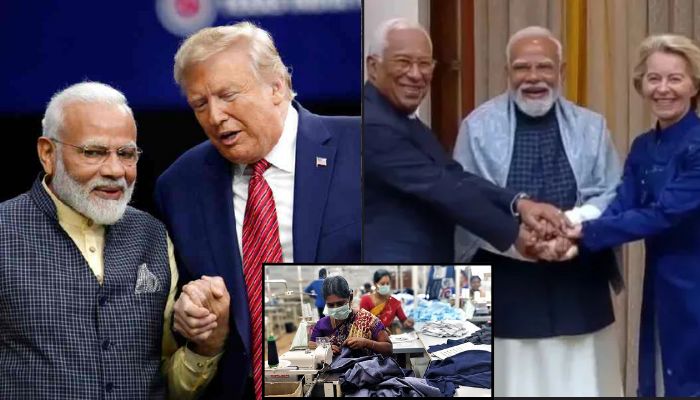
India’s textile and apparel industry is set for a great boost with the finalisation of the first phase of the India-US trade agreement. The framework for the recently announced agreement is centred on reducing import taxes on various goods to enhance trade between the two nations.
India-US Trade Agreement, major boost for Textile Industry
Currently, the USA is the largest export market for Indian textiles and textile products, with exports valued at $10.5-11 billion annually. Close to 28% of total textile and textile product exports from India in FY25 were meant for exports to the USA alone. Now, with the USA agreeing to reduce customs duty on Indian textile products to merely 18%, Indian textile exports are expected to gain a strong edge over other competing countries such as Bangladesh (20%), Vietnam (20%), Pakistan (19%), and China (30%).
On Saturday, 7th February, the Union Ministry of Textiles has said that the agreement opens up access to a massive $118 billion US import market for textiles, apparel and made-ups. This means Indian exporters will now find it easier and more cost-effective to sell their products in the US. The ministry believes that this deal will play a key role in helping India reach its ambitious target of $100 billion in textile and apparel exports by 2030, up from $37.7 billion in FY25.
A big opportunity for the textile hub of Tiruppur, Tamil Nadu
Tamil Nadu, especially Tiruppur, which is a hub for the textile industry, is likely to gain significantly from the India-US agreement. Tiruppur is a city situated about 450 km from Chennai and is also referred to as India’s knitwear capital. It has over 1,100 exporters across the city under the Tiruppur Exporters’ Association (TEA).
According to TEA president K M Subramanian, currently, the export of garments from Tamil Nadu to the US has been valued at ₹15,000 crore. This figure, he mentioned, is expected to double to ₹30,000 crore within the next three years following this new agreement. The agreement, says Subramanian, has great significance; the city will gain tremendous growth momentum within the next five years.
The employment impact could be equally impressive. At present, around 10 lakh people work in the textile and knitwear sector in Tiruppur and nearby areas. With increased exports and fresh orders from the US, another five lakh jobs could be created over the next three to five years. For a labour-intensive industry like textiles, this could bring major social and economic benefits to the region.
Entrepreneurs in Tiruppur are already optimistic. M Rathinasamy, founder of Starrlight Exporters, said that earlier, many US orders were shifting to countries like Bangladesh. Now, with the improved tariff position, more orders are expected to come back to India. Exporters believe that within the next three months, the impact of the deal will begin to show in higher shipment volumes.
This renewed growth is particularly important because Tiruppur had reportedly suffered losses of nearly ₹15,000 crore in 2025 due to tariff disadvantages in the US market. The new agreement could help factories run at full capacity again and restore confidence among exporters.
The EU deal: “Mother of all deals”
If the US agreement is a big step forward, the India–EU free trade agreement is being described as even bigger. This deal has been described as the “mother of all deals” for the subcontinent. India and the European Union have signed a wide-ranging agreement after nearly two decades of negotiations, which enables duty concessions on almost all goods and services traded between India and the European Union.
The European Union is a very large market in the world. The European Union imports goods worth $6.5 trillion every year. Commerce and Industry Minister Piyush Goyal described this agreement as a ‘game-changer’ for India’s textile industry, as it removes the initial imposition of customs duty of 9 to 12% on Indian textiles and apparel. Under the new agreement, there will be zero customs duty on 90% of Indian imports immediately, and the remaining 7% will be raised to 93% in seven years.
For a long time, Indian exporters complained about a large differential in the EU market with Bangladesh, which benefited from the duty-free market under the “Everything But Arms” facility. Bangladesh ships nearly $30 billion worth of textiles to the EU duty-free, while India’s $7 billion exports faced tariffs of up to 12%. With the new FTA, India will finally compete on equal footing.
India can now ramp up textile exports to compete with Bangladesh in Europe
"India can boost textile exports to Europe from $7 billion to $30-40 billion quickly. We were always asked how Bangladesh exports so much to Europe. They had zero duties and captured a $30 billion share" pic.twitter.com/HK6HtrJvTX
Industry experts believe India’s share in the EU textile market, currently about $5.5 billion or 6%, could double to over $11 billion in the next five years. Given that textiles are India’s second-largest employer after agriculture, employing around 40 million people, the job potential is huge. Estimates suggest that better access to the EU market could generate 6 to 7 million additional jobs in the coming years.
India already has a strong presence in home textiles such as bed linen, towels and curtains. With zero-duty access, European buyers are expected to increase sourcing from India. This means better pricing stability for retailers and long-term business security for Indian manufacturers.
Bangladesh faces growing pressure
While these deals are positive news for India, they present serious challenges for Bangladesh. The EU-India FTA significantly reduces the tariff advantage Bangladesh has long enjoyed as a Least Developed Country (LDC).
Bangladesh’s economy is heavily dependent on textiles and apparel, which account for nearly 94% of its exports to the EU. The EU absorbs about 44% of Bangladesh’s total exports. With India now enjoying zero tariffs, Bangladesh risks losing market share, especially in basic, price-sensitive apparel segments.
Bangladesh is set to graduate from least-developed country (LDC) status in 2026. Its duty-free access under the EU’s EBA scheme will effectively expire by November 2029. After that, unless it secures special GSP+ benefits, it could face tariffs of around 12% on apparel exports. If India continues to enjoy zero-duty access while Bangladesh faces double-digit tariffs, the competitive gap could widen sharply.
This situation could lead to trade diversion. European brands, looking to diversify supply chains under the “China+1” strategy, may prefer India because of tariff advantages, better regulatory predictability, and a strong cotton-to-garment supply chain.
For Bangladesh, this is a wake-up call. It will need to focus on compliance with international labour and environmental standards to secure future trade benefits. But for now, India’s improved tariff position gives it a strong edge in both the US and EU markets.
A turning point for India’s textile ambitions
Taken together, the India-US and India-EU trade deals mark a turning point for the country’s textile and apparel industry. They not only reduce tariff barriers but also improve India’s image as a reliable sourcing destination.
The deal also comes at a crucial time. In November 2025, US imports of textiles and apparel from India had dropped sharply by over 31% compared to the previous year. The new tariff structure is expected to reverse this decline and restore India’s competitiveness in the American market.
With access to two of the world’s largest consumer markets on better terms, Indian exporters could expect to benefit from more orders, expanded factories, and employment generation. States such as Tamil Nadu, Gujarat, Maharashtra, and Punjab could also see fresh investments and employment generation.
But if the momentum continues and the reforms in the domestic market are favourable to these industries, India’s dream of accomplishing $100 billion in textile exports by the year 2030 doesn’t seem to be a distant dream after all. For the industry, these trade deals promise to greenlight the coming decade.
After over two decades of prohibition, Punjab in Pakistan has formally reinstated Basant. Lahore’s skyline is once again streaked with kites. The state has gone all in to oversee what it now refers to as a “Punjabi cultural festival,” deploying surveillance drones, enforcing QR-coded kite lines, registering rooftops, and applying stiff penalties. But as Basant returned to the skies, an old justification campaign resurfaced online, with several users on X insisting that the Basant celebrated in Pakistan is entirely different from India’s Basant Panchami, and claiming that it was started in Lahore by Amir Khusro as a Muslim, kite-flying spring ritual, supposedly unconnected to Hindu tradition or Indian civilisational history.
Framed as historical nuance, this claim is anything but. It reduces centuries of civilisational continuity to a single Sufi anecdote, deliberately blurs the line between cultural participation and cultural origin, and functions as a textbook case of cultural chori, retaining the festival, its symbols, and its economic value, while quietly stripping it of its Indian roots to make it ideologically palatable.
A quarter century on, Basant proved Lahore’s spirit was only paused, never broken.This wasn’t the end of Basant; it was the return of Lahore 🩷 pic.twitter.com/y0wBO49XD5
Before Islam, before Khusro: Basant’s civilisational lineage
Basant is not an abstract “seasonal celebration” that evolved naturally in medieval Punjab. It is a vernacular continuation of Vasant (spring) observances that date back to Indic culture, predating Islam’s arrival in the subcontinent. Classical Sanskrit literature, temple calendars, and regional folk traditions all celebrate spring as a time of agricultural renewal. Basant marks the preparation for the arrival of spring. The colour yellow, central to Basant, is not a decorative coincidence; it reflects ripening mustard fields, the changing agrarian cycle, and springtime fertility across North India.
These symbols existed independently and coherently centuries before any Sufi engagement with local culture. By the time Muslim rule entered Punjab and Delhi, Basant was already a social fact, not a ritual in search of meaning, but a lived seasonal rhythm. What followed was not invention but adaptation. This distinction is crucial. When Muslim invaders, elites or common people participated in Basant, they were entering an already-established cultural space. Participation did not retroactively convert the festival’s origin, just as celebrating a harvest does not rewrite the origin of agriculture.
What Amir Khusro actually did and what is being falsely attributed to him
Amir Khusro’s relationship with Basant is real, but what is deceptive is the scale and significance that are now being retroactively built around it. The historical record places Khusro’s Basant observance squarely within the precincts of Delhi’s Nizamuddin dargah, not Lahore, and ties it to a specific, symbolic episode rather than the creation of a new festival. Following the death of his young nephew, Hazrat Nizamuddin Auliya is said to have withdrawn into grief. Among them was Amir Khusro, whose poetry blended Persian court culture with local vernaculars.
According to dargah tradition, Khusro encountered a group of Hindu women dressed in yellow, carrying flowers, on their way to the Kalkaji Mandir to celebrate Basant. Khusro adopted the colour yellow and brought the symbolism back to the dargah, where it briefly lifted his mentor’s sorrow. It is in memory of this act that Basant continues to be ritually observed at the Nizamuddin shrine.
This is not just a ‘Heeramandi’ song. Watch till the end to discover the rich history behind Khusrau’s ‘Sakal Ban’. Centuries ago, on Basant Panchami, when grief silenced a Hazrat Nizamuddin, his disciple chose the colours, rhythms, and beauty of a Hindu festival to heal him. pic.twitter.com/BvNCONRibF
This episode explains why Basant is commemorated at one specific Sufi shrine in Delhi. It does not explain the origins of Basant itself, nor does it support the claim that Khusro “started” Basant as a Muslim festival, introduced it to Muslims at large, or founded a kite-flying tradition in Lahore. There is no contemporaneous Persian chronicle, tazkira, or historical account that makes such a claim. What is being projected today is not history, but retrospective myth-making.
Why this rewriting is convenient for Pakistan
Pakistan’s relationship with its pre-Islamic past has always been uneasy. Hindu temples are neglected, Indian history is marginalised in textbooks, and ancient cultural continuities are treated as ideological liabilities. Yet Basant poses a problem: it is too deeply embedded in Punjabi social life to be discarded altogether. The solution has been to retain the festival while rewriting its provenance. By framing Basant as a “Punjabi” festival rather than an Indian one, a Muslim cultural practice rather than a Hindu seasonal observance, and a Khusro-origin tradition rather than a pre-Islamic continuity. Pakistan gets to enjoy the celebration without confronting the civilisational inheritance it comes from.
That is the essence of cultural theft, keeping the practice, erasing the source.
Conclusion: You can celebrate, but you cannot erase
There is nothing illegitimate about Punjabis in Pakistan celebrating Basant. After all, Culture survives borders and outlives states. But there is something deeply dishonest about celebrating a festival while denying its origins. Basant does not need Islamic validation. Amir Khusro does not need to be turned into a civilisational founder. And Punjabi culture does not need historical amnesia to survive. You can fly the kites. You can paint the city yellow. But you cannot cut the string that ties Basant to its Indian, Hindu, civilisational roots, no matter how many times the story is rewritten.
On 2nd February, a sessions court sentenced two individuals to 10 years of imprisonment each, related to cow slaughter and the unlawful possession of beef in Godhra, Gujarat. The father and son duo have been identified as Mehboob Abdullah Saburiya and Farhan Mehboob Saburiya, while another person, Salim Siddiqui, was acquitted due to a lack of sufficient evidence.
This case dated back to 9th July 2024, and the pair has been convicted under sections 5(A), 6(B), 8(4) and 10 of the Gujarat Animal Preservation Amendment Act and a fine of Rs 2 lakh each was also imposed on them.
On 9th July 2024, officers from the Godhra B Division police station were conducting a routine patrol when a suspicious vehicle was observed near the Ali Mosque along the Godhra-Hamirpur road. The cops halted and interrogated the occupants, but several of them fled the scene. After this, two men were apprehended, and the vehicle was searched, leading to the discovery of cow meat.
The authorities also confiscated several weapons. During the interrogation, they revealed their identities and disclosed that Salim Siddiqui and Faisal Maqsood had summoned them to Hamirpur and provided them with the consignment. They were taking it to their place to sell.
The police then called a veterinarian to the location to inspect the meat, which weighed approximately 53 kilograms. The samples were sent to the Surat Forensic Science Laboratory (FSL) for testing, and the report arrived the next day, confirming that it was beef. The police then registered a case against the accused under the Gujarat Animal Preservation Act and took them into custody.
The police launched an FIR (First Information Report) against three individuals in total. Mehboob and Farhan were nabbed at the spot with beef, while Salim was reported to have supplied the beef to them. Subsequently, the case was brought before the Sessions Court, where the charge sheet was submitted on 19th November of that year. It established the charges on 20th February 2025 and commenced the trial, as the verdict was delivered a year later.
The court called and cross-examined numerous witnesses, including police officers, panches and veterinary officers. Furthermore, the prosecution introduced evidence such as the panchnama (witness statement), the veterinary report and the Forensic Science Laboratory findings.
The court’s judgment
The court noted that both the veterinary and FSL reports clearly substantiated that the seized meat was beef in its ruling. Cow slaughter alongside the storage, transportation and sale of beef are completely prohibited in Gujarat.
The court further mentioned that both perpetrators were caught at the scene with the beef. On the other hand, they failed to prove any official permission for the slaughter or carriage of the meat during the trial. Furthermore, the pair argued that they had been falsely implicated by the police, but the court rejected these arguments, outlining that the seizure, sample testing and other procedures were conducted properly and convicted them.
The court, however, acquitted the third accused, stating that he was not found with beef and the prosecution’s assertions relied exclusively on the statements of the co-accused. It is remarked that such statements lack independent verification, cannot be deemed definitive and cannot serve as the foundation for convicting anyone in a criminal trial. Hence, he was granted the benefit of the doubt.
The court highlighted that the father and son acquired beef on a significant scale with the intent to sell it at retail from their residence despite the legal ban, thereby committing deception. It was observed that in light of the amendments made to the law by the government in 2017, imposing a sentence would reinforce the original intent of the law, deter such criminal activities in society and impose legal restrictions on those who engage in such offences.
The court eventually sentenced the two Muslim males and mandated that their prison terms would be prolonged by an additional two years if the penalty was not paid.
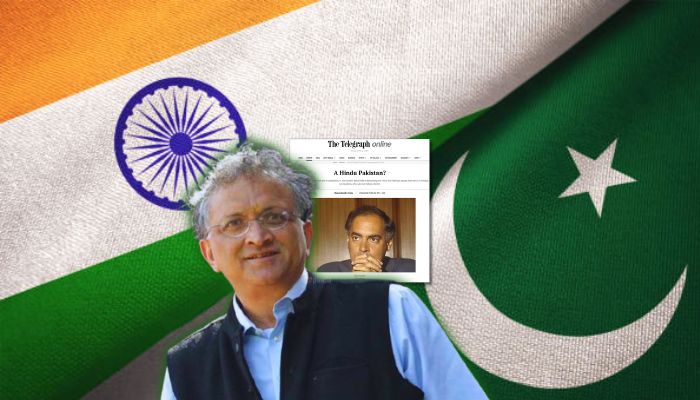
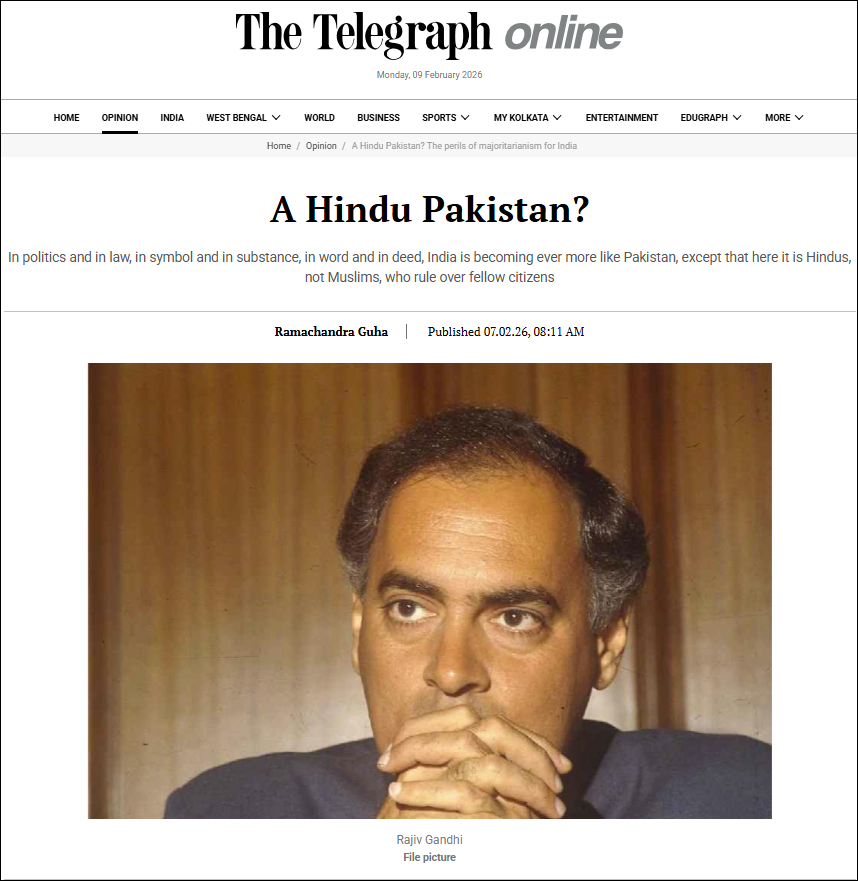
Equating India with Pakistan, be it in terms of economy, military, governance or religious freedom, is essentially an insult to India and an utter contempt of basic facts. However, in its pursuit of adding melodramatic, dishonest and alarmist chapters to the Muslim victimhood, or rather, atrocity literature, the Indian left-liberal cabal keeps doing it, again and again. In this vein, leftist ‘historian’ Ramachandra Guha wrote an opinion piece in The Telegraph India on 7th February, wherein he contended that a supposed ‘Hindu majoritarianism’ is turning India into a ‘Hindu Pakistan’.
Secular India mirroring Islamic Pakistan? Ramchandra Guha recycles the ‘Not the India I grew up in’ trope
At the very onset of the propaganda piece titled “A Hindu Pakistan?”, Guha invokes India’s first Prime Minister, Jawaharlal Nehru, to contend that contrary to the initial envisioning of India as an inclusive nation, unlike Pakistan, India under the Modi government is “coming ever closer to Pakistan with regard to the merging of faith and State.”
Ramchandra Guha wrote that while Nehru worked “assiduously to marginalise the forces of Hindutva”, despite a significant section of the Congress party’s leadership not agreeing with him, it is drifting away from inclusivity to majoritarianism.
“Nehru’s commitment to secularism and equal rights for minorities was not universally shared even within his Congress Party, which had its fair share of conservative Hindus. However, as prime minister, he himself worked assiduously to marginalise the forces of Hindutva as represented in the Rashtriya Swayamsevak Sangh and the Jana Sangh. It was only in the decades after his death that the RSS and the Jana Sangh’s successor, the Bharatiya Janata Party, grew rapidly in influence. As a result, our nation, which after August 1947 hoped to chart a different, more inclusive, path from its neighbour, is now coming ever closer to Pakistan with regard to the merging of faith and State,” Guha wrote.
The leftist propagandist cited Nehru’s letter, written two months after India’s partition, to the chief ministers. In this letter, Nehru wrote, “Whatever the provocation from Pakistan and whatever the indignities and horrors inflicted on non-Muslims there, we have got to deal with this minority in a civilized manner. We must give them security and the rights of citizens in a democratic State.”
It is not a secret that Jawaharlal Nehru was an idealist. However, idealism is suicidal when the adversary is immoral, violent, intransigent, and bigoted. PM Nehru’s idealism has done irreversible damage to India. What Nehru overlooked, Sardar Patel saw clearly.
The Muslim ‘minority’ Nehru committed to give security and equal rights, but did not even choose India. Of all, 87% of seats in the 1946 provincial elections were won by the Muslim League in undivided India. The Mohammed Ali Jinnah-led Muslim League’s core agenda and demand was the carving out of a separate nation for Muslims, Pakistan. This essentially means that 87% of Muslims in undivided India in 1946 wanted, supported, and voted for Pakistan. In fact, it was the Nehru-Liaquat Pact of 1950 that scuttled the de facto population exchange.
The point of discussing this chapter of history was important because to this day, Islamo-leftists attempt to guilt-trip the Hindu majority for hailing the loyalty of Indian Muslims whose ancestors chose’ a secular India over an Islamic Pakistan. In fact, a subtle objective of Ramchandra Guha’s op-ed is also to instil guilt within the Hindu majority that by voting and supporting ‘Hindutva’ nationalist parties like the BJP, they are essentially victimising Muslim ‘minorities’ and turning India into a ‘Hindu Pakistan’.
Basically, Ramchandra Guha wants Nehru’s ‘secular India’ where reconstruction of Somnath Mandir was deemed ‘Hindu revivalism’, and decries Modi’s ‘Hindu majoritarian’ India where Muslims are ‘victimised’ despite enjoying the rights and freedom, Pakistani Hindus can only dream of.
Guha’s contention that India under Modi is becoming a ‘Hindu Pakistan’ triggers a question: if the Bhartiya Janata Party is such a Hindu extremist and anti-Muslim party, why, despite being in power for over has it not amended the constitution to declare India a Hindu Rashtra?
In the last three general elections, not one of the 800 BJP MPs elected is Muslim: Does BJP not giving tickets to Muslims amount to the latter’s political erasure?
Ramchandra Guha lamented that the ‘majoritarian’ cast on today’s India is evident in the fact that of more than 800 MPs elected on a BJP ticket in the last three general elections, not one is a Muslim. Guha insinuated that by not giving tickets to Muslims, the BJP is essentially attempting an erasure of the ‘minority’ community from the Indian political landscape.
This is not a unique contention. Islamo-leftists have long been decrying the BJP for the supposed deliberate avoidance of Muslims as its electoral candidates. This claim of exclusion has been pushed over the years to set a narrative that Muslim ‘minorities’ are marginalised despite making up the largest population of the country after Hindus.
Guha ignores the basic fact that there is no law in India that stops Muslims from contesting, winning an elections and holding constitutional positions. His desire is that the BJP, since it has won elections, should ideally ensure that some of its MLAs and MPs are Muslims. But that is not how an electoral democracy works at all.
However, they never discuss the fact that Muslims, despite getting a large portion of the central government’s benefits, Muslims do not vote for the BJP government. In fact, the Muslim voting pattern is generally rooted in the agenda of voting for any party or candidate that can defeat the BJP. If the likes of Guha actually cared about secularism and inclusivity, they would have questioned the Muslim community about why their voting pattern revolves around their religion.
“Under Narendra Modi and Amit Shah, the BJP has sought to create a Hindu vote bank, fighting and often winning elections on the basis of the support of Hindus alone. Once a Hindu-first politics propelled them to power, the Sangh Parivar has consolidated its dominance socially, through harassing and demonising Indian Muslims (and on occasion Indian Christians too),” Guha wrote.
It is amusing that when so-called secular political parties like Congress appease the Muslim community, often by crushing the rights and interests of Hindus, why no one from the liberal ‘intelligentsia’ raise alarm that Muslim ‘minorities’ have become a religious votebank. There are political parties like the Samajwadi Party and All India Majlis-e-Ittehadul Muslimeen (AIMIM) that have been fighting elections on the basis of the support of Muslims largely, if not alone.
However, when political parties manage to rally the Muslim votebank, they are deemed secular and inclusive but if the BJP garners support of a significant section of the otherwise fragmented Hindu voters, then liberals cry that India is becoming a Hindu majoritarian state, Muslims are being excluded, marginalised, erased, and whatnot.
The political erasure of Muslims argument would have had some merit if Muslims were disenfranchised by law. This, however, is not the case; voter turnouts have consistently been high, indicating that they are partaking in elections and exercising their rights. While many Muslim caste groups have made their way into OBC reservations, Pakistani Hindus getting to breathe without being forcibly converted to Islam, discriminated against, humiliated, raped, and killed, is still a luxury.
Guha further attempted to villainise the Hindu ‘majority’ and portray the Muslim ‘minority’ as victims, by arguing that once Muslims “held important cabinet posts, ran major government departments (including the diplomatic corps and the Intelligence Bureau), headed the Supreme Court and the Indian air force”, but are missing from posts of prominence in public life.
This is such a juvenile argument. What is Guha even trying to suggest? Has the Modi government expelled Muslim diplomats or Muslim officials in intelligence agencies? Has the Modi government impeached any Muslim Supreme Court judge? Or has the BJP-led government barred Muslims from joining the Indian Air Force? That is not the case. Being a Muslim alone does not make one entitled to running government departments, heading the Supreme Court or the Indian Air Force.
Guha also claims that Muslims are subjected to discrimination in housing and to routinised taunting and humiliation, which quite often takes the form of targeted violence (as in lynchings and house demolitions).
This was supposed to evoke sympathy for Muslims, but rather, Guha’s claim raises several questions. There is no evidence of any widespread discrimination or acts of taunting or humiliation against Muslims in housing or at the workplace. Guha selectively highlighted lynchings and house demolitions to suggest that Muslims are randomly cornered by Hindus and beaten to death for being Muslims, and that the BJP governments first mark houses of Muslims and then get them bulldozed. The leftist author chose not to make any mention of the incidents of Muslims attacking Hindus, or the fact that the demolition of Muslim houses in several-ruled states is not due to their religion but has been a part of anti-encroachment drives or action against illegal properties of rioters.
Guha also chose not to discuss why Hindus and other non-Muslim communities must be growing fearful of renting their house or rooms to Muslims. When even educated doctors like Umar Un Nabi can be as hateful and intolerant of non-Muslims that they resort to carrying out Fidayeen attacks and even make videos to justify the killing of innocent people, is it not natural for non-Muslims grow fearful or even intolerant?
Moving further, what is even an Indian leftist meltdown without the mention of the Citizenship Amendment Act (CAA) and the abrogation of Article 370 in Jammu and Kashmir? Ramchandra Guha suggested that the CAA and the removal of Article 370 were anti-Muslim decisions of the Modi government.
“Hindu majoritarianism is also manifest on the legal front. The Citizenship (Amendment) Act clearly discriminated against Muslims, and the abolition of Article 370 was not unrelated to the fact that Jammu and Kashmir was India’s only Muslim-majority state,” Guha wrote in The Telegraph India.
Notably, the CAA only accelerated citizenship for persecuted non-Muslim minorities from Pakistan, Bangladesh and Afghanistan, who fled persecution at the hands of Muslims in these Muslim-majority countries. The CAA expedited Indian citizenship for Hindu, Sikh, Christian, and other non-Muslim minorities, and did not strip Indian Muslims of their citizenship.
Contrary to the narrative pushed by Islamo-leftists, the exclusion of Muslims from CAA was not driven by any anti-Muslim bias or hatred, but rather by common sense. How can Muslims be persecuted for being Muslims in Muslim-majority or Islamic countries? Shias and Ahmadiyyas are indeed subjected to violence and discrimination in Pakistan; however, these sects continue to identify as Muslims, making their case sectarian and not religious persecution.
On Article 370, Guha writes that Article 370’s abrogation was somehow related to Jammu and Kashmir being India’s only Muslim-majority state. It is amusing that liberals loathe Hindu ‘majoritarianism’ but want decisions of Muslim-majority regions or states to be contingent on the will and whims of the majority community. Basically, Hindu majoritarianism is bad, but Muslim majoritarianism is good.
Only if Indian liberals tried to understand and call out the relation between terror attacks by Jihadis and the Islamic motivations behind it, instead of finding a link between Article 370, a temporary provision, and the religious demographics of Jammu and Kashmir, they would have comprehended why Pakistan exists, and why a Hindu-majority India can never become a ‘Hindu Pakistan’.
It is criminal to even think that there is any equivalence in the situation of Indian Muslims and Pakistani Hindus. In Pakistan, Hindu, Sikh and other non-Muslim minor girls are abducted, forcibly converted to Islam, and married off to their Muslim abductors twice or thrice their age, almost on a daily basis. Even their police and courts side with the Muslim criminals in most cases. In Pakistan, non-Muslims are barred from the presidency and prime ministership by a constitutional fiat, and in India, on the contrary, Muslim politicians give open threats of eliminating Hindus if the police are removed for 15 minutes.
In Pakistan, most of the Hindu population lives in poverty, while in India, Muslims have legal or illegal control over land and properties via Waqf Boards. While Pakistani Hindus struggle to have their dignity intact, Indian Muslims are active in all fields, be it sports, movies, government jobs, politics, or even crime. Indian Muslims make up to 14% of India’s population as per the last census, and since 1947, their number has risen and risen exponentially. In Pakistan, the population of Hindu and Sikh minorities has reduced to just 2%.
Ramchandra Guha also targeted the West Bengal BJP leadership and Assam Chief Minister Himanta Biswa, who has been vocal about the attempt by illegal Muslim immigrants to alter the local demographics. Though Guha did not make any specific mention, the hint was clearly towards CM Sarma’s ‘Miya Muslims’ remark, even as the Assam Chief Minister used that term for Bangladeshi Muslim infiltrators and not Indian Muslims.
Guha also argued that while Nehru strove to keep state and religion separate, Prime Minister Narendra Modi presided over the consecration of the Ayodhya Ram Mandir. Firstly, this European concept of separation of state and religion did not originally suggest that the state had to be religion-less. But let’s not get too deep into that detail for now. Even if we go by the popular understanding of this concept, it can never fully be applied in a country like Bharat, which has the Hindu civilisation and consciousness in its soul. PM Modi’s presence at the Ram Mandir consecration ceremony did not amount to disrespect of other religious communities, or his abandonment of duties towards all citizens of India, irrespective of socio-religious, regional or linguistic backgrounds.
To appear balanced, Ramchandra Guha criticised former PM Rajiv Gandhi for betraying the Shah Bano Case and for appeasing Muslims and opening the Babri structure, for what he calls ‘Hindu appeasement’.
Leftists don’t hate Pakistan, they just hate Hindus
Equating India with Pakistan, Guha presented a role reversal in India, to suggest that while in Pakistan, the Muslim majority rules over Hindus, in India, it is Hindus ruling over Muslims. “In politics and in law, in symbol and in substance, in word and in deed, India is therefore becoming ever more like Pakistan, except that here it is Hindus, and not Muslims, who rule over fellow citizens who are of other faiths,” Guha writes.
It is essential to mention that an Indian liberal fearmongering that a secular India is somehow becoming a Hindu Pakistan, should not be misread as their condemnation of the Islamic Pakistan. In fact, leftists love Pakistan, Muslims, and everything Islamic or Islamised. It is Hindus, Hindu civilisation, and Hindu assertiveness that is called ‘Hindutva’, which the leftists hate.
The whole excuse of ‘don’t become Pakistan’ is hollow; the leftists never question totalitarian Islamic laws and mandates to render non-Muslims as second-class citizens, but their only problem is that “majority” Hindus who are winning through a secular democratic process are not “leaving” their share of seats/power for Muslims.
Despite suggesting that India should not become Pakistan, leftists cling to the wretched ‘Aman ki Asha’. The Indian leftists have time and again targeted the Modi government for shutting the doors of dialogue and diplomacy with Pakistan for the latter’s refusal to stop cross-border Islamic terrorism against India. All this despite ‘believing’ that Pakistan is governed by Islamic majoritarianism that crushes the rights and dignity of religious minorities.
Indian leftists do not want India to become like Pakistan, but when movies like Dhurandhar show the true face of Pakistan, this same lot outrages the most and cries ‘anti-Pakistan propaganda’ and ‘Islamophobia’ peddled by a ‘Sanghi’ director. No wonder Ramchandra Guha wrote in his article in The Telegraph India that Hindutva has also penetrated popular culture, with Bollywood, once a bastion of secularism, now increasingly prone to showcasing films that portray non-Hindus in poor light.
Apparently, all was well when Bollywood romanticised Islamic terrorists, villainised Hindus, mocked Hindu beliefs, promoted stereotypes against Brahmins, but when some filmmakers decided to show Muslim characters with a spectrum of nuances, such as Mughal tyrant Aurangzeb in Chhaava, Pakistani terrorists in Dhurandhar, or Jihadis in the Kashmir Files and the Islamist conspiracy of religious proselytisation in The Kerala Story, things suddenly turned bad.
India can never become a Hindu Pakistan because Hinduism lacks the genocidal feature that Islamists have
Guha concludes his article with the argument that “Making the religion of the majority central to the public identity of a nation, designing laws, policies and institutions according to the wishes of mullahs, priests, monks or rabbis, has had disastrous results in countries that are variously Sunni, Shia, Buddhist, or even Jewish. There is no reason to suppose that Hindus are somehow exempt from this rule.”
Hindus are essentially exempt from the ‘rule’ that making the majority community’s religion central to national identity, policies, laws, and institutions yields disastrous results. One would wonder why. How can it be said that India can never become a Hindu Pakistan? The answer lies in the core difference between Islamism and Hindu Dharma.
Leftists and other propagandists look at Hindus through an Islamic prism. Muslims in the majority act as Islam mandates them to. Can quote Quran verses about killing non-believers. Islamists commit genocide of Hindus and other non-Muslims because that’s a core tenet of their faith. The anti-Hindu pogrom in Bangladesh by the Muslim majority serves as an example of how Islamists can exploit any opportunity to attack Kafirs.
The only thing standing between Muslims and the realisation of that religious mandate is numbers. In Bangladesh, burning Hindus alive has become a new normal. Pakistan is witnessing a systemic erasure of Hindus. Hindus in these countries are not powerful, not Sanghi, not even in numbers strong enough to even pose a resistance and yet Islamists cannot tolerate them. The higher the Muslim population, the stricter the practice of Islam, which essentially means no tolerance of ‘Kufr’ and ‘Kafirs’. This is why Pakistan is what it is. Bharat will not become “Hindu Pakistan” till Hindus are in the majority because that behaviour isn’t a feature of Hinduism, like it is of Islam.
India, under Modi’s ‘Hindutva’ or ‘Hindu-majoritarian’ leadership, has achieved significant economic growth, enhanced national security, bolstered its position as a key leader of the global south, and its democracy is flourishing even as the opposition continues to peddle lies about it. India owes its secular character to the Hindu majority. As long as Hindus are inthe majority, India will remain a secular country rooted in Hindu consciousness. If ever Hindus are outnumbered by Muslims, forget Hindu Pakistan or Muslim India, the entire Indian subcontinent will be Islamised.
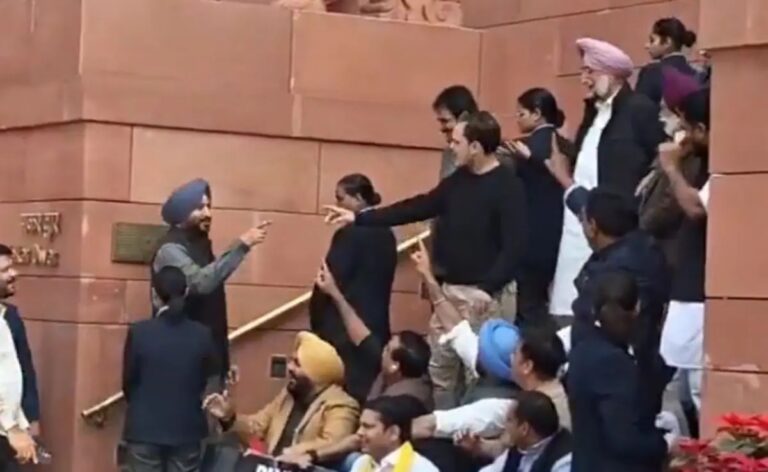
When the Leader of Opposition, Shri Rahul Gandhi, chose to brand a sitting Member of Parliament and a respected Sikh leader, Shri Ravneet Singh Bittu, as a “traitor”, inside the campus of the Indian Parliament, it was not merely a political jibe gone wrong. Such language crosses the boundaries of civility and dignity and strikes at the very identity of a community whose patriotism has been written in blood and sacrifice. For Sikhs, words like “traitor” are not casual insults, they echo a long and painful history of state-backed persecution under Congress rule.
This incident is not an aberration. It is a reminder of a pattern. For decades, the Indian National Congress has oscillated between using Sikh identity for electoral arithmetic and vilifying Sikh assertion when it challenged Congress power. Punjab’s history with the Congress party is scarred by repression, betrayal, and delayed justice. The casual slur of today draws its moral lineage from the brutal actions of yesterday.
Emergency: The first great betrayal
During the Emergency imposed between 1975 and 1977, civil liberties across India were suspended, but Punjab and the Sikh community faced a particularly harsh crackdown. More than 40,000 Sikhs, including prominent Akali leaders and grassroots workers, were imprisoned. Torture, arbitrary detention, and forced sterilisation were not excesses; they were policy tools. Sikh political mobilisation was deliberately broken because it represented a challenge to Congress’s centralisation. The message was unmistakable, dissent from Congress would be crushed, even if it meant trampling on constitutional rights and human dignity.
1984 anti-Sikh pogrom: Organised, not spontaneous
What followed Indira Gandhi’s assassination later that year was even darker. The anti-Sikh violence of 1984 was not a spontaneous outburst of grief. It was an organised pogrom. Senior Congress leaders, including Sajjan Kumar, Jagdish Tytler, H K L Bhagat, Kamal Nath, Balwant Khokkar, and Mahender Yadav, were repeatedly named by survivors. Sikh homes were marked. Voter lists were used to identify targets. Mobs were supplied with iron rods, clubs, petrol, and diesel. Over three days, thousands of Sikhs were butchered in the national capital and beyond.
Journalist Sanjay Suri later confirmed that Kamal Nath was seen leading a mob at Rakab Ganj Sahib, where two Sikh men were burnt alive. Witnesses recalled that a single signal from Nath either incited or restrained the mob. This was power exercised over life and death, in full public view.
State complicity and institutional cover-up
Investigations later revealed what victims had long known. The Central Bureau of Investigation found that the violence was backed by both the Congress government and sections of the police. Law enforcement looked away or actively assisted rioters. Transport and logistical support were arranged. Curfews were selectively enforced. Justice was not merely delayed; it was deliberately derailed.
Congress governments perfected the art of postponement and obfuscation. Inquiry commissions were set up late, under-resourced, and politically constrained. The Misra Commission, instead of delivering accountability, shielded Congress leaders, destroyed crucial evidence, and effectively exonerated the Rajiv Gandhi government. Each delay ensured that witnesses aged, memories faded, and perpetrators remained protected.
Truth acknowledged, justice denied
Even leaders within Congress could not entirely suppress the truth. Captain Amarinder Singh, while serving as a Congress Chief Minister, publicly named Sajjan Kumar and others, acknowledging that victims consistently identified Congress leaders as responsible. Yet institutional accountability never followed.
It took over three decades for a measure of justice to arrive. Sajjan Kumar was convicted only in 2018, more than 34 years after the crimes. Jagdish Tytler’s trial began as late as 2024. Many accused died without ever facing a courtroom. The Nanavati Commission in 2005 confirmed organised violence and the involvement of Congress leaders but noted that years of delay and evasion had foreclosed meaningful justice.
The Delhi High Court went further, describing the 1984 pogrom as a “crime against humanity” and observing that the accused enjoyed political patronage and escaped trial. Yet as an institution, the Congress party has never accepted responsibility. No formal apology. No accountability. Only periodic amnesia.
From violence to verbal vilification
Against this backdrop, Rahul Gandhi’s slur is not merely offensive; it is revealing. To call a Sikh leader a “traitor” without basis is to trivialise the sacrifices of a community whose Gurus laid down their lives to protect faith and freedom. Sikh valour in India’s armed forces, their role in nation-building, and their unshakeable patriotism stand in stark contrast to Congress’s historical record in Punjab.
Words matter because they carry memory. For Sikhs, Congress’s words have too often preceded violence, and its silence has followed injustice. The remark highlighted in the image is thus not an isolated lapse. It is part of a continuum that stretches from the Emergency to the streets of 1984 to the corridors of delayed justice.
A call for accountability, not amnesia
India’s democracy demands that political debate be fierce but fair. It also demands that parties confront their past honestly. The Bharatiya Janata Party believes that reconciliation begins with truth, accountability, and respect. Congress, by contrast, continues to evade institutional responsibility while allowing its leaders to demean communities it once brutalised.
Punjab and the Sikh community do not seek privilege. They seek dignity and justice. Calling a Sikh a “traitor” is not just an insult to one individual; it is an affront to a community that has repeatedly proven its loyalty to the nation, even when the nation failed it. Until Congress acknowledges its historical sins and reforms its political culture, such incidents will continue to reopen wounds that have never truly healed.
Within hours had passed after India and the United States announced a framework for an interim trade agreement and a familiar pattern started to set in. The Indian Left leaning media ecosystem rushed to declare the trade deal a problematic step by Prime Minister Narendra Modi led government and now international commentators and media have also stepped in.
They are portraying a preliminary negotiating outline as a finalised act of national surrender. From Bloomberg to The Hindu to The Wire, the language was not of analysis but of alarm. It is designed less to inform than to provoke political anxiety, particularly among farmers.
What is interesting in their cunningly worded narrative is that it is not about disagreement with the government but a deliberate attempt to mischaracterise the announcements that have been made. The joint statement issued on 6th February is not a signed free trade agreement.
As OpIndia detailed earlier, it is a framework, an outline meant to guide negotiations. Yet, it has been repeatedly described as a done deal. The narrative of the Left leaning Indian and international media is directed towards making the framework look as if it is completely filled with irreversible concessions, binding commitments and permanent losses to sovereignty.
From framework to fiction in a single news cycle
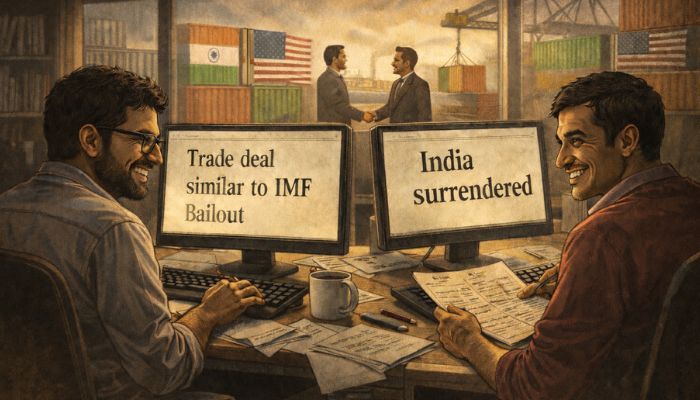
The op-ed authored by Andy Mukherjee and published by Bloomberg likened the India-US trade framework to an IMF bailout, complete with metaphors of parole, tourniquets and strategic submissions. The problem with this analogy is not its drama but its factual looseness. IMF bailouts involve legally binding conditionalities tied to the disbursement of funds. What India has agreed to here is neither a bailout nor a binding purchase order. It is a pathway to restore market access lost to punitive tariffs imposed by Donald Trump led US government.
Similarly, Prasenjit Bose, who is a Congress leader, in The Hindu declared the framework a blow to India’s strategic autonomy. He asserted that India had already committed to zero tariffs on all American industrial and agricultural goods. The joint statement does not say this. It refers to discussions on tariff rationalisation in areas where India already has import dependencies, not a blanket opening of markets.
Pushparaj Deshpande’s piece in The Wire goes a step further and repeatedly cited statements attributed to US officials as proof of Indian capitulation. At the same time, he admitted that no final text or signed agreement exists. This contradiction runs through much of the criticism. Claims are treated as facts, speculation as policy, and a negotiating posture as a settled outcome.
Russian oil and the art of selective outrage
A major portion of the fearmongering revolves around Russian oil. International media has insisted that India has agreed to abandon discounted Russian crude under American pressure. This claim does not appear in the joint statement issued by India and the US. It appears in a separate executive order issued by the White House, which reflects an American position and not an Indian commitment.
As OpIndia pointed out earlier, India has never relied exclusively on Russian oil. Purchases increased after the Russia Ukraine war because of steep discounts. Those discounts are already narrowing, and Russian oil imports have begun falling in the current financial year. To present this as a sudden collapse of energy sovereignty is to ignore both market dynamics and historical precedent.
India has previously reduced imports from Iran and Venezuela under sanctions pressure without economic collapse. That reality is inconvenient for those attempting to frame the present moment as unprecedented surrender.
Agriculture, GM panic and the return of protest politics
Fearmongering has also revolved around the agriculture sector. Farmer unions, led by groups such as the Sanyukt Kisan Morcha and All India Kisan Sabha, have announced nationwide protests on 12th February. They have accused the government of handing Indian agriculture to American multinationals. Effigies of the US President and PM Modi are to be burnt, even though no agricultural free trade agreement exists.
The claim that soybean oil imports amount to backdoor entry of genetically modified crops has been repeatedly debunked. As OpIndia noted in its reports, India already imports large quantities of soybean oil because domestic production does not meet demand. Importing oil is not the same as importing the crop itself, let alone permitting its cultivation.
Furthermore, the assertion that India does not import farm products and is now being forced to do so is highly misleading. India imported agricultural products worth around 38 billion dollars in 2024 to 25, which included edible oils, pulses, fruits and nuts. These imports plug domestic shortages and support food security. They have not destroyed Indian agriculture so far, nor is there evidence that limited tariff adjustments will suddenly do so now.
Opposition narratives and manufactured panic
The issue is that political actors in India have amplified these distortions with remarkable speed. AAP leader Sanjay Singh accused the government of lying to farmers. Similarly, Yogendra Yadav warned of maize and soy flooding Indian markets through the so called back door. None of these claims are supported by the joint statement or any official clarification from either government.
What is being attempted is not scrutiny but mobilisation. By presenting a framework as a finished agreement, the opposition and its media allies create urgency, anger and fear, the essential ingredients of street politics. The aim is not to understand the deal but to delegitimise the government before negotiations even begin.
What the framework actually does and does not do
The interim framework primarily restores tariff relief to Indian exporters who were facing duties as high as 50 percent. It reduces these to 18 percent, easing pressure on labour intensive sectors such as textiles, gems and jewellery. It opens talks on issues like pharmaceuticals, aircraft parts and standards alignment, none of which are resolved yet.
India has not signed away the agriculture sector. The framework does not mandate zero tariffs across the board. It does not commit India to a fixed 500 billion dollar purchase obligation. These are negotiating aspirations, not binding clauses.
To conflate a starting point with an end state is either analytical incompetence or political mischief.
Fear first, facts later
The pace at which international and domestic Left leaning media declared disaster reveals more about their worldview than about the trade framework itself. Any engagement with the US is framed as subjugation, any negotiation as surrender, and any compromise as betrayal. It simply does not fit their script that India might negotiate from a position of interest rather than ideology.
Trade negotiations are messy, incremental and often opaque. They are not decided in op ed columns or protest calls. India has not signed away its future. It has opened talks. Those talks deserve scrutiny, not hysteria. Media houses’ and political actors’ real story is not of a one-sided deal but of a coordinated attempt to convert a framework into a fear campaign. And that, more than any tariff line, should concern anyone serious about public discourse and national interest.
Education has always been not only a means of knowledge but also a powerful tool for social change. This becomes even more important in a large and socially diverse state like Uttar Pradesh. Preparing for major competitive exams and subsequently bringing about social change is the dream of many students, but the reality is that millions of poor and rural students, regardless of their talent, are left behind because they cannot afford expensive coaching.
In cities like Delhi and Kota, preparing for UPSC, PCS, NEET, or JEE requires spending lakhs of rupees, which is nearly impossible for a typical farmer, labourer, or lower-middle-class family. To address this social inequality, the Uttar Pradesh government, under the leadership of Chief Minister Yogi Adityanath, took a historic step and launched the ‘Mukhyamantri Abhyudaya Yojana’ for free coaching. This scheme became not just a government program but a new beginning of hope for millions of youth who had dreams but lacked the means.
What is the Mukhyamantri Abhyudaya Yojana?
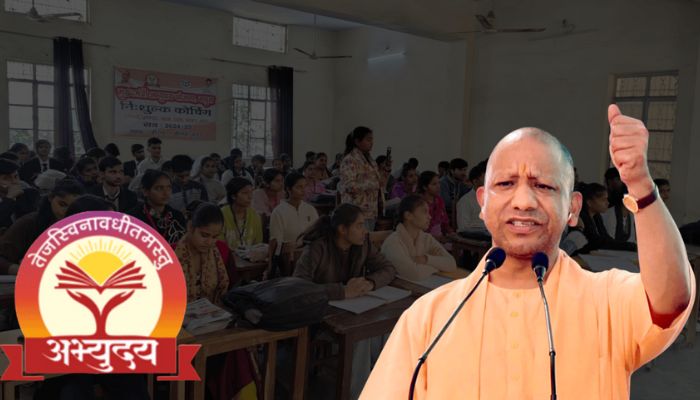
The “Chief Minister Abhyudaya Yojana” was launched on 16th February, 2021, on the auspicious occasion of Basant Panchami, under the guidance of CM Yogi Adityanath. Its purpose is to provide free coaching to talented students who are unable to attend private coaching institutes due to financial constraints or lack of resources. The government operates eight free residential and 150 Chief Minister Abhyudaya coaching institutes for youth in the state. A few days ago, Chief Minister Yogi Adityanath also recounted an anecdote related to the establishment of these coaching institutes.
The Chief Minister’s Abhyudaya Yojana provides preparation for several major competitive exams. This includes preparation for the Union Public Service Commission (UPSC) and Uttar Pradesh Public Service Commission (UPPSC) preliminary and main exams, as well as interview preparation. Training is also provided for engineering and medical entrance exams like JEE and NEET. Preparation for defence services exams like the NDA and CDS is also available under this scheme.
Under the scheme, students are provided with a variety of free educational facilities. Both offline and online classes are offered, allowing students to study at their convenience. An e-learning platform is also provided. Government officials and subject matter experts provide guidance and resolve their concerns. Career counselling, library access, and inspirational classes are also provided.
The scheme is supported by a large team of experienced officers and subject experts. This team includes over 500 IAS officers, over 450 PCS officers, over 300 IFS officers, and experts from various disciplines. These officials and experts prepare study materials for students and guide offline classes and online sessions to provide students preparing for competitive exams with the right direction and quality education.
Furthermore, students are also provided with mock interviews to prepare for interviews, enabling them to confidently approach the exam. The government states that this scheme provides opportunities for talented students from underprivileged backgrounds to advance and is helping them achieve success in various fields, including administrative services.
How to register for the scheme
The Mukhyamantri Abhyudaya Yojana is now available in all 75 districts of Uttar Pradesh. Students from poor and rural backgrounds can apply either online or offline.
Students can register online by visiting the websites abhyuday.up.gov.in, abhyudayup.in, and Yuvasathi.in. Offline registration is typically provided at the Social Welfare Officer’s office located in the district’s Vikas Bhawan. After registration, students are added to a WhatsApp group through which they receive updates about classes, schedules, and other important information.
Certain documents are required during registration. These include an Aadhaar card, Uttar Pradesh domicile certificate, income certificate, educational certificates such as 10th, 12th, or graduation mark sheets, and a passport-size photo. These documents are used to verify students’ identity, residence, and financial status.
Eligibility and selection process
Eligibility for admission to the scheme is determined by the exam. Science students who are in or have passed grade 11 or 12 are eligible for JEE and NEET preparation. Final-year undergraduate students or those who have already completed their graduation can apply for training for civil service exams like the IAS and PCS. Eligibility for defence services exams like the NDA and CDS is determined by the relevant exam rules.
The process for selecting students has also been established. Coaching sessions typically run from 1st July to 30th April. The selection process for the respective course is determined each year according to the established dates. Students are selected based on an entrance exam, merit list, or interview. This entire process is determined by a district-level committee to ensure that eligible students receive the benefits of the scheme.
Avinash, who served as a course coordinator for the scheme in Ghaziabad district, described the initiative as a major opportunity for economically weaker students. Speaking to OpIndia, he said the scheme has proved to be a blessing for talented students who could not afford expensive private coaching. He added that the combination of offline and online classes allows students from remote villages to participate easily. However, he also suggested that strengthening digital infrastructure in every district could help benefit even more students.
Hundreds of students wrote success stories
This scheme is proving to be an effective platform for students. The free coaching and guidance provided under this scheme have helped students succeed in major competitive exams. A total of 75 students associated with the Abhyudaya Scheme have succeeded in the Uttar Pradesh Public Service Commission’s PCS Main Examination 2024. Of these, the highest number of 40 students were selected from Bhagidari Bhawan, Lucknow. Additionally, 18 students from the Adarsh Pre-Examination Training Centre in Lucknow and 17 from the IAS/PCS Coaching Centre in Hapur have succeeded in the main examination.
Earlier, in the UPSC 2023 examination, 23 students linked with the scheme were selected. In UPPCS 2023, 30 students cleared the exam. Similarly, in JEE Mains 2024, 35 students associated with the scheme qualified, showing that the initiative is helping not only civil services aspirants but also engineering candidates.
According to government data, around 27,000 students have registered for the upcoming session to prepare for various competitive exams under the scheme. The growing number of registrations indicates increasing trust among students, especially those from rural and economically weaker backgrounds who earlier struggled due to a lack of proper guidance and resources.
The Yogi govt’s bold step towards social change
Previously, the dream of becoming a civil servant, a doctor or an engineer was limited to children from large cities and the affluent. Now, children from villages and poor families are also entering these fields. When a student from a small village clears UPSC or PCS, it does not just change one life; it inspires an entire community. It sends a message that talent can come from anywhere, and with the right support, it can shine.
This initiative by the Yogi government deserves praise because it recognises education as a government responsibility, rather than leaving it solely to private institutions. Today, the coaching industry in India has become a multi-billion-dollar business, with limited opportunities for poor students. In such a scenario, the state government’s decision to provide free coaching is a bold one.
Like any large government scheme, the Abhyudaya Yojana has also faced challenges. There have been occasional complaints regarding the lack of resources, the quality of teaching at some centres, and infrastructural gaps. Digital access in certain districts also needs improvement to ensure equal benefit for all students. The Yogi government views this program not just as a government announcement but as a long-term educational reform.
(This article is a translation of the original article published on OpIndia Hindi.)
Kolkata Police have arrested Shamik Adhikary, a 25-year-old social media influencer from the city, on charges of alleged sexual assault. Adhikary, who is popularly known by his online name “Nonsane,” was picked up from Dum Dum, Kolkata, on Thursday evening, 5th February. Adhikary was first booked on charges of wrongful confinement, assault, and outrage to the modesty of a woman, but later, police framed him on the charge of rape based on the statement given by the 22-year-old victim.
He was presented in a court on Friday, 6th February, and has now been remanded to police custody until 16th February. According to the police, the woman had complained that Adhikary had forcibly confined her at his Behala residence from around 9:30 pm on February 2 until 5 pm the following day.
During this time, the woman alleged, she was subjected to physical assault, beaten, and threatened. She, in addition, alleged that Adhikary had touched the woman inappropriately, pulled her clothes, and then subjected her to penetratory sexual assault.
The police added that the medico-legal examination of the complainant was conducted at MR Bangur hospital, and a lady police officer recorded her statement, and the section of the Bharatiya Nyaya Sanhita concerning rape was added to the FIR. The injury marks were found on the body of the victim, and she was visibly traumatised, hence the reason she took her time to file the police report, the police told the court.
The police further told the court that Adhikary allegedly threatened the woman by sending her pictures of her in a compromising position. The police investigators said that location data collected from tower signals confirmed the presence of both the complainant and the accused at the crime scene during the time mentioned in the complaint.
The defence, however, argued that the two were old friends and had known each other for a long time. They claimed there was a misunderstanding that night, but denied that any force was used. The defence also questioned why police custody was required if there was nothing substantial left to investigate.
The viral reel that sparked political debate
Shamik Adhikary is not just any influencer. With around 420k followers on Instagram and over 400k followers on Facebook, he had built a strong presence online. But what brought him into the political spotlight was a reel he posted from his Instagram account ‘@yournonsane’ on 21st January, just 2 months before the upcoming West Bengal elections.
The reel, which went viral and crossed 3 million views with more than 350k likes, sharply criticised the ruling Trinamool Congress (TMC) government in the state. In the video, Adhikary portrayed himself as a common man going to cast his vote. He showed a scene where a local TMC “goon” was pressuring voters to vote only for the ruling party and threatening consequences otherwise.
As the video continued, flashbacks of incidents that, according to him, reflected the state’s condition followed. Scenes included the 26,000 government teachers who lost their jobs and the emotional toll, as well as the scene depicting a woman walking alone in the middle of the night and being followed by some men.
The reel also referred to the RG Kar rape-murder case of a 34-year-old doctor. In that case, a Kolkata court sentenced the convict Sanjay Roy to imprisonment for life and ordered the state government to pay ₹17 lakh as compensation to the victim’s parents, though the victim’s parents claimed that they were seeking justice and not compensation.
The video directly targeted the ruling government and came barely two months before elections; many saw its timing as politically sensitive. Soon after it went viral, political reactions started pouring in.
TMC claims political links
Soon after the reel of Adhikary became viral, several TMC leaders and supporters started propagating that Adhikary was affiliated with the BJP. They claimed that he was not just a content creator, but he was politically motivated.
TMC spokesperson Riju Dutta shared a strong statement on social media, calling Adhikary a “BJP YouTuber.” In his post, Dutta said that the same person who had accused the West Bengal government of failing to protect women was now himself booked for outraging the modesty of a woman and physical assault.
Breaking 🚨
BJP YouTuber named Shamik Adhikary popularly known as “Nonsane” is booked for Outraging the Modesty of a Woman & Physical Assault! – He is the same person who made a video against WB Govt. claiming women are not safe in Bengal and said not to vote for TMC !
Dutta detailed the sections under which the case was registered and highlighted that the complainant had alleged confinement for nearly 12 hours, physical assault and threats. In a controversial remark, he also linked Adhikary to BJP IT Cell chief Amit Malviya and stated that people misusing women join the BJP.”
Now, the TMC’s narrative has been that the case is a straightforward criminal matter, and political colour is unnecessarily being given by the opposition.
Questions over timing and false allegations
On the other hand, BJP supporters and several influencers have questioned the timing of the arrest. Many of them have hinted that the case could be politically motivated, especially since Adhikary’s reel had sharply criticised the state government.
Trinamool Congress is running the most authoritarian and dictatorial regime Bengal has seen to date.
The people of Bengal live in fear afraid that speaking against Mamata Banerjee will invite FIRs and false cases.
— Pradeep Bhandari(प्रदीप भंडारी)🇮🇳 (@pradip103) February 6, 2026
Some social media users have gone as far as suggesting that the sexual assault complaint is fabricated to silence him. They argue that the arrest happened soon after his viral video and just before the elections, raising suspicion.
Amit Malviya, BJP’s IT Cell chief, strongly criticised the Mamata Banerjee-led government. In a social media post, he said that West Bengal had turned into a “dictatorial regime” where critics were targeted with fake and malicious FIRs.
This is the video of ‘YourNonsanee’ that rattled the Trinamool Congress so deeply that it unleashed the entire police machinery against him.
The Trinamool Congress is running the most authoritarian and dictatorial regime Bengal has witnessed to date.
Malviya claimed that activists and voices who embarrassed the ruling party were being subjected to character assassination and police action. Referring to Adhikary’s case, he questioned why details of the alleged incident were not publicly known and why the complainant had not spoken earlier.
“This is the TMC’s model of governance: Muzzle free speech, intimidate critics, weaponise the police and destroy reputations to stay in power.”
“But Bengal is watching. And Bengal will not stay silent. BJP will stand with every individual victimised by Mamata Banerjee‘s regime.”
“Together with the people of West Bengal, we will defeat fear, expose abuse of power, and restore democracy. This is not justice. This is political persecution. And it will end,” he added.
Support from fellow influencers
Adhikary has also received support from some fellow content creators and social media users. One X user questioned why influencers who speak about social and political matters in West Bengal are facing cases. He asked why there was no public outrage when such actions were taken against them.
First Sayak Chatterjee on Beef Issue & Now Samik Adhikari both are big youtubers bloggers from Kolkata both took social & political scenario of #WestBengal & #Kolkata. Police filed cases against them for raising their voices for exercising the democratic rights. Why No outrage ?? pic.twitter.com/c4eMJ5de0w
Supporters argue that raising concerns about governance and women’s safety is part of democratic rights and should not lead to legal harassment. However, others say that the criminal allegations must be treated seriously and investigated independently of political debates.
The matter has clearly gone beyond a criminal case and entered the political arena. With elections approaching, every development is being viewed through a political lens.
For now, Shamik Adhikary has not made any public statement. The developments in the court proceedings over the coming days, and also the investigation findings, will have a major role to play in this issue.
While the case began as a complaint against a crime, it’s turned into a political debate, questioning not just the charges against the accused, but also freedom of expression, political rivalry, and the role of social media at the time of the election.
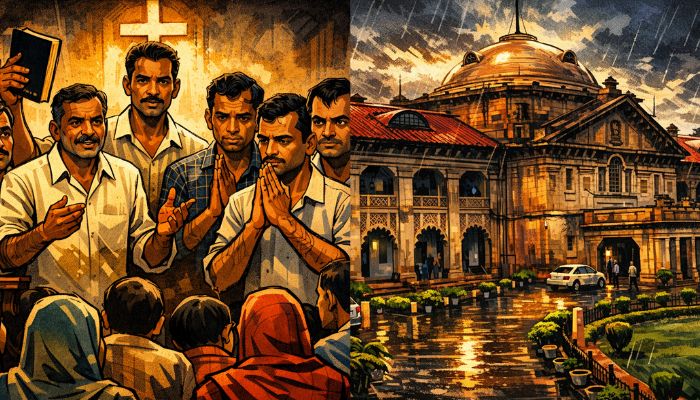
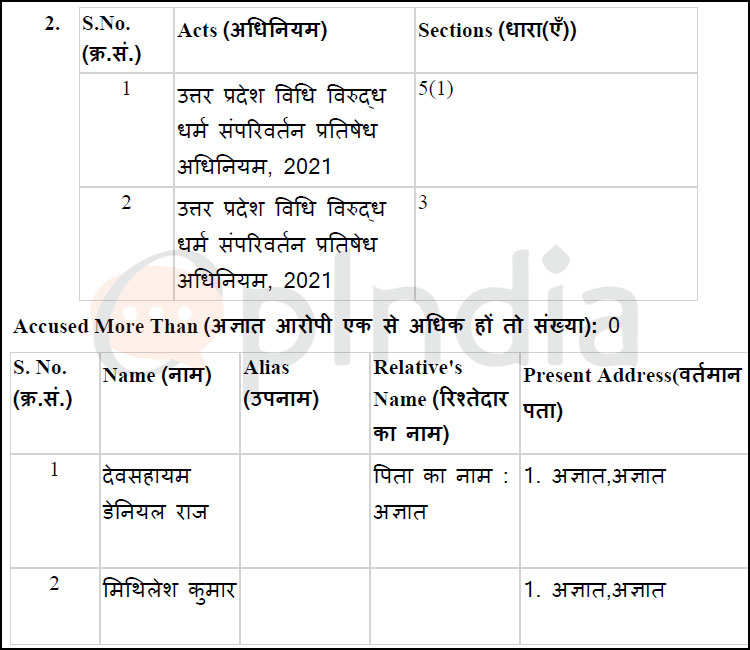
On 28th January, the Allahabad High Court granted bail to Dev Sahayam Deniyal Raj, a Tamil Nadu resident accused of coercing Hindus to convert to Christianity. He was involved in a conversion racket in the Ahraura police station area of Mirzapur, Uttar Pradesh, and was booked under Sections 3 and 5(1) of the Uttar Pradesh Prohibition of Unlawful Conversion of Religion Act. OpIndia accessed relevant court documents in the matter.
In its judgment, the High Court recorded that Deniyal Raj had been in jail since 30th September 2025. The court granted bail after noting the nature of accusations, the severity of punishment in the event of conviction, the nature of supporting evidence, and a reasonable apprehension of witness tampering. The court clarified that bail was granted without going into the merits of the case.
The court directed his release on personal bonds and sureties, subject to standard conditions such as not tampering with evidence, not intimidating witnesses, and appearing before the trial court on all dates.
The key observation in the judgment was a legal objection to the very initiation of proceedings. The court relied on a recent Supreme Court ruling interpreting who is authorised to set the law in motion under the unamended statutory scheme. During the hearing, counsel for the accused argued that the FIR was lodged on the complaint of a person who was neither the aggrieved individual nor an immediate family member or blood relative. Thus, the prosecution itself was unsustainable.
The Mirzapur FIR and what it says
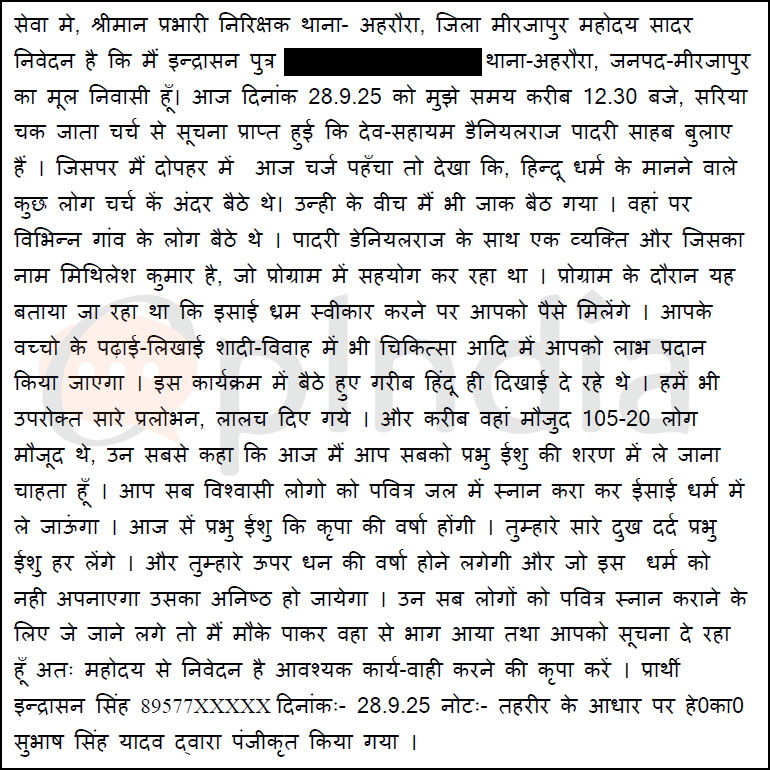
The FIR in the matter was registered on 28th September 2025 at Ahraura police station in Mirzapur based on the complaint of Indrasan. In his complaint, he stated that he received information around 12:30 pm from a church referred to in the FIR as Sariya Chak Jata Church. When he went there, he found Hindus from different villages seated inside. Dev Sahayam Deniyal Raj, the main accused, was holding the prayer meeting, and another accused, Mithilesh Kumar, was assisting him during the programme.
Source: UP police
During the prayer meeting, Hindus present in the church were asked to accept Christianity, claiming that it would bring financial benefits and assistance, including claims relating to children’s education, marriage, and medical treatment.
He further stated that an attempt was made to persuade those present to accept Jesus and that a baptism related process was being spoken about. After observing the meeting, the complainant left and approached the police to file a complaint.
Source: UP Police
Based on his complaint, police registered an FIR and swung into action. Deniyal Raj and his four associates were arrested by the police. According to media reports, he was involved in the conversion of 50–70 Hindus to Christianity. Furthermore, he had made a list of 500 Hindus whom he wanted to convert. He had eight associates working for him. Notably, during questioning, he revealed that he was appointed as field incharge of Indian Missionaries Society, Tamil Nadu.
According to police, they started surveying the region in 2012. In 2023, they came to the area and by 2024, they started converting people to Christianity.
Why the Sessions Court rejected bail and what it recorded
On 30th October 2025, the Sessions Court in Mirzapur rejected Deniyal Raj’s bail plea. The court noted that the prosecution opposed bail, stating that the accused and his associates committed the offence by offering inducements and allurements to convert Hindus to Christianity. The court noted the gravity of the offence and declined to grant bail.
The Sessions Court’s judgment was crucial because the court noted that the prosecution placed on record that the accused was linked to three other cases, all related to unlawful religious conversions. It was not a casual detail but a critical factor when assessing bail in offences that are alleged to be organised, repeat, and network driven.
The Sessions Court therefore rejected bail after considering the case diary and available documents, holding that sufficient grounds for bail were not made out.
The High Court order and the gap that raises concern
The High Court judgment stated that the applicant argued that he had no criminal antecedents and that nothing incriminating was recovered from his possession, along with the argument about the informant not being an aggrieved person or relative. It also records that the State opposed bail. Despite this, the High Court allowed the bail plea. This is where the bail grant becomes controversial and, from a public interest perspective, problematic.
The Sessions Court order is on record, and it specifically recorded that there were similar cases against the accused, making him a person of interest with criminal history relating to unlawful conversions. The High Court order, on the other hand, recorded the applicant’s plea that he had no antecedents, but does not reflect engagement with the Sessions Court’s finding on repeat involvement.
That gap matters because bail decisions are not purely about time spent in custody. They are also about the likelihood of repetition, tampering, influence, and the broader pattern behind the offence.
When a trial court records that an accused is connected to multiple similar cases, it strengthens the prosecution’s argument that the offence is part of a continuing pattern rather than an isolated incident. Ignoring that dimension at the bail stage undermines the very rationale behind stricter bail conditions in special statutes.
Why courts must treat organised conversion cases with stricter scrutiny
The key issue in such cases is inducement-based conversions. When such conversions are executed through organised networks, they are not spontaneous acts. They are operational exercises that involve recruitment, persuasion, repeated contact, resource flow, and on ground mobilisation.
The FIR and the Sessions Court record both point towards inducements, including money, education support, marriage related help, and medical assistance being used as persuasion tools. Where courts have material suggesting repeat involvement, the bail stage becomes critical.
It has to be noted that bail is not an acquittal, but it does shape ground reality. It gives room for networks to regroup, influence witnesses, change local dynamics, and continue outreach under different covers.
The matter is even more sensitive as demographic change is not an abstract discussion point. It is a real outcome when targeted conversion activity focuses on poor, economically weak, and socially vulnerable communities.
The ideological messaging may be packaged as healing or welfare, but the end result is a change in religious composition in micro pockets over time. The law exists precisely because the State considers inducement-based conversions a public order and social harmony issue, not merely a private faith choice question.
The bottom line
This bail order is not just about one case. It is about whether courts will treat organised inducement-based conversion cases with the seriousness that the statute demands. The Sessions Court rejected bail after recording the statutory threshold and the fact that the accused was linked to three other similar cases. The High Court granted bail while noting the legal objections relating to who can initiate prosecution and after recording standard bail considerations.
For a law framed to curb inducement driven conversions, judicial scrutiny at the bail stage becomes the first real test. When repeat conduct is recorded on the trial court record, bail orders need to reflect deeper engagement with that reality. Otherwise, the signal that goes out is not about safeguarding liberty. In reality, it directly affects social stability and demographic balance over time, even if bail is not granted on the merits.
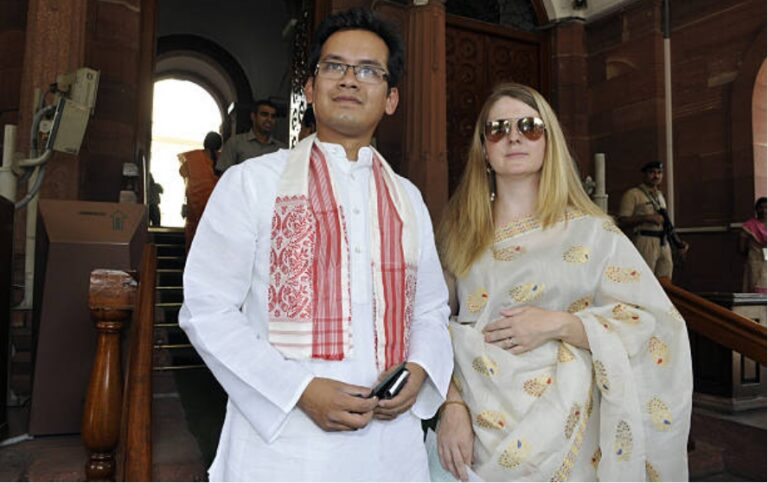
The Special Investigation Team (SIT) formed by the Assam government to probe the Pakistan link of Congress MP Gaurav Gogoi and his wife Elizabeth Colburn Gogoi has concluded. In a press conference today, Assam Chief Minister Himanta Biswa Sarma presented the findings of the probe, levelling serious allegations against the Deputy Leader of Opposition in Lok Sabha and his wife.
The CM said that the state government has forwarded the findings of the SIT probe to the Union Ministry of Home Affairs for further probe, as Assam Police does not have jurisdiction over many matters linked to the case. He said these links pose a significant threat to national security and require further detailed probe.
The Chief Minister described the findings as “damning and damaging,” emphasising that the involvement of a sitting MP elevates the matter to one of “extreme seriousness.” He alleged that Gogoi “attempted to legitimise Pakistan” through various actions, including leading a youth delegation to the Pakistan High Commission in New Delhi in 2015, where he met with then-High Commissioner Abdul Basit.
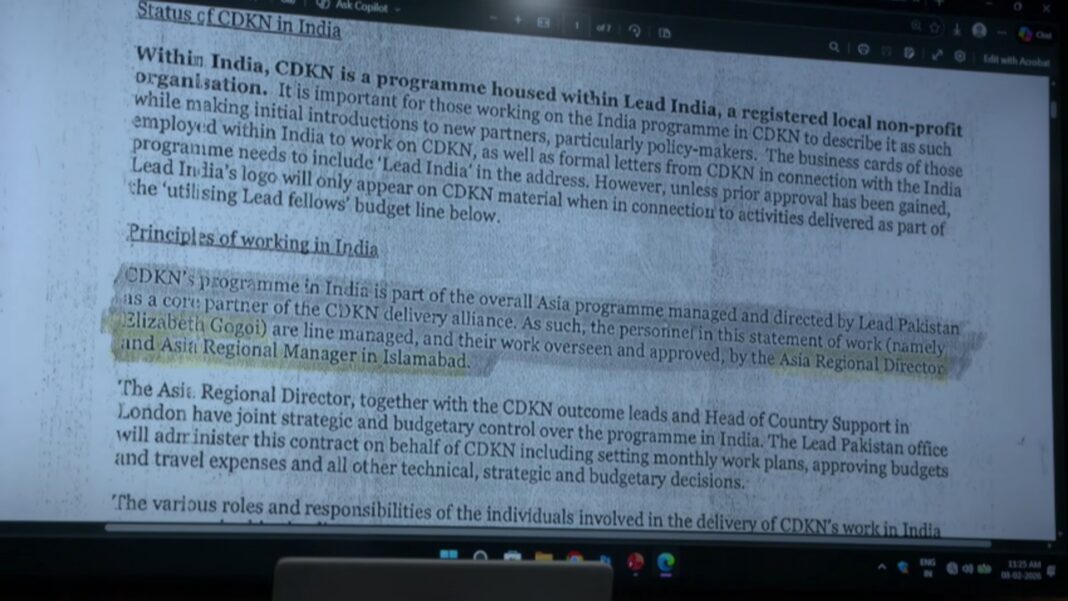
As per the CM, Elizabeth previously served as an aide to former US Senator Tom Udall, who is linked to anti-India billionaire George Soros, who wants to topple nationalist governments across the world, including the Modi government.
Sarma pointed to a viral photograph from this meeting, which he initially suspected was photoshopped but later confirmed as authentic after endorsements from Congress leaders. Following the photo’s circulation, Basit reportedly visited Assam, which Sarma suggested was not coincidental.
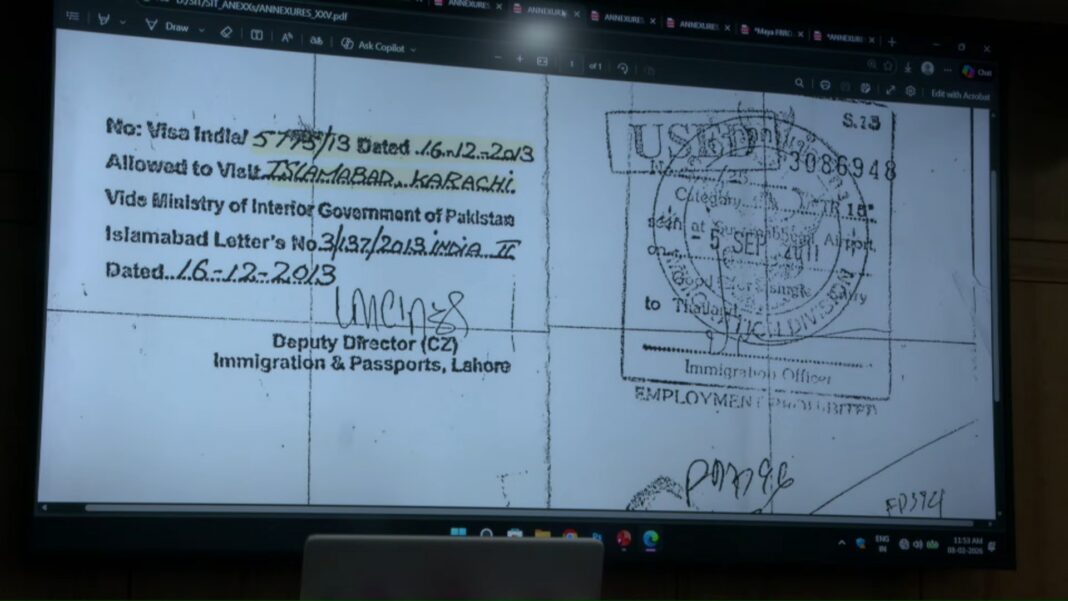
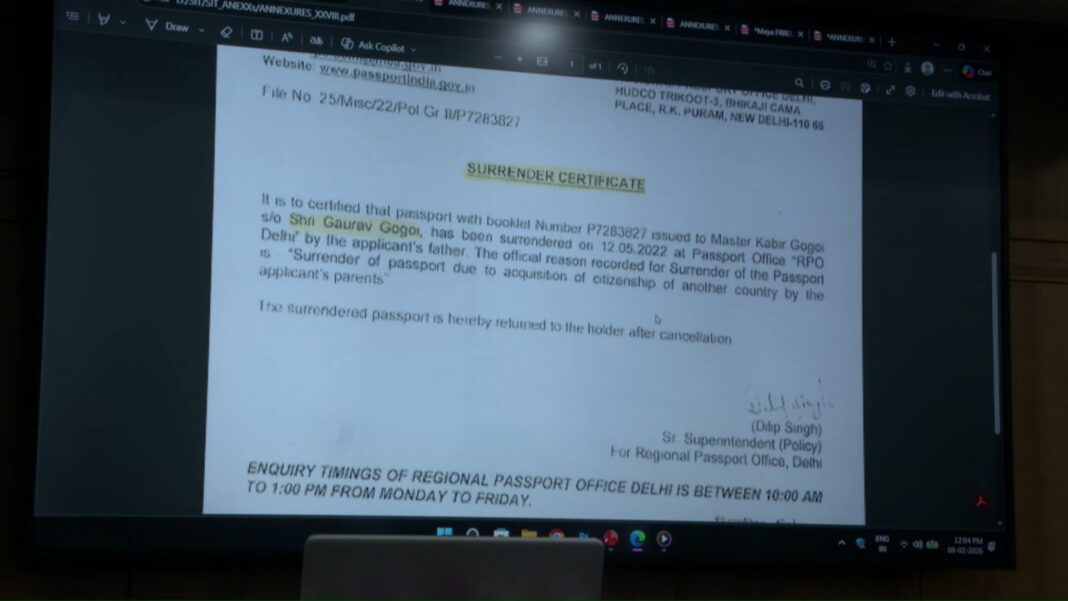
The main allegations are regarding Elizabeth Colburn Gogoi and her links with Pakistani national Ali Tauqeer Sheikh. As per the probe, Elizabeth worked in Pakistan from March 18, 2011, to March 17, 2012, under a Pakistan-based organisation called LEAD Pakistan. During this period, she allegedly developed close ties with Ali Tauqeer Sheikh, whom CM Sarma described as a “Pakistani agent” with connections to the Pakistan Army, the Inter-Services Intelligence (ISI), and the country’s Planning Commission.
Sheikh, according to Sarma, was no mere environmentalist but a figure who promoted anti-India narratives on global platforms, particularly regarding the Indus Water Treaty and other bilateral conflicts. Sheikh visited India at least 13 times between 2010 and 2013, raising concerns about his role in anti-India activities. CM Sarma said that he was allowed to visit India by the UPA govt despite his anti-India comments being known.
Sarma revealed explosive details from the SIT report, claiming Elizabeth was transferred to India but continued to receive her salary from the Pakistani firm even after her relocation. Moreover, an appointment letter placing her in India was issued a year before her transfer. As per the SIT probe, LEAD India was brought under LEAD Pakistan so that Elizabeth’s salary could be transferred from Pakistan to India, bypassing FCRA regulations.
The CM said that LEAD Pakistan could not send the salary directly to Elizabeth, as a fund transfer under FCRA is only for Indians, and she is not an Indian citizen. Therefore, the fund was diverted to LEAD India, an Indian organisation, to pay her salary.
Elizabeth Colburn Gogoi worked under Bhawana Luthra in Lead India, who was questioned by the SIT in connection with the case. As per the financial records of Lead India checked by the investigators, LEAD India received funds from LEAD Pakistan in the name of organisational work, but actually the money was for Gogoi’s salary.
Sarma stated that Elizabeth maintained active bank accounts in Pakistan, where she received payments, but she refused disclose details of the accounts to the SIT. Another shocking fact was that her salary was much higher than that of her superior in India. While she received ₹2,50,000, Bhawana Luthra’s salary was ₹50,000.
As per the probe, Gogoi received a total of ₹82.41 lakhs from Pakistan through FCRA. LEAD India received ₹63.48 lakh from LEAD Pakistan, while in total it received ₹91.27 lakh from September 2012 to November 2014. Out of this, 90% amount was received by Gaurav Gogoi’s wife alone.
Moreover, while Gogoi was under Bhawana Luthra in LEAD India, she actually reported to Asian Regional Director Ali Tauqeer Sheikh in Islamabad. The agreement appointing Elizabeth in LEAD India said, “CDKN’s programme in India is part of the overall Asia programme managed and directed by Lead Pakistan as a core partner of the CDKN delivery alliance. As such, the personnel in this statement of work (namely Elizabeth Gogoi) are line managed, and their work overseen and approved, by the Asia Regional Director and Asia Regional Manager in Islamabad.
It further states that, “The Asit. Regional Director, together with the CDKN outcome leads and Head of Country Support in London have joint strategic and budgetary control over the programme in India. The Lead Pakistan office will administer this contract on behalf of CDKN including setting monthly work plans, approving budgets and travel expenses and all other technical, strategic and budgetary decisions.”
This makes it clear that LEAD India was completely under LEAD Pakistan, an unusual arrangement as, in general, country units of international organisations have equal rank and status, and are governed by regional/global heads. But in this case, the wife of a Lok Sabha MP worked under an organisation under direct control of Pakistan, and CM Sarma called it a very serious issue.
The agreement was collected by the SIT during the probe. As per CM Sarma, while Elizabeth transferred from Pakistan to India, she remained a ‘shadow employee’ of LEAD Pakistan working in India. He said that the SIT has confiscated documents showing the flow of money from Pakistan to India from the LEAD India office, and Bhawana Luthra has also confirmed the same.
In another explosive allegation, the CM alleged she collected sensitive information on activities surrounding India and sent reports back to Pakistan, including a 50-page confidential document to Sheikh that referenced Intelligence Bureau (IB) sources. The report was marked as confidential, and it prima facie violates Section 2 of the Official Secrets Act, 1923.
During questioning, Elizabeth agreed that she authored the report. As per the CM, the report stated, “no risk, no visibility strategy recommended”. It further advocated that the Pakistan-based actor maintain a covert operational strategy in India to avoid detection and scrutiny, as per the SIT.
Elizabeth had also recommended bypassing the central government in India and working directly with state governments and other regional agencies. She had written that the tension between the centre and states will increase under PM Modi.
When she was working in LEAD India, she visited Islamabad six times, and after she left LEAD India and joined Oxford Policy Management, she visited three more times. Each time, she used the land route through the Atari border, instead of taking flights, the CM said. As per SIT, LEAD India head Bhawana Luthra said that she does not know why Elizabeth visited Pakistan.
The SIT made the following major observations regarding Elizabeth Colburn Gogoi
Links to George Soros via Senator Tom Udall
Employment with LEAD Pakistan under Ali Tauqeer Sheikh
Refused to disclose Pakistani bank account details
Pre-determined employment contract with LEAD India (issued 18 months before joining)
Shadow employment arrangement to facilitate entry into India
Salary 500% higher than reporting manager – FCRA violation
Concealed funding source from Pakistan
Primary beneficiary of Rs. 82.41 lakhs from Pakistani FCRA funds
No oversight from LEAD India management-reported directly to Pakistan
Transmission of CONFIDENTIAL report to Pakistan (August 5, 2014)
Report contained reference to secret IB communication
Advocated “Low Risk Low Visibility” strategy for Pakistani actors
Recommended bypassing Central Government via State-level engagement
Exploited Centre-State political tensions in intelligence report
Joint pre-employment travel with Ali Tauqeer Sheikh (3 occasions)
6 unauthorized visits to Pakistan while at LEAD India
3 additional Pakistan visits after joining Oxford Policy Management
The Chief Minister also talked about Gaurav Gogoi, saying that in 2013, five months before his first Lok Sabha election win, Gogoi visited Pakistan via the land border after losing his passport during a trip to Israel. CM Sarma questioned the upgrade of Gogoi’s single-entry visa to multiple-entry upon arrival in Pakistan and his access to ISI strongholds in Pakistani cities amid ongoing border skirmishes.
As per the CM, while Gogoi’s visa was only for Lahore, after he reached Pakistan, his visa was extended to include visits to Islamabad and Karachi. This extension was granted based on a letter written by Pakistan’s interior ministry. CM Sarma said that the SIT has obtained the passport showing the endorsement for extending the visa locations.
As per the CM, Gogoi’s personality completely changed after visiting Pakistan, and raised parliamentary questions related to confidential matters, like Nuclear power plants, uranium reserves, border security, defence hardware and software, air power, domestic weapons manufacturing, espionage at the Pakistan High Commission in Delhi. He also asked questions on national water mission strategies, a matter linked to Elizabeth’s area of work.
The CM also showed a video clip from an interview, where Gaurav Gogoi had said that he visited Pakistan because his wife was working there. But the CM pointed out that his wife was transferred to LEAD India a year before his visit.
While Gaurav Gogoi’s daughter is a British citizen, as she was born in London, CM Sarma revealed that he had surrendered the Indian passport of his India-born son. He displayed the surrender certificate issued by the Regional Passport in Delhi, stating that the passport was surrendered on 12 May 2022. CM Sarma called it very regrettable that the son of former Assam CM Tarun Gogoi surrendered his son’s Indian passport.
Another serious allegation the CM made was that when son Kabir Gogoi had an Indian passport, his religion was mentioned as Hindu, but no religion is mentioned in his British passport. On the other hand, the British passport of daughter Maya Gogoi mentions her religion as Christian.
CM Sarma said that his son is being converted to Christianity, and Gaurav Gogoi is now a religious minority in his own family.
Himanta Sarma underscored the national security implications of these facts, stating, “The SIT has given proof that three persons have a direct link with Pakistan—Ali Tauqeer Sheikh, Elizabeth Gogoi, and Gaurav Gogoi. After seeing the SIT report, our cabinet ministers were shocked.”
He added that the probe, initially handled by Assam Police’s CID, revealed information requiring Interpol assistance and access to classified data out of the jurisdiction of Assam Police. The cabinet discussed the report on February 7 and authorised its partial disclosure today, excluding confidential elements. The cabinet has decided to refer the report to the Union Home Ministry for further investigation.
Chief Minister Himanta Biswa Sarma has also questioned why Elizabeth Colburn Gogoi retains her UK visa even so many years after her marriage with Gaurav Gogoi. He has also questioned why their children are also British citizens and why no application has been made for Indian citizenship.