

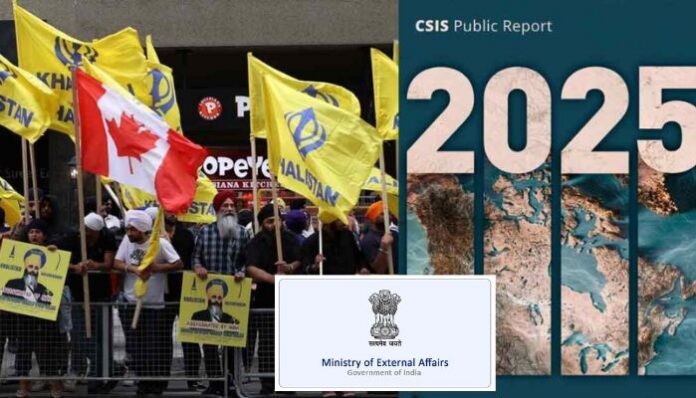
India on Thursday, 7th May, strongly rejected the allegations made in the Canadian Security Intelligence Service (CSIS) Public Report 2025, saying that New Delhi respects the sovereignty of other countries and does not interfere in their internal matters. Responding to the claims made in the report, the Ministry of External Affairs (MEA) said such sensitive issues should be handled through proper institutional mechanisms and not through what it described as “politicised public narratives.”
MEA spokesperson said India has taken note of the report but firmly denied accusations related to foreign interference in Canada. The spokesperson added that the CSIS report itself acknowledges the presence of Khalistani extremist supporters operating from Canadian soil and identifies them as a threat to both India and Canada.
#WATCH | India has categorically rejected the allegations mentioned in the CSIS report, reiterating that it respects the sovereignty of other nations and does not interfere in the internal affairs of other countries. India maintains that such concerns should be addressed through… pic.twitter.com/5s7cyeYh2I
— DD News (@DDNewslive) May 7, 2026
India also repeated its long-standing concern over anti-India activities being carried out from Canada. The MEA further said, “India has consistently urged Canadian authorities to act against anti-India elements involved in extremism, glorification of violence, threats against diplomats, vandalism of places of worship, and attempts to promote secessionism through so-called referendums and promoting separatism through so-called referendums.”
What the CSIS Public Report 2025 says
The Canadian Security Intelligence Service released its Public Report 2025 in March this year, as part of its annual assessment of national security threats facing Canada. The report discusses issues such as espionage, cyber threats, violent extremism and foreign interference.
A major section of the report focuses on Khalistani extremism in Canada. According to CSIS, while peaceful support for Khalistan remains a legal political activity in Canada, a small section of extremists is allegedly using Canadian territory to promote violence, raise funds, and plan attacks mainly targeting India.
The report also marked 40 years since the 1985 Air India Flight 182 bombing, which remains the deadliest terrorist attack in Canadian history. The bombing killed 329 people, most of them Canadian citizens. CSIS noted that the suspects in the attack were linked to Canada-based Khalistani extremist groups.
The report stated that even today, “ongoing involvement in violent extremist activities by CBKEs continues to pose a national security threat to Canada and to Canadian interests.” However, it also clarified that there were no Khalistan-linked attacks reported in Canada during 2025.
Allegations against India
The CSIS report further alleged that India is among the countries involved in foreign interference activities in Canada. It claimed that India has carried out what it called “transnational repression” activities aimed at countering Khalistan separatism.
According to the report, these activities allegedly include surveillance, intimidation and pressure tactics targeting sections of the Indo-Canadian community that support Khalistan. It also claimed that India has historically developed covert ties with politicians, journalists and community members in Canada to influence public opinion and advance its interests.
At the same time, the report acknowledged that Canada-based Khalistani extremist groups continue to exploit Canadian institutions and community networks for fundraising and extremist activities linked to violence abroad. It also mentioned that the Lawrence Bishnoi Gang was among the organisations added to Canada’s terrorist entities list in 2025.
CSIS said evolving forms of extremism and online radicalisation are becoming increasingly difficult to track and counter, and stressed the need for continued intelligence cooperation and monitoring.
