

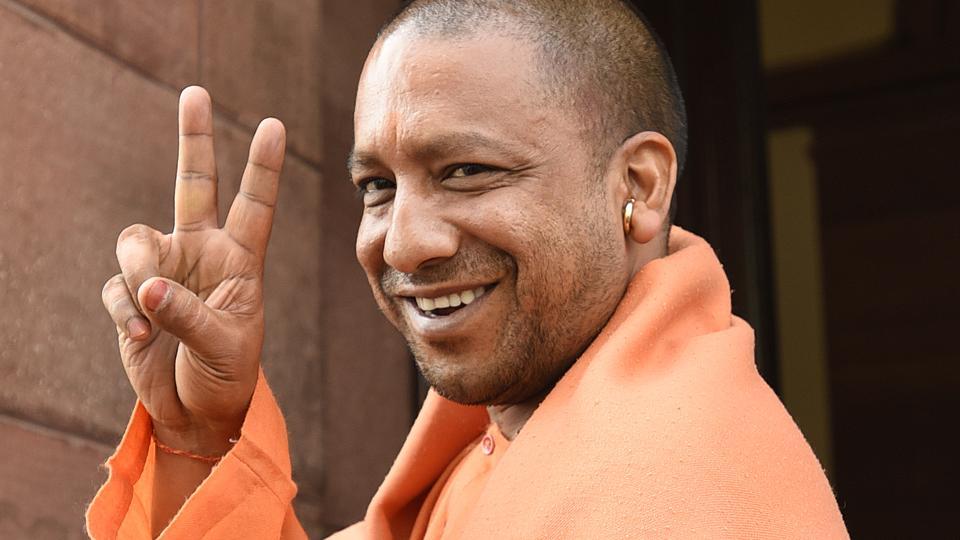
Although Yogi Adityanath was shown as enjoying popular support of many BJP supporters in various surveys before the Uttar Pradesh assembly elections, he was not shown as any front-runner for the post of the Chief Minister after BJP scored a stunning victory in the polls last week.
If one believed mainstream media reports, leaders like state unit President Keshav Prasad Maurya and Union Minister Manoj Sinha were the front-runners, but BJP surprised the media and some of its supporters by announcing Yogi Adityanath as their choice for the new Chief Minister of Uttar Pradesh.
Yogi Adityanath, who has won his Lok Sabha seat for five consecutive times since 1998 general elections, and who is known for his aggressive brand of Hindutva, immediately became the target of political commentary in media and social media once the appointment was confirmed.
While criticism of his brand of politics is valid, some media persons and politicians resorted to spreading blatant lie by claiming that Adityanath had delivered a hate speech calling for rape of dead Muslim women.
The lie was repeated by various supporters of these media persons and politicians. One of the earliest one to spread this lie was Sagarika Ghose, who immediately changed her stance when confronted:
.@sagarikaghose sayid @yogi_adityanath spoke of raping dead Muslim women. When confronted, says Yogi was just listening. #NotMyMedia pic.twitter.com/yHpkokEs8P
— Ishant Sharma (@CrimeMasterV2) March 18, 2017
The same lie was repeated by her husband Rajdeep Sardesai on national television, where no one confronted him:
PM just gave a speech on @indiatoday, @sardesairajdeep blatantly lies on the same channel that Yogi said “Muslim women should be raped”!!! pic.twitter.com/Qzdh10b7Hw
— Ishant Sharma (@CrimeMasterV2) March 18, 2017
Spotting the opportunity to do “secular” politics, the same line was repeated by some politicians like:
Congratulations @MehboobaMufti. Your friends & allies have chosen a man who called for the dead bodies of Muslim women to be raped as CM.
— Omar Abdullah (@abdullah_omar) March 18, 2017
Aaah! Yogi Adityanath, the man who asked Hindus to rape dead Muslim women is “UP’s new CM”. This is Modi’s India!
— Salman Nizami (@SalmanNizami_) March 18, 2017
An India where Yogi Adityanath can wish rape on dead Muslim women and STILL be CM is not the India my conscience accepts as our country.
— Junaid Azim Mattu (@Junaid_Mattu) March 18, 2017
The truth is that Yogi Adityanath never said anything like that. The alleged speech was delivered by an unidentified supporter of Yogi Adityanath based on an undated video clip that went viral a couple of years back. In the video, the speaker is not seen, while the video plays images of Adityanath sitting on the stage when audio of the speech is heard. The speech was allegedly delivered at an event organized by Yogi’s outfit Hindu Yuva Vahini.
One can’t rule out malicious video editing, however, even if the video is considered genuine, it’s clear that Adityanath was not the one who delivered the deplorable hate speech.
It is also a fair criticism that if Adityanath was indeed present on the stage when such a speech was delivered, he should have registered his protest, but that doesn’t mean that facts are twisted to say that it was Adityanath himself who delivered the speech.
Furthermore, the same set of journalists and politicians support the likes of JNU student leaders who organized or were present at an event where anti-India slogans were shouted. If organizing an event or being present when something objectionable is being said is not a crime, the same benefit of doubt should be given to Yogi Adityanath too.
Nonetheless, while it’s totally legitimate to oppose Adityanath’s brand of politics, the use of blatant lie to push a propaganda has further lowered the standards of journalism and politics in India.


