

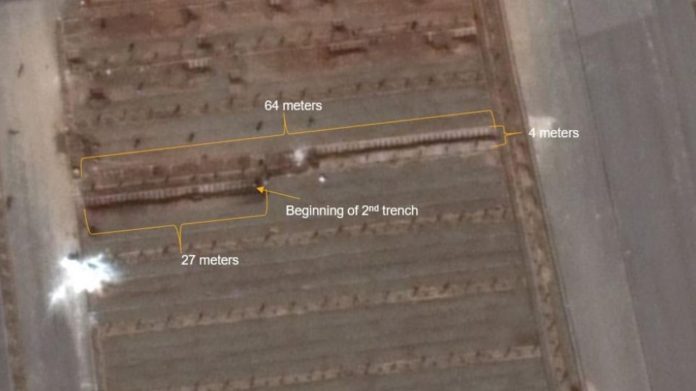
The coronavirus pandemic has resulted in such massive casualties in Iran that two vast trenches of 100 metres that are now visible from space were dug at the Behesht-e Masoumeh complex in Qom, reported The Washington Post. The evacuation work in Qom, a city located about 130km south of Tehran, began around February 21 but it was expanded rapidly to keep with the rising number of deaths (429 according to official figures).
The story was unearthed by two journalists, namely Dalton Bennett and Erin Cunningham. In a Twitter thread, Bennett talked about a viral video that triggered the investigation into the case. As the man recording the video pointed out, close to two dozen dead bodies (sealed in black sleeping bags) were to be disposed off at the morgue at Behesht-e Masoumeh.
On March 3, another video surfaced allegedly showing Iranian authorities carrying corpses of coronavirus victims to the dedicated section at the Behesht-e Masoumeh cemetery. The man recording the video claimed that around 80 bodies had been buried while the Government put the number to 34.
The Washington Post reporters sought help from Planet Labs, the largest earth observation satellite network, and an analyst named Fabian Hintz from the Middlebury Institute of International Studies at Monterey to ascertain that the video was shot at the morgue in Qom, Iran.
The journalists collected high-resolution satellite images from Maxar Technologies, a company that specialises in combining space infrastructure and Earth intelligence capabilities, and discovered that the excavation work for a new section of the morgue began around February 21. Another image from March 1 shows two large trenches with a combined length of that of a football field.
A senior analyst from Maxar Technologies revealed that the excavation work undertaken at the site in the wake of the coronavirus outbreak was clearly different from the burial practices of the past. Fabian Hintz from the Middlebury Institute of International Studies at Monterey used “colour infrared satellite imagery” to determine changes in chlorophyll that could help track changes at the site.
Moreover, historic imagery data released by Planet Labs confirmed instances of recent excavation at the Behesht-e Masoumeh cemetery. The same was independently ascertained by Maxar Technologies. The deadly pathogen, coronavirus, that originated in Wuhan, China has affected around 10,000 people in Iran until now.
Earlier, 44 people in Iran died due to consumption of bootleg alcohol due to the rumours that it can cure coronavirus infection. Also, hundreds have been hospitalized after consuming the methanol in an effort to curb the disease. According to the Health Ministry Official Ali Ehsanpour, the deceased and others who are hospitalized consumed the toxic methanol instead of ethanol. Seven bootleggers have been arrested in connection with the incident.
It may be noted that China has ordered immediate cremation of coronavirus victims and banned burial and other methods of preserving the bodies, so that the virus does not spread which may happen in case of burial. China, where the virus originated and is worst hit by it, has also banned funeral ceremonies for those who die due to the infection.


