

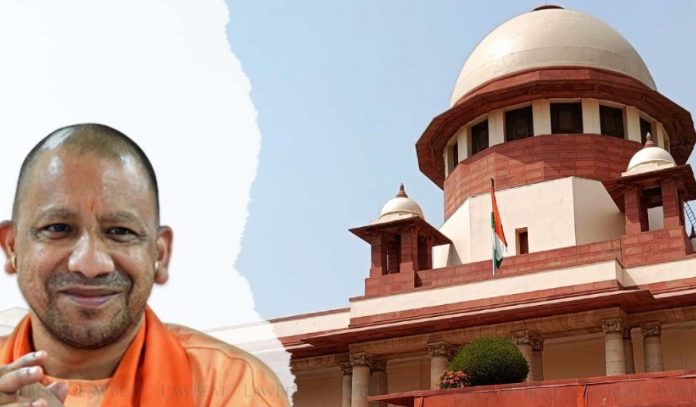
The Supreme Court on Friday upheld the then Uttar Pradesh government’s refusal to grant sanction to prosecute then-Parliamentarian Yogi Adityanath for a ‘hate-speech’ case allegedly delivered by him in Gorakhpur in 2007.
While delivering the verdict, the bench led by outgoing Chief Justice of India NV Ramana stated, “In view of the above circumstances, we do not think it is necessary to go into the legal questions relating to grant of sanction. Consequently, the appeal is dismissed. The question of law is left open.”
The bench of CJI NV Ramana, Justices Hima Kohli and CT Ravikumar was hearing a petition filed by Parvez Parwaz challenging the denial of sanction to prosecute Chief Minister Yogi Adityanath for alleged role in the 2007 Gorakhpur riots while challenging an Allahabad High Court order upholding it.
The matter
The matter dates back to 2007 when Yogi Adityanath, a Lok Sabha MP from Gorakhpur was arrested on the charges of disturbing the peace and violating prohibitory orders. This was prompted after he along with his supporters gathered to mourn a man’s death during communal clashes.
In November 2008, almost a year later, an FIR was lodged which alleged that Yogi and others had incited communal riots in 2007 via their hate speeches. The CID completed the investigation in 2015 and sought sanction for prosecution.
In 2017, the UP government refused to grant a sanction to prosecute, citing a draft investigation report filed by the police’s CB-CID as evidence that there was insufficient evidence to proceed with a trial against Yogi Adityanath. The government observed that video evidence submitted by the complainant against Adityanath and four others, which was sent to the Central Forensic Science Laboratory in October 2014 was tampered with.
A petition was filed in the Allahabad High court by Parvez Parwaz and Asad Hayat (a supposed witness in the matter) challenging the UP government’s decision not to grant sanction. These petitioners asked the High Court to direct an independent agency to carry out an investigation into this matter, which was rejected by the Allahabad High Court in February 2018.
Following the court’s verdict, Parvez Parwaz approached the Supreme Court. Later that year, the Supreme Court issued a notice to the Uttar Pradesh government in response to the Allahabad High Court’s order.


