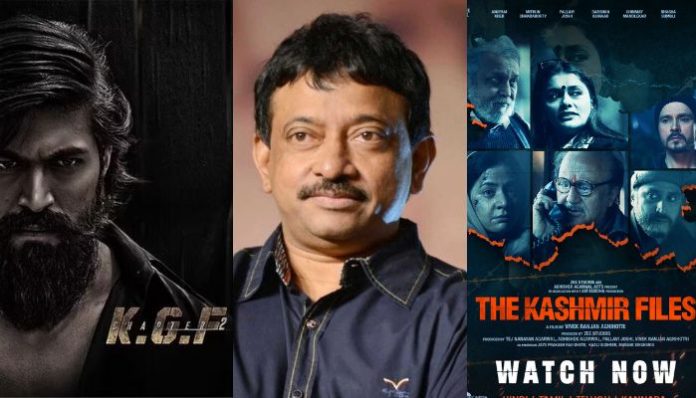
Controversial filmmaker Ram Gopal Varma has once again stirred the hornet’s nest through his critical remarks on major box office hits like ‘The Kashmir Files’ and ‘KGF- Chapter 2’.
In an interview with Bollywood Hungama, Ram Gopal Varma said, “Two films that have f**ked up everything are KGF – Chapter 2 and The Kashmir Files…The scary part of KGF – Chapter 2 is that nobody in Bollywood liked it.”
Varma claimed that a big Bollywood director told him that he could not watch ‘KGF- Chapter 2’ beyond 30 minutes, despite 5 attempts. He described the movie as an old 70s-era film, a concept that he believed was outdated.
He added, “It’s not like I didn’t like the film. I can’t get the right word. I would say, I was flummoxed. I was watching with my mouth open. Like, ‘F**k, what?”
“The so-called filmmakers look for logic. And when a logic-less film like KGF – Chapter 2 breaks all records, what the f**k do you do then?” Ram Gopal Varma added.
The controversial filmmaker also made similar unsavoury comments about ‘The Kashmir Files’ and its director Vivek Agnihotri.
He remarked, “The Kashmir Files is no less. It’s made by an unknown director whom Bollywood never took seriously. Anupam Kher was the most known actor in the film. Yet, it ended up making Rs. 250 crores domestically.”
Ram Gopal Varma said, “The Kashmir Files was the slowest film ever made. It goes against whatever we, as filmmakers, learnt what not to be made. There’s no screenplay, no first or second act, no interval and no climax. And people are going gaga over it!”
“I don’t think that in the last 20 years, anybody would have seen a film more seriously than they saw The Kashmir Files,” he concluded.
The Kashmir Files made a mark despite the propaganda
The film ‘The Kashmir Files’ takes the viewers back to 1989, when due to rising Islamic Jihad, a huge conflict erupted in Kashmir, forcing the great majority of Hindus to flee the valley.
Most of the Kashmiri Hindu inhabitants migrated between February and March 1990 in the face of Islamic Jihad. More of them fled in the years that followed until just about 3,000 families remained in the valley by 2011.
The movie which was released on March 11, this year proved to be the biggest hit of the year. Though the film was praised all over the world, a section of Indian opposition parties and leftists tried to run down the film or discredit the story shown within.
While some directly called the film a pack of lies, others tried to target the BJP over the issue. Multiple theories were also peddled to discredit the film and its makers, but the public verdict muted all the criticism.