

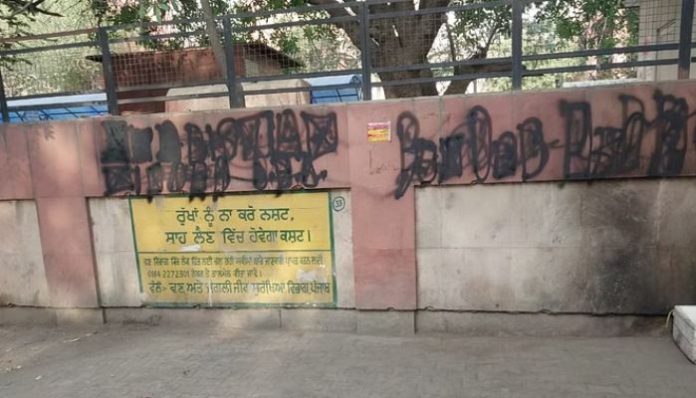
The walls of several government offices in a high-security zone in Punjab’s Bathinda were defaced with pro-Khalistani graffiti on Saturday morning (27th April). The Pro-Khalistani graffiti was found written on the walls of Bathinda’s mini secretariat complex, which is a high-security zone. It is pertinent to note that the secretariat is less than 100 yards away from the residence of the Additional Director General of Police (ADGP) and it is a few yards away from the SSP’s office.
Unidentified Khalistani miscreants had spray painted Pro-Khalistani slogans outside the walls of the office of the Deputy Commissioner, a women’s police station, a post office, and the court premises. Following the incident, the state administration rushed to the spot and removed the graffiti from the walls of these government and administration offices. They have launched an investigation into the matter and are analysing all the nearby CCTVs to apprehend the perpetrators.
Khalistani Graffiti Painted Outside Bathinda's DC Office
— TIMES NOW (@TimesNow) April 27, 2024
The pro-Khalistan group Sikh for Justice (SFJ) has claimed responsibility for the Khalistani graffiti found outside the DC office in Bathinda, Punjab. The messages were painted on the walls of the DC office, Women's Police… pic.twitter.com/AZA3vWbX0G
As per reports, the miscreants had written that there should not be any political party in Punjab, neither BJP, SAD, nor Congress. Additionally, the banned Khalistan organisation Sikh for Justice (SFJ) has claimed responsibility for the act. Reportedly, SFJ terrorist Gurpatwant Pannun has released a video to claim responsibility for the act.
Several incidents have taken place since last year where miscreants defaced public walls and pillars with pro-Khalistan graffiti. These incidents were reported across several States including Haryana, Punjab, Rajasthan, Himachal Pradesh, and Delhi.
Last year, miscreants spray painted pro-Khalistan slogans on the walls of five metro stations in Delhi. Back then, slogans like ‘Delhi will become Khalistan’ and ‘Khalistan Referendum Zindabad’ were found on walls of Punjabi Bagh, Shivaji Park, Madipur, Paschim Vihar, Udyog Nagar, Maharaja Surajmal Stadium, and Nangloi metro stations. The development came at a time when India was hosting the G20 summit across several states in the country.
Later, the Delhi Police arrested two members of the banned Khalistani terror outfit led by Gurpatwant Singh Pannun, Sikhs For Justice (SFJ), from Punjab in connection with the incident. One of the arrested accused in this case was identified as Preetpal, who was arrested on 31st August, last year.


