

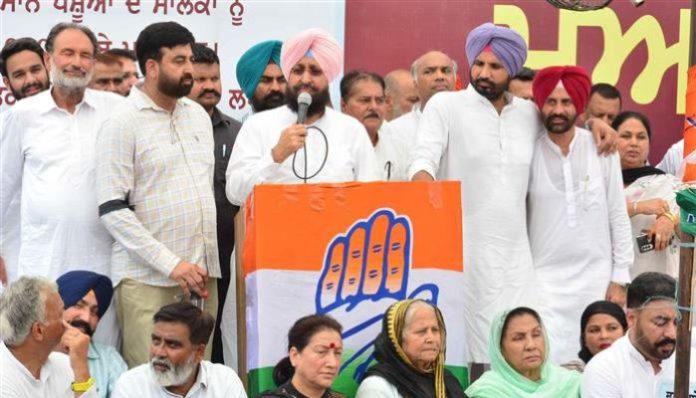
Partap Singh Bajwa, the Leader of the Opposition in Punjab, has affirmed that the Congress party is set to independently contest all 13 Lok Sabha seats in the forthcoming Lok Sabha elections. Notably, Bajwa highlighted that there won’t be any collaboration with the ruling Aam Aadmi Party (AAP). Interestingly, Bajwa’s statement comes amid the joint efforts by both parties to counter the ruling BJP and its NDA coalition in the Parliament. It is worth mentioning that Congress and AAP are two constituents of the newly formed opposition alliance named I.N.D.I.A.
Speaking at a gathering in Patiala, where protests were underway to demand compensation for farmers affected by floods, Bajwa stated that the Congress’ collaboration with the AAP at the national level, in opposition to the BJP, was confined to offering support on matters concerning governors and lieutenant governors across different states.
In the face of resistance from multiple state units, particularly the Punjab and Delhi Congress factions, the Congress made a strategic choice to back the AAP on the matter of the Delhi Service Bill on a national scale. This decision was aimed at preventing a division within the unity of the opposition. Nevertheless, Bajwa’s declaration underscores the existence of underlying dissatisfaction within the grassroots ranks among the various parties within the I.N.D.I.A. coalition.
Earlier, a war of words had erupted between Congress leader Sandeep Dikshit and AAP leaders over the support to the Delhi ordinance bill in the parliament. While AAP minister Saurabh Bhardwaj had dismissed Sandeep Dikshit’s comments on the issue as insignificant, Dikshit had said the same about AAP MP Sushil Gupta.
While the opposition coalition advocates the concept of one seat, one candidate on the national stage and endeavours to establish a comprehensive nationwide alliance, the reality in the states portrays a contrasting picture. Within these states, the very same parties find themselves engaged in intra-alliance conflicts and disagreements.
This week, the Congress extended its support to the Aam Aadmi Party by voicing opposition to the Delhi Service Bill during parliamentary proceedings. Despite these efforts, the bill successfully secured passage in Parliament. The disagreement between the Congress and AAP in Punjab represents the second instance of friction within the I.N.D.I.A. coalition. The first instance arose when the CPM declared its unwavering stance of not making any concessions to the TMC in West Bengal.


