

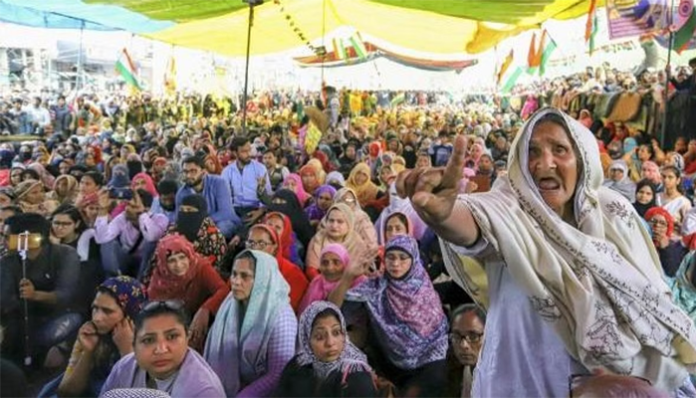
On 11th March, the Government of India notified the Rules for Citizenship (Amendment) Act, 2019 (CAA). The rules opened the way for Hindu, Sikh, Parsi, Jain, Christian and Buddhist immigrants from Afghanistan, Pakistan and Bangladesh who faced religious persecution in the specified countries. Though CAA has nothing to do with the Muslims in India, and it would not affect or snatch away their citizenship, an atmosphere of fear has been created once again among the Muslim population in the country. Media has started fanning the same narration that the Muslims are fearful of their future while covering Shaheen Bagh as they did in 2019, which led to the anti-Hindu riots of 2020 in Delhi.
‘No humgama in Ramzan but hum kagaz nahi dikhayenge’
Times of India’s report suggested that the residents of Shaheen Bagh did not protest because of Ramzan. They quoted a Shaheen Bagh resident questioning the presence of a heavy police force in the area. She said, “Why are there so many police personnel? Are they afraid of Shaheen Bagh? It is the month of Ramzan, so there are no protests, but we will not show papers”. After four years, the resident was still not ready to believe no one was asking for her papers. CAA has nothing to do with Indian Muslims. However, the media conveniently ran the narrative.
A 68-year-old shopkeeper said, “Why Muslims are precluded from the decisions on this law is a question that will remain unanswered. Implementing CAA is a tactic to divide and rule and polarise voters ahead of the Lok Sabha elections. Not surprisingly, police have been patrolling here since Monday night.”
Another resident claimed they have only two choices: accept or get beaten up. “There is no choice for us,” he asserted. He further contended that the constitutional values of secularism were at stake. It is unclear how constitutional values of secularism would be at stake when no Indian would get affected by CAA. India already gives citizenship to asylum seekers after due process, irrespective of religion. After CAA, Muslims from any country can still apply for Indian Citizenship if they meet the criteria. The only thing that CAA has done is to simplify the process for the persecuted minorities in three neighbouring countries who have already been living in India.
The New Indian Express quoted a person named Yusuf, who claimed that there was “fear and uncertainty among Muslims”. Another person from Shaheen Bagh said, “We refuse to comply with this directive,” and asserted that they would not comply with the central government’s directive. However, it has to be noted and communicated to the Muslim citizens of India that CAA is not going to affect them. The fearmongering and unnecessary doubt that has prevailed in the minds of Muslims need to be dealt with with accurate information.
‘If not Ramzan, we would have protested.’
Telegraph, in its report, claimed that the residents believe CAA’s implementation would “adversely impact the Muslim population”. How? They did not explain. They quote a resident saying, “Ramadan has started, so most of the residents in the area are busy with preparations. But in our hearts, we feel anger and anguish that our struggle (anti-CAA protests during 2019-20) has gone wasted. If it were not for Ramadan, we would have protested again.” Another resident, Huzaifa, said, “We are angry with this decision. The Centre is using its power to target Muslims. We will not accept this order. It is only for the safety of our families that we are quiet.”
The Print quoted a resident, Hina Ahmed, saying, “We gathered together in 2019 to express our concerns to the government. But they didn’t listen to us. We don’t intend to protest if this government doesn’t listen.”
No protests, more awareness among residents of Shaheen Bagh
Hindustan Times, however, showed a different side of Shaheen Bagh. In its report, the newspaper noted that Shaheen Bagh was “calm but tense” after the rules were notified. Why? Nobody knows. Notably, multiple Delhi police teams and the Rapid Action Force (RAF) were deployed in Shaheen Bagh to maintain law and order in case a protest broke down after the notification by the GoI over CAA Rules. However, nobody came out to protest. Residents told Hindustan Times that rules would not impact Indian Muslims and there was nothing to worry about.
Fearmongering and misinformation around CAA have deeply entrenched apprehensions among the Muslim community in India. Despite the government’s efforts to communicate that CAA is not going to impact Indian Muslims in any way, there is unrest among a large portion of them. This unnecessary fear can largely be attributed to the opposition parties, left-liberals and propagandists who have been instrumental in establishing the narrative against CAA. They propagated that CAA is a threat to the Muslim population.
These entities have repeatedly highlighted imaginary implications of the Act, which led to a widespread belief among the Muslim population that their rights and citizenship are at stake. The misleading narrative has contributed to communal tension and unrest across the country, leading to anti-Hindu riots in Delhi in 2020. The misrepresentation by the media, particularly around the Muslims of Shaheen Bagh, has added fuel to the fire of fear and resistance among the community. Despite repeated clarification from the central government, the Muslim community has failed to understand the law and continued to believe who used it for their vested agendas.


