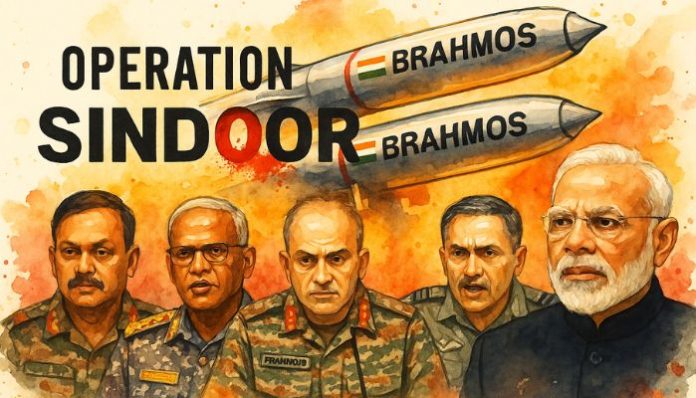
In the early hours of 10th May, the Indian Air Force (IAF) launched precision strikes on 11 airbases in Pakistan, including three critical Pakistani airbases, that are Jacobabad, Chaklala (Rawalpindi), and Sargodha under Operation Sindoor. The attack sent shockwaves within the military command of Pakistan.
Notably, these three airbases play a critical role in the operation, maintenance, and deployment of F-16 jets that have been supplied to Pakistan by the United States. Furthermore, these locations also house essential infrastructure, including training facilities and ammunition stockpiles.
The strike at Chaklala was of particular significance, as it not only serves as a transport hub but also hosts Pakistan’s air-refuelling assets, which help extend the range of fighter jets. The base is home to Pakistan’s main transport squadrons and vital for logistical and strategic airlift operations, housing aircraft like C-130 Hercules and IL-78 mid-air refuelers.
Major damage to these airbases can paralyze Pakistan Air Force, and make a number of their key assets useless. Chaklala is also in close proximity to the Strategic Plans Division of Pakistan, which oversees the country’s nuclear arsenal. The attack, thus, spooked Islamabad and prompted it to seek intervention from the US.
General Munir turns to Washington for help
Officials described the attack as the largest Indian military strike since 1971. Pakistan Army Chief General Asim Munir rushed to US Secretary of State Marco Rubio, requesting American intervention to de-escalate the spiralling tensions with India.
At Pakistan’s request, Rubio urged both nations to initiate dialogue and spoke to the External Affairs Minister, Dr S. Jaishankar, on the matter. The US also offered to mediate and help reduce further conflict between India and its hostile neighbour.
Soon after, Pakistan’s Director General of Military Operations, Maj Gen Kashif Abdullah, called his Indian counterpart, Lt Gen Rajiv Ghai, and proposed a pause in hostilities. Indian officials saw this as a direct outcome of the successful neutralisation of Pakistan’s air defences and infrastructure.
Air superiority altered regional military balance
India targeted a total of 11 Pakistani airbases and two radar sites. Such a massive attack, in such a short span, created a “new normal” in military parity. Pakistan’s inability to respond stemmed from its collapsed air defence systems and outdated military preparedness compared to the advanced capabilities of the Indian Armed Forces.
India’s strikes also highlighted the widening technological gap between the two nations. Indian officials stated that Pakistan’s admission of inferiority led to its desperate appeal for help from the US. India’s military power projection on 10th May has redrawn strategic calculations in the Indian subcontinent.
Though US President Donald Trump has repeatedly claimed that his intervention led to the ceasefire between India and Pakistan, India has categorically denied the role of any third party in the decision to de-escalate. Trump also claimed he used trade as a “weapon” to push both countries to agree to ceasefire, which India denied as well. Furthermore, Indian Armed Forces and Defence Minister Rajnath Singh have clearly stated that the arrangement should not be seen as a ceasefire, but as an understanding. India will continue to assess how Pakistan behaves in the coming days and will act accordingly. Operation Sindoor, according to India, continues.
India pushes for UN action against TRF
While Pakistan is struggling to cover up the damage caused by India, New Delhi has intensified its diplomatic campaign to seek terror designation for The Resistance Front (TRF), an offshoot of Lashkar-e-Taiba, at the UN Security Council. TRF had claimed responsibility for the 22nd April Pahalgam terrorist attack. A dossier implicating Pakistan’s role in the incident has been submitted, though Islamabad, with China’s backing, continues shielding TRF at the UNSC.