

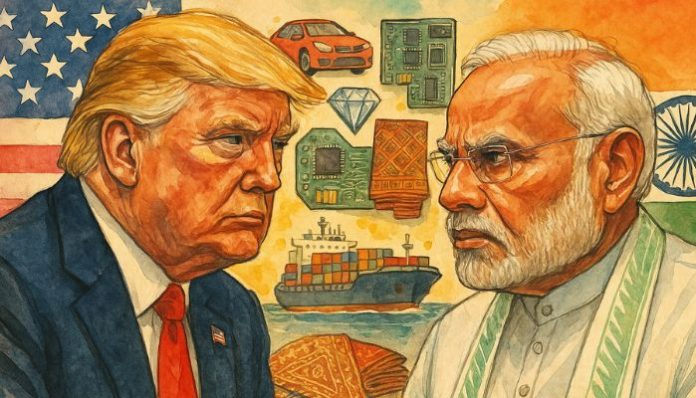
On 30th July, President of the United States, Donald Trump, announced a 25% tariff on imports from India, which will come into effect on 1st August 2025. In a statement on the social media platform Truth Social, he added that the tariff would be coupled with an unspecified penalty tied to India’s defence and energy imports from Russia.
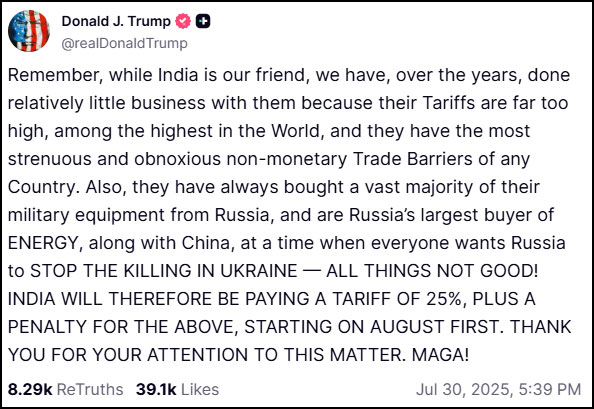
Trump accused India of imposing “among the highest tariffs in the world” and maintained “the most strenuous and obnoxious non-monetary trade barriers” despite being declared “a friend” of the US. He also stated that India “has always bought a vast majority of their military equipment from Russia” and remains “Russia’s largest buyer of energy, along with China”.
Notably, the tariff announcement came just ahead of 25th August, when US trade representatives are set to visit New Delhi for the next round of negotiations on a bilateral trade agreement. According to reports, White House adviser Kevin Hassett said that Trump has been “frustrated with the progress of trade talks with India and believed the 25% tariff announcement would help the situation”.
What these tariffs entail and who bears the cost
According to US trade practice, tariff revenues benefit the federal government. However, the economic burden is carried by American importers, who pass higher costs to consumers or absorb reduced profits. While Indian exporters do not directly pay these duties, the tariffs diminish the competitiveness of their goods in the US market.
The 25% tariff applies to a wide range of sectors, including textiles, smartphones, marine products, gems and jewellery, automotive components, steel, electronics, marine products, processed foods, tea and dairy. Notably, pharmaceuticals, semiconductors and critical minerals are temporarily exempt.
In April 2025, a baseline tariff of 10% was introduced by the Trump administration. It is unclear if the 25% rate will replace it or is cumulative. The 25% rate places India above the 20% imposed on Vietnam and 19% on Indonesia, though lower than the tariff proposed for Bangladesh (35%) and Thailand (36%). White House documents had initially floated a potential 26% reciprocal tariff on India earlier this year.
Scale of US-India trade and impact on India’s GDP
In 2024, US imports from India totalled around US $87.4 billion. On the other hand, US exports to India stood near US $41.8 billion. This resulted in a trade deficit of around US $45.7 billion. It means total bilateral goods trade amounted to roughly US $129 billion. Although India’s trade with the US represents only 1% to 2% of India’s GDP, economists have warned that the tariffs could shave 0.2% to 0.5% points off GDP growth, which may reach 0.7% under harsher penalty scenarios. Rating agency ICRA has already downgraded its GDP forecast to 6.2% for FY2026, citing possible weak exports and deferred capital expenditure.
Penalty linked to Russian imports reflects geopolitical strategy
For the first time, the US has announced a secondary penalty tied to a country’s external relations, in this case, India’s purchases of Russian crude oil and military hardware. Trump’s Truth Social post placed heavy emphasis on India being a leading buyer of Russian energy and equipment. Western powers, including the US, have attempted to stop India from buying oil from Russia for years since the Russia–Ukraine war broke out. However, India has stood firm and placed the interests of Indians first while deciding where to buy oil from.
Notably, India’s dependency on Russian crude has increased from less than 1% before the 2022 invasion to 35% to 40% by mid-2025. Russia is now India’s primary oil supplier. In contrast, US goods imports from Russia remain marginal. In 2024, the US imported $3 billion worth of Russian goods, a 34% year-on-year fall, and roughly $2.3 billion during January to May 2025.
While small in volume, US imports from Russia include palladium and enriched uranium. Both of these commodities are critical for industrial and nuclear sectors. These strategic elements underpin Washington’s framing of the penalty.
Sector-specific consequences and market reaction
Labour-intensive sectors including textiles, gems and jewellery, particularly from Rajasthan and Gujarat, and electronics and auto components are most vulnerable. MSMEs from Tamil Nadu, Maharashtra and Karnataka may face a decline in orders or have to renegotiate contracts at a lower price. However, industry groups have urged exporters to remain calm and stated that the tariff might be a negotiating tactic and that the final rates would likely be adjusted after the sixth round of trade talks in August.
India’s broader economic resilience and negotiation posture
Despite pressure, India’s economy remains fundamentally anchored in domestic consumption. Around 70% of GDP is driven by internal demand, which provides resilience to external shocks. Indian government policies have focused on tax incentives, capital expenditure, and interest rate relief to sustain growth. Furthermore, India’s external reserves are robust and the rupee has remained relatively stable, which has insulated the Indian economy.
Following the announcement by Trump, New Delhi has reiterated its commitment to securing a “fair, balanced and mutually beneficial” trade deal. The Government of India has emphasised its duty to protect livelihoods, especially for farmers, micro and small businesses, and to preserve policy autonomy, as seen in its negotiations with the UK on the Comprehensive Economic and Trade Agreement.
Geopolitical backdrop and strategic calculation
The tariff and penalty should be seen as a calibrated negotiating gambit by the US, linking commerce and diplomacy to put pressure on India to reduce tariffs on sectors including agriculture, dairy, digital services and intellectual property. Not to forget, India has already rattled the US by refusing to allow “non-veg” milk in the Indian market.
The current proposed 25% tariff on imports from India is significant and ranks above rates agreed with ASEAN countries. The move has come amid broader US efforts to diversify supply chains and reduce reliance on China. Interestingly, Trump is also pushing US-based companies to set up their manufacturing in the US rather than in countries like China or India, where labour costs are low.
There is visible friction between India and the US, especially following the recent announcement. However, India is restraining itself from making any sudden moves and is calculating the impact of the tariff announced by Trump. Furthermore, despite the recent developments, both sides appear to retain interest in continuing negotiations. India and the US have shared interests in defence, climate, technology and Indo-Pacific strategy, and their engagements go beyond tariffs.
Conclusion
President Trump’s decision to impose a 25% tariff and a Russia-linked penalty shows that the US is trying to use trade as leverage to push its geopolitical objectives. While bilateral goods trade between India and the US represents only 2% of India’s GDP, there will be some impact on sectors including textiles, jewellery, electronics and automobiles. MSMEs and export hubs may face some notable disruptions, but these can be controlled by exploring other international markets.
India has a large internal market. Its policies offer strength in resisting external economic blowbacks. Domestic resilience, along with ongoing negotiations, means the worst-case macroeconomic effect may be limited. However, the firm-level strain in export-reliant industries is unavoidable unless exemptions or rollbacks emerge.


