

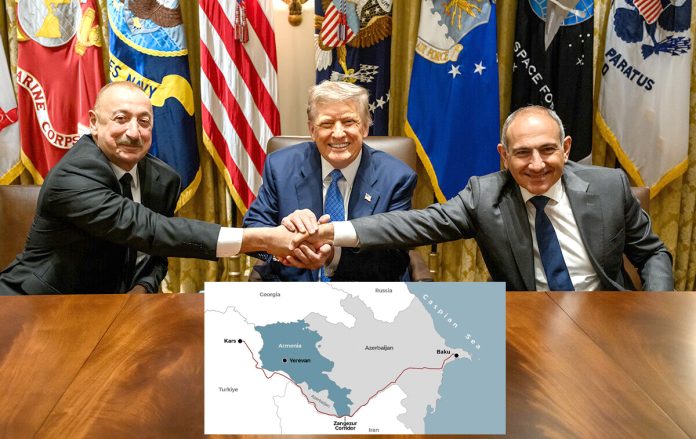
Iran has sharply opposed a newly announced US-brokered peace accord between Armenia and Azerbaijan, declaring it will block a planned transport corridor running through the Caucasus. The project, unveiled at the White House and named the Trump Route for International Peace and Prosperity (TRIPP), has been described by Tehran as a direct threat to Armenia’s sovereignty and regional balance.
Iran’s strong warning
Ali Akbar Velayati, senior adviser to Iran’s supreme leader, said the passage would be obstructed “with or without Russia” and denounced it as “political treachery.” Speaking to state-affiliated Tasnim News, he accused Washington of treating the Caucasus “as a piece of real estate” and warned that the route would not become a gateway for American influence but “their graveyard.”
The corridor is set to pass close to Iran’s border, linking Azerbaijan to its Nakhchivan enclave under Armenian law but with exclusive US development rights. Velayati argued this would allow NATO to position itself “like a viper” between Iran and Russia.
Regional reactions
Iran’s foreign ministry stressed that while it welcomed peace initiatives, projects near its borders must respect sovereignty and avoid “foreign interference.” Russia also welcomed the deal cautiously, supporting stability but warning against external involvement. Moscow invoked the “unfortunate experience” of Western-led interventions in the Middle East as a cautionary tale.
Turkey, by contrast, hailed the agreement as a chance to enhance regional connectivity. President Recep Tayyip Erdogan, in talks with Azerbaijani President Ilham Aliyev, voiced Ankara’s support. Foreign Minister Hakan Fidan described the route as a vital bridge linking Europe to Asia via Turkey.
Prospects for a final peace
The deal is being seen as a roadmap to end decades of hostility between Armenia and Azerbaijan, who have fought repeatedly over Nagorno-Karabakh since the late 1980s. Last year, Armenia ceded several villages to Azerbaijan in what Baku celebrated as a historic step.
Ahmad Shahidov of the Azerbaijan Institute for Democracy and Human Rights told Al Jazeera that a final peace declaration is expected in the coming weeks, with no outstanding territorial disputes left between the two neighbours.
The corridor, however, risks becoming the latest fault line in a region where the interests of Washington, Moscow, Tehran and Ankara intersect uneasily.


